Month: March 2021

04 Mar 2021

Daily Crunch: Square acquires Tidal

Square buys a majority stake in Jay-Z’s Tidal, WhatsApp improves its desktop app and Hopin raises even more funding. This is your Daily Crunch for March 4, 2021.

The big story: Square acquires Tidal

Square announced this morning that it has purchased a majority stake in Tidal, the music streaming service founded by Jay-Z. It sounds like an odd fit at first, which Square CEO Jack Dorsey acknowledged in a tweet asking, “Why would a music streaming company and a financial services company join forces?!”

His answer: “It comes down to a simple idea: finding new ways for artists to support their work. New ideas are found at the intersections, and we believe there’s a compelling one between music and the economy. Making the economy work for artists is similar to what Square has done for sellers.”

Square is paying $297 million in cash and stock for the deal, which will result in Jay-Z joining Square’s board.

The tech giants

WhatsApp adds voice and video calling to desktop app — This should provide relief to countless people sitting in front of computers who have had to reach for their phone every time WhatsApp rang.

Apple’s App Store is now also under antitrust scrutiny in the UK — The U.K.’s Competition and Markets Authority announced that it’s opened an investigation following a number of complaints from developers alleging unfair terms.

Google speeds up its release cycle for Chrome — Mozilla also moved to a four-week cycle for Firefox last year.

Startups, funding and venture capital

Hopin confirms $400M raise at $5.65B valuation — For Hopin, the round is another rapid-fire funding event.

Coursera is planning to file to go public tomorrow — The company has been talking to underwriters since last year, but tomorrow could mark its first legal step in the process to IPO.

Luxury air travel startup Aero raises $20M — The startup describes its offering as “semi-private” air travel.

Advice and analysis from Extra Crunch

As activist investors loom, what’s next for Box? — A company with plenty of potential is mired in slowing growth.

Unraveling ThredUp’s IPO filing: Slow growth, but a shifting business model — ThredUp is a used-goods marketplace approaching the public markets in the wake of Poshmark’s own strong debut.

(Extra Crunch is our membership program, which helps founders and startup teams get ahead. You can sign up here.)

Everything else

SITA says its airline passenger system was hit by a data breach — Global air transport data giant SITA has confirmed a data breach involving passenger data.

How to successfully dance the creator-brand tango — What makes creators succeed, and how should brands work with them?

Announcing the Early Stage Pitch-Off Judges — On April 2, TechCrunch will feature 10 top startups across the globe at the Early Stage Pitch Off.

The Daily Crunch is TechCrunch’s roundup of our biggest and most important stories. If you’d like to get this delivered to your inbox every day at around 3pm Pacific, you can subscribe here.

04 Mar 2021

Making sense of the $6.5B Okta-Auth0 deal

When Okta announced that it was acquiring Auth0 yesterday for $6.5 billion, the deal raised eyebrows. After all, it’s a substantial amount of money for one identity and access management (IAM) company to pay to buy another, similar entity. But the deal ultimately brings together two companies that come at identity from different sides of the market — and as such could be the beginning of a beautiful identity friendship.

The deal ultimately brings together two companies that come at identity from different sides of the market — and as such could be the beginning of a beautiful identity friendship.

On a simple level, Okta delivers identity and access management (IAM) to companies who use the service to provide single-sign-on access for employees to a variety of cloud services — think Gmail, Salesforce, Slack and Workday.

Meanwhile, Auth0 is a developer tool providing coders with easy API access to single-sign-on functionality. With just a couple of lines of code, the developer can deliver IAM tooling without having to build it themselves. It’s a similar value proposition to what Twilio offers for communications or Stripe for payments.

The thing about IAM is that it’s not exciting, but it is essential. That could explain why such a large number of dollars are exchanging hands. As Auth0 co-founder and CEO Eugenio Pace told TechCrunch’s Zack Whittacker in 2019, “Nobody cares about authentication, but everybody needs it.”

Putting the two companies together generates a fairly comprehensive approach to IAM covering back end to front end. We’re going to look at why this deal matters from an identity market perspective, and if it was worth the substantial price Okta paid to get Auth0.

Halt! Who goes there?

When you think about identity and access management, it’s about making sure you are who you say you are, and that you have the right to enter and access a set of applications. That’s why it’s a key part of any company’s security strategy.

Gartner found that IAM was a $12 billion business last year with projected growth to over $13.5 billion in 2021. To give you a sense of where Okta and Auth0 fit, Okta just closed FY2021 with over $800 million in revenue. Meanwhile Auth0 is projected to close this year with $200 million in annual recurring revenue.

Identity and access management market numbers from Gartner.

Image Credits: Gartner

Among the top players in this market according to Gartner’s November 2020 Magic Quadrant market analysis are Ping Identity, Microsoft and Okta in that order. Meanwhile Gartner listed Auth0 as a key challenger in their market grid.

Michael Kelly, a Gartner analyst, told TechCrunch that Okta and Auth0 are both gaining something from the deal.

“For Okta, while they have a very good product, they have marketing muscle and adoption rates that are not available to smaller vendors like Auth0. When having [IAM] conversations with clients, Okta is almost always on the short list. Auth0 will immediately benefit from being associated with the larger Okta brand, and Okta will likewise now have credibility in the deals that involve a heavy developer focused buyer,” Kelly told me.

Okta co-founder and CEO Todd McKinnon said he was enthusiastic about the deal precisely because of the complementary nature of the two companies’ approaches to identity. “How a developer interacts with the service, and the flexibility they need is different from how the CIO wants to work with [identity]. So by giving customers this choice and support, it’s really compelling,” McKinnon explained.

04 Mar 2021

Data is the world’s most valuable (and vulnerable) resource

There’s no overstating it: 2020 was a hell of a year. When future generations learn about 2020, the pandemic, social tension and political unrest will take up most of the oxygen. But for those learning about the history of cybersecurity, 2020 and a midsize company from Austin, Texas — SolarWinds — will take center stage.

Malicious code in one update of a trusted software provider was the Trojan horse that enabled access to petabytes of private data across 18,000 organizations, including Fortune 500s and government entities.

Every business leader must acknowledge what many in cybersecurity have been saying — cyber strategy is company strategy.

Why will SolarWinds be so generationally important, and why am I talking about it? Because the large (and growing) impact of the hack and the substantial (and mounting) losses mean that every business leader must acknowledge what many in cybersecurity have been saying — cyber strategy is company strategy. It is not an audit, but an important part of C-suite strategies and best practices ranging from employee onboarding to mundane everyday coding.

I believe generational startups will be created from this reckoning with cybersecurity, just as they’ve been created coming out of market disruptions in the past. I’ve been thinking about this for a while, but it is more clear than ever that we will see cyber go on a tear this next decade.

Forecasts suggest $100 billion of new market value by 2025 alone, putting total market size at close to $280 billion, but I think this figure is conservative. Cyber is — and will be — a massive business.

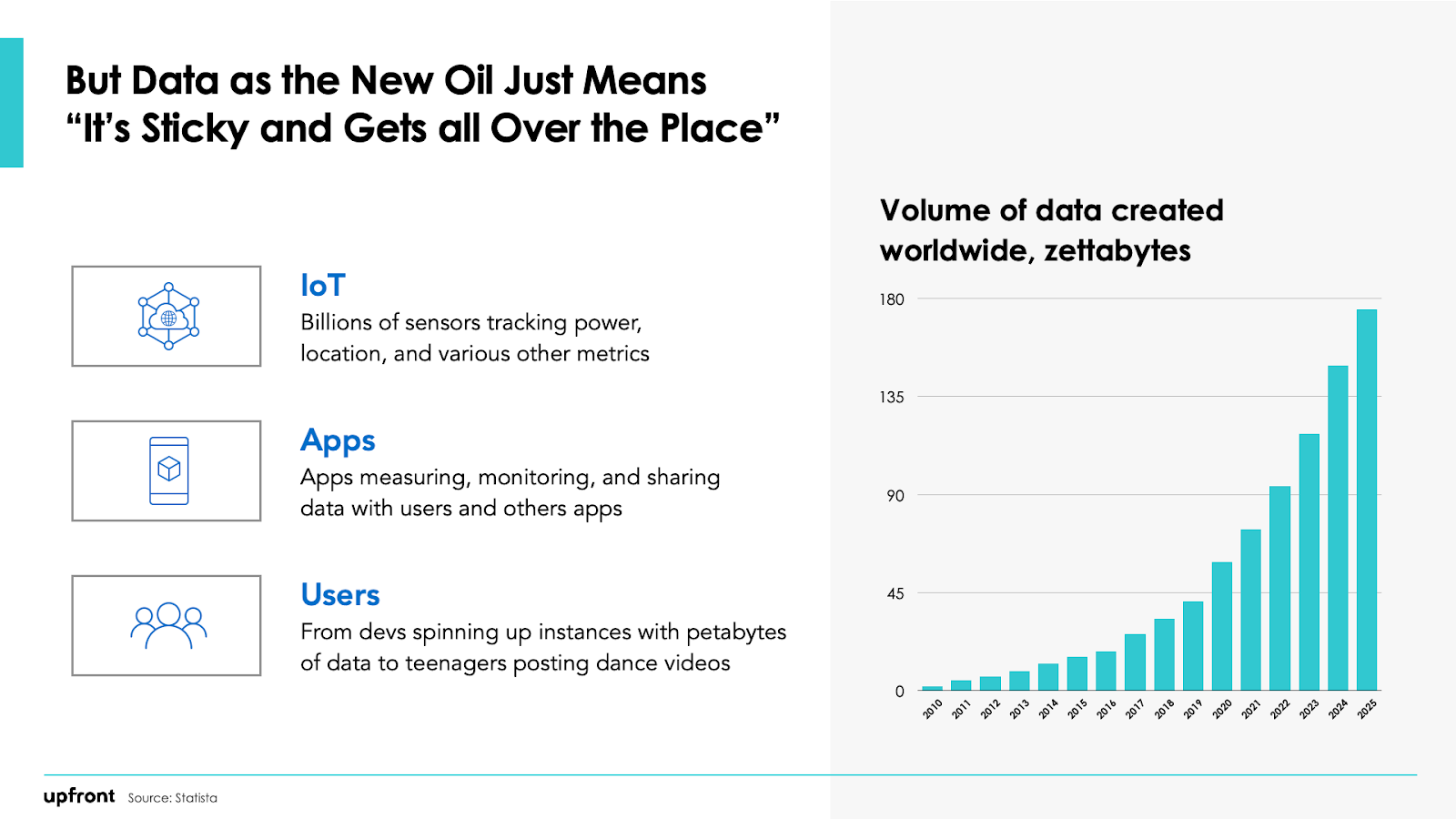
One key driver of growth in the cyber market is really easy to understand, but really hard to solve for: data. Cyber is often a second-order value proposition, after speed of development, managing IT assets or data. We’re familiar with the idea that “data is the new oil.” Since that phrase was coined by mathematician Clive Humby 15 years ago, the total amount of data in the world has increased 74x.

By 2025, IDC forecasts the data universe will consist of 175 zettabytes. In case you don’t know, one zettabyte is 1 trillion gigabytes. If you were to download 175 zettabytes of data on your computer, it would take you 1.8 billion years. Mind-boggling!

And it only increases exponentially from here. From likes, posts, profile views, follows and RTs for end consumers to time on site, conversion rate and bounce rate for websites to events, errors and anomaly tracking in IoT — all of this data is logged and tracked. We’ve seen billion-dollar companies built, taken public and acquired that ingest and visualize all of the data we capture.

The next generation of API startups is valuable proportionally to their ability to “talk” with apps in the ecosystem by sharing and ingesting data.

Image Credits: Upfront Ventures

04 Mar 2021

Asynchronous video startup Weet just launched to cement bonds, and know-how, within companies

For founder Najette Fellache, coming to the Bay Area a few years ago from Nantes, France was a way to grow a company she’d founded and which was already was beginning to count major U.S. corporations like GE, Tesla, Amazon, and Medtronics as customers.

What that six-year-old outfit, Speach, sells is essentially knowledge sharing between colleagues via videos produced by the employees themselves, often to augment written instructions. The idea is to maximize learning, fast, and investors liked the idea enough to provide Speach with $14 million in funding.

But while the technology has only become more relevant in a world shut down by COVID-19, an internal project within the company began to interest Fellache even more after her children abruptly began attending school remotely from home. As she tells it, her aha moment came in the form of a drawing from her youngest son, who struggled to understand why his mother’s meetings kept taking precedent over him.

Like many parents trying to figure out how to balance work and family over the last year, Fellache wasn’t immediately sure of how to parent around the clock while also leading a company. Unlike a lot of parents, she had access to engineers who could put create a technology that enabled her, along with other members of Speach’s team, to create short videos that could quickly communicate important information and be viewed at the recipient’s convenience — as well as saved for future reference.

In fact, as sometimes happens with internal projects, the technology worked so well for Speach that it has since taken on a life of its own. Indeed, using a bit of that earlier funding from Speach — its backers are Red River West, a Franco-American fund co-managed by Artémis, the investment company of the Pinault family, and the early-stage firm Alven — Fellache and a team of 10 employees this week launched Weet, a new asynchronous video startup.

It’s entering into a crowded field. Fellache is hardly alone in recognizing the power of asynchronous meetings as an attractive alternative to phone calls, real-time meetings, and even email, where tone is lost and content can be misconstrued. Loom, for example, a six-year-old enterprise collaboration video messaging service that enables users to send short clips of themselves, has already raised at least $73 million from investors, including Sequoia Capital, Kleiner Perkins, and Coatue.

Another, newer entrant is SuperNormal, a year-old, Stockholm, Sweden-based work communication platform that employs video and screen recording tools to help teams create and send asynchronous video updates throughout the day and which raised $2 million in seed funding led by EQT Ventures in December.

Still, if you believe that the future of work is remote, it’s clear that the opportunity here is a big one. Further, Weet —  which is accessible for free via a browser extension and whose integrations with both Slack and Microsoft Teams are scheduled to go live next month — is fast becoming a better product than some of what’s available in the market already, argues Fellache.

Weet already features instant recording, screen sharing, virtual backgrounds, video filters, emoji reactions, commenting options, and auto transcription. For a premium paid version in the works, it is also developing features that will not make past exchanges easier to sift through but that can organize discussions for users.

Imagine, for example, a salesperson looking for communications about a potential client and wanting notes from those auto-transcriptions that are presented together in one email to him or her.

As for privacy, Fellache points to the data management expertise that Speach has developed over time working with clients like Airbus and Colgate-Palmolive that are acutely mindful of privacy. Weet — which Fellache says is already being used by units inside of Colgate-Palmolive — employs the same standards and practices.

Weet is seemingly taking a different approach on the marketing front, too. At least, Fellache says not to think of Weets as transactions in which critical information alone is exchanged but as a new way of communicating with far-flung teams (and customers) about all kinds of things, from national holidays, to who is watching which new show and why.

As Fellache stresses, with Weet, because there is nothing to download — there is no software or plugin to install –it’s click and go, for both work and play.

In a world where teams are increasingly scattered around the globe, she notes, they’ve become two sides of the same coin.

04 Mar 2021

Flourish, a startup that aims to help banks engage and retain customers, raises $1.5M

It’s not uncommon these days to hear of U.S.-based investors backing Latin American startups.

But it’s not every day that we hear of Latin American VCs investing in U.S.-based startups.

Berkeley-based fintech Flourish has raised $1.5 million in a funding round led by Brazilian venture capital firm Canary. Founded by Pedro Moura and Jessica Eting, the startup offers an “engagement and financial wellness” solution for banks, fintechs and credit unions with the goal of helping them engage and retain clients.

Also participating in the round were Xochi Ventures, First Check Ventures, Magma Capital and GV Angels as well as strategic angels including Rodrigo Xavier (former Bank of America CEO in Brazil), Beth Stelluto (formerly of Schwab),  Gustavo Lasala (president and CEO of The People Fund) and Brian Requarth (Founder of Viva Real). 

With clients in the U.S., Bolivia and Brazil, Flourish has developed a solution that features three main modules: 

  • A rewards engine designed to incentivize users to save or invest money
  • An intelligent and automated micro-savings feature where users can create personalized rules (such as transferring $15 into a rainy day fund every time their favorite sports team wins)
  • A financial knowledge module, where personal financial transactions and spending patterns are turned into a question and answer game. 

In the U.S., Flourish began by testing end-user mechanics with organizations such as CommonWealth and OpportunityFund. In 2019, it released a B2C version of the Flourish app (called the Flourish Savings App)  as a pilot for its banking platform, which can integrate with banks through a SDK or an API.  It is also now licensing its engagement technology to banks, retailers and fintechs across the Americas. Flourish has piloted or licensed its solution to US-based credit unions, Sicoob (Brazil’s largest credit union) and BancoSol in Bolivia. 

The startup makes money through a partnership model that focuses on user activation and engagement. 

Both immigrants, Moura and Eting met while in the MBA program at the Haas School of Business at UC Berkeley. Moura emigrated to the U.S. from Brazil as a teen while Eting is the daughter of a Filiponio father and mother of Mexican descent.

The pair bonded on their joint mission of building a business that empowered people to create positive money habits and understand their finances.

Currently, the 11- person team works out of the U.S., Mexico and Brazil. It plans to use its new capital to increase its number of customers in LatAm, do more hiring and develop new functionalities for the Flourish platform. 

In particular, it plans to next focus on the Brazilian market, and will scale in a few select countries in the Americas. 

“There are three things that make Latin America, and more specifically Brazil, attractive to us at this moment,” Moura said. “Currently, the B2B financial technology market is still in its nascency. This combined with open banking regulation and the need for more responsible products provides Flourish a unique opportunity in Brazil.”

04 Mar 2021

Inside Workvivo’s plans to take on Microsoft in the employee experience space

Maintaining company culture when the majority of staff is working remotely is a challenge for every organization — big and small.

This was an issue, even before COVID. But it’s become an even bigger problem with so many employees working from home. Employers have to be careful that workers don’t feel disconnected and isolated from the rest of the company and that morale stays high.

Enter Workvivo, a Cork, Ireland-based employee experience startup that is backed by Zoom founder Eric Yuan and Tiger Global that has steadily grown over 200% over the past year.

The company works with organizations ranging in size from 100 employees to over 100,000 and boasts more than 500,000 users. According to CEO and co-founder John Goulding, it’s had 100% retention since it launched. Customers include Telus International, Kentech, A+E Networks and Seneca Gaming Corp., among others.

Founded by Goulding and Joe Lennon in 2017, Workvivo launched its employee communication platform in mid-2018 with the goal of helping companies create “an engaging virtual workplace” and replace the outdated intranet.

“We’re not about real time, we’re more asynchronous communication,” Goulding explained. “We have a lot of transactional tools, and typically carry the bigger message about what’s going on in a company and what positive things are happening. We’re more focused on human connection.”

Using Workvivo, companies can provide information like CEO updates, recognition for employees via a social style — “more things that shape the culture so workers can get a real sense of what’s happening in an organization.” It launched podcasts in the second quarter and livestreaming in Q4.

In 2019, Workvivo showed its product to Zoom’s Yuan, who ended up becoming one of the company’s first investors. Then in May of 2020, the company raised $16 million in a Series A funding led by Tiger Global, which is best known for large growth-oriented rounds.

Workvivo, which was built out long before the COVID-19 pandemic, found itself in an opportune place last year. And demand for its offering has reflected that. 

“Since COVID hit, growth has accelerated,” Goulding told TechCrunch. “We grew three times in size over where we were before the pandemic started, in terms of revenue, users, customers and employees.”

The SaaS operator’s deals range from $50,000 to close to $1 million a year, he said. Workvivo is Europe-based and operates in 82 countries. But the majority of its customers are located in the U.S. with 80% of its growth coming from the country.

The startup opened an office in San Francisco in early 2020, which it is expanding. Thirty percent of its 65-person team is currently U.S.-based, with some working remotely from other states.

While Workvivo would not reveal hard revenue figures, Goulding only said it’s not seeking additional funding anytime soon considering the company is “in a very strong capital position.”

To tackle the same problem, Microsoft last month launched Viva, its new “employee experience platform,” or, in non-marketing terms, its new take on the intranet sites most large companies tend to offer their employees. With the move, Microsoft is taking on the likes of Facebook’s Workplace platform and Jive in addition to Workvivo.

Despite the increasingly crowded space, Workvivo believes it has an advantage over competitors in that it integrates well with Slack and Zoom.

“We’re sitting alongside Slack and Zoom in the ecosystem,” Goulding said. “There’s Zoom, Slack and us.”

Slack is real-time messaging and what’s happening in the immediate future, and Zoom is real-time video and “about the moment,” he said.

To Goulding, Microsoft’s new offering is unproven yet and a reactionary move.

“It’s obvious there’s a battle to be won for the center of the digital workplace,” he said. “We’re here to capture the heartbeat of an organization, not pulses.”

04 Mar 2021

Will moving, ‘spacial video’ start to eat into square-box Zoom calls? SpatialChat thinks so

With most of us locked into a square video box on platforms like Zoom, the desire to break away and perhaps wander around a virtual space is strong. These new ways of presenting people – as small circles of videos placed in a virtual space where they can move around – has appeared in various forms, like ‘virtual bars’ for the last few months during global pandemic lockdowns. Hey, I even went to a few virtual bars myself! Although the drinks from my fridge could have been better…

The advantage of this spatial approach is it gives a lot more ‘agency’ to the user. You feel, at least, a bit more in control, as you can make a ‘physical’ choice as to where you go, even if it is only still a virtual experience.

Now SpatialChat, one of the first startups with that approach which launched on ProductHunt in April last year, is upping the game with a new design and the feature of persistent chats. The product debuted on ProductHunt on April 20, 2020, and rose to No. 3 app of the day. The web-based platform has been bootstrapped the founders with their own resources.

SpatialChat now adding a special tier and features for teams running town hall meetings and virtual offices, and says it now has more than 3,000 organizations as paying customers, with more than 200,000 total monthly active users.

The startup is part of a virtual networking space being populating by products such as
Teamflow, Gather, and Remo. Although it began as a online networking events service, its now trying to re-position as a forum for multi-group discussions, all the way up from simple stand-up meetings to online conferences.

SpatialChat uses a mix of ‘proximity’ video chats, screen sharing, and rooms for up to 50 people. It’s now putting in pricing plans for regular, weekly, and one-time use cases. It says it’s seen employees at Sony, Panasonic, Sega, LinkedIn, Salesforce, and McKinsey, as well as educators and staff at 108 American universities, including Harvard, Stanford, Yale, and MIT, use the platform.

Almas Abulkhairov, CEO and Co-founder of SpatialChat says: “Slack, Zoom, and Microsoft Teams represent a virtual office for many teams but most of our customers say these apps aren’t a good fit for that. They don’t provide the same serendipity of thought you get working shoulder to shoulder and “Zoom fatigue” became a term for a reason. We want to bring the best from offline work.”

Konstantin Krasov, CPO at DataSouls, who used the platform, said: “We had 2500 people in attendance during a 2-day event that we hosted for our community of 50,000 Data Scientists. SpatialChat enabled us to make a cool networking event, Q/A and AMA with thought leaders in data science.”

04 Mar 2021

Coursera is planning to file to go public tomorrow

Coursera, an online education platform that has seen its business grow amid the coronavirus pandemic, is planning to file paperwork tomorrow for its initial public offering, sources familiar with the matter say. The company has been talking to underwriters since last year, but tomorrow could mark its first legal step in the process to IPO.

The Mountain View-based business, founded in 2012, was last valued at $2.4 billion in the private markets, during a Series F fundraising event in July 2020. Bloomberg pegs Coursera’s latest valuation at $5 billion.

The latest financing event brought its cash balance to $300 million, right around the money that Chegg had before it went public. Coursera CEO Jeff Maggioncalda did confirm then that the company is eyeing an eventual IPO.

Coursera has had a busy pandemic. Similar to Udemy, another massive open online course provider planning to go public, Coursera added an enterprise arm to its business. It launched Coursera for Campus to help colleges bring on online courses (credit optional) with built-in exams; more than 3,700 schools across the world are using the software. It is unclear how much money this operation has brought in, but we know that Udemy for Business is nearing $200 million in annual recurring revenue. In February, the company announced that it has received B Corp. certification, which means that it hits high standards for social and environmental performance. It also converted to a public benefit corporation.

GSV, a venture capital firm that exclusively backs edtech companies, had its largest position of its first fund in Coursera. GSV announced a $180 million Fund II yesterday. 

It makes sense that edtech companies want to go public while the markets remain hot and remote education continues to be a central way that instruction is delivered. Other companies from the sector that have gone public in recent weeks include Nerdy and Skillshare, two companies that used a SPAC to make their public debuts. Once – and if – Coursera does go public, it will join these newbies as well as the long-time edtech public companies including 2U, Chegg, and K12 Inc, and Zovio Solutions.

Coursera declined to comment.

04 Mar 2021

Whatnot raises $20M for its live streaming platform built for selling Pokémon cards and other collectibles

When I first wrote about Whatnot in February of last year, they were just getting started. Aiming to be the GOAT of collectible toys, they were focusing first on being the go-to trusted spot for buying and selling authenticated Funko Pop figurines.

A few months later, as they expanded into categories like pins and Pokémon cards, the company started to build out a live shopping platform — think of something along the lines of a TV shopping network, but swap out the studios and camera crews for folks at home with iPhones selling to an audience of fellow collectors. The concept had already proven popular in China, and was starting to gain traction amongst buyers of collectibles in the US… but a good chunk of those US live streams were happening on Instagram Live, which isn’t really built for things like bidding or handling payments after a sale occurs. Whatnot saw a gap in the market, and wanted to fill it.

It seems that move is working out well for the team. At the end of 2020, Whatnot raised a $4M seed round; just a few months later, building on the momentum of its live shopping platform and looking to expand into many more categories of collectibles, it has raised another $20M.

The company tells me that this Series A round was led by Connie Chan of Andreessen Horowitz, and backed by YC, Wonder Ventures, Operator Partners, Scribble Ventures, Steve Aoki, and Chris Zarou.

Whatnot continues to offer a more traditional, non-livestreamed selling platform — but co-founder Grant Lafontaine tells me about “95%” of the team’s focus is on the livestream side of things.

“People really come to us for the live, but then they’re like ‘Eh, I don’t want to sell across 10 different platforms’ so we give them the tools to be a one-stop shop,” he says.

As I wrote back in December, one increasingly popular type of livestream on Whatnot is the “card break”, wherein:

Users pool their money to buy an entire box of trading card packs — often boxes that are no longer being produced and can cost thousands of dollars to obtain. Each user gets a number, each number tied to a pack (or packs) within the box. Each pack is opened on the livestream, its contents sent to the (hopefully?) lucky owner tied to that pack’s number.

So why raise more money? Lafontaine tells me it’s to help them expand into more categories, fast. The company currently focuses primarily on Pokémon cards, Funko Pops, FigPins, and sports cards, but they mention things like comic books, video games, and vintage hardware as natural fits. Diving into a new category means building up a community for it, convincing trusted sellers to hop on their platform and marketing to the right buyers to make it worthwhile. In time, Lafontaine tells me, the team expects to cover 100+ categories.

04 Mar 2021

Stream raises $38M as its chat and activity feed APIs power communications for 1B users

A lot of our communication these days with each other is digital, and today one of the companies enabling that — with APIs to build chat experiences into apps — is announcing a round of funding on the back of some very strong growth.

Stream, which lets developers build chat and activity streams into apps and other services by way of a few lines of code, has raised $38 million, funding that it will be using to continue building out its existing business as well as to work on new features.

Stream started out with APIs for activity feeds, and then it expanded to chat, which today can be integrated into apps built on a variety of platforms. Currently, its customers integrate third-party chatbots and use Dolby for video and audio within Stream, but over time, these are all areas where Stream itself would like to do more.

“End-to-end cryption, chatbots: we want to take as many components as we can,” said Thierry Schellenbach, the CEO who co-founded the startup with the startup’s CTO Tommaso Barbugli in Amsterdam in 2015 (the startup still has a substantial team in Amsterdam headed by Barbugli, but its headquarters is now in Boulder, Colorado, where Schellenbach eventually moved).

The company already has amassed a list of notable customers, including Ikea-owned TaskRabbit, NBC Sports, Unilever, Delivery Hero, Gojek, eToro and Stanford University, as well as a number of others that it’s not disclosing across healthcare, education, finance, virtual events, dating, gaming and social. Together, the apps Stream powers cover more than 1 billion users.

This Series B round is being led by Felicis Ventures’ Aydin Senkut, with previous backers GGV Capital and 01 Advisors (the fund co-founded by Twitter’s former CEO and COO, Dick Costolo and Adam Bain) also participating.

Alongside them, a mix of previous and new individual and smaller investors also participated: Olivier Pomel, CEO of Datadog; Tom Preston-Werner, co-founder of GitHub; Amsterdam-based Knight Capital; Johnny Boufarhat, founder and CEO of Hopin; and Selcuk Atli, co-founder and CEO of social gaming app Bunch (itself having raised a notable round of $20 million led by General Catalyst not long ago).

That list is a notable indicator of what kinds of startups are also quietly working with Stream.

The company is not disclosing its valuation but Schellenbach hints that it is “6x its chat revenues.”

Indeed, the Series B speaks of a moment of opportunity: it is coming only about six months after the startup raised a Series A of $15 million, and in fact Stream wasn’t looking to raise right now.

“We were not planning to raise funding until later this year but then Aydin reached out to us and made it hard to say no,” Schellenbach said.

“More than anything else, they are building on the platforms in the tech that matters,” Senkut added in an interview, noting that its users were attesting to a strong return on investment. “It’s rare to see a product so critical to customers and scaling well. It’s just uncapped capability… and we want to be a part of the story.”

That moment of opportunity is not one that Stream is pursuing on its own.

Some of the more significant of the many players in the world of API-based communications services like messaging, activity streams — those consolidated updates you get in apps that tell you when people have responded to a post of yours or new content has landed that is relevant to you, or that you have a message, and so on — and chat include SendBird, Agora, PubNub, Twilio and Sinch, all of which have variously raised substantial funding, found a lot of traction with customers, or are positioning themselves as consolidators.

That may speak of competition, but it also points to the vast market there for the tapping.

Indeed, one of the reasons companies like Stream are doing so well right now is because of what they have built and the market demand for it.

Communications services like Stream’s might be best compared to what companies like Adyen (another major tech force out of Amsterdam), Stripe, Rapyd, Mambu and others are doing in the world of fintech.

As with something like payments, the mechanics of building, for example, chat functionality can be complex, usually requiring the knitting together of an array of services and platforms that do not naturally speak to each other.

At the same time, something like an activity feed or a messaging feature is central to how a lot of apps work, even if they are not the core feature of the product itself. One good example of how that works are food ordering and delivery apps: they are not by their nature “chat apps” but they need to have a chat option in them for when you do need to communicate with a driver or a restaurant.

Putting those forces together, it’s pretty logical that we’d see the emergence of a range of tech companies that both have done the hard work of building the mechanics of, say, a chat service, and making that accessible by way of an API to those who want to use it, with APIs being one of the more central and standard building blocks in apps today; and a surge of developers keen to get their hands on those APIs to build that functionality into their apps.

What Stream is working on is not to be confused with the customer-service focused services that companies like Zendesk or Intercom are building when they talk about chat for apps. Those can be specialized features in themselves that link in with CRM systems and customer services teams and other products for marketing analytics and so on. Instead, Stream’s focus are services for consumers to talk to other consumers.

What is a trend worth watching is whether easy-to-integrate services like Stream’s might signal the proliferation of more social apps over time.

There is already at least one key customer — which I am now allowed to name — that is a steadily growing, still young social app, which has built the core of its service on Stream’s API.

With just a handful of companies — led by Facebook, but also including ByteDance/TikTok, Tencent, Twitter, Snap, Google (via YouTube) and some others depending on the region — holding an outsized grip on social interactions, easier, platform-agnostic access to core communications tools like chat could potentially help more of these, with different takes on “social” business models, find their way into the world.

Stream’s technology addresses a common problem in product development by offering an easy-to-integrate and scalable messaging solution,” said Dick Costolo of 01 Advisors, and the former Twitter CEO, in a statement. “Beyond that, their team and clear vision set them apart, and we ardently back their mission.”