Month: March 2021

04 Mar 2021

IFC backs Bolt with $24M to expand its transportation network in emerging markets

Bolt, an Uber competitor that is building an international on-demand network of services to transport people, food and other items in cars, scooters and bikes across Europe and Africa, has picked up some strategic funding today to continue expanding its business in emerging markets.

The International Finance Corporation, a division of the World Bank, is investing €20 million ($24 million) in the Tallinn, Estonia-based startup to open up more services across Eastern Europe and Africa, with a specific mention of more services in Ukraine and Nigeria, two of those regions’ biggest economies, and more innovative services to target demographic groups that might be under-represented or under-served, such as women. 

Funding from the IFC is a significant endorsement of a company, if at the same time a relatively small amount compared to Bolt’s wider fundraising efforts.

Most recently, it raised $182 million in December at a significant hike to its previous valuation (which had been $1.9 billion). A Bolt spokesperson tells us that, once again, “our valuation has grown with the latest funding round, but we’re not disclosing the updated number.” (For the record, in December we calculated that the valuaton was probably around $4.3 billion, based on a 1.5x multiple on GMV of €3.5 billion, figures provided to us by CEO and co-founder Markus Villig. That figure wasn’t disputed, nor confirmed, though.)

People may not consider the IFC in the same breath as more typical VCs like SoftBank, Sequoia, Index Ventures, or Andreessen Horowitz, but it’s a significant player when it comes to backing startups around the world. Last year alone it invested $22 billion in companies, it said.

Backing a transportation startup is a notable move for it, considering that a lot of the IFC’s interest in tech has typically been around financial services. For example, it has also invested money into CurrencyCloud, Remitly, CompareAsiaGroup, and Kreditech, among others.

But improving transportation is another development target — in particular when you consider that companies like Bolt are built like marketplaces that provide income to people, infrastructure to businesses (in the form of delivery), on top of its most obvious service helping consumers get around.

“We are looking forward to partnering with IFC to further support entrepreneurship, empower women and increase access to affordable mobility services in Africa and Eastern Europe,” said Villig, in a statement. “Together with the investment from the European Investment Bank last year, we are proud to have sizable and strategically important institutions backing us and recognizing the strategic value Bolt is providing to emerging economies”.

Bolt’s efforts in emerging markets have long been one the key ways that the company differentiates itself from Uber — perhaps logical, considering that the company itself was founded in an emerging economy. Since launching in 2013, it has picked up over 50 million customers and more than 1.5 million drivers in 40 countries, including 400,000 drivers in 70 cities on the African continent.

That strategy has also grown over time to include services for under-represented groups in these under-represented markets. Bolt is piloting a “Women Only” ride-hailing service in South Africa, with female drivers and passengers to improve job opportunities and general safety, one of the programs that the IFC funding will support, it said.

“Technology can and should unlock new pathways for sustainable development and women’s empowerment,” said Stephanie von Friedeburg, IFC Senior Vice President of Operations, in a statement. “Our investment in Bolt aims to help tap into technology to disrupt the transport sector in a way that is good for the environment, creates more flexible work opportunities for women, and provides safer and more affordable transportation access in emerging markets.”

04 Mar 2021

Countingup closes £9.1M for its business current account with built-in accounting features

Countingup, the U.K. fintech offering a business current account with built-in accounting features, has closed £9.1 million in Series A investment. Leading the round is Framework Venture Partners, with participation from Gresham House Ventures, Sage and existing investors.

It’s noteworthy that Countingup has previously taken investment from ING, and the addition of Sage as a backer is interesting since both could help the startup reach more business customers. It also potentially sets up one future road to exit. However, let’s not get ahead of ourselves.

Founded in 2017 by Tim Fouracre, who previously founded cloud accounting software Clear Books, Countingup now boasts over 34,000 business customers. The company’s long-term vision is to be the one “financial hub” for micro businesses in the U.K. and beyond. Its initial “attack vector” was to combine a business bank account with bookkeeping features to help automate the filing of accounts — a major time sink and pain-point for sole traders and small businesses.

Today that includes a business bank account with its own sort code and account number, a Mastercard for making payments and support for faster payments and direct debits. On the accounting software side, Countingup currently supports automated bookkeeping, invoicing, receipts, payment of bills, tax estimates and profit and loss reporting.

In addition, accountants can be given limited access via the web to better support clients banking with Countingup. This includes the option for business owners to share real-time bookkeeping data with their accountant, “eliminating the pains of re-authorisation requests, data lags, duplicates, and inaccuracies,” says the fintech.

To that end, Fouracre tells me the new funding will be used to quickly scale up the team from 30 to 80 people. “This will accelerate our roadmap enabling more swim lanes of product work to be on the go concurrently,” he says.

That roadmap includes tax filing, new financial services (e.g. loans, card payment services) and multi-currency invoicing and payments to support the 33% of SMEs in the U.K. that trade internationally. A web version of the app for small business customers is planned too.

“We will also be building out our sales and marketing teams for more aggressive growth,” adds Fouracre.

Countingup’s business model combines both SaaS and fintech. On the SaaS side, the company earns monthly subscription fees. On the fintech side, it generates revenue from banking activity (e.g. interchange fees) on Mastercard spend. In the future, that will likely include other sources of income via offering credit, payments and FX.

Comments Neal Watkins, EVP, Small Business Segment at Sage: “Investing in high-growth SaaS businesses is core to our strategy to enable small businesses and accountants to survive and thrive. This is an exciting opportunity to be part of the startup journey in a new way as businesses explore the benefits of bringing accounting and financial services together”.

04 Mar 2021

WhatsApp rolls out voice and video calls to desktop app

WhatsApp is rolling out support for voice and video calling to its desktop app, the Facebook-owned messaging service said Thursday, providing relief to countless people sitting in front of computers who have had to reach for their phone every time their WhatsApp rang.

For now, WhatsApp said its nearly five-year-old desktop app for Mac and Windows will only support one-to-one calls for now, but that it will be expanding this feature to include group voice and video calls “in the future.”

Video calls work “seamlessly” for both portrait and landscape orientation, and the desktop client is “set to be always on top so you never lose your video chats in a browser tab or stack of open windows,” it said.

Speaking of which, support for voice and video calls is not being extended to WhatsApp Web, the browser version of the service, at the moment, a spokesperson told TechCrunch. (Facebook launched dedicated desktop app for its Messenger service last year, which supports group video calls.)

The new feature support should come in handy to millions of people who use WhatsApp’s desktop client everyday and have had to use Zoom or Google Meet for one-to-one video calls on desktop partly because of convenience.

WhatsApp, used by over 2 billion people, hasn’t shared how popular video and voice calls are on its platform, but said it processed over 1.4 billion calls on New Year’s Eve — the day usage tends to peak on the Facebook-owned platform.

Like the 100 billion messages WhatsApp processes on its platform each day, voice and video calls are also end-to-end encrypted, it said.

Once known for taking quarters to push a feature improvement to its app, WhatsApp has visibly grown more aggressive with adding new features in the past year. In late January, Facebook added opt-in biometric fingerprint, face, or iris scan authentication for WhatsApp on desktop and the web, an additional protection layer that makes more sense after today’s update.

It rolled out ephemeral messages, photos, and videos that disappear after seven days late last year, and also rolled out its payments service in India, its biggest market by users.

The new feature additions come as WhatsApp is attempting to convince users to agree to its planned changes to privacy policy — which has received some heat on Tech Twitter. Whether those concerns raised by a handful of people on Twitter extends to the larger population remains to be seen.

04 Mar 2021

Payfazz invests $30M in Xfers as the two Southeast Asian fintechs form Fazz Financial Group

Payfazz and Xfers, two startups that want to increase financial inclusion in Southeast Asia, announced today they have joined forces to create a new holding entity called Fazz Financial Group. As part of the deal, Payfazz, an agent-based financial services network in Indonesia, invested $30 million into payments infrastructure provider Xfers.

Based in Singapore, Xfers will serve as the B2B and Southeast Asia arm of Fazz Financial Group, while Payfazz, which already uses Xfers’ payments infrastructure, will continue expanding in Indonesia. The two companies will retain their names while working together under the new holding entity.

Both Payfazz and Xfers are Y Combinator alums, and want to make financial services accessible to more Southeast Asians, even if they don’t have a bank account. Xfers co-founder Tianwei Liu told TechCrunch in an email he and Payfazz co-founder Hendra Kwik began talking about joining forces in early 2020 because of their startups’ shared goals.

“This is also coupled with the fact that last year, the COVID-19 pandemic has driven a significant increase in demand for digital payments and financial services across Indonesian rural areas, creating a huge growth opportunity for us,” Liu added.

Kwik will serve as Fazz Financial Group’s group CEO, while Liu will be the financial entity’s deputy CEO. Both will continue serving as CEOs of their respective companies. Fazz Financial Group also appointed as its chief financial officer Robert Polana, who previously held the same role at booking platform Tiket.com.

In Indonesia, Payfazz has built a network of 250,000 financial agents to reach people in rural areas where many banks don’t operate branches. Customers deposit cash with agents, and that balance can used to pay phone, electricity and other bills.

Payfazz, which announced a $53 million Series B in July from investors including Tiger Global and Y Combinator, also offers loans and payment services for offline retailers. As part of Fazz Financial Group, it will continue to build its agent banking network.

Payfazz uses payment infrastructure developed by Xfers to accept digital payments. Originally launched six years ago with an API for bank transfers, Xfers has since expanded its portfolio of software to include payment acceptance for businesses, tools for disbursing and transferring funds and a cryptocurrency wallet. In 2020, Xfers obtained a Major Payment Institution license for e-money issuance from the Monetary Authority of Singapore.

Xfers will continue to serve clients in Indonesia and Singapore with its payments infrastructure, which enables them to accept bank transfers, e-wallet funds and payments through convenience stores and agent banking networks (like Payfazz). Xfers says it has access to more than 10 million underbanked consumers in Indonesia through its work with agent banking services, and also plans to expand into Thailand, the Philippines, Malaysia and Vietnam.

Fazz Financial Group plans to launch two new products later this year: a zero-integration payment solution for Singapore-based merchants and a single-integration solution that will connect local payment methods across Southeast Asia.

Liu said that, unlike the United States, Southeast Asia “has a fragmented local payments landscape, even within each country,” meaning that consumers often use several payment methods. Creating a single-integration for payment methods in Southeast Asia gives brands a growth channel when entering new countries, allowing them to scale up more quickly, he added.

“The COVID-19 pandemic lockdown has also driven a big surge in online sales and transactions across Southeast Asia, so there is a huge need for online payments by businesses and merchants across the region,” Liu said. “The zero-integration and single-integration solution will help businesses and merchants start accepting online payments quickly and easily with a simple integration within minutes, without any need to deal with complex regulation/license handling and technology development.”

04 Mar 2021

Indian state government website exposed COVID-19 lab test results

A security flaw in a website run by the government of West Bengal in India exposed the lab results of at least hundreds of thousands of residents, though likely millions, who took a COVID-19 test.

The website is part of the West Bengal government’s mass coronavirus testing program. Once a COVID-19 test result is ready, the government sends a text message to the patient with a link to its website containing their test results.

But security researcher Sourajeet Majumder found that the link containing the patient’s unique test identification number was scrambled with base64 encoding, which can be easily converted using online tools. Because the identification numbers were incrementally sequenced, the website bug meant that anyone could change that number in their browser’s address bar and view other patients’ test results.

The test results contain the patient’s name, sex, age, postal address, and if the patient’s lab test result came back positive, negative, or inconclusive for COVID-19.

Majumder told TechCrunch that he was concerned a malicious attacker could scrape the site and sell the data. “This is a privacy violation if somebody else gets access to my private information,” he said.

Two COVID-19 lab test results, but with details redacted, to show what kind of data has been exposed.

Two redacted COVID-19 lab test results exposed as a result of a security vulnerability on the West Bengal government’s website. (Screenshot: TechCrunch)

Majumder reported the vulnerability to India’s CERT, the country’s dedicated cybersecurity response unit, which acknowledged the issue in an email. He also contacted the West Bengal government’s website manager, who did not respond. TechCrunch independently confirmed the vulnerability and also reached out to the West Bengal government, which pulled the website offline, but did not return our requests for comment.

TechCrunch held our report until the vulnerability was fixed or no longer presented a risk. At the time of publication, the affected website remains offline.

It’s not known exactly how many COVID-19 lab results were exposed because of this security lapse, or if anyone other than Majumder discovered the vulnerability. At the time the website was pulled offline at the end of February, the state government had tested more than 8.5 million residents for COVID-19.

West Bengal is one of the most populated states of India, with about 90 million residents. Since the start of the pandemic, the state government has recorded more than 10,000 coronavirus deaths.

It’s the latest of several security incidents in the past few months to hit India and its response to the coronavirus pandemic.

Last May, India’s largest cell network Jio admitted a security lapse after a security researcher found a database containing the company’s coronavirus symptom checker, which Jio had launched months earlier.

In October, a security researcher found Dr Lal PathLabs left hundreds of spreadsheets containing millions of patient booking records — including for COVID-19 tests — on a public storage server that was not protected with a password, allowing anyone to access sensitive patient data.


Send tips securely over Signal and WhatsApp to +1 646-755-8849. You can also send files or documents using SecureDrop.

04 Mar 2021

Gillmor Gang: Off The Record

Of all the gin joints etc. etc. Clubhouse continues to confound those who don’t believe in the restorative powers of the Next Big Thing. It doesn’t make sense, they say, that an audio service based on live podcasts will change the course of human history, And they are right. Social computing is in the doghouse in the wake of January 6 and the former president. But the folks behind Clubhouse have gotten a few key things right.

The main thing is that in the beginning of the return to some rational possibility for the suppression of Covid, we’re opening our hearts to the hope we’ve abandoned for more than a year. Our children are crying at the prospects of returning to school, to the classroom, to the hallway rendezvous with friends, to the safety of the arc of life translating across generations and family stories. We’re tentatively daring to believe in things we took for granted even as we rebelled against them in our youthful exploration of the world we were on the cusp of creating.

Social was never about challenging the existing world, the stagnant media, the secret passageways to our own version of new history. It was about creating a storyline for our generation that we could invest in. And the fuel we sought was trust. If we work backwards from the current reigning media, it’s easy to see when trust was discounted. Some call this partisanship, but it’s deeper than that.

As we choose our guiding voices, the fragmentation of media sources has made it much more difficult to commit to one individual, party, or candidate. The world my parents gave us was dominated by 3 television networks as the war wound down. In the placid feel of the Fifties, we took our daily cues from Walter Cronkite, Chet Huntley and David Brinkley, and influential but overmatched anchors from ABC, the most junior of the three networks. David Brinkley was my favorite, with a dry wit that fit nicely with the gruff grit of his co-anchor.

But Cronkite was the one we all trusted in the end. When he broke with Johnson on the Vietnam War, he basically set the course for the unwinding of our presence. He was the father figure who told us JFK was dead; now he was saying the government was lying to us. The images of defeat filled our screens. Who were we going to believe, our lying eyes?

Retreat changed our national story of invincibility. The media splintered into slivers of respectability, the Hollywood of the studio system replaced by Easy Rider, Bonnie and Clyde, and the Godfather, which taught us who was really in charge. Nixon resigned but no one won the job of leading the country. Decades passed.

But what didn’t change was radio. From FDR’s Fireside Chats to the Martian broadcast of Mercury Theater fame to the Firesign Theatre’s prophetic Beat the Reaper, radio survived as a direct channel to our innermost fears and imagination. And the catchphrase Wherever you go, there you are has never been so resonant as it is in the Pandemic Age wherever you don’t go, there you are.

Clubhouse may be enforced upon us, but it directly competes with the other media channels we’ve adhered to in this struggle with manmade and medical viri. The other night, I ping-ponged back and forth between an MSNBC political discussion and a Clubhouse newsletter room. Now I just leave the sound off and surf the lower-third captions on TV, opting for the good choice of silence and Clubhouse rooms. The arguments may rage about Clubhouse rules, agendas, and visions of unicorns, but as Thunderclap Newman sang, there’s Something in the Air.

We’re playing house with the app, anticipating an Android version and meaningful competition from Twitter’s Spaces, currently in a limited private beta and apparent element of a mashup with newsletter acquisition Revue and possible subscription plus schemes. We’re using Revue here on the Gang newsletter, which you can get by clicking at the end of this post or at the URL in the show above. For the moment, we’re testing Clubhouse private rooms with the members of the Gang. A button labelled Open It Up yearns to be clicked.

As viewers of the Gillmor Gang can attest, the show has always had the feeling of an organic conversation loosely managed by a moderator, namely me. Mostly I accept the designation, which defaults to me most frequently when things go wrong, too long, or with no seeming direction. But I actually treasure the moments when the moderator in each of us steps up to take a whack at the job. Clubhouse is onto this in its moderator design, which lets the originating speaker delegate moderator status to others on the stage.

In our experiments, I emulate the Gang dynamics by assigning this power to all the Gang. They then have, among other things, the ability to kick me back to listener status, and force me to beg for readmittance to the club. More productively, they can invite others to the stage, and even give them moderator status. Already, moderator follows are a prized indicator of status, but the simple organic power of letting both the thematic and social dynamics flow free in the air are seductive, slightly dangerous, and better than cable.

from the Gillmor Gang Newsletter

__________________

The Gillmor Gang — Frank Radice, Michael Markman, Keith Teare, Denis Pombriant, Brent Leary and Steve Gillmor. Recorded live Friday, February 26, 2021.

Produced and directed by Tina Chase Gillmor @tinagillmor

@fradice, @mickeleh, @denispombriant, @kteare, @brentleary, @stevegillmor, @gillmorgang

Subscribe to the new Gillmor Gang Newsletter and join the backchannel here on Telegram.

The Gillmor Gang on Facebook … and here’s our sister show G3 on Facebook.

04 Mar 2021

Mary Meeker’s Bond is closing on $2 billion for its second fund, per a new filing

Bond, the growth-stage firm that spun out of the Kleiner Perkins Digital Growth Fund in late 2018, is closing a second fund with $2 billion, suggests a new SEC filing that says the amount has not yet been raised, though investment firms sometimes file their paperwork at the final stages of their fundraising and even long afterward.

Axios was first to flag the paperwork.

Earlier today, we reached out to the firm — which closed its debut fund with $1.25 billion in 2019 — and are awaiting more information. But that Bond would be raising almost twice as much capital for its second vehicle is unsurprising for numerous reasons. For one, thing, the outfit, spearheaded by famed former investment banker Mary Meeker — who left Kleiner with other alums of the firm including Mood Rowghani, Noah Knauf, Juliet de Baubigny, Daegwon Chae, and Paul Vronksky — has been adding to its investing roster.

Most notably, late last year the firm brought aboard Jay Simons to lead its global enterprise practice. Simons knows a thing or two about scaling a business as the former president of Atlassian, the maker of business development and collaboration software that went public in 2015 at a $4.3 billion valuation and now boasts a market cap of nearly $57 billion. (Simons joined the outfit in 2008 as its VP of sales and was promoted to president three years later, spending the next nine years in that role before leaving last summer.) According to LinkedIn, the firm has separately hired a more junior investor, Alex Knight, a Yale graduate and former Stanford business school student who is based in New York.

Bond’s team has also backed the kinds of brands that institutional investors like to see in a portfolio, with growth-stage bets while at Kleiner that include Slack, Uber, Snap and Waze, and current stakes through Bond in some other big and growing businesses around the world. Among these is Byju’s of India, which is among the world’s largest ed tech companies and whose founder wants to take the company public in the next year or two; the London-based online bank Revolut, which was valued at $5.5 billion by private investors as of a year ago and said last month it eventually aims to go public via a traditional U.S. IPO; and Canva, the Australia-based design platform for non-designers that was valued at $6 billion during its last funding round in June of last year.

Of course, a third reason that Bond is raising so much capital ties to the large amount of money still sloshing around in the market and which seems more eager than ever to find its way into late-stage deals, particularly as more companies are being brought into the public market at jaw-dropping valuations.

One of Bond’s portfolio companies, for example, Nextdoor, was last valued by private investors at $2.2 billion back in 2019. According to Bloomberg, the company, which has raised $470 million altogether, began considering options to go public several months ago at a valuation in the range of $4 billion to $5 billion.

Altogether, Bond appears to have used its first fund to invest in roughly 20 companies. Among its newest bets is Locus Robotics, a nearly seven-year-old, Wilmington, Ma.-based company that makes autonomous mobile robots for warehouses and that announced $150 million in Series E funding at a post-money valuation of $1 billion last month co-led by Tiger Global Management and Bond.

According to a December report in The Information, Bond also led the newest round for portfolio company Ironclad, which develops software that helps companies such as Dropbox and MasterCard create and manage business contracts. According to The Information, Bond led a Series D round of at least $100 million for the company at a post-investment valuation of more than $950 million, more than double its valuation from late 2019.

04 Mar 2021

Revolut lets customers switch to Revolut Bank in 10 additional countries

Fintech startup Revolut has its own banking license in the European Union since late 2018. It lets the company offer some additional financial services without partnering with third-party companies. And the company is going to let customers switch to Revolut Bank in 10 additional countries.

The Bank of Lithuania has granted a specialized license — it isn’t a full-fledged license per se as it focuses on some activities. The company is taking advantage of European passporting rules to operate in other European countries. Right now, Revolut takes advantage of its banking license in two countries — Poland and Lithuania.

In Lithuania for instance, you can apply for a credit card with a credit limit that’s twice the value of your monthly salary (up to €6,000). The company also offers personal loans between €1,000 and €15,000. You can pay back over 1 to 60 months.

Now, customers in Bulgaria, Croatia, Cyprus, Estonia, Greece, Latvia, Malta, Romania, Slovakia and Slovenia will be able to become Revolut Bank customers. It’s not a transparent process as you need to get through a few steps to carry your account over.

But once this process is done, your deposits are protected under the deposit guarantee scheme. If Revolut Bank shutters at some point down the road, customers can claim up to €100,000 thanks to the scheme — both euros and foreign currencies are protected.

You can expect new credit products in the 10 new markets. Overall, Revolut has attracted 15 million customers. The company recently announced that it was also applying for a banking license in the U.K., its home country and its biggest market.

03 Mar 2021

SpaceX’s Starship prototype flies to 32,000 feet and sticks the landing in third flight test

SpaceX has launched SN10 – the tenth iteration of its current prototype series of Starship, the heavy-lift reusable spacecraft it’s developing. Starship SN10 took off from Boca Chica, Texas, where SpaceX is developing the vehicle. It flew to a height of roughly 10 km or 32,000 feet, before performing a maneuver to re-orient itself for a friction-assisted landing descent.

Unlike the last two Starship prototypes to fly this high, however, the roughly 6 minute flight did not end in a fireball. Instead, it completed its landing flip maneuver as intended and slowed itself for a soft touchdown, with the rocket remaining vertical and intact afterwards.

This was a fantastic outcome, and a nominal one in all regards according to SpaceX’s live stream. But why the prior explosions to get to this point? That’s partly down to the way in which it’s being doing its development of this vehicle. All rocket development includes unexpected events and sub-optimal outcomes, but SpaceX has a couple of things at work that mean is efforts are subject to unusual scrutiny vs. your average spaceship manufacturer.

First, it’s doing this out in the open – the Boca Chica facility is basically just a couple small buildings, some concrete pads, some storage tanks and some scaffolding. It’s extremely close to a public roadway (which is closed during testing, while the surrounding area is evacuated), and people can and do just drive up and set up cameras to film what’s going on. That’s not at all how legacy rocket makers have typically done things.

Second, SpaceX founder and CEO Elon Musk has been adamant that SpaceX pursue a development strategy of rapid iteration and prototyping with Starship’s development. That has meant it’s manufacturing and assembling Starship prototypes simultaneously, making small changes as it goes, rather than stepping back after each test and doing a prolonged, multi-month analysis before proceeding with building and flying another version.

A launch attempt earlier in the day was cut short after a brief engine fire, when instrument readings from the rocket showed a slightly high thrust value that violated what Musk termed “conservative.” The fix that SpaceX instituted was actually adjusting the limit higher in order to avoid the abort initiation.

Next up for Starship is likely increasing the height of these test flights. Eventually, the goal is to reach orbit of course, but SpaceX is likely to try a few launches that remain atmospheric but far exceed this one before it attempts making that trip.

03 Mar 2021

The Aston Martin DBX is a tale of two vehicles

The Aston Martin DBX is the brand’s first SUV — and the stakes for the iconic British luxury car maker couldn’t be higher.

Like Astons before it, the DBX is objectively handsome. Its sculptural form stretches out to unapologetic ample proportions, and stands out in the crowd of SUVs that frequent the private-school pickup lane. It’s an opulent design that scores high on aesthetics, performance and character. It’s also a vehicle that arrives late to the ultra premium SUV segment, and lacks the in-car technology and fuel economy of others of its ilk. Sales of the DBX, which starts at $176,900, began overseas last summer and entered the U.S. market in late 2020. (The version Aston Martin provided to TechCrunch for a test drive had the option-loaded retail price of $205,186 DBX, including delivery fees.)

Call it a tale of two vehicles in a time of dueling principles vying for luxury auto buyer budgets. Demand for SUVs continues to skyrocket, just as the mobility sector inclines sharply toward electrification. Aston Martin set a goal of selling 14,000 vehicles by 2023, a steep hike for a small, boutique brand. However, under new leadership, the company has dialed back those projections to 10,000 as part of its reorganization dubbed “Project Horizon.”

After an underwhelming year due to the pandemic, a new major owner and a new CEO are in place. It’s unclear which narrative will determine the DBX’s fate. The future of the company rests on its success.

Aston Martin said the DBX met sales expectations in 2020, with 1,516 units sold. The company anticipates that the DBX will make up 40% to 60% of global volume in 2021 — its first year of full production.

A tale of two vehicles

How to achieve best-in-class tech in both engineering and in-car experience is a quagmire for low-volume supercar makers who aren’t owned by a larger automaker that can lend that expertise. Aston took steps to solve this problem through an agreement reached with Mercedes-Benz AG to develop engines and electric architecture back in 2013. Tobias Moers, who headed up Mercedes-Benz’s AMG division until last summer, is Aston’s new CEO, a clue on how vital Aston still sees Daimler’s technical performance to its future.

Aston Martin has recently reentered Formula One racing, and true to the brand’s motorsports history, the DBX has sports car-like power, sprinting from 0 to 60 miles per hour in 4.3 seconds, using Mercedes-Benz AMG engines.

On the interior, the DBX scores high as a total sensory experience to drive (and floss in), affording its passengers panache and comfort, all swathed in Bridge of Weir leather. There are nifty options such as a snow pack, complete with a ski boot warmer.

Image Credits: Aston Martin

The other half of this product’s interior story raises more pragmatic questions about the role of in-car tech in the super luxury segment, and gets at the crux of Aston’s dilemma. Aston will always be at least one generation behind the latest Mercedes advancements. For a vehicle with a starting price of $180,000, cars that cost half the price have more advanced in-car features.

User experience

The Aston Martin DBX is equipped with COMAND, an infotainment system that Mercedes introduced in 1998, refreshed in 2014 and updated again in 2016. When it comes to tech, a few years feels like a lifetime. 

The challenge is that it’s not as simple as replacing a head-unit, Nathan Hoyt, a spokesperson for Aston Martin, told TechCrunch.

“The car would need to be revised to work a whole new electrical architecture” he said. “That said, the closer alignment we previously announced between Mercedes and Aston Martin means we will continue using MB technology for the foreseeable future.”

While Aston Martin is saddled with an older system, Mercedes-Benz has since moved on to MBUX, a new more technologically advanced infotainment system that was introduced in 2018 and has already been updated. No word on when MBUX will find its way to Aston Martin products.

In practical terms, that means a 2021 luxury vehicle that’s missing a touchscreen. What’s in its place is far too much clunky plastic to be called classic analog, which perhaps would make more sense. Think Mac keyboard, circa 2014. Apple CarPlay is standard on the DBX, but it lacks Android Auto.

aston-martin-dbx interior

Image Credits: Aston Martin

Instead of slick knobs, there are plastic buttons that seem out of step with the rest of the vehicle’s swanky naturally sourced woods. Plastic is also present on the air vents and gear selector.

In fairness, the everything-but-the-kitchen sink isn’t the best solution to in-car technology. Many carmakers have far too much frustrating and tactile tech on the dash that isn’t intuitive.

aston-martin-dbx-hyper-red-a1-aml-213-jpg.

Image Credits: Aston Martin

The tech that stood out

Aston’s done what it can to make DBX’s inner working distinct from the traditional Mercedes system. Creative thinking shows up in the 10.2-inch display’s slick graphics made for DBX on the center stack. A DB5, James Bond’s vehicle of choice, is used as an icon to indicate adaptive cruise control activation.

Aston manages to use the tech that it does have to its advantage — and it’s a whole mood.

Ambient lighting offers 64 different colors in two zones and a sound system that feels of the moment. The custom sound system boasts 790 watts over 13 speakers and a sealed subwoofer, and noise compensation tech that drowns out road noise. The combination of that cushy cabin and the boom of those speakers makes it feel as if one is driving around in a high-end theater, back when we all went to the movies, or if you’re an Aston owner, escaped into your personal home theater.

ADAS: form and function

Aston compensates for lack of computational power by making adaptive cruise control, front and rear parking sensors, lane-departure warning, lane-keeping assist and blind-spot monitoring all standard safety features.

Each function is housed in one of the aforementioned plastic buttons. Adaptive cruise control is on the left of the steering wheel, and can be adjusted to monitor distance and speed. The lane-keeping assist button is on the right of the center console.

The controls on the center console require the driver to glance down for a brief moment, causing the eyes to flit off the road. When lane-keeping assist is engaged, a light on the dash and a gentle twitch of the wheel alert the driver. Other switches control driver performance and Aston’s air suspension settings.

Character study

Stateside, Aston might be limited to James Bond, but for the British car culture enthusiasts, the brand is steeped in emotion, gravitas and significance. I attended the Aston centenary in 2010 in England, where I saw an outpouring of love across the U.K. for the brand’s heritage.

Under former CEO Andy Palmer, Aston was in pursuit of its future. A more modern factory in Wales was built to make DBX. But part of Aston’s intrinsic appeal is that some components are still hand built to suit the low-volume connoisseur of a few thousand-of-a-kind vehicle. As cars become more complex computerized systems, hand built becomes more of a liability.

The DBX’s path comes down to what the prospective driver wants and needs this vehicle to be in place of proper high-six figure dream machine such as the Rolls-Royce Cullinan owned by the BMW group, or Bentley Bentayga, Lamborghini Urus and Porsche Cayenne, which fall under the collective VW umbrella. Or Tesla, which is Tesla.

aston-martin-dbx

Image Credits: Aston Martin

As slick technological features become more important, Aston Martin may need to rethink how it solves for lagging behind. That may mean doubling down on what it means to be unapologetic and classic. Or using future powertrain variants to push the 21st century automaker messaging. The latter seems most likely.

A 2020 agreement with Mercedes that builds off of an existing partnership will give Aston Martin access to a wide range of technology, including electric, mild and full hybrid powertrain architectures through 2027.

Aston Martin indicated in its latest earnings call that offering a hybrid SUV will be important for the company. Tobias Moers, Aston Martin’s new CEO and the former head of Mercedes-Benz AMG, said a plug-in hybrid DBX will be offered before 2024. All-electric vehicles are part of the company’s plans as well, and have been targeted for middle of the decade.

The question is whether Aston Martin will give the infotainment system the needed upgrade to match the hybrid and EV tech.

When it comes to high-six figure SUVs, the air is thin at the top.
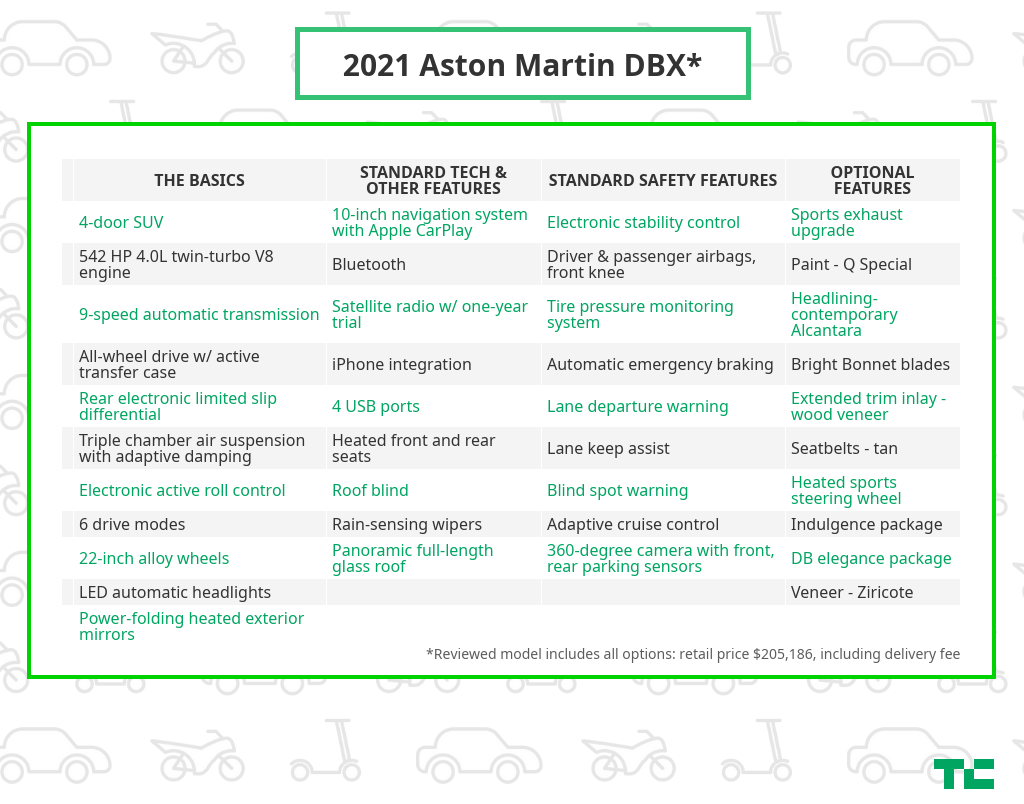
Image Credits: Bryce Durbin