Month: August 2021

25 Aug 2021

Avalo uses machine learning to accelerate the adaptation of crops to climate change

Climate change is affecting farming all over the world, and solutions are seldom simple. But if you could plant crops that resisted the heat, cold, or drought instead of moving a thousand miles away, wouldn’t you? Avalo helps plants like these become a reality using AI-powered genome analysis that can reduce the time and money it takes to breed hardier plants for this hot century.

Founded by two friends who thought they’d take a shot at a startup before committing to a life of academia, Avalo has a very direct value proposition, but it takes a bit of science to understand it.

Big seed and agriculture companies put a lot of work into creating better versions of major crops. By making corn or rice ever so slightly more resistant to heat, insects, drought or flooding, they can make huge improvements to yields and profits for farmers, or alternatively make a plant viable to grow somewhere it couldn’t before.

“There are big decreases to yields in equatorial areas — and it’s not that corn kernels are getting smaller,” said co-founder and CEO Brendan Collins. “Farmers move upland because salt water intrusion is disrupting fields, but they run into early spring frosts that kill their seedlings. Or they need rust resistant wheat to survive fungal outbreaks in humid, wet summers. We need to create new varieties if we want to adapt to this new environmental reality.”

To make those improvements in a systematic way, researchers emphasize existing traits in the plant; this isn’t about splicing in a new gene but bringing out qualities that are already there. This used to be done by the simple method of growing several plants, comparing them, and planting the seeds of the one that best exemplifies the trait — like Mendel in Genetics 101.

Nowadays, however, we have sequenced the genome of these plants and can be a little more direct. By finding out which genes are active in the plants with a desired trait, better expression of those genes can be targeted for future generations. The problem is that doing this still takes a long time — as in a decade.

The difficult part of the modern process stems (so to speak) from the issue that traits, like survival in the face of a drought, aren’t just single genes. They may be any number of genes interacting in a complex way. Just as there’s no single gene for becoming and Olympic gymnast, there isn’t one for becoming drought-resistant rice. So when the companies do what are called genome-wide association studies, they end up with hundreds of candidates for genes that contribute to the trait, and then must laboriously test various combinations of these in living plants, which even at industrial rates and scales takes years to do.
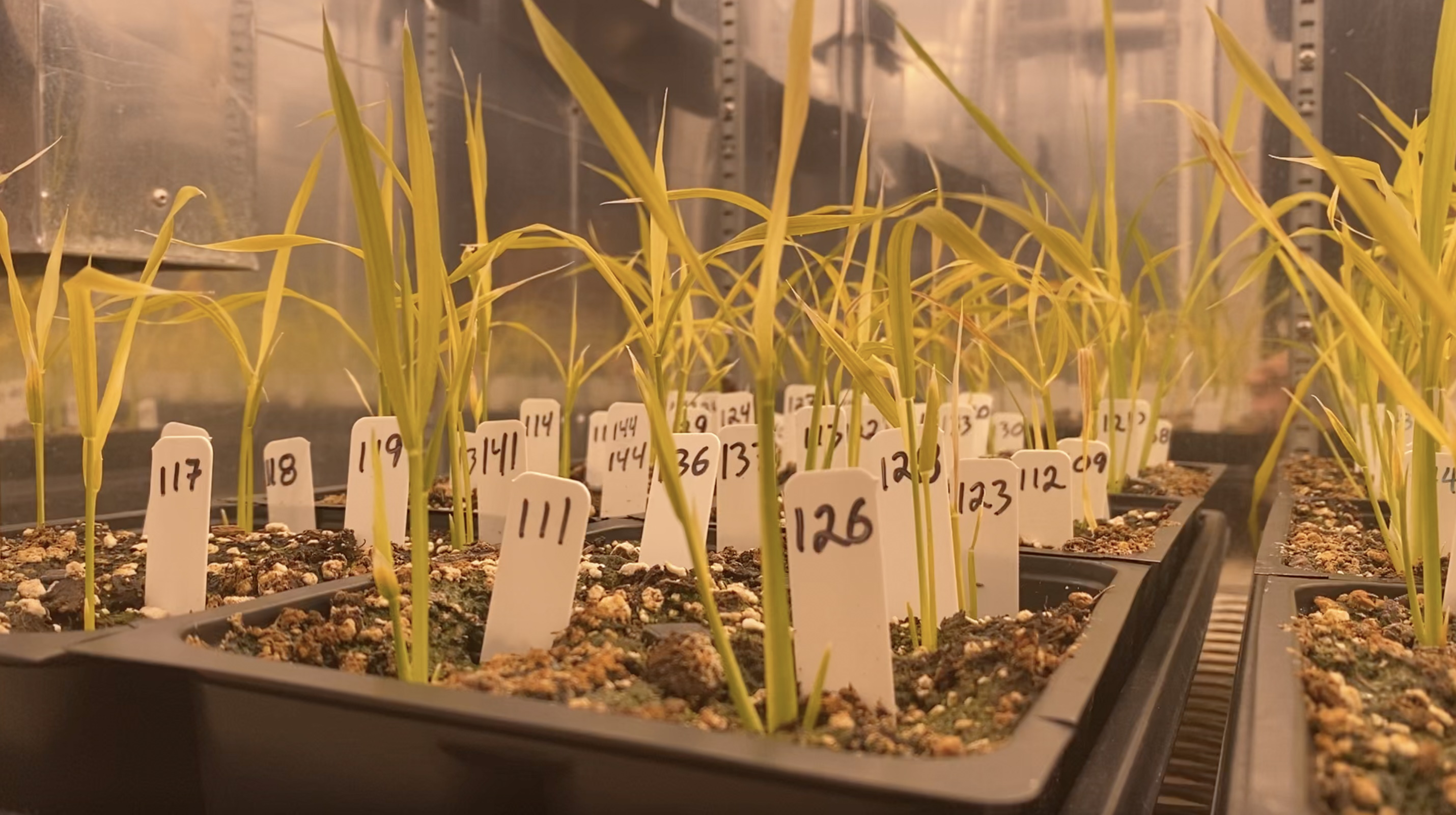
Numbered, genetically differentiated rice plants being raised for testing purposes.

“The ability to just find genes and then do something with them is actually pretty limited as these traits become more complicated,” said Mariano Alvarez, co-founder and CSO of Avalo. “Trying to increase the efficiency of an enzyme is easy, you just go in with CRISPR and edit it — but increasing yield in corn, there are thousands, maybe millions of genes contributing to that. If you’re a big strategic [e.g. Monsanto] trying to make drought tolerant rice, you’re looking at 15 years, 200 million dollars… it’s a long play.”

This is where Avalo steps in. The company has built a model for simulating the effects of changes to a plant’s genome, which they claim can reduce that 15-year lead time to 2 or 3, and the cost by a similar ratio.

“The idea was to create a much more realistic model for the genome that’s more evolutionarily aware,” said Collins. That is, a system that models the genome and genes on it that includes more context from biology and evolution. With a better model, you get far fewer false positives on genes associated with a trait, because it rules out far more as noise, unrelated genes, minor contributors, and so on.

He gave the example of a cold-tolerant rice strain that one company was working on. A genome-wide association study found 566 “genes of interest,” and to investigate each costs somewhere in the neighborhood of $40K due to the time, staff, and materials required. That means investigating this one trait might run up a $20M tab over several years, which naturally limits both the parties who can even attempt such an operation, and the crops that they will invest the time and money in. If you expect a return on investment, you can’t spend that kind of cash improving a niche crop for an outlier market.

“We’re here to democratize that process,” said Collins. In that same body of data relating to cold-tolerant rice, “We found 32 genes of interest, and based on our simulations and retrospective studies, we know that all of those are truly causal. And we were able to grow 10 knockouts to validate them, 3 in a 3-month period.”
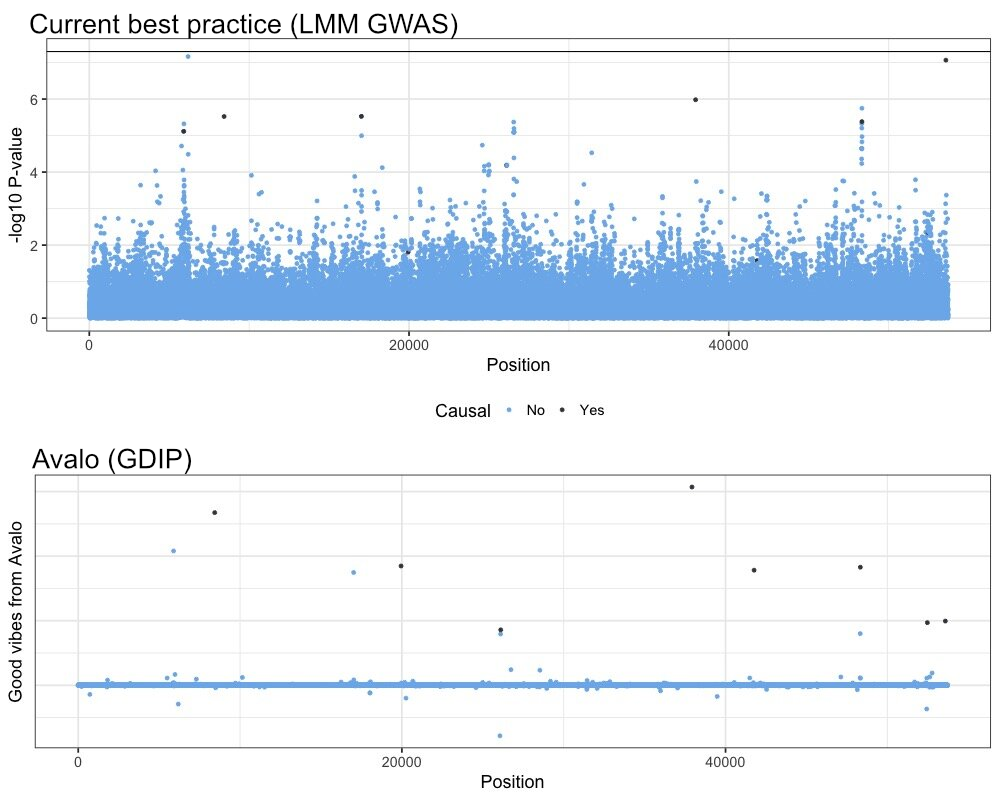
In each graph, dots represent confidence levels in genes that must be tested. The Avalo model clears up the data and selects only the most promising ones.

To unpack the jargon a little there, from the start Avalo’s system ruled out more than 90 percent of the genes that would have had to be individually investigated. They had high confidence that these 32 genes were not just related, but causal — having a real effect on the trait. And this was borne out with brief “knockout” studies, where a particular gene is blocked and the effect of that studied. Avalo calls its method “gene discovery via informationless perturbations,” or GDIP.

Part of it is the inherent facility of machine learning algorithms when it comes to pulling signal out of noise, but Collins noted that they needed to come at the problem with a fresh approach, letting the model learn the structures and relationships on its own. And it was also important to them that the model be explainable — that is, that its results don’t just appear out of a black box but have some kind of justification.

This latter issue is a tough one, but they achieved it by systematically swapping out genes of interest in repeated simulations with what amount to dummy versions, which don’t disrupt the trait but do help the model learn what each gene is contributing.
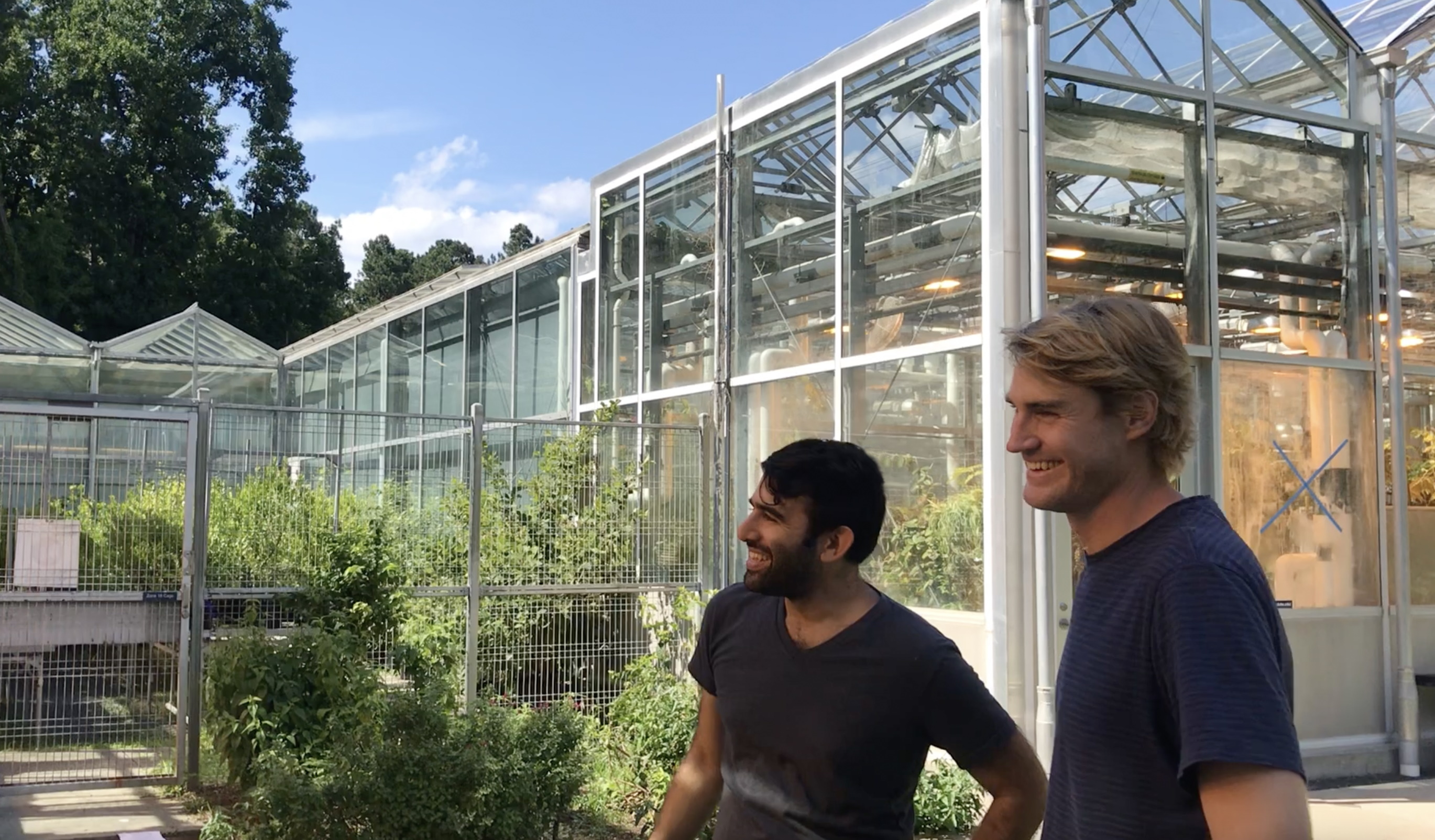
Avalo co-founders Mariano Alvarez (left) and Brendan Collins by a greenhouse.

“Using our tech, we can come up with a minimal predictive breeding set for traits of interest. You can design the perfect genotype in silico [i.e. in simulation] and then do intensive breeding and watch for that genotype,” said Collins. And the cost is low enough that it can be done by smaller outfits or with less popular crops, or for traits that are outside possibilities — since climate change is so unpredictable, who can say whether heat- or cold-tolerant wheat would be better 20 years from now?

“By reducing the capital cost of undertaking this exercise, we sort of unlock this space where it’s economically viable to work on a climate-tolerant trait,” said Alvarez.

Avalo is partnering with several universities to accelerate the creation of other resilient and sustainable plants that might never have seen the light of day otherwise. These research groups have tons of data but not a lot of resources, making them excellent candidates to demonstrate the company’s capabilities.

The university partnerships will also establish that the system works for “fairly undomesticated” plants that need some work before they can be used at scale. For instance it might be better to super-size a wild grain that’s naturally resistant to drought instead of trying to add drought resistance to a naturally large grain species, but no one was willing to spend $20M to find out.

On the commercial side, they plan to offer the data handling service first, one of many startups offering big cost and time savings to slower, more established companies in spaces like agriculture and pharmaceuticals. With luck Avalo will be able to help bring a few of these plants into agriculture and become a seed provider as well.

The company just emerged from the IndieBio accelerator a few weeks ago and has already secured $3M in seed funding to continue their work at greater scale. The round was co-led by Better Ventures and Giant Ventures, with At One Ventures, Climate Capital, David Rowan and of course IndieBio parent SOSV participating.

“Brendan convinced me that starting a startup would be way more fun and interesting than applying for faculty jobs,” said Alvarez. “And he was totally right.”
25 Aug 2021

Kanye wants to sell you a $200 music gadget

Kanye (or “Ye,” as it were) is going all out in the promotion of his upcoming tenth studio album, “Donda” (named for his late-mother, Donda West). In July, there was a massive listening party at New Orleans’ Mercedes-Benz Stadium (where he also took up residence in a locker room). For an upcoming listening party in his native Chicago, meanwhile, the rapper is rebuilding his childhood home at Soldier Field.

The forthcoming LP also sees West launching a $200 music gadget called, Stem Player, under his Yeezy Tech brand. The product is designed to isolate stems — specific elements like vocals, bass, samples and drums. It can add effects and remix the song elements according to the site.

The device reportedly ships with a copy of the new record pre-loaded. A FAQ on the site helpfully adds, however, while the product is being released in conjunction with “Donda,” it can also be used for other music.

Image Credits: Kanye West

Interestingly, the device was created in tandem with Kano, a London-based startup known for a different kind of STEM product. The company creates educational devices to help children learn things like programming. In 2019, Kano struggled through layoffs, in spite of releasing a number of Disney-branded devices.

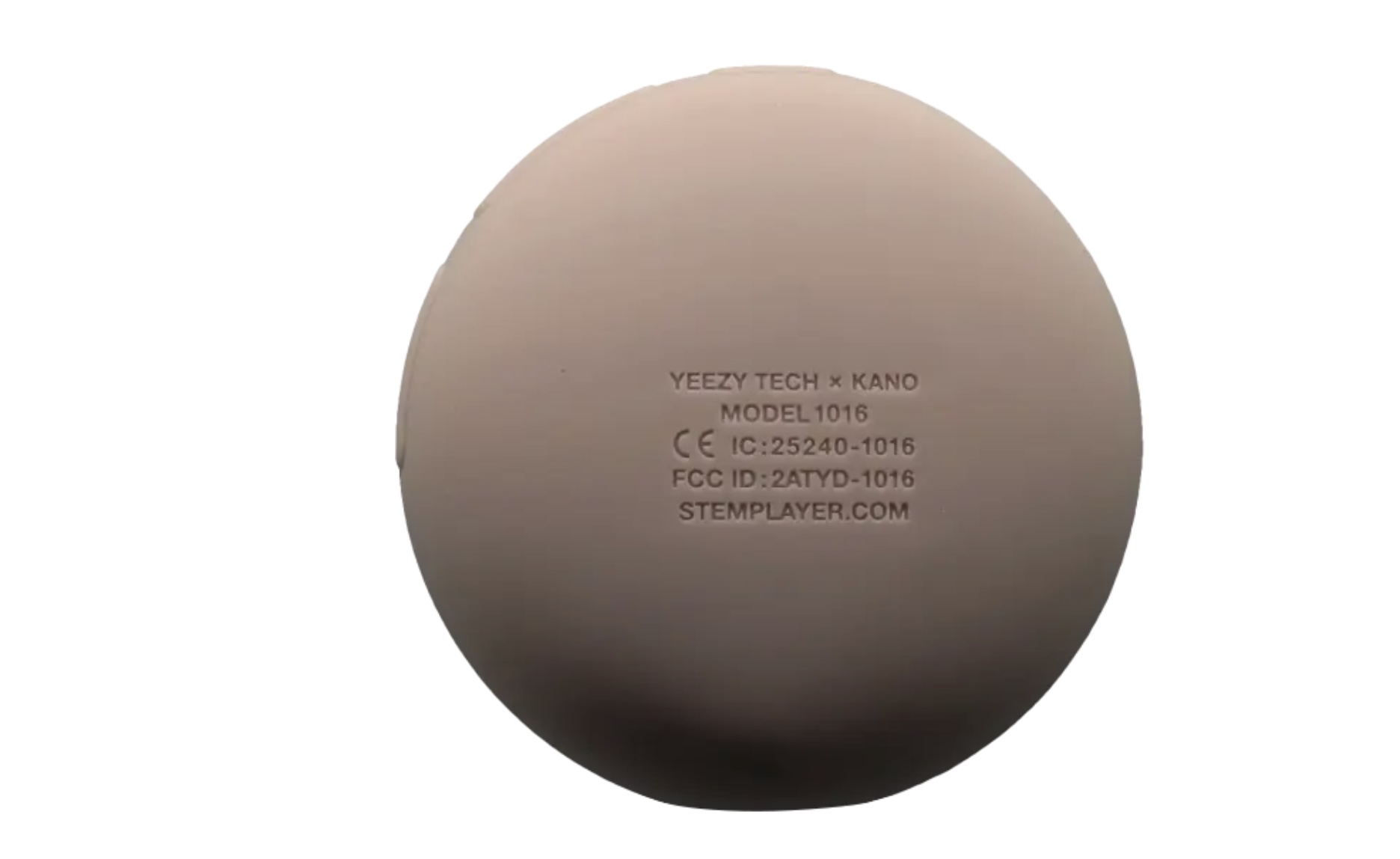
It seems the company’s found an interesting new bit of life here, and the product even goes so far as crediting Kano on the back of its silicone skin exterior with a Yeezy Tech x Kano branding on the rear.

West name-checked the device (or its predecessor) during an interview around his previous album, “Jesus Is King” in 2019. At the time, it appeared to be a collaboration with design firm Teenage Engineering. “This portable stem player that we designed with Teenage Engineering for this album and the albums before it, is to spread the gospel,” West told Zane Lowe at the time.

The product is set to ship this summer.

25 Aug 2021

Fig raises $2.2M to supercharge the terminal

Can an old Terminal learn new tricks? Fig, a company out of Y Combinator’s S20 class, has raised a $2.2M seed round to prove that it can. Their goal: augment (but don’t try to replace) the command line terminal that so many people use every day and make it more powerful and easy to use – especially for teams.

The first of these augmentations is autocomplete. Start typing your command and it’ll respond with a narrowing drop down of things that might complete it, saving you the keystrokes, time, and brain juice required to perfectly remember the myriad terminal commands you might use throughout your work day.

If you’re changing directories, for example, it can help finish paths as you type; with Git, it can keep track of your most recently tapped branches. If you find yourself punching in the same Google Cloud or AWS commands ten times a day, it’ll put them a tap away. The autocomplete functionality tied to each command line tool can be tweaked to your liking and shared with the wider community. Everything can be done without taking your hands off the keyboard, for those who tend to avoid reaching for a mouse.

Autocomplete is a great feature, though perhaps not enough to fuel an entire company – but it’s just step one, says the team. Fig founder Brendan Falk tells me the goal is to build out an “app ecosystem” for companies that use the terminal as a key part of their daily workflow, charging teams a monthly subscription fee. They’ve built a platform for shareable Markdown-based apps that can a user can launch from the terminal, giving them a visual interface that can be filled out and adjusted before piping output back into the terminal. Autocomplete, as they see it, is just the foot in the door.

“Suddenly I’ve written a little script, but it’s visual, it’s discoverable, I can share that with my team,” says Falk. “Building these internal tools for your development team is really where we want to go here… things like sharing scripts, sharing deployment workflows, sharing monitoring commands. All of this boilerplate stuff that is spread throughout your system, that really is focused within your terminal and should be contained within the terminal.”

Here’s a tweet from Fig showing that visual interface in motion:


The team didn’t initially set out with their sights set on the terminal. Falk tells me that he and co-founder Matt Schrage had pivoted from idea to idea for months, building out things like a personal CRM, prediction markets, and a stock exchange for creators. “We had all of the bad college kid ideas,” Falk says, “but they were just not problems we had. They were ideas, as opposed to problems people had.”

A bunch of pivots later, says Falk, they realized that each pivot had them back in the terminal typing the same commands, following the same complicated workflows to spin up a new project. “The terminal came out in 1978, and hasn’t really changed since.” notes Falk. “Yet literally every hardware engineer, software engineer, data scientist is using it.” Could that be the problem they went after?

It seems there’s an audience for it; while Fig is still in private beta, Falk tells me they currently have tens of thousands of users on the waitlist to get access.

This round was led by General Catalyst, and backed by YC, SV Angel, Kleiner Perkins, and a bevy of current/former tech execs including Adobe CPO Scott Belsky, Stripe CPO Will Gaybrick, Datadog CEO Olivier Pomel, former Github CTO Jason Warner, former Heroku CEO Adam Gross, Segment co-founder Calvin French-Owen, and Eventbrite founder Kevin Hartz.

Fig works with macOS’ built-in terminal out of the box, but they’ve also got add-on integrations to make it work within things like VSCode, Hyper, and iTerm. It won’t work on Windows or Linux just yet, but the team says support for them is on the roadmap.

25 Aug 2021

Canalys: U.S. PC sales up 17% YoY for quarter, even as tablet sales stagnate

Canalys released its quarterly U.S. PC sales today, and while the news was quite good with sales overall up 17% YoY, the growth slowed significantly from the prior quarter when sales soared to 74% pushed by the pandemic.

HP retained top spot for the second straight quarter with 21.9% of the market, up over 20% from the previous year. Apple remained in second spot with 20.6% share. It’s worth noting, however, that Apple’s growth fell -2.8% for the year.

Dell was in third place with 15.6%, followed by Lenovo with 12.4%. If you’re looking at yearly growth rate, Samsung had the highest with over 50%, but that translated into just over 6% market share.

Brian Lynch, Research Analyst at Canalys is optimistic that the pandemic-fueled growth we have been seeing in this market throughout 2020 and 2021 will continue and that consumer refreshes could be on the horizon as the economy continues to rebound.

“The commercial and education segments have exploded, triggering tremendous refresh potential. The US economy has bounced back well from its pandemic woes and small businesses are recovering, which will lead to a wave of purchasing from the segment,” Lynch said in a statement.

Overall there were 36.8 million units sold and that includes notebooks which were up 27%, desktops which were up 23% and tablets, which were basically stagnant with growth actually down 1%. Canalys attributed this drop to the education market moving away from tablets and the fact that many people bought tablets when they were stuck at home, but won’t be refreshing quickly.

In spite of this, Apple remains firmly in charge in the tablet market with 45% share, while Amazon is well back in second place with 22% followed by Samsung with 18%.

It seems clear that even though more people may be returning to in-person learning and in-office work at some point, many schools and businesses will continue to take a hybrid or even fully remote approach and that should bode well for the PC industry.

25 Aug 2021

Europe’s quick-commerce startups are overhyped: Lessons from China

More than 10 companies currently compete across Europe with an instant grocery delivery business model. Half of them were established in 2020, the year of the pandemic. These companies have raised more than $2 billion to date.

Existing and well-funded online food-delivery service players like Delivery Hero are also joining the race by launching dedicated grocery offerings. However, if lessons from the world’s largest online grocery market, China ($400 billion), matter, then it’s clear that instant delivery is not the magic bullet to crack the dominance of Europe’s incumbent supermarket chains in the overall $2 trillion-plus flat market.

Instead, China’s quick-commerce equivalents (like Dingdong Maicai, Miss Fresh and Meituan Maicai) compete alongside a wealth of other online grocery models (such as Pinduoduo, JD’s Super and Alibaba’s Taoxianda), which have helped bring total market penetration to 20% and beyond.

Quick commerce suffers from narrower profit margins compared to competing models and is addressing lower consumer demand in China than anyone in the West is expecting it to achieve in Europe and the U.S. If the performance of online grocery platforms in China (a market five to seven years ahead of Europe in terms of online retail) is anything to go by, a range of B2C business models would be more likely to displace the traditional grocery retailers.

Third-time luck for quick commerce?

The idea of ordering groceries online and having them delivered to consumers in less than an hour is nothing new. Back in the heyday of the dot-com bubble, a company attempted to do just that: Kozmo.com. Founded in 1998, it raised more than $250 million (around $400 million in today’s dollars) from investors, promising to deliver food, among other items, to consumers within an hour, while charging no delivery fees.

In 1999, it had revenues of $3.5 million and a loss of $1.8 million. However, in 2001, the business was shut down by its board after the company could not make the business model work at scale.

Some 15 years later, another company had a go. Gopuff was established in Philadelphia in 2013 and originally targeted students. What started out as a hookah delivery service soon expanded into a much broader convenience store offering and delivered to customers in approximately 30 minutes.

Gopuff was most recently valued at $15 billion after raising a total of $3.4 billion — 75% of which occurred in the past 12 months. Last year, Gopuff grew revenues from around $100 million to $340 million.

Kozmo.com went out of business after just three years. Meanwhile, Gopuff was turned down by several VCs in its early days, and it wasn’t until the pandemic that it saw a rapid acceleration in fundraising. Little did teams at either company know that they would later become the inspiration for a whole generation of founders in Europe.

Europe’s $2B instant-grocery gamble

Has anything fundamentally changed in the 20 years since Kozmo.com? Indeed, we’ve seen little technological progress that would hugely affect the operations of an instant commerce business. However, there have been much larger shifts in consumer habits.

Firstly, the number of global internet users has skyrocketed (from below 500 million to beyond 4 billion), and mobile internet has taken over. Secondly, demand for online grocery delivery has grown significantly due to the COVID-19 pandemic, as consumers have preferred to make retail purchases from home for safety reasons. Thirdly, consumers are now accustomed to paying fees for delivery services, typically around $2 per order, which Kozmo notoriously did not do.

While many online grocery business models exist, the instant grocery, quick-commerce approach has been the favorite of European entrepreneurs and VCs over the past 18 months. The model itself, also referred to as q-commerce, is not that hard to understand.

Companies maintain a small product offering of around 1,000–2,000 SKUs that consumers would otherwise find in convenience or drug stores. These products are purchased directly from brands or through distributors and are stored in self-operated microwarehouses close to customers’ locations.

Marketing tactics are aggressive, often employing vouchers for first-time users of up to $12 (50% of an average shopping basket), and many startups offer their products at supermarket price or even at a discount of 10%–15%. Delivery usually happens by bicycle, e-bike or scooter, within 10-30 minutes of an order being placed, for a fee of around $2 with no minimum order value.

Companies like Getir from Istanbul (total funding: $1 billion, last valuation: $7.5 billion) and Gorillas from Berlin (total funding: $335 million, last valuation: $1 billion) are leading the way. When Gorillas announced its $290 million Series B in March 2021, it became the fastest European startup to achieve unicorn status (nine months after launch). The company is already rumored to be seeking Series C financing at a $2.5 billion valuation.

There are more than 10 companies across Europe with more or less the same business model. Those include the 2020-established Flink (Germany-based, $300 million raised), Zapp (U.K.-based, $100 million raised), Dija (U.K.-based, $20 million raised and just acquired by Gopuff), Jiffy (U.K.-based, $7 million raised) and Cajoo (France-based, $6 million raised).

There is also JOKR, which was started by the founder of Foodpanda. JOKR was only established in Q1 2021, but right after incorporation raised one of the largest ever initial seed rounds (rumored to be $100 million) and subsequently a $170 million Series A in July to bring the model to Europe, Latin America and the U.S.

Likewise, companies coming from food delivery have pushed further into this space and received additional funding in recent months, notably Delivery Hero through Dmart and Glovo through SuperGlovo, following role models in the U.S., such as DoorDash.

Does instant grocery stand a chance of becoming profitable?

As these companies approach later-stage financing sometime in the future, questions will be asked about the path to profitability in an industry of notoriously thin margins. Indeed, this is an uncomfortable truth that hasn’t changed since the early days of Kozmo.com.

The available figures show that old patterns are repeating. Gopuff recently reported an EBITDA of negative $150 million on $340 million in revenue (EBITDA margin: -45%). Furthermore, an analysis by the German business monthly Manager Magazine concluded that Gorillas was operating at negative unit economics of -6%. Additional costs, such as overhead and technology, might push this number up significantly further.

25 Aug 2021

Hulu launches support for HDR on select original content

For the first time, Hulu has started adding support for HDR viewing, years after some of its competitors. The gradual rollout of HDR support began on August 19, Hulu told TechCrunch, and should be available to all users with HDR-compatible devices in the coming days.

So far, Hulu has only enabled HDR viewing on high-profile original content, like “The Handmaid’s Tale” and “Nine Perfect Strangers,” but the streaming service said that it will continue adding HDR support to both new and existing content over time.

If a viewer is using an HDR-compatible device, a badge will appear on a show’s details page, indicating that it can be streamed in HDR. Per Hulu’s support page — which is where users spotted the feature’s quiet rollout — HDR content on the Hulu app is supported with HDR-compatible models of Roku, Fire TV, Fire TV Stick, Fire TV Cube, Apple TV 4K, Vizio, and Chromecast Ultra. Hulu told TechCrunch that “it is recommended that viewers update their devices to the latest version for the best experience.”

Hulu has historically been slower than its competitors to enable support for technology like HDR, which provides an enhanced viewing experience. HDR isn’t a resolution like 4K, but rather, it creates a more natural-looking image by expanding its contrast ratio and color palette. YouTube rolled out HDR support in 2016, while Amazon and Netflix enabled the feature within the previous year. Though Disney+ and Hulu share a parent company in Disney, Disney+ has already supported HDR for some of its content.

Some streaming services like Netflix offer pricier monthly subscription plans for access to HD or Ultra HD content, but as of now, Hulu doesn’t charge a premium for access to higher-quality streaming.

25 Aug 2021

Zeit’s early warning wearable for sleep strokes could save hours and lives

Those at risk are always vigilant for the signs of a stroke in progress, but no one can be vigilant when they’re sleeping, meaning thousands of people suffer “wake-up strokes” that are only identified hours after the fact. Zeit Medical’s brain-monitoring wearable could help raise the alarm and get people to the hospital fast enough to mitigate the stroke’s damage and potentially save lives.

A few decades ago, there wasn’t much anyone could do to help a stroke victim. But an effective medication entered use in the ’90s, and a little later a surgical procedure was also pioneered — but both need to be administered within a few hours of the stroke’s onset.

Orestis Vardoulis and Urs Naber started Zeit (“time”) after seeing the resources being put towards reducing the delay between a 911 call regarding a stroke and the victim getting the therapy needed. The company is part of Y Combinator’s Summer 2021 cohort.

“It used to be that you couldn’t do anything, but suddenly it really mattered how fast you got to the hospital,” said Naber. “As soon as the stroke hits you, your brain starts dying, so time is the most crucial thing. People have spent millions shrinking the time between the 911 call and transport, and from the hospital door to treatment. but no one is addressing those hours that happen before the 911 call — so we realized that’s where we need to innovate.”

If only the stroke could be identified before the person even realizes it’s happening, they and others could be alerted and off to the hospital long before an ambulance would normally be called. As it turns out, there’s another situation where this needs to happen: in the OR.

For illustrative purposes, an EEG signal that changes its character can be detected quickly by the algorithm.

Surgeons and nurses performing operations obviously monitor the patient’s vitals closely, and have learned to identify the signs of an impending stroke from the EEG monitoring their brainwaves.

“There are specific patterns that people are trained to catch with their eyes. We learned from the best neurologists out there how they process this data visually, and we built a tool to detect that automatically,” said Vardoulis. “This clinical experience really helped, because they assisted in defining features within the signal that helped us accelerate the process of deciding what is important and what is not.”

The team created a soft, wearable headband with a compact EEG built in that monitors the relevant signals from the brain. This data is sent to a smartphone app for analysis by a machine learning model trained on the aforementioned patterns, and if anything is detected, an alarm is sent to the user and pre-specified caregivers. It can also be set to automatically call 911.

“The vast majority of the data we have analyzed comes out of the OR,” said Vardoulis, where it can immediately be checked against the ground truth. “We saw that we have an algorithm that can robustly capture the onset of events in the OR with zero false positives.”

That should translate well to the home, they say, where there are actually fewer complicating variables. To test that, they’re working with a group of high-risk people who have already had one stroke; the months immediately following a stroke or related event (there are various clinically differentiated categories) is a dangerous one when second events are common.

Orestis Vardoulis, left, and Urs Naber, co-founders of Zeit, pose with each other in a courtyard.

Image Credits: Zeit

“Right now we have a research kit that we’re shipping to individuals involved in our studies that has the headband and phone. Users are wearing it every night,” said Vardoulis. “We’re preparing for a path that will allow us to go commercial at some point in 2023. We’re working with he FDA to define the clinical proof needed to get this clear.”

They’ve earned a “Breakthrough Device” classification, which (like stroke rehabilitation company BrainQ) puts them in position to move forward quickly with testing and certification.

“We’re going to start in the US, but we see a need globally,” said Naber. “There are countries where aging is even more prevalent and the support structure for disability care are even less.” The device could significantly lower the risk and cost of at-home and disability care for many people who might otherwise have to regularly visit the hospital.

The plan for now is to continue to gather data and partners until they can set up a large-scale study, which will almost certainly be required to move the device from direct-to-consumer to reimbursable (i.e. covered by insurance). And although they are totally focused on strokes for the present, the method could be adapted to watching for other neurological conditions.

“We hope to see a future where everyone with a stroke risk is issued this device,” said Vardoulis. “We really do see this as the missing puzzle piece in the stroke care continuum.”

25 Aug 2021

Netflix sets ‘Tudum,’ its first ever virtual global fan event, for September 25

Netflix has announced Tudum, a global virtual fan event set for September 25 that will showcase exclusive news and first looks at some of the streaming giant’s original content. Tudum, which is named after the sound users hear when they press play on Netflix, will feature stars and creators from over 70 Netflix series, films and specials.

“It’s our first ever global Tudum event, and our goal is simple: to entertain and honor Netflix fans from across the globe,” a spokesperson for Netflix told TechCrunch in an email.

The event will feature interactive panels and conversations with the creators and stars of some of Netflix’s most popular shows, including “Stranger Things,” “Emily in Paris,” “The Witcher,” “The Crown,” “Cobra Kai” and “Bridgerton.” Netflix will also feature some of its popular films including “Red Notice,” “Don’t Look Up,” “Extraction,” “The Harder They Fall,” “The Old Guard” and more.

Netflix is among several other major companies that have started hosting their own virtual events during the COVID-19 pandemic and the shift towards livestreamed programming. Disney+, for instance, held a special event to honor National Streaming Day earlier this year in May. These types of events are becoming the new way for companies to showcase their original content, whereas in previous years they would do so at various in-person fan conventions.

With this new fan event and other similar ones such as Geeked Week, Netflix is no longer relying on other programming or conventions to promote its original content as it can now host its own events. Tudum also seems to be a way for Netflix to acquire more subscribers by promoting popular returning shows and teasing upcoming content.

The virtual livestream for the three-hour Tudum event starts at 12 pm EST/9 am PST on Saturday, September 25. The event will be broadcast on YouTube, Facebook and Twitch. Netflix is also hosting special pre-shows to showcase its Korean and Indian original series and films along with its anime content at 8 am EST/5 am PST.

Netflix’s event announcement comes as the streaming giant has spent the past year expanding its service and adding new features. Recently, the platform has launched a new “Play Something” shuffle feature, a new section to help users track upcoming releases and a new ‘Downloads For You’ feature that automatically downloads content you’ll like. In terms of the future, Netflix has said its gaming push will begin with mobile and that it plans to bring spatial audio to the platform’s iPhone and iPad apps.

25 Aug 2021

Shares is a new stock trading app with a focus on social features

Meet Shares, a new European startup that wants to add a social twist to financial investment — in that case, the company means ‘social’ as in ‘social network’. The startup has been developing its product under the radar for a few months already. It is also moving at a fast pace. It has assembled a team of 35 people and raised $10 million in a pre-product seed round.

Shares sent me a few details about what you should expect from the trading platform and why it’s different from what’s out there. Essentially, the startup combines two important trends.

First, stock trading has been moving to mobile and a few tech companies have been working on well-designed trading platforms to appeal to a new set of users. That shift is well underway in the U.S. as Robinhood has managed to attract tens of millions of users.

In Europe, it’s been a different story as the European market is still fragmented with a handful of stock-trading apps slowly expanding to new markets. Those companies include Freetrade, Trade Republic, Bitpanda and, to a certain degree, Revolut.

The second big investment trend of the past couple of years is that investment has become a social activity. Evidence of this lies in the GameStop short squeeze that occurred back in January 2021. In other words, people like to talk about stocks on Reddit, Discord, Telegram groups and more.

With Shares, users will be able to trade 1,500 stocks with no-minimum, no-fees access. You’ll be able to buy fractional shares and start investing with £1.00 in your Shares account. With such a low barrier to entry, the startup wants to convince first-time investors as the vast majority of people don’t own individual stocks. Shares plans to comply with KYC and AML regulation (‘Know Your Customer’ and ‘Anti-Money Laundering’).

But the app will offer more than just an interface to buy and sell shares. Users will be able to start conversations with friends, learn from experts and access market intelligence data. Shares will also feature some information to learn more about investing, tax, regulation and compliance. The most intriguing feature will be the ability to create group stock indexes with friends.

The startup was co-founded by Benjamin Chemla and François Ruty. Among other things, Benjamin Chemla previously co-founded Stuart, a last-mile logistics company that was acquired by La Poste in 2017.

They have already raised $10 million in a seed round led by Singular. Valar Ventures, Global Founders Capital and Red Sea Ventures also participated in the funding round. The startup has also partnered with some strategic advisors, including Freetrade co-founder André Mohamed.

That’s an impressive seed round for a fintech company that isn’t live yet. With a team of 35 people, it’s clear that Shares wants to move fast. It’s going to be interesting to see how online communities react when the app goes live.

25 Aug 2021

Grocery delivery startup Membo is hungry to build a Europe-wide, local food producer network

Estonia-based Membo — which is backed by Y Combinator and will be presenting at the incubator’s Summer 2021 Demo Day next week — is aiming to take a slice of the premium end of grocery shopping in Europe and a bite out of supermarket giants’ continued dominance of the traditional weekly food shop. 

On-demand food delivery in Europe is of course a highly competitive business with rapid-fire market moves and bursts of consolidation among app makers making a kind of sizzling startup stir-fry. Online grocery delivery, by contrast, tends to be a bit more sedate. Although there is some overlap, with developments like dark stores.

Interest in app-based grocery shopping also had an especially big boost during the pandemic — which has fired up consumer interest in doing the weekly shop online so that’s now driving more startup activity and capacity from supermarket giants trying to meet increased demand for online delivery.

Entering this fray is Membo — which, starting in Estonia, has built an app-based marketplace for local food producers to sell directly to consumers, cutting out other middlemen as the startup handles delivery logistics and billing.

Its service is live in the Estonian cities of Tallin and Tartu, currently. So most of us can merely oggle the mouth-watering fare for now.

Food producers display their wares in Membo’s app, which it likens to a virtual farmers’ market — allowing shoppers to browse and buy from multiple high quality, local fresh food producers and have everything delivered to them in one go. Its business model is based on taking a commission on orders made via its platform.

Products ordered via Membo can be delivered to customers in one of (currently) three slots a week. So within a few days or even next day. The startup batches customer orders to send to producers who only have to send one bulk order back to Membo’s centralized warehouse — where its staff take care of the packing and distribution to fulfil all the individual customer orders.

It launched the service last December and has seen 30% month on month growth over the past eight months — with, to date, 4,000+ orders sent out and customer numbers reaching over 1,400.

While local produce — and therefore the environmental benefits of sourcing food locally (lower ‘food miles’) — is a big feature of what Membo is selling it does also offer food from further afield — shipping Spanish oranges to its Estonia-based shoppers, for example — in order that it can provide customers with a full range of groceries and do things like be able to offer certain seasonal produce at different times of the year.

A full inventory is also important for it to be able to compete with traditional supermarkets on the ‘single weekly shop’ convenience front too, of course.

At present there are 800+ items listed on Membo’s platform from some different 65 producers. (And while groceries are its core offering it says it’s keeping an open mind about how that might expand — noting it recently added a locally produced pet food producer to its inventory, for example.)

But the overarching idea is for the food Membo sells to be as locally sourced to the customer as possible — which obviously has positive knock on impact on freshness and therefore overall grocery quality.

“Everything that we’re doing stems from the insight that people ordering their weekly groceries actually care much more about freshness and quality of their food than they actually care about 15 minute deliveries,” says co-founder and CEO Vahur Hansen, who cut his startup teeth working as an early engineer for TransferWise (now Wise).

“Coming from that insight we set out to build a model that can guarantee that when you order from us, every item in your cart always arrives as the freshest version possible. As an example… when you order trout from us the same trout was caught the day before. You get dairy produce that was specifically prepared for your delivery. You get oranges that were picked from the tree 24 hours ago. That’s the sort of reality that we’re focused on.”

“The product, from a fundamental point of view, is built for Europeans — and sort of for the European mentality,” he also tells TechCrunch. “It’s not new for people [here] to have this sort of mission/feel on being able to consume local produce. Europeans all over, in every country, they know that they need to support their local producers but they also know that local producers really make the best products for them. And for us the bigger goal is to build a cross-European, high quality producer network — coupled with very efficient logistics — so that we can, anywhere, deliver high quality local producers across Europe.”

On the last mile delivery side, the team has tried a few different approaches but is currently outsourcing that to delivery partners — with Hansen reiterating it makes sense for it to stay focused on the core logistics piece.

“When we started with this product we realized that we’re more of a logistics company than an actual store. So everything that we do is logistics in trying to figure out how to organize the quickest producer to end customer delivery.”

Given the target segment is premium groceries, Membo shoppers’ baskets are unsurprisingly more valuable than the average food delivery app — which conversely cater to impulse buys and hyper quick convenience. (Toothpaste, chocolate bars, takeaways, that sort of thing.)

So although there can be some overlap in the basic nature of what’s offered for delivery by Membo vs the average on-demand food delivery app there is more than enough clear blue water separating its value proposition vs — for example — the stuff that even a dark store operator like Spain’s Glovo can bike to your door.

It is very hard for hyper speedy delivery focused players to handle fresh produce and get it intact and in date to the customer’s door. Non-perishable, long shelf life products — processed foods, bottled drinks, toiletries etc — or indeed meal deliveries from restaurants which are set up to dish up takeaway are far easier for such platforms to manage and deliver. So grocery freshness is an especially difficult USP for such apps to compete on.

The question then is how large is the market for freshness and quality in the grocery space vs hyper quick, push-button convenience.

Membo’s bet is that delivering quality groceries is ultimately the more sustainable app business to be in. And it looks like a solid one. Certainly in a wealthy region like Northern Europe.

“It’s definitely a different model to dark stores — where they need to have mini warehouses spread across all cities — and also for us, unit economics wise, it’s a very good thing, because you can really save on scale,” says Hansen, discussing how Membo’s model contrasts with on-demand delivery apps doing grocery deliveries out of networks of dark stores.

“The fact that us needing one big warehouse as opposed to like ten smaller ones really effects our unit economics positively.”

“They capture impulse buys — and we capture planned out weekly grocery baskets,” he goes on. “Based on my research, our grocery baskets are at least 50% higher than for the sort of ‘convenience’ grocery apps. Right now it’s around $50 for an average customer. So from a very practical point of view we already see that — people come to our site to really order all of our fresh produce. As opposed to just a few items.”

There is another differentiating factor in play too.

Membo isn’t relying on a retail model that requires predicting customer demand in advance — so its business can be leaner and more efficient. Which also sums to less food being wasted — something else Membo’s target buyers are probably going to appreciate too. (The typical Membo customer is a 27-55 year old suburban mother who likes to cook for their family and prepare weekly meals ahead, per Hansen — someone who “really appreciates high quality, mostly eco ingredients for the food that they make”.)

“We set out to avoid food sitting in our warehouse and all the fresh produce that comes to our warehouse in the morning — it’s based on orders and it gets sent out to end customers the same evening. And also as a side effect of that model for the local food produce that we serve — there’s no food waste,” he says, adding: “Everything that arrives to our warehouse has already been ordered by our customers and our warehouse, essentially, is empty by the end of the day.”

It’s still early days for Membo of course. But it has big expansion plans in the region.

It’s been using its home market as a “playground” for fine-tuning its model and operations ahead of planned scaling into other European markets — with an eye on potential launches in Switzerland, Germany or France.

Markets with a rich network of local food producers who can be persuaded to sell their wares more directly to consumers via its platform will take priority, per Hansen, who says a range of factors will be involved in deciding where it goes next — so clearly the local competitive mix will also be key.

(Europe-based rivals include the UK’s Farmdrop — which targets a similarly discerning grocery shopper, who cares where their food is coming from and has the money to pay a quality premium, offering farmer sourced produce direct to UK consumers via its own online platform.)

“We’ve been using Estonia as a playground to figure out what is the exact operating model under which we can guarantee freshness for every item. So we’re been fine-tuning our product and building it so that we know it’s a sustainable business before going into expansion,” he says, adding: “That’s also one of the things that YC has really taught us.

“Build a working business and don’t go into scaling mode too quickly. But we are getting to the point where we’re already mapping bigger Western European countries and really honing in — trying to figure out what is the best combination of all of these factors to go in.”

Prior to taking in investment from YC, Membo had raised a little pre-seed funding to get going — although Hansen notes that its team remains small and expenses are therefore pretty lean. Its pre-seed backers included the CEO and VP of growth at Estonian ride-hailing startup Bolt, as well as some of Hansen’s ex colleagues at (Transfer)Wise.