Month: August 2021

31 Aug 2021

Kai-Fu Lee and Chen Qiufan will share their vision of our AI-powered future at Disrupt

We’ve had visionary investors onstage before, and we’ve had science fiction authors onstage — but never at the same time, let alone a pair who collaborated on a unique book of stories and essays that make an optimistic prediction of our AI-infused future. Sinovation founder Kai-Fu Lee and author of “Waste Tide” and others Chen Qiufan will join us at Disrupt (September 21-23) for a discussion of the fiction and fact of today’s hottest technology.

Lee, born in Taiwan, attended CMU and obtained a PhD in computer science, working initially on speech recognition before working for Apple, SGI and Microsoft, then establishing Google China as its president. His research and investment company, Sinovation (originally Innovation Works) has been his focus since its founding in 2009, and he has grown to become a leading mind and influential figure in AI.

When we last spoke with Lee, at Disrupt SF 2018, he emphasized that China was catching up to the U.S. on AI research, and had surpassed it in some ways. And certainly his own investments have contributed to that. Since then, as someone who thinks frequently about what the future holds, he has found a kindred spirit in Chen Qiufan.

Qiufan is a Chinese author whose 2013 novel “Waste Tide” propelled him to literary fame, though like many authors, that wasn’t enough to make him quit his day job until a few years later (Wired only just ran a profile on him). But by that time he had attracted the attention of Lee, who proposed a novel project: a collaborative book where the two would put their heads together to create a fictitious future informed by fact and realistic extrapolation.

The result is “AI 2041”: 10 stories by Qiufan set in the titular year, all over the world, with people from all walks of life encountering AI in the many ways that the authors speculate it may come to shape society over the next two decades. Each is followed by an explanatory essay by Lee that goes into the technical aspects and why they might lead to that future.

I’ll be posting a full review of the book ahead of the event, but I can certainly say that it’s unlike any collection I’ve read before. Each story is independent but takes place in something like a shared world, and each illustrates a potential application, conflict or change in thinking that AI could lead to. And, importantly, the AI is recognizable as descended directly from existing technologies.

For instance, one story concerns a talented deepfake creator working out of Lagos, one who knows the ins and outs of generative adversarial networks, image inspection, media pathways and so on. He’s tasked with creating a video of a long-dead celebrity that fools not just people watching it but the hosting service’s automated scanners, the government’s facial recognition algorithms and all the rest — but he begins to suspect there’s an unsavory motive behind it all (I won’t spoil the rest).

What follows the story is Lee’s essay on GANs, facial recognition and deepfakes that explains the concepts in an understandable but not patronizing way, then explores the risks and benefits in a non-narrative way. It helps ground the stories as real possibilities, not just imagined situations.

With both Qiufan and Lee onstage (virtually this time), the discussion of the book and the issues it brings up should be a lively one — not least because it will be moderated by yours truly. But to catch this session, you’ll need to grab a pass to attend Disrupt happening September 21-23. Get yours today for less than $100 for a limited time!

31 Aug 2021

TikTok’s new Creator Marketplace API lets influencer marketing companies tap into first-party data

TikTok is making it easier for brands and agencies to work with the influencers using its service. The company is rolling out a new “TikTok Creator Marketplace API,” which allows marketing companies to integrate more directly with TikTok’s Creator Marketplace, the video app’s in-house influencer marketing platform.

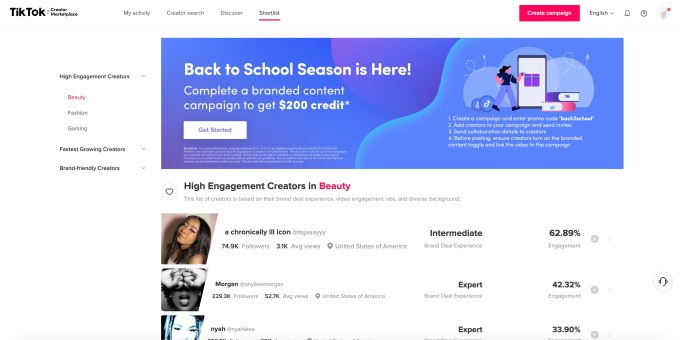
On the Creator Marketplace website, launched in late 2019, marketers have been able to discover top TikTok personalities for their brand campaigns, then create and manage those campaigns and track their performance.

The new API, meanwhile, allows partnered marketing companies to access TikTok’s first-party data about audience demographics, growth trends, best-performing videos, and real-time campaign reporting (e.g. views, likes, shares, comments, engagement, etc.) for the first time.

They can then bring this data back into their own platforms, to augment the insights they’re already providing to their own customer base.

TikTok is not officially announcing the API until later in September, but it is allowing its alpha partners to discuss their early work.

One such partner is Capitv8, which tested the API with a NRF top 50 retailer on one of their first TikTok campaigns. The retailer wanted to discover a diverse and inclusive group of TikTok creators to partner with on a new collaboration and wanted help with launching its own TikTok channel. Captiv8 says the branded content received nearly 10 million views, and the campaign resulted in a “significant increase” in several key metrics, which performed about the Nielsen average. This included familiarity (+4% above average), affinity (+6%), purchase intent (+7%) and recommendation intent (+9%).

Image Credits: TikTok Creator Marketplace website

Capitv8 is now working with TikTok’s API to pull in audience demographics, to centralize influencer offers and activations, and to provide tools to boost branded content and monitor campaign performance. On that last front, the API allows the company to pull in real-time metrics from the TikTok Creator Marketplace API — which means Capitv8 is now one of only a handful of third-party companies with access to TikTok first-party data.

Another early alpha partner is Influential, who shared it’s also leveraging the API to access first-party insights on audience demographics, growth trends, best-performing videos, and more, to help its customer base of Fortune 1000 brands to identify the right creators for both native and paid advertising campaigns.

One partner it worked with was DoorDash, who launched multiple campaigns on TikTok with Influential’s help. It’s also planning to work with McDonald’s USA on several new campaigns that will run this year, including those focused on the chain’s new Crispy Chicken Sandwich and the return of Spicy McNuggets.

Other early alpha partners include Whalar and INCA. The latter is currently only available in the U.K. and its integration stems from the larger TikTok global partnership with WPP, announced in February. That deal provided WPP agencies with early access to new advertising products marketing API integrations, and new AR offerings, among other things.

Creator marketplaces are now common to social media platforms with large influencer communities as this has become a standard way to advertise to online consumers, particular the younger generation. Facebook today offers its Brands Collabs Manager, for both Facebook and Instagram; YouTube has BrandConnect; while Snapchat recently announced a marketplace to connect brands with Lens creators. These type of in-house platforms make it easier for marketers to work with the wider influencer community by offering trusted data on metrics that matter to brands’ own ROI, rather than relying on self-reported data from influencers or on data they have to manually collect themselves. And as campaigns run, marketers can compare how well their partnered creators are able to drive results to inform their future collaborations.

TikTok isn’t making a formal announcement about its new API at this time, telling TechCrunch the technology is still in pilot testing phases for the time being.

“Creators are the lifeblood of our platform, and we’re constantly thinking of new ways to make it easy for them to connect and collaborate with brands. We’re thrilled to be integrating with an elite group of trusted partners to help brands discover and work with diverse creators who can share their message in an authentic way,” said Melissa Yang, TikTok’s Head of Ecosystem Partnerships, in a statement provided to select marketing company partners.


31 Aug 2021

This YC Summer batch features the largest group of African startups yet

Y Combinator’s summer batch of 2021 features 377 startups from 47 countries. It’s the 33rd Demo Day of the well-known accelerator and holds the largest cohort yet. YC S20 had 198 startups, so that’s a 90% increase from last year.

About half of the companies represented are based outside the U.S. The countries with the most representatives (aside from the U.S.) include India, with 33 startups; the U.K., with 18 startups; Mexico with 17; Singapore with 12; and Canada and Brazil, 11 each.

While the Demo Day for this year’s winter batch was held in a day, it’s two days for this summer batch. Today, 189 companies will pitch, while the rest will pitch tomorrow.

African startups also increased from 10 in the winter batch to 15 this time around, a record for African startups in a single YC cohort.

“This is the largest batch we have ever funded and it’s about 50% international. As a result, it is not surprising that this is the largest cohort from Africa,” Y Combinator managing director and group arptner Michael Seibel told TechCrunch when asked if any extra factor contributed to the rise in accepted African startups.

Another valid reason for the uptick could be that YC is getting more applications from Africa due to the recent success stories of Paystack and Flutterwave. At least, that’s the view shared by Kat Mañalac, the head of Outreach at YC.

“Alumni are always the best spokespeople and representatives for YC. A lot of African founders (and future founders) I’ve spoken to were encouraged by seeing Paystack do so well and get acquired. The success of a lot of our African alumni are inspiring more African teams to apply,” she told TechCrunch.

Nigeria leads the way again with five startups, while Egypt has four, Morocco has two, and Kenya, Ghana, Zambia and South Africa each have one. Here’s the list of African startups that made it to YC S21 in alphabetical order.

Amenli (Egypt)

Africa has the lowest insurance penetrations globally. In Egypt, the insurance penetration rate stands at a minuscule 1%.

Amenli, founded by Shady El Tohfa and Adham Nauman in 2020, is addressing an untapped $2 billion market, being the first licensed online insurance broker in the country.

Chari (Morocco)

A wave of disruption of digitizing informal retail stores is sweeping across emerging markets this year, and Chari is joining in on the action.

Sophia Alj and Ismael Belkhayat founded Chari in 2020. The company allows traditional retailers in Morocco and some parts of North Africa to order consumer goods via its platform and handles free delivery to their stores. Chari has a fintech side by providing these retailers with credit.

Fingo (Kenya)

Neobanks have taken the world by storm and Africa is the last frontier for this brand of fintech innovation. Fingo is providing an alternative brand of banking to African millennials, starting from Kenya.

Founded by Kiiru Muhoya Gitari Tirima James da Costa and Ian Njuguna in 2020, the digital bank claims to offer fees 90% cheaper than traditional banks in Kenya, among other services.

FloatPays (South Africa)

In South Africa, up to 5 million employees borrow money to meet their monthly needs when they exhaust their salaries. However, the lending options for these employees come with outrageous interest rates.

Simon Ward founded FloatPays in 2019 as an on-demand wage access platform to help employees access, spend, save and manage their money.

Freterium (Morocco)

Managers of delivery businesses handle hundreds or thousands of delivery points every day. With a fleet made up of many trucks or vans, there’s a need to drop a delivery plan for each at different locations daily. How do they optimize for costs and efficiency at the same time?

Enter Freterium. The company allows contractors, manufacturers, distributors and logisticians to plan and optimize their B2B or B2C shipments while providing a cloud platform for real-time visibility of shipments, logistics infrastructure and seamless collaboration that breaks down traditional organizational silos. Omar El Kouhene and Mehdi Cherif Alami founded Freterium in 2018.

Infiuss Health (Nigeria)

A large number of Africans are exempt from clinical research studies due to time constraints. Per reports, it can take up to ten months to conduct such studies in these climes.

Infiuss Health says it is building a decentralized platform for remote research and clinical trials in Africa. How? By connecting researchers directly to patients who want to participate in clinical research studies in less than a week.

The company was founded by Melissa Bime and Mbah Charles in 2020.

Lemonade Finance (Nigeria)

There are millions of African immigrants in Europe and North America. Some have established businesses in both these regions and also in Africa.

In another digital banking play, Lemonade Finance provides multi-currency accounts for these migrants to enable seamless transactions and banking. The company was founded by Rian Cochran and Ridwan Olalere in 2020

Mecho Autotech (Nigeria)

Repairing one’s vehicle can be a painstaking process in Africa due to pricing and quality issues. The latter is because many of these professionals (mechanics) are unvetted.

Ayoola Akinkunmi and Olusegun Owoade started Mecho Autotech in 2021 as an on-demand auto maintenance and repairs platform. Mecho Autotech has created a network of vetted mechanics, and via an app, car owners can book and pay for their services.

Odiggo (Egypt)

Like its predecessor on this list, Odiggo connects car owners with mobile mechanics in the Middle East. On the platform, car owners can also access extra services, which include car washing and maintenance.

Although Odiggo lists as a Dubai-based company on the YC database, it has origins in Egypt and launched operations first in the North African country.

Payhippo (Nigeria)

Access to credit is still very much a problem to the millions of small and medium businesses in Nigeria, which make up most of the country’s businesses.

Founded by Zach Bijesse, Uche Nnadi and Chioma Okotcha in 2019, Payhippo provides loans to businesses that couldn’t ordinarily get loans or credit cards from banks or other financial institutions.

Pylon (Egypt)

Water and electricity distribution companies face losses from leakages and thefts when opening new revenue streams in emerging markets.

Pylon acts as an infrastructure management platform for these distribution companies and helps to reduce these losses. It was founded in 2017 by Ahmed Ashour and Omar Radi.

ShipBlu (Egypt)

When merchants start to grow their e-commerce businesses, it can be difficult to manage the end-to-end delivery and fulfilment needs. In Egypt, several platforms are already offering solutions to this ever-growing need, and ShipBlu is adding to that list.

Founded by Ahmed ElKawass, Abdelrahman Hosny and Ali Nasser in 2020, ShipBlu claims to offer a full suite of delivery services for e-commerce merchants from overnight to delivery to five- to seven-day delivery.

Suplias (Nigeria)

Another digitizing-informal-retail-stores play, this time from Nigeria. Suplias is a B2B marketplace where mom-and -op stores in Africa buy inventory directly from manufacturers using a mobile app.

The company was founded by Stephen Igwue, Michael Adesanya and Sefa Ikyaator in 2019.

Union54 (Zambia)

African fintechs are in the business of providing virtual and physical cards to their customers. However, it doesn’t come easy and cheap when done in partnership with banks.

Union54 is an alternative and provides an API for them to issue debit cards cheaper and faster. It was founded by Alessandra Martini and Perseus Mlambo in 2021.

Yemaachi Biotechnology (Ghana)

Yaw Attua-Afari, Yaw Bediako, David Hutchful and Joyce Ngoi founded Yemaachi Biotechnology in 2020. The startup’s idea is to diversify precision cancer diagnostics and treatments across the continent, starting with Ghana.

An estimated 752,000 new cancer cases, 4% of the world’s total, occurred in sub-Saharan Africa in 2018. Yemaachi is working to lower the burden cancer causes by creating molecular diagnostics optimized for all Africans.


31 Aug 2021

Inside Freshworks’ IPO filing

Freshworks, a customer engagement software company with roots in both California in the United States and Tamil Nadu in India, is going public. Its S-1 filing paints the picture of a company scaling rapidly, with improving profitability as it matures. However, to understand the company’s numbers, we’ll have to peel away certain costs for a clear picture.

The Exchange spoke with Freshworks CEO Girish Mathrubootham a few weeks ago about the future of his company, a conversation that in hindsight we timed rather well. We’ll lean on notes from the call as we parse Mathrubootham’s IPO filing.


The Exchange explores startups, markets and money.

Read it every morning on Extra Crunch or get The Exchange newsletter every Saturday.


Quite a lot of venture capital is riding on Freshworks’ IPO going well. The company raised hundreds of millions of dollars while private, per Crunchbase data, including a $150 million Series H round of capital in late 2019 that valued the company at around $3.5 billion. Its investor list includes Accel, Tiger, Sequoia and Capital G.

This morning, let’s dig into the company’s historical growth, track Freshworks’ changing profitability profile and check to see if its revenue quality is improving over time.

Quick notes on product

Before we dive into the numbers, let’s discuss Freshworks’ historical product work.

The company started life with a single piece of software called Freshdesk. Freshdesk was born after the company’s CEO struggled with poor customer service when trying to return a broken television.

Per Mathrubootham, he felt like there were more avenues than ever for customers to reach companies, and that the business market was evolving in a way that gave customers more clout in how brands were perceived. So, Freshdesk brought together a host of customer contact methods, including social media, which at the time was a more nascent market category.

Freshworks later noticed that some of its customers were using its customer service software to offer IT support to their own employees. From that observation, the company built Freshservice, a version of its original product, but tuned for internal use. The company later built out sales tools and, more recently, a unified database for customer data. The latter allows companies using Freshworks software to have a single record for each customer across marketing and sales interactions, which it intends to extend to support communications as well.

All that’s to say that Freshworks has a product that it can sell to small companies that may need a single piece of its larger product mix, and lots more software that it can upsell to those customers. And that it has a product suite it can sell to larger companies as well.

So how has the company performed in the market? Let’s find out.

31 Aug 2021

Osana Salud raises $20M to build API-connected infrastructure for the LatAm healthcare industry

Osana Salud, which aims to transform the healthcare infrastructure in Latin America, has closed on a $20 million Series A round of funding led by General Catalyst.

The Argentina-based, yet fully remote, startup was founded in 2019 — just a few months before the pandemic. Since launching less than a year ago, Osana says it has secured contracts with health insurance firms and providers that collectively serve more than 6 million patients in the region. For example, it is working with Sanatorio Güemes and PAMI, which has a network of 5 million patients, among others.

Quiet Capital, Preface Ventures, FJ Labs, AforeVC and K50 Ventures also put money in the latest round, which brings Osana’s total raised over its lifetime to $26.5 million. Lee Fixel’s Addition is also an investor.

CEO Andre Lawson told TechCrunch he was inspired to start Osana Salud because an estimated 50% of Latin America does not have access to quality healthcare. So he teamed up with COO Jorge Lopez to found the company to help change that. President Charu Sharma (the only staffer who is U.S.-based) and CTO Hugo Martin joined at a later date.

“Our vision is to enable affordable and accessible healthcare for every person in Latin America by leveraging technology,” Lawson said.

Specifically, Osana Salud is building an API-connected infrastructure to help the region’s healthcare industry offer a patient experience that offers “greater convenience, outcomes and value,” Lawson told TechCrunch. Its initial focus is on building solutions for telehealth, pharmacy and diagnostics. 

For example, he said, Osana wants to make it faster and cheaper for healthcare players to build solutions that are “safe, secure and interact well” with other health systems. With that in mind, the company has tapped doctors and engineers to design that infrastructure.

“The goal is to empower the next generation of healthcare providers in building patient-centric solutions with the potential to positively impact the healthcare experiences and outcomes for hundreds of millions of people,” Lawson said.

In the past eight months, Osana has grown from four to about 50 people, and it expects to have over 250 employees in the next year. Despite not quite being two years old, the startup believes it’s already grown to be Latin America’s biggest telehealth company.

Sharma told TechCrunch that despite living in Silicon Valley, she was drawn to the company’s mission and found the potential to “massively transform healthcare for a whole continent” appealing.

“In the U.S. tech ecosystem, we focus on first-world problems a lot, but an emerging market like LatAm gave me the opportunity to make a meaningful impact at a very basic human need level,” she said. “As the saying goes, talent is equally distributed but opportunity is not.”

In fact, as evidence that remote work will never be the same after COVID, neither Sharma nor Martin have met Lawson or Lopez in person.

The new capital will in part go toward accelerating the company’s product roadmap, Lawson said, and helping it expand to Brazil and Mexico, where it has seen “strong inbound interest.” But primarily, it will be used for hiring.

The timing of the company’s inception was good. The pandemic shed light on the fractures of the healthcare system in Latin America, Lawson believes. It also gave the industry the opportunity to show the benefits of a “virtual first” approach, he added. And once people got a taste of it, they wanted more.

As a result, Osana says it has seen a big bump both in the number of clients and in the usage of its technology platform amongst existing ones.

“Furthermore, COVID-19 created urgency for healthcare providers, which resulted in very short sales cycles for us,” Lawson said.

Hemant Taneja of General Catalyst said the startup’s thesis aligns “perfectly” with his firm’s thesis around healthcare. Taneja himself is also a co-founder and executive chairman of San Francisco-based Commure, a venture-backed startup which is also building software infrastructure aimed at transforming the healthcare space.

“The healthcare infrastructure landscape in Latin America is highly fragmented,” he told TechCrunch. Most software vendors are small or medium-sized local vendors, who have not crossed into other Latin American geographies, Taneja pointed out.

“Osana has a variety of solutions for providers, payors and the pharmaceutical industry that are customizable and modular to create truly personalized experiences — regardless of the region in Latin America,” he said. “They can be an important unifier in a really fractured marketplace.”

31 Aug 2021

Compounds Foods brews up $4.5M to make coffee without beans

Maricel Saenz, founder and CEO of Compound Foods, is among the over 80% of Americans who love a cup of coffee daily. And she also loves the environment.

However, when the Costa Rican-born entrepreneur, now living in the Bay Area, saw how climate change was affecting coffee growers around the world — coffee is the fifth-most polluting crop in the value chain — she wanted to create a coffee product that tasted good, but was also sustainable.

“Temperatures are rising and combined with erratic rains are leading to lower crop yield,” Saenz told TechCrunch. “The same crop can’t grow in the same place anymore, or it will be a lower quality product. Farmers in Costa Rica are having to sell their land or go higher up the mountain. Experts predict that 50% of farmland will be unsuitable in the next couple of decades.”

Founded in 2020, Compound Foods uses synthetic biology to create coffee without coffee beans by extracting molecules. Saenz said the company spent a lot of time examining what makes coffee, well coffee, and then trying to correlate flavors and aromas in certain ways.

And yes, the company can still call it “coffee” even if it doesn’t contain coffee beans because there is no official regulatory definition, she said.

They use food science to recreate a base formula using sustainable ingredients that also don’t use a lot of water — she said it takes 140 liters of water along the coffee growth chain to make one cup of coffee. The company is also working toward a goal of being able to recreate coffee inspired by flavors that you would get from different areas of the world, like Costa Rica, but also the chocolate notes from a cup of Brazilian coffee.

Compound Foods announced $4.5 million in seed funding to give it total funding of $5.3 million to date. Backers of the company include Chris Sacca’s climate fund Lowercarbon Capital, SVLC, Humboldt Fund, Collaborative Fund, Maple VC, Petri Bio and angel investors like Nick Green, CEO of Thrive Market.

Saenz intends to use the new funding to improve the formulation and scale up the brand as the company works toward a soft launch by the end of the year.

There are a few competitors in the space doing different technology, including Seattle-based Atomo, which said it makes its coffee from “other fruits and plants that had seeds similar to coffee beans.”

Compound Foods is hiring coffee lovers to help build out its technology and to expand its marketing, product and business teams.

Saenz is clear that the company is not competing with coffee.

“We love coffee and know the farmers, and we are providing an alternative solution,” she added. “We want to recreate it, and even drink it on Mars one day, and we want to bring the coffee farmers and the industry with us on the journey.”


31 Aug 2021

Pandemic-driven liquid oxygen shortage threatens ULA, SpaceX launches

The ongoing reverberations from the COVID-19 pandemic are continuing to make themselves felt in the most unlikely of places: spaceflight. On Friday, NASA took the unexpected step to ground a September satellite launch due to pandemic-related shortages of liquid oxygen (LOX), and there may be more launch delays yet to come.

Demand for oxygen has only risen with the Delta variant, which in many cities pushed hospitalization and ICU admittance rates back to where they were at the start of the pandemic. But oxygen isn’t just used in ventilators. The space industry uses LOX as an oxidizer in rocket propellant, often in combination with other gases like liquid hydrogen. (That’s why there can be so much steam during a launch – it’s the hydrogen reacting with the oxygen to form water.)

NASA and United Launch Alliance, a joint venture between Boeing and Lockheed Martin, said the launch date for the Landsat 9 satellite will now take place on September 23.

ULA isn’t the only launch company to potentially be impacted by the LOX shortage. “We’re actually going to be impacted this year with the lack of liquid oxygen for launch,” SpaceX President Gwynne Shotwell said last week during a panel at the Space Symposium. “We certainly are going to make sure the hospitals are going to have the oxygen that they need, but for anybody who has liquid oxygen to spare, send me an email.”

Elon Musk, SpaceX’s founder and CEO, was more tempered a few days later on Twitter, saying that the LOX shortage “is a risk, but not yet a limiting factor.”

Even beyond the actual supply of oxygen, the gas shortage is also being exacerbated by widespread shipping delays as coronavirus-related disruptions continue to impact the supply chain. ULA CEO Tory Bruno added on Twitter that a contractor who handles nitrogen transportation to Vandenberg Space Force Base in California was diverted to assist with LOX delivery in Florida.

It’s not just the space industry that’s feeling the effects of the LOX squeeze: shortly before NASA announced the launch delay, Orlando, Florida officials sent out a separate notice urging residents to conserve water, as LOX is used to treat the city’s water supply.

“Nationally, the demand for liquid oxygen is extremely high as the priority for its use is to save lives, which is limiting the supply that [Orlando municipal water utility] OUC is receiving,” Orlando Mayor Buddy Dyer said on Facebook. “There could be impacts to our water quality if we do not immediately reduce the amount of water we need to treat.”

As early as May of last year, the nonprofit Center for Global Development called COVID-19 a “wake-up call” for ensuring an adequate supply of oxygen to hospitals.

31 Aug 2021

Fundraising for your startup? We’ve got you covered at TechCrunch Disrupt 2021

Fundraising is a huge part of building a successful startup, and whether you’re looking for information about the latest trends, alternative funding or how to fine-tune your pitch to attract investors, you’ll find that and a whole lot more at TechCrunch Disrupt 2021 on September 21-23.

Disrupt always taps the top experts, visionaries, founders, investors and makers to share their insights, tips and actionable advice. This year is no different, and you can choose from more than 80 presentations, events and breakout sessions over the course of three full days.

Be disruptive: Buy your pass today for less than $100 and get ready to learn from and connect with a global startup community.

Money makes the world go around (just ask Liza Minelli), and we’re highlighting just a sampling of the fundraising-focused sessions to help you on your financial journey at Disrupt.

Ready to raise? Here’s just a sample of the fundraising knowledge you can get — you’ll find the specific days and times listed in the Disrupt 2021 agenda.

How to Raise Your First Dollars

Deciding how to go about getting your initial funding is always a tricky subject, as the wrong move could adversely impact your young company. In this session we’ll hear from Index Ventures’ Nina Achadjian, Sequoia Capital’s Luciana Lixandru and Canvas Ventures’ Rebecca Lynn — experts who’ve shepherded multiple companies from the earliest to the latest fundraises.

How to Ditch Traditional Fundraising

In 2021, venture capital has never been more plentiful, but some founders still can’t break into networks or have found that traditional fundraising isn’t the best route for their business. Fortunately, alternative fundraising techniques are gathering steam as founders find paths to raise cash that diverge from the startup success stories of the past. Join Pipe’s Harry Hurst, Accel’s Arun Mathew and Clearco’s Michele Romanow to learn more about alternative fundraising options.

You’ve Raised Your Seed Round — Now What? Preparing for Your Series A

You cleared the first hurdle: initial funding is in the bank. You’re hiring more talent, seeing the beginnings of a finished product with clear evidence of traction and experiencing the coveted growth that previously felt just out of reach. Before you know it, the decision to raise for what is arguably the most competitive round is staring you in the face. Join Samsung Next’s David Lee alongside founders Kadie Okwudili (Agapé), Andy Hoang (Aviron), and Jim Bugwadia (Nirmata) as they discuss the learnings and nuances of bridging Seed to Series A. Presented by Samsung Next.

Where to Cut and Where to Spend in First-Check Fundraising

Every time a founder raises financing, they usually have one goal: growth. But what does that actually mean? And how do you begin divvying up your new capital between the various goals your startup is barreling toward? In this panel, which includes Harlem Capital’s Henri Pierre-Jacques, Equal Ventures’ Richard Kerby, and BBG Ventures’ Nisha Dua, you will learn about how to spend your investment the best way, balancing runway with classic startup rigor.

How Circle’s $4.5B Public Listing Will Change Startup Fundraising

Circle acquired SeedInvest in 2019, as a further step toward realizing its vision of a more open, global, connected and inclusive financial system. Circle recently announced its plans to become a $4.5B public company with over $1 billion of fresh capital. In this session, Circle CEO and Co-Founder Jeremy Allaire and Ryan Feit, CEO and co-founder of SeedInvest, will break down the evolution of the two companies and how Circle and SeedInvest plan to double down on online fundraising to make it faster and easier for entrepreneurs. Presented by by SeedInvest.

Crafting a Pitch Deck that Can’t Be Ignored

Investors may be chasing after the hottest deals, but for founders selling their startup’s vision, it’s never been more important to communicate it in the clearest way possible. Our panelists of pitch deck experts — Lightspeed Venture Partners’ Mercedes Bent, Pear VC’s Mar Hershenson and Techstars’ Saba Karim — dig into what’s essential, what’s unnecessary and what could just make all the difference in your next deck.

TechCrunch Disrupt 2021 takes place on September 21-23. Buy your pass today and take advantage of these fundraising sessions and expert advice — so you can find the money to make your world go around.

Is your company interested in sponsoring or exhibiting at Disrupt 2021? Contact our sponsorship sales team by filling out this form.

31 Aug 2021

EV charging solutions will become an asset, not a liability, to the grid

President Joe Biden’s plan for electric vehicles (EVs) to comprise roughly half of U.S. sales by 2030 is a clear indication that the U.S. is making strides in decarbonizing its transportation systems, which currently account for nearly half of total U.S. emissions.

Though this kind of federal support is critical in accelerating the mass adoption of EVs, we must face the impending need to rehabilitate the ailing U.S. electric infrastructure that millions currently rely on, namely the capabilities of the power grid.

As society converts to an all-electric future and demand rises for EVs, a challenge our modern world will face is how to charge the increasing number of vehicles without overstressing the grid past its capacity. While some predict EVs will overload the power grid, others have found methods that support our energy infrastructure, including solutions such as wireless charging, vehicle-to-grid (V2G) integration or more efficient methods of utilizing renewable energy sources, to name a few.

Amid warranted concerns about the unstable grid, there is an urgent need to find solutions that can reinforce this critical infrastructure to avoid pushing the grid to its limits.

The current challenges facing the grid

According to the recent IPCC climate change report, extreme heat waves that previously only struck once every 50 years are now expected to happen once per decade or more frequently due to global warming and anthropogenic emissions. While this has already been seen in this past year through record-breaking heat waves and extreme fires in the Pacific Northwest, utilities, operators and industry experts continue to express concern about whether current energy systems will be able to withstand increasing temperatures from climate change.

And it’s not just heat: In February, a cold snap in Texas crippled energy infrastructure and left millions without power. These numbers will only continue to increase as temperatures rise and the grid overworks itself to meet electricity needs.

In addition to fluctuating temperatures impacting the grid, many are also concerned about its ability to support the increasing number of EVs expected to hit the market in the coming years. With reports indicating that transportation electrification will likely require a doubling of U.S. generation capacity by 2050, there is a need for flexible EV charging options that can increase flexibility and load times during peak charging hours. However, as it currently stands, the U.S. power grid is only capable of supporting 24 million EVs until 2028 一 well under the required number of EVs needed to successfully curb road transport emissions.

Despite these challenges, one thing that industry experts have pointed out is that EVs have the potential to play a massive role in managing demand as well as aid in stabilizing the grid when necessary. However, as EVs are more widely adopted across the U.S., utilities need to ask themselves critical questions such as when people will likely charge their vehicles, how many users are charging their vehicles and when, what types of chargers are in use, and what types of vehicles are charging (such as passenger vehicles or medium- to heavy-duty fleets) to determine the additional demand for electricity and how they must upgrade their grids.

EV charging solutions will become an asset, not a liability

With long lead times for grid infrastructure upgrades paired with an increasing number of individuals and companies looking to electrify their vehicles, municipalities across the U.S. are desperately searching for methods to implement the necessary charging infrastructure to stay ahead of the rising EV tide while simultaneously ensuring the grid’s stability. However, a recent analysis by the ICCT estimates that with the current number of U.S. EV chargers at 216,000, the country will need 2.4 million public and workplace chargers by 2030 if it wants to meet its goals.

To address this concerning lack of charging infrastructure, cities have begun to explore charging options outside of the traditional, stationary station to not only speed up the adoption of the necessary charging infrastructure, but to protect the grid as well. One of these options is dynamic charging, otherwise known as wireless or in-motion charging.

On one hand, some argue wireless electric vehicle charging will pose an additional strain on existing grid infrastructure by increasing demand variability due to fragmented charging duration caused by charging lane layouts and traffic. On the other hand, many argue that wireless charging actually decreases the demand on the power grid due to the fact that energy demand is spread over time and space throughout the day, rather than being confined to stationary chargers’ charging period between 2 p.m. and 7 p.m., which enables a reduction in required grid connections and upgrades.

Additionally, wireless charging can be deployed in locations where conductive (plug-in) charging solutions cannot — such as roads, directly under commercial facility loading docks, at exit and entry points to facilities, under taxi queues, at bus stations and terminals, etc., which means that wireless technology can charge EVs at regular intervals throughout the day with “top-up” charging.

This method also enables more efficient utilization of renewable solar energy, produced and utilized predominantly during daylight hours, meaning limited additional energy storage devices are required, unlike conductive EV charging stations, which can typically only be used in the evening and nighttime hours and require energy storage.

These benefits indicate that cities and utilities alike can capitalize on efficient energy utilization strategies such as wireless charging to spread energy demand over time and space — adding additional flexibility and protection to the grid. While this method can and should be applied to passenger EVs, using it to power medium- to heavy-duty fleet vehicles will allow for a much faster transition to electric in these challenging-to-electrify fleet segments.

Can wireless charging assist the grid in supporting widespread adoption of EVs?

While passenger EVs pose challenges of their own to the grid, large-scale fleet charging will be a monumental task if utilities don’t get ahead of the transition. Wireless charging offers a cost-effective solution to operators looking to transition to meet carbon reduction goals, with projected numbers of electric commercial and passenger fleets making up 10%-15% of all fleet vehicles by 2030. Let’s take a closer look at an example comparison between plugging in large vehicles versus wireless charging and the impact both have on the grid:

  • Conductive (plug-in): 100 e-buses with 240 kWh batteries using overnight conductive charging at a bus depot requires a minimum grid connection of 6 megawatts (MW) because the entire fleet charges at the end of daily operations, typically simultaneously.
  • Inductive (wireless): 100 e-buses using wireless charging stationary charging technology at bus terminals, garages and stations located inside city centers enable the buses to be “topped-up” throughout the day at natural breaks in their operations. This charging strategy enables both massive battery capacity reduction (the exact amount depends on the fleet and vehicle energy requirements) and, because the bus fleet charging is spread throughout the day, the required grid connection(s) can be reduced by 66% to just 2 MW.

Wireless electric roads accompanied by solar panel fences adjacent to the road may be the ultimate solution for decentralizing power generation and eliminating stress on the grid. According to industry calculations, approximately 0.6 miles of this electric fence solution could provide between 1.3-3.3 MW of power. This combination of solar generation coupled with wireless charging infrastructure embedded into the road can support anywhere between 1,300 to 3,300 buses per day independent of power grid supply (assuming an average speed of 50 mph and accounting for seasonal variations in solar radiation).

Furthermore, because wireless electric roads are a shared platform for all EVs, this same road would also charge trucks, vans and passenger vehicles without placing additional pressures on the grid.

Innovative charging methods will play a critical role in modernizing and adapting our power grid

Although wireless charging is still relatively new to the market, the benefits are beginning to become glaringly self-evident. Amid increasing concerns about outdated grid infrastructure in the face of widespread transport electrification efforts, rising temperatures and extreme weather conditions, innovative charging methods can provide an optimal solution.

From distributing EV charging throughout the day to avoid overloads to being able to support the energy capacity needs of both passenger vehicles and large fleets simultaneously, technologies such as wireless charging will become critical resources in adapting to an all-electric decarbonized future.

31 Aug 2021

Flipboard rolls out newsfeed personalization tools to save you from doomscrolling

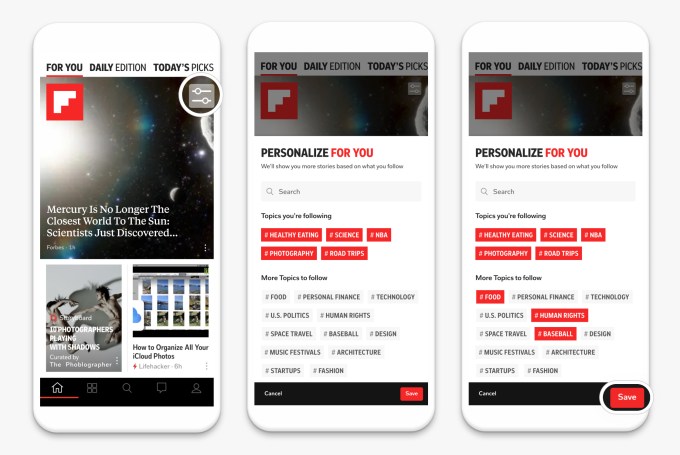
Facebook is preparing to adjust its News Feed to de-emphasize political posts and current events, but news reader Flipboard is instead rolling out an update that puts users in control of their own feeds. The company announced this morning the launch of a new controller on the cover of its own main newsfeed, aka the “For You” feed, which now allows users to select new topics to follow and deselect those they no longer want to hear about. The feature, which Flipboard dubs “an antidote to doomscrolling,” allows users to customize their For You feed to deliver a wider selection stories related to their various interests, instead of focusing their home page on breaking news and politics.

Given today’s current events — a pandemic that’s dragging on, climate change-induced wildfires and major storms, the fall of Afghanistan, and other disasters — it’s no wonder why people want to take a break from the daily news. But for Flipboard, that trend could mean reduced use of its news-reading app, as well.

But while Flipboard notes that millions do use its app to keep up with breaking stories and politics, a majority of its user base also spends their time engaging with other topics — like travel, food, photography, fitness, and parenting.

By introducing tools that allow users to customize their own feeds, the company believes users will not only see improved mental health, but will also spend a longer time in the Flipboard app. Already, this appears to be true, based on other recent changes Flipboard has made.

The company recently introduced topic personalization features, which allowed users to zero in on more niche interests — think, not just cooking but keto cooking; not just health, but mindfulness and sleep, for example. Users who customized their preferences spent between 9 and 12 minutes per day reading stories about these topics, on average, Flipboard found.

With the launch of For You newsfeed controls, Flipboard wants to bring a similar level of customization and control to users’ own homepages.

The company said the feature also addresses the number one request from users — they’ve been asking to have more control over the content selection in their For You feed.

To use the feature, you’ll look for the new filter toggles at the top of the main page. After tapping the icon, you’ll be launched into a window where you can tap and untap a range of topics. You can also use the search bar to discover other interests that may not be listed. When you’re finished customizing, you’ll just tap “Save” to exit back to your newly customized For You feed.

Flipboard hopes its customization capabilities will help it to stand out from other news reading experiences — whether that’s browsing news inside social media feeds or even in dedicated news reading apps.

“This level of content control is unique to Flipboard; just think about how hard it is to adjust your feed on any other platform,” noted Flipboard CEO Mike McCue, when introducing the update.  “A highly personalized feed empowers people to focus on the things that matter to them, without being distracted by doomscrolling, misinformation or browsing through other people’s lives. We build a platform that lets people take control of their media consumption rather than letting it control them,” he added.