Month: August 2021

20 Aug 2021

Alerzo raises $10.5M Series A to bring Nigeria’s informal retail sector online

The process of digitizing the operations of mom and pop stores in Nigeria is serious business right now. In fact, it might be the second-best thing after fintech at the moment.

Today’s news is from Alerzo, a little-known B2B e-commerce retail startup based in Ibadan, Nigeria. The company is announcing a $10.5 million Series A round led by New York-based Nosara Capital. FJ Labs and several family offices from the U.S., Europe and Asia, including Michael Novogratz’s, participated in the round.

In total, Alerzo has raised more than $20 million since its launch. Early investors include the Baobab Network, an Africa-focused accelerator based in London, and Signal Hill, a Singapore-based fund manager that participated in its $5.5 million seed round last year. The company also said it closed a $2.5 million working capital facility to serve its customers.

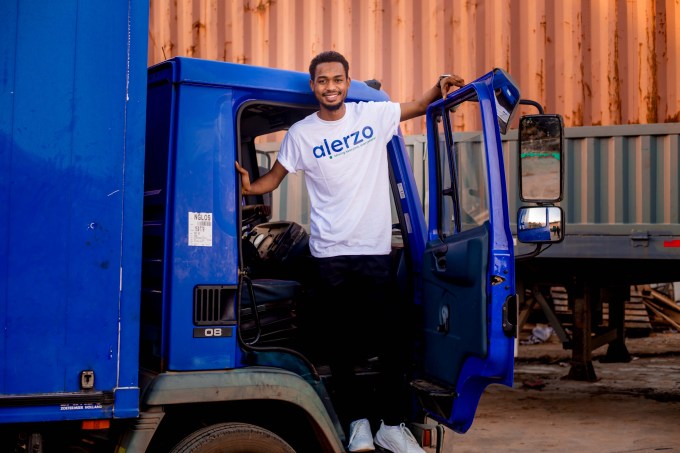
Adewale Opaleye founded Alerzo in 2018 as a last-mile distribution platform that helps retailers stock inventory directly from manufacturers. Its business, officially launched in 2019, is centered on helping street-side vendors and shops in Nigeria’s south-western cities access household supplies quicker and efficiently.

Speaking with TechCrunch, Opaleye said he started Alerzo to empower the millions of women who are the backbone of consumer commerce in Nigeria’s $100 billion informal retail sector.

The need to solve this problem stemmed from observing firsthand the challenges his mom faced while operating two mom-and-pop stores.

“Growing up in Ibadan, I watched my mother operate two informal retail stores to raise my three siblings and me. Seeing the many challenges she faced running her stores, and I decided to start a business that uniquely catered to the needs of retailers just like her,” he told TechCrunch in an interview

These retailers are beholden to an inefficient distribution system that results in inconsistent inventory availability, opaque pricing and limited access to formal financial and banking services.

The founder says Ibadan was the ideal market to establish its headquarters because informal retailers in the region experience these challenges more than those in Lagos.

Alerzo

Adewale Opaleye (Founder & CEO, Alerzo)

Alerzo’s core business distributes FMCG goods using a first-party relationship platform which allows suppliers to clear inventory faster and lets Alerzo control the supply chain and delivery.

Given the lack of trust in the marketplace and the requirement to pay on delivery, Opaleye says this was the most inclusive business model where the economics made sense for the company.

Alerzo claims to have built up a network of up to 100,000 small businesses, 90% of which are women-led. The company exclusively serves the country’s tier-2 to tier-4 cities in Southwest Nigeria — Ibadan, Ekiti and Abeokuta, to name a few. It connects retailers to local and multinational distributors of consumer brands, like Unilever, Nestlé, Procter & Gamble, Dangote, and PZ.

“Without Alerzo, these retailers need to take a day off from the store to visit a central market, pay for transportation and haul a large amount of inventory back to the store. Alerzo replaces this stressful experience by not only reducing costs and time spent running a retail shop but also improving the livelihood of these working women,” said the founder about the company’s growth.

About one-third of the total retailers on Alerzo use the platform monthly. According to its website, retailers can order products via SMS, voice and WhatsApp and deliver them to their stores in less than 10 hours. The company claims to have processed over 1 million orders this past year.

Alerzo owns and operates its full-stack tech-driven supply chain and logistics to process these orders. The company provides warehousing and fulfillment solutions to suppliers and storefront delivery to informal retailers. It currently owns over 200 vehicles and 20 warehouses to serve its thousands of customers.

The last couple of years have seen a rise in last-mile delivery and distribution companies with a large increase in on-demand services across many sectorsWhile most players in Nigeria tend to focus on Lagos and Nigeria’s capital city Abuja, Alerzo’s approach to covering other cities has seemingly paid off so far.

But though Alerzo has enjoyed almost a first-mover advantage in less crowded markets, stiff competition will play out as other key players look to come in. Omnibiz, for instance, has Ibadan in its sights, and TradeDepot is setting up a presence in 10 to 15 cities, aiming to cover all major cities in the country by the end of the year.

Nevertheless, Alerzo’s investors remain bullish on the company’s potentials.

“We’ve studied informal retail marketplaces globally over the last couple of years and Alerzo really stood out to us due to a strong management team led by a founder with a unique understanding of his customer and an attractive business model with exceptional unit economics,” said Ian Loizeaux, the managing partner at Nosara Capital, in a statement. “The company is at the beginning of a compelling multi-decade opportunity to streamline and digitize Nigeria’s retail supply chain.

Seed investor Kevin Jung of Signal Hill cites Alerzo’s focus on the informal retail market outside Lagos as one of the reasons why he backed Alerzo earlier on. He also referred to the company’s orientation toward Asia (a playbook Opaleye adopted when he went to China for studies in 2016), as the best reference point for the emerging business model of digitizing informal retail markets

Alerzo has an office in Singapore that the CEO says serves as a regional hub to identify best practices among similar high-growth businesses operating across Southeast Asia and India and adapt them to the Nigerian market. Likewise, to expand its digital footprint, the company recently launched an office in Lagos.   

The proceeds from this Series A round will be used to expand geographically to northern Nigeria. Alerzo also plans to launch AlerzoPay, the company’s cashless payments and lending platform, as well as a portfolio of new business support services.

20 Aug 2021

Microsoft backs India’s Oyo at $9.6 billion valuation

Microsoft has invested $5 million in Indian budget hotel chain Oyo, according to a regulatory filing this week. The investment confirms a TechCrunch scoop from last month.

The new investment values Oyo at $9.6 billion, only slightly below the $10 billion implied valuation from the Indian startup’s previous financing round in 2019. The startup, which lost significant business to the pandemic, was valued at just $3 billion in recent quarters by SoftBank, one of its largest investors.

TechCrunch reported earlier that this strategic investment may also involve Oyo shifting to use Microsoft’s cloud services. The company is planning to file for an IPO later this year, according to two people familiar with the matter.

Oyo, which is one of India’s most valuable startups, has aggressively expanded to many markets including Southeast Asia, Europe and the U.S. in recent years.  But some of its missteps — “toxic culture,” lapse in governance, and relationship with many hotel owners — have scarred its growth.

Just as the startup was pledging to improve its relationship with hotel owners, the pandemic arrived. In response, Oyo slowed its growth and laid off thousands of employees globally earlier this year as nations across the world enforced lockdowns.

The pandemic hit the seven-year-old startup like a “cyclone,” Agarwal told Bloomberg TV last month. “We built something for so many years and it took just 30 days for it drop by over 60%,” he said, adding that the firm had not made any decision on exploring the public markets.

Airbnb-backed Oyo had between $780 million to $800 million in its bank, Agarwal said at a virtual conference recently and had pared its “monthly burn” across all businesses to $4 million to $5 million. (The startup had about $1 billion in the bank in December 2020.)

Last month — after Agarwal’s remarks at the aforementioned conference — Oyo said it had raised $660 million in debt. That debt was used to pay off the previous debt, according to a person familiar with the matter.

If the deal between the two firms materializes, it will be Microsoft’s latest investment in an Indian startup. The firm has backed a handful of startups in the South Asian market, including news aggregator and short-video platform DailyHunt, e-commerce giant Flipkart, and logistics SaaS firm FarEye.

20 Aug 2021

Microsoft backs India’s Oyo at $9.6 billion valuation

Microsoft has invested $5 million in Indian budget hotel chain Oyo, according to a regulatory filing this week. The investment confirms a TechCrunch scoop from last month.

The new investment values Oyo at $9.6 billion, only slightly below the $10 billion implied valuation from the Indian startup’s previous financing round in 2019. The startup, which lost significant business to the pandemic, was valued at just $3 billion in recent quarters by SoftBank, one of its largest investors.

TechCrunch reported earlier that this strategic investment may also involve Oyo shifting to use Microsoft’s cloud services. The company is planning to file for an IPO later this year, according to two people familiar with the matter.

Oyo, which is one of India’s most valuable startups, has aggressively expanded to many markets including Southeast Asia, Europe and the U.S. in recent years.  But some of its missteps — “toxic culture,” lapse in governance, and relationship with many hotel owners — have scarred its growth.

Just as the startup was pledging to improve its relationship with hotel owners, the pandemic arrived. In response, Oyo slowed its growth and laid off thousands of employees globally earlier this year as nations across the world enforced lockdowns.

The pandemic hit the seven-year-old startup like a “cyclone,” Agarwal told Bloomberg TV last month. “We built something for so many years and it took just 30 days for it drop by over 60%,” he said, adding that the firm had not made any decision on exploring the public markets.

Airbnb-backed Oyo had between $780 million to $800 million in its bank, Agarwal said at a virtual conference recently and had pared its “monthly burn” across all businesses to $4 million to $5 million. (The startup had about $1 billion in the bank in December 2020.)

Last month — after Agarwal’s remarks at the aforementioned conference — Oyo said it had raised $660 million in debt. That debt was used to pay off the previous debt, according to a person familiar with the matter.

If the deal between the two firms materializes, it will be Microsoft’s latest investment in an Indian startup. The firm has backed a handful of startups in the South Asian market, including news aggregator and short-video platform DailyHunt, e-commerce giant Flipkart, and logistics SaaS firm FarEye.

20 Aug 2021

Top four highlights of Elon Musk’s Tesla AI Day

Elon Musk wants Tesla to be seen as “much more than an electric car company.” On Thursday’s Tesla AI Day, the CEO described Tesla as a company with “deep AI activity in hardware on the inference level and on the training level” that can be used down the line for applications beyond self-driving cars, including a humanoid robot that Tesla is apparently building.

Tesla AI Day, which started after a rousing 45 minutes of industrial music pulled straight from “The Matrix” soundtrack, featured a series of Tesla engineers explaining various Tesla tech with the clear goal of recruiting the best and brightest to join Tesla’s vision and AI team and help the company go to autonomy and beyond.

“There’s a tremendous amount of work to make it work and that’s why we need talented people to join and solve the problem,” said Musk.

Like both “Battery Day” and “Autonomy Day,” the event on Thursday was streamed live on Tesla’s YouTube channel. There was a lot of super technical jargon, but here are the top four highlights of the day.

Tesla Bot: A definitely real humanoid robot

This bit of news was the last update to come out of AI Day before audience questions began, but it’s certainly the most interesting. After the Tesla engineers and executives talked about computer vision, the Dojo supercomputer and the Tesla chip (all of which we’ll get to in a moment), there was a brief interlude where what appeared to be an alien go-go dancer appeared on the stage, dressed in a white body suit with a shiny black mask as a face. Turns out, this wasn’t just a Tesla stunt, but rather an intro to the Tesla Bot, a humanoid robot that Tesla is actually building.

Image Credits: Tesla

When Tesla talks about using its advanced technology in applications outside of cars, we didn’t think he was talking about robot slaves. That’s not an exaggeration. CEO Elon Musk envisions a world in which the human drudgery like grocery shopping, “the work that people least like to do,” can be taken over by humanoid robots like the Tesla Bot. The bot is 5’8″, 125 pounds, can deadlift 150 pounds, walk at 5 miles per hour and has a screen for a head that displays important information.

“It’s intended to be friendly, of course, and navigate a world built for humans,” said Musk. “We’re setting it such that at a mechanical and physical level, you can run away from it and most likely overpower it.”

Because everyone is definitely afraid of getting beat up by a robot that’s truly had enough, right?

The bot, a prototype of which is expected for next year, is being proposed as a non-automotive robotic use case for the company’s work on neural networks and its Dojo advanced supercomputer. Musk did not share whether the Tesla Bot would be able to dance.

Unveiling of the chip to train Dojo

Image Credits: Tesla

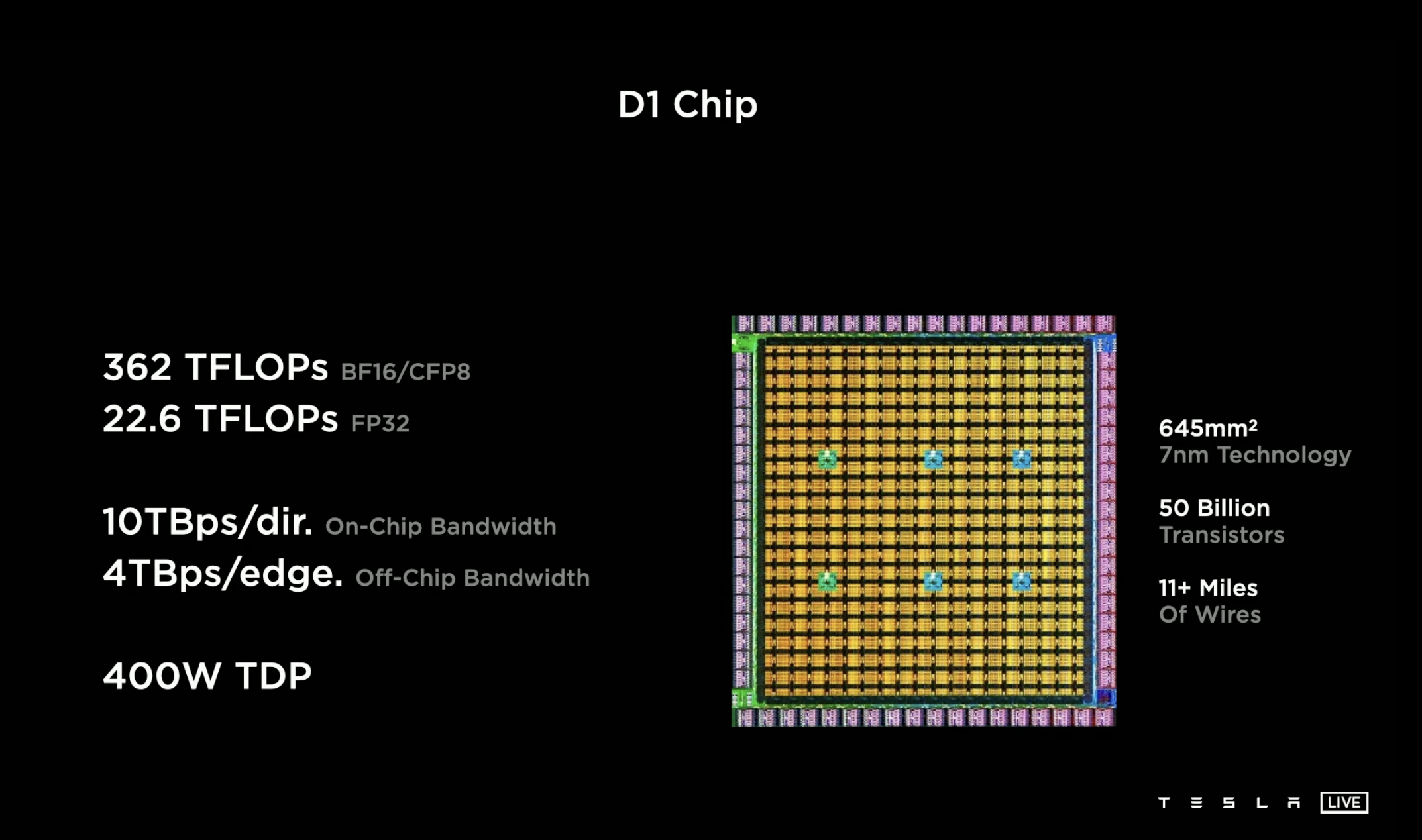
Tesla director Ganesh Venkataramanan unveiled Tesla’s computer chip, designed and built entirely in-house, that the company is using to run its supercomputer, Dojo. Much of Tesla’s AI architecture is dependent on Dojo, the neural network training computer that Musk says will be able to process vast amounts of camera imaging data four times faster than other computing systems. The idea is that the Dojo-trained AI software will be pushed out to Tesla customers via over-the-air updates. 

The chip that Tesla revealed on Thursday is called “D1,” and it contains a 7 nm technology. Venkataramanan proudly held up the chip that he said has GPU-level compute with CPU connectivity and twice the I/O bandwidth of “the state of the art networking switch chips that are out there today and are supposed to be the gold standards.” He walked through the technicalities of the chip, explaining that Tesla wanted to own as much of its tech stack as possible to avoid any bottlenecks. Tesla introduced a next-gen computer chip last year, produced by Samsung, but it has not quite been able to escape the global chip shortage that has rocked the auto industry for months. To survive the shortage, Musk said during an earnings call this summer that the company had been forced to rewrite some vehicle software after having to substitute in alternate chips. 

Aside from limited availability, the overall goal of taking the chip production in-house is to increase bandwidth and decrease latencies for better AI performance.

“We can do compute and data transfers simultaneously, and our custom ISA, which is the instruction set architecture, is fully optimized for machine learning workloads,” said Venkataramanan at AI Day. “This is a pure machine learning machine.”

Venkataramanan also revealed a “training tile” that integrates multiple chips to get higher bandwidth and an incredible computing power of 9 petaflops per tile and 36 terabytes per second of bandwidth. Together, the training tiles compose the Dojo supercomputer. 

To Full Self-Driving and beyond

Many of the speakers at the AI Day event noted that Dojo will not just be a tech for Tesla’s “Full Self-Driving” (FSD) system, it’s definitely impressive advanced driver assistance system that’s also definitely not yet fully self-driving or autonomous. The powerful supercomputer is built with multiple aspects, such as the simulation architecture, that the company hopes to expand to be universal and even open up to other automakers and tech companies.

“This is not intended to be just limited to Tesla cars,” said Musk. “Those of you who’ve seen the full self-driving beta can appreciate the rate at which the Tesla neural net is learning to drive. And this is a particular application of AI, but I think there’s more applications down the road that will make sense.”

Musk said Dojo is expected to be operational next year, at which point we can expect talk about how this tech can be applied to many other use cases.

Solving computer vision problems

During AI Day, Tesla backed its vision-based approach to autonomy yet again, an approach that uses neural networks to ideally allow the car to function anywhere on earth via its “Autopilot” system. Tesla’s head of AI, Andrej Karpathy, described Tesla’s architecture as “building an animal from the ground up” that moves around, senses its environment and acts intelligently and autonomously based on what it sees.

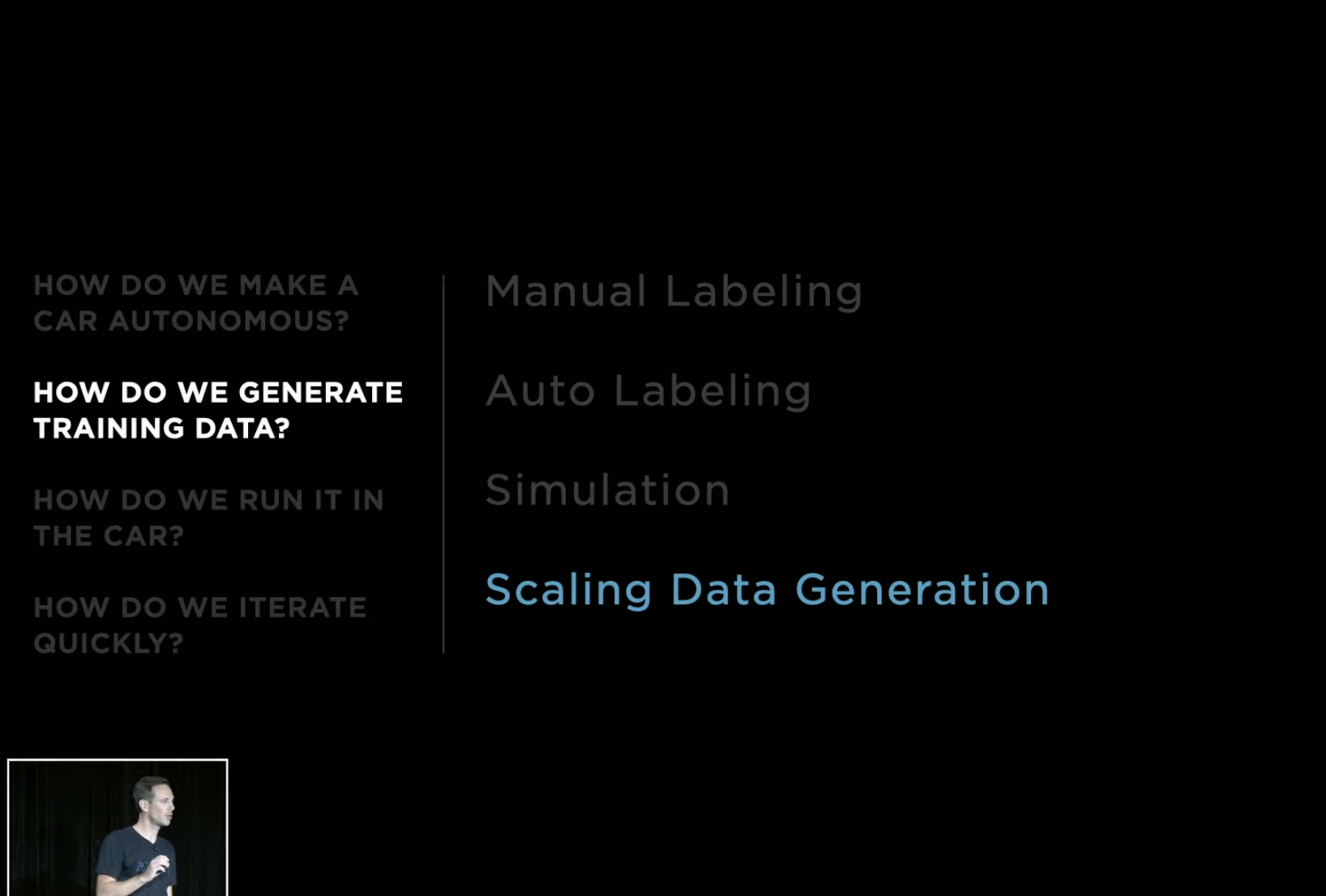
Andrej Karpathy, head of AI at Tesla, explaining how Tesla manages data to achieve computer vision-based semi-autonomous driving. Image Credits: Tesla

“So we are building of course all of the mechanical components of the body, the nervous system, which has all the electrical components, and for our purposes, the brain of the autopilot, and specifically for this section the synthetic visual cortex,” he said.

Karpathy illustrated how Tesla’s neural networks have developed over time, and how now, the visual cortex of the car, which is essentially the first part of the car’s “brain” that processes visual information, is designed in tandem with the broader neural network architecture so that information flows into the system more intelligently.  

The two main problems that Tesla is working on solving with its computer vision architecture are temporary occlusions (like cars at a busy intersection blocking Autopilot’s view of the road beyond) and signs or markings that appear earlier in the road (like if a sign 100 meters back says the lanes will merge, the computer once upon a time had trouble remembering that by the time it made it to the merge lanes).

To solve for this, Tesla engineers fell back on a spatial recurring network video module, wherein different aspects of the module keep track of different aspects of the road and form a space-based and time-based queue, both of which create a cache of data that the model can refer back to when trying to make predictions about the road.

The company flexed its over 1,000-person manual data labeling team and walked the audience through how Tesla auto-labels certain clips, many of which are pulled from Tesla’s fleet on the road, in order to be able to label at scale. With all of this real-world info, the AI team then uses incredible simulation, creating “a video game with Autopilot as the player.” The simulations help particularly with data that’s difficult to source or label, or if it’s in a closed loop.

Background on Tesla’s FSD

At around minute forty in the waiting room, the dubstep music was joined by a video loop showing Tesla’s FSD system with the hand of a seemingly alert driver just grazing the steering wheel, no doubt a legal requirement for the video after investigations into Tesla’s claims about the capabilities of its definitely not autonomous advanced driver assistance system, Autopilot. The National Highway Transportation and Safety Administration earlier this week said they would open a preliminary investigation into Autopilot following 11 incidents in which a Tesla crashed into parked emergency vehicles. 

A few days later, two U.S. Democratic senators called on the Federal Trade Commission to investigate Tesla’s marketing and communication claims around Autopilot and the “Full Self-Driving” capabilities. 

Tesla released the beta 9 version of Full Self-Driving to much fanfare in July, rolling out the full suite of features to a few thousand drivers. But if Tesla wants to keep this feature in its cars, it’ll need to get its tech up to a higher standard. That’s where Tesla AI Day comes in. 

“We basically want to encourage anyone who is interested in solving real-world AI problems at either the hardware or the software level to join Tesla, or consider joining Tesla,” said Musk.

And with technical nuggets as in-depth as the ones featured on Thursday plus a bumping electronic soundtrack, what red-blooded AI engineer wouldn’t be frothing at the mouth to join the Tesla crew?

You can watch the whole thing here: 

20 Aug 2021

Musk: The Tesla Bot is coming

Remember that weird Will Smith movie about robots?

Yeah, neither do we. But Elon Musk does. Tesla is developing a 5’8” Tesla Bot, with a prototype expected sometime next year. The news comes during Tesla’s inaugural AI Day, which was streamed on the company’s website Thursday night.

The bot is being proposed as a non-automotive robotic use case for the company’s work on neural networks and its Dojo advanced supercomputer.

Image Credits: Tesla

“Basically, if you think about what we’re doing right now with cars, Tesla is arguably the world’s biggest robotics company because our cars are like semi-sentient robots on wheels,” Musk said. “With the Full Self-Driving computer, [ … ] which will keep evolving, and Dojo and all the neural nets recognizing the world, understanding how to navigate through the world, it kind of makes sense to put that on to a humanoid form.”The bot is “intended to be friendly and navigate through a world built for humans,” he added. He also said they’re developing it so that humans can run away from it and overpower it easily. It’ll weigh 125 pounds and have a walking gait of 5 miles per hour.

Interestingly, Musk is imagining this as replacing much of the human drudge work that currently occupies so many people’s lives — not just labor but things like grocery shopping and other everyday tasks. He waxed about a future in which physical work would be a choice, with all the attendant implications that might mean for the economy.

“In the long term I do think there needs to be universal basic income,” Musk said. “But not right now because the robot doesn’t work.”

Developing…

20 Aug 2021

Indonesian D2C insurance marketplace Lifepal raises $9M Series A

Choosing an insurance policy is one of the most complicated financial decisions a person can make. Jakarta-based Lifepal wants to simplify the process for Indonesians with a marketplace that lets users compare policies from more than 50 providers, get help from licensed agents and file claims. The startup, which says it is the country’s largest direct-to-consumer insurance marketplace, announced today it has raised a $9 million Series A. The round was led by ProBatus Capital, a venture firm backed by Prudential Financial, with participation from Cathay Innovation and returning investors Insignia Venture Partners, ATM Capital and Hustle Fund.

Lifepal was founded in 2019 by former Lazada executives Giacomo Ficari and Nicolo Robba, along with Benny Fajarai and Reza Muhammed. The new funding brings its total raised to $12 million.

The marketplace’s partners currently offer about 300 policies for life, health, automotive, property and travel coverage. Ficari, who also co-founded neobank Aspire, told TechCrunch that Lifepal was created to make comparing, buying and claiming insurance as simple as shopping online.

“The same kind of experience a customer has today on a marketplace like Lazada—the convenience, all digital, fast delivery—we saw was lacking in insurance, which is still operating with offline, face-to-face agents like 20 to 30 years ago,” he said.

Indonesia’s insurance penetration rate is only about 3%, but the market is growing along with the country’s gross domestic product thanks to a larger middle-class. “We are really at a tipping point for GDP per capita and a lot of insurance carriers are focusing more on Indonesia,” said Ficari.

Other venture-backed insurtech startups tapping into this demand include Fuse, PasarPolis and Qoala. Both Qoala and PasarPolis focus on “micro-policies,” or inexpensive coverage for things like damaged devices. PasarPolis also partners with Gojek to offer health and accident insurance to drivers. Fuse, meanwhile, insurance specialists an online platform to run their businesses.

Lifepal takes a different approach because it doesn’t sell micro-policies, and its marketplace is for customers to purchase directly from providers, not through agents.
Based on Lifepal’s data, about 60% of its health and life insurance customers are buying coverage for the first time. On the other hand, many automotive insurance shoppers had policies before, but their coverage expired and they decided to shop online instead of going to an agent to get a new one.

Ficari said Lifepal’s target customers overlap with the investment apps that are gaining traction among Indonesia’s growing middle class (like Ajaib, Pluang and Pintu). Many of these apps provide educational content, since their customers are usually millennials investing for the first time, and Lifepal takes a similar approach. Its content side, called Lifepal Media, focuses on articles for people who are researching insurance policies and related topics like personal financial planning. The company says its site, including its blog, now has about 4 million monthly visitors, creating a funnel for its marketplace.

While one of Lifepal’s benefits is enabling people to compare policies on their own, many also rely on its customer support line, which is staffed by licensed insurance agents. In fact, Ficari said about 90% of its customers use it.

“What we realize is that insurance is complicated and it’s expensive,” said Ficari. “People want to take their time to think and they have a lot of questions, so we introduced good customer support.” He added Lifepal’s combination of enabling self-research while providing support is similar to the approach taken by PolicyBazaar in India, one of the country’s largest insurance aggregators.

To keep its business model scalable, Lifepal uses a recommendation engine that matches potential customers with policies and customer support representatives. It considers data points like budget (based on Lifepal’s research, its customers usually spend about 3% to 5% of their yearly income on insurance), age, gender, family composition and if they have purchased insurance before.

Lifepal’s investment from ProBatus will allow it to work with Assurance IQ, the insurance sales automation platform acquired by Prudential Financial two years ago.

In a statement, ProBatus Capital founder and managing partner Ramneek Gupta said Lifepal’s “three-pronged approach” (its educational content, online marketplace and live agents for customer support) has the “potential to change the way the Indonesian consumer buys insurance.”

Part of Lifepal’s funding will be used to build products to make it easier to claim policies. Upcoming products include Insurance Wallet, which will include an application process with support on how to claim a policy—for example, what car repair shop or hospital a customer should go to—and escalation if a claim is rejected. Another product, called Easy Claim, will automate the claim process.

“The goal is to stay end-to-end with the customer, from reading content, comparing policies, buying and then renewing and using them, so you really see people sticking around,” said Ficari.

Lifepal is Cathay Innovation’s third insurtech investment in the past 12 months. Investment director Rajive Keshup told TechCrunch in an email that it backed Lifepal because “the company grew phenomenally last year (12X) and is poised to beat its aggressive 2021 plan despite the proliferation of the COVID delta variant, accentuating the fact that Lifepal is very much on track to replicate the success of similar global models such as Assurance IQ (US) and PolicyBazaar (India).”

19 Aug 2021

Daily Crunch: Under pressure from ‘banking partners and payout providers,’ OnlyFans bans explicit content

To get a roundup of TechCrunch’s biggest and most important stories delivered to your inbox every day at 3 p.m. PDT, subscribe here.

Hello and welcome to Daily Crunch for August 19, 2021. Today is a good day, with lots of interesting news, and even a hot, fresh newsletter from the TechCrunch team. More on that in a moment. Before we start, UiPath CEO Daniel Dines is coming to our October SaaS event. It’s going to be, as the kids say, lit. — Alex

The TechCrunch Top 3

  • OnlyFans to kick some adult content off its service: In a move that temporarily broke Twitter and melted TechCrunch servers, well-known subscription content service OnlyFans is moving away from its traditional content varietal. “OnlyFans did not respond to TechCrunch’s inquiries as to its definition of sexually explicit content or how it expected this would impact the company’s bottom line,” is a good summary of where this story is. Expect more as it evolves.
  • Chicago puts points on the board for the Midwest: When COVID shook up the venture capital market last year, one city in particular saw its fortunes change — for the better. Since the second half of 2020, Chicago has seen huge sums of money pour into its local startups. We wanted to better understand what happened, and why.
  • Feedback divided on Facebook’s meeting VR app: Our own Lucas Matney was modestly positive about Facebook’s new VR service that mimics a conference room. So that we can all enjoy that office vibe from home. Some folks noted that the tech could be great for folks who might have a harder time physically commuting. And lots of people thought it looked like a hot mess on stilts and more of a method for Facebook to change the narrative about its various regulatory issues than really move the VR ball forward.

Startups/VC

Do you love robots and want more robotics in your life? Good news! We’ve shared Brian Heater’s robot roundups here on Daily Crunch for months now. But we won’t have to in the future, because he’s rolling out a newsletter just for the subject. Friends, meet Actuator.

  • The Standard Oil of cannabis delivery: Eaze is buying Green Dragon, which is actually pretty big news in the cannabis delivery market. If you live in a part of the U.S., or the world, where you cannot get weed delivered to your house, weep. Civilization will reach you soon enough. Perhaps via an Eaze courier.
  • Bird launches electric bike: Bird is busy going public via a SPAC — and it recently dropped its Q2 numbers, mind — but that’s not all the scooter company is up to. It also built an electric bike. Which is frankly cool, as we should rip out a bunch of streets in global cities and replace them with bike paths and green spaces.
  • Global regulations as a service: That’s the gambit behind Regology, a startup that automates the process of understanding local laws the world ‘round. As companies increasingly go remote, and the internet has made global commerce the norm, Regology could be onto something. Also from this story, there actually is a venture capital firm called “Acme Capital.” Perhaps they invest in anvils, dynamite and other contra-Road-Runner products.
  • Launch House raises $3M to scale venture community: This one is a little bit complicated, so read the story. But in essence: Launch House is building a class-based startup community in physical and digital spaces. And it just put together seven figures of capital to pursue its vision.
  • Today’s Tiger Global round is Nacelle: What is Nacelle, and why did Tiger just lead a $50 million Series B into the company? Nacelle is a headless commerce solution. And Tiger just backed it because it’s a headless commerce solution. If that makes sense.
  • Hitting the TechCrunch website just after we capped off the Daily Crunch draft yesterday, Ron Miller and I put together some notes on what Databricks might look like at a $38 billion valuation. Enjoy!

Let’s make a deal: A crash course on corporate development

Venrock Vice President Todd Graham has some frank advice for founders at venture-backed startups: “It would be wise to generate a return at some point.”

With that in mind, he authored a primer on corporate development that lays out the three most common categories of acquisitions, tips for dealing with bankers and explains why striking a partnership with a big company isn’t always the best way forward.

Regardless of the path you choose, “you need to take the meeting,” advises Graham.

“In the worst-case scenario, you’ll get a few new LinkedIn connections and you’re now a known quantity. The best-case scenario will be a second meeting.”

(Extra Crunch is our membership program, which helps founders and startup teams get ahead. You can sign up here.)

Big Tech Inc.

  • Twitter’s newsletter push is just getting started: Twitter is building out better integrations between its Revue newsletter service and its main interface. This is not a surprise, but is welcome all the same. Whether Twitter can become a material anti-Substack is not yet clear.
  • Facebook wants to eat TikTok’s lunch: Facebook is bringing its Reels product to the United States. So, if you prefer Facebook to own your data instead of a ByteDance subsidiary, here’s your chance.
  • Congress wants to eat TikTok’s lunch: Speaking of ByteDance, TikTok’s plans to collect biometric data of its user base is not popular in the U.S. Congress. This is not a surprise. Especially because the Chinese Communist Party takes a board seat in ByteDance’s key China-based company.
  • GM wants to put 5G in your ride: From an entirely orthogonal corner of the technology universe, GM is working with U.S. telco AT&T to put 5G into cars. I don’t know precisely why we need this, or if there is enough 5G juice really out there to even squeeze out a single glass of lemonade, but here it is all the same.

TechCrunch Experts: Growth Marketing

Illustration montage based on education and knowledge in blue

Image Credits: SEAN GLADWELL (opens in a new window) / Getty Images

We’re reaching out to startup founders to tell us who they turn to when they want the most up-to-date growth marketing practices. Fill out the survey here.

Read one of the testimonials we’ve received below!

Marketer: Nate Dame, Profound Strategy

Recommended by: Diana Tamblyn, Danaher

Testimonial: “[I] did a fairly extensive search for a content partner. [I] was impressed with their expertise, their references (I spoke to three) and their growth forecasting.”

19 Aug 2021

Google says geofence warrants make up one-quarter of all US demands

For the first time, Google has published the number of geofence warrants it’s historically received from U.S. authorities, providing a rare glimpse into how frequently these controversial warrants are issued.

The figures, published Thursday, reveal that Google has received thousands of geofence warrants each quarter since 2018, and at times accounted for about one-quarter of all U.S. warrants that Google receives. The data shows that the vast majority of geofence warrants are obtained by local and state authorities, with federal law enforcement accounting for just 4% of all geofence warrants served on the technology giant.

According to the data, Google received 982 geofence warrants in 2018, 8,396 in 2019, and 11,554 in 2020. But the figures only provide a small glimpse into the volume of warrants received, and did not break down how often it pushes back on overly broad requests. A spokesperson for Google would not comment on the record.

Albert Fox Cahn, executive director of the Surveillance Technology Oversight Project (STOP), which led efforts by dozens of civil rights groups to lobby for the release of these numbers, commended Google for releasing the numbers.

“Geofence warrants are unconstitutionally broad and invasive, and we look forward to the day they are outlawed completely.” said Cahn.

Geofence warrants are also known as “reverse-location” warrants, since they seek to identify people of interest who were in the near-vicinity at the time a crime was committed. Police do this by asking a court to order Google, which stores vast amounts of location data to drive its advertising business, to turn over details of who was in a geographic area, such as a radius of a few hundred feet at a certain point in time, to help identify potential suspects.

Google has long shied away from providing these figures, in part because geofence warrants are largely thought to be unique to Google. Law enforcement has long known that Google stores vast troves of location data on its users in a database called Sensorvault, first revealed by The New York Times in 2019.

Sensorvault is said to have the detailed location data on “at least hundreds of millions of devices worldwide,” collected from users’ phones when they use an Android device with location data switched on, or Google services like Google Maps and Google Photo, and even Google search results. In 2018, the Associated Press reported that Google could still collect users’ locations even when their location history is “paused.”

But critics have argued that geofence warrants are unconstitutional because the authorities compel Google to turn over data on everyone else who was in the same geographic area.

Worse, these warrants have been known to ensnare entirely innocent people.

TechCrunch reported earlier this year that Minneapolis police used a geofence warrant to identify individuals accused of sparking violence in the wake of the police killing of George Floyd last year. One person on the ground who was filming and documenting the protests had his location data requested by police for being close to the violence. NBC News reported last year how one Gainesville, Fla. resident whose information was given by Google to police investigating a burglary, but was able to prove his innocence thanks to an app on his phone that tracked his fitness activity.

Although the courts have yet to deliberate widely on the legality of geofence warrants, some states are drafting laws to push back against geofence warrants. New York lawmakers proposed a bill last year that would ban geofence warrants in the state, amid fears that police could use these warrants to target protesters — as what happened in Minneapolis.

Cahn, who helped introduce the New York bill last year, said the newly released data will “help spur lawmakers to outlaw the technology.”

“Let’s be clear, the number of geofence warrants should be zero,” he said.

19 Aug 2021

Arianna Simpson of a16z on Yield Guild Games, the firm’s newest bet on crypto + gaming

As one of four general partners at Andreessen Horowitz who are now investing the venture firm’s third crypto fund, a $2.2 billion vehicle, Arianna Simpson is very focused on how to return that capital and much more to the firm’s limited partners.

Toward that end, she has been more focused of late on startups that combine crypto with gaming. Last month, for example, her team co-led an investment in Virtually Human Studio, the startup behind a digital horse racing service Zed Run, wherein users buy, sell and breed virtual horses whose value rises depending on their performance against other virtual horses. (Each is essentially a non-fungible token, or NFT, meaning it is unique.)

Simpson is relatedly intrigued with NFT-based “play-to-earn” models, wherein gamers can earn cryptocurrency that they can then cash out for their local currency if they so choose. Indeed, a16z is announcing today that it just led a $4.6 million investment in the tokens of Yield Guild Games (YGG), a decentralized gaming startup based in the Philippines that invites players to share in the company’s revenue by playing games like “Axie Infinity,” a blockchain-based game where players breed, battle, and trade digital creatures names Axies in order to earn tokens called “Small Love Potion” that they can eventually cash out. YGG lends the money to buy the Axies and other digital assets to start the game, so they they can start earning money. (The obvious hope is that they earn more than they have to pay YGG for the use of its assets.)

We talked yesterday with Simpson — who joined a16z after first backing some of the same startups, including the blockchain infrastructure company Dapper Labs and the global payment platform Celo —  to learn more about what’s happening at the intersection of crypto and gaming. She also shared what platforms a16z tracks most closely to identify up-and-coming crypto startups. Our chat, edited for length, follows.

TC: Zed Run is really interesting. How did you first come across this digital horse racing business?

AS: I think it was crypto Twitter, which honestly is where we’re finding a lot of our gaming investments. The community on there is really incredible and often one of the first places where really exciting new projects are surfaced.

Zed really marks the advent of kind of a new type of more involved gameplay in crypto. If you look at [the collectibles game] Crypto Kitties, it was one of the first NFT-based games that really caught the attention of people outside of the crypto sphere. Zed is definitely a derivative extension in the sense that you have a digital animal that you’re playing with, but the gameplay is much more complex, and the thing that’s been incredible to watch is just how excited the community is. People are putting together all kinds of very sophisticated guides around how to play the game, to read [race] courses, how to do all kinds of different things in the game, and tens of thousands of people all over the world [are playing].

TC: Maybe these already exist, but are there endless opportunities across verticals here, like, say, a digital car racing equivalent or a UFC-style equivalent or people are buying and betting on digital fighters and hoping they’ll rise in value?

AS: There’s an incredibly broad range of possibilities in terms of what’s happening and what will happen in the universe of crypto games. I think at the core of this movement is really the idea of giving more of the value and ownership in these in game assets back to the players.That’s something that has historically been a problem. You might spend years and years building up your arsenal of skins or in-game assets , and then a game will change the rules take [some of your winnings] away from you or do any number of things that can leave players feeling very disappointed and kind of ripped off. The idea [with blockchain-based games] is to make them more open and allow players to have actual ownership in the space themselves.

TC: Which leads us to your newest investment, Yield Guild Games, or YGG. Why did this company capture the firm’s attention?

AS: During the pandemic, a lot of people were put out of work and not able to provide for themselves and for their families. This time kind of coincided with the rise of a game called “Axe Infinity,” one of the first games to pioneer a play-to-earn model, which is becoming a very important theme in crypto games.

In order to play “Axe Infinity,” you need to have three Axies, and generally speaking, that means you need
to buy them upfront. Obviously if you’re out of work, you have no money [so buying these digital pets] can become a very challenging proposition. So [YGG founder] Gabby Dizon in the Philippines, who played “Axe Infinity” started lending out his Axies so other peple could play the game and earn tokens that could then be converted to local currency. And so basically YGG emerged as sort of the productization of what they were doing here, so YGG either purchases or breeds in-game assets that are yield-earning, then loans them to out “scholars,” who are the recipients of these in-game assets, and YGG then takes a small cut of the in-game revenue that the players generate over time.

TC: Does a “scholar” have to be a sophisticated player?

AS: There are managers who basically manage teams of scholars; they’re the ones who effectively decide who to bring into the guild.

TC: So these Axies can be cashed out for currency, but where, and who is buying them?

AS: They can be bought or sold on exchanges and other players are buying them if they need to breed in “Axe” and needs some [Axies]; others are buying them for investment purposes. Also, they aren’t necessarily selling the NFTs but they may be selling the tokens that they earn as part of the gameplay.

TC: There are now 5,000 of these scholars playing the game. Are they mostly in Southeast Asia?

AS: A majority of the players and scholars are in Southeast Asia, but we’re seeing really strong international growth as well, both for “Axe Infinity” and YGG, in particular. At this point, scaling internationally is definitely a core focus for the YGG team.

TC: You mentioned crypto Twitter. What about Discord and Reddit? Where else are you looking around for new crypto projects that are bubbling up and capturing people’s imagination?

AS: All of the above. Discord in particular is very actively used by the crypto community, and the thing that’s interesting there is it really allows you to get a pulse for how active a community is, how engaged people are, how frequently they’re talking, and what they’re talking about. It gives you a look into the community at large and that’s very important thing to consider when looking to make an investment or assess the health of a project.

19 Aug 2021

Today’s real story: The Facebook monopoly

Facebook is a monopoly. Right?

Mark Zuckerberg appeared on national TV today to make a “special announcement.” The timing could not be more curious: Today is the day Lina Khan’s FTC refiled its case to dismantle Facebook’s monopoly.

To the average person, Facebook’s monopoly seems obvious. “After all,” as James E. Boasberg of the U.S. District Court for the District of Columbia put it in his recent decision, “No one who hears the title of the 2010 film ‘The Social Network’ wonders which company it is about.” But obviousness is not an antitrust standard. Monopoly has a clear legal meaning, and thus far Lina Khan’s FTC has failed to meet it. Today’s refiling is much more substantive than the FTC’s first foray. But it’s still lacking some critical arguments. Here are some ideas from the front lines.

To the average person, Facebook’s monopoly seems obvious. But obviousness is not an antitrust standard.

First, the FTC must define the market correctly: personal social networking, which includes messaging. Second, the FTC must establish that Facebook controls over 60% of the market — the correct metric to establish this is revenue.

Though consumer harm is a well-known test of monopoly determination, our courts do not require the FTC to prove that Facebook harms consumers to win the case. As an alternative pleading, though, the government can present a compelling case that Facebook harms consumers by suppressing wages in the creator economy. If the creator economy is real, then the value of ads on Facebook’s services is generated through the fruits of creators’ labor; no one would watch the ads before videos or in between posts if the user-generated content was not there. Facebook has harmed consumers by suppressing creator wages.

A note: This is the first of a series on the Facebook monopoly. I am inspired by Cloudflare’s recent post explaining the impact of Amazon’s monopoly in their industry. Perhaps it was a competitive tactic, but I genuinely believe it more a patriotic duty: guideposts for legislators and regulators on a complex issue. My generation has watched with a combination of sadness and trepidation as legislators who barely use email question the leading technologists of our time about products that have long pervaded our lives in ways we don’t yet understand. I, personally, and my company both stand to gain little from this — but as a participant in the latest generation of social media upstarts, and as an American concerned for the future of our democracy, I feel a duty to try.

The problem

According to the court, the FTC must meet a two-part test: First, the FTC must define the market in which Facebook has monopoly power, established by the D.C. Circuit in Neumann v. Reinforced Earth Co. (1986). This is the market for personal social networking services, which includes messaging.

Second, the FTC must establish that Facebook controls a dominant share of that market, which courts have defined as 60% or above, established by the 3rd U.S. Circuit Court of Appeals in FTC v. AbbVie (2020). The right metric for this market share analysis is unequivocally revenue — daily active users (DAU) x average revenue per user (ARPU). And Facebook controls over 90%.

The answer to the FTC’s problem is hiding in plain sight: Snapchat’s investor presentations:
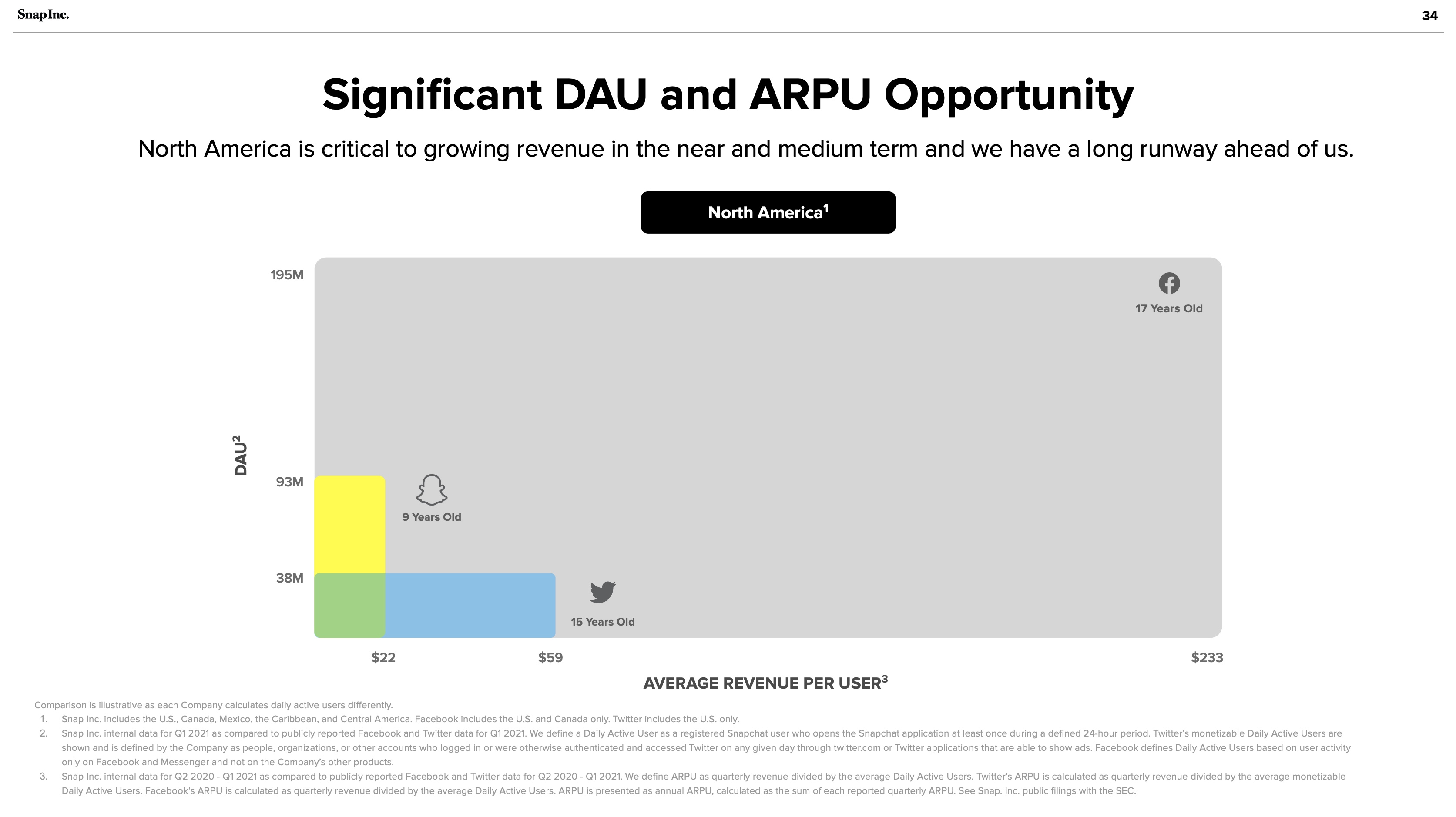
Snapchat July 2021 investor presentation: Significant DAU and ARPU Opportunity

Snapchat July 2021 investor presentation: Significant DAU and ARPU Opportunity. Image CreditsSnapchat

This is a chart of Facebook’s monopoly — 91% of the personal social networking market. The gray blob looks awfully like a vast oil deposit, successfully drilled by Facebook’s Standard Oil operations. Snapchat and Twitter are the small wildcatters, nearly irrelevant compared to Facebook’s scale. It should not be lost on any market observers that Facebook once tried to acquire both companies.

The market Includes messaging

The FTC initially claimed that Facebook has a monopoly of the “personal social networking services” market. The complaint excluded “mobile messaging” from Facebook’s market “because [messaging apps] (i) lack a ‘shared social space’ for interaction and (ii) do not employ a social graph to facilitate users’ finding and ‘friending’ other users they may know.”

This is incorrect because messaging is inextricable from Facebook’s power. Facebook demonstrated this with its WhatsApp acquisition, promotion of Messenger and prior attempts to buy Snapchat and Twitter. Any personal social networking service can expand its features — and Facebook’s moat is contingent on its control of messaging.

The more time in an ecosystem the more valuable it becomes. Value in social networks is calculated, depending on whom you ask, algorithmically (Metcalfe’s law) or logarithmically (Zipf’s law). Either way, in social networks, 1+1 is much more than 2.

Social networks become valuable based on the ever-increasing number of nodes, upon which companies can build more features. Zuckerberg coined the “social graph” to describe this relationship. The monopolies of Line, Kakao and WeChat in Japan, Korea and China prove this clearly. They began with messaging and expanded outward to become dominant personal social networking behemoths.

In today’s refiling, the FTC explains that Facebook, Instagram and Snapchat are all personal social networking services built on three key features:

  1. “First, personal social networking services are built on a social graph that maps the connections between users and their friends, family, and other personal connections.”
  2. “Second, personal social networking services include features that many users regularly employ to interact with personal connections and share their personal experiences in a shared social space, including in a one-to-many ‘broadcast’ format.”
  3. “Third, personal social networking services include features that allow users to find and connect with other users, to make it easier for each user to build and expand their set of personal connections.”

Unfortunately, this is only partially right. In social media’s treacherous waters, as the FTC has struggled to articulate, feature sets are routinely copied and cross-promoted. How can we forget Instagram’s copying of Snapchat’s stories? Facebook has ruthlessly copied features from the most successful apps on the market from inception. Its launch of a Clubhouse competitor called Live Audio Rooms is only the most recent example. Twitter and Snapchat are absolutely competitors to Facebook.

Messaging must be included to demonstrate Facebook’s breadth and voracious appetite to copy and destroy. WhatsApp and Messenger have over 2 billion and 1.3 billion users respectively. Given the ease of feature copying, a messaging service of WhatsApp’s scale could become a full-scale social network in a matter of months. This is precisely why Facebook acquired the company. Facebook’s breadth in social media services is remarkable. But the FTC needs to understand that messaging is a part of the market. And this acknowledgement would not hurt their case.

The metric: Revenue shows Facebook’s monopoly

Boasberg believes revenue is not an apt metric to calculate personal networking: “The overall revenues earned by PSN services cannot be the right metric for measuring market share here, as those revenues are all earned in a separate market — viz., the market for advertising.” He is confusing business model with market. Not all advertising is cut from the same cloth. In today’s refiling, the FTC correctly identifies “social advertising” as distinct from the “display advertising.”

But it goes off the deep end trying to avoid naming revenue as the distinguishing market share metric. Instead the FTC cites “time spent, daily active users (DAU), and monthly active users (MAU).” In a world where Facebook Blue and Instagram compete only with Snapchat, these metrics might bring Facebook Blue and Instagram combined over the 60% monopoly hurdle. But the FTC does not make a sufficiently convincing market definition argument to justify the choice of these metrics. Facebook should be compared to other personal social networking services such as Discord and Twitter — and their correct inclusion in the market would undermine the FTC’s choice of time spent or DAU/MAU.

Ultimately, cash is king. Revenue is what counts and what the FTC should emphasize. As Snapchat shows above, revenue in the personal social media industry is calculated by ARPU x DAU. The personal social media market is a different market from the entertainment social media market (where Facebook competes with YouTube, TikTok and Pinterest, among others). And this too is a separate market from the display search advertising market (Google). Not all advertising-based consumer technology is built the same. Again, advertising is a business model, not a market.

In the media world, for example, Netflix’s subscription revenue clearly competes in the same market as CBS’ advertising model. News Corp.’s acquisition of Facebook’s early competitor MySpace spoke volumes on the internet’s potential to disrupt and destroy traditional media advertising markets. Snapchat has chosen to pursue advertising, but incipient competitors like Discord are successfully growing using subscriptions. But their market share remains a pittance compared to Facebook.

An alternative pleading: Facebook’s market power suppresses wages in the creator economy

The FTC has correctly argued for the smallest possible market for their monopoly definition. Personal social networking, of which Facebook controls at least 80%, should not (in their strongest argument) include entertainment. This is the narrowest argument to make with the highest chance of success.

But they could choose to make a broader argument in the alternative, one that takes a bigger swing. As Lina Khan famously noted about Amazon in her 2017 note that began the New Brandeis movement, the traditional economic consumer harm test does not adequately address the harms posed by Big Tech. The harms are too abstract. As White House advisor Tim Wu argues in “The Curse of Bigness,” and Judge Boasberg acknowledges in his opinion, antitrust law does not hinge solely upon price effects. Facebook can be broken up without proving the negative impact of price effects.

However, Facebook has hurt consumers. Consumers are the workers whose labor constitutes Facebook’s value, and they’ve been underpaid. If you define personal networking to include entertainment, then YouTube is an instructive example. On both YouTube and Facebook properties, influencers can capture value by charging brands directly. That’s not what we’re talking about here; what matters is the percent of advertising revenue that is paid out to creators.

YouTube’s traditional percentage is 55%. YouTube announced it has paid $30 billion to creators and rights holders over the last three years. Let’s conservatively say that half of the money goes to rights holders; that means creators on average have earned $15 billion, which would mean $5 billion annually, a meaningful slice of YouTube’s $46 billion in revenue over that time. So in other words, YouTube paid creators a third of its revenue (this admittedly ignores YouTube’s non-advertising revenue).

Facebook, by comparison, announced just weeks ago a paltry $1 billion program over a year and change. Sure, creators may make some money from interstitial ads, but Facebook does not announce the percentage of revenue they hand to creators because it would be insulting. Over the equivalent three-year period of YouTube’s declaration, Facebook has generated $210 billion in revenue. one-third of this revenue paid to creators would represent $70 billion, or $23 billion a year.

Why hasn’t Facebook paid creators before? Because it hasn’t needed to do so. Facebook’s social graph is so large that creators must post there anyway — the scale afforded by success on Facebook Blue and Instagram allows creators to monetize through directly selling to brands. Facebooks ads have value because of creators’ labor; if the users did not generate content, the social graph would not exist. Creators deserve more than the scraps they generate on their own. Facebook suppresses creators’ wages because it can. This is what monopolies do.

Facebook’s Standard Oil ethos

Facebook has long been the Standard Oil of social media, using its core monopoly to begin its march upstream and down. Zuckerberg announced in July and renewed his focus today on the metaverse, a market Roblox has pioneered. After achieving a monopoly in personal social media and competing ably in entertainment social media and virtual reality, Facebook’s drilling continues. Yes, Facebook may be free, but its monopoly harms Americans by stifling creator wages. The antitrust laws dictate that consumer harm is not a necessary condition for proving a monopoly under the Sherman Act; monopolies in and of themselves are illegal. By refiling the correct market definition and marketshare, the FTC stands more than a chance. It should win.

A prior version of this article originally appeared on Substack.