Month: August 2021

19 Aug 2021

Companies betting on data must value people as much as AI

The Pareto principle, also known as the 80-20 rule, asserts that 80% of consequences come from 20% of causes, rendering the remainder way less impactful.

Those working with data may have heard a different rendition of the 80-20 rule: A data scientist spends 80% of their time at work cleaning up messy data as opposed to doing actual analysis or generating insights. Imagine a 30-minute drive expanded to two-and-a-half hours by traffic jams, and you’ll get the picture.

As tempting as it may be to think of a future where there is a machine learning model for every business process, we do not need to tread that far right now.

While most data scientists spend more than 20% of their time at work on actual analysis, they still have to waste countless hours turning a trove of messy data into a tidy dataset ready for analysis. This process can include removing duplicate data, making sure all entries are formatted correctly and doing other preparatory work.

On average, this workflow stage takes up about 45% of the total time, a recent Anaconda survey found. An earlier poll by CrowdFlower put the estimate at 60%, and many other surveys cite figures in this range.

None of this is to say data preparation is not important. “Garbage in, garbage out” is a well-known rule in computer science circles, and it applies to data science, too. In the best-case scenario, the script will just return an error, warning that it cannot calculate the average spending per client, because the entry for customer #1527 is formatted as text, not as a numeral. In the worst case, the company will act on insights that have little to do with reality.

The real question to ask here is whether re-formatting the data for customer #1527 is really the best way to use the time of a well-paid expert. The average data scientist is paid between $95,000 and $120,000 per year, according to various estimates. Having the employee on such pay focus on mind-numbing, non-expert tasks is a waste both of their time and the company’s money. Besides, real-world data has a lifespan, and if a dataset for a time-sensitive project takes too long to collect and process, it can be outdated before any analysis is done.

What’s more, companies’ quests for data often include wasting the time of non-data-focused personnel, with employees asked to help fetch or produce data instead of working on their regular responsibilities. More than half of the data being collected by companies is often not used at all, suggesting that the time of everyone involved in the collection has been wasted to produce nothing but operational delay and the associated losses.

The data that has been collected, on the other hand, is often only used by a designated data science team that is too overworked to go through everything that is available.

All for data, and data for all

The issues outlined here all play into the fact that save for the data pioneers like Google and Facebook, companies are still wrapping their heads around how to re-imagine themselves for the data-driven era. Data is pulled into huge databases and data scientists are left with a lot of cleaning to do, while others, whose time was wasted on helping fetch the data, do not benefit from it too often.

The truth is, we are still early when it comes to data transformation. The success of tech giants that put data at the core of their business models set off a spark that is only starting to take off. And even though the results are mixed for now, this is a sign that companies have yet to master thinking with data.

Data holds much value, and businesses are very much aware of it, as showcased by the appetite for AI experts in non-tech companies. Companies just have to do it right, and one of the key tasks in this respect is to start focusing on people as much as we do on AIs.

Data can enhance the operations of virtually any component within the organizational structure of any business. As tempting as it may be to think of a future where there is a machine learning model for every business process, we do not need to tread that far right now. The goal for any company looking to tap data today comes down to getting it from point A to point B. Point A is the part in the workflow where data is being collected, and point B is the person who needs this data for decision-making.

Importantly, point B does not have to be a data scientist. It could be a manager trying to figure out the optimal workflow design, an engineer looking for flaws in a manufacturing process or a UI designer doing A/B testing on a specific feature. All of these people must have the data they need at hand all the time, ready to be processed for insights.

People can thrive with data just as well as models, especially if the company invests in them and makes sure to equip them with basic analysis skills. In this approach, accessibility must be the name of the game.

Skeptics may claim that big data is nothing but an overused corporate buzzword, but advanced analytics capacities can enhance the bottom line for any company as long as it comes with a clear plan and appropriate expectations. The first step is to focus on making data accessible and easy to use and not on hauling in as much data as possible.

In other words, an all-around data culture is just as important for an enterprise as the data infrastructure.


19 Aug 2021

Samsung Galaxy Watch 4 Classic: A well-rounded smartwatch

For smartwatches, it’s Apple against the world. Per recent numbers from CounterPoint, the Apple Watch commanded more than one-third of global shipments in Q1. Samsung/Tizen’s own market share is a distant — but respectable — second place, with 8%. With Google’s Wear OS at fifth place at just under 4%, it’s easy to see both companies — utterly dominant in other categories — are itching for competitive advantages.

For Google, the answer is two-fold. First, the Fitbit acquisition effectively doubles its existing market. Convincing Samsung to return to Wear OS after a long time in the Tizen woods. For Samsung, a return to the Google operating system made sense from the standpoint of developer access — and the resulting apps. And hey, if it means Google gets to deal with the underlying support issues, that’s all the better.

From a pure market share standpoint, Samsung has the clear upper hand here. And while building out its own version of Tizen hasn’t necessarily caught the world on fire, it has helped the electronic giant secure a solid second place. Clearly if the company was going to return to Google, it would need to do so on its own terms.

Image Credits: Brian Heater

Following an announcement at Google I/O that the two companies were once again working together in the smartwatch category, Samsung finally unveiled the first fruit of that labor last week, in the form of the Galaxy Watch 4. The new wearable, available in both the standard and Classic form, runs “Wear OS Powered by Samsung.” What that means in practical terms is that Samsung worked closely with Google to build out a customized version of Wear OS — one that, effectively, looks, swims and quacks like Tizen.

It’s an effort to make a leap to a robust — if struggling — wearable OS ecosystem, without losing the familiarity of the experience Samsung spent years building out. And honestly, I’m here for it. The Samsung/Google team-up has done a fine job determining what works about their respective ecosystems and building out an experience that pulls from the best of both. It’s an ideal situation for Google, certainly, and one the company would no doubt benefit from by recruiting other big hardware makers — though none has anywhere near Samsung’s momentum in the category.

That’s coupled with several generations of hardware iteration and health improvements that go a long way toward making the Galaxy Watch 4 one of the few smartwatches that can truly go head to head with Apple. And like Apple, the new wearable is explicitly tied to the Samsung ecosystem — after all, even the other week was nothing if not an ecosystem play.

Image Credits: Brian Heater

The new Galaxy Buds are arguably the best earbuds for a Samsung user, and the same can be said for the company’s solid new smartwatch. As much as the company is opening things up to third parties by way of Wear OS (fewer than Apple, but a step in the right direction), this is still decidedly a Samsung smartwatch that works best with first-party Samsung apps on Samsung’s mobile hardware. It’s the sort of gamble you can take when you’re the No. 1 smartphone maker in the world. Let the Huaweis, Garmins and Fitbits fight for the rest of the non-iOS market.

As with its smartphones and earbuds, the Galaxy Watch line hasn’t always been the most straightforward, in terms of how things break down. The company has flirted with different models and SKUs over the years, but I think it’s finally hit on a setup that makes sense. Effectively, the lower-end, haptic bezeled Galaxy Watch Active is now the standard Galaxy Watch, and the standard Galaxy Watch is now the Galaxy Watch Classic.

Now that I’ve typed that, I recognize that it’s not as straightforward as it sounded in my head. Basically it breaks down thusly: Galaxy Watch 4 = thinner, lighter, sportier. Galaxy Watch 4 Classic is a bit classier looking, trading the digital bezel for Samsung’s trademark rotating hardware bezel.

Image Credits: Brian Heater

I’ve said it before and I’ll say again: The spinning bezel is Samsung’s ace in the hole. It’s the place where the company unequivocally has Apple beat in the smartwatch category. Apple’s crown is fine, but the bezel is currently the best way to navigate a smartwatch interface. I was, frankly, baffled when the company ditched it for the Galaxy Watch 2 in favor of a digital version. The company clearly thought better of it, bringing it back for the 3.

If you read my earlier review, you know my biggest sticking point with earlier Samsung watches was size. The things were giant. I’m not a small man, nor do I possess an abnormally small wrist, but even I had issues walking around with them on. Some people like big, clunky watches, but only making these devices available in the one size is severely limiting your potential audience right out of the gate.

Thankfully, you’ve got a number of choices here. The Galaxy Watch is available in 40mm and 44mm versions ($250 and $300, respectively), while the Classic comes in 42mm and 46mm ($350 and $380, respectively). You’re already talking about a pretty sizable premium for what mostly amounts to design differences. Add LTE onto the classic and you’re talking $379 and $429. Of course, that still compares favorably to the Apple Watch Series 6’s $399 starting price.

I opted to go somewhere in the middle, with the 42mm Galaxy Watch Classic. Having worn the device for several days now, I’m feeling pretty good about the choice. Given the design, I’m fairly certain the 46mm would have been too much watch for my day to day use. And certainly it would have been too large to attempt to sleep in.

I’m still curious how the 44mm version of the standard Watch would have fit, but if you’ve got the choice of rotating bezel, go for rotating bezel. A 40mm version of the Classic would be a nice option for users with smaller wrists looking for that functionality, but Samsung’s heading in the right direction here, with four distinct sizes.

Image Credits: Brian Heater

Like much of the competition, Samsung is leading with health offerings here. I’ve been trying to up my exercise game, a year and half into the pandemic, and the watch does a solid job with workout detection. It’s about on par with the Apple Watch, in terms of auto detecting walks and runs. I’ve gotten into the rowing machine at the gym of late, and it does a solid job there, as well. It understandably is considerably more difficult with my morning HIIT routines, and yoga was a wash, so you’re best starting those manually, unless you’re using one of the company’s connected routines.

There’s an ECG on-board to detect heart irregularities. It’s a quickly standardizing tool that many medical professionals have begun to recommend for detecting early heart issues. Body Composition is a standout new feature here that offers key health metrics like skeletal muscle, body water, metabolic rate and body fat percentage by placing two fingers on the device.

Sleep tracking offers solid insight, including blood oxygen, light/deep/rem and total sleep score (hint, mine is low). If you’re able/willing to sleep with your phone near you, the app will also let you know how much time you’ve been snoring during the night. Taken together, the numbers can offer some good, actionable insight into your sleeping patterns.

Image Credits: Brian Heater

Of course, wearing a watch to sleep is not only a matter of comfort — it’s also a matter of battery life. The life on the Watch Classic is okay — I was able to go a day and a half of standard to light usage. That’s enough to do fitness and sleep tracking, assuming you can find some time in the morning or around lunch to charge it up again. Perfectly acceptable for most usage, but not really anything to write home about.

All of these elements add up to a solid smartwatch experience. The Galaxy Watch 4 is the best smartwatch for Samsung users, and there’s a strong case to be made for it being the best Android-compatible smartwatch, period.


19 Aug 2021

Adobe buying Frame.io in $1.28B deal

Adobe announced today it is acquiring Frame.io, a video review and collaboration platform used by over a million customers, for $1.275 billion in cash.

Founded in 2014 by the owner of a post-production company Emery Wells and technologist John Traver, New York-based Frame.io was created to solve the workflows challenges filmmakers faced in their daily lives. 

Today, the Frame.io platform helps creative professionals streamline the video creation process by centralizing media assets, including dailies, scripts, storyboards, work-in-progress, and more, while also allowing for frame-accurate feedback and comments, annotations, and real-time approvals. The company additionally touts faster upload speeds than other cloud hosting services, like Vimeo, Box, Dropbox, and others.

Frame.io has raised $90 million in venture funding over its lifetime, and in November 2019, announced a $50 million Series C led by Insight Partners that included participation from Accel, FirstMark, SignalFire, and Shasta Ventures. Accel led the company’s seed and Series A rounds in 2015.

Adobe said the combination of its creative software, including Premiere Pro and After Effects video editing products, and Frame.io’s review and approval functionality would “deliver a collaboration platform that powers the video editing process.” The Frame.io web platform was designed to be a part of its customer’s existing processes, by integrating with non-linear editing systems (NLEs) such as like Adobe Premiere Pro. Such integrations allow editors to upload directly to Frame.io, then organize and share their products both internally and with external clients.

“Whether it’s the latest binge-worthy streaming series, a social media video that sparks a movement, or a corporate video that connects thousands of remote workers, video creation and consumption is experiencing tremendous growth,” Adobe said in a statement. “…Today’s video workflows are disjointed with multiple tools and communication channels being used to solicit stakeholder feedback. Frame.io eliminates the inefficiencies of video workflows by enabling real-time footage upload, access, and in-line stakeholder collaboration in a secure and elegant experience across surfaces.”

The deal is expected to close during the fourth quarter of Adobe’s 2021 fiscal year, and is subject to regulatory approval and customary closing conditions. Once the deal closes, Well and Traver will join Adobe. Wells will continue to lead the Frame.io team, reporting to Scott Belsky, Adobe’s chief product officer and EVP of Creative Cloud.

19 Aug 2021

OnlyFans’ porn ban is crypto’s opportunity of a lifetime

Today, OnlyFans dropped the massive bombshell that it will be banning “sexually explicit content” from the app later this year. This is obviously a wildly seismic shift for OnlyFans, which completely disrupted the adult content industry and gave performers a path towards greater independence by allowing them to connect directly with their fans via subscriptions. This shutdown is also the opportunity of a lifetime for the crypto industry which could capitalize on the shutdown and a recent wave of increasingly consumer-friendly crypto payments infrastructure products to create a platform that won’t crumble under the influence of payment providers.

OnlyFans, which has been trying to raise at a unicorn valuation and running into plenty of trouble doing so despite huge revenues, didn’t mince words on the reasoning for today’s fundamental change. “These changes are to comply with the requests of our banking partners and payout providers,” a statement on the news from OnlyFans partially read.

Despite popular culture’s ongoing destigmatization of sex work and adult content, banking institutions are still fundamentally conservative and wary to handle money flowing through these platforms. Most of the operators of these platform are forced to deal with constant uneasiness of knowing their platforms might one day lose favor among these providers and instantly lose everything. All the while, “vice clauses” present in plenty of venture capital firms’ underpinnings keep them from operating in these spaces as well and prevent these platforms from accessing growth capital. It’s clear that adult content platforms are probably never going to have a friendly relationship with these financial institutions and it’s likely time for the platforms — and the creators using them — to move on.

In a lot of ways, OnlyFans dumping porn seems like an outright betrayal of their creator network and one those creators will be sure to remember when embracing whatever copycats spring up in their wake. They are likely going to look at new platforms with renewed skepticism in how they’ll handle payment provider standoffs, but there likely isn’t going to be a different outcome for ambitious platforms looking to grow. That would likely be a different situation for crypto native platforms, but given the tiny adoption, it’s still a substantial risk for creators to embrace a platform their fans might not know how to pay for content on.

The porn industry has been embracing crypto payments, albeit slowly. In 2018, Pornhub first announced that they would begin accepting cryptocurrency payments, fast forward to 2020 when Visa and MasterCard dumped the platform, now crypto payments and ACH bank transfers are the only ways to pay for its premium subscription service. There are already a few crypto platform players in this space like CumRocket and SpankChain catering to niche audiences (and probably in need of rebranding), but with the OnlyFans juggernaut out of the way, there might actually be a space for an existing or upstart player to innovate and capture this market.

The real challenge is in making it simple to onboard new users to both a new platform and potentially their first crypto wallet — while staying compliant with regulatory guidelines — at a time when more conventional web payment structures have gotten so streamlined and free adult content is just as prolific as ever. Know your customer (KYC) guidelines that push users to upload their passport or driver’s license to verify crypto purchases probably aren’t the easiest onboarding ask for a new crypto porn site, but as the market matures a bit and the challenges of a user setting up their first wallet are decoupled from the onboarding process for the platform, there are plenty of benefits to be realized.

Porn has always been a launchpad of sorts for new technologies. While the popularity of crypto has surged in recent months and nearly eclipsed $2 trillion in total assets, crypto penetration among the apps that people are actually using remains extremely low. As new solutions and startups pop up aiming to demystify buying and sending crypto, it feels like there’s a chance the industry could be in the perfect place to fill the void left by OnlyFans’ exit and build a more innovative platform in its image that goes all-in on crypto.

19 Aug 2021

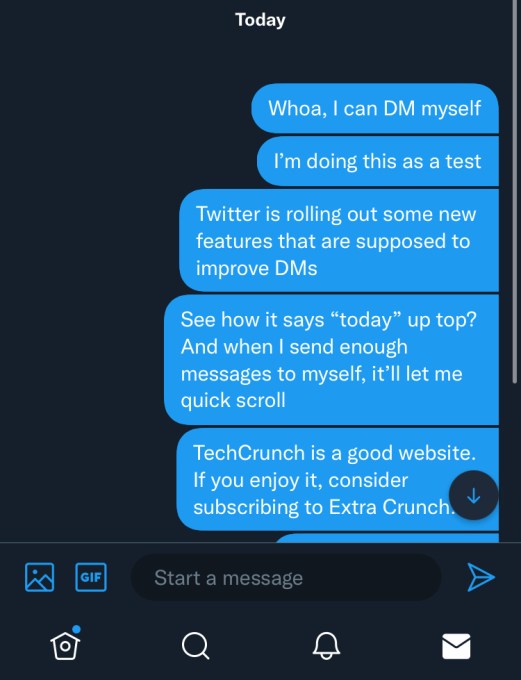
Twitter rolls out a series of improvements to its Direct Message system

Have you ever tried to share a funny tweet with a few friends via Twitter DM, only to accidentally start a group chat? You’re not alone. Today, Twitter announced that it will roll out a few quality of life improvements to its direct messaging system over the next few weeks, including the ability to DM a tweet to multiple people at once in individual conversations. Researcher Jane Manchun Wong noticed that Twitter was working on this functionality last month.

A potential downside of this update is that it might invite more spam — you can’t send a message to more than 20 people at once, but that’s still a lot of people. And users receiving these messages now may not realize they were a part of group spam, as the individual DMs will seem like private 1:1 messages.

Twitter says Android users will have to wait a bit longer than iOS and web tweeters to gain access to this feature — and it’s unclear how long that will take, because in the past, it’s taken years for iOS DM updates to reach Android. But as a consolation prize, on both Android and iOS, if you scroll up in a DM conversation, you’ll be able to return to the latest message by pressing a down arrow button to quick-scroll.

Twitter’s other two DM improvements are only rolling out so far on iOS — instead of timestamping individual messages with the date and time, messages will be grouped by day. Individual DMs will still have a timestamp, but Twitter says that this change will yield “less timestamp clutter.

Finally, in DMs, iOS users will be able to access the “add reaction” menu from both double-tapping and long-pressing on a message. Long-pressing a friend’s message also gives you the option to delete the message on your account only, report the message, or copy the text.

A demonstration of new Twitter DM features

Image Credits: Twitter, screenshot by TechCrunch

Twitter also announced today that it’s testing a feature that puts users’ Revue newsletters on their profile (Twitter acquired the newsletter platform earlier this year). But last week, it unveiled more noticeable UI updates that experts believe made the platform less accessible. Within two days of the update, Twitter made contrast changes on its buttons and identified issues with its proprietary font Chirp on Windows.

19 Aug 2021

OnlyFans bans explicit content

OnlyFans has announced that it will ban sexually explicit content starting in October. The platform was not built specifically for porn but that has grown to be its most popular and visible use case, but pressure from “banking partners and payout providers” means the company will have to leave the adult content world behind and focus solely on SFW material going forward.

The news, first reported by Bloomberg, was confirmed by the company in a statement:

Effective 1 October, 2021, OnlyFans will prohibit the posting of any content containing sexually-explicit conduct. In order to ensure the long-term sustainability of the platform, and to continue to host an inclusive community of creators and fans, we must evolve our content guidelines. Creators will continue to be allowed to post content containing nudity as long as it is consistent with our Acceptable Use Policy.

These changes are to comply with the requests of our banking partners and payout providers.

We will be sharing more details in the coming days and we will actively support and guide our creators through this change in content guidelines.

OnlyFans did not respond to TechCrunch’s inquiries as to its definition of sexually explicit content or how it expected this would impact the company’s bottom line.

The OnlyFans platform has become the de facto standard for independent creators doing adult content. Over the pandemic it grew increasingly popular as the adult industry, like others, had its normal operations interrupted. It has proved an invaluable asset for many creators, professional and aspiring, who used the platform to directly monetize fans without interacting with notoriously predatory established adult industry companies.

But sex work has always been risky in online operations. The practical risk of hosting illegal content means platforms must exert constant vigilance for things like child sex abuse material, malicious content like revenge porn and unwanted leaks, and everyday internet threats like piracy.

At the organizational level, however, the companies may find it difficult to scale due to the trepidation of investors and banks, both of which tend to avoid the industry in general as a “vice,” much the way cannabis and sex toy startups have faced challenges. Pushback from financial backers and payment processors can effectively sink an entire business model.

OnlyFans in this case says openly that it is abandoning adult content due to exactly this type of pressure. While the company has recently debuted and promoted its OFTV app, a SFW alternative to the main OnlyFans site, and of course there are many creators on the platform who do not produce sexually explicit content, this will be an enormous blow to both the sex work industry and to the company itself. Affected creators were not notified ahead of time.

“This is going to shatter a lot of people’s main source of income, the foundation of their entire business,” said Tristan West, who as dreamboytristan is a top creator of adult content on OnlyFans. “Me and a lot of people have got to do a lot of work to secure our business, move our assets, move our content to another platform. It’s not the end of the world, but this is a huge setback.”

West noted that other platforms are finding ways to monetize adult content as well, such as Twitter adding its paid follows and sites like PornHub building out direct monetization opportunities as well. But OnlyFans holds all the cards and will need to make that transition possible.

“I’d like to see them do what’s needed — it’s weird that they haven’t come to us and talked to us in any way,” said West. “Offer a quick option to download all the content on OnlyFans — that’s your asset, that’s your business. That’s the bare minimum that can do for creators.”

It’s a serious question whether OnlyFans will be able to survive this transition in any recognizable form. The choice to abandon their most lucrative and loyal segment of customers and creators may poison the well, with others declining to rely on a platform that failed to support others. Investors, once wary of the risk of putting money into a sex-adjacent product, may now be wary of paying to board a sinking ship. That $1B valuation may be farther away than ever.

The obvious and immediate answer from the tech community is to operate OnlyFans or something like it using cryptocurrencies, which are generally speaking not subject to these limitations. This may represent a way forward for the next platform, but for OnlyFans it may be too late to adapt.

“Thankfully, we have a couple months,” West said. “OnlyFans was the top platform in this market but they’re not the only one. It’s an opportunity for someone else to come around and do better for sex workers and online creators.”

This story is developing and may be updated in the near future with more information.

19 Aug 2021

Let’s make a deal: A crash course on corporate development

Wash, rinse, repeat: A startup is founded, first product ships, customers engage, and then a larger company’s corporate development team sends a blind email requesting to “connect and compare notes.”

If you’re a venture-backed startup, it would be wise to generate a return at some point, which means either get acquired or go public.

If you’re going to get acquired, chances are you’re going to spend a lot of time with corporate development teams. With a hot stock market, mountains of cash and cheap debt floating around, the environment for acquisitions is extremely rich.

And as I’ve been on both sides of these equations, an increasing number of my FriendDA partners have been calling for advice on corporate development mating rituals.

Here are the highlights.

Before my first company was acquired, I believed that every acquisition I’d ever read about was strategic and well thought out. I was blindingly wrong.

You need to take the meeting

Book a 45-minute initial meeting. Give yourself an hour on the calendar, but only burn the full 60 minutes if things are going well. Don’t be overly excited, be a pleaser and or ramble on. Pontificate? Yes, but with precision.

You need to demonstrate a command of the domain you’ve chosen. Also, demonstrate that you’re humble and thoughtful, but never come to the first meeting with a written list of “ways we can work together.” That will smell of desperation.

In the worst-case scenario, you’ll get a few new LinkedIn connections and you’re now a known quantity. The best-case scenario will be a second meeting.

But they’re going to steal my brilliant idea!

No, they aren’t. I hear this a lot and it’s a solid tell that an entrepreneur has never operated within a large enterprise before. That’s fine, as not everyone gets to have an employee ID number with five or six digits.

Big companies manage operational expenses, including salaries and related expenses, pretty tightly. And there frequently aren’t enough experts to go around the moneyball startups for new domains, let alone older enterprises.

So there’s no secret lab with dozens of developers and subject matter experts waiting for a freshly minted MBA to return with their meeting notes and start pilfering your awesomeness. Plus, a key component to many successful startups is go-to-market (GTM), and most larger enterprises don’t have the marketing and sales domain knowledge to sell a stolen product.

They still need you and your team.

19 Aug 2021

Revolut introduces salary advance feature in the UK

Fintech startup Revolut is launching a new feature called Payday. It is an alternative to credit card debt and short-term credit as it lets you unlock a portion of your wage early. If a business decides to integrate with Revolut, users can then access the feature from the financial super app directly.

Right now, the feature is limited to businesses based in the U.K., but the company plans to launch it in the European Economic Area and the U.S. as well. That’s the trick — Payday isn’t going to be available to everyone who receive their salary in their Revolut account through direct deposit.

Revolut has to plug into an employer’s payroll system first so that the company knows how much employees are earning at any point in time. The fintech startup says that employers don’t have to change their payroll system, though.

Once this is done, employees can unlock a portion of their earned pay whenever they want. Users can withdraw up to 50% of what they’ve earned in advance. While the feature is free for businesses, Revolut will charge a small, flat fee to users.

“We believe in the importance of making financial wellbeing accessible to all, and this includes focusing on the impact of financial stability on employees’ mental health,” Revolut co-founder and CEO Nik Storonsky said in a statement. “After the difficulties of the past year, the last thing employees need now is financial uncertainty and stress. It is important to move away from a situation where many are dependent on payday loans and expensive short-term credit, a reliance that is exacerbated by the monthly pay cycle.“

People who live paycheck to paycheck could leverage Payday for unplanned expenses. For instances, if you have to fix your car and it cannot wait until the end of the month, you can unlock some money right away.

This isn’t debt and doesn’t affect your credit score — it’s a portion of your salary, which means that you’ll receive less money at the end of the month when you get paid.

Even if you’re not using the salary advance feature, Payday lets you see how much you’ve earned so far this month. It’s going to be interesting to see whether a lot of companies adopt the feature. With millions of users in the U.K., chances are businesses are going to learn about Payday from their own employees.

19 Aug 2021

A VC shares 5 things no one told you about pitching VCs

The success of a fundraising process is entirely dependent on how well an entrepreneur can manage it. At this stage, it is important for founders to be honest, straightforward and recognize the value meetings with venture capitalists and investors can bring beyond just the monetary aspect.

Here are five pointers that founders should consider while pitching to venture capitalists:

Be honest and accurate

Raising a venture round is, in a way, a sales process, but any claims that could call into question a founder’s trustworthiness can result in a negative outcome rather than an investment.

As VCs, we cannot overemphasize how important it is that founders are transparent and upfront.

Here are a few select cases of such claims:

  • Overstating traction or revenues, which due diligence brought to light.
  • Concealing material attributes of the founding team — such as a co-founder’s commitment to the company, which at best was part time.
  • Speaking of committed investors who were about to wire money to the company, except they were still at the due diligence stage and eventually decided not to invest.

Investing in early-stage companies is often about making bets on people. As VCs, we cannot overemphasize how important it is that founders are transparent and upfront. It is critical to help establish the initial seeds of trust with a capital partner.

Further, most investors understand that things change — if there are any material shifts during the diligence process, communicating them promptly is an additional signal of maturity and uprightness. This will go a long way during the capital raise and beyond.

Know your BATNA

Founders often enter conversations with venture capitalists with a good handle on their product and the business. However, it’s common for entrepreneurs to falter at the negotiation stage, not knowing what their best alternative to a negotiated agreement (BATNA) is.

We have witnessed founders who mistake initial interest in the venture market for real commitment, and unreasonably hike their valuation, which results in them losing serious investors. We have also seen founders fail to ascribe the value serious VCs bring to the table and consequently hesitate to discount their valuation, only to later realize that the existing cap table lacks firepower.

The best way for founders to uncover their BATNA is to run an efficient process. This requires:

19 Aug 2021

Deed pulls your employer’s charity and volunteer program into Slack to keep it front of mind

If your employer does any sort of charity donation matching, the system powering it might be… not great. Maybe it’s got an ancient interface; maybe it’s stuffed behind the VPN at some weird URL that takes a half hour to dig up every December when you remember there’s donation match money about to expire.

Deed, a company out of the ongoing Y Combinator S21 class, is looking to modernize the Corporate Social Responsibility (or CSR) concept – and do a bit more to keep it on your radar, while they’re at it.

Deed’s web interface does much of what you’d expect of a platform like this. It’ll handle employee donations and facilitate donation matching based on the employer’s rules, and it’ll offer up volunteer opportunities and track volunteer hours accordingly. And it’ll do it all with a clean interface that shouldn’t look out of place and dated in a modern company’s toolset.

But it also offers up plenty of neat stuff I haven’t seen the alternatives do — like a dating app-style swipe interface for narrowing down volunteering opportunities, deeper support for employee resource groups (you can follow employee groups within your company, and those groups can highlight organizations you might want to donate to), and tools to promote a bit of friendly who-can-volunteer-more competition between departments. Next up: Slack integration.

Image Credits: Deed

This week Deed is rolling out an early build of its Slack tie-in which, as company co-founder Deevee Kashi tells me, is meant to “meet employees where they are.”

While Deed’s web interface isn’t going anywhere, this new integration lets them beam many of the most commonly accessed features – plus a feed of any donation/volunteer activity your coworkers opt to share – right into Slack. Easier access, harder to forget.

Deed is a bit further along than many of the companies we see coming out of YC. Many of the teams we see in each YC batch are made up of a couple co-founders working from whatever desk space they can find; Deed, meanwhile, has 20+ employees across the world and a growing HQ in Berlin.

But it’s still early days for the company – much of its growth, and even its focus on the enterprise, is relatively new.

Deed’s hybrid in-person/remote team Image Credits: Deed

Deed started its life in 2016 as an app with a similar, but different, focus. Kashi, coming off a ten-year stint of running night clubs and, as he puts it, “throwing parties for a living”, decided it was time to retune.

“Externally people perceived my career as being successful. Internally, I was very… distraught,” he tells me. “I wasn’t really connecting to what I was doing and, by any means, it didn’t align with my values.”

“I took a step back and decided to volunteer, just kind of locally in the city. After trying to volunteer, I realized how cumbersome the process was – how antiquated all the technology was, and how nonprofits were struggling to engage with younger demographics.”

From that came the first iteration of Deed, then an app meant to help individuals find the right volunteer opportunities for them. They grew a community of tens of thousands of users around New York… then the big companies came knocking.

“Their employees came to them and said they really enjoyed using the app in their free time,” says Kashi. “They’d assumed we had an enterprise offering as well to help them with their employee volunteering and engagement programs.”

After a bit more tugging at that thread, the team decided to go all in on enterprise in 2020. They’d take what they learned about building a pretty, modern interface for individual volunteering and adapt it for the needs of these big teams. And it seems to be working; they quickly signed their first big customer with Adidas. Then came Sweetgreen, Airbnb, and Stripe. Kashi tells me that they’re now working with companies with anywhere from 250 employees to 100,000.

Deed raised $2M at the end of last year – and with the momentum behind its shift to enterprise teams, saw its own team grow quickly. “We couldn’t afford two desks.” says Kashi. “Now we’ve hired a bunch of people over the past year and a half. And I’d never met them in person! Then all of a sudden I walk up and the entire floor is ours. It’s really surreal onboarding people remotely, managing them for a year and a half… and then seeing them for the first time.”