Month: August 2021

31 Aug 2021

Offchain Labs raises $120 million to hide Ethereum’s shortcomings with its Arbitrum product

As the broader crypto world enjoys a late summer surge in enthusiasm, more and more blockchain developers who have taken the plunge are bumping into the blaring scaling issues faced by decentralized apps on the Ethereum blockchain. The popular network has seen its popularity explode in the past year but its transaction volume has stayed frustratingly stable as the network continues to operate near its limits, leading to slower transaction speeds and hefty fees on the crowded chain.

Ethereum’s core developers have been planning out significant upgrades to the blockchain to rectify these issues, but even in the crypto world’s early stages, transitioning the network is a daunting, lengthy task. That’s why developers are looking to so-called Layer 2 rollup scaling solutions, which sit on top of the Ethereum network and handle transactions separately in a cheaper, faster way, while still recording the transactions to the Ethereum blockchain, albeit in batches.

The Layer 2 landscape is early, but crucial to the continued scalability of Ethereum. As a result, there’s been quite a bit of passionate chatter among blockchain developers regarding the early players in the space. Offchain Labs has been developing one particularly hyped rollup network called Arbitrum One, which has built up notable support and momentum since it beta-launched to developers in May, with about 350 teams signing up for access, the company says.

They’ve attracted some high-profile partnerships including Uniswap and Chainlink who have promised early support for the solution. The company has also quickly piqued investor interest. The startup tells TechCrunch it raised a $20 million Series A in April of this year, quickly followed up by a $100 million Series B led by Lightspeed Venture Partners which closed this month and valued the company at $1.2 billion. Other new investors include Polychain Capital, Ribbit Capital, Redpoint Ventures, Pantera Capital, Alameda Research and Mark Cuban.
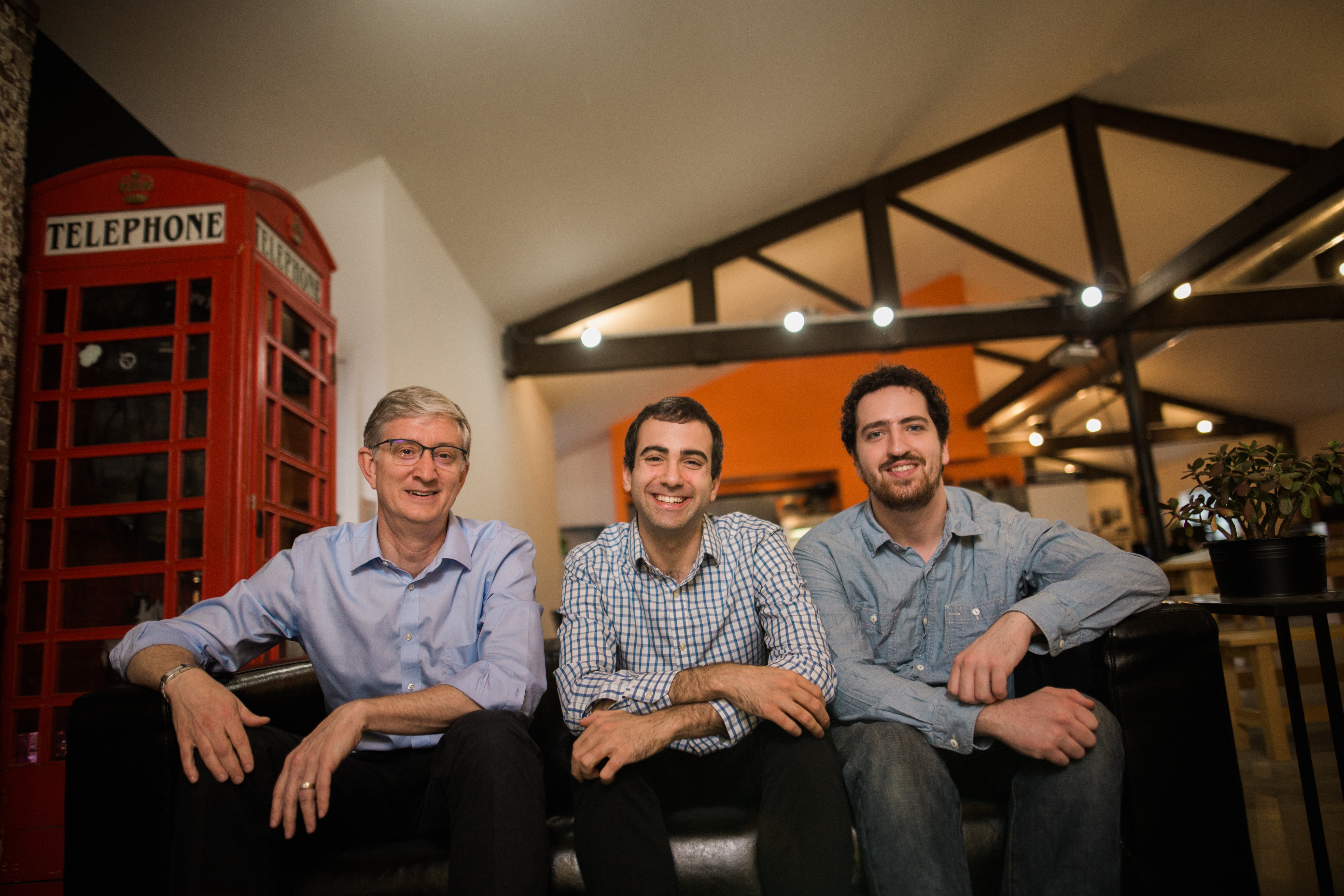
Offchain Labs co-founders Felton, Goldfeder and Kalodner

It’s been a fairly lengthy ride for the Arbitrum technology to public access. The tech was first developed at Princeton — you can find a YouTube video where the tech is first discussed in earnest back in early 2015.  Longtime Professor Ed Felton and his co-founders CEO Steven Goldfeder and CTO Harry Kalodner detailed a deeper underlying vision in a 2018 research paper before licensing the tech from Princeton and building out the company. Felton previously served as the deputy U.S. chief technology officer in the Obama White House, and — alongside Goldfeder — authored a top textbook on cryptocurrencies.

After a lengthy period under wraps and a few months of limited access, the startup is ready to launch the Arbitrum One mainnet publicly, they tell TechCrunch.

This team’s scaling solution has few direct competitors — a16z-backed Optimism is its most notable rival — but Arbitrum’s biggest advantage is likely the smooth compatibility it boasts with decentralized applications designed to run on Ethereum, compared with competitors that may require more heavy-lifting on the developer’s part to be full compatibility with their rollup solution. That selling point could be a big one as Arbitrum looks to court support across the Ethereum network and crypto exchanges for its product, though most Ethereum developers are well aware of what’s at stake broadly.

“There’s just so much more demand than there is supply on Ethereum,” Goldfeder tells TechCrunch. “Rollups give you the security derived from Ethereum but a much better experience in terms of costs.”
31 Aug 2021

Peak raises $75M for a platform that helps non-tech companies build AI applications

As artificial intelligence continues to weave its way into more enterprise applications, a startup that has built a platform to help businesses, especially non-tech organizations, build more customized AI decision making tools for themselves has picked up some significant growth funding. Peak AI, a startup out of Manchester, England, that has built a “decision intelligence” platform, has raised $75 million, money that it will be using to continue building out its platform as well as to expand into new markets, and hire some 200 new people in the coming quarters.

The Series C is bringing a very big name investor on board. It is being led by SoftBank Vision Fund 2, with previous backers Oxx, MMC Ventures, Praetura Ventures, and Arete also participating. That group participated in Peak’s Series B of $21 million, which only closed in February of this year. The company has now raised $118 million; it is not disclosing its valuation.

(This latest funding round was rumored last week, although it was not confirmed at the time and the total amount was not accurate.)

Richard Potter, Peak’s CEO, said the rapid follow-on in funding was based on inbound interest, in part because of how the company has been doing.

Peak’s so-called Decision Intelligence platform is used by retailers, brands, manufacturers and others to help monitor stock levels, build personalized customer experiences, as well as other processes that can stand to have some degree of automation to work more efficiently, but also require sophistication to be able to measure different factors against each other to provide more intelligent insights. Its current customer list includes the likes of Nike, Pepsico, KFC, Molson Coors, Marshalls, Asos, and Speedy, and in the last 12 months revenues have more than doubled.

The opportunity that Peak is addressing goes a little like this: AI has become a cornerstone of many of the most advanced IT applications and business processes of our time, but if you are an organization — and specifically one not built around technology — your access to AI and how you might use it will come by way of applications built by others, not necessarily tailored to you, and the costs of building more tailored solutions can often be prohibitively high. Peak claims that those using its tools have seen revenues on average rise 5%; return on ad spend double; supply chain costs reduce by 5%; and inventory holdings (a big cost for companies) reduce by 12%.

Peak’s platform, I should point out, is not exactly a “no-code” approach to solving that problem — not yet at least: it’s aimed at data scientists and engineers at those organizations so that they can easily identify different processes in their operations where they might benefit from AI tools, and to build those out with relatively little heavy lifting.

There have also been different market factors that have also played a role. Covid-19, for example, and the boost that we have seen both in increasing “digital transformation” in businesses, and making e-commerce processes more efficient to cater to rising consumer demand and more strained supply chains, have all led to businesses being more open to and keen to invest in more tools to improve their automation intelligently.

This, combined with Peak AI’s growing revenues, is part of what interested SoftBank. The investor has been long on AI for a while, but it has been building out a section of its investment portfolio to provide strategic services to the kinds of businesses that it invests in. Those include e-commerce and other consumer-facing businesses, which make up one of the main segments of Peak’s customer base.

“In Peak we have a partner with a shared vision that the future enterprise will run on a centralized AI software platform capable of optimizing entire value chains,” Max Ohrstrand, senior investor for SoftBank Investment Advisers, said in a statement. “To realize this a new breed of platform is needed and we’re hugely impressed with what Richard and the excellent team have built at Peak. We’re delighted to be supporting them on their way to becoming the category-defining, global leader in Decision Intelligence.”

Longer term, it will be interesting to see how and if Peak evolves to be extend its platform to a wider set of users at the organizations that are already its customers.

Potter said he believes that “those with technical predispositions” will be the most likely users of its products in the near and medium term. You might assume that would cut out, for example, marketing managers, although the general trend in a lot of software tools has precisely been to build versions of the same tools used by data scientists for these tell technical people to engage in the process of building what it is that they want to use. “I do think it’s important to democratize the ability to stream data pipelines, and to be able to optimize those to work in applications,” he added.

31 Aug 2021

Kevala raises $21M to improve tools for managing energy grid infrastructure

Kevala, the startup that collects and analyzes energy grid infrastructure data for utility companies, renewable energy providers, EV charging companies, regulators and other energy industry stakeholders, has raised $21 million in a Series A round.

The company says it will use the funds to grow its team from 60 employees to around 100 by the end of 2021 and increase the deployment of its grid analytics tools. 

Kevala’s Assessor Platform, its interactive cloud-based grid analytics toolbox, allows a range of energy industry stakeholders to leverage massive quantities of data the company has collected from public sources, as well as from its clients, in order to predict and plan for things like “extreme weather events, renewable energy adoption and increasing demand from vehicle, building and industry electrification,” according to a statement released by the company. 

Today, there is a greater range of energy sources and receptors than ever before. There’s also more extreme weather conditions, with the latest power outages in New Orleans due to Hurricane Ida being a prime example of ways the current grid system falls short. Visualization software that uses AI to cross reference not only demand on the grid but also other relevant information, like demographics of a specific location, maps of electrical wires and locations of solar panels, is going to be essential for managing it all. Google’s moonshot arm, X, is starting to move into this space via a recent partnership with AES, an electricity distributor. The two will work together to simulate and virtualize AES’s distribution grids in Indiana and Ohio. While Google has big business muscle behind it, Kevala has been working in this space since 2014 and is potentially poised to become an industry leader. 

“Kevala has first mover advantage in providing comprehensive big data analytics on grid infrastructure,” said Zulfe Ali, managing partner at C5 Capital, in a statement. C5 Capital’s fund focused on data-driven technologies transforming critical infrastructure, C5 Impact Partners LP, led the Series A round alongside Thin Line Capital. Senior energy sector executives Tom Werner, current chairman and former CEO of SunPower Corp., and Mark Ferron, former California Public Utilities Commissioner, also participated in the round.

“We’re incredibly excited to partner with the company as it expands into new markets such as cybersecurity and national security, as well as new geographies outside of the United States,” continued Ali. 

Kevala already has nearly the entire country mapped in terms of above-ground distribution infrastructure, and is working on expanding its coverage internationally. The company’s data set, which Kevala founder and CEO Aram Shumavon says is in the terabytes range, is largely sourced from publicly available data. That can mean data that’s observable from satellite imagery or found in building permits that allow the company to see things like where wind turbines are located or where rooftop photovoltaic (PV), or solar powered, systems are. 

“We can take all the houses in a localized area, check it against the weather, and see what the energy consumption will be, what do we think the PV production would be for all of the PVs on those rooftops, and you can start to see how investments in different technologies will affect the overall loading and utilization of the grid and begin to better understand how resources could be utilized to drive cost savings, or alternatively, might increase the cost of that infrastructure as a whole,” Shumavon told TechCrunch.

During a walkthrough of Kevala’s dashboard, Shumavon explained how energy industry stakeholders might be able to, say, predict which neighborhood might see an increase in EV ownership based on household income and other demographics data. From there, visualizing the ratio of electricity to rooftop PVs to other renewable energy is helpful in predicting power usage, but Shumavon took it a step further by playing out a scenario of placing a battery in that location. 

“Could I reduce the cost of the grid in this area by limiting the need for building out new infrastructure in the form of wires, and instead shifting that load to another period of time?” said Shumavon. “And that savings can be also calculated for any investment that might be able to provide a similar service, whether it’s a battery or an investment in an energy efficiency measure, or potentially a rooftop PV system or a demand response program where you agree to not charge your car during peak hours.”

That’s just one example of the types of analyses Kevala is performing everyday. The startup also hopes to increase its cybersecurity services to help protect grid infrastructure. Shumavon said one area Kevala is particularly interested in is third-party devices that have the ability to be compromised and potentially used to destabilize the grid. For example, someone with malicious intent might hack into thousands of IoT-connected washing machines and suddenly turn on all of the heating coils in the machine, creating a drastically increased load that can affect both the supply and demand of electricity.

Monitoring a situation like this is usually outside the control of traditional utility control systems, but Shumavon says through overseeing energy use data, Kevala is able to observe anomalies and mitigate them when they happen, as well as plan for attacks on the horizon so stakeholders are ready with an appropriate response. Kevala is also focusing on data privacy.

“We’re seeing increasingly large amounts of information about end-use customers become potentially available when they use electricity and how advanced metering infrastructure, like smart meters, can contain very detailed information about when people consume electricity and how much,” said Shumavon. “Being able to make sure if those data need to be used by third parties that they’re not revealing information that would be considered personally identifiable is another area where we provide service, which is a strong corollary to cybersecurity work. We really see cybersecurity and privacy as two sides of the same coin.”

31 Aug 2021

Minnesota twins raise $3M to increase accessibility to disability care

Having a loved one with specialized care needs is incredibly challenging, but not something that people who have never had to deal with the issue would necessarily quite understand.

For anyone who has had to help care for someone with special needs, the lack of options out there to navigate finding access to care providers is almost shocking.

Twin sisters Melanie Fountaine and Melissa Danielsen know the problem firsthand, having helped take care of their brother, who had a developmental disability and severe epilepsy, for years.

“We saw the struggle for our family to find reliable care,” Danielsen told TechCrunch.

After he passed away 12 years ago at the age of 29, the siblings decided they wanted to dedicate their careers to making disability care accessible to families with complex care needs. They founded Josh’s Place, a company that provided group home accommodations and other services to adults across Minnesota, which ended up being acquired by REM Minnesota in early 2020.

The pair then came up with the concept behind Joshin, a digital care platform that aims to connect care providers to families with specialized care needs. (Both companies were named after the sisters’ brother, who was named Josh). And today, that startup is announcing it has closed on a $3 million seed round of funding co-led by Anthemis Group and The Autism Impact Fund.

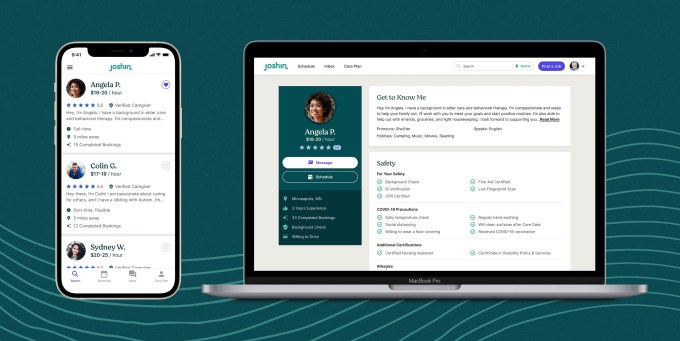
Joshin started out as an app that creates a care plan that helps it match families to a “carefully vetted” trained caregiver. It has evolved to also include a corporate benefits program with Joshin partnering with companies who want to offer an inclusive care benefit to their employees.

Image Credits: Joshin

An estimated one in five families have complex health needs, ranging from children with neurodivergence to dependent adults with developmental and physical disabilities. The COVID-19 pandemic has only highlighted the need for support, making it even more difficult to find necessary care. As such, many people (most of which are women) are finding they have to leave jobs to become full-time caregivers.

“For too long, people with special health needs and their families have been underserved and had fragmented access to disability care providers,” said CEO Danielsen.

COO Fountaine says that historically the care economy has focused on children under 12, or adults over 65 — childcare and eldercare, respectively.

“Joshin really is positioned to be the leader in that huge age gap that’s out there,” she said. “We work with people at all stages of life, and I think it’s unfortunate that until now, that’s been missing from the conversation. 

The company plans to use its new capital in part to grow its network of care providers. It also aims to expand its corporate benefits program.

“We’re continuing to scale our technology to lessen the burden of caregiving responsibilities for employees and their families,” added Danielsen.

Over the past 12 months, Joshin’s community of members and caregivers has grown 200%. With the new funding, the startup plans to expand its services to Los Angeles and Seattle. It is currently operational in its home base of Minneapolis, Minn., Chicago and New York City.  Joshin will be soft launching in 8 new markets over the next few weeks and hopes “to be national very soon,” Fountaine said.

The startup is starting with employers, and building up the data that it derives from that effort. Over the next year, it intends to partner with managed Medicaid organizations, and with both private and public insurance companies so that it “can get families access to this care, quickly,” said Danielsen.

“Our goal is to make this to make quality care free for families who need it,” she told TechCrunch.

Chris Male, co-founder of the Autism Impact Fund, said his organization backs companies that are addressing unmet needs of the autism community. Finding, retaining, and coordinating care are three of the biggest hurdles that individuals with autism spectrum disorder (ASD) and their families face, according to Male.

“Joshin has a proven ability to provide a reliable means to source caregivers with diverse skill sets and potential to serve as a platform for streamlining access to a variety of critical yet highly fragmented services for the special needs community,” he said. “Given the current insurance payer landscape and employer emphasis on DEI, Joshin is not only generating strong impact for a large disability market, but is a monetizable opportunity as both a reimbursable service and as a benefit to employees.”

By partnering with employers, Male added, Joshin will help provide an environment of support that will allow “employees to quickly and easily access key resources and thus minimize downtime. “

Matthew Jones, managing director at Anthemis, said his firm doubled down on its investment in the startup because it saw in its founders “one of the strongest examples of founder-market fit out there.” (Anthemis also led the company’s $1.6 million funding round in July of 2020).

The progress that they have made since our last investment – coupled with the insights that they have collected – led us to believe that doubling down in this round was a no-brainer,” he told TechCrunch.

Also, the complexity that comes with building technology in the space “makes the barriers to entry very high,” Jones added.

“The team’s grit, combined with their understanding of the problems and opportunities associated with disability-related care, set Joshin apart,” he wrote via email. “No other platform comes close in terms of having such specialized leaders at the helm, so it’s no surprise that corporates are lining up to add Joshin to their roster of employee benefits.”

31 Aug 2021

Hum Capital thinks the future of funding is a return to old school Wall Street

Hum Capital CEO Blair Silverberg thinks that the future of fundraising requires a return to old school Wall Street – sans the fraud.

Back in the day, he explained, people would go to Wall Street and request funding for different projects, such as a rail line from New Jersey to St. Louis or a new store. A banker would chat through all the financing options, analyze different tradeoffs, and eventually help business owners pick the best capital option for their goals.

“It was very, ‘let’s think about the problem we’re trying to solve, and then let’s make the financing fit,’” Silverberg said. “Today, we do the opposite.” Even with ample capital in the market, startup check-writing is still a game dictated by warm intros, cold pitches, and oftentimes, sheer luck that the founder bugged the right person in the right way at the right time.

Silverberg said the current climate forces founders and investors to do a “crazy adversarial dance” when it comes to partnerships, which feels “backwards.” He wants his startup, Hum Capital, to bring optionality back into the mix.

“The dream scenario is that any company in the world uses Hum to articulate what they’re trying to do with their mission, and then gets all the relevant forms of financing just sitting right there waiting for them to pick the one that makes the most sense,” he said. No term-sheets for term-sheets sake, but instead, Hum Capital can be a clear way to visualize and compare different financing options for a company’s goal.

The nod to nostalgia has helped the startup land fresh capitalization for the future. Hum Capital announced today that it has raised $9 million in a Series A round led by Steve Jurvetson’s Future Ventures. Jurveston was an early investor in SpaceX, Tesla and Memphis Meats, which Silverberg thinks symbolizes that “[Hum Capital is] an equally world changing company.”

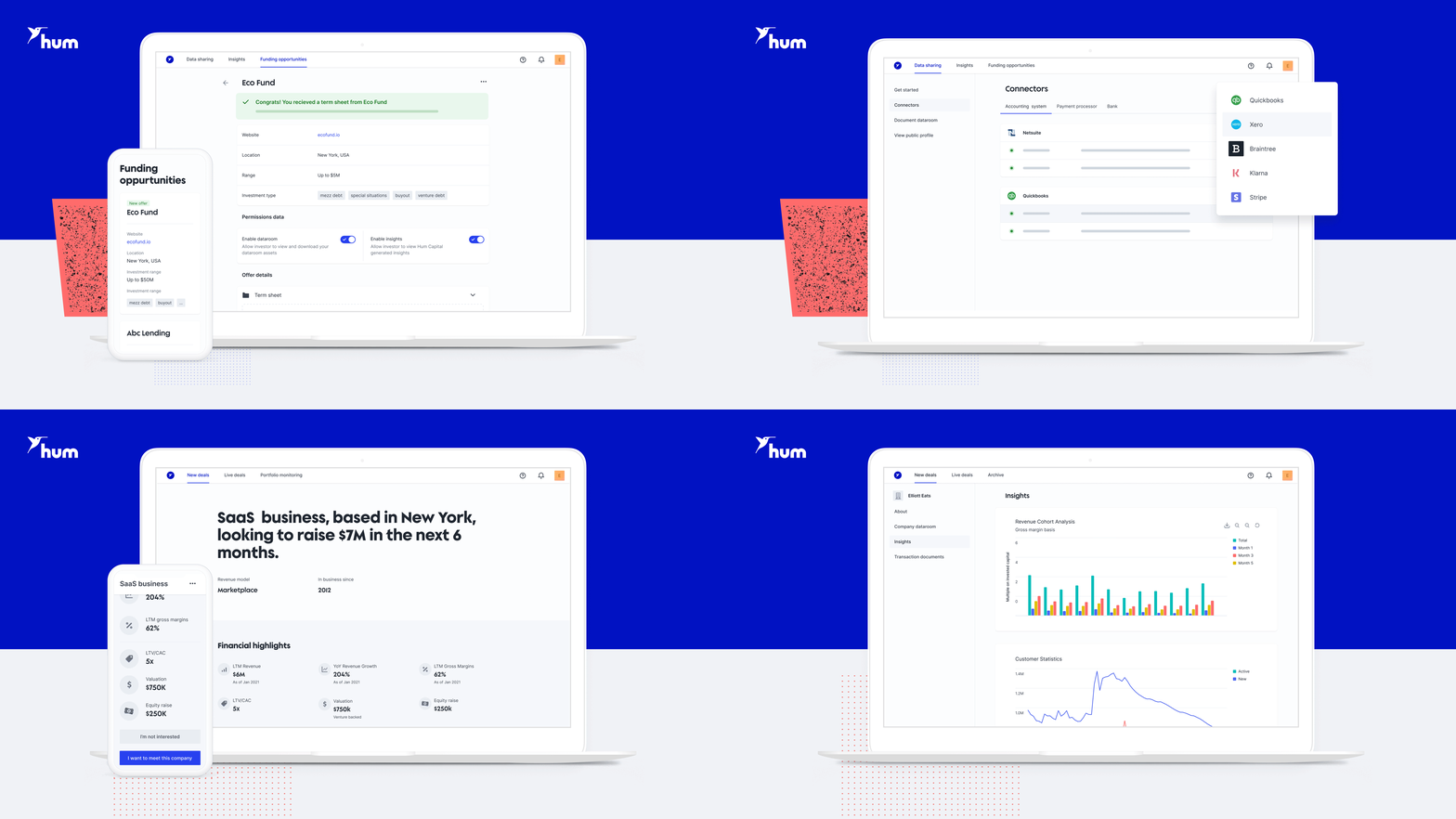
At this stage, Hum Capital’s product is easy to explain: it uses artificial intelligence and data to connect businesses to the some available funders on the platform. The startup connects with a capital-hungry startup, ingests financial data from over 100 SaaS systems including Quickbooks, Netsuite and Google Analytics, and then translates them to the some 250 institutional investors on its platform.

It’s a navigation engine for startups that aren’t sure whether they should go for venture debt, traditional VC, revenue-share financing options, or others. The average deal size is $6.4 million, but Hum can help founders access checks up to $50 million for their businesses.

Image Credits: Hum

Hum is free for startups and investors to use for data-sharing purposes and eventual connections. The startup makes money by charging a 2% marketplace fee on capital raised whenever a deal is closed through its platform.

Founders could theoretically use Hum to meet investors and then close the deal offline to avoid the 2% fee. Silverberg said that most users to-date don’t do this because they want to be repeat customers during future fundraises.

Hum’s biggest challenge is that it isn’t human. In venture, especially at the earliest stages, most check-writing comes down to an investor believing in a person’s ambition (and maybe their pitch deck). Hum leans heavily on data as a determinant of success, and while numbers don’t lie, it could mean early ideas with big ambition are left without options.

Silverberg argued that Hum isn’t meant to replace chemistry, but can work to make sure that the business makes financial sense for an investor. Meetings still matter, but with Hum, he thinks a founder and investor can spend the 30 minute meeting talking about mission and vision, and skip other basics of the business.

Fair rebuttal aside, Hum could be limited in the sorts of startups that it funds long-term. It doesn’t need to find ways to fit into traditional VC – since most businesses aren’t venture-bacable, but it will need to find a way to make sure high-quality investors consistently use the platform for deal flow. Today, much of the investment on the platform is classified as venture debt.

Early adoption suggests some early trends. Companies from 46 states have uploaded data to its Intelligent Capital Market (ICM) platform, and nearly half of all companies on the platform come outside of California and New York.

To date, the platform has helped facilitate more than $400 million in capital transactions across 150 fee agreements. The majority of that money moved between March and now, with customers including SecurityScorecard, Evolv AI and Flaviar.

Hum Capital’s raise is announced in a time where traditional financing feels challenged: Carta just raised money off of a valuation it set for itself, Brex launched a $150 million venture debt business, and Clearco, an alternative to VC, raised money from VCs at an over a $2 billion valuation.

“[Resource allocation] as important as making the world multiplanetary, or global problems like climate change,” Silverberg said. “…We’re at the book sales stage of Amazon.”

31 Aug 2021

Owner.com serves up $10.7M so that independent restaurants can get cooking

Independent restaurants don’t typically have the luxury to create their own online food ordering and delivery capabilities or negotiate for lower rates from legacy ordering platforms like the large restaurant chains do.

Here’s where Owner.com comes in. The Beverly Hills-based company provides a free online ordering, delivery and marketing platform for independent restaurants that puts them on similar playing fields with the big guys. And unlike the legacy food delivery services, Owner.com restaurants own their customer data and can automate marketing campaigns.

Adam Guild is the company’s 21-year-old co-founder and CEO, a high school dropout and a Thiel Fellow, who originally started by assisting his mother’s dog grooming business that was having difficulties attracting customers. After stepping in with some online marketing methods, her business grew, and later expanded into multiple locations. Guild then wanted to work with a bigger group of people and stumbled across restaurants while helping some clients create online landing pages.

With consumer demand shifting to primarily online ordering and delivery over the past 18 months, online ordering revenue is expected to double from $248 billion in 2020 to $449 billion by 2025. Ordering platforms like Doordash, Uber Eats and Grubhub control 80% of orders and typically charge between 20% and 30% per order to restaurants and additional fees to consumers.

In contrast, Owner.com is free for restaurants and charges customers a flat $4 fee when they order from the website. Guild explained that larger restaurant chains have the buying power to negotiate lower rates, while independent restaurants do not. With the inability to keep up, some 110,000 restaurants in the U.S. closed in 2020.

Guild initially bootstrapped his company, working with large restaurant chains, like P.F. Chang’s, drive online orders. Then the global pandemic hit. He ended up losing all of his revenue and had to let all of his employees go but one. To add to his bad luck, he was then rejected from Y Combinator and other accelerator programs.

“For the first three days, I was depressed,” Guild told TechCrunch. “I had spent two years building a company and now it was dead. In the same way we were disrupted, I began to think there was no better position to be in than a scrappy startup. I didn’t know what the next business would look like, so I started cold-calling restaurant owners, asking how I can be helpful and what type of technology they were looking for. Many of them told me that online ordering sucked, but if they didn’t solve it soon, they would go out of business.”

One pivot and a year later with co-founder Dean Bloembergen, Owner.com closed on $10.7 million in seed funding led by SaaStr Fund, with participation from Redpoint Ventures and Day One Ventures, as well as a group of individual investors including Naval Ravikant, CNBC’s The Profit host Marcus Lemonis, The Kitchen Restaurant Group’s Kimbal Musk, DoNotPay founder Joshua Browder, Figma founder Dylan Field, The Chainsmokers and independent restaurant owners and customers of Owner.com.

Jason Lemkin, founder of SaaStr Fund, said restaurant SaaS was a space in which his firm was interested in investing, but thought it was a bit boring — there were already quite a few vendors in the space, like Toast and Grubhub, and most were just technology solutions. However, when he heard that Owner.com was a break-out company from the monotony, he said he had to take a look.

“The ability to own the customer relationship is that ultimate differentiation,” Lemkin said. “Their ultimate goal is to provide a robust technology platform to increase margins, have people order more and come back often.”

Meanwhile, Guild intends to use the new funding to continue product development and add new features like landing pages, the ability to make reservations and native apps for white-label service.

Since the launch last year, the company has reached a seven-figure run-rate and over 105% monthly revenue retention across over 700 restaurant locations, Guild said. To date, Owner.com has transacted over $18 million and helped its restaurant customers avoid paying $3 million to online order platform fees annually.

“It’s all about empowering the 40% of the restaurant industry that is run by people who started off in entry-level positions, and over the years, worked their way up to own the ‘American Dream,’ ” he added.


31 Aug 2021

Max Q: Astra’s launch goes sideways

Max Q is a weekly newsletter from TechCrunch all about space. Sign up here to receive it weekly on Mondays in your inbox.

We had a few launches this week, including SpaceX’s first one after one of its longer recent pauses in activity. Astra hoped to have its first commercial payload mission go well, but instead it had one of the more visually interesting takeoff mishaps in private spaceflight.

Astra’s launch drifts and then nearly recovers

Image Credits: Astra

Astra’s launch from Kodiak, Alaska was its first attempt since it nearly reached orbit with a successful test last year. The engines all lit as planned, but almost as quickly, one of those went out and the result was a rocket that nearly toppled over, before floating horizontally for a while, while the remaining engines redistributed power to ultimately start the vehicle climbing skyward.

It’s perhaps more impressive that the Astra rocket didn’t crash and burn right away, even if this was ultimately a failure. The rocket eventually climbed to an altitude of around 160,000 feet before Astra’s flight engineers issued an abort command and the vehicle returned safely to Earth after the engines cut off.

This was a disappointment because the mission was meant to be Astra’s first commercial flight, since it was carrying a simulated test payload on behalf of client the U.S. Space Force. But it also was still technically a test, and the company says it gathered a lot of valuable data from the roughly 2.5 minutes that the rocket was flying before the abort command was given.

While the newly public Astra’s share price took a hit on the news, I think the more instructive bit for the company’s long-term fortunes will be how long it takes to recover from this mishap and try again, and also what the result will be of that follow-up mission.

SpaceX breaks in its new landing barge

Image Credits: SpaceX

SpaceX’s return to flight was another of the Commercial Resupply Services flights it performs for NASA to the International Space Station, and this one went smoothly as usual. The cargo included a new robotic arm for use on the station, as well as interesting experiments including live ants.

The launch also saw SpaceX use its new ‘A Shortfall of Gravitas’ autonomous drone ocean landing ship for the first time. This is the third drone ship that SpaceX has in its fleet, and everything went smoothly with the landing for a successful recovery of the first stage booster used for the flight.

Blue Origin launches suborbital, non-crewed flight

Image Credits: Blue Origin

Blue Origin has launched its 17th New Shepard reusable rocket mission, though this one wasn’t as impressive as its last effort: No Jeff Bezos on board. Unlike that first human spaceflight, there weren’t any passengers in the capsule this go around, but there were a healthy collection of experiments.

One of those was a NASA experimental landing system component that’s going to be used eventually for the agency’s lunar landing vehicle. The interesting subtext here is that Blue Origin is actually suing the agency over its award process for the human lander contract, which selected SpaceX (and only SpaceX) as a lunar lander vehicle provider earlier this year.

Rocket Lab goes public

Image Credits: Rocket Lab

Rocket Lab is now a public company, trading under the name RKLB on the NASDAQ after a SPAC merger. This is one of the largest private space companies yet to go public via any means, and our own Aria Alamalhodaei spoke to Rocket Lab founder and CEO Peter Beck to get the low-down on the company and what it means to be a member of the public markets.

Meanwhile, ispace is creating a larger lunar lander that can make it through lunar nights. Its existing small lander design isn’t intended to last long in the dark, since its power reserves would deplete quickly and also the super low temperatures are not kind to most electronics.

Join us at TC Sessions: Space in December

Last year we held our first dedicated space event, and it went so well that we decided to host it again in 2021. This year, it’s happening December 14 and 15, and it’s once again going to be an entirely virtual conference, so people from all over the world will be able to join — and you can, too.

31 Aug 2021

Apple’s rumored iPhone satellite support may be for emergency calls and messages

The rumored satellite features for future iPhones are reserved for emergency uses only, according to Bloomberg’s Mark Gurman. A few days ago, a report by well-known analyst Ming-Chi Kuo said the next iPhones will come with support for Low Earth Orbit satellite calls and messages. Gurman’s sources said, however, that Apple isn’t turning its devices into actual satellite phones, at least for now. Instead, the tech giant is reportedly developing at least two emergency-related features relying on satellite networks.

The first feature is called Emergency Message via Satellite and will be added as a third protocol, alongside iMessage and SMS, to the Messages app. It’s apparently codenamed Stewie inside the company and will allow users to text emergency services even when there’s no signal, which sounds especially useful during emergencies in remote locations, such as mountains and forests.

The tool will also give users a way to text their emergency contacts simply by typing Emergency SOS in the recipient line. Messages will be restricted to a shorter length, but the senders’ contacts will get a notification for them even if their phone is set to Do Not Disturb. Satellite messages will appear as gray bubbles instead of blue or green so they can be easily identified. Eventually, the feature could handle phone calls, as well.

Apple is also reportedly working on a second satellite feature that will allow users to report crisis situations like plane crashes and fires. This system will give users a way to report the incident at length and will ask them specifics, such as if anybody needs search-and-rescue services or if anybody in the vicinity is armed. It can also automatically send authorities the reporter’s location and their details from the Health app, such as their medical history, age, medications and information like height and weight. The feature can also a notify the reporter’s emergency contacts for them.

While both features sound useful, their availability is restricted by satellite location and reach. They might not work for some regions, and in some cases, users may have to walk outdoors in a certain direction where their iPhone can connect to a satellite. Also, Gurman’s sources said it’s unlikely that the features will be ready before the year ends, which means the next iPhones expected be announced sometime in September won’t be able to send messages via satellite yet.

Editor’s note: This post originally appeared on Engadget.

31 Aug 2021

Gatik expands autonomous box truck operations to Texas with $85 million in new funds

In the two years since Gatik AI came out of stealth, the autonomous vehicle startup has launched pilots with Walmart and Canadian retail giant Loblaw in its bid to prove that self-driving technology combined with box trucks is the secret economic sauce for hauling goods short distances.

Now, the company is expanding into Texas — its fourth market — with a fresh bundle of capital. Gatik said Tuesday it has raised $85 million in a Series B round led by new investor Koch Disruptive Technologies, the venture arm of Koch Industries. Existing investors Innovation Endeavours, Wittington Ventures, FM Capital, Dynamo Ventures, Trucks VC, Intact Ventures and others also participated. Gatik has raised $114.5 million to date.

“We are very much in expansion mode in growth mode and felt that Koch Industries would add the most value,” Gatik CEO and co-founder Gautam Narang said in a recent interview, adding that he views the company as a strategic investor.

Gatik has been shuttling goods as part of pilot programs for Walmart in Arkansas and Louisiana and in Ontario, Canada for Loblaw Companies Limited. Gatik also struck a manufacturing partnership with Isuzu in 2020 with an aim to mass produce medium duty autonomous trucks by early 2023.

Unlike other autonomous delivery companies, Gatik isn’t targeting consumers. Instead, the startup is using its autonomous trucks to shuttle groceries and other goods from large distribution centers to retail locations. For instance, Gatik uses about five box trucks to carry goods for Loblaw. On one route in Arkansas, Gatik has removed the human safety driver, which means some of the autonomous box trucks used to carry goods are now “driverless.” The goal is to remove safety operators from all of its box trucks.

Gatik said it has opened an autonomous trucking facility in the AllianceTexas Mobility Innovation Zone, a 26,000-acre industrial, mixed-use, and residential planned development in the Dallas-Fort Worth area that has become a hub of transportation and logistics. The company is already carrying freight for several customers, which it declined to name. Narang did say that the trucks deployed in Texas are based on the Isuzu platforms.

The company plans to have presence in multiple cities within Texas, Narang said.

Its move to Texas follows other autonomous vehicle technology companies such as Aurora, Kodiak Robotics, TuSimple and Waymo that have set up shop in the state. The decision to expand into Texas was driven by its status an international shipping hub, the regulatory environment that supports autonomous vehicle testing and deployment on public roads and favorable weather. Narang added that the abundance and variety of potential customers will also allow it to have a multi-tenant operation. This means it can use the same truck throughout the day for multiple customers.

The new funding will be used add more vehicles to its fleet of Class 3-6 multi-temperature autonomous box trucks and hire more employees, particularly in Texas. Today, Gatik’s roughly 70 employees are spread between its headquarters in Palo Alto, engineering center in Toronto and operations in Arkansas and Louisiana.

Narang said they plan to double the number of employees to around 150 people in the next six to nine months.

31 Aug 2021

Power Global eyes India’s auto rickshaw industry with swappable battery and retrofit kit

In India, a country that is more densely populated and has lower rates of car ownership, auto rickshaws and other two- or three-wheeled vehicles play a central role. While many auto rickshaws on Indian roads are already electric, they tend to rely on lead-acid batteries that need to be replaced every six to 11 months.


Power Global, a two-year-old startup, wants to disrupt the auto rickshaw market by offering a retrofit kit for diesel-powered vehicles and swappable battery pack to transition the more common lead-acid batteries to lithium-ion.

Power Global was founded by Porter Harris, who had previously engineered the batteries for SpaceX’s Falcon 9 rocket and Dragon spacecraft. He also worked as the chief battery engineer at EV startup Faraday Future. Thus far, he estimates Power Global has been around 95% self-funded – thanks in part to the sale of his SpaceX stock.

“I’ve been looking at the Indian market now for about five years,” he told TechCrunch in a recent interview. The opportunity is certainly ripe, with some market research firms estimating that the electric rickshaw market in India will grow to $1.3 billion by 2025. It’s also dire: last year, 15 out of the top 20 most polluted cities in the world were in India, according to air quality technology company IQAir, and much of those emissions are due to transportation.

By offering two separate products for diesel-powered or electric rickshaws – the retrofit kit, which Harris said will fit over 90% of current models, and the “eZee” swappable battery – Power Global is aiming to capture almost the entire auto-rickshaw market.

Harris says the company already has around 48 dealers ready to sell their products, thanks largely to Power Global co-founder Pankaj Dubey’s extensive history working with Indian dealerships over his career with Hero Motors, Yamaha, and Polaris. And that’s a real benefit, because much of Power Global’s plan is dependent upon an extensive dealer network that can get people signed up to the swappable battery subscription model and help drivers buy and install the retrofit kits.

The main source of revenue will come from getting drivers on the energy-as-a-service monthly subscription model via Power Global’s “eZee” swappable batteries.

“It’s a totally different business model,” Harris said. “We can’t translate petrol or gas solutions and try and make that work for electric, it’s really a whole new thing. Our viewpoint is: a lot of kiosks, a small amount of [battery] modules per location.”

The company wants to launch on the outskirts of New Delhi, National Capital Region to start, with the eventual goal of planning a kiosk every three kilometers or so. Drivers will also have the option to take the battery home and charge it using a Power Global home charger.

On the user side, the company’s also developing an app that will allow drivers to see stats like how many kilometers they’ve traveled that day, their remaining battery life and where they can find the nearest battery swapping kiosk.

Power Global expects its batteries to last four and a half to five years. The company plans to use the batteries for stationary energy storage application once they’re taken out of the eZee ecosystem. Harris said there are plans to eventually tie those batteries in with small solar panels to provide energy to rural areas. Once the battery has been completely depleted of all its useful life, Harris said it’ll be sent to a recycler.

The company aims to release its eZee swappable battery product in the first quarter of next year, followed by the retrofit kits. It has opened a battery production plant in Greater Noida, India, which it anticipates will produce about a gigawatt-hour – which is about 10,000 Model S packs –this time next year. That’ll make it one of the largest domestic manufacturers of lithium-ion batteries in the country. By the end of 2022, Power Global aims to have at least 10,000 vehicles on the eZee swappable system.

While Power Global is in discussion with some U.S.-based companies interested in the eZee product, Harris said the focus is ultimately further east. “Do we really need another solution for the top 10% of the world? No, we don’t. Let’s focus on the other 90% of the world and actually make a difference.”