Month: August 2021

09 Aug 2021

Match beta test targets dating app complaints like frustration with swiping, ghosting

Match today is introducing new features that aim to address some of users’ complaints with modern-day dating apps — like how much time it takes to find a relevant match and how frustrating it is when users ghost one another after the initial conversation fades. As part of a new strategy to better position Match for more “emotionally mature” singles (read: adults), the company says it will begin beta testing a recommendation system called “Matched by Us,” which may pave the way for a broader matchmaking service in the future. It’s also testing an anti-ghosting feature which pushes users to either continue a conversation or unmatch the recipient, instead of leaving them hanging.

The features are designed to address the challenges that face Match’s older demographic. Match users tend to be in their 30’s and up, and have full lives. They’re generally ready to find relationships and settle down with a partner. That’s a different life phase than those using other Match dating apps, like Tinder, where younger users are still in a more exploratory phase and enjoy on going on many dates, including casual dates.

“When we talk to our members, we hear a lot of frustration around [there being] a lot of swiping, a lot of messaging back and forth — that’s happening in the dating world more broadly,” explains Dushyant Saraph, Match’s Chief Product Officer. “When we think about folks on our product, who don’t have a ton of time, that’s where ‘Matched by Us’ came from. Our singles don’t want to swipe through hundreds of profiles,” he says.
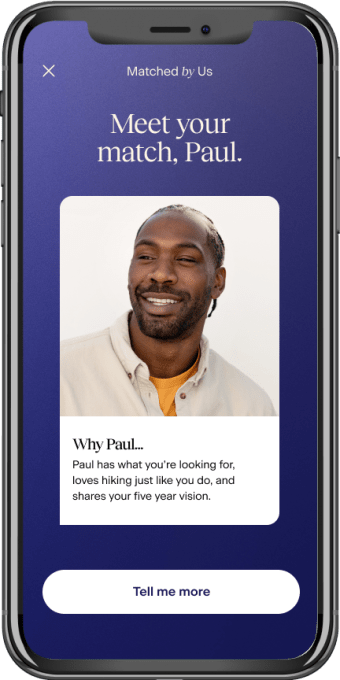
Image Credits: Match

The new feature, which is made available to free and paid users alike, will present one, free customized match every week, where both users can see each other and no longer have to wait for a “like” back in order to engage in a conversation.

The system works to find compatible matches by algorithmically examining a new set of preferences around users’ personalities, based on responses to questions posed in users’ Match bios.

For example, questions may ask about users’ five-year plans, their favorite weekend activities, or whether they’re open to moving somewhere new if they find the right person. The latter has become especially relevant in the new age of remote work, driven by the pandemic, which no longer requires people to live in the bigger cities where their company may be headquartered, Saraph notes.
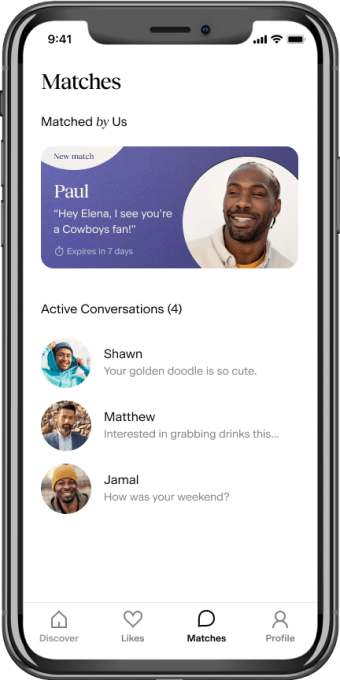
Image Credits: Match

Currently, the system will recommend a match based on a holistic view of users’ preferences, as determined by an algorithm, but the company has been internally testing adding a layer of human curation to its suggestions, as well.

In other words, Match is testing an actual match-making service.

For the time being, however, the human curation team inside Match is working in more of an R&D capacity, Saraph says.

“We’ve been flexing how many experts we need as we’re testing kind of different concepts — everything from coaching to expert picks, where we’re doing human curation,” he says. The team also works on other features, like suggesting conversation starters to keep conversations going.

“Long-term we expect to be flexible, depending on which of these [products] is most interesting to our members, and scaling up our expert team accordingly. Right now, human curation is one area that we’re really excited about and want to crack, and I think you’ll hear more about that in the coming months,” Saraph adds.

Another new feature aimed at helping adults to stop waste their time on dating apps involves how Match will handle matches’ conversations. Typically, conversations either take off leading to real-world dates, or slowly fade away, until communication stops altogether. Sometimes, the other party simply “ghosts,” and never responds at all.
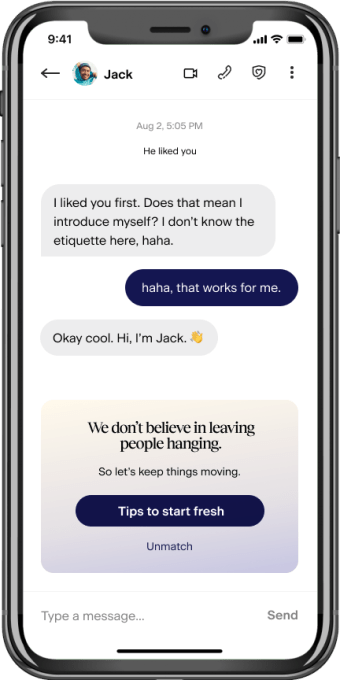
Image Credits: Match

Users told Match that their main issue with ghosting is the uncertainty around what it means.

Did the user just get busy, or did they decide they weren’t interested?, users wonder.

A new feature aims to keep conversations’ momentum going by nudging users when a conversation is about to “expire” — that is, when it will be archived into a new section of the inbox for inactive conversations.

And if you are in the app, you can visit the conversation to get suggestions of conversation starters to help you pick things back up, or you can tap a button to unmatch the other user. The latter would send a more explicit signal to the recipient that there was a lack of interest, though it won’t actually push a notification that tells the user they’ve been unmatched. (That can sometimes lead to safety issues, particularly for women who have received threats from men they’ve rejected.)

Image Credits: Match

Match says it’s currently testing the right number of days to elapse before it nudges users to either re-engage or end their conversations with an unmatch. But the right amount of time seems to be in the three to five-day range, Saraph says.

The new features are rolling out to some portion of Match’s U.S. user base in beta, as the company kicks off a new brand campaign targeting adult daters. The campaign’s message is that Match understands what modern adult singles are looking for in order to date better, and these features are an example of that understanding being put into practice.

The beta tests are rolling out across all Match platforms, including iOS, Android, mobile web and desktop over the next few months, starting in the U.S.

The news follows a mixed earnings report from the dating app giant, Match Group, which owns top brands including Match, Tinder, OKCupid, Plenty of Fish, Hinge, and others. The company saw the impact of a pandemic recovery in the second quarter, with 15 million paying customers across its brands, up from 13 million in the year-ago quarter. Revenue was $707.8 million, topping analyst projections of $694 million. But Match Group missed on earnings, with net income of $140.9 million, or 46 cents a share, when analysts expected 49 cents per share.

The company also spoke in detail about its plans for social networking app maker Hyperconnect, a company Match bought for $1.73 billion earlier this year. Match Group said it plans to add audio and video chat, including live video, to its dating brand portfolio.

Match’s dating app is among those that will benefit from Hyperconnect integrations, Saraph told TechCrunch, as Match plans to explore “building out live experiences.” The company expects these to be added around year end towards the beginning of 2022, we’re told.
09 Aug 2021

Early-stage brands should also unlock the power of influencers

They’ve made waves on every screen and have been sponsored by nearly every major brand, from Charli D’Amelio x Hollister to MrBeast x Honey. And they’re only multiplying.

If influencers aren’t part of your early-stage growth marketing plan, it’s time to get on board. When companies think of how to rapidly increase their reach and revenue, paid acquisition is always at the top of the list. But there are other important pillars in a growth marketing engine, such as leveraging lifecycle marketing, cultivating organic reach via SEO and doing later-stage brand marketing.

Influencer marketing isn’t solely for big brands; it’s for every brand. If influencers aren’t part of your growth marketing plan, it’s time to get on board.

However, an often overlooked tactic for new brands is influencer marketing. If the value and power of influencer marketing were widespread knowledge, we would see more of an uptick. And it doesn’t help that we have a supply-constrained pool of marketers who understand how to unlock this lever.

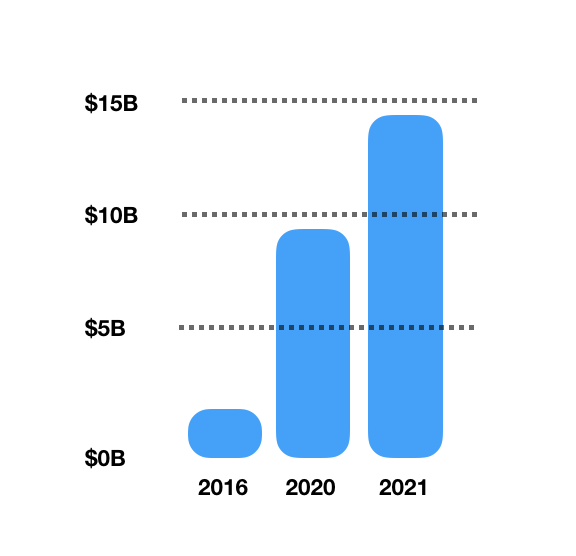
Influencer marketing spending from 2016 to 2021 (predicted). Image Credits: Jonathan Martinez

This marketing tactic is only growing. So let’s demystify influencer marketing, learn how to couple it with a little-known paid marketing hack and uncover the numerous mediums to leverage influencer assets. After three years at Postmates (which nailed influencer marketing), being a YouTuber myself in 2008 and advising startups, I’ve unlocked the power of influencer marketing and want everyone to do the same.

Starting out

If there’s one key piece of advice to take from this column, it’s that influencer marketing isn’t solely for big brands. It’s for every brand. As you start to formulate your growth strategy, make sure to include an influencer pillar as part of the plan.

When reaching out to influencers, it’s a sheer numbers game in capturing their attention and pitching your brand, but there are myriad ways to increase response conversion. Below are the cold message components you must nail down before reaching out to influencers:

  • Your brand pitch.
  • An enticing offer.
  • Clear next steps.

The one constant with influencers is the high number of messages they receive from fans and brands alike. If you’re at the marketing stage, nailing your pitch should hopefully be natural at this point, so utilize what you’ve crafted and condense it down to a sentence or two.

What are your brand’s key value propositions, and why should influencers care? To show them, relate your brand to their category, to their style and to the content that they post.

After the pitch, an irresistible offer needs to follow — something that’s the opposite of this: “I’ll send you a few samples of our protein bars.” The conversion rate will be a freakishly low tenth of a percent with that offer. Instead, make your offer enticing and utilize one of these structures: fixed fee, fixed fee + performance or performance.

Depending on budget and risk tolerance, there are a few ways to structure an influencer offer: paying a one-time fixed fee, paying for each conversion (CPA performance basis) or a hybrid of the two.

09 Aug 2021

UN’s IPCC report on climate change sounds “code red” for planet

A major UN scientific report has concluded that human activity is changing the climate at an unprecedented rate. The report has been describe as a “code red for humanity” by its authors.

The UN’s Intergovernmental Panel on Climate Change (IPCC) is stern and blunt in its conclusions: “It is unequivocal that human influence has warmed the atmosphere, oceans, and land,” it says.

The IPCC – a grouping of scientists whose findings are endorsed by the world’s governments – warns of increasingly extreme heatwaves, droughts, and flooding and a key temperature limit being broken inside the next decade.

This “means that the world will hit one-and-a-half degrees warming much earlier than expected, possibly the middle of 2034” says the report.

The IPCC says going past 1.5C will create more intense and more frequent heatwaves.

Prof Ed Hawkins, from the University of Reading, UK, one of the report’s authors said: “It is a statement of fact, we cannot be any more certain; it is unequivocal and indisputable that humans are warming the planet.”

However, the scientists say a catastrophe can be avoided if the world acts fast, and, with deep cuts to the emissions of greenhouse gases, could stabilize rising temperatures.

And scientists are hopeful that global emissions can be cut by 2030 and reach net zero by the middle of this century.

The report is the first major review by the IPCC since 2013 and comes less than three months before the COP26 climate summit in Glasgow.

IPCC report key points:

• 1.5C will be reached by 2040 in all scenarios unless emissions aren’t slashed in the next few years

• Keeping to 1.5C will require “immediate, rapid and large-scale reductions” in emissions and slower action leads to 2C and more suffering for all life on Earth

• Human influence is “very likely” (90%) the main driver of the global retreat of glaciers since the 1990s and the decrease in Arctic sea-ice

• Heatwaves have become more frequent and more intense since the 1950s, while cold events have become less frequent and less severe

• There will be likely increases in ‘fire weather’ in many countries

• Drought is increasing in more than 90% of regions

• Global surface temperature was 1.09C higher in the decade between 2011-2020 than between 1850-1900

• The past five years have been the hottest on record since 1850

• The recent rate of sea-level rise has nearly tripled compared with 1901-1971

• A rise of around 2m in sea levels by 2100 cannot be ruled out – and neither can a 5m rise by 2150, threatening millions of people in coastal areas

• Extreme sea-level events that occurred once a century are projected to occur at least annually

Under all the emissions scenarios considered in the report, all targets for reductions targets will be broken this century unless huge cuts in carbon take place.

Solutions proposed by the scientists include using clean technology, carbon capture, and storage, or planting trees.

Another co-author, Prof Piers Forster from the University of Leeds, UK, was quoted as saying: “If we are able to achieve net-zero, we hopefully won’t get any further temperature increase; and if we are able to achieve net-zero greenhouse gases, we should eventually be able to reverse some of that temperature increase and get some cooling.”

The IPCC report found that 2,400bn tonnes of CO2 have been emitted by humanity since 1850, and that we can only leak another 400bn tonnes to have a 66% chance of keeping to 1.5C.

This means the planet has spent 86% of its carbon ‘budget’ already.

Furthermore, no-one is safe from the effects of climate change.

“We can no longer assume that citizens of more affluent and secure countries like Canada, Germany, Japan, and the US will be able to ride out the worst excesses of a rapidly destabilizing climate,” says Prof Katharine Hayhoe, chief scientist at The Nature Conservancy. “It’s clear we’re all in the same boat – facing a challenge that will affect every one of us within our lifetimes.”

Below are links to TechCrunch’s most recent Climate and Sustainability coverage:

09 Aug 2021

How Twilio is moving beyond a diversity numbers game toward becoming an antiracist company

When George Floyd was murdered in May 2020, it set off a firestorm of protests and shed a bright hot spotlight on the issues of racism in America and elsewhere. As a response, many companies gave messages of support to people of color, yet have failed to make substantive change since that time. One company that is attempting to move beyond lip service and diversity quotas is Twilio, whose CEO Jeff Lawson has made a commitment to work toward being an antiracist company.

As part of that commitment, he hired Lybra Clemons, who has years of experience in corporate diversity jobs, as chief diversity officer and the two of them have worked together with the rest of the executive team to try and execute the company’s antiracist vision.

It’s a complex and challenging task to parse personal bias and institutional and societal racism and try to build a company that actively works to combat all of this, but Lawson and Clemons seem determined to be an example to all tech companies.

As part of this effort, the company published a diversity report recently, partially to document its progress and partly to share some of the lessons it has learned as it goes on this journey to build a better and more inclusive company.

I spoke to both executives to learn about their efforts and how they think about anti-racism, deal with it on multiple levels from personal to business to societal — and how the work is never really done.

Making the effort

Clemons said that when she came on board in September 2020, it was part of an overall effort on the part of Lawson and the executive team to commit to being antiracist, and part of her job was to help define what that meant. In part, it was an effort to move beyond some of “the perfunctory responses” from other companies, but also an honest attempt at trying to do something different to improve how they hired people, and the systems they put in place to make people feel welcome and succeed, regardless of who they were, what they looked like or where they came from.

“I’m not saying that all companies are like that, but there were a lot of perfunctory responses [after George Floyd was murdered],” Clemons told me. “I do believe that there was a full-on commitment [at Twilio] to figure out what it means to become an antiracist company, [figuring out what] anti-racism means — which we are grappling with right now — and, if we use that lens, how we’ll be able to approach diversity, equity and inclusion in a different way.”

Lawson says that this isn’t something he just picked up on in the wake of George Floyd’s murder. He has been thinking about this for a long time. One of Twilio’s early backers was Kapor Capital. The firm’s principals, Mitch Kapor and Freada Kapor Klein, who have been preaching about diversity and inclusion for decades, encouraged Lawson to come to meetings with other founders to discuss diversity in the early days of the company, which was founded in 2008.

In an interview in 2017, Kapor Klein told TechCrunch about the importance of establishing a positive culture as early as possible in a startup’s evolution because it becomes much harder, the larger you get as a company.

“It’s almost impossible to overemphasize the importance of intentionally building a positive culture from the start. Finding time to articulate values, principles and how you want to be known is critical. There’s always too much to do, but retrofitting culture or diversity and inclusion in a big company is much harder,” she said at the time.

Lawson says these early meetings with the Kapors and other startup founders helped plant the seeds about the kind of company he wanted to build. He realized at the time that as focused as he was on building the successful business his startup would become, there was no perfect time to start thinking about DEIB (diversity, equity, inclusion, belonging), and it was his responsibility as the leader of his startup to begin thinking about it right then and there, before, as he said, “the company was a thousand white men.”

That thinking evolved over the last year on how to build an antiracist company, a concept he picked up by reading the book ‘How To Be An Antiracist’ by Ibram X. Kendi, and he is committed to that approach.

“Anti-racism just speaks to the fact that there are systems, institutionalized systems in any society…that biases certain people over others, and that can be done intentionally or unintentionally, and the work of anti-racism is to say, let’s try to do the work and to identify what those systems are, and then ask how we can combat that,” Lawson said.

Using data to move, not prove

Clemons says that throughout the mid 2000s, the standard way of looking at diversity was simply to look at the data and pat yourself on the back if you reached your diversity goals, but she said that she wanted to help Twilio use the data to move beyond that approach to use data to drive substantive change at the company.

“The data is helping us understand that either we increased or we didn’t increase in this particular demographic or population. So how do we use the data to actually move and make some changes or shifts to our policies or practices and so forth,” she said.

“This is a full journey of really understanding the history of the U.S., the history of the world as it relates to racism, colonialism, all of the isms, colorism and homophobia, and addressing that. Figuring out what our choices are, our individual stakes in them and then using that as a way to build out antiracist policies and practices to actually start to make some shifts in our diversity, equity and inclusion strategy.”

In a story earlier this year about Valence, a startup with the goal of advancing Black professionals in the workplace, company CEO Guy Primus said he wants to help companies move beyond the numbers game that Clemons referenced.

“People want the numbers to go up, and there’s [this notion of] recruit, retain and promote. The problem is that everyone is focused on the recruiting pipeline, but they’re not focused on retention and promotion, which ultimately affects recruiting. So it’s an ecosystem problem, not a pipeline issue,” Primus told TechCrunch at the time.

That’s an area where Twilio is moving into actionable programs to help move beyond simply recruiting, although that’s clearly part of it, and helping build a company where every employee feels appreciated, that they can succeed based on their skills, and that they truly belong.

The Twilio report cites a number of specific programs to help make this happen.

One is called Hatch, which launched in 2017. Hatch looks for folks from non-traditional backgrounds who have been through a coding boot camp, and puts them in a six-month apprenticeship program. The program is designed to teach them more advanced coding skills and learn what it takes to be a successful coder with coaching and mentorship.

Lawson says that as of last year, 93% of the folks who came through this program are still with the company. That’s a track record that suggests people are coming into the company, which is putting systems in place to help ensure their success.

Other programs include Rise Up, which helps Black and Latinx employees move into management positions via a leadership development program, and Twilio Unplugged, which teaches candidates from historically excluded backgrounds how to succeed in a tech company interview process to get through that initial step to get hired.

These and so many more programs are designed to help achieve the company’s anti-racism goals. Lawson is the first to admit that it is not a perfect system, and that with the help of Clemons and others, he and the rest of the executive team are still working and learning and trying to build a company where everyone can succeed and everyone feels a part of the team.

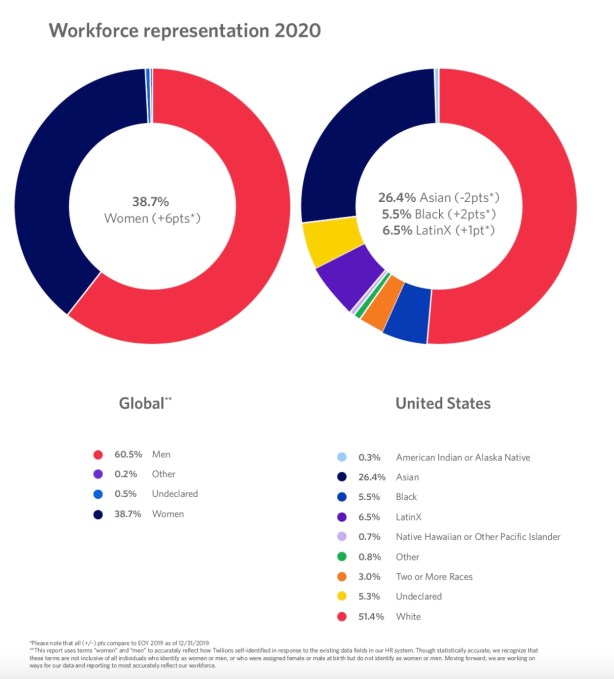
Twilio is still 60% male and just over 38% female, a number that was up 6% in 2020. The overall racial and ethnic makeup of the company is around 51% white, 25% Asian, 6.5% Latinx and 5.5% Black. While the ratio of whites to nonwhites is quite favorable, with a large percentage of Asians, it still has work to do when it comes to other historically excluded groups.

Twilio work demographics chart.

Image Credits: Twilio

The company certainly understands that. Lawson says that by working on an individual, company and societal level, the company hopes to do its part to improve its own record and continue to get better at this. Part of that is sharing their learnings in the report, not to pat themselves on the back, but bring the conversation outside the company.

As Clemons said in the video that accompanied the company’s diversity report: “Everyone has their experience. Everyone comes in with all types of experiences, whether good or bad, and we cannot change that, but what Twilio can do is provide a space for those to feel like they are part of something, and it goes back to this antiracist framework of ensuring that there’s equity for all people to feel like they can have a great career and a great career journey at Twilio.”

09 Aug 2021

Car-sharing startup Turo has filed confidentially for an IPO

Turo, the peer-to-peer car-sharing startup, has initiated the confidential process of filing for an initial public offering with the U.S. Securities Exchange Commission.

The number of shares to be offered in the IPO and the price range have not yet been determined, the company said in a statement. Turo declined to provide additional information to TechCrunch.

The eleven-year-old Turo’s marketplace is analogous to AirBnB, letting car owners post an ad to rent out their vehicle on its app and website. Cars are available to rent in more than 5,500 cities across four countries, Turo says on its website. That includes Germany, where Turo took over Daimler AG’s car-sharing subsidiary Croove alongside an investment deal.

The company had a $250 million Series E in July 2019, which pushed the company into unicorn status and “past the billion-dollar valuation mark,” CEO Andre Haddad said in a blog post. Turo followed that up with a $30 million extension round the following February, bringing its total funding to date to over $500 million.

Turo did not have a completely smooth ride during the pandemic; like other transportation startups Bird and Getaround, Turo laid off 30% of its workforce, or 108 employees, in March 2020 according to data tracker Layoffs.fyi.

ockquote>

09 Aug 2021

Harassment will happen at my startup and yours: Here’s how we prepare

Sexual harassment is, unfortunately, always in the news. Of late, it’s revelations at gaming giants and governments. Yet despite how prevalent harassment is, companies often adopt an “it can’t happen here” stance — until it does, and then there are knee-jerk reactions and crisis communications.

A better approach: recognizing how pervasive it is and planning with that in mind.

When I first started Ethena, I explained the concept of innovative harassment prevention training to my father. Like any good parent, he thought my entrepreneurial genius was actually a terrible idea and advised me to stay put at my job. But when he finally accepted that I was going to start this company, he said, “Make sure you don’t have harassment at your company. That would be bad.”

He’s not wrong. My team provides a modern compliance training platform. Since our first product was harassment prevention training, it would be pretty bad if we were talking the talk without walking the walk.

Train your team members to better understand inclusion and recognize what harassment looks like so the bar is set higher than “let’s just not get sued.”

If I could prevent workplace harassment on optimism alone, I absolutely would. But I’ve seen the data on the prevalence of workplace harassment.

A 2018 Pew survey, for example, found that 59% of women and 27% of men reported experiencing sexual harassment. And the rise of remote work hasn’t changed things. In fact, there are some indications that harassment is on the rise thanks to “keyboard courage.”

Knowing that, I’ve come to terms with the fact that these are issues we’ll likely face, so I want us to be prepared. Today’s workplace demands that leaders acknowledge gray areas and engage with uncomfortable topics; it’s how companies grow in new and healthy directions. Here’s how we think about that growth.

Plan for it

As a Floridian, I grew up assuming hurricanes would hit my house. We always had some plywood and canned food because when you know something is going to happen, you plan for it.

Unlike prepared Floridians, startups tend to adopt an ostrich approach when it comes to harassment. Instead of stocking the pantry, so to speak, companies wait until they’re already in a storm.

Early on, a startup is a small group of (usually homogeneous) friends, and it’s uncomfortable to acknowledge that bad things could happen. It’s much easier to hope that building a team of stellar humans is enough.

But, unfortunately, bad things do happen, because sometimes harassment is not as cut-and-dry as we are led to believe. Rather, harassment often grows from the complexities of human interactions– intent, perception, privilege and context, to name a few. It can start with a few small jokes, a colleague who gets drunkenly inappropriate every Friday, or a team that never seems to hire anyone outside of their social circle.

Then, things can escalate, and people start to realize that what they’re actually experiencing is a hostile work environment. Unfortunately, at that point, it’s really hard to right the ship because the company is suddenly 600 people and change gets harder as companies grow.

Knowing that problems are more likely as companies scale, it’s vital that teams prepare by learning how to identify warning signs early. At a bare minimum, train your team members to recognize what workplace harassment looks like and better understand inclusion so that the bar is set higher than “let’s just not get sued.”

Out of everyone at the company, managers really need to get the memo. As a company scales, senior leaders have a limited span of control, so frontline managers become the most crucial employees in either promoting or preventing inclusive workplaces. It just so happens that training is legally required in states like California and New York.

Make feedback, not just “tell HR,” an option

The traditional way that harassment is talked about is very binary. Either a workplace is perfectly inclusive or it’s a toxic cesspool. Obviously, it’s important to take these issues seriously, but the problem with treating every act as either fine or serious, capital-H harassment is that it gives employees a choice between bad and worse.

Let’s say Elena is on an engineering pod with Jonah, and Jonah occasionally does small things that cause her to feel less than included.

For example, they’re hiring for a new front-end engineer and Jonah always refers to this future hire as “he.” In the traditional, frowny-faced lawyer version of harassment, Elena has two options”

  1. Do nothing: Bad because Jonah is going to keep doing it.
  2. Tell HR: Also bad. Elena doesn’t want to get Jonah fired. She just wants him to be more inclusive.

However, if training teaches Elena — and, ideally, everyone else on her team — to say something in the moment, Elena now has a tool she can actually use.

Next time Jonah says, “OK so when he joins…” Elena can jump in with, “Unless you’re psychic, which seems unlikely given how poorly you did in Fantasy Football, please use ‘they’ to refer to our new hire, since we don’t know their gender.”

Did Elena need to insert the burn? Probably not, but humor can diffuse a tense situation so sure, why not? Regardless, once Elena says something, it’s on Jonah to accept her feedback and make a change; and, if team values are clear, hopefully Jonah’s colleagues will hold Jonah accountable, too.

Accountability is everything

This last lesson is only applicable after something at the company happens. Let’s say Jonah’s comments escalate, even after Elena gives feedback. Jonah consistently excludes Elena and other women from key meetings, talks over them, and when confronted, says, “Look, we all know they’re only here for diversity stats.”

If Jonah’s manager at this fictitious, problematic company does nothing, that’s the ballgame. There’s literally no amount of workshops, training, blog posts or all-hands meetings that can convince Elena that the company cares. Actions speak loudest.

The best possible version of dealing with an issue involves transparency so that people can learn from what happened and see that the company does care. Obviously, it’s hard when issues involve private information and protecting those who reported the issues, but to the extent possible, it’s crucial to have accountability.

Of course, my dad is right: Harassment at my company would be bad. But we’re preparing for it because scaling a company means rapidly increasing the number of human interactions.

Thankfully, building an inclusive company looks a lot like building a good company – preparation, feedback and accountability are managerial best practices that should be put in place early.

09 Aug 2021

Instagram tests ads in its Shop tab

Instagram is further investing in its e-commerce business, Instagram Shops, with the launch of a new advertising product, Ads in Instagram Shop. The company says it’s currently testing the new format, which includes both single images and the option for an image carousel, with select U.S.-based advertisers ahead of an expansion to other markets in the months to come.

The company first introduced Instagram Shops last year as part of a larger effort at Facebook to make its social platforms not just a place to connect with friends and follow favorite brands, but also an online shopping destination with an integrated checkout experience. Naturally, this type of initiative also lends itself to Facebook’s advertising model, as brands looking to connect with consumers could pay for expanded reach.

Like Instagram’s other advertising products, Ads in Instagram Shop will launch with an auction-based model, the company says. The ads will only appear on mobile, as the Instagram Shop tab is a mobile-only feature. However, how many ads an individual consumer sees will be based on how they use Instagram and how many people are shopping the Instagram tab. The company plans monitor consumer sentiment on this point, in order to balance ads and content.

Initially, Instagram is working with a handful of U.S. advertisers who will test the product and provide feedback, including Away, Donny Davy, Boo Oh, Clare paint, JNJ Gifts, DEUX and Fenty Beauty. These brands encompass some of the more popular categories of goods Instagram users like to shop for, including beauty, home décor, pet products, travel and more.

The company hasn’t yet disclosed an exact time frame for rolling out the ads more publicly, but says the plan is to expand the new format to advertisers in other, non-U.S. markets over the next several months.

The Instagram Shop tab has been one of the app’s more controversial additions in recent years, as it replaced the popular “Activity” tab (heart button) in the bottom navigation row — a change that made the app feel more commercially-driven than in the past and alienated some users. Today, the creative community is weighing its options as Instagram distances itself further from its photo-sharing roots with other new additions, like its TikTok clone Reels, as well.

09 Aug 2021

SpaceX to acquire satellite connectivity startup Swarm Technologies

SpaceX will be acquiring satellite connectivity startup Swarm Technologies, the first such deal for the 19-year-old space company headed by Elon Musk.

Swarm operates a constellation of 120 sandwich-sized satellites as well as a ground station network. The deal would transfer control of Swarm’s ground and space licenses to SpaceX, in addition to any licenses pending before the commission. If the transaction is approved, the startup would become a “direct wholly-owned subsidiary” of the larger company.

The acquisition, which was reported in under-the-radar filings with the Federal Communications Commission, marks a sharp departure from the launch giant’s established strategy of internally developing its tech.

The deal was reportedly reached between the two companies on July 16. The FCC filings do not disclose any financial details or terms of the transaction. Neither SpaceX nor Swarm could be reached for comment.

“Swarm’s services will benefit from the better capitalization and access to resources available to SpaceX, as well as the synergies associated with acquisition by a provider of satellite design, manufacture, and launch services,” the companies said in the filing. For SpaceX’s part, the company will “similarly benefit from access to the intellectual property and expertise developed by the Swarm team, as well as from adding this resourceful and effective team to SpaceX.”

What this means for SpaceX’s operations, particularly its Starlink satellite network, is unclear, as these satellites operate in a different frequency band from that of Swarm. In the short term, Swarm CEO Sara Spangelo told TechCrunch last month that the company is “still marching” toward its goal of operating a 150-satellite constellation.

Compared to SpaceX, Swarm is a relatively new company. It raised a $25 million Series A almost exactly three years ago, in August 2018, but it only went commercially live with its flagship product earlier this year. That product, the Tile, is a small modem that can be embedded in various connectivity devices and linked to the satellite network, to allow users a low-cost way to power Internet of Things devices.

Swarm’s Evaluation Kit. Image Credits: Swarm (opens in a new window)

Swarm also launched its second product last month, the $499 Evaluation Kit, an all-in-one package designed to give anyone the ability to create a IoT device using a Tile, a solar panel, and a few other components.

09 Aug 2021

Senators press Facebook for answers about why it cut off misinformation researchers

Facebook’s decision to close accounts connected to a misinformation research project last week prompted a broad outcry from the company’s critics — and now Congress is getting involved.

A handful of lawmakers criticized the decision at the time, slamming Facebook for being hostile toward efforts to make the platform’s opaque algorithms and ad targeting methods more transparent. Researchers believe that studying those hidden systems is crucial work for gaining insight on the flow of political misinformation.

The company specifically punished two researchers with NYU’s Cybersecurity for Democracy project who work on Ad Observer, an opt-in browser tool that allows researchers to study how Facebook targets ads to different people based on their interests and demographics.

In a new letter, embedded below, a trio of Democratic senators are pressing Facebook for more answers. Senators Amy Klobuchar (D-MN), Chris Coons (D-DE) and Mark Warner (D-VA) wrote to Facebook CEO Mark Zuckerberg asking for a full explanation on why the company terminated the researcher accounts and how they violated the platform’s terms of service and compromised user privacy. The lawmakers sent the letter on Friday.

“While we agree that Facebook must safeguard user privacy, it is similarly imperative that Facebook allow credible academic researchers and journalists like those involved in the Ad Observatory project to conduct independent research that will help illuminate how the company can better tackle misinformation, disinformation, and other harmful activity that is proliferating on its platforms,” the senators wrote.

Lawmakers have long urged the company to be more transparent about political advertising and misinformation, particularly after Facebook was found to have distributed election disinformation in 2016. Those concerns were only heightened by the platform’s substantial role in spreading election misinformation leading up to the insurrection at the U.S. Capitol, where Trump supporters attempted to overturn the vote.

In a blog post defending its decision, Facebook cited compliance with FTC as one of the reason the company severed the accounts. But the FTC called Facebook’s bluff last week in a letter to Zuckerberg, noting that nothing about the agency’s guidance for the company would preclude it from encouraging research in the public interest.

“Indeed, the FTC supports efforts to shed light on opaque business practices, especially around surveillance-based advertising,” Samuel Levine, the FTC’s acting director for the Bureau of Consumer Protection, wrote.

09 Aug 2021

Turkey’s first decacorn: Trendyol raises $1.5B at a $16.5B valuation

Trendyol, an e-commerce platform based in Turkey, has raised $1.5 billion in a massive funding round that values the company at $16.5 billion. General Atlantic, SoftBank Vision Fund 2, Princeville Capital and sovereign wealth funds, ADQ (UAE) and Qatar Investment Authority co-led the round. 

The deal marks SoftBank’s first in the country.

The new financing also makes Trendyol Turkey’s first decacorn, and among the highest valued private tech companies in Europe. It comes just months after strategic – and majority – backer Alibaba invested $350 million in the company at a $9.4 billion valuation.

Founded in 2010, Trendyol ranks as Turkey’s largest e-commerce company, serving more than 30 million shoppers and delivering more than 1 million packages per day. It claims to have evolved from marketplace to “superapp” by combining its marketplace platform (which is powered by Trendyol Express, its own last-mile delivery solution) with instant grocery and food delivery through its own courier network (Trendyol Go), its digital wallet (Trendyol Pay), consumer-to-consumer channel (Dolap) and other services.

Trendyol founder Demet Suzan Mutlu said the new capital will go toward expansion within Turkey and globally. Specifically, the company plans to continue investing in nationwide infrastructure, technology and logistics and toward accelerating digitalization of Turkish SMEs. She said the company was founded to create positive impact and that it intends to continue on that mission.

Evren Ucok, Trendyol’s chairman,  added that part of the company’s goal is to create new export channels for Turkish merchants and manufacturers.

Melis Kahya Akar, managing director and head of consumer for EMEA at General Atlantic, said that Trendyol’s marketplace model – ranging from grocery delivery to mobile wallets – “brings convenience and ease to consumers” in Turkey and internationally.

A 2020 report by JPMorgan found that e-commerce represented only 5.3 percent of the overall Turkish retail market at the time but that Turkish e-commerce had notched impressive leaps in revenues in recent years: 2018 alone saw the market jump by 42 percent, followed by 31 percent in 2019. As of 2020, 67 percent of the Turkish population were making purchases online.