Year: 2021

01 Sep 2021

How a Vungle-owned mobile marketer sent Fontmaker to the top of the App Store

Does this sound familiar? An app goes viral on social media, often including TikTok, then immediately climbs to the top of the App Store where it gains even more new installs thanks to the heightened exposure. That’s what happened with the recent No. 1 on the U.S. App Store, Fontmaker, a subscription-based fonts app which appeared to benefit from word-of-mouth growth thanks to TikTok videos and other social posts. But what we’re actually seeing here is a new form of App Store marketing — and one which now involves one of the oldest players in the space: Vungle.

Fontmaker, at first glance, seems to be just another indie app that hit it big.

The app, published by an entity called Mango Labs, promises users a way to create fonts using their own handwriting which they can then access from a custom keyboard for a fairly steep price of $4.99 per week. The app first launched on July 26. Nearly a month later, it was the No. 2 app on the U.S. App Store, according to Sensor Tower data. By August 26, it climbed up one more position to reach No. 1. before slowly dropping down in the top overall free app rankings in the days that followed.

By Aug. 27, it was No. 15, before briefly surging again to No. 4 the following day, then declining once more. Today, the app is No. 54 overall and No. 4 in the competitive Photo & Video category — still, a solid position for a brand-new and somewhat niche product targeting mainly younger users. To date, it’s generated $68,000 in revenue, Sensor Tower reports.

But Fontmaker may not be a true organic success story, despite its Top Charts success driven by a boost in downloads coming from real users, not bots. Instead, it’s an example of how mobile marketers have figured out how to tap into the influencer community to drive app installs. It’s also an example of how it’s hard to differentiate between apps driven by influencer marketing and those that hit the top of the App Store because of true demand — like walkie-talkie app Zello, whose recent trip to No. 1 can be attributed to Hurricane Ida

As it turns out, Fontmaker is not your typical “indie app.” In fact, it’s unclear who’s really behind it. Its publisher, Mango Labs, LLC, is actually an iTunes developer account owned by the mobile growth company JetFuel, which was recently acquired by the mobile ad and monetization firm Vungle — a longtime and sometimes controversial player in this space, itself acquired by Blackstone in 2019.

Vungle was primarily interested in JetFuel’s main product, an app called The Plug, aimed at influencers.

Through The Plug, mobile app developers and advertisers can connect to JetFuel’s network of over 15,000 verified influencers who have a combined 4 billion Instagram followers, 1.5 billion TikTok followers, and 100 million daily Snapchat views.

While marketers could use the built-in advertising tools on each of these networks to try to reach their target audience, JetFuel’s technology allows marketers to quickly scale their campaigns to reach high-value users in the Gen Z demographic, the company claims. This system can be less labor-intensive than traditional influencer marketing, in some cases. Advertisers pay on a cost-per-action (CPA) basis for app installs. Meanwhile, all influencers have to do is scroll through The Plug to find an app to promote, then post it to their social accounts to start making money.
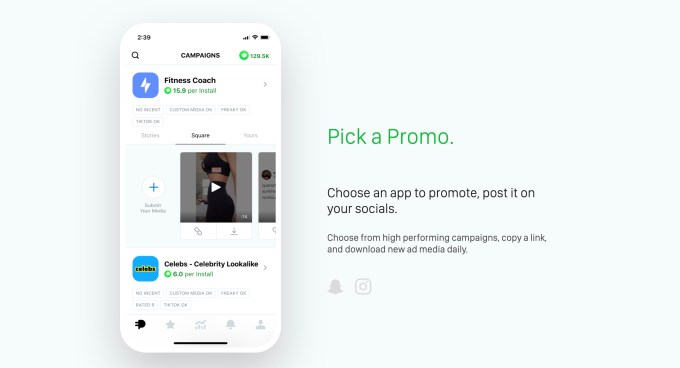
Image Credits: The Plug’s website, showing influencers how the platform works

So while yes, a lot of influencers may have made TikTok videos about Fontmaker, which prompted consumers to download the app, the influencers were paid to do so. (And often, from what we saw browsing the Fontmaker hashtag, without disclosing that financial relationship in any way — an increasingly common problem on TikTok, and area of concern for the FTC.)

Where things get tricky is in trying to sort out Mango Labs’ relationship with JetFuel/Vungle. As a consumer browsing the App Store, it looks like Mango Labs makes a lot of fun consumer apps of which Fontmaker is simply the latest.

JetFuel’s website helps to promote this image, too.

It had showcased its influencer marketing system using a case study from an “indie developer” called Mango Labs and one of its earlier apps, Caption Pro. Caption Pro launched in Jan. 2018. (App Annie data indicates it was removed from the App Store on Aug. 31, 2021…yes, yesterday).
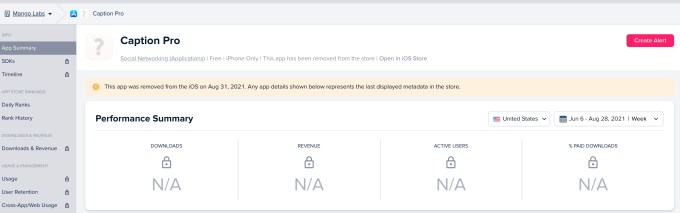
Image Credits: App Annie

Vungle, however, told TechCrunch “The Caption Pro app no longer exists and has not been live on the App Store or Google Play for a long time.” (We can’t find an App Annie record of the app on Google Play).

They also told us that “Caption Pro was developed by Mango Labs before the entity became JetFuel,” and that the case study was used to highlight JetFuel’s advertising capabilities. (But without clearly disclosing their connection.)

“Prior to JetFuel becoming the influencer marketing platform that it is today, the company developed apps for the App Store. After the company pivoted to become a marketing platform, in February 2018, it stopped creating apps but continued to use the Mango Labs account on occasion to publish apps that it had third-party monetization partnerships with,” the Vungle spokesperson explained.

In other words, the claim being made here is that while Mango Labs, originally, were the same folks who have long since pivoted to become JetFuel, and the makers of Caption Pro, all the newer apps published under “Mango Labs, LLC” were not created by JetFuel’s team itself.

“Any apps that appear under the Mango Labs LLC name on the App Store or Google Play were in fact developed by other companies, and Mango Labs has only acted as a publisher,” the spokesperson said.
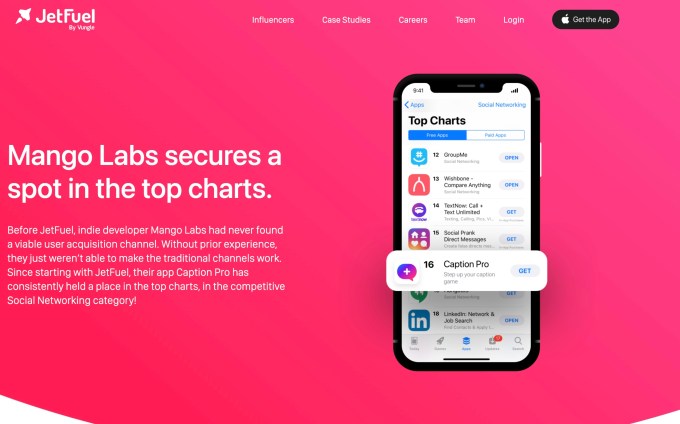
Image Credits: JetFuel’s website describing Mango Labs as an “indie developer”

There are reasons why this statement doesn’t quite sit right — and not only because JetFuel’s partners seem happy to hide themselves behind Mango Labs’ name, nor because Mango Labs was a project from the JetFuel team in the past. It’s also odd that Mango Labs and another entity, Takeoff Labs, claim the same set of apps. And like Mango Labs, Takeoff Labs is associated with JetFuel too.

Breaking this down, as of the time of writing, Mango Labs has published several consumer apps on both the App Store and Google Play.

On iOS, this includes the recent No. 1 app Fontmaker, as well as FontKey, Color Meme, Litstick, Vibe, Celebs, FITme Fitness, CopyPaste, and Part 2. On Google Play, it has two more: Stickered and Mango.

Image Credits: Mango Labs

Most of Mango Labs’ App Store listings point to JetFuel’s website as the app’s “developer website,” which would be in line with what Vungle says about JetFuel acting as the apps’ publisher.

What’s odd, however, is that the Mango Labs’ app Part2, links to Takeoff Labs’ website from its App Store listing.

The Vungle spokesperson initially told us that Takeoff Labs is “an independent app developer.”

And yet, the Takeoff Labs’ website shows a team which consists of JetFuel’s leadership, including JetFuel co-founder and CEO Tim Lenardo and JetFuel co-founder and CRO JJ Maxwell. Takeoff Labs’ LLC application was also signed by Lenardo.

Meanwhile, Takeoff Labs’ co-founder and CEO Rhai Goburdhun, per his LinkedIn and the Takeoff Labs website, still works there. Asked about this connection, Vungle told us they did not realize the website had not been updated, and neither JetFuel nor Vungle have an ownership stake in Takeoff Labs with this acquisition.
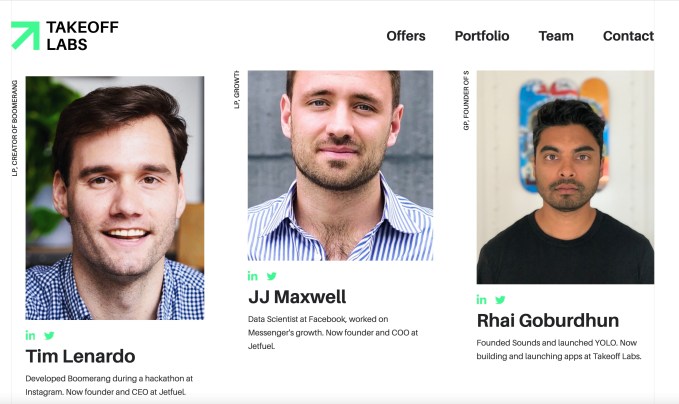
Image Credits: Takeoff Labs’ website showing its team, including JetFuel’s co-founders.

Takeoff Labs’ website also shows off its “portfolio” of apps, which includes Celeb, Litstick, and FontKey — three apps that are published by Mango Labs on the App Store.

On Google Play, Takeoff Labs is the developer credited with Celebs, as well as two other apps, Vibe and Teal, a neobank. But on the App Store, Vibe is published by Mango Labs.
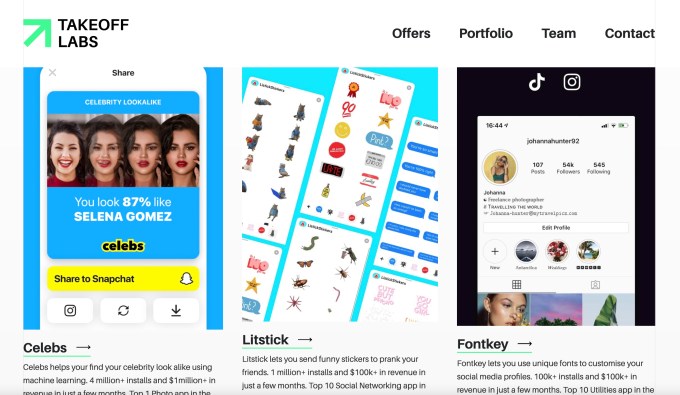
Image Credits: Takeoff Labs’ website, showing its app portfolio.

(Not to complicate things further, but there’s also an entity called RealLabs which hosts JetFuel, The Plug and other consumer apps, including Mango — the app published by Mango Labs on Google Play. Someone sure likes naming things “Labs!”)

Vungle claims the confusion here has to do with how it now uses the Mango Labs iTunes account to publish apps for its partners, which is a “common practice” on the App Store. It says it intends to transfer the apps published under Mango Labs to the developers’ accounts, because it agrees this is confusing.

Vungle also claims that JetFuel “does not make nor own any consumer apps that are currently live on the app stores. Any of the apps made by the entity when it was known as Mango Labs have long since been taken down from the app stores.”

JetFuel’s system is messy and confusing, but so far successful in its goals. Fontmaker did make it to No. 1, essentially growth hacked to the top by influencer marketing.

But as a consumer, what this all means is that you’ll never know who actually built the app you’re downloading or whether you were “influenced” to try it through what were, essentially, undisclosed ads.

Fontmaker isn’t the first to growth hack its way to the top through influencer promotions. Summertime hit Poparrazzi also hyped itself to the top of the App Store in a similar way, as have many others. But Poparazzi has since sunk to No. 89 in Photo & Video, which shows influence can only take you so far.

As for Fontmaker, paid influence got it to No. 1, but its Top Chart moment was brief.
01 Sep 2021

Subscription-based Bright Cellars lands more funding to personalize its wines

Bright Cellars, a six-year-old, Milwaukee, Wis.-based subscription-based wine seller has, like many upstarts, evolved over time. While it once sent its club members third-party wines that fit their particular profiles, Bright Cellars says it’s now amassing enough data about its customers through its “palate” quizzes that it no longer sells wines made by other brands. Instead, while some of its “original” offerings are admittedly sold by other labels under different names, it is increasingly finding success by directing its winemaker partners to tweak the recipe, so to speak.

“We’re optimizing wine like you might optimize a more digital product,” says cofounder and CEO, Richard Yau, a San Francisco native whose startup entered into a regional accelerator program early on and stayed, though the company is now largely decentralized.

We talked earlier today with Yau about that shift, which investors are supporting with $11.2 million in Series B funding, led by Cleveland Avenue, with participation from earlier backers Revolution Ventures and Northwestern Mutual. (The company has now raised roughly $20 million altogether).

Yau also talked about industry trends that he’s seeing because of all that data collection.

TC: You say you’re building a portfolio of wines. What does that mean?

RY: We don’t own any land. We’re working primarily with suppliers [as do big companies like Gallo and Constellation], but at a larger scale than before, so we now get to shape what wines taste like and look like, and we can optimize across variables like how sweet should this wine be? How acidic? What do we want its color and brand and label to look like and which segment of our customers will really enjoy this wine the most?

TC: What is one of your concoctions?

RY: We have a sparkling wine that’s produced in the Champagne method— not a Champagne wine; it’s a domestic wine — using grape varietals that no one uses for sparkling wine, and it’s one of the top-rated wines on our platform. Sparkling wine has been really good for us.

TC: How many subscribers do you have?

RY: We can’t share that, but we saw an acceleration in not just new subscribers throughout the pandemic but also in terms of seeing a  larger share of [customers’] wallets going to D2C, and that impacted us pretty positively. Even as things eased up over the summer, we saw that people were cooking and eating at home more [and drinking wine].

TC: What’s the average price of a bottle of wine on the platform?

RY: $20 to $25.

TC: Where are your grape suppliers?

RY: A lot are on the West Coast, in Washington and California, but we also have grape suppliers internationally, including in South America and Europe.

TC: How many wines do you offer, and how long do you trial a wine?

RY: We’ve tested around 600, and at any given time, we’ll have 40 to 50 wines on the platform. We don’t stock everything forever; those that don’t do as well, we basically eliminate.

TC: A lot of D2C brands eventually branch into real-world locations. You aren’t doing that. Why not?

RY:  It’s possible that we might at some point, but we like being D2C and it makes a lot of sense in a world where our members now work from home and are home to receive packages. It lines up with e-commerce trends in general. If you’re not buying your groceries at the store anymore, you aren’t buying wines at the store, either.

TC: From where are these bottles shipped?

RY:  From a variety of places but primarily from Santa Rosa [in the Bay Area].

TC: Have you seen the impact the weather is having on California winemakers, some of whom are now spraying sunscreen on their grapes to protect them?

RY: [Climate change] has certainly affected the wine industry. One of the fortune things about us is we have flexibility in the suppliers we’re working with, so from a business-health perspective, we haven’t been as affected by that. Because a lot of our operations are in California, we did a couple of years ago have some interruptions with distribution where we weren’t able to ship some days; we were also impacted by warm temperatures. But fortunately, so far for this year, we haven’t had any operational or supply-chain disruptions.

TC: Have you been approached by one of legacy firms about a partnership or acquisition?

RY: We’ve had conversations, more in terms of partnerships because we have lots of data and can help them. For example, we can launch a new wine and get feedback almost like a focus group to figure out who likes what. We can split test two different blends for a wine and figure out which does better. That’s where conversations with legacy wine companies have happened.

TC: So they’d pay you for your data.

RY: We’re not opposed to selling data in the future, but we’ve approached it more like, here’s an opportunity to learn about how innovation works at a larger wine company. We don’t expect to be able to do what Constellation does well — with its large salesforce and distributors in every state — but what we can do in a complimentary way is understand the consumer.

TC: What have you learned about different groups that might surprise outsiders?

RY: For example, petite sirah [offerings] do as well, if not better than, cabernet and pinot noir on the platform. Cab and pinot are fully 50 times the market size of petite sirah, but we see that our members really like it. People also like merlot a lot more than they think — pretty much across all demographics. People like to hate merlot, but when we look at red blends that do well . . .

TC: What do people have against merlot?

RY: Have you ever seen “Sideways?”

01 Sep 2021

Subscription-based Bright Cellars lands more funding to personalize its wines

Bright Cellars, a six-year-old, Milwaukee, Wis.-based subscription-based wine seller has, like many upstarts, evolved over time. While it once sent its club members third-party wines that fit their particular profiles, Bright Cellars says it’s now amassing enough data about its customers through its “palate” quizzes that it no longer sells wines made by other brands. Instead, while some of its “original” offerings are admittedly sold by other labels under different names, it is increasingly finding success by directing its winemaker partners to tweak the recipe, so to speak.

“We’re optimizing wine like you might optimize a more digital product,” says cofounder and CEO, Richard Yau, a San Francisco native whose startup entered into a regional accelerator program early on and stayed, though the company is now largely decentralized.

We talked earlier today with Yau about that shift, which investors are supporting with $11.2 million in Series B funding, led by Cleveland Avenue, with participation from earlier backers Revolution Ventures and Northwestern Mutual. (The company has now raised roughly $20 million altogether).

Yau also talked about industry trends that he’s seeing because of all that data collection.

TC: You say you’re building a portfolio of wines. What does that mean?

RY: We don’t own any land. We’re working primarily with suppliers [as do big companies like Gallo and Constellation], but at a larger scale than before, so we now get to shape what wines taste like and look like, and we can optimize across variables like how sweet should this wine be? How acidic? What do we want its color and brand and label to look like and which segment of our customers will really enjoy this wine the most?

TC: What is one of your concoctions?

RY: We have a sparkling wine that’s produced in the Champagne method— not a Champagne wine; it’s a domestic wine — using grape varietals that no one uses for sparkling wine, and it’s one of the top-rated wines on our platform. Sparkling wine has been really good for us.

TC: How many subscribers do you have?

RY: We can’t share that, but we saw an acceleration in not just new subscribers throughout the pandemic but also in terms of seeing a  larger share of [customers’] wallets going to D2C, and that impacted us pretty positively. Even as things eased up over the summer, we saw that people were cooking and eating at home more [and drinking wine].

TC: What’s the average price of a bottle of wine on the platform?

RY: $20 to $25.

TC: Where are your grape suppliers?

RY: A lot are on the West Coast, in Washington and California, but we also have grape suppliers internationally, including in South America and Europe.

TC: How many wines do you offer, and how long do you trial a wine?

RY: We’ve tested around 600, and at any given time, we’ll have 40 to 50 wines on the platform. We don’t stock everything forever; those that don’t do as well, we basically eliminate.

TC: A lot of D2C brands eventually branch into real-world locations. You aren’t doing that. Why not?

RY:  It’s possible that we might at some point, but we like being D2C and it makes a lot of sense in a world where our members now work from home and are home to receive packages. It lines up with e-commerce trends in general. If you’re not buying your groceries at the store anymore, you aren’t buying wines at the store, either.

TC: From where are these bottles shipped?

RY:  From a variety of places but primarily from Santa Rosa [in the Bay Area].

TC: Have you seen the impact the weather is having on California winemakers, some of whom are now spraying sunscreen on their grapes to protect them?

RY: [Climate change] has certainly affected the wine industry. One of the fortune things about us is we have flexibility in the suppliers we’re working with, so from a business-health perspective, we haven’t been as affected by that. Because a lot of our operations are in California, we did a couple of years ago have some interruptions with distribution where we weren’t able to ship some days; we were also impacted by warm temperatures. But fortunately, so far for this year, we haven’t had any operational or supply-chain disruptions.

TC: Have you been approached by one of legacy firms about a partnership or acquisition?

RY: We’ve had conversations, more in terms of partnerships because we have lots of data and can help them. For example, we can launch a new wine and get feedback almost like a focus group to figure out who likes what. We can split test two different blends for a wine and figure out which does better. That’s where conversations with legacy wine companies have happened.

TC: So they’d pay you for your data.

RY: We’re not opposed to selling data in the future, but we’ve approached it more like, here’s an opportunity to learn about how innovation works at a larger wine company. We don’t expect to be able to do what Constellation does well — with its large salesforce and distributors in every state — but what we can do in a complimentary way is understand the consumer.

TC: What have you learned about different groups that might surprise outsiders?

RY: For example, petite sirah [offerings] do as well, if not better than, cabernet and pinot noir on the platform. Cab and pinot are fully 50 times the market size of petite sirah, but we see that our members really like it. People also like merlot a lot more than they think — pretty much across all demographics. People like to hate merlot, but when we look at red blends that do well . . .

TC: What do people have against merlot?

RY: Have you ever seen “Sideways?”

01 Sep 2021

Rocket Lab boosts its space systems divison in quest to become an “end-to-end space company”

Peter Beck hasn’t been shy about his intention to grow Rocket Lab into more than just a launch provider, but a fully vertically integrated space company that makes spacecraft in addition to sending them to orbit. The company, which he founded in 2006, has taken yet another major stride toward that goal with the news Wednesday that it will open a new production facility to manufacture satellite components at a larger scale than ever before.

The facility will manufacture reaction wheels, critical attitude and stability control systems on satellites. Rocket Lab says the facility, which will be operational in the fourth quarter of this year, will be capable of producing up to 2,000 reaction wheels annually. Given that spacecraft generally have between 3 and 4 reaction wheels, it’s safe to assume that Rocket Lab customers likely have around 500 individual satellites ready in the pipeline to accept these components. “These are these are large volumes of supply across multiple constellations,” Rocket Lab CEO Beck said in a recent interview with TechCrunch.

The news is a marked expansion for Rocket Lab’s space systems business, which is already kept busy by the in-house Photon spacecraft and was boosted last year when the company acquired major satellite hardware manufacturer Sinclair Interplanetary. Rocket Lab also offers bespoke Photons for individual use cases – it will be designing the vehicles for forthcoming launches with space manufacturing startup Varda Space Industries and two Photons that will be sent to Mars on an upcoming science mission.

Historically, spacecraft components have generally been produced on the scale of tens or hundreds, because the barriers to get to orbit were so high. But as the cost of launch has declined (thanks in part to innovations from companies like Rocket Lab) more and more entities are able to send projects to space. That means more satellites, and more reaction wheels. Even today, there are around 200 Rocket Lab-made reaction wheels in orbit, so 2,000 in a single year is a huge jump in scale.

It’s all part of Rocket Lab’s goal of being a fully-integrated space services company. A major benefit from the vertical integration for customers, Rocket Lab says, is slashed manufacturing lead times. Beck said that when the company first started producing Photons, they quickly encountered months-long delivery times for reaction wheels, which effectively pushed back their timeline for launching one to orbit.

“If the space economy is to grow in the way that it’s predicted, then this has to be solved,” he said. “This is a fundamental problem that has to be solved. The whole space supply chain is characterized by small scale operations that really lack the ability to produce volume in any scale.”

Rocket Lab will be hiring more than 16 roles to support the space systems division and the new production facility, which will otherwise be highly automated; the company said in a statement that the production tools and environmental testing workstations will all be automated, and the metal machining is optimized to operate unattended. Beck said these techniques are very much in line with Rocket Lab’s other manufacturing processes – he pointed to Rosie the Robot as a cornerstone of the company’s capacity to use automation to rapidly scale its products.

Beck stayed mum about whether the company is planning on scaling the production of other spacecraft components, like the star trackers navigation tool, which Rocket Lab also manufacturers. However, he did say that the company plans on introducing new products – what those will be will, he declined to specify. But Beck’s stated aim when he started the space systems division is that “everything that goes to space should have a Rocket Lab logo on it.”

That aim goes to Rocket Lab’s larger vision, which is becoming an end-to-end space company: combining launch services with spacecraft manufacturing to be able to build in-orbit infrastructure.

“When you combine those things together, you have an immensely powerful platform that you can use to develop infrastructure in orbit and ultimately provide services,” he said.

But when asked what kinds of services he was thinking of, Beck played it close to the chest, instead choosing to give a well-known example from a competitor: SpaceX’s Starlink internet satellite project, which it builds and launches itself. He stayed mum on what kinds of ventures Rocket Lab might pursue, just saying that the vertical integration gives the company the ability to try new business models.

“The marginal cost for us to experiment is very, very low.”

01 Sep 2021

Virtual events startups have high hopes for after the pandemic

Few people thought of virtual events before the pandemic struck, but this format has fulfilled a unique and important need for companies and organizations large and small during the pandemic. But what will virtual events’ value be as more of the world attempts to return to life before COVID-19?

To find out, we caught up with top executives and investors in the sector to learn about the big trends they’re seeing — as the sequel to this survey we did in March 2020.

Certain use cases have been proven, they say. Today, you can find numerous small niche events available year-round that might have been buried in the back of a larger in-person conference before 2020. For organizations, internal virtual events can also be instrumental in helping connect and promote engagement for remote-first teams.

However, some respondents acknowledged that low-quality virtual events are growing ever more common, and everyone agreed that there is much more work to be done.

We surveyed:

Xiaoyin Qu, founder and CEO, Run The World

With the pandemic hopefully becoming more manageable soon, do you feel a return to in-person events is inevitable?

Certain types of events will go back to in person. Obviously, something to do with a President’s Club — the company rewards you with a party in Hawaii — that kind of thing will not go virtual. I think events more focused on increasing reach will continue to trend toward virtual.

“Hybrid is just another buzzword to say that both online and offline events formats will coexist. Of course they will.”

We’re also seeing that many events are getting smaller, more niche. Before the pandemic, if we look at a general pediatric conference, for example, an attendee may only be interested in two topics out of the 200 offered. But now we’ve seen that there’s a rise in many niche events that focus on very specific topics, which helps streamline these events for attendees.

I think such events are still going to happen virtually just because they’re easier to organize and people can have more in-depth conversations. Internal virtual events for employees is another category that is getting more traction, because companies have been going remote. So many the internal events like the company happy hour — events that help employees engage better — we think that’s still going to happen virtually. So there are a number of use cases we think will continue to be virtual and are probably better virtual.


Help TechCrunch find the best growth marketers for startups.

Provide a recommendation in this quick survey and we’ll share the results with everybody.


What sort of trends do you think will emerge once in-person events are possible again?

Another important trend we’re seeing is that a lot of organizers have begun hosting events more frequently. They were doing large conferences in the past, but now they’re pivoting or they’re rethinking their strategy. They realize that hosting maybe 10 events a year is better than hosting one big event every year. A traditional conference is usually multiday, with maybe 200 different topics and 100 different speakers. Now a lot of people are thinking about spreading it out throughout the year.

01 Sep 2021

Virtual events startups have high hopes for after the pandemic

Few people thought of virtual events before the pandemic struck, but this format has fulfilled a unique and important need for companies and organizations large and small during the pandemic. But what will virtual events’ value be as more of the world attempts to return to life before COVID-19?

To find out, we caught up with top executives and investors in the sector to learn about the big trends they’re seeing — as the sequel to this survey we did in March 2020.

Certain use cases have been proven, they say. Today, you can find numerous small niche events available year-round that might have been buried in the back of a larger in-person conference before 2020. For organizations, internal virtual events can also be instrumental in helping connect and promote engagement for remote-first teams.

However, some respondents acknowledged that low-quality virtual events are growing ever more common, and everyone agreed that there is much more work to be done.

We surveyed:

Xiaoyin Qu, founder and CEO, Run The World

With the pandemic hopefully becoming more manageable soon, do you feel a return to in-person events is inevitable?

Certain types of events will go back to in person. Obviously, something to do with a President’s Club — the company rewards you with a party in Hawaii — that kind of thing will not go virtual. I think events more focused on increasing reach will continue to trend toward virtual.

“Hybrid is just another buzzword to say that both online and offline events formats will coexist. Of course they will.”

We’re also seeing that many events are getting smaller, more niche. Before the pandemic, if we look at a general pediatric conference, for example, an attendee may only be interested in two topics out of the 200 offered. But now we’ve seen that there’s a rise in many niche events that focus on very specific topics, which helps streamline these events for attendees.

I think such events are still going to happen virtually just because they’re easier to organize and people can have more in-depth conversations. Internal virtual events for employees is another category that is getting more traction, because companies have been going remote. So many the internal events like the company happy hour — events that help employees engage better — we think that’s still going to happen virtually. So there are a number of use cases we think will continue to be virtual and are probably better virtual.


Help TechCrunch find the best growth marketers for startups.

Provide a recommendation in this quick survey and we’ll share the results with everybody.


What sort of trends do you think will emerge once in-person events are possible again?

Another important trend we’re seeing is that a lot of organizers have begun hosting events more frequently. They were doing large conferences in the past, but now they’re pivoting or they’re rethinking their strategy. They realize that hosting maybe 10 events a year is better than hosting one big event every year. A traditional conference is usually multiday, with maybe 200 different topics and 100 different speakers. Now a lot of people are thinking about spreading it out throughout the year.

01 Sep 2021

Agility Robotics’ Digit gets a warehouse gig

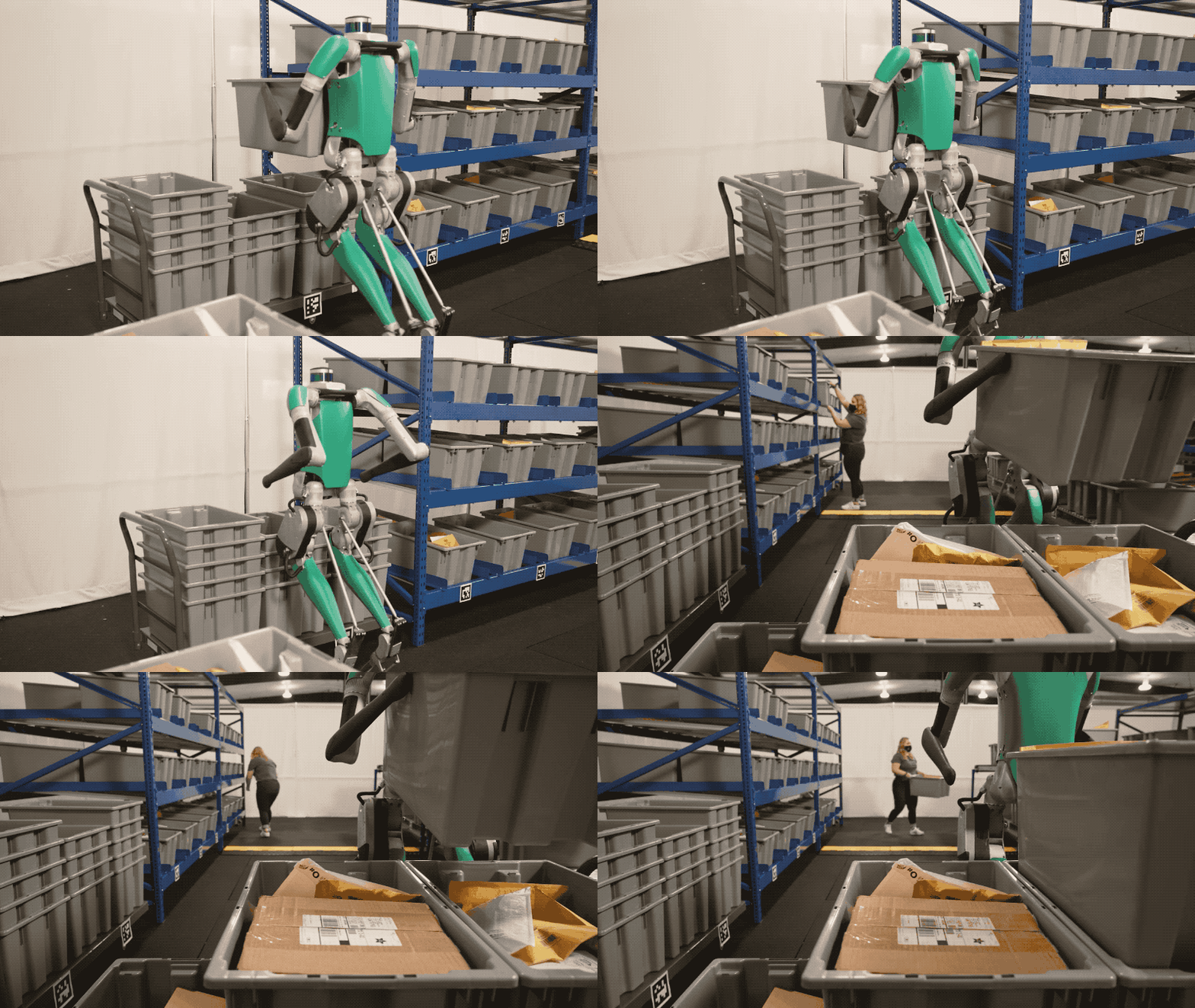
A new video from Agility Robotics showcases an increasing familiar sight: advanced, autonomous robots performing boring warehouse tasks. It’s not the sort of video that tends to be hugely viral for a company, rather, it’s the sort of meat and potatoes proof of concept that companies like Boston Dynamics wedge between flashy videos of parkour and highly choreographed dance sessions.

Ultimately, however, this is precisely the sort of tasks the robots’ creators are targeting: the well-known trio of dull, dirty and dangerous. Moving payloads back and forth certainly ticks that first box pretty well. There’s a reason warehouse and fulfillment workers often liken their work to robotics.

“The conversation around automation has shifted a bit,” Agility CEO Damion Shelton tells TechCrunch. “It’s viewed as an enabling technology to allow you to keep the workforce that you have. There are a lot of conversations around the risks of automation and job loss, but the job loss is actually occurring now, in advance of the automated solutions.”

Digit, the bipedal robot the company announced back in 2020, had its most high-profile moment in the spotlight after Agility announced a partnership with auto giant Ford back at CES. The auto giant currently owns two of the robots, with long-term plans to utilize the technology for delivery.

Today’s video is an attempt to showcase some more short-term solutions, putting Digit to work on more menial tasks.

Image Credits: Agility Robotics

“The value and goal of a machine like Digit is the generality,” CTO Jonathan Hurst says. “It’s a robot that can operate in human environments and spaces. It’s a relatively straightforward thing for very structured, repetitive tasks, to say, ‘there’s going to be boxes over there. We’re going to tell you which one from a databasing system, and we want you to move it over there.’ Maybe this is something that it does for three or four hours a day and then it goes to a different space and does it three or four hours and then it unloads a tractor trailer.”

The company sees Digit’s value as a more plug and play solution than something like Berkshire Gray’s offerings, which builds a fully automated warehouse from the ground up. There’s still programming involved, of course. An Agility rep will appear on-site to pre-map a location and help the robot execute its repetitive tasks.

“In terms of where we can actually deploy and do useful work for a customer, it turns out a lot of the tasks — walk from Point A to Point B, pick up and carry a package — are portable across these environments,” says Shelton. “There’s no real core piece of technology that you develop, that’s different for an indoor environment versus outdoor. It’s just the level of maturity. I think we’ve reached that pretty quickly on the indoor stuff, so it’s a logical first place for deployment.”

Image Credits: Agility Robotics

Agility hasn’t announced partners beyond Ford, though it says it’s currently working with “major logistics companies.” It hasn’t revealed numbers of Digits sold, either, though it tells TechCrunch that the number is “substantially more” than the dozen Cassie units it sold prior to Digit, largely for research purposes. Sales are largely CapEx at the moment, though the company is exploring other opportunities, such as a RaaS (robotics-as-a-service model).

Agility’s team is currently at 56 people, primarily based in Oregon (the company got its start as part of OSU’s nascent robotics division), where the robots are primarily manufactured.

“We’ve grown pretty rapidly since last December,” says Shelton. “We’re expanding our Pittsburgh office by the end of the year, in addition to the Oregon office. We have a pretty rapid growth rate. As we’ve been increasing the production rate on the robots, we’ve had a fair amount of hiring for that. We just moved into a new facility that we remodeled, back in June.”


01 Sep 2021

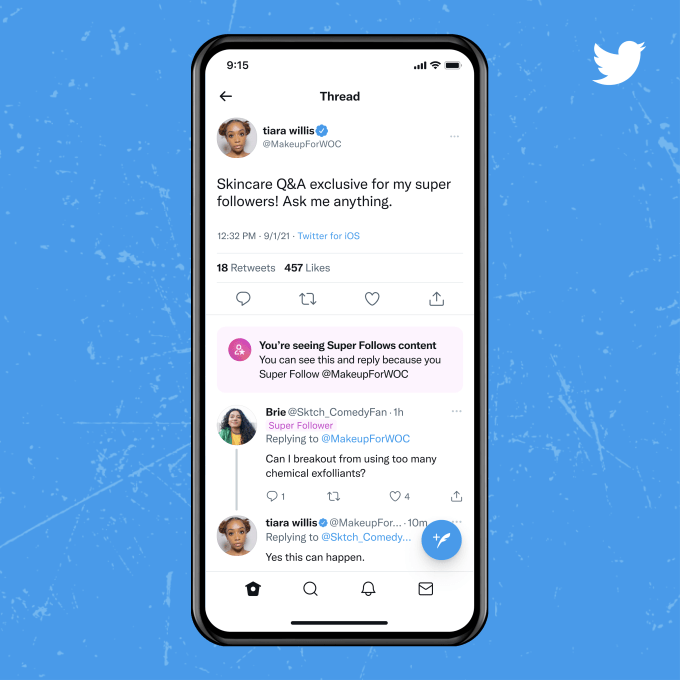
Twitter rolls out paid subscription ‘Super Follows’ to let you cash in on your tweets

After opening applications in June, Twitter is rolling out Super Follows, its premium subscription option, starting today.

The feature, first revealed in February, will allow users to subscribe to accounts they like for a monthly subscription fee in exchange for exclusive content. For creators, Super Follows are another useful tool in the emerging patchwork of monetization options across social platforms.

Eligible accounts can set the price for Super Follow subscriptions, with the option of charging $2.99, $4.99 or $9.99 per month, prices fairly comparable to a paid newsletter. They can then choose to mark some tweets for subscribers only, while continuing to reach their unpaid follower base in regular tweets.

Twitter Super Follows

Paid subscribers will be marked with a special Super Follower badge, differentiating them from unpaid followers in the sea of tweets. The badge shows up in replies, elevating a follower’s ability to interact directly with accounts they opt to support. For accounts that have Super Follows turned on, the option will show up with a distinct button on the profile page.

Super Follows aren’t turned on for everyone. For now, the process remains application only, with a waitlist. The option lives in the Monetization options in the app’s sidebar, though users will need to be U.S.-based with 10K followers and at least 25 tweets within the last month to be eligible.

U.S. and Canada-based iOS Twitter users will be able to Super Follow some accounts starting today, with more users globally seeing the rollout in the coming weeks. On the creator side, Super Follows are only enabled in iOS for now, though support for Android and desktop are “coming soon.”

Twitter says that Super Follow income will be subject to the standard, though controversial, 30 percent in-app purchase fees collected by Apple or Google. Twitter will only take a 3 percent cut of earnings for up to the first $50,000 generated through Super Follows — a boon for smaller accounts getting off the ground or anyone who uses the paid Twitter feature as a way to supplement other creator income elsewhere. After an account hits the $50,000 earnings mark, Twitter will begin taking a 20 percent cut.

Super Follows aren’t Twitter’s first monetization experiment to make it out in the wild. In May, Twitter introduced Tip Jar, a way for accounts to receive one-time payments through integration with the Cash App and other payment platforms. The test is limited to a subset of eligible accounts including “creators, journalists, experts, and nonprofits” for the time being.

Last week Twitter rolled out Ticketed Spaces for users who applied for the paid audio room feature back in June. Twitter’s cut from Ticketed Spaces mirrors the same fee structure it uses for Super Follows and users will be able to charge anywhere from one dollar to $999 for advanced ticketing.

The product is the latest in a flurry of activity from the social platform after a lengthy period of product stagnation. But Twitter has been busy in the last twelve months, from releasing and killing its ill-fated Fleets to finally showing signs of life on the kind of anti-abuse features many people have been calling for for years.

Giving users the ability to charge for premium content is a pretty major departure for Twitter, which mostly stayed the course until activist shareholders threatened to oust CEO Jack Dorsey. It’s also a major move for the company into the white-hot creator space, as more platforms add tools to empower their users to make a living through content creation — ideally keeping them loyal and generating revenue in the process.

01 Sep 2021

Berlin Brands Group, now valued at $1B+, raises $700M to buy and scale merchants that sell on marketplaces like Amazon

Berlin Brands Group — one of the new wave of e-commerce startups hoping to build lucrative economies of scale around buying up smaller brands that sell on marketplaces like Amazon and using technology to run and scale them more efficiently — has picked up a big round of funding to fill out that mission. The startup has closed a round of $700 million, comprising both equity and debt, which it will use in part to continue building its fulfillment and logistics infrastructure, as well as its tech platform, and in part to buy more companies.

BBG confirmed that the investment — one of the biggest to date in the space — boosts its valuation to over $1 billion.

Bain Capital is leading the equity portion of this round. The deal will also see it buy out a previous investor, Ardian, for an undisclosed amount that is separate to the $700 million raise.

This funding round is the second announced by BBG this year. In January it announced it would be investing $302 million off its own balance sheet for M&A, and in April it announced a debt round of $240 million. This latest $700 million is different in that it includes the equity component alongside the equity.

BBG got its start initially developing its own products and selling them on Amazon and other marketplaces — founder and CEO CEO Peter Chaljawski was a DJ in a previous life and started with a focus on audio equipment he developed for himself.

Over time, it saw an opportunity to diversify that into a wider consolidation play, where BBG would also acquire and merge third party brands into its business, tapping into the opportunity to provide the owners of the third-party businesses an exit route and bring those smaller brands more scale, more marketing nous, and more tech to improve the efficiency of their operations.

Today the mix totals 3,700 products and 14 own brands, including Klarstein (kitchen appliances), auna (home electronics and music equipment), Capital Sports (home fitness) and blumfeldt (garden). BBG says it has access to some 1.5 billion e-commerce customers across various marketplaces where it sells goods in Europe, the UK, the U.S. and Asia. Notablym unlike many others in the same space as BBG, it is focused on more than Amazon, with some 100 channels in 28 countries.

That list of “many others in the same space” is a long one and seemingly growing by the day. Yesterday, two of them — Heroes and Olsam — respectively raised $200 million and $165 million. Others leveraging the opportunity of consolidating merchants that sell via Fulfillment by Amazon include  Suma Brands ($150 million); Elevate Brands ($250 million); Perch ($775 million); factory14 ($200 million); Thrasio (currently probably the biggest of them all in terms of reach and money raised and ambitions), HeydayThe Razor GroupBrandedSellerXBerlin Brands Group (X2), Benitago, Latin America’s Valoreo and Rainforest and Una Brands out of Asia. \

As more startups enter the fray, all battling to buy the best of the third-party brands will become more of a challenge, and so the backing of Bain should help BBG shore up against that competition.

“With Bain Capital’s commitment and the additional funding secured, we have set our next milestone on our path to building a global house of brands,” said Chaljawski in a statement. “This allows us to tackle strategic goals of acquiring and developing brands globally, as well as the operational and logistical expansion. Bain Capital’s experience working with founders worldwide will help us continue our evolution as a leading e-commerce company in scaling brands.”

“BBG is a disruptive leader in the rapidly changing consumer goods space. Their ability to develop and scale brands that meet current consumer trends through their highly efficient e-commerce platform gives the company tremendous growth potential in a fast-growing market,” added Miray Topay, MD at Bain Capital Private Equity. “We have partnered with many founder-led management teams and look forward to helping Peter and his team achieve their goal of becoming a global leader in consumer e-commerce”.

01 Sep 2021

Sphere raises $2M to help employees lobby for Green 401(k) plans

In the United States, a 401(k) plan is an employer-sponsored defined-contribution pension account. However, with legacy institutional investing, most of these have at least some level of fossil fuel involvement and let’s face it, very few of us really know. Now a startup plans to change that.

California-based startup Sphere wants to get employees to ask their employers for investment options that are not invested in fossil fuels. To do that it’s offering financial products that make it easier – it says – for employers to offer fossil-free investment options in their 401(k) plans. This could be quite a big movement. Sphere says there are over $35 trillion in assets in retirement savings in the US as of Q1 2021.

It’s now raised a $2M funding round led by climatetech-focused VC Pale Blue Dot led the investment round. Also participating were climate-focused investors including Sundeep Ahuja of Climate Capital. Sphere is also a registered ‘Public Benefit Corporation’ allowing it to campaign in public about climate change.

Alex Wright-Gladstein, CEO and founder of Sphere said: “We are proud to be partnering with Pale Blue Dot on our mission to reverse climate change by making our money talk. Heidi, Hampus, and Joel have the experience and drive to help us make big changes on the short 7 year time scale that we have to limit warming to 1.5°C.” Wright-Gladstein has also teamed up with sustainable investing veteran Jason Britton of Reflection Asset Management and BITA custom indexes.

Wright-Gladstein said she learned the difficulty of offering fossil-free options in 401(k) plans when running her previous startup, Ayar Labs. She tried to offer a fossil-free option for employees, but found out it took would take three years to get a single fossil-free option in the plan.

Heidi Lindvall, General Partner at Pale Blue Dot said: “We are big believers in Sphere’s unique approach of raising awareness through a social movement while offering a range of low-cost products that address the structural issues in fossil-free 401(k) investing.”