Year: 2021

01 Sep 2021

Streamers are boycotting Twitch today to protest the platform’s lack of action on ‘hate raids’

Over the last month, Twitch users have become increasingly concerned and frustrated with bot-driven hate raids. To protest Twitch’s lack of immediate action to prevent targeted harassment of marginalized creators, some streamers are going dark to observe #ADayOffTwitch today.

Per the protest, users are sharing a list of demands for the Amazon-owned Twitch. They want the platform to host a roundtable with creators affected by hate raids, allow streamers to approve or deny incoming raids, enable tools to only allow accounts of a certain age to chat, remove the ability to attach more than three accounts to one email address, and share a timeframe for when comprehensive anti-harassment tools will be implemented.

TechCrunch asked Twitch if it has plans to address these demands. Twitch responded with a statement: “We support our streamers’ rights to express themselves and bring attention to important issues across our service. No one should have to experience malicious and hateful attacks based on who they are or what they stand for, and we are working hard on improved channel-level ban evasion detection and additional account improvements to help make Twitch a safer place for creators.”

Twitch Raids are a part of the streaming platform’s culture — after one creator ends their stream, they can “raid” another stream by sending their viewers over to check out someone else’s channel. This feature is supposed to help more seasoned streamers support up-and-comers, but instead, it’s been weaponized as a tool for harassment.

In May, Twitch launched 350 new tags related to gender, sexual orientation, race and ability, which users requested so that they could more easily find creators that represent them. But at the same time, these tags made it easier for bad actors to harass marginalized streamers, and Twitch hasn’t yet added tools for streamers to deal with increased harassment. In the meantime, Twitch users have had to take matters into their own hands and build their own safety tools to protect themselves while Twitch works on its updates. Twitch hasn’t shared when its promised anti-harassment tools will go live.  

As recently as December, Twitch updated its policies on hateful content and harassment, which the platform said have always been prohibited, yet vicious attacks have continued. After facing targeted, racist hate raids on their streams, a Black Twitch creator RekItRaven started the #TwitchDoBetter hashtag on Twitter in early August, calling out Twitch for its failure to prevent this abuse. While Twitch is aware of the issue and said it’s working on solutions, many users find Twitch’s response to be too slow and lacking.

Along with streamers LuciaEverblack and ShineyPen, RekItRaven organized #ADayOffTwitch to put pressure on Twitch to make its platform safer for marginalized creators.

“Hate on the platform is not new,” Raven told WYNC’s The Takeaway. But bot-driven raid attacks are more difficult to combat than individual trolls. “I’ve had people come in with bots. It’s usually one or two people who program a bunch of bots, you bypass security measures that are put in place and just spam a broadcaster’s chat with very inflammatory, derogatory language.”

While Raven said they have since had a discussion with Twitch, they don’t feel that one conversation is enough.

As part of #ADayOffTwitch, some streamers are encouraging their followers to support them financially on other platforms through the #SubOffTwitch tag. Twitch takes 50% of streamers’ revenue, so creators are promoting their accounts on platforms like Patreon and Ko-Fi, which take a much smaller cut. Though competitor YouTube Gaming takes 30% of revenue, and Facebook Gaming won’t take a cut from creators until 2023, Twitch remains dominant in the streaming space. According to Streamlabs and Stream Hatchet, Twitch represented 72.3% of the market share in terms of viewership Q1 2021.

Still, popular creators like Ben Lupo (DrLupo), Jack Dunlop (CouRage), and Rachell Hofstetter (Valkyrae) have recently left Twitch for exclusive deals with YouTube Gaming. If Twitch remains unsafe for marginalized creators, others might be swayed to follow their lead, exclusive deals or not.

01 Sep 2021

Ubco 2X2 Adventure Bike review: Utility that shreds

A recent move to Auckland, New Zealand — a city with lackluster public transit and hills that can turn a quick bike ride to the store into a sweaty workout — piqued my interest in e-bikes. 

Strong demand and skyrocketing prices, however, made it difficult to access these coveted e-bikes here in the Land of the Long White Cloud. That changed after learning about Ubco, the New Zealand-based electric utility bike startup that recently raised $10 million from investors. 

The company provided me with the Ubco 2X2 Adventure Bike for nearly a month, which gave me plenty of time to put it to the test. 

I may not be Ubco’s target audience, although I did my best to use the bike as its design suggests, and packed it up with bags of books and other heavy things that might simulate the weight of delivered garlic bread, mail and other packages. The Ubco 2X2 Adventure Bike is made for city utility riding, with the option of going off-road, which I would later try with gusto.

The company’s flagship is the Ubco 2X2 Work Bike, an electric dirt bike that was originally designed to help farmers. The fresh capital the company raised in June will be used to expand into existing verticals like food delivery, postal service and last-mile logistics, scale a commercial subscription business and target sales growth in the United States. 

Domino’s drivers in Auckland, and I hear in the U.K., can be seen delivering hot pizzas on Ubco bikes, and the company has a range of other national clients, like the New Zealand Post, the Defense Force, the Department of Conservation, and Pāmu, or Landcorp Farming Limited, as well as other local restaurants and stores.

Image Credits: Rebecca Bellan

The handoff

CEO and co-founder Timothy Allan drove out from the company headquarters in Tauranga to hand off the bike personally. It was a sunny day in my neighborhood, and I listened impatiently as he described the various bits and bobs, how to work the machine and how to charge it.

Allan helped me download the Ubco app to pair my phone with the bike, which, among other functionalities, allowed me to select beginner mode, which would cap the vehicle speed at around 20 miles per hour. I made a mental note so that I could write about it here, but was determined to reach the top speed of 30 miles per hour right away. 

I did, and it was … pretty sick. I’m not supposed to gush, but man! It’s a sweet ride. Here’s why:

Appearance

The Adventure Bike comes standard in white and sits on 17X2.75-inch multi-use tires with aluminum rims, both of which are DOT compliant. My version also had Maori decals on the frame, in a nod to the indigenous people of New Zealand.  

The bike’s height is about 41 inches and the seat comes to 32 inches. From wheel to wheel, it’s about 72 inches. The payload, including the rider, is about 330 pounds, so both my partner (6’2” man) and I (5’7” female) rode this bike with ease, needing only to adjust the wide rearview mirrors sticking out of the handlebars. And no, we didn’t ride it together. This bike is designed as a one-seater. 

Image Credits: Rebecca Bellan

That said, there’s a little cargo rack above the back wheel, which holds the license plate (apparently these are classified as mopeds, which require registration in many places) and any other cargo one might carry. I didn’t try, but I reckon it could hold at least five pizza boxes tied down with a bungee cord. The bike rack also allows for saddlebags to be strapped on. Ubco sells what it calls the Pannier Back Pack, a weather-resistant roll-top cargo bag, for $189 that slots in very nicely and is actually a quality bag with 5.28-gallon capacity. 

Accessories aside, the alloy frame is lightweight and step-through, which I love in a bike — it lets me start to shift myself off before I fully park and I feel super agile and swift. Speaking of parking, the rules are different everywhere, I assume, but here, you park it on the street or in parking spaces, not on the sidewalk. It’s got a kickstand to hold it in place, and you can lock the front wheel so no one can just wheel it away. They could, however, probably chuck it into the back of their pickup truck if they so chose, since it’s only 145 pounds. 

The appearance of the bike stood out, and not just to me. During my multi-week test drive, numerous tradesmen and bike folks went out of their way to compliment its design, the exact demographic that Ubco is aiming for. 

Rideability

The lightness of the bike means that it’s easy to take off and find your balance. The battery is also in the middle of the frame, just near where your feet sit, which anchors the bike and gives you a stable center of gravity.

The lightweight nature of the bike is a blessing and a curse. Cutting a turn is easy, but on a windy day and an open road, there were moments I worried that I’d be knocked off it — but maybe that had more to do with riding next to a 10-wheeler on the street. Because it’s so light, it did feel a bit strange to me to be in the street lane with the other bigger, meaner cars rather than in the bike lanes.

The bike accelerates quickly via the fully electronic throttle control, even up steep hills, due to the high torque geared drivetrain. The drivetrain has two 1kw Flux2 motors with sealed bearings, active heat management and active venting for residual moisture — a necessity in this moistest of cities.

The acceleration sound, which mimics those of a gas-powered dirt bike but with a softer electronic tone, was a surprising plus. I didn’t realize how much I relied on my sense of sound to tell how fast I was going until I rode the Ubco. 

The braking system was a bit touchy. It felt very sensitive to me, probably because hydraulic and regenerative brakes are operating together on the vehicle. There’s also a passive regenerative braking system, which I gather is what put the brakes on for me when I was just trying to coast down one of those mammoth hills.

Image Credits: Rebecca Bellan

Both the front suspension, 130 mm, and rear suspension, 120 mm, have a coil spring with a hydraulic dampener and have preload and rebound adjustment. In other words, the shocks are awesome. Even when I actively drove myself off sidewalks and over speed bumps, I could barely feel a thing. 

To test its off-road capabilities, I took the bike to Cornwall Park, where I ran it at full speed on the grass, swerving between trees, flying over roots and rocks, doing doughnuts in the field. It was good fun and I felt completely in control of the vehicle. I can imagine why farmers have turned to the Work Bike.

When it was time to test out its use as a delivery bike, I packed the two saddlebags with books and groceries and took it for a spin. Still a great ride, although I was a little wobbly turning corners until I got the hang of it.

Value

Since the Ubco Adventure Bike doesn’t neatly fit into a specific bike category, it’s not a simple price comparison. An electric moped, like a Lexmoto Yadea or a Vespa Elettrica, could set you back anywhere from $2,400 or $7,000, respectively. Electric dirt bikes could cost anywhere from $6,000 to $11,000 for something like a KTM or Alta Motors. 

With that in mind, the Ubco Adventure Bike costs $6,999 with a 2.1 kW power supply and $7,499 for a 3.1 kW power supply. Depending on what you want it for, I’d say it’s somewhere around mid-range for a bike like this. Since you’d probably use it for work-related activities, it could get a tax write-off. Plus, you want quality in a bike that’s down to do some heavy lifting, and Ubco has plenty of that. It’s not only a handy utility bike, but it’s also got some excellent tech under the proverbial hood, which we’ll get to later. 

Ubco estimates a 10- to 15-year life expectancy, depending on use. Over-the-air software updates, replacing parts and full refurbishments can help keep the bike going for longer. The company encourages riders to send back the dead bikes because it’s committed to full product stewardship.

That said, if you wanted to buy a bike now, it’d be a preorder (unless your local Ubco dealer had some in stock). Ordering now could get you an Ubco by September if you live in the States. The company says it’s still feeling the effects of COVID, with high demand and a stretched supply chain causing delays. The preorder requires a $1,000 deposit. 

Ubco also has a subscription model, which is mainly available for enterprise customers at the moment and priced on a case-by-case basis. However, it’s piloting subscriptions for individuals in Auckland and Tauranga before rolling the program out globally. Subscriptions will start at around NZD $300 per month for a 36-month term.

Range

The Adventure Bike comes with either the 2.1 kWh battery pack, which has around 40 to 54 miles of range, or the 3.1 kWh, with 60 to 80 miles.

The battery is run off a management system, called “Scotty,” to monitor real-time performance and safety. The battery, which is sealed with alloy and vented during use, is made with 18650 lithium-ion cells, which means it’s a powerful battery that can handle up to 500 charging cycles. Ubco says its batteries are designed to be disassembled at the end of life.
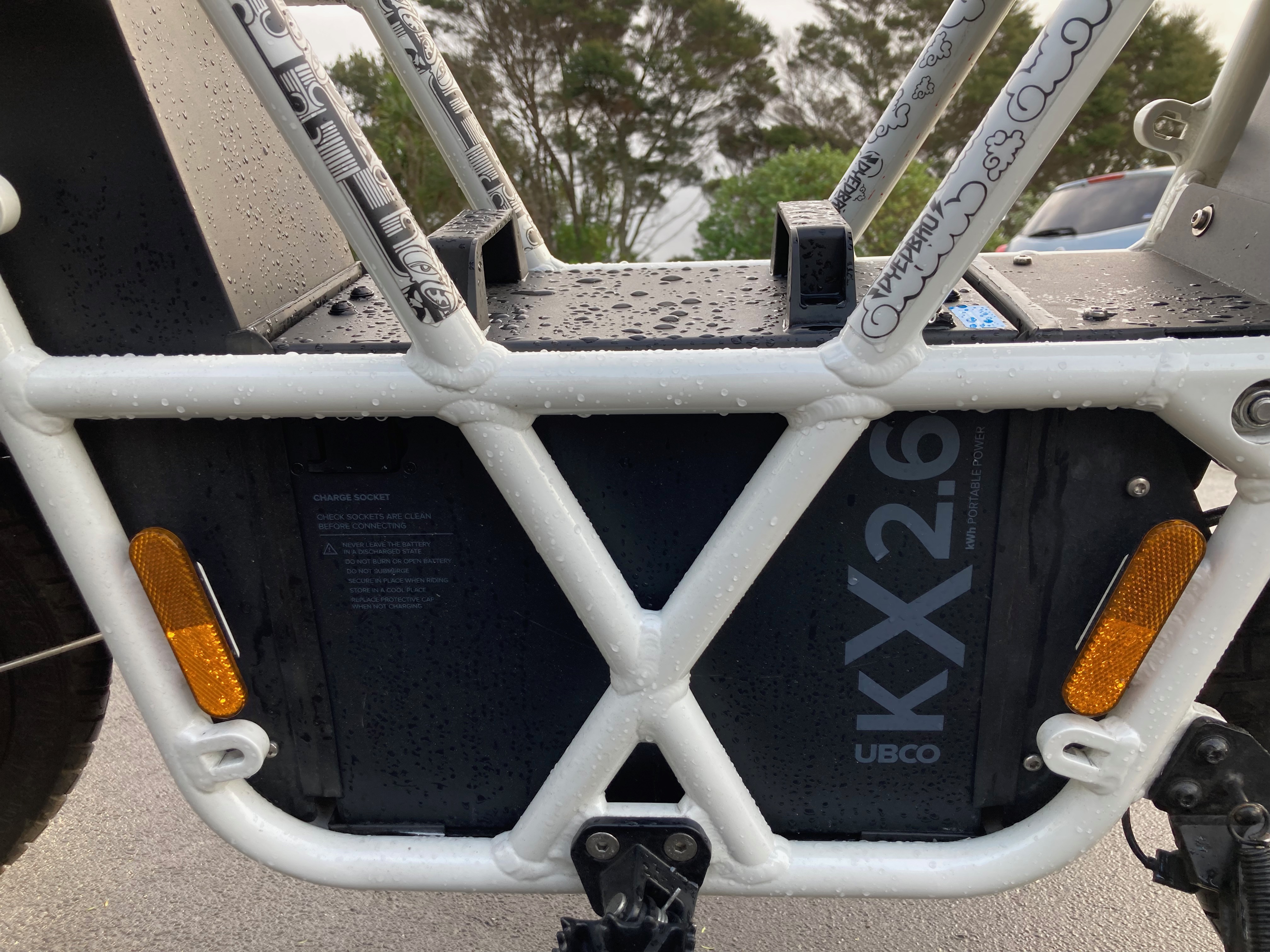
Image Credits: Rebecca Bellan

The 10amp alloy fast charger can fuel the battery fully within four to six hours. You can charge it while it’s still in the vehicle by just connecting it to a power outlet, or you can unlock the battery and yank it out (it’s a little heavy) and charge it inside. Note: Charging is loud. Not sure if this is standard, but probably is. 

I charged it every two to three days, but that will depend on use and where you are. It’s winter in Auckland, so a bit cold, which affects battery life, and the hills are brutal, which also use up a lot of battery life.

I’d ride it downtown and around my neighborhood every day, but I’d wager a delivery driver would need to charge it nightly. As I mentioned earlier, the battery can be removed for charging, so if you take it to work, you can always take it up to the office or wherever to charge while you’re doing other things. 

Tech features

Vehicle management system

The vehicle runs off what Ubco calls its Cerebro vehicle management system, which integrates all electronic and electrical functions of the vehicles and provides control and updates via Bluetooth. Ubco builds with end of life in mind, so the CAN bus is isolated so future CAN devices can be easily integrated. 

Now, one of my first questions, given the heftiness of this bike and the likelihood of gig economy workers who would ride it for work living in urban dwellings, was this: How can I ensure no one will steal this thing when it’s on the street, because there’s no way I’m lugging it up to my fifth-floor walkup?

Like I said, you can lock the wheel in place, which would make it far more difficult for someone to wheel it off. If someone did decide to capture the whole cumbersome vehicle, Ubco would be able to track it for you. Each Ubco bike has telemetry, aka a SIM card, hardwired inside, and that can help provide data that can be used for location, servicing, theft, safety, route planning, etc. 

This VMS architecture is made for handling fleets via Ubco’s enterprise subscription vehicles, but it obviously has other uses, like providing peace of mind (personally, I’d still lock it up with chains, but I’m a New Yorker and trust no one). Obviously, if you think this telemetry is creepy, you can opt out, but it does come standard with subscriptions, allowing subscribers to track their bike’s location on the app.

Display

Image Credits: Rebecca Bellan

Mounted on the handlebar is an LCD display that shows speed, power levels and more. Also on the handlebars are switch controls for high or low beams, indicators and a horn. I found the indicators to be a bit sticky and sometimes I would slip and hit the horn. What I wish the handlebars also had was a mount for your phone so you could follow directions. I had my headphones in and was listening to Google Maps tell me how to get around, but that felt less safe and efficient. 

Turning it on

You can turn the power on with a keyless fob by either clicking the button on the fob or the button on the handlebars. I will note that the keyless fob button is weirdly sensitive. At multiple points, I had it in my pocket with my phone or other pocket inhabitants and it must have knocked into the button, turning the vehicle off while I was riding it. Thankfully, that never happened anywhere busy, but that’s something to be wary about. 

App

As I mentioned earlier, you could pair your phone, as well as other users’ phones, to the bike using the app. The app allows you to choose learner mode or restricted mode, which controls ride settings; turn the bike and lights on and off; change the metrics; and check the status of things like battery life, speed and motor temperature. It’s basically all the info on the dash, but on an app. I didn’t really feel the need to use it.

Lights

The LED headlights are on at all times when the vehicle is turned on, but there’s also a high and low beam, as well as peripheral parking lights, all of which are designed for disassembly at the end of life. There are also LED rear, brake and number plate lights, as well as DOT-approved indicator lights.

Other stuff

Among the features that don’t fit neatly into the other categories, there’s the field kit, which is fastened to the lift-up seat and contains a user manual and tools to set up and maintain the 2X2, which is really handy. Usually, when people buy an Ubco bike, it comes in a box and there are “a few simple steps to follow to get it ready to ride.” There’s also an UBCO University course that shows how to set it up. If you buy from one of Ubco’s dealers, they’ll unpack it and set it up when you come to collect it. 

Maintenance

Maintenance comes with the cost of a monthly subscription. Ubco has a network of technicians placed wherever the company sells its bikes if they’re in need of fixing. If there’s no authorized mechanic nearby, Ubco’s head office will work with customers to help them fix the bike. Ubco did not respond to information about how many authorized mechanics are in its network.

Again, being from New York, I’ve seen probably thousands of delivery riders on bikes and mopeds, oven mitts covered in a plastic bag taped onto the handlebars so drivers can keep their hands warm during the colder months. This bike can handle a hefty load for delivering goods, it’s quick and agile for weaving in and out of traffic, and it’s easy to ride and use.

The subscription offering, especially for enterprise, makes this a great city utility bike that can probably handle a range of weather conditions. I already know it can handle rain and mud, so all signs point to success in the sloshy, icy hell of a Northern city winter. And for the adventurer — the person who just wants to ride something sweet on- and off-road, out of the city and into the wilderness — this is also a great consumer ride that will last you quite a while.


01 Sep 2021

SEC fines brokerage firms over email hacks that exposed client data

The U.S. Securities and Exchange Commission has fined several brokerage firms a total of $750,000 for exposing the sensitive personally identifiable information of thousands of customers and clients after hackers took over employee email accounts.

A total of eight entities belonging to three companies have been sanctioned by the SEC, including Cetera (Advisor Networks, Investment Services, Financial Specialists, Advisors, and Investment Advisers), Cambridge Investment Research (Investment Research and Investment Research Advisors), and KMS Financial Services.

In a press release, the SEC announced that it had sanctioned the firms for failures in their cybersecurity policies and procedures that allowed hackers to gain unauthorized access to cloud-based email accounts, exposing the personal information of thousands of customers and clients at each firm

In the case of Cetera, the SEC said that cloud-based email accounts of more than 60 employees were infiltrated by unauthorized third parties for more than three years, exposing at least 4,388 clients’ personal information.

The order states that none of the accounts featured the protections required by Cetera’s policies, and the SEC also charged two of the Cetera entities with sending breach notifications to clients containing “misleading language suggesting that the notifications were issued much sooner than they actually were after discovery of the incidents.”

The SEC’s order against Cambridge concludes that the personal information exposure of at least 2,177 Cambridge customers and clients was the result of lax cybersecurity practices at the firm. 

“Although Cambridge discovered the first email account takeover in January 2018, it failed to adopt and implement firm-wide enhanced security measures for cloud-based email accounts of its representatives until 2021, resulting in the exposure and potential exposure of additional customer and client records and information,” the SEC said. 

The order against KMS is similar; the SEC’s order states that the data of almost 5,000 customers and clients were exposed as a result of the company’s failure to adopt written policies and procedures requiring additional firm-wide security measures until May 2020. 

“Investment advisers and broker-dealers must fulfill their obligations concerning the protection of customer information,” said Kristina Littman, chief of the SEC Enforcement Division’s Cyber Unit. “It is not enough to write a policy requiring enhanced security measures if those requirements are not implemented or are only partially implemented, especially in the face of known attacks.”

All of the parties agreed to resolve the charges and to not commit future violations of the charged provisions, without admitting or denying the SEC’s findings. As part of the settlements, Cetera will pay a penalty of $300,000, while Cambridge and KMS will pay fines of $250,000 and $200,000 respectively.  

Cambridge told TechCrunch that it does not comment on regulatory matters, but said it has and does maintain a comprehensive information security group and procedures to ensure clients’ accounts are fully protected. Cetera and KMS have yet to respond.

This latest action by the SEC comes just weeks after the Commission ordered London-based publishing and education giant Pearson to pay a $1 million fine for misleading investors about a 2018 data breach at the company.

01 Sep 2021

Forum Brands secures $100M in debt financing to acquire more e-commerce brands

Forum Brands, an e-commerce acquisition platform, announced today that it has secured $100 million in debt funding from TriplePoint Capital.

The financing comes just just over two months after the startup raised $27 million in an equity funding round led by Norwest Venture Partners.

Brenton Howland, Ruben Amar and Alex Kopco founded New York-based Forum Brands in the summer of 2020, during the height of the COVID-19 pandemic. 

“We’re buying what we think are A+ high-growth e-commerce businesses that sell predominantly on Amazon and are looking to build a portfolio of standalone businesses that are category leaders, on and off Amazon,” Howland told me at the time of the company’s last raise. “A source of inspiration for us is that we saw how consumer goods and services changed fundamentally for what we think is going to be for decades and decades to come, accelerating the shift toward digital.”

Since we covered the company in June, Forum Brands says it has acquired several new brands, including Bonza, a seller of pet products, and Simka Rose, a baby-focused brand specializing in eco-friendly products. Simka sells in the U.S. and the EU and is an example of how Forum is expanding globally, Amar said.

Howland and Amar emphasize that the Forum team continues to focus on quality over quantity when evaluating potential acquisitions. Although they meet with 15-20 founders a week, they are selective in which companies they choose to acquire.

“We continue to be a quality-first buyer, and not quantity-driven,” Amar said, noting that the company will still help a company build its brand even if it does not yet meet Forum’s quality threshold or if the founders are just not yet ready to sell.

The new funds will be used to, naturally, acquire more e-commerce companies. As part of the debt financing, Sajal Srivastava, co-CEO and co-founder of TriplePoint Capital, will be joining Forum’s board of directors.

“We are impressed not only by Forum’s long-term strategy and ability to leverage technology and deep collective e-commerce and M&A experience but also by how Forum cultivates relationships with their sellers both before and after partnering with them,” he said in a written statement.

At the time of its June raise, Forum had about 20 employees. As of today, it has about 40.

Forum’s technology employs “advanced” algorithms and over 100 million data points to populate brand information into a central platform in real time, instantly scoring brands and generating accurate financial metrics.

01 Sep 2021

Chrome Beta to experiment with a more powerful New Tab page, web highlights, and search changes

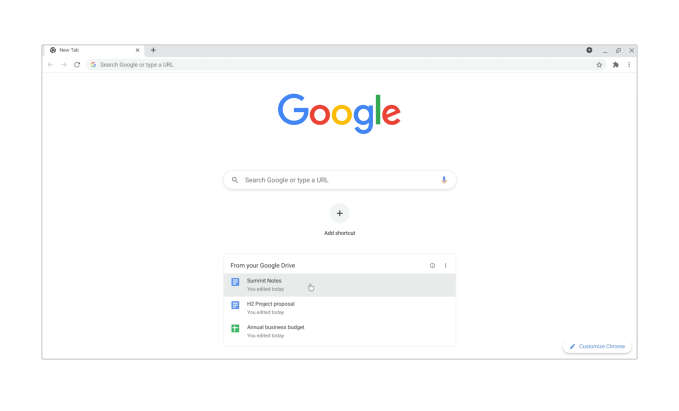
Google is launching a new version of its Chrome Beta browser today that’s introducing some fairly notable changes to its user interface and design. The browser will introduce an updated New Tab page, which will now include cards directing you back to past web search activities, instead of only a list of shortcuts to favorite websites. Other changes aim to make it easier to navigate search results and to highlight and share quotes from the web.

The New Tab page’s update will be one of the first changes Chrome beta users may notice.

The idea behind this design change is about getting you back quickly to past web activities without a need dive into your browsing history to remember which sites you had been using for things like recipes or shopping. It can also help you to return quickly to your recent documents list in Google Drive, in a handy bit of cross-promotion for Google services.

Image Credits: Google

The page will now feature what Google is calling “cards,” not just links, which could direct you to things like a recently-visited recipe site where you had been browsing for ideas, a Google doc you need to finish editing, or a retailer’s website where you had left your shopping cart filled with things you may like to purchase at a later date. The latter ties into Google’s larger investment in online shopping, which has already seen the search giant trying to grab more marketshare in the space by making product listings free and partnering with e-commerce platforms like Shopify.

Google is rightly concerned about Amazon’s surging advertising business, which is a large part of the retailer’s “Other” category that grew 87% year-over-year to generate $7.9 billion in the second quarter. Now, it’s capitalizing on Chrome’s New Tab real estate to elevate shopping activity in the hopes of pushing users to complete their transactions.

Another change aims to make it easier to do web research. Google says that often, users searching for something on its platform will navigate to multiple web pages to find their answer. The new version of Chrome will experiment with a different way of connecting users to their search results by adding a row beneath the address bar on Chrome for Android that will show the rest of the results so you can navigate to other web pages without needing to hit the back button.

Image Credits: Google

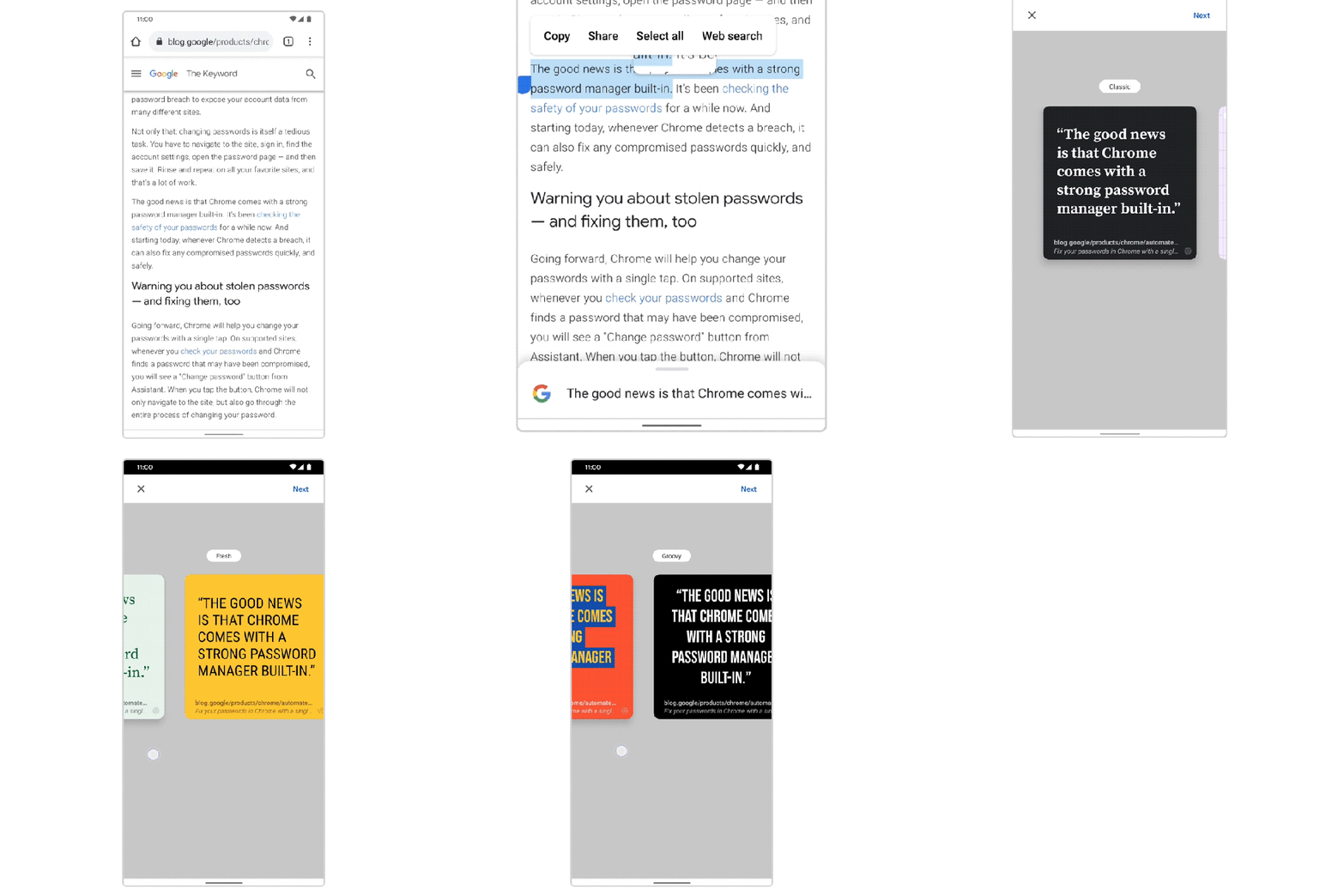
A new “quote cards” experiment, also coming to Chrome Beta on Android, will allow users to create a stylized image for social sharing that features text found on websites. Taking a screengrab of a website’s text is something that’s already a common activity, and particularly for people who want to share a key point from a news article they’re reading with followers on platforms like Twitter, Facebook, or Instagram. With this new feature, you’ll be able to long press text to highlight it, then tap Share and select a template by tapping on the “Create Card” option from the menu.

All features are a part of the Chrome Beta browser. To enable experiments, you can type chrome://flags into the browser’s address bar or click on the Experiments beaker icon, and then enable the flags. The associated flags for these experiments are #ntp-modules flag (New Tab page), #continuous-search (search results changes), and #webnotes-stylize flag (quote cards).

Experiments don’t necessarily become Chrome features that roll out more broadly. Instead, they offer Google a way to capture large-scale user feedback about its new design ideas, so the features can be tweaked and fine-tuned before a public release.

01 Sep 2021

Twitter is testing a new anti-abuse feature called ‘Safety Mode’

Twitter’s newest test could provide some long-awaited relief for anyone facing harassment on the platform.

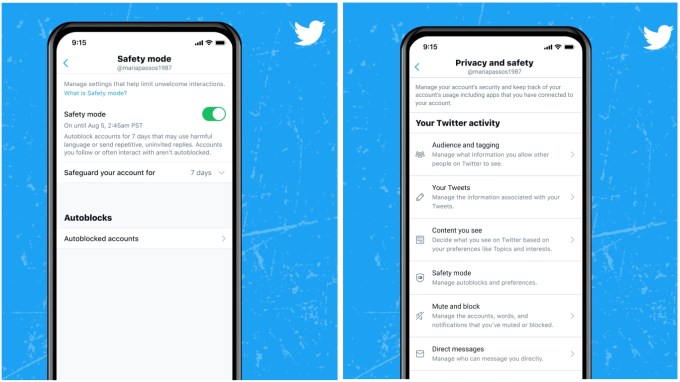
The new product test introduces a feature called “Safety Mode” that puts up a temporary line of defense between an account and the waves of toxic invective that Twitter is notorious for. The mode can be enabled from the settings menu, which toggles on an algorithmic screening process that filters out potential abuse that lasts for seven days.

“Our goal is to better protect the individual on the receiving end of Tweets by reducing the prevalence and visibility of harmful remarks,” Twitter Product Lead Jarrod Doherty said.

Safe Mode won’t be rolling out broadly — not yet, anyway. The new feature will first be available to what Twitter describes as a “small feedback group” of about 1,000 English language users.

In deciding what to screen out, Twitter’s algorithmic approach assesses a tweet’s content — hateful language, repetitive, unreciprocated mentions — as well as the relationship between an account and the accounts replying. The company notes that accounts you follow or regularly exchange tweets with won’t be subject to the blocking features in Safe Mode.

For anyone in the test group, Safety Mode can be toggled on in the privacy and safety options. Once enabled, an account will stay in the mode for the next seven days. After the seven day period expires, it can be activated again.

In crafting the new feature, Twitter says it spoke with experts in mental health, online safety and human rights. The partners Twitter consulted with were able to contribute to the initial test group by nominating accounts that might benefit from the feature, and the company hopes to focus on female journalists and marginalized communities in its test of the new product. Twitter says that it will start reaching out to accounts that meet the criteria of the test group — namely accounts that often find themselves on the receiving end of some of the platform’s worst impulses.

Earlier this year, Twitter announced that it was working on developing new anti-abuse features, including an option to let users “unmention” themselves from tagged threads and a way for users to prevent serial harassers from mentioning them moving forward. The company also hinted at a feature like Safety Mode that could give users a way to defuse situations during periods of escalating abuse.

Being “harassed off of Twitter” is, unfortunately, not that uncommon. When hate and abuse get bad enough, people tend to abandon Twitter altogether, taking extended breaks or leaving outright. That’s obviously not great for the company either, and while it’s been slow to offer real solutions to harassment, it’s obviously aware of the problem and working toward some possible solutions.

01 Sep 2021

Goodcall picks up $4M, Yelp partnership to answer merchant inbound calls

Even without staffing shortages, local merchants have difficulty answering calls while all hands are busy, and Goodcall wants to alleviate some of that burden from America’s 30 million small businesses.

Goodcall’s free cloud-based conversational platform leverages artificial intelligence to manage incoming phone calls and boost customer service for businesses of all sizes. Former Google executive Bob Summers left Google back in January, where he was working on Area 120 — an internal incubator program for experimental projects — to start Goodcall after recognizing the call problem, noting that in fact 60% of the calls that come into merchants go unanswered.

“It’s frustrating for you and for the person calling,” Summers told TechCrunch. “Every missed call is a lost opportunity.”

Goodcall announced its launch Wednesday with $4 million in seed funding led by strategic investors Neo, Foothill Ventures, Merus Capital, Xoogler Ventures, Verissimo Ventures and VSC Ventures, as well as angel investors including Harry Hurst, founder and co-CEO of Pipe.com, and Zillow co-founder Spencer Rascoff.

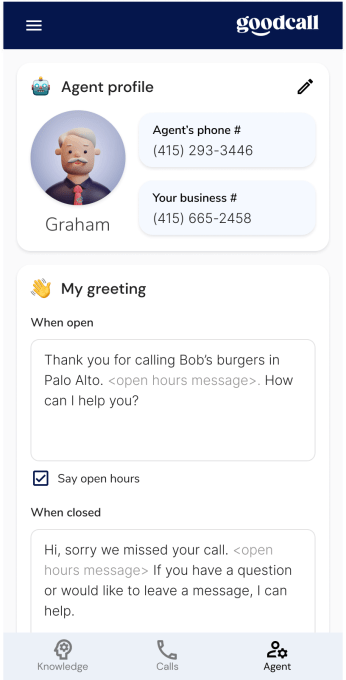
Goodcall mobile agent. Image Credits: Goodcall

Restaurants, shops and merchants can set up on Goodcall in a matter of minutes and even establish a local phone number to free up an owner’s mobile number from becoming the business’ main line. The service is initially deployed in English and the company has plans to operate in Spanish, French and Hindi by 2022.

Merchants can choose from six different assistant voices and monitor the call logs and what the calls were about. Goodcall can also capture consumer sentiment, Summers said.

The company offers three options, including its freemium service for solopreneurs and business owners, which includes up to 500 minutes per month of Goodcall services for a single phone line. Up to five additional locations and five staff members costs $19 per month for the Pro level, or the Premium level provides unlimited locations and staff for $49 per month.

During the company’s beta period, Goodcall was processing several thousands of calls per month. The new funding will be used to continue to offer the free service, hire engineers and continue product development.

In addition to the funding round, Goodcall is unveiling a partnership with Yelp to tap into its database of local businesses so that those owners and managers can easily deploy Goodcall. Yelp data shows that more than 500,000 businesses opened during the pandemic. The company pulls in from Yelp a merchant’s open hours, location, if they offer Wi-Fi and even their COVID policy.

“We are partnering with Yelp, which has the best data on small businesses, and other large distribution channels to get our product to market,” Summers said. “We are bringing technology into an industry that hasn’t innovated since the 1980s and democratizing conversational AI for small businesses that are the main driver of job creation, and we want to help them grow.”


01 Sep 2021

Apollo completes its $5B acquisition of Verizon Media, now known as Yahoo

Private equity firm Apollo Global Management this morning announced that it has completed its acquisition of Yahoo (formerly known as Verizon Media Group, itself formerly known as Oath) from Verizon. The deal is worth $5 billion, with $4.25 billion in cash, plus preferred interests of $750 million. Verizon will be retaining 10% of the newly rebranded company.

“This is a new era for Yahoo,” Yahoo CEO (and former VZM head) Guru Gowrappan said in a release tied to the news. “The close of the deal heralds an exciting time of renewed opportunity for us as a standalone entity. We anticipate that the coming months and years will bring fresh growth and innovation for Yahoo as a business and a brand, and we look forward to creating that future with our new partners.”

There have been reports that Gowrappan might not stay on as CEO of Yahoo for the long term now that the deal has closed; for now he’s still at the helm.

In addition to its titular Yahoo properties (Mail, Sports, Finance, et al.), the group includes us, TechCrunch; AOL; Engadget and interactive media brand, RYOT. All told, the umbrella brand encompasses around 900 million monthly active users globally and is currently the third-largest internet property, per Apollo’s figures.


The deal puts to a close a years-long effort by Verizon to make a comprehensive move into online media, specifically around adtech, which ultimately proved to be too costly, mostly unprofitable, and finally not core enough to the telco’s bigger growth strategy.

The news comes during a tumultuous time for online media, amid increasing industry-wide consolidation, many felt within Verizon Media. Verizon acquired AOL in 2015 for $4.4 billion, followed by buying Yahoo for $4.5 billion two years later, combining the two legacy media properties into a combined group named Oath. At the end of 2018, Oath wrote down $4.6 billion, following the merger.

It’s not clear how a new owner will steer that large ship differently, but one strategy — standard practice for PE firms — could involve Apollo selling off parts of the business or rationalizing it in other ways.

However, for its part, Apollo has promised to continue investing in the newly acquired proprieties, and it has secured all jobs at the time of handover for at least an initial period. The bigger firm of Apollo has a massive set of TMT holdings so it will be interesting to see how and if it leverages that, too.

“We look forward to partnering with Yahoo’s talented employee base to build on the company’s strong momentum and position the new Yahoo for long-term success as a standalone consumer internet and digital media leader,” Apollo Partner Reed Rayman said in the release. “We couldn’t be more excited about this next chapter for Yahoo as we look to invest in growth across the business, including accelerating its customer-first offerings and commerce capabilities, expanding its reach and enhancing the daily user experience.”

01 Sep 2021

Blueprint raises $16M Series B to grow its title-focused insurtech business

Blueprint Title, an insurtech startup working in the title insurance space, announced this morning that it closed a $16 million Series B. The new round was led by Forté Ventures. The startup previously raised an $8.5 million Series A in the final weeks of 2019.

While Blueprint is an insurtech startup and therefore fits into the neoinsurance cohort that we’ve tracked in recent quarters as a number of companies from the group have gone public, it’s somewhat distinct. Blueprint is different from the Roots and MetroMiles and Hippos that debuted via traditional IPOs or SPACs; it largely sells to business customers and has a very different product on offer.

The neoinsurance companies that went public in the last year and a half sell to consumers. Blueprint, in contrast, sells to professional groups looking for a better title insurance experience. That means its customer base is not made up of consumers hoping to cover their main residence, Blueprint CEO Steve Berneman told TechCrunch in an interview.

That means that the company’s go-to-market activities are distinct from its mates in the consumer-focused cohort and that its loss profile is very different.

Title insurance, Berneman said, has around a 1% to 4% claims rate, far lower than auto insurance, to pick an example. That means its risk profile is different, and its pricing less flexible; there’s less loss ratio to wring out of title insurance underwriting, so cost and delivery of service are even more important than in other insurance varietals.

According to the CEO, the title insurance market in the United States today is made up of four companies with around 90% market share. And thanks to rules requiring public pricing in many states, there’s alignment on pricing from some leading players. The result of market concentration and effective price harmonization is that Berneman thinks that the $18 billion title insurance business should really be a $10 billion market.

Our call with Blueprint was the first in which a startup discussed shrinking its market.

But the point is reasonable; if title insurance is mispriced, and Blueprint sells to corporate customers, it can likely offer profitable coverage at a lower-than-market price point — and grow quickly in the process. That appears to be the case, with the startup stating in a release that it anticipates 400% revenue growth in 2021 when compared to 2020.

That growth rate explains the Nashville-based company’s most recent round and what we presume was a stiff upsizing in its valuation.

As part of its funding round announcement, Blueprint also disclosed that it has purchased Southwest Land Title Insurance Company, an underwriting company. Berneman said that to shrink the title insurance market through more reasonable pricing, his company needs to be full-stack, i.e., both writing its own coverage and selling it. Otherwise, margins would leak on either side of its operations.

Blueprint, akin to Next Insurance, is a startup bet that selling insurance to business customers will prove to be a lucrative effort. Given that consumer-focused neoinsurance providers have seen Wall Street change its tune on their value, it will be interesting to watch this more B2B cohort grow and eventually debut.

01 Sep 2021

Fire up CrunchMatch today and start networking with TechCrunch Disrupt 2021 attendees

You read that right, folks. CrunchMatch, our AI-powered platform that simplifies finding and connecting with the people on your must-meet list, is now open for business. TechCrunch Disrupt 2021 takes place on September 21-23, but why wait to get your network mojo working?

Granted, networking can sometimes feel like a contact sport, especially at a global event with more than 10,000 attendees. But CrunchMatch brings measured calm and efficiency to the game — and you get a three-week head start, to boot.

Shameless marketing plug: Buy your Disrupt 2021 pass now and hop on board the opportunity express.

With CrunchMatch you can access the entire Disrupt attendee list and start searching for opportunities — no matter what kind of connection you need to drive your business forward. Find founders or investors? Check. Cultivate new customers? Check. Meet mentors, marketers and manufacturers? Check, check and check.

Based on the info you provided during registration, CrunchMatch searches for suitable candidates and sends out invitations so you can line up RSVPs in advance (you retain control over who you meet — it’s not SkyNet). Set up 1:1 video meetings, pitch investors, demo products or interview prospective employees.

Here’s how two founders describe their experience using CrunchMatch.

CrunchMatch made it easy to set up short networking sessions, and I used it to meet with founders in adjacent areas like climate or B2B SaaS. I met interesting people I wouldn’t necessarily have connected with otherwise. — Ashley Barrington, founder, MarketPearl.

The CrunchMatch networking platform is such a smart, useful tool. It lets you see who’s there, find the right people and reach out for a meeting. I scheduled five or six appointments in one day. The meetings were small, intimate and very informative. — Felicia Jackson, inventor and founder of CPRWrap.

You know who else is on the Disrupt attendee list? Media outlets. Yeah, this is a great opportunity to pitch your startup to an accredited tech journalist. They’re hunting for great stories. Why not help them tell yours?

TechCrunch Disrupt 2021 takes place on September 21-23, and the CrunchMatch networking platform is waiting for you with its AI arms wide open. Save time, increase productivity and use these next three weeks to super-charge your Disrupt experience.

Is your company interested in sponsoring or exhibiting at Disrupt 2021? Contact our sponsorship sales team by filling out this form.