Year: 2021

26 Aug 2021

Mental health startup Intellect gets $2.2M to expand across Asia

Intellect, a Singapore-based startup that wants to make mental health care more accessible in Asia, announced it has raised $2.2 million in pre-Series A funding. It is taking part in Y Combinator’s current batch, which will hold its Demo Day at the end of this month.

The round was led by returning investor Insignia Venture Partners and included participation from Y Combinator, XA Network and angel investors like Rainforest co-founder J.J. Chai; Prenetics and CircleDNA founder Danny Yeung; and Gilberto Gaeta, Google’s director of global HR operations.

This brings Intellect’s total funding since it launched a year ago to $3 million, including a seed round announced in December 2020 that was also led by Insignia.

Intellect offered two main product suites: a consumer app with self-guided programs based on cognitive behavioral therapy techniques, and a mental health benefits solution for employers with online therapy programs and telehealth services. The startup now claims more than 2.5 million app users, and 20 enterprise clients, including FoodPanda, Shopback, Carousell, Avery Dennison, Schroders and government agencies.

Founder and chief executive officer Theodoric Chew told TechCrunch that Intellect’s usage rate is higher than traditional EAP helpline solutions. On average, its mental health benefits solution sees about 20% to 45% engagement within three months after being adopted by companies with more than 5,000 employees.

In many Asian cultures, there is still a lot of stigma around mental health issues, but that has changed over the last year and a half as people continue to cope with the emotional impact of the COVID-19 pandemic, Chew said. “From individuals, to companies, insurers and governments, all these different types of people and organizations are today prioritizing mental healthcare on an individual and organizational level in an extremely rapid manner.”

Intellect protects user privacy with zero-knowledge encryption, so the startup and employers don’t have access to people’s records or communications with their coaches and counsellors. Any insights shared with employers are aggregated and anonymized. Chew said the company is also compliant with major data privacy regulations like ISO, HIPAA and GDPR.

Intellect is currently collaborating in 10 studies with institutions like the National University of Singapore, King’s College London, University of Queensland and the Singapore General Hospital. It says studies so far have demonstrated improvements in mental well-being, stress levels and anxiety among its users.

The new funding will be used to expand into more Asian markets. Intellect currently covers 12 countries and 11 languages.


26 Aug 2021

Jolla hits profitability ahead of turning ten, eyes growth beyond mobile

A milestone for Jolla, the Finnish startup behind the Sailfish OS — which formed, almost a decade ago, when a band of Nokia staffers left to keep the torch burning for a mobile linux-based alternative to Google’s Android — today it’s announcing hitting profitability.

The mobile OS licensing startup describes 2020 as a “turning point” for the business — reporting revenues that grew 53% YoY, and EBITDA (which provides a snapshot of operational efficiency) standing at 34%.

It has a new iron in the fire too now — having recently started offering a new licensing product (called AppSupport for Linux Platforms) which, as the name suggests, can provide linux platforms with standalone compatibility with general Android applications — without a customer needing to licence the full Sailfish OS (the latter has of course baked in Android app compatibility since 2013).

Jolla says AppSupport has had some “strong” early interest from automotive companies looking for solutions to develop their in-case infotainment systems — as it offers a way for embedded Linux-compatible platform the capability to run Android apps without needing to opt for Google’s automotive offerings. And while plenty of car makers have opted for Android, there are still players Jolla could net for its ‘Google-free’ alternative.

Embedded linux systems also run in plenty of other places, too, so it’s hopeful of wider demand. The software could be used to enable an IoT device to run a particularly popular app, for example, as a value add for customers.

“Jolla is doing fine,” says CEO and co-founder Sami Pienimäki. “I’m happy to see the company turning profitable last year officially.

“In general it’s the overall maturity of the asset and the company that we start to have customers here and there — and it’s been honestly a while that we’ve been pushing this,” he goes, fleshing out the reasons behind the positive numbers with trademark understatement. “The company is turning ten years in October so it’s been a long journey. And because of that we’ve been steadily improving our efficiency and our revenue.

“Our revenue grew over 50% since 2019 to 2020 and we made €5.4M revenue. At the same time the cost base of the operation has stablized quite well so the sum of those resulted to nice profitability.”

While the consumer mobile OS market has — for years — been almost entirely sewn up by Google’s Android and Apple’s iOS, Jolla licenses its open source Sailfish OS to governments and business as an alternative platform they can shape to their needs — without requiring any involvement of Google.

Perhaps unsurprisingly, Russia was one of the early markets that tapped in.

The case for digital sovereignty in general — and an independent (non-US-based) mobile OS platform provider, specifically — has been strengthened in recent years as geopolitical tensions have played out via the medium of tech platforms; leading to, in some cases, infamous bans on foreign companies being able to access US-based technologies.

In a related development this summer, China’s Huawei launched its own Android alternative for smartphones, which it’s called HarmonyOS.

Pienimäki is welcoming of that specific development — couching it as a validation of the market in which Sailfish plays.

“I wouldn’t necessarily see Huawei coming out with the HarmonyOS value proposition and the technology as a competitor to us — I think it’s more proving the point that there is appetite in the market for something else than Android itself,” he says when we ask whether HarmonyOS risks eating Sailfish’s lunch.

“They are tapping into that market and we are tapping into that market. And I think both of our strategies and messages support each other very firmly.”

Jolla has been working on selling Sailfish into the Chinese market for several years — and that sought for business remains a work in progress at this stage. But, again, Pienimäki says Jolla doesn’t see Huawei’s move as any kind of blocker to its ambitions of licensing its Android alternative in the Far East.

“The way we see the Chinese market in general is that it’s been always open to healthy competition and there is always competing solutions — actually heavily competing solutions — in the Chinese market. And Huawei’s offering one and we are happy to offer Sailfish OS for this very big, challenging market as well.”

“We do have good relationships there and we are building a case together with our local partners also to access the China market,” he adds. “I think in general it’s also very good that big corporations like Huawei really recognize this opportunity in general — and this shapes the overall industry so that you don’t need to, by default, opt into Android always. There are other alternatives around.”

On AppSupport, Jolla says the automative sector is “actively looking for such solutions”, noting that the “digital cockpit is a key differentiator for car markers — and arguing that makes it a strategically important piece for them to own and control.

“There’s been a lot of, let’s say, positive vibes in that sector in the past few years — new comers on the block like Tesla have really shaken the industry so that the traditional vendors need to think differently about how and what kind of user experience they provide in the cockpit,” he suggests.

“That’s been heavily invested and rapidly developing in the past years but I’m going to emphasize that at the same time, with our limited resources, we’re just learning where the opportunities for this technology are. Automative seems to have a lot of appetite but then [we also see potential in] other sectors — IoT… heavy industry as well… we are openly exploring opportunities… but as we know automotive is very hot at the moment.”

“There is plenty of general linux OS base in the world for which we are offering a good additional piece of technology so that those operating solutions can actually also tap into — for example — selected applications. You can think of like running the likes of Spotify or Netflix or some communications solutions specific for a certain sector,” he goes on.

“Most of those applications are naturally available both for iOS and Android platforms. And those applications as they simply exist the capability to run those applications independently on top of a linux platform — that creates a lot of interest.”

In another development, Jolla is in the process of raising a new growth financing round — it’s targeting €20M — to support its push to market AppSupport and also to put towards further growing its Sailfish licensing business.

It sees growth potential for Sailfish in Europe, which remains the biggest market for licensing the mobile OS. Pienimäki also says it’s seeing “good development” in certain parts of Africa. Nor has it given up on its ambitions to crack into China.

The growth round was opened to investors in the summer and hasn’t yet closed — but Jolla is confident of nailing the raise.

“We are really turning a next chapter in the Jolla story so exploring to new emerging opportunities — that requires capital and that’s what are looking for. There’s plenty of money available these days, in the investor front, and we are seeing good traction there together with the investment bank with whom we are working,” says Pienimäki.

“There’s definitely an appetite for this and that will definitely put us in a better position to invest further — both to Sailfish OS and the AppSupport technology. And in particular to the go-to market operation — to make this technology available for more people out there in the market.”


 

26 Aug 2021

Taktile makes it easier to leverage machine learning in the financial industry

Meet Taktile, a new startup that is working on a machine learning platform for financial services companies. This isn’t the first company that wants to leverage machine learning for financial products. But Taktile wants to differentiate itself from competitors by making it way easier to get started and switch to AI-powered models.

A few years ago, when you could read ‘machine learning’ and ‘artificial intelligence’ in every single pitch deck, some startups chose to focus on the financial industry in particular. It makes sense as banks and insurance companies gather a ton of data and know a lot of information about their customers. They could use that data to train new models and roll out machine learning applications.

New fintech companies put together their own in-house data science team and started working on machine learning for their own products. Companies like Younited Credit and October use predictive risk tools to make better lending decisions. They have developed their own models and they can see that their models work well when they run them on past data.

But what about legacy players in the financial industry? A few startups have worked on products that can be integrated in existing banking infrastructure. You can use artificial intelligence to identify fraudulent transactions, predict creditworthiness, detect fraud in insurance claims, etc.

Some of them have been thriving, such as Shift Technology with a focus on insurance in particular. But a lot of startups build proof-of-concepts and stop there. There’s no meaningful, long-term business contract down the road.

Taktile wants to overcome that obstacle by building a machine learning product that is easy to adopt. It has raised a $4.7 million seed round led by Index Ventures with Y Combinator, firstminute Capital, Plug and Play Ventures and several business angels also participating.

The product works with both off-the-shelf models and customer-built models. Customers can customize those models depending on their needs. Models are deployed and maintained by Taktile’s engine. It can run in a customer’s cloud environment or as a SaaS application.

After that, you can leverage Taktile’s insights using API calls. It works pretty much like integrating any third-party service in your product. The company tried to provide as much transparency as possible with explanations for each automated decision and detailed logs. As for data sources, Taktile supports data warehouses, data lakes as well as ERP and CRM systems.

It’s still early days for the startup, and it’s going to be interesting to see whether Taktile’s vision pans out. But the company has already managed to convince some experienced backers. So let’s keep an eye on them.

26 Aug 2021

The SEC and the DOJ just charged this startup founder with fraud, saying he lied to Tiger and others

Today, both the U.S. Department of Justice and the Securities and Exchange Commission charged Manish Lachwani, cofounder of a mobile app testing company Headspin, with fraud. The SEC says he violated antifraud provisions and the civil penalties it’s seeking include a permanent injunction, a conduct-based injunction, and an officer and director bar of Lachwani.

The DOJ, which actually arrested Lachwani today, has accused him of one count of wire fraud and one count of securities fraud, and the associated penalties if he’s found guilty are are more harsh, including, for wire fraud, a maximum sentence of 20 years in prison and a fine of $250,000. If he’s found guilty of securities fraud, he faces a maximum sentence of 20 years in prison and a fine of $5,000,000.

Both the the SEC and the DOJ say Lachwani — who led the company as CEO until May of last year — defrauded investors out of $80 million by falsely claiming that his company, Headspin, had “achieved strong and consistent growth in acquiring customers and generating revenue” when he was pitching its Series C round to potential backers.

By the SEC’s telling, his apparent bluster was largely an attempt to secure the round at a so-called unicorn valuation. That apparent plan worked, too, with Headspin attracting coverage in Forbes in February of last year after Dell Technologies Capital, Iconiq Capital and Tiger Global Management provided the company with $60 million in Series C funding at a $1.16 billion valuation. Forbes reported at the time that the valuation was double the valuation investors  assigned HeadSpin when it closed its Series B round in October 2018.

The SEC also says that Lachwani was looking to enrich himself, saying he did so “by selling $2.5 million of his HeadSpin shares in [that] fundraising round during which he made misrepresentations to an existing HeadSpin investor.”

The DOJ’s federal complaint offers many more details. It says that the success of Headspin — a six-year-old, Palo Alto-based company that helps apps and devices work in different environments around the world and which sells subscriptions to its service – was being misrepresented to investors by Lachwani beginning in at least early November 2019, when the company was fundraising.

The complaint alleges that “in materials and presentations to potential investors, Lachwani reported false revenue and overstated key financial metrics of the company. . . he maintained control over operations, sales, and record-keeping, including invoicing, and he was the final decision maker on what revenue was booked and included in the company’s financial records.” It says that in its investigation, it discovered “multiple examples” of Lachwani “instructing employees to include revenue from potential customers that inquired but did not engage Headspin, from past customers who no longer did business with Headspin, and from existing customers whose business was far less than the reported revenue.”

Among other materials, Lachwani “provided investors false information that overstated Headspin’s annual recurring revenue . . . by approximately $51 to $55 million,” says the DOJ.

According to the complaint, Lachwani’s fraud unraveled after the company’s Board of Directors conducted an internal investigation that revealed significant issues with HeadSpin’s reporting of customer deals and revised HeadSpin’s valuation down from $1.1 billion to $300 million.

Indeed, in August of last year, The Information reported that “after an internal review of financial irregularities forced [Headspin] to restate its financials,” the company planned to lower the value of its Series C stock by nearly 80%.

The outlet reported at the time that Lachwani had been replaced by another executive. That person, according to LinkedIn, is Rajeev Butani, who joined Headspin as its chief sales officer around the time its Series C round was being announced in February of last year.

Nikesh Arora, a former SoftBank president, the current CEO and chairman of Palo Alto Networks, and a now-former board member of Headspin, helped lead the internal review, said The Information.

The SEC’s investigation is continuing, it says. Meanwhile, the DOJ notes in its announcement that “a complaint merely alleges that crimes have been committed, and all defendants are presumed innocent until proven guilty beyond a reasonable doubt.”

In the meantime, it doesn’t look very promising right now for Lachwani, who, according to Forbes, previously sold a mobile cloud business to Google and wound up co-founding Headspin after Yahoo cofounder Jerry Yang introduced him to Brien Colwell, a former Palantir and Quora engineer was working at the time on a different startup.

Colwell remains with Headspin as its CTO. He has not been named in either the SEC or the DOJ’s complaints relating to Headspin. The company itself, which has reportedly been cooperating with the government’s investigation, was also not charged.

Pictured above, left to right, Headspin founders Lachwani and Colwell.

25 Aug 2021

Solo.io integrates a cloud native API gateway and service mesh into its enterprise platform

Connecting to all the services and microservices that a modern cloud native enterprise application requires can be a complicated task. It’s an area that startup Solo.io is trying to disrupt with the new release of its Gloo Mesh Enterprise platform.

Based in Cambridge, Massachusetts, Solo has had focus since its founding on a concept known as a service mesh. A service mesh provides an optimized approach to connect different components together in an automated approach, often inside of a Kubernetes cloud native environment. 

Idit Levine, founder and CEO at Solo, explained to TechCrunch that she knew from the outset when she started the company in 2017 that it might take a few years till the market understood the concept of the service mesh and why it is needed. That’s why her company also built out an API gateway technology that helps developers connect APIs, which can be different data sources or services.  

Until this week, the API and service mesh components of Solo’s Gloo Mesh Enterprise offering were separate technologies, with different configurations and control planes. That is now changing with the integration of both API and service mesh capabilities into a unified service. The integrated capabilities should make it easier to set up and configure all manner of services in the cloud that are running on Kubernetes.

Solo’s service mesh, known as Gloo Mesh, is based on the open source Istio project, which was created by Google. The API product is called Gloo Edge, which uses the open source Envoy project, originally created by ride sharing company Lyft. Levine explained that her team has now used Istio’s plugin architecture to connect with Envoy in an optimized approach.

Levine noted that many users start off with an API gateway and then extend to using the service mesh. With the new Gloo Mesh Enterprise update, she expects customer adoption to accelerate further as Solo will be able to differentiate against rivals in both the service mesh and API management markets.

While the service mesh space is still emerging including rivals such as Tetrate, API gateways are a more mature technology. There are a number of established vendors in the API management space including Kong which has raised $71 million in funding. Back in 2016, Google acquired API vendor Apigee for $625 million and has been expanding the technology in the years since, including the Apigee X platform announced in February of this year.

With the integration of Gloo Edge for API management into Gloo Mesh Enterprise, Solo isn’t quite covering all the bases for API technology, yet. Gloo Edge supports REST based APIs, which are by far the most common today, though it doesn’t support the emerging GraphQL API standard, which is becoming increasingly popular. Levine told us to ‘stay tuned’ for a future GraphQL announcement for Solo and its platform.

Solo has raised a total of $36.5 million across two rounds, with an $11 million Series A in 2018 and a $23 million Series B announced in October 2020. The company’s investors include Redpoint and True Ventures.

25 Aug 2021

Dawn Aerospace conducts five flights of its suborbital spaceplane

While the rocket launch sector is quickly becoming crowded, the same can’t be said for companies developing suborbital spaceplanes. This means there’s plenty of room to grow for startups like Dawn Aerospace, which has now completed five test flights of its Mk-II Aurora spaceplane that is designed to fly up to 60 miles above the Earth’s surface.

The flights, which took place at the Glentanner Aerodrome in New Zealand’s South Island in July, were to assess the vehicle’s airframe and avionics. While the vehicle only reached altitudes of 3,400 feet, the flights allowed Dawn’s team to capture “extensive data enabling further R&D on the capability of Mk-II,” CEO Stefan Powell said in a statement.

Dawn’s approach is to build a vehicle that can take off and land from conventional airports and potentially perform multiple flights to and from space per day. The obvious benefit of this approach is that it’s significantly less capital-intensive than vertical launches. Mk-II is also barely the size of a compact car, less than 16 feet long and weighing only 165 pounds empty, which further lowers costs.

As the name suggests, the Mk-II is the second iteration of the vehicle, but Dawn doesn’t plan on stopping there. The company has plans to build a two-stage-to-orbit Mk-III spaceplane that can also be used to conduct scientific research, or even capture atmospheric data for weather observations and climate modeling. While Mk-II has a payload of 3U, or less than 8.8 pounds, Mk-III will be capable of carrying up to 551 pounds to orbit.

The Mk-III will ultimately be fitted with a rocket engine to enable supersonic performance and high-altitude testing.

The company hit a major milestone last December when it received an Unmanned Aircraft Operator Certificate from the New Zealand Civil Aviation Authority to fly Mk-II from airports. It also received a grant from by the province of Zuid-Holland in the Netherlands, along with Radar Based Avionics and MetaSensing, to test a low-power sense and detect radar system. That demonstration, which is scheduled to take place next year, will happen once Mk-II undergoes some minor modifications, Powell told TechCrunch.

25 Aug 2021

Peter Beck on Rocket Lab’s public listing debut, space SPACs, and the Neutron rocket

Peter Beck’s earliest memory is standing outside with his father in his hometown of Invercargill, New Zealand, looking up at the stars, and being told that there could very well be people on planets orbiting those stars looking right back at him.

“For a three or four year old, that was a mind-blowing thing that got etched into my memory and from that point onwards, that was me destined to work in the space industry,” he said at the Space Generation Fusion Forum (SGFF).

Of course, hindsight is 20/20. But it’s true that Beck’s career has been characterized by an unusually single-minded focus on rocketry. Instead of going to university, Beck got a trade job, working as a tool-making apprentice by day and a dilettante rocket engine maker by night. “I was very, very fortunate through my career that the companies I worked with and worked for, and the government organizations that I’ve worked for, always encouraged – or tolerated, maybe is a better word – me using their facilities and doing things in their facilities at night,” he said.

His tinkering matured with experience, and working double-time paid off: in 2006, he founded his space launch company Rocket Lab. Now, fifteen years and 21 launches later, the company has gone public through a merger with a blank-check firm that’s added $777 million to its war chest.

The space SPAC craze

The merger with Vector Acquisition catapulted Rocket Lab’s valuation to $4.8 billion, putting it second (by value) amongst space launch companies only to Elon Musk’s SpaceX. SPACs have become a popular route to going public amongst space industry companies looking to secure large amounts of capital; rival satellite launch startups Virgin Orbit and Astra have each started trading via a SPAC merger, in addition to other companies in the sector, like Redwire, Planet and Satellogic (to name just a few).

Beck told TechCrunch that going public has been part of Rocket Lab’s plans for years; the original plan was to use a traditional initial public offering, but the SPAC route in particular enabled certainty around capital and valuation. According to an March investor presentation in advance of the SPAC merger – documents that should always be taken with a large grain of salt – the future is bright: Rocket Lab anticipates revenues of $749 million in 2025 and surpassing $1 billion the following year. The company reported revenues of $48 million in 2019 and $33 million in 2020, and anticipates hitting around $69 million this year.

But he remains skeptical of pre-revenue space startups, or those that failed to raise capital, using SPACs as a financial instrument. “There has been a lot of space SPACs go out, and I think that there is a spectrum of quality there for sure – some that have failed to raise money in the private markets, and [a SPAC merger] is the last-ditch attempt. That is no way to become a public company.”

While the space industry is relatively crowded now, with companies like Rocket Lab and SpaceX sending payloads to orbit and myriad newer entrants looking to join them (or, more optimistically, take their leading place), Beck said he anticipates the crowd thinning out.

“It’s going to become blatantly obvious to investors really quickly, who’s executing, and who’s aspiring to execute,” he said. “We’re in a time where there’s lots of excitement, but at the end of the day, this industry and the public markets is all about execution. The wheat from the chaff will get separated very, very quickly here.”

From Electron to Neutron

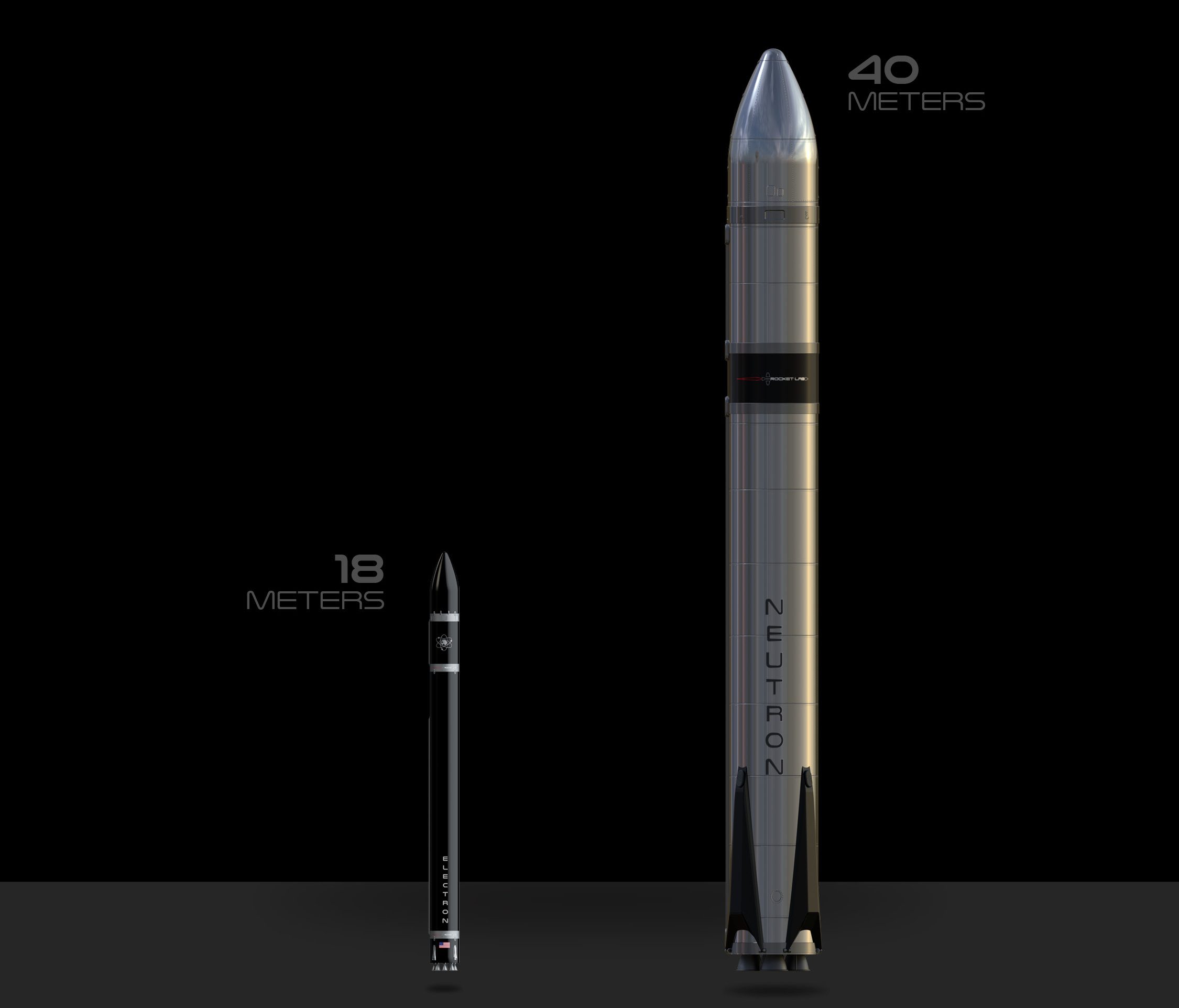
Rocket Lab’s revenues have largely come from the small payload launch market, in which it’s managed to take a leading position with its Electron rocket. Electron is only 59 feet tall and scarcely four feet in diameter, significantly smaller than other rockets going to space today. The company conducts launches from two sites: its privately-owned launch range on Mahia Peninsula, New Zealand, and a launch pad out of NASA’s Wallops Island facility in Virginia (which has yet to play host to an actual Rocket Lab mission).

Rocket Lab is in the process of transitioning Electron’s first-stage booster to be reusable. The company has been implementing a new atmospheric reentry and ocean splashdown process that uses a parachute to slow the booster’s descent, but the ultimate goal is to catch it in the air using a helicopter.

Thus far, Rocket Lab and SpaceX have dominated the market, but that could change soon. Both Astra and Relativity are developing small launch vehicles – the latest iteration of Astra’s rocket is around 40 feet tall, while Relativity’s Terran 1 is in-between Electron and Falcon 9 at 115 feet.

For that reason, it makes sense that Rocket Lab is planning on expanding its operations to include medium-lift rocketry, with its much-anticipated (and very mysterious) Neutron launch vehicle. The company has been keeping the details about Neutron close to its chest so far – Beck told SGFF attendees that even publicly-released renderings of the rocket have been “a bit of a ruse” (meaning the image below bears little to no resemblance to what the Neutron actually looks like) – but it’s expected to be more than double the height of Electron and be capable of sending around 8,000 kilograms to low Earth orbit.

Image Credits: Rocket Lab

“We do see a lot of people in the industry copying us in many ways,” he explained to TechCrunch. “So, we’d rather get a little bit further down the path and then reveal the work that we’ve done.”

Rocket Lab estimates that Electron and Neutron will be capable of lifting 98% of all satellites forecasted to launch through 2029, making the need for an additional heavy-lift rocket unnecessary.

In addition to Neutron, the company has also started developing spacecraft. It’s called Photon, and Rocket Lab imagines it as a “satellite platform” that can easily be integrated with the Electron rocket. The company’s already lined up Photon missions to the moon and beyond: first to lunar orbit for NASA, as part of its Cislunar Autonomous Positioning System Technology Operations and Navigation Experiment (CAPSTONE) program.

Two Photons were selected earlier this month for an 11-month mission to Mars, and Beck has publicly discussed long-term plans to send a probe into Venus’ atmosphere via a Photon satellite.

Beyond Photon, Rocket Lab has also locked in a deal with space manufacturing startup Varda Space Industries to build it a spacecraft, to launch in 2023 and 2024.

Neutron has been designed to be human-rateable right from the start, meaning that it will meet certain safety specifications for carrying astronauts. Beck said he’s certain that “we are going to see the democratization of spaceflight” and he wants Rocket Lab to be well-poised to deliver that service in the future. In terms of whether Rocket Lab would eventually expand into building other spacecraft, like landers or human-rated capsules, Beck demurred.

“Never, ever say never,” he said. “That’s the one takeaway I’ve learned in my career as a space CEO.”

25 Aug 2021

Daily Crunch: South Korea’s parliament delays final vote on ‘anti-Google law’

To get a roundup of TechCrunch’s biggest and most important stories delivered to your inbox every day at 3 p.m. PDT, subscribe here.

Hello and welcome to Daily Crunch for August 25, 2021. If you wanted to know just how fast the technology news cycle is running today, look no further than our lead story. You’ll note that it is a complete reversion of the week’s previously most important news item! What a world! — Alex

The TechCrunch Top 3

  • OnlyFans backtracks, will allow adult content: So much for all that. After igniting an online firestorm by announcing that it would end support and sale of most adult content, OnlyFans has changed course. Now it won’t block the material. For more on the topic, the Equity podcast crew has notes.
  • Warby Parker is going public: After a short summer lull, we could be gearing up for yet another IPO cycle. This time the lead-off hitter may be D2C eyewear purveyor Warby Parker. We’ve all heard of the company, so TechCrunch was excited to get into its numbers. Our take? It’s a very neat company, albeit one that has an interesting time defending its final private-market valuation.
  • Headspace + Ginger: News broke today that meditation service Headspace and mental-health-focused startup Ginger are merging to create Headspace Health. The combined entity will be worth $3 billion and have 800 employees. Headspace has long been in competition with Calm, another massive player in the meditation market.

Startups/VC

Before we dive into a number of thematic pairs of startup news, Kanye West. He’s out with a gadget called the “Stem Player,” which, per TechCrunch, is “designed to isolate stems — specific elements like vocals, bass, samples and drums” from musical tracks. It’s a somewhat neat idea. The fact that Kanye is doing it should provide it with a bit of a marketing boost.

From the fintech startup world today, we have two stories, both of which make us wonder just how much money can heavily populated fintech verticals absorb before investors get bored?

From the logistics realm this afternoon, two stories that may give you hope for a future in which having stuff brought to your house has a lower carbon footprint and, perhaps, a cheaper price point:

  • Alphabet’s drone delivery business scales: That’s the news from Down Under. Wing, Alphabet’s drone delivery company, has reached the 100,000-delivery mark, it recently announced. The service is currently live in Logan, Australia, where around 300,000 folks live. Alphabet, please bring this to Providence, Rhode Island.
  • And Coco has raised $36M for super-cute delivery robots: Somewhere in time there was a committee meeting that I missed at which it was decided that all delivery robots had to be cute. I don’t know why. Coco’s delivery robot is, however, adorable. And now very well funded thanks to capital from a Series A led by Sam Altman of Y Combinator fame.

Staying close to the logistics theme, here’s a pair of stories dealing with the world of digital commerce in Europe:

And to round us out, cybersecurity venture capital activity has reached new high, and cannabis-focused startup Jane just put together a $100 million round.

India’s path to SaaS leadership is clear, but challenges remain

By 2030, India’s SaaS industry is estimated to comprise 4%-6% of the global market and generate between $50 billion and $70 billion in yearly revenue, according to a SaaSBOOMi/McKinsey report.

“With the right approach, it won’t be long before the Indian SaaS community becomes a large-scale employer of talent, a significant contributor to India’s GDP and a creator of unmatched products,” says Manav Garg, CEO and founder of Eka Software Solutions.

In a guest post, he lays out several key growth drivers, which include “the largest concentration of developers in the world” and the fact that “SaaS is not a winner-take-all market.”

Even so, the region still faces challenges, since “growth requires a growth mindset.”

(Extra Crunch is our membership program, which helps founders and startup teams get ahead. You can sign up here.)

Big Tech Inc.

  • The PC isn’t dead: So much for iPads taking over the world, new data from Canalys indicates. Per the data company, PC sales rose 17% from year-ago totals, while tablet sales went sideways. Perhaps having full-power machines is more popular than ever, as we all have more work to do than, well, ever? Regardless, the PC news is good for a host of big technology firms, including HP and Lenovo.
  • Hulu launching HDR viewing for some content: Better late than never, U.S. video streaming service Hulu started rolling out HDR content support on August 19, which “should be available to all users with HDR-compatible devices in the coming days,” TechCrunch reports. So far HDR playback only extends to certain, high-profile Hulu content.
  • South Korea delays proposed “anti-Google law”: If passed, TechCrunch’s own Kate Park writes, “South Korea will be the first country to prohibit such global tech giants from imposing billing systems on in-app purchases.” Apple and Google, naturally, oppose the measure.

TechCrunch Experts: Growth Marketing

Illustration montage based on education and knowledge in blue

Image Credits: SEAN GLADWELL (opens in a new window) / Getty Images

We’re reaching out to startup founders to tell us who they turn to when they want the most up-to-date growth marketing practices. Fill out the survey here.

Read one of the testimonials we’ve received below!

Marketer: One Net Inc.

Recommended by: The Good Ride

Testimonial: “Exceptional SEO expertise. My e-comm startup relies 100% on SEO traffic, and three years ago we were delisted from Google because we didn’t understand about duple content. One Net fixed our site, and optimized it for Google, which allowed us to get back into the SERPs. Bottom line: They saved our business.”

25 Aug 2021

Using AI to reboot brand-client relationships

Marketing automation has usually focused on driving sales, mainly using past purchase or late funnel behavior (e.g., paid search) as a predictor of an imminent purchase. While effective at boosting sales numbers, this widely implemented strategy can result in a disservice to brands and industries that adopt it, as it promotes the perpetual devaluation of goods or services. Narrowing a brand’s focus only to aspects linked to conversions risks stripping the customer experience of key components that lay the groundwork for long-term success.

We live in a world rich with data, and insights are growing more vibrant every day. With this in mind, companies and advertisers can strategically weave together all the data they collect during the customer experience. This enables them to understand every inference available during customer interactions and learn what benefits the customer most at a given time.

But focusing exclusively on data collected from customers, brands risk falling subject to the law of diminishing returns. Even companies with meaningful consumer interactions or rich service offerings struggle to gain impactful contextual insights. Only by harnessing a broader dataset can we understand how people become customers in the first place, what makes them more or less likely to purchase again and how developments in society impact the growth or struggle a brand will experience.

Here’s a look at how we can achieve a more complete picture of current and future customers.

A critical component in re-imagining customer experience as a relationship is recognizing that brands often don’t focus enough on consumers’ wider needs and concerns.

Leverage AI to unlock new perspectives

Over the past several years, almost every industry has capitalized on the opportunity data-driven marketing presents, inching closer to the “holy grail” of real-time, direct and personalized engagements. Yet, the evolving toolset encouraged brands to focus on end-of-the-funnel initiatives, jeopardizing what really impacts a business’ longevity: relationships.

While past purchase or late-funnel behavior data does provide value and is useful in identifying habit changes or actual needs, it is relatively surface level and doesn’t offer insight into consumers’ future behavior or what led them to a specific purchase in the first place.

By incorporating AI, brands can successfully engage with their audiences in a more holistic, helpful and genuine way. Technologies to discern not just the content of language (e.g., the keywords) but its meaning as well, open up possibilities to better infer consumer interest and intentions. In turn, brands can tune consumer interactions to generate satisfaction and delight, and ultimately accrue stronger insights for future use.

25 Aug 2021

Salad chain Sweetgreen buys kitchen robotics startup Spyce

Like so many other aspects of the robotics world, the pandemic has dramatically accelerated interest in the automated kitchen. After all, the food and restaurant industry was deemed essential amid global shutdowns, but finding kitchen staff proved a problem for many, especially early on when questions remained around COVID’s transmission.

This week, California-based fast casual salad chain Sweetgreen announced plans to go all in on automation with the acquisition of Spyce. Founded in 2015, the Boston-based startup started making waves a few years back as a spinout of MIT mechanical engineering students. First serving up food at the school’s dining hall, the team ultimately opened a pair of automated restaurants in the Boston area. The startup notes, “our Spyce restaurants will stay open at this time.”

Sweetgreen plans to eventually incorporate Spyce’s technology into its restaurants. It will likely take some time to scale up to the needs of the chain, which currently operates more than 120 locations across the U.S.

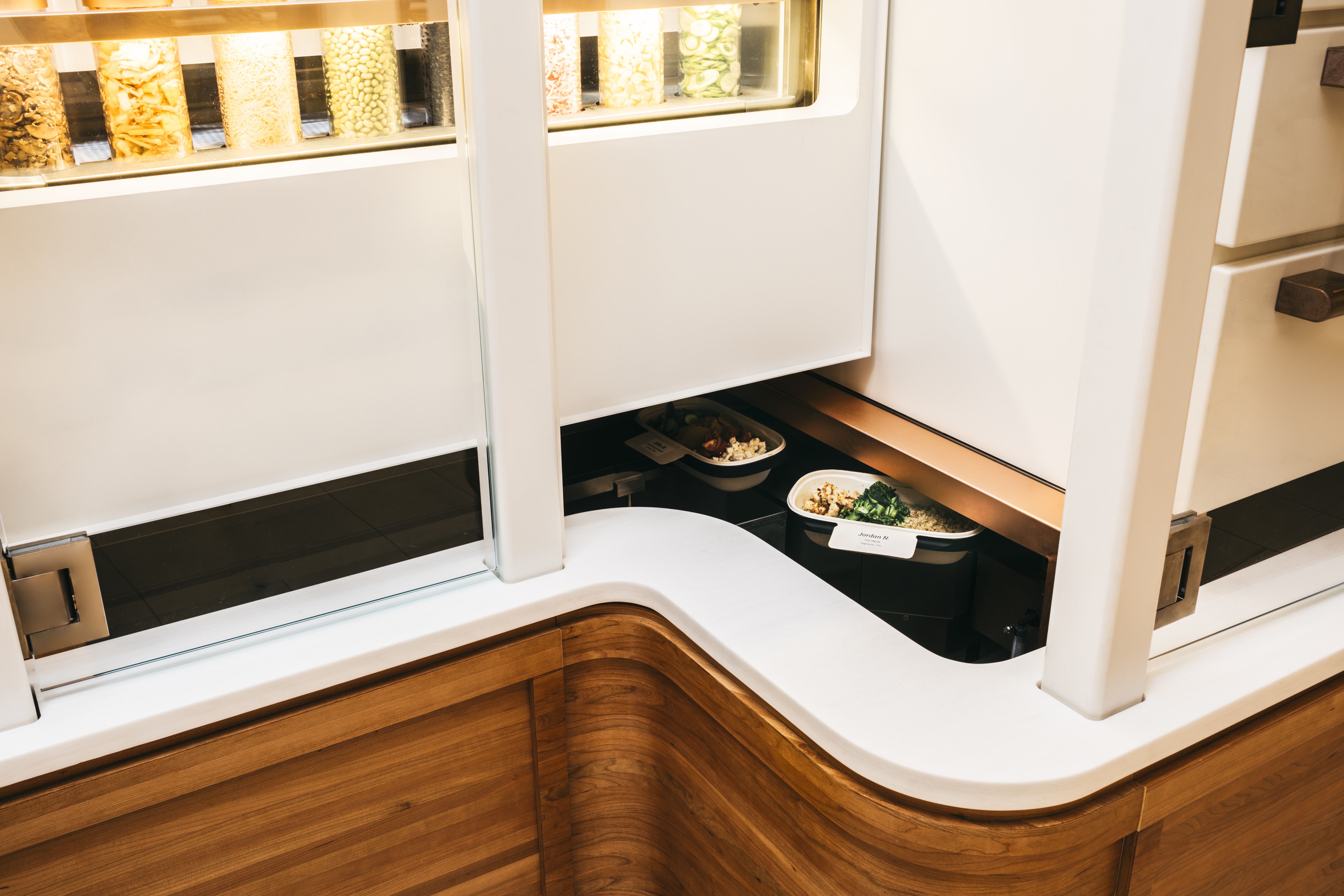
Image Credits: Spyce

“We built Sweetgreen to connect more people to real food and create healthy fast food at scale for the next generation, and Spyce has built state-of-the-art technology that perfectly aligns with that vision,” Sweetgreen CEO and co-founder Jonathan Neman said in a statement. “By joining forces with their best-in-class team, we will be able to elevate our team member experience, provide a more consistent customer experience and bring real food to more communities.”

Like pizza, salads are a clear target for early food automation. They’re both popular and relatively straightforward to automate — essentially mixing a bunch of ingredients from different chutes into a bowl.

Sweetgreen is quick to note that the plan isn’t to replace employees outright, however.

“[T]eam members will be able to focus more on preparation and hospitality moments, while having the opportunity to work with state-of-the-art technology,” the company writes. “Invest more in training and development to support team members to become Head Coaches. Interested team members will be able to develop technology-facing skills to operate and maintain Spyce technology.”

The deal is expected to close in Q3. Terms were not disclosed.