Year: 2021

11 Aug 2021

Link-in-bio monetization platform Snipfeed raises a $5.5M seed round

The link-in-bio business is heating up as more mobile website builders compete for a coveted slice of real estate on a creator’s TikTok, Instagram, or Twitter. Linktree leads the space, securing a recent $45 million Series B raise to build out e-commerce features, but Beacons boasts competitive creator monetization tools with just a $6 million seed round in May. Now, Snipfeed enters the ring with its own $5.5 million seed round, including investments from CRV, Abstract Ventures, Crossbeam (Ali Hamed), id8, Michael Ovitz (founder of CAA), Michael Bosstick, Diaspora Ventures, and others.

Linktree has been around since 2016 and has more funding than its up-and-coming competitors. But for creators seeking to monetize their following, these newer platforms may be more attractive to some creators, since they already have built-in tools to help them monetize their followings. Linktree currently supports tipping on the platform for users subscribed to its $6 Linktree Pro platform, but Snipfeed offers a wider range of monetization options; some creators are making over $20,000 per month on the platform, according to CEO and co-founder Rédouane Ramdani.

Snipfeed started as a content discovery platform with 44,000 weekly active users — but when Snipfeed added a creator monetization tool to its platform, it became its most popular feature. So, in February 2020, with little to no funding left, the company completely pivoted to its current link-in-bio business. Since then, Snipfeed has amassed 50,000 registered users, with the user base growing 500% in the last six months (Linktree, for comparison, has over 12 million users).

Based in Paris and Los Angeles, Snipfeed’s 15-person staff is particularly interested in the “long tail” of creators, which it says encompasses over 46 million people.

“Content creator doesn’t necessarily mean you’re going to be the next Addison Rae or a TikTok star,” explained Ramdani. “It means that you might be a doctor or lawyer, and on top of that, you’re going to have a TikTok where you explain how to file your taxes and that kind of stuff. They have this expertise, and they’re wondering, ‘How can I turn that into a side-hustle?'”
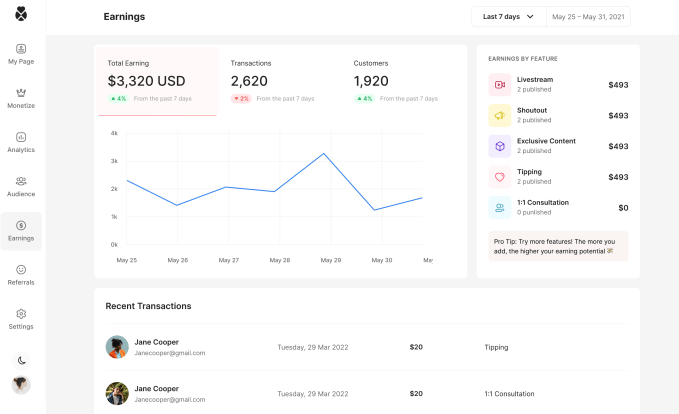
Image Credits: Snipfeed

In addition to a standard tipping tool, Snipfeed allows users to sell digital goods, like on-demand video, ebooks, access to livestreams, and one-on-one consultations. But Snipfeed’s biggest differentiator is its Cameo-like system for selling personalized content. For example, TikToker maylikethemonthh uses Snipfeed to sell asynchronous, video-recorded tarot readings. While asking a single, personalized astrology question costs $5, a more in-depth reading can cost up to $20 or $40.

Snipfeed is free to set up, but if you make sales, the company takes 15% — this percentage is inclusive of any transaction fees. Through Snipfeed’s referral program, creators can make 5% of sales from anyone they onboard to the platform (this comes out of Snipfeed’s commission).

“We decided to go with this model because we really want to have a relationship where we help the creators really make money. We only make money if they make money,” Ramdani said.

If a creator or celebrity were to sell personalized videos on Cameo, they’d lose 25% to the platform. Meanwhile, Beacons takes 9% of sales from its free version, and 5% from its $10 per month version, which offers more customization, integrations, analytics.
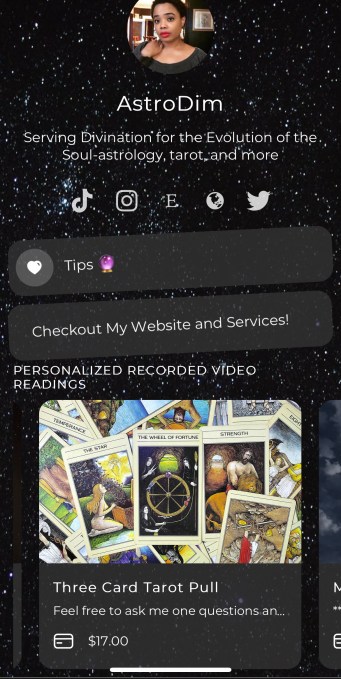
Image Credits: Snipfeed

Still, depending on the type of creator, the features that each link-in-bio startup offers might matter more than the cost. Beacons allows users to share a shopping-enabled TikTok feed, which could be huge a money-maker for creators that often share product recommendations with affiliate links, which give them a commission from sales. Ramdani said that astrologers have been particularly successful on Snipfeed, since fans can book a variety of asynchronous services at a wide range of prices. But these features could benefit any creator who can profit from answering followers’ specific questions — a chef could offer recipe ideas based on what’s in a fan’s fridge, or a life coach could make a personalized video if a follower requests advice.

With its $5.5 million in seed funding, Snipfeed plans to build out its e-commerce tools so that creators can sell physical products on their link-in-bio (Beacons and Linktree are also working on this with their recent funding rounds — but Beacons’ and Snipfeed’s seed rounds are small compared to Linktree’s Series B). The company also wants to develop educational content to show its users how to best monetize their platform — if Snipfeed can help its creators make money, then it’ll make more money too.


11 Aug 2021

Amazon’s $1.5 billion U.S. air cargo hub is open for business

Amazon’s $1.5 billion air cargo hub in Northern Kentucky opened Wednesday, the latest effort by the e-commerce giant to connect a network of 40 sites and control all aspects of delivery as demand for speed and convenience accelerates.

The Amazon Air Hub operations, located at the Cincinnati/Northern Kentucky International Airport, will be the center of its U.S. cargo network. The hub opened after more than four years of planning and construction. Amazon said the U.S. hub will eventually operate a dozen flights per day and process millions of packages every week.

The hub is comprised of a 800,000-square-foot sortation building located on a 600-acre campus that includes seven buildings, a new ramp for aircraft parking and a multi-story vehicle parking structure.

Amazon said that eventually more than 2,000 people will be employed there. The air hub will also rely on robotics technology, specifically to robotics arms to move and sort packages and mobile drive units to transport packages across the building.

Amazon Air launched in 2016 and has grown into a network of more than 40 locations. Last year, Amazon Air launched its European air hub at Germany’s Leipzig/Halle Airport, a 215,000-square-foot facility that hosts two Amazon-branded Boeing 737-800 aircraft.

Amazon Air also has regional air hubs at airports in Texas, Puerto Rico and Florida in the U.S., and plans to expand to San Bernardino International Airport in California and Cincinnati/Northern Kentucky International Airport in 2021.

11 Aug 2021

WhatsApp gains the ability to transfer chat history between mobile operating systems

WhatsApp users will finally be able to move their entire chat history between mobile operating systems — something that’s been one of users’ biggest requests to date. The company today introduced a feature that will soon become available to users of both iOS and Android devices, allowing them to move their WhatsApp voice notes, photos, and conversations securely between devices when they switch between mobile operating systems.

The company had been rumored to be working on such functionality for some time, but the details of which devices would be initially supported or when it would be released weren’t yet known.

In product leaks, WhatsApp had appeared to be working on an integration into Android’s built-in transfer app, the Google Data Transfer Tool, which lets users move their files from one Android device to another, or switch from iOS to Android.

The feature WhatsApp introduced today, however, works with Samsung devices and Samsung’s own transfer tool, known as Smart Switch. Today, Smart Switch helps users transfer contacts, photos, music, messages, notes, calendars, and more to Samsung Galaxy devices. Now, it will transfer WhatsApp chat history, too.

WhatsApp showed off the new tool at Samsung’s Galaxy Unpacked event, and announced Samsung’s newest Galaxy foldable devices would get the feature first in the weeks to come. The feature will later roll out to Android more broadly. WhatsApp didn’t say when iOS users would gain access.

To use the feature, WhatsApp users will connect their old and new device together via a USB-C to Lightning cable, and launch Smart Switch. The new phone will then prompt you to scan a QR code using your old phone and export your WhatsApp history. To complete the transfer, you’ll sign into WhatsApp on the new device and import the messages.

Building such a feature was non-trivial, the company also explained, as messages across its service are end-to-end encrypted by default and stored on users’ devices. That meant the creation of a tool to move chat history between operating systems required additional work from both WhatsApp as well as operating system and device manufacturers in order to build it in a secure way, the company said.

“Your WhatsApp messages belong to you. That’s why they are stored on your phone by default, and not accessible in the cloud like many other messaging services,” noted Sandeep Paruchuri, product manager at WhatsApp, in a statement about the launch. “We’re excited for the first time to make it easy for people to securely transfer their WhatsApp history from one operating system to another. This has been one of our most requested features from users for years and we worked together with operating systems and device manufacturers to solve it,” he added.


11 Aug 2021

A close look at Singapore’s thriving startup ecosystem

Singapore is home to fewer than six million people, making it one of the smallest ASEAN countries, in terms of population. It is a young country as well — having gained independence in 1963 — and resides in a neighborhood with far larger economies, including China, Indonesia, and Vietnam. When the country first became independent, its mandate was to simply survive rather than thrive.

So how does a country evolve from a position of relative uncertainty, with comparatively few resources, to one that leads the ASEAN region in venture capital investment and has been home to 10 unicorns?

Countries around the world examine Singapore’s ecosystem from a distance, hoping to learn from, and emulate, its story. The World Bank Group recently published a report, The Evolution and State of Singapore’s Start-up Ecosystem, documenting the country’s experience in building its startup ecosystem and the challenges facing it.

This article presents an overview of the report’s key findings and offers a few key recommendations on what other countries can learn from Singapore’s experience, as well as what Singapore itself can do to maintain progress.

A glimpse into Singapore’s current startup ecosystem

As of 2019, Singapore had over $19 billion in PE and VC assets under management, more than twice that of neighboring Indonesia, Philippines, Vietnam, Malaysia, and Thailand combined. In that same year, the country was home to an estimated 3,600 tech startups and nearly 200 different intermediary and supporting organizations (accelerators, co-working spaces, coding academies, etc.) – some which have a multinational presence, such as Blk71, whose Singapore headquarters has been referred to as “the world’s most tightly packed entrepreneurial ecosystem.”

While assessing the size and strength of startup ecosystems is an evolving method, Start-up Genome priced Singapore’s ecosystem at over $25 billion, five times the global median.

Arguably, the most eye-catching hallmark of this ecosystem is its population of current and former unicorns. Collectively, Singapore has been home to ten unicorns, three of which have offered an IPO (Nanofilm, Razer and Sea) and two of which have been acquired – one by giant Alibaba (Lazada) and one by Chinese streaming powerhouse YY (Bigo Live). The remaining five are Trax, Acronis, JustCo, PatSnap, and Grab – the ASEAN region’s largest unicorn to date.


The education sector is also prominent in Singapore’s ecosystem. Universities like the National University of Singapore (NUS) and Nanyang Technological University (NTU) are deeply embedded into this ecosystem, helping with R&D commercialization linkages, incubation, talent/knowledge transfer, and other areas.

So, how did Singapore’s startup ecosystem come to be?

Numerous factors have contributed to building Singapore’s startup ecosystem, with government intervention and leadership being the dominant driving forces. The government has spent more than USD60 billion over the past several decades to enhance the country’s R&D infrastructure, create VC funds, and launch accelerators and other support organizations.

11 Aug 2021

Don’t miss these special breakout sessions at TechCrunch Disrupt 2021

Go ahead and add “produce a world-class tech conference” to the long list of items that can complete the expression “It takes a village to…” TechCrunch Disrupt 2021 runs September 21-23, and we’d like to take a moment to give a major shout-out to a vital part of the TechCrunch village — our sponsors.

Admin Tip: Buy your pass to Disrupt before the price goes up on September 20.

TechCrunch sponsors don’t just write a check; they bring their deep knowledge and expertise to the party to help early-stage founders move their business to the next level and beyond. Michael McCarthy, the CEO of Repositax, attended Disrupt 2020 and shared his thoughts on the breakout sessions with us.

“There was always something interesting going on in one of the breakout sessions, and I was impressed by the quality of the people participating. Partners in well-known VC firms spoke, they were accessible, and they shared smart, insightful nuggets. You will not find this level of people accessible and in one place anywhere else.”

We have an impressive slate again this year, and our enormous thanks go out to our TC Disrupt 2021 sponsors: Aerospace Corporation, Cedar, Checkr, Connection, Foxxum, Google Cloud, hu.brussels, Mambu, rlaxx TV, SeedInvest, Sentry Software and Xero.

Let’s take a look at the sponsored breakout sessions scheduled over three days. You’ll find them, along with more than 50 other presentations, in the Disrupt 2021 agenda.

You Complete Me: In the age of the composable ecosystems, we’re all partners now – from frenemies to pure collaborations. So why is now, more than ever, the right time to invite friends and challengers to the table? The truth is we have to build for an unknown future, with a shared strategy and value outcome. Join Elliot Limb, chief customer offer at Mambu, to learn five ways to encourage more symbiotic relationships in the platform economy. Presented by Mambu.

So, You Want to Build a Space Business? The space industry is changing faster than ever, with new technologies and lower launch costs democratizing access to space and driving a new era of innovation. The opportunities to build the next great business are seemingly endless, but space can be a difficult and unforgiving place, especially for those new to the domain. This session will feature practical insights and advice from experienced space leaders for entrepreneurs looking to get their business off the ground. Presented by The Aerospace Corporation.

The Connection IT Superhero Awards: Connection and TechCrunch have teamed up to celebrate and recognize IT people who have gone the extra mile with the inaugural Connection IT Superhero Awards. Winners of the five category awards will be announced live, presented by Connection’s Chief Innovation & Growth Officer, Jamal Khan. These awards are about people, not products for the many out there deserving recognition for their daily efforts. We think some well-earned awards are a great place to start. Nominate your IT Superhero here by August 24. Presented by Connection.

Demo Derby — How Startups are Disrupting the Status Quo with Innovative Data Analytics, AI and Modern App Development: Startups need to move quickly and focus limited resources on areas where they can differentiate. In this fast-paced session, learn from startups and Google experts how you can leverage Google technologies to serve customers better and get to market more quickly. In a series of short demos, see how innovative startups and Google experts have used Google compute, storage, networking and AI technologies to ‘disrupt’ the status quo. Presented by Google Cloud.

How Circle’s $4.5B Public Listing will Change Startup Fundraising: Circle acquired SeedInvest in 2019, as a further step toward realizing its vision of a more open, global, connected and inclusive financial system. Fast forward to today, Circle recently announced its plans to become a $4.5B public company, with over $1 billion of fresh capital. In this session, Jeremy Allaire, Circle CEO and co-founder, and Ryan Feit, CEO and co-founder of SeedInvest, will break down the evolution of the two companies and how they plan to double down on online fundraising to make it faster and easier for entrepreneurs. Presented by SeedInvest.

Belgian Startup Pitch Competition: Join us for the 7th edition of our Belgian Startup Pitch Competition. We look forward to seeing you there! Presented by hub.brussels.

Illuminating the Next Great Entertainment Frontier — The Connected TV Metaverse: While the proliferation of operating systems and OTT platforms have made TV more convenient and accessible, the magnitude of players in this ecosystem have also made television more complicated to navigate –for programmers, advertisers, and viewers. We all want our programming in each of its various delivery methods, provided in an easy-to-navigate, fast-to-discover, intuitive interface. Join an in-depth conversation with media industry veteran and technology futurists as they identify the outlook of the CTV world. Presented by Foxxum and rlaxx TV.

Achieve Sustainable IT with Prometheus, Grafana and Hardware Sentry: Implementing sustainability initiatives to achieve net-zero carbon emissions in the data center is a vital challenge. Join Bertrand Martin, Sentry Software’s co-founder and CEO, as he presents Hardware Sentry Exporter for Prometheus. Measure the power consumption and temperature of more than 250 platforms with this unique pure-software solution. Report CO₂ emissions, electricity usage and costs of applications and services in Grafana. Reduce the carbon footprint of your datacenter with intelligent optimization of ambient temperature. Presented by Sentry Software.

Hacking U.S. Healthcare: How a Simple Platform Can Help Solve Some of America’s Most Complex Healthcare Problems: Few things conjure more negative emotions than navigating medical billing; Americans urgently need solutions that prioritize their needs, decrease costs and elevate the patient journey so they can focus on getting care. Fortunately, digital innovation can provide exceptional patient experiences that remove friction for payers, providers and consumers alike. Hear how digital health unicorn Cedar has engineered a complete consumer-first digital platform that’s revolutionizing the financial experience for the entire healthcare industry. Presented by Cedar.

Powering the Small Business Economy with Cloud Technology: Small business is a critical engine of job creation, economic growth, innovation and a driver in our efforts to recover from a global pandemic. Fifteen years ago, a start-up company from New Zealand called Xero was founded with the purpose of making life better for people in small business and their advisors. Xero achieved this by shifting accounting practices to the cloud and providing an open set of APIs which has enabled more than 1,000 application partners to build affordable tech solutions connected to the Xero platform. Steve Vamos, CEO will discuss how Xero is revolutionizing the way small businesses do business by using cloud and its platform to connect real-time data, with bespoke business solutions that help small business owners be more successful. Steve will speak to a number of key initiatives that will change the game for startups and entrepreneurs who want to innovate and collaborate on the Xero platform, and he will explain how Xero’s vision extends beyond just technology to galvanizing a global community of support and purpose to help small businesses everywhere. Presented by Xero.

Why Employers are Ignoring a Large Candidate Pool that’s Necessary for Growth Today: Hear directly from Checkr CEO, Daniel Yanisse and DDI CEO Aaron Hageman about why this job market is fueling the gig economy growth, how to tap into fair chance hiring and how it will help your employee base. Learn about the benefits of fair chance hiring, its impact on your bottom line and organizations and allies that promote fair chance hiring and why this matters to DEI efforts. Presented by Checkr.

Connection IT Superhero Awards Announcement: Use this link to nominate someone for the Connection IT Superhero Awards. The nomination deadline is August 24. Presented by Connection.

TechCrunch Disrupt 2021 takes place September 21-23. Do not miss the invaluable information waiting for you in the sponsored breakout sessions — just some of the Disrupt programming designed to help you build a bigger, better and stronger startup. Get your pass today!

Is your company interested in sponsoring or exhibiting at Disrupt 2021? Contact our sponsorship sales team by filling out this form.

11 Aug 2021

Weedmaps adds in-app cannabis purchasing for iPhone users

Thanks to Apple loosening App Store restrictions, Weedmaps users can now purchase cannabis within the popular app. This means Weedmaps users can browse, select, and purchase cannabis and have it set for pick-up or delivery — all within the app. Previously, users could only locate and browse menus of local retailers thanks in part to restrictions by Apple and local and federal guidelines.

The updated app is now available.

The change comes after Apple opened up the App Store for some cannabis apps. Under the new guidance, licensed cannabis operators fall under the same restrictions (to Apple) as licensed pharmacies allowing apps like Weedmaps, which lists licensed cannabis operators, to offer such services.

“Our ability to enable ordering functionality through our mobile iOS app is a game-changer that will improve accessibility for both our customers and business partners alike,” said Justin Dean, Chief Technology Officer at WM Technology, Inc. “We commend companies like Apple that work with industry leaders to find solutions that drive innovation in our space. It’s encouraging to see policies and attitudes toward cannabis shift in a way that promises remarkable growth, and we look forward to introducing an even simpler way to order cannabis from retailers through our platform.”

Weedmaps sits at a unique position in the marketplace. As one of the leading cannabis apps, it’s already used throughout the country. Unlike competing delivery services, like Eaze, Weedmaps is not facilitating delivery. It’s only providing a platform for licensed delivery dispensaries to list their goods and services.

Under the new App Store restrictions, apps like Weedmaps must limit users to ordering within a geo-restricted area where cannabis sales are legal. This means, if a user living in a place where cannabis sales are illegal, they cannot order from a dispensary in a legal area.

Here’s the previous Apple App Store policy:

“Apps that encourage consumption of tobacco and vape products, illegal drugs, or excessive amounts of alcohol are not permitted on the App Store. Apps that encourage minors to consume any of these substances will be rejected. Facilitating the sale of controlled substances (except for licensed pharmacies), marijuana, or tobacco is not allowed.

Here’s the updated policy as of June 7, with the changes highlighted in bold.

“Apps that encourage consumption of tobacco and vape products, illegal drugs, or excessive amounts of alcohol are not permitted on the App Store. Apps that encourage minors to consume any of these substances will be rejected. Facilitating the sale of controlled substances (except for licensed pharmacies and licensed or otherwise legal cannabis dispensaries), or tobacco is not allowed.”

“Apps that provide services in highly-regulated fields (such as banking and financial services, healthcare, gambling, legal cannabis use, and air travel) or that require sensitive user information should be submitted by a legal entity that provides the services, and not by an individual developer. Apps that facilitate the legal sale of cannabis must be geo-restricted to the corresponding legal jurisdiction.

11 Aug 2021

Joby Aviation makes its public trading debut on the NYSE

Joby Aviation is now public, twelve years after JoeBen Benvirt founded the company at his ranch in the Santa Cruz mountains. The air taxi developer began trading on the New York Stock Exchange on Wednesday under the ticker symbol “JOBY,” after completing a merger with special purpose acquisition company Reinvent Technology Partners.

As of 10:00 AM ET, the price per share was at $11.01, up 9.8% from its prior-day closing amount.

Joby’s post-transaction valuation now stands at $4.5 billion, the largest in the industry. It also now has the highest cash balance. All told, Joby has around $1.6 billion in total capital to take its air taxi operations to commercialization in 2024. That includes $835 million of private-investment-in-public-equity as well as more than $500 million of capital on the balance sheet.

RTP reported to the Securities and Exchange Commission that around 63% of the 69 million ordinary shares were redeemed prior to the public trading debut, giving Joby access to $255 million out of the $690 million of cash held in trust from the blank-check firm.

It’s a sizable amount, but creating an entirely new form of transportation is a capital-intensive business. Joby’s executive chairman Paul Sciarra told TechCrunch he thinks $1.6 billion will be enough to prepare the company for launch.

“We think that’s enough to execute on the things that matter over the next few years, and those are […] one, ensuring that we execute on the certification program; two, showing we can demonstrate our ability to repeatedly manufacturing these aircraft in a certifiable way; and then third and finally, the opportunity to lay the groundwork for commercial launch,” Sciarra said.

Joby is developing a five-seat electric vertical take-off and landing aircraft, which it unveiled to much anticipation in February. The company, which has backing from Toyota and JetBlue, has released a slew of announcements in recent months as it geared up for the public listing.

“A lot of people talk about us as a secretive company,” Benvirt said in an interview with TechCrunch. “We’re not actually a secretive company, we just choose to do the work and then show our work, rather than talking about it and then doing it.”

From $RTP to $JOBY

Joby’s merger with blank-check firm Reinvent, headed by LinkedIn co-founder Reid Hoffman, was announced in February. The transaction includes a few provisions to ensure longer-term collaboration, including a lock-up on founder shares for up to five years, as well as vesting provision with earnout not realized until the price per share reaches $50 – a $30 billion market cap.

SPACs are not a new instrument for going public, but they have gained a widespread presence in the transportation space, particularly amongst eVTOL startups looking to secure amounts of capital. Archer Aviation was the first developer to announce it would merge with a blank-check firm, followed by Joby, Lilium and Vertical Aerospace. But there are signs that the investment bubble may be starting to deflate: late last month, Archer cut its valuation by $1 billion in a “strategic reset” of the transaction terms with Atlas Crest Investment Corp.

Such turbulence is not uncommon in markets populated by pre-revenue companies. But despite now being a public company – and having shareholders to answer to – Sciarra said Joby’s task remains unchanged. “We can’t control the markets,” he said. “[Joby] is a company that’s been executing quietly for a very long time on things that matter. I think it’s going to be incumbent upon us to do the same as we make this transition to a public company: tell folks what we’re going to do, and then go out and do them. That, quarter by quarter, is what builds credibility, what combats skepticism, and what gives investors and frankly, the broader public, confidence that this is a company that means what it says.”

One way to frame the fate of air taxis is whether they will be more like autonomous vehicles or electric vehicles. The AV space circa five years ago was filled with companies setting ambitious expectations about when true self-driving cars would be on the roads, only to have multiple companies collapse or sell under the weight of overshot expectations.

But Sciarra suggested that a better analogy to the eVTOL industry as it currently stands is the early days of electric vehicles. He pointed out that Joby’s aircraft is designed to conform to existing safety and certification standards, with a trained pilot onboard, similar to how helicopters and planes operate today. “We didn’t want to compound the technical risk of developing a new aircraft with the technical and regulatory risk of developing full autonomy from day one.”

“We think about our approach as a little bit more Tesla versus, say, Waymo,” he added.

11 Aug 2021

When the economic tide goes out, we’ll see which VCs are naked

Hello and welcome back to Equity, TechCrunch’s venture capital-focused podcast, where we unpack the numbers behind the headlines.

This week we were back to full strength, with Danny Natasha and Alex joined by Chris to chat through the latest venture capital brouhaha. Namely whether or not venture capital is about to get shaken to its core, or if we’re really parsing some long-term economic trends that will eventually revert.

Here’s a rundown:

  • Sam Lessin kicked off the Twitter conversation by positing that venture capital as we know it is kaput, with software and later-stage investing possibly seeing the most disruption.
  • Both Alex and Crunchbase News posted responses to the concept, which could best be summarized as yeah, but.
  • However, the point that there is a lot of non-venture money flooding into startups is both real and material, and worth chewing on. So, masticate we did, parsing which areas of startup investing might be the most winsome for the VCs we spend so very much time talking to,

The direction and future of the venture capital world has largely been lost amidst a sea of large numbers. New megarounds. New unicorns. That sort of thing. But inside the rising tide of capital available to private companies has been a mix-shift of sorts. The question is where that goes long-term. We tried to posit a few things that could happen next.

Equity is back on Friday!

v class="article-content">
Equity drops every Monday at 7:00 a.m. PDT, Wednesday, and Friday morning at 7:00 a.m. PDT, so subscribe to us on Apple PodcastsOvercastSpotify and all the casts.
11 Aug 2021

Samsung’s latest Galaxy Z Flip starts at $1,000

The Galaxy Z Flip is probably destined to forever play second fiddle to the Fold. And with its older and larger sibling now ascending to the ranks of “flagship” with a slew of new features like S-Pen functionality, the designation is probably all but inevitable.

But for those seriously considering the world of foldables, there’s something to be said for the clamshell devices. It has always been the more compact and — dare I say — accessible member of the Galaxy Z family. Of course, at $1,380 — well, let’s just say “accessibility” is relative.” At today’s Unpacked event, however, Samsung announced that the Galaxy Z Flip 3 is getting an even larger price drop than the Fold.

At $999.99, again, we’re speaking relatively here. But at the very least, a nearly $400 price drop brings the Flip into the realm of mainstream flagship pricing (the Fold 3, while cheaper than its predecessor, is still $1,799). Add onto that the learnings that come with a third-generation device, and there’s a case to be made that this is Samsung’s (and, probably the industry’s) most mainstream foldable to date. I mean, anything beats the original Razr foldable, right?

Image Credits: Brian Heater

Obviously we’re going to hold out for a review unit until we’re able to say something more definitive on the matter. But while Samsung continues to lead with the Fold, don’t sleep on the alternative. Both devices have (understandably) prioritized durability among their new features. That includes a stronger protective film made of PET plastic, coupled with a reconfiguration of the display panels aimed at reinforcing what has traditionally been the weak link on these products.

Also on board is Samsung’s new proprietary Armor Aluminum for the body, Gorilla Glass Victus for the exterior of the device and IPX8 water resistance. That means the new foldables can withstand significantly more water than their predecessors. The “X” in the rating means it’s not rated against debris, due to the nature of the hinges, but Samsung believes the sweeping mechanism it introduced on previous models can make quick work of particulate matter that could potentially fall behind the screen and damage it in the process of pressing.

Image Credits: Brian Heater

The phone has also gotten a striking redesign. When closed, I’d say it’s a considerably better-looking device than the Fold — not to mention significantly easier to port around in your pocket. The device now comes in Cream, Green, Lavender and Black, coupled with a variety of different grips and straps. If you get it online, you can also choose a Gray, Pink or White version. The internal display is effectively the same as its predecessor at 6.7 inches (2640 x 1080), but the front screen has been further increasing from 1.1 to 1.9 inches — a not insignificant bump when we’re dealing with those sizes.

The cameras remain roughly the same as the Flip 2:

  1. Front: 10MP Selfie. F2.4, Pixel size: 1.22μm, FOV: 80-degree
  2. Rear: 12MP Ultra Wide. F2.2, Pixel size: 1.12μm, FOV: 123-degree
  3. Rear 2: 12MP Wide-angle. Dual Pixel AF, OIS, F1.8 Pixel size: 1.4μm, FOV: 78-degree

Image Credits: Brian Heater

The battery is (understandably) a fair bit smaller than the Fold’s at 3,300mAh, split over two modules (because, folding). It supports fast-wired and wireless charging, as well as Samsung’s Wireless PowerShare for giving some juice back to your other devices. Like the Fold, the new flip is powered by the Snapdragon 888. Here that’s coupled with 8GB of RAM and either 128 or 256GB of storage.

Like the other devices announced today, the Flip is now up for preorder and starts shipping August 26. Preordering will get you a $150 Samsung Credit.

11 Aug 2021

Samsung’s latest Galaxy Fold adds stylus support, waterproofing and an under-display camera

Behold, Samsung’s latest flagship. With the Galaxy Note out of the way — for this year, at least — the company used today’s Unpacked event to breathe added legitimacy into its foldable line. The original Galaxy Fold, introduced in 2019, represent a sort of experiment for the company (along with all the hiccups that entailed), as the first foldable from a major hardware manufacture, whereas last year’s Galaxy Z Fold 2 found the company correcting some of the glaring issues with its predecessor.

Today’s event finds the company making the case for Galaxy Z Fold 3 as something beyond an experiment or a curiosity. The task will almost certainly be an uphill battle for the next few generations. Unlike the latest version of the Flip, which starts at a price reduced considerably from its predecessor, the new Fold drops the entry price $200, down to $1,800. Any price reduction is a step in the right direction — and something that should be increasingly feasible as the technology continues to scale. But even in the world of premium flagships, that will continue to be a tough pill to swallow.

Image Credits: Brian Heater

What the upgraded Fold truly brings to the table, however, is a continued refinement to build materials that make the foldable screen a feasible option for day to day usage. This, of course, is precisely what hamstrung the original. Sure, the company did a lot of testing in controlled rooms, but once the product got out into the world (and into the hands of non-Samsung employees), problems of durability began cropping up, resulting in displays that were unintentionally damaged in a variety of imaginative ways.

The Galaxy Z Fold features a stronger frame made of “Armor Aluminum,” new protective film for the foldable display, Gorilla Glass Victus on the front-facing screen and an IPX8 rating — representing the first waterproof rating for the company’s foldable. Waterproofing has, of course, become something of an industry standard, but obviously things complicate quickly when you add folding mechanisms into the equation.

In fact, that’s why the rating has an “X” stuck in the middle of it. It’s effectively protected from accidental dunks in water, but not dust and debris. This is due to the hinge mechanism created for earlier models that allows some particulate matter through, but sweeps it away with a built in brush that moves as the device opens. That effectively protects it from getting behind the screen, where it could damage the phone with a finger press on the other side.

Image Credits: Brian Heater

Of course, the stronger protective film is the thing. It’s what’s (hopefully) standing between you and damaging your phone’s biggest selling point with an overzealous finger press — or, for that matter, a stylus. The Fold, after all, is following in the footsteps of Samsung’s S series by blurring the line with the Note (which handily opted to sit this round out).

In fact, Samsung actually went out of its way to create a special Fold Edition of the S-Pen specially designed to not damage the Fold display. It’s optional, of course, and as with the S21, there’s slot for the stylus in the handset — that’s to be expected, given the relatively fragility of the product. There will, of course, be a case with a built-in S-Pen holster.

The Fold Edition S-Pen is smaller and features a spring-loaded tip designed to retract so you don’t damage the screen by writing/drawing too hard. Certainly the Fold is a clear candidate for stylus functionality, given its 7.6-inch canvas that puts even the Note Ultra’s 6.9-inch screen to shame. Of course, the feasibility of this combination has been severely hampered by structural integrity issues with the screen. It will be interesting to see how the company has managed to navigate that.

At 7.6 inches (2208 x 1768, 374 ppi), the primary screen is largely unchanged. The cover screen, too, is about the same, at 6.2 inches — though it now joins the main screen with a 120 Hz refresh rate. 

Image Credits: Brian Heater

Notably, the Galaxy Z Fold 3 is the first Samsung device to add an under-display camera. That, along with foldable displays, has been one of the biggest holy grails in the smartphone category for the past several years. Samsung’s not the first to introduce the technology. A handful of Chinese manufacturers, including Xiaomi and Oppo, have either released or plan to release devices sporting the technology.

It’s telling that the company opted to test the water with the Fold. Aside from the obvious aspect of creating a contiguous display, it gives the company the opportunity to test out another mainstream technology. The dirty little secret about the first generation of under-screen cameras is that the picture quality tends to suck. Samsung surely knows this and has opted to stick it on a device that already has a selfie camera above its front display.

The company describes new tech as follows, “the minimum pixels applied on top of the camera hole, Z Fold 3 features an increased viewable area so users get an unbroken canvas for their favorite apps.” The thinking here is that the internal camera simply doesn’t get as much use, save for things like teleconferencing (which is, granted, something we’ve been doing a lot more of in the past year). As currently configured, it’s a bit of a compromise on both ends. Picture quality takes a hit and the camera hole is still semi-visible. So, either the best or worst of both worlds, depending on what you’re looking for.

Image Credits: Brian Heater

The under-display camera is four megapixels (when was the last time you saw one of those?), verses the 10-megapixel front/cover camera. The rear camera setup is virtually identical to its predecessor:

  • 12MP Ultra Wide. F2.2, Pixel size: 1.12μm, FOV: 123-degree
  • 12MP Wide-angle. Dual Pixel AF, OIS, F1.8, Pixel size: 1.8μm, FOV: 83-degree
  • 12MP Telephoto. PDAF, F2.4, OIS, Pixel size: 1.0μm, FOV: 45-degree

The battery has taken a bit of a hit, down from 4,500 to 4,400mAh (spread out over two modules, as is the foldable way). The Fold also supports fast charge/fast wireless and Wireless Powershare to use that 4,400mAh battery to power other gadgets. Samsung generally doesn’t offer battery estimates for phones prior to release, so wait on the review for that. The whole thing is powered by a Snapdragon 888 chip (market depending), coupled with 12GB of RAM and either 256 or 512GB of storage.

Image Credits: Brian Heater

Like the rest of the devices announced today, the Galaxy Z Fold 3 is up for preorder now and starts shipping on the 26th. The $1,800 price tag continues to be a roadblock toward more mainstream adoption, though the company has moved a number of these devices to early adopters already. Preorders get a $200 Samsung Credit.