Year: 2021

11 Aug 2021

Twitter redesigns website with new font, less clutter, and high contrast features

Twitter today is introducing a revamped version of its website, which the company says will make the site more accessible, less cluttered and easier to use. Among the changes, the site is implementing Twitter’s new font, “Chirp,” and it’s changing various elements to become more high contrast, among other things. Soon, it will roll out new color palettes as well, to allow users to personalize their Twitter experience further.

Chirp was first introduced in January as Twitter’s first proprietary typeface. In the past, the company had relied on fonts like SF Pro, Roboto, and Helevetica Neue for its brand. The goal with Chirp — beyond giving Twitter’s its own form of visual expression — was to offer a typeface that’s sharp and legible for everyday use, but also one that would allow for more personality, including when put into motion or used for brand advertising.

At the time of its debut, however, Twitter had not yet committed to making Chirp the typeface for its wider product, though Creative Director for Twitter’s global brand, Derrit DeRouen, said it was his “personal desire” to do so.

Today, Twitter is making Chirp a core part of the new Twitter website.

It’s also making all Western-language text align left, which the company says will make it easier to read as you scroll. (Non-Western text is unchanged.)

The colors on Twitter. com have been updated to be more high-contrast, too, as have the buttons. One notable change is that there’s a lot less of Twitter’s blue on the site. For example, the tweets and the navigation have now shifted to black when using the default Twitter theme with the white background. And the changes to buttons — like Twitter’s “Follow” buttons, for instance — are aimed at making the most important actions stand out, notes Twitter.

These tweaks may seem minor for now, but they could become more important as Twitter rolls out its expanded feature set — like the Super Follow and other features — as they give the company a way to emphasize particular actions it wanted the user to take.

The redesign has removed some of the visual clutter on the screen, too, like what Twitter refers to as “unnecessary divider lines.” There are fewer gray backgrounds as well as increased space to make text easier to read.

The changes prepare Twitter to make room for a different type of online experience that goes beyond just sharing text-based posts with the occasional photo or other media attached.

With Super Follow, Twitter is aiming to bring more creators onto the platform, and the company is also rolling out e-commerce shopping features, a subscription service for power users, live audio with Spaces, redesigned bookmark collections, and more.

But adding features could lead to a more confusing experience, particularly for newcomers, as the new options could begin to crowd the screen. That’s why it makes sense that Twitter is redesigning its website now. However, whether Twitter users will appreciate the update remains to be seen.

The company says today’s changes are just the start of more visual updates to come, though it didn’t hint at what those future tweaks may include. It only noted that it would roll out more color palettes “soon.”

11 Aug 2021

The gray revolution: Fundraising within the older adult space

The technology industry is often thought of as being the domain of the young and the new. We see an emphasis on young founders (“40 Under 40”), innovative ideas and disruptive challenges to legacy brands, incumbent companies and “old” ways of thinking.

But one of the things I’ve learned on my journey in co-founding my latest startup is that technology should be enabling and accessible to all, and nowhere is this more critical than for empowering our older adults.

Older adults are one of the most underrepresented audiences for new technology products and platforms. There is a massive opportunity to provide products and services that will make life better for today’s seniors and future generations of older adults to come. Founders in every space, from edtech to healthcare, from financial services to robotics, can make a bigger impact if we recognize the opportunity of being of service to older adults.

One of the best strategies for tech companies that want to serve the older adult market is to focus your value proposition on empowering older adults.

Don’t make a product “for old people”

Older adults often get overlooked by tech companies. In fairness, it can be hard (and insensitive and uninspiring) to market products and services as being “for old people,” because people in this group don’t tend to think of themselves as “old.”

One of the best strategies for tech companies that want to serve the older adult market is to focus your value proposition on empowering older adults. Don’t make a product “for old people” — make a product that helps older adults lead a healthier, more active, more connected life.

Whether it’s the education tech space, financial services, health tech, consumer products or other innovative digital services for seniors, tech companies have big opportunities to empower older adults.

We are seeing some great examples, including:

  • AgeBold is doing interesting work with at-home exercise programs for older adults to improve their balance, strength and mobility. The value proposition: Exercise for better aging. It’s a product “for” older adults, but the message is focused on empowerment and building strength, helping people live healthier, more active lives as they age.
  • Eldera.ai connects children with vetted older adult mentors, for one-on-one or group conversations and remote learning activities. This concept is powerful because it helps older adults share their life experience and build relationships with other families.

Older adults have so much to offer. Instead of approaching this market as a “problem” to be solved, startups should engage with older adults as an active, curious, ready-to-learn group of people who are eager to be empowered.

Recognize the size of the opportunity of the older adult market

It often seems like so many consumer-facing apps today are created for younger people. But there’s a big disconnect between where so much of the tech industry’s attention and investment is going and the spending power and lifestyle preferences of today’s older adults.

Older adults are the most underserved demographic for the tech world. They’re also one of the fastest-growing age cohorts. The number of people worldwide who are 65 and older is expected to grow from 524 million in 2010 to 1.5 billion in 2050.

The “silver economy,” driven by the spending power of older adults, is expected to grow into the 2030s because the senior population is the wealthiest age group and their numbers are growing 3.2% per year (compared with 0.8% for the overall population).

11 Aug 2021

Google launches Android 12 beta 4, hitting the platform stability milestone

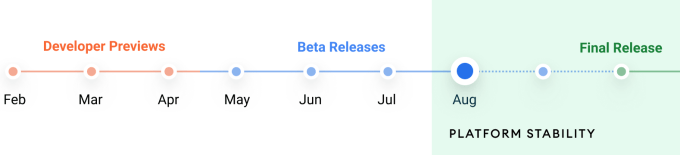
Google has now taken another step towards the public release of the latest version of the Android operating system, Android 12. The company today released the fourth beta of Android 12, whose most notable new feature is that it has achieved the Platform Stability milestone — meaning the changes impacting Android app developers are now finalized, allowing them to test their apps without worrying about breaking changes in subsequent releases.

While the updated version of Android brings a number of new capabilities for developers to tap into, Google urges its developers to first focus on releasing an Android 12-compatible update. If users find their app doesn’t work properly when they upgrade to the new version of Android, they may stop using the app entirely or even uninstall it, the company warns.

Among the flagship consumer-facing features in Android 12 is the new and more adaptive design system called “Material You,” which lets users apply themes that span across the OS to personalize their Android experience. It also brings new privacy tools, like microphone and camera indicators that show if an app is using those features, as well as a clipboard read notification, similar to iOS, which alerts to apps that read the user’s clipboard history. In addition, Android 12 lets users play games as soon as they download them, through a Google Play Instant feature. Other key Android features and tools, like Quick Settings, Google Pay, Home Controls, and Android widgets, among others, have been improved, too.

Google has continued to roll out smaller consumer-facing updates in previous Android 12 beta releases, but beta 4 is focused on developers getting their apps ready for the public release of Android, which is expected in the fall.

Image Credits: Google

The company suggested developers look out for changes that include the new Privacy Dashboard in Settings, which lets users see which app are accessing what type of data and when, and other privacy features like the indicator lights for the mic and camera, clipboard read tools, and new toggles that lets users turn off mic and camera access across all apps.

There’s also a new “stretch” overscroll effect that replace the older “glow” overscroll effect systemwide, new splash screen animations for apps and keygen changes to be aware of. And there are a number of SDKs and libraries that developers use that will need to be tested for compatibility, including those from Google and third-parties.

The new Android 12 beta 4 release is available on supported Pixel devices, and on devices from select partners including ASUS, OnePlus, Oppo, Realme, Sharp, and ZTE. Android TV developers can access beta 4 as well, via the ADT-3 developer kit.

11 Aug 2021

Hear how Cityblock Health’s Toyin Ajayi, Carbon Health’s Eren Bali and Forward’s Adrian Aoun see tech impacting access to health at Disrupt 2021

If there’s one thing that the ongoing COVID-19 crisis has proven, it’s that the healthcare system in the U.S. is in drastic need of major transformation. One of the biggest issues to be highlighted by the pandemic in particular is the iniquity in access to care, but there are signs that one of the effects of COVID-19 will be a stepping up of accessibility reform driven in particular by technology.

At Disrupt 2021, we’re thrilled to have three guests onstage for a panel discussion all about how tech companies are working to address access gaps in healthcare. From Cityblock Health, we’ll host co-founder and Chief Health Officer Toyin Ajayi; from Carbon Health, co-founder and CEO Eren Bali; and from Forward, CEO and co-founder Adrian Aoun.

Cityblock Health is the first tech-driven provider for communities with complex health and social needs — bringing better care to neighborhoods where it’s needed most. Cityblock’s goal is to foster a model of care that meets individuals where they are, delivering highly personalized primary care, behavioral healthcare and social services to its members, with a focus on those who access Medicaid, are dually eligible for Medicaid and Medicare, and others living in lower-income neighborhoods.

Carbon Health has a goal of making good healthcare accessible to all, with same-day appointment booking, telehealth services and prescription delivery, facilitated through partnerships with some of the leading insurers and payers in the U.S. The company has taken a central role in vaccine administration in California, and continues to evolve its model of modular healthcare delivery to reach communities where primary care hasn’t traditionally been readily available.

Forward is an AI-based healthcare system combining world-class private doctors with new technology to enable proactive, data-driven primary care. Starting with cutting edge in-clinic and at-home biometric data measurement, Forward aims to tailor its primary care to individuals in a combination that delivers both scalability and personalization. The company also espouses a direct-to-consumer, subscription-based model of care that it argues avoids some of the traditional pitfalls of insurance-backed care.

We’re excited to be able to dig in to these very different approaches to healthcare, that still all share the fundamental goal of making a higher-quality standard of care available to more people.

During the three-day event, writer, director, actor and Houseplant co-founder Seth Rogen will be joined by Houseplant Chief Commercial Officer Haneen Davies and co-founder and CEO Michael Mohr to talk about the business of weed, BioNTech co-founder and CEO Uğur Şahin will dive into what’s next for mRNA technologies after COVID, and Coinbase CEO Brian Armstrong will dig into the volatile world of cryptocurrency and his company’s massive direct listing earlier this year.

Disrupt 2021 wouldn’t be complete without Startup Battlefield, the competition that has launched some of the world’s biggest tech companies, including Cloudflare and Dropbox. Join Ajayi, Bali, Aoun and more than 10,000 of the startup world’s most influential people at Disrupt 2021 online this September 21-23. Check out the Disrupt 2021 agenda here. We’ll add even more speakers soon.

Buy your Disrupt pass before September 20, and get ready to join the big, bold and influential — for less than $100. Get your pass to attend now for under $99 for a limited time!


11 Aug 2021

Here’s everything Samsung announced this morning

While it was one of the less hyped gadget debuts in recent memory, Samsung blasted out a series of announcements at an Unpacked event bright and early this morning.

Too busy to tune in? Still asleep when it all went down? Here’s the slimmed down version of everything you need to know.

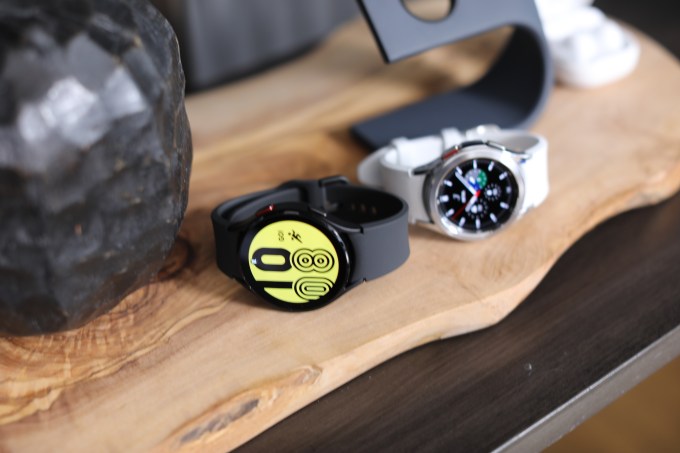
Galaxy Watch 4

Image Credits: Brian Heater

Samsung is back with another set of smartwatches, this time with a twist: after years of focusing on their own operating system with Tizen, these latest watches are back on Google’s Wear OS. Or, at least, Samsung’s take on it — this software build will be called “Wear OS Powered by Samsung”, and will borrow some of the best bits of Tizen while being Wear OS at its core.

Samsung went deep on health metrics this time around, focusing much of the announcement on the Watch’s ability to constantly monitor things like blood pressure, blood oxygen, and body composition.

This year’s watch comes in two forms: Galaxy Watch 4, and Galaxy Watch 4 Classic. The standard Watch 4 is a bit thinner and lighter, with a touch-sensitive bezel for controlling the interface; Watch 4 Classic bulks things up a bit, with a bezel that physically spins. Watch 4 starts at $250 and comes in 40mm or 44mm, while Watch 4 Classic bumps the base price to $350 and comes in 42mm or 46mm.

Read the full announcement post here

Galaxy Z Fold 3

Image Credits: Brian Heater

Pricey and with plenty of problems to work out of the earliest versions, folding smartphones haven’t exactly taken over the world. Hell, most people probably still haven’t seen a folding phone in person. But Samsung isn’t done in this space just yet!

This morning the company announced the Galaxy Z Fold 3, its third iteration on the hotdog-style folding phone approach. They’ve managed to drop the price tag a bit (from $2000 to $1800), while bumping up the overall build quality — its got a stronger aluminum frame, a more durable folding display, and it’s waterproofed (a first for the Samsung foldables!) up to an IPX8 rating. (One catch: that “x” means it’ll survive an accidental dunk in the tub, but you still want to keep it away from dust/debris.)

The Fold 3 will be the first Samsung device with an under-display camera — an awesome trick, albeit one that generally comes at the expense of picture quality. The back of the device brings in three more (more standard, less hidden) lenses — ultra wide, wide-angle, and telephoto, all coming in at 12 megapixels each. Oh, and it supports the S Pen stylus now!

Expect this one to start shipping on the 26th of this month.

Find more specs and details in our full post here.

Galaxy Z Flip 3

Image Credits: Brian Heater

While the flagship Fold 3 took up most of the folding spotlight today, Samsung’s relatively entry-level (clamshell!) foldable gets an update too with the announcement of the Galaxy Z Flip 3.

The Flip 3 will get many of the same durability improvements coming to the aforementioned Fold 3, including the improved aluminum body, more durable display, and IPX8 water resistance. It’s got a 10MP selfie cam on the inside, with two 12MP cameras (ultra wide and wide Angle) on the outside. At $999 — nearly $400 less than the last one — it’s the first time Samsung has managed to drag its foldable line into the sub-$1k price range. It’s got a bigger cover screen (the screen that shows whenever the device is folded shut) this time around, at 1.9″ versus last-gen’s 1.1″.

As with everything else announced today, it starts shipping on August 26th. Find our full post on the Flip 3 here.

Galaxy Buds 2

Image Credits: Brian Heater

Samsung also debuted a new generation of its entry-level wireless earbuds today, and everything you need to know could fit in a tweet: they’re smaller and lighter and have active noise cancellation, and will ship on August 26th for $149.

Want more details? Here’s the full post.

Less plastic!

They kinda snuck this one in at the end, but it’s worth a highlight: Samsung is committing to eliminating all single-use plastic from its phone packaging by 2025, with plans to dramatically increase its use of recycled material across its mobile products by the same year. Given that Samsung ships more phones per quarter than any other company on the planet, thats huge — and, hopefully, an example others will follow.

11 Aug 2021

Hyzon Motors has begun shipping hydrogen fuel cell trucks to customers

Hydrogen-powered heavy-duty truck company Hyzon Motors said Wednesday it is ramping up operations in the wake of its merger with blank-check firm Decarbonization Plus Acquisition Corp., including shipping its first trucks to European customers.

The company, which reported second-quarter earnings Wednesday, said it is also preparing to start its first customer trials in the United States.

Like other transportation companies that have gone public via a merger with a special purpose acquisition fund, Hyzon doesn’t yet have any revenue to speak of. Instead, Hyzon is banking on the huge injection of capital from the transaction – more than $500 million – and growing customer orders to take it to positive cash flow.

As of now, the company reported a net loss for the quarter of $9.4 million, including $3.5 million in R&D expenses. It had a negative adjusted EBITDA of $9.1 million. The company has $517 million in cash on hand, enough to reach free cash flow by 2024 without having to sell additional equity, Hyzon CFO Mark Gordon said during a second quarter earnings call.

In addition to manufacturing hydrogen fuel cell powertrains, Hyzon is also investing in hydrogen fuel production hubs, a key piece of infrastructure for technology uptake. In April, the company signed a MOU for a joint venture with renewable fuels company Raven SR for up to 100 hydrogen production hubs. Gordon confirmed the first two will be in the Bay Area.

He also said that the company is on track to deliver 85 fuel cell vehicles by the end of this year, with the company’s first revenue coming next quarter. Orders and memoranda of understanding under contract has grown to $83 million from $55 million as of April, but many of the MoUs are non-binding. An agreement with Austrian grocer MRPEIS for 70 trucks next year is one such example. Similarly, Hyzon faces a slightly uphill battle in terms of technological adoption, as many of their customers have never seen or used a hydrogen fuel-cell vehicle before.

“Many customers are getting their hands on the first fuel cell vehicles they’ve ever seen in the next six to 12 months,” CEO Craig Knight said during the call. That is a genuine kind of technology validation process and the customers need to feel comfortable the vehicles function well in their use case.”

While many of Hyzon’s sales are for a small number of trucks, Knight said he sees the purchasing timeline from initial sale to fleet conversion growing shorter – at least in Europe, where there is significantly more hydrogen availability. “Whereas, earlier I would have said, it’s a 12-to-18 month process to go from getting your first fuel cell truck and trying it out and then maybe getting a few more and figuring out what fleet conversion would look like over time, and then kicking off that fleet conversion process – I actually think that’s compressing,” Knight said.

The company is focused on mostly on back-to-base operations rather than long-haul freight haulage, as the latter requires a more extensively built-out hydrogen refueling network. The U.S. customer trial with logistics company Total Transport Services Inc is high-utilization (trucks can run up to 18-20 hours per day) use case, but the truck will only ever need to access the single refueling station in Wilmington, California. “It’s a good application for hydrogen, and we’re not introducing the complication of having to find hydrogen stations across the country,” Knight said.

11 Aug 2021

Austin transplant Geoff Lewis wants to pop Silicon Valley’s ‘self-referential’ bubble

Austin has made headlines over the past year for a number of reasons: It’s home to Oracle’s new headquarters. Tesla is building a massive gigafactory in the Texas capital. And people, mostly tech workers, are leaving the Bay Area in droves to settle in the city, driving up home prices in the process.

It’s not just tech workers. A number of venture capitalists have set up shop in Austin, including Jim Breyer of Breyer Capital and Palantir co-founder Joe Lonsdale, who said last year he was moving his venture capital firm, 8VC, from Silicon Valley to the city.

The latest VC to call Austin home is Geoff Lewis, founder & managing partner of Bedrock Capital, a four-year-old early-stage venture capital firm with $1 billion in assets under management. Lewis started his investing career at Founders Fund, where he was a partner for several years. He either serves or has served on the board of companies such as Lyft, Nubank, Vercel and Workrise. 

Lewis also led early investments in Wish, Upstart, Tilray, Canva, Rippling, ClearCo, Flock Safety and a number of other unicorns. He’s largely credited with popularizing the phrase “narrative violation” to describe promising companies that are overlooked or underestimated because they are incongruent with popular narratives.

In making the move to Austin, the investor said he had grown disillusioned with Silicon Valley and the region’s continued lack of focus on solving what he described as real-world problems. In a recent Medium post, Lewis said he was first introduced to Austin after backing Workrise (formerly called RigUp), a marketplace for skilled trade workers. In fact, he was the company’s first seed investor eight years ago, and has gone on to invest in the company eight subsequent times. Today, Workrise is valued at nearly $3 billion.

Lewis said he was drawn to the company, not just because it was “going to be huge” but also because it was “much more concerned with real people and real places than today’s Silicon Valley behemoths.”

“Put simply, it is a more humane technology company,” Lewis writes. “And it’s my search for this more humane genre of technological innovation that brought me to Texas. I’ve lived on the coasts and built my career as a Silicon Valley technology entrepreneur and investor, but I’ve never felt of the coasts or as an insider in Silicon Valley — I didn’t go to Stanford nor grow up rich.”

TechCrunch talked with Lewis to get more details around his decision to move his firm to Austin, learn more of his views on why Silicon Valley is too much of “a bubble” (spoiler alert: they may not be popular with many of you!) and how he plans to invest in more of Texas’ nexus of startups.

This interview has been edited for brevity and clarity.

TC: I understand that you grew up in Canada. How did you first get involved in the tech industry to begin with?

Lewis: I started off as an entrepreneur myself, building a SaaS company in the travel space [Topguest]. I founded that business in New York City and in 2009, ended up moving my team to San Francisco. I spent most of my career from 2009 to 2021 mostly bouncing between New York and SF. We ended up selling that company in 2011 and it was a reasonably okay outcome. I joined Founders Fund in 2012, where I just fell in love with investing. I ended up really having a special trajectory there and 2012 was a great time to be a young VC in San Francisco and Silicon Valley. I ended up specializing in marketplaces, both consumer and enterprise, backing companies like Lyft and Canva early. I also did the firm’s first fintech investment in Latin America, backing Nubank, and now that company has a $30 billion valuation. 

I grew up with pretty modest means and by 2017, I figured I had done well enough as a VC and I should strike out on trying to get back to what I wanted to do, which was more entrepreneurial. So we founded Bedrock in late 2017. We’re on Fund III now and really it’s been consistent with the investment philosophy I pursued — trying to find what we call narrative violations, or these counter narrative companies that are being overlooked or underestimated. We were very early investors in Cameo, which is now obviously a pretty well-known business, for example.

TC: You initially chose to base Bedrock in New York. Why?

Lewis: When I was at Founders Fund I had a home in both cities (SF and NYC) so I was the kid who grew up in Calgary, Canada, and wanted to live on the coasts and be in the center of the action. But we decided to actually headquarter Bedrock in New York in 2017 because we had an inclination that Silicon Valley was becoming a little bit overly self-referential and wanted to be a bit outside of the noise. New York is less of a one-horse town, so we decided to base the firm there, but really invested in, and continue to invest, everywhere across the country, and quite honestly around the world. We invested in WordPress in the early days, and more recently in Argyle and Lambda School.

TC: Tell me about this migration to Austin. At what point did you decide this is where you want to be and what drew you here? 

Lewis: My first visit was in 2012 when I invested in Workrise, so I came to Austin quarterly for board meetings for years. And then a family member of mine actually got a position at UT (University of Texas). So that made me more excited about spending more time here. And then the real impetus I’d say happened, as I think it did for many people, during the pandemic. I remember in February, my partner Eric [Stromberg] and I had this conversation where we were like, “OK, COVID is going to have a deeper impact on New York City.” We saw it coming and decided we should get out of New York. At first, I moved to Hawaii and it was just a bit too isolated to live year-round, so I was like, “What’s a place that combines access to nature that’s not being in a big city but still has a nexus of smart, interesting people. I also was looking for a place where it would be easy to hop on a plane and get to either coast. Austin was the obvious choice. So many of my friends from the Bay Area were moving there, one after another, and loving it. So by January 2021, we had made the decision to move our firm here.

I don’t believe everyone should move to Austin. I don’t think it’s right for everyone, but I do think it’s right for us.

TC: Having myself lived in both the Bay Area and Austin, I actually see a number of growing similarities between the two. What do you say to that? Do you also feel like the culture is spilling over here?

Lewis: I have friends who are locals and have been here in some cases for like a generation-plus, and in other cases, have lived here since they were kids. They are really alarmed by how the city is changing, certainly like the real estate crisis, especially if you’re anywhere close to the core, is just absolutely insane. They’re definitely not used to the California and New York transplants. I definitely think it’s a problem that the city somehow does not quite have the infrastructure from a housing standpoint and from a transportation standpoint to support the growth on that; it’s a very big problem. I don’t think it’s a healthy long-term dynamic where you’ve got locals that really don’t like the newcomers coming in. So I think that is a big problem and I don’t quite know what the solution is.

But I think the wealth inequality is far less of a problem here than it is in the Bay Area. To me, that’s the number one thing that’s much better about Austin. Yes, there’s a homeless problem and yes there are people struggling here, but we’re not anywhere near the wealth inequality situation that exists in the Bay Area, which is like the most unequal — from a wealth standpoint — place in the country.

People can still get by here. And then I think the fact that it’s a blue city in a red state is actually really important. I’m pretty much an apolitical person and not that engaged in American politics but I do think there’s a dynamic where you’ve got a diversity of views and a diversity of opinions. There’s a natural tension that doesn’t exist in San Francisco and I think that leads to a more healthy set of policies over time.

TC: I know you’re planning to invest in more startups in Austin and Texas but not exclusively, right? 

Lewis: Yes, we will invest anywhere and everywhere but already we have four investments in companies we met here in Austin, three of which we have made just since April. One is a Dallas-based company, Leader, that has built a leadership development platform for enterprises. Another is a stealth company based here in Austin and we’ve also put money in a cryptocurrency analytics company that is not technically based here but has an office in Austin.

I definitely expect we’ll be making more investments in Texas than we used to now that we’re on the ground here.

TC: In your blog post, you made the statement that “innovators in Texas seem to care about real people in real problems more than the obstructions from reality to animate too much of Silicon Valley.” And I thought that was interesting and probably could stir up some controversy and backlash. Can you elaborate on that?

Lewis: I think there’s sort of this cultural dynamic where you have people that truly do live in these bubbles and so when you’re in the technology industry in San Francisco or quite honestly the entertainment industry in Los Angeles, I think folks just live entirely in this sort of self-referential bubble. And you only communicate and only ever interact with people that are in the same industry as you, and I think that leads to just a very, quite honestly parochial sort of inward looking worldview. There is something about a place that is less dominated by technology. When you think about Texas as a state — yes, tech is a major employer in Austin, but tech does not dominate the state of Texas by any means. It’s a huge state, there are lots of people here. There is a much smaller tech community. So definitionally, I think people tend to be friends with people from different walks of life. And I think people are just much more keyed into practical problems and issues.

There’s a Houston company that I’m not an investor in but that I’m really excited about the business, SolidEdge. It’s innovating chemical manufacturing in more environmentally sustainable and cost-effective ways, which to me is very much more of a real-world, practical problem type company. 

You’ve got Leader, which is trying to do leadership development for churches and faith organizations, using software. It feels like a company that just would never get started out of San Francisco where nobody is religious, and no one goes to church. So I do just think it’s a much different vibe here where you’ve got people that are less siphoned off from the real world versus living in this bubble, which is quite unhealthy. I don’t want to spend my time on another widget. I want to invest in things that are gonna actually have an impact on the world.

TC: This will likely be an unpopular opinion with many, and your comments might provoke some defensiveness. What would you say to any counterarguments?

Lewis: It’s not zero sum. The vibe here is I think a healthier one for me but I realize it’s not for everyone. Obviously there are many companies that have dramatically improved the world that have come out of the Bay Area. There are also companies that arguably have been net negative for society. These things are always open to debate. Whether something’s good for the world or bad is fundamentally subjective. I think at the very least Texas is a place where there’s a little bit more freedom to debate those opinions.


11 Aug 2021

Airtable makes Bayes its first acquisition to up its data visualization game

Airtable, the makers of the no code relational database, announced its first acquisition today, acquiring Bayes, an early stage visualization startup. The purpose of the purchase is to enhance the data visualizations on the Airtable platform. The companies did not share the purchase price.

Much like Airtable, Bayes focuses on a no-code approach and the two companies have a shared vision about simplifying activities that once required engineering talent to pull off. Airtable CEO and co-founder Howie Liu says that while he hasn’t really been thinking about acquisitions, this opportunity came along and he liked how the team and product fit in with the Airtable no-code philosophy.

“We fell in love with the team and the product that they had built insofar as it showed us their vision for for doing data visualization in a really interesting and user friendly way that we thought would be applicable…and in spirit to be able to apply that kind of design thinking to Airtable’s product and enable our customers to basically better visualize their data,” Liu said.

Bayes’s four employees have joined Airtable and the plan is to shut down the product and incorporate the functionality into Airtable in the coming months.

Will Strimling, company co-founder says his startup matched up well with Airtable, which he said was a huge inspiration for his company since it launched in 2019. He said that it seemed like they could be better together after the two companies began talking. “After comparing our respective roadmaps and future plans, it became clear that by working together we could build something that is greater than the sum of its parts — an Airtable with even more insights, visualizations, and reporting features that will continue to improve the way teams manage workflows,” he said.

While Airtable does provide some basic visualization in the current product, Liu says that with Bayes it will really take that capability to a different level, allowing customers to create a custom interface on top of Airtable. “We’re going to provide much more advanced ways of graphing and reporting on your data. We’re also going to invest into giving our customers the ability to create truly a custom interface on top of the product,” he said.

Liu said up until now the company really lacked the scale to think about acquisitions, but with 500 employees in the fold he feels that they are sufficiently large, and also they have the talent on the executive team to execute on acquisitions now. “I think it’s harder to absorb acquisitions when you’re a very small company yourself, whereas now I think we’re at the scale where it starts to make sense to accelerate our roadmap by acquiring talent,” he said.

Airtable was founded in 2013 and has raised over $600 million. The most recent round was a $270 million Series E at a fat $5.77 billion valuation, so from that perspective they have some financial flexibility to make these kinds of moves, and may consider additional purchases moving forward.

11 Aug 2021

Doxel raises $40M from Insight, a16z to become the ‘Waze for construction’

Doxel, which has developed software that uses computer vision to help track and monitor progress on construction job sites, announced today that it has raised $40 million in Series B funding.

Insight Partners led the round, which included participation from existing backers Andreessen Horowitz (a16z) and Amplo and brings the startup’s total raised to $56.5 million since its December 2015 inception. A16z has participated in each of Doxel’s rounds — from seed to Series B. In addition to its institutional investors, Robinhood CEO Vladimir Tenev also put money in Doxel’s Series A round as an angel.

Co-founder and CEO Saurabh Ladha said he could not disclose the valuation at which the capital was raised, but that it was “over a 4x multiple” from its $12 million Series A in early 2020. He described the Series B as an “opportunistic raise.”

“We raised because we could, at a phenomenal valuation. The full series A is still in the bank. We didn’t touch it even,” he told TechCrunch. “Our growth and bookings traction has actually been so high that we’ve been cash flow neutral in that period of time.

Ladha was inspired to start Doxel after his family nearly suffered from financial catastrophe after a two-year delay on a major construction project in India in which his father was involved.

“I almost thought we’d lose our house. It was the first time I was made aware of the impact construction can have on livelihoods,” Ladha told TechCrunch. “Even as a child, I realized that predictability is what keeps projects on time and on budget.”

Twenty years later, when Ladha graduated from Stanford University, he learned that 90% of projects are delayed and delivered over budget.

Ladha then teamed up with Robin Singh, Doxel’s CTO, in 2015 to found Doxel to build a “computer-vision-powered predictive analytics platform” designed to help owners and contractors “navigate problems before they happen.” Or put more simply, Doxel is building what it describes as the “Waze for Construction” platform.

The company’s biggest differentiator from competitors, according to Ladha, is that it provides real-time insight on the construction field.

“A lot of companies offer backward-looking or real-time analytics,” he told TechCrunch. “We’re the only player offering a forward-looking solution that’s predictive…In much the same way drivers have come to rely on satellite technology to avoid traffic accidents and slow-downs ahead of them, Doxel’s customers have come to rely on our AI-powered Project Controls platform.”

Doxel, Ladha added, does monitoring for project teams, so they can focus on solving problems rather than on finding them.

“Our predictive analytics gives building owners and general contractors a way to identify critical risk factors that threaten to derail their project before they even know the risks exist,” he said. “So they are not finding out about problems when it’s too late to actually solve them.”

The premise is that by the time potential risk factors are discovered, it’s too late and cost overruns and project delays are unavoidable. Over the years, with all the data it has gathered, Doxel has built out what it describes as a “Construction Encyclopedia” that helps it in identifying those potential risk factors.

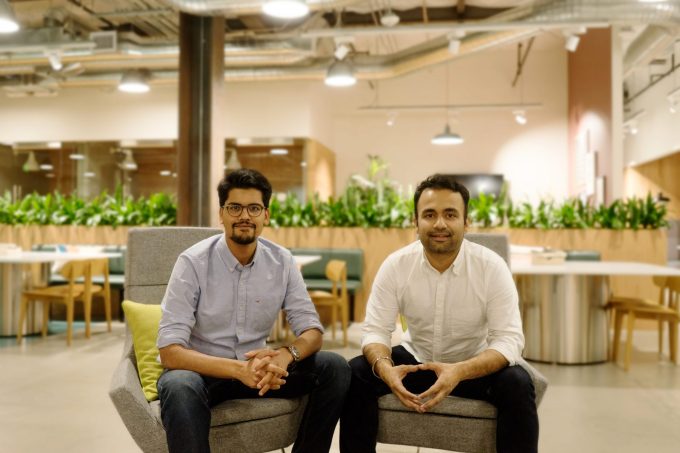
Image Credits: Co-founders Saurabh Ladha (CEO) and Robin Singh (CTO) / Doxel

The company claims that its technology has helped its customers come in up to 11% below budget on projects and see an average 38% increase in productivity, according to Ladha.

Doxel’s platform works by tapping into multiple real-time data sources on a project, such as 360-degree images, Building Information Models (BIM) — also known as 3D designs — as well as budget and schedule in an effort to provide both predictability and control to building owners and contractors. The goal is to help prevent a domino effect of delays and heightened costs, so that building owners and contractors are better able to stay on time and on budget.

“Other companies don’t bridge all silos across field, accounting and schedule management,” Ladha said. “These are three disparate entities that operate separately and without the knowledge silos being bridged.”

Besides cost overruns, the loss of revenue associated with projects not being available for use per plan is exponentially disastrous, Ladha noted. For example, a multifamily developer expecting to make money by selling or renting condo units will lose income the longer it takes for project completion.

Over time, Doxel says it has tracked tens of billions of capital expenditures for “a diverse group” of Fortune 500 companies, including Kaiser Permanente and Royal Dutch Shell. Doxel claims to have saved companies “tens of millions” of dollars with its predictive technology.

“Our users are senior execs tasked with making multibillion-dollar decisions with little information on a week to week basis,” Ladha said. “They need to know if they are on cost and on time.”

Nikhil Sachdev, managing director at Insight Partners, said his firm was really excited about the size of the problem Doxel is going after in addition to the traction the company has “with some of the world’s largest enterprises, and their highly defensible AI-first software.”

Conversations with customers revealed that prior to using Doxel’s technology, they did not have a way to accurately predict the future state of their construction projects.

“Most construction management software tools are still dependent on manual data entry or photos tagged to blueprints, which requires weeks of manual mining to extract insights on a project’s cost & schedule performance,” Sachdev wrote via email. “Doxel is the only tool we’ve found that can ingest all of the relevant data, process it using their AI, and make the leap to what the project will look like in the future.”

Looking ahead, Redwood City, California-based Doxel plans to use its new capital to scale its platform and hire across its engineering, sales, marketing and product staff. Currently, Doxel has 75 employees across offices in the U.S. and Bangalore. It’s looking to roughly double the size of its team over the next year.

11 Aug 2021

Doxel raises $40M from Insight, a16z to become the ‘Waze for construction’

Doxel, which has developed software that uses computer vision to help track and monitor progress on construction job sites, announced today that it has raised $40 million in Series B funding.

Insight Partners led the round, which included participation from existing backers Andreessen Horowitz (a16z) and Amplo and brings the startup’s total raised to $56.5 million since its December 2015 inception. A16z has participated in each of Doxel’s rounds — from seed to Series B. In addition to its institutional investors, Robinhood CEO Vladimir Tenev also put money in Doxel’s Series A round as an angel.

Co-founder and CEO Saurabh Ladha said he could not disclose the valuation at which the capital was raised, but that it was “over a 4x multiple” from its $12 million Series A in early 2020. He described the Series B as an “opportunistic raise.”

“We raised because we could, at a phenomenal valuation. The full series A is still in the bank. We didn’t touch it even,” he told TechCrunch. “Our growth and bookings traction has actually been so high that we’ve been cash flow neutral in that period of time.

Ladha was inspired to start Doxel after his family nearly suffered from financial catastrophe after a two-year delay on a major construction project in India in which his father was involved.

“I almost thought we’d lose our house. It was the first time I was made aware of the impact construction can have on livelihoods,” Ladha told TechCrunch. “Even as a child, I realized that predictability is what keeps projects on time and on budget.”

Twenty years later, when Ladha graduated from Stanford University, he learned that 90% of projects are delayed and delivered over budget.

Ladha then teamed up with Robin Singh, Doxel’s CTO, in 2015 to found Doxel to build a “computer-vision-powered predictive analytics platform” designed to help owners and contractors “navigate problems before they happen.” Or put more simply, Doxel is building what it describes as the “Waze for Construction” platform.

The company’s biggest differentiator from competitors, according to Ladha, is that it provides real-time insight on the construction field.

“A lot of companies offer backward-looking or real-time analytics,” he told TechCrunch. “We’re the only player offering a forward-looking solution that’s predictive…In much the same way drivers have come to rely on satellite technology to avoid traffic accidents and slow-downs ahead of them, Doxel’s customers have come to rely on our AI-powered Project Controls platform.”

Doxel, Ladha added, does monitoring for project teams, so they can focus on solving problems rather than on finding them.

“Our predictive analytics gives building owners and general contractors a way to identify critical risk factors that threaten to derail their project before they even know the risks exist,” he said. “So they are not finding out about problems when it’s too late to actually solve them.”

The premise is that by the time potential risk factors are discovered, it’s too late and cost overruns and project delays are unavoidable. Over the years, with all the data it has gathered, Doxel has built out what it describes as a “Construction Encyclopedia” that helps it in identifying those potential risk factors.

Image Credits: Co-founders Saurabh Ladha (CEO) and Robin Singh (CTO) / Doxel

The company claims that its technology has helped its customers come in up to 11% below budget on projects and see an average 38% increase in productivity, according to Ladha.

Doxel’s platform works by tapping into multiple real-time data sources on a project, such as 360-degree images, Building Information Models (BIM) — also known as 3D designs — as well as budget and schedule in an effort to provide both predictability and control to building owners and contractors. The goal is to help prevent a domino effect of delays and heightened costs, so that building owners and contractors are better able to stay on time and on budget.

“Other companies don’t bridge all silos across field, accounting and schedule management,” Ladha said. “These are three disparate entities that operate separately and without the knowledge silos being bridged.”

Besides cost overruns, the loss of revenue associated with projects not being available for use per plan is exponentially disastrous, Ladha noted. For example, a multifamily developer expecting to make money by selling or renting condo units will lose income the longer it takes for project completion.

Over time, Doxel says it has tracked tens of billions of capital expenditures for “a diverse group” of Fortune 500 companies, including Kaiser Permanente and Royal Dutch Shell. Doxel claims to have saved companies “tens of millions” of dollars with its predictive technology.

“Our users are senior execs tasked with making multibillion-dollar decisions with little information on a week to week basis,” Ladha said. “They need to know if they are on cost and on time.”

Nikhil Sachdev, managing director at Insight Partners, said his firm was really excited about the size of the problem Doxel is going after in addition to the traction the company has “with some of the world’s largest enterprises, and their highly defensible AI-first software.”

Conversations with customers revealed that prior to using Doxel’s technology, they did not have a way to accurately predict the future state of their construction projects.

“Most construction management software tools are still dependent on manual data entry or photos tagged to blueprints, which requires weeks of manual mining to extract insights on a project’s cost & schedule performance,” Sachdev wrote via email. “Doxel is the only tool we’ve found that can ingest all of the relevant data, process it using their AI, and make the leap to what the project will look like in the future.”

Looking ahead, Redwood City, California-based Doxel plans to use its new capital to scale its platform and hire across its engineering, sales, marketing and product staff. Currently, Doxel has 75 employees across offices in the U.S. and Bangalore. It’s looking to roughly double the size of its team over the next year.