Year: 2021

05 Aug 2021

Walter Isaacson is working on a biography of Elon Musk

Walter Isaacson, the biographer who chronicled the lives of Steve Jobs, Benjamin Franklin and Leonardo Da Vinci, is turning his attention to the life and career of Elon Musk. The Tesla CEO announced the project in a tweet Wednesday.

Musk said that Isaacson has shadowed him “for several days so far,” though he later added that an autobiography might still be in the cards one day. It’s unclear when the book will be released or how far along Isaacson is in the project. His biography on Steve Jobs (aptly titled “Steve Jobs) took over two years and included interviews with more than 100 of Jobs’ peers.

Musk has been the subject of a number of books, but Isaacson is the most high-profile biographer yet to take on his story. The author is currently a professor at Tulane University and was previously the CEO of the Aspen Institute and the CEO of CNN. Isaacson appeared onstage at TechCrunch’s Disrupt in 2014.

Other books on Musk’s life and work include Ashlee Vance’s 2015 biography, “Elon Musk: Tesla, SpaceX, and the Quest for a Fantastic Future, which Musk participated in; Ed Niedermeyer’s “Ludicrous: The Unvarnished Story of Tesla Motors” and this month’s release of Tim Higgins’ “Power Play: Tesla, Elon Musk, and the Bet of the Century.

The comment came in the midst of a brief back-and-forth about a section of “Power Play” describing a particularly spicy interaction between him and Apple CEO Tim Cook. The conversation, which Higgins reported in his book took place over the phone, was over Cook’s purported interest in acquiring Tesla back in 2016. As Higgins tells it, Musk tells Cook he’s interested, but on the condition that he be instated as CEO of Apple – to which Cook replies, “F—you.”

Musk maintained in a tweet that he and Cook have never spoken or written to each other. Higgins replied that the anecdote came from people who reported as hearing Musk’s recounting of the conversation at the time. He added that Musk was given plenty of opportunities to comment on the anecdote. “He didn’t,” he said.

05 Aug 2021

John Deere buys autonomous tractor startup Bear Flag Robotics

In the world of robotic startups, acquisition is often as good an outcome as any. And when it comes to robotic tractor startups, you could do worse than being acquired by John Deere. The agricultural technology giant announced today that it’s set to acquire Bear Flag Robotics for $250 million.

The Bay Area-based firm, which specializes in autonomous farming heavy machinery, was founded in 2017. They first crossed our radar the following year, as a member of YC’s Winter 2018 cohort.

“We got a tour of an orchard and just how pronounced the labor problem is,” co-founder Aubrey Donnellan told TechCrunch at the time. “They’re struggling to fill seats on tractors. We talked to other growers in California. We kept hearing the same thing over and over: Labor is one of the most significant pain points. It’s really hard to find quality labor. The workforce is aging out. They’re leaving the country and going into other industries.”

In the intervening years, John Deere tapped Bear Flag for its own Startup Collaborator initiative. And the robotics firm has also begun to deploy its technology to an undisclosed (“limited,” per their wording) number of sites in the U.S.

“One of the biggest challenges farmers face today is the availability of skilled labor to execute time-sensitive operations that impact farming outcomes. Autonomy offers a safe and productive alternative to address that challenge head on,” co-founder and CEO Igino Cafiero, says in a release. “Bear Flag’s mission to increase global food production and reduce the cost of growing food through machine automation is aligned with Deere’s and we’re excited to join the Deere team to bring autonomy to more farms.”

Agricultural is one of several robotics categories that have seen a spike in interest in the past year, due to labor shortages that predate but were exacerbated by the global pandemic. Of course, that interest doesn’t make anyone immune from the difficulties of launching a robotics startup.

Last month, apple-picking robotics firm Abundant confirmed it was closing up shop, noting, “After a series of promising commercial trials with prototype apple harvesters, the company was unable to raise enough investment funding to continue development and launch a production system,” the company noted at the time.

An acquisition seems like a reasonable outcome for a company like Bear Flag. The startup gains a lot of resources from its massive new owner, and its new owner adds some new tech to its portfolio. Indeed, John Deere has been pretty aggressively looking to expand into more cutting-edge technologies like robotics and drones in recent years.

Bear Flag will retain operations in the Bay Area.


05 Aug 2021

Drunk-driving provision could fuel demand for driver detection technology

Companies developing driver detection technology could get a boost from a provision tucked inside the 2,702-page $1 trillion infrastructure bill that would require automakers to build into new cars technology that can tell if drivers have had a few cold ones.

The provision in the bill, which is actually a piece of bipartisan legislation called the Reduce Impaired Driving for Everyone Act that was introduced in April 2021, would direct the U.S. Department of Transportation to establish a technology safety standard for automakers within three years. Automakers would then have another two years to comply and implement tech that detects and prevents drunk driving. Reuters was the first to notice the language

While the provision doesn’t dictate what type of tech has to be in these vehicles, industry experts believe that companies developing camera-based driver monitoring systems (DMS) stand to benefit the most. DMS systems are already mature in the auto industry, representing a technological byproduct of autonomous driving developments. While the auto industry explores self-driving cars as a way to drastically reduce road deaths in the future, advocates and regulators say there’s room to use some of this tech to solve problems that exist now, like drunk or distracted driving. 

“What’s happening in the U.S. Senate this week potentially opens the door to a camera-based real-time solution, which will be the first time that the U.S. automakers will have the ability and the requirement to look at real-time physiological changes in your body that occur when you are inebriated,” Dr. Mike Lenné, chief science and innovation officer at Seeing Machines told TechCrunch. “There are distinct reliable changes to the way you scan the environment, to the way your eyes respond to stimuli, which is why the police use that ‘follow the finger’ test.”

The system would have to monitor the performance of a driver to detect impairment and prevent or limit vehicle operation if impairment is detected; detect whether BAC (blood alcohol concentration) is equal to or greater than the legal limit, potentially preventing operation of the vehicle at all; or a combination of both systems. 

Cameras aren’t the only solution that has been trotted out in recent years.

The Driver Alcohol Detection System for Safety (DADSS) program, a technology that’s been developed in partnership between the Automotive Coalition for Traffic Safety and the National Highway Traffic Safety Administration (NHTSA), has advocated using a breath or touch-based approach to determine BAC levels. The touch-based approach involves measuring BAC through the skin’s surface by shining an infrared light through the driver’s fingertip. According to DADSS, the current timeline for bringing the breath-based approach to vehicles is by 2024, and the touch-based approach by 2025. 

Lenné argues that a camera-based approach would be far more successful than a breath or touch-based approach because BAC levels can rise within minutes. Someone could theoretically down a bunch of shots immediately before getting behind the wheel and it wouldn’t show up on a reading for several minutes. Or they could get wasted while driving. And BAC detection doesn’t help at all when it comes to drug-impaired driving. 

Europe versus U.S.

Moves are already being made in Europe to encourage automakers to include drunk driving detection technology, specifically through camera-based DMS approaches, whereas most of the discussion on this type of tech in the U.S. has been, until recently, focused on DMS for assisted driving and Level 2 autonomous driving and above. (According to the Society of Automotive Engineers, Level 2 autonomy means the vehicle has combined functions like steering and acceleration but requires the driver to remain engaged.)

The U.S. provision could propel an industry that has already seen growth in recent years as automakers like GM and Ford implement hands-free advanced driver assistance systems.

“From an integration viewpoint, it’s actually not a step change at all from what the OEMs are doing right now for distracted driving and drowsy driving with camera-based DMS. It’s just another feature to offer, another algorithm on the chip, if you like,” Lenné said. 

Near-term tech

“Billions of dollars have gone into developing the technology to make AVs a reality but they are really far off,” Stephanie Manning, chief government affairs officer at Mothers Against Drunk Driving (MADD), told TechCrunch. “In the process, automakers have developed a lot of technology that can help us right now in terms of saving lives. If this passes, it’s going to be the biggest safety rulemaking that NHTSA has ever done in terms of lives saved, and it couldn’t have come at a better time. But the more we wait, the more we delay, the more people die.”

The technology is not at all far from market, said Lenné, and he would know. Seeing Machines provides the DMS that is used in Super Cruise, GM’s hands-free advanced driver assistance system. Super Cruise, once relegated to just one Cadillac model, has expanded in capability and GM’s portfolio and is now in the Cadillac CT6, CT4, CT5, Escalade and Chevrolet Bolt. Seeing Machine’s tech is also used in the new Mercedes-Benz S-Class and EQS sedans.

“Once it’s regulated, we can expect to see more entrants to the market because what this does is it creates a top-down demand,” said Lenné. “It takes it out of the consumers’ hands and tells vehicles they must have these safety features, so the market size will increase dramatically, and so will the market opportunity.”

The global DMS market is estimated to surpass $2.1 billion by 2026, growing at a compound annual growth rate of 9.8% from this year, according to IndustryARC. Top-down demand due to regulations like the infrastructure bill will certainly increase demand, but it won’t make the problem easier to solve.

“We’re trying to assess what’s going on in someone’s head, and that’s really different from having a forward-facing radar that’s trying to look at what’s 30 meters in front of you,” he said. “You’re trying to interpret whether or not this person is safe to drive. So it’s a really difficult technical problem to solve. Our company is 21 years old. Smart Eye has been around for over 10 years. Whilst the market size has increased dramatically, it’s a hard problem to solve as a new entrant.”

Newcomers will face competition from established and large Tier 1 suppliers like Seeing Machines and Smart Eye, a Swedish computer vision company that people familiar with the industry say works with Ford (Ford did not confirm or deny this). IndustryARC also names major players as Faurecia, Aptiv PLC, Bosch, Denso, Continental AG and others. But new players are finding their way into the scene, like Israel-based Cipia, formerly Eyesight Technology, and Sweden-based Tobii Tech.

Room for growth in the market

More entrants to market means more advancements to the technology. Smart Eye’s recent acquisition of emotion-detection startup Affectiva for $73.5 million hints at the potential future applications of DMS in passenger vehicles. Today it might be distracted, drowsy or drunk driving, but in a few years DMS could detect other types of drug impairment, cognitive impairments or even road rage.

Tobii, an eye-tracker technology company, just announced its entrance into the DMS market, a space it’s been exploring for the past few years as it has watched the legislative changes happening first in Europe and now in the U.S.

While a new entrant to the automotive space, Tobii has been in the eye tracking space since 2001, working in industries like marketing, scientific research, virtual reality, gaming and more. Anand Srivatsa, Tobii’s division CEO, told TechCrunch he thinks one of the biggest challenges will be scaling across different populations, given the different eye shapes of different ethnicities, which he says puts Tobii at an advantage, even with its limited automotive experience.

“Because of this long history, we have what it takes to deliver a full solution from a component level all the way to end software because we’ve done it in other parts of our business,” Srivatsa told TechCrunch. “Some of our automotive partners see that as a unique capability from Tobii where we can talk about the compute that is needed for eye tracking because we build our own asix, we’ve built our own sensor. We have end user software in some aspects of our business, so we understand the implications and the constraints of each of these parts of the stack, and we can work with them to create a more disruptive solution. And that’s something that I think is going to be quite important in this space. How do you reduce the total cost of the solution to allow it to scale efficiently across all cars?”

Srivatsa also said there’s room to extend into other spaces the biometrics or physiological signals that eye tracking yields, reconfiguring information based on outside road conditions or what else is going on in the car in a way that optimizes the tech to ensure drivers are spending the bulk of their time looking at the road.

“What I am hoping and dreaming for is technologies like forward collision warning, or blind spot warning or even the lane swerving warnings help me out when I need it most by understanding if I’m becoming complacent or tired, perhaps distracted, and then adjust how the systems perform, the warning timing and things like that, based on what I need in the moment,” Kelly Funkhouser, program manager of vehicle interface testing and head of connected and automated vehicles at Consumer Reports, told TechCrunch. “Counter to that is I would like it to not bother me and nag and annoy me when I am fully paying attention. I’m like ‘Yeah I know exactly what I’m doing, I am purposely driving over this line so that I don’t hit the mom and kids.’ ”

Lenné said there’s a potential for driver monitoring systems that capture what is really going on inside of a car to become more personalized in order to provide a better driving experience. 

“I think in all of this, writing a better driving experience is absolutely pivotal,” said Lenné. “If it doesn’t do that, it risks not being accepted by the consumers.”

Advancing existing ADAS tech

Automakers have been a part of the conversation regarding drunk driving technology for years. Back in 2007, Nissan revealed a drunk driving concept car that would use alcohol odor sensors, facial monitoring and vehicle operational behavior to detect driver impairment.

In the same year, Toyota announced a similar system that it said would be in cars by 2009. More recently, Volvo announced in 2019 that it would install cameras and sensors in cars to monitor drivers for signs of being drunk or distracted and then signal the vehicle to intervene, but that tech is designed for Volvo’s SPA2 architecture for hands-free driving, which hasn’t been released yet. The bottom line is without legislation mandating drunk driving prevention and detection, automakers haven’t really moved forward on implementing the tech, despite much of the building blocks being in place already. 

Manning thinks that’s because automakers want to be able to upcharge for safety features. 

“Automakers want to test their supercomputers on the open road, but they don’t want to put the money and time and energy into solving drunk driving, because they don’t feel it’s their responsibility, and they don’t want this rule-making,” she said. “We fully expect that they’re going to fight us tooth and nail throughout the rule-making process.”

Representatives from GM and Ford could not be reached for comment, but John Bozzella, president and CEO of the Alliance for Automotive Innovation, which worked with NHTSA on the DADSS program, told TechCrunch that the auto industry is committed to supporting public and private efforts to address this threat to road safety.  

“We appreciate the efforts of congressional leaders and other stakeholders to advance a legislative approach that provides NHTSA the ability to review all potential technologies as options for federal regulation and, consistent with the Motor Vehicle Safety Act, to make a well-informed decision as to whether any specific technologies meet the standard for consumer vehicles,” he said.

05 Aug 2021

Aduhelm approval sparks HHS watchdog review of FDA’s accelerated approval pathway

The Department of Health and Human Services (HHS) Office of the Inspector General will review the FDA’s accelerated approval pathway, the office announced Wednesday. This sweeping review comes just two months after the controversial approval of Biogen’s Alzheimer’s drug Aduhelm.

The review will focus on the FDA’s accelerated approval pathway — a route that allows drugs for serious diseases without existing treatments to be approved if they hit certain interim benchmarks (called surrogate endpoints). These drugs are thought to provide clinical benefit, but that benefit hasn’t actually been demonstrated before the drug is approved. Once the drug is approved, a phase four study would need to demonstrate clinical efficacy.

This is the pathway that allowed for the highly controversial approval of Aduhelm, the first Alzheimer’s drug to be approved since 2003. It’s this approval that set the HHS-OIG review process in motion, per the Inspector General’s Wednesday announcement.

“The FDA’s approval of Aduhelm raised concerns due to alleged scientific disputes within the FDA, the advisory committee’s vote against approval, allegations of an inappropriately close relationship between the FDA and the industry, and the FDA’s use of the accelerated approval pathway,” the announcement reads.

“In response to these concerns, we will assess how the FDA implements the accelerated approval pathway.”

While the FDA has defended its decision to approve Aduhlem via this pathway, there has been significant backlash about the drug’s efficacy and how it got approved in the first place.

Aduhelm, also known as aducanumab, had demonstrated it could reduce amyloid plaques in the brain (sticky compounds that disrupt communications between brain cells). However, there have been lingering questions about how much patients actually benefited from the drug. It was unclear whether lowering levels of amyloid plaques would actually slow rates of Alzheimer’s most pernicious symptom: cognitive decline.

In March 2019, two phase three trials of the drug were shut down after independent monitoring committees found that the drug wasn’t improving patients rates of cognitive decline. Another analysis conducted by Biogen in October, however, yielded different results. One phase three clinical trial of the drug did not show any improvements in cognitive decline, but the other trial did show some modest effects in patients who got the highest doses.

In November 2020 an independent FDA committee declined to endorse the drug for approval. Yet, by June 2021, the drug was approved anyway.

Within the pharmaceutical industry, the approval of Aduhelm initially sparked optimism that the FDA might open its doors to more biomarker-based approvals. However, that optimism wasn’t shared by the wider scientific community.

Three members of the independent committee that had advised against the drug’s approval resigned in protest. Based on the inconsistent data, major hospital systems like Mt. Sinai and the Cleveland Clinic have indicated they won’t prescribe the drug.

Part of the controversy around Aduhelm’s approval has centered around allegations of an especially close working relationship between the FDA and Biogen leading up to the drug’s approval. As STAT first reported, Biogen launched an internal effort called Project Onyx to try to convince regulators to approve the drug, and some FDA officials eventually played active roles in the drug’s approval, including joint presentations before external experts.

In a July 9 letter, Janet Woodcock, acting FDA Commissioner, called for HHS-OIG to conduct an external review that would investigate this working relationship.

“We believe an independent assessment is the best manner in which to determine whether any interactions that occurred between the manufacturer and the agency’s review staff were inconsistent with FDA’s policies and procedures,” she wrote on Twitter.

While the HHS-OIG investigation was spurred by the Aduhelm controversy, this review will not focus on reviewing the scientific evidence behind Aduhlem (or any other drug, for that matter). Rather it will peek under the hood of the entire accelerated approval pathway to assess how, and when, the FDA chooses to allow drugmakers to go down that road.

HHS-OIG will review interactions between the FDA and outside parties, policies and procedures, and interrogate the FDA’s compliance with those procedures. The review will cover the Aduhelm review process but will also interrogate how the pathway was used to approve other drugs as well.

In a statement on Twitter Woodcock also said that the FDA will “fully cooperate” with the HHS-OIG review.

“Should the HHS OIG identify any actionable items and provide the agency with any recommendations, the FDA would review those expeditiously to determine the best course of action,” she said.

Should actions be required, they could have significant ramifications for drugs in the future, as this pathway is already an attractive option for other companies pursuing Alzheimer’s drugs.

Eli Lilly, for instance, is also working on an Alzheimer’s drug called donanemab, has released exploratory findings from a Phase II trial showing that the drug lowered levels of amyloid and other biomarkers and was associated with patient improvements. However, the bulk of the results rest on the drug’s efficacy against biomarkers of Alzheimer’s, rather than individual patient outcomes.

In a Q2 earnings call this week, Eli Lilly’s senior vice president and chief scientific medical officer, Daniel M. Skovronsky, noted that the FDA’s approval of Aduhelm “reflects a shift in policy and sets a new path for Alzheimer’s drug approval in the U.S,” and Eli Lilly still intends to file for FDA approval for donanemab using the FDA accelerated approval pathway by the end of the year.

But, that’s the same pathway that will now be under investigation by HHS-OIG.

Still, we might not see results anytime soon, so it is unclear how this news will impact future Alzheimer’s drugmakers seeking to capitalize on a perceived “shift in policy.” The report is scheduled to be released in 2023.

05 Aug 2021

Qualcomm wants to buy Veoneer for $4.6B, beating Magna’s offer

The $3.8 billion sale of Swedish automotive tech company Veoneer to Magna International hit a roadblock Thursday after chipmaker Qualcomm submitted a bid for the company for $800 million more.

Qualcomm’s $4.6 billion bid, which comes in at $37 per share, has already received approval from the company’s board and would not need a stockholder vote, the chipmaker said in a statement. Veoneer and Magna said in July that both companies’ boards had approved the acquisition.

Veoneer is a developer of advanced driver assistance systems, decision-making vehicle hardware and software that can perform a limited set of actions under certain conditions, like changing lanes on a highway or emergency braking. While ADAS is a far cry from “self-driving cars,” it has become a popular — and attainable — set of features that are appearing in a greater share of new vehicles on offer today.

The burgeoning bidding war between Magna and Qualcomm is bullish on the future of ADAS technology, as each company seeks to stay competitive with Tier-1 ADAS suppliers Continental and Bosch. Qualcomm’s market capitalization currently sits at $164.8 billion, while Magna’s is $25.3 billion. It’s unclear whether Magna will submit a counter-bid.

The market has responded to the new bid, with the stock price of Veoneer rising nearly $7 per share, from $31.22 to $38.20 between Wednesday and Thursday. Prior to the announcement of the sale to Magna on July 23, Veoneer stock sat at $19.93 per share.

Veoneer was spun off from automotive safety system maker Autoliv in 2018. The company formed a joint venture with Volvo Cars, dubbed Zenuity, that was focused on advanced driver assistance systems. That venture was later split last July.

The ADAS developer also has a pre-existing relationship with Qualcomm. The two companies signed an agreement in January to collaborate on an ADAS platform.

05 Aug 2021

Yelp adds tools that let businesses share their Covid policies related to vaccines

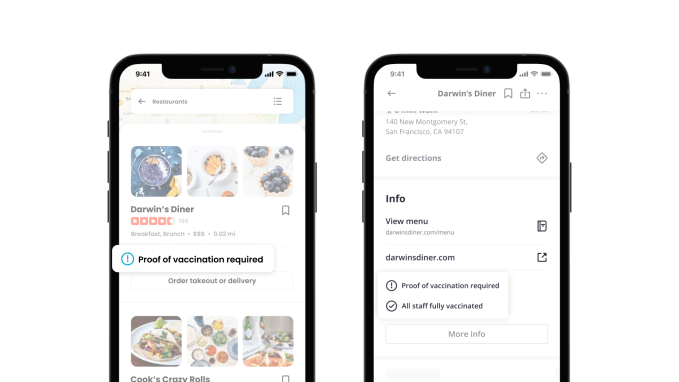
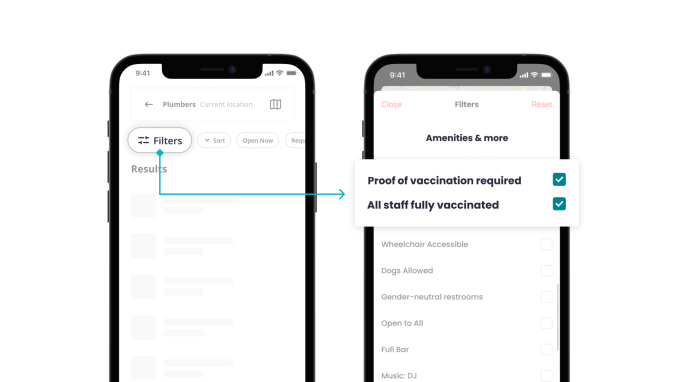
As more businesses around the U.S. are choosing to implement vaccine requirements for patrons or staff, business discovery and review site Yelp is introducing new tools that allow businesses to communicate those changes to their customers. On Thursday, Yelp will begin rolling out two profile attributes, “Proof of vaccination required” and “Staff fully vaccinated,” to help consumers to understand how a business is operating with regard to the pandemic.

While there is no federal mandate for businesses to require proof of vaccination, some cities are introducing their own policies. Recently, New York City became the first to require proof of vaccination for indoor restaurants and gyms, and, San Francisco is now exploring a similar set of mandates. Other cities may choose to follow suit in the future.

In addition, local business owners across the U.S. are implementing their own measures outside of federal or state guidance, including requiring masks or proof of vaccination for customers, or requiring their staff to be vaccinated. These choices often come at price, as the businesses risk social media backlash and bad reviews from the anti-vaccine crowd.

Yelp’s new features will represent an attempt to help mitigate that reaction, the company explains.

Image Credits: Yelp

Yelp says it will proactively leverage a combination of automated systems and human moderators to safeguard businesses from attacks from customers if a business opts to activate either of the two new options related to their Covid vaccine policies.

Though the company has long since had systems in place to address “review bombing” incidents, Yelp says the practice has gotten worse in recent months.

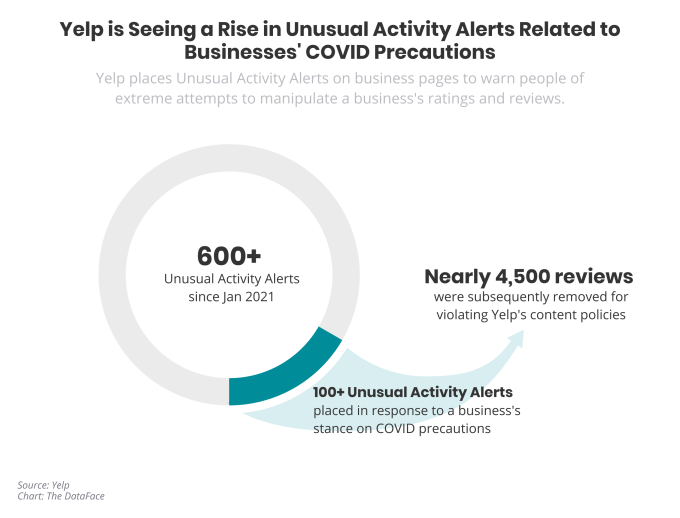
In the past, businesses that gained negative public attention may have had an influx of reviews from those who didn’t have a first-hand experience with the business in question, which violates Yelp’s policy. Yelp may then alert visitor to the business’s page that there’s the potential for fake reviews or that thee had been spikes in unusual activity. The company will sometimes even temporarily block users from being able to leave reviews. And in some cases, Yelp will also need to remove false reviews or those that otherwise violate its policies.

But since January 2021, Yelp says it’s had to place over 100 Unusual Activity Alerts on its pages in response to a business gaining public attention for their Covid health and safety practices. This has included if a business notified customers that vaccinations were required for its employees or for its patrons.

As a result, Yelp has had to remove nearly 4,500 reviews for violating its content guidelines.

Image Credits: Yelp

As Yelp was already handling these types of incidents, it’s now more formally introducing a way for businesses to flag their Covid policies through the new products.

The company notes it put a similar system in place when it launched our Black-owned attribute in June 2020 and again followed the same process for other identity attributes (e.g. Latinx-owned, Asian-owned, and LGBTQ-owned) by proactively monitoring business pages that activated these attributes for any hateful, racist or other harmful content that violated its content guidelines.

The company tells TechCrunch there was demand for its new Covid policy feature from business owners, as well.

Image Credits: Yelp

“Both business owners and consumers have expressed interest in Yelp releasing vaccine-related attributes,” said Noorie Malik, Yelp’s VP of User Operations. “For many months we’ve seen businesses implement vaccine requirements for both their customers and staff. As a result, we’ve also seen a rise in reviews focused on people’s stance on Covid vaccinations rather than their actual experience with the business,” Malik noted.

The businesses want to be assured that their page will be more actively monitored for false reviews when they choose to share this information.

Yelp, of course, understands that if allowed its reviews platform to become a place that veered away from customers detailing their first-hand experiences, it service overall would become less useful.

“Yelp has always served as a trusted source of information on local businesses, helping the millions of people that come to Yelp every day make informed spending decisions,” Malik said. “It’s important that consumers have a resource for relevant first-hand information when engaging with a business. You could argue this is even more important during a public health crisis, making reviews from relevant first-hand consumer experiences critical.”

The feature is rolling out now and can be found on the Yelp for Business account page.

05 Aug 2021

Do bronze medals ever make sense for unicorns?

Last week, Deliveroo made news when it announced it was preparing to leave the Spanish market. The recently-listed Deliveroo couched its explanation in market terms, noting its market position in Spanish on-demand delivery wasn’t sufficient to warrant continued investment. Left unmentioned: a Spanish legal change requiring companies that previously depended on freelance couriers to hire their delivery staff.

Race Capital’s Edith Yeung helped explain the Deliveroo choice to The Exchange, saying the Spanish market doesn’t have a very large population, which may mean that the “potential upside for being #1 in Spain has [a] ceiling.”

While she noted that she doesn’t have access to Deliveroo data, her statement jibes with the company’s own comment that Spain made up less than 2% of its aggregate gross transaction value (GTV) in the first half of 2021.


The Exchange explores startups, markets and money.

Read it every morning on Extra Crunch or get The Exchange newsletter every Saturday.


One company exiting a market is not a big deal, but we were curious about Deliveroo’s comments regarding the need for market leadership — or something close to it — to warrant continued investment. Is this the common reality for startups battling for market position, no matter if those markets are cities or countries?

Some startup markets have trended towards monopolies or duopolies. The Uber-Didi battle in China led to the companies agreeing to stop competing. Uber also recently sold its Uber Eats business in India to Zomato. In the United States, Uber and Lyft’s smaller competitors have long been forgotten and both the American ride-hailing giants continue to battle for dominance.

There are other familiar examples of this trend of consolidation. The food delivery game is concentrated amongst leading players. Postmates failed to survive as an independent company, winding up as part of Uber’s operations. Perhaps GoPuff will manage to claw out a spot in the market, but DoorDash and Uber Eats together accounted for 83% of the U.S. food delivery business in June this year, per SecondMeasure data.

It’s no surprise that some startup markets lean towards monopolies or duopolies. Many countries protect intellectual property via patents that can constrain new innovation to one or two players for an extended period of time. Monopolies can also arise when a new technology or method of business is invented — Google’s Internet parsing search tech led to a nigh-monopoly in many markets, for example.

In businesses where efficiencies of scale have a large effect, monopolies can form when leading players consolidate smaller competitors until just one or two companies remain. Standard Oil is the canonical example of this process.

What’s interesting about the on-demand delivery market is that it is both incredibly expensive but isn’t very technologically difficult to get into, which has meant that many companies have jumped into the sector around the world. This means on-demand delivery is the opposite of other patent-protected markets from which we might expect monopolies to form or competition to be extinguished past the top two players.

Yet, it’s also an industry where economies of scale can play a key role in profit generation, and increased competition can lead to price wars and advertising tussles. It’s a ripe market, then, for consolidation, even if it lacks an exploitable IP base.

05 Aug 2021

Allocations sees a world where myriad, smaller private equity funds are the norm

This morning Allocations, a fintech startup building software to help smaller private equity funds form and operate, announced that it has closed a $4 million round at a $100 million valuation.

The startup also shared a host of performance metrics, including that it reached a $4.6 million revenue run rate in June, and a $6 million bookings run rate in the same month.

Allocations also told TechCrunch that it has posted 28% monthly revenue growth over the last 12 months. With metrics like that, our curiosity was piqued. What is Allocations building that is attracting so much early demand? And how does the company’s thesis regarding the future of private equity funds intersect with micro-venture funds themselves?

What Allocations does

Born from CEO Kingsley Advani’s efforts in building a community of angel investors, and the issues that he ran into spinning up special purpose vehicles (SPVs), Allocations started off as software built to scratch its founder’s itch. SPVs are an increasingly common way to raise capital for a single investment from pooled sources, and in today’s rapid-fire venture capital market, Advani had to race to get capital into deals before they closed.

As with many technology startups, Allocations is software designed to solve a known pain point. The old way of putting together SPVs just didn’t match the expected pace at which private investors are expected to commit to investing.

Today the startup’s software helps its users to create new SPVs and funds more quickly, also helping investors manage capital calls and the like after their fund is formed. The startup charges either one-time (in the case of an SPV, by definition a single-shot investment), or recurring fees (multi-asset SPVs and funds). A 30-investment fund will cost its managers $15,000 per year through Allocations.

But how many funds are there for the startup to support? Is there enough market to allow Allocations to become a large enterprise itself? So far, the company has attracted some 300 funds to its roster. And Advani thinks that there will be plenty of demand. In an interview with TechCrunch, the founder noted that present-day denizens of major funds locked out of material carry — venture economic upside, more simply — can peel off and start their own fund, allowing them much better economics. That dynamic could spur demand for his startup’s services.

And Advani said that family offices and other major capital pools that once fought for allocation into brand-name venture capital funds and other private equity vehicles — venture capital is a subset of private equity — are increasingly chasing smaller funds that may post better returns than larger investing partnerships can manage. This is the law of large numbers in reverse; it’s easier to 10x a $10 million fund than a $10 billion vehicle.

And Advani expects his customers will put together multiple funds. Per the CEO, the goal of new fund managers is to get to their second fund. So, new managers often invest their first fund quickly in hope of reaching their second more quickly — more funds means more fees for Allocations.

In the startup’s view, the market will see many more small-scale private equity funds in time, perhaps smaller than $10 million in capital. This perspective mirrors what TechCrunch has seen in the market lately, with rolling funds rising to prominence in the early-stage startup investing, and solo GPs putting together what feels like more micro-funds than ever.

Allocations fits into the larger trend of fintech startups taking antiquated models in the world of money and making them faster, more modern, and often lower cost. Sure, there’s miles of distance between Allocations and Robinhood, but as both are about smaller investors, democratization of investing access, and using tech to tear down old walls, they are more brethren than different species.

Update: It’s a $4 million round, not $5 million. Post has been corrected.

05 Aug 2021

Automakers urge greater government investment to meet Biden’s EV sales target

President Joe Biden is expected to set an ambitious new target for half of all new auto sales in the U.S. to be low- or zero-emission by 2030, a plan that has received tentative support from the Big Three automakers pending what they say will require hefty government support.

General Motors, Ford, and Stellantis (formerly Fiat Chrysler) issued a joint statement Thursday that they had “shared aspiration[s]” to achieve a 40% to 50% share of electric in new vehicle sales by the end of the decade, with the caveat that such a target “can be achieved only with the timely deployment of the full suite of electrification policies committed to by the Administration in the Build Back Better Plan.”

Some of the investments they list include consumer incentives, a national EV charging network “of sufficient density,” funding for R&D, and manufacturing and supply chain incentives.

Biden’s target, which will come in the form of an executive order on Thursday, will be non-binding and entirely voluntary. The target includes vehicles powered by batteries, hydrogen fuel cells, or plug-in hybrids.

Executives from the three OEMs, as well as representatives from the United Automobile Workers union, are expected to attend an event on the new target at the White House Thursday. Tesla, it seems, was not invited, according to a tweet from CEO Elon Musk.

Biden will also be calling for new fuel economy standards for passenger and medium- and heavy-duty vehicles through model year 2026, which were rolled back under President Trump’s tenure, according to a White House factsheet released Thursday. The new standards, which will be crafted under the jurisdiction of the Department of Transportation and the Environmental Protection Agency, should come as no surprise to automakers: they were included in Biden’s so-called “Day One Agenda” and mark a cornerstone of his strategy to combat climate change.

The new standards will likely borrow from those passed by California last year, which were finalized in concert with a coalition of five automakers: BMW AG, Ford, Honda Motor Co., Volkswagen AG, and Volvo AB. Those automakers, in a separate statement Thursday, said they supported the White House’s plan to reduce emissions. However, like the Big Three, they said that “bold action” from the federal government will be needed to achieve emission reductions targets.

The road to 2030

While Biden’s non-binding order is more of a symbolic one, the targets are likely achievable, Jessica Caldwell, Edmunds’ executive director of insights said in a statement. She added that automotive industry leaders “have seen the writing on the wall for some time now” regarding electrification, regardless of who has been in the White House.

Thanks to the relatively long product development lead time, many of the major automakers have already announced multi-billion dollar investments in EVs and AVs at least through the middle of the decade. That includes a $35 billion investment through 2025 from GM and $30 billion through the same year from Ford – not to mention similar announcements from Stellantis and many billions earmarked for battery R&D from Volkswagen, and even Volvo Cars’ shift to all-electric by 2030.

These massive numbers follow the automakers’ own sales targets, which are for the most part in line with Biden’s goal.

Fuel economy rules, however, have historically garnered slightly more mixed reactions from automakers. GM, Fiat Chrysler (now Stellantis) and Toyota had previously supported a Trump-era lawsuit that sought to strip California’s authority to set its own emissions standards – but each company eventually made an about-face, leaving the road open for Biden to introduce his own standards this year.

In a very real sense, Biden’s announcement is as much about geopolitics as it is about climate change. He, too, has seen the writing on the wall regarding EVs. His Administration notes in the factsheet that “China is increasingly cornering the global supply chain” for EVs and EV battery materials. “By setting clear targets for electric vehicle sale trajectories, these countries are becoming magnets for private investment into their manufacturing sectors – from parts and materials to final assembly.”

While three times as many EVs were registered in the U.S. in 2020 versus 2016, America still lags behind both Europe and China in terms of EV market share, according to the International Energy Agency.

The news has garnered a slew of mixed reactions, with some environmental groups urging more decisive action on the part of the Administration. Carol Lee Rawn, senior director of transportation at Ceres, said in a statement that future standards should target a 60% reduction in emissions and a “clear trajectory” to 100% vehicle sales by 2035.

Although the UAW will be joining Biden at the White House on Thursday, President Ray Curry said in a statement that the group is “not focused on hard deadlines or percentages, but on preserving the wages and benefits that have been the heart and soul of the American middle class.”

05 Aug 2021

3 invaluable founder lessons I learned on my immigration journey

I was four years old when my dad first showed me a computer. I immediately asked him if we could take it apart to see how it worked. I was hooked.

When I learned that Windows and Mac were based in the United States, I was 10. Since then, I’ve wanted to come here to launch my own tech business.

What I didn’t realize back then was that the first half of that dream — coming to the U.S. — would provide me with essential training for realizing the second half — launching a business.

As it turns out, the behaviors, attitude and mindset required to traverse the U.S. immigration system are many of the same ones required to navigate the uncertain waters of entrepreneurship.

The behaviors, attitude and mindset required to traverse the U.S. immigration system are many of the same ones required to navigate the uncertain waters of entrepreneurship.

In 2019, I launched Preflight, which makes smart and fast no-code test automation software for web applications. One big reason the business currently exists is that, in my journey to getting asylee status in the United States, I became really good at three things: accepting uncertainty, building resilience and maintaining a positive mental attitude.

I needed them all to get Preflight off the ground.

The many paths to the U.S. (and launching a startup)

I had my first shot at making my longtime dream a reality when I was applying to college as an undergraduate. I figured if I could go to school in the United States, I could find a way to stay and start a business.

After doing some research, though, I realized that U.S. colleges were too expensive.

But I figured getting out of Turkey, my home country, would be a start. I looked around for affordable schools and saw that France had good options. So I went to France.

Unfortunately, even after three attempts, I wasn’t able to get a student visa. So I headed back to Turkey and went to college there. After graduation, I knew I had a second shot at the U.S.: a master’s degree. I applied to computer science programs and got accepted — a huge win!

I first arrived in Georgia, where I got my TOEFL certification, then enrolled at Tennessee State University, where I got a teaching assistantship.

Keep in mind, to do all this, I had to have the right visas. I needed a student visa for my master’s degree, but if I wanted to work after graduation, I’d need a work visa.

The thing is, though, I didn’t want to work at a “job.” I wanted to start my own business, which requires a different type of visa altogether.

Oh, and there was another factor at play: I was enrolled at Tennessee State from 2014 to 2016, during the lead-up to the election of Donald Trump. So in addition to trying to figure out which visa I could reasonably get, I had to deal with the fact that the rules for visas could all change in the coming months.

These experiences are similar to what many founders deal with every day in the process of launching and running a business.

We don’t know if our products will work or if they’ll find a market. We don’t know how changing regulations might affect what we’re doing. We have no idea when something like a pandemic will pull the rug out from everything we’ve built.

But we keep going anyway. In my experience, the most successful founders are the ones who don’t wait for all the pieces to fall into place — they know that will never happen. They’re the ones who do the best they can with what they have. They trust that they’ll be able to adapt and adjust when things inevitably change.

Which brings me to my next lesson.

Resilience: Hearing “no” as “not yet”

Hearing “no” isn’t fun, especially when that “no” is about something you’ve wanted for more than a decade.

I experienced a lot of “no”s in my immigration journey, as one visa attempt after another failed. If I’d let any one of those failures stop me, I wouldn’t be where I am today — working at my own startup in the U.S.

The lesson I learned was to hear “no” as “not yet.” It’s been invaluable to me in my journey to becoming a founder.

For example: In 2014, while I was in graduate school, I learned about Y Combinator and decided that I wanted to be a part of it. Throughout grad school, I applied and got rejected three times.

The clock was ticking on my student visa, so I decided to shift my tactics. I applied to jobs at companies that were Y Combinator graduates to see what I could learn.

In 2016, I got hired at ShipBob, a Chicago-based company that was in Y Combinator’s Summer 2014 batch. I joined the team as its first full-time developer and the first one based in the States. From there, things changed dramatically.

For starters, I learned a lot. In my time with ShipBob — just two and a half years — we grew from 10 people to more than 400. I built two apps and applied to Y Combinator twice more and got rejected both times.

But in my work growing and leading a team of developers, I saw a need for a product that didn’t yet exist: a smart, fast, no-code test automation tool.

My team was spending way too much time building tests for ShipBob’s latest updates to make sure existing functionalities worked when we deployed. But when the code changed too quickly, our tests were outdated. It was incredibly frustrating.

Then we hired two quality assurance engineers and it took them four months to get 10% automated test coverage.

These problems led me to an aha moment: I could build a company to address this. A tool that is fast in test creation and can adapt to the UI changes.

That company is Preflight, and it’s the one that finally got me admitted to Y Combinator in the Winter 2019 batch. I was ecstatic when I heard that we’d been accepted. But then I realized that I couldn’t actually work on Preflight full time with my current visa status — at least, if I wanted to one day make a salary, I couldn’t.

And that brings me to my next point.

Maintaining a positive mental attitude as you face (many) challenges

My professional life wasn’t the only thing that changed dramatically while I was at ShipBob. My immigration status also evolved.

ShipBob applied for and got me an H-1B visa, which made me eligible to work in the U.S.

But when I got accepted to Y Combinator on my sixth application, I knew I needed an alternative: If I left ShipBob to run Preflight, I would lose my H-1B and my ability to work in the U.S.

This kind of conundrum is all too familiar to most startup founders: There’s no new opportunity without a new challenge to accompany it.

So I did what any founder would do: I focused on the positive (I’d gotten into YC!) and dedicated myself to figuring out a different way to stay in the country.

First, I tried to apply for the EB-1 visa, but the required documentation was too burdensome. I don’t think any founder could prepare for that application without several months of preparation.

Then I tried the O-1. No luck.

So I asked ShipBob if I could take an unpaid sabbatical, which would let me keep my H-1B status while I attended Y Combinator and worked on Preflight. They agreed. My brothers, who had both moved to Chicago and started working at ShipBob (you’re welcome, guys!) agreed to support me (thanks, guys!).

Finally, I had a solution that worked — but only for the time being. If Preflight was successful, I’d have to find a different way to stay in the country.

Transferring my H-1B to Preflight wouldn’t work, in part because it would require me to yield 70% to 80% ownership to my co-founder and agree that he could fire me at any time.

But there was another option I’d been reluctant to lean on: asylee status. In 2016, there was an attempted coup in Turkey (that’s the official story, anyway). I won’t get into the political details, but my family and I were supporters of the movement blamed for the attempt. As a result, we were at risk of imprisonment if we stayed in Turkey — and eligible for asylum status in the U.S.

I applied, but hoped that I’d land a work visa in the meantime, partly because asylum status can take years to get approved and partly because there was no telling whether the current administration would change the rules to make me ineligible before my status came through.

When I got accepted to Y Combinator, my asylum status was pending. When my initial sabbatical from ShipBob ran out, it was still pending. I asked for an extension and got it (thanks, ShipBob!). A few months later, I figured I could not get the visa sorted. I wanted to focus on my business and use asylum-pending status, which would give me work authorization for two years. I was therefore able to work on and take a salary from Preflight.

Putting it all together

My asylum was granted early this year, four years after applying. Getting asylee status was a big win because it meant I could realize my dream of running a business in the U.S. So I was, in some ways, at the resolution of my immigration journey — but I was just at the beginning of my journey as a founder.

Right away, I had my first experience applying all the lessons I’d learned in the last six years: We wanted to raise our first funding round. That funding would let me start taking a salary.

All told, we approached more than 100 VCs before we got a yes. But we did get that yes, and we raised a seed round of $1.2 million in September 2019.

It was a big win for Preflight, but it didn’t have the transformational power for the company I’d hoped for. That’s because, after closing our round, we didn’t focus on sales and marketing to the extent that we should have.

After several months of frustrating results, I consulted with my advisers about how to proceed. They offered me insight that seemed obvious once I had it — but that I may not have gotten on my own — which was discussing everything that’s happening internally with the investors. And the outcome was me being the CEO.

In the month and a half after I adjusted course based on my vision, I grew Preflight’s revenue 600% in just about two months.

The only constant is change

The whole startup ethos of disrupting what’s not working to improve people’s lives is based on the premise that the world is constantly changing. The global disruption caused by COVID-19 underscored that in a major way.

Founders who accept that change is inevitable and who embrace uncertainty, develop resilience for when things go wrong, and maintain a positive mental attitude about the ups and (especially) the downs of running a startup will be the ones who succeed for the long haul.

I’ve known since I was 10 that I wanted to run a company in the United States. Given the choice, I would have opted for a much smoother road to entrepreneurship. But what I’ve discovered is that the difficult immigration path I had to follow provided exactly the training I needed to succeed in the challenging role of a founder.