Year: 2021

05 Aug 2021

Nubank co-leads $45 million investment in Indian neobank Jupiter

Industry veteran Jitendra Gupta’s neobank for consumers in India has raised $45 million in a new financing round as the Bangalore and Mumbai-based startup gears up for Jupiter’s public launch in a month.

The new financing round, a Series B, was co-led by Brazil-based Nubank, Global Founders Capital, Sequoia Capital and Matrix Partners. Mirae Assets Venture also joined the round and existing investors including Addition Ventures, Tanglin VC, Greyhound, 314 Capital and Beenext, also participated.

The new round values the two-year-old Indian startup, which has raised $70 million to date, at over $300 million.

Jupiter has built a neobank for consumers in India. The startup, which launched its eponymous platform in beta in June, is attempting to bring “delight” to the banking experience.

“We believe that a bank account should be a smart account, where it gives you insight, shares personalized tips and guides you through attaining some financial discipline,” said Gupta — who co-founded CitrusPay (sold to Naspers’ PayU) and served as managing director of PayU — in a recent interview with TechCrunch.

The startup, which employs over 110 people, has developed a number of products including a savings account bundled with features that aim to simplify money management.

The platform, which positions itself as a “100% digital bank” also offers the ability to buy now and pay later on UPI, a standard developed by a coalition of banks in India that has become the most popular way people in the country transact online.

More to follow…

04 Aug 2021

Oh, Facebook changed its privacy settings again

Ever considerate of its users, Facebook has determined that its privacy settings needed a bit of a shuffle to keep things clear and easy to find. To that end they’ve taken the “privacy settings” settings and scattered them mischievously among the other categories.

“We’ve redesigned our entire settings menu on mobile devices from top to bottom to make things easier to find. Instead of having settings spread across nearly 20 different screens, they’re now accessible from a single place,” writes Facebook in a blog post announcing the changes.

Oh, sorry — that’s from 2018, when they centralized privacy settings to make them easier to find. This is the one from today about decentralizing them into a bunch of different places.

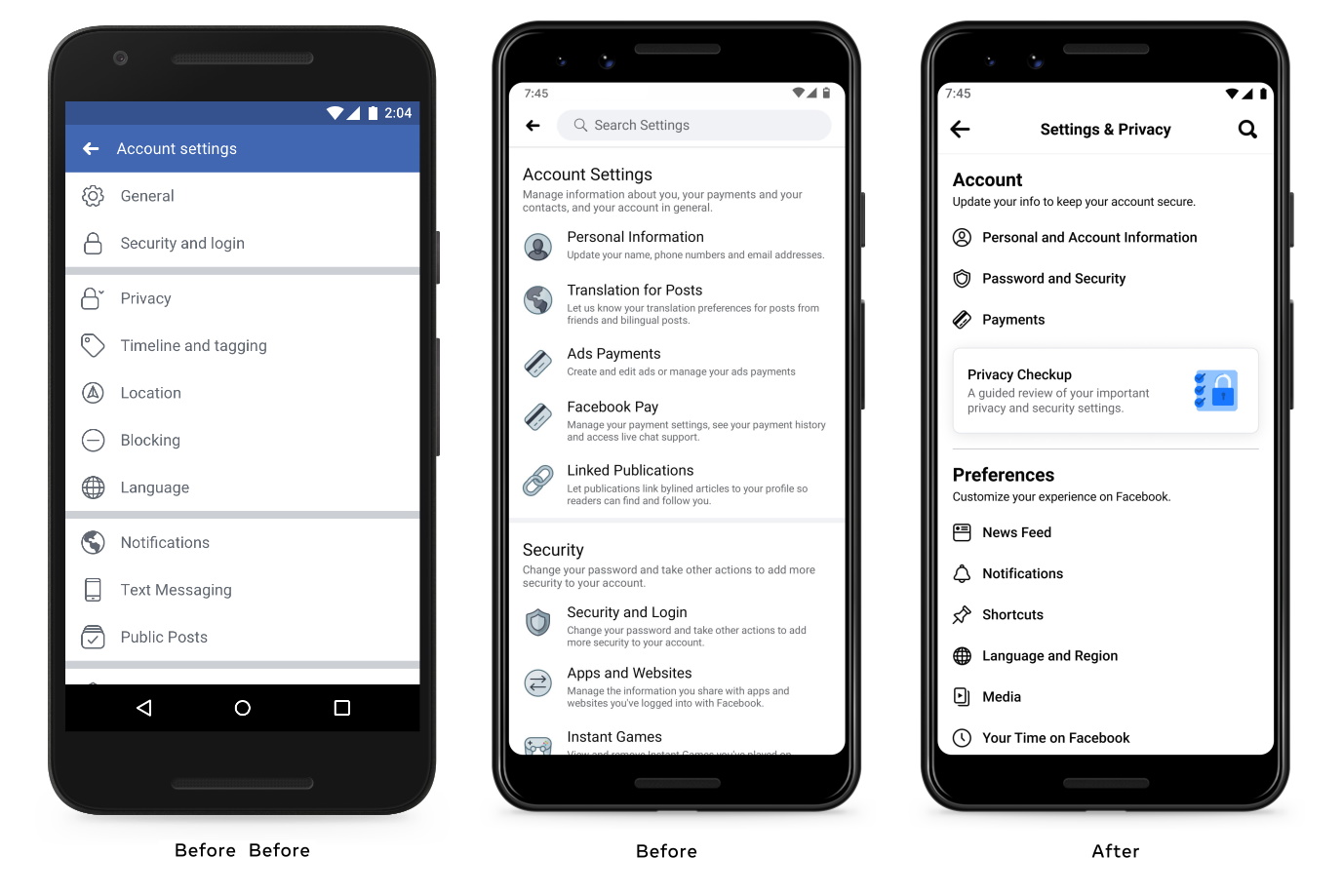
“Settings are now grouped into six broad categories, each containing several related settings: Account, Preferences, Audience and Visibility, Permissions, Your Information, and Community Standards and Legal Policies… We’ve unbundled the Privacy Settings category and moved the settings previously contained within it into other categories.”

Facebook unbundling its privacy settings (but the image is actually a guy sprinkling salt in the wind)

Pictured: Facebook unbundling its privacy settings into new categories

Under which of those categories do you think privacy settings belong? Facebook “renamed them to more closely match people’s mental models,” so it should be obvious. Just use your mental model.

If your answer is “all of them, conceivably,” congratulations, you got it! Now if you want to update your privacy settings, all you need to do is visit all of these new categories and sub-categories individually. Any one of them might have a crucial toggle inside — it’s like a treasure hunt!

Facebook’s settings page, from oldest to newest. Which do you prefer?

We joke, but Facebook did also make the “Privacy Checkup” item much more prominent in this update. This “guided review” may give the company opportunities to employ dark patterns that lure users away from less desirable (for the company) privacy choices, but does certainly go through many of the more important settings and let people change them.

“We’re confident this new settings page will make it easier for people to visit their settings, find what they came for, and make the changes they want,” Facebook writes. We’ll all find out one way or another later today when the redesign rolls out for iOS, Android, mobile web, and FB Lite.

04 Aug 2021

Uber CEO calls Massachusetts gig economy ballot measure the ‘right answer’

Uber CEO Dara Khosrowshahi expressed his support Wednesday for a ballot initiative in Massachusetts that would keep gig economy workers classified as independent contractors, fulfilling a promise he made nearly a year ago to push for laws that preserve its business model

“In the state of Massachusetts, we think the right answer is our IC+ model, which is independent contractor with benefits,” Khosrowshahi said during the earnings call with investors. “Our drivers love it. Prop 22 has proven to be incredibly popular with California drivers.”

His comments come a day after a coalition of app-based ride-hailing and on-demand delivery companies, which includes Uber, Doordash, Lyft and Instacart, filed a petition for the ballot initiative that would classify app-based ride-hail and delivery workers as independent contractors and provide them with benefits such as healthcare stipends for drivers who work at least 15 hours per week. The coalition claimed that the provision would allow drivers to earn about $18 per hour in 2023 before tips. The ballot measure, if it passes legal muster and receives enough signatures, would be included in the November 2022 election. 

Proposition 22 passed in California in November last year, a ballot measure that kept gig workers in the state classified as independent contractors. It also exempts gig companies like Uber from AB-5, the bill that entitles gig workers to self-classify as employees with usual labor protections that don’t apply to independent contractors, like minimum wage, sick leave, unemployment and workers’ compensation benefits.

Gig companies, which largely have yet to become profitable, spent $205 million in marketing for this ballot measure and made no secret about plans to do the same thing in other states. Which brings us back to Massachusetts.

Khosrowshahi said during the earnings call that the vast majority of drivers prefer the IC+ model over full-time employment. The Coalition to Protect Workers’ Rights disagreed, arguing that the ballot language has loopholes that would create a sub-minimum wage for app-based workers and that few would qualify for the healthcare support promised. It also noted that the measure would remove anti-discrimination protections, eliminates workers’ compensation rules and allows companies to cheat the state unemployment system of hundreds of millions.

“Uber has been using independence as a red herring for years,” Shona Clarkson, organizer for Gig Workers Rising, told TechCrunch. “We know that drivers do not actually have independence while driving for Uber. There is no independence in working 70+ hours a week, not being able to set your own rates, not being able to see where a ride is going and having no real control at work. The benefits promised under Prop 22 were a sham that have not materialized. As a network of over 10,000 gig workers in the state of California, we have not seen Uber drivers able to access any meaningful benefits since the implementation of Prop 22.”

Khosrowshahi said Californians voted in favor of Prop 22 because they had driver support, and he sees no reason why Massachusetts should be any different.

“We absolutely prefer a legislative outcome in Massachusetts, but if we can’t get there we’ll take it to the vote and based on what happened in California, we’re quite confident,” he said.

04 Aug 2021

5 factors founders must consider before choosing their VC

Though 2021 is far from over, it’s already witnessed a record level of venture capital activity in the technology sector. With larger round sizes announced daily, founders may have their pick of term sheets — but they need to think critically and strategically about which firms to add to their cap table.

So far this year, we’ve seen $292.4 billion in venture financing across the globe, of which $138.9 billion was raised in the United States. Specific to tech companies, the capital is only accelerating: In Q2, founders raised 157% more capital compared to the same period last year, according to the latest data from CB Insights.

It’s not just that more companies are raising money they are doing so at a higher valuation. Median seed and Series A stage valuations today stand at $12 million and $42 million, respectively, up 20% to 30% from 2020. This can be partly attributed to growing exits/M&A activity in the technology sector, a record number of IPOs and a general bullishness around technology, as well as low interest rates and liquidity in the market.

Good VCs who are aligned with a startup’s vision create more value than the dollars they bring to the table.

At a time when we are witnessing record VC activity, founders would be well served to go back to the basics and focus on the principles of fundraising when determining who sits on their cap table. Here are a few pointers for founders in that direction:

1. Value > valuation

Good VCs who are aligned with a startup’s vision create more value than the dollars they bring to the table. Typically, such value is created across a few distinct functions — product, sales, domain expertise, business development and recruiting, to name a few — based on the background of the partners of the fund and the composition of their limited partners (investors in the venture fund).

Further, the right VC can serve as an authentic, objective sounding board for CEOs, which can be an asset to have as a startup navigates uncertainty and the typical challenges that come with scaling a young company. As founders assess multiple term sheets, it’s worth thinking through whether they should optimize for VCs who offer the highest valuation, or for ones who bring the most value to the table.

2. A two-way street

Running an efficient fundraising process, in part, entails holding VCs accountable to their own diligence requests. While it is unfortunately common for VCs to request a lot of data upfront, startups should share information after assessing intent and appetite on the investors’ part.

For every additional data request, founders are well within their rights (and should) check with their potential investors on where the process stands and get indicative timelines for moving forward with next steps. Mark Suster said it best: “Data rooms are where fundraising processes go to die.”

04 Aug 2021

Daily Crunch: Second-day trading surge launches Robinhood stock into meme territory

To get a roundup of TechCrunch’s biggest and most important stories delivered to your inbox every day at 3 p.m. PDT, subscribe here.

Hello and welcome to Daily Crunch for August 4, 2021. It’s been hectic: Robinhood’s stock lost its mind. Facebook made another chunk of the internet mad. And a new unicorn wants to go public? It’s been a great day for tech news.

But before we get on with it, we’re excited to announce that TechCrunch is launching another newsletter! This Week in Apps by Sarah Perez launches this Saturday morning, August 7, and is the place to go for all of your app news goodness. Be sure to sign up here. — Alex

The TechCrunch Top 3

  • Robinhood’s stock does insane things: Robinhood users were involved in the GameStop and AMC trading frenzies earlier this year. So perhaps it was inevitable that Robinhood’s own stock would get caught in a similar updraft. That’s what happened today, with shares of the newly public fintech company soaring far, far above its IPO price. So much for the Robinhood public offering being underwhelming!
  • Human Interest is now a unicorn, wants to go public: With a fresh $100 million round constructed of bricks of cash from both TPG and SoftBank, Human Interest’s SMB 401(k) service is now worth $1 billion. Per our own Mary Ann, it’s “targeting a traditional IPO sometime in 2023, with execs saying the target is to have ‘$200 million+ in run-rate revenue before going public.’” More of this sort of clear planning, please.
  • Neobanks’ improving economics could hint at future IPOs: Checking in on the recent financial performance of a few neobanks, TechCrunch discovers quite a lot to like in the numbers. There are some laggards, but the huge, global venture capital bet on the fintech banking model appears to be set to pay off.

Startups/VC

  • Denver’s Reserve Trust reloads for business payments: It takes a bit of explaining, but moving money around the world is hard without a partner bank. Reserve Trust wants to help companies move their funds directly, sans banking partners. And it just raised $30.5 million to do so. The issues of accepting and moving money online are huge problem spaces, evidence of which you can see in this section of Daily Crunch most days, it feels.
  • ispace is going to the moon: Japanese space tech company ispace has raised a fresh $46 million Series C to help it undertake a number of lunar missions in the coming years. Three missions in three years, it turns out. The new capital is to support its second and third launches which should come — take off? — in 2023 and 2024.
  • FullStory raises $103M to make digital UIs suck less: By tracking where users click in confusion, anger or frustration, FullStory wants to help companies improve their various digital interfaces. If you hate how some apps are built (and who doesn’t), FullStory could be good news. The Atlanta-based company is now worth $1.8 billion.
  • More money to buy up e-commerce brands: The global push to raise capital, buy e-commerce brands and unify them under a single aegis is a huge area of venture capital investment. Today’s round is Suma Brands, which now has $150 million to execute acquisitions. The new capital is mostly debt, it turns out.
  • tabby raises $50M Series B for Middle Eastern BNPL work: We have a new buy now, pay later round for you today. This time it’s tabby, which is based in Dubai and has a focus on its local region. Global Founders Capital and STV led the funding round, which also included a host of other venture capital firms like Mubadala Investment Capital and Raed Ventures.
  • Work-Bench closes $100M new fund: New York-based Work-Bench has raised a new fund to invest in enterprise SaaS companies. In a world of megafunds and billion-dollar deals, the firm is staying smaller than it probably could have grown. (It also dropped some research on the New York tech scene that I’m chewing on.)
  • Rounding out our startup coverage, if you are a startup and want to learn more about the world of PR, we had a few comms pros on the Equity podcast this week. Tune in here.

What Square’s acquisition of Afterpay means for startups

In his first column since returning to TechCrunch, reporter Ryan Lawler considered the potential ripples Square’s purchase of Afterpay may send across the pond of buy now, pay later startups.

For commentary and perspective, he interviewed:

  • Dan Rosen, founder and general partner, Commerce Ventures
  • Jake Gibson, founding partner, Better Tomorrow Ventures
  • TX Zhuo, partner, Fika Ventures
  • Matthew Harris, partner, Bain Capital Ventures

The investors he spoke to agreed that deferring payments helps drive e-commerce, “but scale matters and long-term margins look slim for BNPL startups,” reports Ryan.

(Extra Crunch is our membership program, which helps founders and startup teams get ahead. You can sign up here.)

Big Tech Inc.

TechCrunch Experts: Growth Marketing

Illustration montage based on education and knowledge in blue

Image Credits: SEAN GLADWELL (opens in a new window) / Getty Images

TechCrunch wants you to recommend growth marketers who have expertise in SEO, social, content writing and more! If you’re a growth marketer, pass this survey along to your clients; we’d like to hear about why they loved working with you.

If you’re curious about how these surveys are shaping our coverage, check out this guest column by Stewart Hillhouse, “Demand Curve: Tested tactics for growing newsletters.”

04 Aug 2021

What’s the board’s role in an early-stage startup?

What’s the board’s role in an early-stage startup?

Startup founders frequently ask me about the role of a board of directors. A board can be a crucial asset in an early-stage startup.

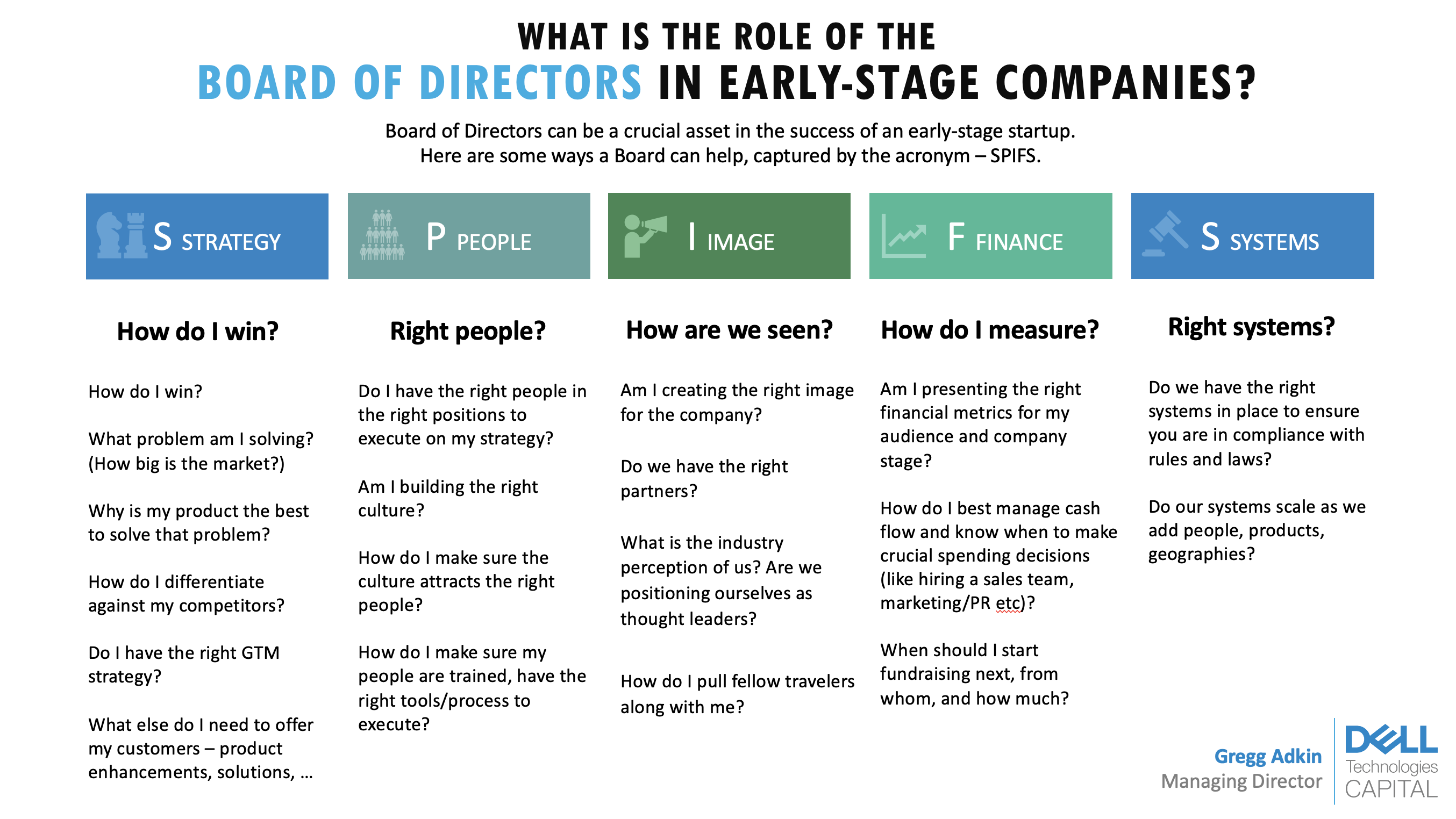
Here’s a framework for how it can help drive success at your company: Strategy, People, Image, Finance and Systems for compliance, or “SPIFS.”

What is a board of directors, anyway?

The board of directors helps with governance of the company. U.S. law requires that any company have one, though does not require how big it should be. By generic definition, the board of directors consists of elected individuals that represent shareholders. It is the governing body that provides company oversight and helps set business policy and strategy.

On a more practical level and in a startup environment, the board can aid in creating a successful business strategy, putting together the right management team, developing branding, building good financial habits, and avoiding legal and compliance issues. The needs and composition of the board will change depending on the startup’s stage, management and financing history (e.g., if there are preferred shareholders, investors that require a board seat and more).

Investors often ask founders about their board: It says a lot about their character, their judgment and their willingness to be challenged.

Investors often ask founders about their board for two reasons. First, it says a lot about their character, their judgment and their willingness to be challenged. The founder can typically choose who is on their board (through careful selection of investors and advisers) and negotiate a board structure they prefer.

Typically, a healthy board will have a good balance between common shareholders, preferred shareholders and independents. It also helps investors and analysts understand who will ask critical questions and give important advice to the company’s executive management, especially when the going gets tough (it inevitably does!).

What exactly can a board help you do?

After 20 years as a venture capitalist and board member, I boiled down the value of a board into five main pieces under the acronym SPIFS: Strategy, People, Image, Finance and Systems for compliance.

SPIFS matrix that describes the role a board of directors plays in an early stage startup

Image Credits: Dell Technologies Capital

Strategy

Setting business strategy is one of the main ways that the board helps founders, especially if it’s their first time running a business. It is a valuable sounding board for validating that you have taken a sober account of the market and have the right plan to develop your product and acquire customers.

The board should ask these questions when guiding founders through setting strategy:

  • How do I win?
  • What problem am I solving?
  • Why is my product the best to solve that problem?
  • How do I differentiate against my competitors?
  • Do I have the right go-to-market strategy?
04 Aug 2021

Hubspot CEO moving to exec chairman role as company promotes Yamini Rangan to CEO

Boston-based CRM company Hubspot announced today that co-founder and CEO Brian Halligan would be stepping into the executive chairman role and CMO Yamini Rangan would be taking over as CEO next month on September 7th.

Rangan joined the company in January 2020 after stints at Dropbox, Workday and SAP. Her strong background in engineering, sales and marketing should prove helpful as she takes over the chief executive role. It’s worth noting that Halligan suffered a snowmobile accident earlier this year, and while he has recovered now, Rangan ran the company in his absence, perhaps helping lay the ground work for this decision  Halligan wrote in a blog post announcing his decision that she is completely prepared to take on this role.

“Yamini has been overseeing day to day operations at HubSpot since March, managing Board meetings, the HubSpot earnings call, and key hiring and growth initiatives, working closely with Dharmesh and the rest of the leadership team. She’s made HubSpot better by being here, and I know that trend will continue with her as CEO.,” Halligan wrote.

Brent Leary, founder and principal analyst at CRM Essentials, who has been following the company since early days, says he isn’t surprised to see a change like this. “With the company recently hitting its 15-year anniversary it really isn’t a huge surprise that something like this is happening. And given all the success they’ve had in growing the company to this point, you have to believe they’ve been preparing for this move for quite some time,” Leary told TechCrunch.

The announcement came as the company released its Q22021 revenue, which looked to be pretty solid coming in at $310.8 million up 53% over the same period last year. The vast majority, over $300 million was subscription revenue with the remainder coming from professional services, a ratio that you would expect for a company like this. The revenue puts them on a nice run rate of over $1.4 billion.

The company was founded in Boston in 2006 by Halligan and Dharmesh Shah and raised over $100 million, according to Crunchbase data. It was an early promoter of content marketing, using quality content, often in the form of company blogs, to drive website traffic and increase sales. It’s something that’s widely accepted now, but when they started the company it was not well known and they helped bring the concept to the mainstream.

Hubspot later moved into a broader CRM platform after going public in 2014. Along with Wayfair, Hubspot is one of the big success stories to come out of the Boston startup scene and go public, helping to fuel the city’s startup ecosystem with the money the founders made on their successful IPOs. Hubspot stock was up over 2% in after market trading on the news, perhaps signaling that investors are pleased with the company’s transition plan.

04 Aug 2021

TikTok confirms pilot test of TikTok Stories is now underway

Twitter may have shut down its Stories features known as Fleets, but the Stories format will continue to invade other social platforms. TikTok today confirmed it’s piloting a new feature, TikTok Stories, which will allow it to explore additional ways for its community to bring their creative ideas to life.

The company notes the new feature will be another option, in addition to its existing storytelling tools like videos, Duets, Stitch, and LIVE — it’s not meant to replace them.

TikTok didn’t say how long the pilot test would run or whether it would result in a public launch. However, we understand the test has been running for several days, not weeks or months, and is available in non-U.S. markets for the time being.

The current set of features may or may not make it to the public product, either, we should warn.

The feature was discovered by social media consultant Matt Navarra, who is often among the first to find new features in social apps. In this case, he tells us that several tipsters brought screenshots of TikTok Stories to him, but it was initially unclear whether or not it was a hoax.

The timing, of course, was somewhat suspect —  Twitter had just shut down Fleets in what was a fairly high-profile example of a failure to make Stories work on a social platform, despite their popularity on other social apps, like Snapchat, Instagram, Facebook, and even, as of late, Pinterest.

The screenshots and videos of TikTok Stories in action confirm what appears to be, for the most part, a feature that will look familiar to users of Stories on other platforms.

Users can tap a camera button from the new navigation bar on the left side of the screen to create their first Story, and use common tools like those to add text or stickers, insert sounds, and even use effects, on their content. Like other platforms, users can either record videos or upload photos — the latter which opens up TikTok to take advantage of users’ larger camera rolls, rather than relying only on video.

Where TikTok’s version of Stories differentiates itself is that it allows users to comment publicly on the creator’s content. These comments are public, the app explains, as mutual friends can see each other’s comments. There is also another tab where you can see how many people viewed a given Story, and whether or not you’re following those users.

The Stories are ephemeral and disappear in 24 hours, the app’s tutorial explains.

To view Stories from other creators, you can scroll through the new sidebar and tap on the creator’s avatar to watch their content. (This almost looks like a vertical version of Twitter’s Fleets bar, even down to the blue rings around creator’s profile photos.)

The addition of Stories may give TikTok users who don’t post with regularity (or at all), an easier way to start engaging with TikTok’s tools by starting with a more comfortable and familiar format. But it can also give creators a way to interact more casually with fans in between their more polished and edited TikTok video posts.

It’s also a direct shot across Instagram’s bow, following the Facebook-owned app’s direct attempt to copy TikTok with Reels.

04 Aug 2021

Uber shares fall despite revenue beat as its core operations continue to lose money

Today after the bell U.S. ride-hailing giant Uber reported its second-quarter financial results. The company’s numbers come a day after its domestic rival, Lyft, shared its own Q2 earnings.

Notably while Lyft managed to generate positive adjusted EBITDA in the second quarter, Uber did not. However, Uber did generate positive net income of $1.14 billion in the quarter thanks to its investments in other companies like Didi and Aurora Innovation.

From the top, Uber’s gross bookings totaled $21.9 billion in the second quarter, up 114% compared to the year-ago period. That gross platform spend resulted in $3.93 billion in revenues at Uber, up 105% from the company’s $1.91 billion Q2 2020 results.

Its Q2 performance was enough to keep Uber on track towards its pre-tax profitability goal, with the company reiterating that it will reach adjusted EBITDA profitability by the fourth quarter, per its earnings release.

Analysts had expected the company to post revenues of $3.74 billion, and earnings per share of -$0.51, per data collected by Yahoo Finance. Shares of Uber are off 5.4% in after-hours trading, despite the company’s earnings per share besting analyst expectations.

Digging into the company’s individual business operations, in gross bookings terms, Uber’s ride business posted the largest growth in Q2 2021, growing 184% from its year-ago result to $8.84 billion. Delivery, a larger chunk of gross bookings at the company, grew 85% in Q2 2021 to $12.91 billion compared to its year-ago comparable.

Uber derives less revenue per dollar of delivery gross bookings than it does in ride-hailing, with its two businesses generating $1.96 billion and $1.62 billion in revenues, respectively, despite their massive differential in total consumer spend.

Freight, Uber’s smallest named division in revenue terms, grew 64% to $348 million. Despite its small size, Uber has been expanding the division and making strategic acquisitions and partnerships as a means to help the segment to break even on an Adjusted EBITDA basis by the end of 2022.

Last month, Uber Freight acquired Transplace for about $2.25 billion from private equity group TPG Capital. The deal involved $750 million in Uber stock with the remainder in cash.

Uber’s two key businesses were not profitable in aggregate, with the company’s ride-hailing and delivery businesses not managing to save the company from negative adjusted profits. However, Uber’s rides business did manage to post $179 million in positive adjusted EBITDA on its own — down from the company’s Q1 2021 result — while the company’s delivery business posted another quarter of negative adjusted profits, turning in -$161 million worth of adjusted EBITDA.

Recall that Uber’s ride-hailing adjusted EBITDA pales in comparison to the company’s unallocated expenses; Uber’s adjusted EBITDA for the second quarter of 2021 came to -$509 million, an improvement of 39% compared to the year-ago period, but still a long way from breakeven.

But Uber’s quarter had a highlight to share in the form of other income. Uber’s operating loss of $1.19 billion was more than ameliorated by the company earning $1.93 billion in non-operating income. That was mostly derived from $1.91 billion in unrealized gains on “debt and equity securities,” including “a $1.4 billion unrealized gain on [its] Didi investment and a $471 million unrealized gain on [its] Aurora Investments recognized in the second quarter of 2021.”

Didi went public in the second quarter.

Turning to geographic results, Uber’s fastest recovery came in the APAC region, where revenue soared 227% from $217 million in the year-ago quarter to $709 million in the company’s most recent three-month period. EMEA came in second, in growth terms, expanding top line 159% from $358 million to $929 million over the same time frame. The United States and Canada posted revenue growth of 76% from $1.13 billion to $1.98 billion, and Latin America managed a more modest 44% rebound in the quarter.

04 Aug 2021

Venture capital undermines human rights

The future of technology is determined by a handful of venture capitalists. The world’s 10 leading venture capital firms have, together, invested over $150 billion in technology startups. The venture capitalists who run these firms decide which startups today will develop the new platforms and technologies that will shape our lives tomorrow.

There is a startling lack of diversity within the venture capital sector. This means that a small group of men — mostly white men — make decisions that affect all of us. Unsurprisingly, they all too often ignore the broader societal and human rights implications of these investment decisions.

We all live in a world shaped by venture capital. As of 2019, 81% of all venture capital funds worldwide are clustered in just a handful of countries, primarily in the U.S., Europe and China, which in turn are shaping the future of technology. If you spend time on Facebook or Twitter, use Google, travel in an Uber or stay in an Airbnb, then you’ve experienced firsthand the impact of venture capital funding.

Venture capital firms, which provide equity financing for early- and growth-stage startups, play a critical gatekeeper role, deciding which new technologies and technology companies will receive funding.

Venture capital firms need to institute human rights due diligence processes that meet the standards set forth in the UN Guiding Principles on Business and Human Rights.

All businesses — including venture capital — have a responsibility to respect human rights. In order to ensure that their investments are not undermining our human rights, it is therefore critical for venture capital firms to conduct due diligence processes before making investments.

Amnesty International recently surveyed the world’s largest venture capital firms and startup accelerators. Of the world’s 10 largest venture capital firms, not a single one had an adequate human rights due diligence process that met the standards set forth in the UN Guiding Principles on Business and Human Rights.

Unfortunately, this is true of the broader venture capital sector as well. Overall, of the 50 VC firms and three startup accelerators analyzed by Amnesty International, we found that almost all of them lacked adequate human rights due diligence policies and processes.

This failure to carry out adequate due diligence means that a vast majority of VC firms are failing in their responsibility to respect human rights.

This almost complete lack of respect for human rights among the world’s largest venture capital firms has three key impacts. First, and most immediately, it means that venture capital firms invest in companies whose products and services have been implicated in ongoing human rights abuses, such as companies that provide support to the Chinese government’s repression of the Uyghur population in Xinjiang and across China.

Second, it means that venture capital firms continue to fund companies whose business models have a significant negative impact on human rights, including our privacy and labor rights. For instance, leading venture capital firms continue to support companies that rely on app-based or “gig” workers, who often face exploitative or otherwise abusive work conditions, as well as companies whose “surveillance capitalism” business model undermines our right to privacy.

Third, the lack of human rights due diligence by venture capital firms dramatically increases the risk that they fund new and “frontier” technologies without ensuring that adequate human rights safeguards are in place.

For instance, the application of increasingly powerful artificial intelligence/machine learning (AI/ML) tools across a wide variety of sectors risks amplifying existing societal biases and discrimination. Seemingly objective algorithms can be biased by reliance on incomplete or unrepresentative training data, and/or by replicating the unconscious bias of those who developed the algorithms.

This is a critical blind spot, especially as VC-funded startups seek to disrupt such fundamental parts of our lives as education, finance and health.

The negative impacts of the VC firms’ lack of human rights due diligence — especially regarding issues like algorithmic bias — are magnified by these firms’ own lack of gender and racial diversity. For instance, women comprise only 23% of venture capital investment professionals (i.e., those involved in deciding which startups to fund).

The numbers are even worse when it comes to racial diversity — just 4% of investment professionals at VC firms in the U.S. are Latinx, and only 4% are Black. Groups like Blck VC, Diversity VC and digitalundivided have been calling attention to this issue for years, but venture capitalists have been slow to respond so far.

This lack of diversity is mirrored in the gender and racial composition of founders who receive VC funding. In 2018, all-female founding teams received just 2.2% of all U.S.-based venture funding. At the same time, Black and Latinx founders received less than 2.3% of all U.S.-based venture capital funding in 2019.

With power comes responsibility. Venture capital firms need to institute human rights due diligence processes that meet the standards set forth in the UN Guiding Principles on Business and Human Rights.

Further, they should provide support to their portfolio companies to ensure that they comply with human rights standards. Venture capital firms should also publicly commit to hiring more diverse teams, especially in investment-related positions. Finally, they should publicly commit to funding more diverse startup founders as part of their flagship funds.

VC firms have a responsibility to ensure that their investments are not causing harm. A responsibility that they have, to date, largely ignored.