Year: 2021

03 Aug 2021

India’s BharatPe valued at $2.85 billion in Tiger Global-led $370 million funding

Indian fintech startup BharatPe has raised $370 million in a new round of financing as it looks to aggressively scale its business in the next two years. It’s the nineteenth Indian startup to become a unicorn this year (up from 11 last year) as several high-profile global investors double down in the South Asian market.

The new round — a Series E — was led by Tiger Global and valued the New Delhi-based startup at $2.85 billion (post-money), it said in a statement Tuesday evening. Dragoneer Investor Group and Steadfast Capital also participated in the new round, which brings the startup’s to-date raise to over $580 million against equity.

Tuesday’s news confirms a TechCrunch scoop from June in which we reported that the four-year-old startup was looking to raise about $250 million at a pre-money valuation of $2.5 billion. BharatPe was valued at about $900 million in its Series D round in February this year, and $425 million last year.

BharatPe co-founder Ashneer Grover confirmed that the startup was indeed looking to raise $250 million until inbound requests from investors prompted an oversubscription. The new investment also includes some secondary transactions.

BharatPe, which counts Coatue, Ribbit Capital and Sequoia Capital India among its existing investors, operates an eponymous service to help offline merchants accept digital payments and secure working capital.

Even as India has already emerged as the second-largest internet market, with more than 650 million users, much of the country remains offline.

Among those outside of the reach of the internet are merchants running small businesses, such as roadside tea stalls and neighborhood stores. To make these merchants comfortable with accepting digital payments, BharatPe relies on QR codes and point of sale machines that support government-backed UPI payments infrastructure.
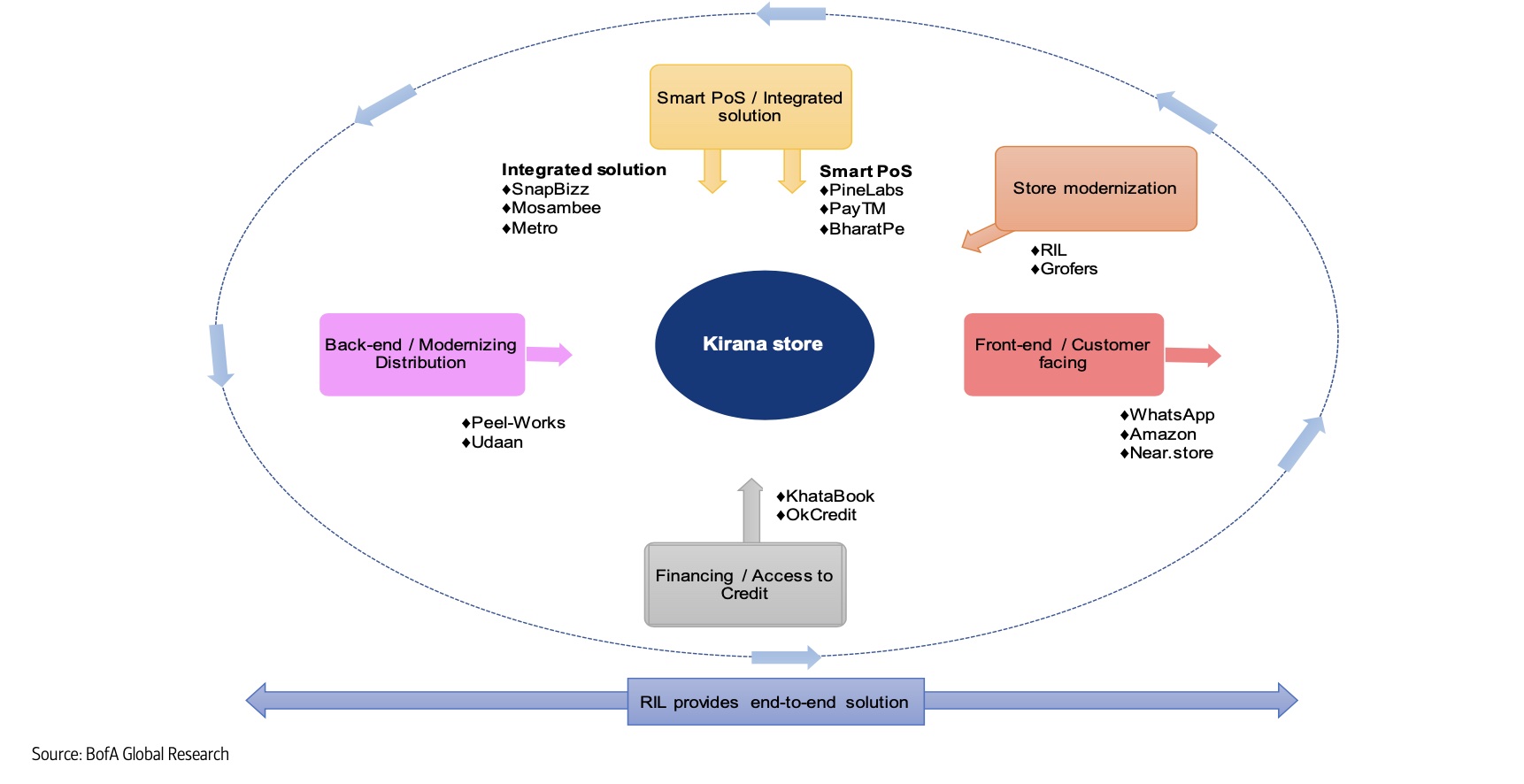
Scores of giants and startups are attempting to serve neighborhood stores in India. Image Credits: Bank of America Research

The startup, which serves more than 7 million merchants in over 130 Indian cities, said it has disbursed close to $300 million to merchant partners. It does not charge merchants for universal QR code access, but is looking to make money by lending.

The startup plans to expand its product offerings as well as work with Centrum Financial Services, with which it was recently granted the license by India’s central bank (Reserve Bank of India) to set up a small finance bank. (Centrum Financial Services has collaborated with BharatPe for the license, and the Indian startup says the two are “equal” partners.)

Tuesday’s development further illustrates the growing interest of Tiger Global in India. The New York-headquartered firm has backed dozens of Indian startups, including social commerce startup DealShare, edtech Classplus, Apna (an app that helps blue-collar workers connect with recruiters) and home services platform Urban Company in recent months.

On Tuesday, Infra.Market, an Indian startup that helps construction and real estate companies procure materials and handle logistics for their projects, said it had raised $125 million in a round led also by Tiger Global.
 

03 Aug 2021

Security flaws found in popular EV chargers

U.K. cybersecurity company Pen Test Partners has identified several vulnerabilities in the APIs of six home electric vehicle charging brands and a large public EV charging network. While the charger manufacturers resolved most of the issues, the findings are the latest example of the poorly regulated world of Internet of Things devices, which are poised to become all but ubiquitous in our homes and vehicles.

Vulnerabilities were identified in the API of six different EV charging brands — Project EV, Wallbox, EVBox, EO Charging’s EO Hub and EO mini pro 2, Rolec, and Hypervolt — and public charging network Chargepoint. Security researcher Vangelis Stykas identified several security flaws among the various brands that could have allowed a malicious hacker to hijack user accounts, impede charging, and even turn one of the chargers into a “backdoor” into the owner’s home network.

The consequences of a hack to a public charging station network could include theft of electricity at the expense of driver accounts and turning chargers on or off.

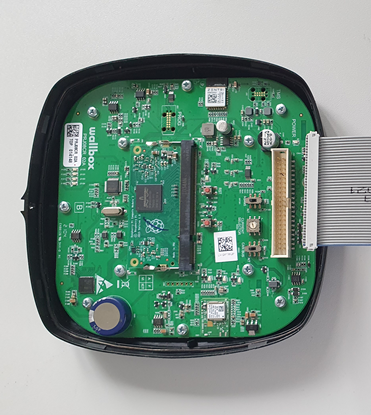
A Raspberry Pi in a Wallbox charger. (Image: Pen Test Partners (opens in a new window))

Some EV chargers used a Raspberry Pi compute module, a low-cost computer that’s often used by hobbyists and programmers.

“The Pi is a great hobbyist and educational computing platform, but in our opinion it’s not suitable for commercial applications as it doesn’t have what’s known as a ‘secure bootloader’,” Pen Test Partners founder Ken Munro told TechCrunch. “This means anyone with physical access to the outside of your home (hence to your charger) could open it up and steal your Wi-Fi credentials. Yes, the risk is low, but I don’t think charger vendors should be exposing us to additional risk.”

The hacks are “really fairly simple,” Munro said. “I can teach you to do this in five minutes,” he added.

The company’s report, published this past weekend, touched on vulnerabilities associated with emerging protocols like the Open Charge Point Interface, maintained and managed by the EVRoaming Foundation. The protocol was designed to make charging seamless between different charging networks and operators.

Munro likened it to roaming on a cell phone, allowing drivers to use networks outside of their usual charging network. OCPI isn’t widely used at the moment, so these vulnerabilities could be designed out of the protocol. But if left unaddressed, it could mean “that a vulnerability in one platform potentially creates a vulnerability in another,” Stykas explained.

Hacks to charging stations have become a particularly nefarious threat as a greater share of transportation becomes electrified and more power flows through the electric grid. Electric grids are not designed for large swings in power consumption — but that’s exactly what could happen, should there be a large hack that turned on or off a sufficient number of DC fast chargers.

“It doesn’t take that much to trip the power grid to overload,” Munro said. “We’ve inadvertently made a cyberweapon that others could use against us.”

The “Wild West” of cybersecurity

While the effects on the electric grid are unique to EV chargers, cybersecurity issues aren’t. The routine hacks reveal more endemic issues in IoT devices, where being first to market often takes precedence over sound security — and where regulators are barely able to catch up to the pace of innovation.

“There’s really not a lot of enforcement,” Justin Brookman, the director of consumer privacy and technology policy for Consumer Reports, told TechCrunch in a recent interview. Data security enforcement in the United States falls within the purview of the Federal Trade Commission. But while there is a general-purpose consumer protection statute on the books, “it may well be illegal to build a system that has poor security, it’s just whether you’re going to get enforced against or not,” said Brookman.

A separate federal bill, the Internet of Things Cybersecurity Improvement Act, passed last September but only broadly applies to the federal government.

There’s only slightly more movement on the state level. In 2018, California passed a bill banning default passwords in new consumer electronics starting in 2020 — useful progress to be sure, but which largely puts the burden of data security in the hands of consumers. California, as well as states like Colorado and Virginia, also have passed laws requiring reasonable security measures for IoT devices.

Such laws are a good start. But (for better or worse) the FTC isn’t like the U.S. Food and Drug Administration, which audits consumer products before they hit the market. As of now, there’s no security check on technology devices prior to them reaching consumers. Over in the United Kingdom, “it’s the Wild West over here as well, right now,” Munro said.

Some startups have emerged that are trying to tackle this issue. One is Thistle Technologies, which is trying to help IoT device manufacturers integrate mechanisms into their software to receive security updates. But it’s unlikely this problem will be fully solved on the back of private industry alone.

Because EV chargers could pose a unique threat to the electric grid, there’s a possibility that EV chargers could fall under the scope of a critical infrastructure bill. Last week, President Joe Biden released a memorandum calling for greater cybersecurity for systems related to critical infrastructure. “The degradation, destruction, or malfunction of systems that control this infrastructure could cause significant harm to the national and economic security of the United States,” Biden said. Whether this will trickle down to consumer products is another question.

03 Aug 2021

Fleet your last Fleet — The Twitter feature vanishes today

You don’t know what you’ve got ’til it’s gone.

After a fittingly fleeting time in the wild, Twitter is banishing its ephemeral stories feature known as Fleets, which debuted in November 2020.

Twitter began testing Fleets back in March of last year. The company thought that it might be able to lure people who were hesitant about collecting their stray thoughts into the platform’s semi-permanent format with a “lower-pressure” kind of a tweet. Many major social platforms have some form of disappearing content, so it made sense that Twitter would give things a try too — but after eight months live, Twitter is killing the feature.

Like Instagram Stories, Fleets lived on top of the timeline, highlighted in their own dedicated space. As fleets phase out, Spaces, Twitter’s Clubhouse-like audio rooms, will occupy the same slot in the app.

The company hoped that Fleets would bring new users under its wing, but the only people who really adopted the new feature were apparently already Twitter diehards. Twitter said it would go back to the drawing board to figure out how to get more people participating on Twitter and Fleets were an unfortunate casualty of that realization.

“If we’re not evolving our approach and winding down features every once in a while – we’re not taking big enough chances,” Twitter Consumer Product VP Ilya Brown said in a blog post.

We can only hope that Twitter’s future products continue the gay sex naming scheme that the company accidentally introduced when it named Fleets “fleets.” (Congrats, gay former intern!)

To the company’s chagrin, the feature’s swift demise apparently inspired more enthusiasm for the product than Fleets had enjoyed previously. Twitter’s tweet announcing the death of Fleets also somehow turned into an iconic enough moment that the company made it into a collectible hoodie that reads “We’re sorry or you’re welcome,” ensuring that Fleets will live on in our hearts until we inevitably forget they ever existed — perhaps the most fitting tribute of all.

03 Aug 2021

A Silicon Valley VC firm with $1.8B in assets was hit by ransomware

Advanced Technology Ventures, a Silicon Valley venture capital firm with more than $1.8 billion in assets under its management, was hit by a ransomware attack in July that saw cyber-criminals steal personal information on the company’s private investors, or limited partners (LPs).

In a letter to the Maine attorney general’s office, ATV said it became aware of the attack on July 9 after its servers storing financial information had been encrypted by ransomware. By July 26, the ATV learned that data had been stolen from the servers before the files were encrypted, a common “double extortion” tactic used by ransomware groups, which then threaten to publish the files online if the ransom to decrypt the files is not paid.

The letter said ATV believes the names, email addresses, phone numbers, and Social Security numbers of the individual investors in ATV’s funds were stolen in the attack. Some 300 individuals were affected by the incident, including one person in Maine, according to a listing on the Maine attorney general’s data breach notification portal.

Venture capital firms often do not disclose all of their LPs — the investors who have thrown millions into an investment vehicle — to the public. A number of pre-approved names may be included in an announcement, but overall, a company’s private investors try to stay that way: private. The reasons vary, but it comes down to secrecy and a degree of competitive advantage: the firm may not want competitors to know who is backing them, and an investor may not want others to know where their money is going. This particular attack likely stole key information on a hush-hush part of how venture money works.

ATV said notified the FBI about the attack. A spokesperson for the FBI did not immediately comment when reached by TechCrunch. ATV’s managing director Mike Carusi did not respond to questions sent by TechCrunch on Monday.

The venture capital firm, based in Menlo Park, California with offices in Boston, was founded in 1979 and invests largely in technology, communications, software and services, and healthcare technology. The company was an early investor in many of the startups from the last decade, like software library Fandango, Host Analytics (now Planfun) and Apptegic (now Evergage). Its more recent investments include Tripwire, which was later sold to cybersecurity company Belden for $710 million; Cedexis, a network traffic monitoring startup acquired by Cisco in 2018; and Actifo, which was sold to Google in 2020.


Natasha Mascarenhas contributed reporting. Send tips securely over Signal and WhatsApp to +1 646-755-8849. You can also send TechCrunch files or documents using our SecureDrop.

03 Aug 2021

A Silicon Valley VC firm with $1.8B in assets was hit by ransomware

Advanced Technology Ventures, a Silicon Valley venture capital firm with more than $1.8 billion in assets under its management, was hit by a ransomware attack in July that saw cyber-criminals steal personal information on the company’s private investors, or limited partners (LPs).

In a letter to the Maine attorney general’s office, ATV said it became aware of the attack on July 9 after its servers storing financial information had been encrypted by ransomware. By July 26, the ATV learned that data had been stolen from the servers before the files were encrypted, a common “double extortion” tactic used by ransomware groups, which then threaten to publish the files online if the ransom to decrypt the files is not paid.

The letter said ATV believes the names, email addresses, phone numbers, and Social Security numbers of the individual investors in ATV’s funds were stolen in the attack. Some 300 individuals were affected by the incident, including one person in Maine, according to a listing on the Maine attorney general’s data breach notification portal.

Venture capital firms often do not disclose all of their LPs — the investors who have thrown millions into an investment vehicle — to the public. A number of pre-approved names may be included in an announcement, but overall, a company’s private investors try to stay that way: private. The reasons vary, but it comes down to secrecy and a degree of competitive advantage: the firm may not want competitors to know who is backing them, and an investor may not want others to know where their money is going. This particular attack likely stole key information on a hush-hush part of how venture money works.

ATV said notified the FBI about the attack. A spokesperson for the FBI did not immediately comment when reached by TechCrunch. ATV’s managing director Mike Carusi did not respond to questions sent by TechCrunch on Monday.

The venture capital firm, based in Menlo Park, California with offices in Boston, was founded in 1979 and invests largely in technology, communications, software and services, and healthcare technology. The company was an early investor in many of the startups from the last decade, like software library Fandango, Host Analytics (now Planfun) and Apptegic (now Evergage). Its more recent investments include Tripwire, which was later sold to cybersecurity company Belden for $710 million; Cedexis, a network traffic monitoring startup acquired by Cisco in 2018; and Actifo, which was sold to Google in 2020.


Natasha Mascarenhas contributed reporting. Send tips securely over Signal and WhatsApp to +1 646-755-8849. You can also send TechCrunch files or documents using our SecureDrop.

03 Aug 2021

Anonymous Snapchat app Sendit surges with 3.5M installs after Snap bans Yolo and LMK

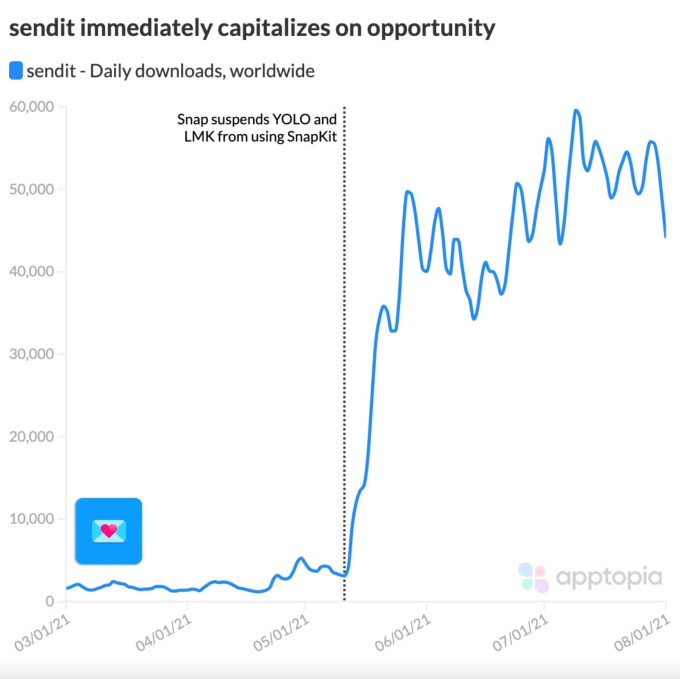
In May of this year, Snap banned two Snapchat platform apps that allowed users to send anonymous messages, Yolo and LMK, following a lawsuit filed on behalf of a mother whose son died by suicide after being bullied through messages on the apps for many months. In the wake of Snap’s ban, another anonymous messaging app called Sendit has been rising in the app stores’ charts, as Snapchat’s younger users sought a replacement for the apps the company blocked.

Since the news of the ban was first reported over 80 days ago, Sendit’s app has seen more than 3.5 million installs across iOS and Android, according to app intelligence firm Apptopia.

This is a rapid pace of installs compared with how quickly it grew while Yolo and LMK were active on the market. In the same period before the news was announced, Sendit had only seen seen 180,000 installs across iOS and Android, Apptopia says.

Image Credits: Apptopia

Sendit also received few user reviews before May 11, 2021. But in the days that followed the ban, “yolo” has become the second-most-used keyword in Sendit’s user reviews, Apptopia told TechCrunch. Most of these reviews are positive, saying the app is like “Yolo but better,” for instance. In other words, Snap’s ban hasn’t stamped out demand for anonymous Snapchat Q&A apps, it only crowned a new app as the market leader.

Sendit today is currently ranking No. 3 among Lifestyle apps on Apple’s U.S. App Store and has climbed to No. 57 on the App Store’s list of top free apps. It jumped three ranks overnight from Monday to Tuesday, in fact.

Like Yolo and LMK, Sendit also features a popular teen activity on Snapchat, anonymous Q&As. The app also includes other Lens games, like “Never Have I Ever,” “This or That,” “Kiss, Marry, Block” and others.

To be clear, none of these are official Snapchat applications. Instead, they integrate with a toolkit for third-party developers called Snap Kit, which allows them to create new product experiences that work with Snapchat’s best features, like Stories, Bitmoji, the Snapchat Camera and more.

Snap says its Snap Kit developers have to agree to its Terms of Service, which requires apps to prioritize user safety and take action on any reports of abuse. Those guidelines are meant to encompass any reports of bullying, harassment, hate speech or threats taking place on the third-party services. In addition, apps that offer friend finding, user-generated content and anonymous features are supposed to inform Snap of their moderation practices and customer support response times.

Image Credits: Screenshot of public App Store review of sendit; username redacted

In practice, however — as the lawsuit highlighted — there appears to be an issue with how well those terms are enforced on Snap’s end. The company tells us that it’s continuing to review developers to ensure their compliance. It has yet to announce any policy changes as result of that investigation, but some child advocates would argue that anonymous apps should have no place in a teenager’s life at all.

Even before the Snap lawsuit, apps like Yolo and LMK had raised concerns among child advocates and parents alike. For example, nonprofit Common Sense Media, an independent source for media recommendations and advice for families, pointed out that “anonymity on social media can easily lead teens down a slippery slope of poor choices.” The organization said that while teens will be drawn to the excitement of responding anonymously — perhaps learning that someone might have a crush on them — “hiding behind anonymity can also bring out hatefulness and sexually explicit risk taking.”

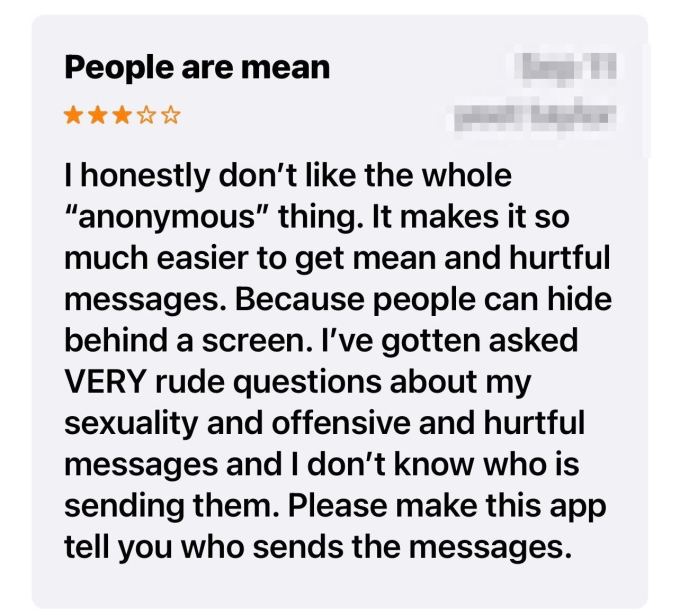
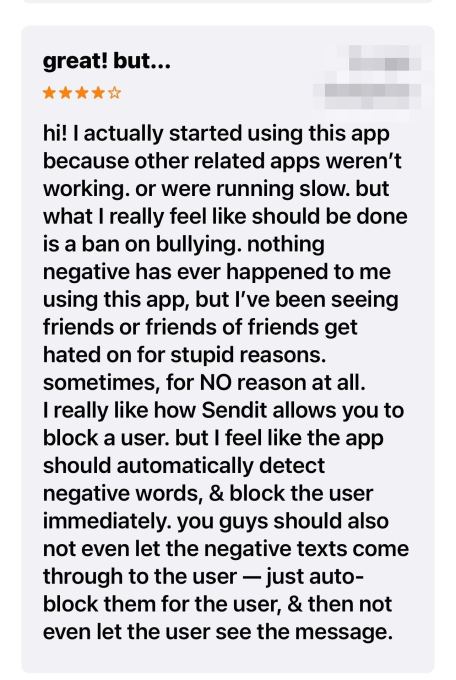
Sendit’s App Store reviews (see photos) indicate that is, indeed, taking place. (Sendit didn’t respond to a request for more information about its app’s operations.)

Image Credits: Screenshot of public App Store review of sendit; username redacted

The tech industry is littered with anonymous social apps that failed due to issues with cyberbullying. After numerous teen suicides related to Ask.fm’s anonymous platform, its owner IAC sold off the toxic property to an asset management firm. Other high-profile anonymous app failures include Secret, which became a home to cyberbullying; Sarahah, which was banned by the app stores and later pivoted; Yik Yak, whose founders left for Square after the app became plagued by cyberbullying; and After School, which also got kicked out of the App Store. To date, only anonymous platforms like Glassdoor and Blind, which focus on workplace chatter and career advice, have seemed to thrive.

The question for Snap to decide now is not just how it will enforce its terms on anonymous apps, but whether it’s worth allowing anonymous apps to operate given their documented dangers — and their potential tragic, as well as legal, consequences.

If you or someone you know is struggling with depression or has had thoughts of harming themselves or taking their own life, The National Suicide Prevention Lifeline (1-800-273-8255) provides 24/7, free, confidential support for people in distress, as well as best practices for professionals and resources to aid in prevention and crisis situations.

03 Aug 2021

Anonymous Snapchat app Sendit surges with 3.5M installs after Snap bans Yolo and LMK

In May of this year, Snap banned two Snapchat platform apps that allowed users to send anonymous messages, Yolo and LMK, following a lawsuit filed on behalf of a mother whose son died by suicide after being bullied through messages on the apps for many months. In the wake of Snap’s ban, another anonymous messaging app called Sendit has been rising in the app stores’ charts, as Snapchat’s younger users sought a replacement for the apps the company blocked.

Since the news of the ban was first reported over 80 days ago, Sendit’s app has seen more than 3.5 million installs across iOS and Android, according to app intelligence firm Apptopia.

This is a rapid pace of installs compared with how quickly it grew while Yolo and LMK were active on the market. In the same period before the news was announced, Sendit had only seen seen 180,000 installs across iOS and Android, Apptopia says.

Image Credits: Apptopia

Sendit also received few user reviews before May 11, 2021. But in the days that followed the ban, “yolo” has become the second-most-used keyword in Sendit’s user reviews, Apptopia told TechCrunch. Most of these reviews are positive, saying the app is like “Yolo but better,” for instance. In other words, Snap’s ban hasn’t stamped out demand for anonymous Snapchat Q&A apps, it only crowned a new app as the market leader.

Sendit today is currently ranking No. 3 among Lifestyle apps on Apple’s U.S. App Store and has climbed to No. 57 on the App Store’s list of top free apps. It jumped three ranks overnight from Monday to Tuesday, in fact.

Like Yolo and LMK, Sendit also features a popular teen activity on Snapchat, anonymous Q&As. The app also includes other Lens games, like “Never Have I Ever,” “This or That,” “Kiss, Marry, Block” and others.

To be clear, none of these are official Snapchat applications. Instead, they integrate with a toolkit for third-party developers called Snap Kit, which allows them to create new product experiences that work with Snapchat’s best features, like Stories, Bitmoji, the Snapchat Camera and more.

Snap says its Snap Kit developers have to agree to its Terms of Service, which requires apps to prioritize user safety and take action on any reports of abuse. Those guidelines are meant to encompass any reports of bullying, harassment, hate speech or threats taking place on the third-party services. In addition, apps that offer friend finding, user-generated content and anonymous features are supposed to inform Snap of their moderation practices and customer support response times.

Image Credits: Screenshot of public App Store review of sendit; username redacted

In practice, however — as the lawsuit highlighted — there appears to be an issue with how well those terms are enforced on Snap’s end. The company tells us that it’s continuing to review developers to ensure their compliance. It has yet to announce any policy changes as result of that investigation, but some child advocates would argue that anonymous apps should have no place in a teenager’s life at all.

Even before the Snap lawsuit, apps like Yolo and LMK had raised concerns among child advocates and parents alike. For example, nonprofit Common Sense Media, an independent source for media recommendations and advice for families, pointed out that “anonymity on social media can easily lead teens down a slippery slope of poor choices.” The organization said that while teens will be drawn to the excitement of responding anonymously — perhaps learning that someone might have a crush on them — “hiding behind anonymity can also bring out hatefulness and sexually explicit risk taking.”

Sendit’s App Store reviews (see photos) indicate that is, indeed, taking place. (Sendit didn’t respond to a request for more information about its app’s operations.)

Image Credits: Screenshot of public App Store review of sendit; username redacted

The tech industry is littered with anonymous social apps that failed due to issues with cyberbullying. After numerous teen suicides related to Ask.fm’s anonymous platform, its owner IAC sold off the toxic property to an asset management firm. Other high-profile anonymous app failures include Secret, which became a home to cyberbullying; Sarahah, which was banned by the app stores and later pivoted; Yik Yak, whose founders left for Square after the app became plagued by cyberbullying; and After School, which also got kicked out of the App Store. To date, only anonymous platforms like Glassdoor and Blind, which focus on workplace chatter and career advice, have seemed to thrive.

The question for Snap to decide now is not just how it will enforce its terms on anonymous apps, but whether it’s worth allowing anonymous apps to operate given their documented dangers — and their potential tragic, as well as legal, consequences.

If you or someone you know is struggling with depression or has had thoughts of harming themselves or taking their own life, The National Suicide Prevention Lifeline (1-800-273-8255) provides 24/7, free, confidential support for people in distress, as well as best practices for professionals and resources to aid in prevention and crisis situations.

03 Aug 2021

Google Maps on iOS adds live location sharing in iMessage, home screen widget, and dark mode

Google Maps announced today three feature updates to its iOS app. With live location sharing in the iMessage app, a traffic widget for the home screen, and dark mode, Google Maps is poising itself as a stronger competitor against iOS’ native Apple Maps.

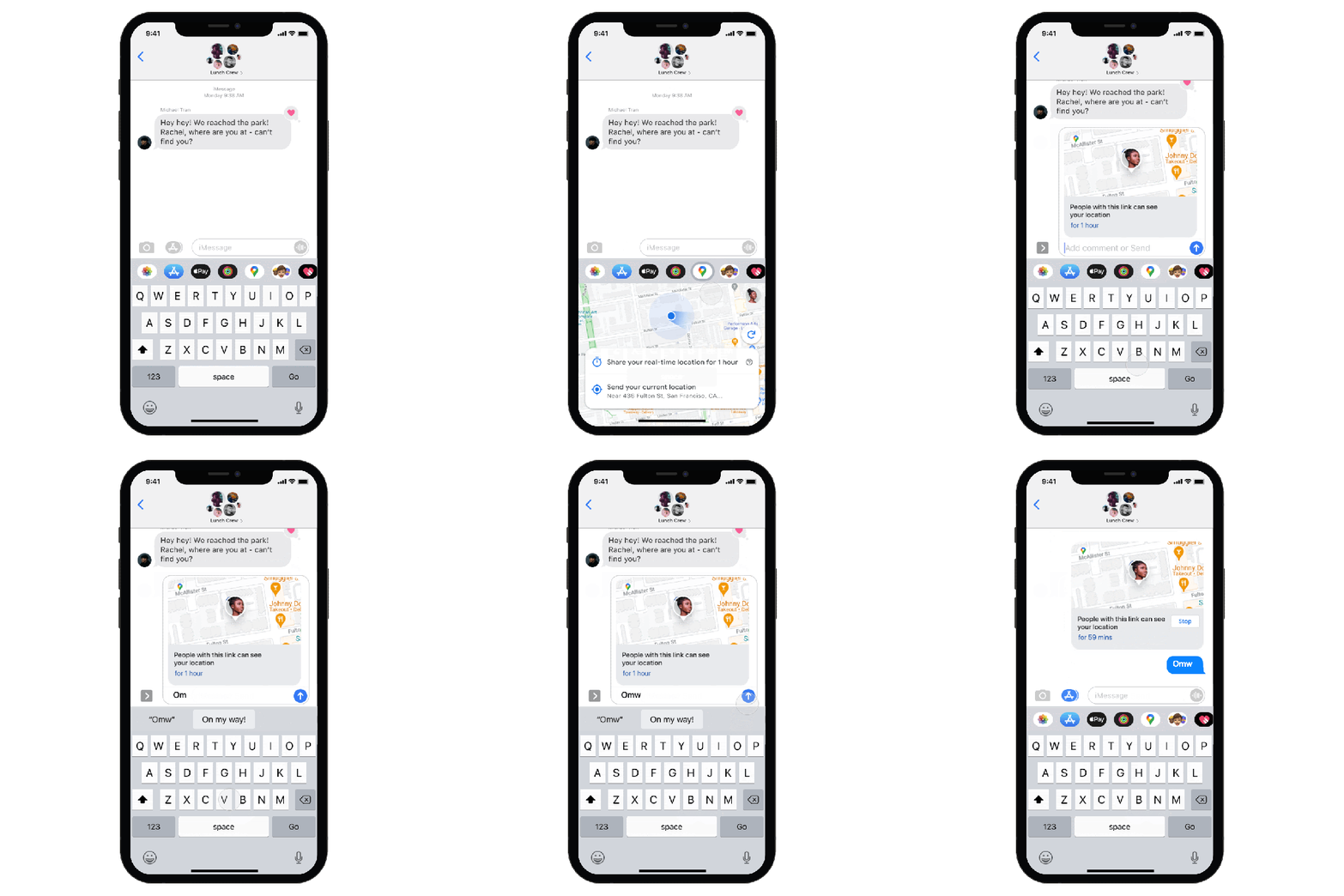
Live location sharing was already possible in Google Maps — by tapping on the blue dot that shows where you are, you can share with select friends your ETA to your destination, and even how much battery life your phone has. But the Google Maps iMessage widget makes it easier to share your location without navigating away from your conversation. By default, Google Maps will share your location for one hour, but it’s possible to extend to up to three days — if you want to stop sharing, tap the “stop” button on the thumbnail.

Image Credits: Google Maps

Google Maps’ existing iMessage widget allows users to send GPS coordinates of their location in iMessage — but if you’re trying to meet up with friends, this wouldn’t be as useful as sharing a live location. Apple Maps already has a similar feature built into iMessage, so Google is taking a leaf out of Apple’s book to try to beat them on their own app. For a long time, Google Maps was widely considered to be the superior navigation app, but in 2018, Apple completely rebuilt Maps from the ground up, making it more competitive. Plus, as iOS 15 rolls out, Apple Maps will add AR functionality, better public transit features, more detailed maps, and other improvements.

Google Maps added Waze-like traffic and incident report features to its app in 2019, which made it more appealing for driving commuters — the app says that one of its “most powerful features is the ability to see live traffic conditions in an area.” Now, users with the latest Google Maps app will be able to add a traffic widget to their home screen, which can quickly share what traffic is like in their area. The widget also allows users to set frequent destinations, like home, work, or the gas station, and navigate to those places with just a tap. Though the app already has dark mode on Android, this feature will also roll out to iOS users in the coming weeks.

As Google Maps and Apple Maps compete to become the best navigation app, an unlikely competitor comes in Snapchat, which has created a more social experience on its Snap Map. Last week, Snapchat added the My Places feature to the Snap Map, which helps users find new spots to visit based on the activity of other users in their area. The ephemeral messaging app also announced at the end of July that during Q2 of 2021, the platform grew both revenue and daily active users at the highest rates it has achieved in the last four years. Still, as of last year, Google Maps had over 1 billion worldwide users.

03 Aug 2021

FandangoNOW and Vudu merge into a new streaming service with titles to rent, buy or stream free

Last year, movie ticketing and discovery business Fandango, a division of NBCUniversal, bought the on-demand video streaming service Vudu from Walmart, after the retailer had failed to capitalize on the service it had first acquired in 2010 for $100 million. Today, Fandango is taking the next steps with Vudu by merging the service with its existing streaming platform, FandangoNOW. The newly combined service will continue to use the name Vudu and will feature over 200,000 new release and catalog movies and TV shows to rent or buy without a subscription, as well as “thousands” of free-to-stream titles.

The company tells us it chose to stick with “Vudu” as its name because it’s already a popular brand with a loyal following and is significantly larger than the FandangoNOW service.

Despite the changes coming to the service, existing FandangoNOW customers won’t lose access to any of the content they already purchased. Both their movies and TV series will be automatically transferred over to the new Vudu service starting today.

Currently, Vudu’s on-demand library competes with Apple iTunes, Amazon Prime Video, and Google Play/YouTube, as well as similar services from various telecos. In particular, these types of services appeal to those who want to watch new releases and have the option to own favorite movies and shows — rather than subscribe to services where such content comes and goes as licensing deals expire.

At launch, the newly merged Vudu will include new releases like “F9: The Fast Saga,” Pixar’s “Luca,” “The Conjuring: The Devil Made Me Do It,” “Peter Rabbit 2,” “The Hitman’s Wife’s Bodyguard,” “A Quiet Place Part II,” Disney’s “Cruella,” “Godzilla vs. Kong,” “In the Heights” and others. Next Tuesday, it will also gain access to Marvel Studios’ “Black Widow” — the title that’s now the subject of a breach of contract lawsuit filed on behalf of actress Scarlett Johansson, who’s suing Disney for sending what was supposed to be a theatrical release directly to its streaming service Disney+ on opening day.

Image Credits: Fandango

Many titles are available in 4K Ultra HD, and support formats such as Dolby Atmos and Dolby Vision, the company notes.

Vudu already has a large, built-in audience for its movie and TV marketplace. Fandango claims the service has over 60 million registered users and reaches “millions” on a daily basis.

By way of its expansive platform support, it’s capable of reaching over 75 million U.S. TV-connected device households, per NPD Group data. This includes Vudu’s support for Samsung, LG and Vizio Smart TVs; the Roku platform, Amazon Fire TV, Apple TV, Xfinity X1 and Xfinity Flex, PlayStation, Xbox, Tivo, and others.

Following the merger and rebranding, the new Vudu service will also take FandangoNOW’s place as the official movie store on the Roku platform, where consumers can rent or purchase using Roku Pay.

Vudu joins Fandango’s existing digital network, which will continue to include Fandango’s movie ticketing business, MovieTickets.com, Flixster, Movieclips, and Rotten Tomatoes. While the merger of the two services at least clears up some overlap within the Fandango division, NBCU parent company Comcast continues to have its own overlap issues when it comes to streaming. Comcast acquired ad-supported streaming service Xumo in February 2020 and, via NBCU, runs the year-old streaming service Peacock. As of yet, it hasn’t made any moves to centralize those efforts.

03 Aug 2021

EdTech startup bina raises $1.4M to teach 4 to 12-year-olds, launch School-as-a-Service

With the pandemic wreaking havoc amongst early years education amid school lockdowns, it’s no wonder EdTech startups have piled into the space. But it’s also served to highlight the abysmal nature of earl years teaching: Some 40 million teachers across the globe are leaving the sector, according to to the World Bank. Of the 1.5 billion primary-age children, only a few can access high-quality education, and approximately 58 million primary-age children are out of education, most of whom are girls

So the opportunity to make a difference, using online teaching, in these very young years is great, because classes sizes can be reduced online, and the quality of teaching improved.

This is the idea behind bina, which bills itself as a “digital primary education ecosystem”. It’s now raised $1.4M to aim at the education of 4 to 12-year-olds.

The funding round was led by Taizo Son, one of Japan’s billionaires. Other investors and advisors include Jutta Steiner, Founder at Parity Technologies, the company behind Polkadot decentralized protocol, and Lord Jim Knight, Ex-Minister of Education (UK).

Bina’s ‘schtick’ is that is has very small online class sizes of 6 students (3x smaller than the OECD average).

It also boasts of “adaptive learning paths” that cover international standards; teachers with a minimum of 8 years of digital teaching experience; and data-driven decision making for its pedagogical approach. 


Noam Gerstein, bina’s CEO and founder said: “I’ve interviewed students, teachers, and parents globally for years, and it is clear a new systemic design is needed. With our founding families, we are building a world in which every child has access to quality education, educators’ skills are valued and continuously developed, and parents don’t need to choose between their work and family life.”
 
He says it also grants pupils company shares (RSUs) as they grow with the school. Currently available to English-speaking students in the CET timezone, the bina School is planning a SaaS product for governments, NGOs and school systems.

“We right now compete against companies like Outschool, Pearson’s online Academy, primer and Prisma,” he told me over a call. “So these are the big names of the last year for the first phase. But the strategy is that we’re building it in two phases. The first phase is actually building a school that we operate as a ‘lab’ school. And the second phase is what we call ‘bina as a service’. So it’s a SaaS ‘school as a service’. The idea is that we offer collaboration with NGOs and governments, doing accreditation and training and licencing of the product. So for that second part we’re actually competing against the big accreditation system.”