Year: 2021

04 Aug 2021

Brazilian digital auto marketplace InstaCarro revs up with $23M in funding

InstaCarro, a digital marketplace that connects used car sellers to dealers in Brazil, has raised $23 million in a Series B round of funding.

Notably, U.S.-based firms co-led the investment, including J Ventures, FJ Labs and Rise Capital. Spain’s All Iron Ventures and Big Sur also participated in the financing, among others. With the latest round, São Paulo-based InstaCarro has now raised more than $56 million since its 2015 inception.

As we all know, the COVID-19 pandemic led to an increase in people all over the world buying and selling things online, with cars being no exception. InstaCarro plans to use its new capital in part to capitalize on the shift and “aggressively” expand its reach within Brazil.

Until this year, the startup operated only in São Paulo. In the first half of this year, it launched operations in eight new cities, and is now also live in Campinas, Curitiba, Joinville, Santos, Brasília, Goiânia, Rio de Janeiro and Belo Horizonte.

For context, the startup compares itself to Carvana in the U.S., Chehaoduo in India and Carro in Indonesia. 

CEO Luca Cafici started InstaCarro after having co-founded a car classified startup in Asia with Rocket Internet. That experience, according to Cafici, taught him that “car classifieds were not solving the problems people had when selling their own cars.”

Inspired by the early success of Auto1 in Europe, he decided to return to Latin America to build a similar model, with an exclusive initial focus on Brazil because it is the third largest car market in the world.

Today, InstaCarro is one of the largest used car buyers in Brazil, according to Cafici. Since its inception, the company has transacted more than R$1 billion, or US$193.2 million, working with over 35,000 people seeking to sell their cars to dealers. The startup has been growing 21% month over month since the start of COVID, and has been profitable since 2019. Profitability is up by nearly 10x compared to pre-pandemic levels, Cafici said.

Looking ahead, InstaCarro aims to become a “full-service” car trading platform after hearing from customers that they would be interested in buying a car directly through its platform as well.

Under its current model, the process seems straightforward. When a customer sells their car through InstaCarro, the company comes out to their home to inspect the car, taking more than 150 pictures, and then auctions the car through its network of over 4,000 dealers across Brazil. Customers receive a bid for their car in 24 hours, and InstaCarro pays out the customer the same day and handles all of the paperwork, according to Cafici.

“The auction is a key component to achieve a great price, as there is no agreement on what the true value of a used car is,” he added. “The more dealers you talk with, the higher price you get.” 

The startup also plans to use its new capital to “improve the coverage” of its home inspection model and improve the efficiency of its digital auction process, Cafici said. It, naturally, intends to also do some hiring. InstaCarro has 120 employees, and it plans to double that number by 2022.

Prior to the pandemic, the company had partnered with major supermarket chains to create inspection points. But with the onset of the pandemic, it began inspecting cars at the sellers’ homes, which has proven to help the company move and grow faster, Cafici said.

“The pandemic forced us to reinvent our business model. Before the lockdowns, most of our operations depended on central inspection sites, which we had to shut down overnight in March 2020,” he told TechCrunch. “For our customers, our dealers, and our team, last year was challenging and scary. Our team worked hard to reinvent our business model around home inspections, so that we could continue doing business in a safe way. We started going to our client’s driveway instead of having them come to an inspection site.”

Today, over 90% of the company’s customers choose to do everything online.

John Nordin of J Ventures said his firm was impressed by the way the company shifted its business model after COVID hit and is “now growing faster than ever.”

“We see digital car dealerships finding success in markets across the world, from the U.S. to the U.K., Indonesia and Mexico,” Nordin said. “The team or teams that build a digital car dealership in Brazil have a lot of work cut out for them, not only to figure out how to fit the model to Brazilian consumers, but also to handle the operational challenges of buying and selling a huge volume of cars every day. InstaCarro has the right team to tackle the challenges ahead.”

03 Aug 2021

What Square’s acquisition of Afterpay means for startups

On Sunday Square announced it was gobbling up Afterpay in a deal worth $29 billion at the time of announcement. Alex followed up yesterday with more details on why the deal made sense for Square and Afterpay over here, but we wanted to ask some notable VCs what it means for the startup market.

For context, the Square deal follows a ton of money and interest flowing into the BNPL market. Just this year, VCs have invested in companies like Alma ($59.4 million, January 2021), Scalapay ($48 million, January 2021), Wisetack ($19 million, February 2021), Zilch ($80 million, April 2021) and Dividio ($30 million, June 2021).

Most of the investors we reached out to were generally bullish on the Square and Afterpay integration, but they were less excited about opportunities for other consumer BNPL businesses to emerge.

Then there’s Klarna, which raised $639 million at a post-money valuation of $45.6 billion in June, after raising $1 billion in March at a post-money valuation of $31 billion.

There’s also interest from some major public companies. After a slow start, PayPal is aggressively pushing BNPL services with merchants that offer it as a payment option. And there are reports that Apple is building its own BNPL offering through Apple Pay.

We reached out to Commerce Ventures founder and GP Dan RosenBetter Tomorrow Ventures founding partner Jake Gibson, Fika Ventures partner TX Zhuo, and Matthew Harris of Bain Capital Ventures to see what they thought of the deal, as well as what it might mean for the opportunity for other BNPL companies and startups.

The main takeaways? “Buy now, pay later” may be effective at driving retail conversion, but scale matters and long-term margins look slim for BNPL startups.

Now, let’s hear from the venture community.

The venture view

Why is the BNPL market so hot?

03 Aug 2021

Gig companies take worker classification fight to Massachusetts through ballot initiative

A coalition of app-based ride-hailing and on-demand delivery companies including Lyft, Uber, Doordash and Instacart have filed a petition for a ballot initiative in Massachusetts that would keep gig economy workers classified as independent contractors as the industry takes a fight it won in California on the road.

The ballot measure proposed by the Massachusetts Coalition for Independent Work comes nearly a year after California voters approved a similar measure known as Proposition 22 that pitted labor rights advocates against gig economy companies in a costly multimillion battle.

Lyft, Uber and other members of the coalition, which also includes several local chambers of commerce in the state, said Tuesday they want the ballot question included in the November 2022 election. The question has to pass a legal review and receive enough signatures from voters for it to be included on the ballot.

“While our priority is to find a legislative solution in Massachusetts, this part of our continued efforts to advocate what the vast majority of drivers want — a flexible earning opportunity that our platform provides plus new benefits,” Lyft co-founder John Zimmer said during Lyft’s earnings call Tuesday. ” While we’re pursuing the ballot option, we’re also closely engaged with the Massachusetts State Legislature and are continuing to work with them on a potential legislative solution.”

The coalition said the proposed ballot question would grant app-based ride-hail and delivery workers new benefits such as healthcare stipends while keeping them classified as independent contractors.

Among the provisions that the coalition touted would be an earnings floor equal to 120% of the Massachusetts minimum wage ($18 per hour in 2023 from app-based platforms, before customer tips) and healthcare stipends for drivers who work at least 15 hours per week. Drivers would still keep all of their tips and be guaranteed at least $0.26 per mile to cover vehicle upkeep and gas, according to the coalition.

Labor activists are already pushing back. The Coalition to Protect Workers’ Rights, a group composed of a variety of organizations including the NAACP New England Area Conference, the Union of Minority Neighborhoods and the Massachusetts Immigrant and Refugee Coalition, said Tuesday the ballot measure contains problematic language that will hurt workers.

The group argued there are extensive loopholes that create a subminimum wage for app-based workers and that few qualify for healthcare. It also noted that the measure would remove anti-discrimination protections, eliminates workers’ compensation rules and allows companies to cheat the state unemployment system of hundreds of millions.

While Uber, Lyft and the broader coalition lobbies for either a ballot measure or legislation, it also faces a lawsuit filed last year by the Massachusetts Attorney General Maura Healey who has asked the court to rule that Uber and Lyft drivers are employees under Massachusetts Wage and Hour Laws.

The AG’s Office alleges in its complaint that Uber and Lyft are unable to meet a three-part test under state law that would allow them to classify drivers as independent contractors. To qualify as an independent contractor the worker must be free from a company’s direction and control, perform services outside the usual course of the business and does similar work on their own.

Uber has been signaling since last year that it planned to push for laws similar to the Proposition 22 measure. Uber CEO Dara Khosrowshahi said in November 2020 during an earnings call with analysts that the company will “more loudly advocate for laws like Prop 22.” He later added that it will be a priority of the company “to work with governments across the U.S. and the world to make this a reality.”

03 Aug 2021

WhatsApp photos and videos can now disappear after a single viewing

WhatsApp said that it would soon let users send disappearing photos and videos and this week the feature will be rolling out to everybody. Anyone using the Facebook-owned messaging app can share a photo or video in “view once” mode, allowing a single viewing before the media in question goes poof. Media shared with “view once” selected will show up as opened after the intended audience takes a peek.

The company notes that the new feature could be helpful for an array of needs that definitely aren’t sending nudes, like sharing a photo of some clothes you tried on or giving someone your wifi password. In the fine print, the company would like to remind you that just because the photos or video will vanish, that doesn’t prevent someone from taking a screenshot (and you won’t know if they do).

Facebook says the new feature is a step to give users “even more control over their privacy,” a song it’s been singing since Mark Zuckerberg first declared a new “privacy-focused vision” for the company back in 2019. Facebook has made a few gestures toward letting people wrest control of their online privacy since then, streamlining audience controls on its core app and enabling disappearing messages in WhatsApp.

The company has also been talking a big game about bringing end-to-end encryption to its full stable of messaging services, which it plans to make interoperable in the future. WhatsApp enabled end-to-end encryption by default back in 2016, but for Messenger and Instagram, the hallmark privacy measure could still be years out.

03 Aug 2021

Extra Crunch roundup: Square buys Afterpay, paid search basics, career advice for devs

Square paid around a quarter of its present-day value for Afterpay, Alex Wilhelm notes in The Exchange. That seems like a lot. But was it too much?

“Afterpay brings global revenues, global users and a more diverse merchant network to Square,” Alex notes. “It would have had to spend to derive those assets over time. Square is willing to pay up to snag them now.”

Dana Stalder, a partner at Matrix Partners and Afterpay’s only institutional investor, describes the deal as part of a recurring “critical innovation cycle” in fintech that “determines the winners and losers” for decades to come.

“I’ve never seen a combination that has such potential to deliver extraordinary value to consumers and merchants,” says Stalder. “Even more so than eBay + PayPal.”

Thanks very much for reading Extra Crunch this week!

Walter Thompson
Senior Editor, TechCrunch
@yourprotagonist

The best way to grow your career? Treat it like an app

Decision making: Wooden figurine thinking about the path to take to reach the target

Image Credits: jayk7 (opens in a new window) / Getty Images

Developers may delight in solving complex technical problems, but the problem of a career path is one many don’t think much about, Juniper Networks CTO Raj Yavatkar writes in a guest column.

He offers a solution that should appeal to developers and engineers: “​​Treat career advancement as you would a software project.”

Design expert Scott Tong outlines 4 concepts founders should consider when designing products

Scott Tong

Image Credits: Scott Tong

At Early Stage 2021, design expert Scott Tong shared some ways founders should think about design and branding.

If you can link your brand with your company’s reputation, I think it’s a really great place to start when you’re having conversations about brands. What is the first impression? What are the consistent behaviors that your brand hopes to repeat over and over? What are the memorable moments that stand out and make your brand, your reputation memorable?

You can’t afford to make poor decisions about incentive stock options

If you’re fortunate enough to be considering cashing in on vested stock options, this guest column is worth a read.

“Most companies admit they need to be better at explaining how ISOs work in general, but they can’t legally work one-on-one with employees to help them exercise and sell shares the right way,” Wealthramp’s Pam Krueger and John Chapman write.

“That’s why, when the time is right, many employees actively look for help from a qualified fiduciary financial adviser who can walk these could-be ‘options millionaires’ through various cash-in scenarios.”

Demand Curve: Questions you need to answer in your paid search ads

Retail and technology. Retail as a Service.

Image Credits: metamorworks (opens in a new window) / Getty Images

At some point, almost every early-stage startup will use paid search ads to connect with customers and throw down the gauntlet with their competitors.

Most of these initial attempts at paid search are unsuccessful. There’s a steep learning curve when it comes to transforming passive searchers into paying customers, and almost no one gets it right the first time.

In a comprehensive guest post, growth marketing expert Stewart Hillhouse identified “14 questions your paid search should answer to ensure you’re only paying for the highest-intent shoppers.”

Question 1? “What’s in it for me?”

5 lessons from Duolingo’s bellwether edtech IPO of the year

Image Credits: Duolingo

Duolingo’s debut last week was a bright spot, Alex Wilhelm and Natasha Mascarenhas write, with the language learning app’s stock price landing above a raised IPO range.

Alex and Natasha detail five lessons to take from Duolingo’s flotation:

  1. The IPO event will bring “more sophistication” to Duolingo’s core service.
  2. Roadshow investors didn’t view Duolingo as an edtech company.
  3. China’s edtech crackdown will have a “neutral” impact on Duolingo.
  4. In certain cases, post-COVID growth declines aren’t lethal.
  5. Growth can still absolve rising losses.

Can your startup support a research-based workflow?

Artificial Intelligence Brain

Image Credits: Andriy Onufriyenko (opens in a new window) / Getty Images

In the U.S. alone, yearly spending on AI R&D is expected to reach $100 billion by 2025.

But can your humble startup attract and retain users while it conducts research and product development?

“For obvious reasons, companies want to make things that matter to their customers, investors and stakeholders. Ideally, there’s a way to do both,” says João Graça, CTO and co-founder of Unbabel, an AI-powered language operations platform.

Kodiak Robotics’ founder says tight focus on autonomous trucks is working

don-burnette-founder-kodiak

Image Credits: Bryce Durbin

As part of an ongoing series with transportation startup founders, Rebecca Bellan interviews Kodiak Robotics CEO and co-founder Don Burnette about why the autonomous trucking company remains private when so many of its rivals have gone public.

“I think there’s also lots of opportunity within the VCs and the private markets,” said Burnette.

“Kodiak is one of the only remaining serious AV trucking companies still in the private sector, and so I think that gives us some advantages in a lot of ways.”

How public markets can help address venture capital’s limitations

After interviewing Draper Esprit co-founder Stuart Chapman, Alex Wilhelm and Anna Heim took a look at the trend of European VCs floating themselves.

Traditional VC models “can foist artificial time constraints on investors and force them to focus their deal flow into particular stages for fund-construction reasons,” Alex and Anna write for The Exchange.

“As we found out researching this piece, the public venture model highlights some of these limitations — and may be able to alleviate them in part.”

Robinhood’s CFO says it was ready to go public

After Robinhood failed to burn up the stock charts, Alex Wilhelm wondered why, exactly, the investing and trading app’s IPO didn’t live up to expectations.

He spoke to Robinhood CFO Jason Warnick, who shared a few reasons why it was time for the company to float:

… Warnick indicated that there were a few factors at play, including that Robinhood had built out its leadership team and its internal processes, and that it had worked on user-safety-related tasks and expanded the site’s use cases. All of that is true.

03 Aug 2021

Daily Crunch: For $20/month, crime alert app Citizen will connect users with live ‘safety agents’

To get a roundup of TechCrunch’s biggest and most important stories delivered to your inbox every day at 3 p.m. PDT, subscribe here.

Hello and welcome to Daily Crunch for August 3, 2021. Today we have a delightful mix of news for you, from Twitter product changes to VCs in trouble to megadeals and even some super-early-stage rounds. Let’s have some fun! — Alex

The TechCrunch Top 3

  • Even VCs get hit by ransomware: Sure, less technically savvy folks get hit by malware and ransomware all the time. You don’t really expect better from legacy telcos or underfunded utilities. But when the victim is Advanced Technology Ventures, which has around $1.8 billion in assets under management, the scourge of aggressive cybercrime starts to take on a more sinister flavor. Who is safe? No one?
  • Unfavored Fleets Flee: Twitter’s plan to kill off its Fleets product hit the ground today. It’s gone from our iOS apps. Fleets were fleeting, as everyone has noted, with the lifecycle of the product coming and going in rapid succession. Bad news for Twitter? Not really. Its Stories-like feature wasn’t too popular, and the company has a million other things in the wings, like its subscription service, its live audio product and its newsletter effort.
  • Substack buys Letter: TechCrunch covered this deal today, causing your humble scribe to sit back and think. Why would Substack buy Letter, a platform for written debate? Well, the newsletter-focused startup is big on the written word, and the value thereof. And many well-known Substack authors are controversial in one way or another. You know, the sort of folks you might want to see have a, say, debate? The two products should line up well.

Startups/VC

We’re breaking our startup and venture capital news today into three sections. The first deals with VCs themselves. Then we’ll talk through some mega-rounds and close with some small venture deals worth our time.

  • Moderne Ventures raises $200M: Every first-time venture capital fund wants to get to its second fund. And if they do, to raise a larger fund. From that perspective, things seem to be going well at Moderne, a firm whose second fund is a multiple of the size of its first. And it was oversubscribed. What does the group invest in? Per our own reporting, startups working in the “real estate, finance, insurance and home services industries.”
  • VCs going public is a thing? Yes, it turns out, it is a thing. Several European venture capital funds have gone public in recent quarters, including Draper Esprit moving from the smaller AIM to the main board in London. It turns out that being a public VC can remove certain time constraints that more traditional venture capital firms have to deal with. And regular folks can invest.

Now, some huge rounds:

  • India’s BharatPe raises $370M: Confirming TechCrunch’s previous scoop, fintech unicorn BharatPe is now worth $2.85 billion after Tiger led its most recent round. The company, TechCrunch reports, “operates an eponymous service to help offline merchants accept digital payments and secure working capital.” Given the number of SMBs in India, BharatPe’s TAM is huge. And now it has nigh-infinite capital to use to power its own growth.
  • Rapyd raises $300M for fintech APIs: The fintech world saw not just one huge round today, but two. Rapyd’s $300 million infusion led by Target Global values the firm at around $8.75 billion, per TechCrunch sources. What does Rapyd do? It offers APIs that power wallets, money transfers and card issuing, among other services, helping other companies offer fintech services around the world.
  • Sure, why not, here’s another huge Tiger round from India: More evidence that Tiger is building an index fund of growth-focused private companies the world ’round, and that the Indian startup market is red-hot, Infra.Market announced its third round in nine months today. The $125 million Series D values the Mumbai-based company at $2.5 billion, post-money. Infra.Market builds software to help construction companies get the raw materials they need and handle project logistics.

And then there’s startup news from the earlier side of the market:

  • bina raises $1.4M for kid-focused edtech: bina — the small b is part of its branding — wants to build an online school with small class sizes aimed at 4- through 12-year-olds. Given the huge changes to the global education market in light of COVID-19, it’s a big task.
  • $1.3M for African-focused agtech startup Khula: Providing farmers large and small with software and a marketplace, Khula wants to meet chronic issues in the African farming market with technology.
  • Finally, Aira’s wireless charging tech just raised $12 million: Sure, Apple gave up on AirPower, but Aira is still hard at work on the wireless charging problem set. Which gives us hope, because our phones are always out of batteries, along with our headphones, keyboards and pretty much everything else. It’s not just us, right?
  • Citizen launches its $20/month Protect service: Controversial consumer security startup Citizen’s Protect service is now something that you can buy. Reach that line of communication and the company’s staff will help you handle your emergency. That doesn’t sound too spicy, but as TechCrunch reports “the app made news earlier this year for launching a private ‘personal rapid response service’ fleet of vehicles and a reward for a person wrongly accused of starting a Los Angeles wildfire.”

Embodied AI, superintelligence and the master algorithm

Over the next 18 months, one technologist says the increased adoption of embodied artificial intelligence will open a path to superintelligence — incredibly powerful software that dwarfs anything the human mind could produce.

“All the crazy Boston Dynamics videos of robots jumping, dancing, balancing and running are examples of embodied AI,” says Chris Nicholson, founder and CEO of Pathmind, which uses deep reinforcement learning to optimize industrial operations and supply chains.

“The field is moving fast and, in this revolution, you can dance.”

(Extra Crunch is our membership program, which helps founders and startup teams get ahead. You can sign up here.)

Big Tech Inc.

  • YouTube’s big short push goes live: Alphabet’s Google division has a video product called YouTube that you may have heard of. And the subsidiary’s subsidiary has a $100 million fund that it hopes will drive interest in creating short-form videos for its viewers. TikTok changed the video game, and YouTube’s huge financial response is now live.
  • Google updates its Maps product on iOS: If you use Maps on iOS, which we reckon is around half of you reading this note, good news. Now you can share location more easily in iMessages, use dark mode and get traffic data on your home screen. You are welcome.
  • Nikola warns on EV deliveries: The chip shortage has a new victim. This time it’s Nikola, the troubled EV company that saw its CEO under fire for fraud in recent days. The company was an early SPAC success and now stands as a cautionary tale for the financial mechanism.
  • Marvell buys Innovium for $1.1B: Here’s a neat acquisition story that is also something of a letdown. Innovium, a maker of “networking ethernet switches optimized for the cloud,” per our own reporting, was worth a bit more in its final private round. Still, it’s a big deal and a billion-dollar-plus exit, making it worth our time.

TechCrunch Experts: Growth Marketing

Illustration montage based on education and knowledge in blue

Image Credits: SEAN GLADWELL (opens in a new window) / Getty Images

TechCrunch wants to help startups find the right expert for their needs. To do this, we’re building a shortlist of the top growth marketers. We’ve received great recommendations for growth marketers in the startup industry since we launched our survey.

We’re excited to read more responses as they come in! Fill out the survey here.

Our editorial coverage about growth marketing includes articles from the TechCrunch team, guest columns and posts like “Demand Curve: Questions you need to answer in your paid search ads” by Stewart Hillhouse on Extra Crunch.

03 Aug 2021

Discord now lets you customize your user profile on its apps

For mobile users, Discord is adding one new feature that you’d find on a more traditional social app. The company rolled out an option for users to customize their profiles across its iOS and Android apps Tuesday, following the feature’s release on the desktop version of Discord in late June.

The new option lives in Discord’s user settings menu under “user profile.” There, you can describe what you’re all about in 190 characters or less, including links and emojis. You can also select a custom profile color if the new default profile color that Discord assigned you isn’t vibing with your whole thing. If you don’t see the option yet, check back as the feature rolls out widely.

With the addition of custom profiles, the company also offered premium Nitro subscribers the option to choose an image or an animated GIF as a profile banner. The options have been out in the wild for desktop for a bit now, but the additional customization features will now give anyone who mostly uses Discord on iOS or Android a way to spice things up a bit.

The feature addition is a small, but it’s a step toward the chat app becoming a touch more like more profile-centric social networks. Discord’s chat rooms, known as servers, have long been the platform’s sole focus, but the company has introduced a flurry of quality of life features in recent months.

Discord rolled out threaded, auto-archiving conversations and Clubhouse-like audio event spaces earlier this year, and also picked up a company called Sentropy that makes AI-powered platform moderation software. The app is already a killer service for community-driven voice and text chat, and the recent additions should help the app attract more users well beyond its humble gaming roots.

03 Aug 2021

Lyft reaches adjusted profitability milestone despite continuing net losses

Today after the bell, U.S. ride-hailing company Lyft reported its second quarter financial performance. In aggregate the company’s performance was a rebound from the year-ago second quarter, which was heavily impacted by the onset of the COVID-19 pandemic and resulting lockdowns in the United States.

Lyft also managed to produce positive adjusted EBITDA in the quarter, a profit metric favored by technology upstarts that have yet to generate net income, a stricter method of calculating profitability. Adjusted EBITDA for the second quarter was $23.8 million.

The company’s adjusted EBITDA reached a nadir in Q2 2020, when it totaled -$280 million. Since then Lyft has posted successive gains to adjusted EBITDA in every quarter. The company’s adjusted EBITDA margin came to 3% in its most recent quarter. After promising investors that adjusted profits would come, Lyft delivered.

Shares of Lyft are up nearly 7% in after-hours trading following the company’s financial report.

Lyft reported revenue of $765 million in the second quarter, more than double the $339.3 million million it brought in during the same period last year. While that is remarkable, remember last year at this time the economy and ride-hailing were getting pummeled by the COVID-19 pandemic. In other words, we expected this.

Importantly, Lyft’s Q2 revenue grew 25.6% over last quarter’s of $609 million. That means that despite rising case counts in the United States thanks to the Delta COVID-19 variant, Lyft still managed to grow.

The company said it had 17.1 million active riders in the second quarter, up 97% from the 8.68 million million riders it had on its network in the same period last year. In the first quarter Lyft said it had 13.49 million active riders in the first quarter. The company also saw more revenue per active user in the second quarter ($44.63) than it did in the year-ago Q2 ($39.06). The company’s revenue per active rider metric slipped slightly from its Q1 2021 result of $45.13.

Lyft’s growth bested street expectations, which anticipated revenues of $696.2 million, per Yahoo Finance data. Despite this growth, Lyft is still losing money when all costs are counted. Lyft reported a net loss of $251.9 million in the second quarter, a 42% improvement from the $437.1 million it lost in the same period last year, but still a steeply negative figure.

The company said that net loss for the second quarter includes $207.8 million of stock-based compensation and related payroll tax expenses, and the $20.4 million expense related to the previously disclosed agreement to reinsure certain legacy auto insurance liabilities.

In the second quarter, Lyft’s aggregate spend on cost of revenue related expenses rose, though that was to be expected given how sharply its revenues themselves expanded compared to the year-ago period. The company also managed to curtail G&A costs, and its “operations and support” line item. However, R&D costs and S&M expenses both expanded compared to the year-ago quarter.

Finally on numbers, what about cash? Despite managing to generate positive adjusted EBITDA in the last three months, Lyft operations consumed $37.5 million in cash during the quarter. Lyft’s operations have not generated positive cash flow since Q3 2019. But don’t worry that Lyft is about to run out of funds — it has more than $2 billion in cash to support its growth.

There are signs that Lyft’s business is maturing into something more profitable than it once was. The company’s contribution margin, a non-GAAP figure that is used to indicate profitability of its ride-hailing model sans corporate costs, rose to 59.1% in the second quarter, an all-time record result. In the year-ago period the metric fell to 34.6%, its worst result since Q1 2017.

Lest we all forget, Lyft is now free of its costly autonomous vehicle technology program called Level 5. Lyft sold Level 5 to Toyota’s Woven Planet Holdings.

That doesn’t mean the company isn’t interested in getting into the robotaxi game.

Last month, Lyft announced a partnership with Argo AI and Ford to launch at least 1,000 self-driving vehicles on Lyft’s ride-hailing network in a number of cities over the next five years, starting with Miami and Austin. The first Ford self-driving vehicles, which are equipped with Argo’s autonomous vehicle technology, will become available on Lyft’s app in Miami later this year.

TechCrunch has tuned into the Lyft call and will update this story as needed.

03 Aug 2021

Demand Curve: Tested tactics for growing newsletters

There are very few marketing channels as well rounded as email newsletters. They provide a direct, owned line of communication with your audience; nearly 40x return on investment (~$40 generated per every dollar spent), are infinitely scalable and virtually free.

But to unlock these benefits, you’re going to need to be strategic. In this article, I’m going to share tactics we’ve used at Demand Curve to grow our newsletter list to over 50,000 highly-qualified subscribers and maintain an open rate of over 50%.

Increase popup conversion using the 60% rule

While they’re often thought of as intrusive, pop-ups work. On average, they convert 3% of site visitors, and strategic, high-performing pop-ups can reach conversion of about 10%.

To make higher-converting, less intrusive pop-ups, try the 60% rule.

  1. Choose a page you’d like to put a pop-up on. We recommend pages that aren’t conversion-focused (like product pages, checkout and sign-ups). We’ve found content pages work the best and they can act as a signal for visitors who are looking for something specific.
  2. Open your website’s analytics and see what the average time spent on that page is.
  3. Set your pop-up to appear after 60% of the average time of that page has elapsed.

So if the average time spent on a page is 50 seconds, set your pop-up to appear 30 seconds (60% of total time) after visitors land on that page.

Why 60%? Readers have shown interest in your content, but are nearing the end of their session. Prompting them to join your newsletter to see more relevant content in exchange for their email will feel fair.

To encourage new subscribers to open your welcome email, try breaking the welcome email pattern using delayed gratification and a recognizable sender.

Give samples of your newsletter to prove quality

If a visitor is new to your content, asking them to sign up for your newsletter can be a big step, and most new visitors won’t convert. To narrow the gap between a new reader and subscriber, provide a sample on the sign-up page. Use your most engaging newsletter as a sample to prove that your content is high quality.

To source your most engaging content, filter by open rate and replies. In your email service provider, sort your previous editions by open rate. This will help you identify which subject lines are most popular with existing readers. Modify your most popular subject line to turn it into a header on your newsletter sign-up page.

Next, go into your inbox and sort by replies to your newsletter. Identify which newsletter got the most replies from your readers. This is a positive signal that the content from that edition resonated the most and would be a solid choice for your free sample.
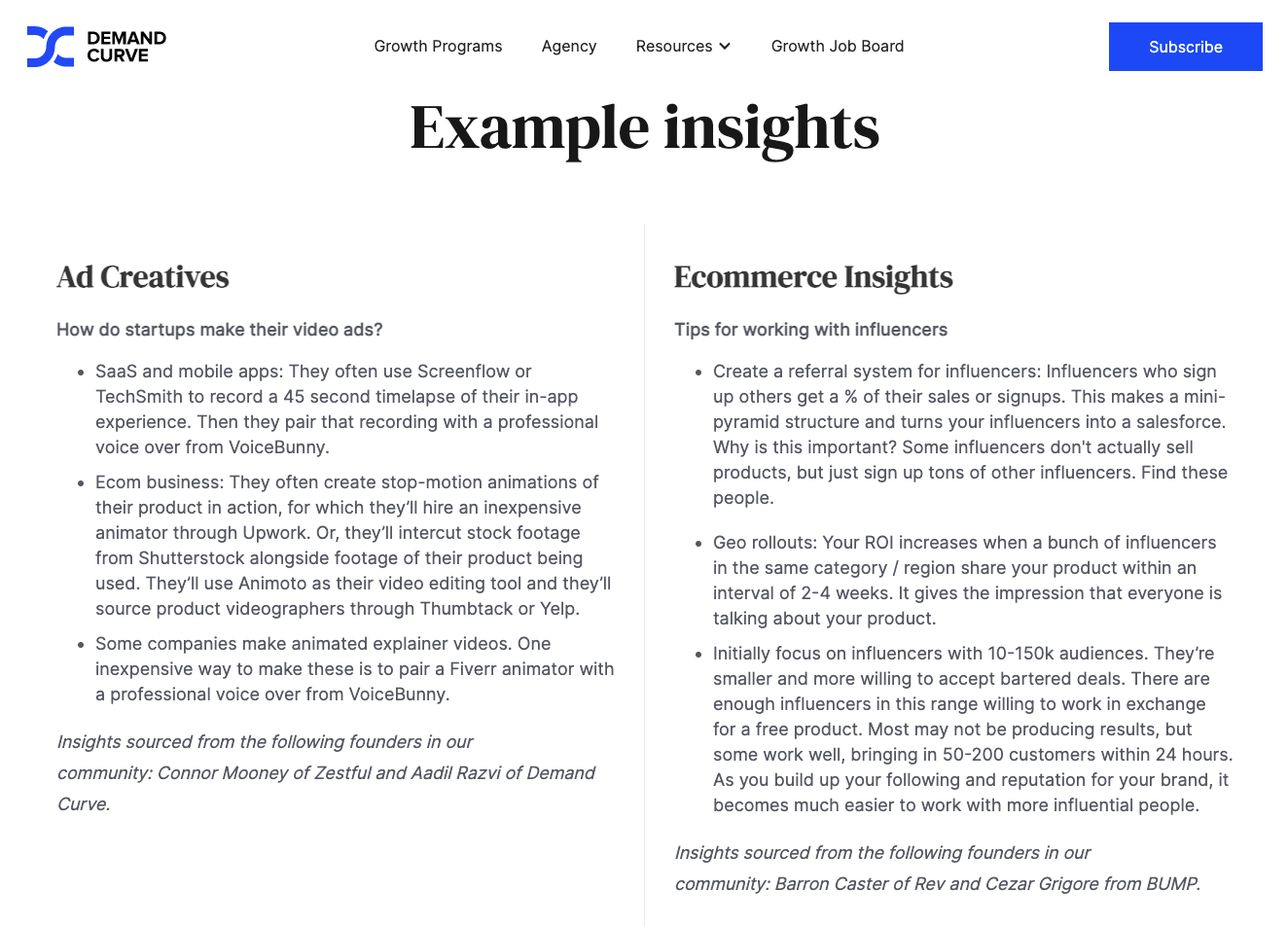
Give samples of your newsletter to prove your quality

Image Credits: Demand Curve

Emails from real people are opened more often

People reflexively ignore welcome emails after they sign up. But, those who do open your welcome email are more likely to consistently open your newsletters.

To encourage new subscribers to open your welcome email, try breaking the welcome email pattern using delayed gratification and a recognizable sender.

Delay your welcome email by 45 minutes. This will bypass the reflex that new subscribers have to ignore an email that pings them seconds after signing up. We’ve found 45 minutes to be ideal, because the delay is long enough that it breaks the pattern, but not so long that your email gets buried in their inbox.

Send your welcome from a person, not from a business account. We’ve found this tactic to be especially effective when the sender is the founder of the business or someone with an established audience. Use a photo of that person and not your company logo to help the email stand out.

To avoid overflowing the sender’s real inbox, create a subdomain for your website that will be used exclusively for sending emails. Create an account for your sender and begin using it for your newsletter. This avoids overwhelming their inbox and maintains the health of your sending domain.
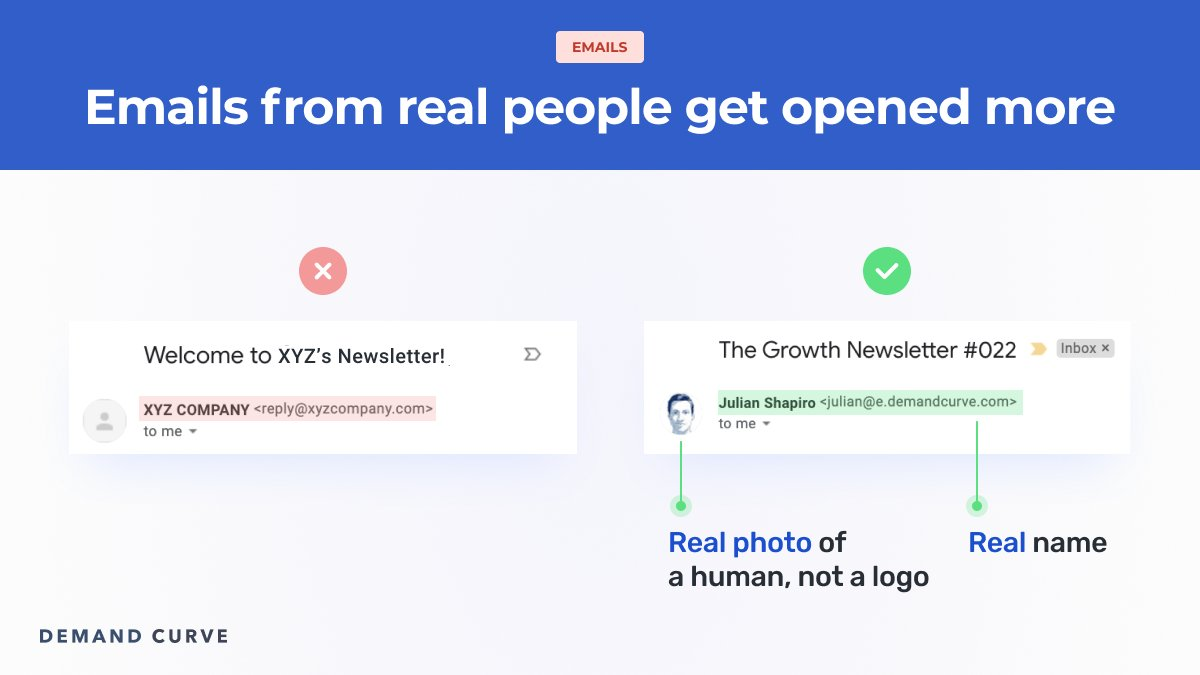
Emails from real people get opened more frequently

Image Credits: Demand Curve

Send a superissue to new subscribers

A new subscriber will be keen to receive their first issue. To ensure they’re satisfied, piece together your best content from past issues into a superissue. But be careful not to use the same content you included as samples on your sign-up page.

Send this first superissue with the welcome email so that your new subscribers are immediately receiving value from your newsletter. Starting with your best content first will get your subscribers excited to open future emails.

We’ve found that shorter welcome emails perform better than long-winded ones. Keep your welcome message short and your opening issue tight. Once they’ve received the welcome email and the first superissue, add them to the regular email cadence.
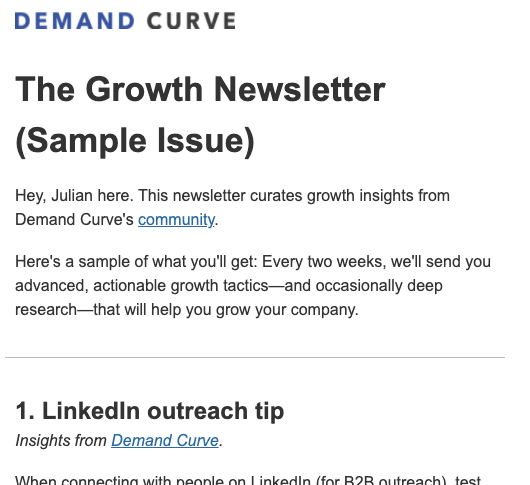
Send a super-issue to new subscribers

Image Credits: Demand Curve

Consider sending fewer emails

We polled over 24,000 marketers on Twitter asking whether people suffer from “newsletter fatigue,” causing them to unsubscribe.

The results: 80% of respondents unsubscribe when they get too many emails.

To avoid overwhelming your subscribers:

Give your subscribers control over how often they are emailed: Some subscribers want them weekly, while others want monthly. In the footer of your email, create opt-out links that allow subscribers to customize the cadence they’ll receive emails. Giving them the opportunity to opt out of frequent emails while still remaining subscribed keeps them as valid contacts on your email list. You want to avoid losing them completely as a subscriber.

Send fewer emails: Putting a constraint on how many emails you’re allowed to send every quarter will force you to be more thoughtful about the contents of those emails. A high volume of emails just for the sake of being in your subscribers’ inbox can burn you and your readers out. We’ve seen very little correlation between volume of emails and the resulting conversion rate.

Make your emails fun — not just educational

Most emails in your inbox are serious. To stand out, consider injecting some lighthearted memes, jokes or interesting links from around the web.

We’ve found this tactic works extremely well, because it gives your readers a dopamine hit in every email. Not every piece of newsletter content you write will resonate with every subscriber. Humor, on the other hand, can have broad appeal. Including interesting and fun content will ensure that every reader is left feeling satisfied.

It also helps build a habit. If every edition is slightly different, your reader will never be sure what they’re opening when a new edition hits their inbox. We’ve found that including something fun at the bottom of the newsletter gives readers a reward: Read the serious stuff, then get rewarded with the fun stuff.

We add a meme to each issue. People reply to tell us how much they appreciate it.
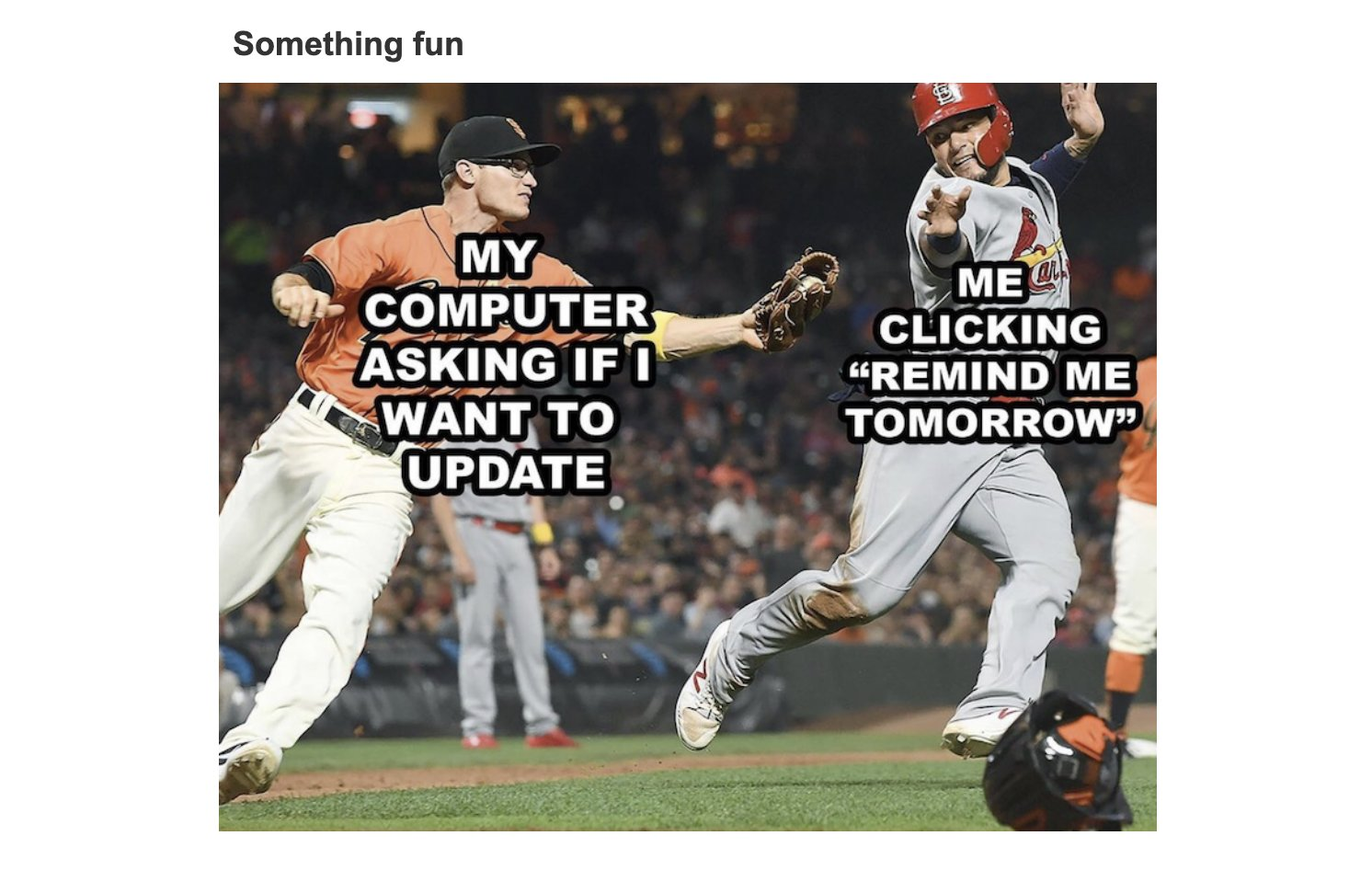
Add a funny meme or interesting content to engage your readers

Image Credits: Demand Curve

Make referrals seamless

Referrals are a free way to grow your newsletter. To increase the chances of subscribers referring you to others, make sure the process takes no longer than 25 seconds.

Remind readers at the end of each issue that they can refer others. A simple way is to ask them to forward the email to a friend who would find it interesting. Include a short sentence in the intro to your newsletter telling people being referred where they can subscribe. Include a link.

An advanced tactic is to include a subscriber’s unique link to a referral program so they can track how many people they’ve invited. Give them the option to share through email or social media.

You should also have a web version of every issue so that your content can be easily shared outside of email. Most email service providers will automatically generate a web link that you can promote through social media or elsewhere. You can also copy the content and post it to your website as a blog post to generate traffic from search engines.

Consider providing rewards to those who refer your newsletter. Merchandise will likely only work as an incentive if your brand is well known or very unique. We suggest incentivizing referrals using exclusive content. Send a monthly bonus issue to subscribers who have referred five or more friends. This will keep your costs down and give your subscribers more of what they already want.

Note that you will need a critical mass of subscribers before referrals will prove to be effective. We’ve found the threshold is about 10,000 subscribers. But if your audience is extremely engaged or the community you serve is active, implementing a free referral program has virtually no downside.

How to turn followers into subscribers

Your subscribers will likely become aware of your content through a social media channel, but social media audiences are rented from the platform — you do not own a direct channel to communicate with them. Converting followers into newsletter subscribers is one way to control a direct line of communication and deepen your relationship with your audience.

When pitching your followers to subscribe to your newsletter, include a link in your bio. This may sound obvious, but many people don’t do it. When someone comes across your social media profile, make signing up for your newsletter the call to action. Otherwise, they’ll have no idea that you even have a newsletter.

You could also cut a Twitter thread or LinkedIn post short and tell people to subscribe for the rest of the insights. You probably don’t want to overuse this tactic.

Create an offer or unique piece of content that can only be accessed through the newsletter. This will motivate your followers to join your email list to get access to exclusive content or unique offers.

Recap

Getting new subscribers: Use pop-ups that are relevant and only to high-intent readers on your site. Provide proof of why they should subscribe to your newsletter with sample content. Make your welcome email stand out and front-load the first issue with your best content.

Keeping subscribers: To keep your subscribers wanting more, send fewer emails. Sprinkle in humor and interesting links to turn your newsletter into a habit.

Promoting your newsletter: Use exclusivity and offers to hook your social media followers into subscribing to your newsletter. Ask your subscribers to refer your newsletter to others to grow your subscriber base.


03 Aug 2021

Embodied AI, superintelligence and the master algorithm

Superintelligence, roughly defined as an AI algorithm that can solve all problems better than people, will be a watershed for humanity and tech.

Even the best human experts have trouble making predictions about highly probabilistic, wicked problems. And yet those wicked problems surround us. We are all living through immense change in complex systems that impact the climate, public health, geopolitics and basic needs served by the supply chain.

Just determining the best way to distribute COVID-19 vaccines without the help of an algorithm is practically impossible. We need to get smarter in how we solve these problems — fast.

Superintelligence, if achieved, would help us make better predictions about challenges like natural disasters, building resilient supply chains or geopolitical conflict, and come up with better strategies to solve them. The last decade has shown how much AI can improve the accuracy of our predictions. That’s why there is an international race among corporations and governments around superintelligence.

In the next year and a half, we’re going to see increasing adoption of technologies that will trigger a broader industry shift, much as Tesla triggered the transition to EVs.

Highly credible think tanks like Deepmind and OpenAI say that the path to superintelligence is visible. Last month, Deepmind said reinforcement learning (RL) could get us there, and RL is at the heart of embodied AI.

What is embodied AI?

Embodied AI is AI that controls a physical “thing,” like a robot arm or an autonomous vehicle. It is able to move through the world and affect a physical environment with its actions, similar to the way a person does. In contrast, most predictive models live in the cloud doing things such as classifying text or images, steering flows of bits without ever moving a body through three-dimensional space.

For those who work in software, including AI researchers, it is too easy to forget the body. But any superintelligent algorithm needs to control a body because so many of the problems we confront as humans are physical. Firestorms, coronaviruses and supply chain breakdowns need solutions that aren’t just digital.

All the crazy Boston Dynamics videos of robots jumping, dancing, balancing and running are examples of embodied AI. They show how far we’ve come from early breakthroughs in dynamic robot balancing made by Trevor Blackwell and Anybots more than a decade ago. The field is moving fast and, in this revolution, you can dance.

What’s blocked embodied AI up until now?

Challenge 1: One of the challenges when controlling machines with AI is the high dimensionality of the world — the sheer range of things that can come at you.