
Year: 2021

04 Aug 2021

Suma Brands raises $150M to acquire more third-party brands for its Amazon roll-up play

Amazon has become a lynchpin in the e-commerce machine over the years in part because it’s a site we consumers can visit to buy just about anything we want — sold either by Amazon or its 5 million+ third-party merchants — and easily get it delivered to our homes. But the system is not completely efficient, and today, one of the startups looking to build more economies of scale is announcing some funding that it will use to roll up and consolidate some of these third-party merchants.

Suma Brands, which buys up what it sees as some of the more interesting and successful brands selling and fulfilling their orders via Amazon, has picked up $150 million in funding, a round led by Pace Capital and Material alongside a credit facility led by i80 Group.

As with other roll-up plays that have raised huge sums of money, the majority of Suma’s round is coming in the form of debt, which will be used for acquisitions, with a smaller equity tranche to continue building out its tech stack and core business. In this case, equity is $12.5 million and the rest is in debt. Valuation currently is not being disclosed.

Roll-up plays are rolling into town at a very fast pace at the moment — we’ve written about many of them raising money, including Elevate, Thrasio; HeydayThe Razor Group; BrandedHeroesSellerXPerchBerlin Brands Group (X2); Benitago; Latin America’s Valoreo and Rainforest and Una Brands out of Asia.

In all of these, the premise is the same: Amazon has built its business on economies of scale, but that efficiency has not necessarily been played out at the marketplace level, where you still see the vast majority of sellers working as independent companies, facing all of the challenges they might face as they grow — these include the need for more sophisticated tech tools to manage areas like marketing, analytics, and supply chains; more buying power with suppliers; capital to grow; and more strategic talent succession plans.

This is where the roll-up plays step in: they provide a route for marketplace founders to potentially exit their businesses without giving them up, by giving them a chance to grow under the wing of a company looking to build the brands alongside others they are acquiring.

In the case of Minneapolis-based Suma, the startup is being led by co-founder Andrew Savage, who has a very interesting insight into the world of retail, and specifically online retail, by way of his background.

It includes years with Amazon itself, where he led teams in categories like toys, and also spearheaded the company’s push into targeting university students. Prior to that, he also worked for years at Target — where he was instrumental in building Target.com — and Best Buy.

Sidenote: these are also two Minneapolis companies, and one reason why this is such an interesting city in which to found an e-commerce startup.

He also spent time as an executive at hip, independent e-commerce company Dolls Kill, meaning he understands both the pain points of being a relatively small and indy brand, as well as the big behemoth that works to sell them on their platforms.

His two co-founders equally have interesting track records: Matt Salzberg was the founder and former CEO of Blue Apron; and Jon Dussel was the former CFO of Dolls Kill.

Savage told me he came to found Suma because he could see a clear opening to build a company to bridge the gap between small merchant and big platform better than it is today. While that might well spell economies of scale and economic opportunity — the two big motivators for other roll-up players — it feels a little more like Suma may be approaching that challenge from the operational perspective.

This will include helping manage supply chains and sourcing, running performance marketing, brand building and running multiple channels across Amazon and other properties, and providing working capital, Savage said.

“We vetted a number of potential investments in the space, but hadn’t found the right team until we talked to Suma,” said Jordan Cooper, General Partner at Pace Capital, in a statement.

“Winners are going to be exceptional operators, and the Suma team from the co-founders on down have e-commerce operations in their DNA. They’re a tested team who have proven their ability to rapidly scale e-commerce businesses,” Asher Hochberg, Managing Director at i80 Group, added.

Suma, like others in this space, declines to say how many brands it has acquired so far, nor will it spell out too many specifics on its strategy of what it wants to pick up. Some of the companies in its stable today include a children’s footwear brand Lone Cone, and Turmaquik, a turmeric supplement company.

Savage tells me that the plan is not necessarily to buy up brands and give founders an easy exit, or even to tie every star to Amazon’s rise: some who want to join Suma may stay on, and some brands might find D2C to be a better or supplementary option to Amazon. There is no winner-takes-all, nor is there a one-size-fits-all approach, simply because it’s too big, and so many brands need help.

“This is a $300 billion space, and growing at double digits,” said Savage. “It’s an ocean. And there are at least a couple of hundred thousand brands with more than $500,000 in revenues worldwide. It’s easy to get lost in that.”

Refreshingly, in a market full of a lot of the same stuff — Amazon is overpopulated with sellers who all buy the same wholesale goods, and it’s somewhat depressing when you realize that choice isn’t nearly as big as it looks on first glance — Suma is looking to forge something different simply by focusing on other things.

“What gets out of bed is not creating financial instruments but a stable that makes people feel better,” said Savage. “The thing that differentiates us is that we are very founder-focused and spend a lot of time considering this before buying a business. We are really trying to avoid the me-too businesses.”

I’ve spoken with a number of founders in this field, and one of my biggest takeaways has definitely been that it may not be a winner-take-all-market if the space is a long term winner, because each company is bringing something unique to the table that gives them a new angle for success.

The “if” in that premise is still debatable, however, not least because Amazon could easily also become a consolidator, and might be best one of all in terms of operational expertise and financial muscle.

Savage said he wasn’t sure if Amazon would ever look to repeat the roll-up approach itself, but it’s an area to watch. If the strategy is strong enough for Amazon to try to replicate itself, it’s a pretty strong signal that it is one to continue pursuing (even with that extra competition in the field).

04 Aug 2021

ByteDance rival Kuaishou is shutting down controversial app Zynn

Kuaishou Technology, a Chinese firm perceived as a ByteDance rival by many, said on Wednesday it will shut down its controversial short video app Zynn later this month. The app was only available in the U.S.

The firm, which last month said it had amassed 1 billion monthly active users, didn’t offer an explanation for why it was shutting down the app, which was mired in controversy ever since it launched in May last year.

An investigation last year found that Zynn was paying users to watch videos to superficially improve its ranking on the US iOS App Store. The app, a clone of TikTok, was also pulled from the Play Store after reports found the platform was riddled with videos that were stolen from other apps. It was then pulled from the Apple App Store following similar complaints.

In a statement, a Kuaishou spokesperson said the decision to stop services of Zynn won’t affect users in any other market. Kuaishou also operates similar apps in many other markets including South America (as Kwai) and the South Asian region (as Snack Video).

“Our strategy for the international markets remains unchanged,” said the firm, which raised $5.4 billion in its Hong Kong IPO early this year.

Zynn app failed to attract users in the U.S. The app had just 200,000 monthly active users in June of this year, down from about 3 million in August 2020, according to mobile insight platform App Annie (data of which an industry executive shared with TechCrunch.)

04 Aug 2021

Naspers leads $11M investment in South African insurtech Naked

South African insurtech platform Naked has raised $11 million in a Naspers-led round. Existing investors, Yellowwoods and Hollard, also participated in the funding round.

This comes barely two weeks after Naspers, via its early-stage tech investment vehicle Naspers Foundry, invested in another South African insurtech platform Ctrl in its $2.3 million Series B round.

Naked’s latest investment is also a Series B round. According to a statement released by the company, Naspers Foundry invested $8.3 million as the lead investor — the largest the Naspers investment vehicle has made so far.

Founded in 2018 by Alex Thomson, Sumarie Greybe, and Ernest North, Naked is a digital insurance platform covering cars, content, homes, and standalone items. The company says it employs artificial intelligence to create new processes and experiences for its customers.

Africa’s insurance sector is worth over $68 billion in annual gross written premiums. South Africa makes up 70% of this market, with an annual gross written premiums market of over $47 billion. However, only a fraction of personal insurance is sold without human intervention.

But the pandemic has changed the way South African millennials want to consume insurance products these days. While 28% of South African millennials are in the market for insurance, 60% of them would prefer communicating with their insurer via the internet. For insurers, this online automation can reduce the cost of a claims journey by 30%.

This is where Naked comes in. On the platform, customers are presented with lower costs than they would ordinarily see in traditional insurance platforms, and more importantly, they have more control of their insurance experience.

“They can get a final insurance quote for their home, its contents, their standalone items or their car in less than 90 seconds, and switch or pause their cover, all online, without speaking to a contact center agent,” said the company in a statement.

Naked is built so that it does not plug into other insurance products in the market. Instead, the company built the product from the ground up, which allows it to add features that resonate with its customer base. One such feature allows customers to pause their car premiums whenever they’re not driving during the lockdown. It is methods like this that Naked takes into consideration to improve insurance experiences for consumers.

“Our ambition is to build insurance that people love by offering an experience that is affordable, convenient, and transparent. We have come a long way since our launch in 2018 towards meeting these goals…,” said co-founder Alex Thomson. “But this is just the start of our journey to reinvent insurance. We are excited to have an investor of Naspers Foundry’s caliber on board to work with us as we expand our team, continue to invest in the technology that puts customers in control, meet the insurance needs of a growing portion of the SA market and enter into international markets.” 

This investment is Naspers’ seventh since launching its Foundry arm back in 2019. The $100 million fund targets South African early-stage tech companies looking to “address big societal needs.” 

Asides from the aforementioned insurtech platform Ctrl, Naspers has invested in mobility company WhereIsMyTransport; edtech platform The Student Hub; food tech startup Food Supply Network; agritech company Aerobotics; and home service platform SweepSouth. 

“We’re excited to support Naked in their journey of pioneering a new generation of insurance, giving consumers access to convenience, control, and savings with its end-to-end digital processes. This fits in with our focus of backing purpose-driven technology businesses. Investing in Naked is consistent with the portfolio we’ve built to date, and Naspers Foundry’s healthy pipeline of potential future investments,” head of Naspers Foundry Fabian Whate said in a statement.

04 Aug 2021

Humanity launches ‘slow your aging’ app in the UK and raises $2.5M more from health investors

More than one smartphone app startup has tried to convince you that by using their app you will miraculously stave off the ravages of age and flab. All I need to do is flip open my phone and real off a few: Gyroscope, MyFitnessPal, Welltory, ActivityTracker, SleepCycle. The list goes on. You name it, there’s a health app for it.

But today you get to download and kick the tires on a new app that is laying claim to be able to literally slow your aging.

We already covered the $2.5m seed funding of Humanity late last year.

But now you can actually download the iPhone app here in the UK. And Android version is on its way. The app will launch in the US/Worldwide on the first week of September. A free version is available, but a premium subscription service of £30 a year will enable users to continuously monitor their biological age and the actions that are affecting it.

More on the app in a moment.

Meanwhile, the UK-based startup is clearly making waves amongst investors. It has now raised yet another seed funding round, this time totalling $2.5 million, from 65 health-tech and consumer-tech investors, taking its total raised to $5m.

Investors include Alex Tew and Michael Acton-Smith (Co-Founders of Calm), Taavet Hinrikus (Co-Founder of Wise, founding team of Skype), Robin Thompson (Co-Founder of MyFitnessPal), One Way Ventures, 7Percent, Seedcamp, Breega, Alexander Ljung (CEO and Co-Founder of Soundcloud) and legendary health tech investor Esther Dyson.

Humanity founders Pete Ward and Michael Geer have also built a ‘Science Advisory Board’, which includes Kristen Fortney, Co-Founder of BioAge, George Church who helped map the Human Genome and a Professor at Harvard Medical School, and Aubrey de Grey, a pioneer of the aging science movement and Chief Science Officer at the SENS Research Foundation, amongst others.

Humanity has also been playing out the invite-only strategy famously employed by startups like Clubhouse to keep the hype building and users bet-testing the app, reaching over 10k users, with, they say, a ‘waiting list of tens of thousands’.

This strategy seems to have paid off. The startup says it’s now reached the maximum number of users on TestFlight (Apple’s app testing facility) and has steadily grown its waiting list.

Ward and Geer teamed up over two years ago with the idea of creating an app that could monitor your biological age and give out hints and tips on how to slow and – they say – possibly even reverse it. This is not beyond normal science.

Humanity app

Humanity app

We are regularly told by doctors say that you can extend your lifespan just by doing simple things like exercising regularly, cutting out fast food, and all that jazz. But what Ward and Geer realized was that you could take standard advice like “walk more” or “drink more water” and actually benchmark this stuff to a real-world population.

So the secret sauce in the Humanity app, isn’t that it will tell you you’ve aged a little slower because you’ve had 8 hours sleep, or similar. It’s because other people of your age and health profile did that, and you’re being compared to that real-world data. Because Humanity isn’t drawing on data of other users of its app, but on a scientific database.

Geer said: “Aging remains the leading cause of disease globally, but few people make the connection between aging and their overall health – and most feel ultimately helpless to tackle it. Being ‘healthy’ is quite a nebulous term as it is completely personal to each individual. Being able to monitor your aging provides a truly holistic indicator of health, which could help reduce your probability of disease and extend the healthy lives of millions.”

Humanity’s appearance is good timing. The Coronavirus pandemic appears to have cut life expectancy in England and Wales by one year, sending it back 10 years with the poor hardest hit.

So how does the app actually work?

Humanity bills its app as being like the Waze traffic app, enabling you to navigate to way to a healthier lifestyle and “add years of fully functional, healthy life”, thus increasing your healthy lifespan, rather than living a reasonably long but unhealthy life.

After registering on the app, it takes you through the basics such as age, weight, and links into Apple Health.

You then get a ‘Humanity Score’ (H Score) in the app under one of four key categories – ‘movement’, ‘mind’ ‘recovery’, and ‘nutrition’. The higher the H Score the more likely you will see a slowing or reversal in the aging process over time, says the startup.

The app also connects with sensors in your smartphone and wearables to track data points such as heart rate, step rate, sleep, and activity. This then feeds into your ‘rate of aging’ and ‘biological age’, analyzing your profile and comparing it to data from the UK Bio bank.

Here’s where Humanity’s ‘special sauce’ lies.

The startup says it’s built algorithms validated against real-world outcomes from longitudinal biobanks (including the UK Biobank). These biobanks take anonymized data about the factors that affect a population’s lifespan. Humanity says it is drawing on in-house research and development alongside collaborations with the teams at Gero and Chronomics, and partnerships with companies like Illumina and Eurofins.

Using all of this data, the app then makes suggestions, such as to go for a run, meditate, get more sleep etc. Admittedly any app could do this, but the fact that it is drawing on actual real-world data about what may really affect your lifespan, does instill a great deal more confidence.

But what about the matter of privacy?

Geer told me over a call: “Health data is obviously some of the most personal data you can have. So we try to keep as much of that data actually just locally on your phone. We’re running our algorithms mostly on your phone. Some of that stuff will have to pass back to our servers, but that’s encrypted both at rest and when it’s in movement. The little that we do take to our servers we keep strictly secure.”

But, is Humanity trying to replace other health apps? What’s the long game here?

Ward told me: “We’re not trying to replace Calm or My Fitness Pal etc. They’re actually part of the ecosystem that we will work with. What we want to do is really be a beacon for this way of using data, to actually know if people are getting healthier. Previously, this kind of health data was only available to study participants in universities, but we want everyone to be able to have this ability to compare their lifestyle to this real-world data. And we think this approach is far more powerful than the old-school ‘health app’ model of just telling you to ‘walk 10,000 steps’ or whatever.”

But there is a wider issue here. Are we looking at a new opportunity for startups to leverage this global Bio Bank data, which is generally held by academic institutions in almost every country? Perhaps we shall see more startups emerge, trying to use it in similar ways to the Humanity startup. Times, as is usually the case, will tell. However, at least for now, Humanity has the jump on that potential competition.

04 Aug 2021

Autonomous cargo drone startup Elroy Air lands $40M Series A

Elroy Air has raised a $40 million Series A, including financing from Lockheed Martin’s venture capital arm, to ramp up the build, testing and validation of its inaugural autonomous cargo drone.

The funding round saw participation from Marlinspike Capital and Prosperity7, as well as existing investors Catapult Ventures, DiamondStream Partners, Side X Side Management, Shield Capital Partners and Precursor Ventures. This latest round brings Elroy’s total raised to $48 million to date.

The four-and-a-half-year-old company was founded by David Merrill and Clint Cope. “We started the company with this dual insight that the enabling technology was within reach, was here to build larger drones […] and that there would be a lot of useful things that larger systems can support,” Merrill said in a recent interview with TechCrunch.

Elroy is focused on building what Kofi Asante, Elroy’s VP of strategy and business development, called “a dual-use system,” fit for both the defense industry and the commercial market. Elroy’s flagship autonomous cargo aircraft, Chaparral, is designed to fly at a 300-mile range, carry 300-500 pounds of cargo, and have automated flying and cargo handling capabilities. The idea is to minimize the need for humans not only in the pilot seat, but on the ground, manually loading and unloading payload.

Unlike other competitors in the space, Chaparral is hybrid electric, equipped all-electric propulsors, a generator, and a turboshaft jet engine. The generator is used mostly during take-off and landing, both of which are energy-intensive, as a way to boost power to the rotors.

Its propulsion system is a key differentiator between Elroy Air’s product and companies that are building eVTOL air taxis, like Joby Aviation. “What we heard from our customers was that they needed longer routes, longer range missions than what today’s battery technology can actually support,” Elroy Air CEO David Merrill said. “It became pretty clear to us that we needed an alternative supply side power plan on a vehicle.”

Another differentiator from other VTOLs is that Elroy has decoupled the cargo pod from the drone via the automated cargo handling function. Through a combination of GPS and sensing technology, the drone can pick up and drop off cargo automatically. The design is meant to maximize efficiency and free up humans for packing and staging the cargo pods.

This functionality could be especially useful in defense settings, as missions like resupply for soldiers can sometimes pose risks to pilot, crew, and cargo handlers.

“More generally, there’s this interest across the national security community of having logistics be more nimble and automated, and this shift from big expensive aircraft that you don’t have very many of to smaller, lower cost aircraft that you can have more of,” Merrill said.

The company has a handful of next steps it needs to take before it starts flying for either defense or commercial customers. On the defense side, Elroy will begin flight validation with the U.S. Air Force and the Navy next year. The company has a Phase 3 Small Business Innovation Research contract with the Air Force via Agility Prime, part of which is doing flight operations with these next systems.

The company would likely be able to start commercial operations abroad, in places that have different regulatory standards, before going through the full certification process here in the U.S. with the Federal Aviation Administration. It will need to achieve both a Type Certificate and a Part 135 certificate before it can start building out its business domestically. They’re staying flexible about potentially selling Chaparral systems to companies that want to operate the network themselves, and operating Chaparral systems itself as a full-service cargo airline.

“The space of drone delivery has risen up quickly with small last mile drones […] and now this new chapter is opening for middle mile [cargo delivery],” Merrill said. “We’re excited that the technology is ready to support this, customers want it, and we’ve built a team and assembled the funds to go after it.”

04 Aug 2021

Product-led revenue startup Correlated launches with $8.3M seed

Correlated on Wednesday announced it raised $8.3 million in seed funding to launch its product-led growth platform for sales teams.

NextView Ventures led the round and was joined by Harrison Metal, Apollo Projects, Attentive co-founders Brian Long and Andrew Jones, Cockroach Labs co-founder Ben Darnell and Atrium’s Pete Kazanjy. The round includes funding raised last year and more recent follow-on funding from both NextView and Harrison, co-founder and CEO Tim Geisenheimer told TechCrunch.

The New York-based company was founded in 2020 by Geisenheimer and Diana Hsieh, who overlapped at TimescaleDB, and John Pena, who Geisenheimer met at Facet. In their previous roles, they saw a need to connect product data to sales tools.

While at Timescale, Geisenheimer said there were thousands of free users to talk to, and he and Hsieh built a similar version of a product-led growth platform there, but secretly wished there was something more like Correlated available.

What they saw was data across multiple tools being stored manually on spreadsheets so that actionable insights could be generated. The data would quickly become outdated. Add in that the way customers use products now is different. Traditionally, customers would not be able to use a product until they talked to the sales team. Today, customers start using products for free and either get value from it or not, but sales teams don’t have real-time data on their experience.

“Sales needs to know how customers are using the product and the right time for sales to engage based on maturity of the experience,” Geisenheimer said. “That was the missing piece of it and sales teams ended up talking to the wrong people. With Correlated, they can close more deals efficiently.”

Correlated’s technology pulls in product usage data from tools and data warehouses and connects to a management platform like Salesforce or HubSpot, stitching it together into a data graph to show how customers are using a product. For example, within a company of 200 to 500 employees, a salesperson can see the frequency employees logged in and be alerted of when the best opportunity is to make the sale.

The company has a SaaS pricing model and is already working with mid-market companies like Ally, Pulumi, ReadMe and LaunchNotes. To support its launch out of beta, Geisenheimer intends to use the new funding for hiring across functions like engineering and go-to-market. The company has 11 employees currently.

There are other product-led growth platforms out there that raised venture capital funding recently, for example, Endgame, and similarly Geisenheimer said the competition is often in-house product teams building their own systems. Correlated’s differentiator is that it has taken on that task itself and enables customers to quickly see value once they are up-and-running, he added.

David Beisel, co-founder and partner at NextView Ventures, said his firm invests in category stage companies and is currently operating out of its fourth fund, infusing business-to-business SaaS and e-commerce companies. Beisel has known Geisenheimer for nearly a decade now, having met him when NextView invested in one of Geisenheimer’s previous companies, TapCommerce.

“At the end of the day with Tim, he knows sales and the company is selling a product that has a strong founder market fit,” Beisel said. “We are moving toward a world where end-user adoption of software — not the initial engagement — is growing over time. Instead, Correlated empowers that initial sale and account expansion and that will align with where the industry is going.”


04 Aug 2021

Dubai-based buy now, pay later platform tabby raises $50M at $300M valuation

These past few years have seen the emergence of buy now, pay later services worldwide, with leading players raising buttloads of cash to serve an insatiable young adult population who don’t fancy credit cards or paying interest.

In what seems to be a consolidation of some sorts, fintech juggernaut Square acquired Australian buy now, pay later giant Afterpay in a mouthwatering $29 billion deal this week.

The deal is a sign of things to come for established markets like Europe and the U.S. and promising markets witnessing a proliferation of these services. For instance, in the Middle East, not less than ten startups offering BNPL services have launched within the past three years.

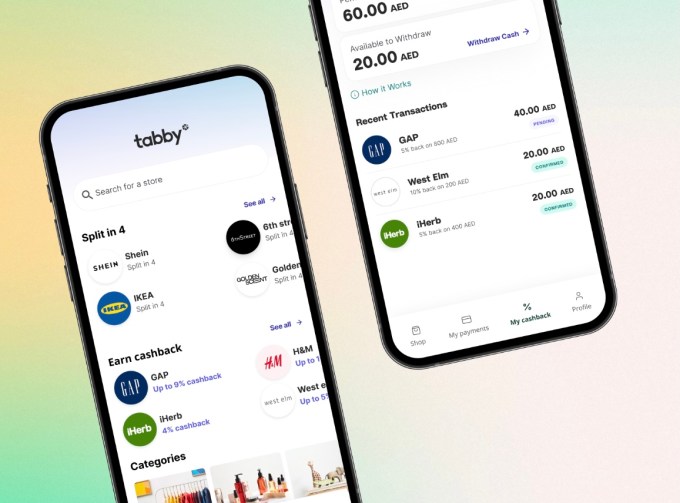
Tabby is one such service and clearly the most known in the region. Today, it is announcing that it has raised a $50 million Series B, valuing the company at $300 million.

Global Founders Capital and STV led the funding round, with participation from Delivery Hero and CCVA. Existing investors, including Arbor Ventures, Mubadala Investment Capital, Raed Ventures, Global Ventures, MSA Capital, VentureSouq, Outliers VC, JIMCO, and HOF, also participated.

Hosam Arab founded the company in late 2019 after he left fashion e-commerce Namshi, a company he led as CEO until a Dubai-based real estate firm acquired it. The launch of tabby as a buy now, pay later solution was to specifically target economic problems of the MENA and wider GCC region, says Arab.

Globally, BNPL services address obvious pain points around the flexibility of payments for customers and better conversion rates for merchants. However, in the Middle East, there’s another component tabby wanted to address, which was the over-dependence on cash as a payment method. It’s so deep-rooted that while running Namshi, Arab noticed that 80% of the transactions recorded by the company were cash-based, presenting unique challenges to scaling the e-commerce platform.

“With buy now, pay later, our view and hypothesis was that, in addition to the well-known benefits of buy now, pay later, we also provide an alternative for consumers to pay online digitally. And if we’re able to do that, that becomes a very interesting solution for the retailers of this market.”

The company integrates with retailers to allow their customers to shop at online and physical stores with interest-free installments. Tabby went live in early 2020. Although it had a relatively slow start because the launch coincided with the onset of the pandemic, it turned out to be in the company’s best interests, as merchants and customers began to shift online significantly. While pre-COVID e-commerce penetration levels in the GCC region stood at single digits, Arab thinks it might have increased to double digits due to the sheer number of merchants and consumers that have since embraced online commerce.

Tabby

Image Credits: Tabby

The jump in penetration is one reason tabby has scaled 20x in transaction volume since June 2020. According to the company, more than 400,000 active shoppers use its platform, and approximately 3,000 installs are recorded daily. In addition, over 2,000 global brands and small businesses, including Adidas, IKEA, SHEIN, and Marks & Spencer, use the platform.

The fast growth has allowed tabby to secure another round of capital than originally planned, Arab adds. In June, the company raised $50 million in one of the largest debt facilities by a fintech in the MENA and GCC region. The investment follows tabby’s seed and Series A rounds of $7 million and $23 million in 2020 per Crunchbase. This means tabby has received over $130 million despite launching early last year. 

But tabby isn’t the only company with such firepower in the region. Its Saudi counterpart Tamara recently raised a $110 million Series A in debt and equity financing from Checkout. Although Tamara claims Checkout acquired a minority stake, there are contrasting reports that prove otherwise.

If the latter is true, the buyout follows a line of consolidation happening in the MENA and wider GCC region. In May, Australian BNPL company Zip Co said it was acquiring Spotti, another major player in MENA, for $26 million. Afterpay also took a significant stake in Postpay’s recent $10 million investment. This series of events makes tabby the sole independent local player in the market. But how does the company see competition playing out?

“We’re seeing this level of competition globally. I don’t think that our market is any different. I think the market is big enough to handle a few players. How many players is really the question, and will that lead into further consolidation down the line potentially?” he said.

I think what we’ve seen as well, even with Square’s acquisition of Afterpay, is that there needs to be a broader differentiation from the just plain vanilla BNPL. I think, if you continue to play in that very limited space of BNPL, the opportunities are going to be fairly challenging.”

Maybe this is why tabby strategically positioned itself with Delivery Hero instead of taking investments from an established BNPL player. The company, which owns and operates several regional food and grocery delivery companies, including Talabat, InstaShop and Hunger Station, has one of the largest customer bases in the MENA region. And the investment marks Delivery Hero’s first fintech investment in MENA.

“As we expand our offering, we’re looking at strategic partners where we see ourselves offering the same services in the future. And working with Delivery Hero that has one of the largest consumer platforms in the region, makes a lot of sense for us. Much more sense than working with, let’s say, a global BNPL player with zero presence in this market,” Arab added.

Mark Venema, the senior vice president, Strategy at Delivery Hero, acknowledges that investing in tabby is strategic. He says the multinational sees “great potential in tabby to drive the industry forward and “is proud to be supporting the company on its growth journey.”

Ahmad Alshammari, partner at co-lead investor STV, in a statement, said, “As the global BNPL market is expected to grow at ~30% CAGR over the next five years, we estimate that MENA will grow at least twice as fast, further accelerated by a rapid switch to contactless payments, e-commerce growth, and access to credit. Our doubling-down shows our strong belief that tabby is the market leader in MENA and that they will continue to drive BNPL’s growth across the region by enabling buyers and merchants alike.”

The funding will help tabby expand its product portfolio and enter new markets in the GCC area. When that happens, will we see more consolidation take place? For instance, will companies like Klarna and Affirm, which don’t have a presence in MENA and the GCC, try to acquire or buy a majority stake in tabby?

“There is a very long journey ahead of us and where we believe we’re headed and what we want to build around this business,” Arab said. “And so the short answer is no, we’re not looking for a quick exit; otherwise, we would have probably done it by now. The opportunity here for us is significantly bigger.”

04 Aug 2021

WhiteHat Jr founder departs a year after selling to Byju’s

Karan Bajaj, the founder and chief executive of WhiteHat Jr, is leaving the firm a year after selling the startup for $300 million to Indian edtech giant Byju’s.

In an email to employees on Wednesday, Bajaj and Byju’s founder and chief executive Byju Raveendran said the departure follows a “mutually decided” decision made at the time of acquisition of WhiteHat Jr.

Chatter about Bajaj leaving the firm has been floating around for more than a quarter. TechCrunch had asked Byju’s on April 1 if Bajaj was going to leave the firm, something India’s most valuable startup dismissed as false information at the time.

Days later, Byju’s announced it was rebranding its international business as Byju’s Future School and appointed Bajaj as its leader.

In the email today, Raveendran said, “while I wish he would’ve stayed longer, Karan is a force of nature and accustomed to making unconventional choices, as you all know, and I wish him only the best for what will surely be an exciting path ahead.”

Raveendran said Trupti Mukker, who previously oversaw the customer experience at WhiteHat Jr, will now be leading WhiteHat Jr.

WhiteHat Jr, which teaches kids coding, math, and science, is one of the fastest growing edtech startups in India. The startup has also drawn attention because of its unusual step to sue critics.

“All in all, I’m truly very excited for your path ahead and deeply grateful for allowing me to be a part of your lives for this intense, challenging but deeply satisfying period we experience together,” wrote Bajaj to employees today.

04 Aug 2021

WhiteHat Jr founder departs a year after selling to Byju’s

Karan Bajaj, the founder and chief executive of WhiteHat Jr, is leaving the firm a year after selling the startup for $300 million to Indian edtech giant Byju’s.

In an email to employees on Wednesday, Bajaj and Byju’s founder and chief executive Byju Raveendran said the departure follows a “mutually decided” decision made at the time of acquisition of WhiteHat Jr.

Chatter about Bajaj leaving the firm has been floating around for more than a quarter. TechCrunch had asked Byju’s on April 1 if Bajaj was going to leave the firm, something India’s most valuable startup dismissed as false information at the time.

Days later, Byju’s announced it was rebranding its international business as Byju’s Future School and appointed Bajaj as its leader.

In the email today, Raveendran said, “while I wish he would’ve stayed longer, Karan is a force of nature and accustomed to making unconventional choices, as you all know, and I wish him only the best for what will surely be an exciting path ahead.”

Raveendran said Trupti Mukker, who previously oversaw the customer experience at WhiteHat Jr, will now be leading WhiteHat Jr.

WhiteHat Jr, which teaches kids coding, math, and science, is one of the fastest growing edtech startups in India. The startup has also drawn attention because of its unusual step to sue critics.

“All in all, I’m truly very excited for your path ahead and deeply grateful for allowing me to be a part of your lives for this intense, challenging but deeply satisfying period we experience together,” wrote Bajaj to employees today.

04 Aug 2021

Vietnamese on-demand e-commerce platform Loship raises $12M at a valuation of $100M

Loship, the Vietnamese on-demand e-commerce platform that started as a reviews app, announced today it has raised $12 million in pre-Series C funding, bringing its valuation to $100 million. The round was co-led by BAce Capital, an Ant Group-backed venture firm, and the direct investment unit of Sun Hung Kai & Co Limited. 

Founded in 2017, Loship offered one-hour deliveries for a large range of products and services, including food, ride-hailing, medicine and B2B supplies. The company says it has more than 70,000 drivers and 200,000 merchants, and serves about 2 million customers in Hanoi, Ho Chi Minh City, Da Nang, Can Tho and Bien Hoa. 

The new round brings Loship’s total raised to $20 million. Its previous funding was a bridge round from MetaPlanet Holdings, announced in February 2021. Loship is in the process of raising a Series C, expected to close by the end of this year, and is in advanced talks with investors.

Co-founder and chief executive officer Trung Hoang Nguyen told TechCrunch that Loship raised a pre-Series C round because “there are so many investors participating in our Series C round that we find it would take a long time to completely close.” As a result, Loship decided to split the round into a pre-Series C and Series C. 

MetaPlanet Holdings returned for the pre-Series C round, which also saw participation from Wealth Well, Prism Ventures and SQ Capital Group (SCCG Ventures Asia). Individual investors included former Starbucks Vice President Mojtaba Ahkbari; FNZ Group APAC chief executive officer Tim Neville; BNP Paribas global macro sales director Ben Fitzpatrick; DASS-Inc founder and CEO Wayne Cowden; EC1 managing partners Simon Eglise; Ilwella Pty Ltd director Quentin Flannery; Prenzler Group director Jonathan Feil; and iVS CEO Milan Reinartz

Loship’s new funding will be used to expand into new cities and grow verticals like B2B deliveries for small food and beverage businesses and retail stores. As part of the round, BAce Capital founder Benny Chen, the former managing director of Ant Group India, where he invested in Paytm and Zomato, will join Loship’s board of directors. 

Co-founder and CEO Trung Hoang Nguyen said Loship has a “very clear path to profitability.” The company started out as an online review platform, before people began using it to buy and sell items through chats. 

“Back then, people used our Lozi app the same way as eBay, where they could list their products, buy from and sell to others. However, we couldn’t really know whether the transaction via Lozi was completed, especially when it was purely online chat,” Nguyen told TechCrunch. “The best way to know the exact status of the transaction was to control the delivery.” 

As a result, the company launched Loship in late 2017, starting with food deliveries and then expanding into other verticals. Nguyen explained that its platform includes “basically anything that can fit on or be transported legally by motorcycle.” This means verticals dedicated to ride-hailing, groceries, medicine, laundry, packages, flowers, beauty products and B2B supplies like ingredients and food packaging. 

The number of its verticals helps Loship differentiate from large players like Grab and Gojek, Nguyen said. He added that being a homegrown startup also gives it an advantage. 

“As the only local player, we understand our local customers on a deeper level compared to other regional ones. We are locals and we have our winning playbook. We strategically enter into new and relatively untouched markets like lower-tier cities, grow the customer base and then take things forward from there.” 

Loship’s plan until the end of 2021 is to expand into five more major cities, bringing the total number of cities it operates in to 10. Then it plans to launch in Tier 2 and 3 cities in Vietnam, before expanding regionally in Southeast Asia (Nguyen describes Laos and Cambodia as “must-win markets.”)

In a statement about the funding, Chen said, “Loship creates a strong ecosystem which adds value to small business, customers as well as riders. Under Trung’s entrepreneurship and leadership, we saw the company get much stronger during the pandemic by constantly bringing product and service innovation to its merchants and users.”