Year: 2021

04 Aug 2021

Third Wave Automation raises $40M to bring its autonomous forklifts to warehouses

Fresh off a strategic partnership with Toyota Industries Corporation to build an autonomous forklift, Third Wave Automation has snagged another $40 million from investors.

The California-based startup, which was founded in 2018, has raised $40 million in a Series B round led by Norwest Venture Partners, including participation from prior investors Innovation Endeavors and Eclipse, along with Toyota Ventures, according to a Form D filed with regulators. Matt Howard, general partner at Norwest Venture Partners, will join Third Wave’s board of directors.

The injection of capital came after Howard learned of Third Wave’s partnership with Toyota Industries Corporation, which builds a third of the world’s forklifts, Third Wave CEO Arshan Poursohi told TechCrunch. Under that deal, which was announced in May, Third Wave and Toyota Industries (TICO) will develop an autonomous forklift together. The machine will be manufactured at a TICO factory and equipped with Third Wave’s sensors and compute stack. Third Wave will support the software side.

Third Wave’s three co-founders — including Mac Mason, who is chief roboticist, and James Davidson, who is no longer with the company — have long backgrounds in robotics, oftentimes working together at places like Google’s robotics program and Google Research and Toyota Research Institute.

“We’ve covered just about every kind of robot there is,” Poursohi said. “But all of these robots that we built ended up, you know, sitting in a closet somewhere because ultimately, Google or, in my case, Sun Microsystems, would decide it’s not worth scaling it out because it’s not the core business, or some other reason.”

The co-founders struck out to form their own company to focus on robots that would be used and would meet an immediate need.

“When we looked at forklifts, it’s this beautiful manipulation problem, so it’s a robot that actually touches the world on purpose,” Poursohi said. “And it’s a thing that we can actually build and ship on a time horizon that is not measured in decades.”

The forklifts they have developed operate under what is called shared autonomy. This means the forklift, which can lift pallets and move them around, will operate on its own 90% of the time. However, every robot can also be controlled remotely if the need arises. The robots are easy to operate, meaning the customer, not Third Wave, can have on-site employees to provide assistance remotely if the robot encounters something that prevents it from operating.

“There’s a big impact we can make on logistics and supply chain, just by moving pallets around, and that’s where we’ve been concentrated. The key to our technology is that it’s very fast to set up and it works in brownfield [environments],” Poursohi said.

Third Wave is still at an early stage in its development, but it’s making progress. The momentum from the funding and the recent completion of technical trials will allow the company to speed up its hiring effort and focus on commercialization, Poursohi said. He noted that Third Wave is in active conversations with 20 third-party logistics operators and retailers in the industry.

“We’ve tackled and have solid answers on all the technical fronts,” Poursohi said. “The next year and a half to two years is about is scaling out our operations team. And the market demand for this right now is massive.”

The target is to have 100 units in the field — meaning warehouses and other indoor locations — by the end of 2022 and scaling to 350 to 400 by the end of 2023.

04 Aug 2021

GM’s earnings dragged down by Chevy Bolt recall

The twice-issued recall for 2017 to 2019 Chevrolet Bolt electric vehicles cost General Motors $800 million, the company said in its second quarter earnings statement Wednesday. Costs associated with fixing defective Bolt batteries make up the lion’s share of GM’s $1.3 billion in warranty expenses last quarter.

CEO Mary Barra specified on an investor call that the recall does not impact the Ultium platform, GM’s battery cell technology it is developing in a joint venture with South Korea’s LG Energy Solutions. “[Ultium] is a different battery system and our joint venture plants that manufactures Ultium cells will follow rigorous quality processes,” she said.

GM issued the second recall for the Bolt in July, telling customers it planned to replace defective battery modules to address fire risk. Until customers are notified that a replacement battery is ready for them, GM advised to charge their vehicle after each use and to not let the battery level drop below around 70 miles of range.

The numbers were posted part of the automotive giant’s second quarter earnings release. It announced revenues of $34.2 billion, up $1.7 billion from the first quarter 2021, and $17.4 billion up from its year-ago quarterly result. GM also reported net income of $2.84 billion in the second quarter, up from a year-ago loss of $758 million, largely driven by the pandemic and associated economic fallout. GM’s adjusted income of $4.1 billion, a figure that is inclusive of recall costs.

Income was boosted by used car prices, truck and SUV sales, and strong profits at GM Financial. GM’s lending arm posted net sales of $3.4 billion and adjusted income of $1.58 billion for the quarter.

“Used vehicle prices drove continued record results at GM Financial,” GM CFO Paul Jacobson confirmed on the call. 

The automaker is bullish the remaining year. GM raised its adjusted full-year guidance to between $11.5 billion and $13.5 billion, or $5.40 to $6.40 a share. That’s up from their previous guidance of $10 billion to $11 billion, or $4.50 to $5.25 a share.

04 Aug 2021

Amazon expands same-day Prime delivery to 6 more U.S. cities

Amazon announced this morning it’s expanding its faster, same-day delivery service to half a dozen more U.S. cities. The service, which the retailer has been working to make same-day delivery even faster over the past year, now offers consumers in a number of markets the ability to shop up to 3 million items on Amazon.com, then receive their orders in only a few hours.

To do so, Amazon invested in what it called “mini-fulfillment centers” closer to where customers lived in select U.S. markets, initially in Philadelphia, Phoenix, Orlando, and Dallas. Those customers could then shop across a dozen merchandise categories, including Baby, Beauty & Health, Kitchen & Dining, Electronics, Pet Supplies, and more. As the pandemic continued to impact Amazon’s business, in November 2020, Amazon expanded its faster same-day service to more cities, to include Nashville and Washington, D.C.

With today’s expansion, Amazon is rolling out same-day delivery to Prime members in Baltimore, Chicago, Detroit, Tampa, Charlotte, and Houston. In these markets, shoppers will be able to place orders online throughout the day then have items on their doorstep in as fast as 5 hours, Amazon says. Customers can also place orders by midnight to have their orders arrive the following morning.

The service continues to be free with no additional charges on orders over $35 that qualify for same-day delivery. Orders under $35 have a $2.99 fee for Prime customers, and a $12.99 fee for non-members. Prime membership, meanwhile, is $12.99 per month or $119 per year.

The time frame commitments for same-day delivery are the same as those Amazon promised last year when it first announced its plans to speed up Prime delivery. Orders placed between midnight and 8 AM will arrive today by 1 PM. Orders placed between 8 AM and 1 PM arrive by 6 PM; those placed between 1 PM and 5 PM will arrive by 10 PM; and those placed between 5 PM and midnight will arrive overnight by 8 AM. That means customers can place orders fairly late and receive their items before they head out of the house the next day.

Faster same-day delivery has been one of the most significant services Amazon has used to challenge rivals like Walmart and Target, who both benefit from having a large brick-and-mortar footprint that allows them to more quickly serve their customers through same-day order pickup, curbside pickup, and same-day delivery services. While Walmart partners with third-parties on its same-day service, Express delivery, largely focused on grocery, Target acquired delivery service Shipt in 2017 to bring its fast delivery services in-house.

In response to the growing competition, Amazon has been recently acquiring smaller warehouse space inside major urban metros, including in these six new markets where it’s now announcing same-day delivery, as well as larger markets, like New York, and even suburban neighborhoods. It also acquired Whole Foods for $137.7 billion in 2017, not only to more fully participate in the online grocery business, but also in part because of its large retail footprint.

As Amazon has sped up the pace of what’s available under “Prime” delivery, it has wound down its older “Prime Now” business, which will be fully shut down by year-end. The separate app had allowed customers to shop items that were available in one or two hours for an additional fee.

04 Aug 2021

When the goals of PR and journalism don’t align

Hello and welcome back to Equity, TechCrunch’s venture capital-focused podcast, where we unpack the numbers behind the headlines.

For our Wednesday show this week, Natasha and Alex hosted a PR roundtable. Yep, our promise back when Alex Konrad came on the program to chat funding rounds is being fulfilled. Here’s who joined us:

We had a few things to chat about, so we broke the show into a few sections:

  • Today’s PR world: The impact of COVID-19, burnout, what their work entails, and some tips for startups.
  • The sheer pace of news today: The evolution of client expectations, managing clients themselves, and burnout.
  • Tech vs. Media: We chatted content marketing, sharing details with the press, and why the media never shares drafts of stories before they go out.

Frankly it was a very good time and a fun chat. Shoutout to our guests for arriving early and being very put together. May all podcast guests in the future learn from such efforts. One guest was even wearing a shirt with a collar! In 2021! We were impressed.

Recall that Equity is off the rest of the week so that we can recharge and retool a bit. Hugs!

Equity drops every Monday at 7:00 a.m. PDT, Wednesday, and Friday morning at 7:00 a.m. PDT, so subscribe to us on Apple PodcastsOvercastSpotify and all the casts.
04 Aug 2021

Robinhood is now a stonk

Update: Trading of Robinhood shares has been halted due to volatility. The company’s stock paused at $65.60 on Robinhood itself. Yahoo Finance has a higher $77.03 price on the company’s equity, up a stunning 64.59% today. Things are fluid, but Robinhood may have been halted, and then rose again when it resumed trading. Stonks indeed.

Shares of Robinhood, an investing-focused consumer fintech company, soared this morning in pre-market trading. The stonk phenomenon, which helped propel minor companies like GameStop and AMC earlier this year, appears to be impacting Robinhood’s own stock; that much GameStop and AMC trading took place on Robinhood’s platform during stonk-fever is irony not lost on this publication.

Here’s what things look like this morning, per Yahoo Finance:

Recall that Robinhood went public at $38 per share, the low end of its range, and sank in its early trading sessions to below its IPO price. Now, it’s worth $54 per share.

Cool.

Normally we’d crack a joke and close this small news item here, but with Robinhood’s IPO featuring a unique twist on the traditional public offering, we have to do a bit more work. When it went public, Robinhood reserved a chunk of its equity for purchase by its own users. The impact of this was that more retail investors likely owned Robinhood equity at the start of its trading life than would be normal with a traditional IPO.

One hypothesis regarding Robinhood’s somewhat slack early trading performance was that early retail demand for its shares was sated by its effort to allow its users to buy stock in its shares, leading to a less-skewed supply/demand curve when it debuted.

Things have changed. What’s going on? Last week, an analyst put a $65 per share price target on the stock. And there are a handful of other ratings to chew on. But the wild swing in the price of Robinhood today appears from our vantage point to be another stonk moment. The stock is being traded like a short-squeeze, even if some market participants are skeptical of the idea due to what they view as a limited short interest in the company.

Checking the Robinhood IR page, there’s no news. Robinhood did not recently report earnings. And the company’s recent 606 filings that deal with PFOF incomes seemed to match up with expectations in revenue terms regarding what the company detailed in its Q2 2021 flash numbers. Perhaps there was more crypto in there than expected, but nothing truly wild.

It appears that Robinhood is simply going up because it is. This happens in 2021; we just have to get used to it.

But what matters most for our purposes is that Robinhood’s decision to sell some IPO stock to its users did not manage to create so much float for the now-public unicorn to diminish weird trading. You can go public in an unusual manner and still catch a stonk wave. Now we know.

04 Aug 2021

Apax to combine three social impact software companies in deal valued at $2B

Who says there is no big money in software aimed at helping people? Private equity firm Apax Funds announced this morning that it is combining three social impact firms to create a platform of sorts in a deal valued at $2 billion.

To build this social good juggernaut, Apax went out and purchased EveryAction from Insight Partners and Social Solutions from Vista Equity Partners, two firms we often see involved in SaaS deals.

The plan is to combine the two firms with CyberGrants, a company that Apax acquired in June. With EveryAction, companies get a customer engagement platform focused on the needs of nonprofits. Instead of trying to get people to buy more stuff, the goal would be to increase engagement with donors. Social Solutions is a tool for gathering data on an organization’s activities and taking advantage of that data to coordinate service delivery and measure how well you are doing with your service goals.

Finally, CyberGrants is a corporate responsibility platform designed to help companies create programs for employees to volunteer in the community and “maximize the impact of corporate philanthropy.”

Erin Mulligan Nelson, CEO of Social Solutions sees combining the three companies as a way to accelerate their individual efforts as companies. “Joining forces will empower human services agencies in both the non-profit and public sectors to fully capitalize on the opportunities for digital transformation. Our expanded offerings and opportunities for product innovation will create real value for our clients, improve outcomes for the people they serve, and help them accelerate lasting social change,” she said in a statement.

While the three companies have a common theme of using software to help customers operate more efficiently in a social impact context, putting together three disparate companies into a single platform could prove challenging, even if the new company will surely have numbers in its favor.

Apax reports the combined companies will generate $200 million in revenue, involving 650,000 non-profits and half the Fortune 500, while coordinating an impressive 38 million donors and volunteers. That is certainly scale.

PE firms tend to be looking for deals in undervalued companies that they can build up and find missing value, and if that involves software aimed at helping charitable efforts, so be it. The fact that Apax bought these companies from other PE firms suggests that this is an area that these companies are watching.

Of the three companies involved only Social Solutions raised venture capital, according to Crunchbase data, raising $70 million including a $59 million investment from former Microsoft CEO Steve Ballmer in 2018. As is often the case with PE deals, these three companies are a bit older, with EveryAction founded in 1997, CyberGrants in 1999, and Social Solutions in 2006. Perhaps they could use modernizing or could benefit from additional investment from a company like Apax, which hopes by combining these three companies, it can be a force in this space.

Sometimes bigger is better. Sometimes it’s not. Time will tell if Apax can pull this off. The deal will be subject to normal closing conditions and is expected to close some time this quarter.

04 Aug 2021

Baleon Capital closes first fund to provide capital infusion to healthcare startups

Baleon Capital, a one-year-old venture capital firm started by investment veteran Jon Kaiden, closed its first fund to invest in pre-Series A and Series A companies focused on health and medical care in the United States.

Before starting the Miami-based firm, Kaiden was a founding member and principal of Sopris Capital, where he told TechCrunch his track record of internal return on revenue landed him in the top 95th percentile of all early-stage funds. Baleon is a mash-up of the names of Kaiden’s four children: Brooke, Allie, Leo and Nicole.

Though he did not disclose the fund amount, Kaiden did say he was targeting $100 million for the fund. He expects to initially be able to invest in between eight and 12 companies with $5 million to $10 million in check sizes. If he is able to get the $100 million, Kaiden plans for nearly three-fourths to go into initial investments and the rest for follow-on or new opportunities that come in.

Despite the pandemic, the past year was a “great environment to raise a fund,” he said. After running Sopris for 18 years, he thought it was time to raise a fund especially targeting the healthcare industry, which saw a boom.

“The pandemic tweaked a lot of the industry, especially virtual healthcare, and sped up a lot of things to be more efficient,” Kaiden said. “However, doctors are still among the slowest group to adopt technology.”

As a result, Baleon Capital will invest in companies building the new digital infrastructure for healthcare, aimed at reducing costs, improving access and solving inefficiencies that are hindering patient care. In addition to healthcare, the firm has identified opportunities in vertical SaaS, like finance and real estate.

Baleon’s first fund invested in three companies: Mantra Health, a digital mental health clinic on a mission to improve access to evidence-based mental healthcare for young adults; LifeLink, which is building infrastructure for modern patient engagement; and ClearStep, a care navigation platform leveraging artificial intelligence to match patients to the right provider based on their symptoms, insurance and location.

As healthcare settles into its new digital transformation, Kaiden sees an industry that will rely more heavily on data interoperability as electronic medical records and gleaning insights from big data will evolve. He expects that to help reduce costs without reducing patient satisfaction and provide better health outcomes.

“It’s always a good time in healthcare, and there will always be companies that are disruptive,” Kaiden said. “Healthcare is 18% of the country’s GDP — that is a huge part of our economy, and it is inefficient. That makes it ripe for entrepreneurs to disrupt it.”


04 Aug 2021

Financial concierge startup Zeni banks $34M to show SMBs their finances in real time

Zeni, a Palo Alto fintech company providing real-time financial services data to venture-backed startups, raised $34 million in Series B funding led by Elevation Capital.

The new investment comes just five months after Zeni announced $13.5 million in a combined seed and Series A round. The company has now raised $47.5 million in total since it was co-founded in 2019 by twin brothers Swapnil Shinde and Snehal Shinde.

Elevation was joined in the new round by new investors Think Investments and Neeraj Arora, as well as existing investors Saama Capital, Amit Singhal, Sierra Ventures, Twin Ventures, Dragon Capital and Liquid 2 Ventures. As part of the investment, Ravi Adusumalli, founder and managing partner at Elevation Capital, will join Zeni’s board.

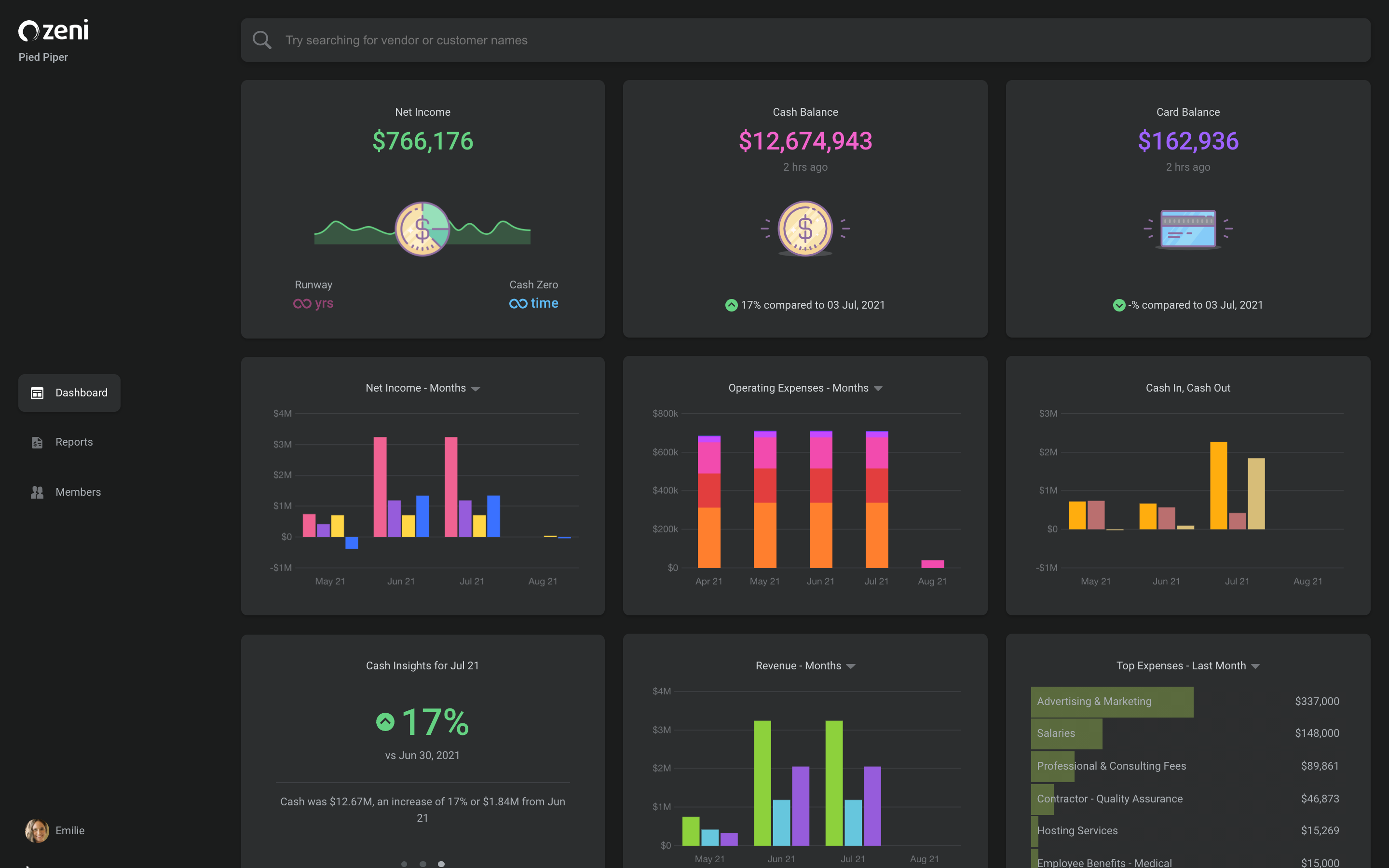
The Shinde siblings started the company after selling their last company, Mezi, a travel concierge, to American Express in 2018. Zeni’s AI-powered finance concierge platform offers bookkeeping, accounting, tax and CFO services, managing these for a flat monthly fee starting at $299 per month. Founders have real-time access to financial insights via the Zeni Dashboard, including cash in and out, operating expenses, yearly taxes and financial projections. They can also download the financial data in the “slice” that they want.

At the time of its seed/Series A round, the company was managing more than $200 million in funds each month, and that has ballooned to more than $500 million, CEO Swapnil Shinde told TechCrunch. Its customers range from pre-revenue startups to businesses generating more than $100 million in annual revenue.

In addition to the cash in and cash out analysis, the company also created a search function for transactions and spend and income trends on every customer and vendor, Snehal Shinde, chief product officer, said.

Zeni Dashboard. Image Credits: Zeni

Zeni experienced 550% revenue growth year-over-year, while the company’s customer base grew 375%, driven by referrals and organic growth, Swapnil Shinde said.

Despite the growth, the Series B came as a surprise to the siblings. The company was already “very well capitalized,” with a majority of the previous round still around, Swapnil Shinde said.

However, Zeni began receiving so many inbound inquiries that he said it was too exciting to pass on. Especially with the addition of Elevation Capital as an investor. Shinde said that was appealing because the firm was an investor in Paytm, and “knows how to partner and build unicorns.”

The new funding will be used to continue scaling and building the bookkeeping and accounting functions and to accelerate hiring, particularly in the engineering, sales and finance team verticals. Shinde expects to double or triple the finance team in the next year.

“As our customers scale through to their Series B, the more you can use our solution in real time to see what is happening with your finances, especially with startups and businesses having more of a remote workforce,” Swapnil Shinde added. “Zeni fits with that.”

Ash Lilani, managing partner at Saama Capital, one of Zeni’s earliest and largest investors, said he knew how big the total addressable market was — $200 billion — and how much these kinds of financial services were a giant pain point for startup companies.

“To know where you stand financially in real time is hard to do, usually, you get that information at month-end,” Lilani said. “I believe we have the opportunity to build a large company. Though Zeni is going after startups today, the small and medium markets can be leveraged. As they grow, Zeni will become their controller on the back end, while companies can just hire a CFO for the strategic decisions.”


04 Aug 2021

Buildots raises $30M to put eyes on construction sites

One year after raising $16 million, construction technology company Buildots is back to claim another $30 million, this time in Series B funding.

Lightspeed Venture Partners led the round, with participation from previous investors TLV Partners, Future Energy Ventures and Tidhar Construction Group. This gives the company $46 million in total funding, Roy Danon, co-founder and CEO of Buildots, told TechCrunch.

The three-year-old company, with headquarters in Tel Aviv and London, is leveraging artificial intelligence computer vision technology to address construction inefficiencies. Danon said though construction accounts for 13% of the world’s GDP and employs hundreds of millions of people, construction productivity continues to lag, only growing 1% in the past two decades.

Danon spent six months on construction sites talking to workers to understand what was happening and learned that control was one of the areas where efficiency was breaking down. While construction processes would seem similar to manufacturing processes, building to the design or specs didn’t happen often due to different rules and reliance on numerous entities to get their jobs done first, he said.

Buildots’ technology is addressing this gap using AI algorithms to automatically validate images captured by hardhat-mounted 360-degree cameras, detecting immediately any gaps between the original design, scheduling and what is actually happening on the construction site. Project managers can then make better decisions to speed up construction.

“It even finds events where contractors are installing out of place and streamline payments so that information is transparent and clear,” Danon said. “Buildots also creates a collaborative environment and trust by having a single source telling everyone what is going on. There is no more blaming or cutting corners because the system validates that and also makes construction a healthier industry to work in.”

Buildots went after new funding once it was able to show product market fit and was expanding into other countries. The platform is being utilized on major building projects in countries like the U.S., U.K., Germany, Switzerland, Scandinavia and China. To meet demand, Buildots will use the new funding to continue that expansion; double the size of its global team with a focus on sales, marketing and R&D; and grow on the business side. Danon’s aim is “to get to the point where we are the standard for every construction site.” The company is also looking at areas outside construction where its technology would be applicable.

Tal Morgenstern, partner at Lightspeed Venture Partners, said he keeps an eye on graduates of the Israel Defense Forces, where the three Buildots founders came from. However, in the case of this company, Lightspeed actually passed on both the seed and Series A.

Morgenstern admits the decision was a mistake, but at the time, he thought the technology Buildots was trying to build “first, impossible and second, I knew construction was difficult to sell into.” He felt that Buildots, with such a premium product, would have a challenge selling to a low-margin industry that was late to adopt technology in general.

By the time the Series B came round, he said Buildots had solved both of those issues, proving that it works, but also that customers were adopting the technology without much sales and marketing. In addition, other solutions in construction tech were still relying on lasers or people to manually input or tap photos.

“Buildots is seamlessly capturing images and providing a level of insights that is so high, and that is why the company is able to command the price structure they have and are receiving interesting commercial results,” Morgenstern said.

Walking around today’s construction site, Danon said the adoption of technology is enabling Buildots to move quickly to build processes for the industry.

As such, the company saw more than 50% growth quarter over quarter over the past year in three of the countries in which it operates. It is now working with four of the top 10 construction companies in Europe and around the world.

“We did a good job selling remotely, but now we need local offices,” Danon added. “We are also sitting on piles of data from construction sites. We learn from one project to another and want to look for the challenges where data will help make a financial impact. It’s a natural next step for the company.”


04 Aug 2021

FullStory raises $103M at a $1.8B valuation to combat rage clicks on websites and apps

Even with all the years of work that have been put into improving how screen-based interfaces work, our experiences with websites, mobile apps, and any other interactive service you might use still often come up short: we can’t find what we want, we’re bombarded with exactly what we don’t need, or the flow is just buggy in one way or another.

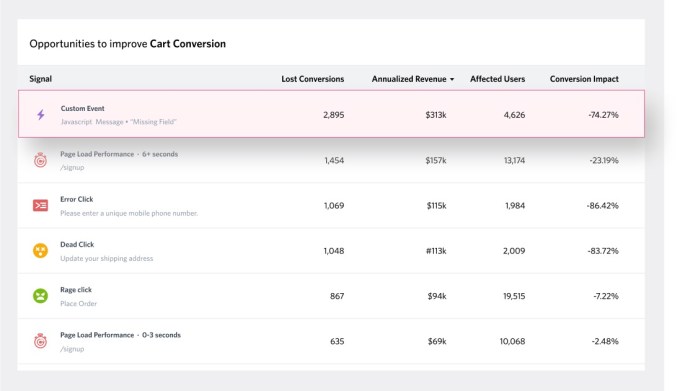
Now, FullStory, one of the startups that’s built a platform to identify when all of the above happens and provide suggestions to publishers for fixing it — it’s obsessed enough with the issue that it went so far as to trademark the phrase “Rage Clicks”, the focus of its mission — is announcing a big round of funding, a sign of its success and ambitions to do more.

The Atlanta-based company has closed a Series D round of $103 million, an oversubscribed round that actually was still growing between me interviewing the company and publishing this story (when we talked last week the figure was $100 million). Permira’s growth fund — which has previously invested in other customer experience startups like Klarna and Nexthink — is leading this round, with previous investors Kleiner Perkins, GV, Stripes, Dell Technologies Capital, Salesforce Ventures, and Glynn Capital also participating.

FullStory, which has raised close to $170 million to date, has confirmed that the investment values the company at $1.8 billion.

Scott Voigt, FullStory’s founder and CEO, tells me that FullStory currently has some 3,100 paying customers on its books across verticals like retail, SaaS, finance, and travel (customers include Peloton, the Financial Times, VMware and JetBlue), which collectively are on course to rack up more than 15 billion user sessions this year — working out to 1 trillion interactions involving clicks, navigations, highlights, scrolls, and frustration signals. It says that annual recurring revenue has to date risen by more than 70% year-on-year.

The plan now will be to continue investing in R&D to bring more real-time intelligence into its products, “and pass those insights on to customers,” and also to “move more aggressively into Europe and Asia Pacific,” he added.

FullStory competes with others like Glassbox and Decibel, although it also claims its tools have more presence on websites than its three biggest competitors combined.

Working across different divisions like product, customer success and marketing, and engineering, FullStory uses machine learning algorithms to analyze how people navigate websites and other digital interfaces.

If approved as part of the “consent gate” you might encounter because of, say, GDPR regulations, it then tracks things like when they are clicking in areas excessively over a short period of time because of delays (the so-called “rage clicks”); or when a click leads nowhere because of, for example, a blip in a piece of JavaScript; or when a person is just scrolling or moving their mouse or cursor or finger in a frustrated (fast) way — again with little or no subsequent activity (or activity from the customer ceasing altogether) resulting from it. It doesn’t use — nor does it have plans to — use eye tracking, or anything like sentiment analysis around data that customers put into, say, customer response windows.

FullStory then packages up the insights that it does collect into data streams that can be used with various visualization tools (having Salesforce as a strategic backer is interesting in this regard, given that it owns Tableau), or spreadsheets, or whatever a customer chooses to put them into. While it doesn’t offer direct remediation (perhaps an area it could tackle in the future), it does offer suggestions for alternative actions to fix whatever problems are arising.

Part of what has given FullStory a big boost in recent times (this round is by far the biggest fundraise the company has ever done) is the fact that, in today’s world, digital business has become the centerpiece of all business. Because of Covid-19 and the need for social distancing that have taken away some of the traffic of in-person experiences like going to stores, organizations that have natively or built experiences online are seeing unprecedented amounts of traffic; and they are now joined by organizations that have shifted into digital experiences simply to stay in business.

All of that has contributed to a huge amount of content online, and a big shift in mindset to making it better (and in the most urgent of cases, even more basically, simply usable), and that has resulted in the stars aligning for companies like FullStory.

“The category was so nascent to begin with that we had to explain the concept to customers,” Voigt told me of the company’s early days, where selling meant selling would-be customers on to the very idea of digital experience insights. “But digital experience, in the wake of Covid-19, suddenly mattered more than it ever has before, and the continued amount of inbound interest has been afterburner for us.” He noted that demand is increasing among mid-market and enterprise organizations, and something that has also helped FullStory grow is the general movement of talent in the industry.

“Our customers tend to take their tools with them when they change their jobs,” he said. Those tools include FullStory’s analytics.

The evolution of bringing more AI into the world of basically structuring what might otherwise be unstructured data has been a big boost to the world of analytics, and investors are interested in FullStory because of how it’s taken that trend and grown its business on top of it.

“We are very excited to partner with the FullStory team as they continue to expand and build a truly extraordinary technology brand that improves the digital experience for all stakeholders,” said Alex Melamud, who led the transaction on behalf of Permira Growth, in a statement.

“Traditional analytics have been upended by AI- and ML-enabled approaches that can instantly uncover nuanced patterns and anomalies in customer behavior,” said Bruce Chizen, a senior advisor at Permira, in a statement. “Leveraging both structured and unstructured data, FullStory has rapidly established itself as the market and technology leader in DXI and is now the fastest-growing company in the category and the de facto system of record for all digital experience data.” Chizen is joining the FullStory Board with this round.