Year: 2021

28 Jul 2021

The Lilium electric Jet will use batteries manufactured by Germany’s Customcells

Electric air taxi startup Lilium has tapped German manufacturer Customcell to supply batteries for its flagship 7-seater Lilium Jet.

The battery IP is the result of “multiple players,” a Lilium spokesperson told TechCrunch, but the manufacturing will be the sole job of Customcells. While Lilium declined to specify the number of battery systems as part of the agreement, it confirmed that Customcells will be manufacturing guaranteed capacity until 2026.

Customcells specializes in high-performance lithium-ion batteries for the aerospace, automotive and maritime industries. The manufacturer recently announced a new joint venture with luxury sports car maker Porsche AG, dubbed Cellforce Group, for the low-volume  production of batteries for racing cars and performance vehicles.

This is just the latest partnership Lilium has announced in recent months as it prepares to shift into component and vehicle testing. The Munich-based eVTOL company has developed an international network of partnerships with suppliers like Japanese company Toray Industries for carbon fiber composite; Spanish aerospace supplier Aciturri for the Jet’s airframe and Palantir Technologies, one of its investors, for software services. In June, Lilium added aerospace manufacturing giant Honeywell to its roster for the Jet’s flight control and avionics system.

Lilium’s decision to outsource major components to established manufacturers is a departure from many of the other leading eVTOL developers, like Joby Aviation, which have chosen to keep much of the engineering and production in-house. The strategy has a few advantages. For one, Lilium doesn’t have to spend millions – possibly hundreds of millions over time – in manufacturing facilities, or production and testing equipment. But the key advantage, Lilium executives suggest, may lie with the certification process.

Like other eVTOL manufacturers, the Lilium Jet must receive regulatory approval from the European Union Aviation Safety Agency and the Federal Aviation Administration in order to operate commercially in the EU and U.S., respectively. Lilium, in line with other major would-be players in the industry, has set an ambitious target of 2024 for commencing commercial operations. Established aerospace suppliers may use components that have already achieved a minimum performance standard recognized by regulators, which could save time in the certification process.

“Collaborating with experts, aerospace partners, is a deliberate choice for us,” Lilium’s chief program officer Yves Yemsi told TechCrunch earlier this year. “It will help us to reduce our time to market and still be safe.”

28 Jul 2021

Score a free month of Extra Crunch with your TC Sessions: SaaS 2021 pass

Whether you’re just starting to build your SaaS empire or you’re further along in your journey, you don’t want to miss TC Sessions: SaaS 2021 on October 27. This day-long virtual event, dedicated to the increasingly sophisticated world of software-as-a-service, features some of the sector’s biggest names, plenty of actionable advice and ample opportunity to network for, well, ample opportunities.

Learn how to scale, how to manage growth — of your business and of the massive amount of data it generates — and how to keep your products and services safe in an increasingly cyber-hostile world. And that’s just for starters.

Bonus Alert: Buy a TC Sessions: SaaS pass and receive a free, one-month subscription to Extra Crunch, our members-only program featuring exclusive daily articles for founders and startup teams.

Extra Crunch membership gives you the inside scoop and helps you stay ahead of the tech, business and investing trends every startup founder needs to know. Since Extra Crunch launched in 2019, we’ve posted more than 2,000 articles.

You’ll have access to exclusive articles on topics like market analysis, growth and fundraising. Here’s a quick peek at just some of the recent titles available to Extra Crunch subscribers:

Your membership also includes access to our weekly virtual event series, Extra Crunch Live. We hosted more than 40 events during 2020, and we built more interactivity into our 2021 format. We added a bunch of new stuff, too — like Pitch Deck Teardowns. Check out what’s going on with Extra Crunch Live in 2021.

We’re not quite ready to share the TC Sessions: SaaS event agenda, but register for updates and you’ll know when we announce new speakers, add events and offer ticket discounts.

TC Sessions: SaaS 2021 takes place on October 27. Join your global SaaS community to learn, inspire, connect and grow a stronger business. Buy your SaaS pass here and scoop up a free month of Extra Crunch goodness on us.

Is your company interested in sponsoring or exhibiting at TC Sessions: SaaS 2021 – Marketing & Fundraising? Contact our sponsorship sales team by filling out this form.

28 Jul 2021

Drivers for Elon Musk’s Loop get a script about their ‘great leader’

Drivers for Elon Musk’s underground Loop system in Las Vegas have been instructed to bypass passengers’ questions about how long they have been driving for the company, declare ignorance about crashes, and shut down conversations about Musk himself.

Using public records laws, TechCrunch obtained documents that detail daily operations at the Loop, which opened in June to transport attendees around the Las Vegas Convention Center (LVCC) using modified Tesla vehicles. Among the documents is a “Ride Script” that every new recruit must follow when curious passengers ask questions.

The script shows just how serious The Boring Company (TBC), which built and operates the system, is about controlling the public image of the new system, its technology and especially its founder, Elon Musk.

“Your goal is to provide a safe ride for the passengers, not an entertaining ride. Keep conversation to a minimum so you can focus on the road,” advises the document. “Passengers will pepper you with questions. Here are some you may be asked and the recommended responses.”

If riders ask a driver how long they have been with the company, they are instructed to respond with: “Long enough to know these tunnels pretty well!” The document goes on to note: “Passengers will not feel safe if they think you’ve only been driving for a week (even though that could mean hundreds of rides). Accordingly, do not share how long you’ve been employed here, but instead, find a way to evade the question or shift the focus,” the document advises drivers.

When asked how many crashes the system has experienced, drivers are told to respond: “It’s a very safe system, and I’m not sure. You’d have to reach out to the company.” Riders should expect similarly vague responses if they wonder how many employees or drivers TBC has, or how much the tunnels cost to dig. (About $53 million in total).

The use of Tesla’s advanced driver assistance system that is branded “Autopilot” is clearly a sore point at TBC. Clark County does not currently permit the use of the various driver assistance features anywhere within the Loop system, including automatic emergency braking or technologies that make the vehicle aware of obstacles and keep the vehicle in lane.

Officials even require mechanics to check the vehicles to ensure these are not activated.

“In addition to completing the actions under the initial inspection checklist, maintenance staff will verify that the automatic features of the vehicle, such as steering and braking/acceleration/deceleration assist (commonly known as Autopilot) are disabled for manual loop operation,” the document reads. The following checks will be conducted on a daily basis by CWPM technicians, according to the Vehicle Maintenance plan viewed by TechCrunch.

If a passenger should ask whether the Loop’s Tesla vehicles use Autopilot, drivers will give a response. However, this content was marked “Public Safety Related Confidential” in the documents TechCrunch received and was redacted, as were many other technical details.

TechCrunch’s repeated requests to officials to explain this decision went unanswered.

He who shall not be named

The script also covers responses to questions about Musk himself: “This category of questions is extremely common and extremely sensitive. Public fascination with our founder is inevitable and may dominate the conversation. Be as brief as possible, and do your best to shut down such conversation. If passengers continue to force the topic, politely say, ‘I’m sorry, but I really can’t comment’ and change the subject.”

Nevertheless, the script provides a number of replies to common Musk questions. Ask what Musk is like and you should expect the answer: “He’s awesome! Inspiring / motivating / etc.”

Follow up with: “Do you like working for him?” and you’ll get a response that could have come straight from North Korea: “Yup, he’s a great leader! He motivates us to do great work.”

Should a customer wonder how involved Musk is in the business, the driver will tell them: “He’s the company founder, and has been very involved and supportive.” Questions about Musk’s erratic tweets will be brushed off: “Elon is a public figure. We’re just here to provide an awesome transportation experience!”

One question, however, seems to hint that not everyone is happy working for Musk: “Is it true what I’ve read about him in the papers that he [is a mean boss / smokes pot / doesn’t let employees take vacations / etc.]?” Your driver’s rather equivocal response will be: “I haven’t seen that article, but that hasn’t been my experience.”

On a side note: While the hundreds of pages of training documents and operational manuals that TechCrunch obtained detail strong policies against drug use and harassment at the Loop, the word “vacation” does not otherwise appear.

Tech that’s allowed

Because Clark County currently forbids the use of automated driving features in the Loop, human drivers could be part of the system for some time. But the system is home to plenty of other advanced technologies, according to design and operational documents submitted to Clark County. Each of the 62 Teslas in the underground Loop has a unique RFID chip — as used in contactless payment systems — that pinpoints its location when it passes over one of 55 antennas installed in the roadway, stations and parking stalls.

Each vehicle also streams data to 24 hotspots through the system, sharing its speed, state of charge, the number of passengers in the car, and whether they are wearing seatbelts. Riders should be aware that every car is also constantly streaming real-time video from a camera inside the passenger cabin. All this data, along with video from 81 fixed cameras throughout the Loop, is fed to an Operations Control Center (OCC) located a few blocks away from the Convention Center. Video is recorded and stored for at least two weeks.

In the OCC, an operator is monitoring the camera feeds and other sensors for security threats or other problems — such as a driver using their own cellphone or speeding. The OCC can communicate with any driver via a Bluetooth headset or an in-car iPad that displays messages, alerts and a map of the car’s location in the tunnels. Vehicles have strict speed limits, ranging from 10 mph within stations to 40 mph on straight tunnel sections, and must maintain at least 6 seconds of separation from the car in front.

During testing this spring, the documents reveal that Clark County officials found some drivers were not following all the rules. “When asked about the speed limitations, several drivers replied with wrong straightaway and/or curved tunnel speeds. None provided at station, express lane, or ramp speeds,” reads one document. “Drivers were not announcing to the passengers to buckle their seatbelts. When asked, [some were saying] that they are optional or not required.”

Several drivers were also failing to maintain the 6-second safety margin with cars in front. TBC told Clark County that it would provide refresher training in those areas.

TBC, Clark County, and the Las Vegas Convention and Visitors Authority, which oversees the LVCC, did not reply to multiple requests for comment for this story.

The LVCVA recently signed a contract with Alphabet’s spin-out urban advertising agency, Intersection Media, to sell naming rights to the Loop system, which it hopes will net it $4.5 million.

TBC is currently building two extensions to the Loop to serve nearby hotels and ultimately wants to build a transit system covering much of the Strip and downtown Las Vegas with more than 40 stations. That system would be financed by TBC and supported by ticket sales.


28 Jul 2021

Snapchat adds My Places feature to Snap Map, recommending spots to visit

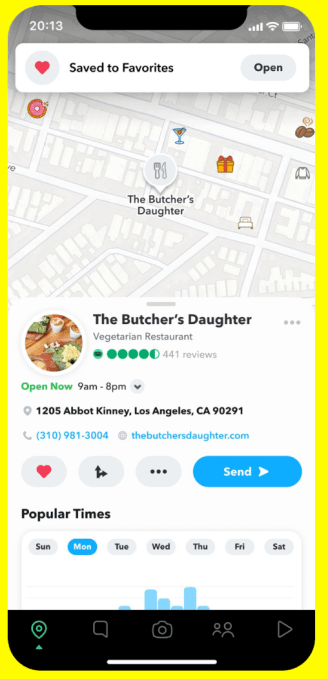
As more people are venturing out into the world this summer (safely, we hope!), Snapchat wants to make it easier for people to find restaurants, stores, parks, and other interesting spots in their neighborhood. Today, Snapchat is starting to roll out the My Places feature on its Snap Map, which connects users with over 30 million businesses. Users can log their favorite spots, send them to friends, and find recommendations.

My Places has three main tabs: Visited, Favorites, and Popular. Visited lists places you’ve checked into on Snapchat, and Favorites saves, well, your favorites. But the Popular tab is particularly interesting, since it marks the first time that Snapchat is using an algorithm to provide personalized recommendations to help people engage with the world around them. The algorithm considers where you are, what you’ve tagged or favorited already, and where your friends and other Snapchatters have visited.

This further differentiates the social-forward Snap Map from more established resources like Google Maps and Apple Maps, which you can’t really use to find out what restaurants your friends like. Sure, Snapchat can’t give you directions to that trendy sushi bar, but it’s not meant to, just like how Google Maps isn’t meant to show you what bar all your friends went to without you last night.

Image Credits: Snapchat

Snapchat shared survey results indicating that its users are more likely on average to engage in “post-pandemic” activities (is that a good thing?), and added that 44% of Snapchatters turn to the Snap Map to find places around them that they’re interested in.

With over 250 million monthly active users on Snap Map, the company announced an update in May called Layers, which lets partner companies add data directly to their own map. So far, Snapchat has collaborated with Ticketmaster and The Infatuation, a restaurant recommendation website — these partnerships help users see where they can find live entertainment, or what great restaurants are hidden in plain sight. Snapchat plans to further integrate Layers into Snap Map and My Places later this year.

Last week, Snap announced that during Q2 this year, it grew both revenue and daily active users at the highest rates it has achieved in the last four years. Year over year, the app grew 23%.

28 Jul 2021

Walmart to sell its e-commerce technologies to other retailers

Walmart’s investments in software and retail technologies it used to transform its business from a brick-and-mortar to one that combines both in-person and online shopping will now be made available to other retailers for the first time, the company announced today. Through a strategic partnership with Adobe, Walmart will integrate access to Walmart’s Marketplace, as well as its various online and in-store fulfillment and pickup technologies, into the Adobe Commerce Platform.

The technologies will be made available to both Adobe Commerce and Magento Open Source customers, Adobe says.

The deal will allow Walmart to potentially reach thousands of small to mid-sized retailers, who will effectively be able to tap into the same tools that one of the largest global retailers is using to run their business.

Through the partnership, Adobe retail customers will be able to do things like show store pickup eligibility and available pickup times online; offer multiple pickup options like curbside and in-store pickup; provide their store associates with mobile tools to pick for orders, validate item selections and handle substitutions; and use tools to communicate with customers about their pickup orders, like those where customers can alert store associates of their ETA or arrival for curbside pickup.

Another aspect of the partnership will allow retailers to syndicate and sell their products across Walmart’s Marketplace.

The arrangement not only aims to benefit Walmart’s bottom line as it offers new revenue streams related to retail technologies, it could also serve as another tool in Walmart’s battle with Amazon for online retail dominance.

Retail businesses will use the Adobe Commerce platform to reach an expanded set of customers by listing products on Walmart’s Marketplace and then leverage Walmart’s Fulfillment Services to offer two-day shopping across the U.S.

And this, in turn, could boost the number of available products sold on Walmart’s Marketplace, which is still largely dwarfed by Amazon.

Walmart’s Marketplace had grown to an estimated 70,000 sellers in 2020, fueled by a surge in online shopping triggered by the pandemic, according to third-party estimates. This was a more than doubling over 2019. Today, the marketplace is topping 100,000 sellers, per Marketplace Pulse data. Amazon’s Marketplace, on the other hand, counts an estimated 6.3 million total sellers worldwide, 1.5 million of which are currently active, per estimates.

Part of Walmart’s problem in scaling its marketplace business could be related to its ease-of-use on the seller side. Many smaller sellers have reported that Walmart’s Marketplace is far more difficult to use than Amazon’s, and they’ve complained about waiting months to hear back from Walmart about whether they were approved to sell on the platform.

Adobe’s partnership could help to address some of those challenges.

Adobe also notes it’s working to consolidate its other channel solutions into a single, unified extension that would allow its retail customers to sell across multiple sales channels — including Amazon’s — using one, integrated tool for easy account setup and catalog syndication.

This is the first time Walmart has made its retail technologies available to other businesses, the company said. And it has yet to forecast what sort of revenue the new partnership could bring in. But it’s a path that Amazon has also been pursuing in recent years to maximize the return on investment from its novel, retail innovations, like its A.I. and computer vision-powered Just Walk Out system that lets customers skip the checkout line.

“The core mission of helping people save money and live better is at the heart of every idea including Scan & Go and checkout technologies, AI-powered smart substitutions and pickup and delivery,” said Suresh Kumar, chief technology officer and chief development officer of Walmart Inc., in a statement. “Combining Adobe’s strength in powering commerce experiences with our unmatched omni-customer expertise, we can accelerate other companies’ digital transformations,” he said.

Adobe’s retail customers in the U.S. will be able to integrate Walmart’s technologies in their own storefronts starting in early 2022, the companies said. Pricing and other details will be provided closer to launch.

While today’s announcement concerns channel partner Adobe, who will help to resell the technologies, Walmart also has a GoToMarket team that will target retailers directly.

28 Jul 2021

Why I make everyone in my company be the CEO for a day

Leaders become great not because of their power, but because of their ability to empower others.

It’s no secret that most tech companies tout their culture as “unique” or “open,” but when you take a closer look, it’s often merely surface level. Yes, you may be dog-friendly or offer unlimited beer on tap, but how are you helping your employees become the best versions of themselves? We’re at our best when our employees are at their best, so we do everything in our power to make that a reality.

We’re at our best when our employees are at their best, so we do everything in our power to make that a reality.

After successfully running Vincit in Finland and Switzerland, in 2016 we made the jump to the United States, setting up an office in California. Although we had moved over 5,000 miles to a new country, it was important that our two main KPIs remain the same: Employee happiness and customer satisfaction. We believe that happy employees make clients happy, and happy clients refer you to others. Therefore, it was essential that this positive and prosperous workplace environment followed us to the United States.

So beyond traditional benefits, like full medical coverage, 401k matching and standard office amenities, we tapped into our Finnish roots to build and provide our employees with an uninhibited, supportive workplace. We keep our company culture as transparent as possible and fully believe in the power of empowering our employees. We have no managers and no real role hierarchy. Employees do not have to go through an approval process on anything they are working on.

We encourage our employees to make a trip to Finland to visit our headquarters. Instead of “Lunch & Learn” meetings, we host “Fail & Learn” meetings where employees get to share something that didn’t work and what they learned from it. And once a month, we let an employee become the CEO for a day.

Unsurprisingly, the “CEO of the Day” program is one of our most popular initiatives. The program gives our employee the reins for 24 hours with an unlimited budget. The only requirement? The CEO must make one lasting decision that will help improve the working experience of Vincit employees. Whatever the CEO of the Day decides, the company sticks with. They can purchase something for the company, change a policy, update a tool we use … Really, anything that they come up with can be done.

28 Jul 2021

Squire, a Barbershop tech platform, triples its valuation (again) with Tiger Global

When co-founders Songe LaRon and Dave Salvant first began barbershop tech platform Squire in 2016, they leaned in quite literally: the duo bought a barbershop in Chelsea, New York to see first-hand how the business worked. For one year, the co-founders religiously worked at the shop, now owned by a larger barbershop chain, handling every bit of the business (except cutting hair).

Five years later, the co-founders view that first-hand experience of the barber industry as a key moment in the history of Squire, now a 175-person company with a tech platform used by over 2,000 shops across three continents. After last raising a Series C in December, and tripling its valuation, Squire announced today that it has raised a $60 million round led by Tiger Global.

And, it tripled its valuation, again. Off of 300% year over year revenue growth, the New York startup is now valued at $750 million. It’s a massive uptick: A little over a year ago, Squire was valued at $75 million.

Like many startups these days, Squire wasn’t searching for capital when Tiger Global, which participated in its Series B and C rounds, offered to lead its next financing. The startup has only spent 10% of its previous round, a $45 million equity round, and now has tens of millions more of money in its bank. Ultimately, its decision to bring on more capital is so it can expand in the U.K. and Canada more aggressively – even in the wake of early-stage competitors like Boulevard. Squire’s dry powder also puts the co-founders in a position where they can acquire companies, a strategy that Salvant is into and plans to be “aggressive about.”

Squire also announced today the official launch of a product that has been in the roadmap since inception: Squire Capital. Squire Capital is a money management platform with tools that are tailored to the needs of barbershop operations, such as instant payments. Squire’s core business has been more around appointments, loyalty programs, and the installment of contactless payment, now with a fintech layer that aims to offer a more niche service than current financial services heavyweights like Square or Paypal.

Fintech is a “natural next frontier” for Squire, says Salvant, because the startup already has deep insights into how its businesses operate and how they process sales; now, it wants to add another service so it can offer a more holistic experience to them.

Squire Capital was built with Bond, a venture-backed fintech infrastructure startup that aims to help enterprise operations launch their own banking products. After experimenting with a $15 million debt financing arm around the time of its Series C, Squire isn’t offering loans at this time – hoping to find a better way to scale offerings in the future.

Squire is on route to becoming a historical, and unfortunately still rare, Black-led unicorn. Salvant talked about the significance of that feat, noting that this was “the optimal outcome” when founding the company. He hopes that VCs and investors will start to invest more in Black founders with Squire as a data point of a success story.

“Let’s face it, we’re not typical founders, we don’t look the same and we don’t act the same,” Salvant said. “I just want to serve as a lighthouse and this is validation for myself, my co-founder, but more importantly, what’s coming after us.”

28 Jul 2021

BioNTech founder Uğur Şahin and Mayfield’s Ursheet Parikh are coming to Disrupt

It’s hard to argue that any technology company has had a greater impact in the past decade than BioNTech, the mRNA-based therapeutics pioneer behind the world’s most widely-used COVID-19 vaccine. Developed in record time in partnership with Pfizer, thanks to an existing partnership to work on immunization for the common flu, BioNTech’s mRNA inoculation is without a doubt one of the biggest medical innovations of the past century.

BioNTech co-founder and CEO Uğur Şahin isn’t stopping there, of course: the company recently announced that it would be developing an mRNA-based vaccine targeting malaria, an illness that still kills more than 400,000 people per year. It also has treatments for a range of cancers in process in its development pipeline, and has announced plans to address HIV and tuberculosis with future candidates.

This year at Disrupt 2021, Şahin will join us along with Mayfield Fund Partner Ursheet Parikh, a key investor in BioNTech. Both Şahin and Parikh will be talking to us about how the COVID-19 vaccine came to be, but more importantly, about what the future holds for mRNA technology and its potential to address a wide range of chronic healthcare problems that have been tough challenges to solve for decades or even centuries. We’ll also be talking about what it means to build a biotech startup with true platform potential, and how that might differ now as compared to what investors were looking for just a few short years ago.

Şahin and Parikh are just two of the many high-profile speakers who will be on our Disrupt Stage and the Extra Crunch Stage. During the three-day event, writer, director, actor and Houseplant co-founder Seth Rogen will be joined by Houseplant Chief Commercial Officer Haneen Davies and co-founder and CEO Michael Mohr to talk about the business of weed, Secretary of Transportation Pete Buttigieg will talk about the future of getting around and the government’s role in partnering with startups, and Coinbase CEO Brian Armstrong will dig into the volatile world of cryptocurrency and his company’s massive direct listing earlier this year.

Disrupt 2021 wouldn’t be complete without Startup Battlefield, the competition that launched some of the world’s biggest tech companies, including Cloudflare and Dropbox. Join Secretary Buttigieg and over 10,000 of the startup world’s most influential people at Disrupt 2021 online this September 21-23. Check out the Disrupt 2021 agenda. We’ll add even more speakers.

Buy your Disrupt pass before July 30 at 11:59 pm (PT), and get ready to join the big, bold and influential — for less than $100.

Get your pass to attend now for under $99 for a limited time!

28 Jul 2021

Want to work at a Google campus? You’ll need to be vaccinated

Even for tech companies who create the tools for remote work, returning to the office is proving a major challenge. After early work from home recommendations last March, companies like Google eventually closed up shop, requiring employees to take their work home with them. The intervening year and change have been a fraught balancing act for the company (along with most of the world), which began outlining return to work plans for some employees as early as May 2020.

As Delta and other Covid-19 variants threaten anticipated returns to normalcy, Alphabet CEO Sundar Pichai offered a clearer look at the company’s new normal. In a letter to employees reprinted on the Google Keyword blog, Pichai notes that all employees working out of one of Google’s campuses will need to be vaccinated.

“We’re rolling this policy out in the U.S. in the coming weeks and will expand to other regions in the coming months,” Pichai writes. “The implementation will vary according to local conditions and regulations, and will not apply until vaccines are widely available in your area.”

Further complicating matters is the second bullet point. While the rise of the Delta variant is expanding the company’s work-from-home policy through October 18, it’s not entirely clear what happens after that date (assuming the virus doesn’t force another goal post shift) to unvaccinated employees, who may not be able work out of a Google office or remotely.

The post does, however, note some exception for those unvaccinated for “medical or other protected reasons.” Google hasn’t clarified how it will enforce such exceptions.

“For those of you with special circumstances, we will soon be sharing expanded temporary work options that will allow you to apply to work from home through the end of 2021,” Pichai writes,.“We’re also extending Expanded Carer’s Leave through the end of the year for parents and caregivers.”

Other tech giants like Apple have also pushed back return-to-office plans and implemented masks in retail stores, as mandates have gone into effect amid increasing Covid-19 rates. Others, including Facebook, are sticking with original Fall reopening plans.

“Expert guidelines state that vaccines are highly effective at preventing variants of Covid-19, including the Delta variant,” a spokesperson for the social media giant recently told The Wall Street Journal. “Our timelines to reopen our offices haven’t changed.”

28 Jul 2021

Fisker invests in EV charging network Allego’s SPAC merger

Less than a year after its own SPAC merger, electric vehicle startup Fisker has turned investor to support EV charging company Allego.

Fisker is investing $10 million in private-investment-in-public equity (PIPE) funding for the merger of Allego and special purpose acquisition company Spartan Acquisition Corp III. The merger, announced Tuesday, puts Allego at a pro forma equity value of $3.14 billion.

The transaction is expected to inject the EV charging provider with $702 million in cash, including $150 million in PIPE from Fisker, investors Landis+Gyr, as well as funds and accounts managed by London-based VC firm Hedosophia and ECP. Funds managed by Apollo Global Management affiliates and Meridiam, the majority shareholder of Allego, also participated in the PIPE. (Apollo is in the process of acquiring Verizon Media Group, which includes TechCrunch.)

Fisker, the sole EV automaker contributing to the PIPE, is interested in Allego’s infrastructure. The company operates more than 26,000 charging points throughout Europe.

Fisker has agreed to “a strategic partnership to deliver a range of charging options for its customers in Europe,” according to Allego. It includes a provision granting a free year of charging on the Allego network to drivers that purchase Fisker Ocean SUV between the beginning of 2023 to March 31, 2024.

The two companies are also working on a “seamless charging experience” for Fisker drivers using Allego chargers, the EV maker said in a separate statement.

“Allego has been a long-standing pioneer in the push to create a seamless pan-European electric vehicle charging network,” CEO Henrik Fisker said. “Our investment in the PIPE is motivated by strategic and tactical considerations, ensuring we have a stake in the future of EV charging networks while delivering tangible benefits to our customers.”

California-based Fisker is aiming to start deliveries of its all-electric Ocean SUV in November 2022, but it hasn’t always been a smooth road to pre-production. Henrik Fisker, a serial automotive entrepreneur best known for being the designer behind luxury vehicles like the Aston Martin V8 Vantage, raised nearly $1 billion in last year’s SPAC merger with Apollo Global Management Inc. That deal skyrocketed the startup’s valuation to $2.9 billion, but expectations deflated somewhat after major deals with Volkswagen fell apart.

Fisker has taken an outsourcing approach to its roster of electric vehicles. The Ocean will be produced via a long-term manufacturing agreement with Magna, Inc. The company signed an additional agreement with Taiwanese company Foxconn, the lead manufacturer of iPhones, to develop a new EV by the end of 2023 that will be sold under the Fisker brand.