Year: 2021

28 Jul 2021

Shopify’s Q2 results beat estimates as e-commerce shines

Canadian e-commerce juggernaut Shopify this morning reported its second-quarter financial performance. Like Microsoft and Apple in the wake of their after-hours earnings reports, its shares are having a muted reaction to the better-than-expected results.

In the second quarter of 2021, Shopify reported revenues of $1.12 billion, up 57% on a year-over-year basis. The company’s subscription products grew 70% to $334.2 million, while its volume-driven merchant services drove their own top line up 52% to $785.2 million.

Investors had expected Shopify to report revenue of $1.05 billion.

Shopify also posted an enormous second-quarter profit. Indeed, from its $1.12 billion in total revenues, Shopify managed to generate $879.1 million in GAAP net income. How? The outsized profit came in part thanks to $778 million in unrealized gains related to equity investments. But even with those gains filtered out, Shopify’s adjusted net income of $284.6 million more than doubled its year-ago Q2 result of $129.4 million. Shopify’s earnings per share sans unrealized gains came to $2.24, far ahead of an expected 97 cents.

After reporting those results, Shopify shares are up less than a point.

In light of somewhat muted reactions to Big Tech earnings surpassing expectations, it’s increasingly clear that investors were anticipating that leading tech companies would trounce expectations in the second quarter; their earnings beats were largely priced-in ahead of the individual reports.

The rest of Shopify’s quarter is a series of huge figures. In the second three-month period of 2021, the company posted gross merchandise volume (GMV) of $42.2 billion, up 40% compared to the year-ago period. That was more than a billion dollars ahead of expectations. And the company’s monthly recurring revenue (MRR) grew 67% to $95.1 million in the quarter. That’s quick.

Shopify is priced like the growth will continue. Using its Q2 revenue result to generate an annual run rate for the firm, Shopify is currently valued at around 43x its present top line. That’s aggressive for a company that generates the minority of its revenues from recurring software fees, an investor favorite. Instead, investors seem content to pay what is effectively top dollar for the company’s blend of GMV-based service revenues and more traditional software incomes.

Consider the public markets bullish on the continued pace of e-commerce growth.

It will be interesting to see how BigCommerce, a Shopify competitor and fellow public company, performs when it reports earnings in early August. Shares of BigCommerce are up more than 3% today in wake of Shopify’s results. Ironic given Shopify’s relaxed market reaction to its own results? Sure, but who said the public markets are fair?
28 Jul 2021

Spotify’s podcast ad revenue jumps 627% in Q2

In the minutes before its quarterly earnings call this morning, Spotify played advertisements for its Originals & Exclusives, like the true crime show “Deathbed Confessions,” and the sex and relationships podcast “Call Her Daddy,” which Spotify recently acquired in a deal worth $60 million. Sure, it’s kind of hilarious to hear a recording of host Alex Cooper’s voice say, “Hey, daddy gang!” as investors log in to an 8 AM call, but the subtext rang clear: Spotify is serious about growing its podcast business.

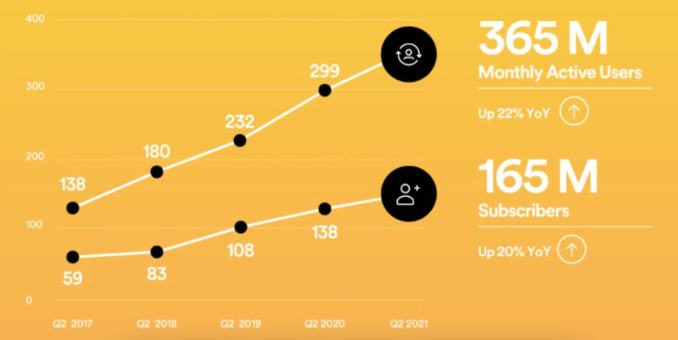
Given how many podcasting companies Spotify has acquired over the past few years, it would be concerning if there hadn’t been significant growth in this realm. Among Spotify users who already listen to podcasts, podcast listening increased 30% year over year, with total hours consumed up 95%. Meanwhile, podcast ad revenue increased by 627%, which out-performed expectations. Spotify attributes this success to a triple-digit year over year gain at its in-house studios (The Ringer, Parcast, Spotify Studios, and Gimlet), and exclusive deals with “The Joe Rogan Experience” and the Obamas’ Higher Ground studio. Spotify also referenced its November acquisition of Megaphone, a podcast hosting and ad company.

“The continued out-performance is is currently limited only by the availability of our inventory, which is something we’re actively solving for,” said CEO Daniel Ek. “The days of our ad business accounting for less than 10% of our total revenue are behind us, and going forward, I expect ads to be a substantial part of our revenue mix.”

Image Credits: Spotify

In April, Spotify launched paid podcast subscriptions — through Anchor, the podcast host that it bought in 2019, creators can choose to certain content behind a paywall. Apple launched a similar feature too, but it’s still too early to know how these subscription services will impact listeners and creators. However, Spotify did share a bit more information about its Audience Network, an audio ad marketplace. Since its rollout in April, Spotify’s “monetizable podcast inventory” tripled. Spotify has also seen a “meaningful” increase in unique advertisers and a “double-digit lift” in CPMs (cost per thousand ad impressions), but didn’t provide specific figures.

Still, the more power a platform like Spotify has over the podcasting industry, the fewer options creators will have for monetization — already, the ubiquity of streaming platforms has taken a toll on musicians, who are working together to demand better compensation from Spotify. The Justice at Spotify movement points out that on average, artists get $0.0038 per stream of a song, which means that a song needs to be streamed 263 times to make a single dollar. Spotify has continued to grow during the pandemic, but since live shows are musicians’ best way to make money in the age of streaming, artists have struggled while it’s unsafe to go on tour.

On this morning’s earnings call, Ek pointed to live performances on Greenroom, Spotify’s Clubhouse clone, as a potential way for musicians to increase revenue. In the past quarter, Spotify has tested live concerts as an income stream, partnering with artists like The Black Keys. Still, smaller artists might not trust the platform given its refusal to make streaming itself a more viable way to get paid for their work.

“Live is a meaningful thing for many of our creators, and it’s something that we’re excited about,” said Ek, adding that Spotify saw positive results from its digital live events thus far. “We want to provide as many opportunities for creators to create more ways to turn a listen into a fan, and turn fans into super fans, and increase the monetization for those creators.”

Though Spotify missed its target for monthly active users (MAUs) in Q2, other key metrics trended upward, like paid subscriber growth and revenue. The platform attributes this road bump in MAU growth to the lingering impact of COVID-19, as well as an issue Spotify had with its third-party email verification system.

“In full disclosure, this was an issue on our end,” said CFO Paul Vogel. “The estimate right now was that it was about 1 to 2 million of MAU growth that was impacted by the friction created by this email verification change. It’s since been corrected and should not be an impact in Q3.”

Of Spotify’s 365 million MAUs, 165 million (about 42.5%) are paid subscribers — that’s still far beyond its next biggest competitor, Apple Music, which had 60 million subscribers in 2019, but hasn’t released updated figures since.

28 Jul 2021

Financial firms should leverage machine learning to make anomaly detection easier

Anomaly detection is one of the more difficult and underserved operational areas in the asset-servicing sector of financial institutions. Broadly speaking, a true anomaly is one that deviates from the norm of the expected or the familiar. Anomalies can be the result of incompetence, maliciousness, system errors, accidents or the product of shifts in the underlying structure of day-to-day processes.

For the financial services industry, detecting anomalies is critical, as they may be indicative of illegal activities such as fraud, identity theft, network intrusion, account takeover or money laundering, which may result in undesired outcomes for both the institution and the individual.

There are different ways to address the challenge of anomaly detection, including supervised and unsupervised learning.

Detecting outlier data, or anomalies according to historic data patterns and trends can enrich a financial institution’s operational team by increasing their understanding and preparedness.

The challenge of detecting anomalies

Anomaly detection presents a unique challenge for a variety of reasons. First and foremost, the financial services industry has seen an increase in the volume and complexity of data in recent years. In addition, a large emphasis has been placed on the quality of data, turning it into a way to measure the health of an institution.

To make matters more complicated, anomaly detection requires the prediction of something that has not been seen before or prepared for. The increase in data and the fact that it is constantly changing exacerbates the challenge further.

Leveraging machine learning

There are different ways to address the challenge of anomaly detection, including supervised and unsupervised learning.

28 Jul 2021

Algramo aims to cut plastic waste with a reusable container ecosystem and $8.5M A round

Single-use plastic containers make up a huge amount of the world’s waste, but so far no one has come up with a good way to replace them that’s also easy for consumers and cost-effective. Algramo may have cracked this nut with a combination of reusable containers and distribution points that both makes and saves money, and it’s about to expand its footprint in a big way with a new $8.5M funding round.

Founded in Chile nearly a decade ago, Algramo is now findings its legs as companies in multiple industries find themselves under immense pressure to go green.

One compelling way to reduce waste is to cut down on single-use plastics, which of course are common for everything from cleaning supplies to soft drinks. The difficulty is figuring out how exactly to do that while not passing the cost on to consumers. If the product is eco-friendly but costs twice as much, only the wealthy will buy it and those working on a tight budget have to go, against their better judgment, with the cheaper, worse option.

“People are deciding between their pocket or their planet,” said CEO José Manuel Moller. “So we needed to be cheaper and better. So rather than make things more complex, we’re trying to make things more simple.”

José Manuel Moller (Founder and CEO Algramo) and Unilever_s Mobile Refill Station

Image Credits: Algramo

The solution they’ve arrived at after years of testing is a modified label for existing products, like detergent or shampoo, that includes an RFID tag that lets the consumer easily refill the bottle at a dispenser. Sold at bulk prices and having removed the cost of packaging (30 percent of the product’s cost, Moller estimated), it’s cheaper and requires nothing but going to a different shelf at the store.

The breakthrough wasn’t the idea, though, it was the relationships with big brands. If someone has to drive past their normal grocery store to refill your dish soap, they’re more likely to just buy a new bottle. Similarly, if only products on offer for bulk refilling are random off-brand ones, the same thing happens. So Algramo has had to make the case to the Walmarts and Unilevers of the world — and very recently they started to listen, at least at the local level.

“This was going to happen with or without Algramo,” said CEO José Manuel Moller. “But we’re integrating into their supply chains, working with the retailers and the brand so they don’t disrupt existing relationships. And actually, ordering the product in bulk saves them about 60 percent of the space.”

There are arrangements in place with Unilever, Nestlé, Colgate-Palmolive, and Walmart Chile.  By offering a turnkey solution that brings together big brands and big retailers and saves consumers a little cash, everyone gets what they want. Originally Algramo operated using a fleet of small vehicles equipped with dispensers, but ultimately the retail avenue proved to be the more successful one.

Unilever_s Mobile Refill Station(1)

The vehicles still exist, though, as this kid is happy to emphasize.

There are now Algramo stations all over Chile, with around 50,000 users repurchasing products in bulk. Those products, by the way, were determined not by profitability but by which is the worst polluter. The worst by far, Moller said, is beverages, but those present a different challenge — one the company is happily taking on but not quite ready to debut.

Instead, there are frequently used products like laundry soap and toiletries — even dog food (dry, obviously… for now). And Algramo was careful to ensure that users can buy as much or as little as they want at the bulk rate, making it more accessible for people who have to make every penny count.

The work in Chile has helped validate the idea at scale, and now the company is raising money ahead of a smattering of pilots around the world. There are projects underway in Jakarta, New York, Mexico, and London, all of which no doubt require a lot of local footwork, since different regulations, sub-companies, and distribution networks will necessitate new contracts and agreements everywhere they attempt to make a beachhead.

That’s what the $8.5M series A is all about: the global push. It was led by Mexico’s Dalus Capital, with participation from (deep breath) Angel Ventures, FEMSA Ventures, Volta Ventures, Impact Assets, University Venture Fund, Century Oak Capital and Closed Loop Partners’ Ventures Group (the last of which led the 2019 seed).

Moller said that there are parallel efforts along the lines of Algramo, but that ultimately their platform may very well end up compatible with the others. Owning both the retail and brand relationships is paramount, then those with the customer, but the last step may be adapted to different circumstances. For instance, if there’s a successful reverse logistics system in place (such as the reusable food containers common all over India) that may be part of the solution, and if someone like a grocery chain were to build their own hardware solution, Algramo would be happy to operate at least partly behind the scenes. (Also, they own several patents.)

That’s all pie in the sky for now, as Algramo focuses on building its own presence in various major markets. If you’re in one of the locations mentioned, keep your eye out at your local big retail or grocery chain for the Algramo station, or just check the map at the bottom of their website.

28 Jul 2021

48-hour countdown to early bird savings on passes to TC Disrupt 2021

What’s big enough, bold enough and influential enough to inspire more than 10,000 people around the world to carve out three days from their intensely busy schedules? If you said TechCrunch Disrupt 2021, the grand matriarch of startup tech conferences, well friend, you’d be right on the money.

And speaking of money, you have just 48 hours left to score the early-bird price on TC Disrupt Innovator, Founder and Investor passes. Buy any of these passes and attend all three days of Disrupt for less than $100. Here’s the catch: The early bird price expires on July 30 at 11:59 pm (PT).

Don’t miss the dynamic 1:1 interviews and panel discussions on the Disrupt Stage. We’ve tapped high-profile speakers — all leading voices in their fields — to download their insight, trends and sage advice. You’ll hear U.S. Secretary of Transportation Pete Buttigieg discuss some of the major challenges of moving people and packages around the block and across the globe.

Houseplant COO, Haneen Davies will join company co-founders Michael Mohr and Seth Rogen — who, it seems, has a somewhat successful side hustle as a Hollywood writer, director and actor — for a lively CBD: Cannabis Business Discussion.

Head on over to the Extra Crunch Stage where you’ll find strategic insight across a range of essential startup skills. Think fundraising, product iteration, tech stack development and growth marketing.

Here’s a quick peek at just some of what’s going down Extra Crunchy.

How to Cultivate a Community for your Company that Actually Lasts: The word of the year in startup-land is “community.” In this panel, Community Fund’s Lolita Taub, Commsor’s Alex Angel and Seven Seven Six’s Katelin Holloway will extract buzz from reality and help founders understand the growing importance of chief community officers in startup culture and, ultimately, financial success today.

The Path for Underrepresented Entrepreneurs: Founding a startup comes with a wide array of challenges but, unfortunately, underrepresented founders face an extra layer of bias, both conscious and unconscious. We’ll talk with Hana Mohan (MagicBell), Leslie Feinzaig (Female Founders Alliance) and Stephen Bailey (ExecOnline) about their journeys, as founders, through fundraising and scaling — and as advocates who can offer tactical insights and advice.

We’re just warming up, folks. You’ll hear from execs, founders and CEOs from companies like Twitter, Calendly, Mirror, Evil Geniuses, Andreessen Horowitz and plenty more. Check out the Disrupt 2021 agenda. We’ll add even more speakers, events and ticket discounts in the coming weeks. Register for updates so you don’t miss out.

TechCrunch Disrupt 2021 takes place on September 21-23. Buy your Disrupt pass before July 30 at 11:59 pm (PT), and get ready to join the big, bold and influential — for less than $100.

Is your company interested in sponsoring or exhibiting at Disrupt 2021? Contact our sponsorship sales team by filling out this form.

28 Jul 2021

Google unveils its proposed ‘Safety Section’ for apps on Google Play

In the wake of Apple’s advances into consumer privacy with initiatives like App Tracking Transparency and App Store privacy labels, Google recently announced its own plans to introduce a new “safety section” on Google Play that offers more information about the data apps collect and share, and other security and privacy details. Today, the company is sharing for the first time what the new section’ user interface will look like, along with other requirements for developers.

In May, Google explained the safety section would be designed to easily communicate to users how apps are handling their data, so they could make informed choices. It said app developers would need to disclose to users whether their app uses security practices like data encryption, whether it follows Google Play’s Families policy for apps aimed at kids, whether users have a choice in data sharing, whether the app’s safety section had been verified by a third party, and if the app allowed users to request data deletion at the time of uninstall, among other things.

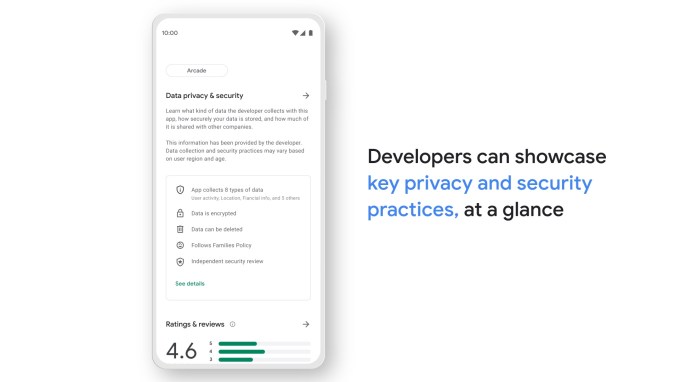
In the user interface concept Google debuted today, developers are now able to see how this feature will look to the end user.

Image Credits: Google

In the safety section, users will be able to see the developer’s explanation of what data the app collects followed by those other details, each with their own icon to serve as a visual indicator.

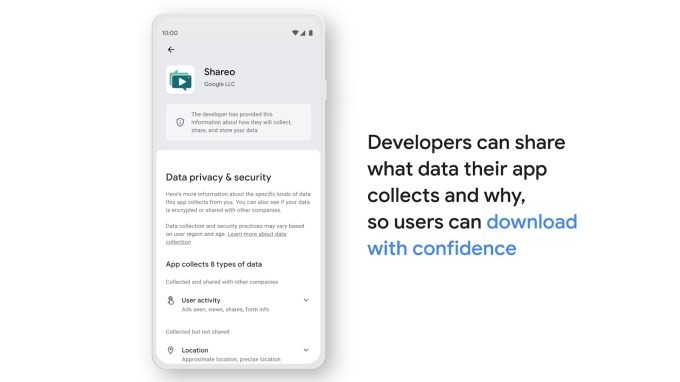
When users tap into the summary, they’ll be able to then see other details like what data is collected or shared — like location, contacts, personal information (e.g., name, email address), financial information and more.

They’ll also be able to see how the data is used — for app functionality, personalization, etc. — and whether data collection is optional. 

Image Credits: Google

Google says it wants to give developers plenty of time to prepare for these Play Store changes which is why it’s now sharing more information about the data type definitions, user journey and policy requirements of the new feature. 

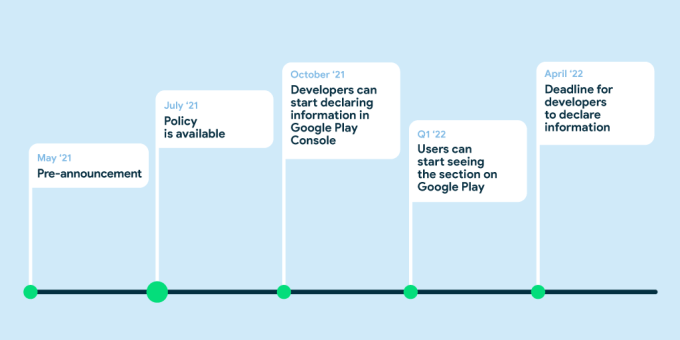
It notes that all developers will have to provide a privacy policy by April 2022. Before, only apps that collected personal and sensitive user data were required to do so. Developers will also be required to share accurate and complete information about all the data in their safety section, including how it’s used by the app’s third-party libraries and SDKs. This is in line with what Apple demands for its apps.

Image Credits: Google

In October 2021, developers will be able to submit their information in the Google Play Console for review, ahead of the planned launch of the safety section in Google Play, which is scheduled for the first quarter of 2022.

The company also notes it’s offering some buffer time after the section’s launch before apps must have their safety section approved by Google. However, the company says apps will have to be approved by Q2 2022 or risk having their app submissions or app updates rejected. And if an app doesn’t provide an approved safety section, the app will say “No information available.”

The change will help to highlight how many active developers are present on Google Play, as those will be the ones who will adopt the new policy and showcase how their apps collect and use data.

The question that remains is how stringent Google will be about enforcing its new guidelines and how carefully apps will be reviewed. One interesting note here is that conscientious developers will be able to submit their safety section for a third-party review and then be able to promote that to users concerned app data privacy and security.

This could help to address some potential criticism that these safety sections aren’t factual. That’s been a problem for Apple since the launch of its App Store privacy labels, in fact. The Washington Post discovered that a number of apps were displaying false information, making them less helpful to the users whose data they aimed to protect.

When reached for comment, however, Google declined to share more details about how the third-party verification process will work.

28 Jul 2021

Duolingo’s IPO pricing is great news for edtech startups

While the Chinese technology market digests a new regulatory landscape impacting the country’s edtech market in a sharply negative manner, U.S. education technology companies have something to cheer about: Duolingo’s IPO priced very well.

The language-learning unicorn initially targeted an $85 to $95 per-share IPO price range. That interval was later raised to $95 to $100 per share. And then, last night, Duolingo priced at $102 per share, just over its raised range.

That’s the sort of IPO pricing run that we tend to see from hot enterprise software companies (SaaS) that investors have favored heavily in recent quarters. But the stock market has also provided nigh-indulgent valuations to consumer-facing tech companies with strong brands, like Airbnb. So, the Duolingo IPO’s pricing strength should not be an utter surprise.

But it is a welcome result for U.S. edtech, regardless. When the company set its first IPO price range, TechCrunch noted that it was on track to earn a new, higher valuation. This led us to the following set of conclusions:

If Duolingo poses a strong debut, consumer edtech startups will be able to add a golden data point to their pitch decks. A strong Duolingo listing could also signal that mission-driven startups can have impressive turns.

And now Duolingo has managed to price above its raised range. Yeehaw, as they say.

In more prosaic terms, Duolingo has set a higher multiple for edtech revenue than we expected it to, implying that the exit value of edtech top line could be greater than private-market investors anticipated. After all, Duolingo was valued at around $2.4 billion last November. At its IPO price, the company’s non-diluted valuation is now $3.66 billion, not counting 765,916 shares that its underwriters may purchase at the $102-per-share price if they so choose.

28 Jul 2021

QuotaPath raises $21.3M in Insight Partners-led round to help sales teams better track commissions

QuotaPath, which has developed a commission-tracking solution for sales and revenue teams, has raised $21.3 million in a Series A funding round led by Insight Partners.

Existing backers ATX Ventures, Integr8d Capital, Stage 2 Capital and HubSpot Ventures also participated in the financing, which brings the startup’s total funding to $26.3 million since its 2018 inception.

The funding comes amid a year of growth for the startup, which has dual headquarters in Austin and Philadelphia. Specifically, QuotaPath has seen 600% revenue growth since January 2021. It has over 5,000 users on the platform, 40% of which are paid. Customers include Guru, Contractbook, Mailgun, Cloud Academy, SaaSOptics and OSG.

AJ Bruno, Cole Evetts and Eric Heydenberk founded QuotaPath with the mission of helping “companies build and scale high-performing, motivated growth teams.” The startup said it gives teams a way to streamline the commission process and avoid inaccurate budgets, incorrect payouts, and “unhappy sales reps due to poor sales commission planning, reporting and administration.”

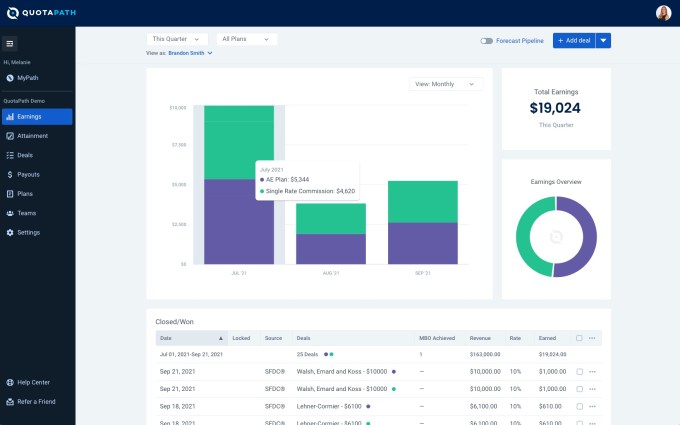
Through real-time CRM integrations with Salesforce, HubSpot and Close.com, sales reps are able to glean more insight into earnings and quota attainment, the company said.

Bruno is no stranger to startups, having co-founded Austin-based PR analytics company TrendKite, which sold to rival Cision in 2019 for $225 million. It was there that Bruno ran the sales and management teams, and about “30 folks into it,” was having some issues with compensation and commission. It took a month and getting several people involved to get the situation sorted. After trying to onboard a sales and commission tool for eight months and “failing miserably,” Bruno saw an opportunity.

“The reps needed to understand what their comp plans were and they didn’t have real-time visibility into the earnings and forecasting of their compensation,” he said. So he and Evetts (who was director of revenue and sales operations at TrendKite) ultimately set about creating a workflow to solve the problem. Heydenberk joined as a technical co-founder and the company went on to raise about $5 million in pre-seed and seed funding.

“What we ultimately said was going to be our north star is that we want the sales team and the sales reps to easily understand the compensation plans, and to do that, we had to build an onboarding setup where it didn’t look like a spreadsheet that was in Excel because most sales reps don’t understand Excel,” Bruno recalled. The team then spent a year working with end users and sales reps to build the back-end infrastructure of the platform so that sales teams could “interpret what was actually happening and all the mechanisms behind it.”

Requirements were that it was fast to onboard (less than one week) and easily adjustable so that customers could make changes in real-time themselves and not have to wait on a company to make them.

“With QuotaPath, a sales team can forecast more earnings and create more goals around what they want to do,” Bruno said, “and connect those goals to the bottom line of the company.”

Image Credits: QuotaPath

The startup launched its paid platform in June 2020 and works with companies with as few as three reps to as many as a few hundred that range from SaaS to commerce shops to low-tech businesses such as wedding venues and funeral homes.

“With 10.5 million salespeople in the U.S., this is a very large market,” Bruno said. Indeed, there are a number of other startups addressing the space. Earlier this year, CaptivateIQ, which has developed a no-code platform to help companies design customized sales commission plans, announced it had raised $46 million in a Series B round led by Accel.

QuotaPath currently has 28 employees and plans to use its new capital to double its headcount by year’s end. It also plans to work on scaling partnerships and expanding product offerings to finance and HR functions.

Rachel Geller, managing director at Insight Partners, is taking a seat on the company’s board as part of the financing. She said that a priority of Insight Onsite, the firm’s ScaleUp engine, is to help its portfolio “build high-performing and scalable sales and marketing functions.”

“Our sales experts are in the trenches understanding the challenges sales teams face, and tracking sales commissions is top of mind,” she said. “Organizations need a formula-free solution to their current pain of spreadsheets and legacy solutions, and QuotaPath presents a clear alternative.”

In particular, Geller said Insight was impressed by QuotaPath’s “ease of use and fast time to deploy” compared to other solutions.

“QuotaPath customers can be up and running in days,” she said.

28 Jul 2021

Twitter launches U.S. e-commerce pilot that lets users shop from profiles

Twitter this morning will launch a pilot in the U.S. aimed at testing the potential for e-commerce on its platform. The company is introducing a new “Shop Module” that offers brands, businesses and other retailers the ability to showcase their products to Twitter users directly on their profile. Users will then be able to scroll through a carousel of product images, and tap through on a product they’re interested in purchasing. This opens up the business’s website inside the Twitter app itself, where the customer can learn more about the product in question and make a purchase.

The Shop Module itself will appear in a new, dedicated space at the top of a supported Twitter profile, which can be seen by U.S. users in English on iOS devices.

The company tells us that only businesses with a Professional Profile will be able to use the feature at this time.

Professional Profiles, which began testing in April, give businesses, non-profits, publishers and creators the ability to display specific information about their business directly on their profile, including things like their address, phone number, operating hours, and more. Essentially, it’s the Twitter equivalent to something like a Facebook Page for a business.

At launch, the Shop Module will be made available to only a small group of pilot testers. In addition to gaming retailer @GameStop and travel brand @ArdenCove, Twitter says there will only be approximately 10 other brands across the lifestyle, traditional retail, gaming, media and entertainment, tech and telco industries who will gain access to the new feature.

At present, Twitter isn’t offering a way for interested businesses to sign up for the pilot, as the company is only in the initial phases of testing this feature.

Image Credits: Twitter

While Twitter users often discuss products on the app and even reach out to companies directly for help with purchases, it’s unclear whether or not users will come to view Twitter as a shopping platform.

With the pilot, Twitter says it wants to better understand what sort of products drive traffic to online retailers. For example, it wants to determine whether people are inspired by online conversations in the heat of the moment — like sports fans buying team apparel — or whether Twitter users could be encouraged to make purchases of a more lasting impact, like products for a new skincare routine. Having a diverse lineup of early pilot testers will help it to compare data across verticals to learn what works best.

Twitter says it will also work directly with businesses to better understand their needs through the creation of a new Merchant Advisory Board, which will consist of “best-in-class examples” of merchants on Twitter.

The company earlier this year had mentioned its plans to expand into e-commerce.

At Twitter’s Analyst Day presentation in February, where it first announced its Super Follow platform for creators, the company also briefly mentioned it planned to invest in e-commerce.

“We’re…starting to explore ways to better support commerce on Twitter,” Twitter Revenue Lead, Bruce Falck, had said during the event. “We know people come to Twitter to interact with brands and discuss their favorite products. In fact, you may have even noticed some businesses already developing creative ways to enable sales on our platform,” he continued.

“This demand gives us confidence in the power of combining real-time conversation with an engaged and intentional audience. Imagine easily discovering, and quickly purchasing, a new skincare product or trendy sneaker from a brand you follow with only a few clicks,” Falck added.

Since then, Twitter has tested a new e-commerce feature for tweets, which allowed businesses to link out to online product pages — like those on a Shopify store, for instance.

Twitter CFO Ned Segal also touted the potential to shop on Twitter when speaking to investors at the J.P. Morgan Technology, Media and Communications conference in May, noting that people “do a lot of research on Twitter before they buy something.”

Twitter’s entry into online shopping comes at a time when social platforms are ramping up their investments in e-commerce. Facebook has made major moves into e-commerce with shopping features across Facebook, Instagram and WhatsApp, including with online storefronts, integrated checkout, product drops, video shopping, and more.

Shopify has also partnered with a number of tech platforms, including Facebook, TikTok and Google, to make it easier for consumers to connect with products sold by its merchants.

Twitter had before attempted to run a commerce operation and failed. In 2017, the company begin to wind down its “Buy” button product, which had allowed Twitter users click to make purchases, and the retailer partnerships associated with that effort due to lack of traction. Clearly, the company believes the time is now right to try again.


28 Jul 2021

Calgary’s parking authority exposed driver’s personal data and tickets

If you parked your car in one of the thousands of parking spots across Calgary, there’s a good chance you paid the Calgary Parking Authority for the privilege. But soon you might be hearing from the authority after a recent security lapse exposed the personal information of vehicle owners.

The parking authority oversees about 14% of the paid parking spots in the Calgary region, and lets drivers pay to park their cars by a parking kiosk, online, or through the phone app by entering their vehicle’s license plate and their payment details.

But a logging server used to monitor the authority’s parking system for bugs and errors was left on the internet without a password. The server contained computer-readable technical logs, but also real-world events like payments and parking tickets that contained a driver’s personal information.

A review of the logs by TechCrunch found contact information, like driver’s full names, dates of birth, phone numbers, email addresses and postal addresses, as well as details of parking tickets and parking offenses — which included license plates and vehicle descriptions — and in some cases the location data of where the alleged parking offense took place. The logs also contained some partial card payment numbers and expiry dates.

None of the data was encrypted.

Because the server’s data was entangled with logs and other computer-readable data, it’s not known exactly how many people had their information exposed by the security lapse. (In 2019, the Calgary Parking Authority issued more than 450,000 parking tickets, up by 69% in five years.)

Security researcher Anurag Sen found the exposed server and asked TechCrunch for help in reporting it to its owner. The server was secured on Tuesday, a day after TechCrunch contacted the authority.

A spokesperson for the authority confirmed that the server was exposed since May 13, though data seen by TechCrunch shows records dating back to at least the start of the year. The authority also told TechCrunch that the exposure was due to human error and that it was investigating its logs to determine if anyone else had access to the server.

“We at the CPA take this very seriously,” said Moe Houssaini, the acting general manager for the Calgary Parking Authority, told TechCrunch in a statement. “Any public access has been disabled and we are actively investigating to determine what exact data was impacted and what unauthorized access may have occurred. We apologize to our customers and will be reaching out to all individuals who may have been impacted. Protecting the security of our systems and privacy of our customers is a top priority of the CPA. It was an isolated error, and the database has now been secured. We are reviewing our procedures to ensure that this does not happen again,” said Houssaini.

The Calgary Parking Authority recently made headlines after it canceled more than a thousand parking tickets for drivers who were attending a COVID-19 vaccination center in the city.

Earlier this year, New York-based cashless parking startup ParkMobile reported a data breach that saw personal account information and license plates on some 21 million customers taken by hackers. The company blamed the breach on a vulnerability in an unspecified piece of third-party software.

Read more:


You can send tips securely over Signal and WhatsApp to +1 646-755-8849. You can also send files or documents using our SecureDrop.