Year: 2021

28 Jul 2021

Insurtech startup Spot brings in $17.5M equity, debt to fill insurance gaps for accidental injuries

Affordable healthcare continues to be a major problem in the U.S., with roughly 30 million people without comprehensive healthcare and high medical costs causing many to go into debt. Spot is tackling this issue with a digital, on-demand injury insurance product that can be as-is or as a complement to traditional health insurance.

Headquartered in Austin, the company raised $15 million in equity and $2.5 million in debt in a round of seed funding led by GreatPoint Ventures, with participation from Montage Ventures, Mutual of Omaha, MS&AD and Silverton Partners.

The idea for the company came from a conversation founder Maria Goy and Matt Randall had back in 2018. Randall is married to Goy’s best friend, and one night, they started talking about Goy’s job at the time, in insurance at New York Life, and how there needed to be a product that provided affordable insurance. That led to a discussion about how to also have healthcare that was accessible.

“Every major market was disrupted by some change of distribution, like Netflix and Airbnb,” Goy told TechCrunch. “We are setting the foundation to drive change and the distribution of insurance.”

Spot’s business model takes a holistic approach by providing customized injury insurance policies through both direct-to-consumer and strategic partnerships with companies and organizations. For example, one of the company’s first partners was the Austin Marathon, selling one-time injury policies to the participants. Randall wasn‘t sure if people would buy them, but they ended up selling over 1,100 policies.

That led to applying the same idea across youth sports, ski resorts and cycling organizations. It now has over a dozen partners, including USA Cycling, Powder Mountain, USA BMX, National Ski Patrol and athleteReg, and covers tens of thousands of people.

The policies start at $25 and work like a monthly subscription. Family plans are also available. Spot covers up to $20,000 each time the customer is injured. The company will also coordinate with any existing healthcare insurance. Customers can use any licensed physician, hospital or urgent care clinic.

Spot has grown 800% in policies from last year and 300% in partnerships, including bringing on Mutual of Omaha. Spot is the first startup the insurance giant has invested in, and “having them alongside Maria is beyond a powerhouse team to say the least,” Randall said.

The company’s policies are available in 42 states via the DTC model and nationwide on group coverage, Goy said. The new funding round will be used to triple Spot’s team of 25, go after new partnerships and develop a go-to-market strategy. Randall also plans to raise a Series A round in the next nine months.

“We are focusing on bringing additional products that fill in holes and gaps in insurance and provide more education to the market,” Goy added. “We are getting requests for alternative coverage. For example, people would rather have acupuncture instead of surgery, which is not easy for a typical policy. Ultimately, our big mission is how to create a community within our customers and drive engagement.”

As part of the investment, Mike McCormick, principal at GreatPoint Ventures, will join Spot’s board of directors. He said in an interview that his firm is on the lookout for things that make healthcare better, including companies rooted in rethinking how to keep people well.

Spending much of his time in both healthcare and insurtech, McCormick wanted to find an answer to the problem of how the U.S. is spending so much money, on a per capita basis, and getting what he called “meh results.”

There are also the issues of most care being fee-for-service, and insurance for most people being attached to employment, while high deductibles have become a big feature, he said. He likes Spot because it is offering a product, for example, to someone young who is unlikely to get diabetes or cancer soon, but could incur $10,000 in medical costs breaking a leg skiing.

“What Spot is doing for the underinsured and uninsured makes sense,” McCormick added. “Maria and Matt are incredible people building an incredible company with growth and product-market fit. In terms of the partnership and direct-to-consumer models, they could build either one into a $10 billion company and both will work.”

 

28 Jul 2021

Launch vehicle startup Isar Aerospace lands an additional $75M in funding

A slew of launch startups have emerged in recent years to help meet growing demand from satellite providers, biotech companies and others looking to send payload to space. One such startup is Germany’s Isar Aerospace Technologies, which is focused on building orbital launch vehicles designed to carry up to 1,000 kilograms to low Earth orbit.

The startup made headlines last December – including here at TechCrunch – for scoring a $91 million Series B, the largest round to date in the European space launch scene. Now the company says it has raised an additional $75 million in a Series B extension, bringing the total round to over $165 million.

The extension round was led by HV Capital, Porsche SE and banking group Lombard Odier. Existing investors Earlybird Venture Capital, Lakestar, Vsquared Ventures, Apeiron Investment Group and UVC Partners also participated, with Earlybird subscribing the largest amount. Earlybird and Airbus Ventures led Isar’s $17 million Series A in December 2019.

Participation by Porsche SE – a major shareholder of Volkswagen – is particularly interesting as it signals growing interest from established mobility investors in connectivity and space-enabled technologies.

“As an investor focusing on mobility and industrial technology, we are convinced that cost-effective and flexible access to space will be a key enabler for innovations in traditional industries as well as for new and disruptive technologies and business models,” Porsche SE executive board member Lutz Meschke said in a statement. “Therefore, we are excited to back Isar Aerospace on its way to become the leading European small-launcher and to meet the increasing appetite for launch services.”

The funding will likely provide a significant boost for continued development and manufacturing as the company nears its planned first test flight in 2022.

Isar began production of its inaugural launch vehicle, the Spectrum rocket, this year. Spectrum is a two-stage vehicle that’s designed for lightweight delivery to low Earth orbit. The idea is to create a launcher that can move quickly and at a low cost to small satellite companies. Isar is aiming to conduct engine tests in Kiruna, Sweden, and launch operations in nearby Andøya, Norway, thanks to a 20-year agreement with Andøya Space for exclusive access to one of its launch pads. Notably, Isar has already secured its first paying customer, Airbus Defence and Space, and said in a statement that it plans on announcing more contracts soon.

The startup was spun out of Munich Technical University, where co-founders Daniel Metzler, Josef Fleischmann and Markus Brandl were studying engineering. While many of the new wave of launch companies are based in the United States, Isar is leading a parallel wave in Germany.

“A competitive and diverse space ecosystem will be crucial for humanity in the decades to come,” Isar CEO Daniel Metzler said in a statement. “We are convinced that European cooperation, a level-playing field for all players, and a demand-driven approach will provide customers with access to different and internationally competitive launch capabilities for a broad spectrum of payloads. The US has shown that cornerstone contracts based on demand – instead of political parameters – are preparing the ground for innovation and growth in the space sector.”

28 Jul 2021

Customer engagement platform Dixa raises $105M Series C led by General Atlantic

European customer engagement platform Dixa has raised a Series C funding round of $105 million, led by growth equity investor General Atlantic. Existing investors Notion Capital, Project A, and Seed Capital also participated. In February last year, it raised $36 million in Series B funding, led by Notion Capital, with support from existing investors Project A and Seed.

As well a product development, Dixa plans to use the cash injection as a war chest to roll-up other products. It already acquired Melbourne-based Elevio in January 2021.

Founded in Denmark in 2015 and launched in 2018, Dixa says it enables brands to stay connected with customers via messaging, live chat, email, or voice.

Mads Fosselius, founder and CEO of Dixa said: “For today’s customers, channels have ceased to matter. The way they engage now is holistically blended into what is called ‘multiexperience’. This is how we’re empowering brands to continuously stay true to their values.

Tom Hussey, Vice President in General Atlantic’s Technology sector focused on B2B software added: “Customer service software is undergoing a fundamental transformation, moving away from disjointed, transactional approaches towards longitudinal, conversational engagement. Dixa has helped to define and lead this multiexperience approach.”

28 Jul 2021

MedRhythms raises $25M to get patients back in tune after a stroke

MedRhythms secured $25 million in Series B funding to advance its digital therapy platform aimed at measuring and improving someone’s ability to walk after they have experienced a neurologic injury or disease.

Morningside Ventures and Advantage Capital co-led the round, with participation from existing investor Werth Family Investment Associates, to give the Portland, Maine-based company $31 million in funding to date.

Company co-founder and CEO Brian Harris was a neurologic music fellow at Spaulding Rehabilitation Hospital in Boston, treating people with stroke and brain deficits with music. He began getting questions from patients and families on how they could access similar care outside of the hospital. Not seeing a suitable alternative, he started MedRhythms with entrepreneur Owen McCarthy in 2016.

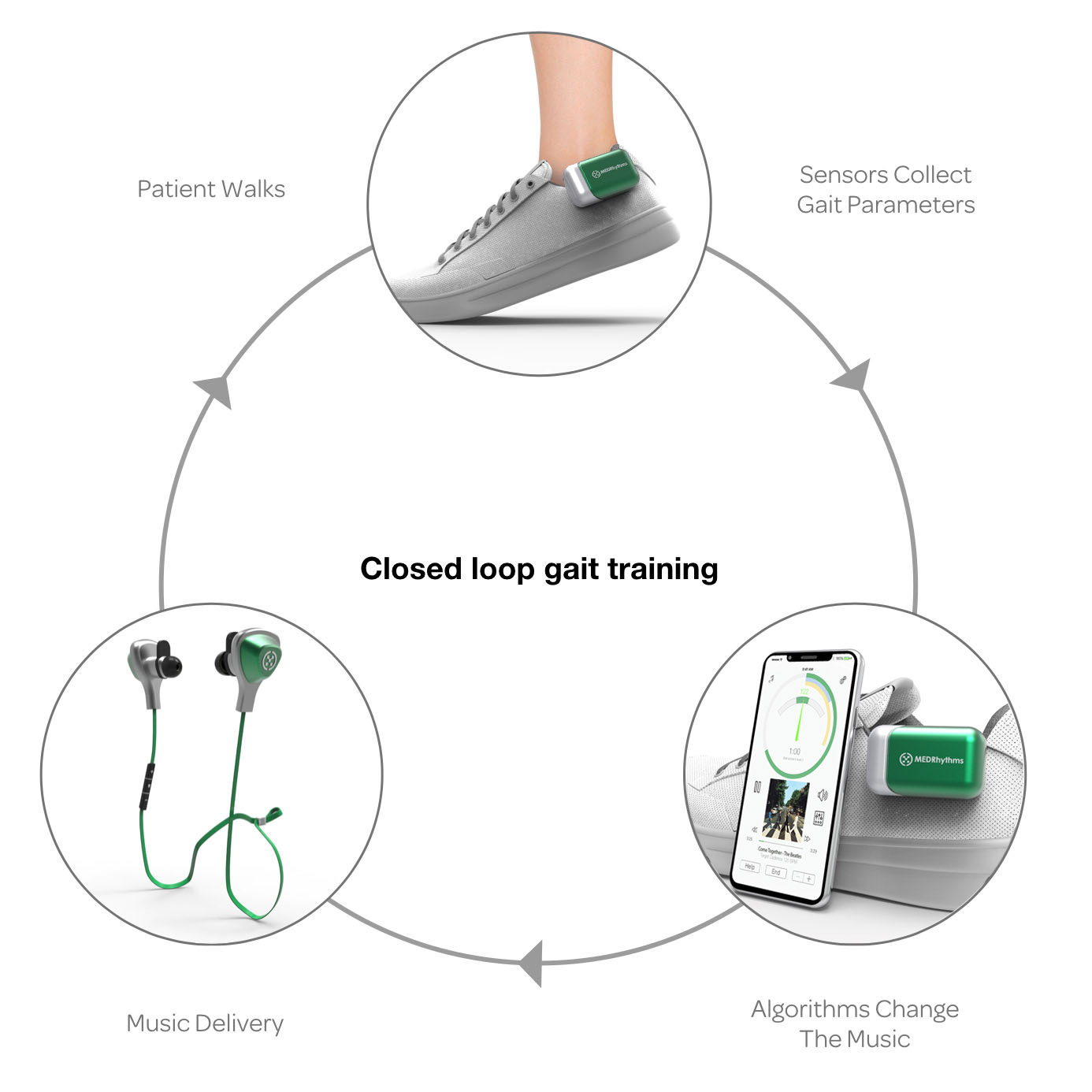
The company’s platform uses sensors, music and software, along with an evidence-based intervention called “rhythmic auditory stimulation,” to target the neural circuitry that controls movement. The technology taps into “entrainment,” a neurologic process in which the auditory and motor systems of the brain are coupled in synchrony with an external rhythmic cue, which over time, can lead to improved walking functionalities.

“There is no other stimulus that engages the brain like music does,” Harris said. “When someone is engaging in music, it aids in neuroplasticity to create new connections and strengthen old ones. Neuroplasticity is how we can learn new things or why people with brain deficits can improve.”

MedRhythms’ product cycle. Image Credits: MedRhythms

A year ago, MedRhythms’ digital therapeutic product received Breakthrough Device designation from the U.S. Food and Drug Administration to treat chronic walking deficits resulting from a stroke. It is the first in the company’s pipeline, which is also looking at using music to treat neurological conditions like Parkinson’s, acute stroke and multiple sclerosis. To that effect, it is participating in a neuroimaging study with Massachusetts General Hospital.

Harris intends to use the proceeds from the Series B funding to get the product to market, expand the team and the treatment pipeline. The company is preparing for submission to the FDA so it can do a commercial launch of the technology and begin clinical trials.

Stephen Bruso, investment partner at Morningside, said he has known the team at MedRhythms for a year. The firm is active in the digital health space and has followed the company closely since then.

COVID served to fundamentally shift healthcare in how to deliver care. The hospital and clinic models were robust, but resistant to change until the pandemic forced care to telemedicine visits at home, he said. It also forced innovation on the industry, and at-home therapy is an area where Bruso expects to see improvement in both patient compliance and recovery, and MedRhythms is capitalizing on that trend of shifting care to the home.

What intrigued the firm for the last couple of months was the idea of affecting the brain via non-pharmaceutical needs.

“MedRhythms using musical intervention to drive changes and improvements in neurologics is compelling,” Bruso added. “Emotional memory is tied to music. Its use provides a richer experience than taking a drug, and the company exists to tap into that.”


28 Jul 2021

Search API startup Algolia raises $150 million at $2.25 billion valuation

Algolia has raised a $150 million Series D funding round at a post-money valuation of $2.25 billion. Compared to the Series C round from October 2019, the company’s valuation has more than quadrupled. It means that Algolia is now a unicorn with a valuation above $1 billion.

The company is best known for its search-as-a-service product. It lets you integrate real-time search in your app or website using a developer-friendly API. Using an Algolia-powered search feature feels like using Spotlight on a Mac. Results load with each keystroke and appear in just a few milliseconds.

The company now has over 10,000 customers, including some big names, such as Slack, Stripe, Medium, Zendesk and Lacoste. Right now, the company handles over 1.5 trillion search queries per year — that’s a 1,500,000,000,000 if you want to see all the zeros.

Lone Pine Capital is leading today’s funding round. Fidelity Management & Research Company LLC, STEADFAST Capital Ventures, Glynn Capital and Twilio also participated in the round. But that’s not all, some existing investors also put more money on the table, such as Accel, Salesforce Ventures, DAG, Owl Rock and World Innovation Lab.

While the company doesn’t share revenue numbers directly, Algolia says that its annual recurring revenue has increased by 180% year over year.

“The future is API-first – a reality underscored by the growth seen by Twilio, Stripe, Algolia and others in the API economy. A huge part of our success has, and will continue to be, our relentless focus on developers with our PLG strategy — enabling them to build search into their websites and apps, so they create the most relevant and dynamic digital experiences.” Algolia CEO Bernadette Nixon said in a statement. “And we’re excited to continue to solve customers' problems as we continue to expand beyond search with Algolia Recommend and Predict.”

In addition to its search API, Algolia has expanded to other real-time APIs. For instance, you can provide real-time product recommendations on your e-commerce website with Algolia Recommend. This is part of a strategy to diversify the company’s product offering.

In particular, the company is now trying to analyze the visitor’s intent to predict whether they’re likely to purchase something on not. Companies can then leverage that info to refresh content dynamically, send a push notification, display a special offer, etc.

Originally founded in France, the company has grown tremendously over the past few years. Algolia is now a big enterprise-focused company with a solid business. Last year, its co-founder and CEO Nicolas Dessaigne decided to transition to a non-operational role.

And the company has recruited quite a few senior executives over the past 18 months — Michelle Adams (chief revenue officer, formerly of Dropbox), Carlton Baab (chief financial officer, formerly of Alfresco), Piyush Patel (chief business development officer, formerly of Capgemini), Jim Schattin (chief customer officer, formerly of Alteryx), Jason McClelland (chief marketing officer, formerly of Salesforce and Adobe) and Bharat Guruprakash (chief product officer, formerly of Twilio).

As you can see, it’s a long list of talented people, which means that Algolia is focused on building a long-term company instead of building cool technology and optimizing for an acquisition. I wouldn’t be surprised to learn about an IPO down the road.

28 Jul 2021

Former Iora Health execs raise $13M to guide seniors through Medicare enrollment

Employers typically offer three options for healthcare insurance. When it’s time to switch to Medicare, particularly Medicare Advantage, there are over 3,500 plans available nationwide, and an average of 30 plans someone can choose from in their particular area. Connie Health is leading seniors through the Medicare maze, helping whittle down those 3,000 plans into a handful of best choices based on care requirements.

The company’s three co-founders, Oded Eran, CEO, David Luna, chief revenue officer, and Michael Scopa, chief growth officer, saw this problem firsthand as executives at primary care company Iora Health, which is being acquired by OneMedical for $2.1 billion.

They started their company in 2019 to develop a Medicare concierge service to assist seniors in easily navigating through those 30 plans to find the right one for them.

“We were coming from the provider side and understood that though healthcare is local, people don’t know the difference in hospitals or the ins and outs of local networks,” Eran told TechCrunch. “Seniors need trust there, and when there are local advisers to meet over the phone or at home, you gain that trust.”

The Boston-based company announced Wednesday it raised $13 million in Series A funding led by Khosla Ventures and Pittango Healthtech to give it a total of $16 million in funding. The company raised $3 million in a seed round back in January 2020, also led by Khosla. The seed and Series A rounds also saw participation by AbstractVentures, Dynamic Loop Capital, Arkitekt Ventures, as well as a group of angel investors, including Hippo Insurance CEO Assaf Wand and Flatiron Health founders Zach Weinberg and Nat Turner.

Image Credits: Connie Health

With 55 million Medicare consumers benefiting from major innovation in Medicare Advantage and value-based care, Kaul saw a large market that was being disrupted by Connie Health. He was especially impressed with the team Eran built and how the company was able to launch during the pandemic and stay nimble.

“The Medicare Advantage space is rich and will continue to grow,” Kaul added. “Technology has not played a big role here, and Oded is going to bring technology in to make the market more efficient.”

Medicare Advantage is the private market part of the insurance program. Eran said the government is trying to drive competition and innovation, so there are a lot of new players coming in to create more plan options, more nuances and to help manage costs better. On the consumer level, this creates a lot of confusion, he added. Potential customers have a hard time making decisions on the latest and greatest options, so they tend to stick with the status quo.

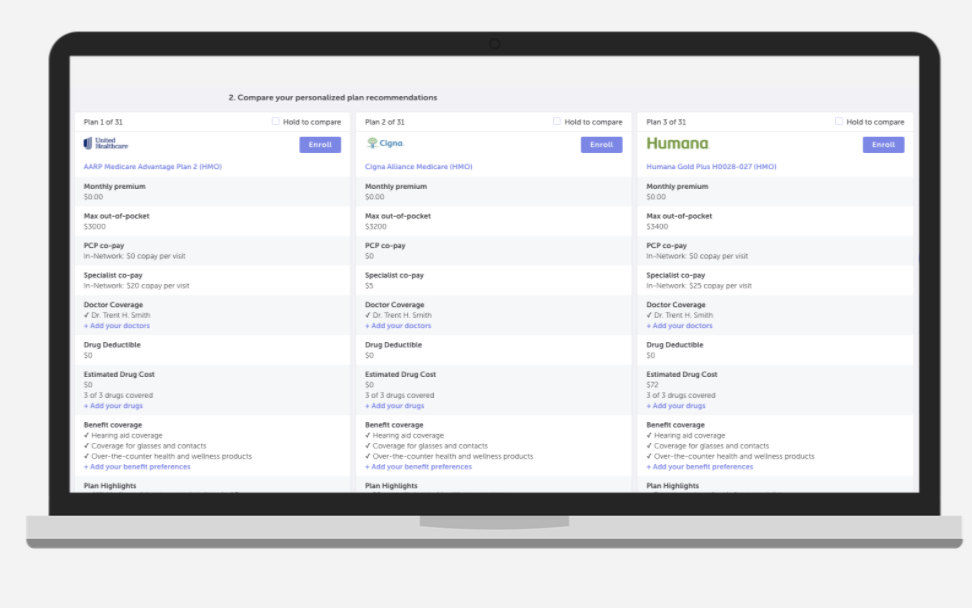
That’s where Connie Health comes in. The company’s technology takes into account the providers someone sees, the medications they are on and the benefits they would like to have, feed those into its model, and based on that, sifts through the thousands of plans available and recommends the best fits.

Four months ago, Connie Health kicked off its consumer platform in Arizona, and with the new investment, also began operating in Texas. Over the next year, Eran expects to move into Illinois, where he is seeing big demographic changes as a lot of people are moving into Medicare and other states. The new funding will also enable the company to branch off to other insurance products.

Within those states, the company’s footprint grew to seven markets, and its local agent base grew 15 times.

“We are going to democratize access to the local agents to help people make these often tough decisions and find healthcare that they deserve and have paid for all of their working life,” Eran said. “We are taking this market-by-market approach because healthcare is in the community.”


28 Jul 2021

High-profile entrepreneurs launch $85 million fund to back Indian SaaS startups

Four high-profile Indian entrepreneurs who are among those who kickstarted India’s SaaS journey, building and helping startups scale and win customers globally and also backed about 100 such firms, are ready for their next phase of participation in the country’s startup ecosystem.

The group — Girish Mathrubootham of Freshworks, Manav Garg of Eka Corporation, Shubham Gupta, formerly with investment firm Matrix, and Avinash Raghava, formerly with Nasscom, iSPIRT and SaaSBOOMi — said on Wednesday it has created a venture capital fund, called Together Fund, with an initial corpus of $85 million to back young Indian startups operating in the software-as-a-service space.

Together Fund is looking to back between 20 to 25 startups at Pre-seed to Series B stages. The firm’s check size will range between $250,000 to $3 million, said Garg in an interview with TechCrunch.

Indian news outlet the CapTable first reported about the fund’s formation earlier this year and cited an investor who said that Together is likely to attract all good SaaS deals because of its founding team and problem statement.

The fund has amassed a network of over 150 startup founders and investors including Krish Subramanian of Chargebee, Nishith Rastogi of Locus, Shashank ND of Practo, Kunal Shah of CRED. And that underscores the reason why Together Fund was conceived, said Garg. The entire team consists of founders and other operators who have built startups and have expertise around sales strategy and global expansion, he said.

“This is India’s first operator and founder-led fund,” he said. “The idea of creating this fund was to provide great help and opportunities to the founders along with money.”

The creation of the fund — which counts its founding team among its LPs — comes at a time when Indian startups are raising record capital as many high-profile investors double down in the world’s second largest internet market.

In the past decade, India’s startup ecosystem has evolved from a space that most Indian families were apprehensive about to one that has witnessed several high-profile exits and many entrepreneurs have marched ahead to do their second startups.

“Today, Freshworks is a large company with more than 3,800 team members and offices all over the world. But almost eleven years ago, we were just a six-member team operating out of a small garage in Chennai. I didn’t have a gilt-edged resume or family wealth but that never stopped me from dreaming big,” wrote Mathrubootham in a blog post.

“To me, Together is not just a fund, it is a way to pay it forward to the startup community that gave me so much. It is a natural progression of the “pay it forward” initiatives we started with community programs such as PNGrowth, SaaSx and SaaSBOOMi. With Together, we are not just offering capital to founders, we are offering our time and counsel as well,” he added.

The founding team of Together Fund will continue to participate in other industry initiatives, including SaaSBOOMi, an annual flagship conference focused on SaaS startups in India, said Raghava in an interview.

India’s SaaS industry could reach $1 trillion in value and create about half million new jobs by 2030, according to a recent study by SaaSBoomi, consultancy firm McKinsey and industry trade group Nasscom.

28 Jul 2021

High-profile entrepreneurs launch $85 million fund to back Indian SaaS startups

Four high-profile Indian entrepreneurs who are among those who kickstarted India’s SaaS journey, building and helping startups scale and win customers globally and also backed about 100 such firms, are ready for their next phase of participation in the country’s startup ecosystem.

The group — Girish Mathrubootham of Freshworks, Manav Garg of Eka Corporation, Shubham Gupta, formerly with investment firm Matrix, and Avinash Raghava, formerly with Nasscom, iSPIRT and SaaSBOOMi — said on Wednesday it has created a venture capital fund, called Together Fund, with an initial corpus of $85 million to back young Indian startups operating in the software-as-a-service space.

Together Fund is looking to back between 20 to 25 startups at Pre-seed to Series B stages. The firm’s check size will range between $250,000 to $3 million, said Garg in an interview with TechCrunch.

Indian news outlet the CapTable first reported about the fund’s formation earlier this year and cited an investor who said that Together is likely to attract all good SaaS deals because of its founding team and problem statement.

The fund has amassed a network of over 150 startup founders and investors including Krish Subramanian of Chargebee, Nishith Rastogi of Locus, Shashank ND of Practo, Kunal Shah of CRED. And that underscores the reason why Together Fund was conceived, said Garg. The entire team consists of founders and other operators who have built startups and have expertise around sales strategy and global expansion, he said.

“This is India’s first operator and founder-led fund,” he said. “The idea of creating this fund was to provide great help and opportunities to the founders along with money.”

The creation of the fund — which counts its founding team among its LPs — comes at a time when Indian startups are raising record capital as many high-profile investors double down in the world’s second largest internet market.

In the past decade, India’s startup ecosystem has evolved from a space that most Indian families were apprehensive about to one that has witnessed several high-profile exits and many entrepreneurs have marched ahead to do their second startups.

“Today, Freshworks is a large company with more than 3,800 team members and offices all over the world. But almost eleven years ago, we were just a six-member team operating out of a small garage in Chennai. I didn’t have a gilt-edged resume or family wealth but that never stopped me from dreaming big,” wrote Mathrubootham in a blog post.

“To me, Together is not just a fund, it is a way to pay it forward to the startup community that gave me so much. It is a natural progression of the “pay it forward” initiatives we started with community programs such as PNGrowth, SaaSx and SaaSBOOMi. With Together, we are not just offering capital to founders, we are offering our time and counsel as well,” he added.

The founding team of Together Fund will continue to participate in other industry initiatives, including SaaSBOOMi, an annual flagship conference focused on SaaS startups in India, said Raghava in an interview.

India’s SaaS industry could reach $1 trillion in value and create about half million new jobs by 2030, according to a recent study by SaaSBoomi, consultancy firm McKinsey and industry trade group Nasscom.

28 Jul 2021

Contentful raises $175M at a $3B valuation from Tiger for its content delivery service

Contentful this morning announced a $175 million Series F round of capital, led by Tiger Global, valuing the unicorn at around $3 billion. Contentful, formerly known as a UI-free content management system (headless CMS), now views itself in a broader light. More simply, Contentful provides customers with a service that will deliver images, words, and other content to their applications and websites around the world, quickly.

According to the company, Tidemark and Base10 Advancement Initiative were added to its cap table in the round, which also saw participation from previous investors. Prior to the round that Contentful announced today, its most recent fundraising event was an $80 million Series E led by Sapphire Ventures in June 2020.

PitchBook data indicates that that round was raised at a roughly $550 million valuation, while our reporting at the time of the company’s Series E includes the tidbit that “a Contentful spokesperson [told TechCrunch] that [the company was] approaching a $1 billion” valuation. Split the difference and it’s clear that Contentful’s new valuation is a multiple of what the company was worth a year ago.

But before we dig into metrics and results — or really a lack thereof — let’s take a minute to chat through Contenful’s business.

What does it do?

TechCrunch caught up with Contentful’s CEO, Steve Sloan (previously of Twilio and Bessemer), and its comms connect, Brian Spittler (previously of Podium), to dig more into its products.

Sloan explained Contentful by analogy, saying that as Twilio served the communications market and Stripe the payments space, Contentful wants to handle the world’s digital content. Yes, we’re talking APIs (application programming interface). Contentful has a handful of core APIs that allow for reading and writing content to its data buckets and making content available at the right time.

In more practical terms, Contentful doesn’t want to help companies build apps. Other companies are rather good at that. Instead, it wants to help customers’ apps load their in-app content very quickly, regardless of where their users are. You can now better understand the modestly aspirational Stripe and Twilio comparison; Contentful wants to take a piece of a developer’s workload, in this case delivering digital content to controlled applications, abstract it and deliver the functionality as an API. So as developers could simply use Twilio to make text messages appear around the world without coming to terms with global telephone providers, Contentful customers can avoid having to think about content delivery networks (CDNs) and global bandwidth for their content.

Now that we have a reasonable grasp of what Contentful does, let’s talk about growth:


No, that’s not an errant space. Contentful’s CEO declined to share essentially anything concerning its business growth, aside from that when Contentful raised its Series E it was around an “inflection point” for the company. This irked me a little; we know that the company had a good 2020 and likely a good 2021 thus far. Why? Because Tiger didn’t invest in a $175 million round at a new, higher price for Contentful on the back of mediocre results.

To his credit, Sloan was willing to explain why his company decided to avoid sharing growth information. Per the CEO, when a company discloses pieces of growth data over time, folks will go back when they go public and compare data to claims. And, he added, given that definitions can change, sharing can be more bother than it’s worth. There’s some truth to this: Some startups will claim profitability, for example, only to gently backpedal and explain that what they meant was really adjusted EBITDA, say, or positive operating cash flow.

The solution, of course, is for growth-stage startups to share GAAP-ready data with the media when they want our attention. After all, Contentful is aiming toward an IPO and is probably already learning to get its books in proper order. GAAP results are possible! And to be fair to Contentful, many startups decline to share useful data about their performance when courting media attention, often at the request of their investors; that we journalists of the world have to then deal with other investors complaining to us that the media is too fixated on funding rounds as progress points is a distinct, if closely related, matter.

Why do we think that Contentful is targeting an eventual public debut? Because companies tend not to raise nine figures at 10-figure valuations if they are hoping for a quick exit. The unicorn is now too expensive for anyone but the largest tech companies to buy; ergo it intends to go public. And, yes, we would go back and check claimed results against historical GAAP data in its S-1 if we were able to. That’s research! And fact-checking!

Gripes aside, Sloan shared employee growth expectations in a broad manner. Contentful is around 600 people today, split between its hubs in Denver, Berlin and San Francisco. Over the next two years, it intends to double (or a bit more than double) that headcount. Pull out your pencils and come up with your own revenue guesses based on that. The correct answer is present-day ARR somewhere between $75 and $75 million. Good luck.

Looking ahead, Contentful sells to three main customer buckets, per its CEO: midmarket customers, enterprise customers and venture-backed startups that intend to get big. Given that all of those are either pursuing digital transformation work or are digitally native, we presume that Contentful’s market will remain fertile for some time. That implies a winsome total addressable market for the company to sell into, implying ample future growth opportunities. Let’s see what it can get done with $175 million more.

28 Jul 2021

Contentful raises $175M at a $3B valuation from Tiger for its content delivery service

Contentful this morning announced a $175 million Series F round of capital, led by Tiger Global, valuing the unicorn at around $3 billion. Contentful, formerly known as a UI-free content management system (headless CMS), now views itself in a broader light. More simply, Contentful provides customers with a service that will deliver images, words, and other content to their applications and websites around the world, quickly.

According to the company, Tidemark and Base10 Advancement Initiative were added to its cap table in the round, which also saw participation from previous investors. Prior to the round that Contentful announced today, its most recent fundraising event was an $80 million Series E led by Sapphire Ventures in June 2020.

PitchBook data indicates that that round was raised at a roughly $550 million valuation, while our reporting at the time of the company’s Series E includes the tidbit that “a Contentful spokesperson [told TechCrunch] that [the company was] approaching a $1 billion” valuation. Split the difference and it’s clear that Contentful’s new valuation is a multiple of what the company was worth a year ago.

But before we dig into metrics and results — or really a lack thereof — let’s take a minute to chat through Contenful’s business.

What does it do?

TechCrunch caught up with Contentful’s CEO, Steve Sloan (previously of Twilio and Bessemer), and its comms connect, Brian Spittler (previously of Podium), to dig more into its products.

Sloan explained Contentful by analogy, saying that as Twilio served the communications market and Stripe the payments space, Contentful wants to handle the world’s digital content. Yes, we’re talking APIs (application programming interface). Contentful has a handful of core APIs that allow for reading and writing content to its data buckets and making content available at the right time.

In more practical terms, Contentful doesn’t want to help companies build apps. Other companies are rather good at that. Instead, it wants to help customers’ apps load their in-app content very quickly, regardless of where their users are. You can now better understand the modestly aspirational Stripe and Twilio comparison; Contentful wants to take a piece of a developer’s workload, in this case delivering digital content to controlled applications, abstract it and deliver the functionality as an API. So as developers could simply use Twilio to make text messages appear around the world without coming to terms with global telephone providers, Contentful customers can avoid having to think about content delivery networks (CDNs) and global bandwidth for their content.

Now that we have a reasonable grasp of what Contentful does, let’s talk about growth:


No, that’s not an errant space. Contentful’s CEO declined to share essentially anything concerning its business growth, aside from that when Contentful raised its Series E it was around an “inflection point” for the company. This irked me a little; we know that the company had a good 2020 and likely a good 2021 thus far. Why? Because Tiger didn’t invest in a $175 million round at a new, higher price for Contentful on the back of mediocre results.

To his credit, Sloan was willing to explain why his company decided to avoid sharing growth information. Per the CEO, when a company discloses pieces of growth data over time, folks will go back when they go public and compare data to claims. And, he added, given that definitions can change, sharing can be more bother than it’s worth. There’s some truth to this: Some startups will claim profitability, for example, only to gently backpedal and explain that what they meant was really adjusted EBITDA, say, or positive operating cash flow.

The solution, of course, is for growth-stage startups to share GAAP-ready data with the media when they want our attention. After all, Contentful is aiming toward an IPO and is probably already learning to get its books in proper order. GAAP results are possible! And to be fair to Contentful, many startups decline to share useful data about their performance when courting media attention, often at the request of their investors; that we journalists of the world have to then deal with other investors complaining to us that the media is too fixated on funding rounds as progress points is a distinct, if closely related, matter.

Why do we think that Contentful is targeting an eventual public debut? Because companies tend not to raise nine figures at 10-figure valuations if they are hoping for a quick exit. The unicorn is now too expensive for anyone but the largest tech companies to buy; ergo it intends to go public. And, yes, we would go back and check claimed results against historical GAAP data in its S-1 if we were able to. That’s research! And fact-checking!

Gripes aside, Sloan shared employee growth expectations in a broad manner. Contentful is around 600 people today, split between its hubs in Denver, Berlin and San Francisco. Over the next two years, it intends to double (or a bit more than double) that headcount. Pull out your pencils and come up with your own revenue guesses based on that. The correct answer is present-day ARR somewhere between $75 and $75 million. Good luck.

Looking ahead, Contentful sells to three main customer buckets, per its CEO: midmarket customers, enterprise customers and venture-backed startups that intend to get big. Given that all of those are either pursuing digital transformation work or are digitally native, we presume that Contentful’s market will remain fertile for some time. That implies a winsome total addressable market for the company to sell into, implying ample future growth opportunities. Let’s see what it can get done with $175 million more.