Year: 2021

21 Jul 2021

Rivian plans to install EV chargers in Tennessee’s 56 state parks

Rivian electric vehicle charging stations are coming to yet another state park system. The EV startup said it would install its so-called “waypoint” chargers at all of Tennessee’s 56 state parks, just four months after announcing a similar agreement with the state of Colorado.

It’s the next step in Rivian’s plans to build out its network of more than 10,000 Level 2 AC chargers by the end of 2023. Installing chargers at state parks and other far-flung locales is a key facet of Rivian’s brand strategy: to position itself as an eco-friendly automaker for the outdoorsy type regardless of whether they own a Rivian vehicle. The waypoint chargers will be open to the public and accessible to all electric vehicle brands with a J1772 plug.

As part of the agreement with the Tennessee Department of Environment and Conservation, Rivian will design and install the chargers at no cost, and cover all servicing, maintenance, and upgrades for 10 years. The automaker said it will also cover any needed utility upgrades associated with the charger installations – for example, improvements to electrical service panels or transformers.

Rivian could start installing chargers as early as this fall. The Level 2 chargers can provide up to 11.5 kilowatts of power. That roughly translates to adding up to 25 miles of range every hour for both the R1T pickup truck and the R1S SUV. While waiting hours for a battery refill isn’t ideal for chargers located along highways and busy thoroughfares, Rivian says these sites will allow drivers “to top up on miles while enjoying a day trip or an overnight campout.”

Charging will initially be provided at no cost, though the automaker noted that future costs could be dependent on how the state decides to recover electricity costs.

Rivian Waypoints are separate from the company’s so-called Adventure Network, its plan to build more than 3,500 DC fast chargers exclusively for Rivian customers. Those chargers will be able to provide up to 140 miles of range in around 20 minutes.

Rivian founder RJ Scaringe has been open about his desire to develop a charging network inclusive of hard-to-reach places – a notable difference from a company like Tesla, whose proprietary network of Superchargers is located in more conventional and even high-end places.

“We’re excited about the opportunity to create Rivian charging locations that aren’t on the interstate, that help draw you or enable you to go to places that normally are not the kinds of places that invite or welcome electric vehicles because of charging infrastructure,” he said in a wide-ranging interview with TechCrunch’s Kirsten Korosec. “We’ve spent a lot of time thinking about how you can essentially create these curated drives where, depending on your point of interest, you can pick different paths. If you want to stop midway through the trip for a one-mile, two-mile or five-mile hike, you know, here’s a route that you want to take and here’s a charging location right next to it.”

21 Jul 2021

Rivian plans to install EV chargers in Tennessee’s 56 state parks

Rivian electric vehicle charging stations are coming to yet another state park system. The EV startup said it would install its so-called “waypoint” chargers at all of Tennessee’s 56 state parks, just four months after announcing a similar agreement with the state of Colorado.

It’s the next step in Rivian’s plans to build out its network of more than 10,000 Level 2 AC chargers by the end of 2023. Installing chargers at state parks and other far-flung locales is a key facet of Rivian’s brand strategy: to position itself as an eco-friendly automaker for the outdoorsy type regardless of whether they own a Rivian vehicle. The waypoint chargers will be open to the public and accessible to all electric vehicle brands with a J1772 plug.

As part of the agreement with the Tennessee Department of Environment and Conservation, Rivian will design and install the chargers at no cost, and cover all servicing, maintenance, and upgrades for 10 years. The automaker said it will also cover any needed utility upgrades associated with the charger installations – for example, improvements to electrical service panels or transformers.

Rivian could start installing chargers as early as this fall. The Level 2 chargers can provide up to 11.5 kilowatts of power. That roughly translates to adding up to 25 miles of range every hour for both the R1T pickup truck and the R1S SUV. While waiting hours for a battery refill isn’t ideal for chargers located along highways and busy thoroughfares, Rivian says these sites will allow drivers “to top up on miles while enjoying a day trip or an overnight campout.”

Charging will initially be provided at no cost, though the automaker noted that future costs could be dependent on how the state decides to recover electricity costs.

Rivian Waypoints are separate from the company’s so-called Adventure Network, its plan to build more than 3,500 DC fast chargers exclusively for Rivian customers. Those chargers will be able to provide up to 140 miles of range in around 20 minutes.

Rivian founder RJ Scaringe has been open about his desire to develop a charging network inclusive of hard-to-reach places – a notable difference from a company like Tesla, whose proprietary network of Superchargers is located in more conventional and even high-end places.

“We’re excited about the opportunity to create Rivian charging locations that aren’t on the interstate, that help draw you or enable you to go to places that normally are not the kinds of places that invite or welcome electric vehicles because of charging infrastructure,” he said in a wide-ranging interview with TechCrunch’s Kirsten Korosec. “We’ve spent a lot of time thinking about how you can essentially create these curated drives where, depending on your point of interest, you can pick different paths. If you want to stop midway through the trip for a one-mile, two-mile or five-mile hike, you know, here’s a route that you want to take and here’s a charging location right next to it.”

21 Jul 2021

Michael Arrington’s next act

As longtime TechCrunch readers know well, Michael Arrington cofounded TechCrunch and Crunchbase, as well as the venture fund CrunchFund, which was later renamed Tuesday Capital. But In 2017, Arrington announced that he was shifting gears and becoming a full-time crypto investor, and despite a volatile ride since, he isn’t looking back, seemingly. As he said during an interview late last week, “I like reinventing myself and I think more people should do that.”

On the heels of new fund announcement earlier this month, we decided to catch up with Arrington to learn more about the hedge fund firm he has been building in recent years with longtime business partner Heather Harde; longtime investor-entrepreneur Ron Palmeri; and Ninor and Ninos Mansor, brothers whose crypto firm merged with Arrington’s Arrington XRP Capital in 2019.

Our chat has been edited for length and clarity below. You can hear that longer conversation here.

TC: You recently moved to Miami. Why?

MA: I visited Miami earlier this year for the first time in a couple decades and was here just for fun on a vacation. Part of it might have been that it was one of the first times I’ve been out and social since COVID. Part of it might just be it’s actually wonderful here in the winter. I think it was February when I came. But we just fell in love with the city and got to know the mayor,  got to know some people here. A lot of my friends, particularly from New York and San Francisco, had already moved here, and it just felt very welcoming. The city’s government seems to care about its citizens and want them to be happy, or at least not explicitly trying to make them unhappy. So we came back to look at houses a couple times [and] moved here pretty quickly.

A number of venture firms have recently relocated to Miami — is there a kind of Sand Hill Road forming anywhere?

What I’ve learned so far is that there are three areas of Miami that people live in. The first is downtown Miami, which is very centrally located and where business gets done. Another area south of that is where all the schools are, and it’s more suburban, and that’s where we live. The last area is Miami Beach where all the fun happens.

If you’re a young entrepreneur, just trying to figure out where you’re going to make your mark, they all seem to be located downtown. A lot of the really wealthy entrepreneurs are in Miami Beach, and then people who have kids are generally down south.

Is the process of meeting with founders any different in Miami than in California?

Since I’m doing crypto now, it’s still a lot of Zoom meetings with Asia and Europe and Russia and all over the world. But there are a lot of in-person meetings here. I’ve already been to a few events here. It’s very much like Silicon Valley was in 2005 when I was starting TechCrunch. It’s a small community, people are very [helpful to one another].

People who haven’t followed your career might wonder why you veered so directly into crypto when you did. 

I started it just because it was new and I like reinventing myself and I think more people should do that. I think a lot of people become very good at something, and then keep doing that, and stop exploring the world. Even though some VCs I know are multibillionaires, they just keep doing [the same thing]. And it’s like, well, you’ve made all the money, why not just explore something else?

My career has always been a series of reinventions. TechCrunch was one of those reinventions. So for me, this is just the next step. And I’m 50. Now, I plan on doing this right now for the rest of my career, but we’ll see in five or seven years if something else takes my fancy.


When you announced your first crypto fund, there were some twists. It was a hedge fund, not a venture fund, and it was denominated in the crypto currency XRP, created by Ripple Labs. Why hitch your wagon to XRP, and what is your relationship with Ripple exactly?

As I was getting into crypto, I was talking to Brad Garlinghouse, who was CEO at the time, and he told me that some people had approached him about maybe doing a venture fund or a hedge fund that was funded by Ripple. And I said, ‘Well, that’s interesting, because I’m thinking about raising a fund.’ And so we explored it. And ultimately, we realized it didn’t work for tax reasons. Ripple holds a lot of XRP, and they do different things with it to try to make the ecosystem for XRP more robust, but if they were to put a sizable amount of XRP into a new fund, that’s a tax-free exchange, but as soon as a fund invests it, then that underlying XRP would be taxed at capital-gains rates based on a zero basis and it would just be a huge tax bill.

At that point, I started talking to some non-tax foundations about doing the exact same thing. And it does work with the foundations because they don’t have to pay taxes and gains, and so a couple of foundations in Silicon Valley contributed a relatively large amount of XRP to us for our first close. And that provided the foundation of our fund. And we went from there and took other LPs who put in money, or Bitcoin or whatever, but that started with them. And so we owe a lot to Ripple and to XRP. And we’ve been very loyal to them.

Why structure it as a hedge fund?

The reason why we wanted to create a hedge fund was we wanted to be able to recycle capital indefinitely. We make private investments very much like a venture fund. But we also have a pretty large active team based in Asia, and when you’re trading the venture fund, if you buy Bitcoin and then you sell Bitcoin, that’s it, you’re done. You return whatever you got from the sale to investors, and that’s it.

Now, there’s nuance to that. Venture funds usually can recycle 25% of their capital, for example, and over time, some of the newer venture funds and crypto funds have actually gotten to the point where they can recycle indefinitely for a period of time [and] look a lot more like hedge funds. But at the time we created our fund, that wasn’t state of the art.

Ripple has been battling with the SEC since the agency filed a lawsuit in December accusing the company of violating federal securities laws. What do you make of what’s happening?

I don’t understand it. The SEC basically let Ripple do its thing for half a decade before they said anything. And it’s odd to me that at some point, on [former SEC chief] Jay Clayton’s last day in office [as he was returning last year to private practice], they filed a lawsuit. So I don’t know if it’s political, I don’t know if it’s personal, I literally just don’t know. And I have no idea how this is going to come out. It hinges on whether or not XRP is a security. And that depends on securities laws that were created in the ‘40s. Frankly, I think it’s all bullshit. But who knows?

You’ve talked openly about having a terrible year in 2018. Your fund lost a lot of its value as the broader crypto market collapsed. You narrowly avoided entering into a death spiral. Where have you made the most money as a crypto investor?

Yeah, Bitcoin and ETH fell  80%. I think XRP fell 90%, something like that. We fell 42% that first year, so it was bad — 42% first year out the door is not good. But we beat the market. And so one of our main LPs actually re-upped in December of 2018 and gave us another $30 million in XRP that we ended up using mostly to buy Bitcoin at $3,500 and that provided a foundation of Bitcoin in our fund that we hold even until today

When Bitcoin is doing terribly, historically it’s been a wonderful time to buy it, and that will remain true until it isn’t true anymore. So we remain very bullish in down markets and very cautious in up markets. It’s not clear to me what market we’re in right now. We think we’re in the middle of an up market with a pause here for 60 or 90 days.

Why do you think we’re in the middle of an up market?

One of the things we look at are the derivatives markets — so people longing and shorting and and there’s a bunch of interesting derivatives markets with Bitcoin and ETH and others; there  are these perpetual futures contracts where people are betting and you see the longs and the shorts stack up. And right now we’re seeing a lot of shorting in different ways of Bitcoin. When that happens, you can have short squeezes, which tend to drive the price way up. So when the market gets super, super short, we get very, very bullish, because you can see squeezes happen and drive the price up as people are liquidated and have to buy to cover their positions. You see that all the time. It happens the other way, too. Sometimes the market gets very, very long, and you see long squeezes, and when that happens, we get nervous and we start to hedge our positions there.

You’re watching the derivatives markets. Are you also participating in them?

We don’t get too exotic. A lot of the really exotic stuff is on unregulated exchanges with fairly serious counter-party risk and it’s fine if you’re doing bets of $100,000. It’s definitely not fine if you’re doing bets of $30 million to $40 million at a time, which we sometimes do.

You’ve done well by stocking up on Bitcoin; where have you seen the biggest losses?

So we’re doing some equity investments, and it’s indistinguishable from venture investing . . . but most of our deals are in tokens that we’re purchasing well before they’re released l . . they these token deals tend to mature much more quickly than equity deals. Sometimes, it’s a year or two but usually it’s a much shorter time frame. We had a deal 50x this year like a month after we invested. They tend to fail faster, and succeed faster.. So we’ve had losses all over the place.

But our venture side, our losses are much smaller than they should be, so that worries me. It worries me that it’s not sustainable, because of course it isn’t, and so we were worried about that. We’re trying not to make long-term investment decisions based on short-term success. But the real losses just come in the wild swings of the market. I mean,  . . .. last year, we had well over $1 billion in assets under management and that has taken a dramatic haircut in the last several weeks . . . it’s just part of crypto’s volatility.

You’ve got other funds cooking. You recently announced you were launching a $100 million fund for bets on projects building on the Algorand blockchain.

That fund is just getting its legs under it now. . .

Why index so heavily on Algorand?

Algorand is a layer one coin, and that means it’s a network coin that has infrastructure to allow third parties to create new companies and protocols on the coin. And the founder Silvio [Micali] is literally, like, Einstein-level brilliant, and he has come up with what he thinks is a way to have your cake and eat it, too [in terms of developing a network that’s both decentralized and where transactions can happen quickly], and we believe he’s right.

Just before we hopped on this call, Dogecoin’s founder, Jackson Palmer, published a streak of tweets in which he accuses the crypto industry of all the things that already worry people about it. He says he believes that “cryptocurrency is an inherently right wing hyper capital capitalistic technology built primarily to amplify the wealth of its proponents through a combination of tax avoidance, diminished regulatory oversight, and artificial enforced scarcity.” Have you seen these? Do you think there’s some truth to what he’s saying here?

I haven’t looked at these specific tweets yet, but based on what you just said, I don’t disagree entirely. Crypto — Bitcoin in particular — is fundamentally anti statist. It’s trying to rip the idea of money away from the state in the name of economic freedom, and people either agree with that or disagree with that.

I’m a libertarian and just happens to fit my world worldview perfectly. But there are tons of statists in crypto and tax avoidance is hard.  As an American, it’s pretty darn hard to avoid crypto taxes at this point, and I certainly don’t even try, I just pay the taxes and smile and go on my way. But there are a lot of people who are in crypto for the money and not for the politics of it, and that’s fine. I’m not sure they see the ultimate outcome of Bitcoin being what I see it as.

There are a lot of multi-billionaires who control large parts of crypto, but I think that’s why we need to see more and more people get into crypto, so that that [wealth] gets distributed among more people as well.

[Note: Arrington’s firm just today published a research report on Algorand. We also talked about his newest investment, we discussed a separate “yield fund” he is trying to put together right now, and much more. Again, you can listen to that interview with Arrington here. Worth mentioning: this editor has never worked for or alongside Arrington; I joined TechCrunch in 2015; he left in 2011 after a somewhat famous spat with AOL, which had acquired TechCrunch a year earlier.)


21 Jul 2021

FTC puts hardware makers on warning for potential ‘unlawful repair restrictions’

As phones and other consumer devices have gained feature after feature, they have also declined in how easily they can be repaired, with Apple at the head of this ignoble pack. The FTC has taken note, admitting that the agency has been lax on this front but that going forward it will prioritize what could be illegal restrictions by companies as to how consumers can repair, repurpose, and reuse their own property.

Devices are often built today with no concessions made towards easy repair or refurbishment, or even once routine upgrades like adding RAM or swapping out an ailing battery. While companies like Apple do often support hardware for a long time in some respects, the trade-off seems to be that if you crack your screen, the maker is your only real option to fix it.

That’s a problem for many reasons, as right-to-repair activist and iFixit founder Kyle Wiens has argued indefatigably for years (the company posted proudly about the statement on its blog). The FTC sought comment on this topic back in 2019, issued a report on the state of things a few months ago, and now (perhaps emboldened by new Chair Lina Khan’s green light to all things fearful to big tech companies) has issued a policy statement.

The gist of the unanimously approved statement is that they found that the practice of deliberately restricting repairs may have serious repercussions, especially among people who don’t have the cash to pay the Apple tax for what ought to be (and once was) a simple repair.

The Commission’s report on repair restrictions explores and discusses a number of these issues and describes the hardships repair restrictions create for families and businesses. The Commission is concerned that this burden is borne more heavily by underserved communities, including communities of color and lower-income Americans. The pandemic exacerbated these effects as consumers relied more heavily on technology than ever before.

While unlawful repair restrictions have generally not been an enforcement priority for the Commission for a number of years, the Commission has determined that it will devote more enforcement resources to combat these practices. Accordingly, the Commission will now prioritize investigations into unlawful repair restrictions under relevant statutes…

The statement then makes four basic points. First, it reiterates the need for consumers and other public organizations to report and characterize what they perceive as unfair or problematic repair restrictions. The FTC doesn’t go out and spontaneously investigate companies, it generally needs a complaint to set the wheels in motion, such as people alleging that Facebook is misusing their data.

Second is a surprising antitrust tie-in, where the FTC says it will look at said restrictions aiming to answer whether monopolistic practices like tying and exclusionary design are in play. This could be something like refusing to allow upgrades, then charging an order of magnitude higher than market price for something like a few extra gigs of storage or RAM, or designing products in such a way that it moots competition. Or perhaps arbitrary warranty violations for doing things like removing screws or taking the device to third party for repairs. (Of course, these would depend on establishing monopoly status or market power for the company, something the FTC has had trouble doing.)

More in line with the FTC’s usual commercial regulations, it will assess whether the restrictions are “unfair acts or practices,” which is a much broader and easier to meet requirement. You don’t need a monopoly to make claims of an “open standard” to be misleading, or for a hidden setting to slow the operations of third party apps or peripherals, for instance.

And lastly the agency mentions that it will be working with states in its push to establish new regulations and laws. This is perhaps a reference to the pioneering “right to repair” bills like the one passed by Massachusetts last year. Successes and failures along those lines will be taken into account and the feds and state policymakers will be comparing notes.

This isn’t the first movement in this direction by a long shot, but it is one of the plainest. Tech companies have seen the writing on the wall, and done things like expand independent repair programs — but it’s arguable that these actions were taken in anticipation of the FTC’s expected shift toward establishing hard lines on the topic.

The FTC isn’t showing its full hand here, but it’s certainly hinting that it’s ready to play if the companies involved want to push their luck. We’ll probably know more soon once it starts ingesting consumer complaints and builds a picture of the repair landscape.

21 Jul 2021

DraftKings shares plans for launch of NFT collectibles marketplace

DraftKings is charging into the NFT game, announcing a marketplace aimed at curating sports and entertainment-themed digital collectibles for its audience of enthusiasts. The platform is “debuting later this summer,” and showcases another potentially lucrative expansion for the fantasy sports betting company.

DraftKings is entering a market that is both crowded and sparse — with plenty of NFT marketplace options for today’s niche group of collectors though offerings are still light when considering the billions that have flowed through the space in the first several months of the year. This week, investors gave NFT marketplace OpenSea a $1.5 billion valuation. Dapper Labs, which makes NBA Top Shot, recently raised at a reported $7.5 billion valuation.

Dapper’s existing sway in the space will leave DraftKings pursuing opportunities outside exclusive league partnerships. NBA Top Shot allows players to buy “Moments” from NBA history, clips of actual game and player footage which it has access to via league and players association partnerships. In addition to the NBA, Dapper has already partnered with other leagues.

DraftKings foothold in the space will come from an exclusive partnership with Autograph, a newly-launched NFT startup co-founded by quarterback Tom Brady. The company has inked exclusive NFT deals with some top athletes including Tiger Woods, Wayne Gretzky, Derek Jeter, Naomi Osaka and Tony Hawk, hoping to build out its platform as the hub for sports personality collectibles.

Aside from the partnerships, DraftKings is hoping to get a leg up in the space by further simplifying the user onboarding process, allowing users to buy NFTs without loading a wallet with cryptocurrency, instead purchasing with USD. When the platform launches users will be able to purchase NFTs from DraftKings and resell or trade them through the platform.

For DraftKings, which has raised some $720 million in funding since launch in 2012, the NFT expansion could offer an opportunity of funneling their existing audience into the new vertical. Few existing tech startups have made noteworthy expansions into the NFT world despite plenty of hype and investor interest. DraftKings co-founder Matt Kalish tells TechCrunch that the startup’s devoted community is its biggest asset to winning in the rising space.

“DraftKings has millions of people in our community who show up to out platform every day and every week,” Kalish says. “We think our biggest advantage is the strength and size of our community… [We] will bring a lot of eyeballs to the table.”

21 Jul 2021

Elon Musk says Tesla will ‘most likely’ accept Bitcoin again when it becomes more eco-friendly

Tesla will ‘most likely’ resume accepting bitcoin as a form of payment once the mining rate for the cryptocurrency reaches 50% renewables, CEO Elon Musk said Wednesday at a virtual panel discussion hosted by the Crypto Council for Innovation, remarks that are in line with statements he made last month on Twitter.

Tesla started accepting bitcoin as a form of payment in February, the same time that the company purchased a historic $1.5 billion in bitcoin – before reneging on its decision just three months later, citing environmental concerns.

Cryptocurrencies get a bad rap for energy usage because they do indeed use up an awful lot of energy, at least many of them do. Bitcoin and Ethereum, the space’s two biggest currencies, use a mechanism called proof-of-work to power their networks and mint new blocks of each currency. The “work” is solving complex cryptographic problems and miners do so by stringing together high-end graphics cards to tackle these problems. Major mining centers have thousands of GPUs running around the clock.

While Ethereum has already committed to transitioning away from proof-of-work to something called proof-of-stake, which vastly reduces energy usage, Bitcoin seems less likely to make this transition. So, becoming “eco-friendly” likely doesn’t mean making any major underlying changes to Bitcoin, but rather shifting what energy sources are powering those mining centers.

While Bitcoin’s global mining network does clearly lean on renewables, it’s pretty difficult to get exact insights on what the spread of renewables usage is given how, ahem, decentralized the grid is. What is clear is that it’s going to take some unprecedented transparency from the global network to even give Musk a starting point here to judge bitcoin’s current or future “eco-friendliness,” and in all likelihood Musk will have a lot of wiggle room to make this decision based on anecdotal data whenever he wants.

Today’s comments come as no surprise: he tweeted in June, “When there’s confirmation of reasonable (~50%) clean energy usage by miners with positive future trend, Tesla will resume allowing Bitcoin transactions.”

His comments do give him plenty of wiggle room, however. “As long as there is a conscious effort to move bitcoin miners toward renewables then Tesla can support that,” he added later in the talk. A large portion of bitcoin mining was done in China, where cheap coal and hydropower made it slightly more economical; but Musk noted that some of these coal plants have been shut down (and a large portion of miners in China have started to migrate abroad, in response to mining crackdowns by the Chinese party).

It should also be noted that his concerns over bitcoin’s environmental impact have caused controversy in the bitcoin community, with some arguing that bitcoin receives an oversized amount of scrutiny relative to its actual energy consumption. Twitter CEO Jack Dorsey, who also participated in the virtual panel, has actually argued that bitcoin can incentivize the transition to renewable energy. A white paper published by the Bitcoin Clean Energy Initiative, a program created by Square, argues that bitcoin mining could make renewables even cheaper and more economically feasible than they are today.

Musk’s comments, as ambiguous as they were, shows he still exerts considerable power over cryptocurrency markets. Bitcoin price fell below $30,000 on Monday, after hitting an all-time high of over $63,000 in April. But after the billionaire founder revealed more details about his and his companies’ holdings at the virtual panel, the price rebounded.

In addition to personal bitcoin holdings and Tesla’s bitcoin holdings, his aerospace company SpaceX also owns bitcoin. Musk added that he also personally owns ether and (of course) dogecoin. The price for all three cryptocurrencies rose after his comments.

21 Jul 2021

Group discounts let you take the whole team to TC Sessions: SaaS 2021

If you want to get the most value out of attending TC Sessions: SaaS 2021, a day-long deep dive into the rapidly changing and expanding world of software-as-a-service, don’t go it alone — take your team. It’s a smart way to cover more ground on October 27, make more connections and increase your ROI.

We’re talking a sweet group discount, people. The early-bird pricing won’t remain in play forever, so get your group passes now and cross that money-saving task off your to-do list before the prices go up.

TC Sessions is where community meets opportunity. Each event focuses on a specific tech sector, and it’s a chance for everyone within that ecosystem to learn about the latest trends, hear from the leading experts, founders, investors and other visionaries and, of course, network.

Expect nothing less from TC Sessions: SaaS. We’re nailing down the agenda and building out a roster of impressive speakers. Does that describe you? Apply here to speak if you want to share your vast knowledge.

We’ll be announcing plenty more speakers in the coming weeks. Here’s a perfect of example. Databricks co-founder and CEO, Ali Ghodsi will grace our virtual stage to talk, among other things, about the future of data management in AI.

Pro tip: Keep your finger on the pulse TC Sessions: SaaS. Get updates when we announce new speakers, add events and offer ticket discounts.

Why should you carve a day our of your hectic schedule to attend TC Sessions: SaaS? This may be the first year we’ve focused on SaaS, but this ain’t our first rodeo. Here’s what other attendees have to say about their TC Sessions experience.

“TC Sessions: Mobility offers several big benefits. First, networking opportunities that result in concrete partnerships. Second, the chance to learn the latest trends and how mobility will evolve. Third, the opportunity for unknown startups to connect with other mobility companies and build brand awareness.” — Karin Maake, senior director of communications at FlashParking.

“People want to be around what’s interesting and learn what trends and issues they need to pay attention to. Even large companies like GM and Ford were there, because they’re starting to see the trend move toward mobility. They want to learn from the experts, and TC Sessions: Mobility has all the experts.” — Melika Jahangiri, vice president at Wunder Mobility.

TC Sessions: SaaS 2021 takes place on October 27. Grab your team, join your community and create opportunity. Don’t wait — jump on this group discount offer right now.

Is your company interested in sponsoring or exhibiting at TC Sessions: SaaS 2021 – Marketing & Fundraising? Contact our sponsorship sales team by filling out this form.

21 Jul 2021

Twitter tests Reddit-style upvote and downvote buttons

Twitter will test the use of Reddit-like upvote and downvote buttons as a way to better highlight the more interesting and relevant replies in a longer conversation thread. The company announced this afternoon it would begin what it’s calling a “small research experiment” that will add upvote and downvote buttons to replies, or even replace the “Like” button entirely. In some cases, the upvote and downvote buttons may be up arrows and down arrows, while in other cases they may be thumbs up and thumbs down buttons.

And in one group of testers, users may continue to see the “Like” button (the red heart) but will now find a downvote button alongside it. In this group, the upvote would count as a “Like,” Twitter said.

Twitter clarified to TechCrunch that only a small number of testers will see these options appear in their Twitter iOS app, and users’ votes will not become public.

The company also said it’s not currently using this vote information to rank the replies at this time. (If, however, such a system ever become a public feature, that could certainly change.)

The goal with the test is to help Twitter to learn what sort of replies users find most relevant during their conversations, which is something Twitter has studied for some time. According to Twitter user researcher Cody Elam, past studies determined that users tended believed replies that were informative, supportive, positive and funny were the “best” types of replies. However, some of the best replies wouldn’t surface quickly enough — an issue Twitter hopes to be able to address with an upvoting and downvoting feature.

Elam says the feature would allow users to privately voice their opinion on the replies’ quality without having to publicly shame other users. Over time, this data could help Twitter to improve its conversation ranking systems.

If Twitter were to act on this information to actually rank the replies, it could make it easier and more enjoyable to read longer Twitter threads — like those that follow viral tweets, for example. But it could also help to better showcase the replies that add something informative or interesting or even just funny to a conversation, while pushing any trolling remarks down the thread.

Today, Twitter allows users to manually hide the replies that detract from a conversation by placing them behind an extra click. Perhaps, in time, it could do something similar for replies that received too many downvotes, too — like Reddit does. But none of these types of features are being tested right now, to be clear.

This isn’t the first time Twitter has shown interest in other types of engagement buttons beyond the Like and Retweet. Earlier this year, for example, Twitter was spotted surveying users about their interest in a broader set of emoji-style reactions, similar to what you’d find on Facebook. That feature has since been put into development, it seems.

The same survey had also asked users how they felt about upvote and downvote buttons, in addition to emoji reactions.

Twitter says the test is rolling out now to a small group on iOS only.

21 Jul 2021

These simple metrics will tell you if your startup is ready to scale

Finding go-to-market fit (GTM) is a pivotal moment for a startup. It means you’ve found a repeatable formula for finding and winning lead that can be written into a repeatable GTM playbook. But before you scale up your sales and marketing, you should check the metrics to make sure you’re ready.

So, how do you know when your startup is ready to scale? I’ll help you answer this using numbers you can calculate on a napkin.

You have to consider three metrics — gross churn rate, the magic number and gross margin. With these, you can measure the health and profitability of your business. By combining them into a simple equation, you can get your LTV:CAC ratio (long-term customer value to customer acquisition cost), which is a measure of your business’ long-term financial outlook. If the LTV:CAC is over 3, you’re ready to scale.

Whatever your particular business, it’s worth spending some time with these metrics to find realistic targets that will push LTV:CAC over 3. Otherwise, you might be in danger of running off a cliff.

Let’s unpack the three basic metrics:

Gross churn rate (GCR) is a measure of product-market fit (PMF). GCR is the percentage of recurring revenue lost from customers that didn’t renew. It answers the question: Do your customers stay with you? If your customers don’t stick with you, you haven’t found PMF.

GCR = Lost monthly recurring revenue / Total MRR.

Example: At the beginning of March, the company brought in $60,000 in MRR. By the end of the month, $15,000 worth of contracts didn’t renew.

GCR = $15,000 / $60,000 = 0.25, or 25% GCR.

21 Jul 2021

In growth marketing, creative is the critical X factor

As we move toward a privacy-centric, less targeted future of growth marketing, the biggest lever will become creative on paid social channels such as the Facebooks of the world. The loss of attribution from our good friend iOS 14.5 has accelerated this trend, but channels have increasingly placed efforts toward automating their ad platforms.

Due to this, I believe that every growth marketing engine should have a proper creative testing framework in place — be it a seed-stage startup or a behemoth like Google.

After three years at Postmates, consulting for various startups, and most recently at Uber, I’ve seen the landscape of marketing change in a multitude of ways. However, what we’re seeing now is being orchestrated by factors out of our control, causing a dawn of shifts unlike anything I’ve seen. Creative has subsequently risen to become the most powerful lever in a paid social account.

The foundation

If you’re looking to leverage the power of creative and succeed with paid social marketing, you’re thinking right. What you need is a creative testing framework: A structured and consistent way to test new creative assets.

Here’s a breakdown of the pieces a creative testing framework needs to be successful:

  • A defined testing schedule.
  • A structured theme approach.
  • A channel-specific strategy.

Creative has become the most powerful lever in a paid social account.

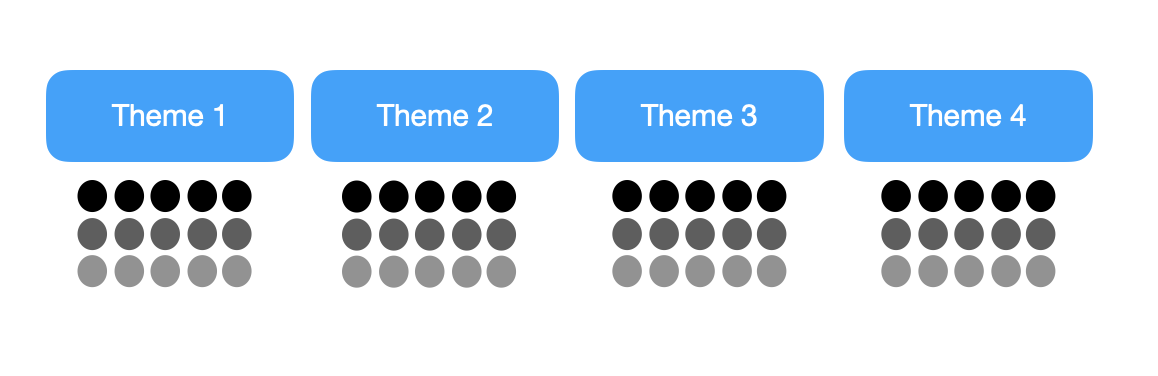
Testing creative should be a constant and iterative process that follows a defined testing schedule. A goal and structure can be as simple as testing five new creative assets per week. Inversely, it can be as complex as testing 60 new assets consisting of multiple themes and copy variations.

For a lower spending account, the creative testing should be leaner due to limited event signal and vice versa with a higher spending account. The most important aspect is that the testing continues to move the needle as you search for your next “champion” asset.

creating a testing schedule for different creative themes

4 themes x 3 variants per theme x 5 copy variations = 60 assets. Image Credits: Jonathan Martinez

After setting a testing schedule, define the core themes of your business and vertical rather than testing a plethora of random ideas. This applies to the creative asset as well as the copy and what the key value props are to your product or service. As you start to analyze the creative data, you’ll find it easier to decide what to double down on or cut from testing with this structure. Think of this as a wireframe that you either expand or trim throughout testing sprints.

For a fitness app like MyFitnessPal, it can be structured as follows:

  • Themes (product screenshots, images of people using it, UGC testimonials, before/after images).
  • Messaging (segmented value props, promo, FUD).

It’s vital to make sure you have a channel-specific approach, as each one will differ in creative best practices along with testing capabilities. What works on Facebook may not work on Snapchat or the numerous other paid social channels. Don’t be discouraged if creative between channels perform differently, although I do recommend parity testing. If you already have the creative asset for one channel, it doesn’t hurt to resize and format for the remaining channels.

Determining wins

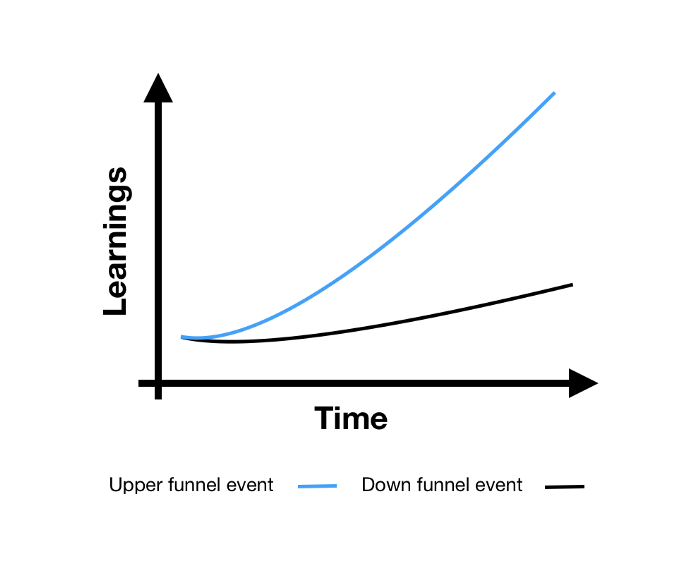
Equally important to the creative is proper event selection and a statistically significant threshold to abide by throughout all testing. When selecting an event to use for creative testing, it’s not always possible to use your north-star metric depending on how high your CACs are. For example, if you’re selling a high-ticket item and the CACs are in the hundreds, it would take an enormous amount of spend to reach stat-sig on each creative asset. Instead, pick an event that’s more upper funnel and a strong indicator of a user’s likelihood of converting.

Using a more upper funnel event leads to faster learnings (blue line).

Using a more upper-funnel event leads to faster learnings (blue line). Image Credits: Jonathan Martinez

It’s important to select a percentage that stays consistent across all creative testing when deciding on which statistically significant percentage to use. As a rule of thumb, I like to use a certainty of 80%+, because it allows for enough confirmation along with the ability to make quicker decisions. A great (and free) online calculator is Neil Patel’s A/B Testing Significance Calculator.

Make or break

You’re scrolling through a social feed, a sleek gold pendant catches your eye, but all the messaging has is the brand name and product specifications. It hooked your attention, but what did it do to reel you in? Think about it: What are you doing to not only hook, but reel people in with “creative” — the make or break it factor in paid social growth marketing?

Circumventing iOS 14.5 data loss

Creative testing is only getting tougher for mobile campaigns as iOS 14.5 obfuscates user data, but that doesn’t equal impossible and simply means we need to get craftier. There are a variety of hacks that can be implemented to help gain clear insight on how creative is performing — some may not last forever and others may be timeless.

Amid all the privacy restrictions, we still have access to a huge population of users on Android that we should take advantage of. Instead of running all creative tests on iOS, Android can be used as a clear way to gather insights, as privacy restrictions haven’t rolled out on those devices yet. The data gathered from Android tests can then be taken directionally and applied to iOS campaigns. It’s only a matter of time until Android data is also at the mercy of data restrictions, so use this workaround to inform iOS campaigns now.

If running Android campaigns isn’t a viable option, another quick and easy solution is to throw up a website lead form to gauge the conversion rate from creative asset to a completed form. The user experience will certainly not be nearly as amazing as evergreen, but this can be used to gain insight for a short period of time (and small percentage of budget).

When crafting the lead form, think of questions that are both qualifying and would indicate someone completing your north-star event on the evergreen experience. After running people through the lead form, communications can be sent to convert them so ad dollars are being put to good use.

Placing efforts by account stage

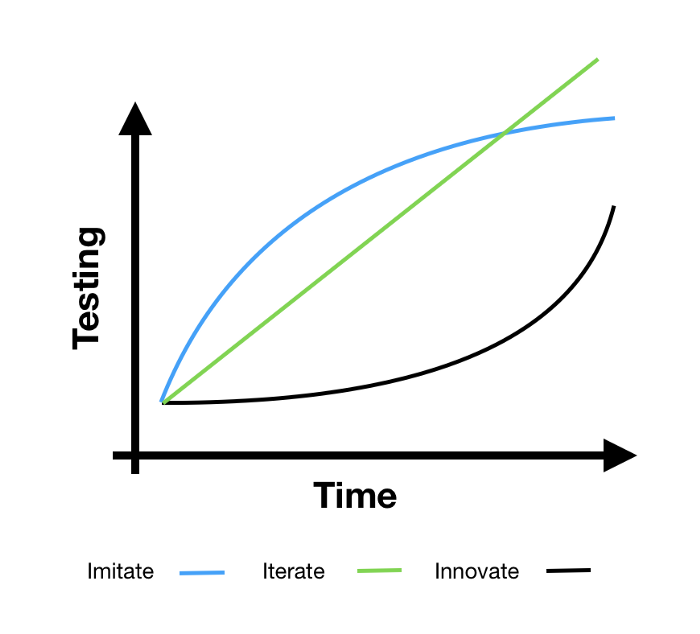
The testing efforts for creative asset types should differ widely by account stage and can be broken down into three I’s: imitation, iteration, innovation.

The type of creative testing should vary over time.

The type of creative testing should vary over time. Image Credits: Jonathan Martinez

The earlier an account stage, the more your creative direction should rely on what’s proven to work by other advertisers. These other advertisers have spent thousands proving performance with their assets, and you can gain strong insight from them. As time passes, you can slightly slow derivation from other advertisers while focusing on iterating on the best performers. If a percentage had to be placed, I would target 80% of efforts on imitation early on, with iteration gaining steam, and innovation being the final, heavy-lagging prong.

This isn’t to say that innovation can’t be attempted early on if there are great ideas, but generally a more mature company can afford to spend heaps to validate their innovative ideas. Whether you have an in-house design team or are working with freelancers, it’ll also be much easier to spin up 50 variations than it will be to think of and design 50 different innovative assets. Imitating and iterating will make your early testing exponentially more efficient.

Leveraging competitor insights

Brainstorming and trying to imagine the most beautiful, eye-catching, hook-inducing creative doesn’t always happen within seconds, let alone minutes or hours. This is where utilizing competitor insights comes into play. The most abundant resource is the Facebook Ads Library bar none, because it contains all the creative assets that every advertiser is using across the platform. It always surprises me how few actually know of this free and powerful tool.

When browsing through competitors or best-in-class advertisers in this library, a sign of a great performing creative is how long an advertiser has been running specific assets. How does one find that? The date of when an advertiser started running their creative is stamped conveniently on each asset — this is beyond powerful. I can spend hours scanning through creative assets, and each advertiser provides even more intel and inspiration.

Creative should be at the top of the list as you think of where to place efforts on your paid social growth marketing. We must have a hacky mindset as data becomes more obscure, but with that mindset comes separating the winners from the losers. The types of strategies put in motion will vary over time, but what won’t vary is the importance on strong creative, the make it or break it factor to success.