Year: 2021

13 Jul 2021

Mighty Buildings lands $22M to create ‘sustainable and affordable’ 3D-printed homes

Oakland-based Mighty Buildings, which is on a quest to build homes using 3D printing, robotics and automation, has raised a $22 million extension to its Series B round of funding.

The additional capital builds upon a $40 million a raise the company announced earlier this year, bringing its total funding since its 2017 inception to $100 million.

Mighty Building’s self-proclaimed mission is to create “beautiful, sustainable and affordable” homes.

The company claims to be able to 3D print structures “two times as quickly with 95% less labor hours and 10-times less waste” than conventional construction. For example, it says it can 3D print a 350-square-foot studio apartment in just 24 hours.

Execs say the new capital will go toward making supply chain improvements and moving up research and development timelines. The money will also go toward helping it achieve a new goal of achieving Net-Zero carbon neutrality by 2028 – which it says is 22 years ahead of the construction industry overall. 

“As a founding team, we have long been passionate about solving productivity for construction in a sustainable way,” said co-founder and CEO Slava Solonitsyn. “We have spent four years figuring out what it takes to achieve that. We believe that we have a master plan now that can work.”

Since its launch, the company has produced and installed a number of accessory dwelling units (ADUs).

Sam Ruben, co-founder and Chief Sustainability Officer of Mighty Buildings, said the new funds will also go toward kicking off development of the startup’s multi-story offering. The multi-story efforts will likely initially focus on 2-3 story single family homes and townhouses with an eye towards expanding into low-rise apartment buildings.  The company hopes to have at least a prototype multi-story offering in late 2022 or early 2023, according to Ruben.

“Along with the sustainability improvements already captured by our new formula, this will allow us to develop our next generation material to get us even closer to our goal of being carbon neutral by 2028,” Ruben said. “It will also give us opportunities to implement improvements in our existing design by reducing the impact of our foundations and other, non-printed elements.” 

Specifically, Mighty Buildings plans to speed up its carbon neutrality roadmap by building “high-throughput, sustainable” micro factories, forming strategic supply chain partnerships, accelerating ”blue skies” technology research and developing new composite materials produced from recycled or bio-based feedstock. 

The micro factories, according to the company, will be able to produce 200 to 300 homes per year in locations where housing gaps exist. Mighty Buildings plans to create single family residential developments with its panelized “Mighty Kit System.”

Mighty Buildings has seen quarter over quarter growth in sales, Ruben said, with the company seeing a record of over $7 million in total contracted revenue in the second quarter. 

The company is also excited about its new fiber reinforced printing material, which is currently undergoing testing with certification expected to be completed later this year. Mighty Buildings claims that its new formula shows “over 50% improvement” in embodied carbon from its original material and a strength profile similar to reinforced concrete, with more than 4 times less weight.

The round extension was supported by a few new and existing investors including ArcTern Ventures, Core Innovation Capital, Decacorn Capital, Gaingels, Khosla Ventures, Klaff Realty, MicroVentures, Modern Venture Partners, Polyvalent Capital, Vibrato Capital and others.


13 Jul 2021

Facebook adds a ‘Payout Time Bonus’ to help retain bug bounty hunters

When it comes to bug bounties, Facebook lags behind the likes of Microsoft and Google in terms of overall payouts and volume of tips received: last year, Microsoft and Google respectively paid out $13.6 million and $6.7 million; Facebook meanwhile paid out just $1.98 million as of November.

But on the other hand, Facebook’s a younger company and is working on improving its system to keep it on bounty hunters’ radar. In the latest development, Facebook today said that it would be adding a new set of bonus rewards when it pays out on a report if more than 30 days have passed since Facebook first received it.

The Payout Time Bonus, as Facebook is calling it, will work on a sliding scale, where payouts made between 30-59 days will get a 5% bonus; payouts made between 60-89 days will get a 7.5% bonus; and payouts made after 90 days or more will get a 10% bonus. Facebook doesn’t specify what the base amount is, but in its last round of bounties, its highest payouts per bug were as much as $80,000 and $60,000 with some $40,000 paid out in its existing bonus program. But payments might be as low as $500.

The extra money will work as a kind of incentive to bounty hunters who make a living from these tips, so that when delays happen with Facebook paying out for legitimate tips, the bug hunters know they’ll get a more lucrative reward for their work in the end — rather than get turned off from working on Facebook-property bugs altogether.

Bug hunting has become a big business for security researchers, with some making upwards of $1 million annually from the programs. But bounty hunting is a double-edged sword: it definitely focuses top minds on to specific platforms, but in doing so, they spend more time there than looking for vulnerabilities in some places than others. That leads the biggest platforms to ensure that they are making their bug-ridden environments more, or as, “attractive” as others to get people to contribute to their work.

Facebook says that it determines bounty amounts based on a variety of factors, including (but not limited to) impact, ease of exploitation, and quality of the report. “If we pay a bounty, the minimum reward is $500,” they told me.

“We reward researchers based on the maximum possible impact of their report that we find during our own internal investigation of each bug, rather than based on the impact reported initially by the researcher,” they continued. “Sometimes our impact investigations can lead tosignificantly higher bounties for researchers, but they can also sometimes take more time to complete. The Payout Time Bonus is meant to also reward our researchers for their patience during this process.

“Our ongoing payout guideline series, shares more details to help external researchers better understand our payout decisions. We have published three guidelines so far and will publish more in the future.”

13 Jul 2021

Looking Glass launches second-gen holographic displays

Brooklyn-based Looking glass today announced the release of a pair of second-gen holographic displays. Following up on late-last year’s release of the entry-level Portrait, the startup is offering new versions of the Looking Glass 4K and 8K systems, which sport 15.6- and 32-inch displays, respectively.

In addition to sizes, there’s a pretty massive gulf in pricing here. Joining the $299 Portrait is the $3,000 4K and $17,500 8K. The pricing difference is all the more pronounced given that the tech essentially offers the same underlying technologies for producing and consuming 3D content.

Image Credits: Looking Glass

“Volume is a part of it,” CEO Shawn Frayne tells TechCrunch. “There are actually very few 8K displays out in the world at this size that folks are driving. While we expect the sale of that to be quite profound over the next few years, in the early phases we’re just not making the same scale as the Portrait.”

The company considers the Portrait a kind of ambassador for its technology — especially over the past year, when getting the systems in front of potential buyers was next to impossible. Having seen a number of Looking Glass’ older systems in person, I can attest to the fact that the effect really isn’t the same over Zoom. Looking Glass says it has sold 11,000 units and is shipping “thousands” a month as it works to fulfil demand and navigate global supply chain issues.

Image Credits: Looking Glass

“I think of it as their first opportunity to get their own holographic display without needing their boss’s approval,” said Frayne. “Someone is curious about it and they get it, and it lives up to or exceeds expectation and they go from there. The quality level is very high for the Portrait, and the bigger units are a bigger format version of that quality.”

Image Credits: Looking Glass

The new models will be replacing their predecessors, which were effectively developer units, rather than mainstream consumer products (though the company will continue to offer support). In addition to lower cost, the second-gen units are lighter and offer improved visual fidelity over their processors — particularly around the edges, where holographic displays can encounter issues.

13 Jul 2021

The TechCrunch List is dead. Long live commodity capital

It’s been almost exactly a year since we launched The TechCrunch List, a curated directory of venture capitalists designed to guide founders to the VCs most relevant to their startups. We had nearly 4,000 recommendations from founders — often with extensive documentation that in some cases exceeded 1000 words. From our initial edition to several extensive updates, we ultimately selected 531 investors.

It was a great experiment used by hundreds of thousands of people with surprisingly deep engagement (people really love reading lists, apparently). Nonetheless, we are officially retiring the product today.

The reason is simple: the venture capital industry has radically changed over the past year, and the central thesis we used in constructing the list no longer applies.

When we designed the list — which, to be clear, was never a ranking — we organized experienced investors across three main axes:

  • Specialization: We believed that investor specialization mattered. We wanted to match biotech founders with biotech investors and ecommerce companies with ecommerce VCs. The bulk of our work reading through all those founder recommendations was identifying the brilliant investors in 31 different market categories who could offer differentiated strategic advice.
  • Stage: We wanted to match founders with investors who would invest at the stage their companies were at, ranging from pre-seed to growth.
  • Geography: We believed that local investors would have an edge over distant investors for founders, particularly at the earliest stages where regular counseling would be useful to reaching product-market fit.

In other words, we took a very strong view that capital wasn’t a commodity, and that the right investor could radically change the trajectory of a founder’s ambitions.

When we started putting together the plans for The TechCrunch List in January 2020, the pandemic was just starting to spread around the world, and many of these assumptions still held true. However, as I think we have all seen, those assumptions have been completely upended over the past year.

The reality today is that capital has never been cheaper or more commodity. VCs invest rapidly, in all geographies, at all stages, in all industries, constantly, rapidly, and all the time.

I constantly heard this feedback over the past few months from both founders and investors. For founders, the focus on terms and price seem to consistently outrank nearly any other factor in building a relationship with an investor. Few founders would ever countenance lowering the valuations of their companies for a more experienced or specialized investor or an investor who was located locally. At the same price, these factors could differentiate one investor from another, but otherwise, price prevails, pretty much every single time.

Commensurately, VCs (and this applies most heavily at big funds of course) no longer care about any guidelines or theses around investing. Any stage, any geography, any market — if there is a deal to be done, they get it done and quickly. Tiger Global and SoftBank’s Vision Fund dominate this narrative, but there are at least a good dozen other firms that have similar styles these days. And given these are some of the largest firms by assets under management, they also just dominate the term sheets flying around the startup world.

If The TechCrunch List was about bringing signal to the noise of fundraising in order to save founders serious time and work, the reality is that the market today is just complete noise and frenetic chaos, and there truly isn’t much to be done to clarify that. The upshot is that VCs make decisions with more alacrity than ever before, so the good news is that the chaos should be short-lived for founders today.

So what’s next? We’ll continue experimenting with ways to help founders fundraise and find the best investors for them. That’s the premise of Extra Crunch, our Early Stage events and the Extra Crunch stage at Disrupt (which is coming up in just a few weeks — so buy your tickets now!) as well as our Extra Crunch Live series of discussions. Who knows, maybe we’ll introduce The TechCrunch List in another form in the future. But for today, it’s burned out and taking a nice, long, post-pandemic vacation.

13 Jul 2021

The TechCrunch List is dead. Long live commodity capital

It’s been almost exactly a year since we launched The TechCrunch List, a curated directory of venture capitalists designed to guide founders to the VCs most relevant to their startups. We had nearly 4,000 recommendations from founders — often with extensive documentation that in some cases exceeded 1000 words. From our initial edition to several extensive updates, we ultimately selected 531 investors.

It was a great experiment used by hundreds of thousands of people with surprisingly deep engagement (people really love reading lists, apparently). Nonetheless, we are officially retiring the product today.

The reason is simple: the venture capital industry has radically changed over the past year, and the central thesis we used in constructing the list no longer applies.

When we designed the list — which, to be clear, was never a ranking — we organized experienced investors across three main axes:

  • Specialization: We believed that investor specialization mattered. We wanted to match biotech founders with biotech investors and ecommerce companies with ecommerce VCs. The bulk of our work reading through all those founder recommendations was identifying the brilliant investors in 31 different market categories who could offer differentiated strategic advice.
  • Stage: We wanted to match founders with investors who would invest at the stage their companies were at, ranging from pre-seed to growth.
  • Geography: We believed that local investors would have an edge over distant investors for founders, particularly at the earliest stages where regular counseling would be useful to reaching product-market fit.

In other words, we took a very strong view that capital wasn’t a commodity, and that the right investor could radically change the trajectory of a founder’s ambitions.

When we started putting together the plans for The TechCrunch List in January 2020, the pandemic was just starting to spread around the world, and many of these assumptions still held true. However, as I think we have all seen, those assumptions have been completely upended over the past year.

The reality today is that capital has never been cheaper or more commodity. VCs invest rapidly, in all geographies, at all stages, in all industries, constantly, rapidly, and all the time.

I constantly heard this feedback over the past few months from both founders and investors. For founders, the focus on terms and price seem to consistently outrank nearly any other factor in building a relationship with an investor. Few founders would ever countenance lowering the valuations of their companies for a more experienced or specialized investor or an investor who was located locally. At the same price, these factors could differentiate one investor from another, but otherwise, price prevails, pretty much every single time.

Commensurately, VCs (and this applies most heavily at big funds of course) no longer care about any guidelines or theses around investing. Any stage, any geography, any market — if there is a deal to be done, they get it done and quickly. Tiger Global and SoftBank’s Vision Fund dominate this narrative, but there are at least a good dozen other firms that have similar styles these days. And given these are some of the largest firms by assets under management, they also just dominate the term sheets flying around the startup world.

If The TechCrunch List was about bringing signal to the noise of fundraising in order to save founders serious time and work, the reality is that the market today is just complete noise and frenetic chaos, and there truly isn’t much to be done to clarify that. The upshot is that VCs make decisions with more alacrity than ever before, so the good news is that the chaos should be short-lived for founders today.

So what’s next? We’ll continue experimenting with ways to help founders fundraise and find the best investors for them. That’s the premise of Extra Crunch, our Early Stage events and the Extra Crunch stage at Disrupt (which is coming up in just a few weeks — so buy your tickets now!) as well as our Extra Crunch Live series of discussions. Who knows, maybe we’ll introduce The TechCrunch List in another form in the future. But for today, it’s burned out and taking a nice, long, post-pandemic vacation.

13 Jul 2021

Investors don’t expect the US startup funding market to slow down

Now in the opening weeks of the third quarter, The Exchange is taking a look back at the Q2 2021 venture capital market. Data indicate that it was incredibly active, with global and regional records shattered during the three-month period.


The Exchange explores startups, markets and money.

Read it every morning on Extra Crunch or get The Exchange newsletter every Saturday.


Per data from CB Insights, for example, The Exchange reported that global venture capital activity shot to $156 billion in the second quarter, up 157% from the year-ago Q2 result of just under $61 billion. More unicorns were born in the second quarter than any similar period to date, and valuations ticked higher.

The only data that seemingly didn’t come back in superlative fashion was round counts, which failed to set all-time highs in some cases. But the general vibe of Q2 venture capital data was clear: It’s a great time for startups looking to raise capital.

To better understand what’s going on, we talked to investors from different regions to get a grip on how they view their market.

Today we’re discussing the U.S. startup world, including notes from Costanoa Ventures’ Amy Cheetham, MaC Venture Capital’s Marlon Nichols, NEA’s Vanessa Larco, and EY U.S. venture capital lead Jeff Grabow.

Why are investors writing so many checks? Let’s find out.

A boom in venture-ready startups?

Given the record capital deployed in the quarter, the fact that deal volume failed to reach all-time highs had us wondering if the market lacked venture-backable startups.

If so, the lack of possible investments would help explain both rising deal size and resulting valuations. With lots of capital provided to venture investors themselves in recent quarters, a lack of startups that fit the venture model would force investors to compete with one another fiercely, possibly leading to larger rounds and higher prices.

That’s not the case. Instead, according to NEA’s Larco, “there are more than enough venture-ready startups to fund,” adding that “the pace of innovation across all industries and geographies has been astounding.”

13 Jul 2021

Investors don’t expect the US startup funding market to slow down

Now in the opening weeks of the third quarter, The Exchange is taking a look back at the Q2 2021 venture capital market. Data indicate that it was incredibly active, with global and regional records shattered during the three-month period.


The Exchange explores startups, markets and money.

Read it every morning on Extra Crunch or get The Exchange newsletter every Saturday.


Per data from CB Insights, for example, The Exchange reported that global venture capital activity shot to $156 billion in the second quarter, up 157% from the year-ago Q2 result of just under $61 billion. More unicorns were born in the second quarter than any similar period to date, and valuations ticked higher.

The only data that seemingly didn’t come back in superlative fashion was round counts, which failed to set all-time highs in some cases. But the general vibe of Q2 venture capital data was clear: It’s a great time for startups looking to raise capital.

To better understand what’s going on, we talked to investors from different regions to get a grip on how they view their market.

Today we’re discussing the U.S. startup world, including notes from Costanoa Ventures’ Amy Cheetham, MaC Venture Capital’s Marlon Nichols, NEA’s Vanessa Larco, and EY U.S. venture capital lead Jeff Grabow.

Why are investors writing so many checks? Let’s find out.

A boom in venture-ready startups?

Given the record capital deployed in the quarter, the fact that deal volume failed to reach all-time highs had us wondering if the market lacked venture-backable startups.

If so, the lack of possible investments would help explain both rising deal size and resulting valuations. With lots of capital provided to venture investors themselves in recent quarters, a lack of startups that fit the venture model would force investors to compete with one another fiercely, possibly leading to larger rounds and higher prices.

That’s not the case. Instead, according to NEA’s Larco, “there are more than enough venture-ready startups to fund,” adding that “the pace of innovation across all industries and geographies has been astounding.”

13 Jul 2021

Cadoo gets $1.5M to gamify fitness with betting challenges

Cadoo, a US-startup that’s gamifying fitness by turning it into a betting opportunity, using the prospect of winning (or losing) cold hard cash to motivate people to get off the couch, has collected $1.5 million in seed funds from Sam & Max Altman’s Apollo VC and the student-focused Dorm Room Fund.

The app itself has been around since 2018 but in March 2020 it launched a “challenge model” that lets users stake money to join a challenge related to a specific fitness goal — be it running 10 miles in 10 days, or walking three miles in three days.

Participants who achieve the challenge goal get their stake back and a pro-rata share of losers’ staked entry fees.

A range of fitness levels are catered to by Cadoo’s challenges (“from daily steps to marathon training”), with some 50 public challenges hosted per week.

It’s also adding private challenges this month — which will enable users to host and configure fitness challenges for themselves/family and friends, or larger groups, such as companies, clubs, or schools.

Challenge-related activity is verified by the app via API data from activity trackers and fitness apps. (Which hopefully means Cadoo is smart enough to detect if someone has attached their Fitbit to their dog… )

The app has support for a number of third party fitness services, including Strava, Fitbit and Apple Health.

CEO and founder Colm Hayden describes the startup as “DraftKings for your own fitness goals”.

“Our audience consists of 25-50 year old fitness fanatics’ who use Cadoo to stay committed to their monthly/weekly fitness goals,” he told TechCrunch, adding: “When people are serious about a goal they are trying to reach, they want intense motivation to back their ambitions.”

He says the app has attracted around 7,000 wager-loving users so far.

Cadoo’s business model is based on taking a fee from challenge losers before their entry fee stakes are distributed to challenge winners — which does potentially give the business an incentive to set harder challenges than users are able to complete.

But of course it’s up to users to pick which challenges to enter and thereby commit their hard earned cash to.

It also claims that 90% of users who sign up for Cadoo challenges successfully complete them.

Hayden says it has future plans to expand monetization potential by offering winners fitness products — and taking a margin on those products. And also by expanding into other types of verifiable goals, not just running/walking. 

“We are working to build a motivation platform that enables anybody to reach their goals,” he says. “Financial incentives is an intense motivator, and 90% of users who sign up for Cadoo challenges reach their fitness goals. We are making Cadoo much bigger than just running goals, and in the future incentivizing almost any goal verifiable on the internet.”

While the app is US-based payments are processed by PayPal and Hayden says it’s able to support participation internationally — at least everywhere where PayPal is available.

Commenting on the seed raise in a statement, Apollo VC’s Altman brothers added: “Cadoo makes it easy to motivate users to stay active with financial incentives. We believe the motivation industry that Cadoo is pioneering will be an important digital money use-case.”

Before the seed round, Cadoo says it had raised $350,000 via an angel round from Tim Parsa’s Cloud Money Ventures Angel Syndicate, Wintech Ventures, and Daniel Gross’s Pioneer.

Of course gamification of health is nothing new — given the data-fuelled quantification and goal-based motivation that’s been going on around fitness for years, fuelled by wearables that make it trivially easy to track steps, distances, calories burned etc.

But injecting money into the mix adds another competitive layer that may be helpful for motivating a certain type of person to get or stay fit.

Cadoo isn’t the only fitness-focused startup to be taking this tack, either, though — with a number of apps that pay users to lose weight or otherwise be active (albeit, sometimes less directly by paying them in digital currency that can be exchanged for ‘rewards’). Others in the space include the likes of HealthyWage (a TC50 company we covered all the way back in 2009!); Runtopia and StepBet, to name a few.  

13 Jul 2021

Marco Financial raises $82M in debt, equity seed round to support small Latin American exporters

Small and medium-sized businesses in Latin America can find it difficult to get the funds they need to export their goods to the United States. It’s a gap Marco Financial is looking to bridge through its tech-enabled risk assessment platform that can provide better insight on who should receive loans.

To continue its mission, the Miami-based trade finance company raised $7 million in seed funding and $75 million in a credit facility, led by Arcadia Funds LLC and Kayyak Ventures, to increase its credit line to $100 million. Marco was backed last September by a small seed round from Struck Capital and Antler and over $20 million in a credit facility underwritten by Arcadia Funds.

Additional investors in the newest seed round and expanded credit facility include Village Global VC, Flexport Ventures, Tresalia Capital, 342 Capital, Struck Capital, Antler LLC, Antler Elevate, Florida Funders and Fox Ventures. Strategic angel investors include Phil Bentley, CEO of Mitie, and Naman Budhdeo, co-founder and CEO of TripStack and FlightNetwork.

Jacob Shoihet, Marco’s co-founder and CEO, says not only is there a roughly $350 billion trade finance market to go after, but cited data learned from Javier Urrutia, director of Foreign Investments at PROCOLOMBIA, an organization that promotes foreign investment and nontraditional exports in Colombia, that for every 1% increase in export productivity, 500,000 new jobs can be created.

“For small and medium businesses in trade, this is important for companies creating a high level of job growth and lowering the poverty rate,” Shoihet told TechCrunch. “By making it easier for businesses to transcend the 30, 60, 90 and now even 120 days they wait to be paid for supplies, we can solve that gap and unlock billions in value so that companies can scale.”

Shoihet met his co-founder and COO Peter D. Spradling through the Antler accelerator, a Singapore- and New York-based early-stage investment and advisory services program that connects entrepreneurs and tech operators to launch new businesses. They started Marco in 2019 and now have offices in New York, Dallas and across Latin America.

Spradling was born in Uruguay and knows firsthand about the challenges of importing and exporting from working in his family’s slaughterhouse and later founding three of his own companies. In fact, one of his businesses imported e-cigarettes — his mother was a lifelong smoker, and he wanted to help her quit. He recalls pre-selling his inventory at a discount in order to get the money to import the goods.

“Banks don’t like risk, which means businesses spend most of their time trying to get financing rather than increasing sales,” Spradling told TechCrunch. “Banks in Latin America have a saying that ‘they lend money to people who don’t need it.’ Families with money can access the banks, but you can’t launch a business without capital, and many owners lack that access to banks.”

Marco’s factoring product enables new companies to get started without having to put up the significant amount of collateral that banks are asking. Banks typically look at financial statements for the past two years of the business and give a line of credit accordingly. Not needing as much collateral also enables more women in Latin America to become business owners because they often don’t have collateral, Spradling said.

In contrast, Marco reduces risk by basing its lines of credit on an analysis of the future potential of the business, thereby freeing up cash so that small and medium exporters can continue their operations and invest in their growth. The company is able to show what kind of financing can be obtained based on the amount of data customers provide. Marco also said it can reduce the loan origination process from over two months to one week and provide funding to approved exporters within 24 hours.

Cristóbal Silva Lombardi, general partner at Kayyak Ventures, told TechCrunch that Marco is providing an alternative for small and medium exporters to access capital that they previously had to get from friends and family.

In countries like Chile, electronic invoicing innovation has enabled the factoring industry to grow, and in turn, companies like Marco tend to become leaders in supply chain financing and shrink the high interest rates spread between small businesses and large firms.

“Marco wants to take that worldwide,” Silva Lombardi said. “There is a lot of value to tackle. Factoring is one of the corners in the financing market that hasn’t been tackled, and by using technology, Marco is building and creating value for the whole society. This is where venture capital firms should be putting their dollars — in companies where technology and talent unleash a lot of value.”

Since launching its product in January 2020, the company has processed thousands of invoices across 20 countries, amounting to more than $18 million.

However, it wasn’t easy in the beginning, according to Shoihet. Starting during the global pandemic, Marco initially had challenges accessing the market due to exports and supply chains being strained.

Today, Marco has found its groove and is lending as little as $25,000 per month and as much as $10 million, Shoihet said.

As such, the new funding will go toward simplifying cross-border payments, assessing risk and productizing ways to take unstructured data, processes and work to create a better experience for the customer. The company also said it aims to give large logistics providers the ability to finance exports on their own.

Marco was also able to attract new leadership, including Prajwal Manalwar, chief product officer, and Sabrina Teichman, chief growth officer. Manalwar worked for 13 years at PayPal, where he most recently was a product lead focused on debit card authorization rates and in-store payments. Teichman joins after 11 years with the U.S. government, most recently serving as managing director for the U.S. International Development Finance Corp.

“Now we can work on how to solve the problem at a larger scale by building infrastructure and information through the underwriting process and through partnerships from larger players in shipping, trade services and insurance — all incumbent industries that have clients with working capital,” Shoihet said. “By innovating the underwriting process, we can come to better conclusions and be the trade finance-as-a-service provider to clients in emerging markets.”

13 Jul 2021

Ramp adds merchant ‘blocking’ to corporate credit card

Ask any employee and they’ll tell you one of their least favorite things to do is file expenses. And for companies, the process of managing corporate spend is one of their biggest challenges.

Corporate credit cards help ease that pain, so it’s no surprise that the competition between startups in the space is heating up by the day. 

One of the fastest growing players in the space is Ramp, a fintech company that earlier this year secured a $150 million debt facility with Goldman Sachs after having raised a $30 million Series B in late December 2020.

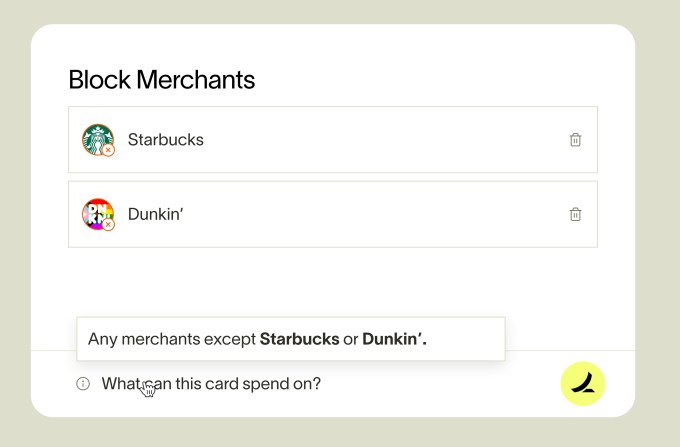
Today, the New York-based company is announcing a new feature that it says will give its corporate customers greater control and flexibility over the way their cards are used. Specifically, Ramp said it now offers its customers the option to approve or block merchants on the cards they offer to their employees.

In an exclusive interview with TechCrunch, Ramp co-founder and CEO Eric Glyman said the move was in response to customer demand.

“This was one of our most requested features, especially from companies with over 100 employees,” he told TechCrunch. “They said, ‘I can block a spam call. It’s crazy I can’t do this with my credit card.’ ”

Image Credits: Ramp

With the new feature, Ramp says companies “have complete control” over how their employees use their corporate cards, down to the vendor level. It allows companies to outline specifically who employees can spend with, which vendors can be charged on what card and how much they can charge. 

So, why is this a big deal? Glyman said this means that merchant-specific cards greatly reduce the risk from stolen or compromised cards. It also helps keep employees from inflating expenses or filing false reimbursement claims.

“This gives security and control back to finance teams in a way that was never before possible,” he said.

It also helps companies in their quest to save money by using corporate credit cards in the first place, Glyman added.

“For example, they can restrict spending to businesses or companies that they have discounts or preferential pricing with,” he said. “It’s another layer of enforcement for finance teams.”

The process was not an easy one since understanding and clustering unique identifiers to be able to identify merchants was “technically complex,” according to Glyman.

For its part, Ramp counts “thousands” of businesses as customers, with well into the tens of thousands individuals using its cards.

“We’re powering into 9 figures monthly and over $1 billion in spend,” Glyman said.

The company must be doing something right.

Since raising the credit line earlier this year, Ramp has seen continued growth, more than doubling volume over the past three months.

While Glyman declined to reveal specific revenue figures, he said Ramp grew by over 6,000% in 2020, compared to the year prior and has grown over 1,000 over the past 12 months. Customers are typically fast-growing startups as well as small businesses. Some of its more well-known startup customers include Ro, Sleep Eight, ClickUp, Marqeta, Candid, Better, Truebill and Nuggs.

While Ramp makes money mostly by interchange fees, Glyman said the two-year-old startup thinks of itself as a SaaS operator.

“Our long-term strategy to develop great software,” he said.