
Year: 2021

13 Jul 2021

Volkswagen’s new business strategy puts software and autonomous driving front and center

Volkswagen will ramp up its software, mobility as a service and battery tech to stay competitive in the coming decades, as it and other automakers prepare for the largest transition in personal mobility since the invention of the car.

Laying out the company strategy Tuesday, Chief Executive Officer Herbert Diess emphasized a top-to-bottom transformation in everything from manufacturing to revenue streams. If revenue was historically driven by sales of internal combustion engine vehicles, Volkswagen CFO Arno Antlitz said the rest of the decade bring income derived not only from electric vehicle sales, but also software, autonomous driving and even ridesharing.

To that end, the company has been busy, planning six battery Gigafactories in Europe and an €800 million ($944 million) hardware platform research and development facility in West Berlin. The company’s also beefing up its in-house automotive software arm Cariad, which VW said could generate as much as €1.2 trillion ($1.4 trillion) in revenue by 2030, via subscriptions and other sales.

Volkswagen also has big plans for autonomous driving. The company wants to take a chunk of the market share from ridesharing and car rental, and it sees an integrated AV platform as the way to do it. Executives painted a vivid picture of customers being able to request a Volkswagen electric AV taxi or shuttle by the end of the decade, one that may not even include a steering wheel or driver’s seat, according to renderings shown during the presentation.

“Imagine that your grandmother or your eight-year-old son can hop in a Volkswagen cab to visit one another, whenever they want, without mom or dad behind the wheel,” Diess suggested. “You can use one of our mobility apps, and an ID Bus will pick you up and your friends.”

Personal vehicles will be powered by Cariad, which the OEM said will have “level 4 readiness” by 2025. Shared mobility vehicles, like shuttles or taxis, will also be VW-owned and operated, and run on tech developed by AV company Argo AI. Volkswagen closed a $2.6 billion investment in the startup last June.

Europe’s largest automaker anticipates its investments in MaaS will pay off: the company expects annual revenues of over $70 billion in the five largest European markets alone by 2030, Christian Senger, CTO of Volkswagen Commercial Vehicles, said. The autonomous rideshare ID Bus, which is being tested in a pilot project in Munich, will be rolled out as a commercial service in Hamburg in 2025, followed shortly by the U.S.
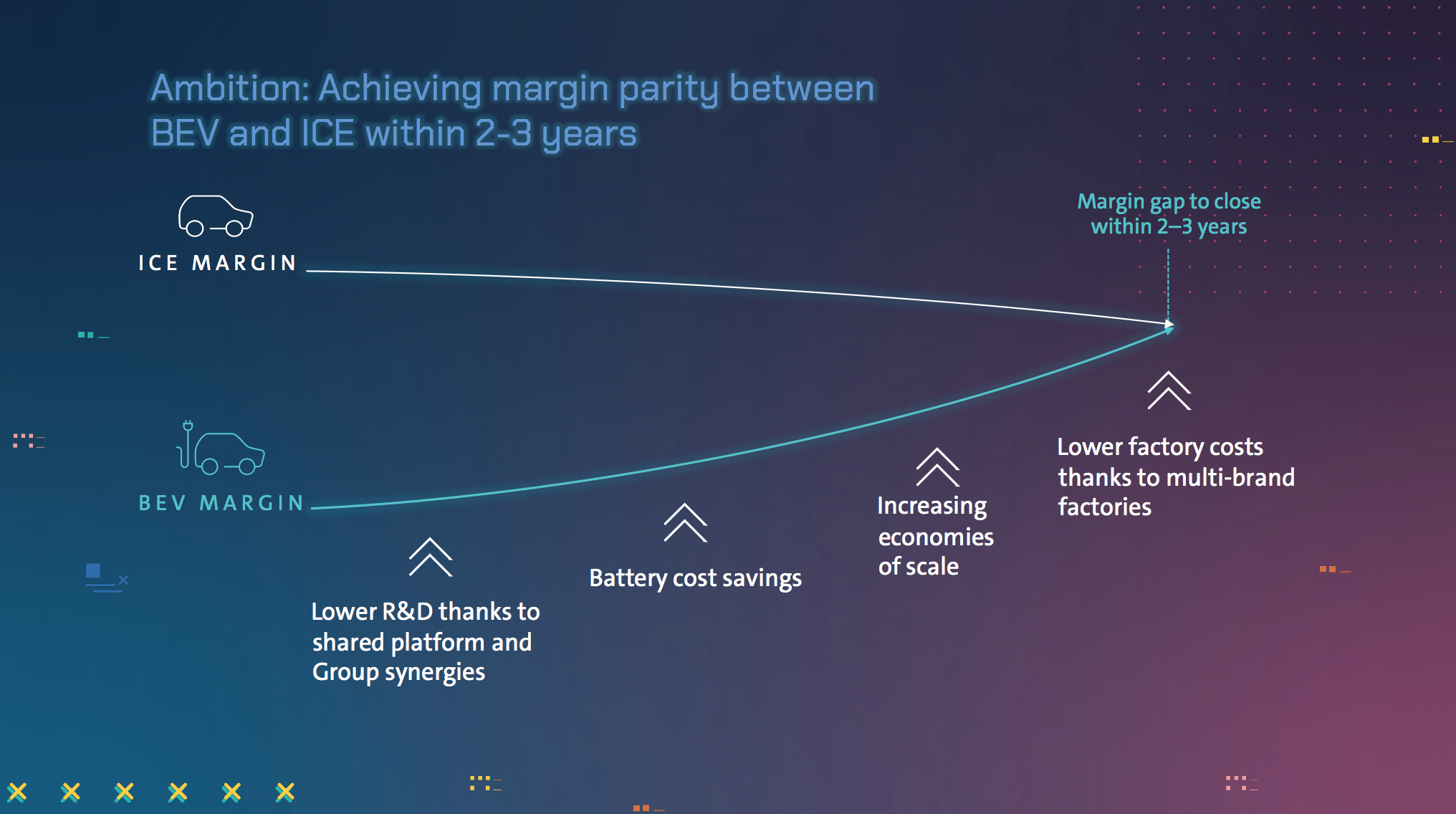
In line with these estimates, the automaker anticipates BEV sales will account for 25% of sales by 2025 and 50% by 2030. ICE margins will likely come under increased pressure due to declining demand, tighter emissions regulations and comparative tax disadvantages, so Volkswagen plans to decrease its number of ICE models by 60% in Europe by 2030. Cost parity between ICE and BEV should be achieved within two to three years, Antlitz said, thanks to economies of scale and lower factory costs.

It’s an optimistic future, but one in which Volkswagen is fully confident: the company upped its profit target for 2025 to 8-9%, from 7-8%.

“Until 2030, the world of mobility will have seen the greatest transformation since the transition from horses to cars at the beginning of the 20th century,” Diess said. “The future of cars, the future of individual mobility will be bright.”


13 Jul 2021

Ring’s latest security updates are good, but still opt-in

Ring, the video doorbell maker dubbed the “largest civilian surveillance network the U.S. has ever seen,” is rolling out new but long overdue security and privacy features.

The Amazon-owned company’s reputation was bruised after a spate of account breaches in late 2019, in which hackers broke into Ring user accounts and harassed children in their own homes. Then, taking advantage of Ring’s weak security practices, hackers had developed bespoke software to brute-force the passwords on Ring accounts, which at this point were only protected by the user’s password. All the while, there were several caches of Ring user passwords floating around the dark web. Ring initially blamed its users for using weak passwords (like “password” and “12345678,” which Ring allowed users to set as passwords), but a couple of months later the company acknowledged its failings by rolling out mandatory two-factor authentication by text message. It was a good start, aimed at making it more difficult — albeit only slightly — to curb the bulk of automated account hijacks.

But now Ring is going a step further by rolling out app-based two-factor authentication, which many companies already offer (and have for some time) as it provides the far more secure delivery of two-factor codes using an encrypted connection, compared to text messages, which are susceptible to interception.

Ring is also enabling CAPTCHA in its apps to add another hurdle aimed at making automated login attempts more difficult by prompting users to prove they aren’t a robot.

Also announced is the launch of video end-to-end encryption, which Ring first rolled out earlier this year as a technical preview. One of Ring’s most flaunted (though highly controversial) features is allowing users to share video footage directly with more than 1,800 local police departments that are partnered with Ring. That said, police with a search warrant can always just demand the footage from Ring instead. Video end-to-end encryption will mean that any video captured from a Ring device can only be accessed by the account owner — and not Ring, or any of its law enforcement partners.

Ring’s CTO Josh Roth said in a blog post that Ring believes that “our customers should control who sees their videos.” If that were true, Ring would have switched on end-to-end encryption to all users, giving every account owner privacy by default. But that would interfere with the company’s efforts to expand its police partnerships, which in turn help to get Ring devices into the hands of local residents.

Compared to past security updates, which didn’t go nearly far enough, Ring’s new features make meaningful changes that give users the choice to make their accounts more secure and their data private. But the keyword there is “choice,” since users will have to opt-in to the new features. That isn’t unusual in itself; companies seldom force security changes on users fearing that it would add friction to the user experience, though recovering from an account hack because of poor security controls is undoubtedly worse.

Switching to app-based two-factor authentication is easy, just go to Ring’s account settings and switch from codes sent by text message to codes delivered by an authenticator app. We have a whole explainer on why it’s important, why you should use an app, and which apps you might want to use.

But the biggest change Ring users can make is to switch on end-to-end encryption on their accounts by going through the advanced settings of Ring’s control center. Switching on end-to-end encryption won’t limit what you can do with your account or stop you from sharing video footage with friends, family, or the police, but it will give you peace of mind knowing that you will have control of your data and what you do with it, and not Ring.

13 Jul 2021

Amperity raises $100M on a $1B+ valuation to help company’s build better profiles of their customers

Cookies and other third-party data sources are going the way of the dodo bird for many companies, regulators and platforms, and that’s giving a new emphasis on technology that will help companies better manage their customer data on their own steam. Today, one of the companies building tools for that end is announcing a big round of funding, underscoring its growth.

Amperity, which provides a customer data platform for its businesses, has raised $100 million in funding at a valuation of over $1 billion. The startup typically works with large, consumer-focused enterprises along the lines of Starbucks, Wyndham Hotels & Resorts, Patagonia and some 100 others, helping them to tap and organize their own data troves better to develop better profiles of their customers.

The Series D funding — led by HighSage Ventures with previous backers Tiger Global Management, Declaration Partners, Madrona Venture Group, and MaderaTechnology Partners also participating — brings the total raised by Amperity to $187 million and comes two years after the company’s Series C of $50 million.

The last year of increased online activity and online shopping has put a much bigger focus on the data that companies are amassing about thier users and how they can better leverage that information to grow further. Amperity said that in 2020, annual recurring revenues were up 100%, partly on the back of that surge of interest in how to tap into customer data, not least because the older way of doing things has fallen out of favor.

Indeed, Kabir Shahani, the CEO who co-founded the company with CTO Derek Slager, believes that the trend away from third-party to first-party data has played and will play a much bigger role in Amperity’s growth longer term.

“Covid certainly ‘helped,'” he said, “but to me the story is less about that and more about how our idea has been validated.”

The idea  he and Slager had been thinking about was the dependency, and problems with, third-party cookies, an issue that has been lingering “for decades,” he said.

“When this idea started percolating, when we looked to start the company, we thought this must have already been solved. It was mind blowing that it hadn’t.” The reason why: data is in too many silos, and it’s not connected, which renders it impossible or at the least very challenging to use.

Amperity’s approach has been to build the connectivity to bring the data together out of its silos, and then to create ways to merge and make it useful. In that regard, it’s not unlike another company that also got some funding today, Quantexa, which originally build something similar to track fraud but is now also going after the customer data platform business as well.

As with Quantexa, Amperity has taken the approach of treating this like a big-data problem that AI can help solve.

“At the root of this is a hard computer science problem, all the disparate data runs off different keys,” he said. Some customer identifiers are based on phone numbers, some on physical addresses, some on email, and so on. “To connect all that you need one single key, but no one had done that before. So we thought, what if we tried to do that using machine learning?” They engaged “the world’s leading researcher in probabilistic data,” who built the models for Amperity, and that’s what powers the service today.

It’s a massive market worth over $114 billion, so it’s no surprise to see investors like Tiger Global looking to get involved.

Amperity represents the future of how customer data can benefit both consumers and businesses by offering the most comprehensive AI-driven CDP on the market today,” said John Curtius, partner at Tiger Global Management. “The company’s technology is bringing outsized value to the biggest and most admired consumer brands in the world. Additionally, they continue to attract exceptional talent at all levels of the company to advance their mission, including the addition of Starbucks CEO Kevin Johnson to its board last year.”

13 Jul 2021

WebOps platform Pantheon raises $100M from SoftBank Vision Fund

WebOps SaaS platform Pantheon, which started out as a Drupal and WordPress hosting service many years ago, today announced that it has raised a $100 million Series E round solely funded by the Softbank Vision Fund. With this round, Pantheon has now reached unicorn status, with a valuation of over $1 billion.

Pantheon co-founder and CEO Zack Rosen told me that the company wasn’t under any pressure to raise. “It really just helps us accelerate everything that we’re doing,” he said. “We didn’t need the funding. We had plenty of cash in the bank. We were planning to raise in a year or two years down the road. But we have a lot of conviction in and where this industry is going and our customers’ needs are pretty apparent, so we just used this as an opportunity to pull things in by six months to a year and accelerate all the things that were already on our operational plans for the company.”

Image Credits: Pantheon

As Rosen noted, the role of company websites has changed quite a bit since Pantheon launched almost a dozen years ago. While originally, they were mostly about brand building and having a publishing channel, these days, they are directly tied to revenue. “The majority of buying decisions get made before anyone talks to a customer these days,” Rosen said. “All the research is getting done — hopefully — on your company’s website. Any link in an advertisement or link in an email is going to route that customer back to the website. That’s your most important digital product. And so marketers are really starting to think about it like that.”

So while hosting and publishing may be solved problems, driving revenue through a company’s website — and measuring that — is where Pantheon sees a lot of opportunities going forward. Though at the core of the company’s offering, of course, is still its serverless hosting platform and developers remain its core audience. But it’s the collaboration between the marketing teams and developers that is driving a lot of what the company is now investing in. “In order to deliver a best-in-class digital experience — and be able to iterate it every single day and work with designers and developers and website owners and project managers — you need a system of record for that work. You need a solid workflow for those teams,” Rosen noted.

Companies, he argues, are looking for a solid SaaS platform that provides them with those workflows, in addition to the high-performance hosting, CDNs and everything else that is now table stakes for hosting websites. “[Teams] want to stop thinking about this stuff,” he said. “They just want a partner — like any other SaaS application, whether it’s Stripe, Twilio or Salesforce. They just want it to work and not to worry about it. And then, once you have that taken care of, then you can move up into the things that really drive the outcomes these teams care about.”

As for raising from the SoftBank Vision Fund, which features the likes of ByteDance, Perch, Redis Labs, Slack and Arm among its investments (and, infamously, WeWork), Rosen said that Pantheon had its choice of firms, but at the end of the day, SoftBank’s team turned out to be “huge believers in this category,” he said, and could help Pantheon reach the scale it needs to define the WebOps category.

“Digital transformation has accelerated the movement to the cloud for essential business infrastructure. By automating workflows and do-it-yourself with its SaaS offering, we believe Pantheon’s leading platform is transforming how modern website experiences are created,” said Vikas Parekh, Partner at SoftBank Investment Advisers. “We are excited to partner with Zack and the Pantheon team to support their ambition of helping organizations embrace a new and better way of building websites that deliver results.”

13 Jul 2021

Impact raises $150M at a $1.5B valuation as affiliate and other marketing partnerships come into their own

Affiliate marketing may have started as a kind of side hustle for bloggers and others that were making the majority of their revenues through advertising or other channels, but with the rise of influencers and the huge profusion of spon-con on social media, the idea of leveraging a person’s own presence to make some money and give a huge sales boost to a product, brand or service has taken on a life of its own. And to underscore that, today a company that’s built a marketplace to help connect people and companies in that larger set of relationships is announcing a big round of funding.

Impact — which has built a partnership management platform that lets brands engage people for influencer and affiliate marketing or wider business development; lets publishers also connect with brands and influencers; and provides the infrastructure both to track that content and collect revenues around it — has closed $150 million in funding on a $1.5 billion valuation.

Qatar Investment Authority (QIA) is leading this round, with Providence Public also participating. The company will be using the funds to continue expanding its partnership network as well as the kinds of tools it builds for brands, agencies and publishers.

Impact runs what it calls a “partnership cloud” — somewhat akin to a “marketing cloud” — that it targets at what it terms the “partnership economy.” Those who use affiliate or influencer marketing to spread the word about their products; those who leverage their personalities or content to do that; and those platforms that house the content can all use Impact to engage with each other, and run their business operations within it.

“We started as a platform that was mostly used in a private marketplace setting,” said David A. Yovanno, Impact’s CEO, in an interview. “We were the first with a product and tech-led product in the affiliate space. We call this category partnerships but we didn’t come up with that term, our customers did after they started to use us in innovative ways.”

Impact has seen a big boom with the rise and increasing ubiquity of influencer marketing and spon-con. In the last year, the New York startup passed $100 million in annual recurring revenue, with its customers a list of some of the biggest names in the worlds of technology, retail and more, including Lenovo, Microsoft, Uber, eBay, Amex, CapitalOne, Disney, NBC’s Peacock, Walmart, Target, lots of D2C brands, and some other really huge tech companies that I’m not allowed to name… In all, its customer list has grown by 50% in the last year.

Spon-con and related marketing techniques have been on an upward trend for years, making gradually bigger dents in the 60% committment that brands typically dedicate to online advertising to get the word out. The last year of Covid-19 living has, perhaps unsurprisingly, worked as a particular boost, however: people spending a lot more time online, and much more time idling hours away on social media rather than engaging in the physical world, has led to a much bigger rush of brands leveraging that landscape to get their names in front of would-be buyers.

The snag in the market that Impact has been building to fix reminds me somewhat of the challenges in the digital music industry: initially, and frankly currently, it remains a challenge for rights owners in the world of music to accurately and efficiently track where and when music gets used, and then to collect revenues based on that, particularly when that music is used across the long tail of user-generated content.

A similar scenario exists in the spon-con world, especially when you consider how video clips are sampled and occasionally go viral, with those re-uses wander far from their origins in the process.

The play that Impact is providing here, therefore, is not just one of accounting and providing a marketplace for entities to discover and engage with one another, but potentially a big data play to track how and where content will be used and engaged with wherever that happens to be. If the space continues to grow as it look like it will, that means a bigger job and more investment needed to track the space.

13 Jul 2021

ZoomInfo drops $575M on Chrous.ai as AI shakes up the sales market

ZoomInfo announced this morning it intends to acquire conversational sales intelligence tool Chorus.AI for $575 million. Shares of ZoomInfo are unchanged in pre-market trading following the news, per Yahoo Finance data.

Sales intelligence, Chorus’s market, is a hot space that uses AI to “listen” to sales conversations to help improve interactions between salespeople and customers. ZoomInfo is mostly known for providing information about customers, so the acquisition expands the acquiring company’s platform in a significant way.

ZoomInfo sees an opportunity to bring together different parts of the sales process in a single platform by “combining ZoomInfo’s historic top-of-the-funnel strength with insights driven from the middle of the funnel in the customer conversations that Chorus captures,” it said in a release.

“With Chorus, the entire organization can make better decisions by surfacing insights and analytics that you would only get if you sat in on every sales or customer success call,” ZoomInfo CEO and founder Henry Schuck said in a blog post announcing the deal.

Ahead of the transaction, ZoomInfo was valued at just under $21 billion.

Chorus looks for what it calls “smart themes” in sales calls, which help managers steer sales teams towards the types of conversation and tone that is likely to drive more revenue. In fact, Chorus holds the largest patent portfolio related to conversational intelligence, according to the company.

Chorus was founded in 2015 and raised over $100 million along the way, according to Pitchbook data. The most recent round was a $45 million Series C last year.

Crunchbase News reports that at the time of its Series C round of funding, Chorus had “doubled its headcount to more than 100 employees and tripled its revenue over the past year.” That’s the sort of growth that venture capitalists covet, making the company’s 2020 funding round a non-surprise.

Notably PitchBook data indicates that the company’s final private valuation was around the $150 million mark; if accurate, it would imply that the company’s last private round was expensive in dilution terms. And that its investors did well in the exit, quickly more than trebling the capital that was last invested, with investors who put capital in earlier doing even better.

But we’re slightly skeptical of the company’s available valuation history given the growth that it claimed at the time of its Series C; it feels low. If that’s the case, the company’s exit multiple would decrease, making its final sale price slightly less impressive.

Of course a half-billion dollar exit is always material, even if venture capitalists in today’s red-hot, and expensive market are more interested in $1 billion exits and larger.

Chorus.ai will likely not be the final exit in the conversational intelligence space. Its rival Gong (often known by its URL, Gong.io) is one of the hotter startups in this space, having raised over $500 million. Its most recent raise was $250 million on a $7.25 billion valuation last month.

The implication of the Chrous.ai exit and Gong’s enormous private valuation is that the application of AI to audio data in a sales environment is incredibly useful, given the number of customers the two companies’ aggregate valuation implies.

13 Jul 2021

Perch acquires Web Deals Direct for $100M+ to boost to its Amazon roll-up play

On the heels of raising $775 million earlier this year, Perch has made a big acquisition that will bring on a number of new brands and operations infrastructure to enhance its position in the race to roll up smaller merchants that sell and fulfill sales through Amazon. The company has acquired Web Deals Direct, an Amazon seller that owns 30 brands of its own pulling in $80 million in revenue annually and also operates its own warehouse.

Terms of the deal are not being disclosed but I understand from sources that it was a nine-figure deal valued between $100 million and $200 million.

There are millions of merchants currently on Amazon’s marketplace, leveraging the e-commerce giant’s storefront, search tools, fulfillment infrastructure, payment tools, warehouses and delivery network to sell products to buyers.

Companies like Perch compete against the likes of Elevate Brands (which yesterday announced $250 million in funding), Thrasio, Heyday, SellerX, Branded, Razor Group and many others that are seizing an opportunity to snap up and roll up the more successful of these to bring better economies of scale into the model, while also building technology to better measure and leverage sales analytics and more.

While these companies are, essentially, acting as marketplace consolidators, this latest acquisition is significant because, in a sense, it underscores an interesting shift towards a consolidation of the consolidators themselves.

WDD’s categories span home goods, sports, arts and crafts, pet supplies and office products, and Perch’s VP of acquisitions, Nate Jackson, said Perch was interested in them because they are one of the more successful Amazon merchants. In a market where visibility is based on how well engaged previous buyers are with your products, WDD has picked up some 110,000 reviews and 2.3 million customers.

For WDD the idea is that joining Perch will give it more reach in terms of targeting more customers, and to bring it better analytics leveraging insights and sales from Perch’s other brands, which currently number at around 70 and cover the same categories.

“We took our business from zero to $80 million in sales in 5 short years,” said Adam Feinberg, CEO of Web Deals Direct, in a statement. “But, with Perch, who are proven eCommerce operators, we think the possibilities of growth in the next 5 years are just as exciting. I’ve been so impressed with the caliber of their team, and I trust their long-term vision to steward our business into the next phase of growth. This was a complex deal, but Perch has made the process fair and transparent. I want to thank all of the great Web Deals Direct team members for the organization we’ve built together; our employees could not be in better hands with Perch.”

It’s also a signal of what the next steps might be for these roll-up companies, with Perch gaining a 230,000 square foot warehouse in California and now looking to get more warehouse space on the East Coast. While Amazon might still be an important storefront for visibility, it’s a sign of how these companies may be looking at taking on more of the process themselves on the fulfillment side to grow margins.

“This deal marks a major milestone for Perch,” said Perch founder and CEO, Chris Bell, in a statement. “The complexity and size of the business is a testament to the excellent organization Adam and the entire team at Web Deals Direct have built, and it is a pleasure to work with such inspirational entrepreneurs.”

This is not a completely new area for Perch, and perhaps the writing has always been on the wall that it would eventually bring more fulfillment into its own e-commerce operations to lessen some of the reliance on Amazon.

Before founding Perch, Bell and Perch’s COO designed and built the Wayfair Delivery Network for online furniture company Wayfair — a service that handled 3 million “heavy bulky orders” annually, and did so with a view to speeding up the turnaround time, turning what typically takes a month to deliver into a two-day process. That will be some of what the team now hopes to bring to Perch, it seems.

13 Jul 2021

Programming robots to put jackets on people is harder than it looks

If there’s one thing we’ve learned from some of our favorite YouTube shitty robots, it’s that human-robot interaction can be a tricky business. Developing methods to get rigid robotic arms to perform delicate tasks around soft human bodies is easier said than done.

This week, a team at MIT’s CSAIL department is showcasing its work using robotic arms to help people get dressed. The promise of such technology is clear: helping people with mobility issues perform tasks that many of us take for granted.

Among the biggest hurdles is creating algorithms that are able to navigate around the human form efficiently, without hurting the person it’s trying to help. Preprogrammed modes can run into all sorts of variables, including shapes and human reactions. Overreacting to variables, on the other hand, can effectively freeze the robot, unsure of the best route to take.

So, the team set out to develop a system that could adapt to different scenarios and learn as it goes.

Image Credits: MIT CSAIL

“To provide a theoretical guarantee of human safety, the team’s algorithm reasons about the uncertainty in the human model. Instead of having a single, default model where the robot only understands one potential reaction, the team gave the machine an understanding of many possible models, to more closely mimic how a human can understand other humans,” MIT writes in a blog post. As the robot gathers more data, it will reduce uncertainty and refine those models.”

The team says it will also be researching how human subjects react to these sorts of tasks.

13 Jul 2021

Arctic Wolf secures $150M at Series F, tripling its valuation

Arctic Wolf, a managed cybersecurity company that offers “security operations-as-a-concierge” service, has raised $150 million at Series F.

This round was led by Viking Global Investors, Owl Rock, and other existing investors, and lands less than a year after the company’s last round of investment when it became the first managed detection and response (MDR) companies to secure a valuation of over $1 billion. This latest round brings its total amount of funding raised to date to just shy of $500 million, and sees the company’s valuation soar from $1.3 billion to $4.3 billion.

“This is a recognition on our part, and our investors’ part, of the challenge that our industry is facing,” Arctic Wolf CEO Brian NeSmith told TechCrunch.

As a result of this challenging cybersecurity landscape, fueled by pandemic turbulence and a mass shift to remote working, Arctic Wolf has seen impressive growth over the last 12 months. The company, which provides round-the-clock security monitoring for small and mid-sized organizations through its cloud security operations platform, saw its revenues double on rapid platform adoption growth, with nearly 60% of its 3,000 customers using at least three of its security operations solutions. This, the company claims, makes it fastest-growing company at scale in the fastest-growing area of the cybersecurity market.

The company’s headcount has also increased dramatically: the company onboard approximately 400 employees over the past 12 months and plans to add 500 new roles in the coming year. 

The newly-raised funds will be used to keep its momentum going, NeSmith said, and to step up its mergers and acquisitions strategy. Arctic Wolf has made three acquisitions since it was founded 2012 — including cybersecurity vulnerability assessment startup RootSecure in 2018 — and it’s planning to increase this number significantly over the next 12 months.

“We’ve got letters of intent for a couple more, and I expect that over the next year we’ll probably do between 5 and 10 acquisitions,” said NeSmith.

With Series F funding under its belt, Arctic Wolf is now starting to think about its exit strategy. NeSmith tells TechCrunch that while the company is weighing up its options, an IPO is likely the next logical move for the company. 

“I think ultimately the exit is IPO. That’s the most likely outcome,” he says. “Frankly, from some of the companies I’ve seen IPO over the last 3-6 months, we could be a public company today. We’re a little more measured, so we want to realize that not being public is an end point, you’re just changing the way you run the company.”

Read more:

13 Jul 2021

Female Founder Fund closes third fund with $57M for female, BIPOC founders

Female Founders Fund announced Tuesday the closing of its Fund III after raising $57 million to create what the seven-year-old New York-based early-stage fund considers “the largest fund for seed capital specifically for female founders.”

The oversubscribed fund is backed by institutional investors including Goldman Sachs, Cambridge Associates, Melinda French Gates’ Pivotal Ventures, Twitter, Plexo Capital and the Doris Duke Charitable Foundation. It also includes investments from 23andMe founder Anne Wojcicki, YouTube CEO Susan Wojcicki and Houseparty co-founder Sima Sistani.

“I firmly believe we are missing out on transformational ideas by not putting resources behind women,” said Melinda French Gates, founder of Pivotal Ventures, in a statement. “I’ve invested in the Female Founders Fund because we need women founders and funders at the table if we want to build a more prosperous and inclusive economy for everyone. New and innovative ideas come from everywhere; we can’t keep looking in the same old packages.”

Fund III brings FFF’s total assets under management to over $95 million since it was formed in 2014 to invest in female-founded technology companies and lifestyle brands. The fund’s portfolio is already 70% invested in BIPOC founders, which stands for Black, Indigenous and people of color, Anu Duggal, founding partner of Female Founders Fund, told TechCrunch.

FFF began raising its third fund in 2020, making its first close just before the global pandemic locked everything down. That didn’t slow down Duggal’s ability to meet potential investors, which she said was done from her kitchen table.

“It was an incredible testament to how fast so much can be done without the flights and in-person meetings, which does take a bunch of time,” she said. “I think investors felt the same because March through June was preoccupied with making sure portfolio companies were in a good spot.”

The new fund is a continuation of FFF’s existing strategy — essentially doubling down on investing in female, women of color and LGBTQ+ founders who are building companies at the seed stage. The biggest differentiator with the third fund is that FFF will be able to increase its check sizes to between $750,000 to $1 million, Duggal said. Half of the fund will go to follow-on funding.

While fundraising over the past 18 months, Duggal said she was inspired by the momentum of female-led companies going public, including Bumble, 23andMe and Figs, which also drove investor backing of the new fund, she added.

Fund III’s fundraising goal is in line with the transition from FFF’s previous funds: Fund I was $6 million and Fund II was $25 million. So far, FFF has invested in more than 50 female-led companies nationwide.

To date, FFF has invested in seven companies from Fund III, including a few that haven’t been announced yet or are in stealth mode. Duggal expects to be able to invest in 25 companies from this fund.

Many of the companies are pre-launch, so there aren’t early successes quite yet, but one of the first investments was in an at-home blood test created by one of Facebook’s female engineers, she said. FFF was able to bring in Anne Wojcicki as an angel investor.

“One of our themes is consumerization of digital health, and this is a great example,” Duggal said. “It can be annoying to have to go get blood drawn, and this is putting the experience and the data in the hands of the consumer.”

The Female Founders Fund is also looking at startups focused on the development of the workplace — tools for employees, small businesses and creators. Most everyone had to adjust to a pandemic working lifestyle, and the firm doesn’t see that ending soon.

Two newer areas of focus are climate change and education. Within education, FFF sees a trend in opportunities for technology to enable senior citizens to remain mentally engaged through continuing education. The firm is also looking at the climate market for technology to replace plastic food containers, refillable solutions, alternatives to meat and ways to record carbon usages on a daily basis.

“From day one, we have been committed to building the largest and most powerful network of female operators in technology,” Duggal added. “We are happy with the support we have received from Anne Wojcicki and Susan Wojcicki, Houseparty and some of our founders, as well as Melinda French Gates. This shows that we are developing something that is unique.”