Year: 2021

13 Jul 2021

Carsome Group will acquire iCar Asia in a deal worth $200M

Southeast Asia’s car marketplace wars are going into high drive. Today Carsome Group, one of the region’s largest online used car marketplaces, said it plans to acquire listings platform iCar Asia in a transaction worth more than $200 million.

Carsome has agreed to acquire 19.9% of iCar Asia from Malaysia internet conglomerate Catcha Group. In exchange, Catcha Group will become a shareholder in Carsome Group. Carsome and Catcha Group have also made a joint proposal to iCar Asia’s directors to buy the rest of the company from its shareholders.

Carsome rival Carro revealed one month ago that it raised a $360 million Series C led by SoftBank Vision Fund 2, boosting it to unicorn status. A day after Carro’s announcement, DealStreetAsia reported that Carsome is in talks to raise over $200 million in a pre-IPO round.

Carsome hasn’t confirmed the funding, but it has been making moves to expand its reach, including a strategic investment in PT Universal, an offline car and motorcycle auction company that has retail branches in five Indonesian cities. Carsome said its investment in PT Universal will allow it to double its automotive transaction volumes in Indonesia.

Now Carsome says its integration with iCar Asia will create a marketplace that is targeting $1 billion in revenue for this year, with about 100,000 cars transacted annually, more than 460,000 live partner listings and over 13,000 car dealers it its network.

iCar Asia, which is listed on the Australian stock exchange, announced last year that it had received a takeover offer from China-based online auto marketplace Autohome. Catcha Group founder Patrick Grove told the Australian Financial Review that proposal was “one of the casualties of the cold war” between China and Australia.

In a press statement, Carsome co-founder and group chief executive officer Eric Cheng said the deal “is the first step toward consolidation to form the largest digital automotive group in terms of revenue, user base, largest live listing and the best end-to-end fulfilment capacity in the region.”

13 Jul 2021

Vara raises $4.8M from investors like Go Ventures and Sequoia India’s Surge to digitize Indonesian SMEs’ payrolls

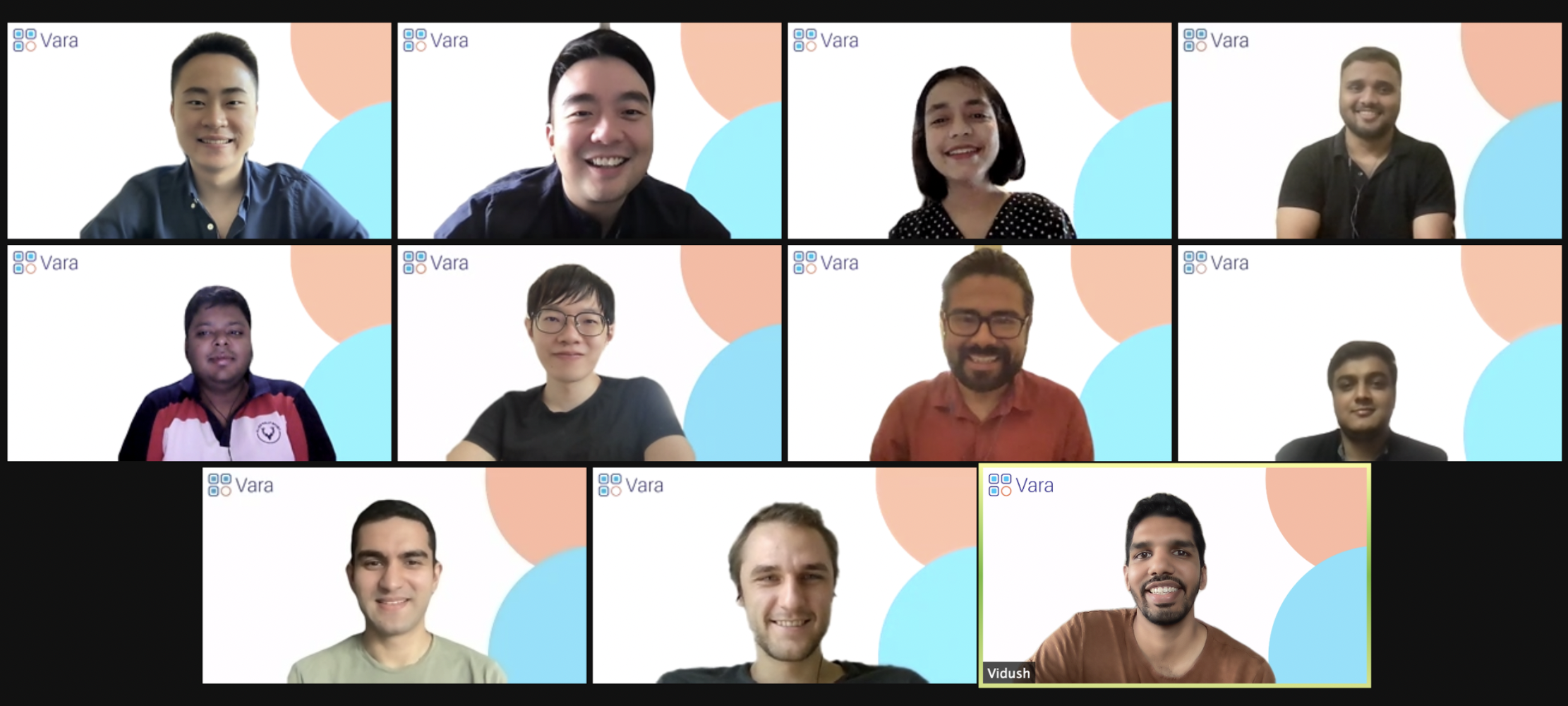
A Zoom group screenshot of Vara's team

Staff management platform Vara’s team

If you follow startup news from Indonesia, you know that the country’s estimated 60 million small businesses are a hot target for tech companies. BukuKas and BukuWarung, for example, both recently raised large rounds to fuel their race to digitize SMEs’ operations. Founded in November 2020, Vara is focused specifically on making staff management easier for small businesses and their workers, replacing the notebooks or spreadsheets many relied on to keep track of payroll with an app called Bukugaji.

The company announced today it has raised $4.8 million in seed funding from Go Ventures, RTP Global, AlphaJWC, Sequoia Capital India’s Surge, FEBE Ventures and Taurus Ventures. Founded by Vidush Mahansaria and Abhinav Karale, who met while studying at the Wharton School at the University of Pennsylvania, Vara is part of the Surge accelerator program’s fifth cohort of startups. It says more than 100,000 small businesses are already using Bukugaji.

The app has features to track attendance, calculate salaries and worker loans and disburse payroll. Mahansaria told TechCrunch that Bukugaji is aimed at companies that have less than 30 employees. Many of them are in retail, food and beverage or labor-heavy service sectors like construction and transportation. Bukugaji has features for specific employee segments, like operational staff who usually work in shifts, or permanent staff whose paychecks are fixed over a specific time period.

“Before downloading and onboarding on Bukugaji, the vast majority of our users utilized notebooks to mark attendance and track payroll,” Mahansaria said. “A small portion used the notes features on their phones or simple Excel sheets.” Bukugaji is designed to be fully self-service, so businesses can download and start using the app on their own. Its main app is mobile only, but the platform also has a web version.

The businesses Bukugaji serves often have workers who are unbanked, meaning they don’t have access to a bank account or traditional financial services. Vara’s founders say many of them live paycheck to paycheck and this means they sometimes have to take out loans from their employers.

“Employees often request cash advances from their employers toward the end of the month, when they need the money the most because sometimes they can’t make ends meet,” said Mahansaria. “This has two outcomes: first, it ties up working capital for the employer. Second, it makes the employee increasingly reliant on the employer to meet emergency needs. It’s hard to break out of this cycle given the current limited accessibility to formal financial infrastructure for this market segment.”

Earned wage access (EWA) platforms are focused on solving this problem by giving employees on-demand access to wages, instead of having to wait for their paycheck. EWA companies are gaining traction around the world, including Wagely and GajiGesa in Indonesia. Vara doesn’t have immediate plans to add an EWA feature to Bukugaji, but it is something the company is thinking about as part of the value-additive services it will build into the platform.

“Owning end-to-end payroll and attendance gives us an information edge that is unparalleled for this labor segment,” Mahansaria said, noting that the data can enable companies to add things like benefits that their employees usually don’t have access to, and in turn give workers a digitally-verified work history.

In the near future, Bukugaji will add time-saving features like automated allowances and overtime, dashboard shortcuts, reminders and customizable reports. It also plans to allow employers to disburse salaries directly through the platform. Over the longer term, Bukugaji will offer data analytics to companies and their workers. For example, employees will also be able to see how their earnings have changed over time. Employers, meanwhile can spot trends in attendance and salary.

Though Vara may eventually expand into markets, Mahansaria said it is currently “razor-focused on Indonesia,” where SMEs account for about 60% of the country’s gross domestic product and employ the vast majority of its workforce.

13 Jul 2021

Nasir Qadree grew up in the projects; now he’s announcing one the largest debut funds for a solo VC

Nasir Qadree had been working in the world of venture capital for the last six years, starting with a role at Village Capital in Washington, then as an associate director of social investments at AT&T, and as a venture partner with Pier 70 Ventures in Seattle.

Qadree encountered even more opportunities to join established venture firms recently. In fact, he says that after deciding early last year to embark on launching his own firm — and garnering capital commitments for it — he became quite interesting to investors who tried bringing him aboard their own organizations.

He gets it, he says. “I think it’s great that organizations want to find new lines of business through their connections with fund managers who have differentiated sourcing and who will yield, I’d imagine, a more diversified portfolio.”

Still, he wasn’t going to hitch his wagon to another firm once he got going. “Venture capital is a wealth-creating business,” says Qadree. “I’m a first-generation college student. I grew up in the projects [and became] president” of numerous student-led organizations at his alma mater, Hampton University.

“I think it’s up to someone like myself and people who are constantly being asked these questions to have strong conviction around how to think about building your franchise. I’ve been through so much to get to this point that to give up my equity, give up my branding and ideas” was not going to happen, he says.

Qadree’s bet on himself appears to be paying off. His Washington-based venture firm, Zeal Capital Partners, today announced that it has closed its oversubscribed subscribed first fund with $62.1 million, making it one of the largest funds to be raised by a solo general partner to date. It was targeting $25 million.

That Qadree’s pitch resonated so widely isn’t surprising. Zeal is focused primarily on two sectors that are being reshaped fast: financial tech and the future of work. The themes play neatly into the firm’s overarching thesis around inclusive investing, meaning in this case that the startups which interest Zeal need in some way to address the yawning economic inequality in the U.S.

The firm’s current portfolio — it has announced five investments publicly — offers a flavor of what’s to come. For example, Kanarys, a three-year-old SaaS platform that provides metrics to help companies prioritize and optimize diversity, equity, and inclusion efforts in the workplace. Zeal led its $3 million seed round, led by Revolution’s Rise of the Rest seed fund and others.

Meanwhile, three-year-old Esusu automates credit building by reporting its customers’ monthly rent payments to credit bureaus in an effort to boost their credit score. The app also allows users to pool and withdraw money for big-ticket transactions, then reports the fulfillment of those obligations to credit bureaus to improve their credit profiles. Forbes wrote about the company — which has raised $4 million in seed funding — last August.

Kanary and Esusu’s founders are Black, as is Qadree. But Qadree isn’t exclusively funding Black founders or Latino founders or women-led teams (the last currently represent 40% of the portfolio). While he says he is leaning into empowering founders who have been underrepresented in the tech world for decades, “being Black doesn’t mean we will only fund Black and brown entrepreneurs.”

He says he is far more focused on ensuring that a team has a specific strategy to evolve (quickly) into a more diverse group if it doesn’t start that way. Says Qadree, “If you’re building out a fintech company that’s rethinking FICO scores and you’re an all-white team, you have to show us that diversifying your management team is top of mind, that you recognize your blind spot.”

Zeal is also focused on founders who are outside of major tech hubs like the Bay Area, New York, and Boston. These “secondary markets” as Qadree calls them (using air quotes during a Zoom call), are just as important to Zeal’s mission around inclusive investing. “We want to level the playing field geographically so that an entrepreneur in Nashville or Detroit receives their fair share of investment capital, just as the Harvard grad who lives in Silicon Valley and is an alum of Google.”

Zeal’s new fund is anchored by investors Truist and Paypal, with additional investments from Synchrony Financial, the Skoll Foundation, Foot Locker, DC’s RockCreek, Hampton University Endowment, Southern New Hampshire University, and Gary Community Investment.

It also counts as investors numerous individuals who are also advising the firm, including NEA cofounder Frank Bonsal and Wes Moore, the former CEO of the Robin Hood Foundation (and current gubernatorial candidate in Maryland).

Not last, Qadree has brought into the fold several operating partners, including Rachel Williams, who is the head of equity, inclusion and diversity at X, the “moonshot factory” that is part of Alphabet; and Kam Syed, a senior sales and business development exec at Amazon.

Pictured above, left to right: Andy Will, a senior associate with Zeal; Nicole ward, an analyst with the firm; Nasir Qadree; Nicole West, an executive in residence who was formerly a managing director with Legg Mason; and Jason Green, who cofounded SkillSmart and is also now an executive in residence with Zeal.


13 Jul 2021

Whisper Aero emerges from stealth to quiet drones and air taxis

The skies are on the cusp of getting busier — and louder — as drone delivery and electric vertical take-off and landing passenger aircraft startups move from moonshot to commercialization. One former NASA engineer and ex-director of Uber’s air taxi division is developing tech to ensure that more air traffic doesn’t equal more noise.

Mark Moore, who was most recently director of engineering at Uber Elevate until its acquisition by Joby Aviation, has a launched his own company called Whisper Aero. The startup, which came out of stealth this week, is aiming to designing an electric thruster it says will blend noise emitted from delivery drones and eVTOLs alike into background levels, making them nearly imperceptible to the human ear.

It’s a formidable challenge. Solving the noise problem comes down to more than simply cranking down the volume. Noise profiles are also characterized by other variables, like frequency. For example, helicopters have a main rotor and tail rotor that generate two separate frequencies, which makes them much more irritating to the human ear than if they were at a single frequency, Moore told TechCrunch in a recent interview.

Complicating the picture even further is that eVTOL companies are designing entirely new types of aircraft, ones that may generate different acoustic profiles than other rotorcraft (like helicopters). The U.S. Army recently undertook a research study confirming that eVTOL rotors generate more of a type of noise referred to as broadband, rather than tonal noise which is generated by helicopters. And as each eVTOL company is developing its own design, not all of the electric aircraft will generate the same level or kind of noise.

Whisper is designing its scalable product to be adoptable across the board.

Moore said the idea for the company had been fomenting for years. He and Whisper COO Ian Villa, who headed strategy and simulation at Elevate, realized years ago that noise (that is, less of it) was key to air taxis taking off.

“The thing that was abundantly clear was, noise matters most,” Villa said. “It is the hardest barrier to break through. And not enough of these developers were spending the time, the resources, the mindshare to really unlock that.”

Whisper CEO Mark Moore. Image Credits: Whisper Aero (opens in a new window)

Helicopters have mostly been able to get away with their terrible noise profile because they are used so infrequently. But eVTOL companies like Joby Aviation are envisioning far higher ride volumes. Moore is quick to point out that companies like Joby (which purchased Elevate at the end of 2020) are already developing aircraft that are many times quieter than helicopter, and are “a step in the right direction.”

“The question is, ‘is it enough of a step to get to significant adoption?’ And that’s what we’re focused on.”

Whisper is staying mum on the details of its thruster design. It has managed to attract around $7.5 million investment from firms like Lux Capital, Abstract Ventures, Menlo Ventures, Kindred Ventures and Robert Downey Jr.’s FootPrint Coalition Ventures. It’s also aiming to convert its provisional patents with the United States Patent and Trademark Office sometime next year.

From there, the startup envisions launching in the small drone market around 2023, before scaling progressively up to air taxis. Moore said the goal is to get the thrusters manufactured and in vehicles by the end of the decade. Should the first generation of eVTOL go to market in 2024 (as Archer Aviation and Joby have proposed), Whisper’s product could potentially appear in second generation eVTOL.

In the meantime, Whisper will continue testing and working out remaining technical challenges – least among which is how to manufacture the end product at a reasonable cost. Whisper is also preparing to conduct dynamic testing in a wind tunnel, in addition to the static tests it has undertaken at its Tennessee headquarters, some in partnership with the U.S. Air Force.

“It’s got to be quiet enough to blend into the background noise,” Moore said. “We know this and that’s the technology we’re developing.”

12 Jul 2021

Vaayu’s carbon tracking for retailers raises raises $1.6m, claims it could cut CO2 in half by 2030

Carbon tracking is very much the new hot thing in tech, and we’ve previously covered more generalist startups doing this at scale for companies, such as Plan A Earth out of Berlin.

But there’s clearly an opportunity to get deep into a vertical sector and tailor solutions to it.

That’s the plan of Vaayu, a carbon tracking platform aimed specifically at retailers. It has now raised $1.57 million in pre-seed funding in a funding round led by CapitalT. Several Angels also took part, including Atomico’s Angel Program, Planet Positive LP, Saarbrücker 21, Expedite Ventures, and NP-Hard Ventures.

Carbon tracking for the retail fashion industry, in particular, is urgently needed. Unfortunately, the fashion industry remains responsible for 10% of annual global carbon emissions, which ads up to more than all international flights and maritime shipping combined.
 
Vaayu says it integrates with various point-of-sale systems, such as Shopify and Webflow. It then pulls in data on logistics, operations, and packaging to monitor, measure, and reduce their carbon emissions. Normally, retailers calculate emissions once a year, which is obviously far less accurate.

Vaayu was founded in 2020 by Namrata Sandhu (CEO) former Head of Sustainability at fashion retailer Zalando, as well as Anita Daminov (CPO) and Luca Schmid (CTO). Vaayu currently has 25 global brand customers, including Missoma, Armed Angels, and Organic Basics. 
 
Commenting on the fundraise, Namrata Sandhu, CEO, Vaayu, said: “We have only nine short years left to achieve the UN’s goal of reducing carbon emissions by 50% by 2030 and as the third-largest contributor to global emissions, retailers need to take action – and fast. Vaayu is here to help retailers measure, monitor, and reduce their carbon footprint at scale across the entire supply chain – something that I know from my own experience can be complex and expensive. 
 
Speaking to me over a call, Sandhu told me: “Putting the focus on retail basically allows us to automate the calculation, which means in three clicks you can get your carbon footprint right away. That then allows us to really accurate data, and with that, we can basically do reductions specific to the business but using software, rather than any kind of manual intervention or a kind of ‘intermediate’ state where you need to put together an Excel sheet. Because we focus on retail we can automate the entire process and also automate the reductions.”

“We are delighted to be backed by female-led CapitalT who understood us and our vision right from the start. We look forward to developing Vaayu further in the coming months so we can reach as many retailers as possible and help put the brakes on the impending climate crisis,” she added.

Janneke Niessen, founding partner, CapitalT commented: “We are very excited to join Vaayu on their mission to reduce carbon emission for retailers worldwide. The Vaayu product is very scalable and its quick and easy implementation allows for fast adoption. We are confident that with this experienced team, Vaayu will soon be one of the fastest-growing climate tech companies in Europe and the world.”

12 Jul 2021

Daily Crunch: Flipkart raises $3.6 billion, setting another record for Indian startups

To get a roundup of TechCrunch’s biggest and most important stories delivered to your inbox every day at 3 p.m. PDT, subscribe here.

Hello and welcome to Daily Crunch for July 12, 2021. You likely spent yesterday watching a football game, watching a space plane or both. We have a little bit more on the latter than the former today in the newsletter, but we can all agree with this regardless of whether you were waving an English or Italian flag yesterday. — Alex

The TechCrunch Top 3

  • Flipkart now worth $37.6B: An anticipated investment into Flipkart has come to be, with the Indian e-commerce player raising some $3.6 billion in a single deal. It’s a massive round and a huge endorsement of the larger Indian startup ecosystem. Now we have just to wait for the company to go public!
  • Virgin Galactic goes to space (mostly): Quite a few folks tuned into the Virgin Galactic rocket-plane space dalliance this weekend. The production had a few hiccoughs and more than a few self-indulgent moments that could have been edited out, but largely went off without a hitch. The recently SPAC’d former startup quickly decided to raise a half-billion dollars after its success. Unlike its space tourism vehicle, however, shares of Virgin Galactic did not take off on the news.
  • Let the billionaires fight: Your humble servant dove into the controversy surrounding the current contest between various billionaires building space companies and fighting to be the first to various space feats. Tax the rich, I think, but let them fight it out in the meantime.

Startups/VC

We have our regular list of funding rounds in a moment, but today we’re kicking off our startup coverage with this headline from earlier today: “Elevate Brands banks $250M to roll up third-party merchants selling on Amazon’s marketplace.”

The headline should feel somewhat familiar as we’ve seen comparable bits of news from other groups. As our own Ingrid Lunden reports, we’ve seen similar deals from Thrasio, The Razor Group, Branded, SellerX, Perch and others. The idea of buying up smaller Amazon retailers is such a potentially lucrative wager that kajillions of dollars are flooding the zone. How many winners that we will see is the next question.

Now, back to our regularly scheduled programming:

  • Gembah wants to make product creation easier: The Austin-based startup now has $11 million to follow its vision. How does it go about meeting its mission? By building a platform/marketplace that helps guide users through the work of product creation. Did we need more stuff? Probably. Gembah wants to help.
  • India’s next tech IPO: This time it’s MobiKwik, a mobile wallet startup that is targeting a $255 million IPO. We have some of its financials, including that revenue in its most recent fiscal year dipped to $40.5 million. So, it’s a smaller company, but we do love seeing IPOs regardless of their scale.

To close out startup coverage today, fake toys. If you’ve been on Twitter today there’s a good chance that you’ve seen folks posting pictures of toys that look like failed tech products. Think Theranos’ unit or the Juicero machine.

TechCrunch Grand Duke Matthew Panzarino wrote that an “idea factory/art house” called MSCHF is making the “hardness of hardware” more real by selling Dead Startup Toys made of vinyl.

Don’t laugh. This is actually somewhat neat. Think of this: Don’t you want a fake, small Juicero on your desk to throw at the wall here and there when you get mad? I do.

The most important API metric is time to first call

Publishing an API isn’t enough for any startup: Once it’s released, the hard work of cultivating a developer base begins.

Postman’s head of Developer Relations, Joyce Lin, wrote a guest post for Extra Crunch based on the findings of a study aimed at increasing adoption of APIs that utilize a public workspace.

Lin found that the most important metric for a public API is time to first call (TTFC). It makes sense — faster TTFC allows developers to begin using new tools quickly. As a result, “legitimately streamlining TTFC results in a larger market potential of better-educated users for the later stages of your developer journey,” writes Lin.

This post isn’t just for the developers in our audience: TTFC is a metric that product and growth teams should also keep top of mind, they suggest.

“Even if your market is defined as a limited subset of the developer community, any enhancements you make to TTFC equate to a larger available market.”

(Extra Crunch is our membership program, which helps founders and startup teams get ahead. You can sign up here.)

Big Tech Inc.

There was a lot going on with the larger tech companies of the world today, so let’s dive right in:

  • A modest improvement to Android: If you are running Android 12, you will be able to start playing games a bit faster in the future. Google just announced a feature that will allow users to launch new games before they are fully downloaded. This has been accessible for some PC games for a while, but it’s nice to see on the mobile platform. That said, we’re really at the end of the innovation cycle for the current era of smartphones.
  • Microsoft buys more cybersecurity: Microsoft confirmed earlier reports that it was looking to buy RiskIQ. The price was not disclosed, but Bloomberg previously reported that it would be more than $500 million in cash. On the podcast this morning, we noted that that wasn’t a huge price for Microsoft, though the larger company has a huge vested interest in more folks being more secure.
  • Elon defends the SolarCity deal: Today’s MuskWatch is all about a deal from the past. Namely the Tesla-SolarCity deal that was worth $2.6 billion. Some shareholders call the deal a bailout. Musk blamed various factors for what could be called underperformance at his car company’s solar division.
  • WhatsApp takes flak in Europe: Facebook’s ability to annoy regulators is a global affair, with the company being accused of “multiple breaches of European Union consumer protection law as a result of its attempts to force WhatsApp users to accept controversial changes to the messaging platforms’ terms of use,” TechCrunch reports.

TechCrunch Experts: Growth Marketing

Illustration montage based on education and knowledge in blue

Image Credits: SEAN GLADWELL (opens in a new window) / Getty Images

We’re reaching out to startup founders to tell us who they turn to when they want the most up-to-date growth marketing practices. Fill out the survey here.

Read one of the recommendations we’ve received below!

Marketer: Maya Moufarek, Marketing Cube

Recommender: Nikki O’Farrell, www.KatKin.club

Recommendation: “Expert ear and eye from the world of startups/scaleups and growth. Her functional and direct approach allows you to execute at speed and see results quickly.”

12 Jul 2021

5 advanced-ish SEO tactics to win in 2021

In nearly every Google algorithm update in recent memory, Google has rewarded old, megatraffic sites, sending their search rankings soaring at the expense of smaller, newer sites. Big sites have increased their search traffic by 28% year over year, according to GrowthBar’s organic search data on the 100 most visited sites.

Why? Large sites such as Wikipedia, LinkedIn, Pinterest, Amazon, Home Depot and Target have something the rest of us don’t — they’ve got years of built-up Google trust signals.

Start with best practices like making incredible content and securing backlinks to your best web pages, but also be willing to think a bit outside the box.

I’d contend that Google favors large sites more than ever before — and it’s a trend that doesn’t seem to be slowing down. After all, Google exists to deliver the best search experience to users. Bad search results would be a death sentence for their business, since Googlers would flock to alternatives like DuckDuckGo and Bing.

Especially today, where distrust of the media is at an all-time high, Google can’t risk its reputation by surfacing bad search results, so I think their algorithm errs on the side of caution. It’s simply safer for their business to surface household names at the top of the search engine results page, particularly in ultrasensitive your money, your life categories.

John Mueller, Google’s SEO mouthpiece, practically settled the debate that older sites are preferred by the algorithm when he said, ” … freshness is always an interesting one because it’s something that we don’t always use. Because sometimes it makes sense to show people content that has been established (SEJ).”

So, how can you hope to compete if you’re deploying an SEO strategy on one of the billions of smaller sites?

Help TechCrunch find the best growth marketers for startups.

Provide a recommendation in this quick survey and we’ll share the results with everybody.

Of course, you should start with best practices like making incredible content and securing backlinks to your best web pages, but you should also be willing to think a bit outside the box. The cards aren’t in your favor, so you need to be even more strategic than the big guys. This means executing on some cutting-edge hacks to increase your SEO throughput and capitalize on some of the arbitrage still left in organic search. I call these five tactics “advanced-ish,” because none of them are complicated, but all of them are supremely important for search marketers in 2021.

Scaling your time with content generators

Businesses spent over $300 billion on content marketing last year. That’s in part because creating new content is the most straightforward way to draw in organic search traffic. Whether you’ve got a mature site or you’re just starting a WordPress SEO site, content is likely a large part of your SEO strategy.

But to scale content like a startup, you’ll need to devote a lot of time to it and/or manage a fleet of writers. Your time is probably better spent building your product or helping customers than on planning hundreds of blog articles. This is precisely where a content generator tool comes into play.

A whole new era of SEO tools is emerging, and some of these are augmented by OpenAI’s GPT-3 technology, the most advanced artificial intelligence language model. These tools have changed the game for SEOs and content creators by automating parts of the content creation cycle. Several tools utilize SEO signals and combine them with OpenAI to help you create blog outlines that include SEO-optimized titles, word counts, keywords, headlines, intro paragraphs and much more.

12 Jul 2021

Q3 IPO cycle starts strong with Couchbase pricing and Kaltura relisting

Today we have new filings from Couchbase and Kaltura: Couchbase set an initial price range for its IPO, something we’ve been waiting for, and Kaltura’s offering is back from hiatus with a new price range and some fresh financial information to boot.

Both bits of news should help us get a handle on how the Q3 2021 IPO cycle is shaping up at the start.

TechCrunch has long expected the third quarter’s IPO haul to prove strong; investors said as 2020 closed that quarters one, three and four would prove very active in terms of public market exits this year. Then the second quarter surpassed expectations, with more companies going public than at least some market observers anticipated.

With that in mind, you can imagine why the newly launched Q3 could prove an active period.

So! Let’s start with a dig into the filing from NoSQL provider Couchbase, working to understand its first price range and what the numbers may say about market demand for technology debuts. Here’s our first look at the company’s value. Then we are taking the Kaltura saga back up, checking into the pricing and second-quarter results from the technology company that provides video streaming software and services.

Frankly, I’ve been waiting for these filings to drop. So, let’s cut the chat and get into the numbers:

Couchbase’s IPO price range

In its new S-1/A filing, Couchbase reports that it anticipates a $20 to $23 per share IPO price. With a maximum sale of just over 8 million shares, Couchbase could raise as much as $185.15 million in its public offering.

The company will have 40,072,801 shares outstanding after its IPO, not including 1,050,000 shares that are reserved for possible release. The math from here is simple. To calculate Couchbase’s possible simple IPO valuation we can just do a little multiplication:

  • Couchbase simple valuation at $20 per share: ~$802 million
  • Couchbase simple valuation at $23 per share: ~$922 million

If you want to include the company’s reserved shares, add $21 million to the first figure, and $24.2 million to the second. Notably, TechCrunch wrote before it priced that using a historical analog from the Red Hat-IBM sale — both Couchbase and Red Hat work in the OSS space — the company would be worth around $900 million. So, we were pretty close.

12 Jul 2021

Q3 IPO cycle starts strong with Couchbase pricing and Kaltura relisting

Today we have new filings from Couchbase and Kaltura: Couchbase set an initial price range for its IPO, something we’ve been waiting for, and Kaltura’s offering is back from hiatus with a new price range and some fresh financial information to boot.

Both bits of news should help us get a handle on how the Q3 2021 IPO cycle is shaping up at the start.

TechCrunch has long expected the third quarter’s IPO haul to prove strong; investors said as 2020 closed that quarters one, three and four would prove very active in terms of public market exits this year. Then the second quarter surpassed expectations, with more companies going public than at least some market observers anticipated.

With that in mind, you can imagine why the newly launched Q3 could prove an active period.

So! Let’s start with a dig into the filing from NoSQL provider Couchbase, working to understand its first price range and what the numbers may say about market demand for technology debuts. Here’s our first look at the company’s value. Then we are taking the Kaltura saga back up, checking into the pricing and second-quarter results from the technology company that provides video streaming software and services.

Frankly, I’ve been waiting for these filings to drop. So, let’s cut the chat and get into the numbers:

Couchbase’s IPO price range

In its new S-1/A filing, Couchbase reports that it anticipates a $20 to $23 per share IPO price. With a maximum sale of just over 8 million shares, Couchbase could raise as much as $185.15 million in its public offering.

The company will have 40,072,801 shares outstanding after its IPO, not including 1,050,000 shares that are reserved for possible release. The math from here is simple. To calculate Couchbase’s possible simple IPO valuation we can just do a little multiplication:

  • Couchbase simple valuation at $20 per share: ~$802 million
  • Couchbase simple valuation at $23 per share: ~$922 million

If you want to include the company’s reserved shares, add $21 million to the first figure, and $24.2 million to the second. Notably, TechCrunch wrote before it priced that using a historical analog from the Red Hat-IBM sale — both Couchbase and Red Hat work in the OSS space — the company would be worth around $900 million. So, we were pretty close.

12 Jul 2021

Bambee founder talks about entrenched fundraising challenges facing Black founders

Allan Jones dropped out of college and spent a decade learning how to run a startup. In 2016, that education resulted in the launch of Los Angeles-based Bambee, which helps small companies by acting as their HR department with the goal of keeping them in compliance with government rules and regulations.

But he found getting funded a challenge in spite of his background. He said that as a Black man, he had to move more carefully in the startup world.

“I think it came as part of the complexities of navigating a mostly white male ecosystem, a mostly straight cis white male ecosystem that either helps you create some skills that make you really effective at the job, or generates so much resentment that it becomes hard to be effective. […] I think that I was always one comment away from the opposite direction [I ended up going],” he explained.

Fortunately, that didn’t happen and he kept on climbing and gaining skills and single-handedly founded his own company, one which has reached Series B and raised $33 million, a significant amount of money for any startup, but particularly for a startup run by a Black founder.

A study published by Crunchbase in February found that VC firms distributed $150 billion in venture funding in 2020. Of that less than 1% or around $1 billion went to Black founders. That highlights just how difficult it has been for him to raise from such a limited pool of money in spite of having a great idea and the business skill and acumen to pull it off.

Jones got his start at the age of 20 at a startup called Helio, which targeted the youth market for multimedia services on mobile phones. It was eventually acquired by Virgin Mobile. He went on to run product at a couple of companies before landing as CMO at ZipRecruiter in 2013. He left that position after three years to launch Bambee in 2016.

In spite of all that experience, he felt that as a gay Black man in Silicon Valley that he was continually saddled with the label of ‘the kid with potential’, and not always taken as seriously as his straight white counterparts. “And I don’t think those intentions necessarily were bad, I think it was quite the opposite, which actually makes them almost worse because they were entrenched in a bias of how to characterize [my abilities].”

Jones launched Bambee, a startup that is going after SMBs with fewer than 500 employees, most of which are operating without an HR department, and could be out of compliance with federal mandates because they don’t have anyone in charge who is aware of the rules.

“Bambee aims to put an HR manager in every American small business. We’ve done so by building a model that allows you to hire one on our platform for $99 a month. So you pay us a flat fee and you get access to our platform and your own dedicated HR professional. […] She acts as your human resource manager and your human resource arm for your company. And our platform helps keep those companies compliant,” Jones explained.

Jones says that while he might not encounter direct bias as he builds his business, there is an unconscious bias that investing in Bambee could be riskier than investing in someone who fits the prototypical startup founder mold, and this is especially true in early-stage investing when investors are essentially betting on the entrepreneur.

“They take bets that they deem as a bit safer — entrepreneurs that look like a certain profile — white cis-gender males that come from Stanford and Harvard that match the profile of confidence and they have kind of built in an anti-bias determination around, so they automatically get the benefit of the doubt to those pedigrees, and those profiles,” Jones said.

He says that means that Black founders have to work that much harder to overcome those biases. Today Bambee has some decent metrics to show investors with revenue reaching tens of millions, growing 300% year over year with thousands of customers across all 50 states, according to Jones. With 100 employees, he plans to double that number by the end of this year.

Even with that, he says there are still barriers to entry he has to deal with. Even if it’s harder for investors to ignore the company’s numbers, he still sees a tendency to accentuate the negative.

“Building a great company with the deficit in belief in you that starts so early on in the venture process, the [obstacles] that you have to [overcome] to get here. It seems impossible with less than 1% of venture capital dollars going to Black founders, and it isn’t because Black founders don’t exist, it’s because the belief in us is not there at scale,” he said.

As Jones continues to build the company, he has learned to look for investors who believe in him and his vision for the company. If he senses that negativity from a potential investor, he moves on because he wants to work with people who want to help build the company and believe in it as much as he does. He says this won’t change when he goes to raise his C round, a stage few Black entrepreneurs reach.

“Is it going to be easier for me going forward? I don’t think so. I think the type of bias that I have to combat based on the class of entrepreneur I’m becoming, it starts to shift and change, and I’ve seen that in every round and I’m prepared for it in my Series C, as well.”

He says that the progress he’s made in the company and his belief in the business will help him find the right partners to continue on that journey, just as he has in previous rounds.

“We will navigate this […] and I think we’ll build a really great business, and ultimately the partners we discover along this journey will be the exact right ones who we were meant to.”