Year: 2021

12 Jul 2021

Papa co-founder lands seed funding for a second swing in eldercare: UpsideHōM

Jake Rothstein spent nearly six years scaling Papa, a Miami-based company that offers care and companionship to seniors. The business, which pairs elderly Americans with uncertified-yet-vetted pals, helps offer casual services, such as technology support, grocery delivery or even a fun conversation. It has raised upwards of $91 million in venture capital to date.

The company gave Rothstein a deeper look into the priorities of older adults and families as they go through the aging journey. And while Papa was about meeting the elderly where they are, it seems that a few years in, the co-founder began to think of a more complex question: What if “where they are” isn’t as supportive as it should be 24/7?

Rothstein left Papa in January 2020 to launch a more modern take on senior living communities. UpsideHōM is a fully managed, tech-enabled living space for older adults in the United States. After Rothstein and his co-founder Peter Badgley completed a year of beta testing, the duo announced today that they have raised a $2.25 million seed round for UpsideHōM, led by Triple Impact Capital and Freestyle Capital, with participation from Techstars.

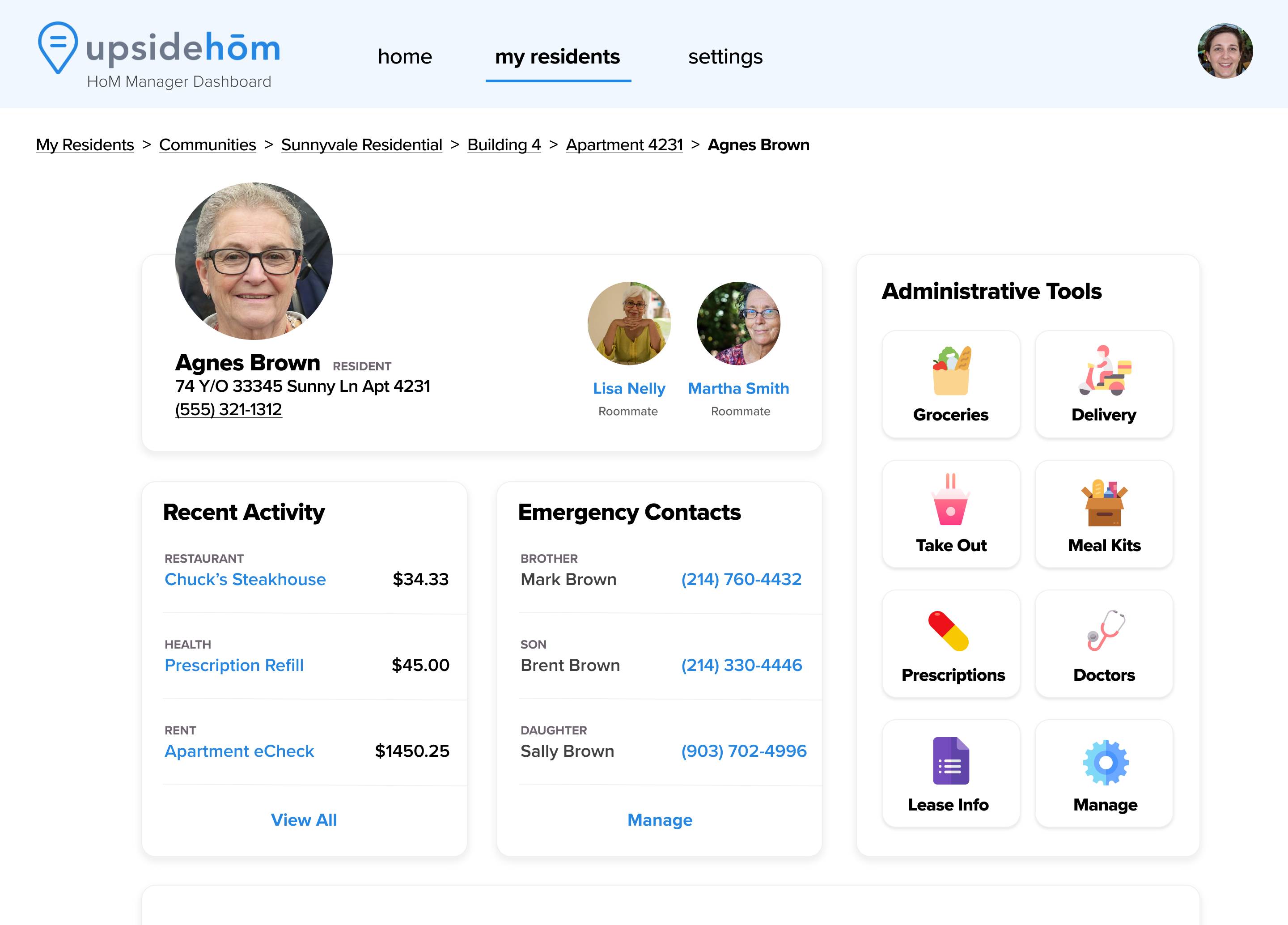
Alongside the funding, UpsideHōM announced its next big bet, dubbed a relaunch, that will sit atop its fully furnished apartments that sit throughout Raleigh, Atlanta, Jacksonville, Tampa and South Florida: a software platform to take out all the clutter from move-in and maintenance. The platform will give residents one spot to chat with their house manager, pay bills and access perks such as on-demand tech support, house-keeping and companion visits thanks to a partnership with Papa. The company also offers add-on services and amenities, including freshly prepared meals, grocery delivery, fitness programming and accompanied transportation.
upsidehom-platform

Image Credits: UpsideHōM

Part of UpsideHōM’s focus is in creating personalized solutions. Elders are diverse in age, needs and financial circumstances — which means the turnkey solution needs to be easily adaptable to service needs when they pop up. The company needs to be careful though: It can’t offer traditional caregiver services due to state by state compliance; instead Rothstein describes the offerings as supportive services, not in replacement of health assistant caregivers.

upsidehomhouse

Image Credits: UpsideHoM

When the company first launched, it was betting on a more unconventional idea.

“I thought, let’s solve loneliness even more completely than what Papa is doing by building in companionship,” Rothstein said, instead of letting people order it on demand. The company decided to offer roommate matching services for elders as one of its core services, alongside the aforementioned assisted living characteristics. It didn’t fully stick. Over half of inbound participants responded to the marketing efforts by saying that they liked the idea, but didn’t want to share the space. Today, 50% of UpsideHōM’s business covers individuals or people with spouses or significant others; the other half covers those looking to share units.

The synergies between UpsideHōM and Papa, Rothstein’s previous company, are clear beyond an overlapping customer base. Papa offered up to and almost including actual care, stopping at traditional care-giving services, which require their own vetting and compliance measures. UpsideHōM offers up to and almost including traditional senior living services, but gives supportive services instead of assisted living services, which similarly have their own logistic hurdles to figure out.

As for why Rothstein didn’t just launch supportive living services as a new product vertical within his earlier company, he chalked it up to the “tremendous” opportunity in the former, which warranted it’s own company. He also said that customer acquisition looks different between the two companies.

“At Papa, what we found was that acquiring customers in this space was incredibly challenging [so we went through] the Medicare Advantage route,” he said. “But senior living is a completely different segment.”

The millions in new venture capital money are coming as UpsideHōM prepares for aggressive growth. While the company did not disclose revenue or total residents, it did say it has hit 1,000% in new resident headcount in the first half of 2021 as a vague proxy. As the startup prepares for its next phase of growth, the co-founders will need to focus heavily on sustainable customer acquisition.

Rothstein thinks that downsizing elders into homes that work for them is a simple argument to make.

“You can age in place for as long as it’s practical, but there’s going to be a day and time when it’s not gonna be practical,” Rothstein said. “Why would you want to make this decision after you’ve broken your hip, after you run out of money or after your spouse died?”


12 Jul 2021

The most important API metric is time to first call

API publishers among Postman’s community of more than 15 million are working toward more seamless and integrated developer experiences for their APIs. Distilled from hundreds of one-on-one discussions, I recently shared a study on increasing adoption of an API with a public workspace in Postman. One of the biggest reasons to use a public workspace is to enhance developer onboarding with a faster time to first call (TTFC), the most important metric you’ll need for a public API.

If you are not investing in TTFC as your most important API metric, you are limiting the size of your potential developer base throughout your remaining adoption funnel.

To understand a developer’s journey, let’s first take a look at factors influencing how much time and energy they are willing to invest in learning your technology and making it work.

  • Urgency: Is the developer actively searching for a solution to an existing problem? Or did they hear about your technology in passing and have a mild curiosity?
  • Constraints: Is the developer trying to meet a deadline? Or do they have unlimited time and budget to explore the possibilities?
  • Alternatives: Is the developer required by their organization to use this solution? Or are they choosing from many providers and considering other ways to solve their problem?

Developer journey to an API

With that context in mind, the following stages describe the developer journey of encountering a new API:

Step 1: Browse

A developer browses your website and documentation to figure out what your API offers. Some people gloss over this step, preferring to learn what your tech offers interactively in the next steps. But judgments are formed at this very early stage, likely while comparing your product among alternatives. For example, if your documentation and onboarding process appears comparatively unorganized and riddled with errors, perhaps it is a reflection of your technology.

Step 2: Signup

Signing up for an account is a developer’s first commitment. It signals their intent to do something with your API. Frequently going hand-in-hand with the next step, signing up is required to generate an API key.

Step 3: First API call

Making the first API call is the first payoff a developer receives and is oftentimes when developers begin more deeply understanding how the API fits into their world. Stripe and Algolia embed interactive guides within their developer documentation to enable first API calls. Stripe and Twitter also use Postman public workspaces for interactive onboarding. Since many developers already use Postman, experiencing an API in familiar territory gets them one step closer to implementation.

12 Jul 2021

Cutting out carbon emitters with bioengineering at XTC Global Finals on July 22

Bioengineering may soon provide compelling, low-carbon alternatives in industries where even the best methods produce significant emissions. Utilizing natural and engineered biological process has led to low-carbon textiles from Algiknit, cell-cultured premium meats from Orbillion, and fuels captured from waste emissions via LanzaTech — and leaders from those companies will be joining us on stage for the Extreme Tech Challenge Global Finals on July 22.

We’re co-hosting the event, with panels like this one all day and a pitch-off that will feature a number of innovative startups with a sustainability angle.

I’ll be moderating a panel on using bioengineering to create change directly in industries with large carbon footprints: textiles, meat production, and manufacturing.

Algiknit is a startup that is sourcing raw material for fabric from kelp, which is an eco-friendly alternative to textile crop monocultures and artificial materials like acrylic. CEO Aaron Nessa will speak to the challenge of breaking into this established industry and overcoming preconceived notions of what an algae-derived fabric might be like (spoiler: it’s like any other fabric).

Orbillion Bio is one of the new crop of alternative protein companies offering cell-cultured meats (just don’t call them “lab” or “vat” grown) to offset the incredibly wasteful livestock industry. But it’s more than just growing a steak — there are regulatory and market barriers aplenty that CEO Patricia Bubner can speak to as well as the technical challenge.

LanzaTech works with factories to capture emissions as they’re emitted, collecting the useful particles that would otherwise clutter the atmosphere and repurposing them in the form of premium fuels. This is a delicate and complex process that needs to be a partnership, not just a retrofitting operation, so CEO Jennifer Holmgren will speak to their approach convincing the industry to work with them at the ground floor.

It should be a very interesting conversation, so tune in on July 22 to hear these and other industry leaders focused on sustainability discuss how innovation at the startup level can contribute to the fight against climate change. Plus it’s free!

12 Jul 2021

Android 12 will let you play games before they finish downloading

At its Game Developer Summit, Google today announced a new feature for Android game developers today that will speed up the time from starting a download in the Google Play store to the game launching by almost 2x — at least on Android 12 devices. The name of the new feature, ‘play as you download,’ pretty much gives away what this is all about. Even before all the game’s assets have been downloaded, players will be able to get going.

On average, modern games are likely the largest apps you’ll ever download and when that download takes a couple of minutes, you may have long moved on to the next TikTok session before the game is ever ready to play. With this new feature, Google promises that it’ll take only half the time to jump into a game that weighs in at 400MB or so. If you’re a console gamer, this whole concept will also feel familiar, given that Sony pretty much does the same thing for PlayStation games.

Now, this isn’t Google’s first attempt at making games load faster. With ‘Google Play Instant,’ the company already offers a related feature that allows gamers to immediately start a game from the Play Store. The idea there, though, is to completely do away with the install process and give potential players an opportunity to try out a new game right away.

Like Play Instant, the new ‘play as you download’ feature is powered by Google’s Android App Bundle format, which is, for the most part, replacing the old APK standard

Image Credits: Google

12 Jul 2021

Microsoft confirms it’s buying cybersecurity startup RiskIQ

Microsoft has confirmed it’s buying RiskIQ, a San Francisco-based cybersecurity company that provides threat intelligence and cloud-based software as a service for organizations.

Terms of the deal, which will see RiskIQ’s threat intelligence services integrated into Microsoft’s flagship security offerings, were not disclosed, although Bloomberg previously reported that Microsoft will pay more than $500 million in cash for the company. Microsoft declined to confirm the reported figure.

The announcement comes amid a heightened security landscape as organizations shift to remote and hybrid working strategies.

RiskIQ scours the web, mapping out details about websites and networks, domain name records, certificates and other information, like WHOIS registration data, providing customers visibility into what assets, devices and services can be accessed outside of a company’s firewall. That helps companies lock down their assets and limit their attack surface from malicious actors.

Microsoft says that by embedding RiskIQ’s technologies into its core products, its customers will be able to build a more comprehensive view of the global threats to their businesses as workforces continue to work outside of the traditional office environment.

The deal will also help organizations to keep an eye on supply-chain risks, Microsoft says. This is likely a growing priority for many: an attack on software provider SolarWinds last year saw affected at least 18,000 of its customers, and just this month IT vendor Kaseya fell victim to a ransomware attack that spread to more than 1,000 downstream businesses.

Eric Doerr, vice president of cloud security at Microsoft, said: “RiskIQ helps customers discover and assess the security of their entire enterprise attack surface — in the Microsoft cloud, AWS, other clouds, on-premises, and from their supply chain. With more than a decade of experience scanning and analyzing the internet, RiskIQ can help enterprises identify and remediate vulnerable assets before an attacker can capitalize on them.”

RiskIQ was founded in 2009 and has raised a total of $83 million over four rounds of funding. Elias Manousos, who co-founded RiskIQ and serves as its chief executive, said he was “thrilled” at the acquisition.

“The vision and mission of RiskIQ is to provide unmatched internet visibility and insights to better protect and inform our customers and partners’ security programs,” said Manousos. “Our combined capabilities will enable best-in-class protection, investigations, and response against today’s threats.”

The acquisition is one of many Microsoft has made recently in the cybersecurity space in recent months. The software giant last year bought Israeli security startup CyberX in a bid to boost its Azure IoT business, and just last month it acquired Internet of Things security firm ReFirm Labs.

12 Jul 2021

Microsoft confirms it’s buying cybersecurity startup RiskIQ

Microsoft has confirmed it’s buying RiskIQ, a San Francisco-based cybersecurity company that provides threat intelligence and cloud-based software as a service for organizations.

Terms of the deal, which will see RiskIQ’s threat intelligence services integrated into Microsoft’s flagship security offerings, were not disclosed, although Bloomberg previously reported that Microsoft will pay more than $500 million in cash for the company. Microsoft declined to confirm the reported figure.

The announcement comes amid a heightened security landscape as organizations shift to remote and hybrid working strategies.

RiskIQ scours the web, mapping out details about websites and networks, domain name records, certificates and other information, like WHOIS registration data, providing customers visibility into what assets, devices and services can be accessed outside of a company’s firewall. That helps companies lock down their assets and limit their attack surface from malicious actors.

Microsoft says that by embedding RiskIQ’s technologies into its core products, its customers will be able to build a more comprehensive view of the global threats to their businesses as workforces continue to work outside of the traditional office environment.

The deal will also help organizations to keep an eye on supply-chain risks, Microsoft says. This is likely a growing priority for many: an attack on software provider SolarWinds last year saw affected at least 18,000 of its customers, and just this month IT vendor Kaseya fell victim to a ransomware attack that spread to more than 1,000 downstream businesses.

Eric Doerr, vice president of cloud security at Microsoft, said: “RiskIQ helps customers discover and assess the security of their entire enterprise attack surface — in the Microsoft cloud, AWS, other clouds, on-premises, and from their supply chain. With more than a decade of experience scanning and analyzing the internet, RiskIQ can help enterprises identify and remediate vulnerable assets before an attacker can capitalize on them.”

RiskIQ was founded in 2009 and has raised a total of $83 million over four rounds of funding. Elias Manousos, who co-founded RiskIQ and serves as its chief executive, said he was “thrilled” at the acquisition.

“The vision and mission of RiskIQ is to provide unmatched internet visibility and insights to better protect and inform our customers and partners’ security programs,” said Manousos. “Our combined capabilities will enable best-in-class protection, investigations, and response against today’s threats.”

The acquisition is one of many Microsoft has made recently in the cybersecurity space in recent months. The software giant last year bought Israeli security startup CyberX in a bid to boost its Azure IoT business, and just last month it acquired Internet of Things security firm ReFirm Labs.

12 Jul 2021

Elon Musk defends Tesla’s $2.6B acquisition of SolarCity in Delaware court

Elon Musk is testifying Monday morning in a lawsuit over Tesla’s 2016 acquisition of SolarCity, a $2.6 billion transaction that a group of shareholders allege was a “bailout” of the failing solar company. The shareholders are seeking repayment to Tesla of the cost to purchase SolarCity.

The suit, filed in the Delaware District Court in 2017, alleges that SolarCity was near bankruptcy at the time of the acquisition. Musk, who was the ailing company’s chairman of the board of directors and its largest stockholder, directly benefited from the transaction, as did some of his friends and family, the lawsuit alleges. SolarCity’s founders, Lyndon and Peter Rive, are Musk’s cousins.

SolarCity “had consistently failed to turn a profit, had mounting debt, and was burning through cash at an unsustainable rate,” the plaintiffs say. The suit goes on to note that the company had accumulated over $3 billion in debt in its ten-year history, nearly half of which was due for repayment before the end of 2017. The purchase by Tesla was approved by vote by 85% of shareholders.

Attorneys for Musk say that the acquisition was part of the CEO’s longer-term vision to transform Tesla into a transportation and energy company. In a blog post titled “Master Plan, Part Deux,” published to Tesla’s website around the time of the deal’s closing, Musk says that combining SolarCity and the electric vehicle startup was key to realizing his vision of combining Powerwall (Tesla’s home and industry battery storage product) and solar roof panels.

A Model X stood ready for inspection by attendees at the Kauai solar storage facility launch. Tesla acquired SolarCity in November 2016. 

In his testimony Monday, Musk said Tesla was forced to shift focus away from its solar business to meet production deadlines for the Model 3 sedan, the Washington Post’s Will Oremus tweeted from outside the courtroom. USA Today reporter Isabel Hughes, also at the courtroom, tweeted that Musk blamed the pandemic for poor performance of the company’s solar division. He was being questioned by attorney for the plaintiffs Randall Baron, whom Musk called “a shameful person” at a 2019 deposition.

Musk’s lawyers say that he recused himself from board discussions and negotiations relating to the acquisition – but the plaintiffs maintain that the recusal was “superficial.” A primary question for the court will be whether Musk exerted undue influence over the transaction, and whether he and other board members concealed information relating to the transaction from shareholders.

The other board members named in the suit – Robyn Denholm, Ira Ehrenpreis, Antonio Gracias, Kimbal Musk and Stephen Jurvetson – settled for $60 million last year, plus $16.8 million in legal fees and expenses, paid for by insurance. The trial, with Musk as the sole defendant, was postponed a year due to the coronavirus pandemic.

The trial is expected to last ten business days. The Delaware Court of Chancery, where the suit is being heard, does not have a jury; instead, the case will be heard by judge Vice-Chancellor Joseph Slights III. Even if Slights finds that the deal was improper, he could order Musk to pay far less than the $2.6 billion that Tesla paid for SolarCity at the time.

12 Jul 2021

Elevate Brands banks $250M to roll up third-party merchants selling on Amazon’s marketplace

The Amazon roll-up play — where one company creates economies of scale by buying up and consolidating multiple smaller third-party merchants that sell their goods via Amazon’s marketplace — continues to be a strong e-commerce trend, and in the latest development, one of the hopefuls in this space is announcing a major injection of capital to fuel its own place in the field.

Elevate Brands, a New York- and Austin-based startup that acquires and runs third-party Amazon merchants, has picked up $250 million in funding, money that it will be using both to continue investing in its technology, as well as to buy up more small businesses.

Elevate is already profitable, with 25 brands currently in its stable, many of which also have come to Elevate with patents for their products, CEO and founder Ryan Gnesin told TechCrunch. The plan will be to continue to enhance the systems it has in place for evaluating potential M&A and analyzing the landscape overall — today its algorithms use some 100 million data points, it says, to find suitable acquisition targets — and to continue building out other organizational efficiencies.

Elevate’s funding is coming as a mix of debt and equity — quite standard for these e-commerce businesses that are raising huge rounds to go after the roll-up opportunity — with backers including a number of individuals and investors with track records in fintech and e-commerce. They include FJ Labs, Novel TMT, Adam Jacobs (who had founded The Iconic in Australia), the founders of buy now, pay later business QuadPay, Intermix (acquired by Gap) founder Khajak Keledjian, Ron Suber (of YieldStreet and MoneyLion), and more. No valuation is being disclosed.

It’s estimated that there are some 5 million third-party sellers on Amazon today, with some 1 million sellers joining the platform in 2020 alone. Thrasio — one of Elevated’s larger consolidator-competitors — believes that there around 50,000 of them are making $1 million or more annually in sales. Elevate estimates that the Amazon marketplace, currently valued at $300 billion, will double in the next five years.

Unsurprisingly, all that has led to a number of companies like Elevated racking up hundreds of millions of dollars in debt and equity to consolidate the most promising of these businesses. Their rationale: the founders and management of these third-party sellers may lack the appetite to stay with their businesses for the longer-term, or they may lack the capital to scale to the next level; so consolidating these businesses to leverage investments in technology for better market analytics, marketing, manufacturing and supply chains is the logical solution.

Given the size of the market opportunity, that’s led to a lot of investment. Thrasio has raised nearly $2 billion — in both debt and equity — for its efforts; Heyday recently raised $70 million from General Catalyst; The Razor Group in Berlin raised $400 million. Others with huge war chests include BrandedHeroesSellerXPerchBerlin Brands Group (X2); Benitago; Latin America’s Valoreo and emerging groups out of Asia including Rainforest and Una Brands.

Elevate’s pitch to the market is that it’s a little different from the rest of the roll-up pack, in that started out as one of the millions of third-party sellers itself.

“We started selling at the end of 2016, testing the waters by selling a few private label products,” Ryan Gnesin, the CEO and founder of Elevated, told TechCrunch in an interview. That gave the company an early look at how to handle supply chains in manufacturing, and to think about how to differentiate its products from similar ones that are sold alongside them on Amazon. By 2017, Elevate was managing some 8,000 SKUs under that model.

That shifted in 2018 to a wholesale model, he said, reselling established brands on Amazon. It ran into trouble multiple times in that period, with Amazon shutting it down three times under suspicion of running counterfeit activities. 

“We got caught up in an algorithm because we were scaling so quickly,” he said. “They assumed we were doing something wrong.” All of that helped Elevate learn how to navigate the waters more adeptly, with the first shut down taking three months to fix, but the second only one month, and the third a mere 24 hours. Eventually, in 2019, the company decided to take what it had learned and apply it to a wider range of brands, which it would pick up by way of acquisition.

“We began as third-party merchants and so we truly relate to them,” he said. “We didn’t just wake up and start buying Amazon businesses. This is what we are in our core, operators first. Anyone can buy a business, but the ones who can grow them are the most successful. That is our long-term view.”

Companies that become the target of roll-up acquirers are an interesting lot. As Gnesin describes it, in many cases the businesses Elevate talks to were built as side-hustles, and so when they take off, the founders are just as happy to pass them on to someone else for a decent exit than they are to stay the course. This is one reason why some of the acquisitions end up staying confidential, he said. Another is that the sellers are simply getting on, looking to retire, and don’t have anyone to pass the business on to. Other times, this is just how entrepreneurs work. “If they make $5 million in a sale to Elevate, they will keep back $4 million for themselves, and use $1 million to start their next business,” he said.

As for target companies, Elevate right now doesn’t focus on any specific product categories as other roll-up players might, although that may change in the future as the company gets more focused. What is a priority, however, is intellectual property — which to me is notable, given what sometimes feels like a genuine lack of differentiation when you look for products on Amazon.

“We have preferences for businesses with patents, since those tend to be more differentiated,” he said. From there, it goes to those that have strong traction and brand pull. “When a product is doing well on Amazon, there is an enormous amount of data there, and so you tend to have copycats. We look for business that can maintain a competitive position, adding new variations and taking that to other marketplaces. And all of that important in the building of communities. If you can build it that gives you an additional competitive advantage.”

Acquisition valuations vary, he added, but on average are around 4 times a company’s Ebitda, but might go as high as 5 times or as low as 2.5x, depending on how competitive bidding is. Elevated’s acquisitions typically are already making between $2 million and $3 million in sellers’ discretionary earnings, he added.

12 Jul 2021

Elevate Brands banks $250M to roll up third-party merchants selling on Amazon’s marketplace

The Amazon roll-up play — where one company creates economies of scale by buying up and consolidating multiple smaller third-party merchants that sell their goods via Amazon’s marketplace — continues to be a strong e-commerce trend, and in the latest development, one of the hopefuls in this space is announcing a major injection of capital to fuel its own place in the field.

Elevate Brands, a New York- and Austin-based startup that acquires and runs third-party Amazon merchants, has picked up $250 million in funding, money that it will be using both to continue investing in its technology, as well as to buy up more small businesses.

Elevate is already profitable, with 25 brands currently in its stable, many of which also have come to Elevate with patents for their products, CEO and founder Ryan Gnesin told TechCrunch. The plan will be to continue to enhance the systems it has in place for evaluating potential M&A and analyzing the landscape overall — today its algorithms use some 100 million data points, it says, to find suitable acquisition targets — and to continue building out other organizational efficiencies.

Elevate’s funding is coming as a mix of debt and equity — quite standard for these e-commerce businesses that are raising huge rounds to go after the roll-up opportunity — with backers including a number of individuals and investors with track records in fintech and e-commerce. They include FJ Labs, Novel TMT, Adam Jacobs (who had founded The Iconic in Australia), the founders of buy now, pay later business QuadPay, Intermix (acquired by Gap) founder Khajak Keledjian, Ron Suber (of YieldStreet and MoneyLion), and more. No valuation is being disclosed.

It’s estimated that there are some 5 million third-party sellers on Amazon today, with some 1 million sellers joining the platform in 2020 alone. Thrasio — one of Elevated’s larger consolidator-competitors — believes that there around 50,000 of them are making $1 million or more annually in sales. Elevate estimates that the Amazon marketplace, currently valued at $300 billion, will double in the next five years.

Unsurprisingly, all that has led to a number of companies like Elevated racking up hundreds of millions of dollars in debt and equity to consolidate the most promising of these businesses. Their rationale: the founders and management of these third-party sellers may lack the appetite to stay with their businesses for the longer-term, or they may lack the capital to scale to the next level; so consolidating these businesses to leverage investments in technology for better market analytics, marketing, manufacturing and supply chains is the logical solution.

Given the size of the market opportunity, that’s led to a lot of investment. Thrasio has raised nearly $2 billion — in both debt and equity — for its efforts; Heyday recently raised $70 million from General Catalyst; The Razor Group in Berlin raised $400 million. Others with huge war chests include BrandedHeroesSellerXPerchBerlin Brands Group (X2); Benitago; Latin America’s Valoreo and emerging groups out of Asia including Rainforest and Una Brands.

Elevate’s pitch to the market is that it’s a little different from the rest of the roll-up pack, in that started out as one of the millions of third-party sellers itself.

“We started selling at the end of 2016, testing the waters by selling a few private label products,” Ryan Gnesin, the CEO and founder of Elevated, told TechCrunch in an interview. That gave the company an early look at how to handle supply chains in manufacturing, and to think about how to differentiate its products from similar ones that are sold alongside them on Amazon. By 2017, Elevate was managing some 8,000 SKUs under that model.

That shifted in 2018 to a wholesale model, he said, reselling established brands on Amazon. It ran into trouble multiple times in that period, with Amazon shutting it down three times under suspicion of running counterfeit activities. 

“We got caught up in an algorithm because we were scaling so quickly,” he said. “They assumed we were doing something wrong.” All of that helped Elevate learn how to navigate the waters more adeptly, with the first shut down taking three months to fix, but the second only one month, and the third a mere 24 hours. Eventually, in 2019, the company decided to take what it had learned and apply it to a wider range of brands, which it would pick up by way of acquisition.

“We began as third-party merchants and so we truly relate to them,” he said. “We didn’t just wake up and start buying Amazon businesses. This is what we are in our core, operators first. Anyone can buy a business, but the ones who can grow them are the most successful. That is our long-term view.”

Companies that become the target of roll-up acquirers are an interesting lot. As Gnesin describes it, in many cases the businesses Elevate talks to were built as side-hustles, and so when they take off, the founders are just as happy to pass them on to someone else for a decent exit than they are to stay the course. This is one reason why some of the acquisitions end up staying confidential, he said. Another is that the sellers are simply getting on, looking to retire, and don’t have anyone to pass the business on to. Other times, this is just how entrepreneurs work. “If they make $5 million in a sale to Elevate, they will keep back $4 million for themselves, and use $1 million to start their next business,” he said.

As for target companies, Elevate right now doesn’t focus on any specific product categories as other roll-up players might, although that may change in the future as the company gets more focused. What is a priority, however, is intellectual property — which to me is notable, given what sometimes feels like a genuine lack of differentiation when you look for products on Amazon.

“We have preferences for businesses with patents, since those tend to be more differentiated,” he said. From there, it goes to those that have strong traction and brand pull. “When a product is doing well on Amazon, there is an enormous amount of data there, and so you tend to have copycats. We look for business that can maintain a competitive position, adding new variations and taking that to other marketplaces. And all of that important in the building of communities. If you can build it that gives you an additional competitive advantage.”

Acquisition valuations vary, he added, but on average are around 4 times a company’s Ebitda, but might go as high as 5 times or as low as 2.5x, depending on how competitive bidding is. Elevated’s acquisitions typically are already making between $2 million and $3 million in sellers’ discretionary earnings, he added.

12 Jul 2021

MSCHF drops tiny action figures of your favorite failed startup hardware

Hardware is hard. You can browse the archives of this site and come up with dozens of bold attempts to make new consumer electronics gadgets work — some of them very close to home. But, like all startups, most hardware companies run into the hard core grind of turning atoms into something worth buying. 

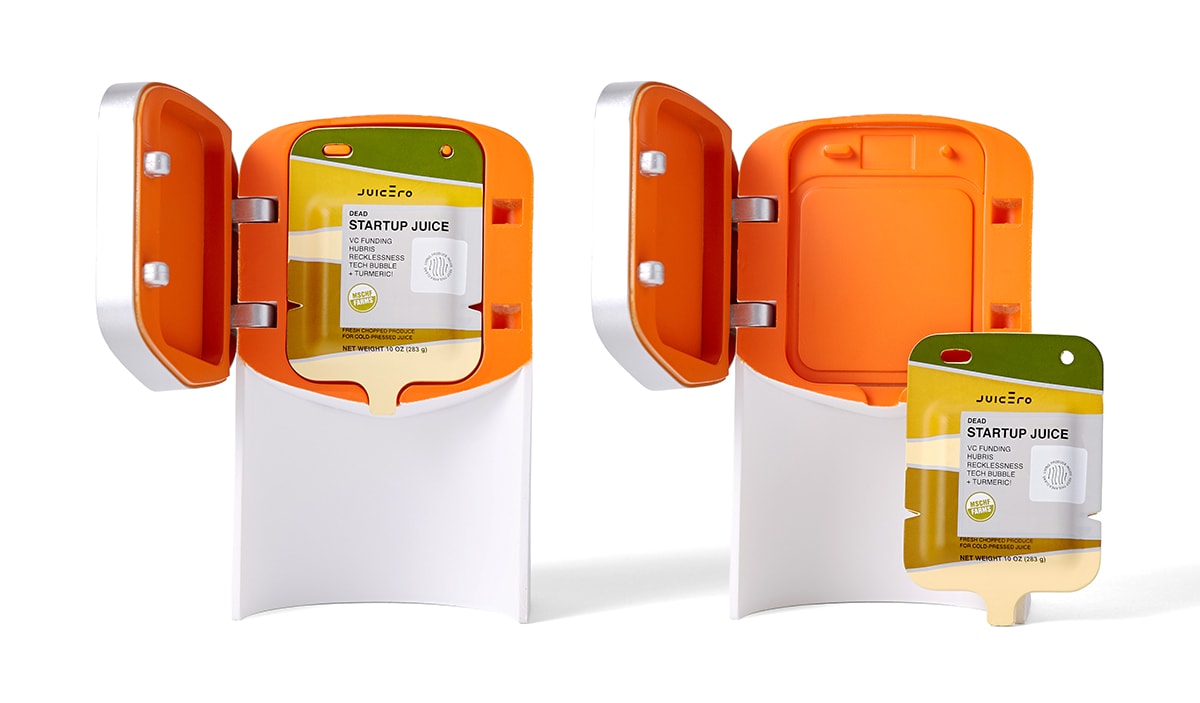
To commemorate the hardness of hardware, idea factory/art house MSCHF is releasing a set of 5 Dead Startup Toys as vinyl figurines that you can buy for $39.99 each or $159.99 for the set. It bills these as ‘iconic failed startups’ and the sales site offers a brief history of the rise and fall of each endeavor. They range from products that never really existed like the Theranos minilab to poorly timed early movers like Jibo to exercises in over-engineering like Juicero. 

Given that I have spent much of my career absorbing and trying to understand the difficult and complicated process of bringing consumer hardware to market, I love these things. There could be a lens of malice here, but I choose not to see it that way. Fraud is fraud and the people behind Theranos and debacles like the Coolest Cooler have or will see the business end of the legal system. 

But big visions and hardware dreams are not always so clearly pocketed into the hole of ‘failure’. Sometimes the hardware works but the supply chain doesn’t. Sometimes the vision is sound but the product is just too early. There are any number of reasons products fail — but (in as much as they were actually real) you often have to give it up for the teams of people and visionaries that wanted a thing to exist in the universe and dragged it kicking and screaming to that point. And off the cliffs.

The figures themselves are really well done, with crisp stamping and accurate detailing with readable text and nicely printed logos. Some of them are articulated as well, and accessorized. The Coolest Cooler gets its infamous blender and the Juicero has a removable (proprietary of course) ‘fresh veg’ pouch. The quality on these is quite high overall, I’d rank them up with some of the better novelty toys I’ve bought over the years — it’s not phoned in, much like the Cooler’s feature set.

The packaging, too, is quite impressive, each gets a customized box and the big set of all of them comes in a bigger rack box. Each one also comes with a ’cause of death’ on the back that tells you why each venture went under. MSCHF went the lengths to make this a pretty premium ‘toy’ drop, which is only fitting given that it’s a monument to physical products. 

As with much of MSCHF’s work, there’s an element of ‘wait, is this legal’ as well, because there are likely a bunch of holes that the IP connected to these products fell into but some of those holes could still have legal entities attached. But that element of danger is what has made many of its projects resonate so far so I don’t think they’re worried. 

After all, none of these products have the sign of the beast on them. Physically, anyway.

[gallery ids="2176106,2176121,2176107,2176105,2176096,2176086,2176090,2176099,2176072,2176079,2176066,2176068,2176071,2176053,2176051,2176058"]