Year: 2021

07 Jul 2021

Juni, a ‘vertical’ neobank for e-commerce and online marketing companies, raises $21.5M

E-commerce in Europe is expected to grow 30% this year to $465 billion, and that’s giving rise to a new ecosystem of services built to cater to e-commerce merchants. In the latest development, Juni, a neobank that is built specifically for companies selling online, has closed a Series A of $21.5 million, only 12 weeks after officially opening for business.

The Series A is being co-led by partners from DST Global and Felix Capital with previous backer Cherry Ventures and other early investors also participating. Gothenburg, Sweden-based Juni had previously raised a seed round fo €2 million ($2.4 million) back in November when it was still only in waiting-list mode.

Part of the reason that the latest funding has materialized so quickly is because Juni has had very strong take-up its three short months of life: Samir El-Sabini, Juni’s co-founder and CEO, told TechCrunch that startup has signed up 300 businesses from a waitlist of 3,000, representing customer growth of around 500% month-on-month. Customers, he said, were primarily those selling their own inventory; dropshippers selling on behalf of retailers; and performance marketers who have moved into selling goods.

The other reason is that Juni is doing so well on both the investor and customer fronts is because of what it has identified and understood, and is building to fix.

El-Sabini and his two co-founders Anders Oresdal (CTO) and Jonathan Sanders (COO) all come from a background of working in e-commerce and fintech (in fact, one previously was at expenses startup Pleo, which this week announced a major round of funding; and two others worked at another expense management startup) and so they know all too well the shortcomings of a lot of banking services when it comes to serving businesses carry out their business online.

As El-Sabini described it, while traditional banks have long courted SMBs as customers, they have never truly understood the dynamics, challenges and particularities of running an e-commerce business, and that has made them less responsive to the financial profiles and needs of these companies.

“What we do is that we provide insights and knowledge of the e-commerce industry,” he said. “And we can have a low risk profile because we understand all the cost centers. We understand what Taboola is, we know Shopify.” El-Sabini noted that typically e-commerce companies have money spread out across different services such as ad networks, payment gateways and their banks.

“So we give them a unified view of all those dashboards. Then we derive insights based on all that activity to give you ‘the right number’,” by which he means a real idea of what the company’s cashflow, incomings and outgoings are across all of these services so that you know how much you have to invest or use in other areas, and specifically on advertising to bring in more customers.

“It’s all about return on ad spend and liquidity,” said El-Sabini.

Cashflow comes into play also with the payment cards that Juni provides as part of its service, he added.

“You need a card with high spending limits,” primarily to account for how you spend money over the month and then pay it back in in a delayed way (due to the time taken for revenues to clear payment gateways, etc). Without the high limits, your card might get rejected when you use it to pay for marketing and ad campaigns.

“Ad campaigns will not do well if you get a card decline,” he said, since Google and others typically demote you in its algorithms when that happens. “My previous company used to switch cards every quarter because we had so many declines.” That, of course, is a pain to sort out and definitely not what you want to be spending your time doing if you’re trying to grow your e-commerce business.

And, when there is a problem, El-Sabini notes that its customer service people speak the same language as the customers, so will be able to address and cope with their issues better.

To sum up all of the above, Juni simply built the kind of bank that the founders wished they had at their previous companies, and that has resonated with others, resulting in what El-Sabini called “tremendous, fund and hopeful growth.” Case in point: the press release I was sent for the story last week noted that Juni had 250 customers across Europe, but by the time we talked the number had grown to over 300.

There is something else interesting about what Juni is doing, which points to a bigger trend in fintech that is probably worth watching, too.

Neobanks have made significant inroads into the world of finance, providing consumers with a better and more modern user experience, more personalization and often better rates than their larger, incumbent counterparts, and we have seen some major developments on that front: huge valuations, big customer growth, and now, slowly, the first of them going public.

Now we are seeing a very strong second wave of neobanks emerging, which are less widely targeted and aiming at more specific, vertical opportunities. These could be something like targeting the agricultural community, or freelancers, or SMBs, or specifically companies working in e-commerce as Juni has.

On that note, there really are a lot of fintech startups targeting smaller businesses with banking services now. They include Finom, Wise, Hatch, Novo, and many others. There is even some competition specifically within e-commerce neobanks, with companies like Viva Wallet, Incard (which appears yet to launch), Yan, and likely more also attempting to cater to the same people that Juni is.

For now it is standing out partly because of how quickly it’s getting adopted, and how they have set out to own this space. That will see Juni also moving into a wider range of products to fill out more of the needs of running an e-commerce business, be it more kinds of credit products to keep cash flowing, one reason why storied investors like DST are interested.

“In just three months, Juni has already proven that it has the potential to become the next big technology solution for merchants worldwide. The product resonates strongly with their customers by solving a clear pain point and putting time back in the hands of digital entrepreneurs,” said Joseph Pizzolato and Susan Lin, investors at Felix Capital, in a joint statement. “As investors, we look for signs of ‘customer love’ and ‘digital queues’ in all our investments, and a waitlist of over 3,000 SMEs for Juni’s product is as good as we’ve seen! We immediately connected with the team and we firmly believe in their vision. Their attention to detail and understanding of their customer’s needs puts them in an ideal position to win this market.”

“Samir, Anders, Jonathan, and the team continue to amaze us,” added Sophia Bendz, a partner at Cherry Ventures. “Since Juni’s beta launch, they’ve experienced an extremely impressive month-on-month transaction volume in such a short period. They have also built a world class team across compliance, finance, tech, and marketing functions as well as fostered a deep commitment to building community and trustworthiness. They are well on their way to becoming the go-to financial companion for e-commerce entrepreneurs globally. This is only the beginning and we couldn’t be more excited to continue to back this team.”


06 Jul 2021

Extra Crunch roundup: Video pitch decks, Didi’s regulatory struggles, Nothing CEO interview

The numbers don’t lie.

According to DocSend, the average pitch deck is reviewed for just three minutes. And if you think a senior VC is studying the presentation your team crafted for months as if it were a Fabergé egg — well, you might be disappointed.

Even if you are lucky enough to land a meeting, it’s more likely that a junior person went through your pitch and ran it up the chain.

“The biggest lie in venture capital is: ‘Yes, I read through your deck,’” says Evan Fisher, founder of Unicorn Capital and Minimal Capital.

“Because those words are immediately followed by, ‘ … but why don’t you run us through it from the beginning?’”


Full Extra Crunch articles are only available to members.
Use discount code ECFriday to save 20% off a one- or two-year subscription.


According to Fisher, the pro forma pitch deck is a thing of the past. Instead, the founders he’s worked with who made video pitches netted two to five times as many investor meetings as people who sent traditional pitch decks.

They also received up to five times more in terms of investor commitments from the first 20 meetings.

“Even if the only benefit was that other investment committee members heard the story direct from the founder, that alone would make your video pitch worth it,” says Fisher.

Thanks very much for reading Extra Crunch this week!

Walter Thompson
Senior Editor, TechCrunch
@yourprotagonist


Nothing founder Carl Pei on Ear (1) and building a hardware startup from scratch

Carl Pei OnePlusDSC04551

Image Credits: TechCrunch

In an exclusive interview with Hardware Editor Brian Heater, Nothing Founder Carl Pei discussed the product and design principles underpinning Ear (1), a set of US$99/€99/£99 wireless earbuds that will hit the market later this month.

“We’re starting with smart devices,” said Pei. “Ear (1) is our is our first device. I think it has good potential to gain some traction.”

Despite Apple’s market share and the number of players already competing in the space, “we’ve just focused on being ourselves,” said Nothing’s founder, who also shared initial marketing plans and discussed the inherent tensions involved with manufacturing consumer hardware.

“Everything is a trade-off. Like if you pursue this design, that has a ton of implications. Battery life has ton of implications on size and on cost. The materials you use have implications on cost. Everything has an implication on timeline. It’s like 4D chess in terms of trade-offs.”


Will Didi’s regulatory problems make it harder for Chinese startups to go public in the US?

Last week, just days after its U.S. IPO, cybersecurity regulators in China banned ride-hailing company Didi from onboarding new members.

Over the weekend, authorities called for Didi to be removed from several app stores due to “serious violations of laws and regulations in collecting and using personal information.”

The move suggests that China’s government “is willing to sacrifice business results for control,” writes Alex Wilhelm in this morning’s edition of The Exchange.

“For China-based companies hoping to list in the United States, the market likely just got much, much colder.”


79% more leads without more traffic: Here’s how we did it

Image Credits: Peter Dazeley (opens in a new window)/ Getty Images

Jasper Kuria, the managing partner of CRO consultancy The Conversion Wizards, walks through an A/B test showing how research-driven CRO (conversion rate optimization) techniques led to a 79% increase in conversion rates for China Expat Health, a lead-generation company.

“Using research-based CRO principles to optimize a landing page for PPC (pay per click) traffic produced a 79% conversion lift, dramatically reducing the cost per lead for the company,” Kuria writes.

“They could then afford to bid more per click, which increased their overall monthly leads. CRO can have this kind of transformative effect on your business.”

06 Jul 2021

Daily Crunch: Nothing sets July 27 rollout for noise-canceling Ear (1) earbuds

To get a roundup of TechCrunch’s biggest and most important stories delivered to your inbox every day at 3 p.m. PDT, subscribe here.

Hello and welcome to Daily Crunch for July 6, 2021. We’re back after a holiday here in the United States. Not that that stopped global technology news, mind, so there’s a lot to get into. Before we do, one more reminder about TechCrunch Early Stage later this week — your humble servant is running a session with venture capitalist Sarah Kunst about fundraising. It’s going to rock. — Alex

The TechCrunch Top 3

Today’s Top 3 are all about conflict. Between tech companies, between tech companies and governments, and between tech companies and their shareholders. Enjoy:

  • Governments versus tech: The scrap between China’s government and Chinese ride-hailing company Didi escalated over the break, from the company having to stop accepting new users to losing its spot in app stores. The company’s stock is down sharply today. Our read? China’s government crackdown on tech is not over, and Chinese companies going public in America just hit a pace better described as glacial. Related: Twitter versus India is still rolling along, and it’s not going well.
  • A cloudy mess: Remember that huge deal to award a cloud contract from the U.S. military to one major tech company? Microsoft won; Amazon pitched a fit. And now neither company will get the $10 billion deal. Womp.
  • Box versus investors: Rounding out our conflict coverage, the latest from Box. Former cloud storage darling and present-day public enterprise productivity shop Box is locked in a lengthy argument with activist investor Starboard. Today, Box went the corporate equivalent of supernova by releasing a TikTok video of its communications with the investing group, essentially calling them out for hypocrisy. Not that that charge means much to amoral capital pools searching for above-market returns, but, hey, it made for some good headlines.

Startups/VC

Today’s startup news includes a number of funding rounds, a neat new venture capital fund and some SPAC news from space (and Earth):

  • Super.mx raises $7.2 million: The Mexico City-based insurtech startup has put together a Series A for its “managing general agent” approach to offering coverage. The startup claims to be able to “handle the entire user experience just like a direct-to-consumer carrier, but with the breadth of product choice offered by an aggregator.”
  • Single.Earth raises $7.9M for crypto-carbon tokens: Here’s an idea that I don’t fully understand: linking carbon credits to tokens that represent the real world. That’s the gist of Single.Earth, which wants to shake up how companies compensate for their carbon footprint. It uses MERIT tokens, and, per its website, is creating a “digital twin” of the natural world.
  • Wagmo raises $12.5M for better pet insurance: Insurtech is a hot market because insurance is a huge market. So large that even its subdivisions are attracting startup competition. Wagmo — not Waymo, mind — wants to bring more pet services into its product to cover your pet more holistically.

Next, a new fund:

  • iFly.vc raises second fund worth $46M: I don’t bring you many new venture capital fundraises because they seem a bit meta for our startup focus, but here’s one regardless. Why include it? The venture capital group — which has a neat history, as the post details — relocated from San Francisco to Austin during the pandemic. That’s notable.

And from the SPAC beat:

  • Space SPAC: Sattelogic is going public via a SPAC. Its deck is light on past results and heavy on future incomes.
  • Earth SPAC: Nextdoor is going public via a SPAC. Its deck is far more rooted in terrestrial things, like trailing revenue.

Finally, TechCrunch covered upcoming headphones from Nothing, a hardware upstart that we don’t know much about. But it thinks its $99 headphone offering can compete with Apple’s AirPods Pro line. Which cost 2.5x as much. If a startup can manage that, we’ll be super impressed. And Nothing will be worth several somethings.

Nothing founder Carl Pei on Ear (1) and building a hardware startup from scratch

In an exclusive interview with TechCrunch Hardware Editor Brian Heater, Nothing Founder Carl Pei discussed the product and design principles underpinning Ear (1), a set of US$99/€99/£99 wireless earbuds that will hit the market later this month.

“We’re starting with smart devices,” said Pei. “Ear (1) is our first device. I think it has good potential to gain some traction.”

Despite Apple’s market share and the number of players already competing in the space, “we’ve just focused on being ourselves,” said Nothing’s founder, who also shared initial marketing plans and discussed the inherent tensions involved with manufacturing consumer hardware.

“Everything is a trade-off. Like if you pursue this design, that has a ton of implications. Battery life has ton of implications on size and on cost. The materials you use have implications on cost. Everything has an implication on timeline. It’s like 4D chess in terms of trade-offs.”

Read the full interview on Extra Crunch.

(Extra Crunch is our membership program, which helps founders and startup teams get ahead. You can sign up here.)

Big Tech Inc.

We got through most of the Big Tech news in our Top Three today, but there’s still a bit more for your enjoyment:

TechCrunch Experts: Growth Marketing

Illustration montage based on education and knowledge in blue

Image Credits: SEAN GLADWELL (opens in a new window) / Getty Images

Are you all caught up on last week’s coverage of growth marketing? If not, read it here.

As usual, if you have a recommendation of a growth marketer we should know about, fill out the survey here.

06 Jul 2021

Gettr, the latest pro-Trump social network, is already a mess

Well, that was fast. Just days after a Twitter clone from former Trump spokesperson Jason Miller launched, the new social network is already beset by problems.

For one, hackers quickly leveraged Gettr’s API to scrape the email addresses of more than 85,000 of its users. User names, names and birthdays were also part of the scraped data set, which was surfaced by Alon Gal, co-founder of cybersecurity firm Hudson Rock.

“When threat actors are able to extract sensitive information due to neglectful API implementations, the consequence is equivalent to a data breach and should be handled accordingly by the firm [and] examined by regulators,” Gal told TechCrunch.

Last week, TechCrunch’s own Zack Whittaker predicted that Gettr would soon see its data scraped through its API.

The scraped data is just one of Gettr’s headaches. The app actually went live in the App Store and Google Play last month but left beta on July 4 following a launch post in Politico. While the app is meant to appeal to the famously anti-China Trump sphere, Gettr apparently received early funding from Chinese billionaire Guo Wengui, an ally of former Trump advisor Steve Bannon. Earlier this year, The Washington Post reported that Guo is at the center of a massive online disinformation network that spreads anti-vaccine claims and QAnon conspiracies.

On July 2, the app’s team apologized for signup delays citing a spike in downloads, but a bit of launch downtime is probably the least of its problems. Over the weekend, a number of official Gettr accounts including Marjorie Taylor-Greene, Steve Bannon, and Miller’s own were compromised, raising more questions about the app’s shoddy security practices.

That incident aside, fake accounts overwhelm any attempt to find verified users on Gettr. That goes for the app’s own recommendations too: a fake brand account for Steam was among the app’s own recommendations during TechCrunch’s testing.

Another red flag: The app’s design is conspicuously identical to Twitter and appears to have used the company’s API to copy some users’ follower counts and profiles. Gettr encourages new users to use their Twitter handle in the sign up process, saying that it will allow tweets to be copied over in some cases (we signed up, but this didn’t work for us). TechCrunch reached out to Twitter about Gettr’s striking similarities and the use of its API but the company declined to comment.

On mobile, Gettr is basically an exact clone of Twitter — albeit one that’s very rough around the edges. Some of Gettr’s copy is stilted and strange, including the boast that it’s a “non-bias” social network that “tried the best to provide best software quality to the users, allow anyone to express their opinion freely.”

The company is positioning itself as an alternative for anyone who believes that mainstream social networks are hostile to far right ideas. Gettr’s website beckons new users with familiar Trumpian messaging: “Don’t be Cancelled. Flex Your 1st Amendment. Celebrate Freedom.”

“Hydroxycholoroquine works!” Miller shared (Gettr’d?) over the weekend, quoting the former president. “And nobody is going to take down this post or suspend this account! #GETTR.” So far on Gettr, content moderation is either lax or nonexistent. But as we’ve seen with Parler and other havens for sometimes violent conspiracies, that approach can only last so long.

In spite of being widely associated with Trump through Miller and former Trump campaign staffer Tim Murtaugh, the former president doesn’t yet have a presence on the app. Some figures from Trump’s orbit have established profiles on Gettr, including Steve Bannon (84.7K followers) and Mike Pompeo (1.3M followers), but a search for Trump only brings up unofficial accounts. Bloomberg reported that Trump has no plans to join the app. (Given Gettr’s preponderance of Sonic the Hedgehog porn, we can’t exactly blame him.)

The online pro-Trump ecosystem remains scattered in mid-2021. With Trump banned and the roiling conspiracy network around QAnon no longer welcome on Facebook and Twitter, Gettr positioned itself as a refuge for mainstream social media’s many outcasts. But given Gettr’s mounting early woes, the sketchy Twitter clone’s moment in the sun might already be coming to an end.

06 Jul 2021

Gettr, the latest pro-Trump social network, is already a mess

Well, that was fast. Just days after a Twitter clone from former Trump spokesperson Jason Miller launched, the new social network is already beset by problems.

For one, hackers quickly leveraged Gettr’s API to scrape the email addresses of more than 85,000 of its users. User names, names and birthdays were also part of the scraped data set, which was surfaced by Alon Gal, co-founder of cybersecurity firm Hudson Rock.

“When threat actors are able to extract sensitive information due to neglectful API implementations, the consequence is equivalent to a data breach and should be handled accordingly by the firm [and] examined by regulators,” Gal told TechCrunch.

Last week, TechCrunch’s own Zack Whittaker predicted that Gettr would soon see its data scraped through its API.

The scraped data is just one of Gettr’s headaches. The app actually went live in the App Store and Google Play last month but left beta on July 4 following a launch post in Politico. While the app is meant to appeal to the famously anti-China Trump sphere, Gettr apparently received early funding from Chinese billionaire Guo Wengui, an ally of former Trump advisor Steve Bannon. Earlier this year, The Washington Post reported that Guo is at the center of a massive online disinformation network that spreads anti-vaccine claims and QAnon conspiracies.

On July 2, the app’s team apologized for signup delays citing a spike in downloads, but a bit of launch downtime is probably the least of its problems. Over the weekend, a number of official Gettr accounts including Marjorie Taylor-Greene, Steve Bannon, and Miller’s own were compromised, raising more questions about the app’s shoddy security practices.

That incident aside, fake accounts overwhelm any attempt to find verified users on Gettr. That goes for the app’s own recommendations too: a fake brand account for Steam was among the app’s own recommendations during TechCrunch’s testing.

Another red flag: The app’s design is conspicuously identical to Twitter and appears to have used the company’s API to copy some users’ follower counts and profiles. Gettr encourages new users to use their Twitter handle in the sign up process, saying that it will allow tweets to be copied over in some cases (we signed up, but this didn’t work for us). TechCrunch reached out to Twitter about Gettr’s striking similarities and the use of its API but the company declined to comment.

On mobile, Gettr is basically an exact clone of Twitter — albeit one that’s very rough around the edges. Some of Gettr’s copy is stilted and strange, including the boast that it’s a “non-bias” social network that “tried the best to provide best software quality to the users, allow anyone to express their opinion freely.”

The company is positioning itself as an alternative for anyone who believes that mainstream social networks are hostile to far right ideas. Gettr’s website beckons new users with familiar Trumpian messaging: “Don’t be Cancelled. Flex Your 1st Amendment. Celebrate Freedom.”

“Hydroxycholoroquine works!” Miller shared (Gettr’d?) over the weekend, quoting the former president. “And nobody is going to take down this post or suspend this account! #GETTR.” So far on Gettr, content moderation is either lax or nonexistent. But as we’ve seen with Parler and other havens for sometimes violent conspiracies, that approach can only last so long.

In spite of being widely associated with Trump through Miller and former Trump campaign staffer Tim Murtaugh, the former president doesn’t yet have a presence on the app. Some figures from Trump’s orbit have established profiles on Gettr, including Steve Bannon (84.7K followers) and Mike Pompeo (1.3M followers), but a search for Trump only brings up unofficial accounts. Bloomberg reported that Trump has no plans to join the app. (Given Gettr’s preponderance of Sonic the Hedgehog porn, we can’t exactly blame him.)

The online pro-Trump ecosystem remains scattered in mid-2021. With Trump banned and the roiling conspiracy network around QAnon no longer welcome on Facebook and Twitter, Gettr positioned itself as a refuge for mainstream social media’s many outcasts. But given Gettr’s mounting early woes, the sketchy Twitter clone’s moment in the sun might already be coming to an end.

06 Jul 2021

Sarah Guo, Kobie Fuller & Casey Aylward headline investor panel at TC Sessions: SaaS

While SaaS has become the default way to deliver software in 2021, it still takes a keen eye to find the companies that will grow into successful businesses, maybe even more so with so much competition. That’s why we’re bringing together three investors to discuss what they look for when they invest in SaaS startups.

For starters, we’ll have Sarah Guo, who has been a partner at Greylock since 2013 where she concentrates on AI, cybersecurity, infrastructure and the future of work — all in a SaaS context of course. Among her investments are Obsidian, Clubhouse and Awake. Her exits include Demisto, which Palo Alto acquired for $560 million in 2019 and Skyhigh Networks, which McAfee bought for $400 million in 2018.

Prior to joining Greylock, she worked for Goldman Sachs investing in growth-stage companies and advising SaaS companies like Dropbox and Workday.

Next we’ll have Kobie Fuller, a partner at Upfront Ventures, who looks at SaaS as well as AR and VR. Fuller has been at Upfront since 2016 when he joined after a three-year stint at Accel. He oversaw a pair of billion dollar exits while at Accel including ExactTarget to Salesforce for $2.5 billion and Oculus to Facebook for $2 billion. Upfront investments include Bevy, community building software, which recently got a $40 million investment with 20% of that coming from 25 Black investors.

Finally, we’ll have Casey Aylward, a principal at Costanoa Ventures where she concentrates on early-stage enterprise startups. Among her investments have been Aserto, Bigeye and Cyral. She tends to concentrate on developer tools. “My entire career so far has been focused on developers: whether it was building tools for developers, building software myself or now investing in enabling technologies for the next generation of technical users,” she wrote on her bio page.

This prestigious group will share their thoughts at TC Sessions: SaaS, a one-day virtual event that will examine the state of SaaS to help startup founders, developers and investors understand the state of play and what’s next. We hope you’ll join us.

The single-day event will take place 100% virtually on October 27 and will feature actionable advice, Q&A with some of SaaS’s biggest names and plenty of networking opportunities. Importantly, $75 Early Bird passes are now on sale. Book your passes today to save $100 before prices go up.

06 Jul 2021

To stay ahead of your competitors, start building your narrative on day one

Having a unique product used to give you at least a few months of lead time over other players, but that advantage seems to matter less and less – just think of how Twitter Spaces managed to land on Android ahead of Clubhouse.

In this context, how do you stay ahead of your competition when you know it’s only a matter of time before they copy your best features?

The solution is messaging, says conversion optimization expert Peep Laja. Unlike features that can be copied and commoditized, a strategic narrative can be a long-term advantage. In the interview below, he explains why and how startups should work on this from their very early days.

(TechCrunch is asking founders who have worked with growth marketers to share a recommendation in this survey. We’ll use your answers to find more experts to interview.)

Laja is the founder of several marketing and optimization businesses: CXL, Speero and Wynter. In a recent Twitter thread, he highlighted common stories and narratives that startups can use, such as “challenging the way things have always been done” or “irreverence,” and came up with examples of companies that employ these tactics. We asked him to expand on some of his thoughts and recommendations for startup founders.

(This interview has been edited for length and clarity.)

Your site’s tagline tells startups that “product-based differentiation is going away” and that they should “win on messaging.” Can you explain the rationale behind this?

David Cancel, the CEO of Drift, said that famously in 2017.

Broadly speaking, any startup is competing on innovation or messaging, and, ideally, on both. Usually, you want to start with innovation — do something new or something better. However, competing on features is a transient advantage. Doing what no one else is doing won’t last: Sooner or later, you’ll get copied by big players or other startups, so innovation is not enough. Features are a transient advantage that lasts maybe two years, but rarely more. Meanwhile, having the right narrative and messaging can give you a long-lasting advantage.

Startups competing on story have a big advantage if they are bold because big companies optimize for being safe, and that often means being very boring, but nobody will call them out for it. In contrast, startups can be brave and polarizing on purpose.

Ideally, you start with innovation, and at the same time start building your brand as well. Once the competition achieves feature parity, you make people choose you because of the brand. It’s hard to be sustainably objectively better than others, but you definitely cannot be objectively worse.

You help startups do research to find and validate their strategic narrative. Can you explain this concept?

As startups get bigger, they realize that they need to communicate less on features and more on story. Their narrative needs to be connected to a bigger concept and be a strategic narrative. “The world used to be like this, but it changed, and our startup will help you in this new context.”

A fictional example would be selling a course of AI for marketers; ideally, instead of talking about AI, you’d lead with a story, explaining that AI and machine learning are an unstoppable thing that is going to change everything. The future is already here, but not evenly distributed yet. There is no stopping this train. You can get on it, or get left behind. Companies that adopt AI will overtake others, and marketers need to learn AI to adapt. This would make the product way more attractive … than selling it through features: “AI for marketers course. 7 hours of video. Top lecturers.”

This is also what I am doing with my company, Wynter. If you look at SaaS, there are 53 times more companies than 10 years ago, with hundreds of tools available in any given category – think of email marketing, for instance. And a striking thing about competitors in each category is sameness: They pretty much offer the same features. In other words, differentiation based on features doesn’t work anymore. Most companies also look the same and say the same things. Sameness is the default for most companies today. Sameness is the combined effect of companies being too similar in their offers, poorly differentiated in their branding, and indistinct in their communication. You’d think that companies would be all about differentiation these days. Curiously, the opposite is true.

Given that feature-based differentiation is a fleeting advantage, companies should compete on brand. That’s the new world we are in, and in order to win, you need to know what your audience wants and how what you’re telling your audience is landing on them. … This is what my company does, and that’s how I pitch it. As you can see, it follows the narrative I described earlier: showing how the world has changed, and explaining that what used to work is no longer adapted to the new reality that is starting to emerge.

How would you recommend founders anchor their startup to success cases?

Bring your best proof that the world has changed — with data to back you up — and then make a case that winning requires a new strategy. Then show winners and losers based on the strategy they have been using, and use it as new proof that it is best suited for this new world. For instance, if you are pitching product-led growth, you can give examples showing that it is working as a go-to-market strategy because we live in a new world where customers want to start using the product right away. You can give examples showing how this is working, and tie your startup to them.

For other examples, you could also look at what HubSpot CTO Dharmesh Shah does with community-led growth.

There’s also this startup shipping hardware to remote workers, Firstbase. The Twitter timeline of its CEO, Chris Herd, is a good example of what I am saying: Just look at how he is selling the narrative, not his company.

So first and foremost you sell a narrative, a point of view on the world. And only much later you explain how your company helps their customer win using this new strategy. The narrative is the context for the features, etc.

How can startups avoid getting it wrong?

Your narrative can miss the mark if it’s not about change in the external world and only internal to the company, or if you are investing in a change that is not happening that you are failing to make sound credible. To win on brand, you need to measure the effectiveness of your narrative.

How do you test that? If you do direct sales, getting feedback is pretty straightforward. In my sales demo, I talk about the narrative before going into the demo. If people ask for a copy of my deck, I know it’s hitting home. I also ask for feedback, observe if people are nodding, etc. If you are not going through this sales process — for instance, if you are doing product-led growth — you need to do message testing. This can be one-on-one or as a qualitative survey, but either way, you need to make sure that you are testing on your actual target audience.

We do that at Wynter — you can conduct message testing as well as for customer research, so you can survey people not just on your message, but also on their perception of the world. This helps you discover what in your sales pitch on your website is hitting home, what falls flat, how it compares to the competition and so on.


Have you worked with a talented individual or agency who helped you find and keep more users?

Respond to our survey and help us find the best startup growth marketers!


When should startups start working on their messaging?

Companies should attach themselves to a narrative from day one because innovation is transient. Staying ahead of your competition through innovation forever is very rare. Winning on brand is more accessible. So before you have product-market fit, you need message-market fit. Potential customers will look at this. It can even be a moat: Instead of positioning yourself as a commodity (when you sell yourself through non-innovative features, you’re a commodity), you develop a story that people emotionally connect to. You’ll know it’s a moat if it makes it possible for you to charge more than your competitors. This doesn’t happen with a feature: It eventually becomes commoditized and expected. This is much less of a problem when you have a brand.

How should the narrative evolve over time, if at all?

Your narrative also needs to evolve as the world evolves; you always need to be scanning for what’s happening and the broader context. The rise of remote is an example of that; see, for instance, how HR company Lattice attached itself to it as it expanded from one feature to a broader offering.

This connects to a broader point, which is that we are going from mass market to smaller clusters. For example, we all used to watch the same shows, versus all the niche content that has emerged today. This can be good for startups because in most cases, they wouldn’t be able to afford to aim for mass-market appeal from the start anyway. But as they grow, their narrative may have to evolve. And there can also be a brand narrative and a strategic narrative at the same time, with the latter being the one that evolves over time.

In terms of stories, some of the ones I mentioned in my Twitter thread are more timeless, but even some of these might not work forever. For instance, the “David versus Goliath” story might not sound authentic once you reach a certain stage. I also gave the example of Wise “standing up for the people” and focusing on disrupting bank fees, but now that it is getting disrupted itself, it might have to change its narrative. Some companies don’t need to move away from their original narrative, but some do.

06 Jul 2021

Yandex Self-Driving Group partners with Grubhub to bring robotic delivery to college campuses

Yandex Self-Driving Group, a unit of Yandex, the publicly-traded Russian tech giant, has announced a partnership with food delivery service Grubhub to be its multi-year robotic delivery provider across American college campuses. Yandex will begin operating this fall with dozens of vehicles, according to Dmitry Polishchuk, CEO of Yandex Self-Driving Group, and hopes to reach over 250 campuses.

Last September, Yandex’s self-driving unit spun out from a joint venture with Uber. In May this year, the company said it clocked a total 7 million autonomous miles, which was more than Waymo at the time. Yandex has been developing full-sized autonomous vehicle technology since 2017, which it’s tested in Tel Aviv, Israel and Ann Arbor, Michigan, as well as Innopolis, Russia via its robotaxi fleet. The company first began public deliveries on its six-wheeled, 150-pound robot, the Yandex.Rover, last April in Skolkovo, Russia, using the same self-driving technology stack as the company’s autonomous cars.

“The technology is definitely very complicated, but we can see that it has already reached the level when it can start being deployed either in form of delivery robots or robotaxi services in small towns or specific districts of big cities,” a spokesperson told TechCrunch. “We believe that in three to four years the technology will reach the level where the car can drive as safe and as efficient as an experienced human driver in rush hour in the center of cities like Moscow or New York.”

Yandex’s approach to commercialization is unique. Of all the companies developing autonomous technology for cars, Yandex is going to market with its robots first, “and it seems to be a pretty efficient way to do it,” said the spokesperson. “It took us two years to get from the idea of making a delivery robot in June 2018 to signing such a solid commercial contract,” she said.

According to a statement by the company, Yandex.Rovers, which move at three to five miles per hour, can navigate pavements, pedestrian areas and crosswalks. They’re ideal for campus areas not accessible by car, and the service has already been fully integrated into the Grubhub app. From the user experience side of things, once the rover reaches its destination, the customer receives a push notification and comes outside to open the robot’s hatch through the app.

Yandex says its delivery robots can operate day or night, rain or snow, in controlled or uncontrolled pedestrian crossing scenarios. The rovers operate autonomously most of the time, but if they get into a complicated situation, they may send a request for remote assistance, according to a spokesperson for the company. The robots have already been tried and tested commercially in Russia via the food delivery platform Yandex.Eats and the express grocery delivery platform Yandex.Lavka.

“Together with Yandex, we’re changing the way college students experience food delivery,” said Brian Madigan, vice president of corporate and campus partners at Grubhub, in a statement. “We’re excited to offer these cost-effective, scalable and quick food ordering and delivery capabilities to colleges and universities across the country that are looking to adapt to students’ unique dining needs. While college campuses are notoriously difficult for cars to navigate, specifically as it relates to food delivery, Yandex robots easily access parts of campuses that vehicles cannot — effectively removing a major hurdle universities face when implementing new technology.”

The company said it also intends to continue developing its robotaxi service as it moves to commercialize more arms of the business and use its AV tech in a range of scenarios.

06 Jul 2021

Nextdoor’s SPAC investor deck paints a picture of sizable scale and sticky users

The SPAC parade continues in this shortened week with news that community social network Nextdoor will go public via a blank-check company. The unicorn will merge with Khosla Ventures Acquisition Co. II, taking itself public and raising capital at the same time.

Per the former startup, the transaction with the Khosla-affiliated SPAC will generate gross proceeds of around $686 million, inclusive of a $270 million private investment in public equity, or PIPE, which is being funded by a collection of capital pools, some prior Nextdoor investors (including Tiger), Nextdoor CEO Sarah Friar and Khosla Ventures itself.

Notably, Khosla is not a listed investor in the company per Crunchbase or PitchBook, indicating that even SPACs formed by venture capital firms can hunt for deals outside their parent’s portfolio.

Per a Nextdoor release, the transaction will value the company at a “pro forma equity [valuation] of approximately $4.3 billion.” That’s a great price for the firm that was most recently valued at $2.17 billion in a late 2019-era Series H worth $170 million, per PitchBook data. Those funds were invested at a flat $2.0 billion pre-money valuation.

So, what will public investors get the chance to buy into at the new, higher price? To answer that we’ll have to turn to the company’s SPAC investor deck.

Our general observations are that while Nextdoor’s SPAC deck does have some regular annoyances, it offers are clear-eyed look at the company’s financial performance both in historical terms and in terms of what it might accomplish in the future. Our usual mockery of SPAC charts mostly doesn’t apply. Let’s begin.

Nextdoor’s SPAC pitch

We’ll proceed through the deck in its original slide order to better understand the company’s argument for its value today, as well as its future worth.

The company kicks off with a note that it has 27 million weekly active users (neighbors, in its own parlance), and claims users in around one in three U.S. households. The argument, then, is that Nextdoor has scale.

A few slides later, Nextdoor details its mission: “To cultivate a kinder world where everyone has a neighborhood they can rely on.” While accounts like @BestOfNextdoor might make this mission statement as coherent as ExxonMobil saying that its core purpose was, say, atmospheric carbon reduction, we have to take it seriously. The company wants to bring people together. It can’t control what they do from there, as we’ve all seen. But the fact that rude people on Nextdoor is a meme stems from the same scale that the company was just crowing about.

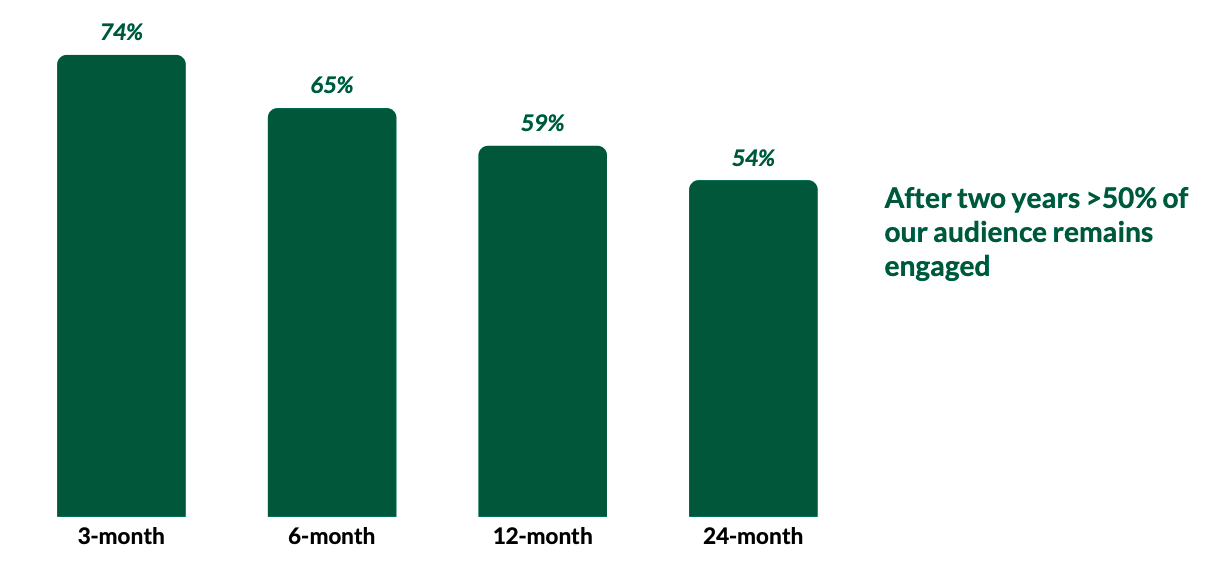
Underscoring its active user counts are Nextdoor’s retention figures. Here’s how it describes that metric:

Image Credits: Nextdoor SPAC investor deck

These are monthly active users, mind, not weekly active, the figure that the company cited up top. So, the metrics are looser here. And the company is counting users as active if they have “started a session or opened a content email over the trailing 30 days.” How conservative is that metric? We’ll leave that for you to decide.

The company’s argument for its value continues in the following slide, with Nextdoor noting that users become more active as more people use the service in a neighborhood. This feels obvious, though it is nice, we suppose, to see the company codify our expectations in data.

Nextdoor then argues that its user base is distinct from that of other social networks and that its users are about as active as those on Twitter, albeit less active than on the major U.S. social networks (Facebook, Snap, Instagram).

Why go through the exercise of sorting Nextdoor into a cabal of social networks? Well, here’s why:

06 Jul 2021

Announcing the startups pitching at TC Early Stage

This Thursday and Friday, TechCrunch will host Early Stage – a virtual bootcamp for early stage founders. After the success of the spring event, on Friday, TC will feature 10 phenomenal early-stage startups to on the virtual stage. Hailing form around the States and the globe, founders will pitch on live, for five minutes, followed by an intense Q&A with our expert panel of judges.

The judges for this pitch-off will be Ben Sun (Primary Venture Partners), Doug Landis (Emergence Capital), Leah Solivan (Fuel Capital) and Shardul Shah (Index Ventures).  Unlike last time, there will be no final round. Each company will only have one chance to impress the judges and the audience!

Alright, alright. I know you want to see who made the cut. Join us on Friday, July 9th to watch the second ever TC Early Stage Pitch-Off. Let’s take a look:

Session 1: 9:00 a.m. – 9:50 a.m. PDT

Mi Terro (City of Industry, CA, USA) – “The world’s first advanced material company that partners with food companies and farmers to create home compostable, single-use plastic-alternative packaging materials made from plant-based agricultural waste – this is a first-of-its-kind approach.

Press Sports App (Atlanta, GA, USA) – A lifelong sports social network for athletes from all levels and sports. Their deeply engaged community is creating system of record starting at the amateur level that has never been built before.

Snowball Wealth (San Francisco, CA, USA) – Provides personalized guidance to pay off debt and build wealth for the 30M women+ in America with student debt. Snowball provides users with a free student loan plan, which helps users save an average of $6K. They’re expanding to include a financial roadmap that’s community-driven and personalized so women+ can build wealth even as they pay down their debt.

My Expat Taxes (Vienna, Austria) – MyExpatTaxes is the leading U.S. expat tax software that guides users through the tax filing process faster and more affordable than any other competitor in the industry. It automates international tax treaties and expat tax benefits, helping U.S. expats stay compliant and claim thousands of dollars in refunds.

Speeko (Chicago, Illinois, USA) – AI-powered feedback on your voice in areas like pace, fillers, inclusivity, conciseness, and enunciation. Based on your speaking style, you’re matched with interactive exercises, courses, and vocal warm-ups. It’s like a gym membership for your voice, where you build muscle memory for speaking clearly and confidently.

Session 2: 10:10 a.m. – 11:05 a.m. PDT

Universal Prequal (Marlboro, NJ, USA) – Helps construction companies effectively manage risk by enabling them to find and vet qualified project teams capable of doing the work. Instead of the paper-intensive, time-consuming, expensive approach that exists throughout the industry today, our solution is online, easy-to-use, and cost-effective. Customers will know us as the national resource for managing risk based on comprehensive, reliable construction information.

T2D2.ai (New York City, NY, USA) – Provides continuous AI and computer vision-driven monitoring of buildings, bridges and other infrastructural assets. The T2D2 portal and dashboard gives asset owners and managers a detailed picture of all visible damage conditions – rank ordered by severity and geo-tagged for location information, so they can focus preventative maintenance efforts and avoid higher downstream repair costs as well as potential safety issues.

Boomerang (Sao Paulo, Sao Paulo, Brazil) – A marketplace for consumer goods rental. We connect retailers, brands, and rental stores with customers that just want to use a product instead of owning it. For suppliers, Boomerang is a plug-and-play rental platform offering logistics, insurance, and online payments solution.

Stash Global (Wilmington, DE, USA) – Turned the most damaging cyber-attack of all, ransomware, into just another business problem that can be solved with the click of a button – without paying a cent (or cyber coin) of ransom. The No Ransom Ransomware Solution does it all: restores files; prevents access of frozen file content by attackers; eliminates ransom extortion.

Vyrill (San Francisco, CA, USA) – With the most powerful AI driven, in-video search, Vyrill is a fan video discovery, insights and content marketing platform enabling brand marketers to supercharge brand awareness and revenue with fan led content such as video reviews, unboxing, how-to videos and more. Vyrill is a Google for fan video and creators, capturing who, what, where and when –inside millions of videos.”

Winner Announcement: 11:30 a.m. PDT