Year: 2021

02 Jul 2021

Fetch Robotics’ CEO on the company’s acquisition and the future of warehouse robots

Yesterday, enterprise computing corporation Zebra Technologies announced its plan to acquire Fetch Robotics. The San Jose-based startup has been a mainstay in warehouse and fulfillment robotics for a number of years, offering a modular system designed to automate companies behind the scenes.

The full deal is valued at $305 million, with Zebra acquiring the remaining 95% of the company for $290 million. It comes as interest in the category is at an all-time high, following widespread labor shortages during the pandemic.

After the news broke, we sat down with Fetch co-founder and CEO Melonee Wise to discuss the deal and the future of warehouse robotics.

Why was this acquisition the right move for Fetch?

When you look at it, over the last seven years, we’ve been building a pretty compelling cloud robotics platform. About two years ago, Zebra invested in Fetch, and we started working together through our partnership. One of the first things we did was integrating their mobile computing devices, for an out-of-the-box experience on our cloud robotics platform. When our customers got robots, they could take the hand scanner they already had today, scan a barcode and call a robot to them.

As we were fundraising for our Series D, this opportunity came out of that. I think when you look at it, over the last couple of years, we’ve had a good relationship with them. With the pandemic, there’s been a huge draw for more and more automation technology. Before the pandemic, there were already labor shortages for warehouse and logistics, and the pandemic only exacerbated it. One of the other great things about us joining Zebra is they have a strong go-to-market engine, and they can amplify our sales capability. They’re already in all of the customers we want to be working with. It helps us reach a much broader, wider and deeper audience.

I’d assumed Fetch was a good potential candidate for an acquisition, but I’d always imagined it would be something like a Walmart looking to compete with Amazon robotics. I suspect that you’ve been approached by companies over the years. Why does this kind of acquisition make more sense, ultimately?

I think the acquisition made sense because it aligns with more of our long-term vision. When we built our platform, we built it to be unifying. Not just our robots. Over the years we’ve been slowly bringing in other partners on the platform. We have a partnership with SICK, we have partnerships with other MWS providers like VARGO. That isn’t going to change. We’re still going to be partner friendly and we’re still going to bring other devices into the ecosystem. When you look at the options and the opportunities, this was a good opportunity and was well aligned with the team we wanted to build.

I know Zebra has developed their own robot and invested in other robotics companies. Are you the cornerstone of an ecosystem play? Is this Zebra building a a robotic retail and fulfillment ecosystem around Fetch?

Yes, that so far has been the discussion. It’s still evolving. I don’t have all the details for you, obviously. And of course, we still have 30 days or 35 days ‘till closing, so we’re still operating as independent businesses. In terms of vision of how we’re thinking about it, Zebra is very excited to kind of make Fetch the centerpiece of this whole new offering that they’re building out. It’s a high strategic priority for them.

Will the Fetch brand remain? Will the company stay in San Jose? Are you staying on board?

Fetch is not moving. We’re kind of becoming the centerpiece, so they want to keep the team together, in San Jose. My plan is to stay. We’re still working out the details [ … ] Fetch has a very strong brand, and so how do we get the best of both worlds.

Is acquisition something that a company like Fetch works toward? Do you consider it to be kind of an inevitability?

I think it’s complicated. When I started the company, I never really planned on anything. I just wanted to go build something. I mean that in the most sincere way. I wanted to go build something and not fail. And the question is, what does not failing look like? I think the facts are that in the last 20-something years, almost no robotics company has IPO’ed. Now we’re starting to see SPACS, but there hasn’t been a robotics company that’s IPO’ed through the traditional route.

I would say that if you were to ask me on any given day, what I thought the probability of IPO versus acquisition, I probably would have said acquisition, because there’s just not a history of robotics companies IPO’ing. That’s for lots of reasons. It’s a hardware intensive business. It takes a lot of technology and investment. Typically, they’re held privately. It’s hard for large corporate entities to have the P&L to invest in this deep technology. I think that’s starting to change. And I think now that there’s SPACs, you’ll see a lot changing in that regard. But I would say you’re still going to see more acquisitions than you’re going to see IPOs for the next 10 years.

Had you been approached about acquisition in the past?

Yeah. In the past we had been, but many times before it was just too early.

What does it mean to be too early?

It just didn’t feel like the right time for lots of reasons. Some of it has to do with what I want. Some of it has to do with what the team wants. And some of it has to do with what our investors want. There are a lot of people at the table. This is always a hard question. Previously when those things had come up, the market was so undefined and so new, we just wanted to see where it went. Now we’re starting to see more structure to the environment, and we’re starting to see an inflection point.

Is additional international expansion part of the plan?

Yeah. We’re in several companies in Europe. We’re in APAC and expanding in that region. Right now, we aren’t placing any large bets in any of those countries. We’re waiting to see how the market develops, but we’re looking to expand.

02 Jul 2021

79% more leads without more traffic: Here’s how we did it

In this case study, we’ll show how we used research-driven CRO (conversion rate optimization) techniques to increase lead conversion rate by 79% for China Expat Health, a lead generation company.

Help TechCrunch find the best growth marketers for startups.

Provide a recommendation in this quick survey and we’ll share the results with everybody.

Before-and-after screenshots of the mobile version of ChinaExpatHealth after a marketing test.

Image Credits: Jasper Kuria

The mobile site view on the left labeled “before” is the control ( “A” version) while that on the right labeled “after” is the optimized page (“B” version). We conducted a split test aka A/B test, directing half of the traffic to each version, and the result attained 95% statistical significance. Below is a description of the key changes made.

Used a headline with a more compelling value proposition

The headline on the control version is “Health Insurance in China.” If I am an expat looking for health insurance in China, at least I know I am in the right place but I don’t immediately have a reason to choose you. I have to scroll and infer this from multiple elements.

For revenue-generating landing pages it is best to always follow the Bauhaus design aesthetic (from architecture). Form follows function, ornament is evil!

The winning version instantly conveys a compelling value proposition: “Save Up to 32% on Your Health Insurance in China,” accompanied by “evidentials” to support this claim — the number of past customers and a relevant testimonial with a 4.5 star rating (by the way, it is better to use a default static testimonial rather than a moving carousel).

As the famed old-school direct response marketer John Caples taught us, “The reader’s attention is yours only for a single instant. They will not spend their valuable time trying to figure out what you mean.” What was true in Caples’ 1920s heyday is doubly so in the mobile age, when attention spans are shorter than a fruit fly’s!

02 Jul 2021

Department of Justice opens investigation into EV startup Lordstown Motors

Lordstown Motors continues to stumble. The beleaguered electric vehicle startup is now being investigated by the Department of Justice, in addition to an ongoing investigation by the Securities and Exchange Commission.

The investigation, first broke by the Wall Street Journal on Friday, is still in its early stages, according to unnamed sources. It is being conducted by the U.S. attorney’s office in Manhattan.

The probe is just the latest series of woes for the startup, which recently said it had to cut production volumes for its debut electric pickup, Endurance, by half – from around 2,200 vehicles to 1,000. Just a few weeks after it made that announcement, there followed news of a corporate shakeup: the resignation of founding CEO Steve Burns and CFO Julio Rodriguez. Burns started the company as an offshoot of his previous startup, Workhorse Group.

Lordstown had a strong start, with investments from General Motors that helped it purchase a 6.2 million square-foot factory from the leading automaker in late 2019. Lordstown made positive headlines last August, when it announced it would go public via a merger with a special purpose acquisition company (SPAC). The deal injected the EV startup with around $675 million in gross proceeds and skyrocketed its market value to $1.6 billion. Less than a year later, Lordstown informed the SEC that it does not have sufficient capital to manufacture Endurance.

Then, in March, the short-seller firm Hindenburg Research released a report disputing the company’s claims that it had booked 100,000 pre-orders for the electric pickup. It wrote that “extensive research reveals that the company’s orders appear largely fictitious and used as a prop to raise capital and confer legitimacy.” The SEC opened its investigation in the wake of these accusations.

The WSJ story is unclear on the scope of the inquiry and Lordstown Motors did not respond to a request for comment by press time. TechCrunch will update the story if it responds.

02 Jul 2021

CMU’s president discusses how Pittsburgh is building — and retaining — high-tech startups

For a brief moment, earlier this week, it seemed as though Pittsburgh might be the center of the tech universe. Just as Carnegie Mellon alum Duolingo was announcing its IPO. Senators Bob Casey and Pat Toomey were in town, as Vice President Kamala Harris paid a visit to the City of Bridges to talk infrastructure.

The morning of TechCrunch’s City Spotlight, the Pittsburgh Robotics Network held its own event to announce a new alliance with members of the local government and faculty from nearby universities.

“The alliance brings together leaders from top robotics companies, research institutions and universities in the Pittsburgh area, including Carnegie Mellon University (CMU), Argo AI, Aurora, the University of Pittsburgh, Kaarta, RE2 Robotics, Neya Systems, Carnegie Robotics, HEBI Robotics, Near Earth Autonomy, BirdBrain Technologies, Omnicell and Advanced Construction Robotics,” a press release noted. “The Richard King Mellon Foundation commemorated this membership milestone with a grant of $125,000 to support the continued growth of the PRN.”

Our own Spotlight event, held later that afternoon, was designed to highlight the city’s continued evolution. To many, Pittsburgh is still very much the plucky but troubled city reeling from the deindustrialization of the 70s and 80s, as the factory and industry jobs that formed its foundation moved out of town and shipped overseas. The rust belt veneer is a hard one to leave behind, but the city’s biggest cheerleaders are working hard to transform the image of Pittsburgh into one of robotics, AI, autonomy and other cutting-edge technologies.

Carnegie Mellon has — and continues to be the cornerstone of that Pittsburgh. A world-class research school by any metric, CMU is the crown jewel of the area’s dozens of colleges and universities. While the University of Pittsburgh is a huge driver for the city’s medical and science communities, CMU is the reason it can count itself among the leaders in robots and self-driving cars.

Speaking at our event, Farnam Jahanian cited the school’s The Swartz Center as a major driver in its efforts to support the startup ambitions of students and faculty alike.

“The Swartz Center for Entrepreneurship at Carnegie Mellon is a system of programming activities that offers a unique path of entrepreneurship, education, engagement, collaboration and opportunities for students, faculty and staff that are interested in entrepreneurship, from the Innovation Scholars Program, to the corporate startup lab, to essentially garages that students and faculty can essentially sign up for to launch their companies from plus a host of other programmatic things, resources that you would need,” says Jahanian, who was appointed CMU’s president in 2018.

The Swartz Center for Entrepreneurship was founded in 2015, courtesy of a $31 million donation from CMU alumnus and Accel Partners co-founder, James R. Swartz. The center built on previous efforts like 2012’s Carnegie Mellon Center and Project Olympus, founded in 2007. The Swartz Center and its recent precursors list among their success stories Duolingo, DataSquid and AbilLife.

Dave Mawhinney recently told TechCrunch that he took the role as the center’s executive director in an effort, “to make it on par with Stanford, MIT, Berkeley, Harvard and other great entrepreneurial universities.” CMU certainly isn’t outclassed by any of the above in terms of its position as a world-class research university, but Mawhinney concedes that the school and the city have traditionally grappled with entrepreneurial retention.

“You can always learn from what you have and build on it,” says Jahanian. “I would stress it is really about the entire ecosystem. It’s not about just what CMU does — that’s a critical part of it. It’s University of Pittsburgh, it’s other universities that are in our region that are also contributing significantly to our ecosystem.”

Mawhinney says that CMU’s ability to incubate and foster tech startups hit an inflection point roughly a decade and a half ago, as Big Tech took an increasing interest in the research the school was doing around things fields like AI and automation.

“Really, the seminal event was when Google put an office in Pittsburgh in 2006. They have over 1,000 employees,” he says. “Every major tech company — Amazon, Facebook, Apple — have all embedded hundreds of engineers in our community, so we’re growing really, really rapidly. Artificial intelligence was invented at Carnegie Mellon — and that sort of set off the robot revolution [ … ] Now we’re the center of the automated vehicle community. Aurora is co-located here, Argo is here, Aptiv is here. We have a very vibrant community and we do want to continue to grow it.”

Building a successful company requires a lot more than engineers, of course (there’s a decent chance you wouldn’t be reading this if that weren’t the case). In the lead up to our event, I asked several interested parties what the biggest hurdle was in continuing to attract and grow the city’s startup ecosystem. The overwhelming answer was simple: venture capital.

“What we need is more capital — angel funds, venture funds so that entrepreneurs have a variety of funding sources to go to locally,” Yvonne Campos of Next Act Fund LLC told TechCrunch. “We definitely need more funding for women-led businesses — women raise about one-third less capital than men-led companies. Not because of the business idea or leader, but because we invest in companies where we have the most comfort — we invest in people that look like us. Nationally, only about 20%-25% of all angel investors are women. We need more women to become active as investors.”

The city’s mayor, Bill Peduto, who also appeared at our event, echoed the sentiment.

“I think the biggest hurdle remains access to venture capital, especially in this stage. I think we’ve been able to convince investors from the coast that the companies don’t need to leave Pittsburgh in order to be highly successful and see their investment pay off,” he told me in an interview. “However, I believe if we had more venture capital arriving here to help to take early-stage companies into that critical next stage of expansion, it would build off itself and it would excel growth in all of the industry cluster, significantly.”

During our conversation, however, Jahanian pushed back on the sentiment. “I respectfully disagree,” he told me. “Funding is important, but great ideas get funded. I’ve seen it my entire career. They get funded at levels that really show that these companies have a shot at being really successful.”

CMU’s president points to another problem, entirely. “You need a lot more than just cool technologies or new research ideas or new concepts or products just to launch a company,” Jahanian says. “You need a lot more around it. You need marketing, product management, you need to be able to develop a business plan. So those are a lot of the resources that we do provide.”

Kleiner Perkins CPO Bing Gordon reflected the sentiment, speaking to me over email. “[Pittsburgh needs] to import CFOs, product managers, ad sales,” he wrote. Another historical concern for the city is attracting that talent. CMU hasn’t had an issue on that front, because location is less of a key concern for students applying for research universities. When it comes to careers after college, settling down and starting a family, on the other hand, suddenly quality of life rockets up the list.

Jahanian says he has long championed green spaces and other communal gathering places in his conversations over the years with Peduto. He adds that the subject should continue to be top of mind for whoever the city’s new mayor is next year.

“One of the most important things about the startup and high-tech community in Pittsburgh is the quality of life for citizens across this town,” says Jahanian. “I can tell you as a university president, an overwhelming majority of the faculty that we recruit want to live in the city and enjoy it. That’s an important part of it. Obviously, there’s a lot more going on beyond the quality of life. The more that the city does to bridge the gap between those who are prospering and those who are potentially left behind in the economies that are created the high-tech economies is important. That’s a responsibility of the private sector and the public sector. I’m really optimistic that we’ll have a great partnership with our future mayor, as we’ve done in the past mayors to catalyze the economy and lift all boats.”

02 Jul 2021

CMU’s president discusses how Pittsburgh is building — and retaining — high-tech startups

For a brief moment, earlier this week, it seemed as though Pittsburgh might be the center of the tech universe. Just as Carnegie Mellon alum Duolingo was announcing its IPO. Senators Bob Casey and Pat Toomey were in town, as Vice President Kamala Harris paid a visit to the City of Bridges to talk infrastructure.

The morning of TechCrunch’s City Spotlight, the Pittsburgh Robotics Network held its own event to announce a new alliance with members of the local government and faculty from nearby universities.

“The alliance brings together leaders from top robotics companies, research institutions and universities in the Pittsburgh area, including Carnegie Mellon University (CMU), Argo AI, Aurora, the University of Pittsburgh, Kaarta, RE2 Robotics, Neya Systems, Carnegie Robotics, HEBI Robotics, Near Earth Autonomy, BirdBrain Technologies, Omnicell and Advanced Construction Robotics,” a press release noted. “The Richard King Mellon Foundation commemorated this membership milestone with a grant of $125,000 to support the continued growth of the PRN.”

Our own Spotlight event, held later that afternoon, was designed to highlight the city’s continued evolution. To many, Pittsburgh is still very much the plucky but troubled city reeling from the deindustrialization of the 70s and 80s, as the factory and industry jobs that formed its foundation moved out of town and shipped overseas. The rust belt veneer is a hard one to leave behind, but the city’s biggest cheerleaders are working hard to transform the image of Pittsburgh into one of robotics, AI, autonomy and other cutting-edge technologies.

Carnegie Mellon has — and continues to be the cornerstone of that Pittsburgh. A world-class research school by any metric, CMU is the crown jewel of the area’s dozens of colleges and universities. While the University of Pittsburgh is a huge driver for the city’s medical and science communities, CMU is the reason it can count itself among the leaders in robots and self-driving cars.

Speaking at our event, Farnam Jahanian cited the school’s The Swartz Center as a major driver in its efforts to support the startup ambitions of students and faculty alike.

“The Swartz Center for Entrepreneurship at Carnegie Mellon is a system of programming activities that offers a unique path of entrepreneurship, education, engagement, collaboration and opportunities for students, faculty and staff that are interested in entrepreneurship, from the Innovation Scholars Program, to the corporate startup lab, to essentially garages that students and faculty can essentially sign up for to launch their companies from plus a host of other programmatic things, resources that you would need,” says Jahanian, who was appointed CMU’s president in 2018.

The Swartz Center for Entrepreneurship was founded in 2015, courtesy of a $31 million donation from CMU alumnus and Accel Partners co-founder, James R. Swartz. The center built on previous efforts like 2012’s Carnegie Mellon Center and Project Olympus, founded in 2007. The Swartz Center and its recent precursors list among their success stories Duolingo, DataSquid and AbilLife.

Dave Mawhinney recently told TechCrunch that he took the role as the center’s executive director in an effort, “to make it on par with Stanford, MIT, Berkeley, Harvard and other great entrepreneurial universities.” CMU certainly isn’t outclassed by any of the above in terms of its position as a world-class research university, but Mawhinney concedes that the school and the city have traditionally grappled with entrepreneurial retention.

“You can always learn from what you have and build on it,” says Jahanian. “I would stress it is really about the entire ecosystem. It’s not about just what CMU does — that’s a critical part of it. It’s University of Pittsburgh, it’s other universities that are in our region that are also contributing significantly to our ecosystem.”

Mawhinney says that CMU’s ability to incubate and foster tech startups hit an inflection point roughly a decade and a half ago, as Big Tech took an increasing interest in the research the school was doing around things fields like AI and automation.

“Really, the seminal event was when Google put an office in Pittsburgh in 2006. They have over 1,000 employees,” he says. “Every major tech company — Amazon, Facebook, Apple — have all embedded hundreds of engineers in our community, so we’re growing really, really rapidly. Artificial intelligence was invented at Carnegie Mellon — and that sort of set off the robot revolution [ … ] Now we’re the center of the automated vehicle community. Aurora is co-located here, Argo is here, Aptiv is here. We have a very vibrant community and we do want to continue to grow it.”

Building a successful company requires a lot more than engineers, of course (there’s a decent chance you wouldn’t be reading this if that weren’t the case). In the lead up to our event, I asked several interested parties what the biggest hurdle was in continuing to attract and grow the city’s startup ecosystem. The overwhelming answer was simple: venture capital.

“What we need is more capital — angel funds, venture funds so that entrepreneurs have a variety of funding sources to go to locally,” Yvonne Campos of Next Act Fund LLC told TechCrunch. “We definitely need more funding for women-led businesses — women raise about one-third less capital than men-led companies. Not because of the business idea or leader, but because we invest in companies where we have the most comfort — we invest in people that look like us. Nationally, only about 20%-25% of all angel investors are women. We need more women to become active as investors.”

The city’s mayor, Bill Peduto, who also appeared at our event, echoed the sentiment.

“I think the biggest hurdle remains access to venture capital, especially in this stage. I think we’ve been able to convince investors from the coast that the companies don’t need to leave Pittsburgh in order to be highly successful and see their investment pay off,” he told me in an interview. “However, I believe if we had more venture capital arriving here to help to take early-stage companies into that critical next stage of expansion, it would build off itself and it would excel growth in all of the industry cluster, significantly.”

During our conversation, however, Jahanian pushed back on the sentiment. “I respectfully disagree,” he told me. “Funding is important, but great ideas get funded. I’ve seen it my entire career. They get funded at levels that really show that these companies have a shot at being really successful.”

CMU’s president points to another problem, entirely. “You need a lot more than just cool technologies or new research ideas or new concepts or products just to launch a company,” Jahanian says. “You need a lot more around it. You need marketing, product management, you need to be able to develop a business plan. So those are a lot of the resources that we do provide.”

Kleiner Perkins CPO Bing Gordon reflected the sentiment, speaking to me over email. “[Pittsburgh needs] to import CFOs, product managers, ad sales,” he wrote. Another historical concern for the city is attracting that talent. CMU hasn’t had an issue on that front, because location is less of a key concern for students applying for research universities. When it comes to careers after college, settling down and starting a family, on the other hand, suddenly quality of life rockets up the list.

Jahanian says he has long championed green spaces and other communal gathering places in his conversations over the years with Peduto. He adds that the subject should continue to be top of mind for whoever the city’s new mayor is next year.

“One of the most important things about the startup and high-tech community in Pittsburgh is the quality of life for citizens across this town,” says Jahanian. “I can tell you as a university president, an overwhelming majority of the faculty that we recruit want to live in the city and enjoy it. That’s an important part of it. Obviously, there’s a lot more going on beyond the quality of life. The more that the city does to bridge the gap between those who are prospering and those who are potentially left behind in the economies that are created the high-tech economies is important. That’s a responsibility of the private sector and the public sector. I’m really optimistic that we’ll have a great partnership with our future mayor, as we’ve done in the past mayors to catalyze the economy and lift all boats.”

02 Jul 2021

Frame streamlines finding a therapist and builds a one-stop-shop for private practices

Therapy is rapidly becoming a standard part of many people’s lives, but 2020 interrupted that trend by nixing in-person sessions and forcing therapists to migrate their entire practice online — and it turns out that’s not so easy. Frame simplifies it with an all-in-one portal for clients and therapists, unifying the listings, tools, and management software that run the countless small businesses making up the industry.

Kendall Bird and Sage Grazer are old friends who happened to be in the right place at the right time — a strange thing to say about anyone anywhere at the start of 2020, but it’s true. The startup’s pitch of bringing your practice entirely online and offering all-online sessions, bookkeeping, scheduling and everything turned out to be exactly what would soon be needed — though as they tell it, it has actually been needed for some time.

Grazer, a therapist herself, experienced firsthand the unexpected difficulties of getting up and running.

“When I started my practice in 2016, I was really passionate about the clinical work, but I was very overwhelmed by setting up a business, marketing, financial stuff,” she said. “So we wanted to help other therapists through that.”

She and Bird happened to reconnect around that time and the two saw an opportunity to improve things.

Kendall Bird (left) and Sage Grazer. Image Credits: Frame

“We think about therapists as being a one-on-one thing, but they’re really a small business,” said Bird, who formerly worked in marketing at Snapchat, Google, and YouTube. “They’re under-served and under-supported as mental health professionals — they don’t have the back office support that doctors do, and they’re not trained how to run businesses. It just made sense to build a scalable SaaS solution that lets these people work for themselves.”

The therapy industry, like other medical institutions, has two sides: client-facing and practitioner-facing. While there are a handful of services online that combine these, many essentially recruit therapists as contractors. If you want to run your own practice, you’ll likely be using a combination of specialty scheduling, telehealth, billing and other tools made with medical privacy considerations in mind.

“The therapy tools and services landscape is incredibly fragmented — the average therapist is using 5-7 tools, and most of those are not built for therapy,” said Bird.

And then of course there’s Psychology Today: a periodical that straddles the roles of pop psych and industry rag, but whose chief reason for existing for many is its voluminous therapist listings, which dominate search and provide an overwhelming first stop for anyone looking to find one in their area. But for such a personal and consequential decision these brief listings don’t give wary potential clients the impression they’re making an informed choice.

“We wanted an experience that was more approachable, uses language that doesn’t feel overwhelming or pathologizing,” said Grazer. “There are people going to therapy feeling alone and confused, who don’t identify with a disorder or checking a check box.”

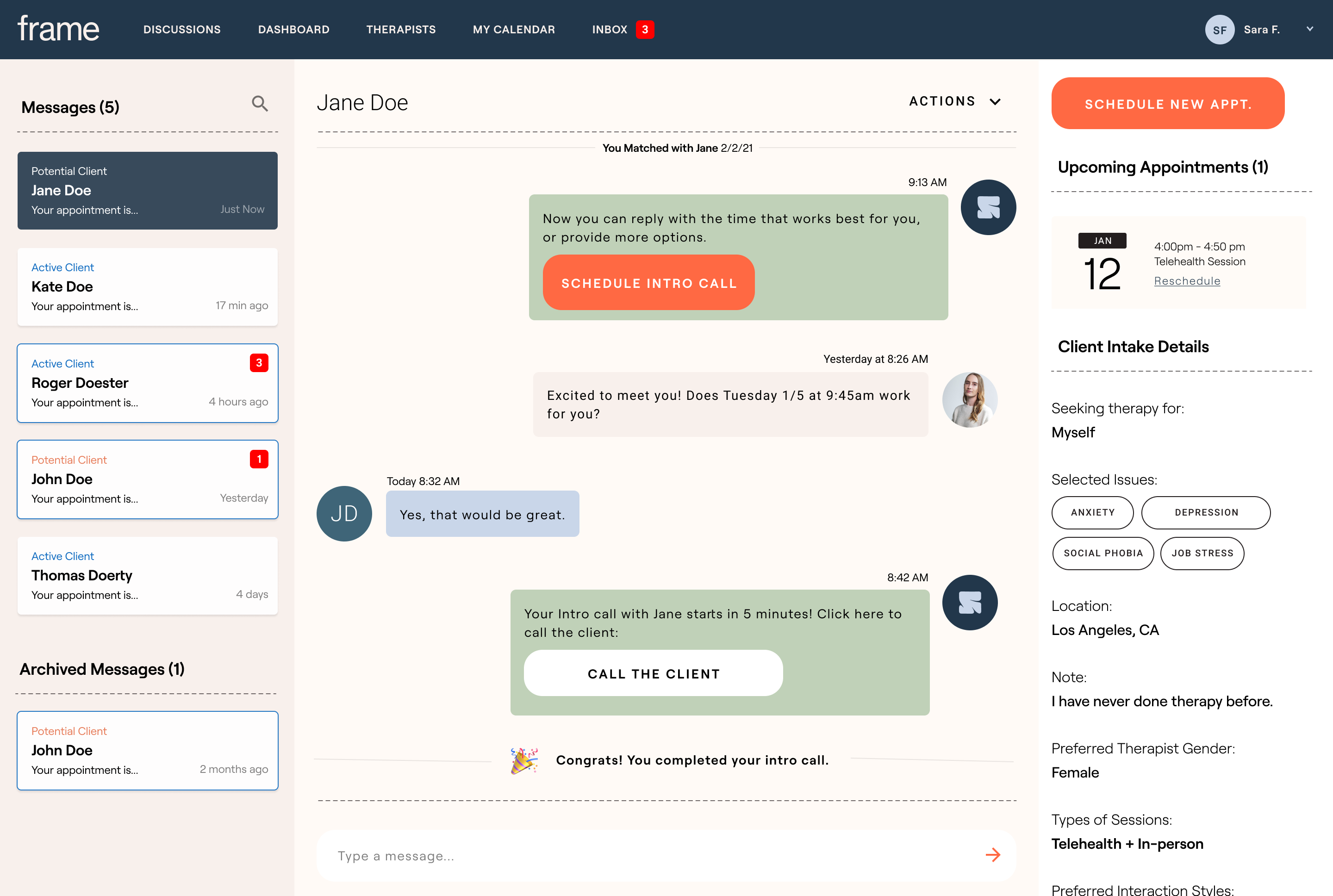
The therapist's inbox showing conversations with clients and prospective clients.

Image Credits: Frame

Frame eschews the over-simplified “scroll through therapists near your area code” with a short quiz — not a diagnosis or personality test but just a few basic questions — that winnows down your choices to a handful of local and appropriate therapists, with whom you can instantly set up free introductory video calls. If you find someone you like, the rest of the professional relationship takes place on Frame, though of course soon in-person sessions may return.

For those not quite ready to take the plunge, the company organizes livestreamed sessions between volunteers and therapists to show what a full hour of work might look like. (Whatever courage it may take to confront one’s issues in therapy, it surely takes even more to do so with an audience.)

On the therapist’s side, Frame is meant to be a one stop shop. Marketing and telehealth sessions are on there, as noted above, but so are things like scheduling, notes, billing, notifications, and so on, all tailored specifically to the needs of the industry. And while the shift to online services has been a long time coming, the company just happened to drop in just as the need went into overdrive.

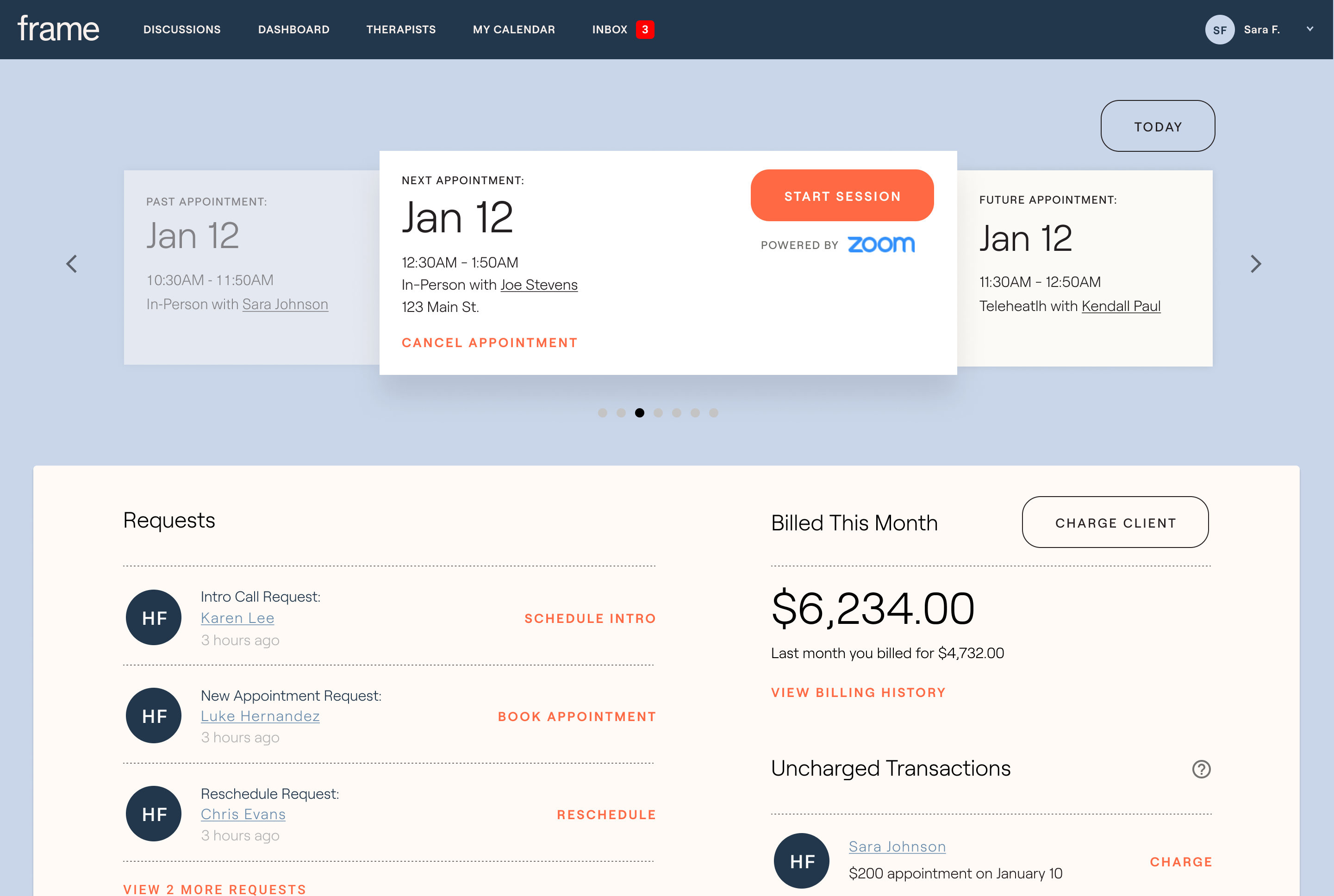
A therapist's online dashboard showing billing, schedules, and links for appointments.

Image Credits: Frame

“We built it before COVID ever existed — launched in March 2020 and had telehealth as an option, thinking ‘oh, well maybe some people will do this.’ The majority of therapists in America weren’t doing sessions online at the time… but after COVID they all are,” Bird said. “And they’re looking for these tools now because they’re seeing the rewards of running a lot of their business through telehealth.”

Many therapists are finding that after resisting the transition for years, they are encountering all kinds of benefits, explained Grazer. Like other industries, the flexibility inherent to shifting in-person meetings to virtual ones has been freeing and in some cases profitable. The change is here to stay.

The site is in a closed beta limited to a part of California at present, since therapists are limited to operating in-state and there are other regulations to consider, not to mention all the usual struggles of putting together a sprawling professional service. But the $3M funding round, led by Maven Ventures, will help fill out the product and move the company towards a larger audience. Sugar Capital, Struck Capital, Alpha Edison, and January Ventures participated in the raise.

The money is “almost exclusively going to engineering.” The goal is to open up the beta, expand to the rest of California, then move out to other states once they have the infrastructure to do so and have responded to feedback from the initial rollout.

“Sage and I are really aligned in the belief that the best way to make therapy more accessible to America is to support therapists,” said Bird.

02 Jul 2021

Dutch court will hear another Facebook privacy lawsuit

Privacy litigation that’s being brought against Facebook by two not-for-profits in the Netherlands can go ahead, an Amsterdam court has ruled. The case will be heard in October.

Since 2019, the Amsterdam-based Data Privacy Foundation (DPS) has been seeking to bring a case against Facebook over its rampant collection of Internet users’ data — arguing the company does not have a proper legal basis for the processing.

It has been joined in the action by the Dutch consumer protection not-for-profit, Consumentenbond.

The pair are seeking redress for Facebook users in the Netherlands for alleged violations of their privacy rights — both by suing for compensation for individuals; and calling for Facebook to end the privacy-hostile practices.

European Union law allows for collective redress across a number of areas, including data protection rights, enabling qualified entities to bring representative actions on behalf of rights holders. And the provision looks like an increasingly important tool for furthering privacy enforcement in the bloc, given how European data protection regulators’ have continued to lack uniform vigor in upholding rights set out in legislation such as the General Data Protection Regulation (which, despite coming into application in 2018, has yet to be seriously applied against platform giants like Facebook).

Returning to the Dutch litigation, Facebook denies any abuse and claims it respects user privacy and provides people with “meaningful control” over how their data gets exploited.

But it has fought the litigation by seeking to block it on procedural grounds — arguing for the suit to be tossed by claiming the DPS does not fit the criteria for bringing a privacy claim on behalf of others and that the Amsterdam court has no jurisdiction as its European business is subject to Irish, rather than Dutch, law.

However the Amsterdam District Court rejected its arguments, clearing the way for the litigation to proceed.

Contacted for comment on the ruling, a Facebook spokesperson told us:

“We are currently reviewing the Court’s decision. The ruling was about the procedural part of the case, not a finding on the merits of the action, and we will continue to defend our position in court. We care about our users in the Netherlands and protecting their privacy is important to us. We build products to help people connect with people and content they care about while honoring their privacy choices. Users have meaningful control over the data that they share on Facebook and we provide transparency around how their data is used. We also offer people tools to access, download, and delete their information and we are committed to the principles of GDPR.”

In a statement today, the Consumentenbond‘s director, Sandra Molenaar, described the ruling as “a big boost for the more than 10 million victims” of Facebook’s practices in the country.

“Facebook has tried to throw up all kinds of legal hurdles and to delay this case as much as possible but fortunately the company has not succeeded. Now we can really get to work and ensure that consumers get what they are entitled to,” she added in the written remarks (translated from Dutch with Google Translate).

In another supporting statement, Dick Bouma, chairman of DPS, added: “This is a nice and important first step for the court. The ruling shows that it pays to take a collective stand against tech giants that violate privacy rights.”

The two not-for-profits are urging Facebook users in the Netherlands to sign up to be part of the representative action (and potentially receive compensation) — saying more than 185,000 people have registered so far.

The suit argues that Facebook users are ‘paying’ for the ‘free’ service with their data — contending the tech giant does not have a valid legal basis to process people’s information because it has not provided users with comprehensive information about the data it is gathering from and on them, nor what it does with it.

So — in essence — the argument is that Facebook’s tracking and targeting is in breach of EU privacy law.

The legal challenge follows an earlier investigation (back in 2014) of Facebook’s business by the Dutch data protection authority which identified problems with its privacy policy and — in a 2017 report — found the company to be processing users’ data without their knowledge or consent.

However, since 2018, Europe’s GDPR has been in application and a ‘one-stop-shop’ mechanism baked into the regulation — to streamline the handling of cross-border cases — has meant complaints against Facebook have been funnelled through Ireland’s Data Protection Commission. The Irish DPC has yet to issue a single decision against Facebook despite receiving scores of complaints. (And it’s notable that  ‘forced consent‘ complaints were filed against Facebook the day GDPR begun being applied — yet still remain undecided by Ireland.)

The GDPR’s enforcement bottleneck makes collective redress actions, such as this one in the Netherlands a potentially important route for Europeans to get rights relief against powerful platforms which seek to shrink the risk of regulatory enforcement via forum shopping.

Although national rules — and courts’ interpretations of them — can vary. So the chance of litigation succeeding is not uniform.

In this case, the Amsterdam court allowed the suit to proceed on the grounds that the Facebook data subjects in question reside in the Netherlands.

It also took the view that a local Facebook corporate entity in the Netherlands is an establishment of Facebook Ireland, among other reasons for rejecting Facebook’s arguments.

How Facebook will seek to press a case against the substance of the Dutch privacy litigation remains to be seen. It may well have other procedural strategies up its sleeve.

The tech giant has used similar stalling tactics against far longer-running privacy litigation in Austria, for example.

In that case, brought by privacy campaigner Max Schrems and his not-for-profit noyb, Facebook has sought to claim that the GDPR’s consent requirements do not apply to its advertising business because it now includes “personalized advertising” in its T&Cs — and therefore has a ‘duty’ to provide privacy-hostile ads to users — seeking to bypass the GDPR by claiming it must process users’ data because it’s “necessary for the performance of a contract”, as noyb explains here.

A court in Vienna accepted this “GDPR consent bypass” sleight-of-hand, dealing a blow to European privacy campaigners.

But an appeal reached the Austrian Supreme Court in March — and a referral could be made to Europe’s top court.

If that happens it would then be up to the CJEU to weigh in whether such a massive loophole in the EU’s flagship data protection framework should really be allowed to stand. But that process could still take over a year or longer.

In the short term, the result is yet more delay for Europeans trying to exercise their rights against platform giants and their in-house armies of lawyers.

In a more positive development for privacy rights, a recent ruling by the CJEU bolstered the case for data protection agencies across the EU to bring actions against tech giants if they see an urgent threat to users — and believe a lead supervisor is failing to act.

That ruling could help unblock some GDPR enforcement against the most powerful tech companies at the regulatory level, potentially reducing the blockages created by bottlenecks such as Ireland.

Facebook’s EU-to-US data flows are also now facing the possibility of a suspension order in a matter of months — related to another piece of litigation brought by Schrems which hinges on the conflict between EU fundamental rights and US surveillance law.

The CJEU weighed in on that last summer with a judgement that requires regulators like Ireland to act when user data is at risk. (And Germany’s federal data protection commissioner, for instance, has warned government bodies to shut their official Facebook pages ahead of planned enforcement action at the start of next year.)

So while Facebook has been spectacularly successful at kicking Europe’s privacy rights claims down the road, for well over a decade, its strategy of legal delay tactics to shield a privacy-hostile business model could finally hit a geopolitical brick wall.

The tech giant has sought to lobby against this threat to its business by suggesting it might switch off its service in Europe if the regulator follows through on a preliminary suspension order last year.

But it has also publicly denied it would actually follow through and close service in Europe.

How might Facebook actually comply if ordered to cut off EU data flows? Schrems has argued it may need to federate its service and store European users’ data inside the EU in order to comply with the eponymous Schrems II CJEU ruling.

Albeit, Facebook has certainly shown itself adept at exploiting the gaps between Europeans’ on-paper rights, national case law and the various EU and Member State institutions involved in oversight and enforcement as a tactic to defend its commercial priorities — playing different players and pushing agendas to further its business interests. So whether any single piece of EU privacy litigation will prove to be the silver bullet that forces a reboot of its privacy-hostile business model very much remains to be seen.

A perhaps more likely scenario is that each of these cases further erodes user trust in Facebook’s services — reducing people’s appetite to use its apps and expanding opportunities for rights-respecting competitors to poach custom by offering something better. 


02 Jul 2021

Don’t send VC a cold deck ever again: Start sending video pitches

Let’s play out this scenario. Your deck is ready and you’re just about to start reaching out. What does conventional wisdom say that you should send? A three-paragraph overview, four bullet points outlining the problem, and three bullet points on how you solve it and why you’re the best. You went through all that work … but who is going to read it? A junior person. Not even a senior VC.

Even if you do end up with a meeting, odds are that your deck didn’t even get read. The biggest lie in venture capital is: “Yes, I read through your deck.” Because those words are immediately followed by, “ … but why don’t you run us through it from the beginning?”

At that point, it’s safe to assume that no one has actually taken the time to read through what you sent, the junior guy thought it would be an interesting meeting considering the fund’s current themes of interest, and no one objected to taking the meeting. But no one has really taken the time to read through your deck.

Even if the only benefit was that other investment committee members heard the story direct from the founder, that alone would make your video pitch worth it.

According to DocSend, the average pitch deck review time over the last 20 weeks is less than three minutes. Let’s break down how much time you’ll be given for a 12-page deck (a very concise deck):

  • Cover — 5 seconds.
  • Back cover — 5 seconds.
  • All the rest — 2:50.

That also includes time for that critical-to-understand diagram that illustrates and distills your unique system or view of the world. Do you think 25 seconds is long enough to fully comprehend that diagram and connect the dots with your value prop? Not likely.

What should you do about it?

Don’t send cold decks, ever. Instead, you should be video pitching — this is a video walkthrough of your deck, with your face in a camera bubble talking through it and giving added color in a video no longer than six-and-a-half minutes. Your objective for this video: Get in, provide a basis of understanding, and get out with a punchy CTA. Nothing flashy, nothing fancy.

More investors are embracing video pitches (prime example: Ashton Kutcher’s Sound Ventures), and in the age of the Zoom-based pitch meeting, it’s quickly becoming the standard.

The rapid but notable shift is because in video pitching, founders get to showcase the preparedness, commitment and passion VCs are looking for, all while telling their story. None of that is effectively transmitted in a cold pitch deck. Further, it allows you to create a deeper connection even before a meeting ever takes place. In a sense, it allows you and the investor to skip a step in the relationship-building process.

Why you have to do video pitches

Cold decks get blown out of the water when compared with the benefits of the video pitch:

  1. You can connect the dots in an easy-to-digest manner. Instead of simply reading the slides, you’re adding context as you go through them. Basically, you’re doing investors a favor by doing the mental heavy lifting for them.
  2. You control the interaction. It’s a recorded video, so you get to pitch with the added benefit of not getting interrupted.
  3. People might not give three minutes to skim a PDF, but they will watch a six-and-a-half minute high-relevance video!
02 Jul 2021

Jim Whitehurst steps down as president at IBM just 14 months after taking role

In a surprise announcement today, IBM announced that Jim Whitehurst, who came over in the Red deal, would be stepping down as company president just 14 months after taking over in that role.

IBM didn’t give a lot of details as to why he was stepping away, but acknowledged his key role in helping bring the 2018 $34 billion Red Hat deal to fruition and helping bring the two companies together after the deal closed. “Jim has been instrumental in articulating IBM’s strategy, but also, in ensuring that IBM and Red Hat work well together and that our technology platforms and innovations provide more value to our clients,” the company stated.

He will stay on as a senior advisor to Krishna, but it begs the question why he is leaving after such a short time in the role, and what he plans to do next. Oftentimes after a deal of this magnitude closes, there is an agreement as to how long key executives will stay. It could be simply that the period has expired and Whitehurst wants to move on, but some saw him as the heir apparent to Krishna and the move comes as a surprise when looked at in that context.

“I am surprised because I always thought Jim would be next in line as IBM CEO. I also liked the pairing between a lifer IBMer and an outsider,” Patrick Moorhead, founder and principal analyst at Moor Insight & Strategies told TechCrunch.

Regardless, it leaves a big hole in Krishna’s leadership team as he works to transform the company into one that is primarily focused on hybrid cloud.  Whitehurst was undoubtedly in a position to help drive that change through his depth of industry knowledge and his credibility with the open source community from his time at Red Hat. He is not someone who would be easily replaced and the announcement didn’t mention anyone filling his role.

When IBM bought Red Hat in 2018 for $34 billion, it led to a cascading set of changes at both companies. First Ginni Rometty stepped down as CEO at IBM and Arvind Krishna took over. At the same time, Jim Whitehurst, who had been Red Hat CEO moved to IBM as president and long-time employee Paul Cormier moved into his role.

At the same time, the company also announced some other changes including that long-time IBM executive Bridget van Kralingen announced she too was stepping away, leaving her role as senior vice president of global markets. Rob Thomas, who had been senior vice president of IBM cloud and data platform, will step in to replace Van Kraligen.

02 Jul 2021

Chinese cybersecurity probe validates Didi’s pre-IPO warning to investors

Shares of Chinese ride-hailing provider Didi are sharply lower this morning after news broke that its domestic regulators are investigating the newly public company. A loose translation of the probe’s official notice indicates that the cybersecurity review is “in order to prevent national data security risks, maintain national security, and protect the public interest.”

Yesterday, regulators ordered Didi to stop registering new users during the investigation.

The move comes amid a larger reset of relations between China’s burgeoning technology sector and its autocratic government. Other fallouts from the campaign included the effective silencing of Jack Ma, the embarrassing cancellation of the Ant IPO, and a crackdown on data collection from technology companies more broadly.


The Exchange explores startups, markets and money.
Read it every morning on Extra Crunch or get The Exchange newsletter every Saturday.


China is not the only nation grappling with its technology sector; India has made consistent noise in recent months regarding tech firms inside its borders, for example. And there is effort inside the U.S. Congress to put some cap on Big Tech’s scale and power, though of the trio, the United States appears the least likely to take a real swipe at technology companies’ market influence.

That Didi has run afoul of China’s regulatory bodies is not a surprise; it’s a well-known tech company in the country with lots of consumer data. Similar data-rich tech shops in the country have come under increased scrutiny as well.

But to see Didi get taken to task mere days after its U.S. debut puts a bad taste in our mouths.

The way that this saga reads from the cynical perspective is that the Chinese Communist Party was willing to let the company go public in the United States, allowing it to raise billions of dollars from foreign sources. And that the ruling party was then content to leave them holding a mid-sized bag by announcing its cybersecurity probe.

Hanlon’s Razor is at play in this situation, naturally.

Didi has not published a new SEC filing since June 30, and, as of the time of writing, its investor relations page is devoid of any information regarding today’s news.

While going public, it’s worth noting that Didi did warn investors that it faces a host of risks relating to its status as a Chinese company, namely its government, and as a Chinese company going public in the United States. Observe the following risk factors that it shared while going public (emphasis added) that dealt with the company’s business operations:

  • Our business is subject to numerous legal and regulatory risks that could have an adverse impact on our business and future prospects.
  • Our business is subject to a variety of laws, regulations, rules, policies and other obligations regarding privacy, data protection and information security. Any losses, unauthorized access or releases of confidential information or personal data could subject us to significant reputational, financial, legal and operational consequences.