Year: 2021

03 Jul 2021

Welcome to hot due diligence summer 

Wow, that headline worked?

A recent board fight at a digital health unicorn is a reminder to entrepreneurs that it’s important to set boundaries, even amid the dizzying volume and velocity of this summer’s deal frenzy.

This week I published a scoop about how Bessemer Venture Partners replaced a board member at Hinge Health, after that board member invested in a competing startup. Hinge Health co-founder Daniel Perez alleges that the board member did not notify him before they led a round in an early-stage startup in the same sector.

The situation gives a rare and nuanced peek into the world of competitive tension between startups. While founders expect certain standards of conduct from investors, including that they notify them of investments in directly competitive startups, investors may be feeling more pressure to make faster decisions that clash with the founders they’ve already backed, while having different definitions of competition from their portfolios. In a post-NDA world, the rules need to be rewritten around how to have these conversations.

I’m not quite sure if more due diligence is the solution to everyone’s woes — but I do think transparency and explicitness between founders and investors can’t hurt. It’s not just for founders. Investors, who owe returns to their LPs, don’t want to be in situations where they can’t invest in a booming sector because they have one other investment in the sector.

The situations are endless:

  • What happens when a startup pivots into a different market than the one that it sold its investors on and is suddenly competitive with a portfolio company?
  • What if a portfolio company’s future roadmap includes a go-to-market strategy that clashes with a potential investment?
  • Can a Sequoia India partner back a company that is directly competing with a Sequoia India company?
  • Is it okay for there to be competing investments within the same firm as long as different partners are sitting on the board?

Based on my DMs, Hinge Health isn’t alone in dealing with current investors backing competitors. It adds an asterisk to the barrage of funding rounds. Welcome to hot due diligence summer, I guess?

In the rest of this newsletter, we’ll get into the Duolingo S-1, a creator economy rebrand and an exclusive interview with top startup marketers. As always, you can find me on Twitter @nmasc_ — send me tips or notes on any competitive tensions you’ve dealt with.

Wall Street, it’s time for your language lesson

Image Credits: Duolingo

Duolingo, a language-learning unicorn last valued at $2.4 billion, filed to go public this week. Beyond the flurry of puns — thanks to this reader for today’s subhed — the S-1 gave us a sneak peak into the financials of a rare edtech company ambitious enough to list on the stock market.

Here’s what to know: A deep dive into the financials and fine print unveiled how Duolingo’s monetization efforts have led to 129% revenue growth and solid conversion between free and paying users. The document also exposed a number of other fun factoids, such as the fact that only four people left the company in 2020 — and that Duolingo is indeed looking to scoop up some companies.

For some more language on the language learning company: 

Rebranding the creator economy

Image Credits: Alexis Gay

On Equity this week, Alex and I brought on techie comedian Alexis Gay to talk about the creator economy. 

Here’s what to know: Gay went from helping creators via her role at Patreon to becoming a creative herself. We talked about pet peeves, why it’s important to be explicit when building tools for this economy, and if rolling funds are inevitable for anyone with a Twitter following. Check out the episode, which I’d say is one of our funniest to date.

And as your postgame:

Marketing some marketing

Image of a group of arrows moving up and around obstacles.

Image Credits: Richard Drury (opens in a new window) / Getty Images

TechCrunch’s Miranda Halpern and Eric Eldon are hard at work on TechCrunch Experts, a directory that will host vetted professionals within the startup industry. Right now, they’re seeking the names of the top growth marketers powering your favorite tech startup — and they’re still taking submissions!

Here’s what to know: Halpern interviewed Kathleen Estreich and Emily Kramer, the co-founders of strategic marketing firm MKT1. The revealing conversation includes notes on marketer attrition, why their job is about a lot more than just advertisements, and how they’re working against the stigma of marketers often being “thought of as second-class citizens” within a company.

Deeper dives:

Around TC

TechCrunch Early Stage 2021: Marketing & Fundraising is next week! The entire event is built for founders seeking tactical tips on everything from how to survive high-speed startup growth during COVID-19 to how to unearth the ever-illusive product-market fit. Buy your tickets, because it will make me very happy.

Across the week

Seen on TechCrunch

Seen on Extra Crunch

Thanks for giving me a few minutes of your time. It truly never gets old. Enjoy the long weekend, and let’s do it all over again next week.

Talk then,

N

03 Jul 2021

A new ‘digital violence’ platform maps dozens of victims of NSO Group’s spyware

For the first time, researchers have mapped all the known targets, including journalists, activists, and human rights defenders, whose phones were hacked by Pegasus, a spyware developed by NSO Group.

Forensic Architecture, an academic unit at Goldsmiths, University of London that investigates human rights abuses, scoured dozens of reports from human rights groups, carried out open-source research and interviewed dozens of the victims themselves to reveal over a thousand data points, including device infections, which show relations and patterns between digital surveillance carried out by NSO’s government customers, and the real-world intimidation, harassment and violence that the victims are also subject to.

By mapping out these data points on a bespoke platform, the researchers can show how nation-states, which use Pegasus to spy on their victims, also often target other victims in their networks and are entangled with assaults, arrests, and disinformation campaigns against the targets but also their families, friends, and colleagues.

Although the thousand-plus data points only present a portion of the overall use of Pegasus by governments, the project aims to provide researchers and investigators the tools and data of NSO’s activities worldwide, which the spyware maker goes to great lengths to keep out of the public eye.

Pegasus “activates your camera, your microphone, all that which forms an integral part of your life.” Mexican journalist Carmen Aristegui

Israel-based NSO Group develops Pegasus, a spyware that allows its government customers near-unfettered access to a victim’s device, including their personal data and their location. NSO has repeatedly declined to name its customers but reportedly has government contracts in at least 45 countries, said to include Rwanda, Israel, Bahrain, Saudi Arabia, Mexico, and the United Arab Emirates — all of which have been accused of human rights abuses — as well as Western nations, like Spain.

Forensic Architecture’s researcher-in-charge Shourideh Molavi said the new findings reveal “the extent to which the digital domain we inhabit has become the new frontier of human rights violations, a site of state surveillance and intimidation that enables physical violations in real space.”

The platform presents visual timelines of how victims are targeted by both spyware and physical violence as part of government campaigns to target their most outspoken critics.

Omar Abdulaziz, a Saudi video blogger and activist living in exile in Montreal, had his phone hacked in 2018 by the Pegasus malware. Shortly after Saudi emissaries tried to convince Abdulaziz to return  to the kingdom, his phone was hacked. Weeks later, two of his brothers in Saudi Arabia were arrested and his friends detained.

Abdulaziz, a confidant of Washington Post journalist Jamal Khashoggi whose murder was approved by Saudi’s de facto ruler Crown Prince Mohammed bin Salman, also had information about his Twitter account obtained by a “state-sponsored” actor, which later transpired to be a Saudi spy employed by Twitter. It was this stolen data, which included Abdulaziz’s phone number, that helped the Saudis penetrate his phone and read his messages with Khashoggi in real-time, Yahoo News reported this week.

Omar Abdulaziz is one of dozens of known victims of digital surveillance by a nation state. Blue dots represent digital intrusions and red dots indicate physical events, such as harassment or violence. (Image: Forensic Architecture/supplied)

Mexican journalist Carmen Aristegui is another known victim, whose phone was hacked several times over 2015 and 2016 by a government customer of Pegasus, likely Mexico. The University of Toronto’s Citizen Lab found that her son, Emilio, a minor at the time, also had his phone targeted while he lived in the United States. The timeline of the digital intrusions against Aristegui, her son, and her colleagues show that the hacking efforts intensified following their exposure of corruption by Mexico’s then-president Enrique Peña Nieto.

“It’s a malware that activates your camera, your microphone, all that which forms an integral part of your life,” said Aristegui in an interview with journalist and filmmaker Laura Poitras, who contributed to the project. Speaking of her son whose phone was targeted, Aristegui said: “To know that a kid who is simply going about his life, and going to school tells us about the kinds of abuse that a state can exert without counterweight.” (NSO has repeatedly claimed it does not target phones in the United States, but offers a similar technology to Pegasus, dubbed Phantom, through U.S.-based subsidiary, Westbridge Technologies.)

“A phenomenal damage is caused to the journalistic responsibility when the state — or whoever — uses these systems of ‘digital violence’,” said Aristegui. “It ends up being a very damaging element for journalists, which affects the right of a society to keep itself informed.”

The timeline also shows the digital targeting (in blue) of Carmen Aristegui, her family, and her colleagues, entangled with break-ins at their office, intimidation, and disinformation campaigns (in red). (Image: Forensic Architecture/supplied)

The platform also draws on recent findings from an Amnesty International investigation into NSO Group’s corporate structure, which shows how NSO’s spyware has proliferated to states and governments using a complex network of companies to hide its customers and activities. Forensic Architecture’s platform follows the trail of private investment since NSO’s founding in 2015, which “likely enabled” the sale of the spyware to governments that NSO would not ordinarily have access to because of Israeli export restrictions.

“NSO Group’s Pegasus spyware needs to be thought of and treated as a weapon developed, like other products of Israel’s military industrial complex, in the context of the ongoing Israeli occupation. It is disheartening to see it exported to enable human rights violations worldwide,” said Eyal Weizman, director of Forensic Architecture.

The platform launched shortly after NSO published its first so-called transparency report this week, which human rights defenders and security researchers panned as devoid of any meaningful detail. Amnesty International said the report reads “more like a sales brochure.”

In a statement, NSO Group said it cannot comment on research it has not seen, but claimed it “investigates all credible claims of misuse, and NSO takes appropriate action based on the results of its investigations.”

NSO Group maintained that its technology “cannot be used to conduct cybersurveillance within the United States, and no customer has ever been granted technology that would enable them to access phones with U.S. numbers,” and declined to name any of its government customers.


You can send tips securely over Signal and WhatsApp to +1 646-755-8849. You can also send files or documents using our SecureDrop. Learn more

03 Jul 2021

Startups, culture and riding the meme wave

Welcome back to The TechCrunch Exchange, a weekly startups-and-markets newsletter. It’s broadly based on the daily column that appears on Extra Crunch, but free, and made for your weekend reading. Want it in your inbox every Saturday? Sign up here.

Ready? Let’s talk money, startups and spicy IPO rumors.

Hey! It’s going to be a long weekend here in the United States, which means that this newsletter is in between myself and being done with work. So, we’re going to hit on even more topics than usual as I am a glutton for both punishment and writing. But I repeat myself.

Up first: Startups and culture.

Something that I very much enjoyed this week was the Robinhood IPO filing. You can read our first look here, and a deeper dig into the numbers here. But today we’re going to riff on culture. Observe the following excerpts, the first from the company’s notes on its goals via its S-1 filing:

Over time, we strive to make Robinhood the most trusted, lowest cost, and most culturally relevant money app worldwide.

Surprised that “culturally relevant made it into the mix? Then check this out, from the prospectus’s overview section (emphasis added):

Cultural Impact. We pioneered commission-free stock trading with no account minimums, which the rest of the industry emulated, and we have continued to build relationships with our customers by introducing new products that further expand access to the financial system. We believe we have made investing culturally relevant and understandable, and that our platform is enabling our customers to become long-term investors and take greater control of their finances. Over half of 18-44 year olds in the United States know who Robinhood is according to an internal brand study that we conducted in March 2021. As a further sign of our relevance today, Robinhood reached the number-one spot on the Apple App Store multiple times in the first quarter of 2021 and was frequently ranked number one in the Finance category on the Apple App store during 2020 and the first quarter of 2021.

The app store bragging is whatever. The focus on culture caught me up.

I’ve often enjoyed watching culture evolve more and more rapidly over time; TikTok further accelerated the trend. And amongst the youths of the world, I’d hazard, the line between brand and culture is blurring as brands work to move more and more into cultural territory. The Robinhood S-1 is forward-looking in a number of ways, but to see a company going public discuss culture in this manner feels like the future.

Up second: American manufacturing is not dead.

That’s what The Exchange learned this week from a conversation with the CEO of Xometry. The company recently went public. You can read more of our notes on its numbers here, but like Robinhood the former startup raised lots of venture capital and this fits into our broader remit.

What doesn’t, really, is what we learned about manufacturing thanks to the chat. Per CEO Randy Altschuler, his business of connecting companies in need of manufacturing with those able to build stuff is nearly an entirely U.S.-based business. That’s to say that, yes, there is still stuff made here in America.

What Xometry does is actually pretty cool — including offering financial services as part of its role as marketplace middleperson — but what got us the most hype was the idea that a digital service was going to help connect folks in need with folks with tools here in the United States. If Xometry’s vision of the future works out, it could help sustain, and dare we say grow, domestic manufacturing in this nation. Who would have thought that that was possible?

Xometry’s IPO was also a huge success, we should add. It priced above range, and then shot higher. That’s what you want as a company.

And third, some fun odds and ends:

  • More tech money in F1: Every race weekend in the Formula 1 calendar helps me notice yet another tech company putting money into racing’s most bonkers series. Zoom has a lot of branding out there, for example. And this week we got news that Crypto.com has closed a five-year, $100-million deal with the racing league. That’s a lot of duckets. Notably Tezos already sponsors some teams, and you can spy both Amazon and Microsoft branding here and there in the series. Oh, and the Splunk-McLaren tie-up was just extended. New life goal: Make lots of money, sponsor F1 team, get paddock access. What could possibly go wrong?
  • Unqork has hired a CRO. Not a CFO, so we can’t make too many IPO noises concerning the no-code service that helps big companies build apps. But the news still matters for you no-code fans.
  • Finally, Apptopia has download numbers for neobanks. Can you guess which was number one?

Alex

02 Jul 2021

Meet Mighty, an online platform where kid CEOs run their own storefronts; a “digital lemonade stand”

For kids of a certain age — think 9 to 15 — options for enrichment are somewhat limited to school, sports, and camps, while the ability to make money is largely non-existent.

A new startup called Mighty wants to provide them with a new alternative through a platform it’s building that, like a kind of Shopify for kids, enables younger kids to open their own store online and to learn a lot in the process. In fact, Mighty — led by founders Ben Goldhirsh, who previously founded GOOD magazine, and Dana Mauriello, who spent nearly five years with Etsy and was most recently an advisor to Sidewalk Labs — sees itself as smack dab in the center of fintech, ed tech, and entertainment.

Investor thinks it’s a pretty solid idea. Mighty recently closed on $6.5 million in seed funding led by Animo Ventures, with participation from Maveron, Humbition, Sesame Workshop, Collaborative Fund and a family office called NaHCO3, among others.

As is often the case, the concept derived from the founders’ own experience. In this case, Goldhirsh, who has been living in Costa Rica, began worrying about his two daughters, who attend a small school and he feared might fall behind their stateside peers so began tutoring them after school. He says he was using Khan Academy and every other software platform that he thought might be helpful to the cause, but their reaction wasn’t exactly positive.

“They were like, “F*ck you, dad. We just finished school and now you’re going to make us do more school?'”

Unsure of what to do, he encouraged them to sell the bracelets they’d been making online, figuring it would teach them needed math skills, as well as teach them about startup capital, business plans (he made them write one), and marketing. It worked, he says, and as he told friends about this successful “project-based learning effort,” friends began to ask if he could help their kids get up and running.

Fast forward and Goldhirsh and Mauriello — who ran a crowdfunding platform that Goldhirsh had helped fund before she joined Etsy — say they’re now steering a still-in-beta startup that has become home to 3,000 “CEOs” as Mighty calls them, with a smaller percentage of “super CEOs” logging into the platform 30 times each month to manage their business affairs.

The interest isn’t surprising. Kids are spending more of their time online than at any point in history. Many of the real-world type businesses that might have once employed young kids are shrinking in size. Aside from babysitting or selling cookies on the corner, it’s also challenging to find a job before high school, given the Department of Labor’s Fair Labor Standards Act<, which sets 14 years old as the minimum age for employment. (Even then, many employers worry that their young employees might be more work than is worth it.)

Still, building out a platform for kids is tricky. For starters, not a lot of 11-year-olds have the tenacity required to sustain their own business over time. While Goldhirsh likens the business to a “21st century lemonade stand,” running a business that doesn’t go away is a very different proposition obviously. On this front, Goldhirsh acknowledges that no kid wants to hear they have to “grind” on their business or to follow a certain trajectory, and he says that Mighty is certainly seeing kids who show up for a weekend to make some money.

Still, he insists, many others have an undeniably entrepreneurial spirit and tend to stick around.  In fact, says Goldhirsh, the company — aided by its new seed funding — has much to do in order to keep its hungriest young CEOs happy. Many are frustrated, for example, that they currently can’t sell their own homemade items through Mighty. Instead, they can sell items like hats, totes, and stickers that they customize and which are made by Mighty’s current manufacturing partner, Printful, which then ships out the item to the end customer. (The Mighty CEO gets a percentage of the sale, as does Mighty.) They can also sell items made by global artisans through a partnership that Mighty has struck with Novica, an impact marketplace that also sells through National Geographic.

The idea was to introduce as little friction into the process as possible at the outset, though Mighty intends to enable its smaller entrepreneurs to sell their own items over time. Mighty also plans to eventually generate revenue through both a revenue split as well as via freemium services.

Of course, it needs to overcome potential competition from established companies like Shopify to get there. Should Mighty gain traction, these stalwarts might pay closer attention.

It’s also conceivable that parents might push back on what Mighty is trying to do. Entrepreneurship can be alternately exhilarating and demoralizing, after all. But Mauriello insists they haven’t. For one thing, she says, Mighty recently launched an online community where its young CEOs can encourage one another and trade sales tips, and she says they are actively engaging there.

She also argues that, like sports or learning a musical instrument, there are lessons to be learned by creating a store on Mighty, and not simply about storytelling and sales. As critically, she says, the company’s young customers are learning that “you can fail and pick yourself back up and try again.”

“There are definitely kids who are like, ‘Oh, this is harder than I thought it was going to be. I can’t just launch the site and watch money roll in,'” adds Goldhirsch. “But I think they like the fact that the success they are seeing they are earning, because we’re not doing it for them.”

02 Jul 2021

Daily Crunch: In one of India’s largest exits, Swedish media giant MTG buys PlaySimple for $360M

To get a roundup of TechCrunch’s biggest and most important stories delivered to your inbox every day at 3 p.m. PDT, subscribe here.

Hello and welcome to Daily Crunch for July 2. We are heading into a holiday weekend here in the United States, so you might imagine that tech news slowed down. It did not, as we’ll see shortly. Looking ahead, TC Early Stage 2021: Marketing & Fundraising is next week and Disrupt is around the corner. Get hype! — Alex

The TechCrunch Top 3

  • When SPACs attack: The United States Department of Justice is investigating Lordstown Motors, the embattled EV company that went public via a SPAC. Detractors of the company have punched holes in the story it told before going public, and the company’s SPAC deck has proven to be somewhat, well, disconnected from reality. The company needs more money, it turns out, despite having told investors that it would not. Whoops.
  • China v. Didi v. American investors: Sticking to the theme of companies in trouble, Chinese ride-hailing giant Didi is in hot water with its own domestic regulators. The company has been told to halt new user registration, pending a cybersecurity review. Just days after it went public in the United States. Oof.
  • IBM’s President steps down: Jim Whitehurst, who made his way to IBM via its Red Hat deal, is out. His tenure as president at the firm lasted 14 months. Details were light on his exit, per Ron Miller Yeesh.

Startups/VC

Today’s startup news has a strong non-American bias. That’s because nearly everyone in the United States took most of today off, regardless of what their boss thought was going on. The rest of the world was still busy, however:

  • Licious raises tasty $192M round: The Bangalore-based meat and seafood e-commerce player has now raised through a Series F. A few years back we would have joked that the F in Series F stood for “failed to go public,” but that’s no longer the case. Why not raise a Series F when money is so cheap? The company is now worth more than $650 million, TechCrunch reports.
  • MTG buys PlaySimple for $360M: Why are investors betting so much money on the Indian startup ecosystem? Rising exit values, perhaps. TechCrunch noted that the sale of India’s PlaySimple to Swedish gaming giant was “one of the largest exits in the Indian startup ecosystem.”
  • Tiger invests $40M into Nigerian neobank: It’s a big day for FairMoney, a Nigerian startup that has its genesis in offering consumers credit. It’s also yet another round for African fintech, a sector that has felt pretty active lately.

3 guiding principles for CEOs who post on Twitter

Did you hear about the CEO who made misleading claims about a funding round and got sued by the SEC? How about that pharmaceutical executive whose taunts to a former secretary of state led to a 4.4% decline in the Nasdaq Biotechnology Index?

In case it isn’t clear: Startup executives are held to a higher standard when it comes to what they post on social media.

“Reputation and goodwill take a long time to build and are difficult to maintain, but it only takes one tweet to destroy it all,” says Lisa W. Liu, a senior partner at The Mitzel Group, a San Francisco-based law practice that serves many startups.

To help her clients (and Extra Crunch readers) stay out of trouble, Liu has six basic questions for tech execs with itchy Twitter fingers.

And if the answer to any of them is “I don’t know,” don’t post.

(Extra Crunch is our membership program, which helps founders and startup teams get ahead. You can sign up here.)

Big Tech Inc.

Today’s Big Tech news is a mixed bag, but a fun one. And each story has a strong California hook. Let’s begin:

  • GM is investing in a California lithium extraction project: Why? Batteries. Gotta have lithium to make batteries. No batteries, no electric cars. In this case the project is actually pretty neat, having a strong hook to Salton Sea Geothermal Field near Los Angeles in the southern part of the state. The geothermal field will provide power and materials. So perhaps electric cars’ pre-driving carbon footprint will be a bit more sustainable in the future.
  • Twitter tests more attention-grabbing misinformation labels: Twitter, a California-based company, is making its misinformation labeling a bit more standout. It’s fun to watch social media companies make warnings sterner at the same time as Google is making advertisements better blend into its organic results.
  • Dutch court will hear another Facebook privacy lawsuit: A few Dutch nonprofits are suing Facebook over alleged “rampant collection of internet users’ data — arguing the company does not have a proper legal basis for the processing,” TechCrunch summarized. This case seems like it could have broad import, depending on how it shakes out. Given, you know, how much data collection goes on literally all the time, literally everywhere, online.

TechCrunch Experts: Growth Marketing

Illustration montage based on education and knowledge in blue

Image Credits: SEAN GLADWELL (opens in a new window) / Getty Images

TechCrunch wants you to recommend growth marketers who have expertise in SEO, social, content writing and more! If you’re a growth marketer, pass this survey along to your clients; we’d like to hear about why they loved working with you.

02 Jul 2021

This week in growth marketing on TechCrunch

TechCrunch is trying to help you find the best growth marketer to work with through founder recommendations that we get in this survey. We’re sharing a few of our favorites so far, below.

We’re using your recommendations to find top experts to interview and have them write their own columns here. This week we talked to Kathleen Estreich and Emily Kramer of new growth advising firm MKT1 and veteran designer Scott Tong, and published a pair of articles by growth marketing agency Demand Curve.

Demand Curve: Email marketing tactics that convert subscribers into customers Growth marketing firm Demand Curve shares their approaches to subject line length, the three outcomes of an email and how to optimize your format for each outcome.

(Extra Crunch) Demand Curve: 7 ad types that increase click-through rates The growth marketing agency tells us how to use customer reactions and testimonials, and other ads types to a startup’s advantage.

MKT1: Developer marketing is what startup marketing should look like MKT1, co-founded by Kathleen Estreich, previously at Facebook, Box, Intercom and Scalyr, and Emily Kramer, previously at Ticketfly, Asana, Astro and Carta, tell us about the importance of finding the right marketer at the right time, and the biggest mistakes founders are still making in 2021.

The pandemic showed why product and brand design need to sit togetherScott Tong shares the importance of understanding users and his thoughts on how companies manage to work together collaboratively in a remote world.

(Extra Crunch) 79% more leads without more traffic: Here’s how we did it — Conversion rate optimization expert Jasper Kuria shared a detailed case study deconstructing the CRO techniques he used to boost conversion rates by nearly 80% for China Expat Health, a lead generation company.

This week’s recommended growth marketers

As always, if you have a top-tier marketer that you think we should know about, tell us!

Marketer: Dipti Parmar
Recommended by: Brody Dorland, co-founder, DivvyHQ
Testimonial: “She gave me an easy-to-implement plan to start with clear outcomes and timeline. She delivered it within one month and I was able to see the results in a couple of months. This encouraged me to hand over bigger parts of our content strategy and publishing to her.”

Marketer: Amy Konefal (Closed Loop)
Recommended by: Dan Reardon, Vudu
Testimonial: “Amy drove scale for us as we grew to a half-billion-dollar company. She identified and exploited efficiencies and built out a rich portfolio of channels.”

Marketer: Karl Hughes (draft.dev)
Recommended by: Joshua Shulman, Bitmovin.com
Testimonial: “Karl is incredibly knowledgeable in the field of content and growth marketing to a large (and equally niche) target audience of developers. He and his team at Draft.dev are some of the best at “developer marketing,” which is a greatly underrated target audience.”

Marketer: Ladder
Recommended by: Anonymous
Testimonial: “They really get what I need. By testing different messaging on different personas, we discover what works and what doesn’t to better understand our users and prospects. This is gold for a company at our stage. Showing those results to our investors blew their minds.”

02 Jul 2021

Extra Crunch roundup: CEO Twitter etiquette, lifting click-through rates, edtech avalanche

Yesterday, China ordered ride-hailing company Didi to stop signing up new customers after regulators announced a cybersecurity review of the company’s operations.

As of this writing, Didi’s stock price is down 5.3%. In today’s edition of The Exchange, Alex Wilhelm suggested that the move wasn’t a complete surprise, but it still “puts a bad taste in our mouths,” since the company went public days ago.


Full Extra Crunch articles are only available to members.
Use discount code ECFriday to save 20% off a one- or two-year subscription.


When Didi filed to go public, it listed several potential pitfalls facing Chinese companies that go public in the U.S., including “numerous legal and regulatory risks” and “extensive government regulation and oversight in its F-1.”

What does this news signify for other Chinese companies that are hoping for stateside IPOs?

We’ll be off on Monday, July 5 in observance of Independence Day. Thanks very much for reading, and I hope you have an excellent weekend.

Walter Thompson
Senior Editor, TechCrunch
@yourprotagonist

3 guiding principles for CEOs who post on Twitter

Did you hear about the CEO who made misleading claims about a funding round and got sued? How about that pharmaceutical executive whose taunts to a former Secretary of State led to a 4.4% decline in the Nasdaq Biotechnology Index?

In case it isn’t clear: Startup executives are held to a higher standard when it comes to what they post on social media.

“Reputation and goodwill take a long time to build and are difficult to maintain, but it only takes one tweet to destroy it all,” says Lisa W. Liu, a senior partner at The Mitzel Group, a San Francisco-based law practice that serves many startups.

To help her clients (and Extra Crunch readers) Liu has six basic questions for tech execs with itchy Twitter fingers.

And if the answer to any of them is “I don’t know,” don’t post.

The 2021 edtech avalanche has just begun

A report from Brighteye Ventures on Europe’s edtech scene shows that this year’s deal flow is on pace to meet or surpass 2020, when remote instruction exploded.

According to Brighteye’s head of Research, Rhys Spence, the average deal size is now $9.4 million, a threefold increase from last year. Still, “It’s interesting that we are not seeing enormous increases in deal count,” he noted.

How Robinhood’s explosive growth rate came to be

jagged line written by robinhood quill logo on graph background

Image Credits: TechCrunch

Trading platform Robinhood has attracted enough users and activity to change the conversation around retail investing — economists will likely be discussing the 2021 GameStop saga for years to come.

After the company filed to go public yesterday, Alex Wilhelm sorted through Robinhood’s main income statement to better understand how it scaled year-ago revenue from $127.6 million to $522.2 million in Q1.

“Those are numbers that we frankly do not see often amongst companies going public,” says Alex. “300% growth is a pre-Series A metric, usually.”

So: where is all that revenue coming from?

As EU venture capital soars, will the region retain future IPOs?

Given the valuation gap between U.S. tech markets and those overseas, it’s easy to see why some foreign startups would head to our shores when it’s time to go public.

But Anna Heim and Alex Wilhelm found that a record increase in European venture capital activity is picking up the pace of IPOs this year, and many of these companies are content to go public in their native markets.

To gain some insight into where European investors believe they have an advantage, Anna and Alex interviewed:

  • Franck Sebag, partner, EY
  • David Miranda, partner, Osborne Clarke Spain
  • Yoram Wijngaarde, founder and CEO, Dealroom

How VCs can get the most out of co-investing alongside LPs

A red and a green shoe tied together

Image Credits: Diana Ilieva (opens in a new window) / Getty Images

In a recent private equity survey, 80% of respondents said their co-investments with people outside traditional VC firms outperformed their PE fund investments.

Alternative investors are highly motivated, and because they’re seeking higher returns than are generally available in public markets, they are less daunted by risk. In return, they benefit from less expensive fee structures and develop close ties with VCs, enlarging the talent pool as they build investment skills.

These relationships have direct benefits for VCs as well, such as more flexibility with diversification and consolidated decision-making power.

“With the right deal structure, deal selection and deal investigation, co-investors can significantly increase their returns,” says C5 Capital Managing Partner William Kilmer, who wrote an Extra Crunch post for VCs considering an alternative path.

Dear Sophie: How can I bring my parents and sister to the U.S.?

lone figure at entrance to maze hedge that has an American flag at the center

Image Credits: Bryce Durbin/TechCrunch

Dear Sophie,

My husband and I are both U.S. permanent residents.

Given what we’ve gone through this past year being isolated from loved ones during the pandemic, we’d like to bring my parents and my sister to the U.S. to be close to our family and help out with our children.

Is that possible?

— Symbiotic in Sunnyvale

How to cut through the promotional haze and select a digital building platform

Modern city buildings on a printed circuits board. Digital illustration.

Image Credits: Andreus (opens in a new window) / Getty Images

Smart-building products include everything from connecting landlords with tenants to managing construction sites.

Given their widespread impact on the enterprise — and the novel nature of much of this new technology, selecting the right digital building platform (DBP) is a challenge for most organizations.

Brian Turner, LEED-AP BD&C, has created a matrix intended to help decision-makers identify the fundamental functions and desired outcomes for stakeholders.

“When it comes to the built environment, creating those comfortable, healthy and enjoyable places requires new tools,” says Turner. “Selecting a solid DBP is one of the most important decisions to be made.”

Demand Curve: 7 ad types that increase click-through rates

Use these seven ad types to improve CTR

Image Credits: Octavian Iolu / EyeEm (opens in a new window)/ Getty Images

One perennial problem inside startups: Because no one on the founding team has significant marketing experience, growth-related efforts are pro forma and generally unlikely to move the needle.

Everyone wants higher click-through rates, but creating ads that “stand out” is a risky strategy, especially when you don’t know what you’re doing. This guest post by Demand Curve offers seven strategies for boosting CTR that you can clone and deploy today inside your own startup.

Here’s one: If customers are talking about you online, reach out to ask if you can add a screenshot of their reviews to your advertising. Testimonials are a form of social proof that boost conversions, and they’re particularly effective when used in retargeting ads.

Earlier this week, we ran another post about optimizing email marketing for early-stage startups.

We’ll have more expert growth advice coming soon, so stay tuned.

To guard against data loss and misuse, the cybersecurity conversation must evolve

Locking down data centers and networks against intruders is just one aspect of an organization’s security responsibilities; cloud services, collaboration tools and APIs extend security perimeters even farther. What’s more, the systems created to prevent the misuse and mishandling of sensitive data often depend heavily on someone’s better angels.

According to Sid Trivedi, a partner at Foundation Capital, and seven-time CIO Mark Settle, IT managers need to replace existing DLP frameworks with a new one that centers on DMP — data misuse protection.

These solutions “will provide data assets with more sophisticated self-defense mechanisms instead of relying on the surveillance of traditional security perimeters,” and many startups are already competing in this space.

02 Jul 2021

Healthcare data sharing: How to improve patient care in the future

Far too often, we see medical mixups and even deaths caused by interoperability obstacles in our healthcare system. In these situations, patients in critical conditions cannot speak to their past medical history in an emergency. Upon their recovery but through no fault of their healthcare providers, they are left footing a massive medical bill or facing other severe financial repercussions. Lack of access to data not only causes these terrible outcomes — it’s also part of the reason why our healthcare costs are nearly 18% of the GDP and growing.

Among the many reasons why healthcare data isn’t more digitally accessible is a very simple one: fear that it will be misused. Patients are scared their data will be used against them. This could happen in a number of ways, the most obvious being the threat that insurance companies will use health data to deny people coverage or that employers will use the data to exclude people when making hiring decisions. That’s why the rules and regulations surrounding health data privacy are so stringent.

So, how can investors advance (and capitalize on) tech development around this issue and help eradicate this fear?

Investors, take note

We know funding for companies in healthcare and digital health has not been a problem — but profitability has. Many of these companies are still struggling financially under a fee-for-service business as required by most insurance companies, Medicaid and Medicare. There are grave inefficiencies in the fee-for-service system: It creates the wrong alignment of interests; doesn’t favor the consumer; is complicated by CPT codes (the numerical codes used to identify medical services and procedures), high copayments and deductibles; and is riddled by waste and abuse.

If the investor community bets on companies that continue to embrace a model that many agree is broken, how can we expect outsized returns?

If the investor community bets on companies that continue to embrace a model that many agree is broken, how can we expect outsized returns? To truly lower costs and reduce inefficiencies, we have to abandon the existing structure and put the customer first.

The key here is to look at companies that are truly trying to solve not just one piece of this puzzle, but those that are attempting to create an end-to-end solution that connects the employer, member, hospital, specialists, pharmaceutical companies, primary care doctors and claims adjusters, powered by digital health data — all while making it more affordable for the consumer.

Keep an eye out for those that are moving away from the fee-for-service structure and focused on employer-driven systems. Employers are properly aligned with patients, as bad health outcomes and financial stress both negatively impact productivity. Employers are also focused on KPIs in their business; they’re used to measuring and tracking results, making them great candidates for data-focused healthcare companies.

Most importantly, in a labor market where companies are clamoring to attract employees, employers will have to work with healthcare technology companies that put a premium on data security because their current and potential employees will demand it.

Innovation over fear

The whole future of healthcare is going to focus on the ability to securely share data. To empower providers and patients to take control of their healthcare journey, we need to build a system of trust that allows the efficient flow of personal healthcare information from stakeholder to stakeholder.

Today, with the way HIPAA works and the requirement to keep data private, that trust has to be in the hands of a provider. Imagine if your primary care physician was the quarterback of your entire healthcare journey. Simply by handling your preventative care, they have a more complete picture.

Even better, preventative care is a major focus when it comes to reducing healthcare costs. If you put the data in the hands of a trusted entity and ensure that each person has access to their full medical history, people are much more likely to grant access at times of need.

The good news? There’s hope

The future is very bright because of technology. The challenge is being able to figure out meaningful ways to utilize and integrate it. Right now, we have a system of incumbency that is disincentivized to embrace new technologies.

Telehealth is a perfect example of how the system can meaningfully change. It took a global pandemic to really be able to break through to a point where telehealth was fully embraced (and covered by insurance). Now, health insurers such as Anthem are actively trying to improve care coordination and interoperability.

Three critical technologies not used in healthcare today could be instrumental in bringing about this change. Ideally, all three will align to usher in a new era of healthcare:

Healthcare telemetry 2.0: Collection of health data on cellular devices

Through our use of social apps and e-commerce platforms on our mobile devices, people have already accepted that our cell phones are constantly collecting data on us and willingly consent to this. Sometimes this function is quite helpful — just look at court cases where detailed location data have provided alibis to suspects.

Anybody with a cell phone is carrying a medical device that counts our steps, tracks our screen actions and is attuned to us as users. So why are we not leveraging this function for optimized care — or at the very least trying to get medical insights out of our device use data?

In the future, the number of times one checks their mobile calendar in a day could be an indicator of early-onset Alzheimer’s in people of a particular age group, as one example. Technologists must continue to push the boundaries of how the computing power in our pockets and purses is used to help us, especially with so much of the groundwork already laid.

Privacy 2.0: Application of blockchain to protect medical information

In just the past six months, we have seen bad actors capitalizing on digital risk to cripple entire industries through data breaches. The Colonial Pipeline hack effectively shuttered gas distribution to a massive portion of the U.S. in a matter of hours. With healthcare data, stewards of the system need to be even more careful. It will be tricky to regulate the privacy and protection of healthcare data, but blockchain technology has proven to be an effective measure in maintaining trust between consumers and data stewards.

Portability 2.0: Ability to securely share information with approved parties

For many people with life-threatening conditions, the simple act of wearing a medical bracelet can make a difference between life and death — but at this point, medical bracelets should be obsolete. Imagine the patient benefits that could come from a next-generation medical “bracelet” that carries a patient’s entire genome, tumor profiles, long-term heart rate trends and more, and can be uploaded instantly in an emergency situation.

Right now, the absence of health record portability creates redundancies that are both expensive and harmful to patients. Doctors spend time and resources rescanning patients, while patients suffer from repeated (and sometimes risky) diagnostics, like blood draws and radiation. Nobody has cracked the code on portability, but effective solutions must navigate tricky regulatory waters while solving for standardization across data sets.

We are already seeing these technologies used in other industries. Apple and Google have turned phones into remote monitoring devices that can easily collect all types of health telemetry data. Cryptocurrency represents billions of dollars in transactions with no breach of trust in various coin exchanges. Uber and Lyft have changed the way we hire, use and pay for transportation. Applying the core technologies used in each of these examples would provide a means for disrupting the current challenges in healthcare. It’s only a matter of time.

History has proven that with innovation, investment and technology, the world has become a dramatically better place. As long as rules and regulations stay out of the way, you can expect that technology will allow us to make enormous leaps forward in the next decade.

Making data secure and meaningful, along with personalized medicine, holds the promise to reduce long-term healthcare costs in the U.S. while improving healthcare outcomes.

02 Jul 2021

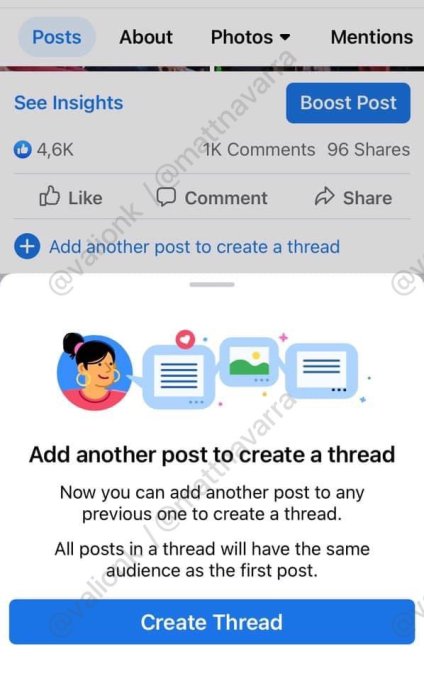
Facebook is testing a Twitter-like ‘threads’ feature on some public figures’ pages

Get your spool-of-yarn emojis ready — threads might be coming to Facebook soon. Facebook has been spotted testing a new feature that gives public figures on Facebook the ability to create a new post that’s connected to a previous one on a related subject. This feature ties the posts together more visually so fans can more easily follow updates over time. When the new post appears on followers’ News Feeds, it will be shown as being connected to the other posts in a thread.

Social media consultant Matt Navarra first spotted this feature in action, and shared several screenshots of how it looks. Reached for comment, Facebook confirmed to TechCrunch it’s testing the feature with a small group of “public figures” on Facebook for the time being. A public figure is a specific type of Facebook Page category aimed at high-profile individuals or anyone else who wants to establish a more public presence on Facebook.


Image Credits: Matt Navarra


Facebook explained these threaded posts will have a “View Post Thread” button, which lets followers easily navigate to see all of the posts in the thread. When you tap on the button, you’ll be shown where you can see all the threaded posts connected together in one place.

Facebook was unable to confirm if or when the test would roll out more broadly to other public figures on its platform or if it would later expand to other Page categories, like Businesses, or to Facebook Groups.

Threads are useful on sites like Twitter, where the character limit makes it harder to have more nuanced conversations — that’s why we end up with those oh-so-beloved “notes app apology” posts on Twitter. (Now, Twitter promotes its Revue newsletter app when you write a thread). But on Facebook, your posts can be up to precisely 63,206 characters long (or, about 225 tweets).

Rather than inspiring longer posts, Facebook threads could be used for live commentary on an event like an award show. Or, users could post updates to their existing posts in a thread, rather than updating the original and making a clunky “edited to add…” announcement. Given that Facebook is testing this feature with public figures, perhaps its intended use is to make the sharing of news more streamlined. It’s no secret that Facebook has dealt with some misinformation issues in the past, so for journalists or government officials sharing information about developing news events, threads could provide useful context.

This testing comes after Facebook announced its Bulletin newsletter offshoot earlier this week.

02 Jul 2021

3 guiding principles for CEOs who post on Twitter

A CEO’s fiduciary duties to their company and its shareholders do not end when they are off the clock — they must always act in good faith. However, navigating the boundaries between a company’s official communications and a personal voice can be difficult in today’s social-media-connected environment.

What a CEO posts on Twitter can raise not only serious reputational issues for themselves and their companies but posting the wrong things at the wrong time can also cause breach of fiduciary duties and may even run afoul of securities laws.

Reputation and goodwill take a long time to build and are difficult to maintain, but it only takes one tweet to destroy it all.

Fiduciary duties can be divided into three buckets: (1) duty of care — CEOs must act in good faith with the care of a reasonable person in a like position with a reasonable belief that their decisions are in furtherance of their company’s best interest; (2) duty of loyalty — CEOs must put the interest of shareholders and the company above their own self-interest; and (3) duty of good faith — CEOs must act with honesty and fairness to shareholders and the company.

There is no denying that Twitter can be leveraged as a powerful tool. Used appropriately, it can fortify the reputation of a company and its CEO, forge stronger consumer relationships and drive business profits. For example, Tim Cook’s habit of tweeting about his interactions with Apple customers demonstrates his customer-service values and effort to connect with consumers, which can potentially lead to a bigger and more loyal following.

Lately, more and more CEOs are communicating their stance on issues that are important to their consumer base to exhibit authenticity, relatability and demonstrate their personal and corporate values through social media. Following last year’s murder of George Floyd and rise of the Black Lives Matter movement, nearly 60% of all S&P 100 tech CEOs, unicorn CEOs, and Fortune 500 CEOs tweeted, “Black Lives Matter.” This was the first time CEOs active on Twitter overwhelmingly voiced their position on racial and social justice issues.

Twitter can also be an opportunity to show transparency in policy. CEOs can use social media to announce new management initiatives, capability expansions and new investments in employees (diversity initiatives, new roles for women, organizational changes) that are positive in tone and speak about the future direction of the company. These can have a positive correlation with stock prices.

It wasn’t that long ago that the world was fixated on Donald Trump’s Twitter posts and their correlation with the stock market. Words have permanence and their impact can be catastrophic. Given their elevated role as a leader and representative of the company and the fiduciary duties they owe, CEOs must watch what they say and when they say it. What it all boils down to is awareness, common sense and the law.

Don’t break the law and stick to the facts

For U.S. publicly traded companies, SEC Regulation Fair Disclosure (Reg FD) says that “an issuer may not disclose material nonpublic information to certain groups, either intentionally or unintentionally, without disclosing the same information to the entire marketplace.” If companies use social media to announce key information, to comply, they must alert investors that social media will be used to disseminate such information.

Regardless of whether it is a public or private company, CEOs are corporate officers and owe fiduciary duties to their companies and their shareholders. Fiduciary duty requires CEOs to act in good faith, apply their best business judgment and to act in the best interest of the company. This is true whether they are in the boardroom or on Twitter.