Year: 2021

01 Jul 2021

The 2021 edtech avalanche has just begun

Last week was a good one for edtech in Europe.

GoStudent became Europe’s first edtech unicorn (IPO’d companies aside), raising its third round in 12 months and the biggest ever in the sector in Europe. Brighteye Ventures’ analysis showed that VC investments in European edtech had breached $1 billion in a calendar year for the first time, even without GoStudent’s mega-round, with six months left to go.

Edtech deal flow in 2021 looks set to match or even outpace 2020 levels, per the report: At $9.4 million, average deal size is triple 2020 levels; seven companies have raised $50 million in five different markets; and the U.K. has more than three times as many deals as the next individual market.

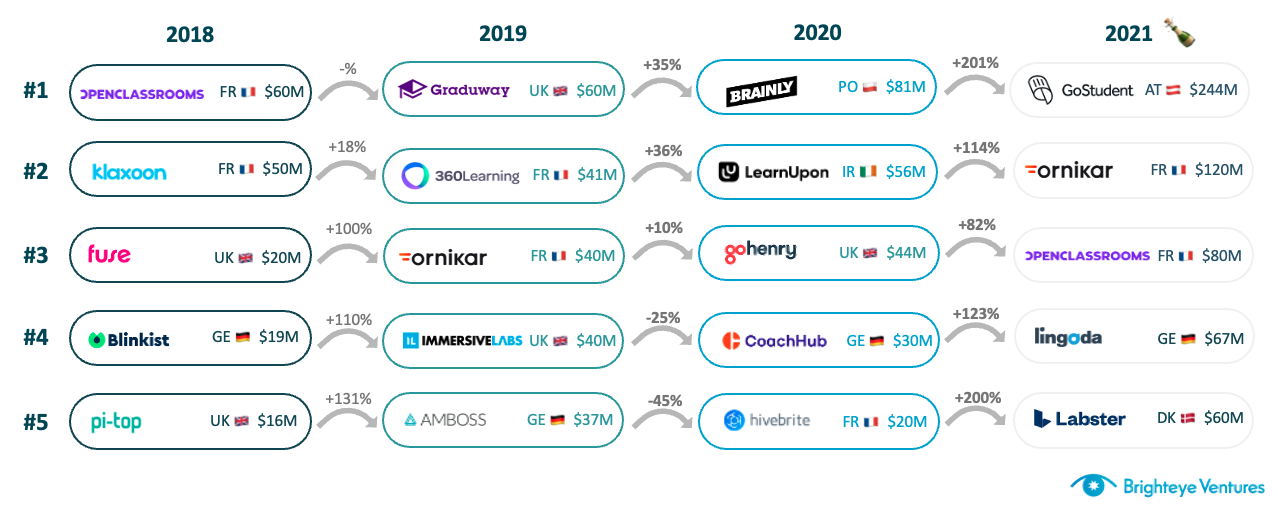
Deal size progression in edtech over the years

Deal-size progression in edtech over the years. Image Credits: Brighteye Ventures

It’s interesting that we are not seeing enormous increases in deal count. The $1.05-billion mark in the report is spread across 111 transactions — there were 237 in 2020, so we could expect a similar total this year. More funding and stable deal count of course means that we are seeing significant increases in deal size.

It seems generalist investors are recognizing that edtech investments can reap outsized returns, similar to sectors like deep tech, health tech and fintech.

We can draw a few conclusions from this. We can construe that companies created last year and in previous years matured significantly during the pandemic due to increased demand. Moreover, this rapid natural selection process provided insights on verticals and possible winners.

Lastly, it seems generalist investors are recognizing that edtech investments can reap outsized returns, similar to sectors like deep tech, health tech and fintech.

This is contributing to larger early rounds than we have seen in previous years — investors can’t pick the winner, but they can slant the playing field instead. We therefore expect to see a surge in the number of pre-seed, seed and Series A rounds in the second half of 2021, as companies founded during the pandemic begin to raise meaningful funding.

Another reason that edtech is being taken seriously by generalist investors is that the true size of the market (and the extent of digitization to come) is becoming more conceivable.

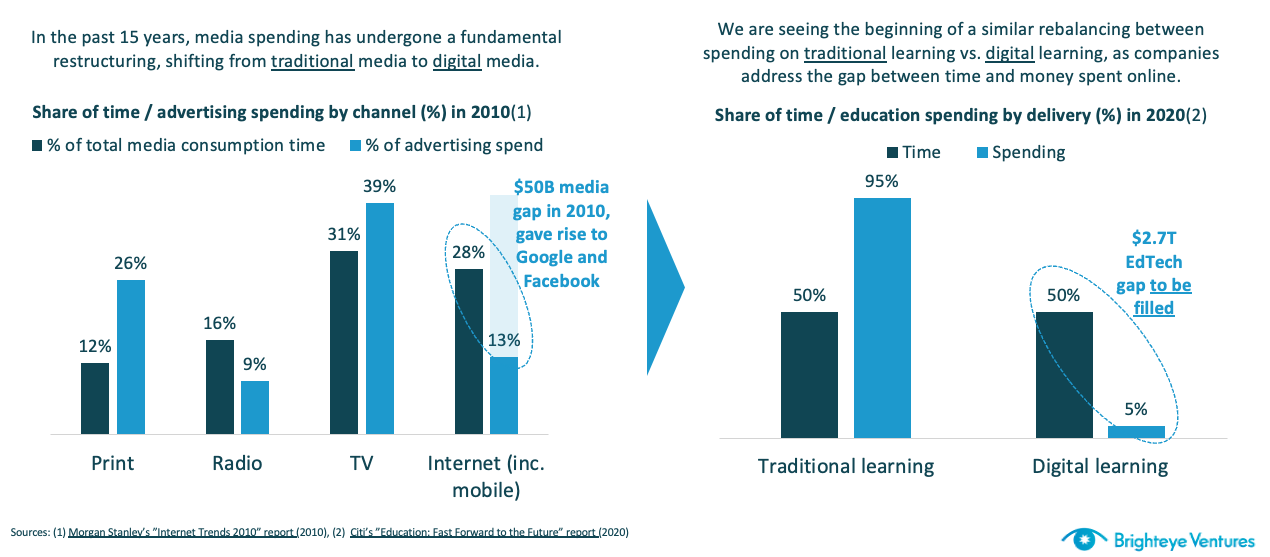
Spending on edtech is undergoing a similar growth to that of media spending in 2010

Edtech spending is growing like media spending did in the 2010s. Image Credits: Brighteye Ventures

01 Jul 2021

How Robinhood’s explosive growth rate came to be

This afternoon Robinhood filed to go public. TechCrunch’s first look at its results can be found here. Now that we’ve done a first dig, we can take the time to dive into the company’s filing more deeply.

Robinhood’s IPO has long been anticipated not only because there are billions of dollars in capital riding on its impending liquidity. But also, because the company became something of a poster child for the savings and investing boom that 2020 saw and the COVID-19 pandemic helped engender.

The consumer trading service’s products became so popular, and enmeshed in popular culture thanks to both the “stonks” movement and the larger GameStop brouhaha, that the company’s public offering carries much more weight than that of a more regular venture-backed entity. Robinhood has fans, haters, and many an observer in Congress.

Regardless of all that, today we are digging into the company’s business, and financial results. So, if you want to better understand how Robinhood makes money, and how profitable or not it really is, this is for you.

We will start with a more in-depth look at growth and profitability, pivot to learning about the company’s revenue makeup, discuss a risk factor or two, and close on its decision to offer some of its own shares to its users. Let’s go!

Inside Robinhood’s growth engine

Before we get into the how of Robinhood’s growth, let’s discuss its how big the company has become.

The fintech unicorn’s revenue grew from $277.5 million in 2019 to $958.8 million in 2020, which works out to growth of around 245%. Robinhood expanded even more quickly in the first quarter of 2021, scaling from year-ago revenue of $127.6 million to $522.2 million, a gain of around 309%.

Those are numbers that we frankly do not see often amongst companies going public; 300% growth is a pre-Series A metric, usually.

Returning to our point about how famous the company has become, we can see in its financial performance — tied as it is to user activity, which we’ll get to shortly — why Robinhood’s IPO will prove noisy. It’s going public because of rapidly-scaling usage form consumers, usage that in turn helped the company’s size flat explode in the last year.

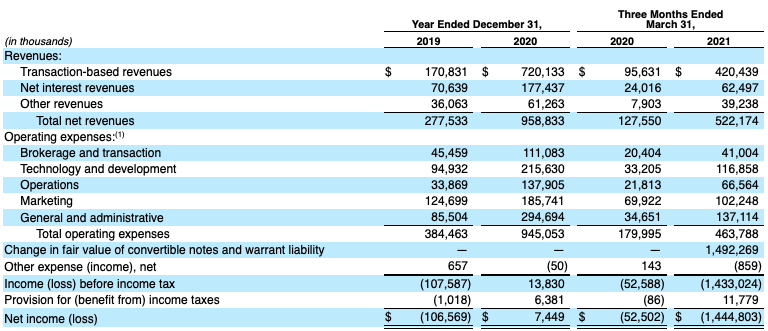
Now let’s talk profitability. Here’s Robinhood’s main income statement, which we’ll both need to discuss the company’s red and black ink:

In 2019 Robinhood’s net losses were not small, with the firm posting a $106.6 million deficit, inclusive of tax costs. However, the next year’s growth turned that all around for Robinhood, with the company managing to end the year just in the black — in percent of revenue terms — with net income of $7.4 million.

The company’s 2019 net loss, however, was not spread out amongst its quarters in a uniform fashion; net losses ramped from around $12 million in both Q1 and Q2 2019 to $38.4 million and $44.6 million in Q3 and Q4 of the year, respectively.

01 Jul 2021

Twitter considers new features for tweeting only to friends, under different personas, and more

Twitter has a history of sharing feature and design ideas it’s considering at very early stages of development. Earlier this month, for example, it showed off concepts around a potential “unmention” feature that would let users untag themselves from others’ tweets. Today, the company is showing off a few more of its design explorations that would allow users to better control who can see their tweets and who ends up in their replies. The new concepts include a way to tweet only to a group of trusted friends, new prompts that would ask people to reconsider the language they’re using when posting a reply, and a “personas” feature that would allow you to tweet based on your different contexts — like tweets about your work life, your hobbies and interests, and so on.

The company says it’s thinking through these concepts and is looking to now gather feedback to inform what it may later develop.

The first of the new ideas builds on work that began last year with the release of a feature that allows an original poster to choose who’s allowed to reply to their tweet. Today, users can choose to limit replies to only people mentioned in the tweet, ony people they follow, or they can leave it defaulted to “everyone.” But even though this allows users to limit who can respond, everyone can see the tweet itself. And they can like, retweet or quote tweet the post.

With the proposed Trusted Friends feature, users could tweet to a group of their own choosing. This could be a way to use Twitter with real-life friends, or some other small network of people you know more personally. Perhaps you could post a tweet that only your New York friends could see when you wanted to let them know you were in town. Or maybe you could post only to those who share your love of a particular TV show, sporting event, or hobby.
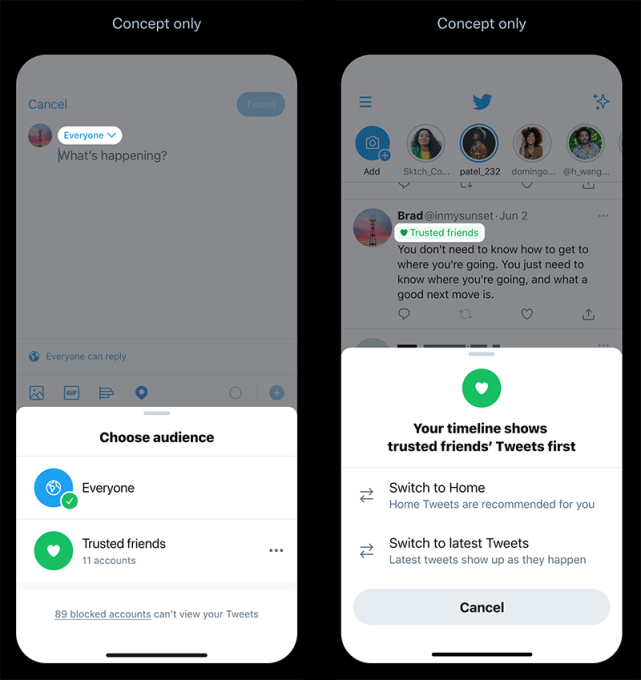
Image Credits: Twitter

This ability to have private conversations alongside public ones could boost people’s Twitter usage and even encourage some people to try tweeting for the first time. But it also could be disruptive to Twitter, as it would chip away at the company’s original idea of a platform that’s a sort of public message board where everyone is invited into the conversation. Users may begin to think about whether or not their post is worthy of being shared in public, and decide to hold more of their content back from the wider Twitter audience, which could impact Twitter engagement metrics. It also pushes Twitter closer to Facebook territory where only some posts are meant for the world, while more are shared with just friends.

Twitter says the benefit of this private, “friends only” format is that it could save people from the workarounds they’re currently using — like juggling multiple alt accounts or toggling between public to protected tweets.

Another new feature under consideration is Reply Language Prompts. This feature would allow Twitter users to choose phrases they don’t want to see in their replies. When someone is writing back to the original poster, these words and phrases would be highlighted and a prompt would explain why the original poster doesn’t want to see that sort of language. For instance, users could configure prompts to appear if someone is using profanity in their reply.
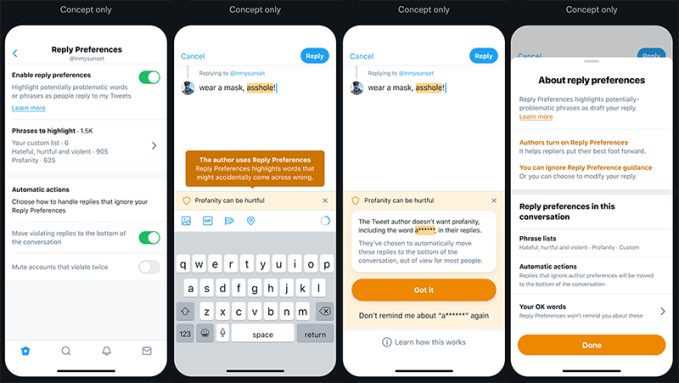
The feature wouldn’t stop the poster from tweeting their reply — it’s more a gentle nudge that asks them to be more considerate.

These “nudges” can have impact. For example, when Twitter launches a nudge that suggested users read an article before they amplify it with a retweet, it found that users opened articles before sharing them 40% more often. But in the case of someone determined to troll, it may not do that much good.

The third, and perhaps most complicated, feature is something Twitter is calling “Facets.”

This is an early idea about tweeting from different personas from one account. The feature would make sense for those who often tweet about different aspects of their lives, including their work life, their side hustles, their personal life or family, their passions, and more.
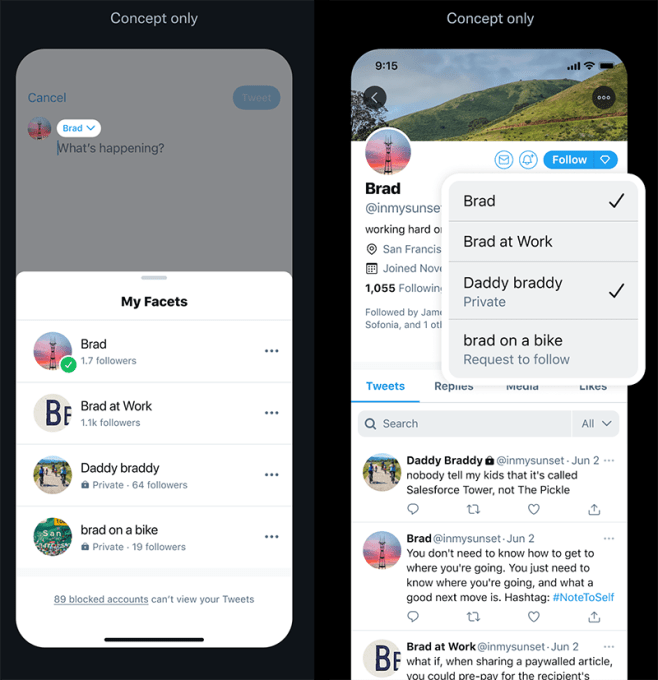
Image Credits: Twitter

Unlike Trusted Friends, which would let you restrict some tweets to a more personal network, Facets would give other users the ability to choose whether or not they wanted to follow all your tweets, or only those about the “facet” they’re interested in. This way, you could follow someone’s tweets about tech, but ignore their stream of reactions they post when watching their favorite team play. Or you could follow your friend’s personal tweets, but ignore their work-related content. And so on.

This is an interesting idea, as Twitter users have always worried about alienating some of their followers by posting “off-topic” so to speak. But this also puts the problem of determining what tweets to show which users on the end user themselves. Users may be better served by the algorithmic timeline that understands which content they engage with, and which they tend to ignore. (Also: “facets?!”)

Twitter says none of the three features are in the process of being built just yet. These are only design mockups that showcase ideas the company has been considering. It also hasn’t yet made the decision whether or not any of the three will go under development — that’s what the user feedback it’s hoping to receive will help to determine.


01 Jul 2021

Robinhood is going public and we’re very excited

It’s a sweltering day here in New York City, and that means Wall Street is on fire, and so is Robinhood, apparently. The popular stock trading app officially filed its Form S-1 with the SEC a few hours ago to go public, where it will trade under the ticker “HOOD.”

The Equity crew has been yammering about Robinhood for years now, and we have been chomping on the bit to see those S-1 results for what feels like ages. Well, we finally got the numbers, we chomped that bit (or at least Alex and Danny did, since Natasha went on vacation about 15 minutes before the IPO hit the wires), and so here’s a special Equity Shot to talk about all the highlights.

We talked about so much in an itsy-bitsy 15-minute episode: crazy revenue growth, crazy revenue concentration from two major sources, regulatory hurdles that the company has been clearing up, better financials with a bit of nuance on the company’s Q1 finances, and the company’s special plan for its IPO.

Wowza.

Here’s what we got up to:

  • Historical growth and profitability.
  • Revenue mix and revenue concentration, along with constituent concerns.
  • The importance of options-related incomes for the company.
  • Dogecoin.
  • Why the company’s adjusted income may help it assuage investors who have their eyes pop out of their skulls when they see its GAAP Q1 2021 results.

And a lot more. Of course, if you hate Robinhood, we will be back with our normally-scheduled Friday episode of Equity tomorrow.

Equity drops every Monday at 7:00 a.m. PST, Wednesday, and Friday morning at 7:00 a.m. PST, so subscribe to us on Apple PodcastsOvercastSpotify and all the casts.

01 Jul 2021

To guard against data loss and misuse, the cybersecurity conversation must evolve

Data breaches have become a part of life. They impact hospitals, universities, government agencies, charitable organizations and commercial enterprises. In healthcare alone, 2020 saw 640 breaches, exposing 30 million personal records, a 25% increase over 2019 that equates to roughly two breaches per day, according to the U.S. Department of Health and Human Services. On a global basis, 2.3 billion records were breached in February 2021.

It’s painfully clear that existing data loss prevention (DLP) tools are struggling to deal with the data sprawl, ubiquitous cloud services, device diversity and human behaviors that constitute our virtual world.

Conventional DLP solutions are built on a castle-and-moat framework in which data centers and cloud platforms are the castles holding sensitive data. They’re surrounded by networks, endpoint devices and human beings that serve as moats, defining the defensive security perimeters of every organization. Conventional solutions assign sensitivity ratings to individual data assets and monitor these perimeters to detect the unauthorized movement of sensitive data.

It’s painfully clear that existing data loss prevention (DLP) tools are struggling to deal with the data sprawl, ubiquitous cloud services, device diversity and human behaviors that constitute our virtual world.

Unfortunately, these historical security boundaries are becoming increasingly ambiguous and somewhat irrelevant as bots, APIs and collaboration tools become the primary conduits for sharing and exchanging data.

In reality, data loss is only half the problem confronting a modern enterprise. Corporations are routinely exposed to financial, legal and ethical risks associated with the mishandling or misuse of sensitive information within the corporation itself. The risks associated with the misuse of personally identifiable information have been widely publicized.

However, risks of similar or greater severity can result from the mishandling of intellectual property, material nonpublic information, or any type of data that was obtained through a formal agreement that placed explicit restrictions on its use.

Conventional DLP frameworks are incapable of addressing these challenges. We believe they need to be replaced by a new data misuse protection (DMP) framework that safeguards data from unauthorized or inappropriate use within a corporate environment in addition to its outright theft or inadvertent loss. DMP solutions will provide data assets with more sophisticated self-defense mechanisms instead of relying on the surveillance of traditional security perimeters.

01 Jul 2021

India’s central bank says growing presence of Big Tech in financial services a concern

India’s central bank has identified Big Tech’s push into financial services as a challenge for banks in the South Asian market, saying the growing presence of these firms have prompted concerns about creation of an uneven playing field.

In a report published on Thursday, Reserve Bank of India (RBI) said Big Tech offers a wide-range of digital services that hold the promise of supporting financial inclusion, generating lastic efficiency gains, and making banks become more competitive, but their expansion in the financial services sector has given rise to “important policy issues.”

“Specifically, concerns have intensified around a level playing field with banks, operational risk, too-big-to- fail issues, challenges for antitrust rules, cyber security and data privacy,” the Indian central bank wrote.

Big tech firms “straddle many different (non-financial) lines of business with sometimes opaque overarching governance structures” and have the potential to become “the dominant players” in financial services, wrote the central bank, which also regulates the finance market in India. “Third, big techs are generally able to overcome limits to scale in financial services provision by exploiting network effects.”

“For central banks and financial regulators, financial stability objectives may be best pursued by blending activity and entity-based prudential regulation of big techs (an activity-based approach is already applied in areas such as anti-money laundering /combating the financing of terrorism; an activity-based approach is the provision of cloud services, where minimising operational and in particular, cyber risk is paramount).”

“Furthermore, as the digital economy expands across borders, international coordination of rules and standards becomes more pressing.”

The caution comes at a time when the RBI, which in the past decade opened up the mobile payments through an retail banks-backed infrastructure called UPI in the past decade, is now opening up the entire national payment network in the country.

A number of players including the tech giants Facebook, Google, and Amazon and plastic card processing firms Visa and Mastercard have applied for licenses to operate retail payments and settlement systems in the country. (RBI is expected to give some of these firms licenses later this year.)

“Nowhere else in the world would the largest corporates, banks, telcos in India and the largest tech players in the world would come together to build national payment networks.” analysts at Bernstein said of the NUE.

An executive at one of the largest payments startups in India slammed the concerns raised by RBI, saying no existing rule is preventing the big banks in India — ICICI and HDFC — that already amass a plethora of data about their customers from investing in their digital expansion.

State Bank of India “is more than half of Indian banking. And Yono [State Bank of India’s digital bank platform] claims a $40 billion market valuation. Why is their reach not a concern?”

The executive, who spoke on the condition of anonymity, said big technology firms are following the regulations set by the RBI, they are using rails built by banks and are required to operate in the space only through partnerships with banks. “The RBI is free to make more regulations — and it’s already doing so with wallet KYC restrictions and imposing market share caps for those doing payments atop UPI infrastructure.”

01 Jul 2021

As EU venture capital soars, will the region hold onto future IPOs?

Shares of American cybersecurity unicorn SentinelOne began to trade yesterday on the New York Stock Exchange. The former startup had raised nearly $700 million before its IPO. And it priced its public debut above a raised price interval. But even its higher-than-anticipated valuation didn’t stop shares of the company from closing around 20% higher.

The SentinelOne IPO is a single data point, but one that fits into a quarters-long trend of high-growth technology companies attracting strong — perhaps exuberant — valuations on American exchanges. The notion that America is a good place to go public is not news; even Chinese tech companies facing what could be called a valuation gap are still pursuing listings in the United States.

But not every technology startup grows up planning, or even dreaming of an American IPO. Many European companies will wind up listing on their native exchanges.


The Exchange explores startups, markets and money. Read it every morning on Extra Crunch or get The Exchange newsletter every Saturday.


In the wake of the busy 2021 IPO cycle, The Exchange wanted to better understand why some tech companies choose to list in Europe over the United States.

The question is pertinent thanks to rising venture capital activity on the continent. The first quarter of 2021 saw record investment in the region, to the tune of $21.4 billion, according to Crunchbase News. Early data looking at European venture capital activity in the first half of 2021 is looking similarly bullish. More VC activity likely implies more breakout startups, which in turn should lead to more startup exits, some of which will be public offerings.

01 Jul 2021

Paris court fines Airbnb $9.6 million for illegal listings

A court in Paris has fined Airbnb, the popular marketplace for vacation rentals. According to the court, the tech company has failed to comply with local regulation when it comes to listing your apartment on the platform. Airbnb should pay $9.6 million (€8.08 million) to the City of Paris.

This decision has been years in the making. Like many major cities around the world, Airbnb has had some impact on the housing market in Paris. Many apartments disappeared from the housing market as they became full-time Airbnb apartments, leading to high rents.

In 2017, it became a bit more difficult to list your home on Airbnb if you live in Paris. For instance, you can’t rent an apartment for more than 120 nights a year. This way, landlords would think twice before switching from full-time tenants to Airbnb customers.

As there are multiple vacation rental platforms, the City of Paris implemented a registration system. If you want to list your apartment on Airbnb, you have to get a registration number first. Platforms like Airbnb would have to ask for that registration number and cap listings to 120 nights per year.

At first, the Mayor’s Office flagged around 1,000 apartments that were not properly registered. They sent the list to Airbnb, asking the company to take down those listings.

In 2019, the City of Paris sued Airbnb for the same reason. Thanks to some regulatory changes, the responsibility was shared between the hosts and the platform. And it leads us to today’s fine.

“This is the first time in France that a local government wins a case against a tech giant,” Paris Deputy Mayor Ian Brossat said in a statement. “Platforms are finally held accountable. A wonderful win for Parisians.”

Airbnb told the AFP that 95% of listings in Paris have been reserved for less than 120 nights in the past year. It means that those last 5% of listings represent much more than 5% of nights.

01 Jul 2021

Robinhood files to go public after squeaking to profitability in 2020

This afternoon Robinhood, the popular investing app for consumers filed to go public. The company intends to list on the NASDAQ under the symbol “HOOD.”

That Robinhood released an S-1 filing today is not a surprise. The company privately filed to go public back in March, leaving the startup-watching world waiting for the eventual filing drop. Robinhood’s public offering document includes a placeholder $100 million raise figure, though that will change the closer we get to its debut.

The company is pursuing a public listing after a period of rapid growth. Robinhood saw its revenues soar from $277.5 million in 2019 to $985.8 million in 2020.

The company’s first-quarter numbers are even more impressive. During the first three months of 2021, Robinhood generated revenues of $522.2 million, up around four times from its Q1 2020 result of $127.6 million. TechCrunch expected Robinhood to post a strong first quarter based on previous filings relating to its payment-for-order-flow (PFOF) business.

Notably, Robinhood was profitable in 2020, generating net income of around $7.4 million during the one-year period. However, the company’s most recent period includes an epic $1.49 billion cost relating to “change[s] in fair value of convertible notes and warrant liability,” leading the company to post an astronomical net loss of $1.44 billion in the first quarter of the year. That compares with a net loss of $107 million for 2019.

For the three-month period ended March 31, Robinhood posted $463.8 million in operating expenses, inclusive of “brokerage and transaction” costs. The company’s business then, apart from its fair-value changes, had a good start to the year in profitability terms.

That Robinhood closed the first quarter of 2021 on a more than $2 billion annual run rate is notable; the firm has quickly scaled to mammoth size on the back of rising consumer interest in investing in both stocks and cryptocurrencies.

Robinhood has proved to be a lightning rod for oversight, fines, mass usage and culture in the last year. And it raised billions this year after running into operational issues regarding trading of certain stocks that retail investors found particularly appealing.

Turning to investor results, DST Global, Index Ventures, New Enterprise Associates and Ribbit capital are listed as shareholders with more than 5% of the company apiece, though certain information in the S-1 filing is yet to be included, including share counts for most of those groups. DST’s 58,102,765 Class A shares, however, are listed.

Robinhood has three classes of shares, including Class A shares with one vote, Class B shares with 10, and Class C shares with none.

TechCrunch is parsing the S-1 and will have more in a following piece. 


01 Jul 2021

TC Early Stage 2021: Marketing and Fundraising kicks off in 1 week

It’s only one week left until we get our bootcamp on at TC Early Stage 2021: Marketing and Fundraising. It’s your chance to learn everything you need to know about fundraising, growth marketing, brand building, pitch deck development and more. And we’ve tapped the brightest minds in startup to share their hard-earned wisdom.

It’s not too late to keep a bit of cheddar in your wallet — buy your pass before July 7 at 11:59 pm (PT) to save $100 on what you’ll pay at the virtual door.

Here’s why one of your contemporaries, Katia Paramonova, founder and CEO of Centrly, says you should consider attending TC Early Stage 2021.

“Early Stage 2020 provided a rich, bootcamp experience with premier founders, VCs and startup community experts. If you’re beginning to build a startup, it’s an efficient way to advance your knowledge across key startup topics.”

Let’s take a quick look at just some of the topics we have on tap for you at ES 2021. You’ll find the full listing in the event agenda, and you can get the 411 on our slate of speakers, too.

Pro Tip: Your pass includes both live-streaming and video-on-demand, so you can catch — or revisit — any session after the conference ends.

Growth Hacking, Product Fit and Pricing: Superhuman’s Rahul Vohra shares strategies for early-stage founders on topics like hacking your way to product-market fit, driving user sign-ups without breaking the bank on paid ads, and identifying your product’s price point.

How to Determine Your Earned Media Strategy: Rebecca Reeve Henderson, an enterprise SaaS communications expert, will share her insight on how to build an effective earned media strategy for your startup by building on her deep expertise developing effective communications programs for some of the top business software companies in the world. Earned media, aka the kind of exposure you get from a TechCrunch article, is a key element of any startup’s marketing strategy, but it’s also one of the trickiest things to get right. Rebecca has worked with companies ranging from Slack to Shopify, Zapier to Canva and many more, helping craft effective earned media strategies in one of the most difficult areas of all: B2B SaaS.

How to Navigate the Ever-Changing World of Early-Stage VC: With over 25 personal investments, AngelList Venture CEO Avlok Kohli knows a thing or two about early stage fundraising. At Early Stage, Kohli will explain the landscape of the early-stage fundraising market and how to take advantage of the changes in the VC world over the past year.

Don’t miss these awesome breakout sessions and the even-more-awesome pitch-off action scheduled for day two.

TC Early Stage 2021: Marketing and Fundraising takes place July 8-9. You have one more week to buy your pass and make the most of this opportunity to build a stronger startup. Plus if you register before July 6, you can get 2 tickets for the price of 1 during our 4th of July sale! Don’t miss out!