Year: 2021

28 Jun 2021

MWC 2021 day one wrap-up

“It is great that MWC is back,” Samsung UK’s James Kitto said, opening up this year’s presser. “And behalf of everyone at Samsung, it’s great to be back at MWC.”

What, precisely, it means to be “back” in 2021 is another question entirely. Samsung was, of course, one of a number of major industry players who announced that they would not be exhibiting at this year’s Mobile World Congress in Barcelona. It was hard not to see an echo of last year’s event, when key players pulled out, one by one, forcing the GSMA to cancel the event altogether.

This year’s event is different for myriad reasons. For one thing, MWC’s traditional timeframe of late-February/early-March put the event directly in the crosshairs of COVID-19’s arrival in the EU. For another, this time out, the organizing body had another year to prepare.

The simplest route would have been to do what the CTA did with CES and go all-virtual. The first all-virtual CES had plenty of issues of course, but attempting an in-person element ahead of a widespread vaccine rollout in the U.S. would have, at best, complicated things by orders of magnitude.

COVID-19 continues to be a concern in Spain – as with much of the world. The GSMA opted to go ahead with the event this year, however, after pushing MWC back several months from its standard dates. The company has implemented all sorts of safety measures, but judging from early videos taken at the event, social distancing ought not to prove an issue on the show floor this year.

Image Credits: Samsung/Google

It seems safe to assume that most who are “attending” the event are doing so virtually – a list that includes the vendors themselves.

Samsung is among those high profile companies that presented a pre-recorded virtual press conference. Perhaps companies still see value in being attached to this sort of event even if it’s virtual, or maybe the on-going partnership with the organization is worth nurturing. The cynical part of me wonders how many of the sponsored sessions just couldn’t be reversed.

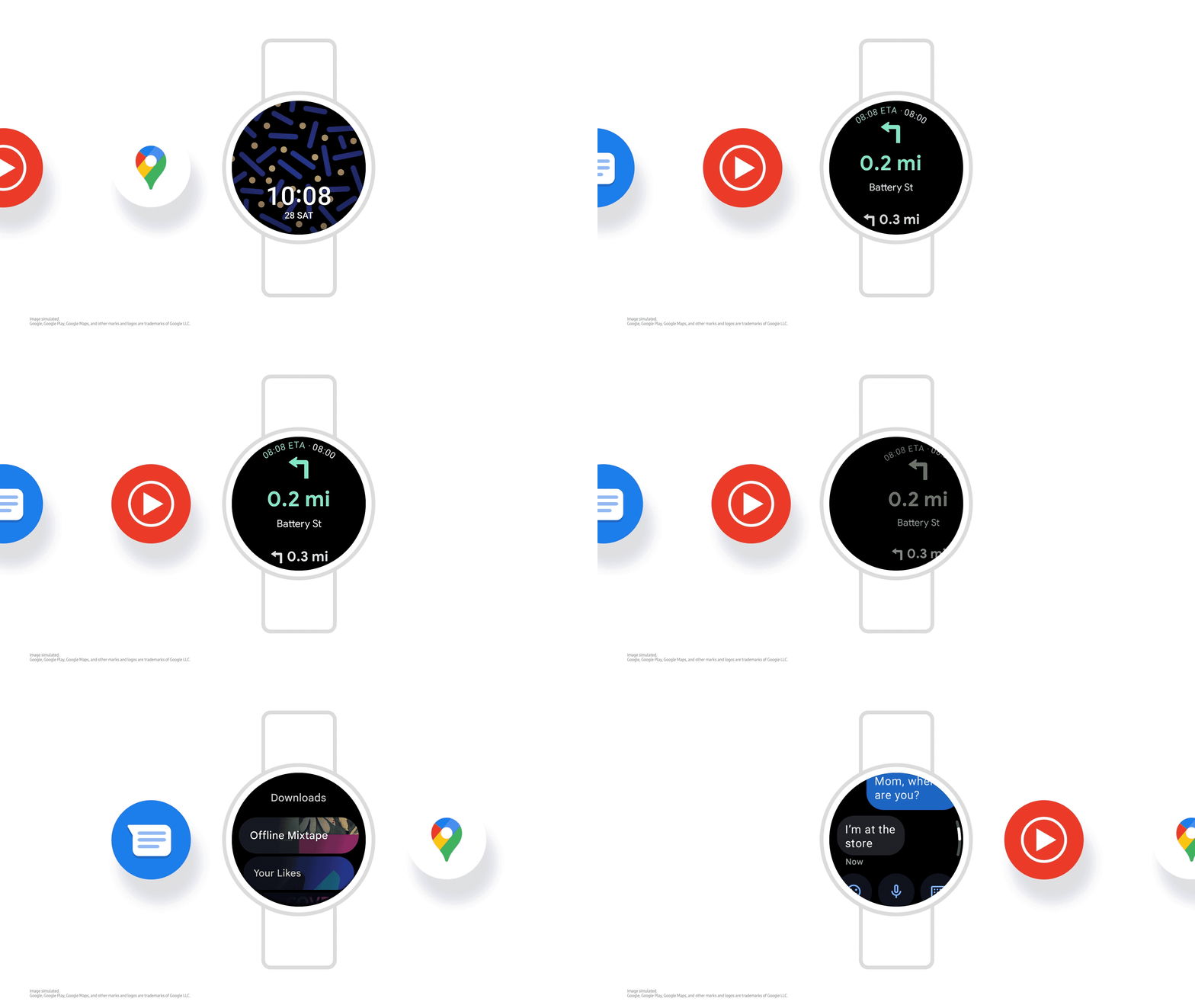
Samsung’s event was arguably the biggest of the day, but the presser felt like little more than a placeholder. The biggest news of the press conference was an expansion of a partnership Google announced at I/O last month, while much of the rest of the stream was pointing toward an Unpacked event happening later this summer.

Image Credits: Samsung

In fact, the event closed with a black and white slide reading “See you soon at the next Unpacked,” in case you didn’t get the hint. Bottom line: no hardware.

Lenovo, on the other hand, didn’t hold back. That’s due, in part, to the fact that the company releases a tremendous amount of hardware, so why not tie it to MWC, right?

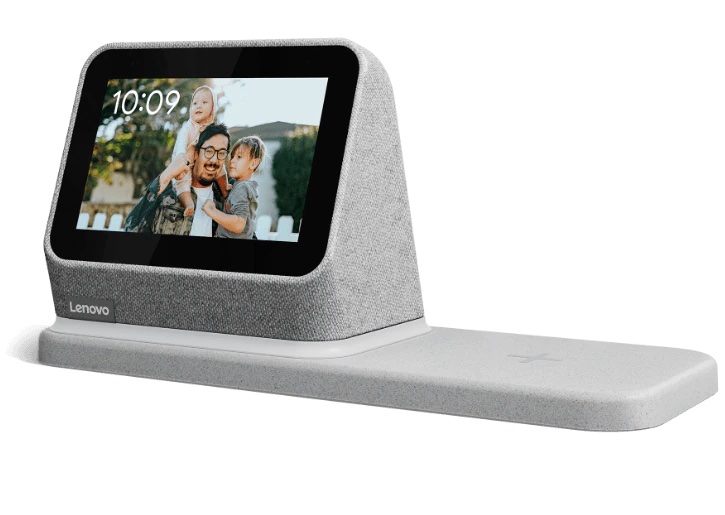
The list of announcements inluces a new version of the Smart Clock Google Assistant alarm clock with a built-in wireless charging pads for phones and several tablets, including the Yoga Tab 11 and 13, which sport combination hanger/kickstand. The 13-inch system also doubles as an external monitor, which is when the kickstand really comes in handy.

Image Credits: Lenovo

TCL got out ahead of the event early, with the announcement of NXTWEAR G – a wearable OLED cinema display. The headmounted device approximates a 140-inch display with a 16:9 aspect ratio. The company also offered a better look at the 20 Pro 5G, which is coming to the States at just a dollar short of $500, featuring a snapdragon 750G processor and a headphone jack to boot.

TCL NEXTWEAR G

Those are your top line headlines for the show so far. The event runs through July 1st, so still plenty of show left, whether or not anyone will be there to see it in person.

Read more about Mobile World Congress 2021 on TechCrunch


28 Jun 2021

Demand Curve: Email marketing tactics that convert subscribers into customers

Email has the highest return on investment of any other marketing channel. On average, email earns you $40 for every $1 spent. And the best part is that email is an owned channel, which means you can reach your subscriber directly instead of relying on social media algorithms to surface your content.

At Demand Curve, we’ve worked with over 500 startups, meticulously documenting growth tactics for all growth channels. We also incorporate what we’ve learned from our agency, Bell Curve, which works with Outschool, Imperfect Produce and Microsoft to name a few.

To understand how to use email marketing effectively, we interviewed email marketers at this year’s fastest-growing startups. This post covers the most profitable tactics they use that capture 80% of the value using 20% of the effort.

If people don’t open it, nothing else matters

The subject line of your email is the most important, yet most marketers neglect it until after crafting the body of the email.

The subject line of your email is the most important, yet most marketers neglect it until after crafting the body of the email.

Increase the open-rate of your subject lines by making them self-evident. You don’t want people guessing why you want them to pay attention to your email. If the subject line is unclear or vague, your subscribers will ignore it.

One trick is to write like you speak. Try using subject lines that use informal language and contractions (it’s, they’re, you’ll). Not only will this save character count, it will also make your copy more friendly and quick to read.

Subject lines should be relevant to your subaudiences. Marketers generate 760% more revenue from segmented email campaigns than from untargeted emails.
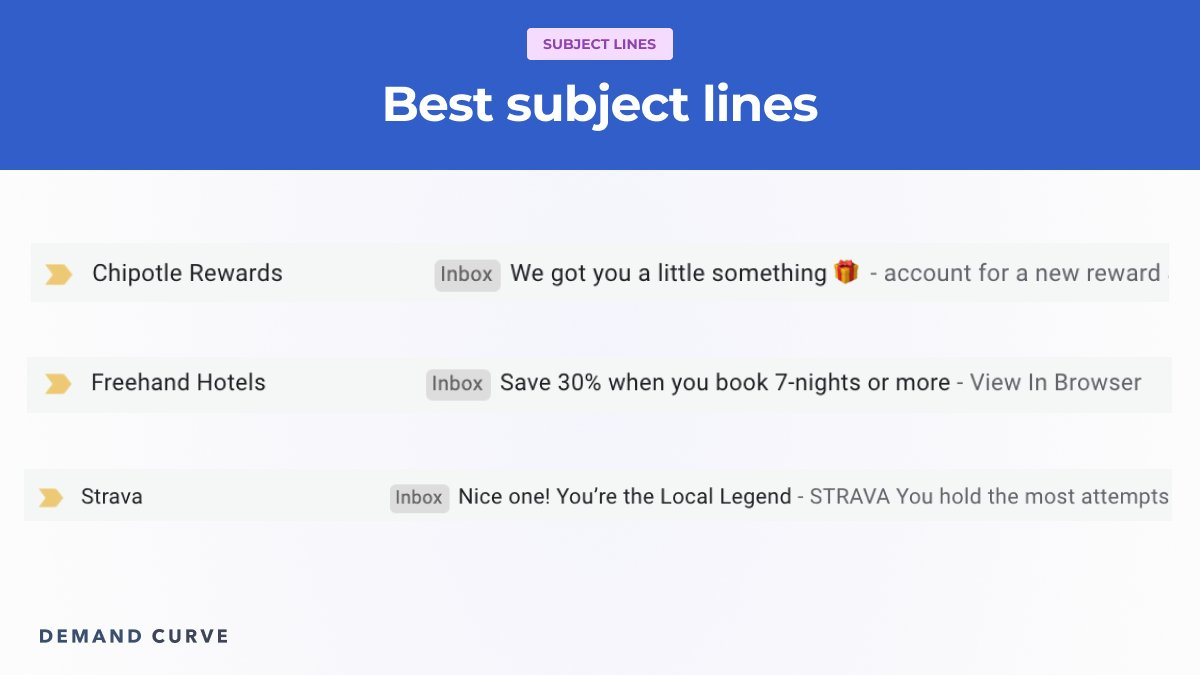
A good subject line will increase the chances of your email being read

A good subject line will increase the chances of your email being read. Image Credits: Demand Curve

If you’re collecting emails from multiple areas on your website, chances are the context will be slightly different for each. For example, people who subscribe after reading an article on ketogenic diets should receive emails that further educate them on keto and seeds products relevant to that lifestyle. Sending them information and product recommendations for vegetarians would not be relevant and could lead to them unsubscribing.

To ensure you’re sending relevant emails to the right audiences, segment your audience using tags and filters within your email marketing platform. Each platform will do this slightly differently, but all modern platforms should allow you to do this. When crafting your email subject line, ask yourself: “Would this email make sense to receive for this segment of subscriber?”

Your subject lines should be short and concise. About 46% of all emails are opened on mobile devices, which means the subject line must be short enough to fit on a smaller screen while getting your point across. Fifty characters is approximately the maximum length a subject line can be before it gets cut off on a mobile screen.

Founders, help TechCrunch find the best growth marketers for startups.

Provide a recommendation in this quick survey and we’ll share the results with everybody.

Keeping your subject lines short also makes them easier to scan when your subscriber is looking through their inbox. Including emojis in your subject line can cut down your character count and emulates how friends send text messages to each other. Including emojis in your subject lines will make your email feel less corporate and more friendly.

Designing emails that get read

Once your subscriber opens your email, there are three outcomes that can follow: read, skim or bounce.

Subscribers that read your emails are the most valuable, because they will consume the full contents of your email. Skimmers will only read the headlines and look at the images you include. Subscribers who bounce will open your email, but if nothing catches their attention right away, they will simply delete or close your email.

You’re going to want to design your emails to minimize the number of bouncers, satisfy readers and provide enough high-level information that skimmers still understand your message.

To minimize the number of bounces, choose an email design that catches the eye and is relevant to your brand. Take the Casper email below for example. The starry night background and moon illustration is directly relevant to the mattresses they sell. Visually branded email designs will help elevate your brand perception.
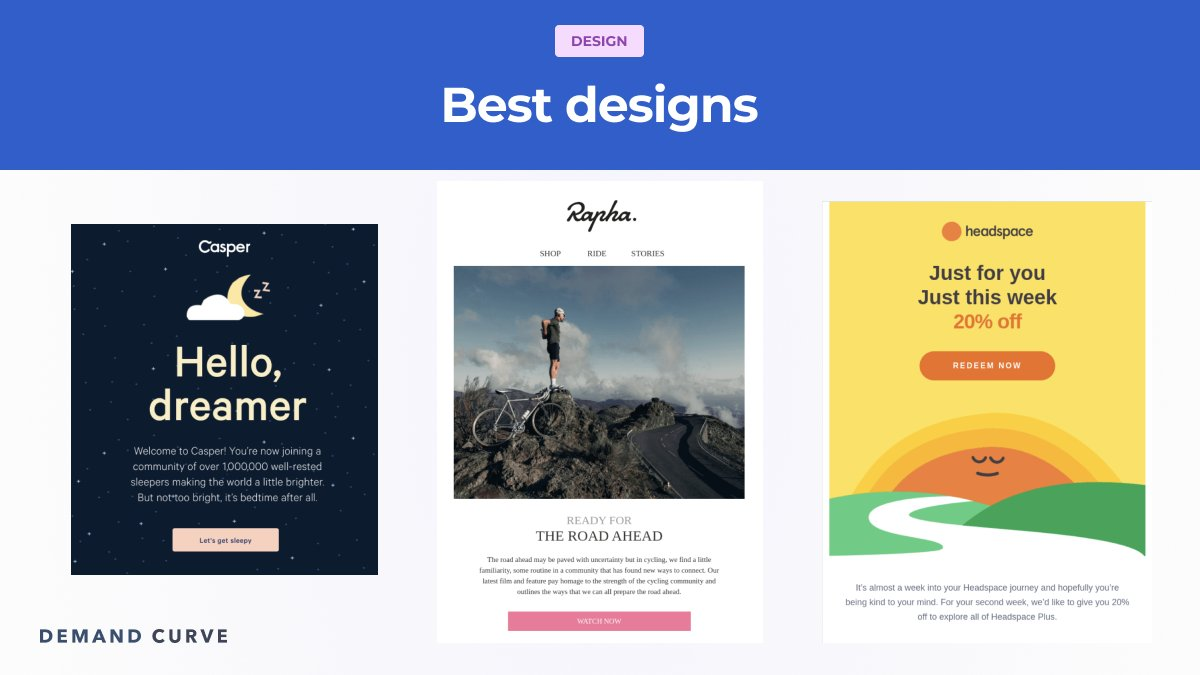
Design your emails to appeal to all kinds of readers

Design your emails to appeal to all kinds of readers. Image Credits: Demand Curve

To optimize for skimmers, write action-focused headlines. Use designs that draw the eye of your reader to key elements. As you can see in the Headspace example, the image of the rising sun pushes your gaze upward to the headline and the call-to-action button. Skimmers should be able to understand the context of the entire email and take action without needing to read the body.

To convert more readers, fulfill the expectation set by the subject line. Readers will be looking for any promises or hints you gave them in your subject line. Be sure to deliver on this promise in the body. Do so in an aggressively concise way — just because they’re reading doesn’t mean they don’t value their time.

Call to actions that convert

The goal of your body copy is to drive people to your call-to-action button (CTA). Your CTA is crucial, because it’s how you convert an email subscriber into a paying customer. To increase the conversion of your CTA, make a valuable promise in your body copy and headers that’s only delivered through your CTA.

Good CTA copy typically begins with a verb that teases what the reader will encounter next:

  • Get your free sample.
  • Redeem discount now.
  • Browse the full inventory.

Low-converting CTA copy is vague or nonactive:

  • Learn more.
  • See inventory.
  • Download.

Your email should only have one CTA. Any more and your conversion will decrease due to unnecessary decision-making. Ensure that the page on your site that your CTA leads to fulfills the promise you made in your body and CTA button.

Recap

Once the focus of the subject line is clear and the desired outcome is chosen, everything else should be crafted to carry the reader step by step through the email, eventually taking them to the desired action.

It’s a good idea to work backward from the desired outcome you want the reader to perform. If the desired outcome is for them to click on a CTA button, frame your subject line, headers and body copy as a valuable promise that can only be achieved by clicking the button.

Consider the experience of your email through the eyes of all three types of subscribers: readers, skimmers and bouncers. Use visual and written prompts that make the purpose of your email clear to all three categories. Failing to do so could lead to unsubscribes and lost revenue.

Email has the highest return on investment than any other marketing channel because you have a captive audience who has opted-in to you communicating with them. Email can drive six times more conversions that a Twitter post and is 40 times more likely to get noticed than a Facebook post.


28 Jun 2021

A startup’s guide to software delivery

One of the biggest factors in the success of a startup is its ability to quickly and confidently deliver software. As more consumers interact with businesses through a digital interface and more products embrace those interfaces as the opportunity to differentiate, speed and agility are paramount. It’s what makes or breaks a company.

As your startup grows, it’s important that your software delivery strategy evolves with you. Your software processes and tool choices will naturally change as you scale, but optimizing too early or letting them grow without a clear vision of where you’re going can cost you precious time and agility. I’ve seen how the right choices can pay huge dividends — and how the wrong choices can lead to time-consuming problems that could have been avoided.

The key to success is consistency. Create a standard, then apply it to all delivery pipelines.

As we know from Conway’s law, your software architecture and your organizational structure are deeply linked. It turns out that how you deliver is greatly impacted by both organizational structure and architecture. This is true at every stage of a startup but even more important in relation to how startups go through rapid growth. Software delivery on a team of two people is vastly different from software delivery on a team of 200.

Decisions you make at key growth inflection points can set you up for either turbocharged growth or mounting roadblocks.

Founding stage: Keep it simple

The founding phase is the exciting exploratory phase. You have an idea and a few engineers.

The key during this phase is to keep the architecture and tooling as simple and flexible as possible. Building a company is all about execution, so get the tools you need to execute consistently and put the rest on hold.

One place you can invest without overdoing it is in continuous integration and continuous deployment (CI/CD). CI/CD enables developer teams to get feedback fast, learn from it, and deliver code changes quickly and reliably. While you’re trying to find product-market fit, learning fast is the name of the game. When systems start to become more complex, you’ll have the practices and tooling in place to handle them easily. By not having the ability to learn and adapt quickly, you give your competitors a massive edge.

One other place where early, simple investments really pay off is in operability. You want the simplest possible codebase: probably a monolith and a basic deploy. But if you don’t have some basic tools for observability, each user issue is going to take orders of magnitude longer than necessary to track down. That’s time you could be using to advance your feature set.

Your implementation here may be some placeholders with simple approaches. But those placeholders will force you to design effectively so that you can enhance later without massive rewrites.

Very early stage: Maintain efficiency and productivity

At 10 to 20 engineers, you likely don’t have a person dedicated to developer efficiency or tooling. Company priorities are still shifting, and although it may feel cumbersome for your team to be working as a single team, keep at it. Look for more fluid ways of creating independent workstreams without concrete team definitions or deep specialization. Your team will benefit from having everyone responsible for creating tools, processes and code rather than relying on a single person. In the long run, it will help foster efficiency and productivity.

28 Jun 2021

The pandemic showed why product and brand design need to sit together

Young startups need to be great at design, not just for their products, but for their brands. The pandemic made that all harder — but lessons are being learned. We caught up with Scott Tong, a startup design expert who advises early-stage companies, to learn more.

The office may still be the best place to hash out big multiteam decisions, he says, but new best practices and modern tools are making remote collaboration easier and easier.

Brand design seems to only be getting trickier, however. “To users,” he explains, “brand and product are lumped together and they each represent the other.”

Today, many users have spent lots of time at home online, often thinking harder about world events and how they are living their lives. They’re scrutinizing what they can observe about a startup to see if its values line up with theirs before they make a decision to sign up (or quit).

The solution, in Tong’s view, is to create a unifying plan where design decisions can address problems before they emerge.

More details are in the interview below. For a full conversation, check out Tong’s talk about design strategy coming up at our TC Early Stage 2021 – Marketing & Fundraising conference on July 8.

The pandemic affected us all. How has it affected user-focused brand design?

The pandemic drove people to consume even more media than before. News about science, politics, race and the economy were unavoidable. Brands have had to navigate a very complex landscape of topics that can be divisive. People increasingly identify with brands that are aligned with their values. But in order to understand a brand’s values, someone has to sift through competing signals — some from the brand itself, and others from vocal supporters and critics. Say the wrong thing and a brand can risk alienating large portions of their audience (including their own employees). If a brand says nothing, their silence can be interpreted as complicity. And if brand messaging comes across as unauthentic, it could spell disaster. It’s a difficult needle to thread. It’s not uncommon for companies to run surveys to gather signals about how their brand is perceived by customers and noncustomers alike.

What new things about users should startups consider when working on designing their identities? What are you advising startups now about designing their brands, versus what you said circa December 2020?

Identities are only one part of a much larger constellation of touch points that make up a user’s perception of a brand. User expectations are extremely high and will continue to rise. Even with their free products, users have gotten accustomed to highly polished experiences. While “high quality” is table stakes for users, the challenge for a company is to pinpoint the handful of dimensions that matter most. That’s why constantly seeking to understand users is so important. Deeply understanding what they care about will help isolate those critical dimensions so teams can focus on areas that will drive the most meaningful impact.

Founders, help TechCrunch find the best growth marketers for startups.

Provide a recommendation in this quick survey and we’ll share the results with everybody.

What do startups continue to get wrong?

One recurring observation is that brand teams and product teams often sit in different parts of a company’s org structure. While there are reasons for this, it’s important to remember that users don’t care about your org structure. To users, brand and product are lumped together and they each represent the other.

Internally, how are companies handling internal challenges like collaborative designing in a more remote world? In-person communication has been vital historically to get all parts of a company thinking in the same way. What is helping those who have gone remote-first succeed (tools, approaches to meeting and documentation, etc.)?

Collaboration tools have never been more abundant. But while tools are plenty, norms around their usage can vary significantly from group to group, even within the same company. Where can I find the project brief? How many back-to-back meetings is too many? How are brainstorms run in a virtual environment? When do I use Slack versus email? Establishing those norms requires conversation and experimentation.

Along with norms around tools, it’s helpful to establish a cadence/rhythm that allows team members to get and stay in sync. Depending on the team, that cadence may be daily, weekly, biweekly, monthly or quarterly, etc., but find the appropriate cadence for each audience.

Alternatively, do you think the demands of good design work will motivate more early-stage startups back into in-person office work?

There are varying opinions on whether being in-person spurs innovation or productivity. The pandemic has forced us all to adapt, and design is no exception. It’s been encouraging to see good design happen in remote work environments, and a lot of that has been enabled by tools and the norms around their usage. While I personally would prefer being in-person, especially at the early stages of company building, I think it’s entirely possible to establish a high-functioning team in a remote environment. Of course there are cases — like hardware or soft goods — where tactile feedback is important and hard to replicate remotely. But even then I’ve seen some successful workarounds (for example, sending the same material sample to every team member). Given that this is all still very new, there will inevitably be hiccups along the way. But a team of willing participants with the right mix of tools and norms can make it work.

Overall, with more teams remote and distributed, it may be even more natural than before to work with a third-party brand design expert. When do you advise startups to bring in an outside consultant today, and how should they work with them?

This depends largely on how design is valued within an organization — as a service or as a partner.

If design is viewed as a partner, then the relationship is ongoing and iterative. This means design is a function that builds, measures and learns alongside their product and engineering counterparts and the benefits of institutional knowledge compound over time.

If design is viewed as a service, third parties make sense, because in a service relationship there is usually a defined beginning and end to an engagement. Clear scope, timeline and deliverables will set this kind of service relationship up for success.

28 Jun 2021

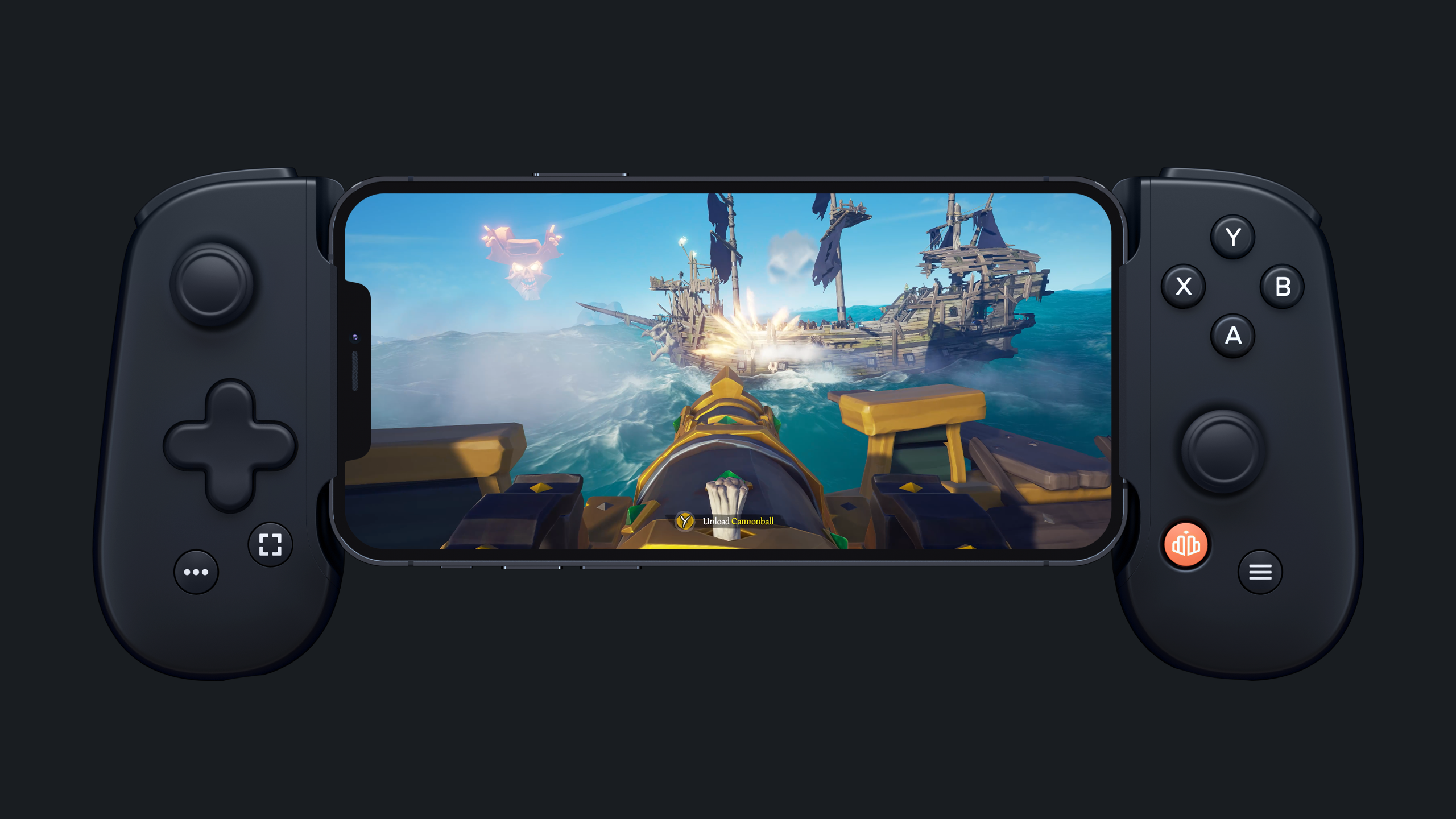
Hit iPhone controller Backbone One scores Xbox Game Pass partnership at xCloud’s iOS launch today

Backbone One, the killer iPhone game pad I profiled here late last year has just scored the mother of all tie-ups for a gaming accessory. It’s getting bundled with Xbox Game Pass Ultimate as it launches on iOS today alongside the xCloud game streaming service.

As a part of the deal, Backbone is being bundled with Xbox Game Pass in a new retail packaging that gets the Designed for Xbox stamp, making a Backbone + iPhone combo the closest thing we’ve ever seen to a portable Xbox. 

In my last piece I noted how Backbone cleverly used the accessory APIs built into iOS to offer super slick functionality for its cross-game dashboard. It’s been updating that dashboard to get better about showing you games, exposing you to new games and letting you use its clipping features to share killer plays with your friends. It’s one of the best gaming apps I’ve seen on iOS in years, and it has big potential to create a cross-universe place to play for the biggest gaming audience in the world. 

The Capture Button on Backbone One works with Xbox Cloud Gaming and lets you share it as a link. There’s also a new Xbox Game Pass feed and a way to move between Xbox and iOS games in the same interface. There’s  also a big callout for Xbox Remote Play, a feature that’s still super-under-utilized and actually quite good on current gen consoles. 

And the package even makes use of an AppClip to display an AR version of Backbone running xCloud for people happening on the retail packaging at a store. 

The Backbone team continues to impress with its slick and clever integrations and solid instincts. The game controller pedigree of the team shows (some original Xbox 360 controller team members worked on Backbone) but the software aspects are the most impressive. The way that Backbone unifies gaming experiences across AAA iOS ports like Warzone or Minecraft, Xbox and Playstation Remote Play and now native xCloud games feels like the way of the future for mobile gaming in a way that none of the individual players, including Apple, has managed to get right. 

Even though xCloud games are web based they are treated and presented as native apps inside Backbone’s really well done dashboard. I’ve personally played a lot of Destiny 2 over Stadia on Backbone and it feels fantastic, I can’t wait for it to be more directly integrated into the dash with clipping and social like the Xbox cloud titles are today. 

The experience of discovering, downloading and playing a game is better with a Backbone installed than even Apple Arcade now that the team is getting more into curation. They’ve also got a really slick linking mechanism that allows you to download apps right from the App Store if you see a clip of them being shared on your feed. This is how internet native players want to find and play new games — a continuously hyperlinked world of games and streams that makes it possible to see, follow and play without having to stop to manually search for anything.  

It’s also making me yearn for a time when discovering games goes beyond ‘downloading’ them and into a world where I can see a clip shared by a friend, tap on it and be playing a single level or match that gets me hooked before having to go buy the game. It would be a killer acquisition onramp for new players. 

The Microsoft tie up means that someone who purchases the Backbone for $99 from its website or at Microsoft Stores today gets 3 months of Game Pass Ultimate, making this the absolute best deal for new customers considering GPU is $45 alone. That’s bound to be a huge boost for Backbone as a young gaming startup. 

28 Jun 2021

FTC’s antitrust case against Facebook falters but doesn’t quite fall in federal court

An antitrust suit against Facebook by the FTC and several states had the wind taken out of its sails today by a federal judge, who ruled that the plaintiffs don’t provide enough evidence that the company exerts monopoly control over social media. The court was more receptive, however, to revisiting the acquisitions of Instagram and WhatsApp, and the case was left open for regulators to take another shot at it.

The court decision was in response to a Facebook motion to dismiss the suit. Judge James Boesberg of the D.C. circuit explained that the provided evidence of monopoly and antitrust violations was “too speculative and conclusory to go forward.” In a more ordinary industry, it might have sufficed, he admits, but “this case involves no ordinary or intuitive market.”

It was incumbent on the plaintiffs to back up their allegation of Facebook controlling 60 percent of the market with clear and voluminous data and a convincing delineation of what exactly that market comprises — and it failed to do so, wrote Boesberg. Therefore he dismissed the complaints in accordance with Facebook’s legal argument. (I’ve asked the FTC and Facebook for comment and will update this post if I hear back.)

On the other hand, Boesberg is sensible that lack of evidence in the record does not mean that the evidence does not exist. So he his giving the FTC and states 30 days to amend their filing, after which the complaints will be reevaluated.

He also found that Facebook’s logic for dismissing the suit’s allegations regarding its controversial acquisitions of Instagram and WhatsApp was lacking.

Facebook argued that even supposing that these acquisitions were somehow problematic, the FTC is not authorized to prosecute such “long-past conduct” and is limited to more recent or imminent problems. Boesberg was not convinced, finding precedent that essentially says such mergers are legally considered current as long as they exist, and the government can revisit them any time it thinks it has cause.

That may very well be the plan of the FTC’s new Chair, Lina Khan, who has taken a hawkish regulatory position regarding antitrust in general and past acquisitions specifically. At her confirmation hearing she commented that the approvals of the mergers may have been made without complete information and as such represented a “missed opportunity” to understand and build rules around.

The 30 day punt in fact may be a great opportunity for Khan to put her ideas into practice, as the judge practically literally invites them to rewrite the complaint with more information. Whether she and the FTC have enough material to put together a compelling case remains to be seen, but one thing is for certain: Facebook should put the champagne back in the fridge, for now at least. Khan may not stop at a slap on the wrist.

28 Jun 2021

Discord acquires augmented reality startup Ubiquity6

After raising tens of millions from investors and executing a pretty substantial pivot earlier this year, augmented reality startup Ubiquity6 and its team have been acquired by gaming chat app giant Discord.

The ambitious AR startup had raised $37.5 million from a series of top investors including Benchmark, First Round, Kleiner Perkins and Google’s Gradient Ventures who were betting on its vision of building a consumer-facing platform for hosting augmented reality content. Its most recent publicly disclosed financing was a $27 million Series B in October of 2018.

Terms of the Discord acquisition weren’t disclosed, though in recent months the startup seemed to abandon most of the products it had spent its first several years building, suggesting that Ubiquity6 had been having some issues finding wide audiences for its products.

Launching back in 2017, Ubiquity6 hoped to build an app that would be the central way mobile phone users would browse augmented reality content. In late 2019, the startup launched a product called Displayland, which aimed to gamify the process of 3D scanning physical environments with a smartphone’s camera.

The company’s efforts to find mass adoption were hampered by a mobile AR market which has largely failed to gain any momentum in recent years despite hefty investment from tech giants including Apple and Google.

In early 2020, CEO Anjney Midha told TechCrunch that the startup had some 65 employees.

In recent months, Ubiquity6 had executed a pretty drastic pivot, leaving augmented reality completely behind in favor of building out a desktop platform that allowed users to play simple online party games together remotely. The beta platform, called Backyard, was designed for pandemic era habits that seem to be on the decline as the US springs back into action. Backyard was discontinued this week as part of the acquisition announcement.

In a Medium post announcing the acquisition, Midha seems to downplay any expectations that Ubiquity6’s augmented reality technology will be living on inside Discord.

“Our mission at Ubiquity6 has always been to unlock new ways for people to connect through shared experiences,” Midha wrote. “Joining Discord today allows us to accelerate that mission — Ubiquity6’s team, Backyard product and multiplayer technology will be integrated into Discord.”

28 Jun 2021

Ending the mental health stigma in the tech community

The road to entrepreneurship is never easy. The process is stressful and requires a tremendous amount of hustle, risk-taking and comfort with ambiguity. The sacrifices are innumerable, and they sometimes come at the expense of a person’s mental health.

Founders often find themselves in situations where they are under-resourced and overcommitted. While it’s exciting to chase a dream, the weight of responsibility — to employees, investors and customers — can feel overwhelming.

Compounding this issue is the reluctance many founders have to disclose how they’re feeling to those closest to them for fear that they will be perceived as a “failure” or ill-equipped to perform their job. Imagine for a moment that a founder is struggling with addiction or substance abuse because of the demands and pressures of running their company. Now imagine compounding the worry and anxiety by having to reveal something like this to investors.

Michael Freeman, a psychiatrist and former CEO who serves on the faculty of the University of California San Francisco School of Medicine, investigated the prevalence and characteristics of mental health conditions among entrepreneurs.

Founders are twice as likely to suffer from depression, six times more likely to suffer from ADHD, three times more likely to suffer from substance abuse and twice as likely to have suicidal thoughts than a demographically matched comparison.

He concluded founders are twice as likely to suffer from depression, six times more likely to suffer from ADHD, three times more likely to suffer from substance abuse and twice as likely to have suicidal thoughts than a demographically matched comparison. Freeman found that entrepreneurs are 50% more likely to report having a mental health condition, with some specific conditions being incredibly prevalent among founders.

The statistics are eye-opening, but the real, tangible impact can be truly devastating.

I say all the time that if I have a sore arm or a sore shoulder, I’ll come into work and I’ll whine about it. But if I couldn’t sleep last night or I’m paranoid about going outside or I’ve been taking too many sleeping pills or drinking too much wine, I won’t talk about it.

I’ll say that I’m going to my doctor to get my shoulder fixed, but I won’t say that I’m going to talk to my therapist.

At QED Investors, we experienced the terrible results of this silence firsthand. In 2018, we lost our partner Greg Mazanec after a long battle with substance abuse. Since then, we’ve been working with Greg’s family to determine how we can do our part to prevent others in the VC and startup worlds from suffering the same fate.

I can’t speak highly enough of Greg, both as a personal friend and a colleague. He was the definition of an amazing human being — an orthogonal thinker, tenacious, brilliant, quirky. We lost him far too soon. Today, we carry him around on our shoulders.

We had a team of 15 people at the time, so you can imagine how close everyone was. I swore to myself and to his family that I would talk about him wherever I had the chance. So, whenever I get in front of LPs or my portfolio companies, I bring this issue out into the open to tackle this corrosive stigma head-on.

Taking mental health discussions out of the shadows can massively change the trajectory of outcomes. Our world of venture capital is replete with people who are going through these kinds of difficulties, even before the COVID-19 pandemic exacerbated people’s fears and worries. People have felt increasingly isolated, depressed, anxious and helpless. Some may have turned to opioids or another form of addiction or substance misuse.

The research is clear — support from friends, peers and colleagues is pivotal in conquering mental illness. As companies start returning to the office or adopting a home-office hybrid, organizations have a real chance to refocus their company cultures, destigmatize addiction and make mental wellness a priority. This is a unique window to focus on this disease.

The Mazanec family created Operation Lighthouse to address substance abuse and addiction in the ecosystem most dear to Greg — the founder and entrepreneur community. It was the easiest of decisions for QED to lean in heavily to support this wonderful initiative.

Earlier this year, QED piloted a program called Just Five with three of our portfolio companies. Created by national mental health nonprofit Shatterproof, Just Five delivers, in 5 minutes per lesson, the most important concepts and facts regarding addiction.

Today, we are excited to roll out that same self-paced and anonymous educational program free of charge to more than 16,000 employees across all 50 of QED’s U.S.-based portfolio companies.

This program’s intent is to provide mental health education and catalyze informed discussion to ultimately reduce stigma.

Over the course of the year, we intend to expand the reach of this program to our international portfolio companies, as well as to other VCs who might wish to support their founders. A Spanish-language version is already planned.

Each of the six lessons has a specific theme. The first two lessons touch on the science of addiction and how certain factors such as age of first use, genetics and environment can explain why some people become addicted and others do not.

The middle lessons explain the dangers of opioids and the signs, symptoms and treatment options for substance abuse, while the final topics touch on ways people can help. The majority of the overwhelmingly positive feedback we have received so far has been centered around those final two lessons. We learned something that we anecdotally already knew — people want to help, but those who need help the most don’t always know how to ask for it.

I’ve taken every opportunity I’ve had to discuss mental health over the past few years. I truly believe that if you destigmatize it, people can deal with it. It’s a solvable problem. Just like your sore shoulder, it can be fixed. We just have to do a better job at creating a culture where people can take the first step and speak openly about it.

We can — we must — make a difference. Have your voice join mine.

28 Jun 2021

Facebook to target Nigerian learners with educational app Sabee, created by its R&D team

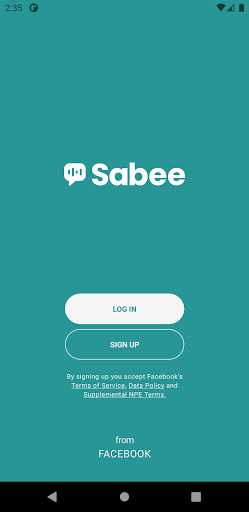
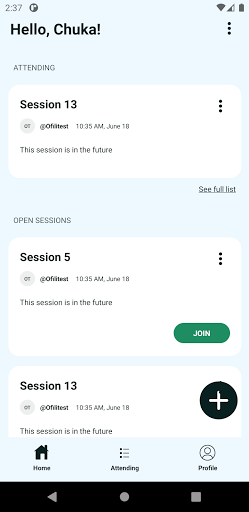
Last fall, Facebook announced it was opening an office in Lagos, Nigeria, which would provide the company with a hub in the region and the first office on the continent staffed with a team of engineers. We’ve now spotted one of the first products to emerge from this office: an education-focused mobile app called Sabee, which means “to know” in Nigerian Pidgin. The app aims to connect learners and educators in online communities to make educational opportunities more accessible.

The app was briefly published to Google Play by “NPE Team,” the internal R&D group at Facebook, which has typically focused on new social experiences in areas like dating, audio, music, video, messaging and more.

While the learnings from the NPE Team’s apps sometimes inform broader Facebook efforts, the group hasn’t yet produced an app that has graduated to become a standalone Facebook product. Many of its earlier apps have also shut down, including (somewhat sadly), the online zine creator Eg.g, video app Hobbi, calling app CatchUp, friend-finder Bump, podcast community app Venue, and several others.

Sabee, however, represents a new direction for the NPE Team, as it’s not about building yet another social experiment.

Instead, Sabee is tied to Facebook’s larger strategy of focusing more on serving the African continent, starting with Nigeria. This is a strategic move, informed by data that indicates a larger majority of the world’s population will be in urban centers by 2030, and much of that will be on the African continent and throughout the Middle East. By 2100, Africa’s population is expected to have tripled, with Nigeria becoming the second-most populated country in the world, behind China.

Image Credits: Facebook NPE Team

To address the need to connect these regions to the internet, Facebook teamed with telcos on 2Africa, a subsea cable project that aims to serve the over 1 billion people still offline in Africa and the Middle East. These aren’t altruistic investments, of course — Facebook knows its future growth will come from these demographics.

Facebook confirmed its plans for Sabee to TechCrunch after we discovered it, noting it was still a small test for the time being.

“There are 50 million learners, but only 2 million educators in Nigeria,” said Facebook Product Lead, Emeka Okafor. “With this small, early test, we’re hoping to understand how we can help educators build communities that make education available to everyone. We look forward to learning with our early testers, and deciding what to do from there.”

Image Credits: Facebook NPE Team

The disparity between learners and educators in Nigeria greatly impacts women and girls, which is another key focus for Sabee — and the NPE Team’s efforts in the region as a whole. The company also wants to explore how to better serve groups who are often left behind by technology. On this front, Sabee is working to create an experience that works with low connectivity, like 2G.

We understand the app is currently in early alpha testing with fewer than 100 testers who are under NDA agreements with Facebook. It’s not available for anyone else beyond that group at present, but the company hopes to scale Sabee to the next stage before the end of the year.

There is no way to sign up for a Sabee waitlist, and the app is no longer public on Google Play. It was available so briefly that it was never ranked on any charts, app store intelligence firm Sensor Tower confirmed to us.

We should note that “sabee” and “sabi/sabis” have other, less-polite meanings in different languages, per Urban Dictionary. But the team has no plans to change the name for now as it makes sense in the Nigerian market where the app is targeted.


28 Jun 2021

How one founder navigated a highly personal product category and a major shift in focus

ON this week’s episode of Found, we speak to Rob Schutz, co-founder and Chief Growth Officer at Ro. Ro recently raised $500 million, bringing its total raised to date to near $1 billion. The digital healthcare startup now does everything from telehealth primary care, to operating physical pharmacies, but it originally began life as Roman, a startup addressing men’s health, and specifically, erectile dysfunction.

Rob told us how a windy path from founding a daily deals site in the heady times of Groupon, to teaching at General Assembly, and being an early employee at Bark Box (now just ‘Bark’) led him to meeting up with co-founders Zachariah Reitano and Saman Rahmanian and setting up Roman in the first place. He also detailed how the company evolved, first to address women’s health as well, and eventually to providing much more broad-reaching remote primary care.

We talked about everything from managing the dynamics in a a founder triumvirate (including declarations of love), to dealing with the ongoing complications of a rebrand, to operating a business in an industry with dense regulatory requirements that vary considerably state to state.

We loved our time chatting with Rob, and we hope you love yours listening to the episode. And of course, we’d love if you can subscribe to Found in Apple Podcasts, on Spotify, on Google Podcasts or in your podcast app of choice. Please leave us a review and let us know what you think, or send us direct feedback either on Twitter or via email at found@techcrunch.com. And please join us again next week for our next featured founder.