Year: 2021

27 Jun 2021

Egypt’s Minly raises $3.6M to connect celebrities and fans through personalized experiences

In the past year, we’ve seen a growing trend of creators adopting digital and social media, not just as a supplement to their media presence but also as a cornerstone of their personal brand.

The pandemic has surely accelerated creator economy trends. Many popular artists and figures have had to postpone concerts and live events, subsequently using social media to carry out these activities and engage their fans. Proliferating through Western and far East markets, the creator economy bug, which has made platforms like Cameo and Patreon unicorns, is beginning to take centre stage in MENA.

Today, Minly, an Egypt-based creator economy platform, is announcing that it has closed a $3.6 million seed round to allow stars across the MENA region to create authentic, personalized connections with their fans.

The round, which Minly says was oversubscribed, was co-led by 4DX Ventures, B&Y Venture Partners, and Global Ventures. It also included participation from unnamed regional funds and angel investors like Scooter Braun, founder of SB Projects and Jason Finger, co-founder of Seamless and Grubhub. 

Experts say time spent viewing social media surpassed time spent viewing TV within the MENA region. But one shortcoming with social media is that its content often feels mass-produced. When creators make posts, it’s most times void of personalization to the different categories of fans they possess. In a way, this dilutes the fan experience and limits the extent and number of ways the creator can monetize.

This is where Minly comes in. The company was founded last year by Mohamed El-Shinnawy, Tarek Hosny, and Bassel El-Toukhy. It provides tools for creators to craft what it calls ‘authentic connections’ with their superfans and audience at scale. “In short, our goal is to eventually deliver tens of millions of unique, unforgettable experiences to fans each year,” El-Shinnawy said to TechCrunch.

Shinnawy, who brings more than 15 years of media and technology experience to the table, is the chief technology officer at Minly. He sold his first company Emerge Technology to a U.S.-based media company. He has also delivered work for Hollywood’s top studios, such as Sony Pictures Entertainment, Universal, Disney, Fox, and Warner Brothers, while playing a role in the global expansion of Apple TV+, Disney+, and Netflix’s to the MENA region.

Minly has experienced rapid growth since launching late last year. It has more than 50,000 users along with an impressive list of popular regional celebrities.

On the platform, users can buy personalized video messages and shoutouts from their favourite celebrities, get unprecedented access to the talent they admire most, and celebrities, in turn, connect with their fans on a deeper level. Minly has also assembled a diverse roster of celebrities. They range from traditional movie and television stars and athletes to musicians and internet influencers. Some of these popular figures include Tamer Hosny, Fifi Abdou, Assala Nasri, and Mahmoud Trezeguet.

We think that we have already differentiated ourselves from other creator economy platforms in the region. We do this by offering the best catalogue of stars and user experience. And our entire team is working hard to grow this gap even further,” said El-Shinnawy on the crop of stars Minly has onboarded to the platform

The CTO further gave instances of the connection created by celebrities with their fans. Last year, Egyptian singer Tamer Hosny made a surprise appearance at two fans’ engagement party. Actress and dancer Fifi Abdou also sent a personal message to one of her biggest fans, who has Down syndrome.

Minly takes a small commission on transactions made through its platform. However, the majority of the transaction price, a figure Minly didn’t disclose, goes directly to the creator. Minly also encourages celebrities to automatically donate a portion of their earnings to partner charities on the platform.

Minly’s knack for creating a personalized experience was one reason Pan-African VC firm 4DX Ventures invested. The firm’s co-founder and general partner Peter Orth, who will be joining Minly’s board, said the company is fundamentally changing the relationship between celebrities and fans in the MENA region.

“The team has both the ambition and the expertise to build a full-stack digital interaction platform that could change the way digital content is created and consumed in the region,” he added. 

The creator economy market surpassed $100 billion in value this year and is still growing at an impressive rate. The pace of content creation will only speed up since surveys suggest that being a YouTuber or TikTokker or the most common term, a Vlogger is one the most desirable careers among Gen Zs. VC firms like a16z, Kleiner, and Tiger Global have also heralded this growth. They have considerably contributed to the more than $2 billion invested in creator economy platforms this year.

In MENA, there’s a huge opportunity for Minly. The region has over 450 million, of which 30% are young people. This demography is known to have a deep connection with social media, and El-Shinnawy believes MENA will soon contribute to a large part of the total creator economy. For Minly, the goal is to capture a huge portion of that spend and become a multi-billion dollar category-leading company. The creator platform has a case to do so. As it stands, the opportunity to build a creator economy one-stop-shop in MENA is huge compared to other regions that already have multiple entrenched incumbents. Also, Minly is one of the few platforms in the region with meaningful venture funding.

“The creator economy is in its infancy and growing at lightning speed. We have the opportunity to build this category’s first unicorn in MENA,” the CTO remarked.

With this investment, Minly is doubling down on building local celebrity acquisition teams in Egypt and other parts across MENA and the GCC, where it has seen significant traction. The company will also scale its engineering team to churn out more products to build a horizontal creator platform.

26 Jun 2021

This Week in Apps: Android apps on Windows 11, App Store Search Ads hit China, Apple argues against sideloading

Welcome back to This Week in Apps, the weekly TechCrunch series that recaps the latest in mobile OS news, mobile applications and the overall app economy.

The app industry continues to grow, with a record 218 billion downloads and $143 billion in global consumer spend in 2020. Consumers last year also spent 3.5 trillion minutes using apps on Android devices alone. And in the U.S., app usage surged ahead of the time spent watching live TV. Currently, the average American watches 3.7 hours of live TV per day, but now spends four hours per day on their mobile devices.

Apps aren’t just a way to pass idle hours — they’re also a big business. In 2019, mobile-first companies had a combined $544 billion valuation, 6.5x higher than those without a mobile focus. In 2020, investors poured $73 billion in capital into mobile companies — a figure that’s up 27% year-over-year.

This week, there’s big news with the expansion of Android apps to Windows. Apple also came out swinging against sideloading and expanded its profitable Search Ads business to China…with more than a few caveats. Meanwhile, TikTok launched its own take on mini-apps after tests, making its videos more interactive.

This Week in Apps will soon be a newsletter! Sign up here: techcrunch.com/newsletters

Top Stories

Microsoft brings Android apps to Windows 11

Image Credits: Microsoft

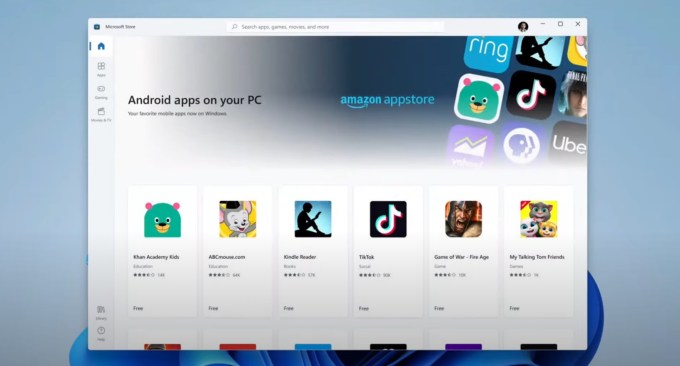
Microsoft surprised industry observers this week at its Windows 11 event with news that it will make Android apps available on the next version of its operating system. The apps will run natively on Windows 11 and can be downloaded from Amazon’s Appstore through the new Windows Store included in the updated OS. They’ll also be able to be integrated into the Start menu and pinned to the taskbar, and can tile or “window” as part of the OS’s new application placement user interface.

The Amazon partnership will bring increased attention to the Amazon Appstore, whose importance has somewhat fizzled over the years given the general lack of investment and its close ties to Amazon Fire devices, which are outsold by iPad. App developers today tend to focus initially on the App Store and Google Play, not Amazon’s Appstore. However, bringing some 3 million Android apps to Windows users opens up a huge new potential market for Android. But could it actually make coding for “iOS first” less of a given for certain types of applications — like those that complement the productivity environment enabled by a Windows PC, perhaps?

In the near-term, more consumers may begin to sideload the Amazon Appstore app on their Android devices for their paid app installs in order to gain access to the cross-platform support a Google Play version would not necessarily provide.

Microsoft noted during the event that it’s partnering with Intel to use its Intel Bridge technology to make this Appstore integration possible on x86 systems. However, the Intel-powered apps will also run on AMD and Arm processors, The Verge noted, though the technical details of how that will work were not immediately available.

Microsoft during the event demonstrated how the app integration would work by showing off TikTok running in a vertical format on the new Windows OS. This may not have been the best example, as TikTok has a fairly usable website for watching videos. Meanwhile, the image of the Amazon Appstore in the Windows Store showed other apps including those from Ring, Uber, Yahoo, Khan Academy, Kindle, Game of War: Fire Age, My Talking Tom Friends, and more, which indicates this is a comprehensive rollout.

Ahead of this news, Amazon announced it would soon lower its cut on app developer revenues from 30% to 20%, as part of a new program for small businesses. The program, which also includes promotional credits for AWS, could help boost developer support for the Appstore. Plus, on the larger Windows Store, non-game developers can keep 100% of their revenue if they use their own payment platforms for in-app purchases. Apps and games using Microsoft’s payment platform split revenue with the company at 85%/15% and 88%/12%, respectively. This sort of commission structure combined with the introduction of Android apps makes the Windows Store seem more developer-friendly than Apple’s App Store, which Microsoft likely hopes will keep it out of antitrust crosshairs.

Apple launches Search Ads in China

Apple this week brought its search advertising business to China five years after its U.S. debut. The system allows developers to bid on an advertising slot based on keywords users search for in the App Store. Though the move opens up a major new market for app developers, the system in China is fairly complex and comes with several caveats. Developers will need to upload documents, including business licenses and other files, that confirm their account has been approved before being able to run ads. Apple may then submit these documents to third-party databases and government entities for validation.

According to Apple’s guidelines, the industry-specific licenses required exclude most foreign businesses from directly advertising in mainland China. Instead, they’ll need to work with local partners who will run ads on their behalf.

The expansion for now only includes the Search Ads in the App Store and not the newly added Search Tab ads, where developers can bid on a slot directly on the Search tab in the App Store itself.

Weekly News

Platforms: Apple

Apple released iOS 15 beta 2 and iPadOS 15 beta 2 for app developers. New features include support for SharePlay, updated Memoji outfits, a new Maps icon, a welcome screen in the updated Weather app, access to launch Quick Note with a swipe from bottom-right on iPad, Shortcuts improvements, bug fixes for iCloud Private Relay, and more. WatchOS 8 beta 2 was also released.

The iOS 15 beta code also revealed Apple is working on a feature that will allow users to update to a beta release when restoring a device from backup instead of being told that you can’t use backups of newer iOS versions.

iOS and iPad apps will now be able to request privileged access to more RAM in iOS 15, exceeding normal system memory limits, 9to5Mac also discovered.

✨ Apple this week published a white paper (PDF) where it presents its argument against any legislation that would force the company to allow sideloading of apps on iOS or iPadOS devices outside its App Store. While there are consumer benefits to allowing for choice — like getting your hands on apps that don’t fit Apple’s rules, for example — Apple makes the case that sideloading could compromise user privacy and security in a number of ways, including potentially opening up users to being scammed and making it more difficult for parents to lock down kids’ iPhones, among other things. Pirated apps could also eat into legitimate developer revenue, not to mention Apple’s own. Apple’s Director of User Privacy Erik Neuenschwander went into further detail with Fast Company about Apple’s position, noting attackers could even trick users into thinking they were downloading from the App Store when they were not.

Platforms: Google

Google’s Android Essentials is now generally available through additional partners in the U.S., the U.K, Japan, France and Germany, with more countries coming soon after a more limited testing period. Essentials makes it easier for companies to manage and secure Android devices in the workplace by enabling features like remote wiping of lost or stolen devices, enforcing a screen lock, and preventing sideloading of applications.

Google opened its Play Media Experience Program globally. The program allows developers to invest in scaling their services beyond mobile to reach other devices including experiences across Video (Android TV, Google TV, Google Cast); Audio (Wear OS, Android Auto, Android TV, Google Cast); and Books (tablets, foldables, integration with the new Entertainment Space.)

E-commerce

Facebook announced a trio of new commerce features this week, including the expansion of its Shops service to WhatsApp as well as Marketplace in the U.S.; Shop Ads, including AR try-on ads in the U.S., and an A.I.-based Visual Search feature on Instagram, where users can upload photos to find similar items.

Augmented Reality

Apple launches an AR-enabled Snapchat Lens to promote Apple Pay Express Transit in New York. The Lens lets users ride the subway through Kings Theater in Flatbush, the Sea Glass Carousel in Battery Park, and the Great Hall at the New York City Hall of Science.

TikTok and Spotify teamed up with makeup brand MAC on a digital campaign that offers an AR lens with lip colors users can virtually try on. The campaign involves MAC’s Love Me Liquid Lipcolor and is running in the U.K. across both apps.

Social

TikTok launched its own mini-app integrations. With its new Jump feature, creators can add interactive third-party integrations to their videos from services like Whisk, Quizlet, Breathwrk, StatMuse, Tabelog, BuzzFeed, Jumprope, IRL and WATCHA.

Instagram said it’s testing a new feature in English-speaking markets that will mix Suggested Posts into your Feed. The company will use its algorithmic suggestions to help point people to accounts they may want to follow, with an apparent goal of increasing time spent in the app.

Twitter announced a new feature will make it possible to share tweets directly to Instagram Stories. To use the feature, which is only on iOS for now, you’ll tap the share icon on a tweet and select “Instagram Stories.” When the Instagram app opens, you can resize or reposition the tweet sticker before posting.

Snap made a deal with Universal Music Group. The deal allows Snapchat users to add song clips from the UMG catalog to their Snaps and on Spotlight, Snap’s TikTok rival.

Twitter has opened up applications for U.S. users who want to test its Ticketed Spaces and Super Follows features. The company said only a “small group” will be able to test the features for the time being. Super Follows lets creators charge $2.99, $4.99, or $9.99 per month for exclusive content. Ticketed Spaces lets creators charge between $1-$999 for access to live audio rooms.

Messaging

Newly relaunched mobile app Squad debuted an audio-based mobile messenger that allows friends to send voice messages to one another that expire after 14 hours.

Dating

After a handful of competitors took on Tinder with video-based dating, Tinder this week introduced a feature that allows daters to upload up to nine videos to their profiles. It also added a speed-dating feature called “Hot Takes” that lets unmatched users chat for a short period before swiping left or right, from 6 pm to midnight on weekdays.

Streaming & Entertainment

YouTube for iOS is officially gaining support for picture-in-picture in the U.S. The feature will allow all users, both free and paid, to watch YouTube while using other apps on their iPhone.

Clubhouse was spotted working on DM text chat feature called Backchannel that would allow users a new way to connect.

Kuaishou, the operator of China’s second-largest short-form video app behind TikTok (Douyin in China), reaches 1 billion monthly active users. The company says the MAU figure includes all of its existing platforms in China, plus its Kwai and Snack Video apps in international markets.

Wattpad and WEBTOON merged their studio divisions to create Wattpad WEBTOON Studios. The deal follows South Korea-based Naver’s recent acquisition of Wattpad in a transaction estimated to be more than USD$600 million, which aligns the two storytelling and entertainment divisions. Both will benefit from the company’s data-driven approach to sourcing content from storytelling apps to turn into TV shows, movies and books.

Gaming

New titles came to Google Stadia, including Madden NFL 2022 — the first sports title to launch on a cloud gaming platform. Google Stadia’s Android TV app also launched on the Play Store with a “Coming Soon” message.

Player spending in U.S. mobile sports games rose 16% year-over-year to $648.8 million, according to Sensor Tower data. The top app by player spending in the U.S. between June 1, 2020 and May 31, 2021 was Golf Clash from Playdemic, which generated $132.8 million. The No. 2 and No. 3 grossing Sports titles were 8 Ball Pool from Miniclip and Fishing Clash from Ten Square Games.

More than half of the $175 billion earned by the games industry this year will come from mobile games, per Newzoo and Arm’s annual report. Mobile games will be increasingly high-fidelity and cross-platform, the report said.

Classic mobile game Jetpack Joyride is also being added to Apple Arcade, following a recent announcement that more classic games would be soon added to the subscription gaming service.

Health & Fitness

Google and the state of Massachusetts got busted by silently installing the state’s COVID-tracking service, MassNotify, on users’ devices without consent. The auto-installed version isn’t an app and instead is only available as a setting users could enable or disable.

Government & Policy

Indian microblogging app Koo is selling itself as a partisan Twitter alternative in Nigeria by supporting government restrictions on social media platforms.

A French court has set a date in the case over allegedly abusive App Store developer contracts brought by the finance ministry against Apple. The hearing will take place Sept 17, 2021, and could influence Apple’s decision to change developer terms and agreements.

Google may soon face antitrust claims over its Play Store from several U.S. states, Reuters reported. A group of state attorneys general may file a lawsuit against Google as early as next week, the report claims, citing sources. The investigation is being led by Utah, Tennessee, North Carolina and New York.

Security & Privacy

Enterprise customers using Jamf to manage Macs gained access to a new Jamf Unlock app for iPhone, which allows users to unlock their Macs using Face ID on their iPhone.

Funding and M&A

? MAJORITY raised $19 million in seed funding for its mobile banking service for migrants. The app offers a $5 per month subscription that offers an FDIC-insured bank account, debit card, mobile credit, and at-cost international calls. The round was led by Valar Ventures, with participation from Avid Ventures, Heartcore Capital and several Nordic fintech founders.

? Mobile commerce startup Via raised $15 million in Series A funding for its suite of mobile marketing tools for e-commerce apps. The round was led by led by Footwork, the new venture firm co-founded by former Stitch Fix COO Mike Smith and former Shasta Ventures investor Nikhil Basu Trivedi. The startup has generated $51 million in sales since May 2020.

? Viva Republica, the maker of Korean financial super app Toss, raised $410 million at a $7.4 billion valuation. The app offers standard neobanking features, as well as P2P payments, money transfers, loans and more.

? Sporttrade raised $36 million for its sports betting and stock trading combo service, which is set to release its app in New Jersey later this year. Investors included former heads of Nasdaq and MGM Resorts.

? EA is acquiring Warner Bros. Games’ Playdemic mobile games studio for $1.4 billion in cash. Playdemic is best known for “Golf Clash,” a top mobile game in the U.S. and U.K. with over 80 million installs to date.

? Charlotte, N.C.-based mobile payments platform Payzer raised $19.5 million according to an SEC filing. The company offers an end-to-end management platform for contractors on a subscription basis.

? Happs raised $4.7 million in post-seed funding for its multicast livestream platform aimed at the creator economy. Users can broadcast live to Facebook, YouTube, Twitter and Twitch simultaneously via the app, and view live comments from all supported social media sites.

? Amazon’s AWS is acquiring  the secure messaging app Wickr, which has been providing services to government and military groups and enterprises. Wickr had raised just under $60 million in funding, per Pitchbook data.

Downloads

Brave

Image Credits: Brave

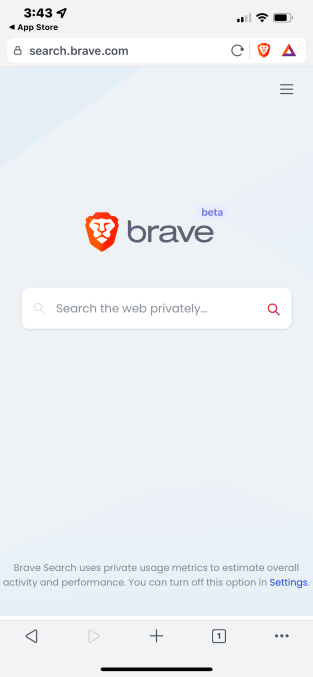
Alternative browser Brave this week introduced its own search service, Brave Search, now available in beta across all platforms — including web, Android and iOS. The service is different from other search engines because it does not track or profile users, and it leverages its own search index for answering queries instead of relying on other providers. Its ranking algorithms will be community-curated and open. Soon, it will also offer options for both an ad-free paid search and an ad-supported search option, allowing users to decide how they want to proceed.

Brave Search was announced in March when Brave acquired Tailcat. The company says the new service will later this year become the default in the Brave browser.

Moonbeam

Image Credits: Moonbeam

Kayak’s co-founder Paul English this week officially launched Moonbeam, a podcast discovery app that leverages a combination of machine learning and human curation to create a newsfeed-style stream of audio content, similar to Podz. Podcasters can also select clips of their shows to feature on the app. Plus, the app allows fans to tip creators directly — and Moonbeam doesn’t take a cut. The app learns what sort of podcasts you may like based on how you interact with those it features, so your recommendations improve over time. Moonbeam can also serve as your podcast player, offering the ability to play back full episodes.

Reading Rec’s

Tweets

26 Jun 2021

Do tech mafias need a modern refresh?

Rumor has it, if you whisper mafia to a venture capitalist or tech reporter, a seed investment and headline appears within minutes. That process quickly turns into seconds if the mafia reference includes the letters S, T, R, I, P and E before it.

Tech mafias, otherwise known as a group of early employees within a company who spin out to start their own, independently successful companies, became a popularized term thanks to PayPal in the early 2000s. As my lede alludes, the term has since become a cliche of sorts. Everything is a mafia, including you, dear Startups Weekly newsletter subscribers. Jokes aside, I’d argue the term is still a helpful way to track the way talent moves in the ever-growing world of startups.

Many venture capitalists have been making subtle, and not-so-subtle efforts, to back the next cohort of star employees turned star entrepreneurs. Wave Capital originally began as an institutional venture capital fund explicitly for Airbnb alumni starting new companies. Ross Fubini of XYZ Ventures introduced Palantir’s first business hire to its first engineer and now invests in the community out of his fund. Eric Tarczynski of Contrary Capital launched Contrary Talent, a program that helps early career professionals navigate the world of entrepreneurship.

This newsletter was going to be about the undercovered mafias that are brewing in tech, but a recent exchange with some of you on Twitter took me in an entirely new direction. Check out the thread if you want to know the next mafioso, but today, I want to explore a more modern way to think about these entities.

Glamorization of mafias

Image Credits: Britt Erlanson / Getty Images

Rebekah Bastian, the chief executive and founder of OwnTrail, isn’t the biggest fan of mafias — even though she’s technically a part of one herself. The first-time founder was the former Zillow VP of Product and VP of Community & Culture who thinks that the growing world of mafias comes with some problematic truths.

“While it’s true that these ‘mafias’ are good for the people within them and often touted with pride, there are reasons that they are problematic from an equity perspective,” she said. First, she pointed to how hiring from and funding employees from a given company, if that company doesn’t have diverse representation (particularly at the leadership level), propagates the inequitable cycles of who is getting hired and funded. Second, she thinks that the press focuses on startups coming out of these companies that serve a privileged subset of the population, instead of mission-focused ones.

What do you think? Her argument is essentially to not glamorize the concept of hiring within existing networks, because if white, male entrepreneurs only hire from within their existing networks, the resulting company will look and act white and male. On the flip side, and this is what gets me excited, underrepresented founders who raise millions of dollars, suddenly have the power to usher in an entirely different group of techies into this world. The Glossier mafia would look quite different than the PayPal mafia.

As I said before, I think “mafias” are certainly a compelling way to track how talent moves. I don’t think we should stop paying attention to the phenomenon or shame people for being opportunistic about alumni groups. It’s how the world works. Instead, I think that there’s hope that problems inherent to them are changing as founding groups themselves become more diverse. To Bastian’s point, I think there’s a way to be more intentional about what is idolized and what is not.

A new descriptor

A few people also mentioned that we should start using a different word to describe this dynamic instead of “mafia” due to its more nefarious connotations. Here’s a list of your best suggestions:

Let me know what you think about all of the above by responding to @nmasc_. In the rest of this newsletter, we’ll chat about BuzzFeed’s SPAC, the early-stage venture market and GM’s startup incubator strategy.

The public market gets buzzed

Image Credits: Malte Mueller / Getty Images

We kicked off Equity Live this week with a hot news item: BuzzFeed is going public via a SPAC and will merge with 890 Fifth Avenue Partners Inc., a publicly traded company. BuzzFeed also disclosed that it will purchase Complex, another media company, for $300 million in cash and shares in BuzzFeed itself; the SPAC deal will help finance its purchase of Complex.

Here’s what to know: Alex gave you five takeaways from BuzzFeed’s SPAC deck so you can better understand what’s going on, beyond the cat pictures and fun quizzes.

As for other public market news, subscribe to The Exchange written by Alex, which includes a smattering of the below:  

Late to the early-stage party?

the recycle logo recreated in folded US currency no visible serial numbers/faces etc.

Image Credits: belterz (opens in a new window) / Getty Images

No worries. Here’s what to put on your early-stage bingo board: emerging fund managers are popping off thanks to new capital support, Li Jin of Atelier Ventures has a must-read thread, and even as summer is in swing, deals still feel frenetic. 

Here’s what else to know: Kirsten took Extra Crunch readers inside GM’s startup incubator strategy, including how they take early concepts and turn them into startups and the company’s favorite messy-stage ideas.

Around TC

Next week, we’re taking you to Pittsburgh to hear from Karin Tsai, the head of engineering there, as well as Carnegie Mellon University President Farnam Jahanian, Mayor Bill Peduto and a smattering of local startups.

Our TC City Spotlight: Pittsburgh event will be held on June 29, so make sure to register here (for free) to listen to these conversations, enjoy the pitch-off and network with local talent.

Across the week

Seen on TechCrunch

Seen on Extra Crunch

Thanks all,

N

26 Jun 2021

Everyone wants to invest in open-source startups now

Welcome back to The TechCrunch Exchange, a weekly startups-and-markets newsletter. It’s broadly based on the daily column that appears on Extra Crunch, but free, and made for your weekend reading. Want it in your inbox every Saturday? Sign up here.

Ready? Let’s talk money, startups and spicy IPO rumors.

Happy weekend, everyone. I hope that your week wasn’t too hectic and that you are getting a good recharge in. That said, we have a lot to talk about.

Something that has been cropping up more and more in my inbox, SMS folder and Twitter DMs are venture rounds from startups with an open-source backbone. Essentially, startups have roots in an open-source project, often with the progenitors of that open tech inside the company itself.

A good example of this at the very end stage of the startup world was Confluent. The company went public this week to pretty good effect, pricing above its IPO range and later appreciating further. Confluent is predicated on the open-source tech Kafka, which you’ve probably heard of.

The Exchange caught up with Mike Volpi of Index Ventures, an early backer of Confluent, on the company’s IPO day. During our chat, we got to nibble on the open-source (OSS) startup world, which Volpi said changed dramatically in recent years. From his telling, venture investors back in 2015 weren’t too hyped about open-source startups, arguing that there already was one (Red Hat), and that that was going to be roughly about it.

If we did our math correctly, Index wound up with a stake worth in excess of $1 billion in Confluent at its IPO price. So, the haters were wrong about OSS.

That said, Volpi added that while he’s as bullish on open-source-focused startups as before, the market has become increasingly picked over as more investors pile into backing the model. That inventors are putting more money to work in the space is not a surprise if you’ve been reading startup funding coverage. BuildBuddy is an example that I wrote about last December. Ron covered Tecton and Airbyte recently.

The trend of venture interest in OSS has been building for some time. Hell, VCs wrote about an explosion of open-source startups for TechCrunch back in 2017. But the Confluent IPO and the recent wave of funding rounds for startups in the space seem to indicate that market appetite for such companies has reached a new, higher plateau. (If you are building an OSS-focused startup and recently raised capital, say hi.)

More on Confluent’s IPO

The Exchange also spoke with Confluent CEO Jay Kreps on his company’s IPO day. A few notes from that chat are worth our time. Here are our key takeaways:

  • Investing is never going back to “normal”: That venture capitalists were able to start doing deals over Zoom was only so surprising. After all, you’d expect your average VC to be somewhat technology savvy. But Kreps said that his IPO roadshow worked well over digital channels, and that he was able to talk to more folks, more quickly than if he had been jet-hopping around the country for face-to-face meetings. If the even more conservative public-market investor set is fine with Zoom, digital pitching is a done deal.
  • Public markets are still burn friendly: Confluent is a quickly growing software company that is not yet profitable. Its IPO reception is a good indication that losing money remains perfectly acceptable in today’s market. Per Kreps, if you have a huge market — he reckons that Confluent has a $50 billion market to attack — and can show that capital is being invested — CEO code for not being utterly torched by an inefficient business model and cost structure — then losses are just fine. This matters for Q3 IPO hopefuls who have more growth than net income. Which is most of them.
  • Even public investors like open source: The Exchange also asked Kreps about being an open-source company approaching the public markets. Was it a positive or negative? A positive, per the CEO, adding that technology has a history of being built around open standards, which means that OSS fits neatly into historical trends. And he added that because open-source projects can have strong organic momentum, it can help public investors see future growth at the corporate level. Neat.

OK, how about even more open source news?

Hope you like open-source software news, because I have even more for you. Earlier this month, Prefect raised a $32 million Series B. I didn’t get to cover the round when it happened, but did catch up with the company this week for a quick chat.

The company is based around the PrefectCore, an open-source project. PrefectCore helps companies make sure that their data inflow is set up correctly, focusing on things like scheduling, monitoring, logging and so forth. The company calls this sort of work negative engineering; it falls into a dead space of sorts. No one really wants to work on it, per the startup.

Notably, Prefect, instead of offering a hosted version of its open-source project, instead sells a monitoring service. It thinks that hosting OSS projects is a somewhat old-hat way of monetizing such projects. So, instead of selling hosting or feature-gating, the company’s commercial product is an API that tracks what PrefectCore is managing. If it reports all green lights, good shit, you’re in swell shape. If not, you have an issue.

But what matters is that Confluent shows that OSS startups can reach a huge scale and become big IPOs. And Prefect indicates that there may be even more ways to skin the OSS cat when it comes to making money off open-source software.

So, expect more OSS VCs deals to land this year.

Alex

26 Jun 2021

Startup leaders need to learn how to build companies ready for crisis

It’s been a tough year for business. From ransomware attacks and power outages to cloud downtime and supply-chain disruptions, it’s never been more important to communicate to customers and stakeholders about what’s going wrong and why. Yet, with partial data and misinformation often spreading faster than official word, it’s also never been harder to deliver accurate and timely messages.

Given the complexities of this environment, I wanted to convene a group of specialists to talk about what the future of crisis comms holds for startups, technology companies, and business more broadly. We had a great set of three folks discuss how to build resilient orgs, handle the decentralization going on in tech today, and how to prioritize crisis management over the mundane tasks every day.

Joining us were:

  • Admiral Thad Allen, who as commandant of the Coast Guard and during his career, was commander of the Atlantic coast during 9/11, and led federal responses during Hurricane Katrina, the Deepwater Horizon oil spill, and the 2010 Haiti earthquake.
  • Ana Visneski, who worked with Allen on building out the Coast Guard’s first digital presence as an officer and chief of media, is now senior director of communications and community at H20.ai and was formerly global principal of disaster communications for Amazon Web Services.
  • John Visneski is the chief information security officer (CISO) at Accolade, and was formerly director of information security at The Pokémon Company. He served 10 years in the U.S. Air Force, where he served as chief of executive communications, and yes, is Ana’s brother.

This discussion has been edited and condensed for clarity

Prepping an organization for catastrophe

Danny Crichton: You’ve all been in disaster communications, in some cases for decades. What are some of the top-level lessons you’ve learned about the field?

Admiral Thad Allen: Great communications and great communications people can’t save a dysfunctional organization. There’s only so much you can do with what you’ve got. I want to say that as a proviso because I’ve seen a lot of people try to communicate their way out of a problem.

The big difference between Katrina in 2005 and the Deepwater Horizon oil spill in 2010 was Katrina was before Twitter and Facebook and Deepwater was after it. In the old days, you went out and did your job. There might be an after-action report, but it was pretty much done within your organizational structure.

I’m going to really date myself. We sent forces into Somalia [around 1993]. It was the first time in history that CNN watched the people come to shore from the amphibious vehicles and I knew life had changed dramatically. There is no operation that takes place these days where the public is not part of the operation, part of the environment, part of the outcomes that are generated. If you fail to realize that, you’re going to fail right away. Anybody who’s got a cell phone enters your world of work.

So the question is, how do you think about that? That’s resulted in a significant Black Lives Matter movement with George Floyd and somebody happened to be there with a cell phone, and if that had not happened, that situation probably would not have turned out the way it did. So the question is what are we to make of that loop?

John Visneski: Generally speaking, your organizational hierarchies are not designed to be optimized for a crisis. They’re designed to build consensus. They’re designed to understand budgets. They’re designed for long-term planning. It’s the same in the military and it’s even worse in the private sector. And so there’s no concept of situational leadership. There’s no concept of who’s actually in charge during a particular crisis.

In recent attacks, the folks that were in my position, didn’t do a good enough job of explaining the technical aspects of what was going on in such a way that their organization could channel that into something that could then be translated to the public.

Ana Visneski: That’s actually called the theory of excellence in crisis communications, which is basically you have to have this transparency and this well-organized system before something goes wrong. And almost everyone doesn’t.

A good example is in 2017, when S3 broke for AWS, which is how I ended up doing crisis comms for them. I looked around and I said, “Well, why don’t we use our crisis comms plan?” And my boss said, “Our what?” And so I ended up building the critical event protocol and I built it based off the Incident Command System (ICS) that is used by federal agencies during a disaster. And essentially it was a big red button that says “Stop! Everyone get on a call, figure out who’s in charge of responding” that just unifies everyone.

Admiral Thad Allen: I’ll give you a classic antidote because I’ve written about it quite a bit. When I was going to the Sloan School at MIT, in December of ’88, we went down to New York and visited a bunch of CEO’s, and one of the days we went across the river to see the CEO at Exxon, a guy named [Lawrence G. Rawl]. During the discussion, I asked, “Bhopal was the biggest industrial accident in the history of the world today. As a CEO running a big corporation, have you thought about what happened if you had a similar Bhopal-type situation?” He spent 20 minutes going over their extremely well-thought-out communications plan and four months later, the Exxon Valdez ran underground and they actually failed at everything.

A Lockheed C-130 plane sprays dispersant over the Exxon Valdez oil spill in Prince William Sound, Alaska, USA. Image Credits: Natalie Fobes via Getty Images.

John Visneski: Your plan that you write down on paper is only as good as how much you practice it. Right? One of the things that the military typically is pretty good at is practicing before you play. Doing mock drills, doing tabletop exercises, having a red team that throws things at you that you might not expect.

Admiral Thad Allen: Yeah. I’ve dealt with a couple of large firms that have had very big problems. The default setting, if you haven’t thought about this ahead of time, is they go to a subject matter expert and hold them accountable for what the organization should do. That is not the way to do it. You need a designated person to create unity of effort. It’s got to involve the C-suite, and it’s got to involve not only your clients and your stakeholders, but your supply chain.

Ana Visneski: We keep talking about training, but just having a plan in the first place is critical. With some of these big companies, they’re so siloed that when something like this happens, everyone’s trying to do the right thing and running into each other. If you don’t have redundancies built in and backups for your backups, you’re going to go down hard.

You’ve got a plan for what happens if your main spokesperson was the incident? Or what happens if there was an earthquake and, all of a sudden, you don’t have your C-suite to talk? And John can talk a lot about this, but the last mile is another problem with crisis comms. If it’s a big disaster, you’ve got to plan around your tech, how are you going to get the information from the field back to where you can actually broadcast it out to people?

Admiral Thad Allen: When I got called to go to Katrina, I was on my way to the airport and the last thing I did was I sent my son along to a Best Buy to get me a mobile handheld and a SiriusXM receiver, so I could have awareness of what was being done. As far as the communications, a thing like that was the smartest thing I did.

Thad Allen (center) in the disaster aftermath of Hurricane Katrina, September 2005. Image Credits: Justin Sullivan

John Visneski: One of the biggest challenges is this all needs to be resourced, right? Your company needs to actually dedicate resources to that prior planning. To being able to build out the infrastructure, to being able to have hot-swap data centers and locations and things like that. And sometimes whether it’s your board or whether it’s your CFO or whoever’s holding the purse strings for your organization, it’s really hard to justify the return on investment that a lot of folks see as sort of a rainy day fund.

So it’s incumbent upon the leadership of the organization, particularly the leadership that is going to be involved in some sort of a disaster response to get ahead of those conversations and understand how disaster response can do things to protect revenue.

Ana Visneski: Because of the pandemic, we’ve had almost two years of shit hitting the fan. So we’re seeing a lot more C-suite leaders going, “We need to know how to be prepared for what happens next.”

Communicating in a decentralized and flat world

Danny Crichton: If you think about the last 20 years, particularly in the private sector, we went from a model of headquarters buildings, large leadership structures all in one place, oftentimes a fairly hierarchical model of how to operate a company, etc. Today, we’re seeing decentralization, and a sort of horizontalness in a lot of companies. How does this new culture affect disaster communications?

Ana Visneski: Well, now that there is this decentralization, it’s incredibly difficult to wrangle all of your people and get everyone on the same page. And you have to think about what happens if Slack goes down. It goes back to redundancies — you have to have multiple ways of contacting your people.

Along that line, I am not a fan of companies saying is, “You can’t post on social media or you shouldn’t do this or that.” Because all that does is sows distrust. Instead, I am a big fan of training your people to do it right. Of course, you have to have company policy that if someone during a crisis is posting secure information or lies, or is just being a racist jerk, obviously there are consequences, but training your people to use the tool right, helps with transparency.

Admiral Thad Allen: My motto when I was commandant was transparency of information breeds self-correcting behavior. If you put enough information out and everybody holds it, organizational intent becomes embedded into how people see the environment they’re in. They’re going to understand what’s going on and you won’t have to give them a direct order to do the right thing. They’ll understand that. And I think that’s really important.

In the military, we have something called a “common operating picture,” and it’s basically a display where everybody’s at, what they’re doing at any one time. It’s not an order. It’s not hierarchical. Instead, it provides context and provides a window into what you’re doing.

So I think there’s a difference between creating a common operating picture and what actually constitutes authority. If you can separate those, the more you put into the former, the less of the latter you’re going to have to do.

John Visneski: I’m based in Seattle. We have an office in Philadelphia, an office in Houston, an office in San Francisco, and an office in Prague. There’s people in all those offices who are critical for our business. The advantage we have is the advantage that a lot of tech organizations take for granted, which is we were already going through a digital transformation, or we were already on the backside of digital transformation. Cloud focus, Software as a Service, Slack, email, Signal on my phone, a million different ways for me to communicate with my team, communicate with leadership and things like that.

What we take for granted is, there are a lot of organizations in the United States and worldwide that have not gone through that digital transformation. No offense to the military, but when I was at the Pentagon, if email went down, you might as well play hockey in the hallways because no work was going to get done.

Admiral Thad Allen: You can add losing GPS as well.

John Visneski: Exactly. So a lot of organizations have had to come to terms with how do they communicate when they’re distributed like that? The answer isn’t one-size-fits-all. It might be different for an Accolade, different from a Facebook, different from a Twitter, different from a Bank of America or a Bank of New York Mellon. Just based on what their architecture looked like pre-pandemic, what their architecture looks now, and what sort of investments they’ve made to future-proof themselves, should something this ever happen again.

Ana Visneski: I was on a Twitter Space recently, and I was talking that in the United States, especially those of us who are in the tech industry, we tend to take for granted all of this stuff. There are all of these assumptions that are made. In reality, not only do you have to deal with the last mile if a disaster happens, but you also have to deal with the fact that not everyone has one of these super computers in their pockets all over the world.

Residents walk past a downed cell network tower in Polangui, Albay province on December 26, 2016.
Image Credits: CHARISM SAYAT/AFP via Getty Images

Talking about technological arrogance, but people forget radio. People forget that there are these older technologies that in a disaster are still where you’re going to go. John makes fun of me all the time, because I’m trying the new thing every time it comes out, but you can’t forget the stuff that works like radio in the morning.

The crisis of crises and how to handle the infinite range of disasters today

Danny Crichton: The next subject I want to get to is the range and diversity of crises that are hitting organizations today. The Admiral had brought up Exxon and ’89. Okay, you’re an oil company, you have an oil spill — I wouldn’t call it predictable, but you can certainly create a plan. You can say, “Here’s how we need to communicate. Here’s how we handle this.”

But look at the range of stuff we’ve had to deal with in the last year. Everything from a pandemic to Texas power outages, wildfires in California, TSMC is dealing with a drought in Taiwan, you’ve got internal employee hostile workplace protests, external protests, ransomware attacks, bitcoin heists, and on and on.

Ultimately does the same toolbox work no matter what the crisis is? Or do different types of crises demand different kinds of responses? And how would you know the difference?

Admiral Thad Allen: I taught crisis leadership in large complex organizations for four years at George Washington University. In the last class, I told my students to write down the worst catastrophe they could ever think would happen that you have to go and wake up the president in the middle of the night. They all wrote it down on a piece of paper, folded it up and put it in a ball cap. I shook it up and pulled one of the pieces out.

I said to the class, “Just listen to what I’m about to say. Thanks for getting up and coming in early to the White House Press Corps office this morning. I want you to know the president was notified at 4:30 this morning about what happened. He and the First Lady were overwhelmed with grief for the loss of life and the impact on the community. We’ve set up a schedule where we’re going to brief the president every four hours and a meeting following the brief to the president. There’ll be a brief to the press 30 minutes after that. The cabinet’s been advised.” And I went on and on and on.

I finished and I said, “What do you think about that?” And James Carville, who was visiting, said, “It’s great” and he asked, “Well, what was the event?” And I said, “I never opened the paper.” So to your point there’s some things that are just a goddammed no-brainer.

Ana Visneski: I took the ICS [Incident Command System] structure and rebuilt it basically to work in the corporate setting. And the reason that’s so effective is it’s built to be flexible. You have someone who’s in charge overall, you have someone who’s in charge of communications. You have someone who’s in charge of logistics. You have someone who’s in charge of security, and it flexes up or down. And so no one can necessarily predict a “black swan” event. But you can build a core response system that is as close to all hazards as possible.

Admiral Thad Allen: Predict complexity.

Ana Visneski: Yes. And you predict that it will be complex and that nothing goes to plan. We’ve made a lot of jokes that nothing prepared me for a wedding during COVID like having been a first responder. Well, my brother got married last year too. And I did a little bit of help there with my background, but for my wedding, nothing was the same. And it’s the same thing during a disaster. Katrina is different from Gustaf. Gustaf was different from Sandy, but they’re all hurricanes at their core.

Admiral Thad Allen: I just spent an hour with a bunch of government employees earlier today on the same topic. What happens in a “complex” situation is that existing standard operating procedures, legal theories, frameworks, and governance break down and do not work, and they have to be replaced with some other way to deal with it.

ICS allows you to do, and with the right standard doctrine, you can get pretty close to a 50-60% solution that will get you headed in the right direction while you figure out the rest of it.

John Visneski: I’ll say at least from the tech side of things is those plans need to abstract technology almost entirely. Take it up to a level where it doesn’t matter what your communications method is from a technological standpoint. Don’t assume that you’re going to have the bits and bytes flowing the way that we do now. Don’t assume cell towers, don’t assume power, don’t assume any of those sorts of things, because the second that you predicate your plan on those assumptions is the second that the complexity is going to come in and tell you you’re wrong. The 40% that is not planned for is going to become what outweighs the 60%.

Ana Visneski: I think one of the things the tech industry kind of runs into is we are so reliant on the technology now that we can’t imagine what we’d do without it. At the end of the day, good crisis comms relies on good people, and good crisis and disaster response relies on the people doing it.

So you have to build your plan around the people and the structure there, and then use the technology at hand during the event to augment what plans you already have for people. Because by the time I’d write a crisis plan for something. If I included Twitter and blah, blah, blah, well, one like John just said, it’s going to break. Or by the time we have the crisis, the technology has changed and we’re using something else. So you got to write it from a perspective of people first and tech is the tool.

Prioritizing crisis management over the day-to-day metrics of a business

Four business people used ropes to tighten their money bags, economic austerity, reduced income, economic crisis

Image Credits: VectorInspiration via Getty Images

Danny Crichton: Okay, so obviously we should all spend more time figuring out how to communicate better during crises. But everyone is busy, and every person is trying to hit whatever metric they need for the quarter. How do you get a low-risk but hugh-impact issue like crisis management on the priority list?

John Visneski: For a B2B organization or a B2C organization or really anybody that’s selling a particular service, typically you need to lean on compliance requirements first. So customer contracts are going to say, from a security perspective, your data security addendum, your privacy addendums, and things that are generally going to have some language that centers around having a business continuity plan, a disaster response plan, an incident response plan, a cyber incident response plan, and then the really good contracts are the ones that actually specify you’ll do it no less than two times a year. So the first thing to lean on is those compliance requirements, because those will actually directly tie to revenue.

Then the secret sauce and what a lot of us in the cyber community are trying to get better at is how do you take that next step? We know that compliance does not necessarily mean security. We know that just because we have a written business continuity plan and that we say we exercise it, we present a report that says we exercise it, doesn’t necessarily mean we’re going that next mile to make sure that we train our employees. The education piece of it is really what we need to advocate to get additional resources for.

Admiral Thad Allen: My pitch to these big companies is if you’ve got a regulatory requirement, you have a plan that’s required. Why would you fund that and not take the opportunity to add just a little bit of incremental effort and resources to take advantage of the natural cycle that you’re required to do anyway?

Ana Visneski: Hit them where the money is, because a good crisis plan can range in price. Let’s say you spend $200,000 getting your system set up. If you’re looking at these companies, a disaster or a crisis could tank your company. Or it could cost you millions and millions of dollars if you’re not prepared. So at the end of the day, the ROI is huge.

And like I said before, with COVID having just happened, I think more of leadership is aware that, “Hey, we’re not crisis proof just because we’re a gaming company or just because we’re whatever.” No, one’s crisis proof. So at the end of the day, you’re going to save money. If you just do it in the first place, because then you just have to update it every year, and you just have to do a little bit of training. The biggest cost is on the front end and then just maintaining it after that and updating it.

John Visneski: Everyone knows that if something bad happens, if you don’t have plans in place, you’re going to lose a shit load of money. But let’s think about it from a consumer standpoint. Generally speaking, your average consumer is becoming much more conversant when it comes to privacy.

Moving forward, it isn’t enough just to say, “If we don’t have this, things can go really bad.” It’s also to say, “We can leverage this if we do this really well. And if we can advertise to our customers, whether it’s another business or whether it’s the consumer that not only do we protect your data, but also we have all these plans in place in order to react to complex situations.” You can actually use that as something that separates you from your near-peer competitors in the business world.

Ana Visneski: At the end of the day, if the trust isn’t there in the tech and the trust isn’t there that you’re doing the right things, it doesn’t matter what you do when a crisis hits. You’re already in the trashcan.


26 Jun 2021

Equity Extras: Q&A from the live show

Hey Equity fam, we have a small clip of extra for you today. After our live show — listen to the recording here, it was good fun — we got to take a few questions from the audience, audio that was not included in the main episode as we didn’t have the time. But we’ve cut it out, given it a short polish, and have it for you today.

If you wanted even more Equity, here you go!

As a small note from the team, we know that this week’s Wednesday episode didn’t have the best audio quality. And to do a Twitter Spaces experiment the same week as a live show might have felt like a lot of change. Don’t worry, it just worked out that way. Equity will keep tinkering and having fun, but we’re back to normal next week.

Enjoy the Q&A, and we’ll see you at our next live show!

— Grace, Chris, Natasha, Danny, and Alex

26 Jun 2021

8 founders, leaders highlight fintech and deep tech as Bristol’s top sectors

The U.K. is gaining in popularity as a great place to start a tech firm. The country is quickly catching up to China on the tech investment front, with VC investments reaching a record of $15 billion in 2020, according to TechNation. A global health crisis notwithstanding, London remained a favorite for investors. U.K. cities made up a fifth of the top 20 European cities, with names such as Oxford, Dublin, Edinburgh and Cambridge rising to the fore in 2020.

Bristol proved especially popular among tech investors last year — local businesses raked in an impressive $414 million in 2020, making it the third-largest U.K. city for tech investment. The city also has the most fintech startups per head in the U.K. outside London, according to Whitecap’s 2019-2020 Ecosystem Report.

Efforts by the city’s private and public sectors to modernize the city have helped it rank among the top smart cities in the U.K., attracting a bevy of tech entrepreneurs. Its proximity to London has meant that it is a good alternative for founders looking for a more affordable stay while letting them tap the capital’s financial resources. The University of Bristol also has the largest robotics department in Europe.


Use discount code HARBOURSIDE to save 25% off an annual or two-year Extra Crunch membership.
This offer is only available to readers in the U.K. and Europe, and expires on August 31, 2021.


Bristol is also home to an important startup accelerator, SETsquared. A collaborative effort by the five universities of Bath, Bristol, Exeter, Southampton and Surrey, the accelerator has supported over 4,000 entrepreneurs and helped their startups raise a total of £1.8 billion. Other startup support players include the new Science Creates VC fund, set up by entrepreneur Harry Destecroix, and TechSPARK Engine Shed.

Key emerging startups from Bristol include Graphcore, Open Bionics, Ultraleap, Immersive Labs and Five AI.

To get a better idea of the state of the tech ecosystem and the investor outlook for this city, we surveyed founders, leaders and executives involved in nurturing Bristol’s startup ecosystem.

The survey revealed that the city has a robust renewable, zero-carbon and fintech startup landscape. Robotics, VR, bio, quantum, digital and deep tech are also areas showing promise. As for the investing scene, although Bristol has a healthy angel network, the city lacks institutional VC, but with London only a drive or train ride away, this has not proved a significant problem.

We surveyed:


Coralie Hassanaly, innovation consultant, DRIAD

Which sectors is Bristol’s tech ecosystem strong in? What are you most excited by? What does it lack?
Bristol is strong in renewable and zero-carbon innovation, fintech and robotics. It’s weak in industry 4.0.

Which are the most interesting startups in Bristol?
Graphcore, LettUs Grow, Open Bionics, Ultraleap and YellowDog.

What are the tech investors like in Bristol? What’s their focus?
A lot of focus on fintech, I think.

With the shift to remote working, do you think people will stay in Bristol or will they move out? Will others move in?
Bristol is a great middle ground between a large dynamic city (plus it’s not far from London) and access to nice countryside area. With remote working we can expect it will attract new residents in the next few years.

Who are the key startup people in the city (e.g., investors, founders, lawyers, designers)?
Aimee Skinner, Abigail Frear and Stuart Harrison.

Where do you think the city’s tech scene will be in five years?
Second major city in U.K. innovation.

Pete Read, CEO and founder, Persona Education

Which sectors is Bristol’s tech ecosystem strong in? What are you most excited by? What does it lack?
Bristol is strong in media/animation, edtech, social impact, health and science. I’m most excited by edtech and the possibility to reach and positively impact millions of students via online learning. It’s weaker in hardware and fintech.

Which are the most interesting startups in Bristol?
Kaedim, Persona Education and One Big Circle.

What are the tech investors like in Bristol? What’s their focus?
There are several very active tech investment networks coming from several angles, e.g., university-led, groups of private angels and tech incubators. The great thing is they all collaborate and share resources, ideas and expertise in initiatives such as The Engine Shed and Silicon Gorge.

With the shift to remote working, do you think people will stay in Bristol or will they move out? Will others move in?
More people are moving in, as Bristol has a great urban lifestyle with easy access to the countryside and Southwest/Wales holiday spots, and an international airport 20 minutes from the center.

Who are the key startup people in the city (e.g., investors, founders, lawyers, designers)?
Jerry Barnes at Bristol PE Club; Abby Frear at TechSPARK; Briony Phillips at Rocketmakers; Jack Jordan-Connelly at SETsquared.

Where do you think the city’s tech scene will be in five years?
It’s developing rapidly with lots of support, so it will be bigger, attracting more investment and definitely more on the international scene five years from now.

Kiran Krishnamurthy, CEO, AI Labs

Which sectors is Bristol’s tech ecosystem strong in? What are you most excited by? What does it lack?
Our tech ecosystem is strong in the aerospace and defense sector. We are excited by the scope and scale of digital transformation opportunities with AI available in this sector. The main weakness in this sector is the slow pace of transformation, especially now due to the pandemic.

Which are the most interesting startups in Bristol?
Graphcore and YellowDog.

What are the tech investors like in Bristol? What’s their focus?
Compared to the U.K. tech sector average, Bristol has a very low proportion of established companies (4% versus 8%), a higher proportion of seed stage companies (42% versus 37%), and a higher death rate (21% versus 17%). It’s a particularly young ecosystem.

With the shift to remote working, do you think people will stay in Bristol or will they move out? Will others move in?
It is possible that people moving out of London will come into Bristol due to the transport links, strong ecosystem and beautiful nature of the city.

Where do you think the city’s tech scene will be in five years?
I wouldn’t be surprised if Bristol turns out to be San Francisco of Europe!

Simon Hall, director, Airway Medical

Which sectors is Bristol’s tech ecosystem strong in? What does it lack?
Bristol is strong in the medtech, veterinary, industrial sectors.

With the shift to remote working, do you think people will stay in Bristol or will they move out? Will others move in?
Others have moved in.

Who are the key startup people in the city (e.g., investors, founders, lawyers, designers)?
SETsquared.

Where do you think the city’s tech scene will be in five years?
We will see massive growth in five years.

Ben Miles, CEO, Spin Up Science

Which sectors is Bristol’s tech ecosystem strong in? What are you most excited by? What does it lack?
Our sector is weak in entrepreneurial ambition among researchers, and so suffers from low rates of deep tech spinout activity from leading universities. We are most excited by the step change in activity we have seen in the past two years and culture shift towards innovation.

Which are the most interesting startups in Bristol?
Rosa Biotech, Albotherm and CytoSeek.

What are the tech investors like in Bristol? What’s their focus?
Medium strength in shallow tech; currently weak in deep tech.

With the shift to remote working, do you think people will stay in Bristol or will they move out? Will others move in?
People are moving in.

Who are the key startup people in the city (e.g., investors, founders, lawyers, designers)?
Spin Up Science, Science Creates and Science Angel Syndicate.

Where do you think the city’s tech scene will be in five years?
Very strong in deep tech with an invested local community of entrepreneurs, incubators and investors.

Rupert Baines, ex-CEO, UltraSoC

Which sectors is Bristol’s tech ecosystem strong in? What are you most excited by? What does it lack?
Bristol is strong in wireless (5G, 60 GHz, etc.), semiconductors (especially processors, AI/ML and parallel architectures), robotics and other hard tech/deep tech.

Which are the most interesting startups in Bristol?
Graphcore, Ultraleap, Blu Wireless and Five AI.

What are the tech investors like in Bristol? What’s their focus?
It’s limited. There are some angels, but few locally focused funds.

With the shift to remote working, do you think people will stay in Bristol or will they move out? Will others move in?
Much the same: People choose to live in Bristol/Bath for quality of life. Much of the work is already external — commuting to London.

Who are the key startup people in the city (e.g., investors, founders, lawyers, designers)?
Nigel Toon, Simon Knowles, Stan Boland, David May and Nick Sturge.

Where do you think the city’s tech scene will be in five years?
Much stronger, with more processor and hardware activity.

Mathieu Johnsson, CEO and co-founder, Marble

Which sectors is Bristol’s tech ecosystem strong in? What are you most excited by? What does it lack?
Bristol has a strong robotics, aerospace and renewables scene. I’m most excited to see how the legacy in aerospace in Bristol will translate to future industry-defining companies. The ecosystem is weak on the investor side, though London VCs are less than a two-hour train journey away.

Which are the most interesting startups in Bristol?
Graphcore, Ultraleap and Open Bionics.

With the shift to remote working, do you think people will stay in Bristol or will they move out? Will others move in?
I believe Bristol will become more attractive.

Who are the key startup people in the city (e.g., investors, founders, lawyers, designers)?
Tom Carter at Ultraleap, and Joel Gibbard at Open Bionics.

Where do you think the city’s tech scene will be in five years?
Getting closer to London and Cambridge.

Chris Erven, CEO, KETS Quantum Security

Which sectors is Bristol’s tech ecosystem strong in? What are you most excited by? What does it lack?
Bristol has a strong biotech, quantum, digital, science-based/deep tech ecosystem. I’m excited by this eclectic city with exciting people that think differently.

Which are the most interesting startups in Bristol?
Any QTEC, SETsquared, or UnitDX members and alumni.

What are the tech investors like in Bristol? What’s their focus?
Very early/nascent, mostly angels.

With the shift to remote working, do you think people will stay in Bristol or will they move out? Will others move in?
Probably move in! Beautiful green spaces around, lots of interesting, independent shops. And (just about) commutable from London.

Who are the key startup people in the city (e.g., investors, founders, lawyers, designers)?
The incubators — QTEC, QTIC, SETsquared and UnitDX; Bristol Private Equity Club; Harry Destecroix.

Where do you think the city’s tech scene will be in five years?
Buzzing. More great startups and VCs moving in.

25 Jun 2021

Another U.S. investor — Activant Capital – is opening an office in Europe as the continent heats up

Earlier this week, we caught up with Steve Sarracino the founder of the growth-equity firm Activant Capital in Greenwich, Conn., We’d last talked with Sarracino back in early April of last year, as people around the world were being forced into their homes by the pandemic, and his firm was just closing its third fund with $257 million in capital commitments.

As we learned, Activant, which tends to invest in e-commerce infrastructure and payments companies, is now (according to an SEC filing), nearing a close on a fourth fund that has targeted $425 million. It has also opened a new office in Berlin, headed by Max Mayer, a former investor with Global Founders Capital.

We talked a bit about Activant’s growing interest in Europe and what underlies it. We also talked about the velocity of deal-making right now and what Sarracino makes of one of the hottest trends of the year: the many roll-ups of third-party sellers on Amazon. Excerpts from that conversation follow, edited lightly for length.

TC: How long have you been investing in Europe?

SS: A long time. We’d invested in Hybris [an e-commerce company that was acquired by SAP in 2013 for $1.5 billion]. We’re also investors in NewMarket [a six-year-old, Berlin- and Boston-based SaaS company that was founded by serial entrepreneur Stephan Schambach, who also founded Demandware].

We go back and forth to London all the time; it’s easy from the East Coast. But the continent is a different story. You really need to have a presence on the ground there.

TC: Why make the move now?

SS: There was always a lot of technical talent there — I think there are two times the number of STEM graduates in Europe as in the U.S. The challenge before was that the venture community was smaller — it takes a vibrant early-stage community to create later-stage opportunities. Europe was also missing middle management. In L.A. or New York or Boston, you can pull strong SVPs or even C-level execs out of Facebook and Amazon, but there wasn’t the same level of big companies there, and that has changed. They’re all [in Europe] now. So you’ve now got the technical talent, [sufficient] venture [dollars] and management.

TC: Are there other advantages? Are valuations any better in Europe or is Tiger Global driving up the numbers there, too?

SS: For the best companies, you don’t see much difference in valuation across continent. But the opportunity in Europe is attractive in the middle stage. Seed and A is pretty well covered, but B,C,D, and E is a very different game.

Another amazing thing about Europe is that while you do have to spend a little more on marketing, sales, and product because you have to be multi-lingual, you have to deal with different tax jurisdictions, you have to sell differently in different countries, European startups as a result are purpose-built to go global much faster versus U.S. companies. [In the U.S.], you have one giant market and you might pop into the UK and Canada, but it’s a very different proposition to go global.

TC: Do the European companies you talk with feel the need to establish a presence in the U.S. as soon as possible, or has that changed, too?

SS:  In some areas, for example, where cloud adoption is behind in Europe versus the U.S., you can get hypergrowth in Europe. So it’s not a requirement or prerequisite to expand into the U.S. But, of course, it’s on the roadmap for anyone in the tech business.

TC: How do you think about companies that could conceivably become rivals with your U.S. investments down the road?

SS: We’re careful about investing in the same company but in different geographies because our belief is that they can compete globally, so we try and pick the global winner. If it’s a micro geo — let’s say it’s a company that sells SMB infrastructure software in Germany and won’t get to the US, we wouldn’t have trouble backing [a similar company in the U.S.], but that’s something you have to pay close attention to, because we are on the board and we are active.

Our funds are fairly concentrated. In our third fund, we only have six assets. With this new fund, we’ll have 10 to 12 partnerships at most. So it’s a little easier to manage.

TC: How can anyone invest in a market that’s moving this fast? We reporters see a lot of deals and they look so much alike at this point that it’s dizzying. It must be exponentially worse for you.

SS: Things are moving fast and they’re expensive. Tiger and bigger firms have shifted the market. But there are still great opportunities in the mid-stages. Our overall philosophy is that, first, you want to find the startup that’s doing something different or doing something that no one has done in a long time. You also have to distinguish between a feature and a platform. Can this startup build out a real platform and acquire different types of customers? Third, you’ve got to know these sectors much better now than ever before, because, to your point, there are 15 companies doing the same thing these days, and to have that level of conviction, you have to meet with all 15 and pick what you think is the winning horse based on where the market is going, the quality of the team, and the quality of the product they can build.

In some ways it’s harder to differentiate, and there are a few ways to react to that. The way we react is to retrench to our core sectors that we know well and say no to a lot of stuff that seems really amazing but we’re just not going to get up to speed fast enough given the velocity of the market.

TC: How do you determine whether a startup is working on a feature versus a platform?

SS: It’s a real issue because there are a lot of great feature companies that can get to some scale pretty fast — $10 million, $20 million, $30 million, $40 million in revenue. But making that next step is hard. Companies with real network effects — meaning that every customer they add, there’s some benefit to the other customers — [can be] any sort of of two-sided marketplace, [it can be] embedded payments, [but there has to be] some other level of ‘value add’ besides selling simple software.

That’s also seeing more companies charging transactionally versus [a flat subscription rate]. I think that’s going to be a big trend over the next three years — this move away from SaaS to charging along the lines of what the customers cares about. When you charge the way the customer views their revenue, the product has to be very good and very differentiated.

TC: You’ve talked with me before about funding companies that help SMBs avoid getting hollowed out by Amazon. Just wondering what you make of these many roll-ups of third-party sellers on Amazon we’re seeing in the U.S. and Europe and suddenly in Asia, too.

SS: Oh, gosh. So they’re basically finding really neat products, buying them for cheap multiples of EBITDA, and then driving better advertising, visibility, and reviews on Amazon to get more buyers driving up EBITDA. It’s a brilliant play, but I’ve had my face ripped off a few times, and one [instance owed to there being] a single point of failure, so as Amazon shifts things, I think that introduces risk.

There are some really interesting assets out there. It’s just not what we do. I also think there was some Covid bump, because people were at home and not spending money on travel, so you saw spending shift away from services and experiences and into goods and products and I think that’s going to shift back quickly to experiences. So we’ll see what happens post COVID with some of these, but it’s going to be get the same kind of overarching growth that drove some of the underlying products. There’s  also a question about how much technology they’re really applying versus, is it more of a deal business. That’s unclear, but, I mean, some of them have raised like half a billion dollars so they got it, they’re doing something right.

25 Jun 2021

On TikTok, Black creators’ dance strike calls out creative exploitation

There’s a new Megan Thee Stallion music video out in time for triple digit temperatures. But instead of launching a fresh viral TikTok dance for summer, the single inspired an informal labor movement among Black creators tired of thanklessly launching trends into the social media stratosphere.

With the release of the video for “Thot Shit,” some Black TikTok creators began calling attention to that exploitation this week, inspiring others to refuse to choreograph a dance to the hit song. The idea behind the movement is that Black artists on the platform create a disproportionate amount of content and culture — much of which is re-packaged and monetized by popular white creators and culture at large.

The song choice probably isn’t a coincidence. The Megan Thee Stallion video is both a playful but important paean to essential workers — twerking grocery, food service and sanitation workers, in this case — and a biting commentary on the wealthy white establishment that exploits their labor without thinking twice.

The “strike” doesn’t have creators leaving the platform or even staying off of the app. Instead, Black creators who might normally contribute dances for the hot new song are sitting back and pointing to what happens when they’re not around. (Predictably: not a lot.)

On the sound’s page, some videos tease choreography but pivot into a statement about how Black creators don’t get their due on the app. In other videos, Black creators watch on in horror at awkward dance attempts failing to fill the void or laugh about how the song’s lyrics are instructional but non-Black TikTok still can’t figure it out. The eminently danceable “Thot shit” could build into Megan Thee Stallion’s biggest hit yet, but just looking on TikTok you wouldn’t know it.

When reached for comment on the phenomenon, TikTok praised Black creators as a “critical and vibrant” part of the community. “We care deeply about the experience of Black creators on our platform and we continue to work every day to create a supportive environment for our community while also instilling a culture where honoring and crediting creators for their creative contributions is the norm,” a TikTok spokesperson said.

Many TikTok accounts participating in the strike cite a recent explosion of white TikTokkers lip-syncing obliviously to a clip of Nicki Minaj’s 2016 song “Black Barbies” that specifically praises Black bodies (“I’m a fucking Black Barbie/Pretty face, perfect body…”). White TikTok inexplicably flocked to the sound, boosting its popularity and crowding out Black creators.

The episode is the latest beat in the ongoing conversation over who gets to cash in on the wellspring of creativity that pours out of a platform like TikTok. More broadly, some creators believe that TikTok’s economics are stacked against them, even compared to other major platforms like YouTube.

Black dancers on TikTok have long been left in the cold when their original moves explode and are picked up by non-Black creators, who also pick up the credit along the way. For Black creators tired of seeing their work appropriated, collectively refusing to gift the world a hot new TikTok dance is certainly one way to show just how vital they are to the online ecosystem — something even a quick glance at the desolate “Thot Shit” sound makes abundantly clear.

25 Jun 2021

Daily Crunch: With Wickr purchase, AWS enters the encrypted messaging business

To get a roundup of TechCrunch’s biggest and most important stories delivered to your inbox every day at 3 p.m. PDT, subscribe here.

Hello and welcome to Daily Crunch for June 25, 2021. We have a great block of startup news and Amazon coverage for you today. But before we get into all of that, a note that there are only two weeks left before our TechCrunch Early Stage 2021: Marketing & Fundraising event. It’s going to rock, so check it out and get prepped. — Alex

The TechCrunch Top 3

  • Amazon buys encrypted messaging service Wickr: If you thought it was strange that an e-commerce company runs the world’s biggest public cloud service, it may feel even stranger that that same public cloud service just bought an encrypted messaging service. But in the platform era, tech companies want to do everything, so we should not be shocked. Amazon’s cloud team intends to “continue operating Wickr as is and offer its services to AWS customers” starting now. In related news, Amazon and Google are taking whacks in the U.K. over fake reviews.
  • Virgin is a go: The American government has cleared Virgin Galactic for commercial spaceflight. The result of the news? Shares of the SPAC’d company rose by nearly 39% today. So, it’s a liftoff moment for the company and its market cap.
  • Didi’s confusing value: Closing out our Top 3 today, TechCrunch took a look at the Chinese ride-hailing giant’s first IPO price range. We’re curious why it looks and feels so cheap compared to its erstwhile rival, Uber.

Startups/VC

TechCrunch stretched its legs today, giving us a lot to discuss past the usual funding round roll call. Here’s what you should read:

  • What’s new in Deep Science: Behind the scenes of startup glitz and venture capital glamor is a bunch of scientific work, the stuff that powers the next generation of tech and the startups of tomorrow. Devin Coldewey has a digest of science work ranging from predicting liquid flow based on still images to AI systems faking confidence.
  • The rapidly evolving early-stage market: If you care about how and when and why early-stage startups raise capital, TechCrunch has lots for you this week. Here’s a look at today’s early-stage venture capital market in the U.S., and here’s another focused on Latin America. More coming next week looking at what’s afoot in Europe.

And, of course, a host of startups raised more money. Here are a few highlights to keep you up to date:

  • Mercuryo raises $7.5M for crypto-powered, cross-border payments: One key use of blockchain tech that was touted years ago was sending money around the world. Traditional banking is famously bad at this, leading to high fees and other issues. Mercuryo could be cracking the model and has crossed the $50 million ARR mark. Impressive.
  • Edge Delta raises $15M to take on data analysis giants: The startup’s new Series A puts it into closer competition with Splunk, Datadog and other huge companies that sell cloud-based data monitoring services. The real story is somewhat technical, but happy we had Frederic Lardinois on hand to explain it to us.
  • Fintual raises $15M for Latin American retail investing: The Robinhood-led boom in retail investing that the United States has seen in recent years is increasingly becoming a global phenomenon. And Fintual wants to take a bite out of the trend in the Latin American market. The Chilean startup now has a Series A under its belt to power its fight against both regulation and incumbent players.

Musculoskeletal medical startups race to enter personalized health tech market

With more than 50 million Americans suffering from chronic pain and musculoskeletal (MSK) medical problems, a number of startups are offering patients new products “that don’t resemble the cookie-cutter status quo,” reports Natasha Mascarenhas.

Startups hoping to enter this space have an uphill climb. Setting aside regulations that cover aspects like product packaging and marketing, they must compete with well-entrenched competition from Big Pharma as they try to partner with health insurance companies.

Natasha profiles three companies that are each taking a different approach to personalized health: Clear, Hinge Health and PeerWell.

(Extra Crunch is our membership program, which helps founders and startup teams get ahead. You can sign up here.)

Big Tech Inc.

From the world of Big Tech today we just have one more entry, as we covered Amazon’s big news up above. Natasha Lomas reported today that “Microsoft-owned LinkedIn has committed to doing more to quickly purge illegal hate speech from its platform in the European Union by formally signing up to a self-regulatory initiative that seeks to tackle the issue through a voluntary Code of Conduct.”

I wanted to raise this particular story because it somewhat underscores how internet regulation is shaping up around the world. You wouldn’t see this story, say, in the United States, or at least not in the same format. And in China, for example, another key internet market, it would also have a very different flavor. To some degree it feels like we’re dealing with three different — and increasingly distant — internets. Something for startups to chew on.

TechCrunch Experts: Growth Marketing

Illustration montage based on education and knowledge in blue

Image Credits: SEAN GLADWELL (opens in a new window) / Getty Images

TechCrunch wants you to recommend growth marketers who have expertise in SEO, social, content writing and more! If you’re a growth marketer, pass this survey along to your clients; we’d like to hear about why they loved working with you.

The results from this survey will help influence our editorial coverage of growth marketing. Today, we have a guest column on Extra Crunch from Mark Spera, “5 companies doing growth marketing right.”