Year: 2021

24 Jun 2021

Databricks co-founder and CEO Ali Ghodsi is coming to TC Sessions: SaaS

In many industries, Databricks has become synonymous with modern data warehousing and data lakes. Since it’s exactly these technologies that are at the core of what modern businesses are doing around operationalizing their data, data engineering and building machine-learning models — and since Databricks is at the forefront of startups that offer these services on a SaaS-like platform, who better to join us at TC Sessions: SaaS on October 27 than Databricks co-founder and CEO Ali Ghodsi.

Ghodsi co-founded Databricks together with a handful of partners in 2013 with the idea of commercializing the open-source Apache Spark analytics engine for big data processing. As is the case with so many open-source companies, Ghodsi, who has a Ph.D. from KTH/Royal Institute of Technology in Sweden and whose research focused on distributed computing, was one of the original developers of the Spark engine. At Databricks, he first served as the company’s VP of Engineering and Product Management before being named CEO in 2016.

Under his leadership, Databricks has reached a $28 billion valuation and has now raised a total of $1.9 billion. The company’s bets on open source, data and AI are clearly paying off and unlike some of its competitors, Databricks has done a good job staying ahead of the trends (and had a bit of luck given that some of those trends, including the rise of machine learning, really benefitted the company, too).

Despite consistent rumors of Microsoft and others trying to acquire the company in recent years, Ghodsi and his board have clearly decided that they want to remain independent. Instead, Databricks has shrewdly partnered with all of the big cloud players, starting with Microsoft, which actually gave the service the kind of prime placement in its Azure cloud computing service and user interface that was previously unheard of. Most recently, the company brought its platform to Google Cloud.

Ghodsi will join us at TC Sessions: SaaS to talk about building his company, raising funding at crazy valuations and what the future of data management in the AI space looks like.

$75 Early Bird ticket sales end October 1. Grab your ticket today and gain insights on how to scale your B2B and B2C company from CEOs who have done it themselves. Meet the founders building with low code/no code, meet the investors cutting the checks, and discover the next generation of SaaS startups bridging data with new technologies.

24 Jun 2021

3 issues to resolve before switching to a subscription business model

In my role at CloudBlue, Fortune 500 companies often approach me for help with solving technology challenges while shifting to a subscription business model, only to realize that they have not taken crucial organizational steps necessary to ensure a successful transition.

Subscriptions scale better, enhance customer experience and hold the promise of recurring and more predictable revenue streams — a pretty enticing prospect for any business. This business model is predominant in software as a service (SaaS), but it is hard to find an industry that doesn’t have a successful subscription story. A growing number of companies in sectors ranging from automotive, airlines, gaming and health to wellness, education, professional development and home maintenance have been introducing subscription services in recent years.

Legacy companies accustomed to pay-as-you-go models may assume shifting to a subscription model is just a sales issue. They are wrong.

However, businesses should be aware that the subscription model is much more than simply putting a monthly or annual price tag on their offering. Executives cannot just layer a subscription model on top of an existing business. They need to change the entire operation process, onboard all stakeholders, recalibrate their strategy and create a subscription culture.

While 70% of business leaders believe subscriptions will be key to their future, only 55% of companies believe they’re ready for the transition. Before talking technology, which is an enabler, companies should first address the following core issues to holistically plan and switch to a recurring revenue model.

Get internal stakeholders involved

Legacy companies accustomed to pay-as-you-go models may assume shifting to a subscription model is just a sales issue. They are wrong. Such a migration will affect nearly all departments across an organization, from product development and manufacturing to finance, sales, marketing and customer service. Leaders must therefore get all stakeholders motivated for the change and empower them to actively prepare for the transformation. The better you prepare, the smoother the transition.

But as we know, people naturally do not like change, even if it is for their own good. So it can be a formidable task to secure the cooperation of all internal stakeholders, which, depending on the size of your company, could number in the thousands.

24 Jun 2021

Instagram may soon let you post from desktop

After years of solely focusing on its mobile product, Instagram is at long last thinking about letting users post from their computers. A number of Twitter uses noticed that the test feature had gone live Thursday and Instagram confirmed the test to TechCrunch.

“We know that many people access Instagram from their computer,” an Instagram spokesperson said. “To improve that experience, we’re now testing the ability to create a Feed post on Instagram with their desktop browser.”

Why now? Apparently over the course of the pandemic, Instagram saw a rise in people cruising Instagram from their computers rather than their phones. The test isn’t available to everyone and it only allows users to create posts for the main feed.

The new test feature is the company’s most recent sign of life for its desktop product: Instagram added the ability to view Stories on the web in 2017 and added direct messaging to desktop late last year.

“… We haven’t found any evidence that the Instagram desktop web experience cannibalizes engagement from the native apps,” a data scientist with Instagram observed with the launch of web messaging.

“In fact, it’s quite the opposite — users who use both interfaces spend more time on each interface, compared to users who use each interface exclusively.”

24 Jun 2021

Psychedelic VR meditation startup Tripp raises $11 million Series A

As an increasing number of startups sell investors on mobile apps that help consumers prioritize well-being and mindfulness, other startups are looking for a more immersive take that allow users to fully disconnect from the world around them.

Tripp has been building immersive relaxation exercises that seek to blend some of the experiences users may find in guided meditation apps with more free-form experiences that allow users to unplug from their day and explore their thoughts inside a virtual reality headset while watching fractal shapes, glowing trees and planets whir past them.

As the name implies, there have been some efforts by the startup to create visuals and audio experiences that mimic the feelings people may have during a psychedelic trip — though doing so sans hallucinogens.

“Many people that will never feel comfortable taking a psychedelic, this is a low friction alternative that can deliver some of that experience in a more benign way,” CEO Nanea Reeves tells TechCrunch. “The idea is to take mindfulness structures and video game mechanics together to see if we can actually hack the way that you feel.”

The startup tells TechCrunch they’ve closed a $11 Million in funding led by Vine Ventures and Mayfield with participation from Integrated, among others. Tripp has raised some $15 million in total funding to date.

Image via Tripp

VR startups have largely struggled to earn investor fervor in recent years as major tech platforms have sunsetted their virtual reality efforts one-by-one leaving Facebook and Sony as the sole benefactors of a space that they are still struggling to monetize at times. While plenty of VR startups are continuing to see engagement, many investors which backed companies in the space five years ago have turned their attention to gaming and computer vision startups with more broad applications.

Reeves says that the pandemic has helped consumers dial into the importance of mindfulness and mental health awareness, something that has also pushed investors to get bolder in what projects in the space that they’re backing.

Tripp has apps on both the Oculus and PlayStation VR stores and subscription experiences that can be accessed for a $4.99 per month subscription.

The company provides a variety of guided experiences, but users can also use the company’s “Tripp composer” to build their own visual flows. Beyond customization, one of Tripp’s major sells is giving consumers deeper, quicker meditative experiences, claiming that users can get alleviate stress with sessions as short as 8 minutes inside their headset. The startup is also exploring the platform’s use in enterprise in-office wellness solutions. Tripp is currently in the midst of clinical trials to study the software platform’s effectiveness as a therapeutic device.

The company says that users have gone through over 2 million sessions inside the app so far.

24 Jun 2021

To sustain diversity, investors must tune into their unconscious biases

When the pandemic struck last year, the fundraising world turned upside down. Due to shifting priorities, investors had to commit to taking care of their portfolio companies, the majority of which were led by white men.

Any funding opportunities we had in the pipeline evaporated. This was especially true for investors considering attempts to reach new and underrepresented founders.

But the fundraising market came back pretty quickly in 2020 — for some. And though we are thrilled to have closed a $1.5 million pre-seed round in the middle of a pandemic, the challenges we faced in the past continued. The spotlight only turned back on minority founders after the Black Lives Matter movement took off last summer, and we began to pursue fundraising again in late 2020. We could tell by how investors interacted with our pitch deck or asked us questions that they already had preconceived ideas about us and our business.

We were in our second year of running Handsome and had traction similar to, if not better than, other male-centric startups that were getting funded, yet we still ran into friction when fundraising. The hard part was that we didn’t have any concrete evidence as to why, or the extent to which, fundraising was harder for minority and female teams outside of our apparent challenges and personal experiences. Men are allowed to have a vision or an idea on the back of a cocktail napkin, while women need to have fully established businesses and revenue streams.

The evidence is in the analytics

DocSend, a tool that we and thousands of other startups use to send out pitch decks to investors, analyzed how investors interact with pitch decks. A recent DocSend study confirmed our hunch, finding that investors do indeed scrutinize the decks of businesses founded by women and minorities differently.

For instance, their data showed investors spent 20% longer on the business model section of decks from all-female teams at the pre-seed stage than all-male teams. While more time spent on a particular section of a deck may seem to indicate more interest, it can actually be a sign of greater scrutiny and skepticism.

We could tell by how investors interacted with our pitch deck or asked us questions that they already had preconceived ideas about us and our business.

When you look at the makeup of the average VC you are pitching to, it is likely a middle-aged white man. When pitching Handsome — something that’s reimagining the education and community of the beauty industry — you can imagine that most VCs don’t understand the value and opportunity at hand. Although beauty is a $190 billion global industry ($60 billion alone in the U.S.), investors who don’t follow this industry might have a hard time understanding how big it is, how the industry works, and how our business fits into this thriving market. Even further, investors might completely discredit our business because of the “beauty” label.

All these factors can lead to more time spent analyzing the business model — and its viability — articulated in our pitch deck. In reality, VCs are busy, and if they’re spending more time on the fundamentals of your business, they don’t understand it. It’s more likely they are looking for ways that your business won’t work. And, frankly, we are not business school graduates or Stanford alumni, so investors who want to de-risk their portfolios will spend more time looking at our deck to gauge if we know how to build a business.

More than goodwill is needed for lasting change

Despite all this, we believe that most of the time, investors don’t even know they are acting on these biases. They don’t realize they may have already written you off, which is part of the problem. Awareness of a subconscious bias is the first step toward making positive change. Investors may think they’re widening the funnel simply by taking a meeting or providing mentorship over coffee when, subconsciously, they’ve already counted you out.

Even though the barriers are being lowered, minority founders just starting out still have a hard time getting their foot in the door. Most underrepresented founders don’t have an established network, making it difficult to get even an initial introduction. That’s why these founders aren’t getting meetings. So even with more investor goodwill, founders are still unable to access the capital they need to grow their businesses.

It takes time and effort to enact meaningful changes. Truly committed people are going to work on these issues over the coming years and decades. It’s only on a longer time scale that we’re going to be able to tell whether investors promising change have delivered. Changing the demographics of the founders you fund requires year in, year out consistency, again and again and again.

Only then will we see a time when the future of great ideas is not hindered by the demographics of the people building businesses out of those ideas.

24 Jun 2021

An internal code repo used by New York State’s IT office was exposed online

A code repository used by the New York state government’s IT department was left exposed on the internet, allowing anyone to access the projects inside, some of which contained secret keys and passwords associated with state government systems.

The exposed GitLab server was discovered on Saturday by Dubai-based SpiderSilk, a cybersecurity company credited with discovering data spills at Samsung, Clearview AI and MoviePass.

Organizations use GitLab to collaboratively develop and store their source code — as well as the secret keys, tokens and passwords needed for the projects to work — on servers that they control. But the exposed server was accessible from the internet and configured so that anyone from outside the organization could create a user account and log in unimpeded, SpiderSilk ‘s chief security officer Mossab Hussin told TechCrunch.

When TechCrunch visited the GitLab server, the login page showed it was accepting new user accounts. It’s not known exactly how long the GitLab server was accessible in this way, but historic records from Shodan, a search engine for exposed devices and databases, shows the GitLab was first detected on the internet on March 18.

SpiderSilk shared several screenshots showing that the GitLab server contained secret keys and passwords associated with servers and databases belonging to New York State’s Office of Information Technology Services. Fearing the exposed server could be maliciously accessed or tampered with, the startup asked for help in disclosing the security lapse to the state.

TechCrunch alerted the New York governor’s office to the exposure a short time after the server was found. Several emails to the governor’s office with details of the exposed GitLab server were opened but were not responded to. The server went offline on Monday afternoon.

Scot Reif, a spokesperson for New York State’s Office of Information Technology Services, said the server was “a test box set up by a vendor, there is no data whatsoever, and it has already been decommissioned by ITS.” (Reif declared his response “on background” and attributable to a state official, which would require both parties agree to the terms in advance, but we are printing the reply as we were not given the opportunity to reject the terms.)

When asked, Reif would not say who the vendor was or if the passwords on the server were changed. Several projects on the server were marked “prod,” or common shorthand for “production,” a term for servers that are actively use. Reif also would not say if the incident was reported to the state’s Attorney General’s office. When reached, a spokesperson for the Attorney General did not comment by press time.

TechCrunch understands the vendor is Indotronix-Avani, a New York-based company with offices in India, and owned by venture capital firm Nigama Ventures. Several screenshots show some of the GitLab projects were modified by a project manager at Indotronix-Avani. The vendor’s website touts New York State on its website, along with other government customers, including the U.S. State Department and the U.S. Department of Defense.

Indotronix-Avani spokesperson Mark Edmonds did not respond to requests for comment.

Read more:

24 Jun 2021

Snap makes a deal with Universal Music Group, adding its catalog to Sounds

Snap today announced a multi-year deal with Universal Music Group, one of the largest music companies in the world. From Queen to Justin Bieber, users can clip songs from the expansive UMG catalog to use in their Snaps and on Spotlight, the app’s TikTok competitor. This announcement comes after Snapchat added its Sounds feature in October, which lets users enhance their Snaps with music that Snap has licensed. Snap says that since then, over 521 million videos have been created using Sounds, which have been viewed over 31 billion times.

Of course, Snapchat’s investment in music is a direct response to the growth of music on TikTok. Last year, Fleetwood Mac’s 1977 album “Rumours” re-entered the Billboard charts after “Dreams,” a song on the record, went viral on TikTok. Dance trends also often go viral on TikTok, which can correlate with a boost in sales for the artist whose song is featured. So, the more music that’s licensed by apps like TikTok and Snapchat, the more opportunity there is for another Nathan Apodaca moment, which means free publicity for the platform.

Already, gen Z artists like Olivia Rodrigo have leveraged these social platforms to promote their new music. On Snap, over 10 million videos were created using her song “Driver’s License,” Snap reports. Rodrigo was also the first artist to use AR Lenses on Snapchat to promote her record-breaking debut “Sour,” but to be fair, she also shared AR effects on Instagram.

Olivia Rodrigo sings about “deja vu” on her new album, and you might also be getting deja vu from Snap’s announcement. TikTok also struck a deal with UMG in February. And before that, in November, TikTok announced a new licensing agreement with Sony. Meanwhile, Snap’s portfolio of music partners include Warner Music Group, Sony Music Publishing, and more. These deals aren’t exclusive — you can make a video with “deja vu” on Snapchat, TikTok, and Instagram alike. When it comes to deals like these, it’s a constant battle of reactionary one-upmanship. If TikTok makes a deal with UMG, Snapchat needs to strike a deal with UMG as well to remain competitive, which is what we’re seeing today. As our friend Olivia would say, it’s brutal out here.

24 Jun 2021

5 takeaways from BuzzFeed’s SPAC deck

Digital media outfit BuzzFeed announced today that it will go public via a SPAC, or blank check company. BuzzFeed also disclosed that it will purchase Complex, another media company, for $300 million in cash and shares in BuzzFeed itself; the SPAC deal will help finance its purchase of Complex.

The transaction will see BuzzFeed merge with 890 Fifth Avenue Partners Inc., a public company, with the combined entity sporting an enterprise valuation of around $1.5 billion after its completion.

BuzzFeed’s SPAC partner is bringing $288 million in cash to the table, and BuzzFeed intends to raise another $150 million in a convertible debt offering.

In raw numbers, BuzzFeed is a large company with hundreds of millions of dollars in yearly revenue and a roughly break-even business in recent years. The company’s investor presentation anticipates a return to growth after a mostly flat 2020, and rising profitability over time.

So let’s get into the company’s investor presentation. We want to know about its historical growth, anticipated growth, revenue mix and profitability, as well as how the company thinks about its news division. Let’s go!

I’ve broken each of our points into its own mini-section, so if you want to skate ahead to any particular point, feel free!

Historical revenue growth

Why is BuzzFeed buying Complex? In part, because it adds audience scale to its platform, a key to the company’s expected future advertising revenue growth (more on that in a moment). But also because Complex adds a lot of revenue to its overall top-line picture.

For example, in BuzzFeed’s historical revenue figures we see the following numbers:

  • 2019: $425 million
  • 2020: $421 million

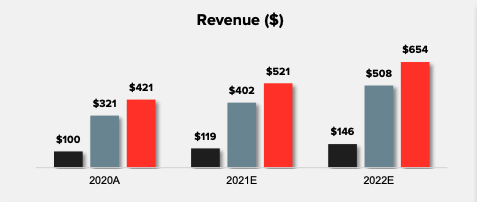
But the company’s historical results are inclusive of Complex. Here’s the breakdown of the company’s historical revenues (gray) and Complex’s own (black). The combined figures are what BuzzFeed notes in its trailing metrics:

Image Credits: BuzzFeed SPAC deck

From this breakdown, we can see that BuzzFeed anticipates 19% growth from Complex in 2021, and just under 23% growth from the group it’s acquiring in 2022.

Per a later slide, BuzzFeed grew 4% in 2019, inclusive of historical Complex numbers. That figure fell to -1% in 2020.

Our read of the company’s historical revenue growth is that it weathered a turbulent 2020 in reasonable health; digital advertising took a huge hit in the first half of the year, likely impacting BuzzFeed’s operating results. To see it manage an essentially flat revenue result last year feels pretty OK.

Future revenue growth

24 Jun 2021

SmartAsset rethinks financial advisory, and becomes a unicorn in the process

SmartAsset, a marketplace that connects consumers to financial advisors, announced today that it has raised $110 million in a Series D round of funding.

The financing values New York-based SmartAsset at over $1 billion, and brings its total raised since its 2012 inception to just over $161 million, according to Crunchbase.

TTV Capital led SmartAsset’s Series D, which also included participation from Javelin Venture Partners, Contour Venture Partners, Citi Ventures, New York Life Ventures, North Bridge Venture Partners and CMFG Ventures.

The company last raised in June of 2018 – a $28 million Series C led by Focus Financial Partners. Since then, it says it has grown revenue “by 10 times” and is now on the cusp of reaching $100 million in ARR (annual recurring revenue). It recently made its one millionth consumer/advisor match on its SmartAdvisor platform. Also in 2020, SmartAsset says it referred $10 billion in new, closed assets under management (AUM) to financial advisors and firms across the U.S.

Besides pairing consumers with advisors with its Automated Financial Modeling software, SmartAsset claims to reach over 100 million people each month through its personal finance content, tools and “personalized” calculators.

Prior to starting the company, Carvin worked in finance. In an interview with Y Combinator (one of its backers), he shared how his frustration in finding information about buying a home and getting a mortgage “that was useful, accurate and unbiased” led him to join forces with Philip Camilleri to found SmartAsset.

“Calculators had obvious errors and the content seemed like it was all written by people that wanted me to take out the largest mortgage possible,” he added. So the pair launched SmartAsset in an effort to provide people with the tools and content to help them make better decisions around topics such as retirement, taxes, savings, homeownership and insurance.

The company plans to use the new capital to invest in new product offerings, technology infrastructure and data partnerships. It also plans to boost its current headcount of 202 by more than 75% this year.

TTV Capital Partner Mark Johnson said the company “is quickly expanding its lead in one of the largest markets in the U.S. by providing an incredibly valuable resource for both consumers and financial advisors alike.”

The funding and its flashy valuation comes with a certain weight, even in the growing world of unicorn companies.

The company claims that, with today’s news, co-founder Michael Carvin now becomes the fourth Black founder and CEO of a company valued at over $1 billion. Others include Compass CEO and founder Robert Reffkin, whom we recently profiled here, and Calendly CEO and founder Tope Awotona, who we have also profiled.

While exciting, the unfortunate rarity of Black-led unicorns is a symptom of historical underfunding in Black or African-American startup founders. Crunchbase estimates that in 2020, 1% of total venture capital funding, or $1 billion, went to this cohort of founders.

A number of Black-led venture capital firms have closed investments in the past year, which could change this number, including Collab Capital’s $50 million investment vehicle, Harlem Capital, which closed a $134 million seed fund earlier this year; Cleo Capital, which set a $20 million target for Fund II; and MaC VC, which landed $103 million for its inaugural fund.

HBCUvc and Google for Startups also announced this month two separate efforts to provide non-dilutive capital to early-stage, underrepresented founders.

With a Series D under its belt, SmartAsset is working on taking out the bias from personal finance – while it itself is a case study in how overlooked founders, which routinely suffer from this exact phenomenon, continue to lead strong businesses.


24 Jun 2021

Companies navigate ethical minefield to build proof of vaccination apps

In the U.S, after you get vaccinated against COVID-19 you are given a small paper card issued by the CDC that is essentially the only evidence that you’ve received your shots. It might seem like a flimsy level of proof, one that you could easily lose, but replacing that paper copy with a digital one has become a political lightning rod in America.

In spite of that, many companies are attempting to attack the problem to produce a viable form of digital proof, sometimes called vaccine passports. For all intents and purposes, what many call a vaccine passport is simply proof you’ve been vaccinated that you can carry on your smartphone, rather than on a card in your wallet.

Some have argued against the digital approach for privacy reasons. Others have claimed it is a civil liberties issue, and some have pointed to equity issues related to not having equal access to appropriate technology or the internet.

That lack of consensus along with the open ethical questions, has led some states including Florida and Georgia to ban the use of electronic passport records, at least as far as requiring them to conduct state business or to create a centralized vaccination record keeping system. In Iowa, the governor signed a law last month that prohibits businesses and the state from requiring any proof to access services, whether the card is physical or digital.

These are just a few examples of the patchwork of state laws and executive orders that has resulted in even more complexity for companies trying to develop products to solve this problem. But not every state is banning digital vaccination records. Earlier this month, California opened a registration system to request a digital record of your vaccination and New York announced a system earlier this year to download proof of vaccination to your smartphone. More on these approaches later.

We spoke to several experts to get their take on moving your vaccine card to the digital world to find out how this could work in spite of the obvious friction.

Practical issues

According to Dr. Shira I. Doron from Tufts Medical Center in Boston, whose specialties include infectious diseases and hospital epidemiology, it’s not as simple a matter as may sound.

For starters she says, states have not kept records in a consistent way. People have been getting vaccinated in all kinds of places from school gyms to pharmacies to stadiums, and it’s not clear if those records have made their way to people’s primary care physicians, assuming they even have one.

“[Vaccine passports could work] if [a system] had been rolled out that way [with central record keeping in mind] from December 15th [when we started vaccinating], but it was not. So, if somebody takes it on to go backwards and issue that kind of proof to people, maybe a system like that could work — and of course there are a lot of people that have taken issue with the ethics of that,” she said.

For her, it comes down to infection rates. As they drop with more people getting vaccinated, it could alleviate the need for any kind of proof at all because we would be safer simply because the infection rate fell below 10%. “I think that more ideally we get down to such a low infection rate and such high rate of vaccination that there is no longer a concern about people walking into a building,” she said.

Putting it in on the blockchain

If the infection rate remains higher than desirable, or certain entities like universities want to require it, how do we offer proof of vaccination beyond the paper card? Some people are pointing to the blockchain, but the approach isn’t without controversy. New York State is using IBM’s blockchain technology for its proof of vaccination called Excelsior Pass, but privacy advocates worry that doing so could expose people’s personal medical information.

The idea with the IBM approach is that you to go to your physician’s healthcare portal or some other place that has your vaccine records, and which has partnered with IBM. The portal will present you with a QR code which you can take a picture of with your phone and store in your phone’s digital wallet. The person then presents the QR code at a venue, which uses a companion scanning application to view it to see proof of vaccination (or a recent negative test). Finally the venue would verify the identity of that person with a secondary form of ID like a driver’s license.

The question then is why use the blockchain at all in this instance. IBM Global VP of Payer and Emerging Business Networks Eric Piscini, says that there are three main reasons. “The first is that the immutability of the blockchain is extremely important, and that’s [a big reason] why we use it. The second piece, which is also very important is the decentralization of that platform so that [all of the vaccine data] is not just in one place. It’s decentralized and managed by different parties. […] The third piece […] is the audit trail, and not just for me as a consumer, but as an [entity] that is trying to verify me,” he explained.

But are those reasons enough to justify its use? Steve Wilson, an analyst at Constellation Research, who specializes in end user privacy thinks the blockchain is an inappropriate technology to use for digital proof of vaccination. “Basically, I don’t see how blockchain adds anything to the digitizing of COVID vaccinations or tests. The purpose of blockchain is to crowd-source agreement on the ordering of some events, and logging that order in a shared record. What problem in vaccination management does that address,” he asked.

An open-source approach to the problem

When California released a digital vaccination record app last week, it went a different route, using an open-source framework called the Smart Health Cards Framework. The framework was developed by an organization called The Commons Project (TCP) along with a broad coalition of health and technology organizations including Oracle, Microsoft, Salesforce, Epic and others.

JP Pollack, co-founder of The Commons Project, Senior Researcher-in-Residence at Cornell Tech, and Assistant Professor at Weill Cornell Medicine, says that since the government has made clear it won’t be compiling vaccine records in a central database, and because the vaccine administration system itself is so fragmented, it’s even more challenging to create digital records. His organization is working to create a solution to that problem.

“What we’re working on at The Commons Project is a steering group called the Vaccination Credential Initiative or VCI. And the purpose of that group is basically to design and advocate for a specification, someday hopefully a standard, that makes it so that all of those disparate issuers of vaccines can issue the same vaccine record in a signed and portable format,” he said.

That comes in the form of a Smart Health Card app that TCP has developed. “The additional layer that we have built is what turns [your vaccine] information into what we’re calling the Smart Health Card. And basically it’s all of the information that goes on your CDC card — so your name, your date of birth, the type of vaccine that you received, the dates of your doses, lot numbers and where you received it. All of those kinds of things get packaged up into this credential, and that credential is then signed by the issuer,” he said.

In addition to California, the state of Louisiana also went live with the The Commons Project solution this week, and Walmart recently announced that anyone that received their vaccine through them is now able to download a digital version of their vaccine record directly to the CommonHealth app (available on Android) or CommonPass app (available on iOS or Android). The company also hinted that other companies that have administered the vaccine would be following Walmart’s lead in the coming weeks and providing access to digital records through the same apps.

The approach doesn’t necessarily solve all of the criticisms around equitable access to technology, privacy or the ethics of being asked to show proof vaccination, but it does provide a means to deliver the information digitally for those that want it in an open way.

Regardless of the method your state chooses, if it indeed chooses any approach at all,  it will come with its own set of pros and cons. The paper CDC card, as Wilson points out, is similar in many ways to the “Yellow Card” vaccination record that people traveling overseas have been carrying for decades, and that has worked fine.

But it seems that in 2021 when approximately half the world’s population owns a smartphone, while two-thirds have some sort of mobile phone, smart or otherwise, it makes sense to make this record available in a digital form. For the many startups and large companies trying to solve that problem, they will have to do more than come up with a clever solution. They will also need to figure out how to convince individuals, businesses and governments that it makes sense to even offer this approach, and that may be the biggest hurdle of all.