Year: 2021

24 Jun 2021

Apple to drive China revenues with search ad launch

After launching five years ago in the United States, Apple’s search advertising service finally arrived in mainland China this week.

The feature, called Apple Search Ads, lets developers bid on an advertising slot based on users’ keyword search in the App Store, similar to how Google search ads work. JPMorgan previously estimated the giant’s annual ad revenue could top $11 billion by 2025, though the forecast didn’t have a breakdown for the search ad business.

Apple has itself been reining in on personalized advertising, letting users turn off data tracking by apps, a move that will inevitably roil the business models of Facebook and others dependent on third-party data to target ads.

China has historically been a strong market for Apple, but iPhones are increasingly losing their luster as a status symbol in the country with the rise of local offerings like Huawei. In the first quarter, however, Apple’s smartphone shipment saw a rebound thanks to Huawei’s slipping sales and the launch of the iPhone 12 family. The Chinese App Store is another important source of income for Apple.

In a five-page guideline, Apple outlines the qualifications for developers targeting ads at mainland Chinese users. There is a stack of industry-specific licenses that advertisers must obtain, which practically excludes most foreign entities from directly advertising in mainland China, as noted in a blog post by AppInChina, an agency that helps international apps launch in China. To bid for search ads in China, apps would have to find local partners with all the government approvals in place.

The requirements for apps importing goods into China, for example, include not just a general license to run value-added internet businesses but also registrations with the relevant trade and customs authorities. Apple may even start asking for these permits from apps that simply want to publish in China, wrote AppInChina, as Apple continues to enforce rules set by the Chinese government as evident from its crackdown on gaming apps.

23 Jun 2021

AdTech startup Tomi raises Seed funding to make real estate ads perform as well as ecommerce

Industries like real estate, automotive, and financial services have long and offline sales cycles and digital advertising tends not to perform well in these areas. The conversion rates are low and because the real-world assets are offline the temptation of advertisers is to buy leads and clicks, which can inflate customer acquisition costs. People are browsing but they end up buying offline, basically.

A new startup, Tomi plans to address this issue by processing a user’s behavior on a company’s website (using a tracking pixel, combined with ad APIs and CRMs) to help companies reach customers more in the way an ecommerce business would.

It’s now raised a $1M seed round from investors including Begin Capital and Phystech Leadership Fund.

Founded by Konstantin Bayandin — a former senior director of digital marketing and technology at Compass and chief marketing officer at Ozon, ‘Russia’s Amazon’ — Tomi competes against similar AdTech companies such as Anytrack, Sociaro, Meetotis, Alytics and Postclick.

However, the difference, Bayandin says, is that Tomi “focuses on offline conversions and works with multiple ad channels, such as Facebook, Instagram and Google.”

Bayandin says: “Real-estate companies would love to leverage online ads in order to sell their inventory but it turns out to be too expensive and difficult. People like to browse but rarely convert and most of these transactions happen offline. So real-estate clients don’t know how to optimize for their real buyers. Tomi uses machine learning to analyze the way real buyers browse the website and optimize ad campaigns towards conversions.”

The background to all this is that with Apple closing down IDFA, Google planning to remove third-party cookies from its Chrome browser, and the latest iOS 14.5 update allowing users opt out of “personalized ads”, the entire ad business is in flux, so new tools are going to be required. Bayandin says Tomi is part of this new wave of AdTech.

23 Jun 2021

Daily Crunch: AWS and Salesforce expand partnership to make cross-platform integrations easier

To get a roundup of TechCrunch’s biggest and most important stories delivered to your inbox every day at 3 p.m. PDT, subscribe here.

Hello and welcome to Daily Crunch for June 23, 2021. The value of leading cryptocurrencies has rebounded some in the last day or so. Congrats to the hodlrs out there. If you are a nocoiner, don’t worry; stocks are also up. If you want more on the topic, the TechCrunch crew held a Twitter Space recently on the current state of crypto. Now, the news. — Alex

The TechCrunch Top 3

  • Robotaxis are coming (slowly): Alphabet’s self-driving unit, Waymo, has been busy lately, but it’s not the only company in its market generating headlines. Chinese robotaxi player WeRide bagged $600 million in less than half a year, TechCrunch reports. The company is now worth $3.3 billion. Let’s hope that all the capital and activity in this particular market works out when the rubber hits the road.
  • Soon, even regular folks can get in on the autonomous action: Love the idea of self-driving cars, but don’t have $100 million or more to pour into one of the industry’s leading private players? Good news! You can put your $100 into Embark soon, as the self-driving truck company is going public via a SPAC. You are welcome for this PSA.
  • Tech’s cultural discussion continues: If you follow the tech industry, you’ve seen news about its evolving cultural discussion. From banning “politics” to public culture memos to private missives that became public, there’s a lot going on at both startups and public companies alike. A new document from the edtech sector takes a rather pointed stand in the larger conversation in favor of not backing down from controversial topics, Natasha wrote for the site. It won’t be the last memo we see on the matter.

Startups

  • The exit market for growth-focused startups is still hot: That’s the lesson from recent IPO filings in the tech space. If you are an investor or startup employee, it’s good news. If you are a wealthy tech company looking to buy smaller firms, the news is less good because you will probably have to pay a large premium to snag startups.
  • Snackpass scoops up $70M: You may have seen Snackpass signs at food spots in your city. The startup focuses on pickup orders inside of restaurants rather than delivery, and, per our reporting, has seen its growth explode in recent months as people have gone back outside. It’s now worth more than $400 million.
  • PairTree raises $2.25M to make adoption easier: There are lots of tech deals with business problems. Sometimes startups build businesses to solve human problems. PairTree is one such company. Per Devin, it wants to make part of the adoption process easier with an “online matching platform where expectant mothers and hopeful adopters can find each other without the facilitation of an agency or other organization.” I love it.
  • Drata raises $25M to make security compliance easier: If you run a company, you have to deal with security compliance. Drata wants to make securing SOC 2 compliance easier. That way, your startup won’t lose a deal over lack of compliance certification, a situation that might lead to you exclaiming “drata!” while smacking your own forehead.
  • Vercel raises $102M for its next.js service: You’ve probably heard of next.js, a React framework for front-end development work. Vercel built it with Facebook and Google. Now the company has $102 million more in the bank thanks to a Series C that valued the company at more than $1 billion. Per TechCrunch, traffic to apps and websites on Vercel’s network doubled since October of last year. That’s the sort of usage growth that investors love to see.

Why Amazon should pay attention to Shein

In the last year, online apparel shopping app Shein grew active daily users by 130%, reports Apptopia.

Each day, thousands of new products arrive on the app’s virtual shelves. Items are rapidly designed and prototyped before Shein’s contractors put them into production in Guangzhou factories — two weeks later, those SKUs arrive in fulfillment centers around the globe.

TechCrunch reporter Rita Liao examined how the company’s agile supply chain has become hot talk among e-commerce experts, but beyond a strong logistics game and data-driven product development, Shein’s close relationships with suppliers are integral to its success.

She also tried to answer a question many are asking: Is Shein a Chinese company?

“It’s hard to pin down where Shein is from,” answered Richard Xu from Grand View Capital, a Chinese venture capital firm.

“It’s a company with operations and supply chains in China targeting the global market, with nearly no business in China.”

(Extra Crunch is our membership program, which helps founders and startup teams get ahead. You can sign up here.)

Big Tech Inc.

We’re taking a break from politics today, so if you wanted even more updates about how India is taking on one American tech company or another, we are sorry. A lot of other stuff happened, however, that is pretty neat:

  • Ford is keeping scooter dreams alive: Remember when Ford bought Spin? It was a great moment for the micromobility space. Today, Spin launched its first in-house scooter. So, if you need two small wheels and a battery pack, Ford has you covered. Recall that Ford is investing heavily in electric cars and trucks as well.
  • Amazon and Salesforce buddy up even more: The growing partnership between Amazon and Salesforce took a new step today, with the two major American tech companies announcing “a new set of integration capabilities to make it easier to share data and build applications that cross the two platforms.” Amazon competes with Microsoft in the public cloud world, and Salesforce competes with Microsoft in the CRM space. So to see the pair of them hold hands is not a huge surprise.
  • TikTok has real competition: TikTok’s chief rival in China just hit the 1 billion monthly active user (MAU) mark. That’s a real accomplishment, given that the world only has 8 billion or so folks in it. Kuaishou, the app in question, has only 150 million non-Chinese MAUs, for what it’s worth, making it more of a giant domestic player in China than an international heavyweight. That may change, of course, if it keeps growing as it has been.

TechCrunch Experts: Growth Marketing

Illustration montage based on education and knowledge in blue

Image Credits: SEAN GLADWELL (opens in a new window) / Getty Images

We’re reaching out to startup founders to tell us who they turn to when they want the most up-to-date growth marketing practices.

Fill out the survey here.

Here’s one of the recommendations we received:

Name of marketer: Karl Hughes, draft.dev.

Name of recommender: Joshua Shulman, Bitmovin.com.

Recommendation: “Karl is incredibly knowledgeable in the field of content and growth marketing to a large (and equally niche) target audience of developers. He and his team at Draft.dev are some of the best at ‘developer marketing,’ which is a greatly underrated target audience.”

Community

Image Credits: TechCrunch

Yo dawg, we heard you liked audio … so we put audio in your audio!

Yesterday, we had a super fun Twitter Spaces chat (with a few hundred of our closest friends) about Bitcoin and crypto in general. It was led by the Equity Podcast crew, but a few of our other writers joined in on the fun. Some of it even made its way into the latest episode of Equity, so have a listen (and keep an eye out for our next live chats).

TC Eventful

It’s pretty simple — In a few short weeks, startup founders from around the world will join our bootcamp series TC Early Stage 2021: Marketing & Fundraising, happening on July 8 and 9. You’ll choose from a wide range of presentations that span the fundamentals of launching and growing your business, whether you are bootstrapping or have just secured your first investment funds. Register before this Friday and get 50% off with promo code DAILYCRUNCH50.

23 Jun 2021

You can share tweets directly to Instagram Stories now

It’s a little thing, but one worth savoring.

If you’re tired of your Instagram feed mostly being a chaotic mashup of screencapped tweets and reshared TikToks, well, those things probably aren’t going away but one is about to look a lot better.

Twitter just added the capability to share a tweet directly to Instagram Stories, letting you port your clever cross-platform moments over properly. You can’t tap the tweets to hop back to Twitter, but they look nice now. Unfortunately for Android users, it’s iOS-only for now.


The new cross-platform feature is just a tiny sample of Twitter’s refreshing recent flurry of product activity — a result of mounting pressure from investors who accused the company of stagnating and planned to oust its CEO, Jack Dorsey. The company also just added two more major features to empower users to monetize their tweets: paid subscriptions known as “Super Follows” and ticketed events.

Twitter users have long waited for a laundry list of small quality of life tweaks to manifest, a phenomenon that often materializes as an entire cohort of journalists complaining about how you still can’t edit tweets. But if it can keep the pace, Twitter might finally be ready to deliver.

See, doesn’t that look nice?

Example of tweet embedded on Instagram Story

23 Jun 2021

Bird launches shared e-bikes and opens its app to local shared operators

Bird has announced the launch of shared e-bikes to its fleet of e-scooters, which it says can be found in over 250 cities around the world. The shared micromobility provider is also launching a so-called ‘Smart Bikeshare’ platform that allows local shared bike and e-moped providers and transit apps to integrate with Bird’s app. 

“Shared e-scooters catapulted shared micromobility to the center stage of eco-friendly transportation in cities by providing more than 150 million zero-emission trips globally,” said Travis VanderZanden, founder and CEO of Bird, in a statement. “We are launching our shared Bird Bike and Smart Bikeshare platform to meet fast-growing demand from cities and riders for more sustainable transportation options while expanding our serviceable addressable market by 5 billion trips per year.” 

This announcement comes just a month after Bird dropped its new Bird Three scooter with better battery life. The micromobility giant’s shared e-bike will roll out later this year, with Cleveland, Ohio, being one of the first markets, according to a spokesperson for the company. In a statement, Bird said the bike will be available in select cities throughout North America, Italy, Spain, Germany, Ireland and France this year. Bird did not say how many e-bikes it would be launching or give a more specific launch date.

Bird also did not respond to whether or not the e-bike is designed or manufactured by the company, and if not, which manufacturer the company is working with.

The Bird Bike is built on a 75-pound frame with a step-through design that can drive riders up hills with as much as a 20% grade, according to the company. It’ll have a front basket, large pneumatic tires and all the on-board geofencing and diagnostics that you’d expect from a Bird vehicle. 

The Bird Bike is not Bird’s first bike. In the summer of 2019, the company unveiled its Bird Cruiser, an electric cross between a bike and a moped that could seat up to two people. But they decided to pause the pilot last year at the onset of the pandemic, according to a spokesperson for the company.

Bird’s bikeshare platform has already kicked off in Italy with local e-moped company Zig Zag, displaying the Italian company’s vehicles alongside its own in the Bird app. Bird says it wants to collaborate with other micromobility companies around the world and is in talks with groups like the North American Bikeshare Association to do so in the U.S. 

Bird did not answer questions about whether it would receive a cut of local operators’ profits if booked through the Bird app.

In a statement from the company, Bird’s bikeshare platform makes the company “the first scooter operator to integrate with local shared bike and e-moped providers.” Bird does not currently have plans to integrate third party, e-scooter providers into their app, according to the company.

If Bird isn’t collaborating with local e-scooter providers, sharing its platform with e-bike and e-moped providers allows it the chance to have more of a multi-modal presence without doing the heavy lifting of actually launching multi-modal fleets. At the very least, these collaborations will also give Bird a better idea of where and how riders are using different vehicles, which could help the company decide on new mobility modes to invest in, while also informing its own expansion plans, especially in Europe.

Bird did not confirm whether this is a part of its bikeshare platform strategy.


23 Jun 2021

Nvidia’s Canvas AI painting tool instantly turns blobs into realistic landscapes

AI has been filling in the gaps for illustrators and photographers for years now — literally, it intelligently fills gaps with visual content. But the latest tools are aimed at letting an AI give artists a hand from the earliest, blank-canvas stages of a piece. Nvidia’s new Canvas tool lets the creator rough in a landscape like paint-by-numbers blobs, then fills it in with convincingly photorealistic (if not quite gallery-ready) content.

Each distinct color represents a different type of feature: mountains, water, grass, ruins, etc. When colors are blobbed onto the canvas, the crude sketch is passed to a generative adversarial network. GANs essentially pass content back and forth between a creator AI that tries to make (in this case) a realistic image and a detector AI that evaluates how realistic that image is. These work together to make what they think is a fairly realistic depiction of what’s been suggested.

It’s pretty much a more user-friendly version of the prototype GauGAN (get it?) shown at CVPR in 2019. This one is much smoother around the edges, produces better imagery, and can run on any Windows computer with a decent Nvidia graphics card.

This method has been used to create very realistic faces, animals, and landscapes, though there’s usually some kind of “tell” that a human can spot. But the Canvas app isn’t trying to make something indistinguishable from reality — as concept artist Jama Jurabaev explains in the video below, it’s more about being able to experiment freely with imagery more detailed than a doodle.

For instance, if you want to have a moldering ruin in a field with a river off to one side, a quick pencil sketch can only tell you so much about what the final piece might look like. What if you have it one way in your head, and then two hours of painting and coloring later you realize that because the sun is setting on the left side of the painting, it makes the shadows awkward in the foreground?

If instead you just scribbled these features into Canvas, you might see that this was the case right away, and move on to the next idea. There are even ways to quickly change the time of day, palette, and other high-level parameters so they can quickly be evaluated as options.

Animation of an artist sketching while an AI interprets his strokes as photorealistic features.

Image Credits: Nvidia

“I’m not afraid of blank canvas any more,” said Jurabaev. “I’m not afraid to make very big changes, because I know there’s always AI helping me out with details… I can put all my effort into the creative side of things, and I’ll let canvas handle the rest.”

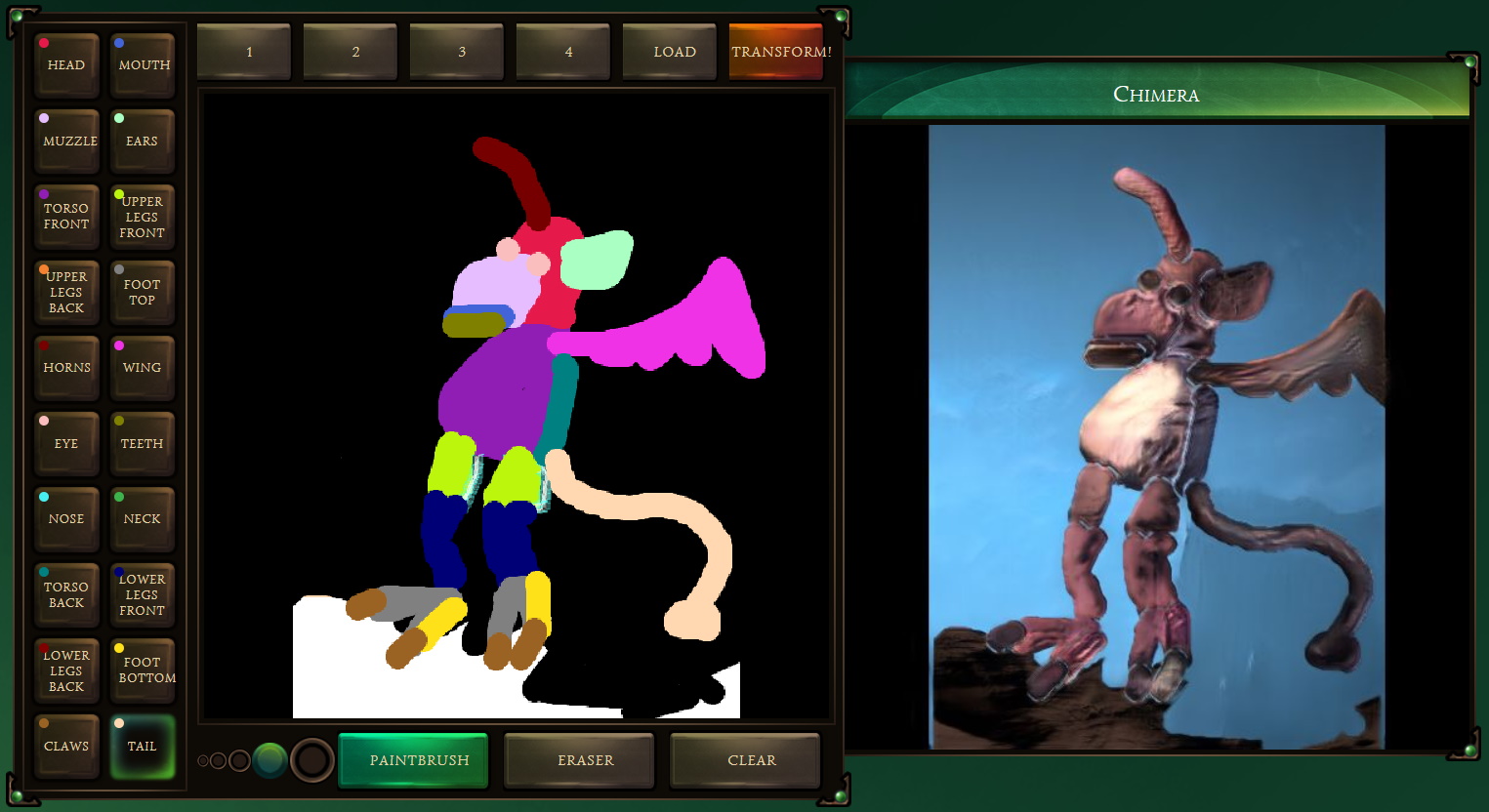
It’s very like Google’s Chimera Painter, if you remember that particular nightmare fuel, in which an almost identical process was used to create fantastic animals. Instead of snow, rock, and bushes it had hind leg, fur, teeth and so on, which made it rather more complicated to use and easy to go wrong with.

Image Credits: Devin Coldewey / Google

Still, it may be better than the alternative, for certainly an amateur like myself could never draw even the weird tube-like animals that resulted from basic blob painting.

Unlike the Chimera Creator, however, this app is run locally, and requires a beefy Nvidia video card to do it. GPUs have long been the hardware of choice for machine learning applications, and something like a real-time GAN definitely needs a chunky one. You can download the app for free here.

23 Jun 2021

NFT marketplace startup Rarible closes $14.2 million Series A

You’ve likely seen the headlines surrounding the pretty major decline in NFT sales from the market’s recent peak, with some reports indicating as much as a 90 percent decline in recent weeks. And while plenty of crypto speculators are on the losing end of that rapid decline, others see a future where digital collectible and digital goods take over the internet.

NFT marketplace Rarible announced Wednesday that they’ve closed a $14.2 million Series A from Venrock Capital, CoinFund and 01 Advisors. The startup allows users to buy and auction off digital art. The firm also has its own Rarible governance token which allows users to make and vote on proposals around the platform’s features and fees.

The startup says it has reached $150 million in sales on the platform since launching 18 months ago.

NFT startups have raised major sums in recent months as investors coalesced around backing early players in the digital collectibles space. OpenSea, one of the most popular NFT hubs, raised a $23 million funding round in early spring from Andreessen Horowitz and Naval Ravikant. In March, invite-only NFT marketplace SuperRare raised a $9 million Series A. Last month, Bitski raised $19 million in bid to become the “Shopify of NFTs.”

Alongside the funding announcement, Rarible shared that they’ve officially partnered with NBA Top Shot maker Dapper Labs to bring their NFT marketplace to Dapper’s Flow blockchain. Dapper Labs has begun building out a wider coalition of NFT platforms on its proprietary blockchain which is more energy efficient and less costly than transactions on the Ethereum network, though it is also much more centralized. Rarible says they will make this transition in the “next couple of months.”

The startup has broad goals for making the NFT space more approachable to everyday web users, saying in a a blog post that they hope to use this funding to explore more user-friendly developments like accepting credit card payments. “We need a world where an indie creator can effortlessly create an NFT and sell it for $5 to his community of supporters, as well as where a pop icon can use NFTs to establish close contact with her multi-million audience in a sustainable way,” the post reads.

23 Jun 2021

Practice agile, iterative change to refine products and build company culture

I firmly believe that principles as much as products drive a company’s success. A startup may have a persuasive brand story and good public relations, but if it’s internally inconsistent — if its employees and executives cannot identify its central values — sooner or later there will be trouble.

At Heap, the analytics solution provider I lead, a defining principle is that good ideas should not be lost to top-down dictates and overrigid hierarchies. Although I’m the CEO, I recognize that I don’t always have the best view simply because I’m on top of (the) Heap. The best results come when you approach leadership like you would create a great product — you hypothesize, you test and iterate, and once you get it right, you grow it.

Most of us have had the experience of receiving a sudden decree “from above” that makes little consideration for the actual, as opposed to the theoretical, situation of people on the ground.

One-and-done decrees versus agile, iterative change

I’ve used this method in the businesses I’ve managed. The scientific method, with its cycle of observation, reporting, hypothesizing, experimenting, analyzing and reporting, is a powerful tool for product and process development.

While my process isn’t quite as rigorous as the scientific method and tends to sprint where science slowly marches, it’s based on similar principles. Before I describe the system, a warning: Although it’s a simple way to iterate new concepts and evaluate new designs, my method requires a genuine commitment to the principles of cooperation and collaboration. In an organization predicated on hierarchy and strict structure, it could be a recipe for groupthink and unearned consensus. Iteration is not, however, a justification for delay: There may be several iterations of a project, but those iterations follow each other quickly.

Most of us have had the experience of receiving a sudden decree “from above” that makes little consideration for the actual, as opposed to the theoretical, situation of people on the ground. You know the kind of thing I mean: The sales team in the saturated territory is told they must increase revenue by 20%, the already lean division is told to cut costs by 10%. Moves like this are bad for morale; they inspire resentment and cut corners. It’s precisely to avoid this kind of top-down debacle that Heap takes a collaborative and iterative approach to change.

Passing ideas back and forth

We put our business’ best minds to work to devise an initial prototype of whatever our business may need. That prototype might be a minimum viable product for commercial release, polished messaging for our forthcoming releases, or even a compendium of internal workflows.

But we can’t consider a project perfect if it’s never been exposed to the world outside the office. Whether we’re crafting a project, tweaking our messaging or establishing pricing tiers, we test in the real world. We show products to consumers, prospects and advisers, who invariably have needs that we hadn’t anticipated. The testers’ concerns may send us rushing back to the drawing board, but that’s accepted and expected. It’s the testing and refining that leads to the best product. While some businesses prefer a rush to market, we’ve observed that doesn’t work. A rushed product will frustrate users, lose word-of-mouth enthusiasm and provide an opportunity to our competitors.

But this isn’t just for product releases; we adopt a similar strategy for determining changes inside the company.

23 Jun 2021

This QR code startup just raised $5 million led by Coatue to make one-click shopping ubiquitous

Amazon revolutionized one-click shopping, and it has a nearly $2 trillion market cap to show for the effort.

Now, a 10-person startup founded by JD Maresco, who previously cofounded the public safety app Citizen, says it plans to make it a lot easier for retailers who sell directly to their customers to make re-ordering their products just as fast and simple through its QR codes. Indeed, Maresco’s new startup, Batch, is already working with numerous products and brands that use Shopify, promising their customers “one-tap checkout” when it’s time to reorder an item as long as the retailer has slapped one of Batch’s codes on their items or incorporated the codes directly into their packaging.

For now, New York-based Batch works by using Apple’s App Clip technology, a lightweight version of an app that saves people from having to download and install an app before using it. (Users can instead load just a small part of an app on demand, and when they’re done, the App Clip disappears.)

But Maresco — whose company just raised $5 million in seed funding led by Coatue, with participation from Alexis Ohanian’s Seven Seven Six, Weekend Fund, and the Chainsmokers, among others — says Batch will eventually work on both iOS and Android phones. We talked with him yesterday to learn more about its ambitions to make the physical world “instantly shoppable.” Our chat has been edited lightly for length and clarity.

TC: Citizen and Batch are very different companies. Is there a unifying thread?

JM: I’ve spent a good portion of my career, trying to change the way people think about and interact with their physical environment. With Citizen, we were questioning why everyone doesn’t have immediate access to information about what the police are doing in our neighborhoods. With batch, we’re asking a simpler question but something that matters to me as a consumer: Why isn’t it easier for me to get more of a product I love and use?

With subscriptions in general, I’ve found myself constantly frustrated because every few weeks I’m emailing to either pause a subscription,  or restart it. I wanted an easier way to use my phone to reorder in 10 seconds on the spot. Our phones are capable of much more than we put them to use for and, so we set out to tackle that problem.

TC: Right now, Batch integrates with Shopify alone, correct?

JM: We have a Shopify plugin that brands can connect into the Batch platform, and then we integrate the experience, all the way from the physical world wherever this QR code lives, through the purchase experience on the mobile side of things into their fulfillment on the back end. But we’re also expanding to other e-commerce platforms.

TC: And Batch takes a per-transaction fee from every item that’s purchased using your codes?

JM: We’re developing our pricing model over time, but currently we’re taking a service percentage-based fee.

TC: How are you getting brands to partner with you?

JM: Brands are starting to wake up to this idea that they can actually create a new retail channel off their physical packaging, where a customer can effectively shop throughout their home or their place of work or anywhere where they interact with these products the moment they run out of an item. So we’ve been able to spend time with dozens of brands now, and work with them to actually reengineer their packaging and say, ‘Let’s put QR codes front and center and figure out how to make this a really important customer touchpoint.’

TC: How many brands are using the codes currently?

JM: We’re launching dozens of brands this summer. We’ve had overwhelming demand, to be honest, and we haven’t really even fully launched yet.

TC: These are physical codes that you’re sending off to your retail partners — stickers, magnets. Are you also creating digital QR codes?

JM: We have customers that are integrating QR codes into out-of-home advertisements, into direct mail, into T shirts, into promotional vans, so we’re not just limited to packaging. There’s a wide range of places that you can integrate QR codes for your customers.

TC: It’s interesting that Coatue led your round. We’ve seen the firm delve more into early-stage deals but a seed round seems anomalous. How did you connect with the firm?

JM: We met during the seed process. They reached out to me and I developed a relationship with Andy Chen and Matt Mazzeo and it was a great opportunity to to work with their platform — the way they support the go-to-market motion around B2B companies; they have a great data platform. Alexis [Ohanian’s] experience in the consumer space was really appealing, too.

TC: Your company makes sense, but I wonder what’s special about these codes. What’s to prevent countless other startups from doing what you’re doing?

JM: QR codes or are not patentable; they’re all over the place. The product we’re building makes it really easy for brands to create high converting shopping experiences and a native mobile interface. It’s a combination of our Shopify integration and our native product design experience and the relationships we have with these brands and how we help them with their packaging that’s not something you can spin up overnight.

TC: I have to ask about Citizen, which was in the headlines recently for all the wrong reasons. Is there anything you want to say about the company or the app or some of that recent coverage?

JM:  I’m not going to comment on the recent press, but I continue to be proud of what the company is continuing to do to help communities stay safe and understand what police and first responders are doing in their neighborhoods.


23 Jun 2021

6 strategies for running more effective startup board meetings

For many companies in the United States, a board of directors is a fact of doing business. While sole proprietorships and LLCs are not obligated to have one, C and S corporations must. The board’s goal is to ensure the best is done for the company and its shareholders. While many entrepreneurs see board meetings as a chore, they can be a powerful tool if used well.

Communicate often

While board meetings usually happen quarterly, it’s good practice to keep the conversation going in between them. Sending a monthly email update to the board offers multiple advantages:

  • Shorter updates: Business professionals’ attention spans are shrinking. Shorter content is easier to digest, and therefore more likely to be read.
  • Timely feedback: A quarter can be a long time, especially for young startups or during challenging times. The monthly format allows the company to receive help or feedback from the board earlier. In business, speed of iteration is key!
  • Keep them posted: Keeping directors up to date will avoid lengthy updates during board meetings, ensuring focus remains on strategic conversations.

Reach out when in need

When meeting online, founders should pause often and regularly ask if there are questions — even if moments of silence feel awkward at times — to give directors a better opportunity to speak up.

Board members can also be solicited on an ad-hoc basis — founders should keep in mind that board members are here to help the company. If you have doubts about a project decision or want a second, informed opinion, reach out to a board member. This is especially true of directors who have expertise on a specific topic. A quick five-minute call can be a game changer.

Being a founder can be a lonely experience because it can be difficult to discuss sensitive matters with the team. Board members should sign nondisclosure agreements, allowing entrepreneurs to share confidential information and get a different perspective on things.

Discuss goals for the next fundraising event

Founders should make sure to regularly discuss business goals to ensure they reach their next round of funding. Because the industry landscape or economy evolved or the competition stepped up, investors may reconsider their expectations to further fund the company.