
Year: 2021

23 Jun 2021

Want in on the next $100B in cybersecurity?

As a Battery Ventures associate in 1999, I used to spend my nights highlighting actual magazines called Red Herring, InfoWorld and The Industry Standard, plus my personal favorites StorageWorld and Mass High Tech (because the other VC associates rarely scanned these).

As a 23-year-old, I’d circle the names of much older CEOs who worked at companies like IBM, EMC, Alcatel or Nortel to learn more about what they were doing. The companies were building mainframe-to-server replication technologies, IP switches and nascent web/security services on top.

Flash forward 22 years and, in a way, nothing has changed. We have gone from command line to GUI to now API as the interface innovation. But humans still need an interface, one that works for more types of people on more types of devices. We no longer talk about the OSI stack — we talk about the decentralized blockchain stack. We no longer talk about compute, data storage and analysis on a mainframe, but rather on the cloud.

The problems and opportunities have stayed quite similar, but the markets and opportunities have gotten much larger. AWS and Azure cloud businesses alone added $23 billion of run-rate revenue in the last year, growing at 32% and 50%, respectively — high growth on an already massive base.

The size of the cybersecurity market has gotten infinitely larger as software eats the world and more people are able to sit and feast at the table from anywhere on Earth (and, soon enough, space).

The size of the cybersecurity market, in particular, has gotten infinitely larger as software eats the world and more people are able to sit and feast at the table from anywhere on Earth (and, soon enough, space).

Over the course of the last few months, my colleague Spencer Calvert and I released a series of pieces about why this market opportunity is growing so rapidly: the rise of multicloud environments, data being generated and stored faster than anyone can keep up with it, SaaS applications powering virtually every function across an organization and CISOs’ rise in political power and strategic responsibility.

This all ladders up to an estimated — and we think conservative — $100 billion of new market value by 2025 alone, putting total market size at close to $280 billion.

In other words, opportunities are ripe for massive business value creation in cybersecurity. We think many unicorns will be built in these spaces, and while we are still in the early innings, there are a few specific areas where we’re looking to make bets (and one big-picture, still-developing area). Specifically, Upfront is actively looking for companies building in:

  1. Data security and data abstraction.
  2. Zero-trust, broadly applied.
  3. Supply chains.

Data security and abstraction

Data is not a new thesis, but I am excited to look at the change in data stacks from an initial cybersecurity lens. What set of opportunities can emerge if we view security at the bottom of the stack — foundational — rather than as an application at the top or to the side?

Image Credits: Upfront Ventures

For example, data is expanding faster than we can secure it. We need to first know where the (structured and unstructured) data is located, what data is being stored, confirm proper security posture and prioritize fixing the most important issues at the right speed.

Doing this at scale requires smart passive mapping, along with heuristics and rules to pull the signal from the noise in an increasingly data-rich (noisy) world. Open Raven, an Upfront portfolio company, is building a solution to discover and protect structured and unstructured data at scale across cloud environments. New large platform companies will be built in the data security space as the point of control moves from the network layer to the data layer.

We believe Open Raven is poised to be a leader in this space and also will power a new generation of “output” or application companies yet to be funded. These companies could be as big as Salesforce or Workday, built with data abstracted and managed differently from the start.

If we look at security data at the point it is created or discovered, new platforms like Open Raven may lead to the emergence of an entirely new ecosystem of apps, ranging from those Open Raven is most likely to build in-house — like compliance workflows — to entirely new companies that rebuild apps we have used since the beginning of time, which includes everything from people management systems to CRMs to product analytics to your marketing attribution tools.

Platforms that lead with a security-first, foundational lens have the potential to power a new generation of applications companies with a laser-focus on the customer engagement layer or the “output” layer, leaving the data cataloging, opinionated data models and data applications to third parties that handle data mapping, security and compliance.
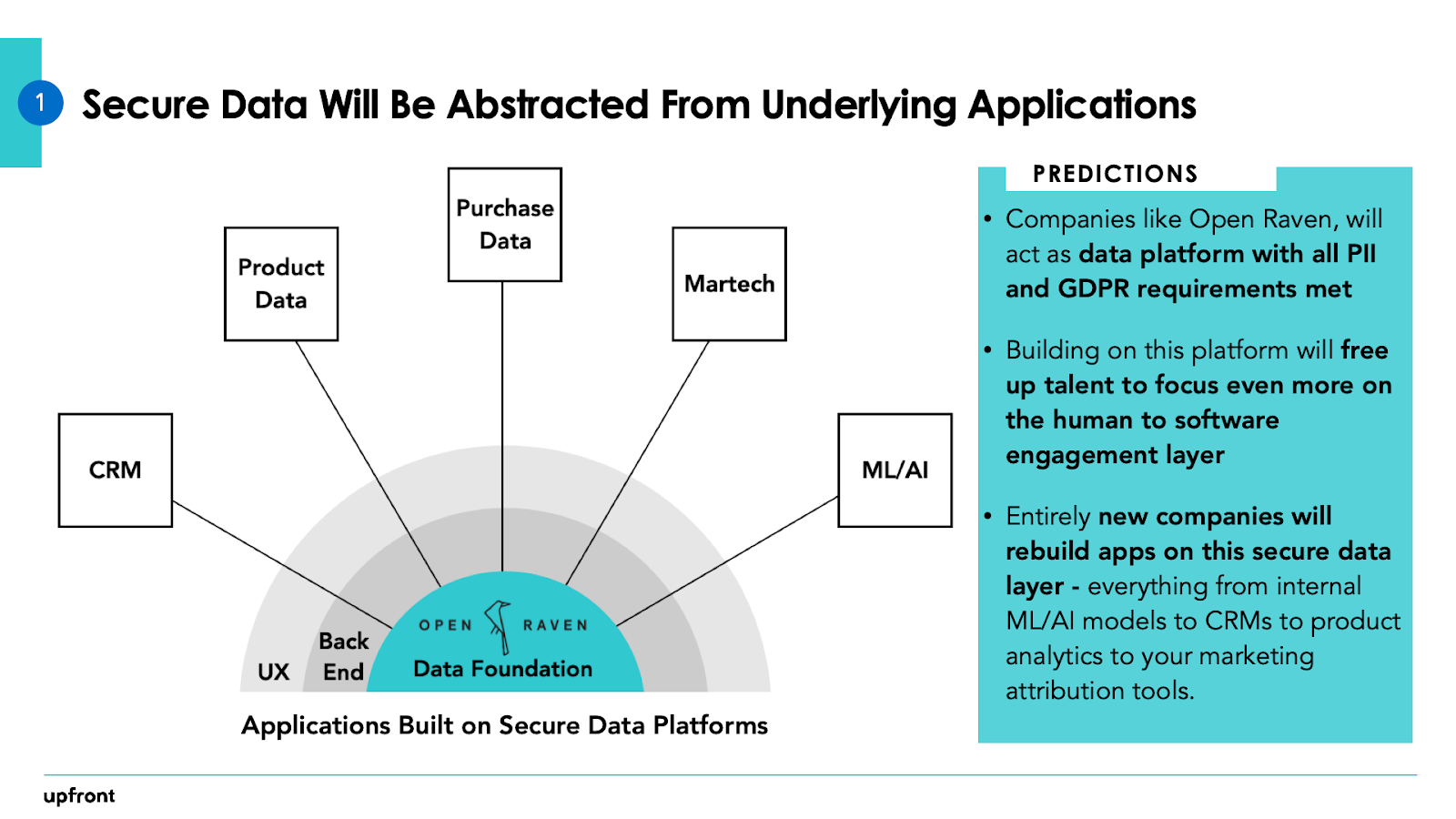
Image Credits: Upfront Ventures

Put simply, if full-stack applications look like layers of the Earth, with UX as the crust, that crust can become better and deeper with foundational horizontal companies underneath meeting all the requirements surrounding personally identifiable information and GDPR, which are foisted upon companies that currently have data everywhere. This can free up time for new application companies to focus their creative talent even more deeply on the human-to-software engagement layer, building superhuman apps for every existing category.

Zero-trust

Zero-trust was first coined in 2010, but applications are still being discovered and large businesses are being built around the idea. Zero-trust, for those getting up to speed, is the assumption that anyone accessing your system, devices, etc., is a bad actor.

This could sound paranoid, but think about the last time you visited a Big Tech campus. Could you walk in past reception and security without a guest pass or name badge? Absolutely not. Same with virtual spaces and access. My first in-depth course on zero-trust security was with Fleetsmith. I invested in Fleetsmith in 2017, a young team building software to manage apps, settings and security preferences for organizations powered by Apple devices. Zero-trust in the context of Fleetsmith was about device setup and permissions. Fleetsmith was acquired by Apple in mid-2020.

About the same time as the Fleetsmith acquisition, I met Art Poghosyan and the team at Britive. This team is also deploying zero-trust for dynamic permissioning in the cloud. Britive is being built under the premise of zero-trust Just-in-time (JIT) access, whereby users are granted ephemeral access dynamically rather than the legacy process of “checking out” and “checking in” credentials.

By granting temporary privilege access instead of “always-on” credentials, Britive is able to drastically reduce cyber risks associated with over-privileged accounts, the time to manage privilege access and the workflows to streamline privileged access management across multicloud environments.

What’s next in zero-based trust (ZBT)? We see device and access as the new perimeter, as workers flex devices and locations for their work and have invested around this with Fleetsmith and now Britive. But we still think there is more ground to cover for ZBT to permeate more mundane processes. Passwords are an example of something that is, in theory, zero-trust (you must continually prove who you are). But they are woefully inadequate.
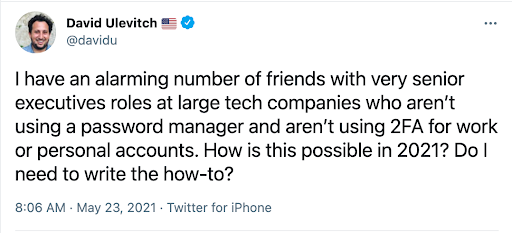
Phishing attacks to steal passwords are the most common path to data breaches. But how do you get users to adopt password managers, password rotation, dual-factor authentication or even passwordless solutions? We want to back simple, elegant solutions to instill ZBT elements into common workflows.

Supply chains

Modern software is assembled using third-party and open-source components. This assembly line of public code packages and third-party APIs is known as a supply chain. Attacks that target this assembly line are referred to as supply chain attacks.

Some supply chain attacks can be mitigated by existing application-security tools like Snyk and other SCA tools for open-source dependencies, such as Bridgecrew to automate security engineering and fix misconfigurations and Veracode for security scanning.

But other vulnerabilities can be extremely challenging to detect. Take the supply chain attack that took center stage — the SolarWinds hack of 2020 — in which a small snippet of code was altered in a SolarWinds update before spreading to 18,000 different companies, all of which relied on SolarWinds software for network monitoring or other services.
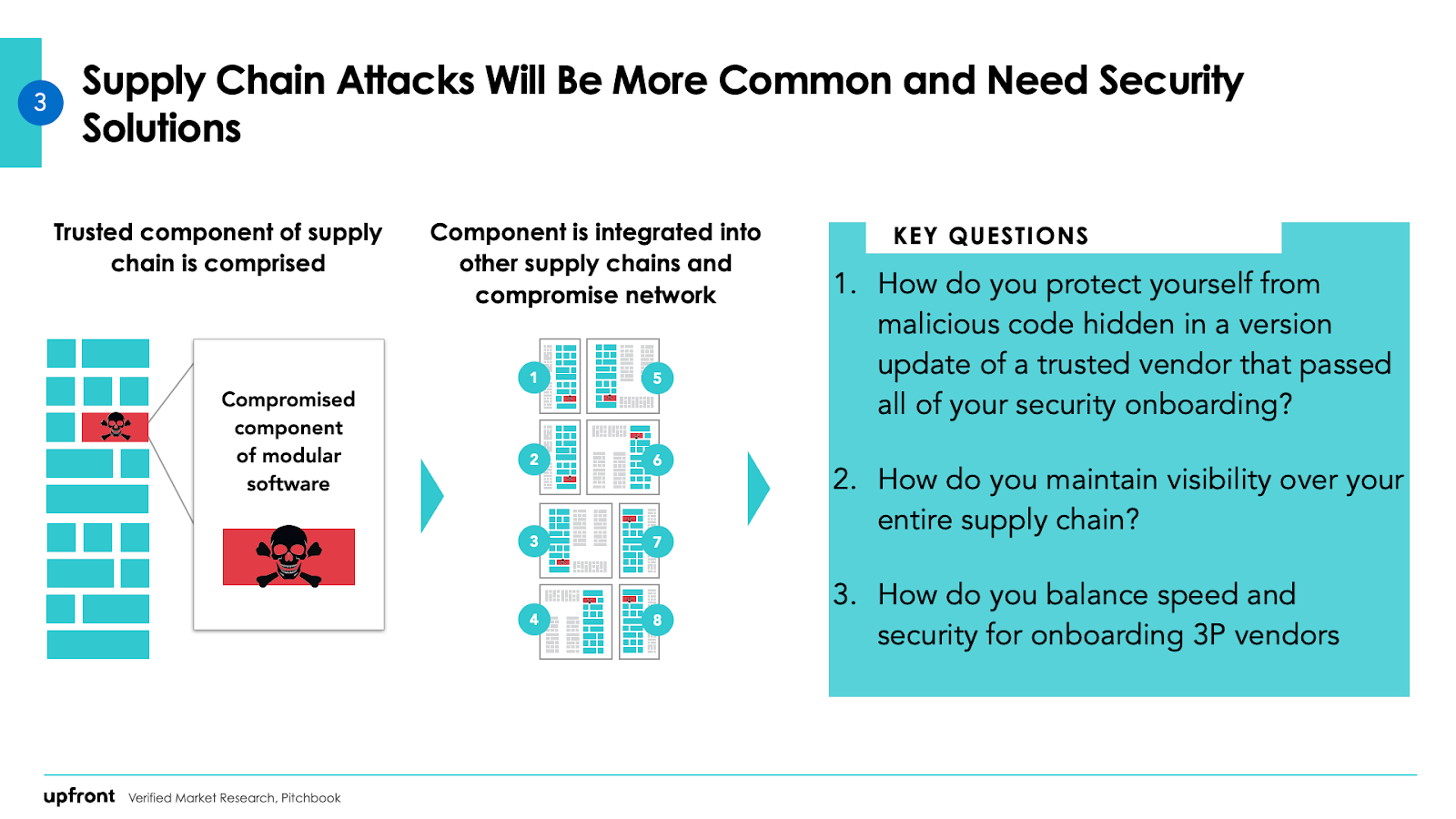
Image Credits: Upfront Ventures

How do you protect yourself from malicious code hidden in a version update of a trusted vendor that passed all of your security onboarding? How do you maintain visibility over your entire supply chain? Here we have more questions than answers, but securing supply chains is a space we will continue to explore, and we predict large companies will be built to securely vet, onboard, monitor and offboard third-party vendors, modules, APIs and other dependencies.

If you are building in any of the above spaces, or adjacent spaces, please reach out. We readily acknowledge that the cybersecurity landscape is rapidly changing, and if you agree or disagree with any of the arguments above, I want to hear from you!
23 Jun 2021

Want in on the next $100B in cybersecurity?

As a Battery Ventures associate in 1999, I used to spend my nights highlighting actual magazines called Red Herring, InfoWorld and The Industry Standard, plus my personal favorites StorageWorld and Mass High Tech (because the other VC associates rarely scanned these).

As a 23-year-old, I’d circle the names of much older CEOs who worked at companies like IBM, EMC, Alcatel or Nortel to learn more about what they were doing. The companies were building mainframe-to-server replication technologies, IP switches and nascent web/security services on top.

Flash forward 22 years and, in a way, nothing has changed. We have gone from command line to GUI to now API as the interface innovation. But humans still need an interface, one that works for more types of people on more types of devices. We no longer talk about the OSI stack — we talk about the decentralized blockchain stack. We no longer talk about compute, data storage and analysis on a mainframe, but rather on the cloud.

The problems and opportunities have stayed quite similar, but the markets and opportunities have gotten much larger. AWS and Azure cloud businesses alone added $23 billion of run-rate revenue in the last year, growing at 32% and 50%, respectively — high growth on an already massive base.

The size of the cybersecurity market has gotten infinitely larger as software eats the world and more people are able to sit and feast at the table from anywhere on Earth (and, soon enough, space).

The size of the cybersecurity market, in particular, has gotten infinitely larger as software eats the world and more people are able to sit and feast at the table from anywhere on Earth (and, soon enough, space).

Over the course of the last few months, my colleague Spencer Calvert and I released a series of pieces about why this market opportunity is growing so rapidly: the rise of multicloud environments, data being generated and stored faster than anyone can keep up with it, SaaS applications powering virtually every function across an organization and CISOs’ rise in political power and strategic responsibility.

This all ladders up to an estimated — and we think conservative — $100 billion of new market value by 2025 alone, putting total market size at close to $280 billion.

In other words, opportunities are ripe for massive business value creation in cybersecurity. We think many unicorns will be built in these spaces, and while we are still in the early innings, there are a few specific areas where we’re looking to make bets (and one big-picture, still-developing area). Specifically, Upfront is actively looking for companies building in:

  1. Data security and data abstraction.
  2. Zero-trust, broadly applied.
  3. Supply chains.

Data security and abstraction

Data is not a new thesis, but I am excited to look at the change in data stacks from an initial cybersecurity lens. What set of opportunities can emerge if we view security at the bottom of the stack — foundational — rather than as an application at the top or to the side?

Image Credits: Upfront Ventures

For example, data is expanding faster than we can secure it. We need to first know where the (structured and unstructured) data is located, what data is being stored, confirm proper security posture and prioritize fixing the most important issues at the right speed.

Doing this at scale requires smart passive mapping, along with heuristics and rules to pull the signal from the noise in an increasingly data-rich (noisy) world. Open Raven, an Upfront portfolio company, is building a solution to discover and protect structured and unstructured data at scale across cloud environments. New large platform companies will be built in the data security space as the point of control moves from the network layer to the data layer.

We believe Open Raven is poised to be a leader in this space and also will power a new generation of “output” or application companies yet to be funded. These companies could be as big as Salesforce or Workday, built with data abstracted and managed differently from the start.

If we look at security data at the point it is created or discovered, new platforms like Open Raven may lead to the emergence of an entirely new ecosystem of apps, ranging from those Open Raven is most likely to build in-house — like compliance workflows — to entirely new companies that rebuild apps we have used since the beginning of time, which includes everything from people management systems to CRMs to product analytics to your marketing attribution tools.

Platforms that lead with a security-first, foundational lens have the potential to power a new generation of applications companies with a laser-focus on the customer engagement layer or the “output” layer, leaving the data cataloging, opinionated data models and data applications to third parties that handle data mapping, security and compliance.

Image Credits: Upfront Ventures

Put simply, if full-stack applications look like layers of the Earth, with UX as the crust, that crust can become better and deeper with foundational horizontal companies underneath meeting all the requirements surrounding personally identifiable information and GDPR, which are foisted upon companies that currently have data everywhere. This can free up time for new application companies to focus their creative talent even more deeply on the human-to-software engagement layer, building superhuman apps for every existing category.

Zero-trust

Zero-trust was first coined in 2010, but applications are still being discovered and large businesses are being built around the idea. Zero-trust, for those getting up to speed, is the assumption that anyone accessing your system, devices, etc., is a bad actor.

This could sound paranoid, but think about the last time you visited a Big Tech campus. Could you walk in past reception and security without a guest pass or name badge? Absolutely not. Same with virtual spaces and access. My first in-depth course on zero-trust security was with Fleetsmith. I invested in Fleetsmith in 2017, a young team building software to manage apps, settings and security preferences for organizations powered by Apple devices. Zero-trust in the context of Fleetsmith was about device setup and permissions. Fleetsmith was acquired by Apple in mid-2020.

About the same time as the Fleetsmith acquisition, I met Art Poghosyan and the team at Britive. This team is also deploying zero-trust for dynamic permissioning in the cloud. Britive is being built under the premise of zero-trust Just-in-time (JIT) access, whereby users are granted ephemeral access dynamically rather than the legacy process of “checking out” and “checking in” credentials.

By granting temporary privilege access instead of “always-on” credentials, Britive is able to drastically reduce cyber risks associated with over-privileged accounts, the time to manage privilege access and the workflows to streamline privileged access management across multicloud environments.

What’s next in zero-based trust (ZBT)? We see device and access as the new perimeter, as workers flex devices and locations for their work and have invested around this with Fleetsmith and now Britive. But we still think there is more ground to cover for ZBT to permeate more mundane processes. Passwords are an example of something that is, in theory, zero-trust (you must continually prove who you are). But they are woefully inadequate.

Phishing attacks to steal passwords are the most common path to data breaches. But how do you get users to adopt password managers, password rotation, dual-factor authentication or even passwordless solutions? We want to back simple, elegant solutions to instill ZBT elements into common workflows.

Supply chains

Modern software is assembled using third-party and open-source components. This assembly line of public code packages and third-party APIs is known as a supply chain. Attacks that target this assembly line are referred to as supply chain attacks.

Some supply chain attacks can be mitigated by existing application-security tools like Snyk and other SCA tools for open-source dependencies, such as Bridgecrew to automate security engineering and fix misconfigurations and Veracode for security scanning.

But other vulnerabilities can be extremely challenging to detect. Take the supply chain attack that took center stage — the SolarWinds hack of 2020 — in which a small snippet of code was altered in a SolarWinds update before spreading to 18,000 different companies, all of which relied on SolarWinds software for network monitoring or other services.

Image Credits: Upfront Ventures

How do you protect yourself from malicious code hidden in a version update of a trusted vendor that passed all of your security onboarding? How do you maintain visibility over your entire supply chain? Here we have more questions than answers, but securing supply chains is a space we will continue to explore, and we predict large companies will be built to securely vet, onboard, monitor and offboard third-party vendors, modules, APIs and other dependencies.

If you are building in any of the above spaces, or adjacent spaces, please reach out. We readily acknowledge that the cybersecurity landscape is rapidly changing, and if you agree or disagree with any of the arguments above, I want to hear from you!

23 Jun 2021

Snackpass gobbles up $70M at a $400M+ valuation as its social food ordering platform crosses 500k users

While every food delivery company is trying to get an edge on its rivals with discount codes, faster service, and a turn into the realm of spooky with ghost kitchens and dark stores, a startup built on a lighter, social concept — letting people see what their friends are chomping on, making it possible to order food and drinks for each other and group order, with buyers picking it all up for themselves — has just raised a substantial Series B and says that it is already profitable.

Snackpass, which describes itself as a “food meets friends” — essentially a social commerce platform for ordering from restaurants, with “snack”, the CEO tells me, of having a double meaning of eating (of course), and a flirtatious reference to a cutie pie — has picked up a $70 million, a super-sized Series B that it will be using to continue expanding to more markets in the U.S.

Conceived four years ago while Kevin Tan, the CEO who co-founded the company with Jamie Marshall, was still a student at Yale studying physics, Snackpass has grown by remaining true to its higher-ed roots. The startup now has 500,000 users across 13 college towns, and has seen its growth explode 7x in the last three months alone. This round values the startup at over $400 million.

This latest tranche of funding is coming from an interesting group of investors. Led by Craft Ventures, it also includes Andreessen Horowitz (which led its $21 million Series A), General Catalyst, Y Combinator, and a long list of individual backers that speaks to the attention Snackpass is getting and the place it’s carving out for itself as a go-to food platform for millennials and younger users.

That list includes AirAngels, the Airbnb alumni investor syndicate; Bastian Lehmann of the Uber-acquired delivery giant Postmates (et tu, Bastian?); David Grutman, a Miami-based hospitality entrepreneur; Draymond Green of the San Francisco Warriors; Gaingels; HartBeat Ventures, Kevin Hart’s venture fund; musician celebs the Jonas Brothers; Shrug Capital (the VC that says it’s interested in consumer startups that are actually interesting to “non-tech” audiences); Stephen Paglucia, co-owner of the Boston Celtics; hip DJ Steve Aoki; Turner Novak of Banana Capital; William Barnes of Moving Capital; and the Uber alumni investor syndicate.

The vast majority of food-ordering platforms these days are focused around delivery and in many cases ways of getting an edge over other platforms in executing on that — a push that often comes at the expense of margins than are thinner than a Roman pizza. Snackpass’s big breakthrough, if you could call it that, was to simply dial back from that one-upmanship, moving away from that premise altogether, aiming to disrupt something much more mundane: the queue.

Tan said Snackpass asked its users what they would do if they weren’t using the app, and they said, “Oh, I just stand in line to order,” he told me in an interview.

“The market share right now is owned by people standing in line at the register, and placing their order. Our vision is that in five years that will no longer exist, like, there will be no more registers. We don’t think it makes any sense.”

He notes that for those who really want delivery, people can opt for that, too — Snackpass integrates with DoorDash, UberEats and others to fulfill that — but 90% of the orders on Snackpass are pickup, meaning that not only does the company then not have to deal with its own fleets of delivery people, and the infrastructure of that, but the operating costs to provide that are also not there.

It turns out that actually a lot of young people seem happy to pop out to get something nice to eat. It means they get to socialise, and take a selfie with their food or drink (boba tea figures strongly) at the venue where it’s being bought. It becomes an experience.

It’s also where the market is in another sense. “What people don’t realize is delivery is only 8% of the restaurant industry,” Tan told me. “And while it’s very much competed for by like big companies, and it’s a huge market, the restaurant industry, is like, much bigger, it’s $800 billion. And 90% of that purchasing is still offline,” he continued, referring to the many people who just queue up, order, buy, and leave. “It’s anonymous, and it’s on the verge of disruption. And we’re focused on that much bigger blue ocean.”

Its formula seems to be working with its target users. Tan said that the service has 80% penetration with students in the markets where it has launched. The average customer orders four and a half times a month, with some customers ordering every day. “You can actually see that it’s like, five to ten times more engagement than the delivery platforms, like UberEats or DoorDash.”

The company’s commissions vary and start at 7% and it’s current suite includes online ordering, self-service kiosks, digital menus, marketing services, and a customer referral program. It’s already profitable but as it continues to grow (and maybe extend to other demographics) you can imagine it adding and expanding on all of these.

There is something about Snackpass that reminds me a lot of Snapchat, not just that the names have a similar ring to them, and not just that they have resonated with college-aged users (and not just that they both squarely target them). It’s something of the whimsy of the app, and how it takes a light touch in its approach to do something that might otherwise feel cumbersome, or mundane, or what, basically, older people do.

Right now, there isn’t much of a social “user graph” per se on Snackpass, nor does it integrate particularly deeply with any specific social apps, but you could imagine a partnership there down the line, especially considering that Snap is getting a whole lot more involved with commerce now.

“In building a social experience around food through shared rewards, gifting, and a social activity feed, Snackpass has created a dynamic and attractive restaurant ordering system,” says Bryan Rosenblatt, partner, Craft Ventures, in a statement. “The growth of its marketplace and virality of the product coupled with Snackpass’ outstanding  team and vision, make it the ultimate solution for consumers and businesses alike. We are thrilled to help take Snackpass to the next level with this latest round of funding.”

23 Jun 2021

Snackpass gobbles up $70M at a $400M+ valuation as its social food ordering platform crosses 500k users

While every food delivery company is trying to get an edge on its rivals with discount codes, faster service, and a turn into the realm of spooky with ghost kitchens and dark stores, a startup built on a lighter, social concept — letting people see what their friends are chomping on, making it possible to order food and drinks for each other and group order, with buyers picking it all up for themselves — has just raised a substantial Series B and says that it is already profitable.

Snackpass, which describes itself as a “food meets friends” — essentially a social commerce platform for ordering from restaurants, with “snack”, the CEO tells me, of having a double meaning of eating (of course), and a flirtatious reference to a cutie pie — has picked up a $70 million, a super-sized Series B that it will be using to continue expanding to more markets in the U.S.

Conceived four years ago while Kevin Tan, the CEO who co-founded the company with Jamie Marshall, was still a student at Yale studying physics, Snackpass has grown by remaining true to its higher-ed roots. The startup now has 500,000 users across 13 college towns, and has seen its growth explode 7x in the last three months alone. This round values the startup at over $400 million.

This latest tranche of funding is coming from an interesting group of investors. Led by Craft Ventures, it also includes Andreessen Horowitz (which led its $21 million Series A), General Catalyst, Y Combinator, and a long list of individual backers that speaks to the attention Snackpass is getting and the place it’s carving out for itself as a go-to food platform for millennials and younger users.

That list includes AirAngels, the Airbnb alumni investor syndicate; Bastian Lehmann of the Uber-acquired delivery giant Postmates (et tu, Bastian?); David Grutman, a Miami-based hospitality entrepreneur; Draymond Green of the San Francisco Warriors; Gaingels; HartBeat Ventures, Kevin Hart’s venture fund; musician celebs the Jonas Brothers; Shrug Capital (the VC that says it’s interested in consumer startups that are actually interesting to “non-tech” audiences); Stephen Paglucia, co-owner of the Boston Celtics; hip DJ Steve Aoki; Turner Novak of Banana Capital; William Barnes of Moving Capital; and the Uber alumni investor syndicate.

The vast majority of food-ordering platforms these days are focused around delivery and in many cases ways of getting an edge over other platforms in executing on that — a push that often comes at the expense of margins than are thinner than a Roman pizza. Snackpass’s big breakthrough, if you could call it that, was to simply dial back from that one-upmanship, moving away from that premise altogether, aiming to disrupt something much more mundane: the queue.

Tan said Snackpass asked its users what they would do if they weren’t using the app, and they said, “Oh, I just stand in line to order,” he told me in an interview.

“The market share right now is owned by people standing in line at the register, and placing their order. Our vision is that in five years that will no longer exist, like, there will be no more registers. We don’t think it makes any sense.”

He notes that for those who really want delivery, people can opt for that, too — Snackpass integrates with DoorDash, UberEats and others to fulfill that — but 90% of the orders on Snackpass are pickup, meaning that not only does the company then not have to deal with its own fleets of delivery people, and the infrastructure of that, but the operating costs to provide that are also not there.

It turns out that actually a lot of young people seem happy to pop out to get something nice to eat. It means they get to socialise, and take a selfie with their food or drink (boba tea figures strongly) at the venue where it’s being bought. It becomes an experience.

It’s also where the market is in another sense. “What people don’t realize is delivery is only 8% of the restaurant industry,” Tan told me. “And while it’s very much competed for by like big companies, and it’s a huge market, the restaurant industry, is like, much bigger, it’s $800 billion. And 90% of that purchasing is still offline,” he continued, referring to the many people who just queue up, order, buy, and leave. “It’s anonymous, and it’s on the verge of disruption. And we’re focused on that much bigger blue ocean.”

Its formula seems to be working with its target users. Tan said that the service has 80% penetration with students in the markets where it has launched. The average customer orders four and a half times a month, with some customers ordering every day. “You can actually see that it’s like, five to ten times more engagement than the delivery platforms, like UberEats or DoorDash.”

The company’s commissions vary and start at 7% and it’s current suite includes online ordering, self-service kiosks, digital menus, marketing services, and a customer referral program. It’s already profitable but as it continues to grow (and maybe extend to other demographics) you can imagine it adding and expanding on all of these.

There is something about Snackpass that reminds me a lot of Snapchat, not just that the names have a similar ring to them, and not just that they have resonated with college-aged users (and not just that they both squarely target them). It’s something of the whimsy of the app, and how it takes a light touch in its approach to do something that might otherwise feel cumbersome, or mundane, or what, basically, older people do.

Right now, there isn’t much of a social “user graph” per se on Snackpass, nor does it integrate particularly deeply with any specific social apps, but you could imagine a partnership there down the line, especially considering that Snap is getting a whole lot more involved with commerce now.

“In building a social experience around food through shared rewards, gifting, and a social activity feed, Snackpass has created a dynamic and attractive restaurant ordering system,” says Bryan Rosenblatt, partner, Craft Ventures, in a statement. “The growth of its marketplace and virality of the product coupled with Snackpass’ outstanding  team and vision, make it the ultimate solution for consumers and businesses alike. We are thrilled to help take Snackpass to the next level with this latest round of funding.”

23 Jun 2021

How one founder realized satellite internet didn’t have to be fast or expensive to be useful

It’s hard to understand just how steeply the cost of launching and operating satellites has dropped, particularly since the introduction of lower cost launch services from a number of commercial players, and the maturation of the smartphone supply chain. Swarm co-founder and CEO realized just how much the cost curve had changed when she and her co-founder Ben Longmeir realized that they could outfit tiny satellites Longmeir had created as a kind of space lover’s hobby with the equipment needed to provide low-bandwidth connectivity to low-powered devices around the world.

In this week’s episode of Found, Sara walks us through how she went from an engineering career that included stints at NASA’s Jet Propulsion Laboratory and Google, to building Swarm as a first-time founder and CEO. We covered a range of topics including how Sara and Ben decided who would be CEO, what it’s like leading a small but growing team, and how to evaluate your decisions as a founder, and commit to a course of action to move forward.

Sara was extremely candid with us about her experience as a founder and CEO, and this is definitely one of our most open and honest conversations to date.

We loved our time chatting with Sara, and we hope you love yours listening to the episode. And of course, we’d love if you can subscribe to Found in Apple Podcasts, on Spotify, on Google Podcasts or in your podcast app of choice. Please leave us a review and let us know what you think, or send us direct feedback either on Twitter or via email at found@techcrunch.com. And please join us again next week for our next featured founder.

23 Jun 2021

Before an exit, founders must get their employment law ducks in a row

Successfully selling a business has much to do with timing. For many entrepreneurs, it’s the high-stakes end game where they cash out and reap the rewards of their efforts. At a certain point, when both buyers and sellers are working hard to close the deal, negotiations can move very quickly. If you’re the seller, this is not the time to discover unanticipated problems in your business.

Distressingly often, these problems are related to employment. Inattention to employment issues can have a significant impact on deals — from preventing closings and reducing the deal value to altering the deal terms or significantly limiting the pool of potential buyers.

Poor compliance, lack of policies or flawed practices mean potential liability exposure or expensive policy revisions and employee retraining — all of which can devalue your business.

Fortunately, such issues typically can be resolved well in advance with a little forethought and legal guidance. It’s important to get your employment ducks in a row long before you start planning your exit.

What follows is an overview of the three main categories of employment issues that can derail or delay a sale. For the most part, these assume an asset sale, but may vary in the case of a stock sale.

Compliance

By far the most significant problem is general employment law compliance. This means creating strong employment policies and practices that are documented, in place and operating long before you pursue a deal. The key area is wage and hour issues — timekeeping and payroll practices, worker classification issues (employee vs. independent contractor; exempt vs. non-exempt), meal and rest periods, PTO policies and payouts at termination.

23 Jun 2021

As clinical guidelines shift, heart disease screening startup pulls in $43M Series B

Cleerly Coronary, a company that uses A.I powered imaging to analyze heart scans, announced a $43 million Series B funding this week. The funding comes at a moment when it seems that a new way of screening for heart disease is on its way. 

Cleerly was started in 2017 by James K. Min a cardiologist, and the director of the Dalio Institute for Cardiac Imaging at New York Presbyterian Hospital/Weill Cornell Medical College. The company, which uses A.I to analyze detailed CT scans of the heart, has 60 employees, and has raised $54 million in total funding.

The Series B round was led by Vensana Capital, but also included LVR Health, New Leaf Venture Partners, DigiTx Partners, and Cigna Ventures. 

The startup’s aim is to provide analysis of detailed pictures of the human heart that have been examined by artificial intelligence. This analysis is based on images taken via Cardiac Computer Tomography Angiogram (CTA), a new, but rapidly growing manner of scanning for plaques. 

“We focus on the entire heart, so every artery, and its branches, and then atherosclerosis characterization and quantification,” says Min. “We look at all of the plaque buildup in the artery, [and] the walls of the artery, which historical and traditional methods that we’ve used in cardiology have never been able to do.”

Cleerly is a web application, and it requires that a CTA image specifically, which the A.I. is trained to analyze, is actually taken when patients go in for a checkup. 

When a patient goes in for a heart exam after experiencing a symptom like chest pain, there are a few ways they can be screened. They might undergo a stress test, an echocardiogram (ECG), or a coronary angiogram – a catheter and x-ray-based test. CTA is a newer form of imaging in which a scanner takes detailed images of the heart, which is illuminated with an injected dye. 

Cleerly’s platform is designed to analyze those CTA images in detail, but they’ve only recently become a first-line test (a go-to, in essence) when patients come in with suspected heart problems. The European Society of Cardiology updated guidelines to make CTA a first-line test in evaluating patients with chronic coronary disease. In the UK, it became a first-line test in the evaluation of patients with chest pain in 2016.

CTA is already used in the US, but guidelines may expand how often it’s actually used. A review on CTA published on the American College of Cardiology website notes that it shows “extraordinary potential.” 

There’s movement on the insurance side, too. In 2020, United Healthcare announced the company will now reimburse for CTA scans when they’re ordered to examine low-to medium risk patients with chest pain. Reimbursement qualification is obviously a huge boon to broader adoption.

CTA imaging might not be great for people who already have stents in their hearts, or, says Min, those who are just in for a routine checkup (there is low-dose radiation associated with a CTA scan). Rather, Cleerly will focus on patients who have shown symptoms or are already at high risk for heart disease. 

The CDC estimates that currently 18.2 million adults currently have coronary artery heart disease (the most common kind), and that 47 percent of Americans have one of the three most prominent risk factors for the disease: high blood pressure, high cholesterol, or a smoking habit. 

These shifts (and anticipated shifts) in guidelines suggest that a lot more of these high-risk patients may be getting CTA scans in the future, and Cleerly has been working on mining additional information from them in several large-scale clinical trials.

There are plenty of different risk factors that contribute to heart disease, but the most basic understanding is that heart attacks happen when plaques build up in the arteries, which narrows the arteries and constricts the flow of blood. Clinical trials have suggested that the types of plaques inside the body may contain information about how risky certain blockages are compared to others beyond just much of the artery they block. 

A trial on 25,251 patients found that, indeed, the percentage of construction in the arteries increases the risk of heart attack. But the type of plaque in those arteries identified high-risk patients better than other measures. Patients who went on to have sudden heart attacks, for example, tended to have higher levels of fibrofatty or necrotic core plaque in their hearts. 

These results do suggest that it’s worth knowing a bit more detail about plaque in the heart. Note that Min is an author of this study, but it was also conducted at 13 different medical centers. 

As with all A.I based diagnostic tools the big question is: How well does it actually recognize features within a scan? 

At the moment FDA documents emphasize that it is not meant to supplant a trained medical professional who can interpret the results of a scan. But tests have suggested it fares pretty well. 

A June 2021 study compared Cleerly’s A.I analysis of CTA scans to that of three expert readers, and found that the A.I had a diagnostic accuracy of about 99.7 percent when evaluating patients who had severe narrowing in their arteries. Three of nine study authors hold equity in Cleerly. 

With this most recent round of funding, Min says he aims to pursue more commercial partnerships and scale up to meet the existing demand. “We have sort of stayed under the radar, but we came above the radar because now I think we’re prepared to fulfill demand,” he says. 

Still, the product itself will continue to be tested and refined. Cleerly is in the midst of seven performance indication studies that will evaluate just how well the software can spot the litany of plaques that can build up in the heart.

23 Jun 2021

VCs to meet with StartupAlley+ cohort at TC Disrupt 2021

This year we’re taking exhibiting in Startup Alley, the epicenter of opportunity at every Disrupt, to a whole new level at TechCrunch Disrupt 2021 (September 21-23). Team TechCrunch will tap up to 50 exhibiting founders to take part in Startup Alley+, an exclusive, VIP experience designed to grow your business and increase your opportunities two months before Disrupt kicks off. Want a shot? Buy a Startup Alley Pass before they’re gone.

Pro Tip: The Startup Alley+ experience does not cost anything beyond what every founder pays to exhibit in Startup Alley. You will be notified if accepted into Startup Alley+ one week after your re

One of the many perks you’ll receive as a member of the Startup Alley+ cohort is access and warm introductions to leading investors — every startup founder’s favorite network connection. We’ll have a veritable volume of VCs available before Disrupt begins, and we’ll match founders and investors based on how their investment theses align.

You’ll meet with your curated VC on CrunchMatch, our investor-founder platform. Get comfy, because you’ll have access to the full list of investors attending Disrupt — use CrunchMatch to meet other investors before and during the conference.

What else comes with the Startup Alley+ experience? It kicks off July 8-9 with a complimentary founder pass to TechCrunch Early Stage: Marketing & Fundraising. Check out the event agenda packed with presentations and breakout sessions, and don’t miss the pitch competition on day two.

In the run-up to Disrupt, you’ll also get to attend these masterclasses and learn from the best.

Get ready to compete in a mini pitch-off at one of these five Extra Crunch Live feed-back sessions. Whip your pitch into shape now — before you need to impress investors.

  • Session 1: July 21
  • Session 2 – August 4
  • Session 3 – August 18
  • Session 4 – September 1
  • Session 5 – September 8

TechCrunch Disrupt 2021 takes place on September 21-23. We have only a handful of spots left if you want to exhibit in Startup Alley — and have a crack at joining the Startup Alley+ cohort. Buy your Startup Alley Pass, stand in the epicenter of opportunity and do what it takes to make your startup dream a reality.

Is your company interested in sponsoring or exhibiting at Disrupt 2021? Contact our sponsorship sales team by filling out this form.

23 Jun 2021

PairTree speeds adoption process with an online self-matching platform and $2.25M seed

Making the choice to adopt, or to find an adopting family, is a legally complex, emotionally taxing, expensive and time-consuming process. PairTree aims to make one part at least considerably easier and faster with its online matching platform where expectant mothers and hopeful adopters can find each other without the facilitation of an agency or other organization. The company has just raised a $2.25 million seed round, a rarity in the industry.

The path to adoption is different for everyone, but there are generally some things they have in common: once the process is started, it can take upwards of $50,000 and over a year and a half to organize a match. While some of this comprises the ordinary legal hurdles involved in any adoption, a big part of it is simply that there are limited opportunities for adoption and compatibility isn’t guaranteed. As many people considering adoption are doing so on the heels of unsuccessful fertility treatment, it can be a lot to take on and a dispiriting wait.

Erin Quick, CEO and co-founder (with CTO Justin Friberg) of PairTree, said that the modern adoption landscape is marked by the fact that nearly 95 percent of adoptions are open, meaning there is ongoing contact between a biological mother and adopting family.

“They’ll be working together forever, and that makes finding a highly compatible match that much more important,” Quick, herself a happy adopter, told TechCrunch in an interview. But because of the way adoption is generally done — through agencies licensed by states — there are limitations on how far anyone involved can reach.

“It’s so bound by geography,” she said. “It’s regulated at the state level and has been facilitated by state level, not because of state laws — there’s no rule saying you can’t adopt out of state — but because the facilitators are small nonprofits. They bind themselves to their geographic region because that’s what they can serve. We’re building a platform that makes what people are already doing much easier and more efficient.”

That platform is in many ways very like a dating app, though of course the comparison is not exact and does not reflect the gravity of choosing to adopt. But like in the dating world, in adoption you have a cloud of people looking to connect over something highly dependent on personality and individual needs.

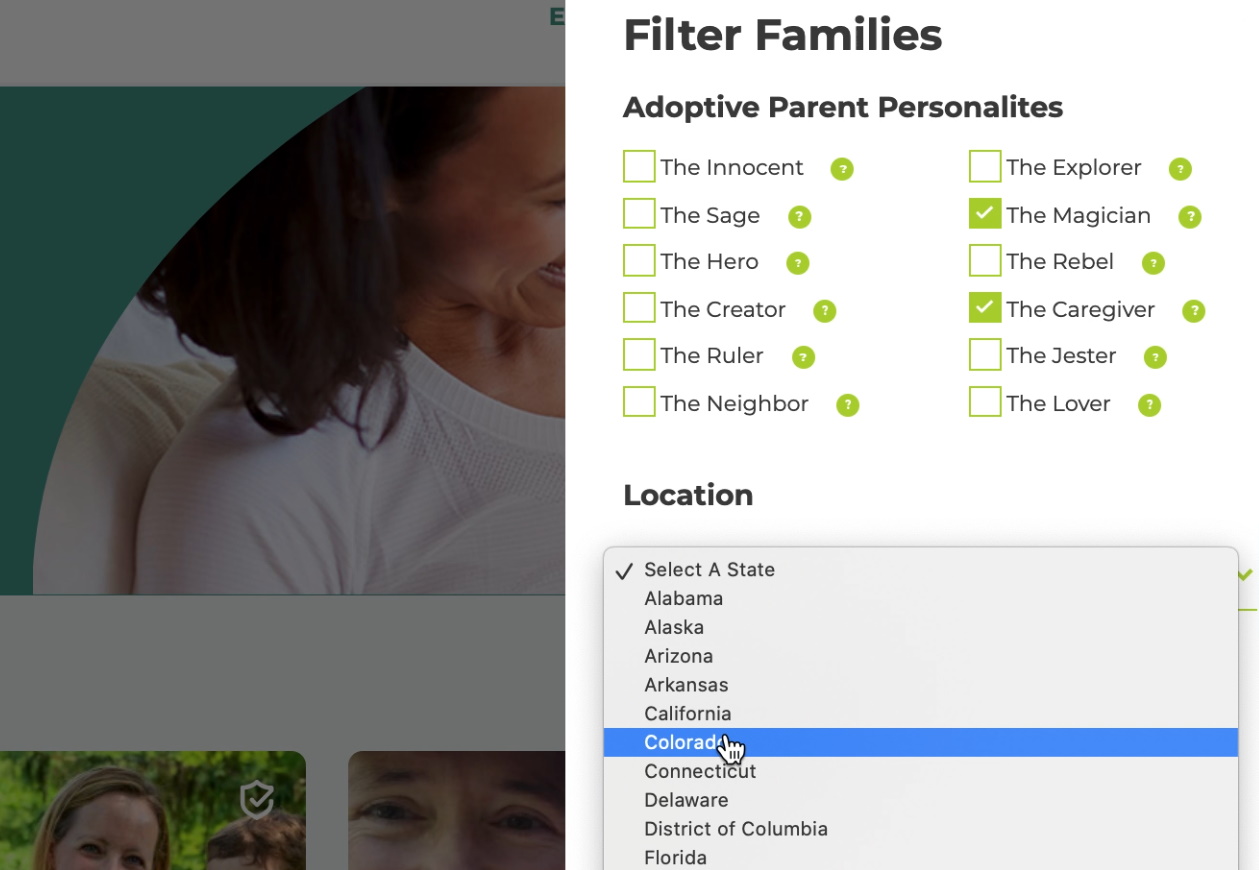
Screenshot of the way expectant mothers can filter and search for compatible adopting families.

PairTree onboards both expectant mothers and adopters with personality tests — not the light-hearted stuff of OK Cupid but a broader, more consequential set of Jungian archetypes that signal a person’s high-level priorities in life. Think “wants to travel and learn” vs “wants to provide and nurture” (not that these are necessarily incompatible) — they serve as important indicators of preferences that might not be so easy summarized with a series of checkboxes. That’s not the only criterion, of course: other demographic and personal details are also collected.

The adopters are added to a pool through which expectant mothers can sift and, if desired, contact (in this, Quick suggested, PairTree mirrors Bumble, where women must message first). PairTree also does basic due diligence stuff like identify verification and confirmation of other important steps like home studies.

If a likely match is found, all the relevant information is passed to the adoption facilitator, who will be coordinating the other legal and financial steps. PairTree isn’t looking to replace these agencies — in fact Quick said that they have been huge proponents of the platform, since it can shorten wait times and improve outcomes. She said based on their existing successful adoptions that the wait can be cut by by a half or even two thirds, and thus the cost (which involves recurring payments as the agency searches and does the legal work) by a similar amount.

“These are small nonprofits, they don’t have a lot of tech chops. When we launched we went to attorneys first, actually, and we were surprised when agencies started reaching out,” she explained.

Agencies have been referring their adopters to PairTree, which has led to a lot of early traction, Quick said. And importantly, they’ve seen great diversity in their early success.

“Adoption has historically been denied by faith-based systems — LGBTQ families and single women have been subject to discrimination,” she noted. And in fact just last week a Supreme Court decision held up the right of religious adoption agencies to deny services to same-sex couples. Quick was proud to say that they have already facilitated adoptions by same-sex couples and single parents.

The company will also set aside 5 percent of its net profits (which hopefully will manifest in volume) for the Lifetime Healing Foundation, which offers counseling and support to birth mothers who have gone though the adoption process.

The $2.25M seed was led by Urban Innovation Fund, with Founder Collective, Female Founders alliance and Techstars participating. It will surprise few to hear that adoption is not a particularly hot industry for venture capital, but rising interest and investment in fertility tech may have shed light on opportunities in adjacent spaces. Adoption is one where significant improvements can be enabled by technology, meaning startups can grow fast while having a positive impact.

The company plans to use the money to expand its product portfolio, pursue more partnerships, and perhaps most importantly for its users, build a native mobile app, since 90 percent of the service’s viewership is mobile.

“We’re grateful to our expert and diverse group of investors who share our vision that adoption should be a
viable path to parenting for more people,” said Quick in the release announcing the raise. “Like us, our investors believe in the importance of supporting Biological and Adopting Families along with the Adoptees, because adoption is not a single transaction but a journey they’re taking over the course of a lifetime.”

23 Jun 2021

Edtech startups and VCs rally around a memo of their own

Outschool founder Amir Nathoo has a message to the edtech sector, which recently found itself under a spotlight thanks to the pandemic: Add your voice, and don’t try to always appear neutral.

The founder of the unicorn business penned a statement, co-signed by other edtech leaders, promoting the continuance of teachers being allowed to teach critical race theory in classrooms across the country. The learning framework, which has been the subject of recent legislative debate, covers the acknowledgement of institutional, and systemic racism in the United States. Critics of critical race theory say that CTR can add more divisiveness to an already polarized world, while supporters see the framework as key to understanding the role that racism plays in society and how current systems perpetuate inequality.

“As a nation, we must take a stand that teaching the wrongs of racism is not ‘divisive’; it is imperative,” the statement reads. “Many of these new laws will require teaching ‘both sides’ of a lesson about race or current events, if permitted at all,” a nuance that would make it difficult for teachers to condemn history like lynching or Jim Crow’s legacy.

It goes on to pledge that, “as CEOs and Board Members of education technology companies, we are taking a stand to say that any new law that restricts teaching racism in a lesson is unacceptable.”

We stand with the thousands of teachers who have come together to protest these laws restricting racism lessons.
We stand with the millions of learners they will impact.
We are signing this letter today so that teachers and students can openly discuss the experiences of Black youth today in the context of the George Floyd protests of 2020.
Above all, we are signing this letter today to say racism is wrong and that hatred based on the color of someone’s skin, religious beliefs, gender, or sexual orientation is wrong, unequivocally wrong.

Signatures on the statement include a number of notable founders and investors in edtech, giving weight to the statement: 

Atin Batra, General Partner, 27V (Twenty Seven Ventures)
Michael Ke Zhang, CEO and Co-Founder of AI Camp
Joanna Smith, CEO and Founder of AllHere
Ilana Nankin, Ph.D. Founder & CEO of Breathe For Change
John Danner, Managing Partner, Dunce Capital
Erika Hairston, CEO and Co-Founder of Edlyft
Michael Haddix, Founder, Elevate
Alex Taussig, Partner at Lightspeed Venture Partners
Brian Swartz – CEO & Co-Founder Neighbor Schools
Bridget Garsh – COO & Co-Founder Neighbor Schools
Cedric McDougal – CTO & Co-Founder Neighbor Schools
Sabari Raja, CEO and Cofounder, Nepris
Sabari Raja, CEO and Co-Founder, Nepris
Amir Nathoo, CEO and Co-Founder of Outschool
Rita Rosa Ruesga, Co-Founder Pikitin Learning Projects
Garrett Smiley, CEO and Co-Founder of Sora Schools
Rethink Education III Team
Rebecca Kaden, Managing Partner, Union Square Ventures
Sara Mauskopf, CEO and Co-Founder of Winnie
Jo Boaler, The Nominelli-Olivier Professor of Education, Stanford University, Co-Founder of youcubed

Mission-oriented politics

There is a growing perspective in Silicon Valley that companies should only get involved in politics when it is related to their mission and can impact their business.

The conversation began with Coinbase’s Brian Armstrong publishing a memo that banned the debate of causes and politics internally that are unrelated to work. Coinbase has since been joined by Basecamp, and there’s a pseudonymous Twitter account, Mission Protocol, dedicated to helping other startups adopt a code of conduct that “follows in Brian Armstrong’s footsteps.”

“We started this project because existing codes of conduct and conversations around social responsibility didn’t have a voice for what is most important: staying focused on the good we actually deliver for society through our missions,” a tweet from the account reads.

In an interview, Nathoo said that critical race theory “is clearly related” to its mission, but that his company is also taking an “expansive view of how our community can be impacted.” The company says it intends to engage, and add their voice, to issues around race and inequality.

“Ideally, companies would stay out of politics but that’s not the reality that we live in,” he said. “We think it’s an abdication of corporate responsibility to try and pretend that there’s both sides to every argument. I don’t think that’s right, and we intend to take a different path on corporate responsibility than other startups might have taken.”

AllHere CEO Joanna Smith, who signed the statement, told TechCrunch that the statement is tied heavily to her mission. Her company developed a 24/7 chatbot to help families and kids that have issues with absenteeism at schools. The company focuses on supporting families, through two-way text and in-person intervention, to get better outcomes and lessen learning gaps.

“I think every startup has to be aware of the environment within which they operate,” she said. “I think specifically in education technologies, it would be very difficult to scale a company that’s directly interfacing and interacting with families and kids, if the company itself is not aware of, or reflective of the needs and priorities of those who they are attempting to serve.

“We don’t have the luxury of putting on blinders to the realities that families and kids live in, which, for AllHere, includes transportation, health care, absenteeism, mental health and, of course, how families see the world,” she added.

The debate is more complex than pro-Coinbase and anti-Coinbase. For example, both companies present an alternative to how startups should address politics: Tie it to the mission, and view the mission as wide-ranging and inclusive.

Nathoo said that a small number of edtech leaders were invited to sign the edtech statement to start. Of those who didn’t sign, the main reasons were disagreement with messaging, or worry about getting involved in politics.

Edtech startups are in a unique spot to address racism because of the content and mission that many have. Quizlet has a number of free, downloadable lessons for educators to address topics like mass incarceration and policing, the fight for women’s suffrage, and the coronavirus in Black America, for example. Outschool has a number of classes offered about anti-racism, including an $11 one-time class for kids ages 4-6. There’s still a lot of work to be done.

Nathoo expects that Outschool’s business, which was recently valued at over $1 billion, will benefit from this choice because of “greater trust and connection” with the community and staff. Medium, for example, recently lost more employees after CEO Ev Williams published a culture memo, in the wake of a failed unionization attempt.

Even with this perspective, Nathoo admits that the company “is not where it wants to be” on diversity, and thinks that there is work left to be done. It’s up to future employees on if today’s effort, rallying against the diminishment of critical race theory and for more conversations of racism, will either be an attractive, or dissuasive, reason to join the team.