Year: 2021

23 Jun 2021

Dear Sophie: What options would allow me to start something on my own?

Here’s another edition of “Dear Sophie,” the advice column that answers immigration-related questions about working at technology companies.

“Your questions are vital to the spread of knowledge that allows people all over the world to rise above borders and pursue their dreams,” says Sophie Alcorn, a Silicon Valley immigration attorney. “Whether you’re in people ops, a founder or seeking a job in Silicon Valley, I would love to answer your questions in my next column.”

Extra Crunch members receive access to weekly “Dear Sophie” columns; use promo code ALCORN to purchase a one- or two-year subscription for 50% off.


Dear Sophie,

I’ve been working on an H-1B in the U.S. for nearly two years. While I’m grateful to have made it through the H-1B lottery and to be working, I’m feeling unhappy and frustrated with my job.

I really want to start something of my own and work on my own terms in the United States. Are there any immigration options that would allow me to do that?

— Seeking Satisfaction

Dear Seeking,

Job dissatisfaction and frustration while on H-1B is normal, according to Edward Gorbis. He is the founder of Career Meets World and a performance coach who specifically works with immigrants and first-generation professionals to help them find fulfillment and thrive in their careers and life. I recently spoke with him for my podcast, “Immigration Law For Tech Startups.”

He says that “once immigrants reach stability, they start to think, ‘Who am I, what do I value, what’s my core identity?’” He partners with people to help them to gain a better understanding of why they think the way they do, teach them how our brain really works, and then reshape and retrain the brain for success.

Gorbis says that imagining overcoming the hurdles that stand in the way of doing the work that will fulfill you is the first step. So, here are some options that can help you imagine how to move toward building the life of your dreams.

A composite image of immigration law attorney Sophie Alcorn in front of a background with a TechCrunch logo.

Image Credits: Joanna Buniak / Sophie Alcorn (opens in a new window)

Raise $250,000 and be the CEO

A great new option for aspiring entrepreneurs is International Entrepreneur Parole, a new immigration program in the United States that allows CEOs, CTOs, and others to obtain a 2.5-year immigration status. You can live in the U.S. and run your company. Your spouse can work and you could be eligible for a 2.5-year extension.

How to qualify? You’ll need to own at least 10% of a U.S. company, such as a Delaware C corporation registered in California. Ideally, you’ll want to show that your company bank account has at least $250,000 raised from qualifying U.S. investors prior to applying, but you can demonstrate other evidence to show that your company has the potential to grow rapidly and create jobs in the U.S.

See yourself at another company

There is technically no limit on how many H-1B employers you can have or how many hours you work — or how few hours you work — in an H-1B position. So, think about other companies.

23 Jun 2021

Drata raises $25M Series A to expand its security compliance platform

Security compliance is precisely three things: incredibly boring, time consuming, and entirely necessary to run a business in the modern age. Compliance isn’t going away, but startups like Drata are making it slightly easier to bear.

Drata helps companies get their SOC 2 compliance quicker by using automation. SOC 2 is a certification used to show that a company can store customer data in the cloud securely, but the process is notoriously complex and can take months to complete — and you have to do it all over again every year. That’s particularly burdensome for startups and smaller firms.

Drata says it can get companies SOC 2-compliant faster and keep them in compliance for longer by integrating with popular business tools and cloud services to get a better picture of a company’s security posture.

Now with a new round of $25 million at Series A in the bank, Drata said it’s expanding its compliance platform to also include ISO 27001, another core security standard used all over the world to help companies protect their systems and safeguard data.

The round landed six months after its $3.2 million seed round in January, and was led by GGV Capital, with participation from Silicon Valley CISO Investors, Okta Ventures, Cowboy Ventures, Leaders Fund, and SV Angel.

Drata CEO and co-founder Adam Markowitz told TechCrunch that the company is growing on average 100% month-over-month since it launched out of stealth and is serving hundreds of customers, including three-person startups to publicly traded companies.

The startup joins several other companies in the compliance space. Secureframe raised $18 million at Series A in March to offer SOC 2 and ISO 27001 certifications. Strike Graph raised a $3.9 million seed round last year to help companies automate security audits and get FedRamp certification needed to provide technology to the federal government. And, Startup Battlefield participant Osano in 2019 raised $5.4 million at Series A to build out its risk and compliance platform.

Related funding news:

23 Jun 2021

How many lives does bitcoin have?

Hello and welcome back to Equity, TechCrunch’s venture capital-focused podcast, where we unpack the numbers behind the headlines.

For this week’s deep dive Danny, Alex, and a bunch of the TechCrunch crew took on the recent happenings in the world of bitcoin. In a break from our regular format, we recorded live from a Twitter Space — it’s like a Clubhouse, but closer to where your social network is — so the audio quality is not going to be Utterly Perfect. But we think the conversation will more than make up for it!

Before we get into the show notes, do not forget that we’re recording Equity live on Hopin Thursday the 24th. Come hang with us and have some fun. It’s free, of course, and should be a good time. Details here, sign up here!

So what did we get into? A lot!

  • Recent price changes to the value of major coins
  • The impact of China on the larger crypto ecosystem
  • What’s the latest from the NFT craze?
  • Are DAOs, you know, actually a thing?

And more. A big thanks to Romain Dillet and Lucas Matney for hanging with us, Drew Olanoff for hosting, and Chris Gates for snagging the audio and making it all work.

See you tomorrow!

Equity drops every Monday at 7:00 a.m. PST, Wednesday, and Friday morning at 7:00 a.m. PST, so subscribe to us on Apple PodcastsOvercastSpotify and all the casts.

23 Jun 2021

Salesforce, AWS announce extended partnership with further two-way integration

Salesforce and AWS represent the two most successful cloud companies in their respective categories. Over the last few years the two cloud giants have had an evolving partnership. Today they announced plans for a new set of integration capabilities to make it easier to share data and build applications that cross the two platforms.

Patrick Stokes, EVP and GM for Platform at Salesforce, points out that the companies have worked together in the past to provide features like secure sharing between the two services, but they were hearing from customers that they wanted to take it further and today’s announcement is the first step towards making that happen.

“[The initial phases of the partnership] have really been massively successful. We’re learning a lot from each other and from our mutual customers about the types of things that they want to try to accomplish, both within the Salesforce portfolio of products, as well as all the Amazon products, so that the two solutions complement each other really nicely. And customers are asking us for more, and so we’re excited to enter into this next phase of our partnership,” Stokes explained.

He added, “The goal really is to unify our platforms, so bring [together] all the power of the Amazon services with all of the power of the of the Salesforce platform.” These capabilities could be the next step in accomplishing that.

This involves a couple of new features the companies are working on to help developers on both the platform and application side of the equation. For starters that includes enabling developers to virtualize Amazon data inside Salesforce without having to do all the coding to make that happen manually.

“More specifically, we’re going to virtualize Amazon data within the Salesforce platform, so whether you’re working with an S3 bucket, Amazon RDS or whatever it is we’re going to make it so that that the data is virtualized and just appears just like it’s native data on the Salesforce platform,” he said.

Similarly, developers building applications on Amazon will be able to access Salesforce data and have it appear natively in Amazon. This involves providing connectors between the two systems to make the data flow smoothly without a lot of coding to make that happen.

The companies are also announcing event sharing capabilities, which makes it easier for both Amazon and Salesforce customers to build microservices-based applications that cross both platforms.

“You can build microservices-oriented architecture that spans the services of Salesforce and Amazon platforms, again without having to write any code. To do that, [we’re developing] out of the box connectors so you can click and drag the events that you want.”

The companies are also announcing plans to make it easier from an identity and access management perspective to access the platforms with a guided setup. Finally, the companies are working on applications to build Amazon Chime communications tooling into Service Cloud and other Salesforce services to build things like virtual call centers using AWS machine learning technology.

Amazon VP of Global Marketing Rachel Thorton says that having the two cloud giants work together in this way should make it easier for developers to create solutions that span the two platforms. “I just think it unlocks such possibilities for developers, and the faster and more innovative developers can be, it just unlocks opportunities for businesses, and creates better customer experiences,” Thornton said.

It’s worth noting that Salesforce also has extensive partnerships with other cloud providers including Microsoft Azure and Google Cloud Platform.

As is typically the case with Salesforce announcements, while all of these capabilities are being announced today, they are still in the development stage and won’t go into beta testing until later this year with GA expected sometime next year. The companies are expected to release more details about the partnership at Dreamforce and re:Invent, their respective customer conferences later this year.

23 Jun 2021

Iceland’s Frumtak Ventures raises its third, $57M, fund focusing on post-seed and Series A

Frumtak Ventures, one of the few VCs in Iceland, has raised its third fund, Frumtak III. The $57 million (ISK 7b, €48m) fund will focus on post-seed and Series A startups. The firm says its typical ticket size will range from $1-5 million (€850k-4.2m).

Frumtak was a somewhat lesser-known European VC until it popped up on our radar as the backers behind the Controlant real-time supply chain monitoring startup, the technology from which was pictured beside Andrew Cuomo, governor of New York, when he held up a box containing the first-ever shipment of the COVID-19 vaccine to the city. Controlant has been a key player in the global distribution cold chain associated with vaccines.

However, the fund has also backed digital banking solutions provider Meniga, digital therapeutics scaleup Sidekick Health, travel CRM and travel booking system provider Kaptio, live event and fan engagement data analytics company Activity Stream, and Data Market, which was acquired by Qlik in 2014.

Svana Gunnarsdottir, managing partner of Frumtak Ventures said: “We are proud of the accomplishments of our portfolio companies and their teams, as well as the investment decisions we made through our first two funds. We look forward to continuing our support of high-potential startups and brilliant founders with Frumtak III. We are also grateful for the confidence shown to us by our LP’s, many of whom have been with us since our first fund in 2009.”

Concurrently, Asthildur Otharsdottir has joined the firm as partner and Frumtak III’s lead investment manager. Otharsdottir was previously Frumtak’s Chairman for 6 years and has been on the board of Marel and Icelandair Group.

23 Jun 2021

Forto raises $240M in funding round led by Softbank, taking its valuation to $1.2Bn

Freight technology startup, Forto, which we most recently covered when it raised $50 million late last year, is upping the stakes.

It’s now raised $240 million in a round led by Softbank Vision Fund 2 to expand its trade shipments between China and Europe. Forto manages shipping containers from origin to destination. Softbank is also hedging its bets after investing in China’s Full Truck Alliance (YMM.N), which plans a $20 billion IPO.

That means Forto’s valuation close to $1.2 billion, after it’s raised a total of $360 million. Also participating in the round were new investors Citi Ventures and G Squared. Existing investors including Northzone, Cherry Ventures and Unbound also took part, Forto said.

German logistics startups are proliferating. Trucking specialist Sennder, a digital road freight forwarder, raised $160 million in Series D financing earlier this year.

Forto says it has 2,500 clients, including Home 24 and German supermarket chain Edeka, and ships up to 10,000 containers a year by sea, rail and air.

23 Jun 2021

PlanetScale raises $30M Series B for its database service

PlanetScale, the company behind the open-source Vitess database clustering system for MySQL that was first developed at YouTube, today announced that it has raised a $30 million Series B funding round led by Insight Partners, with participation from a16z and SignalFire. With this, the company has now raised a total of $55 million, according to Crunchbase.

Today’s announcement comes only a few weeks after PlanetScale launched its new hosted database platform, also dubbed PlanetScale. The company had previously offered a hosted version of Vitess, but with this new service, it is going a step further and offering what it calls a “developer-first database” that abstracts away all of the infrastructures to ensure that developers won’t have to think about cloud zones, cluster sizes and other details.

Indeed, PlanetScale CEO and co-founder Jiten Vaidya was quite open about the limitations of this earlier product. “What we had built last year was pretty much hosted Vitess, which was no different than how a lot of cloud providers today give you databases,” he said. “So none of this ease of use, none of this elegance, none of these state-of-the-art experiences that the developers want and expect today, we had built into our product.”

But a few months ago, the company brought on former GitHub VP of Engineering Sam Lambert as its Chief Product Officer. Vaidya noted that Lambert brought a lot of developer empathy to PlanetScale and helped it launch this new product.

“People come to you because they’re not database experts, but they have data, they have problems,” Lambert said. “And too many companies, especially in the database world, do not think about the daily lives of their users like we do. They don’t think about the complete journey of what the user is actually trying to do, which is to provide value to their customers. They’re just very impressed with themselves for storing and retrieving data. And it’s like, yep, we’ve been doing that. We’ve been doing that since the 60s. Can we do something else now?”

The company’s users today include the likes of Slack, Figma, GitHub and Square, so it’s clearly delivering value to a lot of users. As Lambert noted, PlanetScale aims to offer them a product that is simple and easy to use. “Just because it is simple and easy to use, and beautiful, honestly — like just beautiful, well-designed tooling — it doesn’t mean it’s inferior. It doesn’t mean it’s missing anything. It means the others are missing the poetry and the additional elements of beauty that you can add to infrastructure products,” he said.

PlanetScale plans to use the new funding to scale its team globally and accelerate the adoption of its platform. Insight Partners Managing Director Nikhil Sachdev will join the company’s board, with the firm’s Managing Director Praveen Akkiraju also joining as a board observer.

“PlanetScale is setting a new bar for simplicity, performance and scalability for cloud-based databases in the serverless era,” said Sachdev. “The developer experience for databases has been painful for too long. PlanetScale is breaking that chain, solving longstanding problems related to scalability and reliability in an extremely elegant, tasteful, and useful way.”

23 Jun 2021

In its first funding in 7 years, profitable fintech Lower raises $100M Series A led by Accel

Lower, an Ohio-based home finance platform, announced today it has raised $100 million in a Series A funding round led by Accel.

This round is notable for a number of reasons. First off, it’s a large Series A even by today’s standards. The financing also marks the previously bootstrapped Lower’s first external round of funding in its seven-year history. Lower is also something that is kind of rare these days in the startup world: profitable. Silicon Valley-based Accel has a history of backing profitable, bootstrapped companies, having also led large Series A rounds for the likes of 1Password, Atlassian, Qualtrics, Webflow, Tenable and Galileo (which went on to be acquired by SoFi). 

In fact, Galileo founder Clay Wilkes introduced the VC firm to Dan Snyder, Lower’s founder and CEO. The two companies have a few things in common besides being profitable: they were both bootstrapped for years before taking institutional capital and both have headquarters outside of Silicon Valley.

“We were immediately intrigued because Ohio-based Lower echoes both of these themes,” said Accel partner John Locke, who led the firm’s investment in Lower and is taking a seat on the company’s board as part of the investment. “Like Galileo, Lower will be one of the most successful bootstrapped fintech companies globally. The combination of a company built in a nontraditional region across the globe and a bootstrapped company reminds us of [other] companies we have partnered with for a large Series A.”

There were other unnamed participants in the round, but Accel provided the “majority” of the investment, according to Lower.

Snyder co-founded Lower in 2014 with the goal of making the homebuying process simpler for consumers. The company launched with Homeside, its retail brand that Snyder describes as “a tech-leveraged retail mortgage bank” that works with realtors and builders, among others. In 2018, the company launched the website for Lower, its direct-to-consumer digital lending brand with the mission of making its platform a one-stop shop where consumers can go online to save for a home, obtain or refinance a mortgage and get insurance through its marketplace. This year, it launched the Lower mobile app with a savings account.
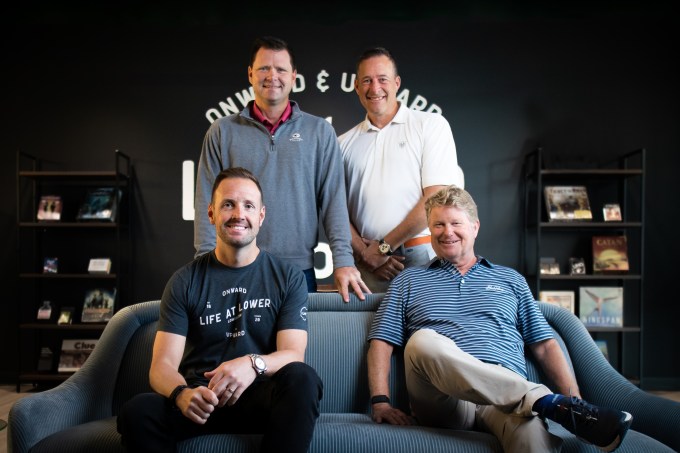
Sitting (L to R): Co-founders Dan Snyder, Grayson Hanes
Standing (L to R): Co-founders Mike Baynes, Chris Miller
Not pictured: Robert Tyson; Image credit: Lower

Over the years, Lower has funded billions of dollars in loans and notched an impressive $300 million in revenue in 2020 after doubling revenue every year, according to Snyder.

“Our history is maybe a little atypical of fintech companies today,” he told TechCrunch. “We’ve had a view going back to the start of the company that we wanted to run it profitably. That’s been one of our pillars, so that’s what we’ve done. Also, we all grew up in the mortgage industry, so we saw firsthand the size of the market, but also how broken it was, so we wanted to change it.”

In launching the direct-to-consumer digital lending brand, the company was working to make the homebuying process more “digital, transparent and easier for consumers to access,” Snyder said.

At the same time, the company didn’t want to lose the human touch.

“We tried to design the app flow in a way where you can get as far along as you can in the application but if you want, at any point in time, to talk or chat with someone, we’re available,” Snyder added.

Image Credits: Lower

Lower’s typical customer is the millennial and now Gen Z who’s aspiring to own their first home, according to Snyder.

“They might be thinking, ‘OK, I might be living in an apartment now, but in the next few years I’m going to meet someone and/or have a child and I want to unlock the investment that is a home,’ ” he told TechCrunch. “And we’ll help them on that journey.”

Lower’s recently launched new app offers a deposit account it’s dubbed “HomeFund.” The interest-bearing FDIC-insured deposit account offers a 0.75% Annual Percentage Yield and is designed to help consumers save for a home with a “dollar-for-dollar match in rewards” up to the first $1,000 saved, Snyder said.

Lower works with more than 35 major insurance carriers nationally, including Nationwide, Liberty Mutual and Allstate. It has more than 1,600 employees, about half of which are based in Lower’s home state. That’s up from about 650 employees in June of 2020.

Looking ahead, the company plans to add more services and has an “aggressive roadmap” for adding new features to its platform. Today, for example, Lower sells primarily to Fannie Mae and Freddie Mac. And while it services the majority of its loans, like many large lenders, it uses a subservicer. That will change, however, in early 2022, when Lower intends to launch its own native servicing platform. 

And while the company intends to continue to run profitably, Snyder said he and his co-founders “think the time is now to gain share.”

“We want to become a global brand, raise money and gain market share,” he added. “We’re going to continue to double down on product and build out our capabilities. We are the best-kept secret in fintech and plan to change that with smart branding, advertising and sponsorships.”

And last but not least, Lower is eyeing the public markets as part of its longer-term roadmap.

“Ultimately, we know we can build a great public company,” Snyder told TechCrunch. “We’re of the scale to be a public company right now, but we’re going to keep our heads down and we’re going to keep building for the next few years and then I think we can be in a spot to be a strong public business.”

Accel’s Locke points out that in the U.S., mortgage and home finance are among the largest financial service markets, and they have primarily been handled by large banks.

“For most consumers, getting a mortgage through these banks continues to be an overly complex, slow-moving process,” Locke told TechCrunch. “We believe by providing consumers a great mobile experience, Lower will gain share from incumbent banks, in the same way that companies like Monzo have in banking or Venmo in payments or Trade Republic and Robinhood in stock trading.” 

23 Jun 2021

Pequity, a compensation platform designed for more equitable pay, raises $19M

Diversity and inclusion have become central topics in the world of work. In the best considerations, improving them is a holistic effort, involving not just conceiving of products with this in mind, but hiring and managing talent in a diverse and inclusive way, too. A new startup called Pequity that has built a product to help with the latter of these areas, specifically in equitable compensation, has now raised some funding — a sign of the demand in the market, as well as how tech is being harnessed in aid of helping it.

The San Francisco-based startup has raised $19 million in a Series A led by Norwest Venture Partners. First Round Capital, Designer Fund, and Scribble Ventures also participated in the fundraise, which will be used to continue investing in product and also hiring: the company has 20 on its own books now and will aim to double that by the end of this year, on the heels of positive reception in the market.

Since launching officially last year, Pequity has picked up over 100 customers, with an initial focus on fast-scaling companies in its own backyard, a mark of how D&I have come into focus in the tech industry in particular. Those using Pequity to compare and figure out compensation include Instacart, Scale.ai and ClearCo, and the company said that in the last four months, the platform’s been used to make more then 5,000 job offers.

Kaitlyn Knopp, the CEO who co-founded the company with Warren Lebovics (both pictured, right), came up for the idea for Pequity in much the same way that many innovations in the world of enterprise IT come to market: through her own first-hand experience.

She spent a decade working in employment compensation in the Bay Area, with previous roles at Google, Instacart, and Cruise. In that time, she found the tools that many companies used were lacking and simply “clunky” when it came to compensation analysis.

“The way the market has worked so far is that platforms had compensation as an element but not the focus,” she said. “It was the end of the tagline, the final part of a ‘CRM for candidates.’ But you still have to fill in all the gaps, you have to set the architecture the right way. And with compensation, you have to bake in your own analytics, which implies that you have to have some expertise.”

Indeed, as with other aspects of enterprise software, she added that the very biggest tech companies sometimes worked on their own tools, but not only does that leave smaller or otherwise other-focused businesses out of having better calculation tools, but it also means that those tools are siloed and miss out on being shaped by a bigger picture of the world of work. “We wanted to take that process and own it.”

The Pequity product essentially works by plugging into all of the other tools that an HR professional might be using — HRIS, ATS, and payroll products — to manage salaries across the whole of the organization in order to analyse and compare how compensation could look for existing and prospective employees. It combines a company’s own data and then compares it to data from the wider market, including typical industry ranges and market trends, to provide insights to HR teams.

All of this means that HR teams are able to make more informed decisions, which is step number one in being more transparent and equitable, but is also something that Pequity is optimized to cover specifically in how it measures compensation across a team.

And in line with that, there is another aspect of the compensation mindset that Knopp also wanted to address in a standalone product, and that is the idea of building a tool with a mission, one of providing a platform that can bring in data to make transparent and equitable decisions.

“A lot of the comp tools that I’ve interacted with are reactive,” she said. “You may have to do, say, a pay equity test, you do your promotion and merit cycles, and then you find all these issues that you have to solve. We’re flagging those things proactively with our analytics, because we’re plugging into those systems, which will give you those alerts before the decisions need to be made.”

As an added step in that direction, Knopp said that ultimately she believes the tool should be something that those outside of HR, such as managers and emploiyees themselves, should be able to access to better understand the logic of their own compensation and have more information going into any kind of negotiation.

Ultimately, it will be interesting to see whether modernized products like Pequity, which are tackling old problems with a new approach and point of view, find traction in the wider market. If one purpose in HR is to address diversity and inclusion, and part of the problem has been that the tools are just not fit for that purpose, then it seems a no-brainer that we’ll see more organizations trying out new things to see if they can help them in their own race to secure talent.

“Compensation reflects a company’s values, affects its ability to hire talent, and is the biggest expense on its P&L. And yet, most comp teams run on spreadsheets and emails,” said Parker Barrile, Partner at Norwest, in a statement. “Pequity empowers comp teams to design and manage equitable compensation programs with modern software designed by comp professionals, for comp professionals.”

23 Jun 2021

Vercel raises $102M Series C for its front-end development platform

Vercel, the company behind the popular open-source Next.js React framework, today announced that it has raised a $102 million Series C funding round led by Bedrock Capital. Existing investors Accel, CRV,
Geodesic Capital, Greenoaks Capital and GV also participated in this round, together with new investors 8VC, Flex Capital, GGV, Latacora, Salesforce Ventures and Tiger Global. In total, the company has now raised $163 million and its current valuation is $1.1 billion.

As Vercel notes, the company saw strong growth in recent months, with traffic to all sites and apps on its network doubling since October 2020. About half of the world’s largest 10,000 websites now use Next.js . Given the open-source nature of the Next.js framework, not all of these users are obviously Vercel customers, but its current paying customers include the likes of Carhartt, Github, IBM, McDonald’s and Uber.

Image Credits: Vercel

“For us, it all starts with a front-end developer,” Vercel CEO Guillermo Rauch told me. “Our goal is to create and empower those developers — and their teams — to create delightful, immersive web experiences for their customers.”

With Vercel, Rauch and his team took the Next.js framework and then built a serverless platform that specifically caters to this framework and allows developers to focus on building their front ends without having to worry about scaling and performance.

Older solutions, Rauch argues, were built in isolation from the cloud platforms and serverless technologies, leaving it up to the developers to deploy and scale their solutions. And while some potential users may also be content with using a headless content management system, Rauch argues that increasingly, developers need to be able to build solutions that can go deeper than the off-the-shelf solutions that many businesses use today.

Rauch also noted that developers really like Vercel’s ability to generate a preview URL for a site’s front end every time a developer edits the code. “So instead of just spending all your time in code review, we’re shifting the equation to spending your time reviewing or experiencing your front end. That makes the experience a lot more collaborative,” he said. “So now, designers, marketers, IT, CEOs […] can now come together in this collaboration of building a front end and say, ‘that shade of blue is not the right shade of blue.'”

“Vercel is leading a market transition through which we are seeing the majority of value-add in web and cloud application development being delivered at the front end, closest to the user, where true experiences are made and enjoyed,” said Geoff Lewis, founder and managing partner at Bedrock. “We are extremely enthusiastic to work closely with Guillermo and the peerless team he has assembled to drive this revolution forward and are very pleased to have been able to co-lead this round.”