Year: 2021

22 Jun 2021

EU puts out final guidance on data transfers to third countries

The European Data Protection Board (EDPB) published its final recommendations yesterday setting on guidance for making transfers of personal data to third countries to comply with EU data protection rules in light of last summer’s landmark CJEU ruling (aka Schrems II).

The long and short of these recommendations — which are fairly long; running to 48 pages — is that some data transfers to third countries will simply not be possible to (legally) carry out. Despite the continued existence of legal mechanisms that can, in theory, be used to make such transfers (like Standard Contractual Clauses; a transfer tool that was recently updated by the Commission).

However it’s up to the data controller to assess the viability of each transfer, on a case by case basis, to determine whether data can legally flow in that particular case. (Which may mean, for example, a business making complex assessments about foreign government surveillance regimes and how they impinge upon its specific operations.)

Companies that routinely take EU users’ data outside the bloc for processing in third countries (like the US), which do not have data adequacy arrangements with the EU, face substantial cost and challenge in attaining compliance — in a best case scenario.

Those that can’t apply viable ‘special measures’ to ensure transferred data is safe are duty bound to suspend data flows — with the risk, should they fail to do that, of being ordered to by a data protection authority (which could also apply additional sanctions).

One alternative option could be for such a firm to store and process EU users’ data locally — within the EU. But clearly that won’t be viable for every company.

Law firms are likely to be very happy with this outcome since there will be increased demand for legal advice as companies grapple with how to structure their data flows and adapt to a post-Schrems II world.

In some EU jurisdictions (such as Germany) data protection agencies are now actively carrying out compliance checks — so orders to suspend transfers are bound to follow.

While the European Data Protection Supervisor is busy scrutinizing EU institutions’ own use of US cloud services giants to see whether high level arrangements with tech giants like AWS and Microsoft pass muster or not.

Last summer the CJEU struck down the EU-US Privacy Shield — only a few years after the flagship adequacy arrangement was inked. The same core legal issues did for its predecessor, ‘Safe Harbor‘, though that had stood for some fifteen years. And since the demise of Privacy Shield the Commission has repeatedly warned there will be no quick fix replacement this time; nothing short of major reform of US surveillance law is likely to be required.

US and EU lawmakers remain in negotiations over a replacement EU-US data flows deal but a viable outcome that can stand up to legal challenge as the prior two agreements could not, may well require years of work, not months.

And that means EU-US data flows are facing legal uncertainty for the foreseeable future.

The UK, meanwhile, has just squeezed a data adequacy agreement out of the Commission — despite some loudly enunciated post-Brexit plans for regulatory divergence in the area of data protection.

If the UK follows through in ripping up key tenets of its inherited EU legal framework there’s a high chance it will also lose adequacy status in the coming years — meaning it too could face crippling barriers to EU data flows. (But for now it seems to have dodged that bullet.)

Data flows to other third countries that also lack an EU adequacy agreement — such as China and India — face the same ongoing legal uncertainty.

The backstory to the EU international data flows issues originates with a complaint — in the wake of NSA whistleblower Edward Snowden’s revelations about government mass surveillance programs, so more than seven years ago — made by the eponymous Max Schrems over what he argued were unsafe EU-US data flows.

Although his complaint was specifically targeted at Facebook’s business and called on the Irish Data Protection Commission (DPC) to use its enforcement powers and suspend Facebook’s EU-US data flows.

A regulatory dance of indecision followed which finally saw legal questions referred to Europe’s top court and — ultimately — the demise of the EU-US Privacy Shield. The CJEU ruling also put it beyond legal doubt that Member States’ DPAs must step in and act when they suspect data is flowing to a location where the information is at risk.

Following the Schrems II ruling, the DPC (finally) sent Facebook a preliminary order to suspend its EU-US data flows last fall. Facebook immediately challenged the order in the Irish courts — seeking to block the move. But that challenge failed. And Facebook’s EU-US data flows are now very much operating on borrowed time.

As one of the platform’s subject to Section 702 of the US’ FISA law, its options for applying ‘special measures’ to supplement its EU data transfers look, well, limited to say the least.

It can’t — for example — encrypt the data in a way that ensures it has no access to it (zero access encryption) since that’s not how Facebook’s advertising empire functions. And Schrems has previously suggested Facebook will have to federate its service — and store EU users’ information inside the EU — to fix its data transfer problem.

Safe to say, the costs and complexity of compliance for certain businesses like Facebook look massive.

But there will be compliance costs and complexity for thousands of businesses in the wake of the CJEU ruling.

Commenting on the EDPB’s adoption of final recommendations, chair Andrea Jelinek said: “The impact of Schrems II cannot be underestimated: Already international data flows are subject to much closer scrutiny from the supervisory authorities who are conducting investigations at their respective levels. The goal of the EDPB Recommendations is to guide exporters in lawfully transferring personal data to third countries while guaranteeing that the data transferred is afforded a level of protection essentially equivalent to that guaranteed within the European Economic Area.

“By clarifying some doubts expressed by stakeholders, and in particular the importance of examining the practices of public authorities in third countries, we want to make it easier for data exporters to know how to assess their transfers to third countries and to identify and implement effective supplementary measures where they are needed. The EDPB will continue considering the effects of the Schrems II ruling and the comments received from stakeholders in its future guidance.”

The EDPB put out earlier guidance on Schrems II compliance last year.

It said the main modifications between that earlier advice and its final recommendations include: “The emphasis on the importance of examining the practices of third country public authorities in the exporters’ legal assessment to determine whether the legislation and/or practices of the third country impinge — in practice — on the effectiveness of the Art. 46 GDPR transfer tool; the possibility that the exporter considers in its assessment the practical experience of the importer, among other elements and with certain caveats; and the clarification that the legislation of the third country of destination allowing its authorities to access the data transferred, even without the importer’s intervention, may also impinge on the effectiveness of the transfer tool”.

Commenting on the EDPB’s recommendations in a statement, law firm Linklaters dubbed the guidance “strict” — warning over the looming impact on businesses.

“There is little evidence of a pragmatic approach to these transfers and the EDPB seems entirely content if the conclusion is that the data must remain in the EU,” said Peter Church, a Counsel at the global law firm. “For example, before transferring personal data to third country (without adequate data protection laws) businesses must consider not only its law but how its law enforcement and national security agencies operate in practice. Given these activities are typically secretive and opaque, this type of analysis is likely to cost tens of thousands of euros and take time. It appears this analysis is needed even for relatively innocuous transfers.”

“It is not clear how SMEs can be expected to comply with these requirements,” he added. “Given we now operate in a globalised society the EDPB, like King Canute, should consider the practical limitations on its power. The guidance will not turn back the tides of data washing back and forth across the world, but many businesses will really struggle to comply with these new requirements.”


 

22 Jun 2021

Transmit Security raises $543M Series A to kill off the password

Transmit Security, a Boston-based startup that’s on a mission to rid the world of passwords, has raised a massive $543 million in Series A funding.

The funding round, said to be the largest Series A investment in cybersecurity history and one of the highest valuations for a bootstrapped company, was led by Insight Partners and General Atlantic, with additional investment from Cyberstarts, Geodesic, SYN Ventures, Vintage, and Artisanal Ventures. 

Transmit Security said it has a pre-money valuation of $2.2 billion, and will use the new funds to expand its reach and investing in key global areas to grow the organization.

Ultimately, however, the funding round will help the company to accelerate its mission to help the world go passwordless. Organizations lose millions of dollars every year due to “inherently unsafe” password-based authentication, according to the startup; not only do weak passwords account for more than 80% of all data breaches, but the average help desk labor cost to reset a single password stands at more than $70. 

Transmit says its biometric-based authenticator is the first natively passwordless identity and risk management solution, and it has already been adopted by a number of big-name brands including Lowes, Santander, and UBS. The solution, which currently handles more than 9,000 authentication requests per second, can reduce account resets by 96%, the company says, and reduces customer authentication from 1 minute to 2 seconds. 

“By eliminating passwords, businesses can immediately reduce churn and cart abandonment and provide superior security for personal data,” said Transmit Security CEO Mickey Boodaei, who co-founded the company in 2014. “Our customers, whether they are in the retail, banking, financial, telecommunications, or automotive sectors, understand that providing an optimized identity experience is a multimillion-dollar challenge. With this latest round of funding from premier partners, we can significantly expand our reach to help rid the world of passwords.”

Transmit Security isn’t the only company that’s on a mission to kill off the password. Microsoft has announced plans to make Windows 10 password-free, and Apple recently previewed Passkeys in iCloud Keychain, a method of passwordless authentication powered by WebAuthn, and Face ID and Touch ID.

22 Jun 2021

Hamburger-flipping robotics company Miso introduces an automated beverage dispenser

How do you follow up a burger-flipping robot? If you’re Miso Robotics (which you likely are, if you’ve created a burger-flipping robot), the answer is simple: beverages. The robotics startup continues to focus on the fast food service industry with the planned launch of an automated beverage-dispensing robot.

The system, which is being created as part of a partnership with beverage dispenser manufacturer Lancer, brings an added level of automation to your standard fast food fountain. It has a point of sale system directly integrated, which kicks off the process of pouring, sealing and advancing the drink. Beyond that, it’s integrated with a larger sales system to ensure that it’s getting orders right, between in-person customers and delivery drivers.

Image Credits: Miso Robotics

Basically it’s a much smarter version of the fountain you encounter in every fast food restaurant and movie theater. Naturally, the company says that interest in the category has only increased amid labor shortages and a pandemic that froze much of the available workforce over the past year and a half.

“Lancer has a legacy of stand-out industry quality and shares in our vision for beverage innovation and futuristic design,” Miso Chief Strategy Officer Jake Brewer said in a press release tied to this morning’s news. “Order fulfillment is a major factor for customer satisfaction and operators can’t afford to have a beverage left behind when a delivery driver or customer visits. We are extremely excited to create a product that will not only make the lives of those working in commercial kitchens better, but will be a game changer for the industry as a whole to deliver a world-class customer experience.”

Image Credits: Miso Robotics

Speaking of striking while the iron is hot, the company is also using the opportunity to announce a planned Series D, following up on a recently closed $25 million Series C.

22 Jun 2021

Chinese sellers on Amazon in hot demand by VCs and e-commerce roll-ups

Chinese merchants selling on Amazon are having a moment. The scruffy exporters are used to roaming about suburban factory areas and dealing with constant cash flow strain, but suddenly they find themselves having coffee with top Chinese venture capital firms and investment representatives from internet giants, who come with big checks to hunt down the next Shein or Anker. While VCs can provide the money for them to scale quickly, many lack the expertise to help on the strategic side.

This is where brand aggregators can put their retail know-how to work. Also called roll-ups, these companies go around acquiring promising e-commmerce brands for operational synergies. After taking off in the United States, Europe, and lately Southeast Asia, it has also quietly landed in China, where traditional white-label manufacturers are trying to move up the value chain and establish their own brand presence.

The latest roll-up to enter China is Berlin Brands Group (BBG), which aims to buy “dozens of” brands in the country over the next few years, its founder and CEO Peter Chaljawski told TechCrunch. This will significantly boost the German company’s existing portfolio of 14 brands.

The move came on the back of BBG’s $240 million funding raised from debt and its announcement to commit $300 million on its balance sheet to buying up companies. The firm opted for debt in part because it has been profitable since its inception. The recent funding won’t be its last round and it may use other financial instruments in the future, said the founder.

Chaljawski doesn’t see VC and corporate investors as direct competitors in the hunt for brands. “There are tens of thousands of sellers in China that generate significant revenue on Amazon. I think the VC money applies to some of them, and the roll-up model applies also to only some of them. But ‘some’ is a very, very big number.”

BBG is no stranger to China. The 15-year-old company has been relying on Chinese manufacturers to make its kitchenware, gardening tools, sports gear and other home appliances, with 90% of its products still made in the country today. For the new brand buy-out initiative, it’s hiring dozens of staff in Shenzhen, which Chalijawski dubbed the “Silicon Valley of Amazon,” referring to the southern city’s key role in global export, manufacturing, and increasingly, design.

Amazon alternative

BBG hopes to offer a new way for Chinese consumer products to scale in Europe and the U.S. beyond being an anonymous brand on Amazon. Sellers may want to break free of the American behemoth to seize more control over consumer data, but building a direct-to-consumer (D2C) brand is no small feat.

Many merchants that are good at operating Amazon third-party businesses lack the infrastructure to go beyond Amazon, like an in-house logistics system, said the founder. In Europe, BBG manages 120,000 square meters of fulfillment centers, allowing it to shed dependence on Amazon.

Chinese brands may also want to find Amazon alternatives in Europe, where the e-commerce landscape is a lot more fragmented than that in the U.S, noted Chaljawski.

“If you look at the U.S., Amazon is dominant. If you look at Europe, Amazon only has 10% of the market share of online retail. So 90% is beyond Amazon. In the Netherlands, you have platforms like Bol. In Poland, you have Allegro, and in France, you have other dominant players.”

To bridge the gap for international brands targeting Europe, BBG operates close to 20 D2C web stores in major European countries, aside from selling on Amazon. Its sales growth in the U.S. has also been in full steam. Currently, over 60% of the firm’s revenues come from non-Amazon channels.

BBG is already in advanced negotiations with “some brands” in China but cannot disclose their names at this stage.

22 Jun 2021

Chinese sellers on Amazon in hot demand by VCs and e-commerce roll-ups

Chinese merchants selling on Amazon are having a moment. The scruffy exporters are used to roaming about suburban factory areas and dealing with constant cash flow strain, but suddenly they find themselves having coffee with top Chinese venture capital firms and investment representatives from internet giants, who come with big checks to hunt down the next Shein or Anker. While VCs can provide the money for them to scale quickly, many lack the expertise to help on the strategic side.

This is where brand aggregators can put their retail know-how to work. Also called roll-ups, these companies go around acquiring promising e-commmerce brands for operational synergies. After taking off in the United States, Europe, and lately Southeast Asia, it has also quietly landed in China, where traditional white-label manufacturers are trying to move up the value chain and establish their own brand presence.

The latest roll-up to enter China is Berlin Brands Group (BBG), which aims to buy “dozens of” brands in the country over the next few years, its founder and CEO Peter Chaljawski told TechCrunch. This will significantly boost the German company’s existing portfolio of 14 brands.

The move came on the back of BBG’s $240 million funding raised from debt and its announcement to commit $300 million on its balance sheet to buying up companies. The firm opted for debt in part because it has been profitable since its inception. The recent funding won’t be its last round and it may use other financial instruments in the future, said the founder.

Chaljawski doesn’t see VC and corporate investors as direct competitors in the hunt for brands. “There are tens of thousands of sellers in China that generate significant revenue on Amazon. I think the VC money applies to some of them, and the roll-up model applies also to only some of them. But ‘some’ is a very, very big number.”

BBG is no stranger to China. The 15-year-old company has been relying on Chinese manufacturers to make its kitchenware, gardening tools, sports gear and other home appliances, with 90% of its products still made in the country today. For the new brand buy-out initiative, it’s hiring dozens of staff in Shenzhen, which Chalijawski dubbed the “Silicon Valley of Amazon,” referring to the southern city’s key role in global export, manufacturing, and increasingly, design.

Amazon alternative

BBG hopes to offer a new way for Chinese consumer products to scale in Europe and the U.S. beyond being an anonymous brand on Amazon. Sellers may want to break free of the American behemoth to seize more control over consumer data, but building a direct-to-consumer (D2C) brand is no small feat.

Many merchants that are good at operating Amazon third-party businesses lack the infrastructure to go beyond Amazon, like an in-house logistics system, said the founder. In Europe, BBG manages 120,000 square meters of fulfillment centers, allowing it to shed dependence on Amazon.

Chinese brands may also want to find Amazon alternatives in Europe, where the e-commerce landscape is a lot more fragmented than that in the U.S, noted Chaljawski.

“If you look at the U.S., Amazon is dominant. If you look at Europe, Amazon only has 10% of the market share of online retail. So 90% is beyond Amazon. In the Netherlands, you have platforms like Bol. In Poland, you have Allegro, and in France, you have other dominant players.”

To bridge the gap for international brands targeting Europe, BBG operates close to 20 D2C web stores in major European countries, aside from selling on Amazon. Its sales growth in the U.S. has also been in full steam. Currently, over 60% of the firm’s revenues come from non-Amazon channels.

BBG is already in advanced negotiations with “some brands” in China but cannot disclose their names at this stage.

22 Jun 2021

Dutch payments startup Mollie raises another $800M at a $6.5B valuation

A payments startup whose backend was originally built by the founder while still living with his parents and bootstrapping the company is today announcing a massive round of funding that catapults it into being one of the most valuable startups in Europe. Mollie, an Amsterdam-based startup that provides a way for businesses to integrate payments into sites, documents and other services by way of an API, is today announcing that it has raised €665 million ($800 million) in an all-equity round that values the company at €5.4 billion ($6.5 billion).

Blackstone Growth (BXG)Blackstone’s growth equity investing business, led the investment, with participation also from EQT GrowthGeneral AtlanticHMI Capital, Alkeon Capital, and TCV. TCV led Mollie’s breakout Series B in September last year.

Mollie has been on a major growth tear in recent years. The company is currently on track to process some €20 billion (nearly $24 billion) in payments in 2021, up 100% on the year before when it processed around €10 billion. It currently has 120,000 monthly active merchants (versus 100,000 in 2020), and customers include the likes of Deliveroo, Unicef, Acer and Guess. It’s adding between 400 and 500 new customers each day.

To be sure, the pandemic saw a massive shift in commerce with all kinds of transactions — buying goods, paying for services, handling your banking and other finances — all moving into the digital world, and that also played out for Mollie.

But that is also not the full story: growing at the same pace this year as last appears to indicate that even as we start to see more signs of the pandemic moving on (well, at least for some…), the shift to paying and buying online (and using Mollie’s rails to do so) will stay.

“The only thing you can reliably measure in payments is consumer spend. That was at 10% and now it’s at 15-20%,” said Shane Happach, who took over as CEO of Mollie in April of this year from founder Adriaan Mol (who, incidentally, was also the founder of MessageBird; Mol’s knickname is Mollie, hence the name of this company).

In an interview, Happach explained that consumer spend, and the subsequent addressable consumer market, is the metric that best indicates how a company like Mollie will grow. So while Mollie has largely been profitable since being founded back in 2004, the plan now will be to put the gas on growth, building related services around payments to continue expanding its product offering while also continuing to move move into more geographies beyond its core, and biggest, market of Europe, helped in no small part by its new, big investors.

That will bring it into deeper competition with a whole raft of players. That is to say, Mollie is far from the only payments company on the market, nor is it the only one that has seen business boom in recent times. But it is bigger and much more fragmented than you might think. Happach — who spent a decade at WorldPay before joining Mollie — points out that the top ten players in payments have 50% of the market, but the other 50% is held by about 5,000 players.

“You’d be really surprised, companies like Stripe are in the 5,000. They’re not in the top ten,” he said. (JP Morgan, WorldPay, Fiserv (First Data), PayPal are among those that make up the first ten.). That essentially gives the company a lot of opportunity to grow and consolidate, while also underscoring just how big the market is for everyone.

Stripe came up a few times in our conversation, in particular when talking about competitive threats — its basic premise, like Mollie’s, has been the building of a payments platform (complex for any non-payment company to do) that can be integrated by customers anywhere by way of a simple API; when talking about valuations (Stripe is now valued at $95 billion); and when talking about product playbooks.

In all cases, the main takeaway seems to be that Stripe’s success speaks to the market Mollie has ahead of it. “We see a huge opportunity in the super underserved population of SMBs,” Happach said. “Especially if you look at our core markets, where most of our customers come from today, the financial services that they can get access to are very clunky.” The company, he added, will be focusing on a few areas that it believes it can do better than what’s out there now, which also complements its payments business: working capital for small businesses, card issuing and corporate card programs, expense management, and business banking. (All areas, I should note, where Stripe also has launched products.)

It will also be interesting to watch how and if Mollie, as it grows, gets more confident to potentially change its cut. It’s taken PayPal years, but it has recently rebalanced its rates. Happach notes Mollie never has and has no plans to follow it.

One area where Mollie is less likely to invest the new capital is in acquisitions, however.

“I came from a company that had acquired a load of other companies, and I think there’s pluses and minuses,” Happach said. “For Mollie, we are building an organic plan…. [Acquisitions are] always an opportunity, [but] I would say it’s not the thesis of what we have agreed with investors is the most likely things that we’d like to do…. I think, right now, we’re mainly focused on hiring as much great talent as we can, really beefing up our commercial product and engineering teams. There’s still quite a lot to do by just investing in our own business building and training our own people and serving the customers that we’ve already got in the best possible way.”

The company, indeed, hasn’t really grown through a sales force or big marketing investments but largely through word of mouth up to now, one reason Blackstone came knocking.

“One of the things that really impressed us at Blackstone is that of the hundreds that sign up to Mollie on a daily basis, 90-95% of them have almost no interaction with Mollie directly,” said Paul Morrissey, who heads up Blackstone’s investing activities in Europe. “They’re just finding Mollie, loving the product and just getting going and that goes back to kind of the unit economics of the business… It talks to their competitive position in the market.”

That is somewhat due to change with the company embarking on a big hiring push, taking its team of 480 to just under 800 in the next nine months.

22 Jun 2021

Vienna’s GoStudent raises $244M at a $1.7B valuation for its online tutor marketplace

Online teaching came into the spotlight for many students and parents in the last year, and today one of the companies that saw a big lift during that rush of activity is announcing a big round of funding to carry it into what has emerged as a more permanent change of habits for many learners.

GoStudent, a marketplace where K-12 students (and their parents) can find and engage with one-to-one video-based tutors in a variety of subjects, has raised €205 million ($244 million), in a Series C round that values the company at €1.4 billion ($1.7 billion).

The funding is coming at a time of strong growth. The Vienna, Austria-based startup is now live in 18 countries and sees some 400,000 sessions booked monthly on its platform, up 700% year-on-year (and up 15% month-on-month). It says it is on track to double employees to 1,000 and reach 10,000 tutors by the end of this year. The plan is to expand to more countries — Mexico and Canada are next on the list — and to continue growing its lists of tutors and subjects covered.

“We now plan to be even more aggressive geographically and plan to invest more into the brand,” Felix Ohswald, cofounder and CEO, told TechCrunch.

(As a point of comparison, when it last fundraised in March, GoStudent was booking a mere 250,000 tutoring sessions over its platform.)

DST Global is leading the round, with SoftBank (via its Vision Fund 2), Tencent, Dragoneer and previous backers Coatue, Left Lane Capital and DN Capital also participating. Vienna, Austria-based GoStudent has raised €291 million to date, including a €70 million round only this past March and €13.3 million in a Series A this past November.

The rapid pace of funding and GoStudent’s rising valuation — this investment makes it the highest-valued edtech startup in Europe, the company said — comes amid a streak of funding rounds for edtech companies.

And that may be no surprise: online and other digital tools in the last year especially felt more relevant (and in many cases were used more) than ever before due to social distancing during the pandemic. (Other recent deals have included funding for Byju’s, Kahoot, Formative, Engageli, Lingoda, Brainly, ClassDojo, Newsela, and Yuanfudao, among many others.)

But in the case of GoStudent, it’s also because the startup itself is also doing an A+ job in scaling its concept.

The company has been around since 2016 — when it started out initially providing a network for people to help each other answer questions (similar to Brainly), as well as connect with tutors, and for tutors to organize classes — but it was only about 2.5 years ago that GoStudent started to focus more squarely on one-to-one tutoring.

GoStudent provides a fully-integrated service, which lets students and their parents select from a range of topics that are typically taught in schools — currently some 30 subjects, including sciences, math, computing, languages, history, business and more — that they can be tutored on generally or specifically with the aim of taking an exam.

Tutoring comes from people who are tested, vetted and interviewed by GoStudent before they can join the platform; and before engaging tutors, parents and students interview an individual tutor and go through a practice lesson as part of that.

Learning plans are then organized according to students’ schedules and what they are setting out to do (they can send over their homework, or chapters they’re studying in school or even a curriculum outline); and the classes, assessments and payments (based on packages booked), are all handled over the platform, too.

Although there are a number of ways of learning a subject over the internet today — and specifically a number of online-only direct tutoring platforms in the market now (including Brainly, Yuanfudao, and others) — Ohswald said that by and large GoStudent’s biggest competition is the bigger in-person business of teaching, and of students and tutors connecting with each other through word of mouth — the “offline shadow market of tutors,” as he calls it.

All the same, while there are tech tools involved in provisioning and running lessons, at its heart GoStudent is also still about humans connecting to help each other, rather than humans connecting with computer programs.

Interestingly, its founders believe that the Covid-19 pandemic effect was not uniformly positive for its business.

“The pandemic had mixed effects,” Ohswald said. “On the one hand there was a natural demand from kids and parents. But with the schools closed, there was less pressure, less exams, less demand for after-school study. That aspect had a negative effect. But more broadly, there was a BIG boost for digital education. So the mindset of the parent and family drastically shifted.”

He noted that many families turned to tutoring to help “support the kids at home, to help them to stop being overwhelmed.” (And I would add, especially in the first part of the lockdown last year when schools were scrambling a little to regroup and teach online, that as a parent, we found it a relief to have at least some consistency with private tutors online at that time.)

What that means, essentially, is that while GoStudent did well in the last year, the company does not want to tie its growth to a specific set of pandemic circumstances that may well become less of an issue in the year ahead.

Indeed, for better or worse, there are bigger factors at play that predate the pandemic. Increasing pressure on students to perform their best competing against others, a continuing focus on testing, and a general level of academic ambition; but also a much easier and cheaper way of finding and connecting with people who can help students feel more supported in their efforts: all of these are also playing a role.

“GoStudent is one of the fastest growing companies that we have ever backed. The company has grown 800% in terms of revenue and 70x in terms of value since 2020 and we are convinced that this is just the beginning,” Nenad Marovac, founder and managing partner, DN Capital, told TechCrunch. “We believe that GoStudent can become one of the top digital schools in the world. By leveraging technology GoStudent democratizes quality education to all at affordable prices.”

22 Jun 2021

Gillmor Gang: Who Knew

The Gillmor Gang recording session is nestled on Friday midday on the East Coast and midmorning out West. Streamed live on Twitter, Facebook Live, and Youtube embed, the show is then edited, sweetened with titles and music, and released on Techcrunch. It’s a kind of hybrid between podcast, Zoom collaboration meeting, and work-from-anywhere encounter group. The Gang grew out of the early days of podcasting, now undergoing rescaffolding from social, drop-in, or just plain fast following from a variety of social networks. The latest entry, Live Audio Rooms from Facebook, is “soft-launching” with verified famous people and creators in good standing up first.

Facebook typically waits just long enough to decide what features to copy, and appears ready to aggregate the strategies of the rest of the market behind a Facebook infrastructure if not firewall. This may incorporate not just social audio features like tipping and raising hands to speak but also live video streaming and perhaps screen-sharing tools like ones announced at Apple’s WWDC for Facetime. Inevitably, the context returns to Clubhouse and its parallel tech media strategy.

Andreessen Horowitz (A16Z) debuted their publishing site, and the media tried its best to push back without burning any bridges to the high-flying venture firm. Even more interesting than the future.com website was a Clubhouse Launch Party where we met authors and their editors for about two hours of chat. Marc Andreessen sat in at the beginning, and A16Z partner Margit Wennmachers provided context for the launch. The strategy: project trust and insight from a venture firm and go direct from technologists to the tech and investment audience. It’s an interesting time in the wake of the Trumpian alternative facts blight, where the cable media seems tied in knots by trying to salvage ratings gold with yet another crisis-to-crisis breaking news schtick.

After that gambit begins to tire, the pitch shifts to the undermining of Democracy by the Autocrats, which although real, is not exactly compelling ratings magic. With vaccinations reaching movie popcorn immunity levels, streaming television is shifting from all out binge releases to the much more familiar weekly cliffhanger model. Working from anywhere is being negotiated based on a hybrid of the best of watching your kids grow up while getting back to a collaborative office when you’ve seen enough of them or them of you.

On the Gang this time, Keith Teare suggests Netflix may be in a bit of a tough spot, as the easing pandemic puts pressure on new shows slowed down by production lockouts. It’s true: the quality seems to be slipping almost imperceptibly, but nothing is accelerating to put pressure on the Big 4 or 5 Flixes including Disney, Amazon Prime, and maybe Hulu. DiscoBros (Frank Radice’s catchy rebrand for Discovery/WarnerMedia) can be fun, Apple TV+ should buy in to boost production, and then we need to look to the Creator Economy to hurry up and save us.

Every few days there’s another social audio pivot/acquisition/update, the most interesting besides Facebook’s if you can call it that being Spotify Greenroom with its auto record and captioning features and inevitable integration with its Anchor podcasting tools. Tip jar resistance is almost a thing, in case you’re wondering. The only thing more enervating is speculation on whether Clubhouse is jumping the shark — I don’t think so. If the Future.com suggests more copying of The Information’s events model, there’s plenty of runway ahead. And social audio gold is anything about Clubhouse on Clubhouse.

For those of us who still remember tech news, the Apple announcements almost reach orbit with the mixture of M1 magic and iOS/MacOS/WatchOS/TVOS blurring. My favorite list is of features that don’t show up on Intel machines, all the cool ones. For the first time in years, we traded up to M1’s on both our Macbooks including a Pro and Air, and in the process enabled Blur mode on Zoom on both essentially for free. The hardware is starting to feel like a subscription service (HaaS) which as Salesforce’s trajectory suggests is likely a very big deal. (Disclosure: I work for Salesforce.) For creators, moving from hardware like Newtek’s Tricaster and BlackMagic’s ATEM Mini to software-based OBS and then NDI5 over the public network is not prime time, but getting there real soon now. Keith thinks so, Brent Leary says maybe. I say, if Apple bundles Apple TV and Apple TV+ with newsletter plugins from Twitter Revue and Substack subscriptions….

from the Gillmor Gang Newsletter

__________________

The Gillmor Gang — Frank Radice, Michael Markman, Keith Teare, Denis Pombriant, Brent Leary and Steve Gillmor. Recorded live Friday, June 11, 2021.

Produced and directed by Tina Chase Gillmor @tinagillmor

@fradice, @mickeleh, @denispombriant, @kteare, @brentleary, @stevegillmor, @gillmorgang

Subscribe to the new Gillmor Gang Newsletter and join the backchannel here on Telegram.

The Gillmor Gang on Facebook … and here’s our sister show G3 on Facebook.

22 Jun 2021

Tesla backs vision-only approach to autonomy using powerful supercomputer

Tesla CEO Elon Musk has been teasing a neural network training computer called ‘Dojo’ since at least 2019. Musk says Dojo will be able to process vast amounts of video data to achieve vision-only autonomous driving. While Dojo itself is still in development, Tesla today revealed a new supercomputer that will serve as a development prototype version of what Dojo will ultimately offer. 

At the 2021 Conference on Computer Vision and Pattern Recognition on Monday, Tesla’s head of AI, Andrej Karpathy, revealed the company’s new supercomputer that allows the automaker to ditch radar and lidar sensors on self-driving cars in favor of high-quality optical cameras. During his workshop on autonomous driving, Karpathy explained that to get a computer to respond to new environment in a way that a human can requires an immense dataset, and a massively powerful supercomputer to train the company’s neural net-based autonomous driving technology using that data set. Hence the development of these predecessors to Dojo.

Tesla’s newest-generation supercomputer has 10 petabytes of “hot tier” NVME storage and runs at 1.6 terrabytes per second, according to Karpathy. With 1.8 EFLOPS, he said it might be the fifth most powerful supercomputer in the world, but he conceded later that his team has not yet run the specific benchmark necessary to enter the TOP500 Supercomputing rankings.

“That said, if you take the total number of FLOPS it would indeed place somewhere around the fifth spot,” Karpathy told TechCrunch. “The fifth spot is currently occupied by NVIDIA with their Selene cluster, which has a very comparable architecture and similar number of GPUs (4480 vs ours 5760, so a bit less).”

Musk has been advocating for a vision-only approach to autonomy for some time, in large part because cameras are faster than radar or lidar. As of May, Tesla Model Y and Model 3 vehicles in North America are being built without radar, relying on cameras and machine learning to support its advanced driver assistance system and autopilot. 

Many autonomous driving companies use lidar and high definition maps, which means they require incredibly detailed maps of the places where they’re operating, including all road lanes and how they connect, traffic lights and more. 

“The approach we take is vision-based, primarily using neural networks that can in principle function anywhere on earth,” said Karpathy in his workshop. 

Replacing a “meat computer,” or rather,  a human, with a silicon computer results in lower latencies (better reaction time), 360 degree situational awareness and a fully attentive driver that never checks their Instagram, said Karpathy.

Karpathy shared some scenarios of how Tesla’s supercomputer employs computer vision to correct bad driver behavior, including an emergency braking scenario in which the computer’s object detection kicks in to save a pedestrian from being hit, and traffic control warning that can identify a yellow light in the distance and send an alert to a driver that hasn’t yet started to slow down.

Tesla vehicles have also already proven a feature called pedal misapplication mitigation, in which the car identifies pedestrians in its path, or even a lack of a driving path, and responds to the driver accidentally stepping on the gas instead of braking, potentially saving pedestrians in front of the vehicle or preventing the driver from accelerating into a river.

Tesla’s supercomputer collects video from eight cameras that surround the vehicle at 36 frames per second, which provides insane amounts of information about the environment surrounding the car, Karpathy explained.

While the vision-only approach is more scalable than collecting, building and maintaining high definition maps everywhere in the world, it’s also much more of a challenge, because the neural networks doing the object detection and handling the driving have to be able to collect and process vast quantities of data at speeds that match the depth and velocity recognition capabilities of a human.

Karpathy says after years of research, he believes it can be done by treating the challenge as a supervised learning problem. Engineers testing the tech found they could drive around sparsely populated areas with zero interventions, said Karpathy, but “definitely struggle a lot more in very adversarial environments like San Francisco.” For the system to truly work well and mitigate the need for things like high-definition maps and additional sensors, it’ll have to get much better at dealing with densely populated areas.

One of the Tesla AI team game changers has been auto-labeling, through which it can automatically label things like roadway hazards and other objects from millions of videos capture by vehicles on Tesla camera. Large AI datasets have often required a lot of manual labelling, which is time-consuming, especially when trying to arrive at the kind of cleanly-labelled data set required to make a supervised learning system on a neural network work well.

With this latest supercomputer, Tesla has accumulated 1 million videos of around 10 seconds each and labeled 6 billion objects with depth, velocity and acceleration. All of this takes up a whopping 1.5 petabytes of storage. That seems like a massive amount, but it’ll take a lot more before the company can achieve the kind of reliability it requires out of an automated driving system that relies on vision systems alone, hence the need to continue developing ever more powerful supercomputers in Tesla’s pursuit of more advanced AI.

22 Jun 2021

Fintech veteran Jitendra Gupta is ready for his new inning — now he is going after banks in India

For most people in India, having to engage with banks doesn’t instill a sense of joy. Banks in the South Asian market are notorious for making unannounced spam calls to upsell customers loans and credit cards, even when they have been explicitly asked not to do so.

Moreover, when a customer does reach out to a bank with a query, it can take forever to get the job done. Take ICICI Bank, India’s third largest bank and until recently my only banking partner for over six years, for an example.

It is now in its third month in figuring out who exactly in its relationship with Amazon is supposed to re-issue me a credit card. I have moved on with my life, and it looks like they did, too, likely before they even looked at my query.

Small and medium-sized businesses aren’t a big fan of banks, either. If you operate an early-stage startup, it’s anyone’s guess if you will ever be able to convince a bank to issue you a corporate account. So of course, startups — Razorpay and Open — took it upon themselves to fix this experience.

For consumers, too, in recent years, scores of startups have arrived on the scene to improve this banking experience. Whether you are a teenager, or just out of college, or a working professional, or don’t have a credit score, there are firms that can get you a credit card and loan.

But even these services have a ceiling limit of some sort. And customers aren’t loyal to any startup.

“A customer’s relationship is always with the entity where they park their savings deposit,” said Jitendra Gupta, a high-profile entrepreneur who has spent a decade in the fintech world. Since these customers are not parking their money with fintech, “the startups have been unable to disrupt the bank. That’s the hard reality.”

So what’s the alternative? Gupta, who co-founded CitrusPay (sold to Naspers’ PayU) and served as managing director of PayU, has been thinking about these challenges for more than two years.

“If you really want to change the banking industry, you cannot operate from the side. You have to fight from the centre, where they deposit their money. It’s a very time-consuming process and requires a lot of initial capital and experience with banks,” he told TechCrunch in an interview.

After more than a year and a half of raising about $24 million — from Sequoia Capital India, 3one4 Capital, Amrish Rau, Kunal Shah, Kunal Bahl, Tanglin Venture Partners, Rainmatter and others — Gupta is ready to launch what he believes will address a lot of the issues individuals face with their banks.

His new startup, called Jupiter, wants to bring “delight” to the banking experience, and it will launch in India on Thursday.

“We believe that a bank account should be a smart account, where it gives you insight, shares personalized tips and guides you through attaining some financial discipline,” he said.

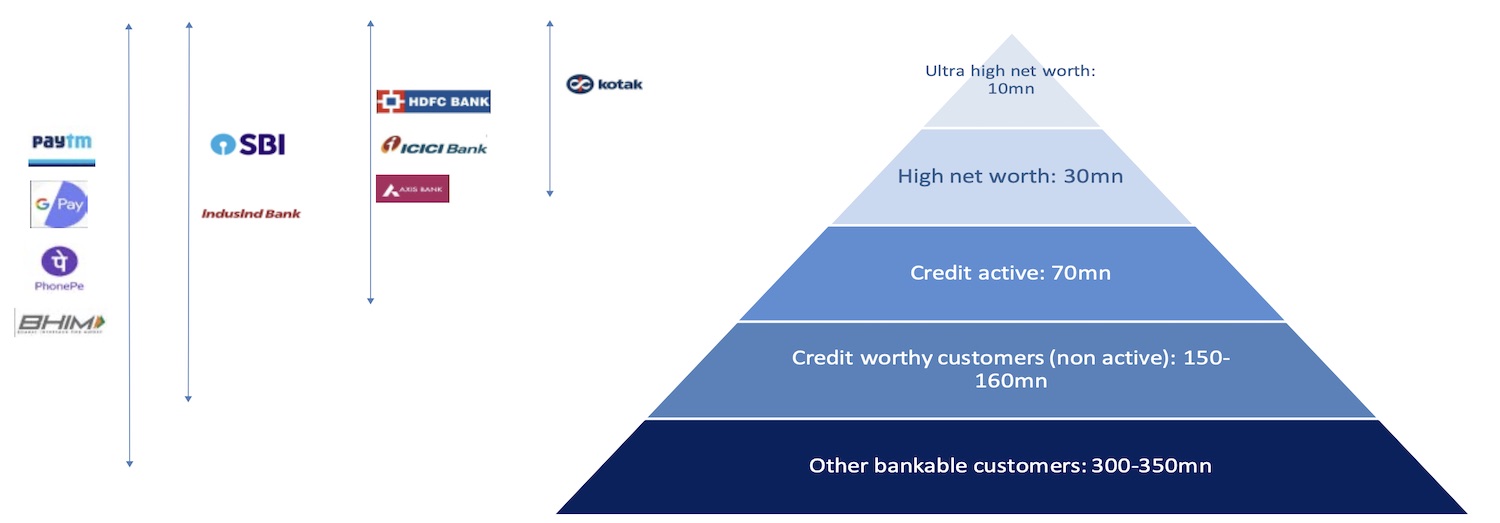
A snapshot of the reach of banks and fintech startups in India. Data: CIBIL, Statista, BofA Global Research. Image: BofA

To be sure, Jupiter, too, will offer loans and other financial services to customers. But instead of making irrelevant calls to customers, it will assess which of its customers are running short on money and give the option to take a credit line from its app itself, he said. “The upsell doesn’t need to happen by way of spam. It needs to happen by way of contextualization and personalization.”

“Jupiter has been built in a deep integration with the underlying bank, allowing the consumer to have a frictionless experience for all their banking needs,” said Amrish Rau, chief executive of Pine Labs, co-founder of CitrusPay and longtime friend of Gupta.

The startup, which employs 115 people, has developed a number of products for customers joining on day one. The products include the ability to buy now and pay later on UPI, a feature first offered in the market by Jupiter, and a mutual fund portfolio analyzer. A debit card, in-app chat with a customer service agent, expense categorisation, finding the right card, determining the existing health insurance coverage, and more are ready to ship, the startup said.

Jupiter is currently working on providing zero mark-up on forex transactions, and frictionless two-factor authentication. The startup has published a public Trello page where it has outlined the features it is working on and when it expects to ship them, as well as features suggested by its beta-testing customers. “I want to establish full transparency in what we are working on to build trust with customers,” said Gupta.

Jupiter will have its own customer relationship team that will engage with the startup’s users. The startup, which last month opened a waiting list for customers to sign up, had amassed more than 25,000 applications as of two weeks ago.

Even Jupiter, which one day wishes to disrupt the banking sector, currently has to partner with banks. Its partners are Federal Bank and Axis Bank.

I asked Gupta about the excitement his investors see in Jupiter. “Everyone believes, as you see with fintech giants such as Nubank globally, that we will become a full bank,” he said.

But for the time being, Gupta said he is not looking to partner with more banks. “I don’t want Jupiter to attract customers because they want to bank with Federal or Axis. I want them to come to Jupiter because they want to bank with Jupiter,” he said.

In the next 12 months, the startup hopes to serve more than 1 million customers.