Year: 2021

15 Jun 2021

Chinese startup Pony.ai plans to launch a driverless robotaxi service in California in 2022

Pony.ai, the robotaxi startup that operates in China and the United States, has started testing driverless vehicles on public roads in California ahead of plans to launch a commercial service there in 2022.

The company said the driverless vehicle testing, which means the autonomous vehicles operate without human safety drivers behind the wheel, is happening daily on public roads in Fremont and Milpitas, California. Pony.ai is also testing its driverless vehicles in Guangzhou, China.

Pony.ai said it also plans to resume a rideshare service to the public in Irvine this summer using AVs with a human safety driver. Its goal is to roll out the fully driverless service to the public in 2022.

“Going completely driverless is key to achieving full autonomy and an indispensable catalyst to realizing our ambitious vision,” said James Peng, CEO and co-founder of Pony.ai.

Pony.ai still has some regulatory hurdles to clear before it can operate commercially. Autonomous vehicle companies that want to charge the public for driverless rides need both the California Department of Motor Vehicles and the California Public Utilities Commission to issue deployment permits. In early June, Cruise became the first company to receive a driverless autonomous service permit from the California PUC that allows it to test transporting passengers. The final step with the DMV, which only Nuro has achieved, is a deployment permit.

Pony’s driverless testing milestone in California comes a month after the state issued the company a permit to test a fleet of six driverless vehicles in a geographic area that spans about 39 square miles. While dozens of companies — 55 in all — have active permits to test autonomous vehicles with a safety driver, it is less common to receive permission for driverless vehicles. Pony was the eighth company to be issued a driverless testing permit in the state, a list that includes Chinese companies AutoX, Baidu and WeRide as well as U.S. businesses Cruise, Nuro, Waymo and Zoox. Only Nuro has been granted a so-called deployment permit, which allows it to operate commercially.

Pony.ai, which was founded in 2016 by former Baidu developers Peng and Lou Tiancheng, has been allowed to test autonomous vehicles with safety drivers since 2017.  The driverless permit issued in May by the California DMV expanded upon Pony’s existing activity in the state.

Pony has tested ridesharing in Fremont and Irvine, California. In 2019, a fleet of electric, autonomous Hyundai Kona crossovers equipped with a self-driving system from Pony.ai and Via’s ride-hailing platform began shuttling customers on public roads. The robotaxi service, called BotRide, wasn’t a driverless service, as there was a human safety driver behind the wheel at all times. The BotRide pilot concluded in January 2020.

The company then started operating a public robotaxi service called PonyPilot in the Irvine area. Pony shifted that robotaxi service from shuttling people to packages due to the COVID-19 pandemic. Pony.ai also partnered with e-commerce platform Yamibuy to provide autonomous last-mile delivery service to customers in Irvine. The delivery service was launched to provide additional capacity to address the surge of online orders triggered by the COVID-19 pandemic, Pony.ai said at the time.

As the pandemic eases and California returns to normal operations, Pony is preparing to launch a commercial robotaxi service. It has already amassed a number of partners and more than $1 billion in funding, including $400 million from Toyota, to help it achieve that goal. Last November, the company said its valuation had reached $5.3 billion following a fresh injection of $267 million in funding. Pony has several partnerships or collaborations with automakers and suppliers, including Bosch, Hyundai and Toyota.

15 Jun 2021

Meet the mobile therapy startup backed by Christian Angermayer’s re:Mind Capital

Mental health startup Ksana Health has received $2 million in seed funding led by re:Mind Capital, the mental health VC arm of Christian Angermayer and Apeiron Investment Group. It’s a move informed by two trends: passive data collection, and a burgeoning mental health crisis in teens and young adults. 

Ksana Health is an Oregon-based company founded two years ago by University of Oregon Professor Nicholas Allen, a clinical psychologist and director of the Center for Digital Mental Health. Ksana’s platforms focus on collecting data related to mental health, and transfer that data from user to healthcare practitioners through an app. It’s, in essence, a mobile therapy app with a highly detailed dashboard of patient information. 

The company has twelve employees, and other investors in the round include WPSS Investments, Panoramic Ventures, the Telosity Fund, Palo Santo Venture Fund, and Able Partners. 

So far, Ksana Health has one live product called the ‘Effortless Assessment Research System’ (EARS) which is designed for institutions conducting clinical research. Participants in clinical trials can download an app and opt-in to sharing data including movement, location (via GPS), keystrokes and patterns in written language content with the trial’s investigators (no specific messages are shared). The app’s connection also goes two ways: trial administrators can send out things like surveys to keep in touch with participants. 

The EARS product, says Allen, has already generated about $900,000 in revenue based on usage in clinical trials, but this most recent round of funding is geared towards another product called Vira, aimed at consumers. 

Vira will also passively collect data like exercise (via an accelerometer), screen time, keystrokes or location-based data via a smartphone or smart device. Screenshots from Vira’s dashboard also include sleep data, though that’s not specifically listed as a recorded variable on the company’s website at the moment. Instead of funneling that data to a clinical trial, the data will be accessible to a patient’s therapist. 

The user would give a therapist a personalized code which allows them to access data collected on their phone. Then, a therapist might discuss those habits, and program behavioral nudges to pop up on a phone during the day, reminding the user to exercise, or wind down before bed. 

“Basically what this system does is it allows some of the data that’s been collected by the way people use their cell phones in a day to day fashion [to be turned] into indicators of important health behaviors that we know are relevant to mental health – so things like sleep, physical activity, geographic mobility, mood, cognition, social connection,” Allen says. 

Vira is a major force of forward momentum for Ksana Health. The company was also selected as part of the insurance company Anthem Inc.’s, Digital Incubator program. That inclusion allows Vira to be trialled within Beacon Health Options, a behavioral health company with 37 million members. 

Vira has yet to launch, but the key audience, says Allen, is people 13 to 30 years old. Rates of mental health issues within this group have increased even before the pandemic. 

In 2019, a study in Abnormal Psychology analyzing data from the National Survey on Drug Use and Health found that the rate of young adults (18 to 25) reporting signs of major depression jumped 63 percent (from 7.7 to 13.1 percent) between 2009 and 2017. Meanwhile, there was no significant increase in the percentage of older adults experiencing mental distress or depression in that study. 

The answer Vira seems to offer is extremely detailed data on well-being that will be funneled to a therapist. Data collection in the mental health space isn’t unheard of – Some AI-based mental health chatbots do indeed analyze user conversations, but those conversations happen within the confines of an app. Vira, conversely, is capable of constantly collecting data on a variety of variables that are passively trackable by a phone, and have some bearing on mental health. 

Critically, there are no clinical trials of Vira itself right now, but the concept of the app is based on research that verifies each one of its’ individual parts. For instance, there is evidence that language used on social media can predict mood disorders, and that lack of sleep (or in some cases, excessive sleep) is linked to anxiety and depression

In some sense, Ksana Health is somewhat reminiscent of a cadre of software betting that improving mental health is partially a factor of increased vigilance of digital life, particularly among teens. A.I-based software like GoGuardian for instance, have been used in school to record students keystrokes or search histories, in an attempt to head off student suicides. 

GoGuardian was used in Clark County district in Nevada, the fifth largest school district in the country, and flagged 3,100 potential signs of self-harm between June and October 2020. 

https://techcrunch.com/2019/06/19/risks-and-rewards-of-digital-therapeutics-in-treating-mental-disorders/

Like GoGuardian, Ksana Health is also catalogs digital activity as an indicator of mental health (note the inclusion of key strokes and language patterns, not just health variables like exercise), but Ksana Health’s focus also appears to be less on flagging harmful behavior automatically, and more about providing an extremely detailed data dashboard to a human therapist. 

“Our focus initially is to keep, for want of a better term, a human in the loop,” says Allen. Ksana Health also isn’t AI- based, so it may be harder to scale, but Allen sees this as a benefit, not a liability. 

 “That’s why we’re focused on embedding this within practitioners,” he says. “There’s obvious appeal to the scale of a fully automated solution, you know you can scale it up very quickly. But I think the problems with safety are very significant in those systems.” 

This comprehensive array of data, but particularly the language component, says Jan Hardorp, a founding partner at re:Mind Capital, is one aspect that attracted the firm to Ksana Health. Hardorp will also have a seat on Ksana Health’s board. 

“We believe that language is very strong and variable, and then combined with other sensors, is a very good technological basis in order to assess and predict mental mental state and depression,” he says. 

The move fits within re:Mind’s somewhat unconventional approaches to mental health: Angermayer held a 22 percent stake in Compass Pathways, a company pursuing psychedelics as a fast-acting treatment for depression. That stake was worth about $316 million during the company’s September 2020 IPO. Angermayer’s other public investments span from cryptocurrencies to cannabis

Hardorp says that overall, re:Mind’s activities are focused on one third novel treatments (like psychedelics), one third brain computer interfaces, and one third into technology. Ksana Health fits squarely in that third category. 

Allen says the company is already planning clinical trials of the Vira program in addition to the pilot program with Beacon Health. But Hardorp notes that so far, the lack of clinical trials on Vira itself hasn’t given him pause. He takes the strength of the EARS platform as a signal that Ksana Health’s platform is viable in the real world. 

“We’re quite confident that it’s really the same technology. The Vira product, if you want, is really a new front-end to existing technology and algorithms,” he says. 

At the moment, the Vira platform isn’t commercially available, but Allen is anticipating a launch in the first quarter of 2022. 


15 Jun 2021

Founders Ben Schippers and Evette Ellis are riding the EV sales wave

EV sales are driving demand for services and startups that fulfill the new needs of drivers, charging station operators and others. Evette Ellis and Ben Schippers took to the main stage at TC Sessions: Mobility 2021 to share how their companies capitalize off the new opportunities presented by the electric transportation revolution.

Ellis is the co-founder and chief workforce officer of ChargerHelp, an on-demand EV charging station repair company. She spoke about how the company approaches hiring and training, why it engages with workforce development centers, and how training in cohorts makes economic sense. Farther down, we’ll hear from Schippers, the founder of TezLab.

Image Credits: ChargerHelp

Why the company works with workforce development centers

Workforce development is a government-run and -funded system to connect job seekers with employers, training and career development. There are thousands of job centers across the country, coordinated by the U.S. Department of Labor, that serve millions of Americans. Evette described why she and co-founder Kameale Terry wanted to engage with workforce development from the beginning.

We really, really wanted to pioneer this idea that you can work with a workforce development center, who our federal government pays lots of money to train and do all the things that you need to get a great talent source, to create that pipeline, to use those pipelines for industries outside of construction or entry-level medical, but also for tech. Tech is the biggest industry in our country and it’s really running the show right now. We wanted to make sure that underrepresented communities didn’t get left out of this shift that is clearly happening. (Time stamp — 13:54)

15 Jun 2021

Telecom giant MTN said to have warned Nigerians of service disruption

Subscribers of MTN, the largest telecom provider in Nigeria, may soon face service disruption in the West African nation, according to a notice seen by some journalists and outlets. 

A rise in insecurity challenges in Nigeria is likely to disrupt MTN’s service, Reuters and others said, citing an alert from customer service reps. Throughout this year, Nigerians have had to battle kidnappings, clashes between farmers and herders, mass abductions of students, and armed robberies.

Sadly, we must inform you that with the rising insecurity in different parts of Nigeria, service delivery to your organization may be impacted in the coming days. This means that in some cases, our technical support team may not be able to get to your site and achieve optimum turnaround time in fault management as quickly as possible,” MTN reportedly said in the message. 

MTN didn’t immediately respond to a request for comment.

When MTN Nigeria published its financial report for Q1 2021, it showed strong growth as data revenue grew by 43% year-on-year to N106 billion ($257 million), contributing to 28% of its total revenue.

Data revenue growth was propelled by a 21% year-on-year jump in active data subscribers to 32.5 million and a 27% year-on-year increase in smartphone penetration to 36.3 million. These numbers reflect MTN’s dominance in Nigeria. Per data from the Nigerian Communications Commission (NCC), the telecom operator is responsible for 43% of Nigeria’s internet subscribers and 38% of the country’s mobile subscribers.

Like most network providers in the country, MTN’s services have been a tale of two experiences: good and subpar. However, Nigerians who spoke with TechCrunch have largely witnessed the latter these past few weeks following the government’s decision to ban Twitter and subsequent fears of internet restriction.

Reports from local media seem to corroborate Reuters, albeit for a different reason: a union’s nationwide strike against all network providers. The union PTECSSAN (Private Telecommunications and Communications Senior Staff Association of Nigeria), which comprises senior telecommunications staff in the country, announced that it would be embarking on a three-day industrial strike starting Wednesday to protest the “arbitrary sack of workers and casualisation.”

PTECSSAN accused telecommunications companies in Nigeria for several reasons in a statement. First, breaching freedom of association and right of workers to organise; victimisation of union members; poor and discriminatory remuneration. They also claimed that telecom operators abused expatriate quotas, practised intimidation, and have harassed and verbally assaulted employees, among other anti-labour practices.

Several MTN customer care agents TechCrunch reached out to were either unaware or refuted the aforementioned message. “We’re not going to have such network glitches,” one said. “Kindly be aware that we dont have any information on any service disruption in the coming days. Once we have any information about that, we’ll let our customers know via messages as soon as possible,” another agent responded.

15 Jun 2021

How to identify unicorn founders when they’re still early-stage

As an early-stage VC, you spend time with hundreds of fantastic startups, trying to identify potential winners by thinking about market size, business model and competition. Nevertheless, deep down you know that in the long run, it all comes down to the team and the founder(s).

When we look at the most successful companies in our portfolio, their amazing performance is in large part thanks to the founders. However, even after 20 years in the industry, I have to admit that analyzing the team is still the most challenging part of the job. How do you evaluate a young first-time entrepreneur of an early-stage company with little traction?

The best founders are humble and well aware of their weaknesses and limitations as well as the potential challenges for their startup.

At Creandum, in the past 18 years, we have been fortunate to work with some of Europe’s most successful startup founders such as Daniel Ek from Spotify, Sebastian Siemiatkowski from Klarna, Johannes Schildt from Kry, Jacob de Geer and Magnus Nilsson from iZettle, Emil Eifrem from Neo4J, Christian Hecker from Trade Republic and many more.

After a while, we realized that these incredible entrepreneurs all share some fundamental characteristics. They all have lots of energy, work hard, show patience, perseverance and resilience. But on top of that, all these unicorn founders share five key traits that, as an investor, you should look for when you back them at an early stage.

They know what they don’t know

Many people expect a typical startup founder to be very confident and have a strong sales mentality. While they should definitely live up to those expectations, the best founders are also humble and well aware of their weaknesses and limitations as well as the potential challenges for their startup.

They keep wanting to learn, improve and grow the business beyond what average people have the energy and drive to manage.

15 Jun 2021

Facebook CEO Mark Zuckerberg hosts first test of Live Audio Rooms in U.S.

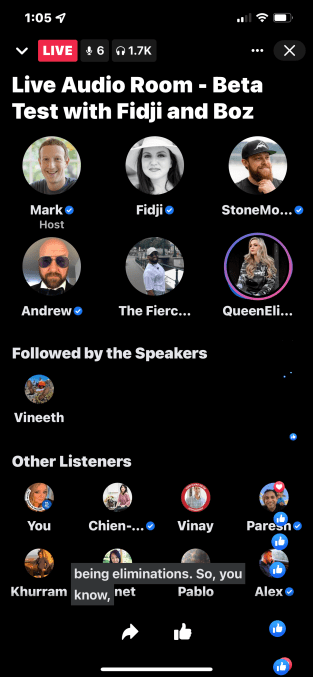
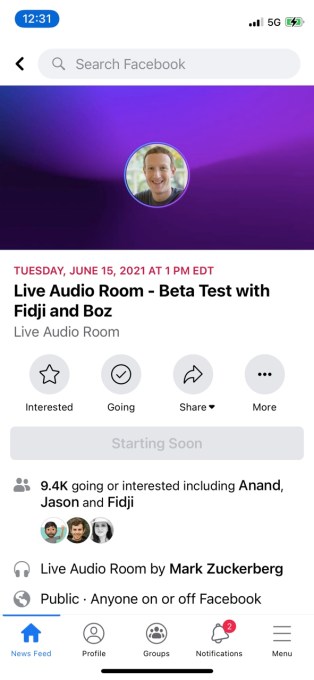
In April, Facebook announced a slew of new audio products, including its Clubhouse clone, called Live Audio Rooms, which will be available across both Facebook and Messenger. Since May, Facebook has been publicly testing the audio rooms feature in Taiwan with public figures, but today the company hosted its first public test of Live Audio Rooms in the U.S. The event itself was hosted by Facebook CEO Mark Zuckerberg, who chatted with fellow execs and creators.

Joining Zuckerberg were Facebook VP and Head of Facebook Reality Labs Andrew “Boz” Bosworth, Head of Facebook App Fidji Simo, and three Facebook Gaming creators, including StoneMountain64, QueenEliminator, and TheFierceDivaQueen.

Image Credits: Facebook screenshot

The creators used their time in the Audio Room to talk more about their gaming journeys on Facebook, what kind of games they were streaming and other gaming-related matters. Zuckerberg also briefly teased new gaming features including a new type of post, coming soon, called “Looking for Players.” This post type will help creators find others in the community to play games with while they’re streaming.

In addition, badges that are earned from live streams will now carry over to fan groups, Zuckerberg said, adding that it was a highly requested feature by creators and fans alike.

Fan groups will also now become available to all partnered creators on Facebook Gaming, starting today, and will roll out to others in the coming weeks.

Image Credits: Facebook screenshot

The experience of using the Live Audio Room is very much like what you’d expect on another platform, like Clubhouse or Twitter Spaces. The event’s hosts appear in rounded profile icons at the top of the screen, while the listeners appear in the bottom half of the screen, as smaller icons. In between is a section that includes people followed by the speakers.

The active speaker is indicated with a glowing ring in shades of Facebook blue, purple and pink. If verified, a blue check appears next to their name.

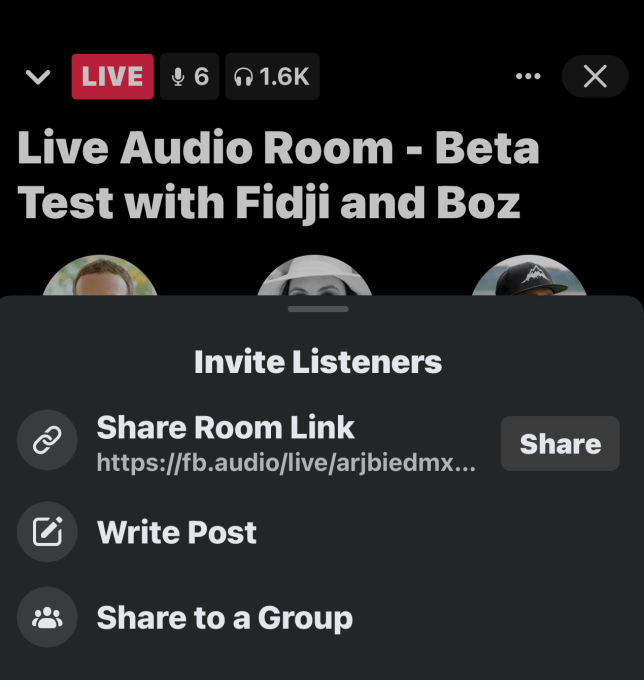
Listeners can “Like” or otherwise react to the content as it streams live using the “Thumbs Up” button at the bottom of the screen. And they can choose to share the Audio Room either in a Facebook post, in a Group, with a friend directly, or through other apps.

A toggle switch under the room’s three-dot “more” menu lets you turn on or off auto-generated captions, for accessibility. From here, you can also report users or any issues or bugs you encountered.

The Live Audio Room today did not offer any option for raising your hand or joining the speakers on stage — it was more of a “few-to-many” broadcast experience.

Before today, TechCrunch received a couple of tips from users who reported seeing the Audio Rooms option appear for them in the Facebook app. However, the company told us it had only tested Live Audio Rooms in the U.S. with employees.

During the test period, Live Audio Rooms are only available on iOS and Android, we’re told.

Zuckerberg also used today’s event to talk more broadly about Facebook’s plans for the creator economy going forward.

“I think a good vision for the future is one where a lot more people get to do creative work and work that they enjoy, and fewer people have to do work that they just find a chore. And, in order to do that, a lot of what we need to do is basically build out a bunch of these different monetization tools,” explained Zuckerberg. “Not all creators are going to have the same business model. So having the ability to basically use a lot of different tools like Fiji [Simo] was talking about — for some people it might be, Stars or ad revenue share or subscriptions or selling things or different kinds of things like that — that will be important and part of making this all add up.”

He noted also that the tools Facebook is building go beyond gaming, saying that Facebook intends to support journalists, writers, and others — likely a reference to the company’s upcoming Substack clone, Bulletin, expected to launch later this month.

Zuckerberg additionally spoke about how the company won’t immediately take a cut of the revenue generated from creators’ content.

“Having this period where we’re not taking a cut and more people can get into these kinds of roles, I think is going to be a good thing to do — especially given how hard hit a lot of parts of the economy have been with COVID and the pandemic,” he said.

More realistically, of course, Facebook’s decision to not take an immediate cut of some creator revenue is a decision it’s making in order to help attract more creators to its service, in the face of so much competition across the industry.

Clubhouse, for example, is currently wooing creators with a payments feature, where creators keep 100% of their revenue. And it’s funding some creators’ shows. Twitter, meanwhile, is tying its audio product Spaces to its broader set of creator tools, which now include newsletters, tips, and soon, a subscription platform dubbed Super Follow.

Zuckerberg didn’t say during today’s event when Live Audio Rooms would be available to the public, but said the experience would roll out to “a lot more people soon.”

15 Jun 2021

Solar concentration startup Heliogen basks in $108M of new funding

Sunlight is a great source of energy, but it rarely gets hot enough to fry an egg, let alone melt steel. Heliogen aims to change that with its high-tech concentrated solar technique, and has raised more than a hundred million dollars to test its 1,000-degree solar furnace to a few game mines and refineries.

We covered Heliogen when it first made its debut in 2019, and the details in that article still get at the core of the company’s tech. Computer vision techniques are used to carefully control a large set of mirrors, which reflect and concentrate the sun’s light to the extent that it can reach in excess of 1,000 degrees Fahrenheit, almost twice what previous solar concentrators could do. “It’s like a death ray,” founder Bill Gross explained then.

That lets the system replace fossil fuels and other legacy systems in many applications where such temperatures are required, for example mining and smelting operations. By using a Heliogen concentrator, they could run on sunlight during much of the day and only rely on other sources at night, potentially halving their fuel expenditure and consequently both saving money and stepping toward a greener future.

Both goals hint at why utilities and a major mining and steel-making company are now investors. Heliogen raised a $25M A-2, led by Prime Movers Lab, but soon also pulled together a much larger “bridge extension round” in their terminology of $83M that brought in the miner ArcelorMittal, Edison International, Ocgrow Ventures, A.T. Gekko, and more.

The money will be used both to continue development of the “Sunlight Refinery,” as Heliogen calls it, and deploy some actual on-site installations that would work in real production workflows at scale. “We are constantly making design and cost improvements to increase efficiency and decrease costs,” a representative of the company told me.

One of those pilot sites will be in Boron, CA, where Rio Tinto operates a borates mine and will include Heliogen’s tech as part of its usual on-site processes, according to an MOU signed in March. Another MOU with ArcelorMittal will “evaluate the potential of Heliogen’s products in several of ArcelorMittal’s steel plants.” Facilities are planned in the U.S., MENA, and Asia Pacific areas.

Beyond mining and smelting, the technique could be used to generate hydrogen in a zero-carbon way. That would be a big step towards building a working hydrogen infrastructure for next-generation fuel supply, since current methods make it difficult to do without relying on fossil fuels in the first place. And no doubt there are other industrial processes that could benefit from a free and zero-carbon source of high heat.

“We’re being granted the resources to do more projects that address the most carbon-intensive human activities and work toward our goals of lowering the price and emissions of energy for everyone on the planet,” Gross said in a release announcing the round(s). “We thank all of our investors for enabling us to pursue our mission and offer the world technology that will allow it to achieve a post-carbon economy.”

15 Jun 2021

Tech antitrust crusader Lina Khan is confirmed as FTC commissioner

The Senate confirmed big tech critic and prominent antitrust scholar Lina Khan as FTC Commissioner Tuesday, signaling a new era of scrutiny for the tech industry. Khan was confirmed in a 69-28 vote, with Republicans joining Democrats in a rare show of bipartisan support for Khan’s ideas on reining in tech’s most powerful companies.

An associate law professor at Columbia, Khan’s star rose with the publication of a landmark paper examining how the government’s outdated ways of identifying monopolies have failed to keep up with modern business realities, particularly in tech. In Khan’s view, that regulatory failure has allowed the biggest tech companies to consolidate unprecedented wealth and power, in turn making it even more difficult to regulate them.

President Biden nominated Khan back in March, sending an early message that Biden would not extend the warm relationship big tech companies enjoyed with the White House under former President Obama.

Khan’s confirmation is a sign that the agency will be prioritizing tech antitrust concerns, a priority that will run parallel to Congressional efforts to bolster the FTC’s enforcement powers. The FTC famously imposed a $5 billion fine on Facebook for privacy violations in 2019, but the record-setting fine was only a glancing blow for a company already worth more than $500 billion.

Last week, Congress revealed a long-anticipated package of bipartisan bills that, if passed, would overhaul tech’s biggest businesses and redraw the industry’s rules for years to come.

A previous bill proposed by Sen. Amy Klobuchar would set aside a pool of money that the FTC could use to create a new division for market and merger research, one step toward modernizing antitrust enforcement to keep up with relentless growth from tech’s most powerful giants.

15 Jun 2021

Europe’s tech leaders define a strategy to create tech giants

A group of 200 startup founders, investors, associations and government members are backing a manifesto and a set of recommendations in order to create the next wave of tech giants in Europe. Today, French President Emmanuel Macron is hosting an event in Paris with some of the members of this group called Scale-Up Europe.

Companies, investors and associations that signed the manifesto include Alan, Axel Springer, Bpifrance, Darktrace, Deutsche Startups, Doctolib, Eurazeo, Flixbus, France Digitale, Glovo, La French Tech, N26, OVHcloud, Shift Technology, Stripe, UiPath and Wise.

“To achieve all that, I’ll follow your ambition — 10 technology companies that are worth €100 billion or more by 2030,” Macron said.

That’s an ambitious goal — that’s why Scale-Up Europe has laid out a roadmap and is issuing a report. While it is backed by both private actors and public institutions, it could be considered as a sort of lobbying effort for the European Commission and European governments.

There are a handful of key topics in those recommendations. And it starts with funding. In particular, the group thinks Europe is still lagging behind when it comes to late-stage investments. The biggest VC funds aren’t as big as the biggest VC funds in the U.S. or in China.

The French government has been working on a way to foster late-stage funds and investments in public tech companies in France. “On funding, we’ve seen the success of the Tibi initiative at the French level. We think we should follow that model at the European level,” a source close to Macron told me.

It means that Europe should consider using public funding as a multiplier effect for VC funds. The European Investment Fund is already pouring a lot of money in VC funds. But Scale-Up Europe recommends associating private funds of funds, sharing risk and pooling public investment banks for increased collaboration.

The second topic is foreign talent. Some countries already have a tech worker visa. The group thinks it should be standardized across the European Union with some level of portability for social rights.

A couple of years ago, an open letter called ’Not Optional’ also highlighted some discrepancies with stock option schemes. Today’s report states once again that some governments should adopt more favorable rules with stock options.

The third topic revolves around deep tech startups. According to the report, Europe isn’t doing enough to foster more deep tech startups and investors. Recommendations include standardizing patent transfer frameworks. Those schemes are important if you want to turn a research project into a company. It also says that the European Innovation Council could also take on a larger role in defining a deep tech roadmap.

Scale-Up Europe then highlights some recommendations to improve relationships between big corporations and startups. These are mostly tax breaks, R&D tax benefits and other fiscal incentives. (I’m personally not convinced there will be more European tech giants if we incentivize acquisitions with tax breaks.)

Finally, the group of investors, founders and government members behind Scale-Up Europe think there should be a European tech mission that works a bit like La French Tech in France. This tech mission could clear regulatory hurdles, promote startups and more.

Overall, those recommendations are mostly focused on making it easier to create — and grow — a startup in Europe. Investors as well as startup employees who hold stock options will be quite pleased to see that it’ll be easier to make money quickly. It’ll be interesting to see whether the European Commission reuses some of these recommendations.

To be fair, those are actionable recommendations. And yet, building a tech giants is a complicated task. Tech giants tend to control a large chunk of their tech stack, including in areas such as cloud hosting, payments, analytics, advertising and artificial intelligence.

Many European startups are currently built on APIs, frameworks and platforms that are built in the U.S. or in China. Scale-Up Europe misses the point on this front. Scaling European startups isn’t a gold rush. It’s a long process that requires continuous investments that start from the bottom of the tech stack and moves upward.

15 Jun 2021

Nintendo teases 2022 release for Breath of the Wild sequel and releases Zelda Game & Watch to tide us over

Nintendo defied expectations today with an E3-timed Direct showing off not the hoped-for new Switch hardware but a dozen or so new games — as well as a general release window for the much-anticipated next Zelda game. And to celebrate the original’s 35th anniversary, it will sell a new Game & Watch featuring the first three games in the series.

Among other things, Nintendo showed off remasters or remakes of titles from the “Monkey Ball,” “Mario Party,” “Advance Wars, “Wario Ware” and other series, and announced new entries in the “Mario + Rabbids” and “Shin Megami Tensei” worlds. Other newly announced or teased games will be making it to Switch as well, like the new “Guardians of the Galaxy.”

Perhaps most surprising was the inclusion of a new side-scrolling Metroid game, the first in nearly 20 years. “Metroid Dread” will release October 8, and we’ll see if Nintendo has managed to keep pace in a genre it pioneered but others have refined.

Samus steps out of a chamber in a screenshot from Metroid Dread.

Image Credits: Nintendo

Everyone was hoping for Zelda news, however, and Nintendo… only slightly disappointed us. As the announcers noted, it’s the 35th anniversary of the NES original, and the perfect time to announce something truly special, but they have “no campaigns or other Nintendo Switch games planned.”

Instead, they offered an admittedly tempting Game & Watch in the style of the one we saw released last year for the Mario series. I had lots of good things to say about that device, and the new one will no doubt be just as fun. The ability to pause the game and pick it up later (but not rewind or save states) should make for a fun, authentic playthrough of the first three games in the Zelda series: “The Legend of Zelda” and “Zelda II: The Adventure of Link” for NES, and “Link’s Awakening” for Game Boy (recently remade).

A handheld gaming machine with Zelda games on it.

Image Credits: Nintendo

The last item on the list was a new look at the follow-up to Breath of the Wild, which years after its debut still shines as one of the, if not the, best game on the Switch. Its sequel has a lot to live up to!

While the first trailer was all cinematic, this one showed gameplay and the overworld, including a new level of verticality that brings flying fortresses and castles in the air into play. It certainly looks impressive, but one wonders how much further the company can push its Switch hardware. After all, “Breath of the Wild” pushed the system to its limits at its debut, and even then it was not as powerful as its rivals from Microsoft and Sony — both now replaced by a new generation.

One hopes that Nintendo is simply being weird and has a trick up its sleeve, as it has many times before. The Switch was announced out of nowhere, and previous hardware updates have also dropped with little or no warning and seemingly arbitrary timing. What’s expected is an updated Switch that’s physically the same dimensions but considerably updated inside and using a larger, better display. Perfect backwards compatibility, like with the 3DS series of handhelds, also seems only logical. But Nintendo has always done its own thing and its fans wouldn’t have it any other way.