Year: 2021

10 Jun 2021

Scale to launch a mapping product to address the changing needs of its autonomous driving customers

Solving the varied challenges that arise in autonomous driving is an incredibly complex task, but even attempting to get started means ensuring you have quality data that’s accurate and well-annotated. That’s where Scale comes in, having identified early on that the AV industry would require annotation of huge swaths of data, including specialized LiDAR imaging. Now, co-founder and CEO Alex Wang tells me at TC Sessions: Mobility 2021 (ExtraCrunch subscription required) that it’s moving into mapping with a new product that’s coming later this month.

“Our role has continued to evolve,” Wang said, regarding how it works with its transportation industry partners, which include Toyota among many others. “You know, as we work with our customers, and we solved one problem for them around data and annotational data labeling, you know, it turns out they they come to us with other problems that we can then help solve as well around data management, we launched a product called Nucleus for that. A lot of our customers are thinking a lot about mapping, and how to deploy with more robust maps. So we’re built a product, I’m going to announce that probably later this month, but we’re helping to address that problem with our customers.”

Despite my prodding, Wang wouldn’t provide any specifics, but he did go into more detail about the challenges of mapping, and what’s lacking in existing maps available to companies working on integrating those with AV systems that include other signals, like sensor fusion and vehicle-to-infrastructure components.

“I think a big question for the overall space has been that historically, the industry has relied very, very heavily on mapping — we relied very, very heavily on very highquality, high definition maps,” he said. “The tricky thing about the world is that sometimes these maps are wrong, and how do you deal with that? […] How do you deal with kind of this challenge of robustness, or updates. Even, if you think about it, Google Maps, which is the best mapping infrastructure in the world, by a huge margin, you know they don’t update quickly enough for [human] drivers.”

Wang said that the challenge isn’t all that different from the one that Scale has been actively solving for most of its existence, which is that of the data flywheel. With autonomous driving, it’s of utmost importance to be able to collect and annotate data quickly and accurately, which results in ever better collection and annotation of future data, and more reliability for the assumptions the system is making about its environment.

“Figuring out how to deal with the real-time nature of how the world changes, is one really big, one really big component,” he said. While we still have to wait to see what exactly Scale has planned, it seems safe to assume that it’s all about building confidence in maps and mapping accuracy as a key ingredient in whatever they launch.
10 Jun 2021

The fintech endgame: New supercompanies combine the best of software and financials

If money is the ultimate commodity, how can fintechs — which sell money, move money or sell insurance against monetary loss — build products that remain differentiated and create lasting value over time?

And why are so many software companies — which already boast highly differentiated offerings and serve huge markets— moving to offer financial services embedded within their products?

A new and attractive hybrid category of company is emerging at the intersection of software and financial services, creating buzz in the investment and entrepreneurial communities, as we discussed at our “Fintech: The Endgame” virtual conference and accompanying report this week.

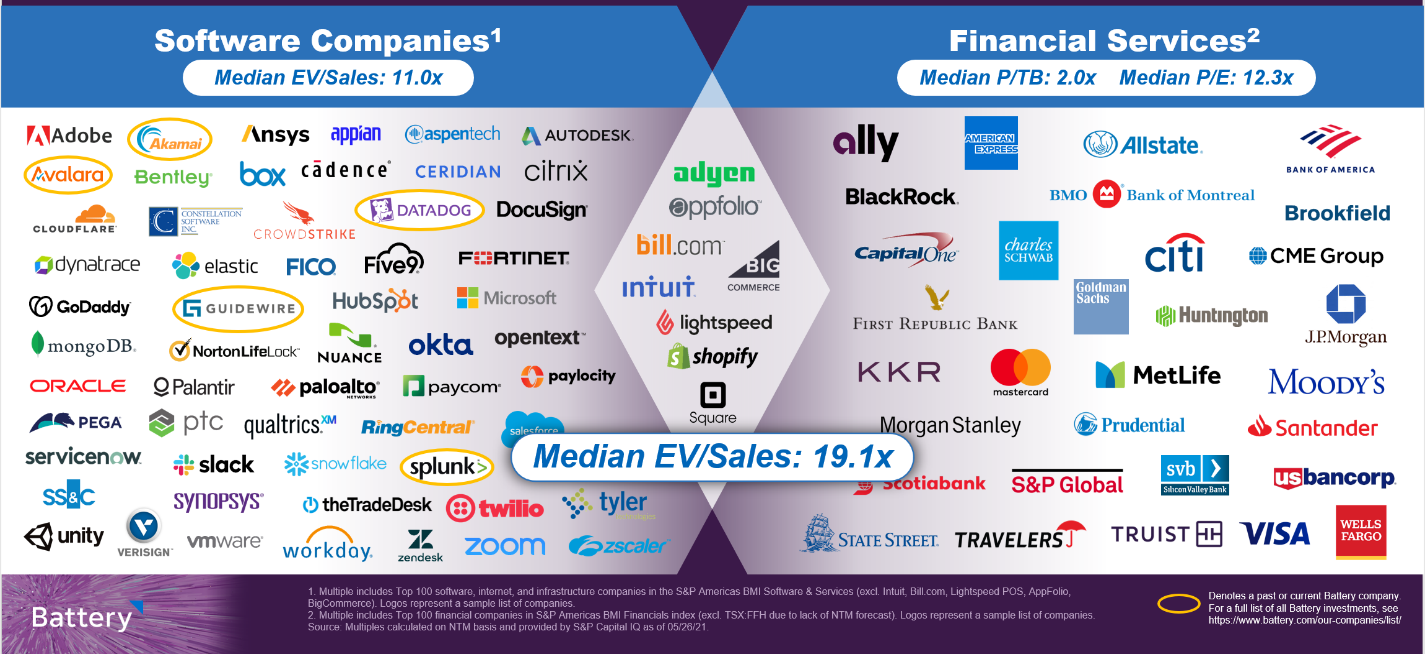
These specialized companies — in some cases, software companies that also process payments and hold funds on behalf of their customers, and in others, financial-first companies that integrate workflow and features more reminiscent of software companies — combine some of the best attributes of both categories.

Image Credits: Battery Ventures

From software, they design for strong user engagement linked to helpful, intuitive products that drive retention over the long term. From financials, they draw on the ability to earn revenues indexed to the growth of a customer’s business.

Fintech is poised to revolutionize financial services, both through reinventing existing products and driving new business models as financial services become more pervasive within other sectors.

The powerful combination of these two models is rapidly driving both public and private market value as investors grant these “super” companies premium valuations — in the public sphere, nearly twice the median multiple of pure software companies, according to a Battery analysis.

The near-perfect example of this phenomenon is Shopify, the company that made its name selling software to help business owners launch and manage online stores. Despite achieving notable scale with this original SaaS product, Shopify today makes twice as much revenue from payments as it does from software by enabling those business owners to accept credit card payments and acting as its own payment processor.

The combination of a software solution indexed to e-commerce growth, combined with a profitable payments stream growing even faster than its software revenues, has investors granting Shopify a 31x multiple on its forward revenues, according to CapIQ data as of May 26.

How should we value these fintech companies, anyway?

Before even talking about how investors should value these hybrid companies, it’s worth making the point that in both private and public markets, fintechs have been notoriously hard to value, fomenting controversy and debate in the investment community.

10 Jun 2021

Course Hero acquires LitCharts, founded by the creators of Sparknotes

I’ll admit it: I was the student that tipped the teacher off that half of our English class, including me, was using Sparknotes to “read” Twelfth Night by Shakespeare, instead of actually reading the text itself. The site, which offered cliff notes and summary of books on a chapter by chapter basis, was the best way to review novels before a quiz — or, was the best last-minute savior if you procrastinated too much and never got around to opening the book in the first place.

History in mind, it makes sense that the creators of everyone’s favorite procrastination tool, Sparknotes, are getting noticed by an edtech unicorn. Litcharts, an offshoot of Sparknotes, got scooped up today by a newly-minted edtech unicorn, Course Hero. The price of the deal was undisclosed. That said, Course Hero last raised an $80 million Series B in August 2020, and assumedly a portion of that check went to this deal.

The creators of Sparknotes, Ben Florman and Justin Kestler, created LitCharts as an extension of their initial success. LitCharts gives notes, definitions, translations, on over 2,000 literary texts. Similar to Sparknotes, LitCharts is all about making complex passages less complex. Grauer estimates that about 30% of LitCharts’ subscribers are teachers and educators.

“We want to make sure that we have the best solution for a specific area, and then at the right moment in time, be able to make a really authentic recommendation of another tool or another offering that can be helpful for you [as a student],” Grauer said, of Course Hero’s long-term ambition. That webbing – or connecting students from one resource to another – could be one of the benefits of virtual education, because there is essentially a history log of every error, stumble, and pause that a student makes as they’re going through a lesson.

The heart of Course Hero, per founder Andrew Grauer, is to create a question and answer platform with extreme levels of specificity for students. It sells subscriptions to students, which unlock access to all of its learning and teaching content, which include course-specific material created by teachers and publishers. Naturally, a big part of Course Hero’s strategy is to offer material on common subjects that students struggle with – English being one of those subjects.

“We’ve been looking at the data on the platform, and where students are actually getting stuck the most, where they need the most help, and where they are asking the most questions,” said Grauer. “And that’s quite informative.”

The company has been building out its literature library for the past five to six years. With LitCharts underneath its wing, Course Hero is putting a significant investment in its literature library, which is chockfull of videos, illustrations, and notes on texts.

This is Course Hero’s second acquisition in the past eight months. In October, Course Hero acquired Symbolab, an artificial intelligence-powered calculator that helps students answer and understand complex math questions. That deal helped bolster Course Hero’s math offering, and today’s acquisition should help Course Hero deepen its literature resources. Both of these brands will continue to operate independently – a choice that Grauer says is part of his operating thesis of supporting the “decentralized, empowerment of entrepreneurs.”

“If you centralize everything, maybe there’s power to that [since] it all looks the same, but actually in doing so many times do you can actually move slower, and not be able to move fast and make decisions and make progress towards the goal because you’re optimizing for so many small specific use cases,” he said. The two recent startups that Course Hero acquired have been operating for over a decade, and Grauer thinks that their scale and brand power is worth keeping as is, instead of forcing into an umbrella brand.

Across its various platforms, Course Hero estimates that it will hit between 2 million to 3 million paid subscribers this year, up from 1 million subcribers the year prior.

10 Jun 2021

Macron says G7 countries should work together to tackle toxic online content

In a press conference at the Élysée Palace, French President Emmanuel Macron reiterated his focus on online regulation, and more particularly toxic content. He called for more international cooperation as the Group of Seven (G7) summit is taking place later this week in the U.K.

“The third big topic that could benefit from efficient multilateralism and that we’re going to bring up during this G7 summit is online regulation,” Macron said. “This topic, and I’m sure we’ll talk about it again, is essential for our democracies.”

Macron also used that opportunity to sum up France’s efforts on this front. “During the summer of 2017, we launched an initiative to tackle online terrorist content with then Prime Minister Theresa May. At first, and as crazy as it sounds today, we mostly failed. Because of free speech, people told us to mind our own business, more or less.”

In 2019, there was a horrendous mass mosque shooting in Christchurch, New Zealand. And you could find multiple copies of the shooting videos on Facebook, YouTube and Twitter. Macron invited New Zealand Prime Minister Jacinda Ardern, several digital ministers of the G7 and tech companies to Paris.

They all signed a nonbinding pledge called the Christchurch Call. Essentially, tech companies that operate social platforms agreed to increase their efforts when it comes to blocking toxic content — and terrorist content in particular.

Facebook, Twitter, Google (and YouTube), Microsoft, Amazon and other tech companies signed the pledge. 17 countries and the European Commission also backed the Christchurch Call. There was one notable exception — the U.S. didn’t sign it.

“This strategy led to some concrete results because all online platforms that signed it have followed through,” Macron said. “Evidence of this lies in what happened in France last fall when we faced terrorist attacks.” In October 2020, French middle-school teacher Samuel Paty was killed and beheaded by a terrorist.

“Platforms flagged content and removed content within an hour,” he added.

Over time, more countries and online platforms announced their support for the Christchurch Call. In May, President Joe Biden joined the international bid against toxic content. “Given the number of companies incorporated in the U.S., it’s a major step and I welcome it,” Macron said today.

But what comes next after the Christchurch Call? First, Macron wants to convince more countries to back the call — China and Russia aren’t part of the supporters for instance.

“The second thing is that we have to push forward to create a framework for all sorts of online hate speech, racist speech, anti-semitic speech and everything related to online harassment,” Macron said.

He then briefly referred to French regulation on this front. Last year, French regulation on hate speech on online platforms has been widely deemed as unconstitutional by France’s Constitutional Council, the top authority in charge of ruling whether a new law complies with the constitution.

The list of hate-speech content was long and broad while potential fines were very high. The Constitutional Council feared that online platforms would censor content a bit too quickly.

But that doesn’t seem to be stopping Macron from backing new regulation on online content at the European level and at the G7 level.

“It’s the only way to build an efficient framework that we can bring at the G20 summit and that can help us fight against wild behavior in online interactions — and therefore wild behavior in our new world order,” Macron said, using the controversial ‘wild behavior’ metaphor (ensauvagement). That term was first popularized by far-right political figures.

According to him, if world leaders fail to find some common grounds when it comes to online regulation, it’ll lead to internet fragmentation. Some countries may choose to block several online services for instance.

And yet, recent events have showed us that this ship has sailed already. The Nigerian government suspended Twitter operations in the country just a few days ago. It’s easy to agree to block terrorist content, but it becomes tedious quite quickly when you want to moderate other content.

10 Jun 2021

Productivity startup Time is Ltd raises $5.6M to be the ‘Google Analytics for company time’

Productivity analytics startup Time is Ltd wants to be the Google Analytics for company time. Or perhaps a sort of “Apple Screen Time” for companies. Whatever the case, the founders reckon that if you can map how time is spent in a company enormous productivity gains can be unlocked and, money better spent.

It’s now raised a $5.6 million late seed funding round led by Mike Chalfen, of London-based Chalfen Ventures, with participation from Illuminate Financial Management and existing investor Accel. Acequia Capital and former Seal Software chairman Paul Sallaberry are also contributing to the new round, as is former Seal board member Clark Golestani. Furthermore, Ulf Zetterberg, founder and former CEO of contract discovery and analytics company Seal Software, is joining as President and co-founder.

The venture is the latest from serial entrepreneur Jan Rezab, better known for founding SocialBakers, which was acquired last year.

We are all familiar with inefficient meetings, pestering notifications chat, video conferencing tools and the deluge of emails. Time is Ltd. says it plans to address this by acquiring insights and data platforms such as Microsoft 365, Google Workspace, Zoom, Webex, MS Teams, Slack, and more. The data and insights gathered would then help managers to understand and take a new approach to measure productivity, engagement, and collaboration, the startup says.

The startup says it has now gathered 400 indicators that companies can choose from. For example, a task set by The Wall Street Journal for Time is Ltd. found the average response time for Slack users vs. email was 16.3 minutes, comparing to emails which was 72 minutes.

Chalfen commented: “Measuring hybrid and distributed work patterns is critical for every business. Time Is Ltd.’s platform makes such measurement easily available and actionable for so many different types of organizations that I believe it could make work better for every business in the world.”

Rezab said: “The opportunity to analyze these kinds of collaboration and communication data in a privacy-compliant way alongside existing business metrics is the future of understanding the heartbeat of every company – I believe in 10 years time we will be looking at how we could have ignored insights from these platforms.”

Tomas Cupr, Founder and Group CEO of Rohlik Group, the European leader of e-grocery, said: “Alongside our traditional BI approaches using performance data, we use Time is Ltd. to help improve the way we collaborate in our teams and improve the way we work both internally and with our vendors – data that Time is Ltd. provides is a must-have for business leaders.”

10 Jun 2021

Dark Sky iOS app and website are likely shutting down at the end of 2022

After Apple acquired Dark Sky in March of 2020, we all knew the super-granular weather app was probably headed for shutdown. But while the company announced that the Android app would go dark in July of the same year, things were left a bit more open-ended for the iOS app. There would be “no changes” for Dark Sky on iOS, they said, “at this time.”

A year later, a small update to the Dark Sky blog (as pointed out by 9to5mac) seems to be putting a new expiration date on the Dark Sky iOS App, API, and website. Writes co-founder Adam Grossman:

Support for the Dark Sky API service for existing customers will continue until the end of 2022. The iOS app and Dark Sky website will also be available until the end of 2022.

It’s worth noting that there’s a little room for interpretation there, in that they don’t explicitly say it will shut down at the end of 2022 — just that they’re committing to running it until the end of 2022, perhaps suggesting its fate after that is in flux. We’ve reached out to Apple for clarification on that point — but until we hear back, we’re taking this as a heads up that shutdown is on the horizon.

On the upside, this is actually an extension for the API and the Dark Sky website. The website was previously scheduled to shutdown in August of 2020; the API, meanwhile, was scheduled to be shuttered at the end of 2021.

This news comes just a few days after Apple announced an overhaul to iOS’ built-in Weather app during WWDC.

10 Jun 2021

Homebuying startup Flyhomes closes $150 million Series C

Amid a recent tear in residential real estate investment, venture capitalists are looking to get a piece of homebuying startup Flyhomes.

The five-year-old startup announced today that they’ve closed a $150 million Series C co-led by Norwest Venture Partners and Battery Ventures. Fifth Wall, Camber Creek, Balyasny Asset Management, Zillow’s Spencer Rascoff, and existing investors Andreessen Horowitz and Canvas Partners also participated in the round. Norwest’s Lisa Wu and Battery’s Roger Lee are joining Flyhomes’ board as part of the deal.

The end-to-end residential real estate startup says they handle “every step of the homebuying process, from brokerage to mortgage,” building financial tools that customers need throughout the process. The company has now raised some $310 million in total.

The startup is well-positioned during a historic run-up of home prices in the US that has made deals more competitive than ever for prospective buyers. A recent report by Redfin notes that more than half of US homes are selling above their asking price right now, up from 1 in 4 a year ago. A Zillow report notes that nearly half of US homes are selling within one week of going on the market.

Flyhomes’s Cash Offer lending product allows consumers purchasing homes to make more attractive all-cash offers to sellers, with the company noting that even if a buyer ends up backing out of the deal, Flyhomes will still buy the home themselves. Central to the startup’s business is sellers being more amenable to all-cash offers, allowing consumers making them to win deals even when they aren’t the highest bidders.

The company says it has bought and sold more than $2.5 billion worth of homes since launching in 2016.

10 Jun 2021

What SOSV’s Climate Tech 100 tells founders about investors in the space

On Earth Day, April 22, SOSV published the SOSV Climate Tech 100, a list of the best startups that we’ve supported from their earliest stages to address climate change. There are always valuable insights embedded in a list like the 100. A TechCrunch story captured the investment perspective, and an SOSV post went deeper into the companies’ category breakdown and founder profiles.

But what can founders learn from the list about climate tech investors? In other words, who invested in the Climate Tech 100? We dug into the “who’s who” of the list, which had more than 500 investors, and here’s what we found.

An active but fragmented landscape

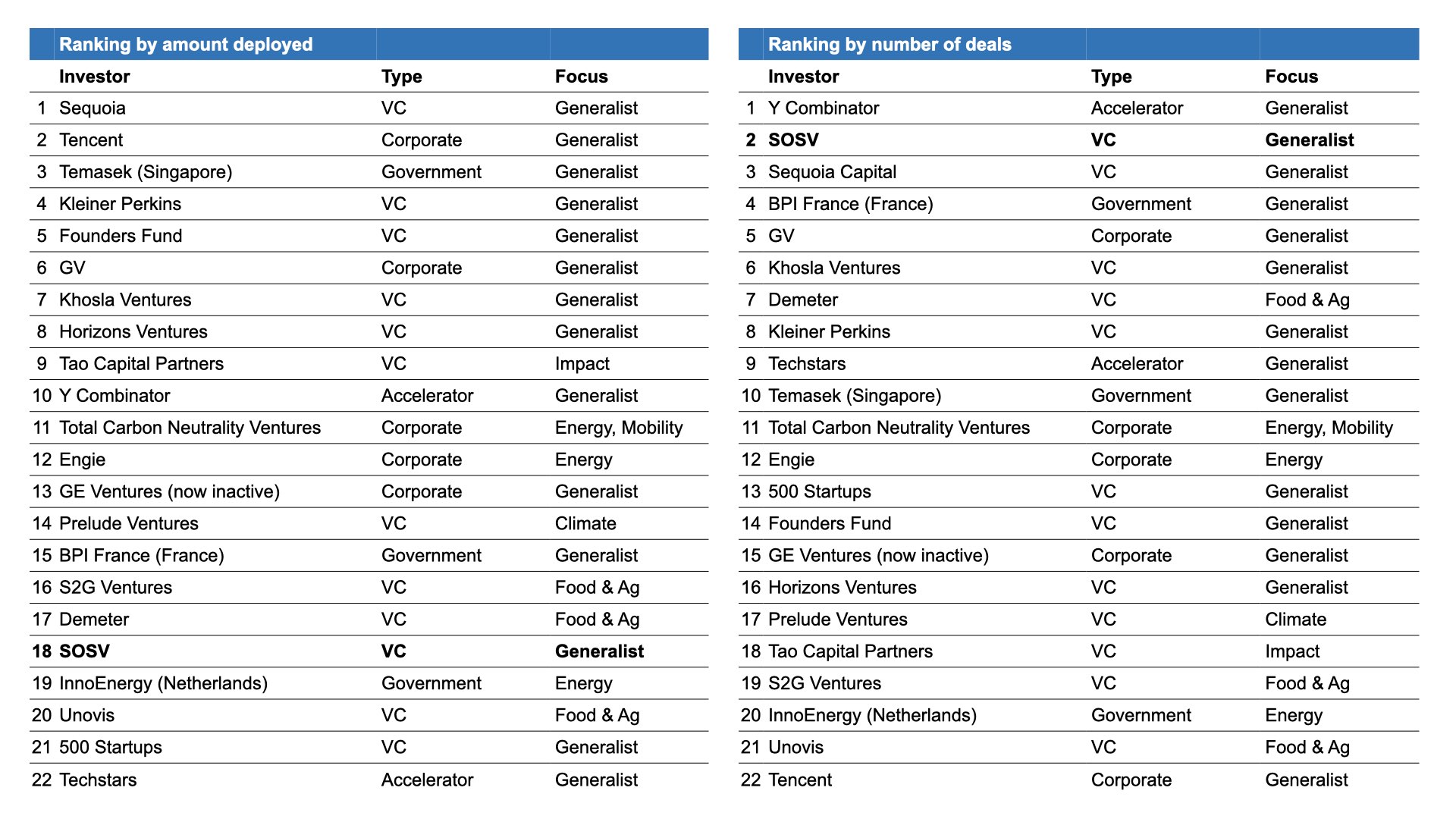
If you think 500 investors in 100 companies is a lot of investors, you’re right. There are clearly a lot of investors interested in climate tech, and most are generalists just testing the waters. For the Climate Tech 100, about 10% of investors put their money in more than one startup and only seven (less than 2%) wrote a check to four or more. These included Blue Horizon, CPT Capital, EF, Fifty Years, Hemisphere Ventures and Horizons Ventures.

That pattern tracks well with data from PwC, which found that 2,700 unique investors had backed 1,200 startups in its State of Climate Tech 2020 report covering the 2013-2019 period. The report found that only 10 firms out of 2,700 made four or more climate tech deals per year, on average, over the 2013-2019 period. The most active firms are listed in the table below.

Most active investors in SOSV Climate Tech 100

Image Credits: PwC, 2020; additional research by SOSV

Capital deployed in climate tech grew at five times the venture capital overall growth rate over the 2013-2019 period.

There is reason to believe that the fragmentation will diminish with the launch of more funds focused on climate tech. Four funds worth more than a billion dollars each have launched since 2020 that fit the description (see chart below).

It’s also encouraging to see that capital deployed in climate tech grew at five times the venture capital overall growth rate over the 2013-2019 period.

Even so, climate tech still only represented 6% of total venture capital deployed in 2019, so there is plenty of room to grow.

10 Jun 2021

Fuel Ventures launches its new $63.6M early-stage VC fund, aiming for 60 startups inside 12 months

You may have heard of payments startup Paddle which has raised $93.3m or perhaps Heroes which raised $65M to become the “Thrasio of Europe” but you might not have heard so much about a backer of these startups, Fuel Ventures, at least not yet.

That’s about to change as Fuel Ventures comes out of the door with a new £45million / $63.6 million early-stage focused VC fund, aiming at 60 UK tech startups over the next 12 months. This is quite the pace for an early-stage fund, but Fuel’s founder and managing partner Mark Pearson told me at length how he is confident of making it one of the most prolific early-stage investors in the UK.

Since launching in 2015, Fuel has raised £80m in capital to invest in seed and series A founders, and the VC will also be aiming for pre-seed ventures with the new fund.

In the last 12 months Fuel says its founders have raised over £180m in follow-on funding. Notable investments include: OnBuy (eCommerce marketplace), Capdesk (equity management platform), OutFund (alternative finance provider), Heroes (scaling Amazon businesses), Moot Group (homeware and furnishing ecommerce business).

Mark Pearson, founder and managing partner of Fuel Ventures, said: “Since we launched our first fund five years ago the country’s tech ecosystem has gone from strength to strength and evolved into an ecosystem that’s the envy of many around the world. Now is not the time to take the foot of the pedal and say job done. We have a responsibility to invest in the future of the UK tech landscape and build on the strong work done so far. This, for us, means making sure we are providing capital for forward-thinking entrepreneurs and their innovative early-stage businesses – even if that means just having an idea or MVP.”

In addition to the new £45million fund, Fuel is also opening up a workspace in central London to serve its portfolio.

Speaking to me over a call, Pearson, who cut his teeth of a startup called MyVoucherCodes, said: “I exited that successfully and left it with about 10 million in revenues. I then started to be a pretty active angel investor, such as in Paddle. When I sold my company I decided to do this full time and found there weren’t many entrepreneurial investors with startup experience themselves, compared to what you see in the US. So I put my entrepreneur hat on, trying to be as founder-friendly as possible. That was five years ago when Fuel Ventures started.”

He told me: “I still think there’s a funding gap between the seed and the Series A. We have always sat in the seed stage. We wanted to just write a decent check to allow these companies what it takes to hire the best talent, build out their product at scale and get them into the institutional funds. We can help you, we will roll up our sleeves, and we’re going to build the business with you. Our network of investors and LPS tend to be entrepreneur types as it is.”

10 Jun 2021

Messenger adds Venmo-like QR codes for person-to-person payments in the U.S.

This spring, Facebook confirmed it was testing Venmo-like QR codes for person-to-person payments inside its app in the U.S. Today, the company announced those codes are now launching publicly to all U.S. users, allowing anyone to send or request money through Facebook Pay — even if they’re not Facebook friends.

The QR codes work similarly to those found in other payment apps, like Venmo.

The feature can be found under the “Facebook Pay” section in Messenger’s settings, accessed by tapping on your profile icon at the top left of the screen. Here, you’ll be presented with your personalized QR code which looks much like a regular QR code except that it features your profile icon in the middle.

Underneath, you’ll be shown your personal Facebook Pay UR which is in the format of “https://m.me/pay/UserName.” This can also be copied and sent to other users when you’re requesting a payment.

Facebook notes that the codes will work between any U.S. Messenger users, and won’t require a separate payment app or any sort of contact entry or upload process to get started.

Users who want to be able to send and receive money in Messenger have to be at least 18 years old, and will have to have a Visa or Mastercard debit card, a PayPal account or one of the supported prepaid cards or government-issued cards, in order to use the payments feature. They’ll also need to set their preferred currency to U.S. dollars in the app.

After setup is complete, you can choose which payment method you want as your default and optionally protect payments behind a PIN code of your choosing.

The QR code is also available from the Facebook Pay section of the main Facebook app, in a carousel at the top of the screen.

Facebook Pay first launched in November 2019, as a way to establish a payment system that extends across the company’s apps for not just person-to-person payments, but also other features, like donations, Stars, and e-commerce, among other things. Though the QR codes take cues from Venmo and others, the service as it stands today is not necessarily a rival to payment apps because Facebook partners with PayPal as one of the supported payment methods.

However, although the payments experience is separate from Facebook’s cryptocurrency walletNovi, that’s something that could perhaps change in the future.

Image Credits: Facebook

The feature was introduced alongside a few other Messenger updates, including a new Quick Reply bar that makes it easier to respond to a photo or video without having to return to the main chat thread. Facebook also added new chat themes including one for Olivia Rodrigo fans, another for World Oceans Day, and one that promotes the new F9 movie.