Year: 2021

08 Jun 2021

Network security startup ExtraHop skips and jumps to $900M exit

Last year, Seattle-based network security startup ExtraHop was riding high, quickly approaching $100 million in ARR and even making noises about a possible IPO in 2021. But there will be no IPO, at least for now, as the company announced this morning it has been acquired by a pair of private equity firms for $900 million.

The firms, Bain Capital Private Equity and Crosspoint Capital Partners, are buying a security solution that provides controls across a hybrid environment, something that could be useful as more companies find themselves in a position where they have some assets on-site and some in the cloud.

The company is part of the narrower Network Detection and Response (NDR) market. According to Jesse Rothstein, ExtraHop’s chief technology officer and co-founder, it’s a technology that is suited to today’s threat landscape, “I will say that ExtraHop’s north star has always really remained the same, and that has been around extracting intelligence from all of the network traffic in the wire data. This is where I think the network detection and response space is particularly well-suited to protecting against advanced threats,” he told TechCrunch.

The company uses analytics and machine learning to figure out if there are threats and where they are coming from, regardless of how customers are deploying infrastructure. Rothstein said he envisions a world where environments have become more distributed with less defined perimeters and more porous networks.

“So the ability to have this high quality detection and response capability utilizing next generation machine learning technology and behavioral analytics is so very important,” he said.

Max de Groen, managing partner at Bain, says his company was attracted to the NDR space, and saw ExtraHop as a key player. “As we looked at the NDR market, ExtraHop, which […] has spent 14 years building the product, really stood out as the best individual technology in the space,” de Groen told us.

Security remains a frothy market with lots of growth potential. We continue to see a mix of startups and established platform players jockeying for position, and private equity firms often try to establish a package of services. Last week, Symphony Technology Group bought FireEye’s product group for $1.2 billion, just a couple of months after snagging McAfee’s enterprise business for $4 billion as it tries to cobble together a comprehensive enterprise security solution.

08 Jun 2021

Sony’s best-in-class noise-cancelling earbuds finally get a pricey upgrade

It’s been two years since Sony raised the bar for wireless earbuds. Six months before Apple upped its own game with the AirPods Pro, the WF-1000XM3 set a new standard for sound and active noise cancelation. Since then, few companies have been able to match – let alone surpass – their performance.

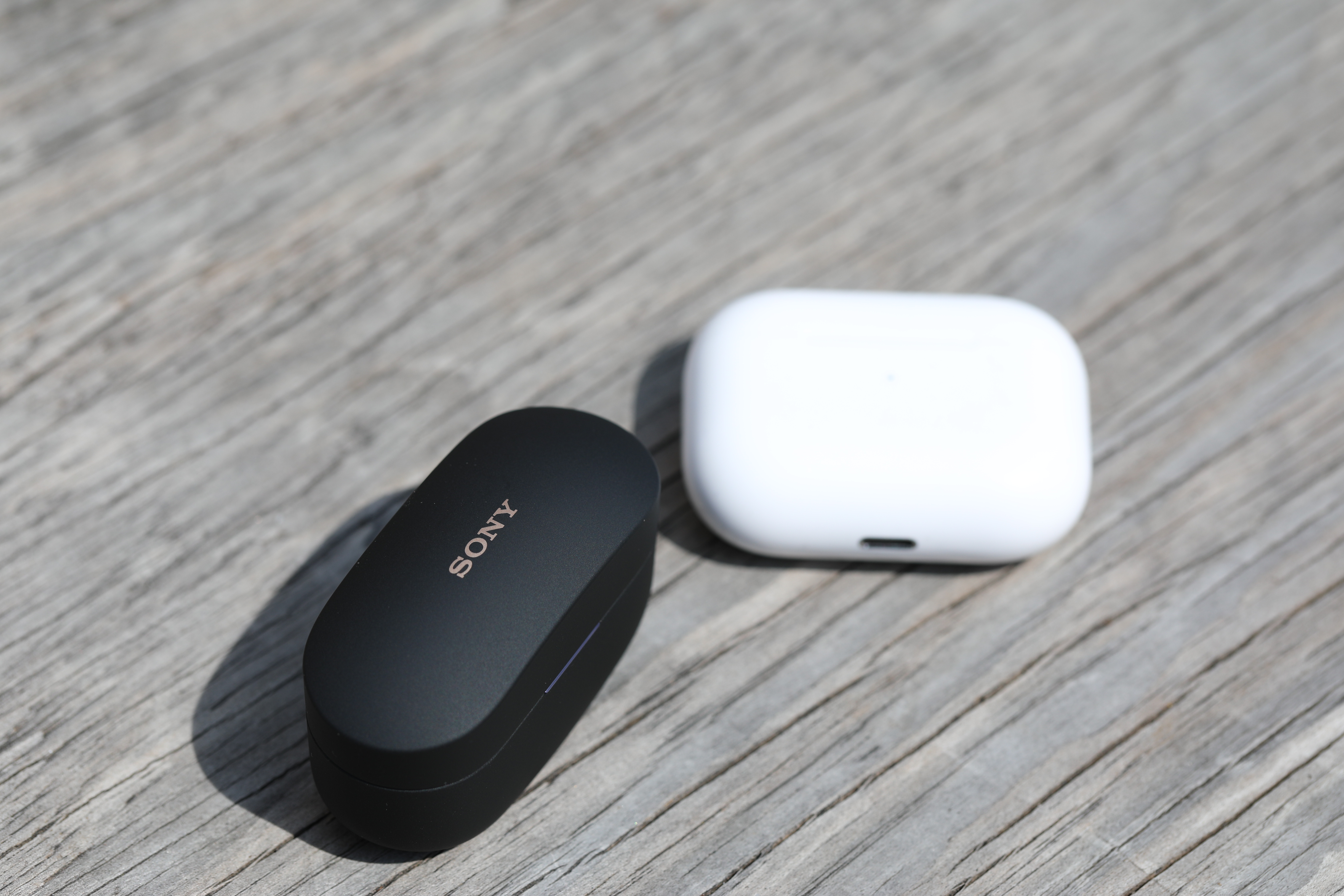
After several weeks’ worth of leaks, the electronics giant is back with the WF-1000XM4 – a pair of buds it claims will best both the sound quality and ANC of the originals. It’s a high bar with an equally lofty price tag. The pricing was steep with the originals at $230, and now it seems Sony is really leaning in here at $280.

The wireless earbud category was already feeling crowded in 2019, but that’s nothing compared to where we’re at in 2021. There are also plenty of sub-$50 options out (you can also pick up decent Sony earbuds for under $100). Rather than finding a way to drop the cost, however, Sony is looking to cement a place at the truly premium end of spectrum, at $30 more than even the AirPods Pro.

Image Credits: Brian Heater

That said, given how high the company set the bar with the M3s, I’m definitely looking forward to testing these things out (a pair just arrived, so more soon). The M4s could well make a great pair of travel headphones – when we start doing that more regularly. The company says the secret sauce here is the V1, a newly designed processor that both enhances the ANC and the sound quality on the buds.

“Specially developed by Sony, the newly designed Integrated Processor V1 takes the noise canceling performance of Sony’s acclaimed QN1e chip and goes even further,” the company writes. “With two noise sensing microphones on the surface of each earbud – one feed-forward and one feed-back – the headphones analyze ambient noise to provide highly accurate noise cancellation.”

There are beam-forming mics on board, as well, to capture sound directly from the speaker’s mouth and reduce unnecessary ambient noise. Interesting tidbit here, too, “The new bone-conduction sensor only picks up vibrations from the user’s voice, enabling even clearer speech when making calls.”

Image Credits: Brian Heater

There’s automatic wind noise reduction for when you’re outside, coupled with a new 6mm driver. The redesigned system promises richer bass and better sound with less distortion. Naturally, Sony has also brought over its High-Resolution Audio Wireless technology, capable of transmitting 3x the data of standard Bluetooth with up to 990 kbps, according to the company.

The buds support Sony’s 360 Reality Audio – clearly something more manufacturers are looking at for high-end headphones, as they take small steps toward augmented audio. That feature needs to be enabled in the Sony app and naturally only works with select services. Adaptive Sound Control, meanwhile, adjusts playback volume based on ambient noise.

Image Credits: Brian Heater

As mentioned above, I’ve got a pair sitting on my desk right now, and right off the bat, the charging case is significantly smaller than the M3, while still boasting a full 24 hours of life on a charge. The buds themselves get up to eight hours, which is around the industry standard for higher-end sets. Five minutes of charging the case should get you an hour of playback.

The shape has changed significantly from the M3. The long wings are now bulbous and sit above the ear canal. Curious to see whether this eases some of the pressure with long term use. The buds are rated IPX4 waterproof and work with both Google Assistant and Alexa. They’ll fast pair to Android devices and Windows 10 machines.

They’re available beginning today for $280.

08 Jun 2021

Here’s what’s happening tomorrow at TC Sessions: Mobility 2021

Tomorrow, June 9 is the big day, mobility fans! Get ready to rub virtual elbows with the brightest minds and makers, movers and shakers at TC Sessions: Mobility 2021. You, along thousands of other attendees from around the world, will find insight, inspiration and, most of all, opportunity to help you make your mobility startup dreams a reality.

Procrastination Station: It’s not too late to join your community and get the inside scoop on the latest mobility trends and tech. Buy your pass now and drive this opportunity like you stole it.

The event agenda features 20 different presentations, interviews, panel discussions and breakout sessions on range of topics — everything from servicing EV charging stations, autonomous vehicles — and the AI that powers them — the state of venture capital (come get your SPAC on), public-private partnerships, equity and accessibility and, whoa, so much more.

We’re going to point out just a few of tomorrow’s highlights to whet your mobility whistle and to help you make the most of your time. You can kiss schedule conflicts goodbye, thanks to video-on-demand. Catch any session you miss later at your convenience.

Ready? Take a look at what’s happening tomorrow at TC Sessions: Mobility 2021. Times listed below are EDT, but the agenda will automatically reflect your time zone.

12:05 pm – 12:35 pm

Self-Driving Deliveries: Autonomous vehicles and robotics were well on their way transforming deliveries before the pandemic struck. In the past year, these technologies have moved from novel applications to essential innovations. We’re joined by execs at Starship Technologies, Gatik and Nuro — each with individual approaches that span the critical middle and last mile of delivery.

1:45 pm – 2:05 pm

Public-Private Partnerships: Advancing the Future of Mobility and Electrification: The future of mobility starts with the next generation of transportation solutions. Attendees will hear from some of the most innovative names on opportunities that await when public and private entities team up to revolutionize the way we think about technology. Trevor Pawl, Michigan’s Chief Mobility Officer, will be joined by Nina Grooms Lee, Chief Product Officer of May Mobility.

3:00 pm – 4:00 pm

Startup Pitch Feedback Session: Tune in as the 28 startups exhibiting at TC Mobility pitch to, and hear feedback from, TechCrunch staff. The pitch deck you improve by watching may be your own.

5:05 pm – 5:15 pm

EV Founders in Focus: We sit down with the founders poised to take advantage of the rise in electric vehicle sales. This time, we will chat with Evette Ellis, co-founder of ChargerHelp! a startup that enables on-demand repair of electric vehicle charging stations.

12:05 pm – 6:20 pm

Explore the expo: Don’t miss the 28 game-changing startups exhibiting in the expo area. Ask for a live demo, a product walk-through or simply start a conversation and see where it leads. Opportunity awaits.

And that, mobility fans, is the classic tip of the iceberg. Get a good night’s sleep, carbo-load and prepare for a marathon of opportunity at TC Sessions: Mobility 2021. We’ll see you tomorrow!

08 Jun 2021

Almanac is building a faster doc editor for the remote work era

Few things have captured Silicon Valley-based investors’ attention in recent years quite like the quest to back the successor[s] to Google Docs. The estimable and entrenched productivity suite has been unbundled and repackaged into products that a number of multi-billion dollar tech startups have been built around.

All the while, entrepreneurs are continuing to poke holes in their predecessors’ lore, creating something faster, sleeker or more intuitive. For plenty of the current generation productivity startups, the journey to replace Google Docs and Microsoft Office got a historic shot in the arm this past year as a global pandemic gave remote work software companies a jot of attention.

“Covid has made everybody realize that the way that we were working had to change,” Almanac CEO Adam Nathan told TechCrunch. “The core tools we used for productivity, Microsoft Word and Google Docs were for when we did a completely different type of work.”

Almanac is trying to revamp the document editor in a package that’s quicker than products like Notion and far more intuitive than legacy software suites, Nathan says. Last year, the startup raised a $9 million seed round led by Floodgate and has been quietly building out its network of users in early access beta.

The document editor found its way into a disparate number of offices outside tech startups — from a Domino’s branch to a veterinary office — through its open source template library Core, a hub for user-submitted guides on everything from how to run a one-on-one meeting to how to structure salaries for your customer service team. There are 5,000 documents on Core which are accessible to any logged-in user, something that has been a sizable customer channel for the startup as more companies and offices across the country have begun to question some entrenched ways of doing things.

“There are way more people working in docs outside of Silicon Valley than in it,” Nathan says.

As a document editor, Almanac’s core offering is the ability to keep files organized in the way that companies actually organize themselves.

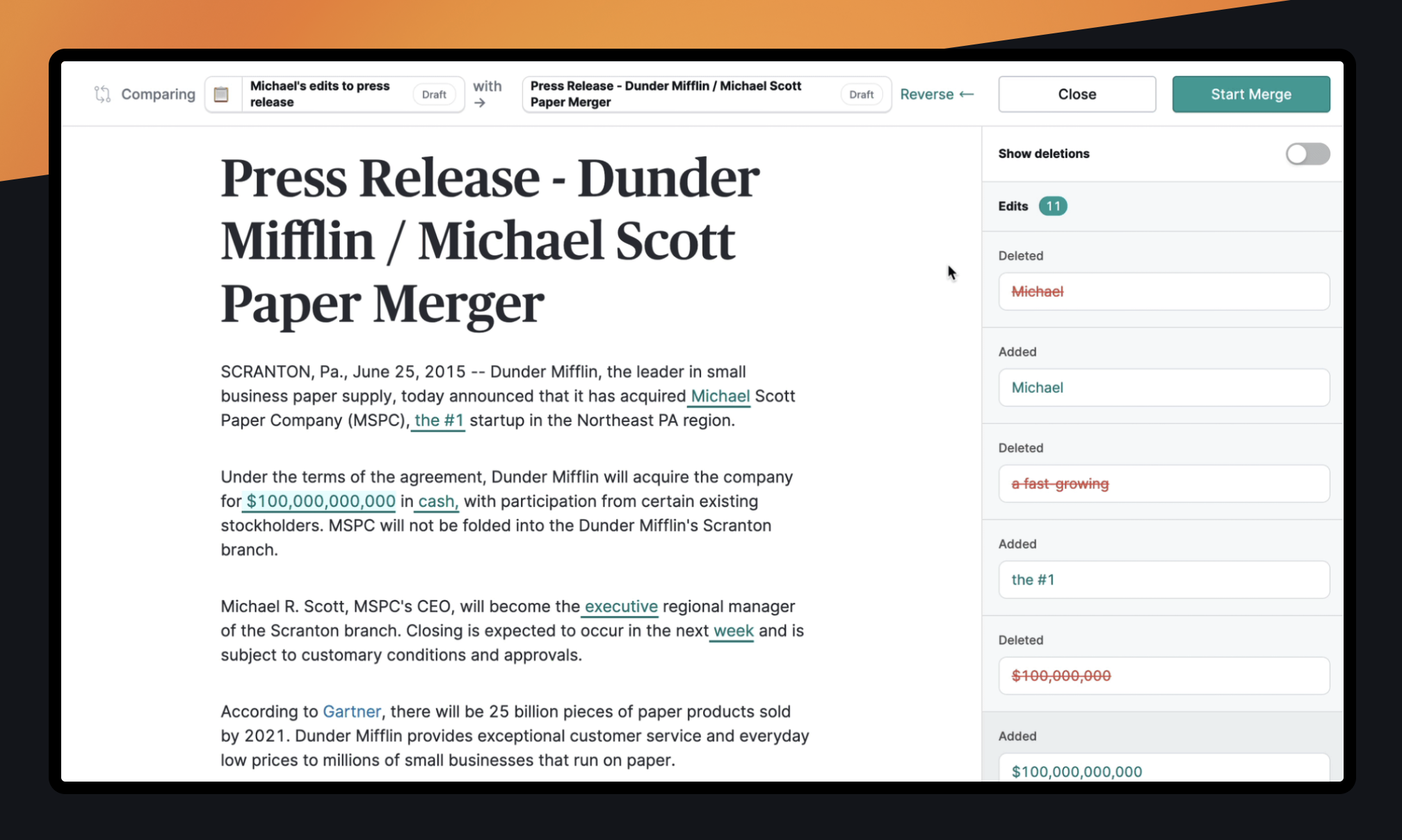
One of its hallmark features is the ability to track document changes in a way that makes Google Docs look completely unintelligible. User can easily make their own copies of documents, merge them with the original and quickly approve changes. Users can also get approval from their manager or another user in their network and ask for feedback along the way.

For tasks that require a bit more thought, people can use Almanac to add tasks to another users to-do list inside the documents themselves, a feature that they might have needed a project management tool like Asana to handle in the past. Updates for items a user has been assigned or has assigned to others live inside their own inbox where notifications flow automatically as documents evolve. The team believes that functionality like this inside Almanac will help teams cut down on unnecessary Slacking and let the documents speak for themselves.

The company is quickly iterating itself into new workflows — they recently launched a feature specifically around building and updating handbooks, and they also just shipped a feature called Snippets which allows users to save oft-used blocks of texts so they can quickly build up new documents.

In a crowded productivity software space, Almanac’s sell relies on users fully committing to the offering, that’s been a central struggle in the post-Microsoft Office era where users have often seen their productivity toolsets swell with tools claiming to cut down on confusion. This often isn’t the fault of the tools themselves, but with how organizations adopt new software. Almanac hopes that by focusing on common workflows inside documents, its users can resist the urge to open another app and instead realize the gains that come from centralizing feedback in one platform.

08 Jun 2021

Blendoor data lets you know if companies are living up to diversity pledges

Many companies talk the talk when it comes to diversity, but it’s harder to know if a firm is actually going the extra mile to hire more qualified people from underrepresented groups, or if they just make noise about it. Blendoor, a six year old startup, wants to put data to work on the problem by giving companies a score based on publicly available data to let the world know just how diverse a company actually is.

Blendoor founder and CEO Stephanie Lampkin, says that when she launched the company, it was more focussed on finding qualified diverse candidates by mitigating unconscious bias in the hiring process. That involved removing name, age, gender or any other indications that could potentially create bias and just let the person’s work record stand on its own. She said that the startup targeted companies that had made public DEI pledges as a natural place to start.

As the company directed its efforts in this direction, however, Lampkin says that it quickly became apparent that the public positioning of a company, and how it directed its hiring resources were often two different things, and she decided to switch focus. “So we decided to create an index, a credit score, and we pulled in a ton of data from their diversity reports, their EEO One forms if they publish them and all of this buzz around different pledges and investments and partnerships, etc,” Lampkin told me.

She then took this data and structured it, normalized it and built an algorithm that could dynamically score companies much the same way that our credit rating or security scorecards work and make that information public.

She said the George Floyd killing was a turning point for her and the company. “When George Floyd [was killed] and I saw this resurgence of the diversity pledge, I decided that I don’t want to play in this diversity theater anymore and just be another check the box solution that companies are using to demonstrate that they care,” she said.

She added, “So we decided to double down on BlendScore and in doing so hold companies accountable for all of these big financial commitments that they’re making in order to track the deployment of that capital, but also the downstream effects in terms of their hiring, retention, promotion rates, compensation equality, etc.”

That culminated in a report the company recent published looking at the data and finding that companies’ public stance doesn’t always match its public face, especially with pledges following Floyd’s death. “My initial purpose was to demonstrate if there is a negative correlation between pledges and performance — and the only area where we found that to be true was with Black employees versus Black Lives Matter pledges.” She says that everywhere else there was pretty consistent positive correlation around companies who said they wanted to improve in areas like gender diversity and pay equality, and those that were actually doing that.

In terms of making money, Lampkin says that she wants to focus on helping companies with governance when it comes to diversity pledges, especially for public companies, who will have to answer to a variety of constituencies from investors to consumers. She also believes that their approach to measuring diversity will also increasingly have an impact on who wants to work at a company and the ability to attract the best talent.

She says that if people are insisting on making diversity a political stance, she’s going to focus on diversity as a fiduciary responsibility. While it may be good for society as a natural byproduct of that, some companies only see it through that governance lens, and if that’s the case, she intends to work that angle.

“I’m doubling down on ESG and fiduciary responsibility. No more talk about what’s good for a society. [It doesn’t matter] what you believe is good for society. This is now about risk management and ESG,” she said.

So far the company has 13 employees and she reports she’s raised about $1.7 million. She acknowledges raising money is a challenge, especially for a Black woman founder. It’s worth noting that less than 100 Black women have ever raised more than $1 million as of last year.

‘It’s been really challenging. We’ve had to just survive off revenue, and think in part it’s because we sit at the intersection of social activism and for-profit venture, when a lot of investors are like Marc Andreessen they don’t see a path [for Stakeholder Capitalism], but I think that’s changing and the investor community claims to be on board for more impact investing, so we’ll see.”

08 Jun 2021

CISA launches platform to let hackers report security bugs to US federal agencies

The Cybersecurity and Infrastructure Security Agency has launched a vulnerability disclosure program allowing ethical hackers to report security flaws to federal agencies.

The platform, launched with the help of cybersecurity companies Bugcrowd and Endyna, will allow civilian federal agencies to receive, triage and fix security vulnerabilities from the wider security community.

The move to launch the platform comes less than a year after the federal cybersecurity agency, better known as CISA, directed the civilian federal agencies that it oversees to develop and publish their own vulnerability disclosure policies. These policies are designed to set the rules of engagement for security researchers by outlining what (and how) online systems can be tested, and which can’t be.

It’s not uncommon for private companies to run VDP programs to allow hackers to report bugs, often in conjunction with a bug bounty to pay hackers for their work. The U.S. Department of Defense has for years warmed to hackers, the civilian federal government has been slow to adopt.

Bugcrowd, which last year raised $30 million at Series D, said the platform will “give agencies access to the same commercial technologies, world-class expertise, and global community of helpful ethical hackers currently used to identify security gaps for enterprise businesses.”

The platform will also help CISA share information about security flaws between other agencies.

The platform launches after a bruising few months for government cybersecurity, including a Russian-led espionage campaign against at least nine U.S. federal government agencies by hacking software house SolarWinds, and a China-linked cyberattack that backdoored thousands of Microsoft Exchange servers, including in the federal government.

08 Jun 2021

Apple Music launches Spatial Audio and Lossless Audio, adds Spatial Audio playlists

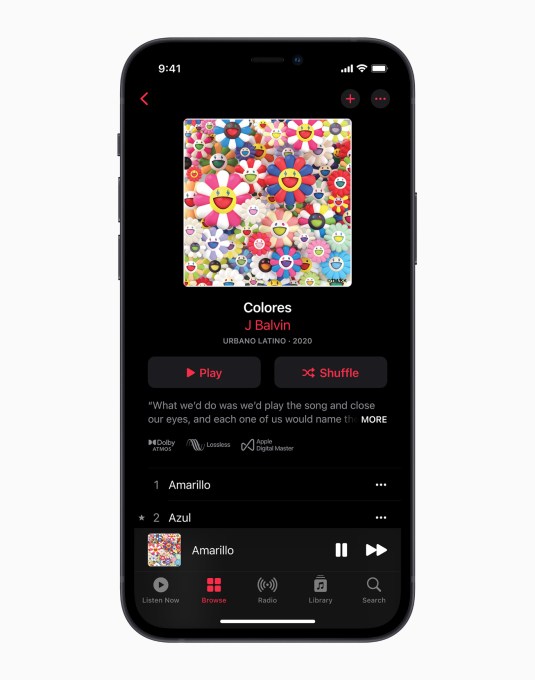
Last month, Apple announced it would soon add lossless audio streaming and Spatial Audio with support for Dolby Atmos to its Apple Music subscription at no extra charge. That upgrade has now gone live, Apple announced this morning — though many noticed the additions actually rolled out yesterday, following the WWDC keynote.

The entire Apple Music catalog of 75+ million songs will support lossless audio.

The lossless tier begins at CD quality — 16 bit at 44.1 kHz, and goes up to 24 bit at 48 kHz, Apple previously said. Audiophiles can also opt for the high-resolution lossless that goes up to 24 bit at 192 kHz. Apple has said you’ll need to use an external, USB digital-to-analog converter to take advantage of the latter — simply plugging in a pair of headphones to an iPhone won’t work.

Apple Music subscribers will be able to enable the new lossless option under Settings > Music > Audio quality. Here, you’ll be able to choose the different resolutions you want to use for different connections, including Wi-Fi, cellular, and download.

When you make your selection in Settings, iOS warns that lossless files will use “significantly more space” on your device, as 10 GB of storage would allow you to store approximately 3,000 songs at high quality, 1,000 songs with lossless, or 200 songs with high-res lossless.

Image Credits: Apple

Meanwhile, Spatial Audio will be enabled by default on hardware that supports Dolby Atmos, like Apple’s AirPods and Beats headphones with an H1 or W1 chip. The latest iPhone, iPad, and Mac models also support Dolby Atmos. Spatial Audio on Apple Music will also be “coming soon” to Android devices, Apple said.

To kick off launch, Apple Music is today rolling out new playlists designed to showcase Spatial Audio. These include:

Apple is also adding a special guide to Spatial Audio on Apple Music, which will help music listeners hear the difference. This will include tracks from artists like Marvin Gaye and The Weeknd, among others. And Apple will air a roundtable conversation about Spatial Audio featuring top sound engineers and experts, hosted by Zane Lowe at 9 am PT today on Apple Music.

Because songs have to be remastered for Dolby Atmos specifically, these guides and playlists will help music fans experience the new format without having to hunt around. Apple says it’s working with artists and labels to add more new releases and the best catalog tracks in Spatial Audio. To help on this front, Apple notes there are various initiatives underway — including doubling the number of Dolby-enabled studios in major markets, offering educational programs, and providing resources to independent artists.

Apple also said it will build music-authoring tools directly into Logic Pro. Later this year, the company plans to release an update to Logic Pro that will allow any musician to create and mix their songs in Spatial Audio for Apple Music.

read more about Apple's WWDC 2021 on TechCrunch

08 Jun 2021

How bottom-up sales helped Expensify blaze the path for SaaS

You’d expect an expense management company to have a large sales department and advertise through all kinds of channels to maximize customer acquisition. But like we’ve seen over and over through the course of this EC-1, Expensify just doesn’t do what you think it should.

Keeping in mind this company’s propensity to just stick to its guts, it’s not much of a surprise that it got to more than $100M in annual recurring revenue and millions of users with a staff of 130, some contractors, and an almost non-existent sales team.

If you’re wondering how its possible to grow to such a level without an established sales team, the short answer is: Word of mouth. To an extent, Expensify can do this due to the space it’s in, as expense reporting is such a thankless, almost mind numbingly boring task that anyone who found a good solution is bound to recommend it to their colleagues and friends.

But it’s more interesting how Expensify grows bottom-up within SMBs, its core customer base. By providing an easy and meaningful experience via the product itself, the company has come to a point where it only takes one or two users who love the service to turn their company into customers.

This approach flips the traditional sales model on its head and is now known as product-led growth, but Expensify did it long before it was an accepted business model. Though that was harder than it sounds, it also put the company in a uniquely privileged position, which it is fully intent on leveraging.

Starting the flywheel

There are many ways to get such a business model started, but as usual, Expensify threw caution and all advice out the window and banked on turning its users into evangelizers for its product.

08 Jun 2021

Google ditches pay-to-play Android search choice auction for free version after EU pressure

Google is ditching a massively unpopular auction format that underpins an choice screen it offers in the European Union, it said today. Eligible search providers will be able to freely participate.

The auction model was Google’s ‘remedy’ of choice — following the 2018 EU $5BN antitrust enforcement against Android — but rivals have always maintained it’s anything but fair, as we’ve reported previously (here, here, here, for eg).

The Android choice screen presents users in the region with a selection of search engines to choose as a default at the point of device set up (or factory reset). The offered choices depend on sealed bids made by search engine companies bidding to pay Google to win one of three available slots.

Google’s own search engine is a staple ‘choice’ on the screen regardless of EU market.

The pay-to-play model Google devised is not only loudly hated by smaller search engine players (including those with alternative business models, such as the Ecosia tree-planting search engine), but it been entirely ineffectual at restoring competitive balance in search marketshare so it’s not surprising Google has been forced to ditch it.

The Commission had signalled a change might be coming, with Bloomberg reporting in May remarks by the EU’s competition chief, Margrethe Vesager, that it was “actively working on making” Google’s Android choice screen for search and browser rivals work. So it evidently heard the repeated cries of ‘foul’ and ‘it’s not working, yo!’. And — finally — it acted.

However, framing its own narrative, Google writes that it’s been in “constructive discussions” with EU lawmakers for years about “how to promote even more choice on Android devices, while ensuring that we can continue to invest in, and provide, the Android platform for free for the long term”, as it puts it.

It also seems to be trying to throw some shade/blame back at the EU — writing that it only introduced what it calls a “promotional opportunity” (lol) “in consultation with the Commission”. (Ergo, ‘don’t blame us gov, blame them!’)

In another detail-light paragraph of its blog, Google says it’s now making “some final changes” — including making participation free for “eligible search providers” — after what it describes as “further feedback from the Commission”

“We will also be increasing the number of search providers shown on the screen. These changes will come into effect from September this year on Android devices,” it adds.

The planned changes raise new questions — such as what criteria it will be using to determine eligibility; and will Google’s criteria be transparent or, like the problematic auction, sealed from view? And how many search engines will be presented to users? More than the current four, that’s clear.

Where Google’s own search engine will appear in the list will also be very interesting to see, as well as the criteria for ranking all the options (marketshare? random allocation?).

Google’s blog is mealy mouthed on any/all such detail — but the Commission gave us a pretty good glimpse when we asked (see their comment below).

It still remains to seen whether any other devilish dark pattern design details will appear when we see the full implementation.

But it’s worth noting that it’s not in Google’s gift to claim these changes are “final”. EU regulators are responsible for monitoring antitrust compliance — so if fresh complaints flow they will be duty bound to listen and react.

In one response to Google’s auction U-turn, pro-privacy search player DuckDuckGo was already critical — but more on the scope than the detail.

Founder Gabriel Weinberg pointed out that not only is the switch three years too late but Google should also be applying it across all platforms (desktop and Chrome too), as well as making it seamlessly easy for Android users to switch default, rather than gating the choice screen to set-up and/or factory reset (as we’ve reported before).

Another long-time critic of the auction model, tiny not-for-profit Ecosia, was jubilant that its fight against the search behemonth has finally paid off.

Commenting in a statement, CEO Christian Kroll said: “This is a real life David versus Goliath story — and David has won. This is a momentous day, and a real moment of celebration for Ecosia. We’ve campaigned for fairness in the search engine market for several years, and with this, we have something that resembles a level playing field in the market. Search providers now have a chance to compete more fairly in the Android market, based on the appeal of their product, rather than being shut out by monopolistic behaviour.”

The Commission, meanwhile, confirmed to TechCrunch that it acted after a number of competitors raised concerns over the auction model — with a spokeswoman saying it had “discussed with Google means to improve that choice screen to address those concerns”.

“We welcome the changes introduced by Google to the choice screen. Being included on the choice screen will now be free for rival search providers,” she went on. “In addition, more search providers will be included in the choice screen. Therefore, users will have even more opportunities to choose an alternative.”

The Commission also offered a little more detail of how the choice screen will look come fall, saying that “on almost all devices, five search providers will be immediately visible”.

“They will be selected based on their market share in the user’s country and displayed in a randomised order which ensures that Google will not always be the first. Users will be able to scroll down to see up to seven more search providers, bringing the total search providers displayed in the choice screen to 12.”

“These are positive developments for the implementation of the remedy following our Android decision,” the spokeswoman added.

So it will certainly be very interesting indeed to see whether this Commission-reconfigured much bigger and more open choice screen helps move the regional need on Google’s search engine market share.

Interesting times indeed!

08 Jun 2021

Mint House claims top NYC hotel after COVID changed its hospitality business

What’s the top-rated hotel in New York City? According to Tripadvisor users, it’s Mint House at 70 Pine, and it’s easy to see why as you click through the photos. Throughout NYC, hotel rooms are essentially bento boxes, carefully constructed to contain all the necessary bits. But not Mint House rooms. Mint House rooms are virtually complete apartments, and travelers have taken notice.

The COVID-19 pandemic changed the way Mint House operates, and as the world starts to reopen, the company is well-positioned to serve business and pleasure travelers alike.

Mint House launched in 2017 and raised $15M in 2019 as it expanded its offering. At the time Tige Savage, Revolution Venture managing partner and Mint House investor, described the company like this: “Mint House is the best of a hotel without the worst of a hotel and the best of an Airbnb without the worst of an Airbnb.”

The company is different from traditional hotels by offering products more similar to those rented by Airbnb, but while still offering similar features as a hotel. Another company called Lyric tried to walk this line, too, and raised $150m before ultimately shutting down.

Initially, Mint House targeted business travelers in secondary markets (read: not New York City). Pre-COVID Mint House rooms were primarily available in Indianapolis, Denver, Nashville, Miami, and Detroit. Mint House CEO Will Lucas explained at the time that there were opportunities in these markets as often accommodations are worse than in major markets.

COVID changed Mint House’s trajectory, Lucas explained in an interview with TechCrunch. At the beginning of the pandemic, the hospitality industry fell off. Mint House saw occupancy rates fall from 60% to single digits, and Mint House had to refund customers and furlough employees. Eventually, through new sales team members, Mint House discovered their product offering was well suited for the pandemic. Displaced workers needed a place to live and work. Traveling healthcare professionals needed a home away from home. Some university students were shut out of student housing but still required to attend school. Mint House’s apartment-like rooms presented a compelling alternative to a traditional hotel room where kitchens are often, at most, just an instant coffee pot and a mini-fridge. But with Mint House rooms, guests have in-room kitchens, living space, and recently rising in importance, an actual workspace.

As the pandemic settled in, Mint House saw a drastic change in length of stay. Before COVID-19, the average stay length was four nights. During COVID-19, the average stay length was 21 nights as the needs for travelers shifted. Instead of flying in for a quick meeting, workers and travelers needed a place to hunker down and work remotely. During the height of the pandemic, 81% of Mint House guests were working remotely.

Mint House’s key features seem purpose-built for social distancing, but they were in place before the pandemic. Guests do not have to check in with a front desk and there are no key cards. Guests can order groceries, and the room will be stocked before arrival — a service rarely found outside of business-centric hotels but now in demand even with leisure travelers too. Customer service for all of the properties is centralized, too.

While most of the hospitality industry languished throughout 2020, Mint House saw terrific growth. Several months into the pandemic, Mint House saw occupancy rates hit new highs. By June, 84% of Mint House’s rooms were booked, and the company averaged 80% over the rest of 2020. The company doubled down and grew its portfolio by over 50% in the last half of 2020, too.

Today, nearly a year after the bottom fell out, Mint House is in 24 buildings in 13 markets.

In New York City, Mint House is competing with giants. CEO Lucas explains.

“This year, in New York City, we have been earning on average 2.2x the RevPAR (revenue per available room),” he said. “Our CompSet (Competitive set, or rather, competing hotels) is incredibly formidable competition that includes two Thompson hotels, three Marriott Hotels, and Hilton Hotels. We are number one in occupancy, number one in ADR (Average Daily Rate), and putting them together, we’re more than double the CompSet.”

Lucas believes these rankings show Mint House’s strengths and how the company is different from traditional hospitality brands. And yet, Mint House turned to executives from classic hospitality brands to fuel growth.

Mint House recently announced the addition of several new executives. Jim Mrha, who previously worked at Domio, Hilton, MGM Hospitality, and Marriott, will serve as Mint House’s CFO. Paul Sacco, a former investment officer and executive at TPG Hotels & Resorts and Starwood, joined Mint House as Chief Development Officer. Jess Berkin, another former hospitality executive of the travel e-commerce startup Porter & Sail, is Mint House’s new marketing and communication executive.

“It feels like we’re about to really blast off,” Lucas said with a bit of pride.

Mint House is engaged in an aggressive growth strategy just as the world is set to reopen. The company is looking to double the number of available units and go international, starting with London in a month and eventually in South America.

Now, halfway through 2021, the pandemic is receding, and travel is starting to change again. Mint House is seeing the average stay drop back down from 21 nights in 2020 to something around six nights. According to Lucas, leisure travelers are increasing, and Mint House is seeing the return of short business stays. And then there’s the new type of business traveler who leaves behind their home office to work remotely from somewhere new, like Miami.

Mint House straddles an interesting line between hotels and short-term rentals like those offered by Airbnb. On one side, they offer the convenience and trust found in a hotel with the style and comfort of a short-term rental. If the company can execute its plan and its recent executive hires should help, the company is well suited to compete with the Hilton and Marriotts in NYC and throughout the States and world.