
Year: 2021

08 Jun 2021

Mint House claims top NYC hotel after COVID changed its hospitality business

What’s the top-rated hotel in New York City? According to Tripadvisor users, it’s Mint House at 70 Pine, and it’s easy to see why as you click through the photos. Throughout NYC, hotel rooms are essentially bento boxes, carefully constructed to contain all the necessary bits. But not Mint House rooms. Mint House rooms are virtually complete apartments, and travelers have taken notice.

The COVID-19 pandemic changed the way Mint House operates, and as the world starts to reopen, the company is well-positioned to serve business and pleasure travelers alike.

Mint House launched in 2017 and raised $15M in 2019 as it expanded its offering. At the time Tige Savage, Revolution Venture managing partner and Mint House investor, described the company like this: “Mint House is the best of a hotel without the worst of a hotel and the best of an Airbnb without the worst of an Airbnb.”

The company is different from traditional hotels by offering products more similar to those rented by Airbnb, but while still offering similar features as a hotel. Another company called Lyric tried to walk this line, too, and raised $150m before ultimately shutting down.

Initially, Mint House targeted business travelers in secondary markets (read: not New York City). Pre-COVID Mint House rooms were primarily available in Indianapolis, Denver, Nashville, Miami, and Detroit. Mint House CEO Will Lucas explained at the time that there were opportunities in these markets as often accommodations are worse than in major markets.

COVID changed Mint House’s trajectory, Lucas explained in an interview with TechCrunch. At the beginning of the pandemic, the hospitality industry fell off. Mint House saw occupancy rates fall from 60% to single digits, and Mint House had to refund customers and furlough employees. Eventually, through new sales team members, Mint House discovered their product offering was well suited for the pandemic. Displaced workers needed a place to live and work. Traveling healthcare professionals needed a home away from home. Some university students were shut out of student housing but still required to attend school. Mint House’s apartment-like rooms presented a compelling alternative to a traditional hotel room where kitchens are often, at most, just an instant coffee pot and a mini-fridge. But with Mint House rooms, guests have in-room kitchens, living space, and recently rising in importance, an actual workspace.

As the pandemic settled in, Mint House saw a drastic change in length of stay. Before COVID-19, the average stay length was four nights. During COVID-19, the average stay length was 21 nights as the needs for travelers shifted. Instead of flying in for a quick meeting, workers and travelers needed a place to hunker down and work remotely. During the height of the pandemic, 81% of Mint House guests were working remotely.

Mint House’s key features seem purpose-built for social distancing, but they were in place before the pandemic. Guests do not have to check in with a front desk and there are no key cards. Guests can order groceries, and the room will be stocked before arrival — a service rarely found outside of business-centric hotels but now in demand even with leisure travelers too. Customer service for all of the properties is centralized, too.

While most of the hospitality industry languished throughout 2020, Mint House saw terrific growth. Several months into the pandemic, Mint House saw occupancy rates hit new highs. By June, 84% of Mint House’s rooms were booked, and the company averaged 80% over the rest of 2020. The company doubled down and grew its portfolio by over 50% in the last half of 2020, too.

Today, nearly a year after the bottom fell out, Mint House is in 24 buildings in 13 markets.

In New York City, Mint House is competing with giants. CEO Lucas explains.

“This year, in New York City, we have been earning on average 2.2x the RevPAR (revenue per available room),” he said. “Our CompSet (Competitive set, or rather, competing hotels) is incredibly formidable competition that includes two Thompson hotels, three Marriott Hotels, and Hilton Hotels. We are number one in occupancy, number one in ADR (Average Daily Rate), and putting them together, we’re more than double the CompSet.”

Lucas believes these rankings show Mint House’s strengths and how the company is different from traditional hospitality brands. And yet, Mint House turned to executives from classic hospitality brands to fuel growth.

Mint House recently announced the addition of several new executives. Jim Mrha, who previously worked at Domio, Hilton, MGM Hospitality, and Marriott, will serve as Mint House’s CFO. Paul Sacco, a former investment officer and executive at TPG Hotels & Resorts and Starwood, joined Mint House as Chief Development Officer. Jess Berkin, another former hospitality executive of the travel e-commerce startup Porter & Sail, is Mint House’s new marketing and communication executive.

“It feels like we’re about to really blast off,” Lucas said with a bit of pride.

Mint House is engaged in an aggressive growth strategy just as the world is set to reopen. The company is looking to double the number of available units and go international, starting with London in a month and eventually in South America.

Now, halfway through 2021, the pandemic is receding, and travel is starting to change again. Mint House is seeing the average stay drop back down from 21 nights in 2020 to something around six nights. According to Lucas, leisure travelers are increasing, and Mint House is seeing the return of short business stays. And then there’s the new type of business traveler who leaves behind their home office to work remotely from somewhere new, like Miami.

Mint House straddles an interesting line between hotels and short-term rentals like those offered by Airbnb. On one side, they offer the convenience and trust found in a hotel with the style and comfort of a short-term rental. If the company can execute its plan and its recent executive hires should help, the company is well suited to compete with the Hilton and Marriotts in NYC and throughout the States and world.

08 Jun 2021

Mint House claims top NYC hotel after COVID changed its hospitality business

What’s the top-rated hotel in New York City? According to Tripadvisor users, it’s Mint House at 70 Pine, and it’s easy to see why as you click through the photos. Throughout NYC, hotel rooms are essentially bento boxes, carefully constructed to contain all the necessary bits. But not Mint House rooms. Mint House rooms are virtually complete apartments, and travelers have taken notice.

The COVID-19 pandemic changed the way Mint House operates, and as the world starts to reopen, the company is well-positioned to serve business and pleasure travelers alike.

Mint House launched in 2017 and raised $15M in 2019 as it expanded its offering. At the time Tige Savage, Revolution Venture managing partner and Mint House investor, described the company like this: “Mint House is the best of a hotel without the worst of a hotel and the best of an Airbnb without the worst of an Airbnb.”

The company is different from traditional hotels by offering products more similar to those rented by Airbnb, but while still offering similar features as a hotel. Another company called Lyric tried to walk this line, too, and raised $150m before ultimately shutting down.

Initially, Mint House targeted business travelers in secondary markets (read: not New York City). Pre-COVID Mint House rooms were primarily available in Indianapolis, Denver, Nashville, Miami, and Detroit. Mint House CEO Will Lucas explained at the time that there were opportunities in these markets as often accommodations are worse than in major markets.

COVID changed Mint House’s trajectory, Lucas explained in an interview with TechCrunch. At the beginning of the pandemic, the hospitality industry fell off. Mint House saw occupancy rates fall from 60% to single digits, and Mint House had to refund customers and furlough employees. Eventually, through new sales team members, Mint House discovered their product offering was well suited for the pandemic. Displaced workers needed a place to live and work. Traveling healthcare professionals needed a home away from home. Some university students were shut out of student housing but still required to attend school. Mint House’s apartment-like rooms presented a compelling alternative to a traditional hotel room where kitchens are often, at most, just an instant coffee pot and a mini-fridge. But with Mint House rooms, guests have in-room kitchens, living space, and recently rising in importance, an actual workspace.

As the pandemic settled in, Mint House saw a drastic change in length of stay. Before COVID-19, the average stay length was four nights. During COVID-19, the average stay length was 21 nights as the needs for travelers shifted. Instead of flying in for a quick meeting, workers and travelers needed a place to hunker down and work remotely. During the height of the pandemic, 81% of Mint House guests were working remotely.

Mint House’s key features seem purpose-built for social distancing, but they were in place before the pandemic. Guests do not have to check in with a front desk and there are no key cards. Guests can order groceries, and the room will be stocked before arrival — a service rarely found outside of business-centric hotels but now in demand even with leisure travelers too. Customer service for all of the properties is centralized, too.

While most of the hospitality industry languished throughout 2020, Mint House saw terrific growth. Several months into the pandemic, Mint House saw occupancy rates hit new highs. By June, 84% of Mint House’s rooms were booked, and the company averaged 80% over the rest of 2020. The company doubled down and grew its portfolio by over 50% in the last half of 2020, too.

Today, nearly a year after the bottom fell out, Mint House is in 24 buildings in 13 markets.

In New York City, Mint House is competing with giants. CEO Lucas explains.

“This year, in New York City, we have been earning on average 2.2x the RevPAR (revenue per available room),” he said. “Our CompSet (Competitive set, or rather, competing hotels) is incredibly formidable competition that includes two Thompson hotels, three Marriott Hotels, and Hilton Hotels. We are number one in occupancy, number one in ADR (Average Daily Rate), and putting them together, we’re more than double the CompSet.”

Lucas believes these rankings show Mint House’s strengths and how the company is different from traditional hospitality brands. And yet, Mint House turned to executives from classic hospitality brands to fuel growth.

Mint House recently announced the addition of several new executives. Jim Mrha, who previously worked at Domio, Hilton, MGM Hospitality, and Marriott, will serve as Mint House’s CFO. Paul Sacco, a former investment officer and executive at TPG Hotels & Resorts and Starwood, joined Mint House as Chief Development Officer. Jess Berkin, another former hospitality executive of the travel e-commerce startup Porter & Sail, is Mint House’s new marketing and communication executive.

“It feels like we’re about to really blast off,” Lucas said with a bit of pride.

Mint House is engaged in an aggressive growth strategy just as the world is set to reopen. The company is looking to double the number of available units and go international, starting with London in a month and eventually in South America.

Now, halfway through 2021, the pandemic is receding, and travel is starting to change again. Mint House is seeing the average stay drop back down from 21 nights in 2020 to something around six nights. According to Lucas, leisure travelers are increasing, and Mint House is seeing the return of short business stays. And then there’s the new type of business traveler who leaves behind their home office to work remotely from somewhere new, like Miami.

Mint House straddles an interesting line between hotels and short-term rentals like those offered by Airbnb. On one side, they offer the convenience and trust found in a hotel with the style and comfort of a short-term rental. If the company can execute its plan and its recent executive hires should help, the company is well suited to compete with the Hilton and Marriotts in NYC and throughout the States and world.

08 Jun 2021

A new climate calculator for livestock aims to help ranchers reduce emissions

When it comes to sustainable livestock production and agriculture, measurement is the first — and sometimes most elusive — step in the process of turning our food system from a carbon emitter into a carbon sink.

So DSM, a science-based company that focuses on agriculture and other parts of our food systems, and Blonk, a data analytics for sustainability consultancy, developed Sustell, a combination software and practical service for ranchers to understand and improve the sustainability of their operations.

While sustainable and regenerative agriculture doesn’t have a universally agreed-upon definition, it usually involves changing land management practices to sequester more carbon in the soil, using more environmentally friendly animal feeds and reducing fossil fuel usage of tractors and other farm equipment among many other changes. The goal is to reduce the 7.1 gigatonnes of CO2 released into the atmosphere, about 14.5% of all greenhouse gas emissions, created by the livestock industry.  

“There’s this tremendous need for accurate footprinting of animal production down to the individual farm level,” said David Nickell, vice president of sustainability and business solutions at DSM. “And each farm, of course, is very different. And you have to have a system which is able to use actual farm data, and to get an accurate picture of that particular farm.” 

The system analyzes the environmental impact of a farm’s activity on 19 different categories, including climate change, resource use, water scarcity, runoff and ozone depletion. Farmers provide data on their daily operations, including feed composition and use, manure management practices, animal mortality, the electricity system and the other infrastructure, transportation logistics and mitigation technologies employed, like scrubbers or excess heat circulation systems, and sometimes packaging to the software.

Blonk’s environmental footprint technology then produces a life cycle assessment of the farm, an analysis of the environmental impact of rearing an animal from inception to when it exits the farm gate. DSM and Blonk have created Sustell modules for most land farm animals, including chickens, pigs and dairy and egg production, and plans to extend it to cover beef and aquaculture. 

“What is really key is that we were able to build on this momentum of methodologies and standards that have been developed,” said Hans Blonk, CEO of Blonk Consultants and Blonk Sustainability Tools. 

Blonk was able to combine agriculture environmental standards from the Food and Agriculture Organization of the United Nations, European Commission and many others in one place to create the vast library of background data needed for the software to produce useful and actionable insights.   

“Customers at the moment really want to understand what they’re doing,” Nickell said. “They want to understand their baseline [footprint] and rank them. Understand what’s good, and what’s not so good. Customers want to understand how they rate compared to peer benchmarking, whether it’s a country or an industry benchmark.”

Once the Sustell software gives farmers clarity on the emissions on their farms, they can then identify where improvements need to be made and DSM helps implement ways of reducing those emissions, creating an end-to-end service for customers and hopefully a positive impact on the planet. 

“Practical interventions make change happen,” Nickell said. “We’ve invested in technologies which reduce the footprint of animal products production. The service is measurement and marry that up with bringing solutions, which make a difference. That’s the complete solution to making this much-needed change happen.”

But in order for Sustell to create that change, it needs to be adopted widely and the learnings need to be shared between competitors. Right now, DSM and, in some ways, the capitalist system, isn’t set up for that. 

According to Nickell, DSM is first focusing Sustell on big integrated livestock companies. This is a common challenge with new innovative environmental technologies that can be adopted by big farming conglomerates or co-ops with money and resources to spend, while smaller family farms get left behind. But Nickell hopes that Sustell can scale to work with smaller farms, as well. 

The second issue is around data sharing. While Nickell was very clear that Sustell will be following all applicable data privacy and ownership rules — and that’s usually a good thing — in order to really create meaningful environmental change, transparency is actually key. Competitors need to share the best ways for reducing emissions so everyone can adopt them and save the planet, but many companies are very data protective. 

“I think maybe that [data sharing] develops in time,” Nickell said. “I don’t think we’re there yet. Maybe it will get to that level as more and more customers are transparent on their footprint and their reporting.”

08 Jun 2021

A new climate calculator for livestock aims to help ranchers reduce emissions

When it comes to sustainable livestock production and agriculture, measurement is the first — and sometimes most elusive — step in the process of turning our food system from a carbon emitter into a carbon sink.

So DSM, a science-based company that focuses on agriculture and other parts of our food systems, and Blonk, a data analytics for sustainability consultancy, developed Sustell, a combination software and practical service for ranchers to understand and improve the sustainability of their operations.

While sustainable and regenerative agriculture doesn’t have a universally agreed-upon definition, it usually involves changing land management practices to sequester more carbon in the soil, using more environmentally friendly animal feeds and reducing fossil fuel usage of tractors and other farm equipment among many other changes. The goal is to reduce the 7.1 gigatonnes of CO2 released into the atmosphere, about 14.5% of all greenhouse gas emissions, created by the livestock industry.  

“There’s this tremendous need for accurate footprinting of animal production down to the individual farm level,” said David Nickell, vice president of sustainability and business solutions at DSM. “And each farm, of course, is very different. And you have to have a system which is able to use actual farm data, and to get an accurate picture of that particular farm.” 

The system analyzes the environmental impact of a farm’s activity on 19 different categories, including climate change, resource use, water scarcity, runoff and ozone depletion. Farmers provide data on their daily operations, including feed composition and use, manure management practices, animal mortality, the electricity system and the other infrastructure, transportation logistics and mitigation technologies employed, like scrubbers or excess heat circulation systems, and sometimes packaging to the software.

Blonk’s environmental footprint technology then produces a life cycle assessment of the farm, an analysis of the environmental impact of rearing an animal from inception to when it exits the farm gate. DSM and Blonk have created Sustell modules for most land farm animals, including chickens, pigs and dairy and egg production, and plans to extend it to cover beef and aquaculture. 

“What is really key is that we were able to build on this momentum of methodologies and standards that have been developed,” said Hans Blonk, CEO of Blonk Consultants and Blonk Sustainability Tools. 

Blonk was able to combine agriculture environmental standards from the Food and Agriculture Organization of the United Nations, European Commission and many others in one place to create the vast library of background data needed for the software to produce useful and actionable insights.   

“Customers at the moment really want to understand what they’re doing,” Nickell said. “They want to understand their baseline [footprint] and rank them. Understand what’s good, and what’s not so good. Customers want to understand how they rate compared to peer benchmarking, whether it’s a country or an industry benchmark.”

Once the Sustell software gives farmers clarity on the emissions on their farms, they can then identify where improvements need to be made and DSM helps implement ways of reducing those emissions, creating an end-to-end service for customers and hopefully a positive impact on the planet. 

“Practical interventions make change happen,” Nickell said. “We’ve invested in technologies which reduce the footprint of animal products production. The service is measurement and marry that up with bringing solutions, which make a difference. That’s the complete solution to making this much-needed change happen.”

But in order for Sustell to create that change, it needs to be adopted widely and the learnings need to be shared between competitors. Right now, DSM and, in some ways, the capitalist system, isn’t set up for that. 

According to Nickell, DSM is first focusing Sustell on big integrated livestock companies. This is a common challenge with new innovative environmental technologies that can be adopted by big farming conglomerates or co-ops with money and resources to spend, while smaller family farms get left behind. But Nickell hopes that Sustell can scale to work with smaller farms, as well. 

The second issue is around data sharing. While Nickell was very clear that Sustell will be following all applicable data privacy and ownership rules — and that’s usually a good thing — in order to really create meaningful environmental change, transparency is actually key. Competitors need to share the best ways for reducing emissions so everyone can adopt them and save the planet, but many companies are very data protective. 

“I think maybe that [data sharing] develops in time,” Nickell said. “I don’t think we’re there yet. Maybe it will get to that level as more and more customers are transparent on their footprint and their reporting.”

08 Jun 2021

A new climate calculator for livestock aims to help ranchers reduce emissions

When it comes to sustainable livestock production and agriculture, measurement is the first — and sometimes most elusive — step in the process of turning our food system from a carbon emitter into a carbon sink.

So DSM, a science-based company that focuses on agriculture and other parts of our food systems, and Blonk, a data analytics for sustainability consultancy, developed Sustell, a combination software and practical service for ranchers to understand and improve the sustainability of their operations.

While sustainable and regenerative agriculture doesn’t have a universally agreed-upon definition, it usually involves changing land management practices to sequester more carbon in the soil, using more environmentally friendly animal feeds and reducing fossil fuel usage of tractors and other farm equipment among many other changes. The goal is to reduce the 7.1 gigatonnes of CO2 released into the atmosphere, about 14.5% of all greenhouse gas emissions, created by the livestock industry.  

“There’s this tremendous need for accurate footprinting of animal production down to the individual farm level,” said David Nickell, vice president of sustainability and business solutions at DSM. “And each farm, of course, is very different. And you have to have a system which is able to use actual farm data, and to get an accurate picture of that particular farm.” 

The system analyzes the environmental impact of a farm’s activity on 19 different categories, including climate change, resource use, water scarcity, runoff and ozone depletion. Farmers provide data on their daily operations, including feed composition and use, manure management practices, animal mortality, the electricity system and the other infrastructure, transportation logistics and mitigation technologies employed, like scrubbers or excess heat circulation systems, and sometimes packaging to the software.

Blonk’s environmental footprint technology then produces a life cycle assessment of the farm, an analysis of the environmental impact of rearing an animal from inception to when it exits the farm gate. DSM and Blonk have created Sustell modules for most land farm animals, including chickens, pigs and dairy and egg production, and plans to extend it to cover beef and aquaculture. 

“What is really key is that we were able to build on this momentum of methodologies and standards that have been developed,” said Hans Blonk, CEO of Blonk Consultants and Blonk Sustainability Tools. 

Blonk was able to combine agriculture environmental standards from the Food and Agriculture Organization of the United Nations, European Commission and many others in one place to create the vast library of background data needed for the software to produce useful and actionable insights.   

“Customers at the moment really want to understand what they’re doing,” Nickell said. “They want to understand their baseline [footprint] and rank them. Understand what’s good, and what’s not so good. Customers want to understand how they rate compared to peer benchmarking, whether it’s a country or an industry benchmark.”

Once the Sustell software gives farmers clarity on the emissions on their farms, they can then identify where improvements need to be made and DSM helps implement ways of reducing those emissions, creating an end-to-end service for customers and hopefully a positive impact on the planet. 

“Practical interventions make change happen,” Nickell said. “We’ve invested in technologies which reduce the footprint of animal products production. The service is measurement and marry that up with bringing solutions, which make a difference. That’s the complete solution to making this much-needed change happen.”

But in order for Sustell to create that change, it needs to be adopted widely and the learnings need to be shared between competitors. Right now, DSM and, in some ways, the capitalist system, isn’t set up for that. 

According to Nickell, DSM is first focusing Sustell on big integrated livestock companies. This is a common challenge with new innovative environmental technologies that can be adopted by big farming conglomerates or co-ops with money and resources to spend, while smaller family farms get left behind. But Nickell hopes that Sustell can scale to work with smaller farms, as well. 

The second issue is around data sharing. While Nickell was very clear that Sustell will be following all applicable data privacy and ownership rules — and that’s usually a good thing — in order to really create meaningful environmental change, transparency is actually key. Competitors need to share the best ways for reducing emissions so everyone can adopt them and save the planet, but many companies are very data protective. 

“I think maybe that [data sharing] develops in time,” Nickell said. “I don’t think we’re there yet. Maybe it will get to that level as more and more customers are transparent on their footprint and their reporting.”

08 Jun 2021

Croatia’s Gideon Brothers raises $31M for its 
3D vision-enabled autonomous warehouse robots

Proving that Central and Eastern Europe remains a powerhouse of hardware engineering matched with software, Gideon Brothers (GB), a Zagreb, Croatia-based robotics and AI startup, has raised a $31 million Series A round led by Koch Disruptive Technologies (KDT), the venture and growth arm of Koch Industries Inc., with participation from DB Schenker, Prologis Ventures, and Rite-Hite.

The round also includes participation from several of Gideon Brothers’ existing backers: Taavet Hinrikus (co-founder of TransferWise), Pentland Ventures, Peaksjah, HCVC (Hardware Club), Ivan Topčić, Nenad Bakić, and Luca Ascani.

The investment will be used to accelerate the development and commercialization of GB’s AI and 3D vision-based ‘autonomous mobile robots’ or ‘AMRs’. These perform simple tasks such as transporting, picking up, and dropping off products in order to free up humans to perform more valuable tasks.

The company will also expand its operations in the EU and US by opening offices in Munich, Germany and Boston, Massachusetts, respectively.

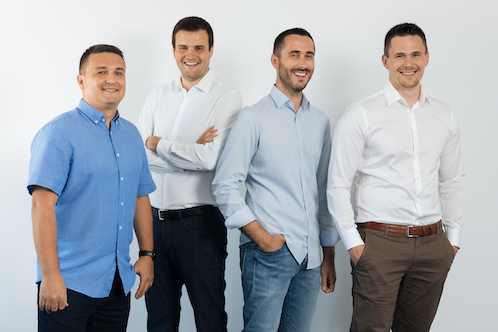
Gideon Brothers founders

Gideon Brothers founders

Gideon Brothers make robots and the accompanying software platform that specializes in horizontal and vertical handling processes for logistics, warehousing, manufacturing, and retail businesses. For obvious reasons, the need to roboticize supply chains has exploded during the pandemic.

Matija Kopić, CEO of Gideon Brothers, said: “The pandemic has greatly accelerated the adoption of smart automation, and we are ready to meet the unprecedented market demand. The best way to do it is by marrying our proprietary solutions with the largest, most demanding customers out there. Our strategic partners have real challenges that our robots are already solving, and, with us, they’re seizing the incredible opportunity right now to effect robotic-powered change to some of the world’s most innovative organizations.”

He added: “Partnering with these forward-thinking industry leaders will help us expand our global footprint, but we will always stay true to our Croatian roots. That is our superpower. The Croatian start-up scene is growing exponentially and we want to unlock further opportunities for our country to become a robotics & AI powerhouse.”

Annant Patel, Director at Koch Disruptive Technologies said: “With more than 300 Koch operations and production units globally, KDT recognizes the unique capabilities of and potential for Gideon Brothers’ technology to substantially transform how businesses can approach warehouse and manufacturing processes through cutting edge AI and 3D AMR technology.”

Xavier Garijo, Member of the Board of Management for Contract Logistics, DB Schenker added: “Our partnership with Gideon Brothers secures our access to best in class robotics and intelligent material handling solutions to serve our customers in the most efficient way.”

GB’s competitors include Seegrid, Teradyne (MiR), Vecna Robotics, Fetch Robotics, AutoGuide Mobile Robots, Geek+ and Otto Motors.

08 Jun 2021

Compose.ai raises $2.1M to help everyone write faster

In today’s GPT-3 world, it’s not uncommon to hear about new software services that deal with text. Compose.ai is one such company, though it built its own language model to help folks write faster. Its early product work was enough for it to land a $2.1 million seed round led by Craft Ventures, it announced this morning.

Compose.ai is essentially an auto-complete function that works wherever you browse the web. The company is also building the capability for its AI-powered backend to learn your voice, imbibe context to help provide better responses, and, in time, absorb a company’s larger voice to help align its aggregate writing output.

Co-founders Landon Sanford and Michael Shuffett told TechCrunch that Compose.ai believes that in five years, average folks won’t type every word that they write. They want to bring that future to more people through the Compose.ai Chrome extension, which hopefully workers can access without having to get corporate permission.

Sanford and Shuffett described their language algorithm as a multi-tier product. Its first tier learns from reading the internet itself, learning English. The second tier deals with specific domains, like email. The third tier learns a user’s voice, and, in time, a fourth tier will deal with a company’s generalized approach to language.

The ability for a company to provide its workers with a shared language model that could offer linguistic and word-choice preferences as they write is an interesting concept. The idea of such a strong, centrally held tone lands somewhere between helpful and intellectually rigid. But lots of folks don’t want to put their own spin on writing; many people don’t like writing at all. So perhaps having more central support won’t be onerous to most — but rather a time-saving hack.

Regardless, Compose.ai is going to staff up modestly with its new raise. The company currently has three full-time workers and some contract help. Sanford and Shuffett told TechCrunch that the company intends to stay small, hiring a few experienced engineering and machine-learning staff to help flesh out its product team.

What’s ahead for Compose? Its founders told TechCrunch that they are starting to talk to the corporate world a bit more than before and are planning on launching a paid service toward the end of the quarter. That could mean early revenue, extending the startup’s runway substantially.

What Compose is building isn’t technically simple, and the company has interesting work ahead of it to get its economics properly tuned. The company’s founders told TechCrunch that the personalization work that its product will execute for customers can be expensive if done incorrectly; the pair said that they could make a future, $10/month plan attractive economically, but if done in a “naive” fashion, Compose.ai could spend $500 in compute costs to support the same account.

That would be bad.

But the company is confident that its impending paid plans should shake out well in financial terms, which makes us all the more interested in giving that version of its product a spin when we get the chance.

08 Jun 2021

Lifted raises $6.2M Series A round led by Fuel Ventures for its long-term social care platform

As people live longer and longer and have long-term health issues like cancer and dementia, caring for elderly relatives is becoming a huge societal and political issue. Right now this care is antiquated and run by incumbents, many of which still run off paper and Excel. We are now seeing a new wave of startups turn up to tackle this space by applying Apple’s age-old model of owning the experience end-to-end and running everything on a platform.

The latest to join this race is UK startup Lifted, which has now raised $6.2 million in a Series A funding round led by Fuel Ventures. Also participating were existing investor 1818 Venture Capital as well as new investors Novit Ventures, Perivoli Innovations, the J.B. Ugland family office, and a number of Angels. This latest funding round takes the total raised by Lifted to $11.2M.

Lifted says its UK market is increasing and claims the number of people caring for adult loved ones has risen exponentially during the pandemic, with almost 1 in 2 people supporting people outside their household.

The startup is entering a perfect storm of increasing need, unpopular care homes, and the UK Government still without a long-term plan for social care.

Lifted app

Lifted app

In contrast to a raft of agencies and freelancers, Lifted directly employs its care workforce and uses its platform to “gamify and improve the experience of carers to make them perform better in people’s lives and also to restore respect to the caring profession” with its Care Management Platform, says the company.

Lifted has also acquired the ‘Live Better With Dementia’ website and launched the Lifted Dementia Hub, an online community with a marketplace of products.

Rachael Crook co-founded Lifted with Sam Cohen. She says she was inspired to get into the sector when, at the age of 24, she had to care for her mother, who was diagnosed with dementia at age 56.

Rachael Crook, Lifted CEO sold me at an interview: “I was in that position much younger than most people. And it seemed abundantly clear to me that it was an experience that was hugely emotionally important to me, and financially expensive, was really convoluted and frustrating. It made an already really difficult time, more difficult. My mum brought me up to really fight for the underdog and I felt like the carers themselves were getting a really poor deal. And yet, it’s a huge colossal market. The care market is set to double in the next 20 years, and for the next 10 years, we will look to compete against traditional care companies. We want to transform the care experience. This is a product that is worth four and a half times your mortgage. And yet, it’s predominantly bought in a really antiquated way with paper and pen systems. It’s really hard to keep up to date with your loved ones’ care. We’re also competing against new entrants.”

She added: “In 12 months, we have tripled revenue, launched the first App in the world to offer free care advice, and cut Carer churn to half the industry average, all while maintaining exclusively 5-star reviews on Trustpilot.”

Mark Pearson, Managing Partner of Fuel Ventures said: “Rachael, Sam and their team have delivered exceptional growth in the past year. They have a unique vision of the future for care and their model is delivering clear results for both sides of the marketplace.”

08 Jun 2021

Liteboxer, the Peloton of boxing, raises $20 million Series A

Liteboxer, the Peloton for boxing, has announced the close of a $20 million Series A funding round led by Nimble Ventures. B. Riley Venture Capital participated, alongside existing investors Raptor Group and Will Ventures.

Liteboxer launched publicly to the world in July of 2020, announcing an in-home device that brings gamification, hit music, and a touch of entertainment to a boxing workout. The patented hardware includes a system of lights that smartly pair with music to give the user an intense workout that feels more like a game. Hit where the light goes off, on beat with the music, until your ass has sufficiently been kicked.

Content is a big piece of the puzzle with Liteboxer. For $29/month, users get access to unlimited training sessions and workouts led by Liteboxer trainers. The Liteboxer also has a Quick Play option, that forgoes the trainer content and lets users workout based on the song they choose.

This comes by way of an exclusive partnership with Universal Music. Liteboxer always has a rotation of 100 Universal Music songs available to users, and the system is able to automatically pair the lighting with the beat of the music for lighter-weight workouts.

Not only are users competing with themselves, but they can also connect with other friends to compete against one another.

Engagement is the name of the game for Liteboxer, according to cofounders Jeff Morin (CEO) and Todd Dagres (Chairman). They say that since shipping equipment in October, they’re seeing users, on average, doing a Liteboxer workout four to five times a week.

Since launch, the company has made some tweaks. For one, the original focus on the trainer side was on the technique of boxing. But given. the importance of music to the workouts, Liteboxer has realized the impact that an entertaining trainer can have.

“Rhythm has been so important,” said Morin. “We’ve learned that you can’t train rhythm if someone doesn’t have that. We’ve seen trainers with more spin class experience be able to feel the cadence. of the music, and know when the beat drop is coming, and craft these programs that are basically an art piece or performance.”

The company is also looking at its employment of these trainers, shifting from 1099 to part-time employment and seriously considering full-time W2 employment for them, as well.

This latest round of funding is meant to fuel growth and power initiatives aimed at getting the device out in the wild so more people can see and experience it. The cofounders explained that this was one of the big challenges of launching during the pandemic with a product like this.
This brings the company’s total funding to $28.5 million.
08 Jun 2021

Version One launches $70M Fund IV and $30M Opportunities Fund II

Early stage investor Version One, which consists of partners Boris Wertz and Angela Tran, has raised its fourth fund, as well as a second opportunity fund specifically dedicated to making follow-on investments. Fund IV pools $70 million from LPs to invest, and Opportunities Fund II is $30 million, both up from the $45 million Fund III and roughly $20 million original Opportunity Fund.

Version One is unveiling this new pool of capital after a very successful year for the firm, which is based in Vancouver and San Francisco. 2021 saw its first true blockbuster exit, with Coinbase’s IPO. The investor also saw big valuation boosts on paper for a number of its portfolio companies, including Ada (which raises at a $1.2 billion valuation in May); Dapper Labs (valued at $7.5 billion after riding the NFT wave); and Jobber (no valuation disclosed but raised a $60 million round in January).

I spoke to both Wertz and Tran about their run of good fortune, how they think the fund has achieved the wins it recorded thus far, and what Version One has planned for this Fund IV and its investment strategy going forward.

“We have this pretty broad focus of mission-driven founders, and not necessarily just investing in SaaS, or just investing in marketplaces, or crypto,” Wertz said regarding their focus. “We obviously love staying early — pre-seed and seed — we’re really the investors that love investing in people, not necessarily in existing traction and numbers. We love being contrarian, both in terms of the verticals we go in to, and and the entrepreneurs we back; we’re happy to be backing first-time entrepreneurs that nobody else has ever backed.”

In speaking to different startups that Version One has backed over the years, I’ve always been struck by how connected the founders seem to the firm and both Wertz and Tran — even much later in the startups’ maturation. Tran said that one of their advantages is following the journey of their entrepreneurs, across both good times and bad.

“We get to learn,” she said. “It’s so cool to watch these companies scale […] we get to see how these companies grow, because we stick with them. Even the smallest things we’re just constantly thinking about— we’re constantly thinking about Laura [Behrens Wu] at Shippo, we’re constantly thinking about Mike [Murchison] and David [Hariri] at Ada, even though it’s getting harder to really help them move the needle on their business.”

Wertz also discussed the knack Version One seems to have for getting into a hot investment area early, anticipating hype cycles when many other firms are still reticent.

“We we went into crypto early in 2016, when most people didn’t really believe in crypto,” he said. “We started investing pretty aggressively in in climate last year, when nobody was really invested in climate tech. Having a conviction in in a few areas, as well as the type of entrepreneurs that nobody else really has conviction is what really makes these returns possible.”

Since climate tech is a relatively new focus for Version One, I asked Wertz about why they’re betting on it now, and why this is not just another green bubble like the one we saw around the end of the first decade of the 2000s.

“First of all, we deeply care about it,” he said. Secondly, we think there is obviously a new urgency needed for technology to jump into to what is probably one of the biggest problems of humankind. Thirdly, is that the clean tech boom has put a lot of infrastructure into the ground. It really drove down the cost of the infrastructure, and the hardware, of electric cars, of batteries in general, of solar and renewable energies in general. And so now it feels like there’s more opportunity to actually build a more sophisticated application layer on top of it.”

Tran added that Version One also made its existing climate bet at what she sees as a crucial inflection point — effectively at the height of the pandemic, when most were focused on healthcare crises instead of other imminent existential threats.

I also asked her about the new Opportunity Fund, and how that fits in with the early stage focus and their overall functional approach.

“It doesn’t require much change in the way we operate, because we’re not doing any net new investments,” Tran said. “So we recognize we’re not growth investors, or Series A/Series B investors that need to have a different lens in the way that they evaluate companies. For us, we just say we want to double down on these companies. We have such close relationships with them, we know what the opportunities are. It’s almost like we have information arbitrage.”

That works well for all involved, including LPs, because Tran said that it’s appealing to them to be able to invest more in companies doing well without having to build a new direct relationship with target companies, or doing something like creating an SPV designated for the purpose, which is costly and time-consuming.

Looking forward to what’s going to change with this fund and their investment approach, Wertz points to a broadened international focus made possible by the increasingly distributed nature of the tech industry following the pandemic.

“I think that the thing that probably will change the most is just much more international investing in this one, and I think it’s just direct result of the pandemic and Zoom investing, that suddenly the pipeline has opened up,” he said.

“We’ve certainly learned a lot about ourselves over the past year and a half,” Tran added. “I mean, we’ve always been distributed, […] and being remote was one of our advantages. So we certainly benefited and we didn’t have to adjust our working style too much, right. But now everyone’s working like this, […] so it’s going to be fun to see what advantage we come up with next.”