
Year: 2021

07 Jun 2021

4 women in engineering discuss harassment, isolation and perseverence

Women engineers often face workplace and career challenges that their male colleagues don’t because they remain a minority in the profession: Depending on how you count, women make up just 13% to 25% of engineering jobs. That inequity leads to a power imbalance, which can lead to toxic working environments.

One of the more infamous and egregious examples is Susan Fowler’s experience at Uber. In a blog post in February 2017, she described her boss coming on to her in a company chat channel on her first day on the job. She later wrote a book, “Whistleblower,” that described her time at the company in detail.

Fowler’s ordeal cast a spotlight on the harassment women engineers have to deal with in the workplace. In a profession that tends to be male-dominated, behavior ranges from blatant examples, like what happened to Fowler, to ongoing daily microaggressions.

Four female engineers spoke with me about their challenges:

  • Tammy Butow, principal software reliability engineer (SRE) at Gremlin
  • Rona Chong, software engineer at Grove Collaborative
  • Ana Medina, senior chaos engineer at Gremlin
  • Yury Roa, SRE technical program manager at ADL Digital Labs in Bogota, Colombia

It’s worth noting that Fowler was also an SRE who worked on the same team as Medina (who was later part of a $10 million discrimination lawsuit against Uber). It shows just how small of a world we are talking about. While not everyone faced that level of harassment, they each described daily challenges, some of which wore them down. But they also showed a strong determination to overcome whatever obstacles came their way.

Feeling isolated

One of the primary issues these women faced throughout their careers is a feeling of isolation due to their underrepresentation. They say that can sometimes lead to self-doubt and an inkling that you don’t belong that can be difficult to overcome. Medina says that there have been times when, intentionally or not, male engineers made her feel unwelcome.

“One part that was really hard for me was those microaggressions on a daily basis, and that affects your work ethic, wanting to show up, wanting to try your best. And not only does that damage your own self-esteem, but your esteem [in terms of] growing as an engineer,” Medina explained.

Roa says that isolation can lead to impostor syndrome. That’s why it’s so important to have more women in these roles: to serve as mentors, role models and peers.

“One barrier for us related to being the only woman in the room is that [it can lead to] impostor syndrome because it is common when you are the only woman or one of few, it can be really challenging for us. So we need to gain confidence, and in these cases, it is very important to have role models and leadership that includes women,” Roa said.

Chong agrees it is essential to know that others have been in the same position — and found a way through.

“The fact that people talk authentically about their own jobs and challenges and how they’ve overcome that, that’s been really helpful for me to continue seeing myself in the tech industry,” she said. “There have been points where I’ve questioned whether I should Ieave, but then having that support around you to have people to talk to you personally and see as examples, I think it has really helped me.”

Butow described being interviewed for an article early in her career after she won an award for a mobile application she wrote.  When the article was published, she was aghast to discover it had been headlined, “Not just another pretty face…”

“I was like, that’s the title?! I was so excited to share the article with my mom, and then I wasn’t. I spent so much time writing the code and obviously my face had nothing to do with it. … So there’s just little things like that where people call it a paper cut or something like that, but it’s just lots of little microaggressions.”

Pushing through

In spite of all that, a common thread among these women was a strong desire to show that they have the technical skill to get past these moments of doubt to thrive in their professions.

Butow said she has been battling these kinds of misperceptions since she was a teenager but never let it stop her. “I just tried to not let it bother me, but mostly because I also have a background in skateboarding. It’s the same thing, right? You go to a skate park and people would say, ‘Oh, can you even do a trick?’ and I was like, ‘Watch me.’ You know, I [would] just do it. … So a lot of that happens in lots of different types of places in the world and you just have to, I don’t know, I just always push through, like I’m just going to do it anyway.”

Chong says she doesn’t give in to discouraging feelings, adding that having other women to talk to helped push her through those times.

“As much as I like to persevere and I don’t like giving up, actually there have been points where I considered quitting, but having visibility into other people’s experiences, knowing that you’re not the only one who’s experienced that, and seeing that they’ve found better environments for themselves and that they eventually worked through it, and having those people tell you that they believe in you, that probably stopped me from leaving when I [might] have otherwise,” she said.

Women helping women

Chong’s experience is not unique, but the more diverse your teams are, the more people who come from underrepresented groups can support one another. Butow recruited her at one point, and she says that was a huge moment for her.

“I think that there is a network effect where we know other women and we try to bring them in and we expand on that. So we can kind of create the change or we feel the change we want to see, and we get to make our situation more comfortable,” Chong said.

Medina says that she is motivated to help bring Latinx and Black people into tech, with a focus on attracting girls and young women. She has worked with a group called Technolachicas, which produced a series of commercials with the Televisa Foundation. They filmed six videos, three in English and three in Spanish, with the goal of showing young girls how to pursue a STEM career.

“Each commercial talks about how we got our career started with an audience persona of a girl younger than 18, an adult influencer and a parent — people that are really crucial to the development of anyone under 18,” she said. “How is it that these people can actually empower someone to look at STEM and to pursue a career in STEM?”

Butow says it’s about lifting people up. “What we’re trying to do is sharing our story and hoping to inspire other women. It’s super important to have those role models. There’s a lot of research that shows that that’s actually the most important thing is just visibility of role models that you can relate to,” she said.

The ultimate goal? Having enough support in the workplace that they’re able to concentrate on being the best engineers they can be — without all of the obstruction.

07 Jun 2021

Pinterest adds a Shopping List feature to round up your saved products

Pinterest has long positioned itself a source for inspiration that could ultimately lead to online purchases. And over the years, it has worked on features to better connect consumers with the products and services they want to buy, like shoppable pins, visual search, AR try-on, product recommendations, and more. Today, the company is rolling out another feature aimed at turning users’ saved Pins into purchases: a shopping list.

The new Pinterest Shopping list feature saves all your Product Pins in one place, so when you’re ready to purchase you won’t have to hunt around through your saved Pins and Boards to find the products you had been considering. Here, you’ll find the information you need, including an item’s price, reviews, and shipping info in an even grid so you can compare products and make decisions.

The feature, however, isn’t just an organizational tool — Pinterest says it will also send out notifications if the items you’ve saved have dropped in price — which could encourage users to make the purchase.

The Shopping List is available on your Profile page above your other boards, and will include the shoppable items you’ve saved as well as items you’ve recently viewed. When you’re ready to buy, you can click on the pin to visit the retailer’s website to complete the transaction — giving Pinterest the credit for the referral, of course.

The feature will launch first in the U.S. and U.K., and will later roll out to Australia, Canada, France and Germany later in the year, Pinterest says.

Alongside the Shopping List, Pinterest today is also expanding merchant tools with the debut of its Verified Merchant Program in the U.K., Australia, Canada, France and Germany, plus a merchant storefront on profile feature, and new product tagging in Australia, Canada, France and Germany. Launched last year, the Verified Merchant Program offers retailers a way to sign up for a manual review to determine if they meet Pinterest’s qualifications for high-quality customer service experiences. If so, they receive a blue checkmark on their profile as a signal to consumers that they’re a trustworthy retailer.

Image Credits: Pinterest

In addition, the company is today launching a special two-week long Shopping Spotlight called “The Goods by Pinterest,” which offers users access to limited edition items sold by DTC brands including Brooklinen, Outdoor Voices, Clare Paint, Olive & June, and Maude. And it’s running a “Shop the mood” campaign offering curated trends from its annual report, “Pinterest Predicts.”

Though Pinterest notes its users, on average, outspend non-users by 2x every month and have a 85% larger basket size, the way people want to shop online is rapidly changing.

Historically an image-centric idea board of sorts, Pinterest may be left behind as more consumers — and particularly younger shoppers — begin to more heavily rely on shopping via video (both recorded and live), including through influencer-driven content across platforms like Facebook, Instagram and TikTok. Pinterest has only more recently expanded into this area, with the launch of video-first “Idea Pins” last month aimed at creators, and a test of livestreamed creator events around the same time.

The new launches follow a Pinterest earnings beat in April on both EPS and revenue (11 cents vs 7 cents expected, and $485M vs $474M expected), but slowing user growth. The company reported 478 million monthly active users versus the 480.5 million expected, causing the stock to drop 10% after the report came out. The company blamed the decline in user growth and user engagement on the easing of Covid-19 restrictions, as consumers began to spend less time online.

With the new additions, Pinterest wants to better ensure those users who are on its site are not just idly browsing, but actually checking out.

07 Jun 2021

Nigeria orders broadcasting media to disregard Twitter as news source

Nigeria’s broadcast regulator, the National Broadcasting Commission, has ordered all broadcasting stations in the country to suspend their use of Twitter. The directive was issued Monday morning, and the broadcasting stations include TV and radio platforms in the country.

“In compliance to the above directive, broadcasting stations are hereby advised to de-install Twitter handles and desist from using Twitter as a source (UGC) of information gathering for news and programmes presentation especially phone-in,” an excerpt of the statement read.

This is coming days after the country halted Twitter operations after the micro-blogging platform deleted a controversial tweet made by President Muhammadu Buhari. The government also cited the micro-blogging platform’s ploy to ‘undermine its corporate existence’ as one reason for the indefinite suspension.

Alongside this directive was an order to the NBC to “immediately commence the process of licensing all OTT and social media operations in Nigeria.” While that is still a work in progress, Nigerians haven’t been able to access Twitter since the early hours of Saturday till now. Yet, most people have employed the use of VPNs and other alternative platforms to bypass the domain restrictions

However, following Nigerians disregard of the government’s order, the country’s Attorney General and Minister of Justice, Abubakar Malami, via his spokesperson, issued a troubling directive over the weekend.

“Malami directed the Director of Public Prosecution of the Federation (DPPF) at the Office of the Attorney General of the Federation and Minister of Justice, to swing into action and commence in earnest the process of prosecution of violators of the Federal Government De-activation of operations of Twitter in Nigeria,” the statement read.

No public arrests have been made so far. And although no one is sure how that directive will be carried out, there are fears the government will employ illegal means to accomplish their plans.

In the meantime, there has been widespread criticism of the Twitter ban, both in the country and abroad. In a joint statement with the EU, the U.S., Canada and the U.K. expressed disappointment in the ban and requested that or the Nigerian government reconsider its stance.

Yesterday, it appeared like though the government would listen as the president, via his spokesperson, said the state-wide ban on Twitter was only a temporary measure to curb misinformation and fake news.

“There has been a litany of problems with the social media platform in Nigeria, where misinformation and fake news spread through it have had real-world violent consequences,” the government said. The platform allowed “the spread of religious, racist, xenophobic and false messages that could tear some countries apart”, the spokesperson added.

But with today’s directive, the government might be speaking out of both sides of its mouth. In the statement released today, it referenced section 5.6.3 of the NBC Act to the role Twitter plays in Nigeria. The broadcasting code “requires broadcasters to be mindful of materials that may cause disaffection, incite to panic or rift in the society in the use of a user-generated content (UGC).”

The regulator didn’t forget to leave a subtle warning stating that it will be unpatriotic for any broadcaster in the country to continue patronising Twitter as a source of information.

07 Jun 2021

Equity Monday: Jeff’s going to space, and everyone wants a piece of Flipkart

Hello and welcome back to Equity, TechCrunch’s venture capital-focused podcast where we unpack the numbers behind the headlines.

This is Equity Monday, our weekly kickoff that tracks the latest private market news, talks about the coming week, digs into some recent funding rounds and mulls over a larger theme or narrative from the private markets. You can follow the show on Twitter here and myself here.

It’s WWDC week, so expect a deluge of Apple news to overtake your Twitter feed here and there over the next few days. But there’s a lot more going on, so let’s dig in:

And that’s your start to the week. More to come from your friends here on Wednesday, and Friday. Chat soon!

Equity drops every Monday at 7:00 a.m. PST, Wednesday, and Friday at 6:00 AM PST, so subscribe to us on Apple PodcastsOvercastSpotify and all the casts!

07 Jun 2021

Mendel raises $18M to tease out data structure from medicine’s disparate document trove

The medical industry is sitting on a huge trove of data, but in many cases it can be a challenge to realize the value of it because that data is unstructured and in disparate places.

Today, a startup called Mendel, which has built an AI platform both to ingest and bring order to that body of information, is announcing $18 million in funding to continue its growth and to build out what it describes as a “clinical data marketplace” for people not just to organize, but also to share and exchange that data for research purposes. It’s also going to be using the funding to hire more talent — technical and support — for its two offices, in San Jose, CA and Cairo, Egypt.

The Series A round is being led by DCM, with OliveTree and MTVLP, and previous backers Launch Capital, SOSV, Bootstrap Labs and Chairman of UCSF Health Hub Mark Goldstein also participating.

The funding comes on the heels of what Mendel says is a surge of interest among research and pharmaceutical companies in sourcing better data to gain a better understanding of longer-term patient care and progress, in particular across wider groups of users, not just at a time when it has been more challenging to observe people and run trials, but in light of the understanding that using AI to leverage much bigger data sets can produce better insights.

This can be important, for example, in proactive identifying symptoms of particular ailments or the pathology of a disease, but also recurring and more typical responses to specific treatment courses.

We previously wrote about Mendel back in 2017 when the company had received a seed round of $2 million to better match cancer patients with the various clinical trials that are regularly being run: the idea was that certain trials address specific types of cancers and types of patients, and those who are willing to try newer approaches will be better or worse suited to each of these.

It turned out, however, that Mendel discovered a problem in the data that it would have needed to enable its matching algorithms to work, said Dr. Karim Galil, Mendel’s CEO and founder.

“As we were trying to build the trial business, we discovered a more basic problem that hadn’t been solved,” he said in an interview. “It was the reading and understanding medical records of a patient. If you can’t do that you can’t do trial matching.”

So the startup decided to become an R&D shop for at least three years to solve that problem before doing anything with trials, he continued.

Although there are today many AI companies that are parsing unstructured information in order to extract better insights, Mendel is what you might think of as part of the guard of tech companies that are building out specific AI knowledge bases for distinct verticals or areas of expertise. (Another example from another vertical is Eigen, working in the legal and finance industries, while Google’s DeepMind is another major AI player looking at ways of better harnessing data in the sphere of medicine.)

The issue of “reading” natural language is more nuanced than you might think in the world of medicine. Gali compared it to the phrase “I’m going to leave you” in English, which could just as easily mean someone is departing, say, a room, as someone is walking out of a relationship. The “true” answer — and as we humans know even truth can be elusive — can only start to be found in the context.

The same goes for doctors and their observation notes, Galil said. “There is a lot hidden between the lines, and problems can be specific to a person,” or to a situation.

That has proven to be a lucrative area to tackle.

Mendel uses a mix of computer vision and natural language processing built by teams with extensive experience in both clinical environments and in building AI algorithms and currently provides tools to automate clinical data abstraction, OCR, special tools to redact and remove personal identifiable information automatically to share records, search engines to search clinical data, and — yes — an engine to enable better matching of people to clinical trials. Customers include pharmaceutical and life science companies, real-world data and real-world evidence (RWD and RWE) providers and research groups.

And to underscore just how much there is still left to do in the world of medicine, along with this funding round, Mendel is announcing a partnership with eFax, an online faxing solution used by a huge number of healthcare providers. Faxing is totally antiquated in some parts of the world now — I’m not even sure that people the age of my children (tweens) even know what a “fax” is — but they remain one of the most-used ways to transfer documents and information between people in the worlds of healthcare and medicine, with 90% of the industry using them today. The partnership with Mendel will mean that those eFaxes will now be “read” and digitized and ingested into wider platforms to tap that data in a more useful way.

“There is huge potential for the global healthcare industry to leverage AI,” said Mendel board member and partner at DCM, Kyle Lui, in a statement. “Mendel has created a unique and seamless solution for healthcare organizations to automatically make sense of their clinical data using AI. We look forward to continuing to work with the team on this next stage of growth.”

07 Jun 2021

Mendel raises $18M to tease out data structure from medicine’s disparate document trove

The medical industry is sitting on a huge trove of data, but in many cases it can be a challenge to realize the value of it because that data is unstructured and in disparate places.

Today, a startup called Mendel, which has built an AI platform both to ingest and bring order to that body of information, is announcing $18 million in funding to continue its growth and to build out what it describes as a “clinical data marketplace” for people not just to organize, but also to share and exchange that data for research purposes. It’s also going to be using the funding to hire more talent — technical and support — for its two offices, in San Jose, CA and Cairo, Egypt.

The Series A round is being led by DCM, with OliveTree and MTVLP, and previous backers Launch Capital, SOSV, Bootstrap Labs and Chairman of UCSF Health Hub Mark Goldstein also participating.

The funding comes on the heels of what Mendel says is a surge of interest among research and pharmaceutical companies in sourcing better data to gain a better understanding of longer-term patient care and progress, in particular across wider groups of users, not just at a time when it has been more challenging to observe people and run trials, but in light of the understanding that using AI to leverage much bigger data sets can produce better insights.

This can be important, for example, in proactive identifying symptoms of particular ailments or the pathology of a disease, but also recurring and more typical responses to specific treatment courses.

We previously wrote about Mendel back in 2017 when the company had received a seed round of $2 million to better match cancer patients with the various clinical trials that are regularly being run: the idea was that certain trials address specific types of cancers and types of patients, and those who are willing to try newer approaches will be better or worse suited to each of these.

It turned out, however, that Mendel discovered a problem in the data that it would have needed to enable its matching algorithms to work, said Dr. Karim Galil, Mendel’s CEO and founder.

“As we were trying to build the trial business, we discovered a more basic problem that hadn’t been solved,” he said in an interview. “It was the reading and understanding medical records of a patient. If you can’t do that you can’t do trial matching.”

So the startup decided to become an R&D shop for at least three years to solve that problem before doing anything with trials, he continued.

Although there are today many AI companies that are parsing unstructured information in order to extract better insights, Mendel is what you might think of as part of the guard of tech companies that are building out specific AI knowledge bases for distinct verticals or areas of expertise. (Another example from another vertical is Eigen, working in the legal and finance industries, while Google’s DeepMind is another major AI player looking at ways of better harnessing data in the sphere of medicine.)

The issue of “reading” natural language is more nuanced than you might think in the world of medicine. Gali compared it to the phrase “I’m going to leave you” in English, which could just as easily mean someone is departing, say, a room, as someone is walking out of a relationship. The “true” answer — and as we humans know even truth can be elusive — can only start to be found in the context.

The same goes for doctors and their observation notes, Galil said. “There is a lot hidden between the lines, and problems can be specific to a person,” or to a situation.

That has proven to be a lucrative area to tackle.

Mendel uses a mix of computer vision and natural language processing built by teams with extensive experience in both clinical environments and in building AI algorithms and currently provides tools to automate clinical data abstraction, OCR, special tools to redact and remove personal identifiable information automatically to share records, search engines to search clinical data, and — yes — an engine to enable better matching of people to clinical trials. Customers include pharmaceutical and life science companies, real-world data and real-world evidence (RWD and RWE) providers and research groups.

And to underscore just how much there is still left to do in the world of medicine, along with this funding round, Mendel is announcing a partnership with eFax, an online faxing solution used by a huge number of healthcare providers. Faxing is totally antiquated in some parts of the world now — I’m not even sure that people the age of my children (tweens) even know what a “fax” is — but they remain one of the most-used ways to transfer documents and information between people in the worlds of healthcare and medicine, with 90% of the industry using them today. The partnership with Mendel will mean that those eFaxes will now be “read” and digitized and ingested into wider platforms to tap that data in a more useful way.

“There is huge potential for the global healthcare industry to leverage AI,” said Mendel board member and partner at DCM, Kyle Lui, in a statement. “Mendel has created a unique and seamless solution for healthcare organizations to automatically make sense of their clinical data using AI. We look forward to continuing to work with the team on this next stage of growth.”

07 Jun 2021

Endua creates hydrogen-powered clean energy storage, using tech from Australia’s national science agency

Hydrogen-based generators are an environmentally-friendly alternative to ones powered by diesel fuel. But many rely on solar, hydro or wind power, which aren’t available all the time. Brisbane-based Endua is making hydrogen-based power generators more accessible by using electrolysis to create more hydrogen and storing it for long-term use. The startup’s technology was developed at CSIRO, Australian’s national science agency, and is being commercialized by Main Sequence, the venture fund founded by CSIRO and Ampol, one of the country’s largest fuel companies.

Main Sequence’s venture science model means that it first identifies a global challenge, then brings together the technology, team and investors to launch a startup that can address that problem. Through the program, Paul Sernia, the founder of electric vehicle charger maker Tritium, was brought on to serve as Endua’s chief executive officer, working with Main Sequence partner Martin Duursma to commercialize the hydrogen-based power generation and storage technology developed at CSIRO. Ampol will serve as Endua’s industry partner.

Endua is backed by $5 million AUD (about $3.9 million USD) from Main Sequence, CSIRO and Ampol. The company plans to launch in Australia first before expanding into other countries.

Sernia told TechCrunch that Endua was created to “solve one of the biggest problems facing the transition to renewable energy—how to store renewable energy in large quantities, for long periods of time.”

Endua’s modular power banks can run up to 150 kilowatts per pack and be extended for different use cases, serving as an alternative to power generators that run on diesel fuel. Batteries serve as backup, but Endua’s goal is to deliver renewable energy that can be stored in large quantities, enabling off-grid infrastructure and communities to have self-sustaining power sources.

“Hydrogen electrolysis technology has been around for quite some time but it still has a long way to go to meet the expectations of commercial markets and be cost-effective when compared to existing energy sources,” Sernia said. “The technology we’ve developed with CSIRO enables us to make the cost more affordable compared to fossil fuel sources, more reliable and easily maintained in remote communities.”

The startup plans to focus on industrial clients before reaching smaller businesses and residences. “One of the biggest opportunities, that few have really tackled, is that of diesel generator users like regional communities, mines or remote infrastructure,” Sernia said. “In farming, Endua’s solution could be used to power equipment such as a bore or irrigation pumps.” The power banks can plug into existing renewable energy systems, including solar and wind, to make the switch economical for users, he added. Water is part of the electrolysis process, but only a small amount is needed.

“Batteries are a great way to deliver dispatchable power in small increments and are a complementary part of the overall transition plan, but we’re focusing on delivering renewable energy that can be stored in large quantities, for large periods of time, so communities and remote infrastructure can access reliable, renewable energy at any time of day,” Sernia told TechCrunch.

Ampol is working with Endua as part of its Future Energy and Decarbonisation Strategy. It will test and commercialize Endua’s tech to reach its 80,000 B2B customers, focusing first on the off-grid diesel generator market, which the company said generates 200,000 tonnes of carbon emissions per year.

In press statement, Ampol managing director and CEO Matthew Halliday said, “We are excited to be involved with Endua, which is part of our commitment to extending our customer value proposition by finding and developing new energy solutions that will assist with their energy transition.”

07 Jun 2021

Endua creates hydrogen-powered clean energy storage, using tech from Australia’s national science agency

Hydrogen-based generators are an environmentally-friendly alternative to ones powered by diesel fuel. But many rely on solar, hydro or wind power, which aren’t available all the time. Brisbane-based Endua is making hydrogen-based power generators more accessible by using electrolysis to create more hydrogen and storing it for long-term use. The startup’s technology was developed at CSIRO, Australian’s national science agency, and is being commercialized by Main Sequence, the venture fund founded by CSIRO and Ampol, one of the country’s largest fuel companies.

Main Sequence’s venture science model means that it first identifies a global challenge, then brings together the technology, team and investors to launch a startup that can address that problem. Through the program, Paul Sernia, the founder of electric vehicle charger maker Tritium, was brought on to serve as Endua’s chief executive officer, working with Main Sequence partner Martin Duursma to commercialize the hydrogen-based power generation and storage technology developed at CSIRO. Ampol will serve as Endua’s industry partner.

Endua is backed by $5 million AUD (about $3.9 million USD) from Main Sequence, CSIRO and Ampol. The company plans to launch in Australia first before expanding into other countries.

Sernia told TechCrunch that Endua was created to “solve one of the biggest problems facing the transition to renewable energy—how to store renewable energy in large quantities, for long periods of time.”

Endua’s modular power banks can run up to 150 kilowatts per pack and be extended for different use cases, serving as an alternative to power generators that run on diesel fuel. Batteries serve as backup, but Endua’s goal is to deliver renewable energy that can be stored in large quantities, enabling off-grid infrastructure and communities to have self-sustaining power sources.

“Hydrogen electrolysis technology has been around for quite some time but it still has a long way to go to meet the expectations of commercial markets and be cost-effective when compared to existing energy sources,” Sernia said. “The technology we’ve developed with CSIRO enables us to make the cost more affordable compared to fossil fuel sources, more reliable and easily maintained in remote communities.”

The startup plans to focus on industrial clients before reaching smaller businesses and residences. “One of the biggest opportunities, that few have really tackled, is that of diesel generator users like regional communities, mines or remote infrastructure,” Sernia said. “In farming, Endua’s solution could be used to power equipment such as a bore or irrigation pumps.” The power banks can plug into existing renewable energy systems, including solar and wind, to make the switch economical for users, he added. Water is part of the electrolysis process, but only a small amount is needed.

“Batteries are a great way to deliver dispatchable power in small increments and are a complementary part of the overall transition plan, but we’re focusing on delivering renewable energy that can be stored in large quantities, for large periods of time, so communities and remote infrastructure can access reliable, renewable energy at any time of day,” Sernia told TechCrunch.

Ampol is working with Endua as part of its Future Energy and Decarbonisation Strategy. It will test and commercialize Endua’s tech to reach its 80,000 B2B customers, focusing first on the off-grid diesel generator market, which the company said generates 200,000 tonnes of carbon emissions per year.

In press statement, Ampol managing director and CEO Matthew Halliday said, “We are excited to be involved with Endua, which is part of our commitment to extending our customer value proposition by finding and developing new energy solutions that will assist with their energy transition.”

07 Jun 2021

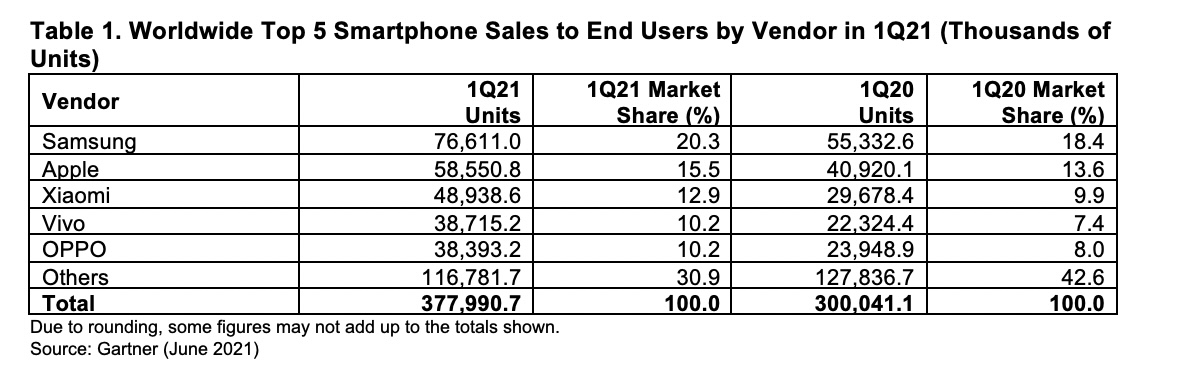
Global smartphone market continues rebound with 26% Q1 bump

More signs of the global market righting the ship after a disastrous 2020. New figures from Gartner point to 26% increase in global sales year over year for the first quarter of 2021. The overall increase is an impressive one, though it comes after a couple of years of market slow down, followed by a step drop amid the pandemic.

Manufacturers got hit from all sides last year. 2020 kicked things off with a manufacturing slowdown, as China and greater Asia were the first to be impacted by the effects of Covid-19. In the following months, global demand slowed, as shutdowns were instated and job loss and economic issues massively hampered sales.

Image Credits: Gartner

The new Gartner numbers maintain the same global top three manufacturers as this time last year. Samsung’s overall market share grew from 18.4- to 20.3%, courtesy of budget devices, returning to the number one spot.

Apple had managed to push its way to number one in Q4, on the strength of its belated 5G push. The company dropped down to number two for the first quarter – the same position it held this time last year. Overall, its market share is up around 2% y-o-y to 15.5, according to the figures. The top five are rounded out by three Chinese manufacturers — Xiaomi, Vivo and Oppo – as Huawei’s struggles continue.

Thus far, global chip shortages appear to have had little impact on shipments.

07 Jun 2021

Astra to acquire electric in-space propulsion company Apollo Fusion

Astra, the space launch startup with plans to go public via a SPAC merger, will acquire electric propulsion maker Apollo Fusion, the company said Monday. Electric propulsion systems are effective at moving spacecraft from lower to higher orbits, even to the moon, Astra Chief Engineer Benjamin Lyon said in a blog post Monday, pointing to Astra’s plans beyond missions to Earth’s orbit.

Under the terms of the deal, Astra will buy Apollo for $30 million in stock and $20 million in cash, for a total purchase price of $50 million. There is also the potential for an additional earn-out of up to $95 million if Apollo hits certain performance benchmarks. PJT Partners is acting as financial advisor to Astra with regard to the transaction, the Alameda-based launch startup said Monday.

Astra CEO Chris Kemp has been forthright about his goal of making the company a vertically integrated launch and space services provider, and Apollo’s thruster technology is a major piece of that puzzle. Astra successfully launched its first test rocket from Kodiak, Alaska last December, but in public statements Kemp has indicated plans for monthly commercial launches.

Apollo produces two EP thruster systems, the Apollo Constellation Engine (ACE) and the ACE Max. Both are compatible with krypton or xenon propellants. The company said it had been selected by York Space Systems as the propulsion system provider for a LEO satellite constellation program that will be launched in 2022.

The transaction between Astra and Apollo will close after Astra’s merger with special purpose acquisition company Holicity is completed later this year.