Year: 2021

03 Jun 2021

Twitter redesigns its mobile app to make Spaces the center tab

Twitter is updating its app to make its audio chat room feature, Twitter Spaces, a central part of the user experience. Today, the company will begin to roll out a dedicated tab for Twitter Spaces in the main navigation bar of its mobile app, initially on iOS to select users. The feature will see Twitter Spaces gain the middle spot in this bar, in between the Search magnifying glass icon and the bell icon for Notifications. As Spaces is not replacing any other tab, that means the navigation bar will now have to accommodate five icons instead of only four.

Not everyone will see the update immediately. Instead, only around 500 people from the original Spaces beta test will first see the new Spaces discovery tab, as it’s called, when it rolls out today.

Twitter says the tab will showcase the Spaces being hosted by people you follow, but these won’t appear like they do on the Fleet line today at the top of the Timeline. Instead, the discovery tab will present Spaces in a more visual format, similar to the promotion cards that appear when you tweet about upcoming Spaces.

Image Credits: Twitter


The company told TechCrunch that, even though Spaces can be fun, it understands the live events have been hard to find and keep track of, given there’s been no dedicated place where Spaces can be discovered. The new tab aims to change that.

Within the tab, users will be able to see active Spaces with more details, including Space names, hosts, and people you know who are participating. The tab will also allow users to manage reminders for scheduled Spaces so you’re be notified when they’re about to begin, and give Twitter feedback about which Spaces you’d like to see more of.

App researcher Jane Manchun Wong had uncovered Twitter’s plans to revamp its app to include Spaces on the nav bar last month.

Currently, only Twitter users with at least 600 followers have been granted the ability to host Spaces, and Twitter told us that figure has not changed with the launch of the tab. However, the company still has grand plans for the Spaces product, including not only scheduled Spaces which are now becoming easier to find with this discovery feature, but also things like ticketed events, co-hosted events, accessibility improvements and more.

Putting Spaces directly in navigation bar represents a big push for Twitter’s audio chat rooms, which have otherwise been fairly easy to ignore by those who aren’t that interested in Twitter’s Clubhouse competitor. It also arrives at a time when Clubhouse is expanding access to its own social audio app. Following its debut on Android, Clubhouse said 2 million Android users have already joined its platform.

Twitter, meanwhile, hasn’t yet publicized how many users have tested out Spaces at this point, either as a host or an end user.

Alongside today’s launch, Twitter will also begin to roll out another Spaces feature that was previously being tested: displaying the purple ring around someone’s profile pictures from the Home Timeline.

Currently, profile pics can be highlighted with a blue ring that takes you to the user’s Fleets when tapped, but the new purple ring will indicate they’re actively using Spaces at that time. You can then tap their profile pic to join them. The feature makes it easier to find Spaces while you’re just scrolling your Twitter Timeline as usual.

After the new Spaces tab is tried out with the original beta test group, it will begin rolling out more people, Twitter says.

03 Jun 2021

5 Reasons you need to attend TC Sessions: Mobility 2021

Get ready to spend a full day rubbing virtual elbows with the global mobility community’s best and brightest minds and makers. TC Sessions: Mobility 2021 takes place June 9, and we’ve packed the agenda with experts, interviews, demos, panel discussions, breakout sessions and a metric ton of opportunity.

Pro tip: It’s not too late to book a ticket. Grab yours here and save with groups of 4+.

If you’re still on the fence, here are five excellent reasons you should attend TC Sessions: Mobility 2020.

Leading Voices
TC Sessions: Mobility represents a broad range of companies and topics within the mobility space.

Want to know what’s happening in self-driving delivery? We’ve got Ahti Heinla (CTO @ Starship), Apeksha Kumavat (Co-Founder @ Gatik), & Amy Jones Satrom (Head of Ops. @ Nuro).

Want to get the low-down on Commuter Cars? We’re talking with Jesse Levinson (Co-Founder & CTO @ Zoox).

Want to see what’s in the future for passenger aircraft? Then you’ll definitely want to watch the session with JoeBen Bevirt (Founder @ Joby Aviation) and Reid Hoffman (Co-Director @ Reinvent Technology Partners)

Check out the full agenda here.

Trendspotting

Mobility is a fast-moving target, and success depends on a company’s or individual’s ability to spot possibilities before they become mainstream. At TC Sessions: Mobility you’ll meet with exhibitors, founders, and leaders to figure out what’s coming next.  Here’s what our attendees are saying:

“Attending TC Sessions: Mobility helps us keep an eye on what’s coming around the corner. It uncovers crucial trends so we can identify what we should be thinking about before anyone else.”
— Jeff Johnson, vice president of enterprise sales and solutions at FlashParking.

1 on 1 Global Networking

At TC Sessions: Mobility you can take advantage of CrunchMatch, our free, AI-powered networking platform (think speed dating for techies) makes connecting with like-minded attendees quick and painless — no matter where they’re located. A virtual conference means global participation, and you might just find your next customer, partner, investor or engineer living on a different continent. It takes only one connection to move your business forward.

Early Stage Expo & Pitch

30 early-stage startups will showcase their mobility tech in our virtual expo. Peruse the exhibitors, peek at their pitch decks, schedule a demo, start a conversation and see where it leads. During the show, you can also check out the pitch sessions where startups will present their company to a panel of TechCrunch editors.

TC Sessions: Mobility on June 9 is sure to be a blast and a great opportunity for you to expand your knowledge and network within the mobility industry. Book your tickets today as prices go up at the door. 

03 Jun 2021

Ganaz raises $7M A round to rethink how agriculture workers get hired and paid

The agriculture sector is ripe for technological improvements, but beyond satellite-based crop management and bees-as-a-service, the actual people who work in the fields should be benefiting as well. Ganaz, empowered by a $7M A round, aims to change how people with little documentation and no bank account get paid and send money with a modern workforce stack that embraces low tech as well.

Growers — that is to say, the companies that own and operate the fields and sell the crops — are under pressure from multiple directions as wages rise, regulations increase, and willing workers dwindle. They need to save money to make money, but they can’t do so by paying less; in addition to being cruel to a marginalized class of people, it would only exacerbate the labor shortage in the sector.

There are plenty of companies out there that help save costs by automating things like payroll and onboarding, but the agriculture business has some unique limitations.

“It’s still operating like it’s the ’80s,” explained Ganaz founder and CEO Hannah Freeman. The number one service these workers rely on is check cashing or payday loans, and fees from these, currency exchange, ATM fees, and remittances eat up a significant portion of each paycheck. “The workforce in our world definitely doesn’t have corporate email and rarely uses personal email. They have trouble downloading and using mobile apps, don’t use usernames. But they’re very conversant in WhatsApp and SMS — so you have to kind of know how to build for them.”

A payment card from Ganaz and text interface for asking about balance and other things.

Image Credits: Ganaz

The ecosystem has parallels to other regions that have stuck with older, cheaper technologies instead of adopting the latest and most expensive tech. Entire markets in Africa and South America, for instance, run on text-based commerce taking place on aging and unreliable infrastructure.

Ganaz has opted for a hybrid approach. The company’s platform offers several services on both the worker and employer side.

Onboarding and basic training can be done simply and intuitively for people who may not be highly literate, via tablets loaded with apps that also operate offline. The most common alternative seems to be file folders served out of a crate in the back of a pickup — that’s not a dig, it’s just what has made sense for years for this highly fluid, distributed workforce.

Payment and balance checks all happen over SMS or WhatsApp with workers, but for sensitive information they are shunted to a web app; similarly, integrated remittance partnerships are coming that will keep things simple and reduce fees.

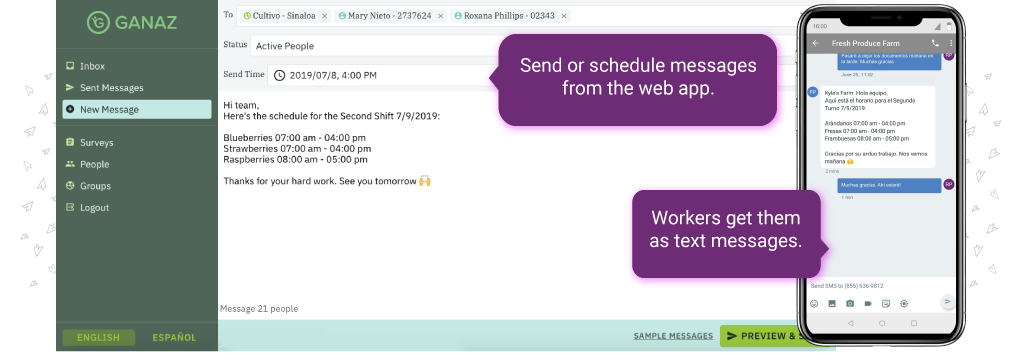
On the employer side, the workers and all their vital stats and documents are tracked centrally in the kind of interface companies have grown to expect. And Ganaz works as an intermediary to send text alerts and questions.

Diagram showing how employers can send texts to many workers at once.

Image Credits: Ganaz

So far Ganaz has 75 employers signed up, one of which is a Costco supplier group, and all told around 175,000 workers on the platform. Their ARR and user count both approximately tripled year over year, so they’re clearly on to something.

The company has tempered its rapid growth with designation as a public benefit corporation, which emphasizes the intention to do more than grow shareholder value. I asked about the tension between needing to show a profit and working in the service of a marginalized group.

“This keeps me up at night,” admitted Freeman. “We try to make sure to set ourselves up to be true to our mission. That means the folks we hire, our board of directors… we want to make sure we’re empathizing and honoring the trust we’ve built with people.”

That includes investors as well, and Freeman noted that the company ended up going with Trilogy as lead for this round partly because of that firm’s experience with Remit.ly.

For instance, Freeman noted, while it would be easy to juice profits by bumping ATM fees, that directly harms the people they’re trying to help. Instead, when they issue their payroll Mastercard later this year, that will allow workers to skip the check cashing step and its fees, and then Ganaz gets a share of the normal card transaction fee. “We can be equally successful that way,” said Freeman, and it doesn’t just replace another predatory structure.

After the cards the plan is to automate remittances, so a user can easily choose to send money to their family in a way that minimizes handling fees and so on. And there will be other options,m accessible via text, to choose where money goes if not to the card.

Ganaz’s main market is the U.S. and Mexico, since the agriculture business and workforce are both largely binational, but there are other targets on the horizon. First, though, the company wants to solidify its position and feature set here. “There’s no breakaway winner yet, so we want to be that winner,” said Freeman.

The $7M round also had participation from Bessemer Venture Partners, Founders’ Co-op, Taylor Ventures, AgFunder and Techstars. Rapid expansion and aggressive pursuit of the roadmap are next up for Ganaz.

“We are conscious of both the huge opportunity ahead of us to digitize billions of dollars in payroll, as well as the responsibility to build inclusive, low-cost, wealth-building tools for workers,” said Freeman.

03 Jun 2021

Google’s Pixel Buds A Series are an exercise in earbud cost cutting

Google does a lot of things well. But hardware strategy has never really been among them. The last several years have seen the company at least finding some consistency with its Pixel and Nest devices. But the former, in particular, has continued to struggle as the company has worked to find its footing in an already crowded space.

In 2017, the company entered the wireless earbud space with the first-gen Pixel Buds. The product was certainly an original take on the category, both in terms of design and features. Ultimately, however, it fell flat. But an “A” for effort, I guess. The second-gen product, introduced in April of last year, corrected a lot of their predecessor’s problems, mostly by delivering a more straightforward approach.

Image Credits: Brian Heater

Announced today, the Pixel Buds A-Series find the company capitalizing on that success with an approach that has worked well for Google’s smartphone line. The first Pixel A arrived just as the company was dealing with the consequences of poor mobile sales. The low-cost approach to the line sold well (by Google smartphone standards), helping deliver positive news for the beleaguered line.

As with the budget phones, the price is, once again, the thing. Here that means $99. It’s a price point that puts it below the new Echo Buds ($119) and Samsung Galaxy Buds ($110), and well under the AirPods 2 ($159). Essentially it’s the low end of the mid-tier of fully wireless earbud pricing. There is arguably even more competition at the really low end, where you can pick up of a pair of Anker earbuds for around $40. But relative to what we’d generally consider brand names, the pricing is quite aggressive.

It’s also a significant reduction from the standard Pixel Buds, which sport an MSRP of $170 (though you can find them quite a bit cheaper with minimal effort). The Series A aren’t replacing the standard Pixel Buds, so much as augmenting them — similar to what Apple did with AirPods, albeit on the other end of the pricing spectrum. With the new buds on the market, I would anticipate a further narrowing of the price gap between the products on many online retailers. As of this writing, there’s at least one offering the Pixel Buds second gens for $99.

Image Credits: Brian Heater

As you’d expect, the lower cost comes with a bit of corner-cutting — or at least the removal of some non-essentials. Ultimately the value for a given user comes down to what you’re willing to lose for the sake of a lower price point. The top-level losses here are:

  • No wireless charging
  • The loss of Attention Alerts (a feature that momentarily reduces volume when things like a siren, baby crying or dog barking are heard), due to lower-cost sensors
  • The loss of noise reduction for calls and wind
  • Limited tap gestures

Otherwise, the Series A are a lot like the Pixel Buds 2, including a similar 12 mm dynamic speaker driver and a nearly identical design. In fact, I was struck by just how similar they were. The size, the shape — really, the only immediate distinction here is coloring. It wasn’t broke, so Google didn’t really fix it. Gone are the bolder matte colors of the predecessors. Now the headphones feature two glossy colors: Clearly White and Dark Olive. Google sent the former, which is a bit more off-white than the AirPods (a bit closer to the Echo Buds coloring), paired with a kind of dull gray. If you want bolder colors, you’re going to have to stick with the standard buds, which also feature a striking orange and mint green colors. I prefer the matte coloring of the original, but the company had to do something to set these apart, I suppose.

Image Credits: Brian Heater

The case is the same vertically oriented oval design as the earlier version. It’s similar in volume to the AirPods Pro — so pretty easy to just pop into a pocket. The USB-C charging port is on the bottom; a light up front tips you off on charging status and the sync button is toward the bottom of the back. Flip up the top and reveal two familiar earbuds.

The size and shape are more or less the same as the Pixel Buds — a good thing, as they’re pretty comfortable over long periods. That’s certainly not something I can say for all of the competition. The silicone tips are user-replaceable for a better fit, but the small silicone ear tip is stuck in there for good. That’s fine for me, but your results may vary.

Like their predecessors, the A Series’ (total side note, but after writing so many funding rounds, I really want to write “Series A”) sound falls in the middle of the pack. You can get better quality from higher-end headphones like the AirPods Pro or Sony WF-1000XM3 (talk about being overdue for a refresh), but these are totally capable for day to day listening and making calls, even if the mic has lost a few of its tricks.

Image Credits: Brian Heater

There’s no noise canceling here. That’s to be expected, of course, given that the standard Pixel Buds don’t have the feature either. Given that it’s becoming increasingly standardized, it’s probably a no-brainer that the Pixel Buds 3 will offer the feature to further distinguish them from the budget model.

The buds offer five hours on a charge (2.5 hours of talk time) and 12 hours when the case is factored in — again, same as the Pixel Buds. They also boast the same IPX4 rating for water/sweat resistance. The Bluetooth connectivity is fairly strong. I found I was able to walk over to another room without losing connection, which is often hit or miss on buds.

Image Credits: Brian Heater

They’ll pair to either an Android (6.0+) or iOS device. Naturally, of course, they play nicely with the former, using Fast Pair. On an Apple handset, you’ll have to use the pairing button. Google Assistant — one of the standout features — also only works with Android devices. It’s handiest for enabling notifications, as well as real-time use of Google Translate.

Nothing about the Pixel Buds A Series is going to set the earbud world on fire. And that’s not really the point. More than anything, the product is an exercise in trimming the fat in order to deliver a solid experience at less than $100. And by that standard, they largely succeed.

03 Jun 2021

Frst and Fabric Ventures announce fellowship program for crypto entrepreneurs

VC funds Frst and Fabric Ventures are teaming up to create Le Crypto Fellowship. With this program, the two firms want to find the next 10 crypto entrepreneurs in France. And they think they might foster the most promising crypto startups if they don’t have any preconceived idea and team yet.

As Pierre Entremont from Frst writes in a Medium post, there are a lot of opportunities if you want to build the next crypto success, but few entrepreneurs are actively looking at this space.

“Nearly all crypto developers and entrepreneurs are already rich and therefore don’t step up their ambition,” he writes.

Blockchain development and DeFi projects are nearly always open source. Learning resources are available for free around the web. So it’s not that hard to get started and build a prototype, but you have to get started. Frst and Fabric Ventures think they can create the right framework to incentivize the next generation of entrepreneurs.

If you get accepted into the program, the two VC firms will hand you €100,000 in exchange for 7% of your company. Basically, this should cover one year of salary for one person in France with a salary of €50,000, €21,000 in employer contributions and €29,000 in expenses. You can be based in another country as long as it’s in the same timezone and you incorporate your company in France.

This way, you get to play around and think about an ambitious idea without feeling any financial pressure. You’ll join a Discord channel with other fellows and you’ll attend weekly Zoom meetings during the first few months. After that, Fabric Ventures and Frst partners will schedule regular office hours with you to check in on your progress.

If you end up creating a proper company and taking your idea to the next level, the fellowship may later ask to invest an additional €700,000 for a 20% stake in the company.

Candidates can apply until June 15. Le Crypto Fellowship isn’t looking for people who already have an idea or are only available part-time. But if you want to join as a team of 2 or 3, you can. Instead of €100,000, you’ll get €200,000 or €300,000. Working as a team will probably help you remain motivated over the long haul.

This isn’t the first startup mentoring program. The Thiel Fellowship is arguably the most well-known one. But Le Crypto Fellowship doesn’t limit itself to college dropouts and has a different focus. It’s going to be interesting to see if it pans out and if the VC firms will have a second, a third and a fourth batch down the road.

03 Jun 2021

The existential cost of decelerated growth

What happens to technology companies with slowing growth and a rising focus on profitability before they reach behemoth scale? How much does the market value hyper-growth?

Just because a technology startup has a hot start, that doesn’t mean it will grow quickly forever. Most will wind up somewhere in the middle — or worse. Put simply, there is a larger number of tech companies that do fine or a little bit worse after they reach scale.


The Exchange explores startups, markets and money. 

Read it every morning on Extra Crunch or get The Exchange newsletter every Saturday.


But what every investor hopes for is the hot company that can keep growth alive even after reaching material scale, running through walls, competitors, economic headwinds and anything else that comes its way. Those companies don’t end up worth a few hundred million, or a billion, but can end up valued in the dozens of billions or more.

In reverse, tech companies — even those with strong gross margins — with slipping growth can see their multiples compress rapidly. Then, the vultures circle.

Which explains some of the news we’ve seen recently in the market. As Dropbox comes under fresh pressure from external parties, joining its erstwhile rival Box in the public-market growth penalty box, we’re seeing companies like Braze, Gong, Shippo and others rip ahead with rapid-fire funding rounds or public brags about their growth.

While the differential between the two groups is clear, it’s still worth exploring in more detail. Let’s talk about the growth dividend. Or, if you’d prefer, the existential cost of growth deceleration.

Grow or die

The news this week that Dropbox has attracted an activist shareholder should not have been a surprise. Its former rival Box is in the midst of a long-running struggle with an activist investor of its own. (More here.)

03 Jun 2021

Delivery, drones and DHL

Locus (not to be confused with this Locus) is one of those names that’s been popping up a lot in the news — and this roundup — over the past year. Last time we spoke to the Massachusetts company, it was around a sizable raise — $150 million to be nearly precise. That effectively valued the company as a unicorn.

Core to the company’s successes are its partnerships (as is the case with any robotics fulfillment company). DHL has been a big (or the biggest) name in the mix since 2017. Amid pandemic lockdowns, the logistic giant signed up for 1,000 robots last year and, as of yesterday, is doubling that number.

Image Credits: Locus Robotics

DHL is really committing to robotics here. At last count, it said it had deployed around 200,000 across the U.S. alone, which puts its right around the same number as Amazon (which admittedly, hasn’t updated that figure lately). Of course, the big difference there is that Amazon is primarily pulling from in-house systems — perhaps Locus is a prime acquisition target?

The robotics company’s CEO shot down that suggestion when I spoke to him earlier this year, stating, “We have no interest in being acquired. We think we can build the most and greatest value by operating independently. There are investors that want to invest in helping everyone that’s not named ‘Amazon’ compete.”

When it comes to companies with deep pockets, though, I never say never.

Also out this morning, is a good size round from Realtime Robotics. The Boston-based company is one of a number of startups looking to streamline the process of installing and deploying industrial robotics. The $31.4 million Series A includes participation from (deep breath)  HAHN Automation, SAIC Capital Management, Soundproof Ventures , Heroic Ventures, SPARX Asset Management, Omron Ventures, Toyota AI Ventures, Scrum Ventures and Duke Angels.

Image Credits: E-Nano

There’s no such thing as a small raise, only a small…I’m not sure. Honestly, I didn’t really thing this one all the way through before I started typing. Anyway, here’s an early-stage, pre-seed from a London based startup called E-Nano. The company has developed a modular robotics system for monitoring sports turf.

Per a press release on the £100,000 ($141,000) raise, “These robots will eventually be able to assess agricultural land and contribute to landowners growing more sustainably. The team aims to implement 5G connectivity into their robots and platform, using this raise to deliver more immediate, real-time data with high throughput.”


Some good news for DJI comes courtesy of The Hill, which reports that the Pentagon has effectively cleared the drone giant in an audit. DJI was one of the names caught up in all of the flagging of Chinese companies that’s occurred over the past couple of years (read: during the Trump administration), which has severely kneecapped brands like Huawei and ZTE. DJI was never banned for sale outright in the States, but this is still a pretty massive relief for its ability to operate in such a large market.

The filing notes that it found “no malicious code or intent” from the company, going so far as “recommend[ing] use by government entities and forces working with US services.” Government use is a nice bonus there.

The company took a victory lap in a comment provided to TechCrunch, noting, “This U.S. government report is the strongest confirmation to date of what we, and independent security validations, have been saying for years – DJI drones are safe and secure for government and enterprise operations.”

Starship delivery robots

Starship delivery robots at UCLA campus on January 15th, 2021. Image Credits: Starship/Copyright Don Liebig/ASUCLA

Starship Technologies, meanwhile, snagged a high-profile name to lead the delivery robotics firm. Former Alphabet Loon CEO Alastair Westgarth will be taking the same title at his new company.

Incidentally, Starship is one of a trio of companies I’ll be speaking with during my delivery robotics panel (also Nuro and Gatik) at the upcoming TC Sessions: Mobility. We also just announced my second panel, which will be exploring a pretty vibrant category in automotive.

Image Credits: Ford/Agility Robotics

Max Bajracharya of TRI (Toyota), Mario Santillo of Ford and Ernestine Fu of Hyundai Motor Group will be discussing their respective employers’ approach to robotics beyond manufacturing and autonomy. They’re all doing really interesting stuff, and Hyundai, of course, is getting ready to close its acquisition of Boston Dynamics.

Should be fun. Register here.

03 Jun 2021

Roku debuts a 15-minute weekly series that recommends what to watch next

Roku is expanding its programming for its free content hub, The Roku Channel, with today’s launch of its own weekly entertainment program called “Roku Recommends.” The 15-minute show will leverage Roku’s data to highlight the Top 5 titles for viewers to stream that week. While not exactly “original programming” the way that Roku’s recent additions of its acquired Quibi content is, the series will run only on Roku, where it can be found in The Roku Channel and Featured Free, with new episodes every Thursday.

The series is the first production to emerge from the new Roku Brand Studio — a studio that aims to produce video ads and other custom branded content for ad partners. The show is produced by Funny Or Die and Mike Farah, Beth Belew, and Jim Ziegler serve as executive producers.

The show’s co-hosts include entertainment reporter and AfterBuzz TV co-founder Maria Menounos and former NFL player, Andrew “Hawk” Hawkins. The duo will present the Top 5 titles to viewers. These recommended shows or movies may come from any of the thousands of channels across the Roku platform, based on data exclusive to the platform.

“According to Nielsen data, the average streamer spends more than seven minutes searching for what to watch next,” said Chris Bruss, Head of Roku Brand Studio, in a statement. “We are uniquely positioned to use our trending data both to help consumers find incredible movies and shows and to help advertisers go beyond the traditional 30-second ad to entertain streamers who otherwise spend time in ad-free, subscription-only environments,” he added.

The series will also allow for ad sponsors. The company says it has already signed on several national advertisers, starting with Walmart, to sponsor the program. Advertisers will have access to Roku’s Measurement Partner Program to determine whether or not their integration reaches subscription video on-demand (SVOD)-only streaming users, as well as view other metrics about their video ad campaign’s reach, brand perception and impact.

The series comes at a time when the streaming landscape is shifting. Today’s streaming services regularly serve up recommended content based on what their customers are watching — Netflix, for example, shows rows of popular and trending content, as well as a Top 10 list of newly popular titles. But as the number of available streaming services grows, larger entities merge, and content jumps around as licensing agreements end and start, consumers may be more in need of a set of current recommendations from across channels and services, not just those isolated inside one service.

Amazon Fire TV’s update recently addressed this need with the introduction of a new “Find” feature that aims to make it easier for users to search and browse movies, shows and free content across its platform. Roku, however, didn’t have a recommendation system of its own.

It’s also interesting to see that Roku is willing to use its proprietary streaming data in this way — something it could choose to do more with further down the road to help build out a broader set of recommendations, if it chose.


03 Jun 2021

Realtime Robotics raises a $31M Series A

Boston-based Realtime Robotics this morning announced a $31.4 million round The funding is part of the $11.7 million Series A the company announced all the way back in late 2019. Investors include HAHN Automation, SAIC Capital Management, Soundproof Ventures , Heroic Ventures, SPARX Asset Management, Omron Ventures, Toyota AI Ventures, Scrum Ventures and Duke Angels.

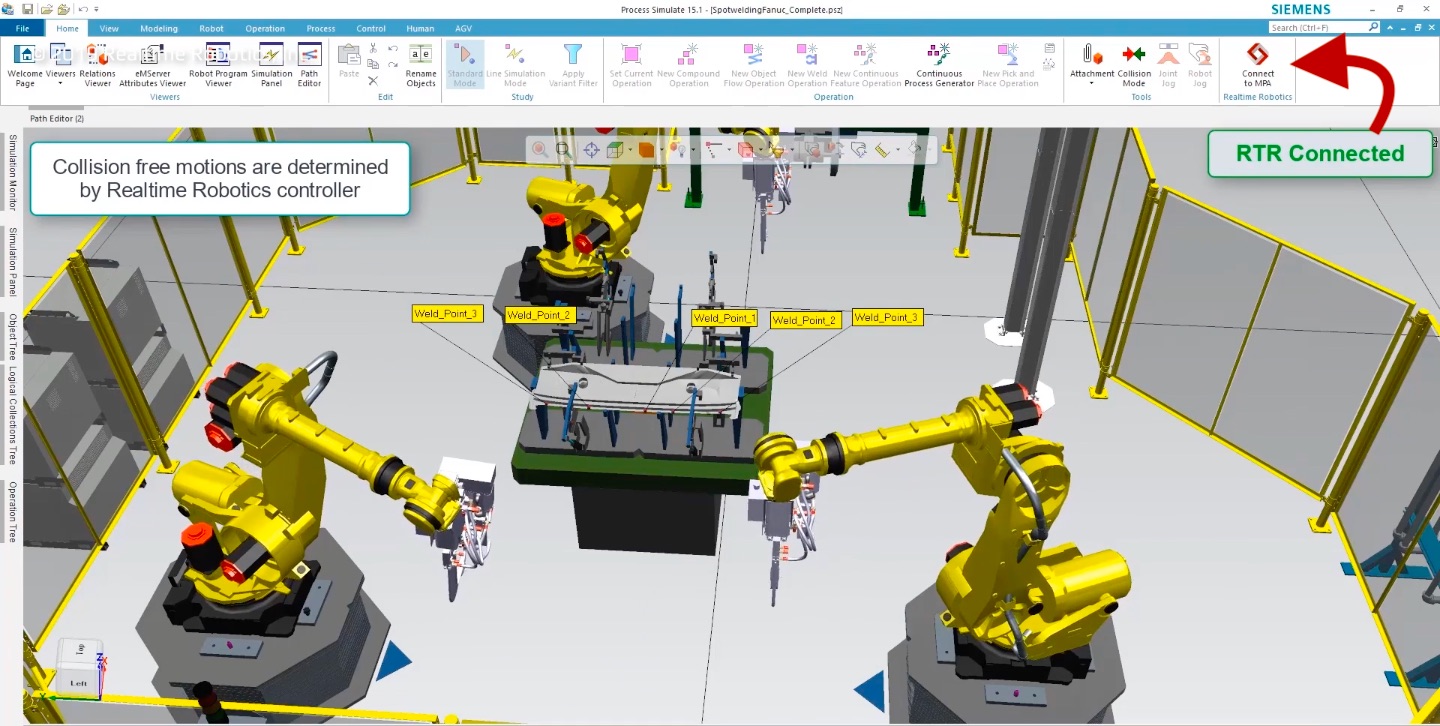
Realtime is one of a number of startups building control on top of industrial robotics. Specifically, the startup looks to help companies deploy systems with limited programming and offering adaptable controls that work for multiple systems at once.

This round, which nearly doubles the company’s existing funding, will be used to accelerate it product development and extend its offering to more markets, globally. It comes as interest in robotics have ramped up amid the global pandemic.

“This investment by some of the world’s leading manufacturers and automation providers stands as a testament to our ability to dramatically improve the value proposition for robotic implementations,” CEO Peter Howard says in a release. “Having already realized early deployment success, a broad spectrum of customers and partners are working closely with us to refine features and user experiences, readying our technology for rollouts in their engineering, factory and warehouse operations.”

The company’s offerings serve a wide range of different industrial robotics tasks, including pick and place machines, packaging and palletizing boxes.

03 Jun 2021

Architect Capital brings alternative capital to the early stage with new $100M fund

Early-stage startups are increasingly looking for alternative ways to access capital, meaning not every company wants to raise money from VCs or take on debt.

In recent years, a flurry of startups have emerged to give companies other options. (Think Pipe, for example.)

And today, San Francisco-based Architect Capital is a new firm that is launching with over $100 million in funds to serve as an “asset-based lender” to “high-growth,” early-stage tech companies. Specifically, the new firm aims to provide non-dilutive or less-dilutive financing options to asset-rich fintech, e-commerce and SaaS companies in the U.S. and Latin America, but with an emphasis on the latter. The region, Architect maintains, does not have a plethora of institutional financing available against assets.

The firm is not out to replace traditional venture capital or venture debt, emphasizes founder and CEO James Sagan, but rather to offer asset-based products that will complement them.

For some context, Sagan is no stranger to the startup world, having co-founded and served as managing partner of Arc Labs, an early-stage credit fund focused on lending to technology-enabled businesses. He’s been investing in Latin America for years, and recognized the need for new forms of financing to fund “novel and underappreciated assets.”

Also, he believes the region is home to “the most prominent fintech ecosystem in the world.”

To Sagan, traditional forms of equity and debt financing in the venture world are vital for things like growing headcount, but he believes they are “not engineered to support the growth of a company’s underlying financial products.”

“VC is highly dilutive and should be used for ROI activities such as hiring engineers and building great teams,” Sagan told TechCrunch. “It’s expensive to use equity to fund assets. Equity should not be put in a loan book. We’ll fund the loan book.”

Image Credits: Architect Capital founder James Sagan / Architect Capital

Architect’s goal is to provide “tailored and less dilutive funding,” especially to companies that produce repeatable revenues, such as SaaS and subscription businesses. 

Sagan said he first discovered the strategy in 2015 when he was working for a multifamily office that was lending against a bunch of traditional assets.

“A colleague and good friend of mine started a business and raised some equity and venture debt, but he couldn’t find the asset-specific financing for the receivables he was generating,” Sagan recalls. “He was lending to small businesses and needed asset-specific financing against those receivables.”

Venture debt doesn’t really work for receivables-based lending because venture debt shops typically are underwriting assets, or rather, underwriting the quality of the investors in the company, Sagan believes.

“So we really tailor our underwriting towards those assets themselves right and those assets range from unsecured consumer receivables to secure small business receivables to real estate,” he told TechCrunch. “Essentially, we’re providing an additional instrument for asset-heavy businesses that will allow them to scale in a way that venture debt will not.”

Architect’s LPs are mostly large institutions, as opposed to traditional high net worth individuals. The firm’s average check size will land at around $10 million to $15 million.

“Our portfolio allocation is more concentrated in general,” Sagan said. “We expect to grow our AUM (assets under management) pretty precipitously.”

Architect Capital has invested in six companies since inception, including PayJoy, a company that delivers consumer financing and smartphone technology to customers in emerging markets; Forum Brands, a U.S.-based e-commerce marketplace aggregator; and ADDI, a fintech that aims to give Colombian consumers access to fair and affordable credit through point-of-sale-financing that recently raised $65 million.