Year: 2021

03 Jun 2021

Not on NextDoor? You can still grab your neighbors’ stuff on Free Finds

Nextdoor, the app that helps neighbors connect, launched a new feature called Free Finds today, which will help people browse the free items available in their neighborhoods. Since the start of 2020, monthly listings to buy, sell, and give away items on Nextdoor have increased by 80%, but 25% of these listings advertised free stuff. So, the company decided to create a more streamlined way to get the word out about cool, free stuff on the curbs of your neighborhood.

You don’t have to be a member of Nextdoor to scroll through the free listings. Typically, becoming a member can be a complicated process that requires you to verify your home address via snail mail. But now, whether you’re looking for a free blender or seeking your next trash-to-treasure upcycle project, you can browse what’s up for grabs in your neighborhood.

To contact the seller, you need to set up a free account and go through the standard Nextdoor sign-up process. If your cell service billing address is at the same address where you live, the sign-up process is quick – you can verify your address via text. But, if the addresses don’t match (read: if you’re still on your parents’ family plan), it can take up to ten days to receive an invitation letter to become a verified Nextdoor member. By then, that lightly worn pair of boots might be long gone.

If you live in a densely populated area, you can probably find a neighborhood “free and for sale”-themed group pretty easily on Facebook. But, at the outset, Nextdoor adds a level of functionality by filtering items into categories, like “for young ones,” “for plant parents,” “spoil your pets,” and “hidden treasures.” It could also appeal to those who don’t want to deal with browsing through multiple Facebook groups, including those that  stretch beyond their neighborhood to nearby areas that would require a commute.

Nextdoor emphasizes the environmental benefits of a feature like Free Finds, which can help neighbors reduce waste when they discard perfectly usable items – instead, they can share resources with their neighbors. But more broadly, Free Finds is about leveraging people’s interest in free stuff to grow Nextdoor’s user base.

It also comes at a time when Facebook is threatening Nextdoor more directly. The tech giant launched its Neighborhoods feature in Canada last month, which is an obvious Nextdoor clone (Facebook copying other social media apps? Stop me if you’ve heard this one before). The feature should roll out soon for U.S. users.

Over the last year, Nextdoor has launched multiple initiatives that aim to support communities, like Sell For Good, which allowed users to sell items on the social network and donate proceeds to nonprofit causes. In response to the coronavirus outbreak, it also added features like Help Maps, Groups, a fundraising option for local businesses, and a neighborly assistance program created with Walmart.

Still, some consumers have become understandably skeptical of neighborhood-based social media apps. The Black Mirror-adjacent crime-reporting app Citizen recently came under fire when its CEO Andrew Frame bribed users with $30,000 to catch an arsonist using the app’s new livestreaming service, but had targeted the wrong person. Nextdoor, meanwhile, had in the past developed such reputation for racial profiling, that the company eventually had to roll out special tools to address this. Today, it still faces accusations of allowing unneighborly behavior, including political discussions and other posts that can make minority groups feel unwelcome or even unsafe.

Ultimately, investing in new products that encourage the opposite behavior — neighbors helping neighbors, as Free Finds offers — can only go so far to combat the app’s reputation.

The new Free Finds feature is live today in all the countries where Nextdoor operates at either nextdoor.com/freefinds or by visiting the Nextdoor Finds section in the Nextdoor app.
03 Jun 2021

Fujifilm becomes the latest victim of a network-crippling ransomware attack

Japanese multinational conglomerate Fujifilm has been forced to shut down parts of its global network after falling victim to a suspected ransomware attack.

The company, which is best known for its digital imaging products but also produces high tech medical kit including devices for rapid processing of COVID-19 tests, confirmed that its Tokyo headquarters was hit by a cyberattack on Tuesday evening.

“Fujifilm Corporation is currently carrying out an investigation into possible unauthorized access to its server from outside of the company. As part of this investigation, the network is partially shut down and disconnected from external correspondence,” the company said in a statement posted to its website.

“We want to state what we understand as of now and the measures that the company has taken. In the late evening of June 1, 2021, we became aware of the possibility of a ransomware attack. As a result, we have taken measures to suspend all affected systems in coordination with our various global entities.

“We are currently working to determine the extent and the scale of the issue. We sincerely apologize to our customers and business partners for the inconvenience this has caused.”

As a result of the partial network shutdown, Fujifilm USA added a notice to its website stating that it is currently experiencing problems affecting all forms of communications, including emails and incoming calls. In an earlier statement, Fujifilm confirmed that the cyberattack is also preventing the company from accepting and processing orders. 

Fujifilm has yet to respond to our request for comment.

While Fujifilm is keeping tight-lipped on further details, such as the identity of the ransomware used in the attack, Bleeping Computer reports that the company’s servers have been infected by Qbot. Advanced Intel CEO Vitali Kremez told the publication that the company’s systems were hit by the 13-year-old Trojan, typically initiated by phishing, last month.

The creators of Qbot, also known as QakBot or QuakBot, have a long history of partnering with ransomware operators. It previously worked with the ProLock and Egregor ransomware gangs, but is currently said to be linked with the notorious REvil group.

“Initial forensic analysis suggests that the ransomware attack on Fujifilm started with a Qbot trojan infection last month, which gave hackers a foothold in the company’s systems with which to deliver the secondary ransomware payload,” Ray Walsh, digital privacy expert at ProPrivacy, told TechCrunch. “Most recently, the Qbot trojan has been actively exploited by the REvil hacking collective, and it seems highly plausible that the Russian-based hackers are behind this cyberattack.”

REvil, also known as Sodinokibi, not only encrypts a victim’s files but also exfiltrates data from their network. The hackers typically threaten to publish the victim’s files if their ransom isn’t paid. But a site on the dark web used by REvil to publicize stolen data appeared offline at the time of writing.

Ransomware attacks have been on the rise since the start of the COVID-19 pandemic, so much so that they have become the biggest single money earner for cybercriminals. Threat hunting and cyber intelligence firm Group-IB estimates that the number of ransomware attacks grew by more than 150% in 2020, and that the average ransom demand increased more than twofold to $170,000.

At the time of writing, it’s unclear whether Fujifilm has paid any ransom to the hackers responsible for the attack on its systems.

03 Jun 2021

UK PM Boris Johnson’s Tories guilty of spamming voters

The governing party of the UK has been fined £10k by the national data protection watchdog for sending spam.

The Information Commissioner’s (ICO) Office has sanctioned the Conservative Party following an investigation triggered by complaints from 51 recipients of unwanted marketing emails sent in the name of prime minister, Boris Johnson.

The emails in question were sent during eight days in July 2019 after Johnson had been elected as Party leader (and also therefore became UK PM) — urging the recipients to click on a link that directed them to a website for joining the Conservative Party.

Direct marketing is regulated in the UK by PECR (the Privacy and Electronic Communications Regulations) — which requires senders to obtain individual consent to distribute digital marketing missives.

But the ICO’s investigation found that the Conservative Party lacked written policies addressing PECR and appeared to be operating under the misguided assumption that their “legitimate interests” overrode the legal requirements related to sending this type of direct marketing.

The Party had also switched bulk email provider — during which unsubscribe records were apparently lost. But ofc that’s not an excuse for breaking the law. (Indeed, record-keeping is a core requirement of UK data protection law, especially since the EU General Data Protection Regulation was transposed into national law back in 2018.) And the ICO found the Tories were unable to adequately explain what had gone wrong.

In another damningly twist, the Conservative Party had been subject to what the ICO calls “detailed engagement” at the time it was spamming people.

This was a result of wider action by the regulator, looking into the ecosystem and ethics around online political ads in the wake of the Cambridge Analytica scandal — and the Party had already been warned of inadequate standards in its compliance with data protection and privacy law. But it went ahead and spammed people anyway. 

So while ‘only’ 51 complaints were received by the ICO from individual recipients of Boris Johnson’s spam, the ICO found the Tories could not fully demonstrate they had the proper consents for over a million (1,190,280) direct marketing emails sent between July 24 and 31 2019. (The ICO takes that view that at least 549,030 of those, which were send to non-Party members, were “inherently likely” to have the same compliance issues as were identified with the emails sent to the 51 complainants.)

Moreover, the Party continued to have scant regard for the law as it spun up its spam engines ahead of the 2019 General Election — which saw Johnson gain a landslide majority of 80 seats in a winter ballot.

“During the course of the Commissioner’s investigation, the Party proceeded to engage in an industrial-scale direct marketing email exercise during the 2019 General Election campaign, sending nearly 23M emails,” the ICO notes. “This generated a further 95 complaints to the Commissioner, which are likely to have resulted from the Party’s failure to address the compliance issues identified in the Commissioner’s investigation into the July 2019 email campaign and the wider audit of the Party’s processing of personal data.”

Its report also chronicles “extensive delays” by the Conservative Party in responding to its requests for information and clarification — so while it was not found to have obstructed the investigation the regulator does write that its conduct “cannot be characterised as a mitigating factor”.

While the ICO penalty is an embarrassing slap for Boris Johnson’s Tories, a data audit of all the main UK political parties it put out last year spared no blushes — with all parties found wanting in how they handle and safeguard voter information.

However it’s only the Conservatives’ fast and loose attitude toward people’s data and privacy online that could have contributed to them being able to consolidate power at the last election.

03 Jun 2021

Little Black Door launches app on iOS/Android allowing women to share wardrobes, online and off

Our relationship with fashion has changed, not just because of the pandemic. Months in lockdown means people are probably more aware of their fashion purchases and how they consume, given its been such a long time without socialising. But the oft-talked about ‘Clueless wardrobe’ which would allow women to both see into their collections, as well as share and potentially borrow from friends, has yet to go mainstream. Now a UK startup aims to change this.

The Little Black door app, previously in closed beta, has just launched on the Apple iOS store here and on Android.

The app allows women to share the content of their wardrobes, in an Instagram-like manner by creating collections (“Lookbooks”), as well as curating their private wardrobe for their own use, with a focus on premium and luxury fashion. Women, says LBD, can “see, style and share”, as well as borrow clothes offline, and resell them.

The Lookbook feature allows women to share wardrobes collections with friends or followers in a controlled way, a feature that lets users borrow from each other.

Co-founder Lexi Willetts tells me: “We’d simply gotten to a point where we didn’t know what fashion we owned, given that almost every other area of life allows this. Most fashion can be easily dash-boarded on our phones – we couldn’t understand why our wardrobe wasn’t! Equally the effort required to list an item on resale was also super hard.”

Willetts and co-founder Marina Pengilly came up with the app when they realized they could make as much as £30,000 a year reselling their luxury clothes and accessories online. LBD is going after four key trends: the rise of resale (Depop etc); rentals like Rent the Runway; AI in e-commerce; and re-receipts.

Users upload their wardrobe by taking a photo of an item. The app will then recognize the item using computer vision. Lookbooks showcasing fashion collections, new and old also have an “I have this” button, allowing users to add items to their own wardrobes, or add as they buy automatically via links to retailers.

Another key feature allows users to see into their own wardrobes to see what they have, and, crucially, see how much they’ve spent, and own, in value.

Users can also create a Lookbook, not unlike on Pinterest, which can be shared with friends or a wider fashion community in a public or private group-controlled way. Lookbooks can be shared with a user’s network to allow them to see your style, or borrow the outfit in real life. As well as this, LBD itself also curates a feed of fashion/lifestyle news and surveys.

Willetts says partnerships with retailers and supplier deals for sales and fashion repairs are also in the offing.

LBD competes with the ‘Save Your Wardrobe’ app.

But is pushing the fact that it places a greater emphasis on sharing the wardrobe as well also allowing people to borrow items, with this focus on premium and luxury fashion – ADD …this is a truly social wardrobe.

The business model is likely to be a Premium version that unlocks extra features, affiliate revenues, advertising, and resale commissions.

Disclosure: Mike Butcher was an early, informal, adviser.

03 Jun 2021

Ford officially adds Maverick, a compact pickup truck, to its lineup

Ford is adding a new entry-level truck called Maverick to its lineup as the automaker seeks to offer pickups at every price level in this increasingly competitive market.

The company said Thursday it will debut the vehicle June 8, including on its new Tiktok channel. Little was seen of the vehicle, just a one second glimpse of it in a teaser ad on YouTube. From the photo, it is obviously a Ford and a compact one. The rest of the details will have to wait until next week, unless they’re leaked between now and then.

In Ford pickup hierarchy, that means the Maverick will sit under the mid-sized Ranger and F series models. The Ranger XL, the most affordable of the trims, starts at about $25,070 before destination fees. That means the Maverick should start at least few thousand dollars below that figure.

The automaker didn’t provide any more details about if it would be a hybrid, electric or gas-powered vehicle. However, noting the direction Ford has taken recently with the hybrid F-150 and the recently revealed all-electric F-150 Lightning, it’s likely that there will at least be a hybrid version offered.

As a reminder, the Ford F-150 is the profitable cornerstone of the U.S. automaker’s business. By adding in an electric sibling to the lineup it seemed like perhaps all the boxes had been ticked. But Ford wants to capture that entry level market of customers who want a pickup that is affordable and more suitable for city living.

03 Jun 2021

Twitter launches its premium subscription, Twitter Blue, initially in Canada and Australia

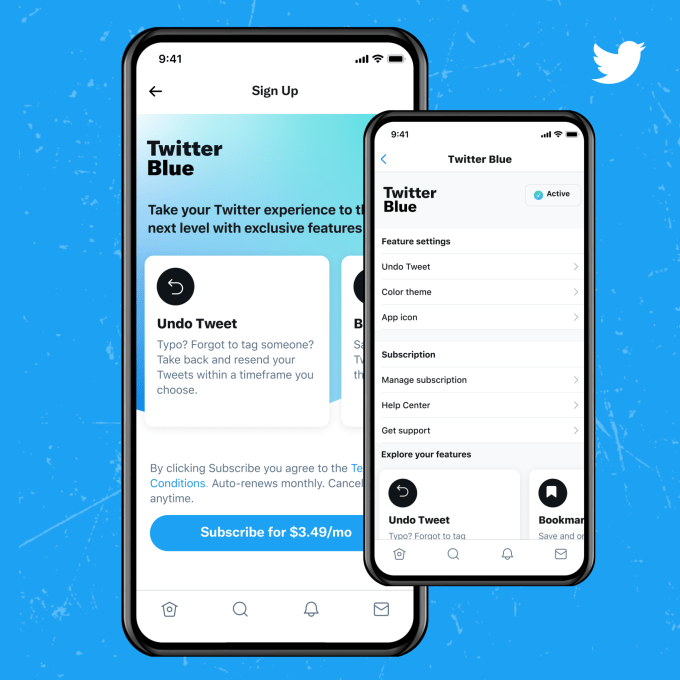
Twitter today is officially launching its first-ever subscription service, Twitter Blue, initially in Australia and Canada. The subscription will allow Twitter users to access premium features, including tools to organize your bookmarks, read threads in a clutter-free format and take advantage of an “Undo Tweet” feature — which is the closest thing Twitter will have to the long-requested “Edit” button.

The company’s plans for the subscription service had been previously scooped by app researcher Jane Manchun Wong, who uncovered the service’s name, pricing and feature set by digging around inside the mobile app’s code. Twitter Blue also recently showed up as an in-app purchase, further confirming some of Wong’s findings.

The only questions that seemingly remained, then, were when Twitter Blue would finally launch and when it would reach all global users.

Twitter tells TechCrunch it’s starting Twitter Blue with the select markets of Canada and Australia to help it determine whether its existing feature set will meet the needs of those who are looking for more customization over their Twitter experience, as well as to encourage discussion around other features that Twitter should prioritize for future iterations of Twitter Blue.

“We are going to continue to iterate on different tier and pricing opportunities as we continue to learn more about what is — and isn’t — working,” a Twitter spokesperson told us.

In Canada and Australia, the subscription will cost $3.49 CAD or $4.49 AUD, respectively.

Image Credits: Twitter

There are also a few things to know about Twitter Blue’s current feature set, beyond the basics.

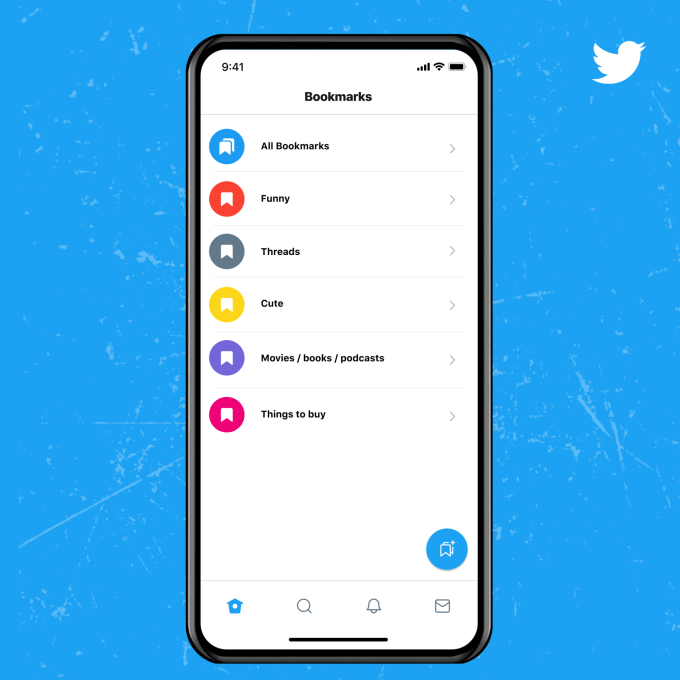
The new Bookmark Folders option is designed to help Twitter users organize their saved content, collected through Twitter’s Bookmarks feature. Introduced in early 2018, Twitter’s Bookmarks gives users a private way to save tweets for later reference. This is useful for those who want to read long-form content at a later time, or for those who want to save tweets without alerting others to that fact. For example, if the tweets being saved aren’t those they would normally “Favorite” (the heart icon), perhaps because the user disagrees with the sentiment being expressed, the bookmarks button lets them save the tweet more privately.

The Folders feature will let users create subfolders for their bookmarks, which are also color-coded for easy at-a-glance access. And there’s an “Add Bookmark” button on this screen, so you can add a tweet to the collection from the Bookmarks section directly.

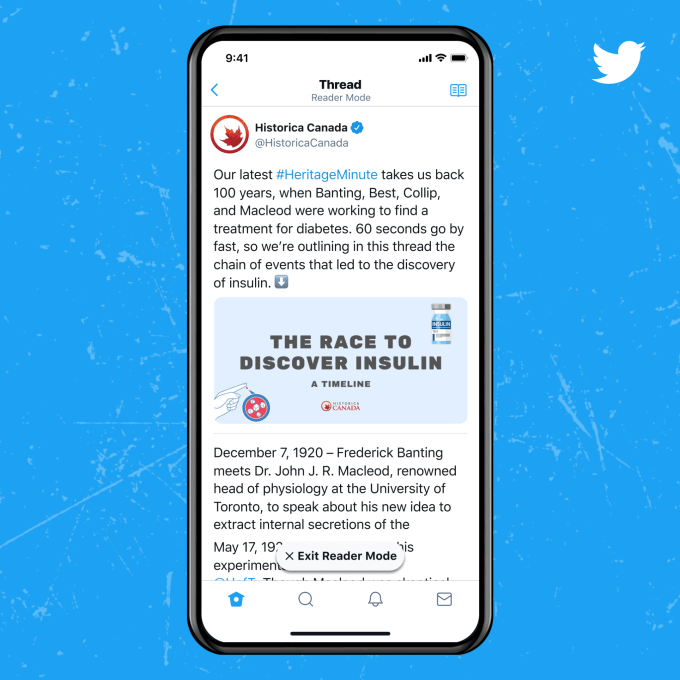
The new Reader Mode feature, meanwhile, may not be exactly what some Twitter users were expecting.

Ahead of Twitter Blue’s launch, Twitter acquired Scroll, a distraction-free reading service that cleans up news articles by removing ads and other clutter for a better reading experience. Scroll CEO Tony Haile then tweeted that the product’s features would be integrated into Twitter’s subscription “later in the year.”

Image Credits: Twitter

But Twitter tells us that Reader Mode isn’t correlated to any of the company’s recent acquisitions, including Scroll, and instead was built separately for the Twitter Blue offering. For the time being at least, Reader Mode is focused on making it easier to read through longer Twitter threads — basically, an alternative to something like the third-party app, Thread Reader App.

When you go into the tweet detail view where it shows you the full Twitter thread, Twitter Blue subscribers will see a button which lets you change the screen to show you long-form text. You can exit Reader Mode to see the thread as usual.

As for Scroll, Twitter says the better reading experiences it brings to the platform will be incorporated into Twitter Blue later on.

Finally, there’s Twitter Blue’s flagship feature, Undo Tweet. While not the Edit button users really want, it will allow you to quickly “unsend” a tweet when you spot a typo or make some other kind of mistake — like forgetting to tag someone, for instance.

Image Credits: Twitter

Users can set their own customizable time of up to 30 seconds to “undo” the tweet or reply from being posted to their Timeline, Twitter says. Before Twitter Blue’s launch, the company had hinted that this “undo” option was the way it would likely address user demand for an Edit button. Twitter had feared actually allowing users to correct their tweets at any time, as it could lead to malicious activity — like changing the text of the tweet to later have a different meaning, for example.

Undo Tweet will address many scenarios, however, where users have quickly posted only to belatedly spot a typo. That alone may be worth a few dollars per month for Twitter power users who tweet frequently.

Twitter stressed today that the launch of Twitter Blue won’t mean anything about the free version of Twitter is changing. The subscription will remain focused on adding enhancements and other complementary features to Twitter’s free tier. And it may grow to include more options over time.

One thing Twitter wouldn’t say, maddeningly, is when Twitter Blue could arrive in the U.S. or other markets. For some context, though, Twitter launched Fleets first in spring 2020 but didn’t roll out the feature to all global users until that November. Asked if Twitter Blue would follow a similar path, Twitter declined to comment.

The subscription service isn’t just a way to better serve Twitter’s power users, it’s part of the company’s broader plan to reduce its reliance on advertising revenue as its only source of profit. As Twitter has struggled to grow its user base over the years, it’s more recently begun looking to generate more money from the dedicated users it does have. These plans will include offering tools to creators, including the upcoming Super Follow subscription, as well as Twitter Blue.

Twitter told investors earlier this year it plans to at least double its total annual revenue, from $3.7 billion in 2020 to $7.5 billion or more, in 2023, in part thanks to its new initiatives, including subscriptions.

Twitter Blue will initially be available in its supported markets on iOS only. Early adopters are asked to tweet their product feedback to @TwitterBlue.

03 Jun 2021

Register for Product Hunt’s Makers Festival for a chance to launch at Disrupt for free

Builders, creators and developers, this one’s for you! TechCrunch has always been about discovering fresh solutions and shining the light on exciting, new products that have the potential to make a difference. Our past hackathons have been the breeding ground for products like Alexa Shop Assist, Quick Insurance, reVIVE and GroupMe who went on to be acquired by Skype.

This year, we’ve partnered with Product Hunt’s Makers Festival to give builders a platform to unleash your creativity and bring your ideas to reality and even have a chance to get some exposure at Disrupt 2021. This Makers Festival is centered all around green tech and environmental ingenuity. As humans, our daily connections to the environment are all-encompassing including how we eat, pay, invest, shop, advocate, and travel. That means there are better solutions everywhere, too. Get inspired and ask yourself “what haven’t we tried yet?”

The grand prize winner will get a free spot to launch their product to the TechCrunch community at Disrupt 2021 in Startup Alley along with a bunch of other prizes and tools to help you kickstart your product.

So how do you participate?

Register here for free and get your creative juices flowing. Make sure you sign up asap as registration closes tomorrow, June 4. 

And who knows – maybe your product will be the next one that snapped up at Disrupt!

03 Jun 2021

Gong going gangbusters, grabs $250M Series E on $7.25B valuation

Gong, the revenue intelligence startup, has been raising capital at a rapid pace, and today the company announced another $250 million on a $7.25 billion valuation, a number that triples its previous valuation from last summer.

Franklin Templeton led today’s festivities with participation from Coatue, Salesforce Ventures, Sequoia, Thrive Capital and Tiger Global. The company raised $200 million last August at a $2.2 billion valuation, and has now raised $584 million, $450 million coming in the last year.

What is making investors open their wallets and pull out such large sums of cash? The company is helping solve a hard problem on how to bring more intelligence to the revenue process. They do this by using artificial intelligence to listen to every customer interaction, whether that’s a sales or service call (or anything else), and use that information to determine valuable information like who is most likely to buy and who is most likely to churn.

It’s been going well and CEO Amit Bendov says the company’s performance really validates the valuation. While he wasn’t ready to discuss specific numbers, he did say that ARR grew 2.3x between Q1 last year and this year, and he says Q2 is on pace to triple ARR.

“The valuation is up about 3x from last summer, but sales are more than 3x. We have high logo customers. [Last year], it was still unclear how COVID was going to impact us. People believed [our business] was going to do well [during the pandemic], but it wasn’t as obvious. Now, it is obvious. And all the […] financials are way better, so from a pure financials [perspective] our multipliers are pretty reasonable for our revenue trajectory,” he said.

With all this growth, the company is adding employees at a rapid pace. It closed the year with 400 people, and is up to around 550 today with a goal of reaching 950 by year end. It has partnered with a consulting firm called ReadySet, which helps companies build diverse and inclusive organizations, and Bendov says they are an equal pay company.

Women represent around 40% of the employees and around 4% are Black, a number he hopes to increase by growing the Atlanta office. In the office in Israel, he has set up employment and training programs to build bridges to the Arab community.

Bendov says he looks forward to meeting his U.S. employees in the coming weeks when he’ll be visiting the Atlanta office for the first time.

03 Jun 2021

Fashion wholesale marketplace Joor opens China office

Joor, an online marketplace that connects fashion brands and retailers around the world, has opened its first China office in downtown Shanghai as it eyes growth in the region.

The 11-year-old New York-based company works as a virtual showroom for brands, which traditionally would meet with their retail partners in physical venues to showcase the latest collections. With Joor, showrooms become live videos, a feature that has no doubt proven useful during COVID-19.

The company also gives brands a set of data tools to analyze their sales that can inform future productions. For buyers, the benefits are similar — they are able to see which brand or product is trending and make better forecasts.

The expansion into China follows a robust year for Joor in APAC and the opening of its offices in Melbourne and Tokyo. Joor’s wholesale volume ordered by retailers in the region grew 139% year-over-year in 2021, and wholesale volume for APAC-based brands was up 419%, the company said in an announcement.

“The establishment of JOOR Shanghai will allow us to provide frictionless wholesale management to the range of fine brands and retailers across the country,” said Joor’s CEO Kristin Savilia in a statement. “It builds on our existing leadership position in North America and Europe, and we expect continued expansion across the Asia-Pacific region.”

Joor’s marketplace boasts more than 12,500 brands and over 325,000 retailers around the world to date. The company has raised over $35 million in funding, according to its disclosed rounds. Its investors include venture capital firms Battery Ventures and Canaan Partners as well as the 71-year-old Japanese trading house Itochu.

03 Jun 2021

LeoLabs raises $65M Series B for its satellite monitoring and collision detection service

Low Earth orbit is full of stuff: not only bits of debris and junk, but also satellites — the number of which is growing rapidly alongside the decreasing cost of launch. This can occasionally pose a problem for satellite providers, whose valuable spacecraft run the risk of colliding with other satellites, or with the many thousands of other objects in orbit.

For most of the space age, debris tracking was performed by a smattering of military outfits and other governmental organizations, but that hardly paints a complete and broadly accessible picture. LeoLabs has been aiming to fill what it calls this “data deficit” in orbital object tracking since the company’s founding in 2016. Now it will be scaling its operations with a $65 million Series B financing round, jointly led by Insight Partners and Velvet Sea Ventures. This latest round brings the company’s total funding to over $100 million.

LeoLabs uses ground-based phased array radars – one in Alaska, one in Texas, two in New Zealand and two in Costa Rica – to monitor low Earth orbit, and to track and measure any object that flies through its observational area. One main advantage of LeoLabs’ tracking system is the size of the objects it can detect: as small as 2 centimeters across, as opposed to the much larger 10 centimeter objects tracked by legacy detection systems.

The difference in scale is huge: there are around 17,000 objects in orbit 10 centimeters or larger, but that number jumps to 250,000 when monitoring from 2 centimeters. That’s a lot of opportunity for collision, and though 2 centimeters sounds small (that’s less than an inch), they can do catastrophic damage traveling at orbital velocity. Customers can access this information using a subscription service, which will automatically alert them about collision risks.

“There just isn’t much information about what’s going on,” Dan Ceperley told TechCrunch. “So we’re rolling out this global radar network to generate a lot of data, and then all that software infrastructure to make it useful.”

LeoLabs sees around three to five close approaches involving larger objects, Ceperley said per year. Those are noteworthy because a collision could potentially produce thousands of smaller fragments – even more space junk. When tracking smaller objects, the company sees up to 20 times more collision risks. Fortunately, many satellites have electric thrusters that can be activated to avoid collisions or maintain orbit. With sufficient advance, companies can maneuver a few days prior to the anticipated collision.

With this new injection of funds, Ceperley said the company is looking to expand the number of radar sites around the world and scale its software-as-a-service business. While LeoLabs already has complete orbital coverage, more radars will increase the frequency with which objects are tracked, he explained. LeoLabs will also be scaling its software and data science teams (already the largest in the company), setting up locations outside the U.S., and adding new products and services.

“There’s a once in a lifetime revolution going on in the space industry, all this new investment has driven down the costs of launching satellites, building satellites and operating satellites, so there’s a lot of satellites going into low Earth orbit,” Ceperley said. “There’s a need for a new generation of services to actually track all these things [. . .] And so we’re building out that next generation tracking service, mapping service, for that new era.”