Year: 2021

24 May 2021

ByteDance’s video editor CapCut is the latest to top the U.S. App Store

From time to time, we see a Chinese app climbing to the top of Google Play and App Store in a host of Western countries. It might be a utility tool like a selfie beautifier or some casual video game, which have universal appeal and require little localization effort. But most of them tend to be a blip on the radar.

The latest Chinese app to top the overseas charts is from TikTok owner ByteDance. Called CapCut, the video editing app allows users to not only add a trove of stickers, filters and effects, it also has a simple-to-use green screen function, a zooming feature that works like a Ken Burns effect, and many more — which make the app like an accessible Final Cut on the go.

Users won’t have to worry about paying for music, as CapCut has a library of licensed sound clips that they can use to spice up their content. Over the past year, TikTok has been beefing up its music arsenal through efforts like scouting for musicians and signing deals with major labels.

Chinese tech giants are adept at attracting a large user base first by offering their services for free, and then exploring monetization models after users become sticky to the products. CapCut appears to have the same playbook.

CapCut’s Chinese sibling Jianying has already had success among Douyin (TikTok for China) users. Now that pattern is repeating outside China, with TikTok users taking advantage of CapCut to make their videos look sleek and professional with a few taps on their phones.

Since May 21, CapCut has been the No. 1 free app on the U.S. App Store, according to data provided by analytics company SensorTower. It ranks 9th on Google Play in the U.S. as of writing. All told, the app has exceeded 250 million installs globally to date from across the App Store and Google Play, and nearly 9.5 million from U.S. app stores, SensorTower says.

CapCut’s rise is reminiscent of the Chinese photo editor Meitu. The app was so popular that it became synonomous with a selfie beautifier in China, but it also had a solid base of loyal users abroad. The difference is CapCut’s rise is built on its sibling TikTok’s global dominance, whereas Meitu’s early attempt to foster a social network around its photo tool to increase user stickiness never really took off.

CapCut probably won’t be ByteDance’s last viral app. TikTok’s sprawling content empire will spawn more offshoots, whether it’s a video editor or an e-commerce service for creators to make money and for users to buy the products endorsed by their favorite influencers.

24 May 2021

Seed-stage accelerator Flat6Labs closes $13.2M fund for startups in Egypt

Investment activities in Egypt continue to gain steam, not for startups only but also the funds backing them. Today, seed accelerator Flat6Labs announced the second close of its Egypt fund to support early-stage startups and provide follow-up investment. The fund had a target for EGP50 million (~$3.2 million) but eventually closed at EGP207 million ($13.2 million).

Launched in 2011, Flat6Labs is a regional seed accelerator with offices in Egypt and Tunisia. The accelerator launched its Cairo programme in 2017 to invest in more than 100 startups across Egypt over the course of five years.

Startups that get into the accelerator are provided with office space, legal and marketing help, and access to mentorship and networking, among other perks. They also receive between EGP500,000 and EGP750,000. However, with the close of this round, Flat6Labs has increased the check sizes to EGP1.5 million (~$95,000) and up to EGP3 million (~$191,000) in post-programme follow-on funding for selected startups.

The International Finance Corporation (IFC), the MSME Development Agency, the Egyptian American Enterprise Fund, and Egypt Ventures are the anchor investors in Flat6Labs seed fund. Sawari Ventures, which recently closed its $71 million fund, also participated in this second close. It comes as no surprise because the firm, which is highly affiliated with the accelerator, said it would set aside 10% of its fund for Flat6Labs seed-stage companies when we covered them in April.

“At Sawari Ventures, our fund strategy has always been to allocate a percentage of our fund to the seed stage, which is a completely different proposition in terms of process, culture, and support needed,” Wael Amin, managing Partner at Sawari Ventures, said in a statement. “As investors in Flat6Labs Accelerator Company, we get the opportunity to profitably participate in Egyptian companies at a very early stage, get early indicators on ecosystem trends, and visibility into the ecosystem.”

The second close of Flat6Labs’ fund is the latest of four venture capital funds targeted at Egyptian startups. Shortly after Sawari Ventures’ close, Algebra Ventures announced launching a $90 million second fund. Subsequently, GIZ Egypt launched a €100 million funding programme called VC University. The fund, which will provide up to four MENA-based fund managers between €25-30 million, is exclusively targeted at Egypt-based startups.

Flat6Labs is one of the continent’s active and well-known seed-stage accelerators. Just in Egypt alone, it has run seven cycles and invested in 62 startups. In Egypt, they provide a filter for some early-stage investors to source what companies to back or not. A good portion of startups in Flat6Labs’ portfolio has piqued investors’ interests in its four years of operation as half have received follow-up investment totalling EGP145,000,000 (~$9.25 million). Some of the startups in Flat6Labs’ portfolio include Welnes, Glued, CreditGo, and Docspert Health.

24 May 2021

Zeta becomes a unicorn with $250 million SoftBank-led funding

Zeta, a startup that helps banks and fintech firms launch products, is the newest to attain the coveted unicorn status after closing a new financing round.

The embedded finance firm, co-founded by veteran Indian entrepreneur Bhavin Turakhia, said on Monday it has raised $250 million in its Series D round led by SoftBank Vision Fund 2, confirming a TechCrunch report from mid-April. Existing investor Sodexo also participated in the round.

The new round valued the startup, which has offices in Bangalore and Dubai, at $1.45 billion, Turakhia said. That’s up from the $300 million valuation that Zeta reported in the second half of 2019.

Zeta has developed a technology stack that helps it engage with both banks, fintech startups, as well as other online consumer platforms. The thesis is that banks — largely operating on antiquated technologies — today don’t have the time and expertise to offer the best experience to hundreds of millions of customers and fintech firms they serve.

Banks, which have licenses to offer financial services to customers, use Zeta’s cloud-native API and SDKs to launch credit cards and debit cards and offer improved experience to customers, and also work with fintechs.

Zeta is SoftBank Vision Fund 2’s latest investment in India. The Japanese conglomerate, which minted another unicorn in social commerce Meesho last month, is in advanced stages of talks to invest up to $500 million in food delivery giant Swiggy and is also engaging with SaaS startup WhatFix.

“Banking software is a $300 billion industry globally. Most banks still employ technology which is significantly older than their customers, impacting user experience and engagement,” Munish Varma, a managing partner at SoftBank Investment Advisers, said in a statement.

More to follow later…

24 May 2021

Aurora Solar aims to power the growing solar industry with a $250M round C

Aurora Solar had one of those pitches that seemed obvious in retrospect. Instead of going to a house and measuring its roof manually for a solar panel installation, why not use aerial scans and imagery of the whole region? That smart play earned them a $20M A round, a $50M B round, and now only six months later a massive $250M C as they aim to become the software platform on which the coming solar power expansion will be run.

The idea is simple enough to explain, but difficult to pull off. There’s lots of data out there about the topography, physical and infrastructural, of most cities. Satellite imagery, aerial lidar scans, light and power lines and usage data, and of course where and how the sun hits a given location — this information is readily available. Aurora’s innovation wasn’t just using it, but assembling it into a cohesive system that’s simple and effective enough to be used widely by solar installers.

“Aurora’s core value proposition is the fact that you can do things remotely much faster and more accurately than could if you traveled to the site,” explained co-founder and CRO Sam Adeyemo.

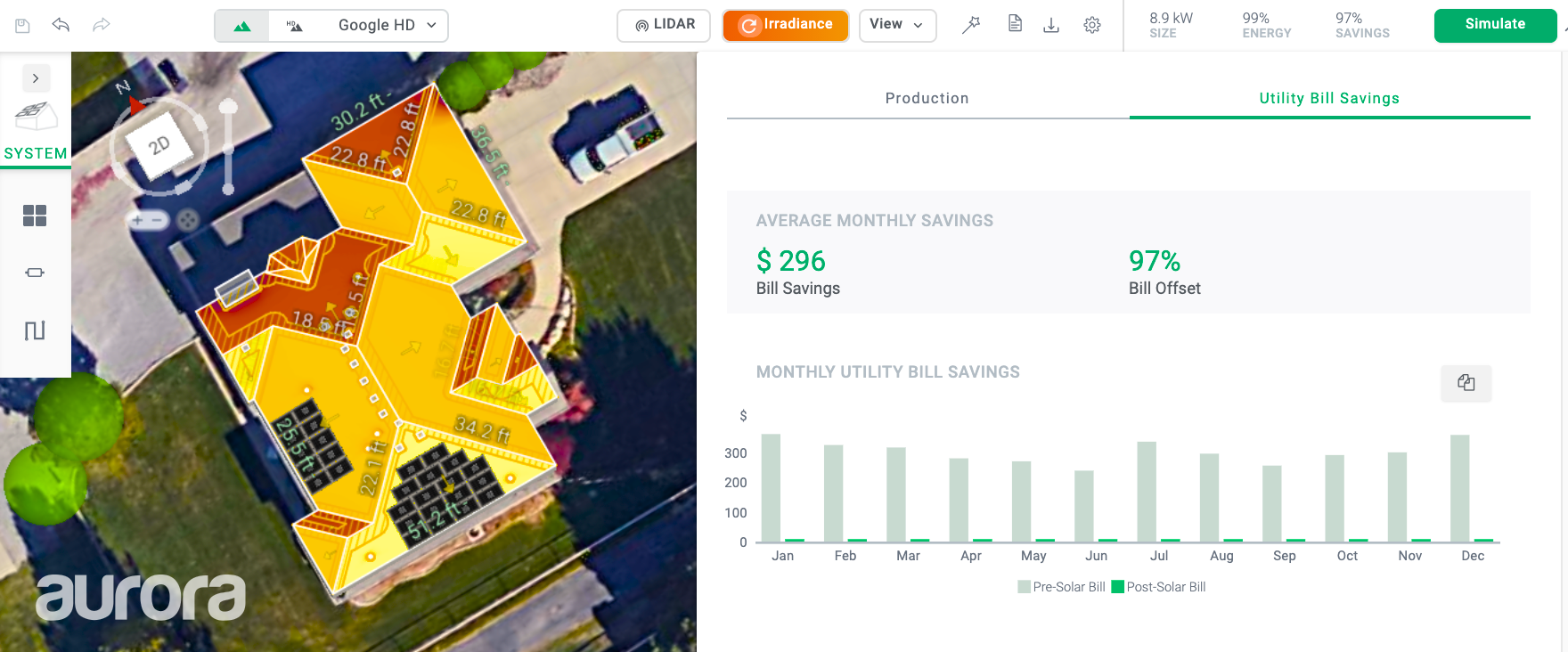
Having developed algorithms that ingest the aforementioned data, the service they offer is a very quick turnaround on the tricky question of whether a solar installation makes sense for a potential customer, and if so what it might cost and look like, down to the size and angle of the panels.

An interface showing a solar roof design and power savings.

Image Credits: Aurora Solar

“It’s not uncommon for the acquisition cost for a customer to be thousands of dollars,” said Adeyemo’s co-founder, CEO Chris Hopper. That’s partly because every installation is custom. He estimated that half the price tag of any setup is “soft cost” — that is, over and above the actual price of the hardware.

“If the quote is for $30K, what actually goes on your roof might be $15K, the rest is overhead, design, acquisition cost, yada yada yada,” he explained. “That’s the next frontier to make solar cost-competitive, and that’s where Aurora comes in. Every time we shave a few dollars off the price of an installation, it opens it up for new consumers.”

The company doesn’t do its own lidar flights or solar installations, so the $250M in funding may strike some as rather high for a company making software. Though I did my best to tease out any secret skunkworks projects under way at Aurora, Adeyemo and Hopper patiently explained that enterprise-scale software isn’t cheap, and the funding is proportional to their ambitions.

“The amount we raised speaks to the opportunity ahead of us,” said Hopper. “There’s a lot more solar to put on roofs.”

Aurora has been used for evaluating about 5 million solar projects so far, about a fifth of which end up being built, Adeyemo estimated. And that’s just a fraction of a fraction. Solar makes up about two percent of the U.S.’s power infrastructure, right now, but that’s on track to increase by an order of magnitude in the next 20 years.

The new administration has thrown fuel on the fire of the industry’s optimism, and whether or not something like the Green New Deal comes to fruition, the fundamentally different approach to environmental and energy policy mean there are more eyeballs directed at clean energy and consequently a lot of checks being written.

Aurora Solar co-founders Samuel Adeyemo (left) and Chris Hopper (right).

Image Credits: Aurora Solar

“It counts for a lot. With heightened awareness about climate change there will be more interest in ways to mitigate it,” said Adeyemo. He gave the example of Texas, which after the recent storms and blackouts had more inquiries per capita than anywhere else in the country. Renewables may be a charged issue in some ways, but solar power is bipartisan and broadly popular across the political spectrum.

The $250M round, led by Coatue and with participation from previous investors ICONIQ, Energize Ventures, and Fifth Wall, allows the company to go both broad and deep with their product.

“Historically we’ve been more of a design solution; the next phase is to broaden that into a platform that covers more of the process of going solar,” said Hopper. “We don’t believe this is going to be a niche market — going from 2 to 20 percent and beyond, that’s a huge endeavor.”

The co-founders would not be more specific than that scaling a SaaS company requires significant cash up front, and during the push to come they can’t be worried about whether or when they’ll need to get more capital.

“The first five years of the company were quasi-bootstrapped… we’d raised like a million bucks. So we know what it’s like to grow a company from that perspective, and now we know what it’s like to really need the capital to scale the business,” said Adeyemo. “If you want to be the platform for a significant percentage of the energy capacity of the country… you gotta tool up.”

What exactly tooling up comprises we will soon find out — the company is planning to announce more news at its upcoming summit in June.

24 May 2021

Emitwise raises an extra $3.2M from ArcTern Ventures for its greenhouse gas emissions platform

Emitwise, a startup that claims its AI platform can measure greenhouse gas emissions from companies and their supply chains, has added to its seed funding round by $3.2 million, bringing its total seed funding raised to $6.6 million. ArcTern Ventures led the $3.2m raise. Also participating were Angel investors including Peter Harrison, the CEO of Schroders; Magnus Rausing; and Saltwater (Uber Co-Founder Ryan Graves’ investment firm). Other investors include True Ventures, Social Impact Capital, Lightbird Ventures, and others.

The company claims its platform will automate carbon accounting across a supply chain; identify emissions hotspots; integrate with ERP systems; and complies with auditing and disclosure systems like CDP, GHG and TCFD.

Mauro Cozzi, Emitwise Co-Founder and CEO, said in a statement: “With leaders set to ratchet up global climate ambition at the upcoming COP26 climate summit, there’s never been more certainty amongst corporates and investors: carbon equals cost and risk. A net zero-aligned model is a proxy for profit, efficiency and resilience and we’re committed to helping firms realize the major economic upsides of the transformation.”

Marc Faucher, ArcTern Ventures, said: “Enterprises face mounting pressure from customers, investors, and regulators to disclose accurate environmental data. Emitwise gives a clear line of sight to supply chain carbon which is critical for instilling effective mitigation strategies and incentives. Here at ArcTern Ventures, we believe Emitwise’s software platform is a game-changer that sets new standards in universal carbon footprint reporting.”

Emitwise competes to some extent with other startups in this space including Watersheds and Plan A, which also recently raised a round of funding.

24 May 2021

Nigeria’s Mono raises millions to power the internet economy in Africa

In February, Nigerian fintech startup Mono announced its acceptance into Y Combinator and, at the time, it wanted to build the Plaid for Africa. Three months later, the startup has a different mission: to power the internet economy in Africa and has closed $2 million in seed investment towards that goal.

The investment comes nine months after the company raised $500,000 in pre-seed last September and two months after receiving $125,000 from YC. Mono’s total investment moves up to $2.625 million, and investors in this new round include Entrée Capital (one of the investors in Kuda’s seed round), Kuda co-founder and CEO Babs Ogundeyi; Gbenga Oyebode, partner at TCVP; and Eric Idiahi, co-founder and partner at Verod Capital. New York but Africa-based VC Lateral Capital also invested after taking part in Mono’s pre-seed.

In a region where more than half of the population is either unbanked or underbanked, open finance players like Mono are trying to improve financial inclusion and connectivity on the continent. Open finance thrives on the notion that access to a financial ecosystem via open APIs and new routes to move money, access financial information and make borrowing decisions reduces the barriers and costs of entry for the underbanked

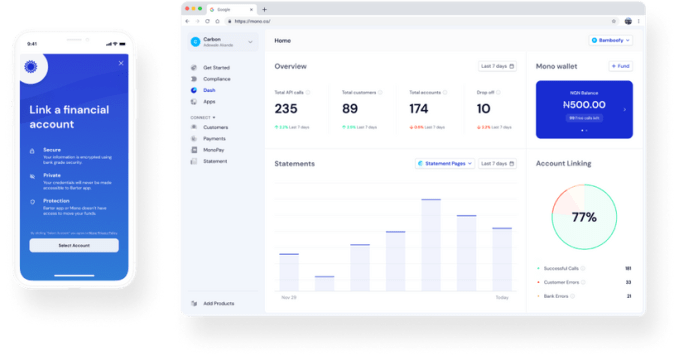
Launched in August 2020, the company streamlines various financial data in a single API for companies and third-party developers. Mono allows them to retrieve information like account statements, real-time balance, historical transactions, income, expense and account owner identification with users’ consent.

When we covered the company early in the year, it had already secured partnerships with more than 16 financial institutions in Nigeria. In addition to having a little over a hundred businesses like Carbon, Aella Credit, Credpal, Renmoney, Autochek, and Inflow Finance access customers bank account for bank statements, identity data, and balances, Mono has also connected over 100,000 financial accounts for its partners and analysed over 66 million financial transactions so far.

Mono has done impressively well in a short period. While it appears to have figured out product-market fit, CEO Abdul Hassan is quick to remind everyone that the burgeoning API fintech space is just an entry point to its pursuit of being a data company — a case he also made in February.

“The way I see it, our market is not that big. Compare the payments market now with 2016, when Paystack and Flutterwave just started. The payments space in 2016 was very small and the number of people using cards online was very small,” said Hassan, who co-founded the company with Prakhar Singh. “It’s the same thing for us right now. That’s why our focus isn’t only on open banking but data. We’re thinking of how we can power the internet economy with data that isn’t necessarily financial data. For instance, think about open data for telcos. Imagine where you can move your data from one telco to another instead of getting a new SIM card and making a fresh registration. That’s where I see the market going, at least for us at Mono.” 

Abdul Hassan (CEO) and Prakhar Singh (CTO)

He adds that the company is taking an approach of building a product one step at a time until it can fully diversify from financial data offerings, including connecting with payment gateways (Paystack and Flutterwave) and other fintechs like wealth management startups Piggyvest and Cowrywise.

“When you’re able to connect to all the systems, a lot of use cases will come up. The first step is how can we connect to all available data and open it up for businesses and developers,” he continued.

Therefore, Mono will use the funding to reinforce its current financial and identity data offerings and launch new products for diverse business verticals. Also, a long-overdue pan-African expansion to Ghana and Kenya is top priority. The last time I spoke with Hassan, the end of Q1 looked feasible to get into at least one of the two markets but it didn’t turn out that way. But the wait seems to be over as the company said it’d be going live in Ghana next month with a handful of existing customers from Nigeria and new ones in Ghana. Some of these partners include five banks (GTBank, Fidelity Bank and three unannounced banks) and the mobile money service arm of MTN Ghana.

“Our expansion is mostly inspired by our customers looking to expand to other markets, same with some of our products. We work with our customers to give them the right tools to build new experiences for their customers,” Hassan stated

Mono

Image Credits: Mono

Mono is one of the three API fintech companies to have raised a seed investment this year. Last month, another Nigerian fintech Okra closed $3.5 million while Stitch, a South African API fintech, launched with $4 million in February. Back to back investments like this show that investors are incredibly optimistic about the market. Avil Eyal, managing partner and co-founder of Entrée Capital, one of such investors, had this to say.

“We are very excited to be working with Abdul, Prakhar and the entire Mono team as they continue to build out the rails for African banking to enable the delivery of financial services to hundreds of millions of people across the African continent.”

24 May 2021

British AI startup Faculty raises $42.5M growth round led by Apax Digital Fund

British artificial intelligence (AI) company, Faculty has raised £30 million ($42.5M) in growth funding from the Apax Digital Fund (ADF). The startup has now raised a total of £40m ($56.6M) to date.

In April this year, the company announced it had won a contract to work with the UK’s NHS to better predict its future needs. It has also picked up at least seven other UK government contracts. Its customers include the UK’s National Crime Agency, Red Bull, Virgin Media, and Moonpig.

The company says it now expects to create over 400 new jobs across its engineering, product and delivery teams. The investment will also be put toward the rollout of Faculty’s new learning and development programme. Founded in 2014 by Dr Marc Warner, Dr Angie Ma and Andrew Brookes, the company is noted for its fondness for hiring swathes of maths and data science PhDs.

Far from being an aloof R&D AI operation, Faculty pitches more as an “AI as a Service”, applying its platform to real-world data for the purposes of real-world outcomes, such as optimizing a company’s marketing spend or forecasting demand for consumer goods. That said, Faculty became briefly notorious after applying its platform to the cause of Vote Leave during the UK referendum.

After helping the campaign win that fight, it’s ironically now been awarded a public contract to help the British government apply machine learning to Britain’s post-Brexit fishing waters, even as the fishing industry comes under considerable strain… because of Brexit.

Speaking to me over a call Marc Warner, CEO and co-founder of Faculty told me: “This is about doubling down on the UK first and then international expansion. We have learned what it takes to do important, impactful AI at scale. And we just don’t think that there’s actually much of it out there. Customers are rightly sometimes a bit skeptical. There’s been hype around this stuff for years and years. We figured out a bunch of real-world applications that actually deliver value. And so, ultimately, the money [we’ve raised] is really just about being able to build out all of the pieces to do that incredibly well for our customers.”

He added that Faculty plans to continue to take advantage of the UK’s talent pool: “The UK is a wonderful place to do AI. It has brilliant universities and a very dynamic startup scene. It’s actually more diverse than San Francisco. There’s government, there’s finance, there’s corporates, there’s less competition from the tech giants, so there’s a bit more of a heterogeneous ecosystem.”

Mark Beith, partner at Apax Digital, who joins Faculty’s board of directors, said: “Faculty is a world-leading AI company with cutting-edge technology, inspiring people and culture, and with phenomenal customer feedback. They enable customers to realize the tremendous value of AI quickly but responsibly, providing robust, fair, and explainable AI, with advanced data privacy. We have seen the power and impact of their solutions first-hand, as a client, and are thrilled to partner with Marc, Angie, Andy, and the team to support their global expansion.”

The Apax Digital Fund joins Faculty’s existing investors, including Guardian Media Group Ventures, LocalGlobe, and Jaan Tallinn, one of Skype’s founding engineers.

The Estonian investor gave Faculty 350 units of Ether in January 2018, worth about $434,000 at the time, and 50 Bitcoins in March 2020, worth about $316,000, according to Faculty’s financial filings at the U.K. business registry Companies House.

24 May 2021

Taking Microsoft’s Surface Laptop 4 for a spin

These days, the path of least resistance in laptop design is straight-up knocking off the MacBook. We’ve certainly seen our share of egregious cases over the years. Microsoft, however, has defiantly forged its own path with industrial design across the board. Its products are largely interesting and innovative — something not every hardware manufacturer can say these days.

The company doesn’t always get it right. It swung for the fences with the Surface Duo, for example. While certainly innovative, the product came up short in enough categories that made it extremely hard to recommend. The Surface Laptop, on the other hand, while not the most groundbreaking product in the line, has pretty consistently been one of the best, marrying a Windows-ready touchscreen with a more standardized notebook design.

The last few models have been solid, and this year’s — perhaps predictably — doesn’t present a big change. The big upgrades after about a year and a half are new chips (your choice of AMD Ryzen or an Intel Core i5 or i7) and enhanced battery life that offers a beefy additional 8.5 hours. Essentially, it’s the sort of thing you’d expect — or hope for — from a regular system refresh.

Image Credits: Brian Heater

The design language remains largely unchanged. The Surface Laptop is nothing if not unique on that front, with its tapered sides and felt-covered palm rests. The material has a nice feel to it — one that bests just straight-up metal on a cold day, though I’ve already noticed a bit of wear after some light use.

The keyboard remains on the soft side, with a surprising amount of give to it. Not the best keyboard I’ve seen on a laptop, but certainly not the worst (who can forget that rough run for Apple?), and like anything else, it takes a bit of getting used to.

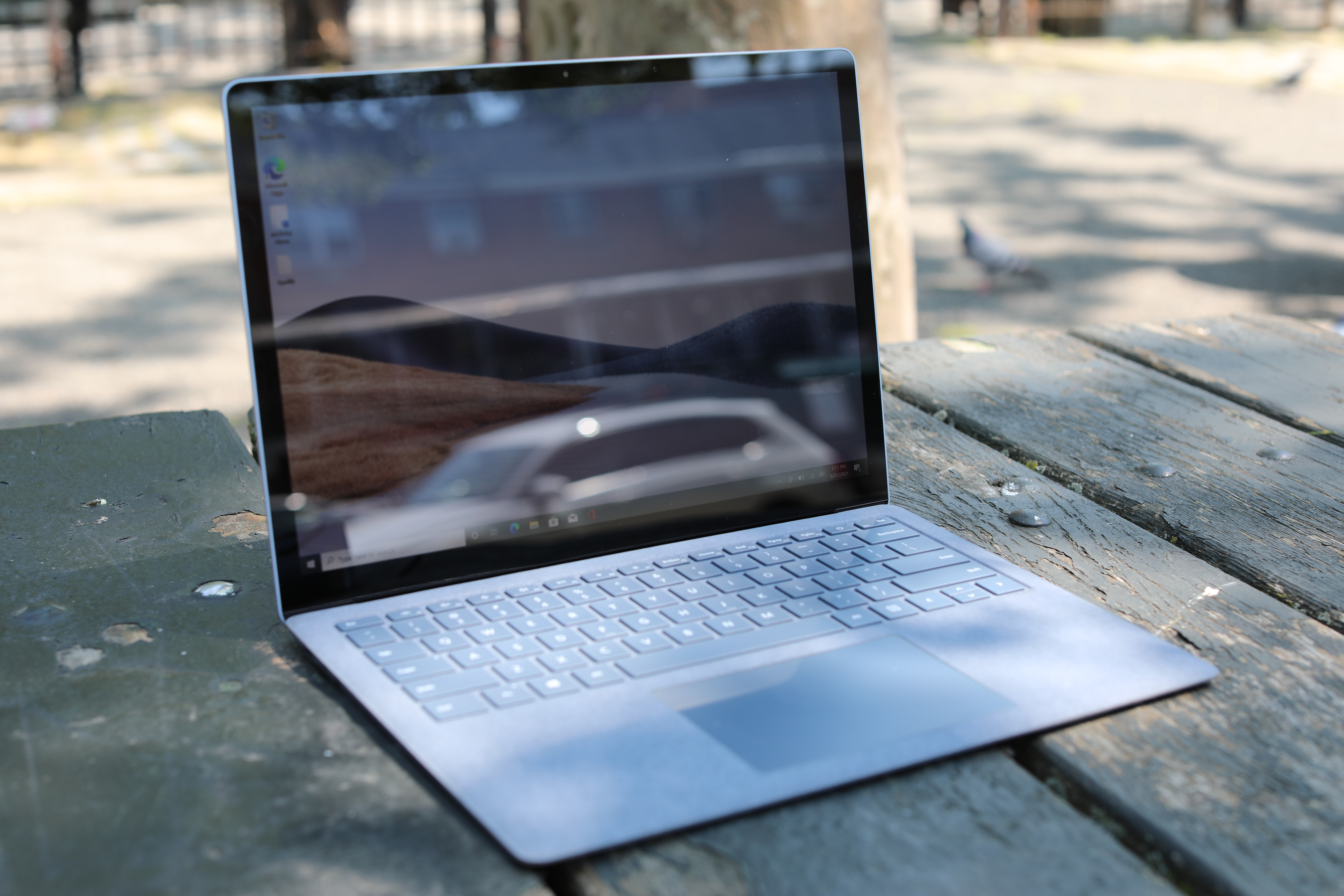
You’d think I’d have learned my lesson by now. Maybe it’s the fact that Microsoft’s Surface Laptops keep coming out when the weather is nice that I always feel inclined to take them outside. But jeez is that display reflective. Almost distractingly so. Plenty of laptop screens are glossy, of course, but Microsoft’s really leaned in here, to the point I wouldn’t recommend using it in any sort of sunshine — even at full brightness, the screen can’t counteract that reflection.

Image Credits: Brian Heater

When you can see it, the display looks great. Microsoft sent along the smaller of the two. At 13.5-inches, the screen clocks in at 2256 x 1504 at 201 ppi (you get the same pixel density on the 15-inch version, as well). Ours was the new Ice Blue color. It’s subtle, though. Honestly, I read it more as a silver/gray. The speakers sound great, and the webcam is just fine, but it’s safe to say it’s probably time to upgrade to 1080p across the board as teleconferencing remains front of mind.

The 13.5-inch system starts at $1,000, which gets you 8GB of RAM and 256GB of storage, along with the AMD Ryzen 5 4680U process. As configured, our system runs $1,700, which doubles the RAM and storage and swaps the AMD in for an Intel Core i7. Another $600 will double the RAM and storage yet again (same processor). Geekbench scored the processor at a solid 1378 on single-core and 4876 on multi-core. Performance was solid throughout — though after spending a fair amount of time using Apple’s M1, it’s clear that Intel has its work cut out for it.

[gallery ids="2156063,2156069,2156068,2156067,2156066,2156064,2156062,2156061,2156060"]

Microsoft is still hanging onto its magnetic proprietary charging port here. I know it still has its diehard fans, but I’d much prefer to see the company go with something more universal, like adding another USB-C port — though that impacts the system’s compatibility with a slew of different Surface accessories. Around the other side you get USB-A, USB-C and a headphone jack. It’s a nice mix, but more ports would certainly be a step up.

I was fairly disappointed with the various corners the company cut on the Surface Laptop Go last year. Of course, the entry-level 13.5-inch Laptop is $300 more than the 12-inch Laptop Go. But if you’re looking to do more than just the basics, this is probably is a wise investment.

23 May 2021

Air India passenger data breach reveals SITA hack worse than first thought

Three months after air transport data giant SITA reported a data breach, we are still learning about the damage.

Air India said this week that personal data of about 4.5 million passengers had been compromised following the incident at SITA, Indian flag carrier airline’s data processor. The stolen information included  passengers’ name, credit card details, date of birth, contact information, passport information, ticket information, Star Alliance and Air India frequent flyer data, Air India said in a statement (PDF).

CVV/CVC data of credit cards were not held by SITA, said Air India as it urged passengers to change passwords “wherever applicable to ensure safety of their personal data.”

The attack compromised data of passengers who had registered with the Indian airline over the past decade, between August 26, 2011 and February 3, 2021, Air India said in a statement.

The revelation comes months after SITA said it had suffered a data breach that involved passenger data. At the time, SITA said it had notified several airlines — Malaysia Airlines, Finnair, Singapore Airlines, Jeju Air, Cathay Pacific, Air New Zealand, and Lufthansa — of the breach.

The Geneva, Switzerland-headquartered firm — which is said to serve 90% of the world’s airlines — had declined to reveal the specific data that had been compromised at the time of disclosure in early March, citing an investigation — which is still ongoing.

Air India said that it was first notified about the cyber attack by SITA on February 25, but the nature of the data was only provided to it on March 25 and April 5.

The struggling Indian airline, which has been surviving on taxpayer’s money, claimed that it had investigated the security incident, secured the compromised servers, engaged with unnamed external specialists, notified the credit card issuers, and had reset passwords of its frequent flyer program.

Air India is the latest Indian firm to disclose a data breach in recent quarters. Payments giant MobiKwik said in late March that it was investigating claims of a data breach that allegedly exposed private information of nearly 100 million users.

Alleged records of nearly 20 million BigBasket (a top grocery delivery startup in India that is now owned by local conglomerate Tata) customers leaked on the dark web for anyone to download in late April. A security lapse at Indian telecom giant Jio Platforms exposed results of some users who had used its tool to check their coronavirus symptoms. Indian state West Bengal and giant blood test firm Dr Lal PathLabs suffered similar breaches. Air India’s peer, Spicejet, also confirmed a data breach last year.

Read more:

22 May 2021

Billboards? Nah, just buy a media company instead

Startups used to be obsessed with billboards. It was the first thing I noticed when I moved to San Francisco: venture-backed companies including Eaze, Airbnb, and notoriously, Brex, would post large billboard advertisements all over the city to grab attention and eyeballs. When I dug into it more, I learned this type of old school, outdoor advertising was a response to the increasingly crowded online channels, such as Facebook and Instagram advertisements.

Well, folks, years later, we have a new response to crowded marketing channels: Ditch the billboards and just buy a media company instead. There has been a recent push for startups and venture capital firms to acquire or create media companies, which I’d argue is them finding a creative way to position content marketing. This past week, Axios discovered that Coinbase is launching a media operation about cryptocurrency. At the same time, Clubhouse wants to hire freelance writers, while its biggest lead investor to-date, Andreessen Horowitz, has ambitions to open up an opinion desk. Other news bits like The Skimm exploring a potential sale and Hubspot acquiring the Hustle also add to the narrative of broader media ambitions across tech.

We got into the impact of a venture-backed media push on Equity, our award-winning (!) podcast, this week. My take, as you can tell by this introduction, is that it’s not a rush to compete with journalism. It’s a rush to compete with a noisy world, and rebrand advertisements to media operations.

I could talk about journalism and tech and media forever, but that is all on that topic today. In the rest of this newsletter, we’ll get into new IPOs, startups providing upfront revenue to other startups and tactical advice on building versus buying a tech stack. As always, you can find me podcasting @Equitypod and tweeting at @nmasc_.

IP(Oats)

Oatly went public this week, and there entirely weren’t enough jokes or puns about it. (Although I did appreciate this one). My complaint aside, it’s been a busy week for the public markets.

Here’s what to know: Marqueta, which is focused on card issuing and payments tech, has a fascinating S-1 filing — including what I’d say it’s a Peloton-Affirm relationship with Square. Alex dug into the numbers and told you what to think about its filing in The Exchange.

And a splash of oat milk please:

GettyImages 1141468846

Image Credits: Getty Images / Eugene Mymrin

Build or buy?

Telemedicine needs to prepare for a post-pandemic world, which comes with its own upfront costs, risks, and, as Marcela points out, opportunities. Around $3.1 billion in funding flowed into the sector in 2020 — about three times what we saw in 2019, according to her latest story. In order to get money and impact out, startups have some work to do.

Here’s what to know: It’s time for you to read a marketmap about telemedicine, from its current state, to different tensions, to affordability and the out-of-pocket dynamics that no one talks about.

And here’s some dessert to finish your healthy meal:

Close-up of spade shovel being used to dig a hole in soil

Image Credits: MoMorad / Getty Images

Pipe’s get burst

Everyone is paying attention to Pipe, which just raised $250 million at a $2 billion valuation. As Mary Ann puts it, the company is claiming to be the Nasdaq for revenue, and it gives SaaS companies a way to get their revenue upfront by “pairing them with investors on a marketplace who will pay a discounted rate for the annual value of those contracts.”

Here’s what to know: That wasn’t the only check that went into startups providing other startups with upfront revenue this week. Uncapped, which is the European equivalent of Pipe, raised $80 million in funding. Put differently, in less than 24 hours, TechCrunch reported that nearly $330 million went into backing the concept of startups providing other startups with upfront revenue.

Other dollar signs to pay attention to:

Image Credits: MirageC / Getty Images

Around TC

TechCrunch is looking for 20 early-stage companies to feature in Startup Battlefield at TC Disrupt 2021 this year. Startups receive a feature article on TechCrunch.com, intensive pitch training from the TC team, the chance to win $100,000 in equity free prize money, and the attention of thousands of global press and investors.

So, what are you waiting for? Apply by May 27!

Across the week

Seen on TechCrunch

Seen on Extra Crunch

Thanks for reading! Do something that requires zero technology this week. After, of course, you share this newsletter with at least two people.

Always,

N