Year: 2021

24 May 2021

The LatAm funding boom continues as Kaszek raises $1B across a duo of funds

Long before SoftBank launched its $2 billion Innovation Fund in Latin America, and before Andreessen Horowitz began actively investing in the region, Sao Paulo-based Kaszek has been putting money into promising startups since 2011, helping spawn nine unicorns along the way.

And now, the early-stage VC firm is announcing its largest fund closures to date: Kaszek Ventures V, a $475 million early-stage fund, believed to be the largest vehicle of its kind ever raised in the region, and Kaszek Ventures Opportunity II, a $525 million for later-stage investments.

Over the years, Kaszek has backed 91 companies, which the firm says collectively have raised over $10 billion in capital. 

MercadoLibre co-founder Hernán Kazah and the company’s ex-CFO, Nicolas Szekasy, founded Kaszek a decade ago after leaving LatAm’s answer to Amazon. Fun fact: the firm’s name comes from a combination of their two last names: Ka-Szek. Rounding out the team are Nicolas Berman, former VP at MercadoLibre, Santiago Fossatti, Andy Young and Mariana Donangelo.

Kaszek founded its first fund in 2011, raising $95 million, an impressive sum at that time. Funds II and III closed in 2014 and 2017, raising $135 million and $200 million, respectively. By 2019, Kaszek had closed on its fourth fund, raising $375 million and its first Opportunity Fund, reserving $225 million for later-stage investing in existing portfolio companies.

It’s notable that in its fifth fund, Kaszek is reserving more of its new capital to fund later-stage investments – a testament to its faith in its current portfolio. Both funds, according to Kaszek, were “several times oversubscribed” with demand coming globally from university endowments, global foundations, technology funds and several tech entrepreneurs.

Silicon Valley-based Sequoia Capital has been an LP since day one via Sequoia Heritage, its community investment office. Also, Connecticut-based Wesleyan University is an LP with Chief Investment Officer Anne Martin describing the founding team as “internet pioneers.”

In recent years, there’s been an explosion of global investor interest in Latin American startups. The region’s startup scene is seeing a surge of fundraises, with new unicorns emerging with increasing regularity. And Kaszek has been at the heart of it all.

“We have been at the epicenter of the technology ecosystem in Latin America since 1999, first with MercadoLibre and now with Kaszek, and have witnessed firsthand the extraordinary  evolution that the sector has experienced since its infancy,” said managing partner and co-founder Kazah. “When MercadoLibre started, the internet penetration was less than 3% and it was mostly dial-up connections. Today, more than two decades later, technology secular trends are stronger than ever before as we are experiencing an acceleration towards digitalization.”

Kaszek has not yet backed any companies out of its newest investment vehicles, but plans to put money in 20 to 30 companies out of its early-stage fund, with check sizes ranging from $500,000 to $25 million, according to Kazah. Its Opportunity Fund investments will be more concentrated with the firm likely backing 10 to 15 companies with check sizes ranging from $10 million to $35 million. The firm is industry agnostic, with Kazah saying it considers “any industry where technology is playing a transformational role.”

General partner and co-founder Szekasy says that In the firm’s first funds, Kaszek mostly backed first-time entrepreneurs. But in its last early-stage fund, it began backing more teams led by repeat entrepreneurs or by founders spawned out of some of the region’s more successful startups.As many VC firms do, Kaszek describes its investment strategy as providing more than capital, but also becoming partners with the founders of its portfolio companies. For example, Creditas founder and CEO Sergio Furio describes the firm as “the co-founder I did not have.”

While the firm declined to comment on performance, a source with firsthand knowledge of its metrics over the years tells TechCrunch that it’s quite impressive with MOICS ranging from 19.2 for Fund I to 2.6 for Fund IV.

The firm’s active portfolio currently consists of 71 companies. Kaszek was one of the earliest investors in Brazilian neobank Nubank, just one of 9 unicorns it has helped build over the years. Other unicorns it’s backed include MadeiraMadeira, PedidosYa, proptech startup QuintoAndar, Gympass, Loggi, Creditas, Kavak and Bitso.

The firm’s investments have largely concentrated in Brazil and Mexico (the two startup hotspots of the region) and Colombia but the firm has also backed startups based in other countries in the region such as DigitalHouse (which was formed in Argentina), NotCo (originally founded in Chile) and Kushki (launched first in Ecuador). It has people on the ground in its home base of Brazil as well as Mexico, the United States, Argentina and Uruguay. 

“We have always believed that the strong secular technology trends that we were seeing 20 years ago, evident in the US and a little later in China, were going to happen in Latin America,” Kazah told TechCrunch. “…Everything we predicted back then was going to happen, happened. Maybe it happened later, but it was also much larger and more comprehensive than what we had initially imagined. That is typically what happens with innovations, they take off later than you think, but fly much higher than you ever imagined.” 

24 May 2021

In a YC “power” play, Gridware girds $5.3M to save humanity from weather

You might have thought that with more than 300 companies joining this year’s winter batch of Y Combinator, the investor interest might have thinned. Well, it’s 2021 and investors are hopping around like crazy to invest in ideas that push the boundaries in fields far flung from enterprise SaaS.

Case in point today: Gridware. It’s a startup I profiled earlier this year when it had just started up in its YC batch. As I wrote about how it wants to save our power grids from the ravages of climate change:

Its approach is to use a small, sensor-laden box that can be installed to a power pole with just four screws. Gridware’s package contains microphones and other sensors to sense the ambient environment around a power pole, and it uses on-board AI/ML processing to listen for anomalies and report them to the relevant managers as appropriate.

Hardware, IoT, infrastructure, utilities and government are five keywords you probably most would have wanted to avoid when pitching investors even a few years ago. But with power disappearing in states like California and Texas for stretches of time, investors have perhaps finally realized there is an opportunity to save the planet and make a bit of money here.

Gridware today announced that it has raised $5.3 million in a seed round led by Priscilla Tyler of True Ventures and Seth Bannon and Shu Yang of Fifty Years. CEO and co-founder Tim Barat said fundraising was quite fierce. “We had 130 investors reach out to us, and I wasn’t even able to get back to some of them yet … [I’m] still going back through the emails,” he said. “Even before Demo Day, we had raised a significant portion of our round.”

For him and the Gridware team, they were looking for investors who were mission-driven and really understood the timeline it would take to build the company. “You see a lot of investors say they are mission-driven … but when it comes time to put their money where their mouth is, it often goes to consumer technology where it is safer,” he said. Tyler at True leads climate investing for the firm, and True has made a variety of bets in the space. Fifty Years focuses on startups tackling the UN’s list of 17 Sustainable Development Goals.

You can read more about the company’s product and market in my profile from three months ago, but with the new funding, Gridware wants to double down on building a very intentional team capable of tackling this tough market. “Dealing with this multi-stakeholder business model is very challenging, so bringing on people with the experience, knowledge and wits to deal with this kind of environment is key,” Barat said.

As I explored recently, the disaster response space is probably one of the toughest markets in the world to sell into. Barat acknowledged the intrinsic difficulty, but sees huge potential in the long run. “One of the things that I have observed with the companies being successful — they really spend the time to meet as many stakeholders as possible,” he said. “With consumer, you can stand in front of a shopping mall and talk to 100 customers in a day [but] in govtech, getting 100 meetings even within a year is a huge accomplishment.”

The company will be re-opening its Bay Area office in Walnut Creek next week on June 1.

24 May 2021

US towns are buying Chinese surveillance tech tied to Uighur abuses

At least a hundred U.S. counties, towns, and cities have bought China-made surveillance systems that the U.S. government has linked to human rights abuses, according to contract data seen by TechCrunch.

Some municipalities have spent tens of thousands of dollars or more to buy surveillance equipment made by two Chinese technology companies, Hikvision and Dahua, after the companies were added to the U.S. government’s economic backlist in 2019 after the companies were linked to China’s ongoing efforts to suppress ethnic minorities in Xinjiang, where most Uighur Muslims live. Congress also banned U.S. federal agencies from buying new Hikvision and Dahua technology or renewing contracts over fears that it could help the Chinese government to conduct espionage.

But those federal actions broadly do not apply at the state and city level, allowing local governments to buy these China-made surveillance systems — including video cameras and thermal imaging scanners — largely uninhibited, so long as federal funds are not used to buy the equipment.

Details of the contracts were provided by GovSpend, which tracks federal and state government spending, to TechCrunch via IPVM, a leading news publication on video surveillance, which has followed the Hikvision and Dahua bans closely.

The biggest spender, according to the data and as previously reported by IPVM, showed that the Board of Education in Fayette County, Georgia spent $490,000 in August 2020 on dozens of Hikvision thermal cameras, used for temperature checks at its public schools.

A statement provided by Fayette County Public Schools spokesperson Melinda Berry-Dreisbach said the cameras were purchased from its longtime security vendor, authorized dealer for Hikvision. The statement did not address whether the Board of Education was aware of Hikvision’s links to human rights abuses. Berry-Dreisbach did not respond to our follow-up questions.

IPVM research found many thermal scanners, including Hikvision and Dahua models, produced inaccurate readings, prompting the U.S. Food and Drug Administration to issue a public health alert warning that misreported readings could present “potentially serious public health risks.”

Nash County in North Carolina, which has a population of 95,000 residents, spent more than $45,000 between September and December 2020 to buy Dahua thermal cameras. County Manager Zee Lamb forwarded emails that confirmed the purchases and that the gear was deployed at the county’s public schools, but did not comment.

The data also shows that the Parish of Jefferson in Louisiana, which includes part of the city of New Orleans, spent $35,000 on Hikvision surveillance cameras and video storage between October 2019 and September 2020. A parish spokesperson did not comment.

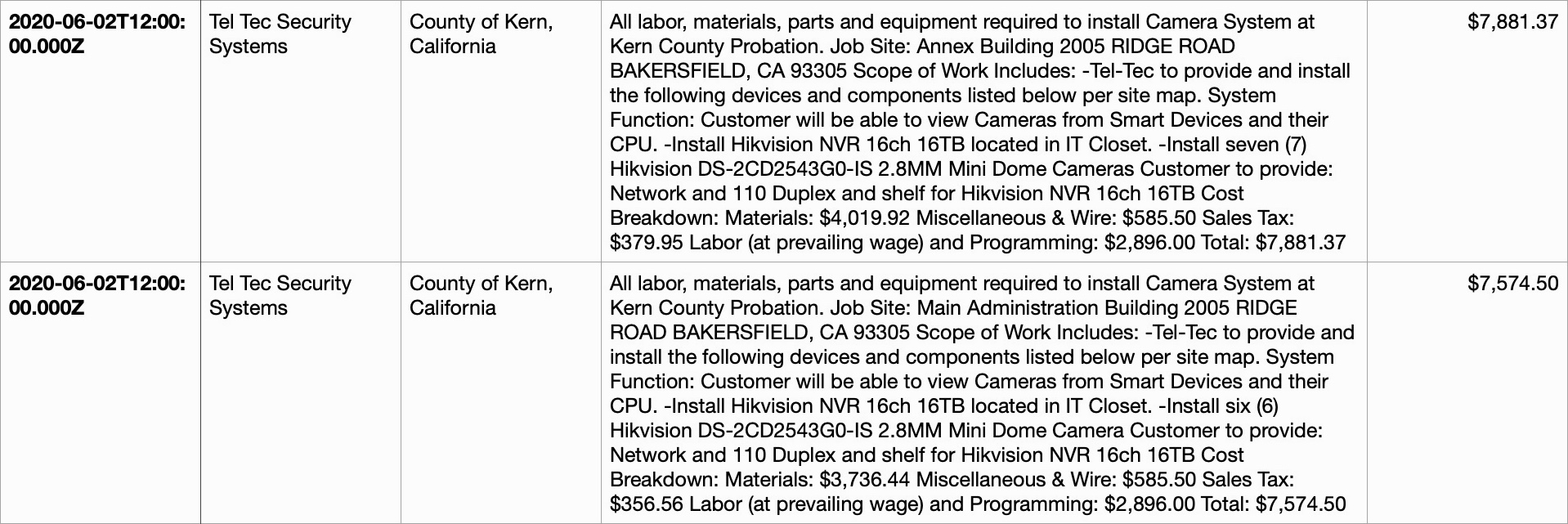
Only one municipality we contacted addressed the links between the technology they bought and human rights abuses. Kern County in California spent more than $15,000 on Hikvision surveillance cameras and video recording equipment in June 2020 for its probation department offices. The contract data showed a local vendor, Tel Tec Security, supplied the Hikvision technology to the county.

Ryan Alsop, chief administrative officer for Kern County, said he was “not familiar at all with the issues you’re referencing with regard to Hikvision,” when asked about Hikvision’s links to human rights abuses.

“Again, we didn’t contract with Hikvision, we contracted with Tel Tec Security,” said Alsop.

Kern County spent more than $15,000 on Hikvision equipment at its county probation service offices. (Data: GovSpend/supplied)

A spokesperson for the City of Hollywood in Florida, which spent close to $30,000 on Hikvision thermal cameras, said the Chinese technology maker “was the only major manufacturer with a viable solution that was ready for delivery; would serve the defined project scope; and was within the project budget.” The cameras were used to take employees’ body temperatures to curb the spread of COVID-19. The spokesperson did not address the links to human rights abuses but noted that the federal ban did not apply to the city.

Maya Wang, a senior researcher at Human Rights Watch, said a lack of privacy regulations at the local level contributed to municipalities buying this technology.

“One of the problems is that these kinds of cameras, regardless of the country of origin and regardless of whether or not they’re even linked to human rights abuses, have been introduced to various parts of the country — especially at state and city levels — without any kind of regulation to ensure that they comply with privacy standards,” said Wang in a call. “There is, again, no kind of regulatory framework to vet the companies based on their track record, whether or not they have abused human rights in their practices, such that we can evaluate or choose better companies, and encourage the ones with better privacy protections to win, essentially.”

Chief among the U.S. government’s allegations are that Beijing has relied heavily on Hikvision, Dahua, and others to supply the surveillance technology it uses to monitor the Uighur population as part of the government’s ongoing efforts to suppress the ethnic group, which it has repeatedly denied.

United Nations watchdogs say Beijing has detained more than a million Uighurs in internment camps in recent years as part of these efforts, which led to the U.S. blacklisting of the two surveillance technology makers.

In adding the companies to the government’s economic blacklist, the Commerce Department said Hikvision and Dahua “have been implicated in human rights violations and abuses in the implementation of China’s campaign of repression, mass arbitrary detention, and high-technology surveillance against Uighurs, Kazakhs, and other members of Muslim minority groups.” The Biden administration called the human rights abuses a “genocide.”

IPVM has also reported extensively on how the companies’ surveillance technology has been used to suppress the Uighurs. Dahua was found to have race detection in its code for providing “real-time Uighur warnings” to police.

Earlier this year, the Thomson Reuters Foundation found half of London’s councils and the largest 20 U.K. cities were using the technology linked to Uighur abuses. The Guardian also found that Hikvision surveillance technology was used in U.K. schools.

When reached, Dahua pointed to a blog post with a statement, and claimed that “contrary to some reporting in the media, our company has never developed any technology or solution that seeks to target a specific ethnic group.” The statement added: “Claims to the contrary are simply false and we are aware of no evidence that has ever been put forward to support such claims.”

Hikvision did not respond to a request for comment.


Send tips securely over Signal and WhatsApp to +1 646-755-8849. You can also send files or documents using our SecureDrop. Learn more

24 May 2021

Sensor Tower makes its first acquisition with deal for market intelligence company, Pathmatics

Mobile app market intelligence firm Sensor Tower has made its first acquisition. The company this morning announced it’s acquiring Pathmatics, a market intelligence company which will now combine its paid digital and social media platform with Sensor Tower’s business. Deal terms were not detailed but include an undisclosed growth investment from Riverwood Capital into Pathmatics.

The acquisition will allow the companies to offer an expanded set of digital and mobile advertising insights to their respective customers, including new social insights for TikTok, YouTube mobile, and Snap this year, powered by Sensor Tower.

They companies will also introduce digital TV (over-the-top) insights, expanded coverage for mobile apps and ad insights, and will extend Pathmatics’ social and digital coverage globally.

The deal follows Sensor Tower’s first significant fundraising last year, with $45 million also from Riverwood Capital. Though Sensor Tower had been profitable since its launch, now serving more than 350 enterprise-level customers for its app and ad intelligence products, it chose to raise the additional capital in order to further grow its business, with investments in hiring, marketing, infrastructure and other expansions.

With Pathmatics, it’s buying a company that’s also been on its way up. The company had seen over 100% year-over-year growth for its own market intelligence business since launching in 2011. It now has over 250 brands, media and advertising agencies as customers, as well as over 7,000 users of its platform, representing over 200% software-as-a-service growth since 2018.

The two businesses are teaming up at a time when digital advertising is also on the rise, in part due to the shifts in the market attributed to the pandemic. As more businesses began operating online last year, advertisers increased their digital ad spending by 12.7% to $368 billion, per eMarketer. And digital advertising will account for 58% of media spending in 2021.

We understand Sensor Tower acquired both the IP and its over 60-person team from Pathmatics as a result of the acquisition. The entire team will join Sensor Tower with the executive suite now being a combination of both of the company’s leaders. Sensor Tower co-founder Alexey Malafeev will remain as CEO while Gabe Gottlieb, CEO and co-founder of Pathmatics, will become Chief Strategy Officer.

Historically, Pathmatics had provided brands and agencies with all creative used by advertisers, spend and impression, and path to publisher and viewer, to help them reduce waste from their budgets, improve their own marketing, and predict their competitors’ next move.

Going forward, both sets of customers will be able to opt into the other company’s solutions, including mobile, social media, and digital insights. Longer-term, the two companies will work together to bring more products to the market for their over 600 combined customers across 50 countries. Among these is a plan to add Pathmatics’ Facebook, Instagram, Twitter and other digital ad intelligence capture into Sensor Tower, as well as an effort to augment Sensor Tower’s dataset with ad insights beyond app installs.

These features will make the product a better fit for larger brands looking into all aspects of the competitors’ campaigns, ranging from how they’re advertising for app installs to how they’re building brand awareness.

The deal officially closed on May 17, 2021, Sensor Tower says.

Santa Monica-based Pathmatics had raised $7.7 million to date from Upfront Ventures, BDMI and Baroda Ventures.

“As the global economy increasingly shifts to digital, it’s imperative that companies can understand and
navigate the entire digital landscape — from mobile to web and desktop — using accurate and insightful data,” noted Ramesh Venugopal, Principal at Riverwood Capital, in a statement about the acquisition. “The combination of Sensor Tower and Pathmatics presents a unique and valuable offering to customers allowing them to take advantage of a broad range of datasets with increased focus on consumer privacy and deep digital insights that leaders in every industry will need,” he added.


24 May 2021

Beacons raises $6 million for its link-in-bio homepage builder that lets creators monetize

Mobile landing page builder Beacons has raised $6 million seed round to expand its vision for empowering creators to make money beyond the cramped confines of their social media profiles. The company, co-founded by Neal Jean, Jesse Zhang, Greg Luppescu and David Zeng, provides anyone who uses social media a single, mobile-optimized link hub to display to their followers.

Like competitor Linktree, Beacons gives people a way to link out to other sites directly from their TikTok, Instagram, or Twitter profile, including pointing followers toward potential income streams like donations and affiliate links. Other companies in the “link in bio” space include Shorby, Milkshake, Tap.bio, Link in Profile, bio.fm and Campsite.

Beacons launched in private beta in September 2020 after emerging out of Y Combinator’s Summer 2019 cohort. Andreessen Horowitz will lead the seed round and is joined by Atelier Ventures, The Chainsmokers’ Mantis Fund, Night Media Ventures and LOUDgg, the Brazilian esports group.

The $6 million seed round will build on $600,000 that Beacons raised in an angel round, allowing the team to hire more engineers and designers to grow its small four-person team of first-time founders.

“I think where we’re really different than Linktree is we let creators customize and personalize their pages all for free and we offer a lot more of those options on our free plan,” Beacons co-founder and CEO Neal Jean told TechCrunch.

“…Creators care a lot about how their website looks so that’s been a good way for us to give creators the features that they want and help us grow our share in the market too.”

To keep creators locked into their own platforms and forthcoming monetization schemes, social media companies don’t offer much support for embedded links, particularly on individual pieces of content. Many also restrict users to one URL in their profiles, putting pressure on creators to maximize the utility of a single link. Beacons reasonably argues that the restrictive design of most social platforms stunts the ability of creators to easily and flexibly make money from their content.

“In the beginning we’re basically building all these different kinds of features for creators to use but I think in the long run the way to make that more scalable is to turn into more of a platform or an ecosystem that lots of people can build on,” Jean said.

“Today, I think we’re probably more like a Wix or a Squarespace for content creators, but in the future I think we want to be a little bit more like Shopify for creators.”

Building on Beacons

Beacons lets users choose between free and premium tiers. At $10 per month, the “entrepreneur” tier offers a couple of killer features worth considering, including support for custom domains and additional “blocks” — the link, text and image slots that comprise a Beacons page.

Beyond premium pricing, Beacons makes money by taking a cut of sales through its handful of monetization-focused blocks, like a shopping-enabled TikTok feed, a digital storefront for videos and ebooks, and a “requests” block that lets creators sell custom content directly to their followers. Beacons’ free plan charges a 9% fee on transactions, while the premium plan cuts that down to 5%.

Landing sites built through Beacons are deeply customizable, hearkening back to the MySpace era of media-rich, curated homepages. The company recently added what it calls the “community block,” a designated place where creators can highlight collaborators they might team up with often on a collab-obsessed platform like TikTok. The company currently counts Sia, Green Day and Russell Brand among its high profile users.

Beacons also supports mobile marketing through email and SMS and analytics to help creators understand their audiences. The company says that its user base has grown by 70% every month since its October launch.

Today’s content creators and consumers have more sophisticated expectations than existing social platforms allow,” Jean said in the funding announcement. “…With Beacons, creators can control their destiny by directing online traffic to a custom domain that looks awesome, is shareable and ultimately generates revenue.” 

24 May 2021

The Station: London scooter winners and Ford’s most important EV

The Station is a weekly newsletter dedicated to all things transportation. Sign up here — just click The Station — to receive it every weekend in your inbox.

Hello and welcome back to The Station, a weekly newsletter dedicated to all the ways people and packages move (today and in the future) from Point A to Point B.

I want to point to two Extra Crunch articles before jumping into the rest of the news and analysis. Yes, Extra Crunch requires a subscription. We’re ramping up the transportation analysis and features in EC and I hope you find it worthwhile.

We’re ramping up our founder Q&A series. The first one was an interview with Revel founder and CEO Frank Reig. This time, it is Arrival founder Denis Sverdlov, who founded his first company at 22 selling IT consulting software to enterprise customers. Since then, he has built and exited multiple companies, most notably telecommunications operator Yota Group. He also founded Roborace.

We have two more interviews coming up with Veo co-founder and CEO Candice Xie and Refraction AI co-founder Matthew Johnson-Roberson.

Finally, we published a piece that examines voice recognition in vehicles, a marketplace that has tech giants like Google and Amazon competing for space with a few up and comers and established suppliers like Cerence.

A friendly reminder that my email inbox is always open — and yes, I do read your messages. Email me at kirsten.korosec@techcrunch.com to share thoughts, criticisms, offer up opinions or tips. You can also send a direct message to me at Twitter — @kirstenkorosec.

Micromobbin’

Dott, Lime and TIER have won the long-awaited, much-coveted bid to operate e-scooter shares in London. The pilot, which will run for up to 12 months, will begin June 7 in some of London’s boroughs, including Canary Wharf and the City of London. More neighborhoods are expected to join as the year progresses, according to TfL. Lambeth and Southwark are also seeking participation. Between 60 to 150 scooters will be available initially in each borough.

This announcement is significant not only because London is one of the biggest targets for micromobility shares, but also because Transport for London is very keen on collecting data from the scooter companies that will help determine how e-scooters could be integrated into a sustainable transport pandemic recovery plan.

Can micromobility address the racial wealth gap?

The Bedford Stuyvesant Restoration Corporation released a report entitled Cementing an Equity Framework for Micro Mobility that talks about next steps for its NYC Better Bike Share Partnership and outlines goals for fostering equity and opportunity for communities of color through public transportation.

“Creating a truly equitable bikeshare system is about more than just placement of stations and the price of fares. It requires deep partnerships with the community and empowering the voices of those who have been traditionally underserved,” said Laura Fox, General Manager of Citi Bike. “We are grateful to the Bedford Stuyvesant Restoration Corporation for their leadership and ongoing efforts to create a culture of cycling, particularly by addressing street safety. As this progress report highlights, we have many accomplishments to be proud of and we look forward to continued partnership to build on these successes.”
Accessible mobility is one of the major drivers of wealth, and I’m a big proponent of the potential for active forms of mobility, from e-scooters to push bikes and everything in between, to both help cities cut emissions and help residents stay healthy.

From a startup’s perspective, can you even contribute to this equitable goal and also make money? I’ll be discussing this in a few weeks at our TC Mobility Event on June 9 with advocate and consultant Tamika Butler, CEO and co-founder at Remix, Tiffany Chu, and CEO and co-founder of Revel, Frank Reig.

Spinning tales of SPACs…

The aftereffects of Bird going SPAC last week is that now we’re all wondering which micromobility company is going to go SPAC next. Will it be Lime? TIER? Or maybe Spin? Bloomberg reported Ford is considering divesting Spin, according to “people familiar with the matter.”

Currently, we have a lot of whisperings and speculation and not a lot of facts. Rumors circulating involve Spin spinning off from Ford or merging with a special purpose acquisition company. Spin did not want to comment, and I think that’s fair given the nebulous shape of this “news.”

While we’re on the subject of Bird…

Bird is working with IT Asset Partners (ITAP) to give its batteries a second life. So, when a scooter reaches the end of its life, it’s broken down for parts, with batteries shipped over to ITAP. Then ITAP breaks down each battery module to the cellular level to get as many reusable battery bits as possible.

This is not only an eco-friendly way to do business, but it’s also increasingly necessary in a world that’s going electric faster than supply can keep up with.

“The circular economy is where the world is going, and it will help determine how global businesses function over the next 10 years,” said Robert Mullaney, Director of Business Development at ITAP, in a Bird blog post announcing the partnership. “As battery technology has improved year over year, their second life potential has increased as well, allowing them to be used in broader and more advanced applications. This includes things like computers and computer chargers.”

— Rebecca Bellan

Deal of the week

money the station

Is it me or am I seeing more activity in the aviation/eVTOL sector these days? We’ve had three SPACs — Lillium, Archer and Joby — plus a smattering of other funding news in the past four months.

And now, there’s one more to add to the list. Electric aviation startup Beta Technologies closed a $368 million Series A funding round with investments from Amazon’s Climate Pledge Fund. The new capital is the second round of funding announced by the company this year, after the company raised $143 million in private capital in March. Beta’s valuation is now at $1.4 billion, putting it in a small circle of electric vertical take-off and landing (eVTOL) unicorns.

The funding round was led by Fidelity Management & Research Company, with undisclosed additions from Amazon’s Climate Pledge Fund, a $2 billion fund established in September 2019 to advance the development of sustainable technologies. The Climate Pledge fund has also made contributions toward electric vehicle manufacturer Rivian, battery recycler Redwood Materials and ZeroAvia, a hydrogen fuel cell aviation company.

Beta is a bit different from other high valuation eVTOL startups. The Vermont-based company isn’t primarily focused on air taxis. Instead, it’s been targeting defense applications, cargo delivery and medical logistics, as well as building out its network of rapid-charging systems in the northeast U.S. Its debut aircraft, the ALIA-250c, was built to serve these various solutions by being capable of carrying six people or a pilot and 1,500 pounds.

Other deals that got my attention …

Mile Auto, insurance tech startup, raised $10.3 million in a seed funding round that includes investment from Ulu Ventures, Emergent Ventures, Thornton Capital, and Sure Ventures. The company said it will use the funding to expand availability of its insurance offering to half of the U.S. auto insurance market by the end of 2021, as well as hiring, adding new distribution channels, onboarding of white-label partners and expanding its automaker network. Mile Auto has also partnered with Ford Motor to offer auto insurance to owners. Mile Auto launched a similar program with Porsche Financial Services in 2019.

Portside, an aviation startup that is building a platform for managing the backend of a corporate flight department, charter operation, government fleet and fractional ownership operation, today announced that it has raised a $17 million funding round led by Tiger Global Management, with participation from existing investors I2BF Global Ventures and SOMA Capital.

Twaice, the German battery analytics software company, raised $26 million in Series B funding led by Chicago-based Energize Ventures. The company, which primarily works in the mobility and energy storage industries, now has a total financing of $45 million.

Virtuo, a Paris-based startup that lets people rent a car for a few days, or up to a few months, has raised $96 million. The funding money will be using to invest in its tech and to expand to more markets beyond France, U.K. and Spain.

Waybridge, a company that has created a supply chain platform for raw materials, raised $30 million in a Series B funding round co-led by Rucker Park Capital and Craft Ventures, with participation from Venrock. The company has developed a digital platform that lets customers track inventory and shipments. Waybridge’s pitch is that its product can help companies navigate disruptive events like the Suez Canal traffic jam and COVID-19.

WeaveGrid raises $15 million Series A round to enable widescale adoption of EVs on the electric grid. Coatue and Breakthrough Energy Ventures will join existing investors to drive software innovation at intersection of utility and automotive sectors.

Wejo, the British automotive-data startup backed by General Motors, is in talks to go public through a merger with Virtuoso Acquisition Corp., Bloomberg reported.

Policy corner

the-station-delivery

Welcome back to Policy Corner! A decision from a little-known but very powerful California regulator caught my eye this week. The California Air Resources Board, which regulates air quality in the state, adopted new rules on Thursday that will require 90% of ride-share trips to be completed by electric vehicles by 2030.

It’s important to remember that ride-sharing giants Uber and Lyft have both vowed to go 100% electric fleets by that year, but this is the first time that a state has adopted EV requirements for ride-share companies. In written comments submitted ahead of the hearing, both Uber and Lyft urged the Board to create EV rebates that are specifically targeted at high-mileage drivers and fleets, and to install EV chargers in “urban and traditionally underserved areas.”

“California’s EV incentive programs and EV infrastructure investments over the past decade have served an exclusive population―wealthy, white, homeowners―that does not reflect Lyft’s driver population,” Paul Augustine, Lyft’s senior manager of sustainability, said in submitted comments.

Back over in Washington, there was a hearing at the House Committee on Energy and Commerce about the ways in which new automotive technologies (like autonomous driving) might enhance vehicle safety and help cut down on the many thousands of automotive deaths that occur on U.S. roads each year.

AV proponents like the Self Driving Coalition point to the many possible safety benefits of AVs. Electrical engineer Ragunathan Rajkumar, who testified at the meeting, urged lawmakers to advance a policy framework to support innovation to ensure America stays competitive against foreign rivals in AV technology.

However, the committee also heard testimony from people who urged a careful and pragmatic approach to AVs. Greg Regan, in testimony representing the AFL-CIO, argued that transportation workers should have a place at the table in conversations about AV deployment. He also said that the government should enact policy to ensure that the AV manufacturing industry yields secure jobs for American workers. Jason Levine, executive director of the Center for Auto Safety, argued that other safety and design upgrades, as well as improved vehicle performance standards, could do much to save lives in the near-term.

“The idea that tens of thousands of unproven and unregulated AVs deployed quickly and without oversight, or a significant upgrade in highway and road infrastructure, will automatically be safer than what we have now may make for a good talking point in a quarterly earnings report — but is not good transportation policy,” he said in his testimony.

The issue of forced arbitration also came up during the hearing. Below is an exchange between Congressman Rush and Jason Levine, who is the executive director of the Center for Auto Safety.

RUSH: As you know, even pedestrians may lose their right to seek justice in the courts if there is a continued proliferation of forced arbitration clauses. These clauses are often buried in terms of service agreements that waive a consumer’s right to sue in court, participate in a class action, or appeal the arbitrator’s decision. Do forced arbitration clauses related to AVs pose a danger to pedestrians? If so, why?

LEVINE: They pose a real threat. The threat is this, as we discussed earlier, the ability to make sure you’re holding any manufacturer, AV or otherwise, responsible for something defective, a defective vehicle, is critical to safety, it is a backstop to our entire system. And so, if you are a pedestrian who has entered into an agreement unknowingly, when you downloaded an app to order a pizza maybe, and you get hit by a pizza delivery vehicle, and you said, “well I’m going to do everything from a legal standpoint through binding arbitration,” you have now lost your ability to go to court. That sounds outlandish, but it’s not actually that far from where we are in terms of binding arbitration removing our ability to hold manufacturers accountable. So that’s something that we do not want to see in an AV context.

Station readers: what do you think?

 — Aria Alamalhodaei

Notable reads and other tidbits

Lots to get to this week.

Autonomous vehicles

May Mobility announced it is launching a new autonomous shuttle service in Ann Arbor, Michigan. The free shuttle service called A2GO will be available to the public starting Oct. 11, 2021. May Mobility said it will operate a fleet of five autonomous, shared, on-demand vehicles as part of the A2GO deployment. Four hybrid-electric Lexus RX 450h vehicles, which can carry three passengers, and one Polaris GEM fully electric vehicle that has capacity for one wheelchair passenger will operate in a service area that connects Kerrytown, the University of Michigan campus and the State Street corridor.

Chinese robotaxi startup Pony.ai has been given permission by California regulators to pilot its autonomous vehicles without a human safety driver behind the wheel in three cities. While dozens of companies — 55 in all — have active permits to test autonomous vehicles with a safety driver, it’s far less common to receive permission for driverless vehicles. Pony is the eighth company to be issued a driverless testing permit in the state, a list that includes Chinese companies AutoX, Baidu and WeRide as well as U.S. businesses Cruise, Nuro, Waymo and Zoox. Only Nuro has been granted a so-called deployment permit, which allows it to operate commercially.

Electric vehicles

It was a big week for EVs, and not just because of the Ford F-150 Lightning reveal. Although that was certainly the biggest EV reveal.

Ars Technica had a fun and brief look at electric vehicles in the beginning of the automotive age.

Canoo gave a few more details of its electric microbus-slash-van, which will be available to buy in 2022 at a base price of $34,750 before tax incentives or add-ons. The Los Angeles-based company, which debuted on the Nasdaq public exchange earlier this year, now taking preorders in the United States for the “lifestyle” vehicle, as well as for its round-top pickup truck and multi-purpose delivery van. While Canoo did not release pricing for the other two vehicles, it said that deliveries for the pickup and production for the delivery van are slated to start as early as 2023. Customers can reserve a model by placing a $100 deposit per vehicle with the company.

The company also disclosed in a regulatory filing that it is being investigated by the U.S. Securities and Exchange Commission, just months after its merger with special purpose acquisition company Hennessy Capital Acquisition Corp. The investigation is broad, covering the Hennessy’s initial public offering and merger with Canoo, the company’s operations, business model, revenues, revenue strategy, customer agreements, earnings and other related topics, along with the recent departures of certain of the company’s officers, according to its first quarter earnings report. Canoo learned of the investigation on April 29. Canoo noted in the regulatory filing. The company added that it does not consider the investigation or other lawsuits it is facing to be material to its business.

ElectReon, an inductive in-road charging technology for commercial and passenger electric vehicles, is joining the “Arena of the Future” project in Brescia, Italy where it will integrate its wireless technology to charge two Stellantis vehicles, and an IVECO bus while driving. The project aims to demonstrate contactless charging for a range of EVs as they drive on highways and toll roads as a potential pathway to decarbonizing our transportation systems along motorway transport corridors.

Ford had a a few EV news items coinciding with the F-150 Lightning reveal. First, there was the truck’s debut, which is arguably its most important new product in years and a critical piece of the company’s $22 billion investment into electrification. This is a challenging vehicle for Ford. As I noted in my coverage, the truck will need everything that has made its gas-powered counterpart the best-selling vehicle in North America as well as new benefits that come from going electric. That means torque, performance, towing capability and the general layout has to meet the needs of its customers, many of whom use it for commercial purposes. The vehicle specs suggest that Ford has delivered on the torque and power, while keeping the same cab and bed dimensions as its gas counterpart.

We ran a poll the night of the reveal asking folks “which electric truck is for you?” The choices and results were 37% picked the Ford F-150 Lightning, 19.6% choose Rivian R1T and 43.4% said they’ll hodl the Tesla Cybertruck.

Ford is offering one item that some customers might find appealing. Ford said its new F-150 Lightning truck, which will come to market in spring 2022, can provide energy to a customer’s home in the event of an outage.

Meanwhile, Ford also announced that it has signed a memorandum of understanding with SK Innovation to establish a joint venture to manufacture batteries for electric vehicles in the United States. The new venture, dubbed BlueOvalSK, will produce around 60 GWh annually starting mid-decade. The MOU is the latest sign that Ford intends to vertically develop its battery capabilities.

Finally, the Verge interviewed Ford CEO Jim Farley.

UPDATE: Ford revealed Monday morning the 2022 F-150 Lightning Pro, a version of the truck designed with commercial customers in mind.

Kia, which held its U.S. reveal of the the Kia EV6, an all-electric crossover that is supposed to kick off the automaker’s Plan S strategy to shift away from internal combustion engines and toward EVs. The EV6, one of 11 electric vehicles that Kia plans to deliver globally by 2026. will come to the U.S. early next year. It’s also the first dedicated battery-electric vehicle to be built on its new Electric-Global Modular Platform, which is shared with Hyundai and Genesis as part of the Hyundai Motor Group.

Lamborghini announced it is going to eventually electrify its portfolio, although it is taking a slow road to get there. The will first pay homage to combustion engines with the introduction of two new V12 luxury sports cars this year before it makes a push into electrification. The aim is to switch its full lineup of vehicles to hybrids by the end of 2024 and launch of an all-electric Lamborghini in the second half of the decade. The company said it plans to invest 1.5 billion euros ($1.82 billion) over four years to make the transition to hybrid vehicles, the largest allocation in its history.

Flight

Volocopter revealed a new electric vertical take-off and landing aircraft targeting the suburban-to-city commuter. The four-seater VoloConnect, which is designed to have a range of 62 miles, is a significant departure from short urban trip aircraft called VoloCity. The two-seat VoloCity, which has to be certified, has a 22-mile range.

VoloConnect’s longer range indicates that the company has its sights set on markets outside of major city centers, and that it is looking to more directly compete with rival eVTOL startups. VoloConnect’s aircraft specs are in line with that of competitors Archer Aviation and Wisk Aero, which each have eVTOL designs with an anticipated range of around 60 miles.

Speaking of Wisk Aero, the startup filed a motion for a preliminary injunction in its ongoing lawsuit with rival electric air travel startup Archer Aviation. The injunction could put a wrench in Archer’s operations should the courts approve it. Wisk has asked the court to immediately prohibit Archer from using 52 trade secrets that it alleges were stolen by former employees who were later hired by Archer. The trade secrets “span the gamut of systems within the aircraft and processes for development,” a Wisk spokesperson told TechCrunch.

In-car tech

The Google I/O developer conference contained a few vehicle related announcements, including that it is extending its Android for Cars App Library, which is available as part of Jetpack, to support the Android Automotive operating system. This is good news for developers who can now create an app that is compatible with two different, but sometimes overlapping platforms: Android OS and Android Auto. It also means developers can create one app that should work seamlessly between various makes and models of vehicles. The company is already working with so-called Early Access Partners, which includes Parkwhiz, Plugshare, Sygic, ChargePoint, Flitsmeister, SpotHero and others to bring apps in these categories to cars powered by Android Automotive OS.

Google also announced it is working with BMW and other automakers to develop a digital key that will let car owners lock, unlock and start a vehicle from their Android smartphone. The digital car keys will become available on select Pixel and Samsung Galaxy phones later this year. Google didn’t name the other automakers that it is working with, but the folks there tell me it will be available in some 2021 models and a number of 2022 model vehicles. My educated guess, based on the companies it is already working with, is that Volvo and GM brands will get the digital key.

HERE Technologies, the location data and technology platform, will power the in-vehicle Human-Machine Interface (HMI) navigation solution in Arrival’s upcoming electric vehicles.

Holoride, the Audi spinoff that’s creating an in-vehicle XR passenger entertainment experience, is deploying blockchain technology and NFTs as the next stage in its preparation for a 2022 market launch. The company said it is integrating Elrond blockchain into its tech stack to bring transparency to its ecosystem of car manufacturers and content creators. The aim is to use NFTs, or non-fungible tokens, to incentivize developers into creating more content on holoride’s platform for the promise of more money earned off token purchases, and to attract passengers who want to personalize their in-car experience.

Stellantis and Foxconn have formed a joint venture called Mobile Drive to supply in-car and connected-car technologies. The non-binding agreement is meant to speed up the time it takes to develop and deploy in-vehicle user experiences enabled by advanced consumer electronics, HMI interfaces and services, according to the companies.


24 May 2021

Equity Monday: Crypto’s awful weekend, Apple v. Epic, and funding rounds galore

Hello and welcome back to Equity, TechCrunch’s venture capital-focused podcast where we unpack the numbers behind the headlines.

This is Equity Monday, our weekly kickoff that tracks the latest private market news, talks about the coming week, digs into some recent funding rounds and mulls over a larger theme or narrative from the private markets. You can follow the show on Twitter here and myself here.

After a somewhat quiet weekend, things are kicking off in rapid-fire fashion this week. Here’s what you need to know:

  • The cryptocurrency selloff that was in full-swing on Friday continued over the weekend. Though bitcoin and ether managed to recoup some of their losses since they set new local minima, the value of popular cryptos is vastly depressed compared to recent highs.
  • Looking ahead, it’s the final day of arguments at the Epic Games vs. Apple trial. And we’re seeing a smaller company try to crack some of the hold that a major tech incumbent enjoys over a huge piece of the digital economy. So, if you like startups, you might want to put aside your Apple fandom for a minute.
  • More than a few funding rounds are cracking off this morning, including neat rounds from African fintech Mono, India-and-UAE-based Zeta, Emitwise raising $3.2 million, and Aurora Solar raising $250 million.

With a busy funding market and a yet-busy IPO cycle, it should be yet another busy week. Strap in!

Equity drops every Monday at 7:00 a.m. PST, Wednesday, and Friday at 6:00 AM PST, so subscribe to us on Apple PodcastsOvercastSpotify and all the casts!

24 May 2021

Korea’s Riiid raises $175M from SoftBank to expand its AI-based learning platform to global markets

“AI is eating the world of education,” Riiid co-founder and CEO YJ Jang notes in his biographical description on his LinkedIn profile, and today his startup — which builds AI-based personalized learning, including test prep, for students — is announcing a major funding round to help it position itself as a player in that process.

Seoul-based Riiid has closed a funding round of $175 million, an equity round coming from a single backer, SoftBank’s Vision Fund 2.

The funding is coming at a high-watermark moment for edtech — with the shift to remote learning in the last year of pandemic living highlighting the opportunity to build better tools to serve that market, and a number of startups in the category subsequently raising hundreds of millions of dollars to tackle the opportunity. Riiid plans to use the investment both to expand its footprint internationally, a well as to expand its products.

Riiid is not disclosing its valuation, but this round is its biggest yet and brings the total raised by the startup to $250 million, a significant sum in the world of edtech.

Riiid has primarily made a name for itself through Santa, a test prep app geared towards people in non-English-language countries to practice and prepare to take the TOEIC English language proficiency exam (often a requirement to apply to English-language universities if you’re not a native English speaker), which has been used by more than 2.5 million students in Korea and Japan.

It has also been partnering with third parties to expand into test prep for other exams. These have included the GMAT (in partnership with Kaplan) for Korean students; an app, in partnership with ConnecME Education (a company that tailors educational services specifically to cater to international audiences) to help people in Egypt, UAE, Turkey, Saudi Arabia, and Jordan prepare for the ACT; and a deal to build AI-based tools for students in Latin America to prepare for their college entrance exams. The ACT development comes after Riiid said that the former CEO of ACT, Marten Roorda, was joining its international arm Riiid Labs as its “executive in residence,” so that could point to more ACT prep applications for other markets, too.

Beyond university entrance tests, Riiid has also been building apps for vocational education, with Santa Realtor for preparing for real estate agency exams, and a test preparation tool for insurance agent exams, both in Korea.

The company has been growing at a time when edtechs are seeing more business and a rise in overall credibility and urgency to fill the gap left by the temporary cessation of in-person learning. The extra element of bringing artificial intelligence into the equation is not unique: a number of companies are bringing in advances in computer vision, natural language processing and machine learning to bring more personalized experiences into what might otherwise appear like a one-size-fits-all model. What is notable here is that Riiid has also been anchoring a lot of its R&D in IP. The company says it has applied for 103 domestic and international patents, and has so far had 27 of them issued.

“Riiid wants to transform education with AI, and achieve a true democratization of educational opportunities,” said Riiid CEO YJ Jang in a statement. “This investment is only the beginning of our journey in creating a new industry ecosystem and we will carry out this mission with global partnerships.”

For SoftBank, this is one of the firm’s bigger edtech investments — others have included Kahoot ($215 million), Unacademy in India, and Descomplica in Brazil. Riiid said that this round is SoftBank’s first specifically in the area of AI built for educational applications.

“Riiiid is driving a paradigm shift in education, from a ‘one size fits all’ approach to personalized instruction. Powered by AI and machine learning, Riiid’s platform provides education companies, schools and students with personalized plans and tools to optimize learning potential,” said Greg Moon, Managing Partner at SoftBank Investment Advisers. “We are delighted to partner with YJ and the Riiid team to support their ambition of democratizing quality education around the world.”

24 May 2021

E-commerce startup Little Birdie lands $30M AUD pre-launch funding from Australia’s largest bank

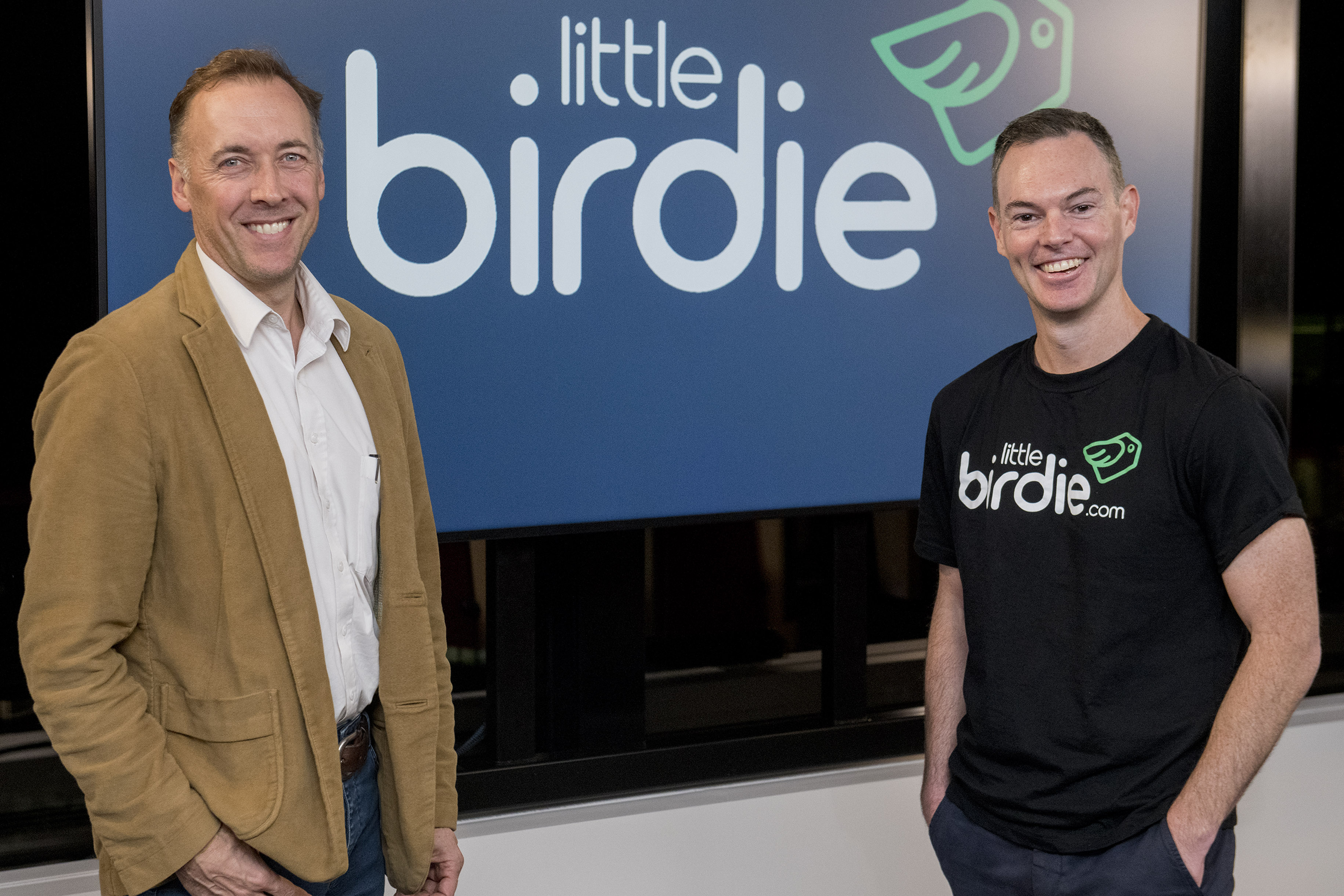
A photo of (left) Commonwealth Bank group executive Angus Sullivan and (right) Jon Beros, co-founder and CEO of Little Birdie, standing in front of Little Birdie’s logo

Commonwealth Bank group executive Angus Sullivan and Jon Beros, co-founder and CEO of Little Birdie

Melbourne-based Little Birdie, an e-commerce startup that wants to become the “new homepage of online shopping,” won’t launch until next month, but it’s already scored a major investor. Commonwealth Bank of Australia (CBA), the largest of Australia’s “Big Four” banks, has poured $30 million AUD (about $23.2 million USD) in pre-launch funding into Little Birdie, and will also integrate its shopping content, including exclusive offers, into its consumer banking app, which reaches 11 million retail customers in Australia.

Little Birdie says this brings its valuation to $130 million AUD (about $100 million USD). Compared to the United States, where Amazon is the largest e-commerce retailer by far, Australian shoppers spend more time choosing between several platforms, including large marketplaces like eBay, Gumtree, Amazon, Woolworths and a host of smaller players.

Set to launch in mid-June, Little Birdie will aggregate over 70 million products from different online brands and stores, with the goal of being the first place shoppers look when they want to buy something. Users can use Little Birdie to track and compare products, and look for price drops, sales and offers. The SKUs come from a combination of brand partnerships and scraping e-commerce sites, with the majority from retailers’ product feeds.

Co-founder and chief executive officer Jon Beros told TechCrunch that “Australia’s e-commerce market is very competitive and quite fragmented with a lot of retailers fighting for market share. The pandemic accelerated online adoption and saw many retailers switch on an online presence, or shift their focus online. With so many players fighting for the attention of shoppers and driving up the cost of acquisition, Little Birdie can genuinely help retailers by providing a new marketing channel that delivers qualified customers leads.”

Commonwealth Bank will be able to access Little Birdie’s catalog of shopping content to create targeted offers for customers, including features that link savings goals to specific items through its money management tools. Beros said that Little Birdie will also seek two different types of brand partnerships: “Firstly with retailers who come on board to promote their exclusive offers and products on Little Birdie and secondly with major brands and media companies that look to integrate our shopping content into their apps or websites. These integration partners ultimately deepen the value Little Birdie offers its retail partners by helping to amplify the reach of their offers to a wider audience.”

The company is looking at expansion into Southeast Asia and the United States, but Beros said there is not a firm timeline for its international growth yet, since it depends on the COVID-19 pandemic situation and when borders start to reopen.

In a press statement, Commonwealth Bank group executive Angus Sullivan said, “We believe customers should have access to the world’s best digital experience and our partnership with Little Birdie will give customers access to exclusive industry leading deals via the CommBank app.”

24 May 2021

Invoca acquires DialogTech for $100M to expand its conversational intelligence tools

On the heels of expanding its marketing call analytics platform last year to provide more insights to help those in sales, e-commerce and customer experience, Invoca is making its first acquisition to widen the net of companies that it targets. The company has acquired DialogTech, a startup that builds tools for marketers to analyze inbound phone calls and other contacts, in what TechCrunch understands to be a $100 million deal.

As part of the transaction, Santa Barbara-based Invoca will be divesting Swydo, a company that Chicago-based Dialog acquired in 2018. Swydo — originally from The Netherlands — will remain a partner of Invoca’s, the company said.

Invoca has up to now focused on larger consumer-facing enterprises — its customers include the likes of ADT, AutoNation, DISH, TELUS, and The Home Depot — providing them with an AI-based platform that lets their marketing, sales and other teams analyze calls from consumer customers and provide call tracking, coaching, and other insights in real time and in the form of post-call reports to help those teams do their jobs more easily.

Gregg Johnson, Invoca’s CEO and one of growing pool of Salesforce veterans that are reinventing the marketing and sales technology landscape, described Dialog as “complementary” to what Invoca does, but will specifically help Invoca better target mid-market companies.

The opportunity that both Invoca and Dialog have identified is that, despite the growth of digital media advertising, social media and other channels for brands to connect to would-be customers, inbound calls remain a very key part of how companies sell goods and services, especially when the sale is of a complex item.

“About 40% to 80% of revenues come through contact centers,” Johnson said. “Brands can do all the retargeting they want but the same strategies in digital don’t work there.”

For those working at the other end of the line, the need for tools to do their jobs better became even more pressing in the last year, a time when customers stayed home and away from physical stores, shifting all of their interactions to virtual and remote channels. Subsequently, they demanded and expected better levels of service there.

“This move enables us to be an even better partner to enterprises and agencies looking to optimize their marketing and drive sales,” said DialogTech CEO, Doug Kofoid, in a statement. “Together as Invoca, our combined company will deliver an unrivaled solution for conversation intelligence, with the most innovative technology, expertise, experience, and resources in our industry.”

The combined business will become one of the bigger “martech” startups focusing on conversational insights, with 2,000 customers, over 300 employees and on track to make more than $100 million this year in revenue. This is, however, just the tip of the iceberg: the conversational intelligence market was estimated to be worth some $4.8 billion in 2020 and is expected to balloon to nearly $14 billion by 2025.

Given how many startups we’ve seen launch in the name of better sales intelligence, it’s likely that this will not be the last piece of consolidation in the area. Combining to expand the functionality of a platform, or to expand the scale and reach of a business, or simply to bring on interesting tech that is easier to acquire than build from scratch, are three areas that will likely drive more M&A.

Invoca last raised funding in October 2019, a $56 million round just ahead of the world shifting into Covid-19 pandemic mode. Johnson confirmed that Invoca — which has to date raised $116 million from Accel, Upfront Ventures, H.I.G. Growth Partners, Morgan Stanley, Salesforce Ventures and others — is in a strong enough position as a business not to need to raise more for this acquisition.

However, I suspect that scaling up like this will help it bid for bigger money and a bigger valuation when it does, as will the fact that peers in the market like Gong (which Johnson described as the “B2B version of Invoca” to me) have seen their valuations catapult in the last year, spurred by the changes in how customers interact with businesses, and sales and marketing can work to better serve them.