Year: 2021

20 May 2021

Kleiner spots Spot Meetings $5M to modernize walk-and-talks for the Zoom generation

Trees, those deciduous entities you can occasionally see outdoors when not locked down or strapped down at a desktop ruminating on a video call, have long been the inspiration for fresh new ideas. Stories abound of how founders built companies while walking the foothills in Silicon Valley or around parks in San Francisco, and yet, we’ve managed over the past year to take movement mostly out of our remote work lives.

Chicago-based Spot Meetings wants to reinvigorate our meetings — and displace Zoom as the default meeting medium at the same time.

The product and company are just a few months old and remain in closed beta (albeit opening up a bit shortly here), and today it’s announcing $5 million in seed funding led by Ilya Fushman at Kleiner Perkins. That follows a $1.9 million pre-seed round led by Chapter One earlier this year.

CEO and co-founder Greg Caplan said that the team is looking to rebuild the meeting from the ground up for an audio-only environment. “On mobile, it needs to be abundantly simple to be very functional and understood for users so that they can actually use it on the go,” he described. In practice, that requires product development across a wide range of layers.

The product’s most notable feature today is that it has an assistant, aptly named Spot, which listens in on the call and which participants can direct commands to while speaking. For instance, saying “Spot Fetch” will pull the last 40 seconds of conversation, transcribe it, create a note in the meeting, and save it for follow-up. That prevents the multi-hand tapping required to save a note or to-do list for follow up with our current meeting products. You “don’t even need to take your phone out,” Caplan points out.

What gets more interesting is the collaboration layer the company has built into the product. Every audio meeting has a text-based scratch pad shared with all participants, allowing users to copy and paste snippets into the meeting as needed. Those notes and any information that Spot pulls in are saved into workspaces that can be referenced later. Spot also sends out emails to participants with follow-ups from these notes. If the same participants join another audio meeting later, Spot will pull in the notes from their last meeting so there is a running timeline of what’s been happening.

Spot’s product design emphasizes collaboration within an audio-focused experience. Image Credits: Spot Meetings

Obviously, transcription features are built-in, but Spot sees opportunities in offering edited transcripts of long calls where only a few minutes of snippets might be worth specifically following up on. So the product is a bit more deliberate in encouraging users to select the parts of a conversation that are relevant for their needs, rather than delivering a whole bolus of text that no one is ever actually going to read.

“Collaboration from now and the future is going to be primarily digital … in-person is forever going to be the exception and not the rule,” Caplan explained. Longer term, the company wants to add additional voice commands to the product and continue building an audio-first (and really, an audio-only) environment. Audio “very uniquely helps people focus on the conversation at hand,” he said, noting that video fatigue is a very real phenomenon today for workers. To that end, more audio features like smarter muting are coming. When a participant isn’t talking, their background noise will automatically melt away.

Before Spot Meetings, Caplan was the CEO and co-founder of Remote Year, a startup that was designing a service for company employees to take working trips overseas. I first covered it back in 2015, and it went on to raise some serious venture dollars before the pandemic hit last year and the company laid off 50% of its workforce. Caplan left as CEO in April last year, and the company was ultimately sold to Selina, which offers co-working spaces to travelers, in October.

Caplan’s co-founder who leads product and engineering at Spot Meetings is Hans Petter “HP” Eikemo. The duo met each other during the very first Remote Year cohort. “He has been a software engineer for two decades [and was] literally the first person I called,” Caplan said. The team will grow further with the new funding, and the company hopes to start opening its beta to its 6,000 waitlist users over the next 3-4 weeks.

20 May 2021

Ford and SK Innovation announce battery manufacturing joint venture BlueOvalSK

Ford Motor Company and Seoul, South Korea-based SK Innovation signed a memorandum of understanding to establish a joint venture to domestically manufacture batteries for electric vehicles, the two companies said Thursday. The new venture, dubbed BlueOvalSK, will produce around 60 GWh annually starting mid-decade. The MOU is the latest sign that Ford intends to vertically develop its battery capabilities.

“Initially with just a Mustang Mach-E, we felt like it was most efficient for us to purchase the batteries from the supply base, but as we start to move up that adoption curve, and move from just the early adopters to the early majority [. . .] we now have sufficient volume to justify this level of investment and this is why we’re pursuing this partnership,” Ford’s chief product platform and operations officer Hau Thai-Tang said Thursday.

Ownership structures will be worked out in the future, Lisa Drake, Ford’s chief operating officer, told reporters Thursday. The 60 GWh production capacity would likely span two manufacturing sites but the companies are still determining those plans, including locations of the plants across North America, Drake added. 60 GWh roughly translates to enough battery capacity to build 600,000 vehicles, Thai-Tang said.

Ford has taken strides in recent months to build a vertically-integrated capability to manufacture battery cells at scale. In April the Dearborn, Michigan-based automaker said it would open a battery technology development center in Michigan. It also led, with BMW, a $130 million investment into solid-state battery developer Solid Power’s Series B round.

But Ford has not always been so bullish on making batteries in-house. “Our product plans changed dramatically,” Thai-Tang said.

The news comes less than 24 hours after Ford debuted its F-150 Lighting, the electric version of its iconic nameplate vehicle and the best-selling truck in America. The Lighting is one of three EVs that Ford has debuted in the past year and will be a cornerstone of the company’s plans to invest $22 billion in EVs through 2025.

SK Innovation already has two separate EV battery plants under construction in Georgia under a collective investment of $2.6 billion. One of the batteries is already producing batteries and the other is set to become operational in 2023. The company is also building a separate factory in Tennessee with Volkswagen AG as its customer. Ford and SK Innovation’s relationship spans many years, with the automaker selecting SK as its battery supplier for the Lightning in 2018.

The company recently completed a $1.8 billion settlement in April over trade secret disputes with rival LG Energy Solutions. The resolution came after a two-year dispute that nearly led to SK Innovation shutting down its Georgia plans.

The two Korean conglomerates have invested billions in American battery manufacturing alongside their automaker partners. LG Energy is building manufacturing facilities in Ohio and Tennessee under its joint venture with General Motors, Ultium Cells LLC.

“The scale just makes sense now,” Drake said. “It’s the perfect time to start to do this.”

20 May 2021

Pitch, a platform for making and sharing presentations, raises $85M on a $600M valuation

Powerpoint may still dominate the landscape for presentations in many people’s minds, but some might say that legacy status also makes Microsoft’s software ripe for disruption. Now, a startup out of Berlin called Pitch has just picked up a substantial Series B of $80 million to take it on with what it believes is a more dynamic approach.

The round is being led by Lakestar and Tiger Global, with previous backers Index Ventures and Thrive Capital also participating. We understand from sources close to the company that the valuation is now at $600 million for the Berlin-based startup.

In the words of CEO and co-founder Christian Reber, the ambition is to create the “YouTube for presentations” with the ability for people to create, create, collaborate on, and share presentations with each other through an online-based interface.

His interest, meanwhile, in taking on Microsoft has a deeper story to it. As we have covered before, Reber’s previous startup, the planning startup Wunderlist, was acquired by Microsoft and folded into its productivity suite, only to eventually be killed off, much to Reber’s disbelief and disappointment.

Not to dwell too much in the past, the funding Pitch has now raised will be used in several areas, including hiring more people and reach. The startup has already seen good progress on the latter front. Pitch is already being used by tens of thousands of teams, it ways, who have created some 125,000 workspaces on the platform. Customers include (ironically) a number of other trailblazers in the world of business productivity: Intercom, Superhuman and Notion are among the list.

The plan will be to work on bringing on more users into its freemium universe, while converting more to its Pitch Pro $10/user/month paid tier, which includes more extensions like unlimited storage, video uploads, version history, and advanced permissioning. Pro already has a “couple of thousand” subscribers, Reber said, enough to prove out that “we definitely see our business model working.” Pitch is also working on rolling out an enterprise version so that it can sell Pitch into the bigger businesses and deployments that dominate usage of Powerpoint.

And the other way that Pitch plans to bring more people into the fold will be with more functionality. Along with the funding, Pitch is rolling out some new features that will include the beginnings of an ecosystem, where presentation designers and creators will be able to upload both presentation templates, as well as presentations themselves, to help other people get started in creating their own presentations.

The idea here is to celebrate creators, Reber said, but it’s (at least for now) stopping short of paying them, seeing this more as a way of sharing designs and ideas in a more collaborative exchange with each other. Both, however, seem to me to be ripe opportunities down the line for building a marketplace. Creating a great pitch deck for a startup is great to share as a resource, but if you are also, say, a leadership coach who makes a living out of giving people inspiring direction on how to handle something, a pitch deck with that IP in it perhaps might not be something you’d always be willing to part with for free. (Reber says his inspiration here was the world of design forums like Dribble where an exchange of ideas has thrived.)

Initially, the user-generated content will be selected by Pitch itself, although the plan over time will be to make it something that will be open to everyone, Reber said.

Another new feature will be presentation analytics. This will not be unlike the kind of data that people currently can apply to, say, email or web traffic to measure what people are clicking on, how long they are spending looking at content, and where they are dropping off. Pitch will apply the same to its presentations — which are HTML-coded — so that those who are making them and sending them around can get a better idea of how they are performing, and even begin the process of A-B testing to try out different approaches.

Reber points out that analytics will be opt-in only: if users choose not to share that tracking it won’t be shared, he said.

“As a German business, we have a special relationship with data privacy in the greatest sense,” he said. “We care deeply about making sure we approach features in a privacy-first way.” The idea is to make it less like spyware, and more like the kind of analytics one might have on YouTube for videos there.

Finally, it’s adding in more video features to bring in narrative recording and playback. These first will be “recorded” around the presentations themselves, but longer term, it’s likely that the feature will also have a live element, which makes a lot of sense since a lot of presentations have had their most highly trafficked exposure by way of webinars or live presentations (say, around an earnings call), where you might not only have multiple presenters talking along a slide deck, but also people feeding back, asking questions in relation to the presentation and so on.

If this all sounds a little WordPress-like, that’s not a coincidence. Reber noted that website building is something else that Pitch wants to bring into the platform. “We are experimenting with that,” he said. “In my opinion, presentations are collections of information and we want to publish them in various ways. Slides just happens to be one format. But if it’s all already written in HTML, why not build it also into a site? That will be another feature coming, and something that we will be also using the funding for.”

Indeed that may not work for deeper content efforts (such as publications like the one you are reading right now) but would be perfectly adequate for, say, basic sites along the kind that are built on sites like Squarespace to lay out some online real estate for a small business. The scope of what you can already do, and what Pitch wants you to do, is precisely what makes this all so interesting to investors, they say.

“The exciting vision that Christian and the team at Pitch have is beyond just being a superior alternative to legacy presentation software,” said Stephen Nundy, partner at Lakestar, in a statement. “A reimagining of the entire workflow surrounding presentations is very much overdue, and when coupled with the ability to harness new data and media integrations, Pitch will lead the way in changing how stories are told. I’m very proud to be joining the board of a European company with its sights set on a truly global opportunity.”

“We are incredibly impressed by the quality of Pitch’s offering today and Christian’s vision for the future. Pitch will be a true productivity platform, and we are excited to become investors in this special company,” John Curtius, partner at Tiger Global, added.

Reber’s take on the new tools also here:

20 May 2021

A16z bets millions on Maven, a platform for cohort-based courses

Maven, a startup that helps professionals teach cohort-based classes, has raised $20 million in a Series A round led by Andreessen Horowitz. The round places A16z general partner Andrew Chen on Maven’s board – and is his latest lead check in a creator-focused company, similarly pouring millions into recent rounds for Clubhouse and Substack.

The investment comes seven months after Maven, then nameless, left stealth alongside a $4.3 million round led by First Round Capital, and three months after it raised a $750,000 equity crowdfunding round. While the company declined to disclose valuation, we do know that it’s a lot of fast cash earmarked toward fueling the same bet: that the future of cohort-based learning is the future of education.

And if you’re wondering why, I’d tell you it’s two-fold. First, the startup has an impressive founding team: Udemy co-founder Gagan Biyani, altMBA co-founder Wes Kao, and early Venmo employee and Socratic co-founder Shreyans Bhansali.

Second, Maven has some impressive growth to tout, showing its potential. Maven’s core product right now is a suite of services that makes it easier to run a cohort-based course, while taking a 10% fee – similar to Substack – from a professional’s revenue. In three months after its January launch, four Maven courses earned over $100,000. To date, over $1 million worth of courses has been sold on Maven.

With the new capital, Kao tells me that her team is focused on getting instructors to see the value of CBCs. The startup has had over 2,000 people apply to become instructors, and expects to grow from 7 to 100 instructors by end of the year. Some of Maven’s investors, including Sahil Lavingia and Li Jin, are instructors on its platform. Long-term, the startup sees its competitive differentiation as helping experts who aren’t “conventional instructors” start sharing their knowledge.

The co-founder teaches a course to all incoming Maven instructors – meta, I know – from deciding to put in a curriculum to understanding course-market fit and building buzz for the course.

While Kao explained that instructors like the idea of turning free advice in modular, revenue-generating classes, she said “monetizing that expertise is often really hard.”

“Traditional platforms—Instagram, TikTok, Twitter—create a division between activities intended to monetize and those meant for community building,” she said. “Meaning, creators give away valuable content, and then monetize via brand partnerships or low-margin merchandise—activities that often detract from community-building.”

The biggest challenge ahead, she thinks, is expanding the mindshare about CBCs for creators. It needs to show the importance of signal in the cacophony of air horns that want creator’s attention.

It’s a problem that Maven is all too familiar with it.

“One of the biggest things we had to untangle early on was the difference between “content” and the Maven offering,” Kao explained. “There’s no shortage of content in our world.” The startup had to spend a good chunk of time figuring out how to create a cohort-based class experience that pairs community and accountability with that content. And it still has ways to go.”

“At the end of the day, it ended up being quite simple. In our view, we’ve reached the Post Content Age,” she said. “In other words: Content is no longer scarce in education. It’s either free or low cost, and it’s abundant.”

20 May 2021

HP outlines ambitious diversity goals

HP today announced a series of ambitious goals aimed at driving “a more diverse, equitable and inclusive” tech industry.

The tech giant, of course, is not the first company to have made strong claims about its intentions around diversity. As former TC reporter Megan Rose Dickey reported extensively, diversity and inclusion as an idea has been on the agenda of tech companies for years now. 

HP Chief Diversity Officer Lesley Slaton Brown says diversity and inclusion is something that the company has been focused on since its 1939 inception. Today, HP has roughly 50,000 employees globally with 31% of its leadership roles and 22% of its technical roles currently held by women – numbers that appear to be higher than most industry averages.

In order to further improve these numbers, HP announced three goals that Slaton Brown says the company is determined to achieve by 2030: 50/50 gender equality in HP leadership (defined as director level and up); greater than 30% technical women and women in engineering; and meet or exceed labor market representation for racial/ethnic minorities. 

I talked with Slaton Brown to get more details on the goals themselves, how the company plans to achieve them and what it plans to do to hold itself accountable. 

This interview has been edited for brevity and clarity.


TC:  Tell me more about the genesis of these goals and what HP has done up until now to achieve more equality – whether it be with regard to gender, race or ethnicity – within the company?

Slaton Brown: It’s foundationally something that we’ve always been focused on. We’re now at a place where I think going into COVID and quarantine last year and the impact that the George Floyd murder had on us as a nation really allowed us to do the double click down into racial equality and the systemic and structural discrimination that exists. 

From that, we were able to then stand up our Racial Equality and Social Justice Task Force. One of our goals has been to increase the representation of Black and African Americans in particular at HP. And also look at what we would need to do to increase the opportunity of Black and African American suppliers and vendors who work with and partner with HP. And then ultimately, how can we impact the communities locally and nationally – whether it’s from policy and legislation to working with municipalities in order to provide bias training and things like that. So all of that was stood up, and now a year later, we’ve made some great progress. 

HP Chief Diversity Officer Lesley Slaton Brown / HP

We have also launched our Human Rights Initiative. We’re looking at standing up for equal and human rights. We’re really focused on how we go after climate action and human rights.

TC: It sounds like that you are committing to a variety of things in terms of more balance among leadership and technical talent in terms of gender, for one. So it’s not just about race. But I’d like to hear more specifics on these particular goals and what you have done historically to work toward greater diversity and inclusion.

Slaton Brown: When we separated in 2015 from HP Co. We were very intentional about creating a diverse board of directors, first and foremost. And so today when I think about our board composition, we’re made up of I think it’s about 45% women, 35% ethnic minorities and over 60% total minorities with just our board of directors alone. We’re one of the most diverse boards in the tech industry. Now why is that important? The importance of building or standing up a board of directors is because they help with the vision of the company and help guide the strategy for the company.

That was one of the first things we did, and when I came into this role at that time, my goal was to embed diversity, equity and inclusion into everything that we do. 

TC: How are you holding yourselves accountable?

Slaton Brown: We’re really talking about answering all the way up to the board of directors on what we’re doing – our dashboards, our matrices that we pulled together will go to our board of directors to say, ‘Here’s what we said we’re going to do, how are we tracking, and then ultimately what was the impact.’ And so that’s what we’re building today. I consider that the infrastructure. So from the board of directors down cascading to your executive leadership team, ensuring that we have a strong narrative built.

By having this goal, we can then drive the actions, the programs, and then the implementation through our infrastructure and an ecosystem to achieve those goals. That includes things like working with organizations like the Society of Women Engineers, the Society of Black Engineers and the Society of Asian Engineers. And not only working with them, but building and investing in them so that we build the partnership in order to get to that pipeline.

TC: Can you be more specific in terms of what you mean by meeting or exceeding labor market representation?

Slaton Brown: I can see where that would be confusing. First, what it doesn’t mean is trying to match the demographics of the overall population, but rather to the labor market in the tech industry. For example, we’re at nearly 4% of having African Americans in a leadership position. Our goal is to achieve hiring at or more than 6% by 2025.

TC: What if you’re not getting enough women or minorities to apply for these leadership and technical roles? Would you rule out qualified white males, for example?

Slaton Brown: We are standing up for equal human rights. What we’re focusing on is also accelerating our gender, racial equality and social justice efforts. Part of that is looking at how do we increase our pipeline? And, how do we increase the talent pool? 

I would submit there is not a shortage of talent. It’s about how do you get to the talent? It has traditionally been through top tier schools such as Stanford and MIT. But you know what? Smart people and great talent are everywhere. People are sometimes financially challenged and so they may go the community college route, and then they might move into some of the top tier schools. That’s one means in addition to HBCUs (historically Black colleges and universities).

For example, we’ve stood up a very good program in the HBCU space to ensure that students that have not traditionally had the opportunity to compete for certain positions have that opportunity and not only have that opportunity, but have the ability to travel to HP sites to see where they would be likely interning. Our goal is to have a 100% conversion rate in terms of converting interns into full-time hires based off of performance, of course. And so it is a holistic or an end-to-end approach.

Okay, so now you’ve made these goals for women and for ethnic minorities and the white guy might say, ‘I’m left out.’ I think the interesting thing about that is that within the tech industry, the white male is the majority. What we’re doing at HP is building a powerful culture of inclusion and belonging. So we’re still getting white guys, but we’re also getting very talented women, and US ethnic minorities, as well, in addition to veterans and people with disabilities. 

It’s about where you go, how you show up as a brand of choice – which is a goal of ours: to be a destination of choice for the underrepresented group – and  then how you welcome them. It’s the attraction, the hiring, the retention, the investment you make in their learning and development, and then in promotion, as well. And so those are some of the things that we’re doing.

TC: What are other ways you are fighting for human rights?

Slaton Brown: This announcement is around how we’re doubling down on our workforce, workforce empowerment, and that is about how we do things is just as important as what we do. And that’s about respecting human rights, and making it a priority. Our commitment to our supply chain workers is to ensure that our vendors are not contributing to the modern day slavery, or bringing in people with degrees and education and then bringing them into a system that charges them charges them ginormous fees and takes their passport.

We want to ensure that we create an environment, and create visibility and a resilient supply chain to ensure that that doesn’t happen, that we respect human rights, and that our manufacturing suppliers are contributing to that, as well.

TC:  In press materials, the company claimed to be the first Fortune 100 tech company to commit to gender parity in leadership.” Hopefully you’ll be setting an example and others will follow.

Slaton Brown: Well, it’s a huge goal and so some of the strategies and best practices that we’ve put in place really is not just about bringing women in as a checkbox exercise for us, but to really establish a new standard.

Our goal and our vision is to become the most sustainable and just tech company in the world. And so we can’t just say that we have to do it. And that’s what I love about the culture of HP – it’s moving from the talk, and really showing the actions in which we’re going to get to that place of being sustainable and just by 2030.


20 May 2021

Ex-Square execs launch Found to help the self-employed, raise $12.75M from Sequoia

If you’ve ever been self-employed you know what a pain it is to keep up with the hassles of running a business. From bookkeeping to invoicing to paying taxes — it’s one big headache.

Freelancers and self-employed people often turn to a number of different solutions to try and address different aspects of running their business. It can be a lot to keep up with.

Enter Found. Previously called Indie, the startup was founded by two former Square execs who got firsthand insight into how SMBs paid their employees.

Lauren Myrick joined Square in 2010 and was the second project manager at the company. She helped launch its first POS (point-of-sale) product and its SaaS products. She eventually became GM of its payroll business unit, and that was her first foray into taxes and understanding their implication. Co-founder Connor Dunn ran engineering for Square Payroll.

After that experience, the pair saw an opportunity to launch a suite of services for self-employed businesses, which have been growing even faster during COVID.

“We started to pay attention to the movement toward self-employment,” Myrick told TechCrunch.

So in 2019, the pair interviewed “lots” of self-employed people to better understand their pain points. What they found is that taxes and expense tracking were considered among the more painful and expensive parts of being self-employed. So they formed Found (formerly called Indie) with the goal of creating a “one-stop shop” for business banking, bookkeeping and taxes for self-employed businesses.

And today, the San Francisco-based startup has raised $12.75 million in a round led by Sequoia that also included participation from some angel investors.

Image Credits: Found co-founders Lauren Myrick and Connor Dunn / Found

Myrick is no stranger to being self-employed herself, having worked as a public accountant after college. Also, her sister is a self-employed yoga instructor.

In Found, Myrick’s two previous professional worlds have come together. 

“With my accounting background and what I learned at Square, I had this big aha moment that we could become a ledger for these businesses, and solve their bookkeeping and tax needs through software,” she said. “So that’s what we’ve built.”

Customers can use the platform to do things like deposit business income, obtain a debit card for business purchases and calculate how much they owe in taxes. The platform also offers a feature that sets aside the money for, and facilitates, the quarterly tax payments, for example. It also offers real-time business and tax reports, so when a business owner swipes their card, expenses are reflected in real time.

Sequoia’s Josephine Chen and Alfred Lin said they were impressed with Myrick from their first call with her.

“Lauren has incredible context and command of the details. She talked about the hoops self-employed people have to jump through to fill out their Schedule Cs; she explained some of the finer points of different tax codes — and we were riveted,” the pair say.

Lin said he was particularly intrigued by the concept of Found because while he was in graduate school he ran a small data analysis business on the side.

“I had to invoice, report on taxes and do my own bookkeeping,” he recalls. “And I kept it together with a spreadsheet. I thought to myself that there should be better tools to do some of this stuff. And that is what Lauren has done with Found.”

20 May 2021

So long, Internet Explorer, and your decades of security bugs

Image Credits: Louis Douvis / Getty Images

Pour one out for Internet Explorer, the long-enduring internet browser that’s been the butt of countless jokes about its speed, reliability, and probably most notable of all, security, which will retire next year after more than 25 years of service.

Microsoft said it will pull the plug on the browser’s life support in June 2022, giving its last remaining half a dozen or so users a solid year to transition to Chrome or Firefox — let’s be honest here — though other respectable browsers are available. There will be some exceptions to the end-of-life plan, such as industrial machines that need the browser to operate.

For years, Microsoft has nudged Internet Explorer users towards its newer Edge browser as a more reliable and secure alternative to the ailing Internet Explorer, often in the most obnoxious ways possible by splashing on-screen ads the second you flirt with using a rival browser. As the wider web’s support for Internet Explorer dwindled, enterprises have also begun phasing out support for the browser.

But in ending support for Internet Explorer, Microsoft is parting ways with one of the most problematic security headaches in its history.

Virtually no other software has been subject to more security bugs than Internet Explorer, in large part due to its longevity. Microsoft has patched Internet Explorer almost every month for the past two decades, trying to stay one step ahead of the hackers who find and exploit vulnerabilities in the browser to drop malware on their victims’ computers. Internet Explorer was hardened over the years, but it lagged behind its competitors, which sped ahead with frequent, almost invisible security updates and tougher sandboxing to prevent malware from running on the user’s computer.

As much as it’s easy to hate on Internet Explorer, it’s been with us for almost three decades since it debuted in Windows 95, and it’s served us well. For many of us who grew up on the internet in our teens and twenties, Internet Explorer was the first — and really the only — browser we used. Most of us signed up for our first Hotmail email address with Internet Explorer. We learned how to code our MySpace page using that browser, and we downloaded a lot — and I mean a lot — of suspicious-looking, malware-packed “games” that slowed the computer down to a crawl but thought nothing of it.

I remember, as a 10-(ish)-year-old child, seeing for the first time the pixelated Internet Explorer icon on that bright, teal wallpapered cathode-ray monitor in a cold attic room in our family home, because, not really knowing what the internet was, I complained to my father: “I don’t want to just explore the internet. I want to see the whole thing.”

Thanks to Internet Explorer, I got to see a large part of it.

20 May 2021

Privacy.com rebrands to Lithic, raises $43M for virtual payment cards

When Privacy.com was founded in 2014, the company’s focus was to let anyone generate virtual and disposable payment card numbers for free.

The goal was to allow those users to keep users’ actual credit card numbers safe while allowing the option to cut off companies from their bank accounts. In an age of near-constant data breaches and credit card skimmers targeting unsuspecting websites, Privacy.com has made it harder for hackers to get anyone’s real credit card details.

The concept has appealed to many. At the time of its $10.2 million Series A last July, Privacy.com said it had issued 5 million virtual card numbers. Today, that number has more than doubled, to over 10 million, according to CEO and co-founder Bo Jiang.

“We set out to create the safest and fastest way to pay online. Our mobile app and web browser extension lets you generate a virtual card for every purchase you want to make online,” Jiang explained. “That can be especially convenient for things like managing subscriptions or making sure your kid doesn’t spend $1,000 on Fortnite skins.”

Over the years, the New York-based company realized the value in the technology it had developed to issue the virtual and disposable payment cards. So after beta testing for a year, Privacy.com launched its new Card Issuing API in 2020 to give corporate customers the ability to create payment cards for their customers, optimize back-office operations or simplify disbursements.

The early growth of the new card issuing platform, dubbed Lithic, has prompted the startup to shift its business strategy — and rebrand.

In the process of building out its consumer product, Privacy.com ended up building a lot of infrastructure around programmatically creating cards.

“If you think about the anatomy of credit/debit card transactions there’s a number of modern processors such as Stripe, Adyen, Braintree and Checkout,” Jiang told TechCrunch. “On the flip side, we’re focused on card creation and issuing, and the APIs for actually creating cards. That side has lagged the card acquiring side by five to seven years…We’ve built a lot to support card creation for ourselves, and realized tons of other developers need this to create cards.”

As part of its new strategy, Privacy.com announced today that it has changed its name to Lithic and raised $43 million in Series B funding led by Bessemer Venture Partners to double down on its card issuing platform and new B2B focus. Index Ventures, Tusk Venture Partners, Rainfall Ventures, Teamworthy Ventures and Walkabout Ventures also participated in the financing, which brings Lithic’s total raised to date to $61 million.

Image Credits: Lithic CEO and co-founder Bo Jiang / Lithic

Privacy.com, the company’s consumer product, will continue to operate as a separate brand powered by the Lithic card issuing platform.

Put simply, Lithic was designed to make it simple for developers to programmatically create virtual and physical payment cards. Jiang is encouraged by the platform’s early success, noting that enterprise issuing volumes tripled in the last four months. It competes with the likes of larger fintech players such as Marqeta and Galileo, although Jiang notes that Lithic’s target customer is more of an early-stage startup than a large, established company.

“Marqeta, for example, goes after enterprise and is less focused on developers and making their infrastructure accessible. And, Galileo too,” he told TechCrunch. “When you compare us to them, because we’re a younger company, we have the benefit of building a much more modern infrastructure. That allows us to bring costs down but also to be more nimble to the needs of startups.”

The benefits touted by Lithic’s “self-serve” platform include being able to “instantly” issue a card and “accessible building blocks,” or what the company describes as focused functionality so developers can include only the features they want.

Another benefit? An opportunity for a new revenue stream. Developers earn back a percentage of interchange revenue generated by the merchant, according to Lithic. “What we’ve noticed is a lot of folks have really big ambitions to build more of a stack in-house. We offer a path for folks by bringing more of a payments piece of the world that they can build for scale,” he said. “As a result of all these things, we end up not competing head to head with Marqeta, for example, on a ton of deals.”

The company charges a fee per card for Lithic API customers (it’s free for Privacy.com). And it makes money on interchange fees with both offerings.

For Charles Birnbaum, partner at Bessemer Venture Partners, the shift from B2C to B2B is a smart strategy. He believes Lithic is building a critical piece of the embedded fintech and payments infrastructure stack.

“We have been big fans of the Privacy.com team and product since the beginning, but once we started to see such strong organic growth across the fintech landscape for their new card processing developer platform the past year, we just had to find a way to partner with the team for this next phase of growth,” he said.

Index Ventures partner Mark Goldberg notes that as every business becomes a fintech, there’s been an “explosion” in demand for online payments and card issuance.

“Lithic has stood out to us as being the developer-friendly solution here — it’s fast, powerful and insanely easy to get up-and-running,” he said. “We’ve heard from customers that Lithic can power a launch in the same amount of time it takes an incumbent issuer to return a phone call.”

Lithic plans to use its new capital to expand the tools and tech it offers to developers to issue and manage virtual cards as well as enhance its Privacy.com offering.

20 May 2021

Privacy.com rebrands to Lithic, raises $43M for virtual payment cards

When Privacy.com was founded in 2014, the company’s focus was to let anyone generate virtual and disposable payment card numbers for free.

The goal was to allow those users to keep users’ actual credit card numbers safe while allowing the option to cut off companies from their bank accounts. In an age of near-constant data breaches and credit card skimmers targeting unsuspecting websites, Privacy.com has made it harder for hackers to get anyone’s real credit card details.

The concept has appealed to many. At the time of its $10.2 million Series A last July, Privacy.com said it had issued 5 million virtual card numbers. Today, that number has more than doubled, to over 10 million, according to CEO and co-founder Bo Jiang.

“We set out to create the safest and fastest way to pay online. Our mobile app and web browser extension lets you generate a virtual card for every purchase you want to make online,” Jiang explained. “That can be especially convenient for things like managing subscriptions or making sure your kid doesn’t spend $1,000 on Fortnite skins.”

Over the years, the New York-based company realized the value in the technology it had developed to issue the virtual and disposable payment cards. So after beta testing for a year, Privacy.com launched its new Card Issuing API in 2020 to give corporate customers the ability to create payment cards for their customers, optimize back-office operations or simplify disbursements.

The early growth of the new card issuing platform, dubbed Lithic, has prompted the startup to shift its business strategy — and rebrand.

In the process of building out its consumer product, Privacy.com ended up building a lot of infrastructure around programmatically creating cards.

“If you think about the anatomy of credit/debit card transactions there’s a number of modern processors such as Stripe, Adyen, Braintree and Checkout,” Jiang told TechCrunch. “On the flip side, we’re focused on card creation and issuing, and the APIs for actually creating cards. That side has lagged the card acquiring side by five to seven years…We’ve built a lot to support card creation for ourselves, and realized tons of other developers need this to create cards.”

As part of its new strategy, Privacy.com announced today that it has changed its name to Lithic and raised $43 million in Series B funding led by Bessemer Venture Partners to double down on its card issuing platform and new B2B focus. Index Ventures, Tusk Venture Partners, Rainfall Ventures, Teamworthy Ventures and Walkabout Ventures also participated in the financing, which brings Lithic’s total raised to date to $61 million.

Image Credits: Lithic CEO and co-founder Bo Jiang / Lithic

Privacy.com, the company’s consumer product, will continue to operate as a separate brand powered by the Lithic card issuing platform.

Put simply, Lithic was designed to make it simple for developers to programmatically create virtual and physical payment cards. Jiang is encouraged by the platform’s early success, noting that enterprise issuing volumes tripled in the last four months. It competes with the likes of larger fintech players such as Marqeta and Galileo, although Jiang notes that Lithic’s target customer is more of an early-stage startup than a large, established company.

“Marqeta, for example, goes after enterprise and is less focused on developers and making their infrastructure accessible. And, Galileo too,” he told TechCrunch. “When you compare us to them, because we’re a younger company, we have the benefit of building a much more modern infrastructure. That allows us to bring costs down but also to be more nimble to the needs of startups.”

The benefits touted by Lithic’s “self-serve” platform include being able to “instantly” issue a card and “accessible building blocks,” or what the company describes as focused functionality so developers can include only the features they want.

Another benefit? An opportunity for a new revenue stream. Developers earn back a percentage of interchange revenue generated by the merchant, according to Lithic. “What we’ve noticed is a lot of folks have really big ambitions to build more of a stack in-house. We offer a path for folks by bringing more of a payments piece of the world that they can build for scale,” he said. “As a result of all these things, we end up not competing head to head with Marqeta, for example, on a ton of deals.”

The company charges a fee per card for Lithic API customers (it’s free for Privacy.com). And it makes money on interchange fees with both offerings.

For Charles Birnbaum, partner at Bessemer Venture Partners, the shift from B2C to B2B is a smart strategy. He believes Lithic is building a critical piece of the embedded fintech and payments infrastructure stack.

“We have been big fans of the Privacy.com team and product since the beginning, but once we started to see such strong organic growth across the fintech landscape for their new card processing developer platform the past year, we just had to find a way to partner with the team for this next phase of growth,” he said.

Index Ventures partner Mark Goldberg notes that as every business becomes a fintech, there’s been an “explosion” in demand for online payments and card issuance.

“Lithic has stood out to us as being the developer-friendly solution here — it’s fast, powerful and insanely easy to get up-and-running,” he said. “We’ve heard from customers that Lithic can power a launch in the same amount of time it takes an incumbent issuer to return a phone call.”

Lithic plans to use its new capital to expand the tools and tech it offers to developers to issue and manage virtual cards as well as enhance its Privacy.com offering.

20 May 2021

TikTok rolls out tools to bulk delete and report comments, block users

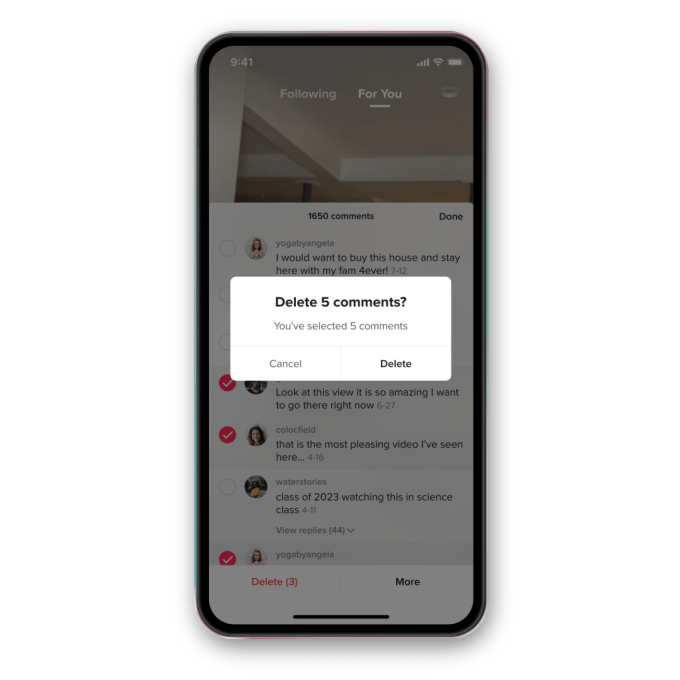
TikTok today is introducing a feature that will allow creators to deal with online abuse in an easier way. The company is launching new tools that will allow creators to bulk delete comments and block users, instead of having to moderate comments one-by-one. The update may be somewhat controversial, as it allows creators to curate a persona where the content they’ve posted is seemingly well-received, when in reality, it had a lot of pushback or correction from the broader TikTok community.

Twitter had faced this same issue in the past, and ultimately split the difference between giving the original poster control over the conversation or ceding that control to the Twitter user base at large. With Twitter’s “Hidden Replies” feature, it allow users to tuck all the unhelpful and rude comments behind an extra click — that way, the replies themselves were not removed entirely, but they weren’t allowed to derail a conversation.

TikTok, on the other hand, is putting full control in the hands of the creator. That’s a more Facebook-like approach, where users can delete anything they want from appearing on their own user profile — including comments on their posts that they don’t like.

Image Credits: TikTok; image shows the bulk delete tool (why is the user deleting nice comments, though?)

This may be the right choice for TikTok, since its social network is mainly designed to have conversations through videos. Video formats like duets and stitches allow TikTok users to react and reply to other content on the site, while also creating new content that raises a creator’s own profile. Some creators use this to their advantage. They single out others who’ve posted something they disagree with — often content that toes the line between being a “bad opinion” and one that violates rules around misinformation. They then duet or stitch (or green screen duet) that content to share their own thoughts on the subject.

However, this process can send a brigade of angry fans over to the other video, where they proceed to troll and harass the original poster. (To what extent that’s a warranted reaction may depend on your own stance on the post and the politics in question.)

TikTok says such abuse can be “discouraging.” It certainly has been for some of TikTok’s early stars, like Charli D’Amelio, a teenage girl who somehow rocketed to TikTok stardom, where she now has nearly 116 million followers. D’Amelio has begun to speak more publicly about the downsides of her online fame, saying she now finds it difficult to find enjoyment on TikTok due the mounting criticism she receives there. This includes the abusive remarks she received, the body shaming, and dealing with the competitive, dishonest nature of the influencer set, among other things.

The new bulk delete feature doesn’t solve these problems, but it may allow creators to clean up their comment section and block trolls quickly enough that they can re-establish some semblance of control over their profile.

To use the new feature, users can long-press on a comment or tap the pencil icon in the upper-left corner to open a window of options. From here, they can select up to 100 comments or accounts instead of going one-by-one, making it easier to delete or report multiple comments or block users in bulk.

TikTok says the new feature is rolling out first to Great Britain, South Korea, Spain, United Arab Emirates, Vietnam and Thailand, and will continue to expand to other markets globally in the weeks to come, including the U.S.