Year: 2021

18 May 2021

Fantasy fantasy sport Blaseball developers score $3M seed funding to go mobile

In the absence of a real baseball league, it is perhaps not surprising that a simulated one should grow popular during the troubled year 2020. But even so, the absurdist horror and minimalist aesthetic of Blaseball seem an unlikely success. The text-based fantasy fantasy league has attracted hundreds of thousands of players and now $3.4 million in funding to build up the game and go mobile.

If you’re unfamiliar with Blaseball, feel free to go check it out now and sign up — it’s free. You’ll probably get a better idea of what the game is from 30 seconds of browsing than the next couple paragraphs.

For those of you who’d rather read, however, Blaseball is a web-based fictional baseball-esque league where players can bet in-game currency on the outcomes. But this is where things get weird. The teams aren’t the Mariners or the Mets but the Moist Talkers and the Worms; players have names like Chorby Soul and Peanutiel Duffy; their stats include things like allergies, pregame rituals, and an inventory of RPG-like items.

Likewise, games — told through simple text summaries of the action like you might see in the corner of a sports site — involve hits, balls, and stealing, but also incineration, shaming, and secret bases. “Weather” might involve spontaneous blood transfusions between players, or birds that interfere with play.

In short, it’s totally ridiculous, utterly unpredictable, and very funny. This totally unique concoction of fantasy leagues, baseball satire, and cosmic horror has accrued a dedicated yet routinely puzzled fanbase over its 19 week-long seasons. And like so many hits, this one came as something of a shock to its creators.
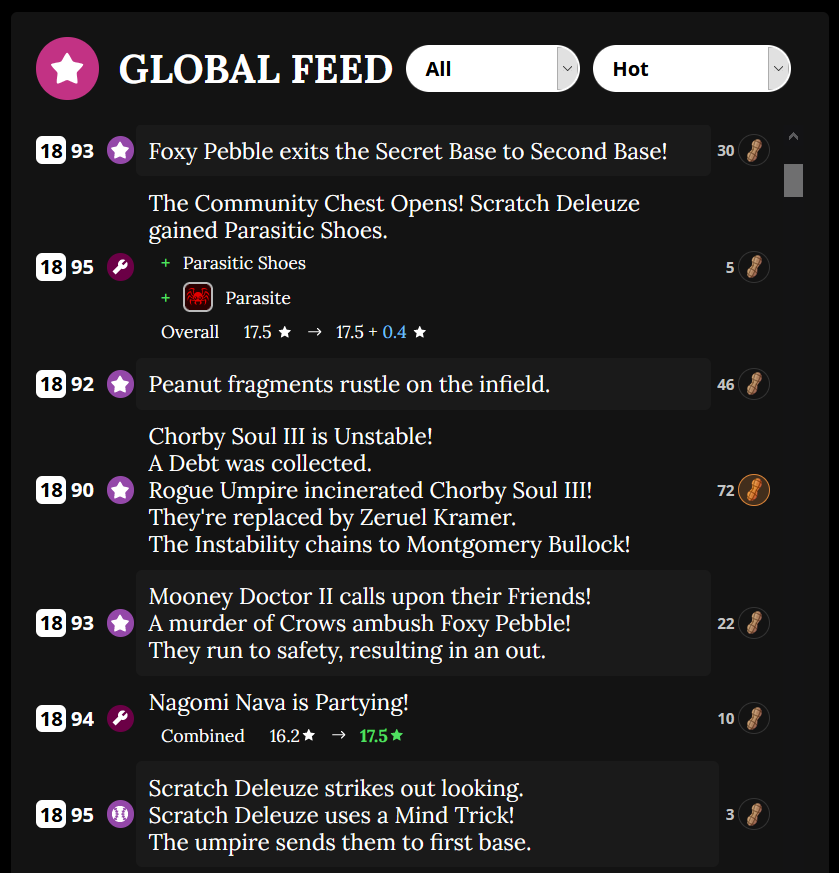
Activity feed from the game Blaseball showing various absurd and normal events like hits and incinerations.

Image Credits: The Game Band

“We’re as surprised as you are,” said Sam Rosenthal, founder and CEO of The Game Band, which developed (and is developing) the game. “Blaseball was an experimental side project for the studio — we were in the middle of a pandemic, publishers were in a spending freeze, it was a scary time. We wanted to make a game that brings people together in this really isolating time.”

The idea for it came from banter at a real baseball game, where Rosenthal and a friend speculated about a league where the rules were “different and more chaotic.” Of course the rules of real-life baseball are continually being revised, but so far there haven’t been any resurrections of players incinerated by rogue umpires, free runs for home teams, or shrink rays.

While the resulting game-like product bears some resemblance to baseball, betting, and fantasy leagues, it’s much too weird and random to really be considered the same thing. That’s led to some friction as players who expect a more traditional experience lose coins on a game decided by, say, a bird pecking their team’s star hitter inside an enormous peanut shell, or a guaranteed home run because the batter ate magma.
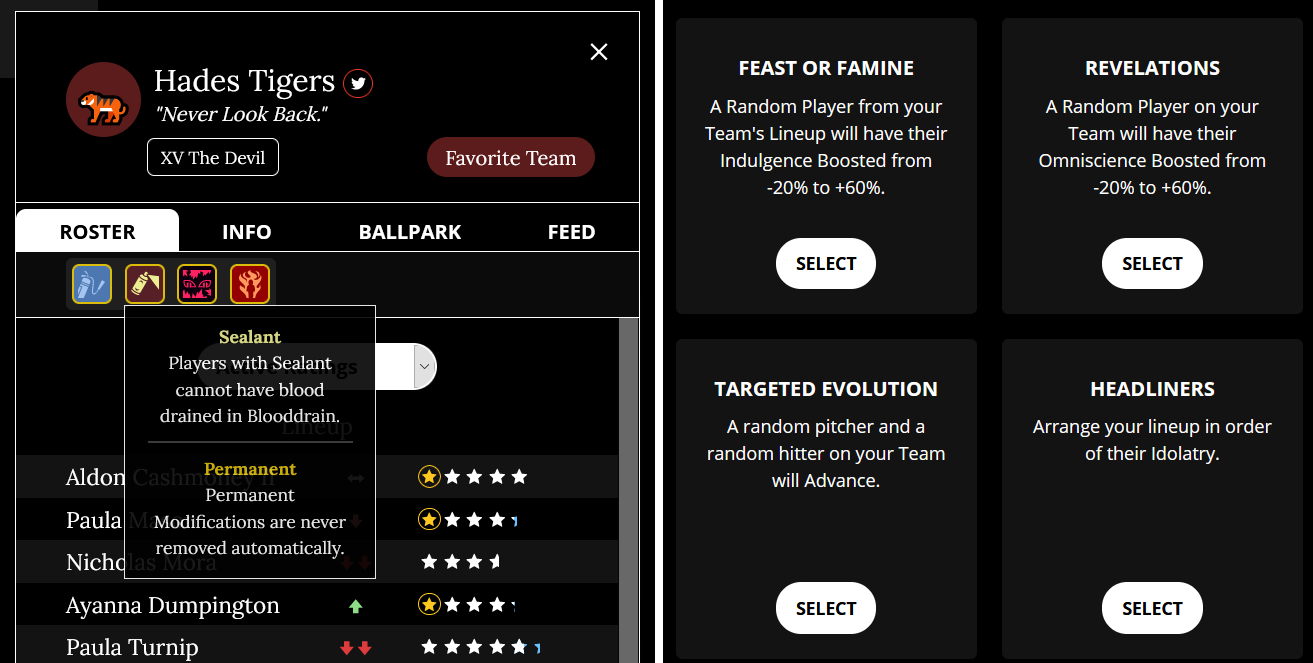
The Hades Tigers… so hot right now. The roster shows a team’s current and permanent attributes, while players can work together to create change by voting weekly.

“Sometimes we have to remind the fans that this is a horror game,” Rosenthal admitted. The gameplay, as players discover in time, consists more in cooperation and guiding the league itself than in precision oddsmaking. “This is not a game about individual success but collective success. The mechanics of the game reward organization, fans banding together with other fans of their team.”

Using those coins to buy votes to determine how the most-idolized players are treated at the end of a season, for instance, could have huge repercussions on the next season. Ultimately the players are really participating in a sort of long-term alternative-reality game rather than a zany baseball sim, as the ominous announcements and events drive home now and again.

Next to the outcome of a match and the news that a player was walked to second base, you might learn that “Reality flickered in the Feedback” or see disembodied dialogue about the league or disordered cosmos.

It can be disconcerting and one may rightly wonder whether the creators have a narrative or goal in mind, or whether they’re just winging it and being weird for weirdness’s sake. I guessed the latter, but Rosenthal set me straight.

The Game Band logo on a flag behind several instruments.

Image Credits: The Game Band

“It is going somewhere,” he assured me. “There are a lot of plans, we have a ton of lore written. We literally have a writers’ room every day, usually about 3-4 hours long. But we need to stay flexible because there’s two other creators: the simulation, since we don’t know what will happen in the games themselves, and the fans. There are things we don’t know they’ll latch onto, emergent narratives like the reincarnation of Jaylen Hotdogs. We’re always learning, and we give ourselves a lot of room to backtrack or change things quickly if needed.”

What was never clear even to the developers, however, was whether the game would live long enough to see those plans come to fruition. Blaseball, being a side project built during strange days, was never envisioned as a big money maker. For a small game developer to have a runaway success on their hands but little ability to monetize that success, the stresses of continuing development and support can overtake the benefits of popularity.

“Since we didn’t really set it up from the get go to be profitable, we were just sort of slowly losing money,” said Rosenthal. “Fortunately our community has been really supportive through Patreon and sponsorships. But ultimately we wanted to make the game better and sustainable, and we wanted to pay our team what they deserve.”
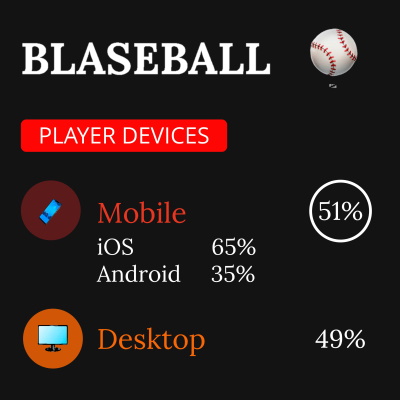
Illustration showing how 51 percent of Blaseball players are on mobile.

Image Credits: The Game Band

The $3M seed round keeps the lights on, to begin with, but also lets The Game Band staff up, so the writers don’t have to break up a meeting early because one of them is doubling as product support and the site is breaking. More importantly, however, the team plans to make a native mobile app. More than half of Blaseball’s players (that is, the real ones, not Baby Triumphant and Wyatt Mason IV) are on mobile and Rosenthal admitted the mobile experience is “not great.”

The company comes from a mobile development background, he noted, so they know what they’re doing, but saw the web as the easiest platform to deploy on during the pandemic. Now they want to get mobile up and running, since the live, constantly shifting nature of the game fits well with the kind of updates sports and fantasy aficionados tend to sign up for. Who wouldn’t want to know right away that their favorite team has entered Party Time, or that their idolized player found a new piece of armor, or that a new non-physical law has been ratified?

Rosenthal said they resisted seeking funding to begin with due to a desire for independence, but was enthused about their choice of investor, Makers Fund, saying they actually understand Blaseball and have been partners rather than parents when it comes to moving the operation towards making money.

“The know we can’t just copy monetization from another game and put it in Blaseball, that would ruin the experience right away. They have an amazing network of people in the games industry, and at the end of the day they’re not prescriptive,” he said.

(They also gamely did not object to a line in the press release by the fictional Commissioner asserting that “Blaseball has acquired Makers Fund,” which says a lot.)

“We’re very cognizant that there are ways that free games can monetize that are detrimental to the community,” he continued. “So it will always be free to play and it will never be pay to win. Like, the Crabs are never going to run away with it because they’re the richest team. When we think about monetization we think about how it can benefit the community as a whole, not individuals.”

In the meantime the league slouches on, morphing from week to week in a live dialogue between players and developers. Don’t expect it go get any less weird, because the creators know that constant disorientation is part of the game’s charm.

Amazingly, Rosenthal even managed to suggest that Blaseball was, in the parlance of game design tropes, the Dark Souls of baseball simulators — “it [Dark Souls] gives you so little, it asks you to interpret and put a thesis together, to go linger on forums and talk with others about it. We wanted to create that kind of experience, and see how people would interpret this sort of weird, unknowable entity.”

They certainly got the weird and unknowable part right. You can try Blaseball out for yourself here.


18 May 2021

Somewhere Good just raised $3.75M to make your somewhere good

Nearly every social media experience today is built on the same premise: Humans identify with individuality. Users create a profile, upload an avatar picture, write a short biography and can then scream into the ether to other users on behalf of their digitally sculpted selves.

Naj Austin, the founder behind Ethel’s Club, built Somewhere Good last year on an entirely different premise. She believes that humans crave collectivism more than individualism in a post-COVID world. So she’s in the process of reinventing how social media looks and feels, and with community and people of color at the core.

Less than a year after launching, Somewhere Good announced this morning that it has raised $3.75 million in a seed round led by True Ventures. Existing investors Dream Machine, Debut Capital and Canvas Ventures participated in the round, along with new investors, including Slauson & Co., NextView Ventures and 2PM Inc. Notable angels include Ellen Pao of Project Include and actor Gabrielle Union. The money will be used for continued product innovation and expanding its nine-person team.

“I’m thinking about scale and trying to ensure that the most people have access to a safe and authentic community on their phones, and that means it has to be venture-backed in terms of being able to accomplish that in a way that also feels delightful,” Austin said. “To build a platform that allows for us to have consultants who are thinking about accessibility, safety and privacy, we have to pay them.”

Extracting the buzz from Community

Somewhere Good is a mobile app that connects people and then fosters that connection in a solely group setting, across a diversity of interests — such as a birdwatching collective for people of color or an anti-capitalist book club.

The platform arose from Austin’s other company, subscription-based community for people of color, Ethel’s Club. Members kept asking her for different things: a cooking club, a therapist recommendation, a wellness group. She said she became a de facto Google for members, and that Ethel’s Club began to “frankenstein” into different groups and needs.

“Which is, you know, not scalable,” she said. “We thought ‘Why don’t we build a technology layer that communities like Ethel’s club need?’” Somewhere Good is now a social search platform for people to join, chat and discover new communities.

Somewhere Good

Users can visit and drop into different “worlds” or communities that fit their interests, she explained. Once a user has entered a world, they can view and post content and have real-time audio conversations with others. People are encouraged to cite content in order to promote content and nuance.

“If I add an Angela Davis article in ‘Abolition World’ I can also see that you added it to ‘Black Feminists’ world and so on,” Austin explained. “This is likely to encourage you to look into the Black Feminists world and further your discovery.”

Austin stressed that no one person or host controls the experience, instead putting focus on the community as a whole to create a world that is living and breathing. It’s her response to the rise of community in every startup right now.

“Communities become a buzzword that everyone’s trying to tap into their platforms now,” she said. “Things I know about community and what I’ve learned over the last year-and-a-half is that you need intimacy, you need nuance, you need collaboration and you need this magical collision of people who have shared identities.”

How Somewhere Good actually executes this mission will rely heavily on its product, which is still in its infancy. Right now, Austin shared that they have made intentional choices to remove what she sees as the “empty noise” of other social media platforms. At this point, there are no advertisements on Somewhere Good, no user profiles, no friending, no following and no feed.

Notably, this differentiation is also one of Somewhere Good’s biggest challenges.

“When building something new, it potentially feels like we are taking it away from the users,” she said. “For example, taking profiles away may feel like it is a less than, versus that it is additive in the long run because you no longer have to have a perfect profile and worry about users.”

The startup is testing out user reaction to these sorts of fundamental structural changes over the next couple of weeks. Somewhere Good also launched SHIFT, a $50,000 year-long fellowship program, to invite people to join the team and create a feedback loop on product, team and community, as well as explore some of the ideas that Austin is experimenting with today.

“We still aren’t going to be able to make the most perfect platform for everyone on Earth to start, and we know that, but in doing so we’ve created a fellowship to help inform us, and kind of heads down and deploy that occurs when you’re building a product.”

Entering the Clubhouse

The app was meant to go into beta in January 2020 but that has now been pushed to the second half of 2021 so the team could continue to tweak the product. The beta will be invite-only to start, including 50 to 75 communities and their members that Somewhere Good has vetted beforehand and the some 5,000 people on its waitlist.

Somewhere Good’s monetization plan is also in the early innings, and the founder says it will focus on that more when the app reaches scale.

Clubhouse, an app valued at $1 billion that is similarly focused on community and spontaneity, could be seen as competition to Somewhere Good. Clubhouse has an exploration page that helps users discover different clubs, and it also built out a creator network to bring high-quality, recurring content to its platform.

“It’s a solid company,” Austin said. “But I think they’ve struggled with really big questions and I think that there are solutions and answers out there that Clubhouse has chosen not to embed to their platform, and that was simply a choice that they made.”

For now, she doesn’t seem fazed.

“I feel like most of the platforms that exist are taking what already exists and kind of putting a veneer on it,” she said. “There’s nothing wrong with repainting, but then it’s just repainting.” Reinventing feels like an outsized opportunity.

“I believe if we get Somewhere Good right, it can replace many of the apps on your phone,” she said. “When you think about it, where you receive the most value, outside of the calculator app, is with your friends and the people you know and trust.”

18 May 2021

Pizza robot-maker Picnic raises another $16.3M

The events of the past year and a half could well mark the beginning of a sea change for the world of restaurant robotics. The essential industrial was slammed amid the pandemic, leaving many companies searching for a decent automated option that could both keep things running and potentially avoid transmission vectors.

Seattle-based Picnic is the latest to benefit from that interest, announcing a $16.3 raise this week. Led by Thursday Ventures — with participation from Creative Ventures, Flying Fish Partners and Vulcan Capital – the Series A includes a $3 million bridge filed last fall.

The company is one of a handful looking to automate the pizza-making process. It’s an obvious target for this technology, given both the food’s popularity and the relative uniformity, versus other meals. XRobotics debuted its own system late-late year, while Zume – possibly the best-known of the bunch – has long since exited the category.

Picnic, meanwhile, says interest in its own pizza system has ramped up of late, announcing a number of industry partnerships, including Orion Land Mark, Ethan Stowell Restaurants, National Service Cooperative  and Baseline Hardware Financing. The plan is to roll the technology out to both restaurants and other public gathering spaces, including schools, stadiums and hospitals. The company says this latest round will go toward headcount and expanding operations.

18 May 2021

Apple 24-inch M1 iMac review

Last September we concluded our 27-inch iMac review thusly,

The big open question mark here is what the future looks like for the iMac — and how long we’ll have to wait to see it. That is, of course, the perennial question for hardware upgrades, but it’s exacerbated by the knowledge of imminent ARM-based systems and rumors surrounding a redesign.

It was, as these things go, less than a full-throated endorsement of Apple’s latest all-in-one. We certainly weren’t alone in the assessment. It was a weird liminal zone for the computer — and Macs in general. At WWDC in June, the company had taken the unusual step of announcing its move from Intel to its own in-house chips without any hardware to show for it.

The reasoning was sound. The company was looking to help developers get out ahead of launch. It was going to be a heavy lift — the first time the Mac line had seen such a seismic shift since 2005. Fifteen years is a long time, and that’s a lot of legacy software to contend with. While the move wouldn’t outright break every piece of MacOS software, it was certainly in devs’ best interest to optimize for the new hardware, by way of the Mac Mini developer kit the company was offering. The full transition to the new silicon, Apple noted, would take two years.

Apple M1 chip

Image Credits: Apple

In November, the company debuted the first M1 Macs: a new Mac Mini, MacBook Air and 13-inch MacBook Pro. We spent several thousand words reviewing all three systems, but ultimately Matthew put it pretty succinctly, “Apple’s new M1-powered MacBook shows impressive performance gains that make Intel’s chips obsolete overnight.”

Which is, you know, a rough look for an all-in-one launched a mere two months before. That goes double for a system that hadn’t seen a fundamental redesign in some time. Two months after launch, the 2020 iMac was already starting to feel old.

Image Credits: Brian Heater

Fast-forward to last month, when Apple announced the new iMac amid a flurry of hardware news. This, it seems, was the iMac we’d been waiting for. The new system brought the most fundamental redesign in a decade, with an ultra-compact new form factor, improvements to audio and video (a big sticking point in the remote work era) and, perhaps most importantly, the new M1 chip.

Image Credits: Brian Heater

The biggest thing the 2020 system has going for it is that it’s, well, big. Having used a 27-inch iMac for much of my day-to-day work throughout the pandemic, I’m honestly surprised by how much I miss those extra three inches. I’d initially assumed that added bit of screen real estate was going to be fairly negligible once you’ve passed the 20-inch threshold, but turns out, like anything else, it takes some getting used to.

There’s an immediate upside, too, of course. I was genuinely surprised by how compact the new design is, compared to past iMacs. In spite of adding 2.5 inches to the display size over the 21.5-inch, the new system is an extremely thin 11.5 mm (or 14.7 when the stand is factored in).

The overarching theme for the system is “cute.” This is not a word I often apply to technology. Words like “cool” or “sleek” are generally go-tos here. But I’m at a loss for a better word to describe what feels like a true spiritual successor to the iMac G3. The colorful line of all-in-ones ushered in Steve Jobs’ second triumphant stint with the company, arriving at the tail end of a decade in a year personified by the Volkswagen’s New Beetle.

Of course, the design language has evolved dramatically in the nearly quarter-century since the first iMac arrived, owing to changing styles and, of course, ever-reducing component sizes. The flat-panel design arrived early this century and settled into the most recent design around 2012. Sure, there have been plenty of updates since then, but nine years is a long time for an Apple design to go without a major refresh.

Image Credits: Brian Heater

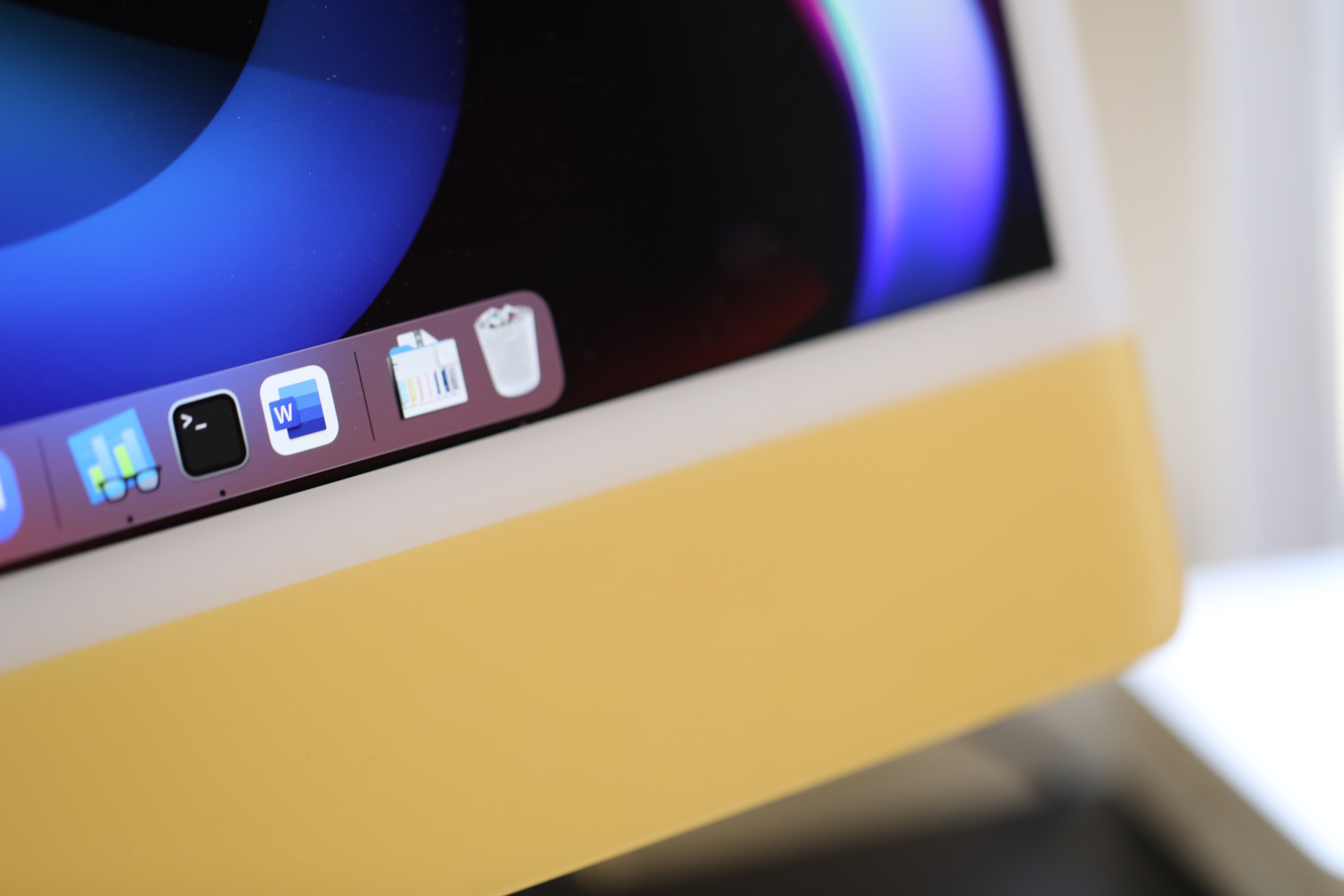
It finds the company moving from what was ostensibly an industrial design to something more warm and welcoming. The color is the thing here. It was the most frequently discussed question around the TechCrunch (virtual) offices. Everyone wants to know which we’d be getting. Mine landed with a yellow hue — something nice, light and spring. Honestly, it’s more of a gold than I expected, with a bright and shiny glean to it. I will advise that anyone who plans to buy one of these systems visit an Apple Store if there’s one nearby if you’re comfortable doing so. It’s really the sort of thing that really benefits from being seen in person, if possible.

That goes double here — since, boy howdy, is Apple on theme. The keyboard matches, the cables match, the desktop wallpaper matches, the adorable packaging matches (it’s a fun unboxing experience, as those things go) and even little touches like the OS buttons match. The latter two, obviously, are something you’re able to futz around with a bit. But the system and even the keyboard is a bit more of a commitment, really. After all, this is probably the kind of thing you’re going to want to hold onto for a number of years, so lighting and interior decorating are both worth considering before you make your decision. I recognize this is an odd thing to think about when talking about a desktop computer, but, well, it’s the iMac.

The company is offering an AR iOS app for seeing how the new iMac will fit in with its surroundings, which is a clever — and probably useful — touch. The system also weighs in at less than 10 pounds. This is admittedly not something I’ve given much thought to with desktops. “Portable” is a weird way to describe the form factor, but particularly compared to other desktop systems, it kind of fits? At the very least, it’s not entirely out of the realm of possibility that you can occasionally move the thing from room to room, as needed.

Image Credits: Brian Heater

In broad strokes, the front of the system is similar to that of the past iMacs, though the bottom panel and its large Apple logo have been swapped out of a streak of color. The pane of glass lies flush with the screen and a not insignificant white bezel that frames it. The bezel, combined with the panel, comprises a not insignificant amount of real estate below the display, likely owing to the placement of components and the downward-firing speaker grille that runs the full length of the computer’s bottom. Up top is the newly upgraded 1080p HD Webcam — the first on any Mac.

As with past iMacs, the system sits atop a stand. In the case of the yellow model, at least, the stand is a notably darker hue than the front of the system. There’s a VESA mount option configurable upon purchase, but the stand itself is very much not designed to be user replaceable. The hinge’s action is smooth. I found myself pivoting the system up and down semi-regularly to better frame myself in the webcam, and did so with ease.

Image Credits: Brian Heater

There’s a 3.5 mm headphone jack on the left — hello, old friend. I much prefer this placement to the rear of the device, which requires the cable to wrap around the side or bottom.

Image Credits: Brian Heater

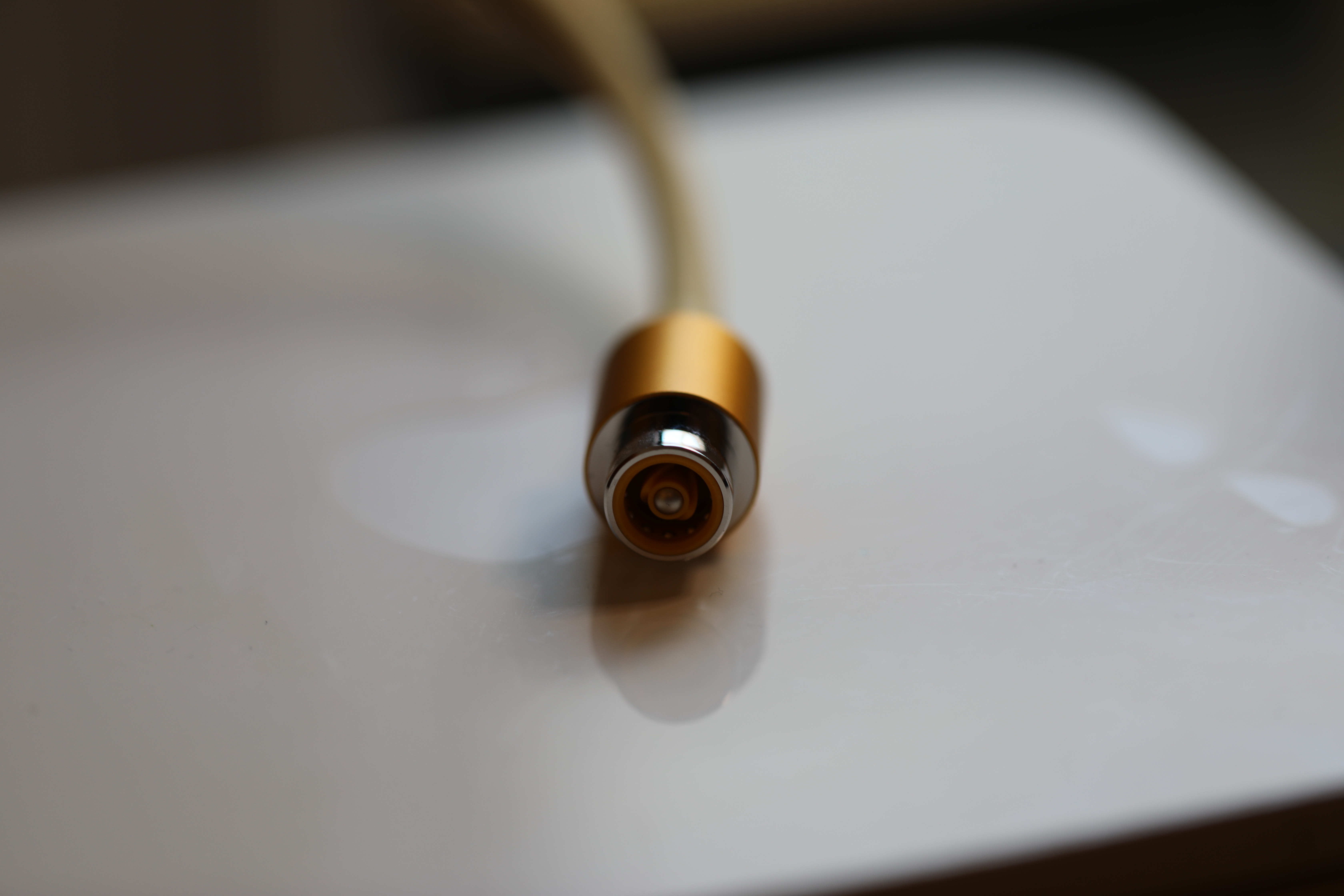
A hole inside the stand is designed for cables to be run through — specifically power. Magsafe — er, the magnetic charging connector — really popped up unexpectedly here. It’s less about the quick release that you would find on the old MacBooks and more about the ease of simply snapping the cable in place. I suspect that people are less likely to trip over a desktop cable that never (or at least rarely) moves.

Image Credits: Brian Heater

The big update to the power cable situation is, of course, the addition of ethernet to the brick. The brick is quite a bit larger — especially if you’re accustomed to dealing with MacBooks. But likely it will be out of the way. What it does bring is the removal of some additional clutter on the back of the system and helps keep the computer itself that much thinner. For most people in most cases that can access a hardwired connection, it’s a nice addition.

Image Credits: Brian Heater

The port situation, on the other hand, is decidedly less so. I like ports. I have lots of stuff that need plugging in to the back of the computer and ports are probably the best case to plug ’em. The entry-level system has two Thunderbolt/USB ports. You can upgrade that to four. Definitely do this. Seriously. You’re not going to regret it.

I’m someone who keeps the wireless keyboard and trackpad/mouse plugged in most of the time. I know, it kind of defeats the purpose, but worrying about charging accessories is not another stress I need in my life right now. So that’s two ports right there. I also have some AV accessories and suddenly, boom, you’re out of ports.

The $1,299 version of the system ships with the Magic Keyboard. It’s pretty much the same as other Magic Keyboards of recent vintage. It’s not for everyone, I know. Those who love mechanical keyboards will find something to be desired in the tactility, but it’s a step up from MacBooks and I’ve certainly grown accustomed to using it. There’s no number pad on the base model, but the coloring coordinates with the Mac.

Image Credits: Brian Heater

With the $1,699 model, you get upgraded to a version with Touch ID — something that’s been a long time coming on the desktop system. Like other Macs (and older iPhones), the fingerprint scanning login is nearly instantaneous. As has been the case for a while, if you’re an Apple Watch wearer, that will log you in as well, but the addition of Touch ID on the desktop is great. The base version comes with the Magic Mouse. It’s $50 to upgrade to a Trackpad and $129 for a combo. I’ve grown fond of the Trackpad, so that’s where I’d probably land here (I doubt many people will have a need for both).

Image Credits: Brian Heater

As ever, I understand the many reasons the company has pushed its line to USB-C — it’s especially obvious when you see how much room has been freed up on the rear of the device. But man, I miss having those legacy USB-A ports on the 2020 iMac. Meantime, you might want to toss a couple of A to C USB adapters into your basket before check out. That’s kind of just life with Apple, though. Courage, and all that.

I do wonder if this means the company is positioning the M1 line for the return of an iMac Pro. Stranger things have happened. For now, of course, the company is more focused on the Mac Pro at the much higher end.

Image Credits: Bryce Durbin/TechCrunch

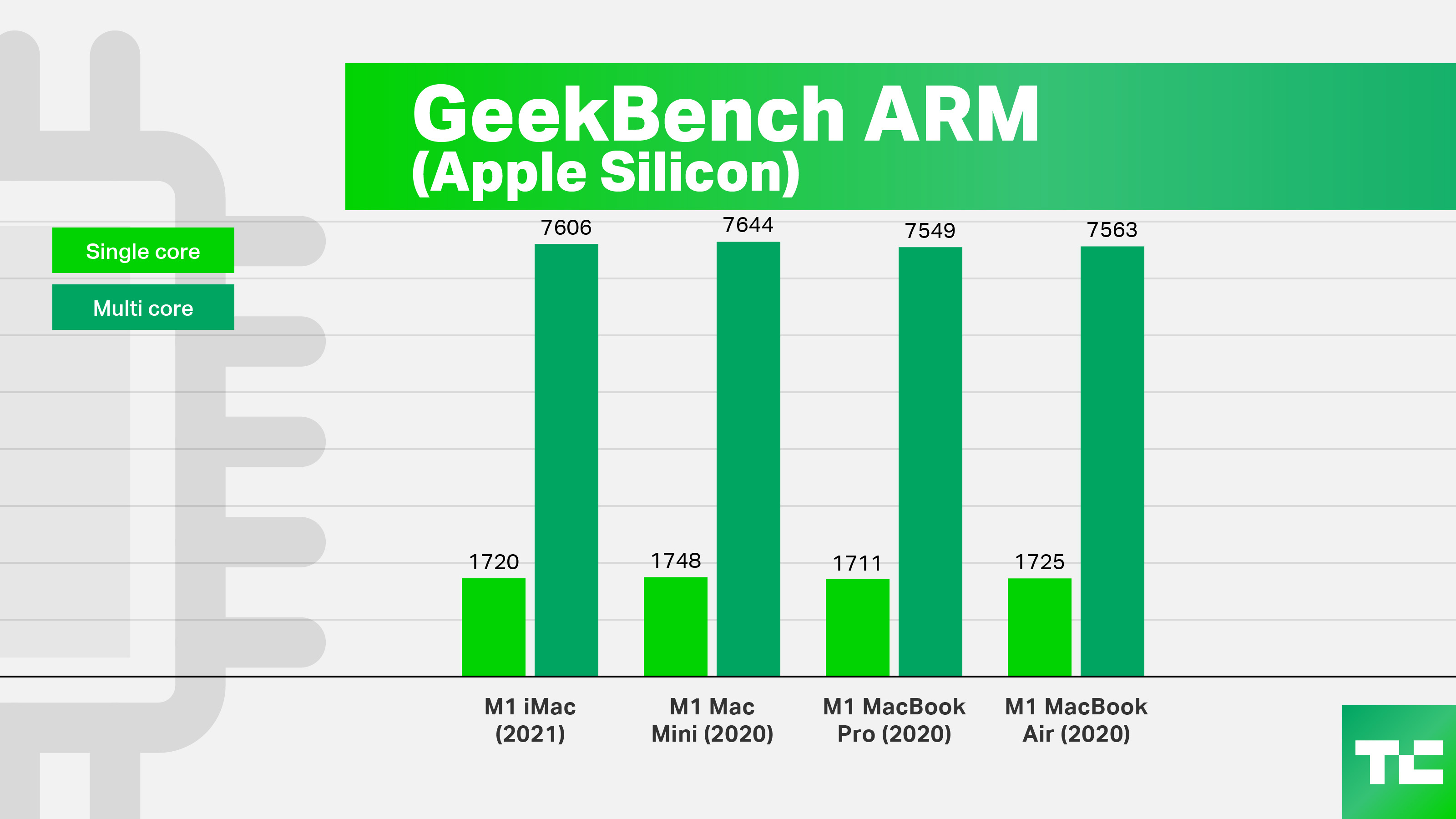
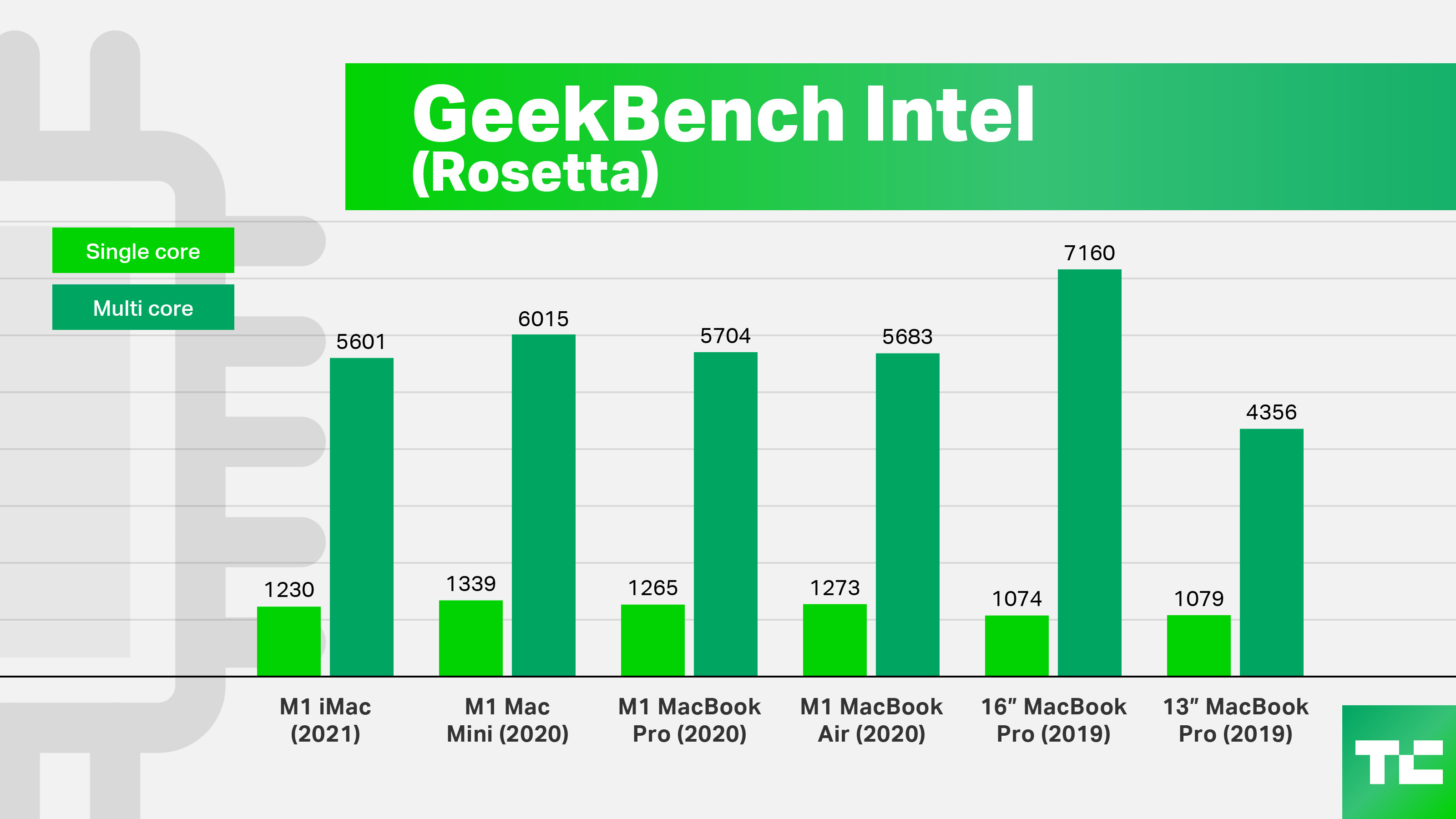
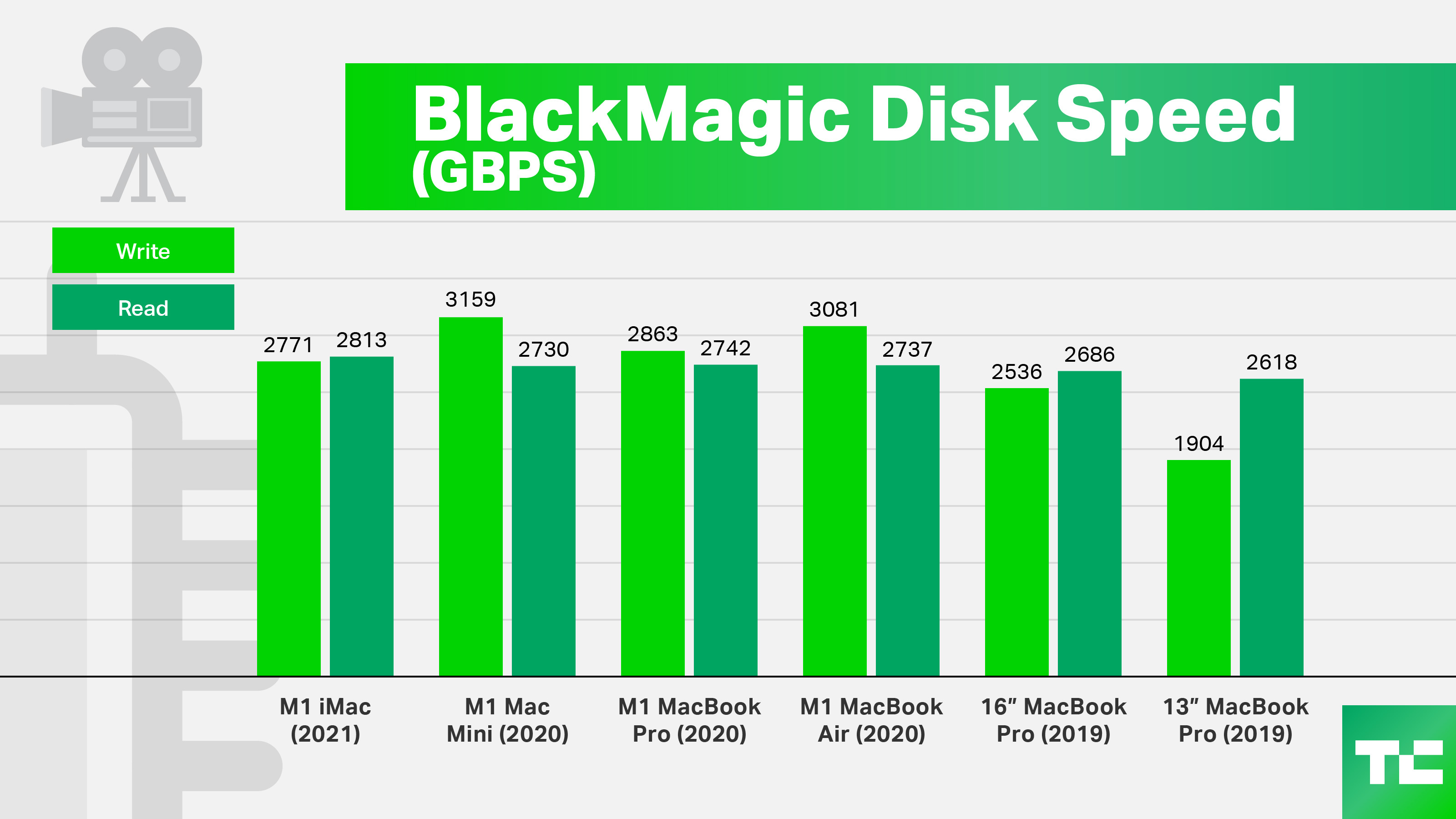
As expected, the new M1 chip breathes new life into the system. Take our Geekbench 5 scores: 1,720 Single and 7,606 multi-core. That blows the average of 1,200 and 6,400 for the 21.5-inch system out of the water. Things understandably take a dip with the Rosetta (Intel) version at 1,230 and 5,601, respectively, but it’s still solid performance running through a translation layer. But it also points to why Apple was so proactive about getting developers on-board with the new silicon. On the whole, the gains are in-line with the the other new M1 systems we’ve seen — which is to say a nice, healthy leap forward into the future of the Mac.

Image Credits: Bryce Durbin/TechCrunch

If you want to know how much of your workflow will be impacted, this resource is a good place to start. On the whole, I found that most of my day to day apps were fine. There are outliers, of course. Spotify and Audacity are right there. Performance is impacted in both case, but on a whole, they worked okay through Rosetta. Usage is more resource-intensive, though.

Image Credits: Bryce Durbin/TechCrunch

Spotify is probably a question of how many resources the Apple Music competitor wants to put into a new version, while Audacity is likely more of an issue of how many resources the organization has at its disposal. The further you move away from big names like Microsoft and Adobe, the more of a crapshoot it is. But there are some support issues with bigger names still, as well. For instance, I upgraded to the Apple silicon version of Zoom, but downgraded when I discovered it doesn’t work with the Intel-only version of the Canon EOS webcam software I use.

Image Credits: Bryce Durbin/TechCrunch

I recognize this is an extremely specific issue, but, then, workflows are extremely specific. As M1 systems become the mainstream of Macs, however, developers ultimately won’t really have much of a choice. Support Apple Silicon or risk becoming obsolete. Growing pains are essentially unavoidable with this sort of shift, but the results really speak for themselves. Apple Silicon is the future of Macs and it’s a fast-booting, smooth-moving future, indeed.

I can practically see the Apple team shouting at me when I mention the external mics and cameras I use to record video for work. After all, the new iMac sees the biggest upgrade to these things in some time. The best time for a new microphone system and the first 1080p HD camera on a Mac would have been last year, as the pandemic was beginning to transform the way we work and meet. The second best time, of course, is now.

Apple did tout an improved camera system on last year’s MacBook, but that was more to do with the image signal processing on the chips. That goes a ways toward improving things like white balance, but a truly meaningful improvement to imaging generally also requires new camera hardware. Take a look at the below images.

Image Credits: Brian Heater

That’s the 2020 iMac on the left and new M1 iMac on the right. Forgetting (hopefully) for a moment my droopy, partially paralyzed face (2020, am I right?), the image is night and day here — and not just because I’m slightly better put together all of these pandemic months later. The change that comes from upgrading from 720p to 1080p is just immediately apparent in term of image quality. I anticipate Apple upgrading its systems across the board, because teleconferencing is just life now.

iMac 2020:

iMac 2021:

Along with camera, the mic system got a nice upgrade. I’ve re-recorded the same audio that I did back in November on the old system. The three microphone array is crisper and much clearer, eliminating much of the background noise hiss. The six-speaker audio system is an improvement, as well. I found it worked well with music and movies, but could be less clear for teleconferencing, depending on the quality of the other attendee’s mic. The audio could be a bit bass-heavy for my taste.

On the whole, for most people, day to day, I think the audio and video upgrades are plenty. If you use your system for the occasional Zoom calls and some music listening, you should be fine. Depending on what you’re looking to get out of these things, though, a decent external camera, mic or speaker is never a bad investment.

The new iMac represents a nice leap forward for the desktop all-in-one in some key fundamental ways, breathing new life into one of the company’s most popular systems that’s long been in need need of a makeover. I miss some ports and now feel spoiled having had an SD reader on the 2020 model. I would also love to see a 27-inch version of the system on the market at some point (iMac Pro reboot, anyone?). On the whole the system is less targeted at creative pros than other models have been in the past — though the M1 and its on-board ML are still capable of impressive audio, video and still image editing.

But a cute, color coordinated design and some long overdue upgrades to teleconferencing elements aside, Apple Silicon is rightfully taking centerstage here as it did with the MacBooks and Mac Mini before it. The pricing on the systems was a source of some confusion around these parts when first announced. The very base-level version runs $1,299, while the tip-top level goes up to $2,628 with all the bells and whistles.

At the most basic level, there are three main configurations:

  • $1,299 gets you an 8-core CPU and 7-Core GPU, 8GB RAM, 256GB storage, two USB ports, standard Magic Keyboard
  • $1,499 upgrades the GPU to eight cores, adds ethernet and two USB ports and brings Touch ID to the keyboard
  • $1,699 upgrades storage to 512GB (Our configuration as tested)

The systems are available for pre-order now and will start arriving in customers’ homes this Friday.

18 May 2021

Piano raises $88M for analytics, subscription and personalization tools for publishers, adds LinkedIn as investor

As publishers face up to whatever might be their next existential crisis — there are so many options from which to choose, including Substack stealing all their writers; or Clubhouse pulling in people through audio-based conversations where news and analysis intermingle seamlessly with networking — a startup that’s helping them build more tools to keep their businesses and audiences intact, and hopefully grow, is announcing a growth round of its own.

Piano, which provides analytics and subscription services to publishers, has closed a round of $88 million, funding that it will be using to continue building out the technology that it provides to its customers, as well as forge into newer areas where it can better connect audiences online.

The funding comes on the heels of a strong period for Piano. The company works with around 1,000 customers — they include CNBC, Wall Street Journal, NBC Sports, Insider, The Economist, Gannett, Le Parisien, Nielsen, MIT Technology Review, The Telegraph, South China Morning Post and (disclaimer) TechCrunch; and it has seen revenues grow 400% since 2019.

Piano has an interesting new backer in this round that might point to what form those newer areas of development might take. LinkedIn, the Microsoft-owned social networking site aimed at the working world, is participating in this Series B, which is being led by previous backer Updata Partners. Rittenhouse Ventures, which is based in Piano’s hometown of Philadelphia, is also participating.

(Piano is not disclosing valuation with this round but I understand it’s operating on a $75 million annual run rate currently. It has now raised just over $241 million.)

Trevor Kaufman, Piano’s CEO, would not be drawn out on how it specifically will be working with LinkedIn, but it’s notable that the latter company has long held back from leveraging the profiles it holds on its 740 million users to do much outside of the core LinkedIn experience.

That could be applied in a number of ways, for example similar to Facebook and Google logins to third-party sites; or for providing an identity layer to comment on stories; or even building a way to manage logins via a LinkedIn profile, which could then potentially be used to help people manage and read/consume all the content they subscribe to. Or something totally different: LinkedIn has a lot of unrealised potential that Piano could help tap.

“Members are increasingly turning to LinkedIn to stay informed on the news and views that shape their respective industries – critical to this is the work we do with trusted publishers and journalists,” said Scott Roberts, VP and Head of Business Development at LinkedIn, in a statement. “The opportunity to collaborate with Piano to help unlock more value for publisher content on LinkedIn makes it a natural strategic investment opportunity.”

The last year has seen many of us spending significantly more time indoors, and for a number of us that has also meant more reading, especially of smaller and more digestible formats such as periodicals. In a way, it’s no surprise that models like Substack’s have emerged and apparently thrived in this period, where writers are looking for different approaches and ways of connecting with readers while publishers by and large are conserving costs and strategies to weather out the storm.

Piano’s rise in that context is especially interesting, as in many cases it’s not reinventing the wheel for publishers but providing them with the tools to better leverage the content production that they already have in place. What’s notable is that in the process, it’s been able to capitalize on changing sentiments in the publishing industry. Whereas paywalls and subscriptions have in the past been seen as a drag on traffic (and the ads that get sold against it) and only useful for those in the world of B2B, now they are increasingly becoming more commonplace in a much wider range of settings, Kaufman said.

Piano’s tools are notable not just as basic levers to manage subscriptions (free and paid) but a more sophisticated set of analytics that provide more insight into how content is being read, which can in turn be used to develop those subscription tiers and determine the likelihood of people subscribing (Nieman Lab has good article on how that works here). 

To add to that, now another area where Piano is likely to develop more products is in the area of newsletters. No, not the Substack kind, but building tools for publishers to help them build out newsletter businesses that they can monetize if they choose. Indeed, the other kind of newsletter venture is far from Piano’s agenda.

“I can’t imagine a more damaging entity for journalism than Substack,” Kaufman told me. “I think it’s gotten a tremendous amount of attention from writers because it is a fantasy come true for journalists, this idea that you can make $500k a year for writing on occasion. But nothing can be farther from the truth.” He believes the model is so “pumped up venture funding” that it’s not a viable one for the long haul.

That remains to be seen, I suppose, and of course Piano has a strong vested interest in supporting its publisher customers. What it mainly says to me is that there are still some innings left in this game, and maybe some more games in a longer series.

The company may also be dipping into more M&A, given how fragmented the audience development, analytics and measurement space is. In March of this year, the company acquired AT Internet, a French company, to better manage and crunch analytics from across a number of silos, including traffic, advertising, subscriptions, engagement and more.

“Piano’s recent growth has been outstanding, and we continue to be impressed by the expanding set of capabilities they bring to both media companies and brands looking to drive more revenue from their audiences,” said Jon Seeber, general partner at Updata Partners and a member of Piano’s board, in a statement “They now have a true end-to-end platform that can power all aspects of the customer journey, allowing their clients to incorporate only the highest-quality data from across touchpoints to create the best experiences for users.”

18 May 2021

Cortex snags $2.25M seed to build services catalog for development teams

One thing is clear in the cloud native world. Developers use a lot of services to create applications, and while service meshes define how these services work together, just getting a grip on the services a team uses is usually tracked manually in spreadsheets. That’s where Cortex, a new startup, comes in. It can help engineers create a catalog of services automatically.

Today the company announced a $2.25 million seed investment from Sequoia with help from Y Combinator and several individual technology industry executives and some new features.

Company co-founder and CEO Anish Dhar says he experienced the pain of tracking services as a developer at Uber in a former job. He says that his team spent a lot of time and effort trying to keep track of the 200-300 services they were using in Excel, trying to understand who owned the service, while making sure they were built with security and operational best practices. It was a part of the job nobody relished and he decided to build a tool to automate much of this.

“So the combination of the data not being up to date and SRE teams having to bug engineers to keep all this information up to date, it just creates a lot of problems around incident response and engineering velocity. And so I started Cortex late last year to solve some of those problems,” he said. The tool tracks the services by integrating with development tools like Jira and DataDog, pulling this information into a catalog for the team.

Dhar and his two co-founders, Ganesh Datta and Nikhil Unni launched the company in October 2019, and spent the next several months building the product, They launched in March 2020 and spent that winter participating in Y Combinator, a good way to ride out the early part of the pandemic.

In addition to the funding, which actually closed last year, the company has continued to build out the product and today it’s announcing Scorecards, a way for engineering managers to enforce services best practices. It’s also releasing Cortex Query Language (CQL), which lets companies define the rules for building services as mathematical expressions. These rules and how well the owner of the service adheres to them, are the basis of the scores on the scorecards.

Bogomil Balkansky, a partner at Sequoia, who will be joining the Cortex board under the terms of this deal, says that his firm has been bullish on the micro services trend as it has developed over the last five years or so. He liked the fact that the Cortex team was solving a pain point for developers that nobody seems to have looked at before.

“The moment I met the Cortex team it was just so intuitive to me that that a product like this will be needed,” he said.

The team is small right now with just two full time engineers along with the founding team, but it plans to add 10-15 employees before the end of 2021. As he builds his company, Dhar says diversity and inclusion is a big priority for him and his co-founders and he is aiming to build a diverse company.

“It’s so important having a team that comes from different backgrounds. It just leads to building a better product. It’s definitely something we constantly think about, and it’s a part of our hiring process,” he said.

With just five employees, and a company that came of age during the pandemic, it doesn’t have an office right now, and the plan is to remain remote, while possibly opening up a small office in San Francisco later this year.

18 May 2021

DuckDuckGo presses the case for true ‘one-click’ search competition on Android

When antitrust accusations close in on Google the tech giant loves to fire back a riposte that competition is just “one click away“. It’s a disingenuous retort from an online advertising behemoth whose power and profits stem from its expertise in capturing markets by manipulating and monopolizing Internet users’ attention.

Indeed, the entire brand is arguably a dark pattern.

Behold the child-like colors! The friendly babble of syllables! The tempting freebies! The tall talk of missions and moonshots! And tucked quietly beneath that Googley exterior: The adtech giant tracking Internet users en masse to sell their attention. The business model that makes money through mass surveillance and people profiling.

Google’s ‘other bets’ have always been PR pocket change beside its ads profit machine. The fun stuff is simply how Google primes its people data pump.

So what if Google’s infamous ‘one-click competition’ claim were to actually be made true in the arena of Android search engine choice? A market where Google’s activity is being closely monitored by EU competition regulators — after a 2018 antitrust decision.

Three years ago the tech giant hit with a $5BN penalty and an order to stop using Android (aka its freebie for mobile device makers) to lock in the dominance of its own-brand search engine (and other Google services) on mobile, where its operating system is massively dominant.

It went on to adopt a so-called ‘choice screen’ on Android in the region — which prompts device users to pick a default search engine from a selection of options (Google auctions slots to rivals).

But the choice is more of a one-shot than a dynamic, ongoing possibility to switch the default for Android users — as they are only asked to choose their default choice on set up of a new device or after a factory reset.

“That means, for all practical purposes, if you want to change your default device search engine again easily, you can’t,” writes DuckDuckGo in its latest blog post pushing for reform of Google’s self-serving Android ‘remedy’.

By DDG’s count it takes 15+ clicks (not one) to switch default search engine on an Android device at any other point (i.e. after initial set up or factory reset). And it says it knows “from experience” that this over-15-clicks method “trips up almost everyone”.

“In other words, one click competition becomes in fact ‘one factory reset away’,” it goes on. “The only reasons we can think of for setting up a preference menu this way are anti-competitive ones.”

The pro-privacy search engine has been banging the drum on this point for months (if not years) at this point. Nor is it alone in complaining about Google’s remedy. And complaints aren’t limited to how hard it is to switch search engines at any other point after set-up, either.

Notably, Google’s decision to opt for a ‘pay-to-play’ model by auctioning slots on the choice screen has been widely criticized — with multiple search rivals arguing that an auction isn’t fair and does not result in a level playing field for competition (Google’s own search engine always appears as a choice, of course, and it doesn’t have to pay anyone to appear).

Not-for-profit search engine Ecosia, for example, points out that the auction format essentially discriminates against non-profit search engines, undermining the public good they may be trying to do (in its case it uses ad revenue from search to plant trees to try to help reduce global carbon emissions — so money paid to Google to win the auction means less money it can spend planting trees).

DDG has also been a critic of the paid auction model from the start. But with its latest blog post it told TechCrunch it’s trying to make sure the ‘ease of switching’ issue doesn’t get lost in criticism of the auction.

It continues to argue that multiple components need to be reformed if the choice screen is to have the pro-competition effect EU antirust regulators are seeking.

It’s increasing clear that the current implementation isn’t working for anyone other than Google — which has been able to maintain its grip on the mobile search market, almost three years after the Commission’s antitrust intervention.

Its share of the search engine market on mobile devices has not declined since 2018. Indeed, as of February it was actually up slightly on the marketshare it had when the antitrust ruling was made, per Statista data.

That can’t be what market rebalancing success looks like.

Previously when we’ve put rivals’ criticisms to the Commission it tends to offer a few stock responses — saying it’s monitoring Google’s implementation and is committed to an effective implementation of the 2018 decision — while avoiding engaging with the substance of the criticisms or specific suggestions to fix Google’s remedy.

The Commission reiterated the same lines when we contacted it now about DuckDuckGo’s call for true ‘one-click’ competition on Android by easier default search engine switching.

But there are signs EU regulators may finally be preparing to do something.

Earlier this month Bloomberg reported on comments made by antitrust chief and Commission EVP Margrethe Vestager, who said regulators are “actively working on making” Google’s Android choice screen for search and browser rivals work.

She is also reported to have said that market share “is changing a bit but we’re working on it”.

In additional comments to us, the Commission reiterated that it’s “committed to a full and effective implementation of the decision, saying: “We are therefore monitoring closely the implementation of the choice screen mechanism.”

“We have been discussing the choice screen mechanism with Google, following relevant feedback from the market, in particular in relation to the presentation and mechanics of the choice screen and to the selection mechanism of rival search providers,” it added.

DuckDuckGo declined to go into detail on any chats it’s having with EU regulators on how to reform the choice screen — saying that it can’t comment on discussions with the Commission. But founder Gabriel Weinberg pointed out other jurisdictions are eyeing how to remedy Google’s dominance, adding that “major countries are actively considering search preference menus right now”.

The US Justice Department, meanwhile, filed its antitrust lawsuit against Google last October. And US states are also challenging the tech giant in court.

“We believe a ‘choice screen’ that only appears once at start up will not meaningfully increase market competition or give consumers the freedom and simplicity they deserve to chose Google alternatives,” Weinberg also told us. “On the other hand, a properly designed preference menu gives users true one-click access to making Google competitors the default search on their device, without having to take the absurd step of factory reseting their phone.”

In its blog post, DDG has some plain words of advice for how regulators can beat Google at its own game and prevent it gaming search competition on Android.

“The sensible approach is to give users an easy pathway to the search preference menu by letting them tap a link from a search engine app or website within the default browser (e.g., Chrome). With that simple tap, the user is whisked directly to the search preference menu,” it writes.

“Not allowing competing search engines to easily guide consumers back to the search preference menu is a pretty big dark pattern because it is requiring users to make an important choice when they often aren’t ready to do so, and then not giving them the option to easily change their mind later while using a competing search engine.”

“So, to anyone considering implementing a search preference menu, or drafting regulations covering search preference menus, please ensure that consumers can access it at any time, especially after a consumer has just chosen to use a competing search engine,” it adds. “Functionality that allows competing search engines to guide consumers directly to the preference menu is necessary for consumer empowerment and search market competition.”

18 May 2021

Artificial raises $21M led by Microsoft’s M12 for a lab automation platform aimed at life sciences R&D

Automation is extending into every aspect of how organizations get work done, and today comes news of a startup that is building tools for one industry in particular: life sciences. Artificial, which has built a software platform for laboratories to assist with, or in some cases fully automate, research and development work, has raised $21.5 million.

It plans to use the funding to continue building out its software and its capabilities, to hire more people, and for business development, according to Artificial’s CEO and co-founder David Fuller. The company already has a number of customers including Thermo Fisher and Beam Therapeutics using its software directly and in partnership for their own customers. Sold as aLab Suite, Artificial’s technology can both orchestrate and manage robotic machines that labs might be using to handle some work; and help assist scientists when they are carrying out the work themselves.

“The basic premise of what we’re trying to do is accelerate the rate of discovery in labs,” Fuller said in an interview. He believes the process of bringing in more AI into labs to improve how they work is long overdue. “We need to have a digital revolution to change the way that labs have been operating for the last 20 years.”

The Series A is being led by Microsoft’s venture fund M12 — a financial and strategic investor — with Playground Global and AME Ventures also participating. Playground Global, the VC firm co-founded by ex-Google exec and Android co-creator Andy Rubin (who is no longer with the firm), has been focusing on robotics and life sciences and it led Artificial’s first and only other round. Artificial is not disclosing its valuation with this round.

Fuller hails from a background in robotics, specifically industrial robots and automation. Before founding Artificial in 2018, he was at Kuka, the German robotics maker, for a number of years, culminating in the role of CTO; prior to that, Fuller spent 20 years at National Instruments, the instrumentation, test equipment and industrial software giant. Meanwhile, Artificial’s co-founder, Nikhita Singh, has insight into how to bring the advances of robotics into environments that are quite analogue in culture. She previously worked on human-robot interaction research at the MIT Media Lab, and before that spent years at Palantir and working on robotics at Berkeley.

As Fuller describes it, he saw an interesting gap (and opportunity) in the market to apply automation, which he had seen help advance work in industrial settings, to the world of life sciences, both to help scientists track what they are doing better, and help them carry out some of the more repetitive work that they have to do day in, day out.

This gap is perhaps more in the spotlight today than ever before, given the fact that we are in the middle of a global health pandemic. This has hindered a lot of labs from being able to operate full in-person teams, and increased the reliance on systems that can crunch numbers and carry out work without as many people present. And, of course, the need for that work (whether it’s related directly to Covid-19 or not) has perhaps never appeared as urgent as it does right now.

There have been a lot of advances in robotics — specifically around hardware like robotic arms — to manage some of the precision needed to carry out some work, but up to now no real efforts made at building platforms to bring all of the work done by that hardware together (or in the words of automation specialists, “orchestrate” that work and data); nor link up the data from those robot-led efforts, with the work that human scientists still carry out. Artificial estimates that some $10 billion is spent annually on lab informatics and automation software, yet data models to unify that work, and platforms to reach across it all, remain absent. That has, in effect, served as a barrier to labs modernising as much as they could.

A lab, as he describes it, is essentially composed of high-end instrumentation for analytics, alongside then robotic systems for liquid handling. “You can really think of a lab, frankly, as a kitchen,” he said, “and the primary operation in that lab is mixing liquids.”

But it is also not unlike a factory, too. As those liquids are mixed, a robotic system typically moves around pipettes, liquids, in and out of plates and mixes. “There’s a key aspect of material flow through the lab, and the material flow part of it is much more like classic robotics,” he said. In other words, there is, as he says, “a combination of bespoke scientific equipment that includes automation, and then classic material flow, which is much more standard robotics,” and is what makes the lab ripe as an applied environment for automation software.

To note: the idea is not to remove humans altogether, but to provide assistance so that they can do their jobs better. He points out that even the automotive industry, which has been automated for 50 years, still has about 6% of all work done by humans. If that is a watermark, it sounds like there is a lot of movement left in labs: Fuller estimates that some 60% of all work in the lab is done by humans. And part of the reason for that is simply because it’s just too complex to replace scientists — who he described as “artists” — altogether (for now at least).

“Our solution augments the human activity and automates the standard activity,” he said. “We view that as a central thesis that differentiates us from classic automation.”

There have been a number of other startups emerging that are applying some of the learnings of artificial intelligence and big data analytics for enterprises to the world of science. They include the likes of Turing, which is applying this to helping automate lab work for CPG companies; and Paige, which is focusing on AI to help better understand cancer and other pathology.

The Microsoft connection is one that could well play out in how Artificial’s platform develops going forward, not just in how data is perhaps handled in the cloud, but also on the ground, specifically with augmented reality.

“We see massive technical synergy,” Fuller said. “When you are in a lab you already have to wear glasses… and we think this has the earmarks of a long-term use case.”

Fuller mentioned that one area it’s looking at would involve equipping scientists and other technicians with Microsoft’s HoloLens to help direct them around the labs, and to make sure people are carrying out work consistently by comparing what is happening in the physical world to a “digital twin” of a lab containing data about supplies, where they are located, and what needs to happen next.

It’s this and all of the other areas that have yet to be brought into our very AI-led enterprise future that interested Microsoft.

“Biology labs today are light- to semi-automated—the same state they were in when I started my academic research and biopharmaceutical career over 20 years ago. Most labs operate more like test kitchens rather than factories,” said Dr. Kouki Harasaki, an investor at M12, in a statement. “Artificial’s aLab Suite is especially exciting to us because it is uniquely positioned to automate the masses: it’s accessible, low code, easy to use, highly configurable, and interoperable with common lab hardware and software. Most importantly, it enables Biopharma and SynBio labs to achieve the crowning glory of workflow automation: flexibility at scale.”

Harasaki is joining Peter Barratt, a founder and general partner at Playground Global, on Artificial’s board with this round.

“It’s become even more clear as we continue to battle the pandemic that we need to take a scalable, reproducible approach to running our labs, rather than the artisanal, error-prone methods we employ today,” Barrett said in a statement. “The aLab Suite that Artificial has pioneered will allow us to accelerate the breakthrough treatments of tomorrow and ensure our best and brightest scientists are working on challenging problems, not manual labor.”

18 May 2021

Insight Partners leads $60M growth round in cross-border payments startup Thunes

The world of digital payments is very fragmented, with different types of online bank accounts, digital wallets and money transfer services used in different countries. Singapore-based Thunes, a fintech focused on making cross-border money transfers easier, announced today it has raised a $60 million growth round led by Insight Partners. One of the world’s largest venture capital firms, Insight is known for working closely with growth-stage companies, helping them expand through its ScaleUp program.

The round included participation from existing shareholders. Thunes’ last funding announcement was in September 2020 a $60 million Series B led by Helios Investment Partners. Other investors include GGV Capital and Checkout.com.

Founded in 2016, Thunes’ customers include Grab, PayPal, MPesa, the Commercial Bank of Dubai, Western Union, Remitly and Singaporean insurance firm NTUC Income. Its technology serves a similar purpose for online payments platforms as the SWIFT system does for commercial banks, acting as a hub to transfer money online to recipients in different countries, even if they use a different financial institution, digital wallet or mobile money account. For example, Western Union uses Thunes so it can move money into digital wallets and bank accounts. Thunes monetizes per transaction through a fixed fee and a small currency exchange fee. It is regulated by the Monetary Authority of Singapore and the Financial Conduct Authority in the United Kingdom.

Chief executive officer Peter De Caluwe told TechCrunch that Thunes looks for active investos who can help it work with banks and regulators in new markets and connect it with potential clients. For example, Helios focuses on African companies and Thunes used part of its funding from the firm to build teams in Kenya, Tanzania, Zimbabwe and Ethiopia. Likewise, GGV Capital, which led its Series A, helped Thunes’ operations in China.

When Insight approached Thunes, it was not planning to raise more funding.

“The important note here is that we were actually not planning to do another round and Insight was pretty persistent in knocking on our door,” De Caluwe said. “Since we last spoke in September, we more than doubled our workforce, our revenues, everything just became bigger and more scaled. So at the end, we decided getting extra funding from a very solid investor makes sense if they can help us.”

Insight’s portfolio also includes Twitter and Shopify and its ScaleUp program focuses on supporting software companies with high growth potential. For example, it recently became the first outside investor in Octopus Deploy, which had been bootstrapped for almost a decade, to help grow its enterprise market over the next five to 10 years.

De Caluwe said Insight’s resources, including its talent network, will help Thunes expand in North and South America, build its engineering and product teams and decide what new services to offer customers. Thunes has doubled its team from about 70 people to 160 over the past half year, including engineers in the United Kingdom, Singapore and China, and business development teams in Latin America and Africa.

“Geographically, this is an important step for us that ticks a big box,” De Caluwe said. For example, Insight can help Thunes onboard larger U.S. retailers and fintech companies, especially ones that want to collect payments from emerging countries.

“Our ambition now is if we have a large U.S.-based retailer, service or game company who uses us to pay somebody in emerging markets, like suppliers or partners, to let our API also collect from someone. So if are you are a U.S.-based player, you can also collect payments and that is something we have been working very aggressively on,” he added.

In a press statement, Deven Parekh, managing director at Insight Partners, said, “Taking an innovative approach to solving the problems of an extremely fragmented and complex payments ecosystem, Thunes has created a unique platform that provides accessible, fast and reliable payment solutions. We see the company as poised for massive growth as it expands its infrastructure. We are looking forward to helping them scale up.”

18 May 2021

Facebook debuts ‘Live Shopping Fridays’ featuring beauty, fashion and skincare brands

Facebook wants to whet consumers’ appetite for live streamed shopping with this week’s launch of “Live Shopping Fridays” event series, which will see larger brands live streaming beauty, skincare, and fashion content on a weekly basis. The event begins Friday, May 22nd and runs through mid-July, with streams from brands like Abercrombie and Fitch, Bobbi Brown, Clinique, Sephora, Dermalogica, Alleyoop, and Zox.

The events are meant to encourage larger brands to try out live shopping as a medium, as well as generally raise awareness about live shopping on Facebook among consumers.

The brands will use their live shopping events in a number of ways. They may give a behind-the-scenes look at their business or they may partner with creators to showcase their products in “how-to” style videos, for example.

During the live streams, viewers can comment and ask questions which brands can read and respond to. Shoppers can also tap on the products displayed in the stream to learn more without having to leave the video. If they want to buy, they can add them to the cart and check out at any time — during or even after the event has wrapped. The brands receive the customer’s shipping information, and if the consumer opts in, they can gain access to other details as well, like email and phone number.

Live stream video shopping became publicly available on Facebook last summer, following a series of smaller trials and beta tests, where the format initially found traction with smaller to medium-sized businesses and digital-first brands, Facebook says.

The Covid pandemic also pushed adoption of the format, in some cases, as creative business owners turned to live shopping to reach their customers when lockdowns closed non-essential businesses.

Image Credits: Facebook

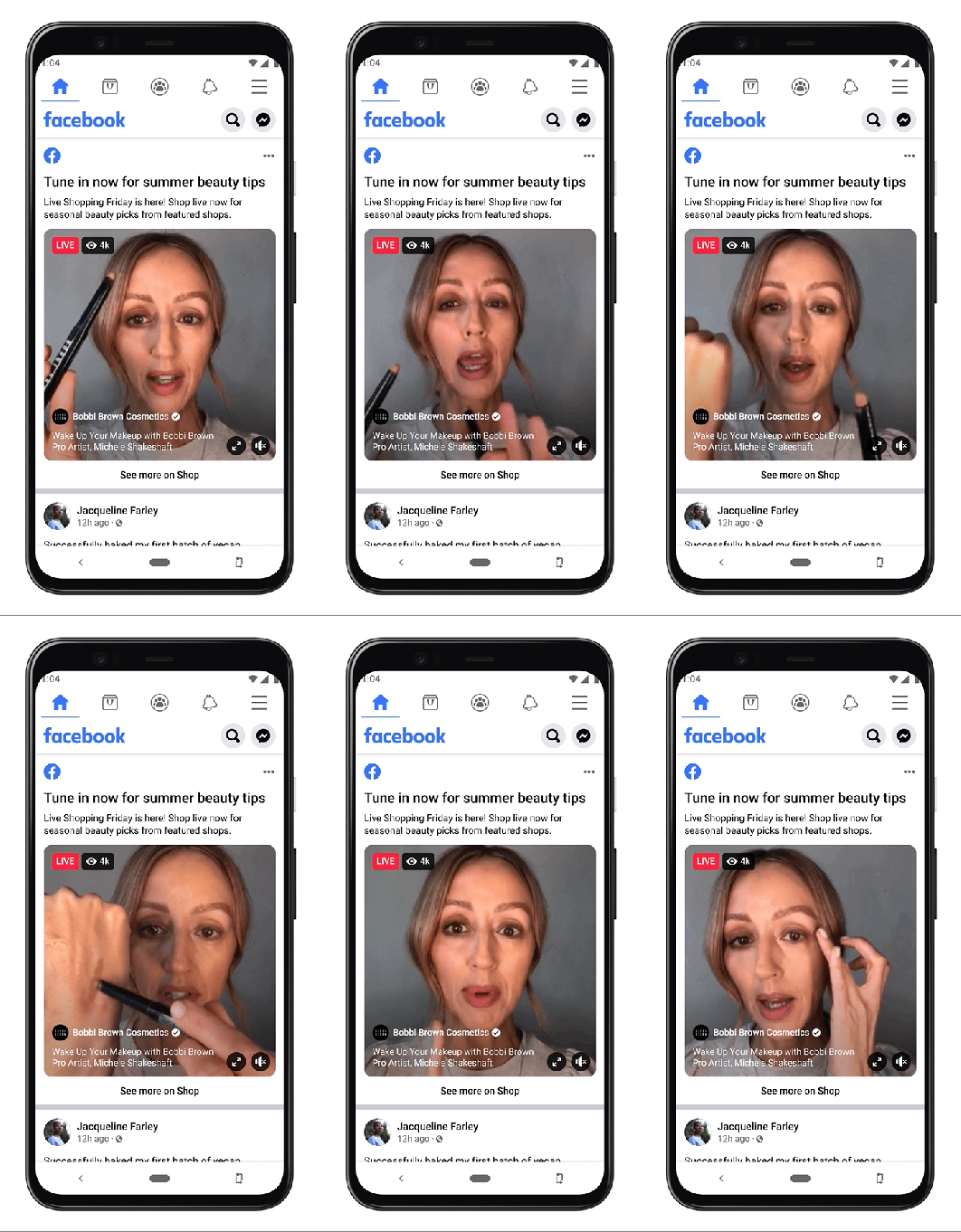
More recently, larger brands like Petco and Bobbi Brown have run live shopping events — the former as part of a charity effort, and the latter with a live stream featuring tips from makeup artist Michele Shakeshaft. (Pictured)

“The way that we’re thinking about this is that e-commerce has made buying incredibly convenient. So when you have a need, you pull out your phone, purchase, and your order is on its way,” explains Yulie Kwon Kim, who leads product for Facebook App Commerce.

“But buying is not shopping. And so, a lot of what people do is window shop to see what’s new, for entertainment. You discover something cool that you didn’t know about. When you’re shopping, people often want to hear from a live person, get suggestions, and see the product and context,” she says. “And increasingly, people are discovering and deciding what to buy through social media,” Yulie adds.

She also notes that almost three-quarters of consumers globally are getting shopping ideas through Facebook, Instagram, Messenger, and WhatsApp, and almost two-thirds agree that social media has now become as important as other information sources when making purchase decisions.


Facebook says the live events will be presented to consumers in a number of ways during the summer. If you follow a brand, you’ll be notified of their participation. You’ll also see News Feed announcements where you’ll be notified when events are starting (see above). And the Facebook Shop tab will offer a schedule of upcoming live shopping streams taking place across the platform.

Facebook, of course, is not the only one to realize the potential in live shopping.

Startups like NTWRK, Popshop Live, Talkshoplive, Dote, Bambuser, and others brought the live shopping model already popular in China to the U.S. and other markets, many months before the pandemic. TikTok has been testing live shopping, including with Walmart in the U.S., as well.

Amazon, meanwhile, live streams to its website, and YouTube announced earlier this year its beta tests of an integrated e-commerce experience.

As for Facebook, a live shopping platform could ultimately serve as a significant revenue stream, thanks to selling fees applied at checkout. While Facebook did waive those selling fees through June 2021 — a decision it claims was to help support small businesses during the Covid-19 pandemic — that move also conveniently helps Facebook stake its place in the live stream shopping market land grab now underway. Facebook also needs to diversify its revenue, given that Apple’s privacy push around third-party tracking will hurt Facebook’s ad business. 

Facebook’s Live Shopping Fridays series will roll out across both mobile and desktop in the U.S. this week, and will also pop on Facebook’s Shop Tab for easy access.