Year: 2021

18 May 2021

Amazon’s market power to be tested in Germany in push for “early action” over antitrust risks

Germany’s Federal Cartel Office (FCO) is seeking to make swift use of a new competition tool to target big tech — announcing today that it’s opened a proceeding against ecommerce giant Amazon.

If the FCO confirms that Amazon is of “paramount significance for competition across markets” — as defined by an amendment to the German Competition Act which came into force in January (aka, the GWB Digitalisation Act) — the authority will have greater powers to proactively impose conditions on how it can operate in order to control the risk of market abuse.

Section 19a of the GWB enables the FCO to intervene earlier, and the idea is more effectively, against the practices of large digital companies.

The provision gives the authority the power to prohibit digital giants from engaging in anti-competitive practices like self-preferencing; or using tying or bundling strategies intended to penetrate new markets “by way of non-performance based anti-competitive means”; or creating or raising barriers to market entry by processing data relevant for competition.

The FCO already has two other proceedings ongoing against Amazon — one looking at the extent to which Amazon is influencing the pricing of sellers on Amazon Marketplace by means of price control mechanisms and algorithms; and a second examining to agreements between Amazon and brand manufacturers to check whether exclusions placed on third-party sellers on Amazon Marketplace constitute a violation of competition rules — but a finding of “paramount significance” would enable the authority to “take early action against and prohibit possible anti-competitive practices by Amazon”, as it puts it.

Amazon has been contacted for comment on the FCO’s latest proceeding.

It’s the second such application by the Bundeskartellamt to determine whether it can apply the new law to a tech giant.

In January the authority sought to extend the scope of an existing abuse proceeding, opened against Facebook in December — related to Facebook tying Oculus use to Facebook accounts — saying it would look at whether the social media giant is subject to the GWB’s “paramount significance” rules, and whether, therefore, its linking of Oculus use to a Facebook account should be assessed on that basis.

Commenting on its latest move against Amazon in a statement, FCO president Andreas Mundt said: “In the past few years we have had to deal with Amazon on several occasions and also obtained far-reaching improvements for sellers on Amazon Marketplace. Two other proceedings are still ongoing. Parallel to these proceedings we are now also applying our extended competences in abuse control.”

“In this particular case we are first of all examining whether Amazon is of paramount significance for competition across markets. An ecosystem which extends across various markets and thus constitutes an almost unchallengeable position of economic power is particularly characteristic in this respect,” he added. “This could apply to Amazon with its online marketplaces and many other, above all digital offers. If we find that the company does have such a market position, we could take early action against and prohibit possible anti-competitive practices by Amazon.”

In January Mundt made stronger comments vis-a-vis Facebook — describing its social networking ecosystem as “particularly characteristic” of the bar set by the new digital law for proactive interventions, and adding that: “In view of Facebook’s strong market presence with the eponymous social network, WhatsApp and Instagram such a position may be deemed to exist.”

The FCO proceeding to confirm whether or not Facebook falls under the law remains ongoing. (It also has a pioneering case against Facebook’s ‘superprofiling’ of users that’s headed for Europe’s top court — which could result in an order to Facebook to stop combining EU users’ data without consent, if judges agreed with its approach linking privacy and competition.)

Zooming out, the Bundeskartellamt’s moves to acquire more proactive powers at the national level to tackle big tech foreshadow planned updates to pan-European Union competition law. And specifically the ex ante regime which is set to apply to so-called “digital gatekeepers” in future — under the Digital Markets Act (DMA).

The DMA will mean that Internet intermediaries with major market power must comply with behavioural ‘dos and don’ts’ set by Brussels, risking major penalties if they don’t play by the rules.

In recent years lawmakers across Europe have been looking at how to update competition powers so regulators can respond effectively to digital markets — which are prone to anti-competitive phenomena such as networking effects and tipping — while continuing to pursue antitrust investigations against big tech. (The Commission laid out a first set of charges against Amazon in November, for example, relating to its use of third party merchant data.)

The problem is the painstaking pace of competition investigations into digital business vs the blistering speed of these players (and the massive market power they’ve amassed) — hence the push to tool up with more proactive antitrust powers.

Earlier, EU lawmakers also toyed with the idea of a new competition tool for digital markets but quietly dropped the idea — going on propose their ex ante regime for gatekeeper platforms, under the DMA, at the end of last year. However the proposal is in the process of being debated by the other EU institutions under the bloc’s co-legislative approach — which means it’s still likely years away from being adopted and applied as pan-EU law.

That in turn means German’s FCO could have an outsized role in clipping big tech’s wings in the meanwhile.

In the UK, now outside the bloc — where it too may have an influential role in reforming regional competition rules to rebalance digital market power — the government is also working on a pro-competition regime aimed at big tech.

This year it set up a dedicated unit, the DMU, within the national Competition and Markets Authority which will be tasked with overseeing a regime that will apply to platforms which are identified as having “strategic market status” (akin to the German approach of “paramount significance for competition across markets”). And while the UK is taking a similar tack to the EU’s DMA, it has said the domestic regime will not sum to a single set of rules for all gatekeeper-style platforms — but rather there will be bespoke provisions per platform deemed to fall under the ex ante regulations.

 

18 May 2021

Gogoro strikes deal with Yadea and DCJ to build a battery-swapping network in China

Less than a month after announcing a partnership with India’s largest two-wheeled vehicle maker, Gogoro is taking another big step in its global expansion plans. This time the market is China, where Gogoro’s technology, including its swappable smart batteries, will be used in scooters made by Dachangjiang Group (DCJ), one of the country’s biggest motorcycle makers, and Yadea, one of it top electric two-wheel companies. DCJ and Yadea will jointly invest $50 million in an operating company to develop new two-wheel vehicles with their own branding that use the Gogoro Network, including its batteries, drivetrains, controllers and other components.

“Think of it as DCJ and Yadea combining to create an AT&T,” Gogoro co-founder and chief executive officer Horace Luke told TechCrunch. “Gogoro will be the technology that powers them, so think about it like we’re the Ericsson.”

Last month, Gogoro and Hero MotoCorp announced a strategic partnership to build a battery-swapping network and electric two-wheeled vehicles in India. Gogoro’s new deals in India and China are the biggest steps it has taken for its global strategy since launching the first Gogoro Smartscooter in 2015.

Gogoro’s swappable batteries, its signature technology, means riders can replace their batteries for new ones at charging stations that are small enough to fit on a sidewalk. In Taipei City, where Gogoro is based, its swapping stations are a common sight, usually tucked against storefronts or by the side of gas stations and parking lots. Since Gogoro’s batteries are swappable, electric vehicles that use them don’t need to be parked to be charged. This addresses “range anxiety,” or consumer concerns about how far an electric vehicle can go before it needs to be charged again. The main challenge is making sure there are enough swapping stations to be convenient for riders of two-wheeled vehicles powered by the Gogoro Network.

DCJ and Yadea’s joint venture will launch first in Hangzhou, its pilot city, before expanding into other cities in 2022. Vehicle availability and pricing will be announced later.

Last year, China’s government introduced new regulations that require all new cars sold by 2035 to use “new energy” instead of fossil fuel. Combined, DCJ and Yadea have 47,000 retailers, covering 358 cities, or more than half the cities in China. Luke said this means once the joint venture expands beyond Hangzhou, it will be able to grow quickly.

Gogoro positions itself as a turnkey solution for other electric mobility companies, and its own brand was a way to develop its charging infrastructure and reputation. In Taiwan, where Gogoro-powered two-wheeled vehicles now account for nearly a quarter of monthly sales, its swappable batteries were first used in Gogoro Smartscooters before the technology was licensed to other makers like Kymco, Yamaha and Aeon.

“It was almost like a roundabout way to prove that the platform is feasible,” said Luke. “We had to build our own vehicles, our own retail chain and now we support 400,000 customers and 2,000 stations. That proof case enabled us to work with these larger partners, so when they asked us to pull up data, we could show them the unit economics, durability, stations and how it works. It took many years, but we were getting ready in the biggest way possible.”


DCJ ships about two million motorcycles a year and the joint venture marks the first time it will build an electric motorcycle. “They’ve been looking for technology to transition to electric, and we’ve been talking to them for almost two years to prove that our platform is the right platform for them to start the transition to electric vehicles,” said Luke.

Yadea sold more than 10 million electric two-wheelers in 2020, but wanted an alternative to lithium-ion batteries, he added. Along with Aima, Yadea is one of the best-known affordable electric two-wheeler brands in China, while Niu dominates the premium market.

Gogoro has raised about $480 million in funding since it was founded in 2011, with investors including HTC, Temasek Holdings and Generation Investment Management (GIM), the green-tech investment firm co-founded by former United States vice president Al Gore.

In a press statement, Gore, who is GIM’s chairman, said, “Gogoro’s partnership with Yadea and DCJ in China, which builds upon their existing work with Hero MotoCorp in India, sends a clear signal that the world’s two-wheel leaders are helping to fuel the sustainability revolution in Asia with smart battery swapping.”

18 May 2021

Uptrust raises $2M to fight the billions of dollars wasted on useless mass incarceration

A technical violation is one of those Orwellian terms used by the U.S. government to occlude the absurd morass of process and procedure that is the modern criminal justice system in this country. After an offender has served their sentence, they are often placed under probation, which is accompanied by scores of rules on everything from where the person can go to who they can see. If a person commits a technical violation, they often are sent back to prison — perhaps months or years for an action as simple as being minutes late to a parole hearing.

Technical violations are expensive for all of us. Earlier this year, New York’s capital newspaper the Times Union reported that “New York imprisons more people for technical parole violations than any other state, and at a rate almost three times higher than the national average” and “The re-incarceration of those individuals cost taxpayers at least $683 million…” based on a report by Columbia University and The Independent Commission on New York City Criminal Justice and Incarceration Reform.

It’s Orwellian, and also Kafkaesque. And it’s a disastrous waste of public resources. Yet, it’s also a problem that lends itself to potential solutions, and that’s where Uptrust wants to make a difference.

Uptrust is a service that connects people returning to society with their public defenders and court records, ensuring that they have the calendars, appointments, rules, and procedures they need to avoid technical violations — improving their re-entry into normal life while saving significant expenses for taxpayers.

The company announced today that it has raised $2 million in seed funding from a trio of lead investors: the Decarceration Fund, Luminate, and Stand Together Ventures Lab. That’s on top of a $1.3 million round we reported on last year.

The company, which came together in 2015 and launched its first product in 2016, was co-founded by Jacob Sills and Elijah Gwynn as they explored how to improve the criminal justice system. They looked at areas like bail bonds, but kept coming back to a fundamental issue: many people were stuck in the system because of missed appointments or other technical violations. “There are way too many people not exiting the system … and they are circling back through,” Sills said.

Uptrust works through text messaging or its own app. Often, it’s linked with a public defender, since a defense attorney is more likely to get through to their clients than other members of the criminal justice system.

Uptrust’s app allows for quick check-ins with probation officers and also monitors key calendar appointments. Image Credits: Uptrust

The company has been on a growth spree after years of trialing various iterations of its product, and it’s now located in 150 sites in 28 states, up from 30 sites just 18 months ago according to Sills. The state of Virginia, which currently uses the service in two sites, will expand it statewide by the end of this year or early next year.

Currently, the company charges a fee to governments to use the service, with the goal of limiting any financial costs to its end users who often lack the funds to pay. Longer term, however, the company sees a large opportunity in connecting its growing population of users to new services as they re-enter society. “More than half of them have challenges accessing health care,” Sills said, and he sees opportunities in areas as diverse as health care, finance and banking, and housing where the app could play a role in the future.

Yet, he acknowledged that this is still a “new market” that isn’t attractive to many traditional venture capital firms. So with this fundraise, Sills and his team decided to target funds that were deeply steeped in criminal justice issues who would understand both the problem being solved and how Uptrust could both succeed in its mission and also succeed as a business.

They also wanted what Sills described as “good diversity of thought.” Decarceration Fund invests in precisely what it says it does, and Luminate, which is part of the progressive-leaning Omidyar Network, is a philanthropy focused on civic engagement. Meanwhile, Stand Together Ventures Lab is funded by Stand Together which was founded by Charles Koch, who in addition to widely funding Republican and conservative causes, has in recent years also increasingly pursued criminal justice reform to minimize the government’s power over private citizens.

Chris Bentley, managing principal at Decarceration Fund, picked Uptrust as the firm’s first investment because he believed that the company understood precisely what this unique population needed. There’s a “very significant history of well-intended companies in this space causing unintended consequences,” he said. The fund is focused on investing in companies with clear guardrails and business models that are aligned with positive outcomes. “Half of our investment committee are founders themselves but are also returning citizens with real, lived experience with the system,” he said.

Uptrust has now grown to 15 people, centered in San Francisco and also scattered up and down the Eastern Seaboard. The “track record of for-profit companies is pretty bad, since most of them just build what the criminal legal system wants,” Sills said. “We are trying to prove that you can make money and do good and have real impact.”

18 May 2021

Pandemic helps Ordr’s simple POS platform for bars and restaurants raise $12M

“Order and pay” platform for bars and restaurants Ordr has raised a €10m ($12M) Series A round from Idekapital and OpenOcean.

Launched in Norway in 2020 it now counts IKEA, Nordic Choice, REKOM and Color Line as customers. The company is now launching in Sweden, Finland, Denmark and the United Kingdom. Ordr’s competitors include FlipDish, Onvi.com and WeOrder.

Ordr has a platform for digital menus, order-placement, and payment which, it claims, increases sales and reduces and queues at bars and restaurants.

Its branded phone solution consists of a ‘virtual POS’, replacing existing POS for restaurants and hotels to take orders and payment. The waiter can also use it. The company says customers don’t have to download a new app, while hotels and pubs can do deals with local restaurants and offer their menus on site.

founder and CEO Edwin Fjeldtvedt said: “Contrary to cash register systems that charge far too much and locks customers in, we’ve created the next generation cash register system that eliminates the need for old-fashioned POS systems and makes them virtual. At the same time, we’ve created an entirely new customer journey with the guest in the center based on the experience they are seeking.” He added that the app “took off” when the pandemic demanded new infection-control measures in the hotel, restaurant and catering industry.

Kristian Øvsthus Managing Partner at Idekapital said: “We have really been impressed by the vision, solution, management and the people they recruit as well as implementation ability.”

Patrik Backman, General Partner, OpenOcean sai: “Ordr has proven that their platform works very well, is a scalable solution that is applicable across a multitude of markets, and the company is now in a great place for an international venture. The catering industry desperately needs a new technology to stay competitive in the future and this is it.”

18 May 2021

Pandemic helps Ordr’s simple POS platform for bars and restaurants raise $12M

“Order and pay” platform for bars and restaurants Ordr has raised a €10m ($12M) Series A round from Idekapital and OpenOcean.

Launched in Norway in 2020 it now counts IKEA, Nordic Choice, REKOM and Color Line as customers. The company is now launching in Sweden, Finland, Denmark and the United Kingdom. Ordr’s competitors include FlipDish, Onvi.com and WeOrder.

Ordr has a platform for digital menus, order-placement, and payment which, it claims, increases sales and reduces and queues at bars and restaurants.

Its branded phone solution consists of a ‘virtual POS’, replacing existing POS for restaurants and hotels to take orders and payment. The waiter can also use it. The company says customers don’t have to download a new app, while hotels and pubs can do deals with local restaurants and offer their menus on site.

founder and CEO Edwin Fjeldtvedt said: “Contrary to cash register systems that charge far too much and locks customers in, we’ve created the next generation cash register system that eliminates the need for old-fashioned POS systems and makes them virtual. At the same time, we’ve created an entirely new customer journey with the guest in the center based on the experience they are seeking.” He added that the app “took off” when the pandemic demanded new infection-control measures in the hotel, restaurant and catering industry.

Kristian Øvsthus Managing Partner at Idekapital said: “We have really been impressed by the vision, solution, management and the people they recruit as well as implementation ability.”

Patrik Backman, General Partner, OpenOcean sai: “Ordr has proven that their platform works very well, is a scalable solution that is applicable across a multitude of markets, and the company is now in a great place for an international venture. The catering industry desperately needs a new technology to stay competitive in the future and this is it.”

18 May 2021

Shein overtakes Amazon as the most installed shopping app in US

Shein‘s quiet rise has reached a crescendo as the fast fashion e-commerce app takes the crown from Amazon as the most downloaded shopping app on iOS and Android in the United States, according to data from app tracking firms App Annie and Sensor Tower.

Its ascent is quiet because the startup, despite reportedly exceeding a $15 billion valuation, maintains an unusually low profile and doesn’t try to make itself known to the media. The app, dubbed the “TikTok for e-commerce” by China-focused internet analyst Matthew Brennan in this thorough piece on the startup, manufactures in China as many apparel retailers do.

The difference is Shein controls its own production chain, from design and prototype to procurement to manufacturing. Each step is highly digitized and integrated with another, which allows the company to churn out hundreds of new products tailored to different regions and user tastes at a daily rate. The strategy is not unlike TikTok matching content creators with users by using algorithms to understand their habits in real-time.

On May 11, Shein became the most installed shopping app on Android in the U.S., and six days later took the top spot on iOS as well.

The origin of Shein, which was previously named “She Inside,” is little understood. On its official website, it describes itself as an “international B2C fast fashion e-commerce platform” founded in 2008. There is no mention of its founder and CEO Chris Xu. In a 2018 corporate blog posted on WeChat, it wrote that it was headquartered in Nanjing, an eastern Chinese city home known for its historical heritages and home to Chinese appliance giant Suning. It also opened offices in other major Chinese cities as well as the U.S., Belgium and the United Arab Emirates.

Shein’s low profile is perhaps expected in times of geopolitical tensions and heightened regulatory scrutiny over China-related tech companies around the world. Shein owns its sales channel and user data, which distinguishes it from the swathe of generic consumer brands relying on Amazon for customer acquisition without meaningful access to user data.

As of May 17, Shein was the top iOS shopping app in 54 countries and ranked top in the category on Android devices across 13 countries.

Shein has not announced who its investors are, but Chinese media reports have listed Capital Nuts, JAFCO Asia, Greenwoods Asset Management, IDG Capital, Sequoia Capital China, Tiger Global, and Xiaomi founder’s Shunwei Capital among its backers.

We’ve reached out to Shein for comments on the story. Sequoia Capital China confirmed it’s an investor in Shein.

18 May 2021

Creandum boosts team with new partner Sabina Wizander, and new principal Gemma Bloemen

Creandum, a European early-stage VC, is bringing on board two new key team members: Ex-Kry CSO Sabina Wizander joins as Partner and Gemma Bloemen as Principal. Both will joins this summer. Creandum has previously backed the likes of Spotify, Klarna, Depop, Kahoot!, Trade Republic, among others. 

Former engineer Wizander was previously at the firn in 2015and worked on Kry’s seed round before joining the digital health startup in 2017. As Partner, she’ll be based in Stockholm.

“I am very excited to rejoin the Creandum team”, says Sabina Wizander. “Creandum has developed very impressively the last few years and I know I’m coming back to an even stronger team, brand and portfolio. I’m also coming in with different goggles than last time, both having been on the other side of the investor table for Kry’s series A to D, and being part of scaling a company +100X in  revenue and team. Given my background from Kry, health tech will be an area of focus for me, and anything climate related is very close to my heart.”

Former McKinsey consultant and Uber executive Bloemen joins at Principal from the post of COO Elder, the UK-based home care specialist, and worked on their Series B fundraising process in 2019.

Bloemen said: “I am thrilled to have the opportunity to work with many different, talented entrepreneurs across a wide range of industries. As a VC-backed startup executive and angel investor I know how important it is to have the right partner along the journey, especially in the early years, and the Creandum team has an impeccable track record and reputation of adding true value as an investor. I am keen to help founders with the operational expertise I gained from my time at Uber and Elder and I’m looking forward to supporting Creandum’s efforts in further establishing their activity in the UK ecosystem and expanding their already very impressive portfolio.”

Staffan Helgesson, General Partner and founder of Creandum added: “Both Sabina and Gemma have an outstanding track record of deep operational expertise and an impact-driven mindset, which will provide additional value to our advisory team, offering the best support to the early-stage company founders we work with. With these two new hires in two different geographies, Creandum has reached another important milestone on its path to become the premier venture capital firm serving entrepreneurs across Europe, helping them scale into global winners.”

18 May 2021

Egyptian furniture marketplace Homzmart lands $15M Series A for MENA expansion

In most parts of Africa and the Middle East, a consumer journey and experience in buying furniture is not fun. A typical shopping process would entail looking out for the best price and quality and asking for recommendations and checking offline stores, one after another.

It is rare to find one-stop shops, especially large offline ones, that can adequately cater to the needs of consumers in the MENA region. Home goods and furniture marketplaces have launched in the last three years around the region to meet this need. Egypt’s Homzmart is one such, and today the company is announcing it has closed its $15 million Series A investment.

The company was founded in 2019 by Mahmoud Ibrahim and Ibrahim Mohamed, but it didn’t launch until the first quarter of 2020. This round of financing follows a $1.3 million seed investment raised in February last year. According to the company, this brings the total amount raised to $17.2 million. 

China’s MSA Capital, one of the investors in Homzmart’s seed round, co-led this Series A investment alongside Nuwa Capital. Other participating investors include EQ2 Ventures, Impact46, Outliers Capital, Nuwa Capital and Rise Capital.

The furniture industry in Egypt has been historically characterized by poor accessibility for consumers. Homzmart’s marketplace collects designs, price ranges and other details of its retailers’ products and solves high distribution costs for them by providing access to consumers who have flexible financing options. In addition, Homzmart said it incorporates AI to optimize content for retailers and intelligent tools to help customers with their purchasing decisions.

“As a marketplace, we stand between the supply and demand. So we connect furniture and home goods suppliers with consumers,” CEO Mahmoud Ibrahim told TechCrunch in an interview. “It’s almost like a big hassle to buy furniture in Africa and the Middle East. And I think it’s a pain all over the world when it comes to having a place that you can shop all your needs when it comes to home products.”

Over the last 12 months, Homzmart claims to have grown 30x in sales. It also showcases more than 55,000 products from thousands of brands and merchants. The online marketplace is tapping into the rapidly expanding $8 billion industry where 14 million customers in the region search online for furniture monthly.

Homzmart

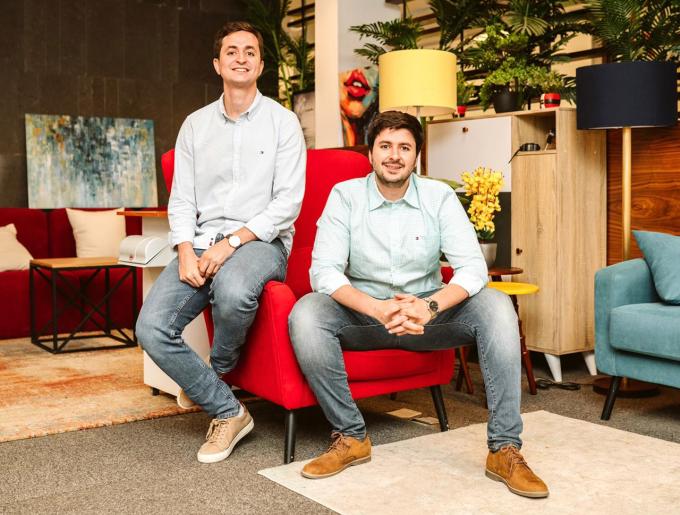
Ibrahim Mohamed (COO) and Mahmoud Ibrahim (CEO)

When Homzmark kicked off its hard launch and raised its seed round, it was right at the start of the pandemic. Ibrahim said the company was uncertain that it would survive due to anticipated behavioral changes in consumer spending. But the opposite happened. Customers in Egypt grew to like the product, resulting in more sales like most marketplaces and e-commerce platforms witnessed this past year.

“At the beginning, we were very worried and not sure how customers would react to buying furniture during the pandemic in the Middle East online. So we’re actually amazed by the traction as it seemed like the region was waiting for something like this to happen.”

The growth experienced within the pandemic was one reason MSA Capital decided to double down on the startup. As stated by Ben Harburg, the firm’s general partner, “The pandemic exposed the extreme vulnerabilities and inefficiencies of the Middle East’s archaic offline retail ecosystem, logistics and supply chain. Into the void stepped Homzmart as the next-generation, digitally enabled online marketplace and optimized logistics provider for large-item retail addressing both consumer and enterprise customers.

Another reason behind the investment, the firm said, is the vast experience of both founders in e-commerce and fulfillment. Ibrahim was the VP of Operations for Jumia Egypt before becoming the Group COO of Daraz, a Southeast Asian company acquired by Alibaba in 2018. Mohamed is also a Jumia alumnus and was part of the logistics development and expansion team in Egypt

Although their experience with different verticals in everyday commerce in Jumia and Daraz was invaluable, the founders chose to launch in the niche furniture market instead of building a similar model as their former employers. “We decided this was a really good vertical that we needed to focus on and hold ourselves accountable to digitizing in the region,” Ibrahim said about developing the niche product.

Homzmart’s first year in business was all about understanding supply and demand. The next couple of years is a strategy to expand across the MENA region, helping fulfill demand from a young and fast-growing consumer middle class.

“Whatever we did in Egypt, we need to do across the region. Homzmart isn’t looking to be just an Egyptian platform, rather a regional platform,” the CEO said.

The company has strategically launched operations close to Damietta City, Egypt, to focus on this regional market opportunity. The city is known to be one of the largest furniture manufacturing hubs in the Middle East and thus allows Homzmart to streamline the region’s vertical industry supply chain. An integral part of this supply chain is handling logistics and the movement of products from merchants to buyers. The company said a sizeable tranche of investments would be used for this effort.

What’s next for the company when logistics is handled?

“I’ll say the thing that keeps me awake at night is the fact that our business is growing very fast. And we need to make sure that we’re building the right institutional infrastructure for that business, to make sure that after two or three years, we’re building like a very solid, multi-billion dollar business,” Ibrahim remarked.

18 May 2021

Watch Google I/O keynote live right here

After skipping a year, Google is holding a keynote for its developer conference Google I/O. While it’s going to be an all-virtual event, there should be plenty of announcements, new products and new features for Google’s ecosystem.

The conference starts at 10 AM Pacific Time (1 PM on the East Cost, 6 PM in London, 7 PM in Paris) and you can watch the live stream right here on this page.

Rumor has it that Google should give us a comprehensive preview of Android 12, the next major release of Google’s operating system. There could also be some news when it comes to Google Assistant, Home/Nest devices, Wear OS and more.

18 May 2021

Pinterest introduces Idea Pins, a video-first feature aimed at creators

Pinterest is expanding further into the creator community with today’s launch of a video-first feature called “Idea Pins,” aimed at creators who want to tell their stories using video, music, creative editing tools and more. The feature feels a lot like Pinterest’s own take on TikTok, mixed with Stories, as the new Pins allow creators to record and edit creative videos with up to 20 pages of content, using tools like voiceover recording, background music, transitions and other interactive elements.

The company says Idea Pins evolved out of its tests with Story Pins, launched into beta in September 2020, after various stages of development beginning the year prior. At the time, Pinterest explained that Story Pins were different from the Stories you’d find on other social networks, like Snapchat or Instagram, because they focused on what people were doing — like trying new ideas or new products, not giving you snapshots of a creator’s personal life.

Another notable differentiator was that Story Pins weren’t ephemeral. That is, they didn’t disappear after a certain amount of time, but rather could be surfaced through search and other discovery mechanisms.

Over the past eight months since their debut, Pinterest has worked with Story Pin creators on the experience. That’s led to the new concept of the Idea Pin — essentially a rebranded Story Pin, which now offers a broader suite of editing tools than what was previously available.

Video is a key element in Idea Pins, as the Pins target the increased consumer demand for short-form video content of a creative nature — like what’s being delivered through TikTok, Instagram Reels, YouTube Shorts and elsewhere. The videos in the Pins can be up to 60 seconds on iOS, Android and web for each page, with up to 20 total pages per Pin.

Image Credits: Pinterest

Creators can edit their videos by adding their own voiceover or using a “ghost mode” transition tool to better showcase their before-and-afters by overlaying one part of a video on another. And they can save drafts of their work in progress.

But Idea Pins still include a number of features common to Stories, like adding stickers or tagging other creators with an @username, for instance. Pinterest says it will start with over 100 stickers featuring hand-drawn illustrations focused on top categories and behaviors it expects to see, like food-themed illustrations, stickers for before-and-afters, seasonal moments, and more.

Pinterest is also working with the royalty-free music database Epidemic Sound to offer a catalog of free tracks for use in Idea Pins.

And because many creators will use Idea Pins to inspire people to try a recipe or project of some sort, they can include “detail pages” where viewers can find the ingredient list or instructions, which is handy.

Image Credits: Pinterest

Pins are shared to Pinterest, where the company says they help the creator build an audience by being distributed in several places across its platform, including in some markets, by locating Pins for creators you follow right at the top of the home page.

Creators can also apply topic tags when publishing to ensure they’re surfaced when people are seeking that sort of content. Each Idea Pin can have up to 10 topic tags, which help to distribute the content in a targeted way to users via the home feed and search, the company says.

While Pins can help creators build an audience on Pinterest, they can use Idea Pins to grow their audience on other platforms, too. The company says it will offer export options that let people share their Pins across the web and social media. To do so, they download their Pin as a video which includes a Pinterest watermark and profile name — a trick learned from TikTok. This can then be reshared elsewhere.

Image Credits: Pinterest

Pinterest users, meanwhile, can save Idea Pins like any other Pin on the platform.

“We believe the best inspiration comes from people who are fueled by their passions and want to bring positivity and creativity into the world,” said Pinterest co-founder and Chief Design and Creative Officer Evan Sharp, in a statement about the launch. “On Pinterest, anyone can inspire. From creators to hobbyists to publishers, Pinterest is a place where anyone can publish great ideas and discover inspiring content. We have creators with extraordinary ideas on Pinterest, and with Idea Pins, creators are empowered to share their passions and inspire their audiences,” he added.

The new Idea Pin format is rolling out today to all creators (users with a business account) in the U.S., U.K., Australia, Canada, France, Germany, Austria and Switzerland.

Image Credits: Pinterest

Pinterest says, during tests, it found that Idea Pins were more engaging than standard Pins, with 9x the average comment rate. The number of Idea Pins (previously known as Story Pins) has also grown by 4x since January, as more creators adopted the format.

To help creators track how well Pins are performing, Pinterest is expanding its Analytics feature to include a new Followers and Profile Visits-driven metric to show creators how their Idea Pins have driven deeper engagement with their account.

The company says the next step is to make Idea Pins more shoppable, which it’s doing now with tests of product tagging underway.

Pinterest has been increasing its investment in the creator community in recent months, with the launch of its first-ever Creator Fund last month, and this month’s test of livestreamed events with 21 creators. It’s also now testing creator and brand collaborations with a select number of creators, including Domonique PantonPeter Som and GrossyPelosi, it says.

Image Credits: Pinterest

While Idea Pins seem like a natural pivot from Pinterest’s founding as an inspiration and idea board, it will face serious competition when it comes to wooing the professional creator community to its platform. Other big tech companies are outspending Pinterest, whose new Creator Fund of $500K falls short of the $1 million per day Snap paid creators or the $100 million fund for YouTube Shorts creators, TikTok’s $200 million fund or the deals Instagram has been making to lure Reels creators. These platforms, as well as a host of startups, are also giving creators a way to directly monetize their efforts through features like tips, donations, subscriptions and more.

What Pinterest may have in its favor, though, is its reach. The company claims 475 million users, which makes it a destination some creators may not want to overlook in their bid for growth, and later, e-commerce.